Abrasive Flow Machining
Process Principle, Parameters and
Capabilities
Process Principle
• AFM is a finishing process that removes a
small quantity of material.
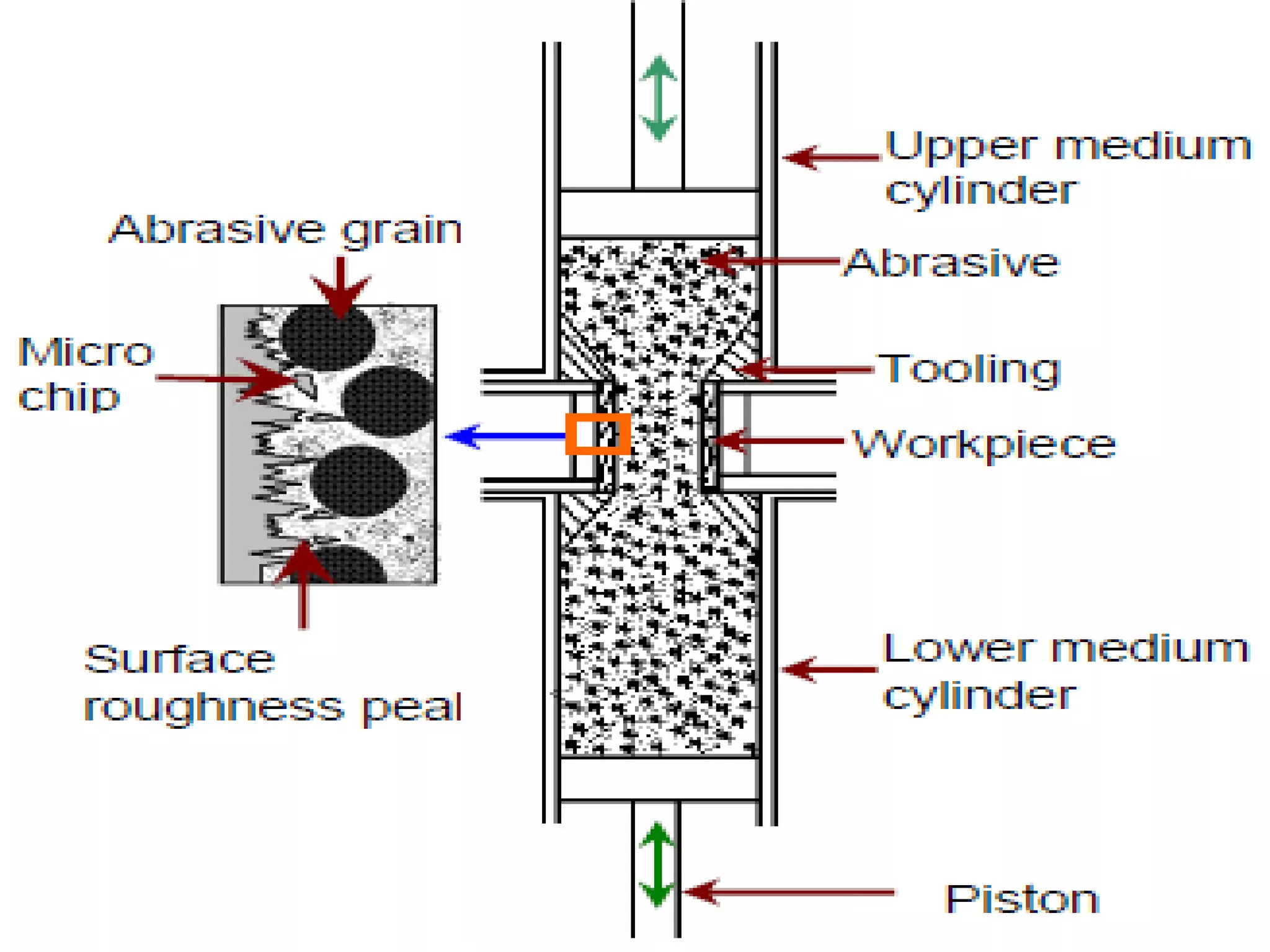
• It uses semi-solid, abrasive laden putty
through or across a work piece.
• It extruded across edges or surfaces to deburr,
radius, polish, remove recast, perform mirror
surface machining.
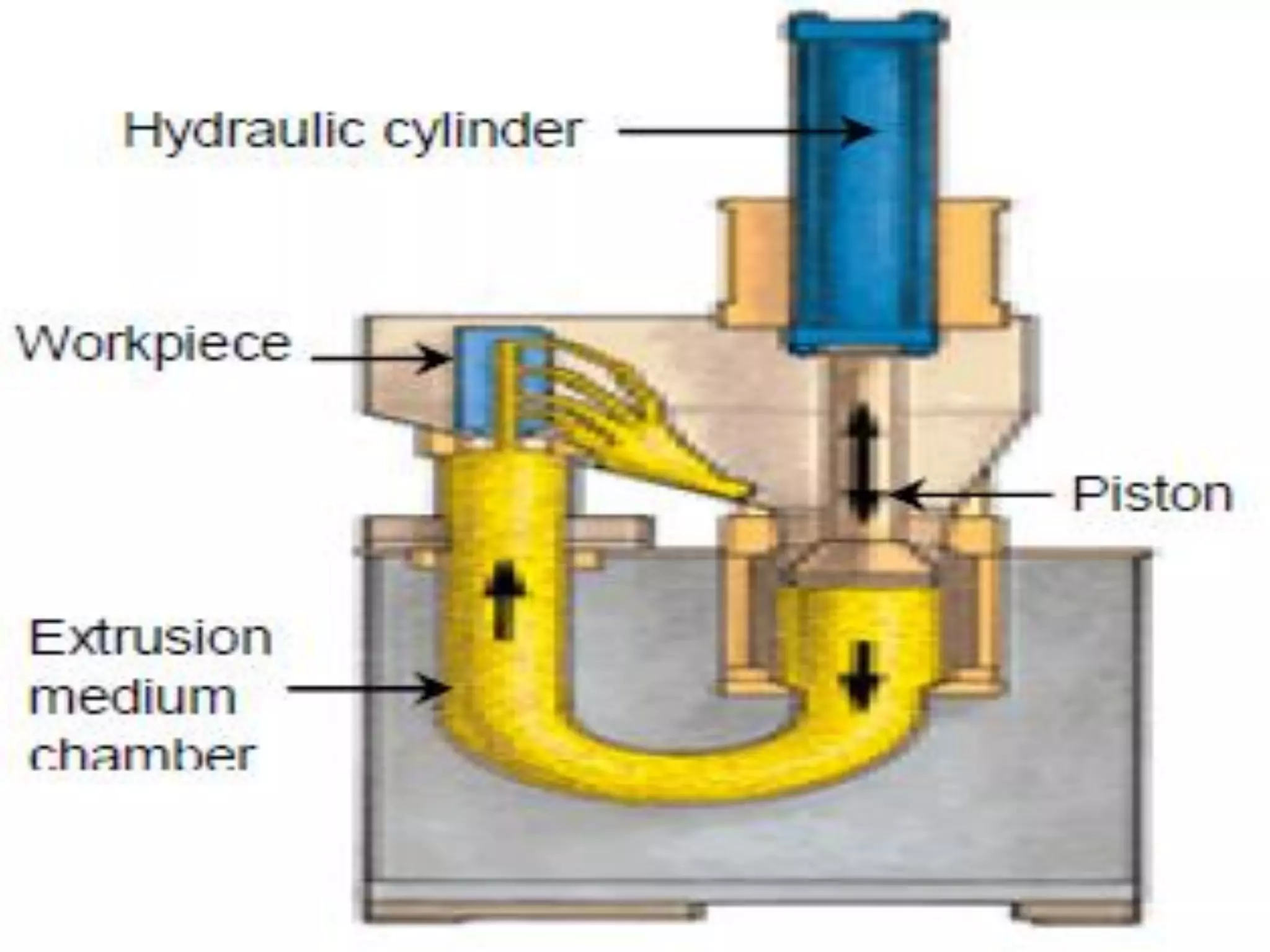
• A hydraulic ram forces the abrasive medium
through the work piece.
• As abrasive medium flows through the part,
its velocity will change with the different cross
– sectional areas.
• Due to its low MRR, it is not suited for mass
material removal.
• It is used for finishing in metals, ceramics, and
many plastics in uniform and economical
manner.
Classification of AFM
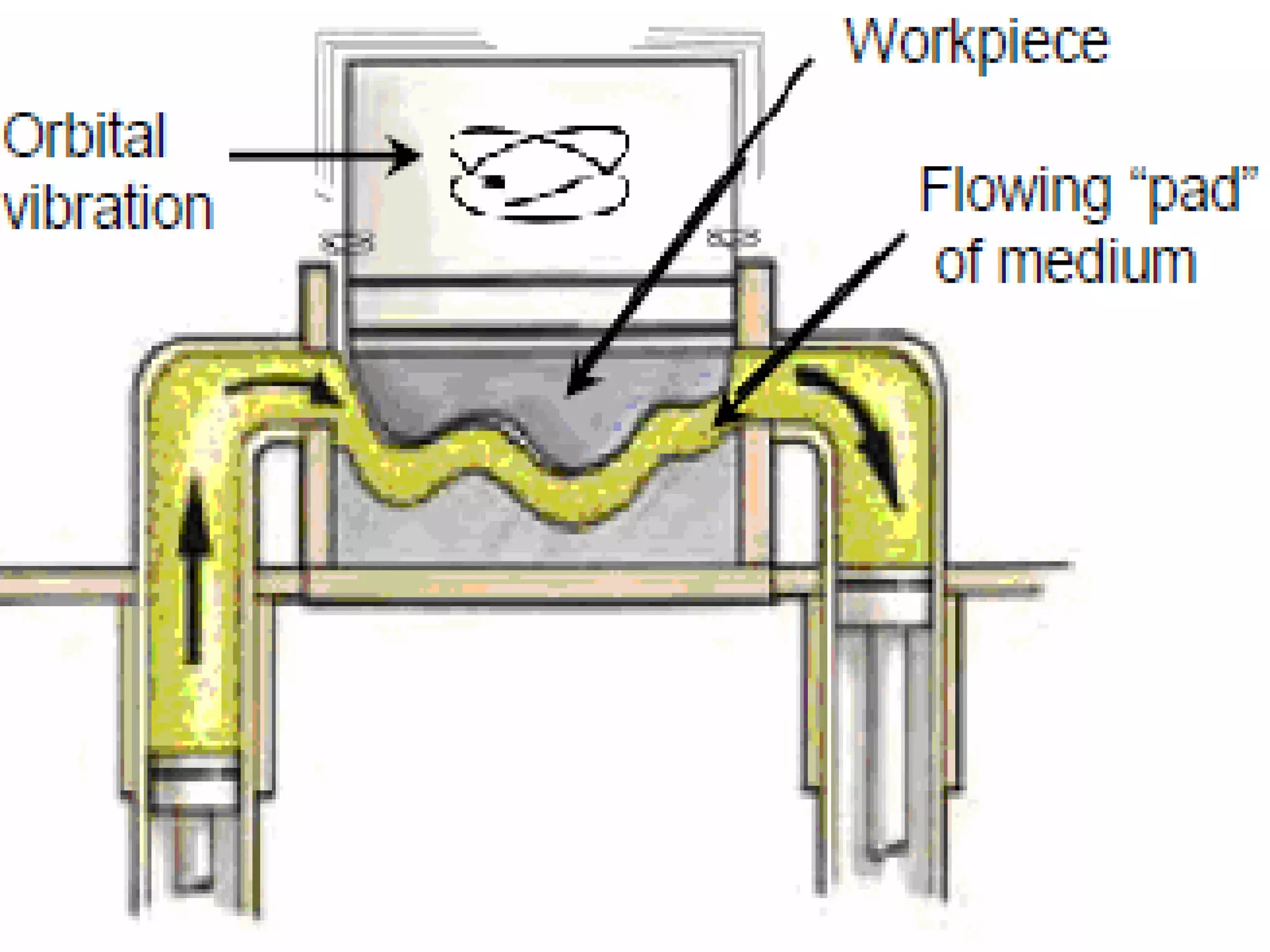
• AFM is classified into three categories viz.
– One way AFM
– Two way AFM
– Orbital AFM
Equipments
• Machine
– It is constructed with two opposing medium
chambers that are hydraulically or manually
clamped together.
– The pressure for extruding medium ranges from
0.69 to 22 MPa (100 to 3200 psi)
– Lower pressure preferred for fragile parts or loose
fixtures.
– Little heat is generated due to friction hence
medium coolants are recommended.
• Tooling
– Uses only to hold the part or parts in position.
– To contain and direct the flow of abrasives.
– Any number of parallel restrictions can be
processed with uniform results.
– Replaceable inserts made of nylon, Teflon or
hardened steel are used. Can last for up to
thousands of parts.

• Media
– AFM media is pliable material that is resilient
enough to act as a self forming grinding stone
when forced through restrictions.
• Media contains base and typically two or
three abrasive grit sizes.
• Base contains an organic polymer, specially
hydrocarbon gels; it determines the degree of
stiffness.
• Four types of abrasive are commonly used viz.
Aluminum oxide, silicon carbide, boron carbide and
diamond.

• Abrasives are available in grit sizes ranging
from 8 to 700 meshes.
Process Parameters
• Flow Rate – 11.3 to 378 L/min. (3 – 100 GPM)
• Cycles – 3 to several hundred
• Pressure – 0.69 – 22 MPa (100 – 3200 psi)
Process Capabilities
• AFM is able to increase surface smoothness
up to 10 times.
• The limit for best surface finish is 0.05
microns.
• Large surface irregularities like deep scratches
or large bumps cant be removed.
• Out of roundness and taper cant be corrected.
• Holes must be of dia. at least 0.2 mm for
effective processing.
Process Summary
• Advantages
– Debur, polish, and radius in one operation
– More repeatable than manual method
– Finish inaccessible area
– Batch production
– Faster than manual

• Disadvantages
– Fixtures can be expensive
– High capital investment
– Cant process blind holes.

Abrasive flow machining (afm)

  • 1.
    Abrasive Flow Machining ProcessPrinciple, Parameters and Capabilities
  • 2.
    Process Principle • AFMis a finishing process that removes a small quantity of material. • It uses semi-solid, abrasive laden putty through or across a work piece. • It extruded across edges or surfaces to deburr, radius, polish, remove recast, perform mirror surface machining.
  • 3.
    • A hydraulicram forces the abrasive medium through the work piece. • As abrasive medium flows through the part, its velocity will change with the different cross – sectional areas. • Due to its low MRR, it is not suited for mass material removal. • It is used for finishing in metals, ceramics, and many plastics in uniform and economical manner.
  • 4.
    Classification of AFM •AFM is classified into three categories viz. – One way AFM – Two way AFM – Orbital AFM
  • 8.
    Equipments • Machine – Itis constructed with two opposing medium chambers that are hydraulically or manually clamped together. – The pressure for extruding medium ranges from 0.69 to 22 MPa (100 to 3200 psi) – Lower pressure preferred for fragile parts or loose fixtures. – Little heat is generated due to friction hence medium coolants are recommended.
  • 9.
    • Tooling – Usesonly to hold the part or parts in position. – To contain and direct the flow of abrasives. – Any number of parallel restrictions can be processed with uniform results. – Replaceable inserts made of nylon, Teflon or hardened steel are used. Can last for up to thousands of parts. • Media – AFM media is pliable material that is resilient enough to act as a self forming grinding stone when forced through restrictions.
  • 10.
    • Media containsbase and typically two or three abrasive grit sizes. • Base contains an organic polymer, specially hydrocarbon gels; it determines the degree of stiffness. • Four types of abrasive are commonly used viz. Aluminum oxide, silicon carbide, boron carbide and diamond. • Abrasives are available in grit sizes ranging from 8 to 700 meshes.
  • 11.
    Process Parameters • FlowRate – 11.3 to 378 L/min. (3 – 100 GPM) • Cycles – 3 to several hundred • Pressure – 0.69 – 22 MPa (100 – 3200 psi)
  • 12.
    Process Capabilities • AFMis able to increase surface smoothness up to 10 times. • The limit for best surface finish is 0.05 microns. • Large surface irregularities like deep scratches or large bumps cant be removed. • Out of roundness and taper cant be corrected. • Holes must be of dia. at least 0.2 mm for effective processing.
  • 13.
    Process Summary • Advantages –Debur, polish, and radius in one operation – More repeatable than manual method – Finish inaccessible area – Batch production – Faster than manual • Disadvantages – Fixtures can be expensive – High capital investment – Cant process blind holes.