Limit, Tolerance & Fits
By S K Mondal
Terminology
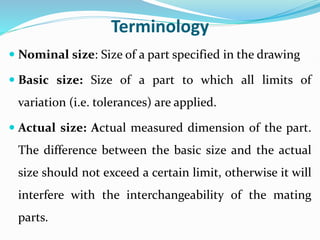
 Nominal size: Size of a part specified in the drawing
 Basic size: Size of a part to which all limits of
variation (i.e. tolerances) are applied.
 Actual size: Actual measured dimension of the part.
The difference between the basic size and the actual
size should not exceed a certain limit, otherwise it will
interfere with the interchangeability of the mating
parts.
Terminology Contd....
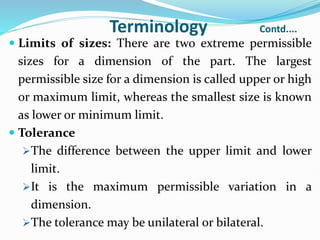
 Limits of sizes: There are two extreme permissible
sizes for a dimension of the part. The largest
permissible size for a dimension is called upper or high
or maximum limit, whereas the smallest size is known
as lower or minimum limit.
 Tolerance
The difference between the upper limit and lower
limit.
It is the maximum permissible variation in a
dimension.
The tolerance may be unilateral or bilateral.
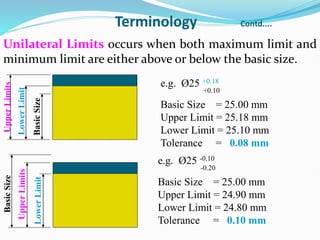
Unilateral Limits occurs when both maximum limit and
minimum limit are either above or below the basic size.
e.g. Ø25 +0.18
+0.10
Basic Size = 25.00 mm
Upper Limit = 25.18 mm
Lower Limit = 25.10 mm
Tolerance = 0.08 mm
e.g. Ø25 -0.10
-0.20
Basic Size = 25.00 mm
Upper Limit = 24.90 mm
Lower Limit = 24.80 mm
Tolerance = 0.10 mm
Terminology Contd....
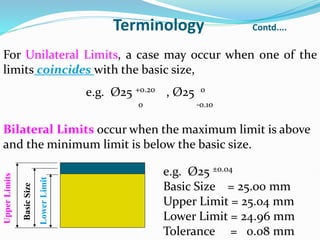
For Unilateral Limits, a case may occur when one of the
limits coincides with the basic size,
e.g. Ø25 +0.20 , Ø25 0
0 -0.10
e.g. Ø25 ±0.04
Basic Size = 25.00 mm
Upper Limit = 25.04 mm
Lower Limit = 24.96 mm
Tolerance = 0.08 mm
Bilateral Limits occur when the maximum limit is above
and the minimum limit is below the basic size.
Terminology Contd....
For PSU
Tolerances are specified
(a) To obtain desired fits
(b) because it is not possible to manufacture a size
exactly
(c) to obtain higher accuracy
(d) to have proper allowances
Terminology Contd....
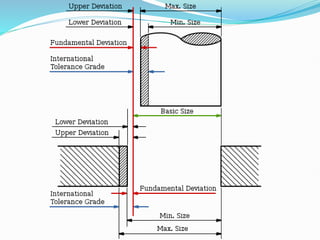
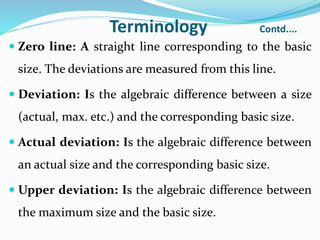
 Zero line: A straight line corresponding to the basic
size. The deviations are measured from this line.
 Deviation: Is the algebraic difference between a size
(actual, max. etc.) and the corresponding basic size.
 Actual deviation: Is the algebraic difference between
an actual size and the corresponding basic size.
 Upper deviation: Is the algebraic difference between
the maximum size and the basic size.
Terminology Contd....
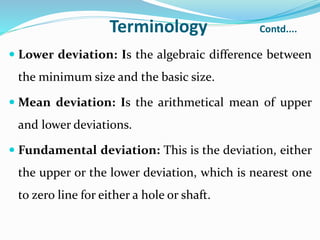
 Lower deviation: Is the algebraic difference between
the minimum size and the basic size.
 Mean deviation: Is the arithmetical mean of upper
and lower deviations.
 Fundamental deviation: This is the deviation, either
the upper or the lower deviation, which is nearest one
to zero line for either a hole or shaft.
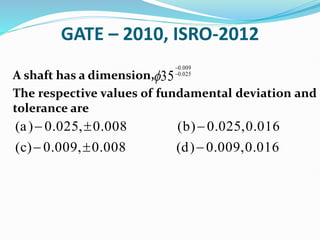
GATE – 2010, ISRO-2012
A shaft has a dimension,
The respective values of fundamental deviation and
tolerance are
0.009
0.025
35



(a) 0.025, 0.008 (b) 0.025,0.016
(c) 0.009, 0.008 (d) 0.009,0.016
  
  
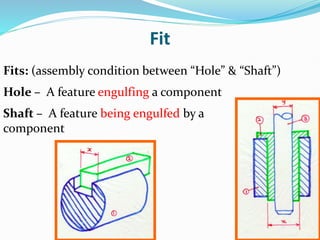
Fits: (assembly condition between “Hole” & “Shaft”)
Hole – A feature engulfing a component
Shaft – A feature being engulfed by a
component
Fit
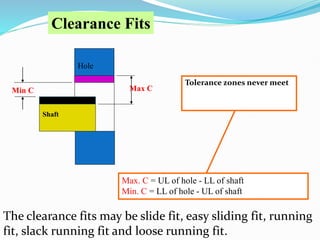
Hole
Shaft
Min C Max C
Clearance Fits
Tolerance zones never meet
Max. C = UL of hole - LL of shaft
Min. C = LL of hole - UL of shaft
The clearance fits may be slide fit, easy sliding fit, running
fit, slack running fit and loose running fit.
GATE - 2007
A hole is specified as mm. The mating
shaft has a clearance fit with minimum clearance of
0.01 mm. The tolerance on the shaft is 0.04 mm. The
maximum clearance in mm between the hole and
the shaft is
(a) 0.04
(b) 0.05
(c) 0.10
(d) 0.11
0.050
0.000
40
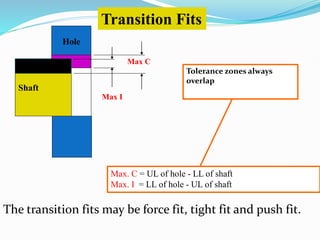
Shaft
Max I
Max C
Hole
Transition Fits
Tolerance zones always
overlap
Max. C = UL of hole - LL of shaft
Max. I = LL of hole - UL of shaft
The transition fits may be force fit, tight fit and push fit.
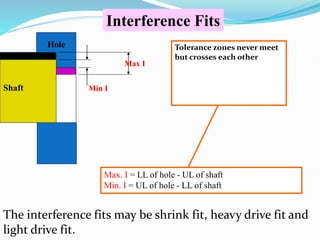
Shaft Min I
Max I
Hole
Interference Fits
Tolerance zones never meet
but crosses each other
Max. I = LL of hole - UL of shaft
Min. I = UL of hole - LL of shaft
The interference fits may be shrink fit, heavy drive fit and
light drive fit.
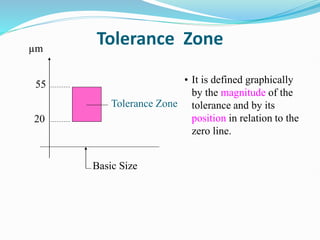
• It is defined graphically
by the magnitude of the
tolerance and by its
position in relation to the
zero line.
Tolerance Zone
Basic Size
µm
55
20
Tolerance Zone
IES 2011
Interference fit joints are provided for:
(a) Assembling bush bearing in housing
(b) Mounting heavy duty gears on shafts
(c) Mounting pulley on shafts
(d) Assembly of flywheels on shafts
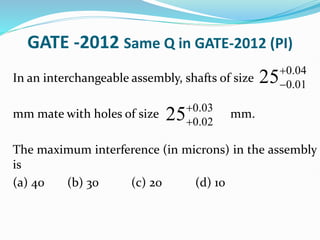
GATE -2012 Same Q in GATE-2012 (PI)
In an interchangeable assembly, shafts of size
mm mate with holes of size mm.
The maximum interference (in microns) in the assembly
is
(a) 40 (b) 30 (c) 20 (d) 10
0.04
0.01
25

0.03
0.02
25

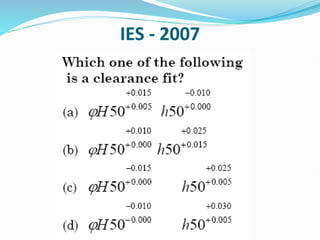
IES - 2007
IES - 2006
Which of the following is an interference fit?
(a) Push fit
(b) Running fit
(c) Sliding fit
(d) Shrink fit
IES - 2009
Consider the following joints:
1. Railway carriage wheel and axle
2. IC engine cylinder and liner
Which of the above joints is/are the result(s) of
interference fit?
(a) 1 only
(b) 2 only
(c) Neither 1 nor 2
(d) Both 1 and 2
Allowance
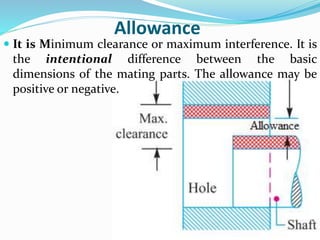
 It is Minimum clearance or maximum interference. It is
the intentional difference between the basic
dimensions of the mating parts. The allowance may be
positive or negative.
GATE - 2001
Allowance in limits and fits refers to
(a) Maximum clearance between shaft and hole
(b) Minimum clearance between shaft and hole
(c) Difference between maximum and minimum size of
hole
(d) Difference between maximum and minimum size of
shaft
GATE - 1998
In the specification of dimensions and fits,
(a) Allowance is equal to bilateral tolerance
(b) Allowance is equal to unilateral tolerance
(c) Allowance is independent of tolerance
(d) Allowance is equal to the difference between
maximum and minimum dimension specified by the
tolerance.
IES - 2012
Clearance in a fit is the difference between
(a) Maximum hole size and minimum shaft size
(b) Minimum hole size and maximum shaft size
(c) Maximum hole size and maximum shaft size
(d) Minimum hole size and minimum shaft size
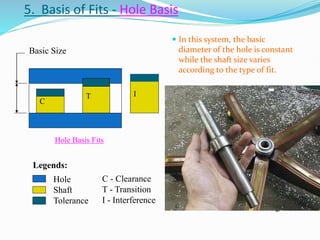
5. Basis of Fits - Hole Basis
 In this system, the basic
diameter of the hole is constant
while the shaft size varies
according to the type of fit.
C
T I
Hole Basis Fits
C - Clearance
T - Transition
I - Interference
Hole
Shaft
Tolerance
Legends:
• This system leads to greater
economy of production, as a single
drill or reamer size can be used to
produce a variety of fits by merely
altering the shaft limits.
• The shaft can be accurately
produced to size by turning and
grinding.
• Generally it is usual to recommend
hole-base fits, except where
temperature may have a
detrimental effect on large sizes.
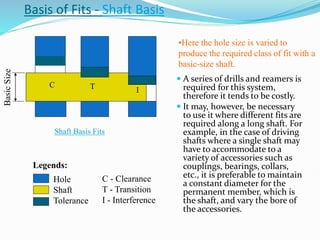
Basis of Fits - Shaft Basis
 A series of drills and reamers is
required for this system,
therefore it tends to be costly.
 It may, however, be necessary
to use it where different fits are
required along a long shaft. For
example, in the case of driving
shafts where a single shaft may
have to accommodate to a
variety of accessories such as
couplings, bearings, collars,
etc., it is preferable to maintain
a constant diameter for the
permanent member, which is
the shaft, and vary the bore of
the accessories.
Shaft Basis Fits
C T I
Legends:
Hole
Shaft
Tolerance
C - Clearance
T - Transition
I - Interference
•Here the hole size is varied to
produce the required class of fit with a
basic-size shaft.
IES - 2005
Assertion (A): Hole basis system is generally
preferred to shaft basis system in tolerance design
for getting the required fits.
Reason (R): Hole has to be given a larger tolerance
band than the mating shaft.
(a) Both A and R are individually true and R is the
correct explanation of A
(b) Both A and R are individually true but R is not the
correct explanation of A
(c) A is true but R is false
(d) A is false but R is true
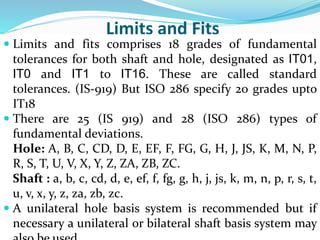
Limits and Fits
 Limits and fits comprises 18 grades of fundamental
tolerances for both shaft and hole, designated as IT01,
IT0 and IT1 to IT16. These are called standard
tolerances. (IS-919) But ISO 286 specify 20 grades upto
IT18
 There are 25 (IS 919) and 28 (ISO 286) types of
fundamental deviations.
Hole: A, B, C, CD, D, E, EF, F, FG, G, H, J, JS, K, M, N, P,
R, S, T, U, V, X, Y, Z, ZA, ZB, ZC.
Shaft : a, b, c, cd, d, e, ef, f, fg, g, h, j, js, k, m, n, p, r, s, t,
u, v, x, y, z, za, zb, zc.
 A unilateral hole basis system is recommended but if
necessary a unilateral or bilateral shaft basis system may
Tolerance Designation (ISO)
Tolerance on a shaft or a hole can also be calculated by
using the formulas provided by ISO.
i
K
T 

where,
T is the tolerance (in µm)
D
D
i 001
.
0
45
.
0 3

 (unit tolerance, in µm)
2
1D
D
D  (D1 and D2 are the nominal sizes marking
the beginning and the end of a range of
sizes, in mm)
  
6
6
.
1
10 IT
ITn
K 
 [For IT6 to IT16]
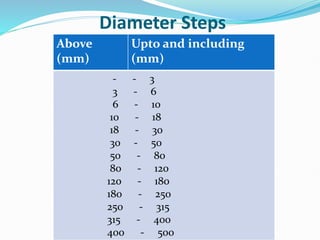
Diameter Steps
Above
(mm)
Upto and including
(mm)
- - 3
3 - 6
6 - 10
10 - 18
18 - 30
30 - 50
50 - 80
80 - 120
120 - 180
180 - 250
250 - 315
315 - 400
400 - 500
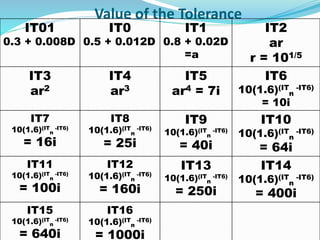
Value of the Tolerance
IT01
0.3 + 0.008D
IT0
0.5 + 0.012D
IT1
0.8 + 0.02D
=a
IT2
ar
r = 101/5
IT3
ar2
IT4
ar3
IT5
ar4 = 7i
IT6
10(1.6)(IT
n
-IT6)
= 10i
IT7
10(1.6)(IT
n
-IT6)
= 16i
IT8
10(1.6)(IT
n
-IT6)
= 25i
IT9
10(1.6)(IT
n
-IT6)
= 40i
IT10
10(1.6)(IT
n
-IT6)
= 64i
IT11
10(1.6)(IT
n
-IT6)
= 100i
IT12
10(1.6)(IT
n
-IT6)
= 160i
IT13
10(1.6)(IT
n
-IT6)
= 250i
IT14
10(1.6)(IT
n
-IT6)
= 400i
IT15
10(1.6)(IT
n
-IT6)
= 640i
IT16
10(1.6)(IT
n
-IT6)
= 1000i
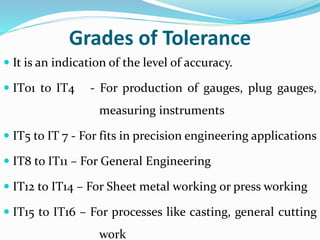
Grades of Tolerance
 It is an indication of the level of accuracy.
 IT01 to IT4 - For production of gauges, plug gauges,
measuring instruments
 IT5 to IT 7 - For fits in precision engineering applications
 IT8 to IT11 – For General Engineering
 IT12 to IT14 – For Sheet metal working or press working
 IT15 to IT16 – For processes like casting, general cutting
work
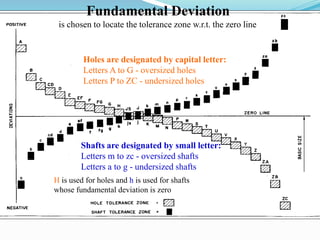
Fundamental Deviation
is chosen to locate the tolerance zone w.r.t. the zero line
Holes are designated by capital letter:
Letters A to G - oversized holes
Letters P to ZC - undersized holes
Shafts are designated by small letter:
Letters m to zc - oversized shafts
Letters a to g - undersized shafts
H is used for holes and h is used for shafts
whose fundamental deviation is zero
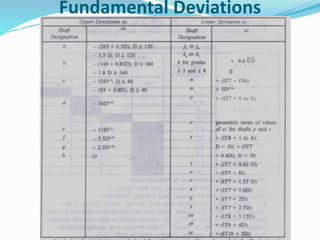
Fundamental Deviations
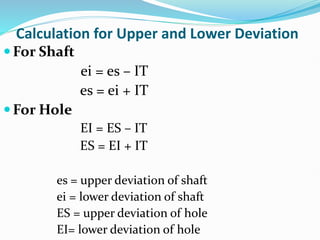
Calculation for Upper and Lower Deviation
For Shaft
ei = es – IT
es = ei + IT
For Hole
EI = ES – IT
ES = EI + IT
es = upper deviation of shaft
ei = lower deviation of shaft
ES = upper deviation of hole
EI= lower deviation of hole
 For hole, H stands for a dimension whose lower
deviation refers to the basic size. The hole H for which
the lower deviation is zero is called a basic hole.
 Similarly, for shafts, h stands for a dimension whose
upper deviation refers to the basic size. The shaft h for
which the upper deviation is zero is called a basic
shaft.
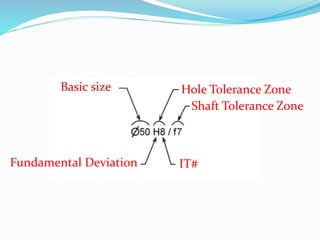
 A fit is designated by its basic size followed by symbols
representing the limits of each of its two components,
the hole being quoted first.
 For example, 100 H6/g5 means basic size is 100 mm
and the tolerance grade for the hole is 6 and for the
shaft is 5.
Basic size
Fundamental Deviation IT#
Hole Tolerance Zone
Shaft Tolerance Zone
IES-2006 Conventional
Find the limit sizes, tolerances and allowances for a
100 mm diameter shaft and hole pair designated by
F8h10. Also specify the type of fit that the above pair
belongs to.
Given: 100 mm diameter lies in the diameter step
range of 80-120 mm. The fundamental deviation for
shaft designation ‘f’ is -5.5 D0.41
The values of standard tolerances for grades of IT 8
and IT 10 are 25i and 64i respectively.
Also, indicate the limits and tolerance on a diagram.
[15-Marks]
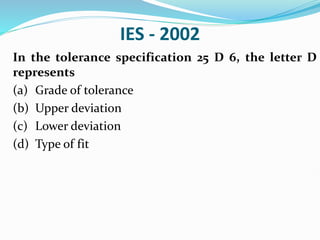
IES - 2002
In the tolerance specification 25 D 6, the letter D
represents
(a) Grade of tolerance
(b) Upper deviation
(c) Lower deviation
(d) Type of fit
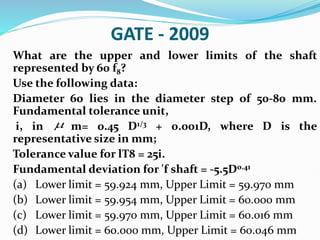
GATE - 2009
What are the upper and lower limits of the shaft
represented by 60 f8?
Use the following data:
Diameter 60 lies in the diameter step of 50-80 mm.
Fundamental tolerance unit,
i, in m= 0.45 D1/3 + 0.001D, where D is the
representative size in mm;
Tolerance value for lT8 = 25i.
Fundamental deviation for 'f shaft = -5.5D0.41
(a) Lower limit = 59.924 mm, Upper Limit = 59.970 mm
(b) Lower limit = 59.954 mm, Upper Limit = 60.000 mm
(c) Lower limit = 59.970 mm, Upper Limit = 60.016 mm
(d) Lower limit = 60.000 mm, Upper Limit = 60.046 mm

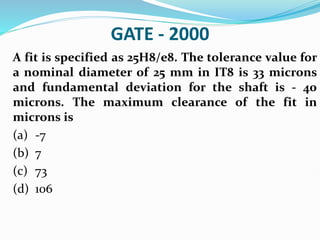
GATE - 2000
A fit is specified as 25H8/e8. The tolerance value for
a nominal diameter of 25 mm in IT8 is 33 microns
and fundamental deviation for the shaft is - 40
microns. The maximum clearance of the fit in
microns is
(a) -7
(b) 7
(c) 73
(d) 106
GATE - 2003
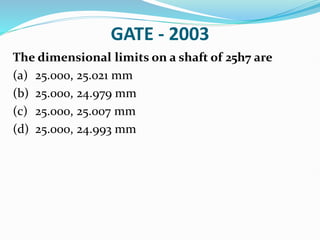
The dimensional limits on a shaft of 25h7 are
(a) 25.000, 25.021 mm
(b) 25.000, 24.979 mm
(c) 25.000, 25.007 mm
(d) 25.000, 24.993 mm
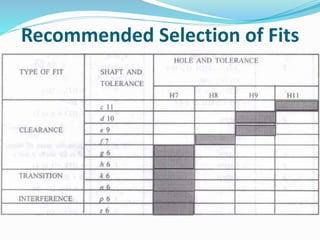
Recommended Selection of Fits
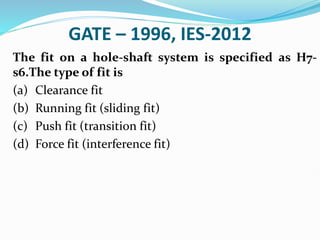
GATE – 1996, IES-2012
The fit on a hole-shaft system is specified as H7-
s6.The type of fit is
(a) Clearance fit
(b) Running fit (sliding fit)
(c) Push fit (transition fit)
(d) Force fit (interference fit)
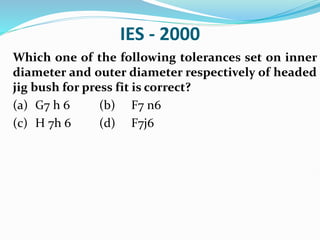
IES - 2000
Which one of the following tolerances set on inner
diameter and outer diameter respectively of headed
jig bush for press fit is correct?
(a) G7 h 6 (b) F7 n6
(c) H 7h 6 (d) F7j6
Selective Assembly
 All the parts (hole & shaft) produced are measured
and graded into a range of dimensions within the
tolerance groups.
 Reduces the cost of production
Interchangeability
 Term employed for the mass production of identical
items within the prescribed limits of sizes.
 If the variation of items are within certain limits, all
parts of equivalent size will be equally fit for operating in
machines and mechanisms and the mating parts will
give the required fitting.
 This facilitates to select at random from a large number
of parts for an assembly and results in a considerable
saving in the cost of production.
Tolerance Sink
 A design engineer keeps one section of the part blank
(without tolerance) so that production engineer can
dump all the tolerances on that section which becomes
most inaccurate dimension of the part.
 Position of sink can be changing the reference point.
 Tolerance for the sink is the cumulative sum of all the
tolerances and only like minded tolerances can be added
i.e. either equally bilateral or equally unilateral.
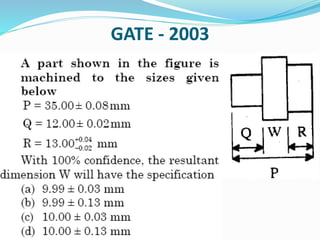
GATE - 2003
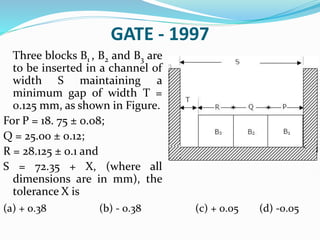
GATE - 1997
Three blocks B1 , B2 and B3 are
to be inserted in a channel of
width S maintaining a
minimum gap of width T =
0.125 mm, as shown in Figure.
For P = 18. 75 ± 0.08;
Q = 25.00 ± 0.12;
R = 28.125 ± 0.1 and
S = 72.35 + X, (where all
dimensions are in mm), the
tolerance X is
(a) + 0.38 (b) - 0.38 (c) + 0.05 (d) -0.05
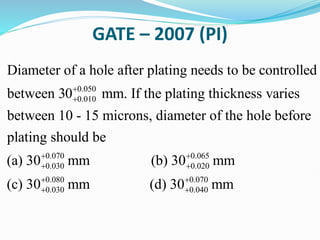
GATE – 2007 (PI)
0.050
0.010
0.07
0.030
Diameter of a hole after plating needs to be controlled
between 30 mm. If the plating thickness varies
between 10 - 15 microns, diameter of the hole before
plating should be
(a) 30




0 0.065
0.020
0.080 0.070
0.030 0.040
mm (b) 30 mm
(c) 30 mm (d) 30 mm


 
 
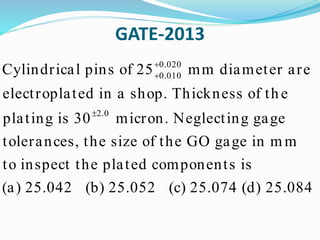
GATE-2013
0.020
0.010
2.0
Cylindrical pins of 25 mm diameter are
electroplated in a shop. Thickness of th e
plating is 30 micron. Neglecting gage
tolerances, the size of the GO gage in m m
to inspect the plated c



omponents is
(a) 25.042 (b) 25.052 (c) 25.074 (d) 25.084
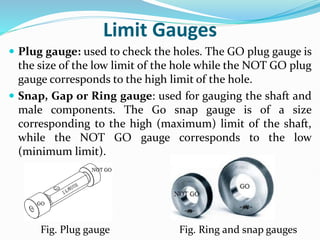
Limit Gauges
 Plug gauge: used to check the holes. The GO plug gauge is
the size of the low limit of the hole while the NOT GO plug
gauge corresponds to the high limit of the hole.
 Snap, Gap or Ring gauge: used for gauging the shaft and
male components. The Go snap gauge is of a size
corresponding to the high (maximum) limit of the shaft,
while the NOT GO gauge corresponds to the low
(minimum limit).
Fig. Plug gauge Fig. Ring and snap gauges
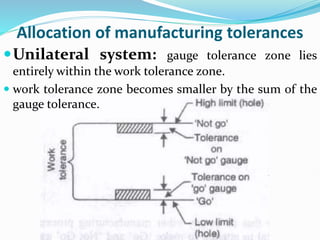
Allocation of manufacturing tolerances
Unilateral system: gauge tolerance zone lies
entirely within the work tolerance zone.
 work tolerance zone becomes smaller by the sum of the
gauge tolerance.
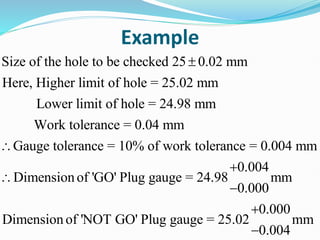
Example
Size of the hole to be checked 25 0.02 mm
Here, Higher limit of hole = 25.02 mm
Lower limit of hole = 24.98 mm
Work tolerance = 0.04 mm
Gauge tolerance = 10% of work tolerance = 0.004 mm
Dimensi



0.004
on of 'GO' Plug gauge = 24.98 mm
0.000
0.000
Dimension of 'NOT GO' Plug gauge = 25.02 mm
0.004




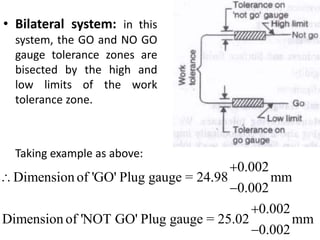
• Bilateral system: in this
system, the GO and NO GO
gauge tolerance zones are
bisected by the high and
low limits of the work
tolerance zone.
Taking example as above:
0.002
Dimension of 'GO' Plug gauge = 24.98 mm
0.002
0.002
Dimension of 'NOT GO' Plug gauge = 25.02 mm
0.002





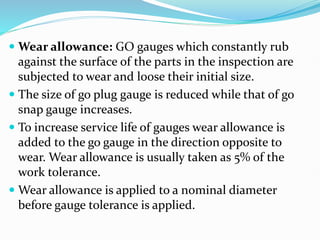
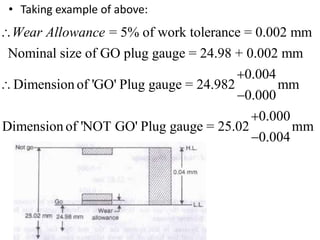
 Wear allowance: GO gauges which constantly rub
against the surface of the parts in the inspection are
subjected to wear and loose their initial size.
 The size of go plug gauge is reduced while that of go
snap gauge increases.
 To increase service life of gauges wear allowance is
added to the go gauge in the direction opposite to
wear. Wear allowance is usually taken as 5% of the
work tolerance.
 Wear allowance is applied to a nominal diameter
before gauge tolerance is applied.
• Taking example of above:
= 5% of work tolerance = 0.002 mm
Nominal size of GO plug gauge = 24.98 + 0.002 mm
0.004
Dimension of 'GO' Plug gauge = 24.982 mm
0.000
0.000
Dimension of 'NOT GO' Plug gauge = 25.02 mm
0.004
Wear Allowance






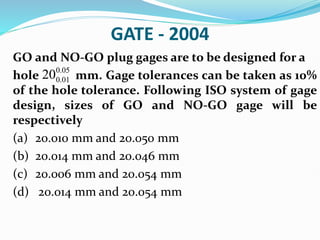
GATE - 2004
GO and NO-GO plug gages are to be designed for a
hole mm. Gage tolerances can be taken as 10%
of the hole tolerance. Following ISO system of gage
design, sizes of GO and NO-GO gage will be
respectively
(a) 20.010 mm and 20.050 mm
(b) 20.014 mm and 20.046 mm
(c) 20.006 mm and 20.054 mm
(d) 20.014 mm and 20.054 mm
0.05
0.01
20
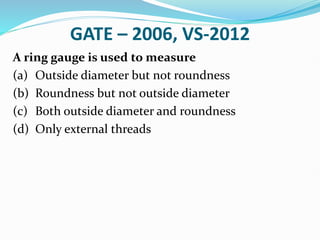
GATE – 2006, VS-2012
A ring gauge is used to measure
(a) Outside diameter but not roundness
(b) Roundness but not outside diameter
(c) Both outside diameter and roundness
(d) Only external threads
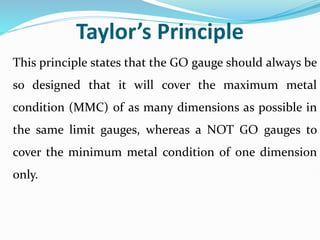
Taylor’s Principle
This principle states that the GO gauge should always be
so designed that it will cover the maximum metal
condition (MMC) of as many dimensions as possible in
the same limit gauges, whereas a NOT GO gauges to
cover the minimum metal condition of one dimension
only.
Ch-24 Limit, Tolerance & Fits.pptx

Ch-24 Limit, Tolerance & Fits.pptx

  • 1.
    Limit, Tolerance &Fits By S K Mondal
  • 4.
    Terminology  Nominal size:Size of a part specified in the drawing  Basic size: Size of a part to which all limits of variation (i.e. tolerances) are applied.  Actual size: Actual measured dimension of the part. The difference between the basic size and the actual size should not exceed a certain limit, otherwise it will interfere with the interchangeability of the mating parts.
  • 5.
    Terminology Contd....  Limitsof sizes: There are two extreme permissible sizes for a dimension of the part. The largest permissible size for a dimension is called upper or high or maximum limit, whereas the smallest size is known as lower or minimum limit.  Tolerance The difference between the upper limit and lower limit. It is the maximum permissible variation in a dimension. The tolerance may be unilateral or bilateral.
  • 6.
    Unilateral Limits occurswhen both maximum limit and minimum limit are either above or below the basic size. e.g. Ø25 +0.18 +0.10 Basic Size = 25.00 mm Upper Limit = 25.18 mm Lower Limit = 25.10 mm Tolerance = 0.08 mm e.g. Ø25 -0.10 -0.20 Basic Size = 25.00 mm Upper Limit = 24.90 mm Lower Limit = 24.80 mm Tolerance = 0.10 mm Terminology Contd....
  • 7.
    For Unilateral Limits,a case may occur when one of the limits coincides with the basic size, e.g. Ø25 +0.20 , Ø25 0 0 -0.10 e.g. Ø25 ±0.04 Basic Size = 25.00 mm Upper Limit = 25.04 mm Lower Limit = 24.96 mm Tolerance = 0.08 mm Bilateral Limits occur when the maximum limit is above and the minimum limit is below the basic size. Terminology Contd....
  • 8.
    For PSU Tolerances arespecified (a) To obtain desired fits (b) because it is not possible to manufacture a size exactly (c) to obtain higher accuracy (d) to have proper allowances
  • 9.
    Terminology Contd....  Zeroline: A straight line corresponding to the basic size. The deviations are measured from this line.  Deviation: Is the algebraic difference between a size (actual, max. etc.) and the corresponding basic size.  Actual deviation: Is the algebraic difference between an actual size and the corresponding basic size.  Upper deviation: Is the algebraic difference between the maximum size and the basic size.
  • 11.
    Terminology Contd....  Lowerdeviation: Is the algebraic difference between the minimum size and the basic size.  Mean deviation: Is the arithmetical mean of upper and lower deviations.  Fundamental deviation: This is the deviation, either the upper or the lower deviation, which is nearest one to zero line for either a hole or shaft.
  • 12.
    GATE – 2010,ISRO-2012 A shaft has a dimension, The respective values of fundamental deviation and tolerance are 0.009 0.025 35    (a) 0.025, 0.008 (b) 0.025,0.016 (c) 0.009, 0.008 (d) 0.009,0.016      
  • 13.
    Fits: (assembly conditionbetween “Hole” & “Shaft”) Hole – A feature engulfing a component Shaft – A feature being engulfed by a component Fit
  • 14.
    Hole Shaft Min C MaxC Clearance Fits Tolerance zones never meet Max. C = UL of hole - LL of shaft Min. C = LL of hole - UL of shaft The clearance fits may be slide fit, easy sliding fit, running fit, slack running fit and loose running fit.
  • 15.
    GATE - 2007 Ahole is specified as mm. The mating shaft has a clearance fit with minimum clearance of 0.01 mm. The tolerance on the shaft is 0.04 mm. The maximum clearance in mm between the hole and the shaft is (a) 0.04 (b) 0.05 (c) 0.10 (d) 0.11 0.050 0.000 40
  • 16.
    Shaft Max I Max C Hole TransitionFits Tolerance zones always overlap Max. C = UL of hole - LL of shaft Max. I = LL of hole - UL of shaft The transition fits may be force fit, tight fit and push fit.
  • 17.
    Shaft Min I MaxI Hole Interference Fits Tolerance zones never meet but crosses each other Max. I = LL of hole - UL of shaft Min. I = UL of hole - LL of shaft The interference fits may be shrink fit, heavy drive fit and light drive fit.
  • 18.
    • It isdefined graphically by the magnitude of the tolerance and by its position in relation to the zero line. Tolerance Zone Basic Size µm 55 20 Tolerance Zone
  • 19.
    IES 2011 Interference fitjoints are provided for: (a) Assembling bush bearing in housing (b) Mounting heavy duty gears on shafts (c) Mounting pulley on shafts (d) Assembly of flywheels on shafts
  • 20.
    GATE -2012 SameQ in GATE-2012 (PI) In an interchangeable assembly, shafts of size mm mate with holes of size mm. The maximum interference (in microns) in the assembly is (a) 40 (b) 30 (c) 20 (d) 10 0.04 0.01 25  0.03 0.02 25 
  • 21.
  • 22.
    IES - 2006 Whichof the following is an interference fit? (a) Push fit (b) Running fit (c) Sliding fit (d) Shrink fit
  • 23.
    IES - 2009 Considerthe following joints: 1. Railway carriage wheel and axle 2. IC engine cylinder and liner Which of the above joints is/are the result(s) of interference fit? (a) 1 only (b) 2 only (c) Neither 1 nor 2 (d) Both 1 and 2
  • 24.
    Allowance  It isMinimum clearance or maximum interference. It is the intentional difference between the basic dimensions of the mating parts. The allowance may be positive or negative.
  • 25.
    GATE - 2001 Allowancein limits and fits refers to (a) Maximum clearance between shaft and hole (b) Minimum clearance between shaft and hole (c) Difference between maximum and minimum size of hole (d) Difference between maximum and minimum size of shaft
  • 26.
    GATE - 1998 Inthe specification of dimensions and fits, (a) Allowance is equal to bilateral tolerance (b) Allowance is equal to unilateral tolerance (c) Allowance is independent of tolerance (d) Allowance is equal to the difference between maximum and minimum dimension specified by the tolerance.
  • 27.
    IES - 2012 Clearancein a fit is the difference between (a) Maximum hole size and minimum shaft size (b) Minimum hole size and maximum shaft size (c) Maximum hole size and maximum shaft size (d) Minimum hole size and minimum shaft size
  • 28.
    5. Basis ofFits - Hole Basis  In this system, the basic diameter of the hole is constant while the shaft size varies according to the type of fit. C T I Hole Basis Fits C - Clearance T - Transition I - Interference Hole Shaft Tolerance Legends: • This system leads to greater economy of production, as a single drill or reamer size can be used to produce a variety of fits by merely altering the shaft limits. • The shaft can be accurately produced to size by turning and grinding. • Generally it is usual to recommend hole-base fits, except where temperature may have a detrimental effect on large sizes.
  • 29.
    Basis of Fits- Shaft Basis  A series of drills and reamers is required for this system, therefore it tends to be costly.  It may, however, be necessary to use it where different fits are required along a long shaft. For example, in the case of driving shafts where a single shaft may have to accommodate to a variety of accessories such as couplings, bearings, collars, etc., it is preferable to maintain a constant diameter for the permanent member, which is the shaft, and vary the bore of the accessories. Shaft Basis Fits C T I Legends: Hole Shaft Tolerance C - Clearance T - Transition I - Interference •Here the hole size is varied to produce the required class of fit with a basic-size shaft.
  • 30.
    IES - 2005 Assertion(A): Hole basis system is generally preferred to shaft basis system in tolerance design for getting the required fits. Reason (R): Hole has to be given a larger tolerance band than the mating shaft. (a) Both A and R are individually true and R is the correct explanation of A (b) Both A and R are individually true but R is not the correct explanation of A (c) A is true but R is false (d) A is false but R is true
  • 31.
    Limits and Fits Limits and fits comprises 18 grades of fundamental tolerances for both shaft and hole, designated as IT01, IT0 and IT1 to IT16. These are called standard tolerances. (IS-919) But ISO 286 specify 20 grades upto IT18  There are 25 (IS 919) and 28 (ISO 286) types of fundamental deviations. Hole: A, B, C, CD, D, E, EF, F, FG, G, H, J, JS, K, M, N, P, R, S, T, U, V, X, Y, Z, ZA, ZB, ZC. Shaft : a, b, c, cd, d, e, ef, f, fg, g, h, j, js, k, m, n, p, r, s, t, u, v, x, y, z, za, zb, zc.  A unilateral hole basis system is recommended but if necessary a unilateral or bilateral shaft basis system may
  • 32.
    Tolerance Designation (ISO) Toleranceon a shaft or a hole can also be calculated by using the formulas provided by ISO. i K T   where, T is the tolerance (in µm) D D i 001 . 0 45 . 0 3   (unit tolerance, in µm) 2 1D D D  (D1 and D2 are the nominal sizes marking the beginning and the end of a range of sizes, in mm)    6 6 . 1 10 IT ITn K   [For IT6 to IT16]
  • 33.
    Diameter Steps Above (mm) Upto andincluding (mm) - - 3 3 - 6 6 - 10 10 - 18 18 - 30 30 - 50 50 - 80 80 - 120 120 - 180 180 - 250 250 - 315 315 - 400 400 - 500
  • 34.
    Value of theTolerance IT01 0.3 + 0.008D IT0 0.5 + 0.012D IT1 0.8 + 0.02D =a IT2 ar r = 101/5 IT3 ar2 IT4 ar3 IT5 ar4 = 7i IT6 10(1.6)(IT n -IT6) = 10i IT7 10(1.6)(IT n -IT6) = 16i IT8 10(1.6)(IT n -IT6) = 25i IT9 10(1.6)(IT n -IT6) = 40i IT10 10(1.6)(IT n -IT6) = 64i IT11 10(1.6)(IT n -IT6) = 100i IT12 10(1.6)(IT n -IT6) = 160i IT13 10(1.6)(IT n -IT6) = 250i IT14 10(1.6)(IT n -IT6) = 400i IT15 10(1.6)(IT n -IT6) = 640i IT16 10(1.6)(IT n -IT6) = 1000i
  • 35.
    Grades of Tolerance It is an indication of the level of accuracy.  IT01 to IT4 - For production of gauges, plug gauges, measuring instruments  IT5 to IT 7 - For fits in precision engineering applications  IT8 to IT11 – For General Engineering  IT12 to IT14 – For Sheet metal working or press working  IT15 to IT16 – For processes like casting, general cutting work
  • 36.
    Fundamental Deviation is chosento locate the tolerance zone w.r.t. the zero line Holes are designated by capital letter: Letters A to G - oversized holes Letters P to ZC - undersized holes Shafts are designated by small letter: Letters m to zc - oversized shafts Letters a to g - undersized shafts H is used for holes and h is used for shafts whose fundamental deviation is zero
  • 37.
  • 38.
    Calculation for Upperand Lower Deviation For Shaft ei = es – IT es = ei + IT For Hole EI = ES – IT ES = EI + IT es = upper deviation of shaft ei = lower deviation of shaft ES = upper deviation of hole EI= lower deviation of hole
  • 39.
     For hole,H stands for a dimension whose lower deviation refers to the basic size. The hole H for which the lower deviation is zero is called a basic hole.  Similarly, for shafts, h stands for a dimension whose upper deviation refers to the basic size. The shaft h for which the upper deviation is zero is called a basic shaft.  A fit is designated by its basic size followed by symbols representing the limits of each of its two components, the hole being quoted first.  For example, 100 H6/g5 means basic size is 100 mm and the tolerance grade for the hole is 6 and for the shaft is 5.
  • 40.
    Basic size Fundamental DeviationIT# Hole Tolerance Zone Shaft Tolerance Zone
  • 41.
    IES-2006 Conventional Find thelimit sizes, tolerances and allowances for a 100 mm diameter shaft and hole pair designated by F8h10. Also specify the type of fit that the above pair belongs to. Given: 100 mm diameter lies in the diameter step range of 80-120 mm. The fundamental deviation for shaft designation ‘f’ is -5.5 D0.41 The values of standard tolerances for grades of IT 8 and IT 10 are 25i and 64i respectively. Also, indicate the limits and tolerance on a diagram. [15-Marks]
  • 42.
    IES - 2002 Inthe tolerance specification 25 D 6, the letter D represents (a) Grade of tolerance (b) Upper deviation (c) Lower deviation (d) Type of fit
  • 43.
    GATE - 2009 Whatare the upper and lower limits of the shaft represented by 60 f8? Use the following data: Diameter 60 lies in the diameter step of 50-80 mm. Fundamental tolerance unit, i, in m= 0.45 D1/3 + 0.001D, where D is the representative size in mm; Tolerance value for lT8 = 25i. Fundamental deviation for 'f shaft = -5.5D0.41 (a) Lower limit = 59.924 mm, Upper Limit = 59.970 mm (b) Lower limit = 59.954 mm, Upper Limit = 60.000 mm (c) Lower limit = 59.970 mm, Upper Limit = 60.016 mm (d) Lower limit = 60.000 mm, Upper Limit = 60.046 mm 
  • 44.
    GATE - 2000 Afit is specified as 25H8/e8. The tolerance value for a nominal diameter of 25 mm in IT8 is 33 microns and fundamental deviation for the shaft is - 40 microns. The maximum clearance of the fit in microns is (a) -7 (b) 7 (c) 73 (d) 106
  • 45.
    GATE - 2003 Thedimensional limits on a shaft of 25h7 are (a) 25.000, 25.021 mm (b) 25.000, 24.979 mm (c) 25.000, 25.007 mm (d) 25.000, 24.993 mm
  • 46.
  • 47.
    GATE – 1996,IES-2012 The fit on a hole-shaft system is specified as H7- s6.The type of fit is (a) Clearance fit (b) Running fit (sliding fit) (c) Push fit (transition fit) (d) Force fit (interference fit)
  • 48.
    IES - 2000 Whichone of the following tolerances set on inner diameter and outer diameter respectively of headed jig bush for press fit is correct? (a) G7 h 6 (b) F7 n6 (c) H 7h 6 (d) F7j6
  • 49.
    Selective Assembly  Allthe parts (hole & shaft) produced are measured and graded into a range of dimensions within the tolerance groups.  Reduces the cost of production
  • 50.
    Interchangeability  Term employedfor the mass production of identical items within the prescribed limits of sizes.  If the variation of items are within certain limits, all parts of equivalent size will be equally fit for operating in machines and mechanisms and the mating parts will give the required fitting.  This facilitates to select at random from a large number of parts for an assembly and results in a considerable saving in the cost of production.
  • 51.
    Tolerance Sink  Adesign engineer keeps one section of the part blank (without tolerance) so that production engineer can dump all the tolerances on that section which becomes most inaccurate dimension of the part.  Position of sink can be changing the reference point.  Tolerance for the sink is the cumulative sum of all the tolerances and only like minded tolerances can be added i.e. either equally bilateral or equally unilateral.
  • 52.
  • 54.
    GATE - 1997 Threeblocks B1 , B2 and B3 are to be inserted in a channel of width S maintaining a minimum gap of width T = 0.125 mm, as shown in Figure. For P = 18. 75 ± 0.08; Q = 25.00 ± 0.12; R = 28.125 ± 0.1 and S = 72.35 + X, (where all dimensions are in mm), the tolerance X is (a) + 0.38 (b) - 0.38 (c) + 0.05 (d) -0.05
  • 55.
    GATE – 2007(PI) 0.050 0.010 0.07 0.030 Diameter of a hole after plating needs to be controlled between 30 mm. If the plating thickness varies between 10 - 15 microns, diameter of the hole before plating should be (a) 30     0 0.065 0.020 0.080 0.070 0.030 0.040 mm (b) 30 mm (c) 30 mm (d) 30 mm      
  • 56.
    GATE-2013 0.020 0.010 2.0 Cylindrical pins of25 mm diameter are electroplated in a shop. Thickness of th e plating is 30 micron. Neglecting gage tolerances, the size of the GO gage in m m to inspect the plated c    omponents is (a) 25.042 (b) 25.052 (c) 25.074 (d) 25.084
  • 57.
    Limit Gauges  Pluggauge: used to check the holes. The GO plug gauge is the size of the low limit of the hole while the NOT GO plug gauge corresponds to the high limit of the hole.  Snap, Gap or Ring gauge: used for gauging the shaft and male components. The Go snap gauge is of a size corresponding to the high (maximum) limit of the shaft, while the NOT GO gauge corresponds to the low (minimum limit). Fig. Plug gauge Fig. Ring and snap gauges
  • 58.
    Allocation of manufacturingtolerances Unilateral system: gauge tolerance zone lies entirely within the work tolerance zone.  work tolerance zone becomes smaller by the sum of the gauge tolerance.
  • 59.
    Example Size of thehole to be checked 25 0.02 mm Here, Higher limit of hole = 25.02 mm Lower limit of hole = 24.98 mm Work tolerance = 0.04 mm Gauge tolerance = 10% of work tolerance = 0.004 mm Dimensi    0.004 on of 'GO' Plug gauge = 24.98 mm 0.000 0.000 Dimension of 'NOT GO' Plug gauge = 25.02 mm 0.004    
  • 60.
    • Bilateral system:in this system, the GO and NO GO gauge tolerance zones are bisected by the high and low limits of the work tolerance zone. Taking example as above: 0.002 Dimension of 'GO' Plug gauge = 24.98 mm 0.002 0.002 Dimension of 'NOT GO' Plug gauge = 25.02 mm 0.002     
  • 61.
     Wear allowance:GO gauges which constantly rub against the surface of the parts in the inspection are subjected to wear and loose their initial size.  The size of go plug gauge is reduced while that of go snap gauge increases.  To increase service life of gauges wear allowance is added to the go gauge in the direction opposite to wear. Wear allowance is usually taken as 5% of the work tolerance.  Wear allowance is applied to a nominal diameter before gauge tolerance is applied.
  • 62.
    • Taking exampleof above: = 5% of work tolerance = 0.002 mm Nominal size of GO plug gauge = 24.98 + 0.002 mm 0.004 Dimension of 'GO' Plug gauge = 24.982 mm 0.000 0.000 Dimension of 'NOT GO' Plug gauge = 25.02 mm 0.004 Wear Allowance      
  • 63.
    GATE - 2004 GOand NO-GO plug gages are to be designed for a hole mm. Gage tolerances can be taken as 10% of the hole tolerance. Following ISO system of gage design, sizes of GO and NO-GO gage will be respectively (a) 20.010 mm and 20.050 mm (b) 20.014 mm and 20.046 mm (c) 20.006 mm and 20.054 mm (d) 20.014 mm and 20.054 mm 0.05 0.01 20
  • 64.
    GATE – 2006,VS-2012 A ring gauge is used to measure (a) Outside diameter but not roundness (b) Roundness but not outside diameter (c) Both outside diameter and roundness (d) Only external threads
  • 65.
    Taylor’s Principle This principlestates that the GO gauge should always be so designed that it will cover the maximum metal condition (MMC) of as many dimensions as possible in the same limit gauges, whereas a NOT GO gauges to cover the minimum metal condition of one dimension only.