Department of Mechanical Engineering
JSS Academy of Technical Education, Bangalore-560060
MECHANICAL MEASUREMENTS AND METROLOGY
(Course Code:18ME36B)
TEXT BOOKS
• Mechanical Measurements, Beckwith Marangoni and Lienhard, Pearson Education, 6th Ed., 2006.
• Instrumentation, Measurement and Analysis, B C Nakra, K K Chaudhry, 4th Edition, McGraw Hill.
• Engineering Metrology, R.K. Jain, Khanna Publishers, Delhi, 2009
REFERENCE BOOKS:
• Engineering Metrology and Measurements, N.V.Raghavendra and L.Krishnamurthy, Oxford
University Press..
Further Reference:
 National Programme on Technology Enhanced Learning (NPTEL)
http://nptel.ac.in/courses/112104121/1
MECHANICAL MEASUREMENTS AND METROLOGY
CHAPTER 2: Limit Gauging
• To equip with knowledge of limit gauges.
Learning Objectives
• Explain the principle of limit gauges and its importance in inspection.
Outcomes
Module 2
• Introduction to limit gauges, Taylor’s principle, Types of limit gauges,
Numerical on limit gauge design
INTRODUCTION
• In mass production, components are manufactured with the tolerance limits,
suggested by the designer to facilitate interchangeability.
• Various measuring instruments are used to measure the actual dimensions and
compared with the standard specified dimensions to decide the acceptability.
INTRODUCTION
• In mass production, gauges are used to check the compliance of the limits of
the part with the permissive tolerance limits, instead of measuring the actual
dimensions.
• The term ‘limit gauging’ signifies the use of gauges for checking the limits of the
components.
INTRODUCTION
• Limit gauges ensures that the components lie within the permissible limits, but
they do not determine the actual size or dimensions.
• Gauges are scale less inspection tools, which are used to check the
conformance of the parts along with their forms and relative positions of the
surfaces of the parts to the limits.
INTRODUCTION
• The gauges required to check the dimensions of the components with reference
to two sizes conforming to maximum and minimum limits of the components
(MMC).
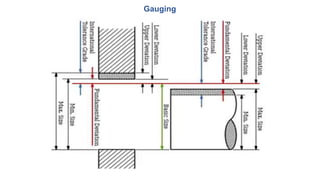
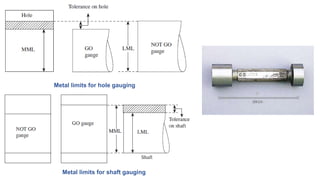
• GO gauges and NO GO or NOT GO gauges, which correspond, to the MML and
LML of the component, as depicted in Fig.
Gauging
Metal limits for hole gauging
Metal limits for shaft gauging
INTRODUCTION
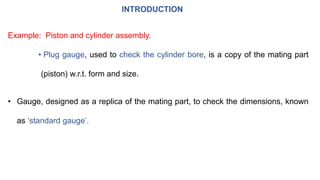
• The GO gauge manufactured to the maximum limit will assemble with the mating
part.
• The NOT GO gauge corresponds to the lower limit will not.
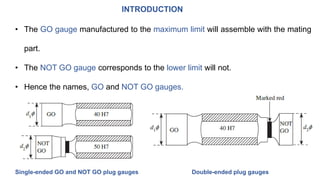
• Hence the names, GO and NOT GO gauges.
Double-ended plug gaugesSingle-ended GO and NOT GO plug gauges
INTRODUCTION
Example: Piston and cylinder assembly.
• Plug gauge, used to check the cylinder bore, is a copy of the mating part
(piston) w.r.t. form and size.
• Gauge, designed as a replica of the mating part, to check the dimensions, known
as ‘standard gauge’.
INTRODUCTION
• The objective in designing the gauges is to make continuous and accurate
measurements.
• Clearance fits are preferred for a majority of the assembly operations.
1. MMLs are crucial for effective functioning of the parts.
2. If MMLs slightly exceeds the specified values, assembly becomes impossible.
• If GO gauges fail to assemble during inspection, the components should not be
accepted under any circumstances.
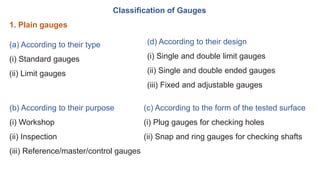
Classification of Gauges
(d) According to their design
(i) Single and double limit gauges
(ii) Single and double ended gauges
(iii) Fixed and adjustable gauges
(a) According to their type
(i) Standard gauges
(ii) Limit gauges
(b) According to their purpose
(i) Workshop
(ii) Inspection
(iii) Reference/master/control gauges
(c) According to the form of the tested surface
(i) Plug gauges for checking holes
(ii) Snap and ring gauges for checking shafts
1. Plain gauges
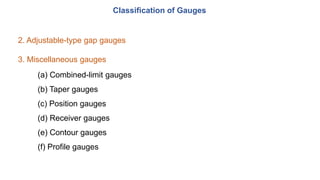
Classification of Gauges
2. Adjustable-type gap gauges
3. Miscellaneous gauges
(a) Combined-limit gauges
(b) Taper gauges
(c) Position gauges
(d) Receiver gauges
(e) Contour gauges
(f) Profile gauges
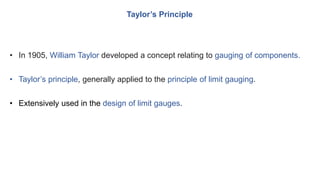
Taylor’s Principle
• In 1905, William Taylor developed a concept relating to gauging of components.
• Taylor’s principle, generally applied to the principle of limit gauging.
• Extensively used in the design of limit gauges.
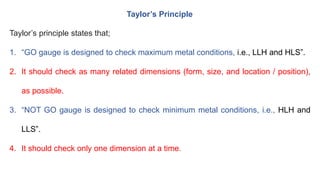
Taylor’s Principle
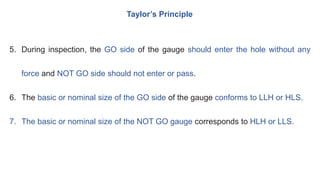
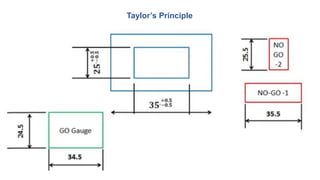
Taylor’s principle states that;
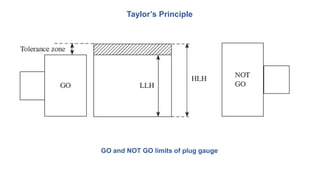
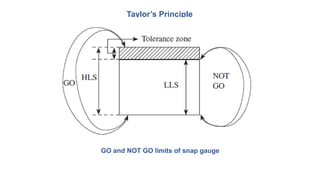
1. “GO gauge is designed to check maximum metal conditions, i.e., LLH and HLS”.
2. It should check as many related dimensions (form, size, and location / position),
as possible.
3. “NOT GO gauge is designed to check minimum metal conditions, i.e., HLH and
LLS”.
4. It should check only one dimension at a time.
Taylor’s Principle
5. During inspection, the GO side of the gauge should enter the hole without any
force and NOT GO side should not enter or pass.
6. The basic or nominal size of the GO side of the gauge conforms to LLH or HLS.
7. The basic or nominal size of the NOT GO gauge corresponds to HLH or LLS.
Taylor’s Principle
Taylor’s Principle
GO and NOT GO limits of plug gauge
Taylor’s Principle
GO and NOT GO limits of snap gauge
Important Points for Gauge Design
Points to be considered while designing gauges:
1. The GO gauges should be replica of the mating parts.
2. GO gauges, enables several related dimensions to be checked simultaneously.
3. In inspection, GO gauges must be put into conditions of maximum impassability.
4. NOT GO gauges check a single element of feature at a time.
5. In inspection, NOT GO gauges must be put into conditions of maximum passability.
Material for Gauges
• Hard and wear resistant, corrosion resistant for a prolonged life
• Capable of maintaining dimensional stability and form
• Low coefficient of expansion
• High-carbon steel, Mild steel, Chromium-plated etc.
Gauge Tolerance (Gauge Maker’s Tolerance)
• In order to accommodate these dimensional variations, arise due to the
limitations of the manufacturing process, some tolerance must be allowed in the
manufacture of gauges, termed as gauge maker’s tolerance or gauge tolerance
Gauge tolerance = 10% of the work tolerance.
Wear Allowance
• The NOT GO gauge, are rarely engaged with the work, therefore does not
undergo any wear. Hence, need not provide an allowance for wear in case of
NOT GO gauges.
• Wear allowance of 10% of gauge tolerance is widely accepted in industries.
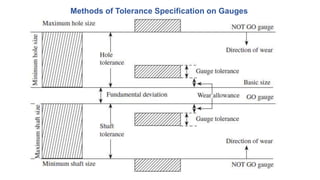
Methods of Tolerance Specification on Gauges
The present British system is in accordance with Taylor’s principle and is widely
accepted in industries.
Guidelines
1. The specified tolerance should be wide and consistent with satisfactory
functioning, economical production, and inspection.
2. During inspection, the work that lies outside the specified limits should not be
accepted.
Methods of Tolerance Specification on Gauges
From Fig.
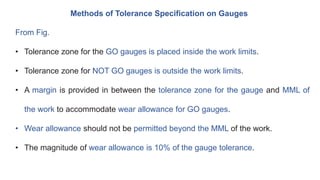
• Tolerance zone for the GO gauges is placed inside the work limits.
• Tolerance zone for NOT GO gauges is outside the work limits.
• A margin is provided in between the tolerance zone for the gauge and MML of
the work to accommodate wear allowance for GO gauges.
• Wear allowance should not be permitted beyond the MML of the work.
• The magnitude of wear allowance is 10% of the gauge tolerance.
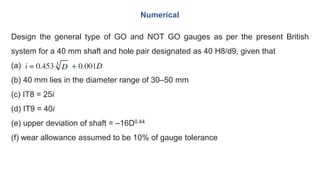
Design the general type of GO and NOT GO gauges as per the present British
system for a 40 mm shaft and hole pair designated as 40 H8/d9, given that
(a)
(b) 40 mm lies in the diameter range of 30–50 mm
(c) IT8 = 25i
(d) IT9 = 40i
(e) upper deviation of shaft = –16D0.44
(f) wear allowance assumed to be 10% of gauge tolerance
Numerical
Solution
40 H8/d9
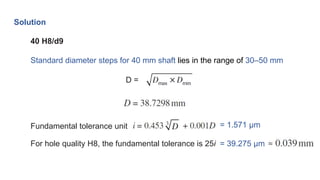
Standard diameter steps for 40 mm shaft lies in the range of 30–50 mm
D =
Fundamental tolerance unit = 1.571 μm
For hole quality H8, the fundamental tolerance is 25i = 39.275 μm
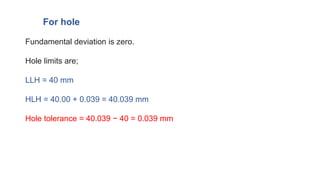
Fundamental deviation is zero.
Hole limits are;
LLH = 40 mm
HLH = 40.00 + 0.039 = 40.039 mm
Hole tolerance = 40.039 − 40 = 0.039 mm
For hole
Fundamental tolerance is 40i.
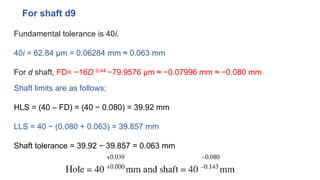
40i = 62.84 μm = 0.06284 mm ≈ 0.063 mm
For d shaft, FD= −16D 0.44 −79.9576 μm ≈ −0.07996 mm ≈ −0.080 mm
For shaft d9
Shaft limits are as follows;
HLS = (40 – FD) = (40 − 0.080) = 39.92 mm
LLS = 40 − (0.080 + 0.063) = 39.857 mm
Shaft tolerance = 39.92 − 39.857 = 0.063 mm
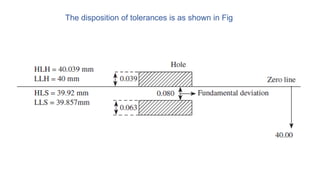
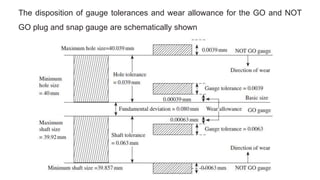
The disposition of tolerances is as shown in Fig
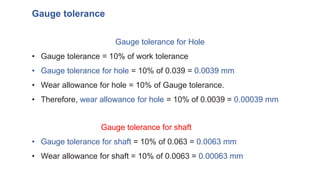
Gauge tolerance for Hole
• Gauge tolerance = 10% of work tolerance
• Gauge tolerance for hole = 10% of 0.039 = 0.0039 mm
• Wear allowance for hole = 10% of Gauge tolerance.
• Therefore, wear allowance for hole = 10% of 0.0039 = 0.00039 mm
Gauge tolerance for shaft
• Gauge tolerance for shaft = 10% of 0.063 = 0.0063 mm
• Wear allowance for shaft = 10% of 0.0063 = 0.00063 mm
Gauge tolerance
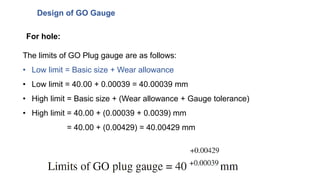
Design of GO Gauge
The limits of GO Plug gauge are as follows:
• Low limit = Basic size + Wear allowance
• Low limit = 40.00 + 0.00039 = 40.00039 mm
• High limit = Basic size + (Wear allowance + Gauge tolerance)
• High limit = 40.00 + (0.00039 + 0.0039) mm
= 40.00 + (0.00429) = 40.00429 mm
For hole:
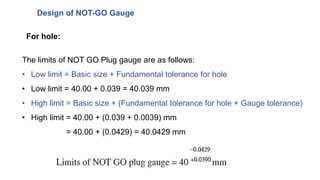
Design of NOT-GO Gauge
The limits of NOT GO Plug gauge are as follows:
• Low limit = Basic size + Fundamental tolerance for hole
• Low limit = 40.00 + 0.039 = 40.039 mm
• High limit = Basic size + (Fundamental tolerance for hole + Gauge tolerance)
• High limit = 40.00 + (0.039 + 0.0039) mm
= 40.00 + (0.0429) = 40.0429 mm
For hole:
For shaft
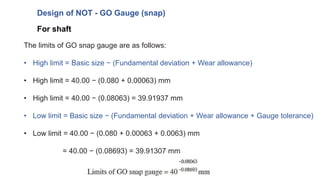
Design of NOT - GO Gauge (snap)
The limits of GO snap gauge are as follows:
• High limit = Basic size − (Fundamental deviation + Wear allowance)
• High limit = 40.00 − (0.080 + 0.00063) mm
• High limit = 40.00 − (0.08063) = 39.91937 mm
• Low limit = Basic size − (Fundamental deviation + Wear allowance + Gauge tolerance)
• Low limit = 40.00 − (0.080 + 0.00063 + 0.0063) mm
= 40.00 − (0.08693) = 39.91307 mm
For shaft
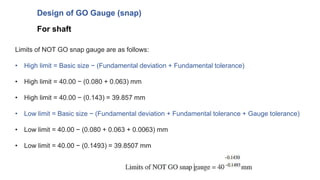
Design of GO Gauge (snap)
Limits of NOT GO snap gauge are as follows:
• High limit = Basic size − (Fundamental deviation + Fundamental tolerance)
• High limit = 40.00 − (0.080 + 0.063) mm
• High limit = 40.00 − (0.143) = 39.857 mm
• Low limit = Basic size − (Fundamental deviation + Fundamental tolerance + Gauge tolerance)
• Low limit = 40.00 − (0.080 + 0.063 + 0.0063) mm
• Low limit = 40.00 − (0.1493) = 39.8507 mm
The disposition of gauge tolerances and wear allowance for the GO and NOT
GO plug and snap gauge are schematically shown
End of Module

Limit Gauges

  • 1.
    Department of MechanicalEngineering JSS Academy of Technical Education, Bangalore-560060 MECHANICAL MEASUREMENTS AND METROLOGY (Course Code:18ME36B)
  • 2.
    TEXT BOOKS • MechanicalMeasurements, Beckwith Marangoni and Lienhard, Pearson Education, 6th Ed., 2006. • Instrumentation, Measurement and Analysis, B C Nakra, K K Chaudhry, 4th Edition, McGraw Hill. • Engineering Metrology, R.K. Jain, Khanna Publishers, Delhi, 2009 REFERENCE BOOKS: • Engineering Metrology and Measurements, N.V.Raghavendra and L.Krishnamurthy, Oxford University Press.. Further Reference:  National Programme on Technology Enhanced Learning (NPTEL) http://nptel.ac.in/courses/112104121/1
  • 3.
    MECHANICAL MEASUREMENTS ANDMETROLOGY CHAPTER 2: Limit Gauging
  • 4.
    • To equipwith knowledge of limit gauges. Learning Objectives
  • 5.
    • Explain theprinciple of limit gauges and its importance in inspection. Outcomes
  • 6.
    Module 2 • Introductionto limit gauges, Taylor’s principle, Types of limit gauges, Numerical on limit gauge design
  • 7.
    INTRODUCTION • In massproduction, components are manufactured with the tolerance limits, suggested by the designer to facilitate interchangeability. • Various measuring instruments are used to measure the actual dimensions and compared with the standard specified dimensions to decide the acceptability.
  • 8.
    INTRODUCTION • In massproduction, gauges are used to check the compliance of the limits of the part with the permissive tolerance limits, instead of measuring the actual dimensions. • The term ‘limit gauging’ signifies the use of gauges for checking the limits of the components.
  • 9.
    INTRODUCTION • Limit gaugesensures that the components lie within the permissible limits, but they do not determine the actual size or dimensions. • Gauges are scale less inspection tools, which are used to check the conformance of the parts along with their forms and relative positions of the surfaces of the parts to the limits.
  • 10.
    INTRODUCTION • The gaugesrequired to check the dimensions of the components with reference to two sizes conforming to maximum and minimum limits of the components (MMC). • GO gauges and NO GO or NOT GO gauges, which correspond, to the MML and LML of the component, as depicted in Fig.
  • 11.
  • 12.
    Metal limits forhole gauging Metal limits for shaft gauging
  • 13.
    INTRODUCTION • The GOgauge manufactured to the maximum limit will assemble with the mating part. • The NOT GO gauge corresponds to the lower limit will not. • Hence the names, GO and NOT GO gauges. Double-ended plug gaugesSingle-ended GO and NOT GO plug gauges
  • 14.
    INTRODUCTION Example: Piston andcylinder assembly. • Plug gauge, used to check the cylinder bore, is a copy of the mating part (piston) w.r.t. form and size. • Gauge, designed as a replica of the mating part, to check the dimensions, known as ‘standard gauge’.
  • 15.
    INTRODUCTION • The objectivein designing the gauges is to make continuous and accurate measurements. • Clearance fits are preferred for a majority of the assembly operations. 1. MMLs are crucial for effective functioning of the parts. 2. If MMLs slightly exceeds the specified values, assembly becomes impossible. • If GO gauges fail to assemble during inspection, the components should not be accepted under any circumstances.
  • 16.
    Classification of Gauges (d)According to their design (i) Single and double limit gauges (ii) Single and double ended gauges (iii) Fixed and adjustable gauges (a) According to their type (i) Standard gauges (ii) Limit gauges (b) According to their purpose (i) Workshop (ii) Inspection (iii) Reference/master/control gauges (c) According to the form of the tested surface (i) Plug gauges for checking holes (ii) Snap and ring gauges for checking shafts 1. Plain gauges
  • 17.
    Classification of Gauges 2.Adjustable-type gap gauges 3. Miscellaneous gauges (a) Combined-limit gauges (b) Taper gauges (c) Position gauges (d) Receiver gauges (e) Contour gauges (f) Profile gauges
  • 18.
    Taylor’s Principle • In1905, William Taylor developed a concept relating to gauging of components. • Taylor’s principle, generally applied to the principle of limit gauging. • Extensively used in the design of limit gauges.
  • 19.
    Taylor’s Principle Taylor’s principlestates that; 1. “GO gauge is designed to check maximum metal conditions, i.e., LLH and HLS”. 2. It should check as many related dimensions (form, size, and location / position), as possible. 3. “NOT GO gauge is designed to check minimum metal conditions, i.e., HLH and LLS”. 4. It should check only one dimension at a time.
  • 20.
    Taylor’s Principle 5. Duringinspection, the GO side of the gauge should enter the hole without any force and NOT GO side should not enter or pass. 6. The basic or nominal size of the GO side of the gauge conforms to LLH or HLS. 7. The basic or nominal size of the NOT GO gauge corresponds to HLH or LLS.
  • 21.
  • 22.
    Taylor’s Principle GO andNOT GO limits of plug gauge
  • 23.
    Taylor’s Principle GO andNOT GO limits of snap gauge
  • 24.
    Important Points forGauge Design Points to be considered while designing gauges: 1. The GO gauges should be replica of the mating parts. 2. GO gauges, enables several related dimensions to be checked simultaneously. 3. In inspection, GO gauges must be put into conditions of maximum impassability. 4. NOT GO gauges check a single element of feature at a time. 5. In inspection, NOT GO gauges must be put into conditions of maximum passability.
  • 25.
    Material for Gauges •Hard and wear resistant, corrosion resistant for a prolonged life • Capable of maintaining dimensional stability and form • Low coefficient of expansion • High-carbon steel, Mild steel, Chromium-plated etc.
  • 26.
    Gauge Tolerance (GaugeMaker’s Tolerance) • In order to accommodate these dimensional variations, arise due to the limitations of the manufacturing process, some tolerance must be allowed in the manufacture of gauges, termed as gauge maker’s tolerance or gauge tolerance Gauge tolerance = 10% of the work tolerance.
  • 27.
    Wear Allowance • TheNOT GO gauge, are rarely engaged with the work, therefore does not undergo any wear. Hence, need not provide an allowance for wear in case of NOT GO gauges. • Wear allowance of 10% of gauge tolerance is widely accepted in industries.
  • 28.
    Methods of ToleranceSpecification on Gauges The present British system is in accordance with Taylor’s principle and is widely accepted in industries. Guidelines 1. The specified tolerance should be wide and consistent with satisfactory functioning, economical production, and inspection. 2. During inspection, the work that lies outside the specified limits should not be accepted.
  • 29.
    Methods of ToleranceSpecification on Gauges
  • 30.
    Methods of ToleranceSpecification on Gauges From Fig. • Tolerance zone for the GO gauges is placed inside the work limits. • Tolerance zone for NOT GO gauges is outside the work limits. • A margin is provided in between the tolerance zone for the gauge and MML of the work to accommodate wear allowance for GO gauges. • Wear allowance should not be permitted beyond the MML of the work. • The magnitude of wear allowance is 10% of the gauge tolerance.
  • 31.
    Design the generaltype of GO and NOT GO gauges as per the present British system for a 40 mm shaft and hole pair designated as 40 H8/d9, given that (a) (b) 40 mm lies in the diameter range of 30–50 mm (c) IT8 = 25i (d) IT9 = 40i (e) upper deviation of shaft = –16D0.44 (f) wear allowance assumed to be 10% of gauge tolerance Numerical
  • 32.
    Solution 40 H8/d9 Standard diametersteps for 40 mm shaft lies in the range of 30–50 mm D = Fundamental tolerance unit = 1.571 μm For hole quality H8, the fundamental tolerance is 25i = 39.275 μm
  • 33.
    Fundamental deviation iszero. Hole limits are; LLH = 40 mm HLH = 40.00 + 0.039 = 40.039 mm Hole tolerance = 40.039 − 40 = 0.039 mm For hole
  • 34.
    Fundamental tolerance is40i. 40i = 62.84 μm = 0.06284 mm ≈ 0.063 mm For d shaft, FD= −16D 0.44 −79.9576 μm ≈ −0.07996 mm ≈ −0.080 mm For shaft d9 Shaft limits are as follows; HLS = (40 – FD) = (40 − 0.080) = 39.92 mm LLS = 40 − (0.080 + 0.063) = 39.857 mm Shaft tolerance = 39.92 − 39.857 = 0.063 mm
  • 35.
    The disposition oftolerances is as shown in Fig
  • 36.
    Gauge tolerance forHole • Gauge tolerance = 10% of work tolerance • Gauge tolerance for hole = 10% of 0.039 = 0.0039 mm • Wear allowance for hole = 10% of Gauge tolerance. • Therefore, wear allowance for hole = 10% of 0.0039 = 0.00039 mm Gauge tolerance for shaft • Gauge tolerance for shaft = 10% of 0.063 = 0.0063 mm • Wear allowance for shaft = 10% of 0.0063 = 0.00063 mm Gauge tolerance
  • 37.
    Design of GOGauge The limits of GO Plug gauge are as follows: • Low limit = Basic size + Wear allowance • Low limit = 40.00 + 0.00039 = 40.00039 mm • High limit = Basic size + (Wear allowance + Gauge tolerance) • High limit = 40.00 + (0.00039 + 0.0039) mm = 40.00 + (0.00429) = 40.00429 mm For hole:
  • 38.
    Design of NOT-GOGauge The limits of NOT GO Plug gauge are as follows: • Low limit = Basic size + Fundamental tolerance for hole • Low limit = 40.00 + 0.039 = 40.039 mm • High limit = Basic size + (Fundamental tolerance for hole + Gauge tolerance) • High limit = 40.00 + (0.039 + 0.0039) mm = 40.00 + (0.0429) = 40.0429 mm For hole:
  • 39.
    For shaft Design ofNOT - GO Gauge (snap) The limits of GO snap gauge are as follows: • High limit = Basic size − (Fundamental deviation + Wear allowance) • High limit = 40.00 − (0.080 + 0.00063) mm • High limit = 40.00 − (0.08063) = 39.91937 mm • Low limit = Basic size − (Fundamental deviation + Wear allowance + Gauge tolerance) • Low limit = 40.00 − (0.080 + 0.00063 + 0.0063) mm = 40.00 − (0.08693) = 39.91307 mm
  • 40.
    For shaft Design ofGO Gauge (snap) Limits of NOT GO snap gauge are as follows: • High limit = Basic size − (Fundamental deviation + Fundamental tolerance) • High limit = 40.00 − (0.080 + 0.063) mm • High limit = 40.00 − (0.143) = 39.857 mm • Low limit = Basic size − (Fundamental deviation + Fundamental tolerance + Gauge tolerance) • Low limit = 40.00 − (0.080 + 0.063 + 0.0063) mm • Low limit = 40.00 − (0.1493) = 39.8507 mm
  • 41.
    The disposition ofgauge tolerances and wear allowance for the GO and NOT GO plug and snap gauge are schematically shown
  • 42.