Line Standard and End Standard
Instructor
Mr. Gaurav Bharadwaj
Assistant Prof.
Department of ME
GLA University
Introduction
• A length may be measured as the distance between two points, two lines or as the distance
between two parallel faces.
• So, the instruments for direct measurement of linear dimensions fall into two categories.
1. Line standard
2. End standard
Line Standard
• When the length is measured as the distance between centers of two engraved lines, it is called
line standard.
• Both material standards yard and meter are line standards.
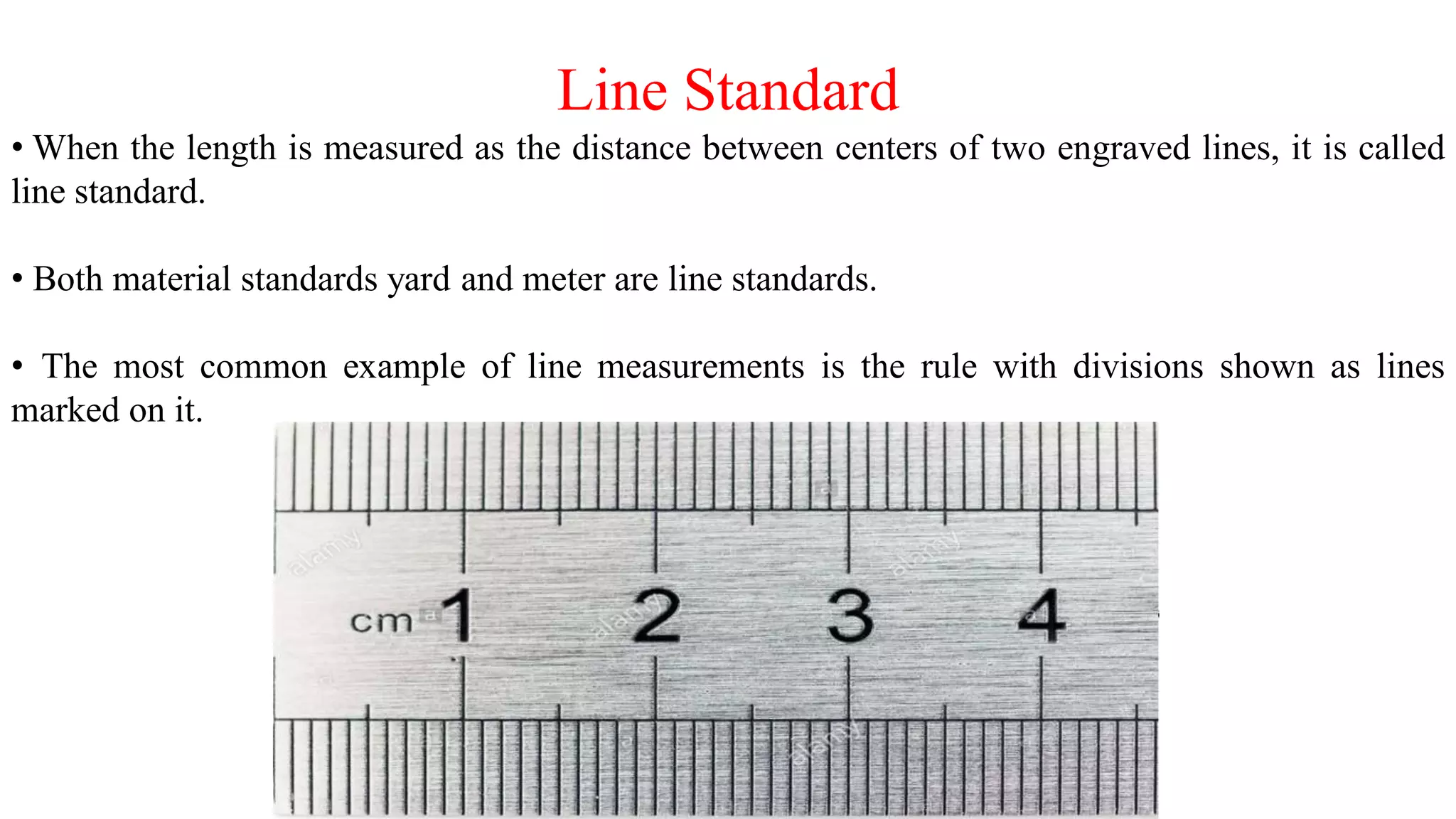
• The most common example of line measurements is the rule with divisions shown as lines
marked on it.
Characteristics of Line Standard
1. Scales can be accurately engraved but the engraved lines themselves possess thickness and it is not
possible to take measurements with high accuracy.
2. A scale is quick and easy to use over a wide range of measurements.
3. The scale markings are not subjected to wear. However, the leading ends are subjected to wear and this
may lead to undersize measurements.
4. A scale does not possess a ‘built in’ datum which would allow easy scale alignment with the axis of
measurement, this again results in ‘under sizing’.
5. Scales are subjected to parallax effect, which is a source of both positive & negative reading errors’
6. Also, the assistance of magnifying glass or microscope is required if sufficient accuracy is to be
achieved.
End Standard
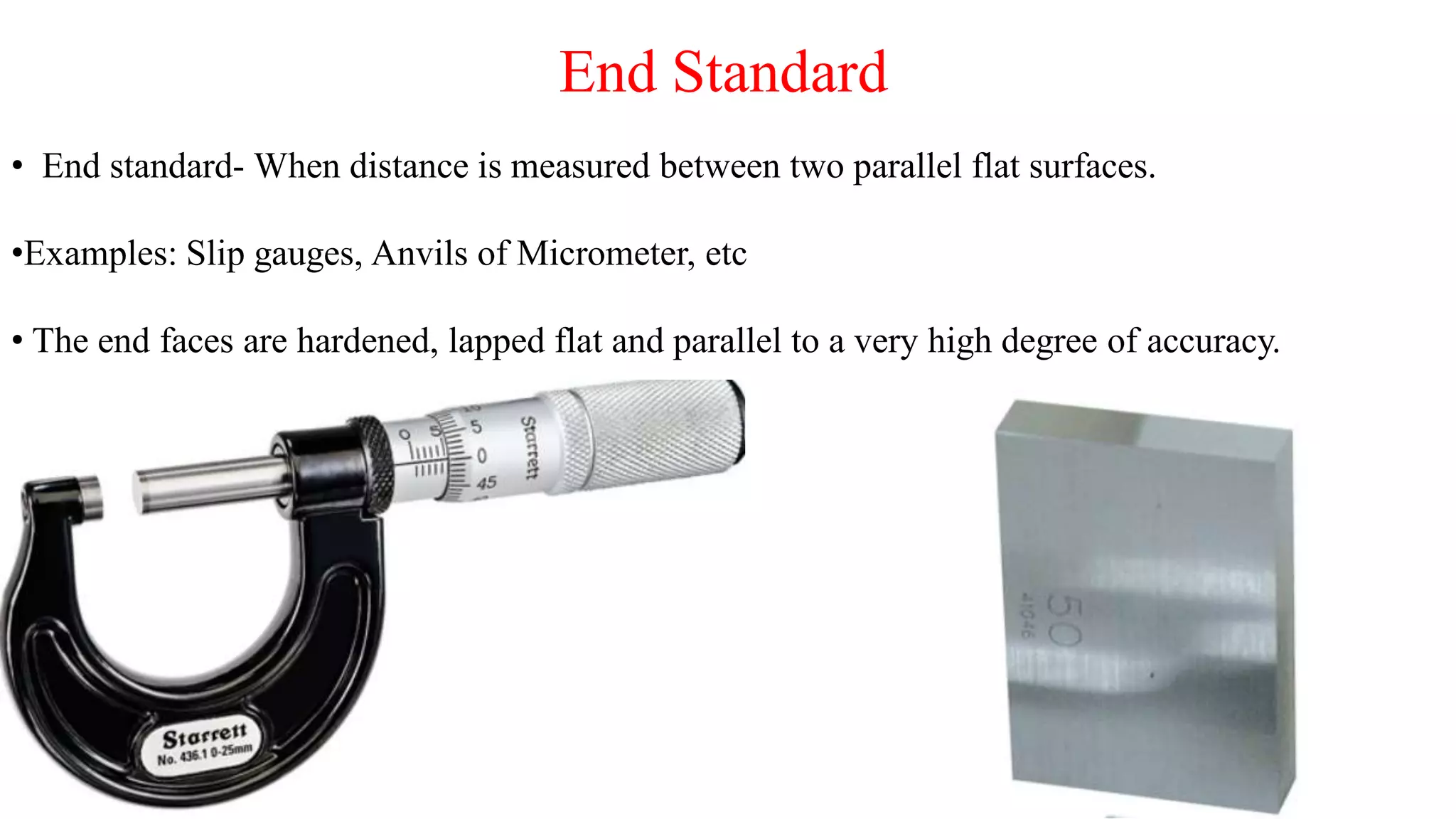
• End standard- When distance is measured between two parallel flat surfaces.
•Examples: Slip gauges, Anvils of Micrometer, etc
• The end faces are hardened, lapped flat and parallel to a very high degree of accuracy.
Characteristics of End Standard
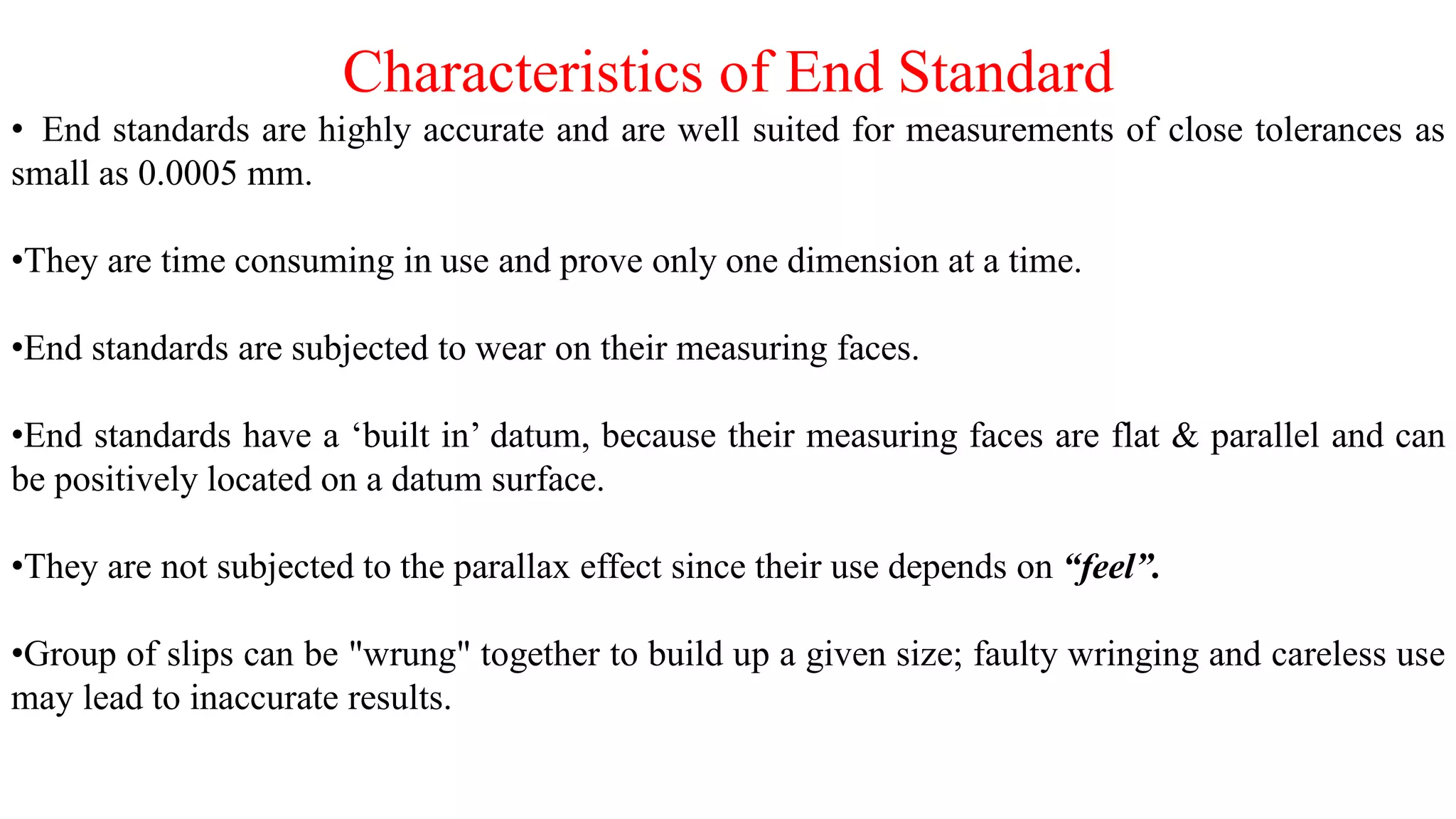
• End standards are highly accurate and are well suited for measurements of close tolerances as
small as 0.0005 mm.
•They are time consuming in use and prove only one dimension at a time.
•End standards are subjected to wear on their measuring faces.
•End standards have a ‘built in’ datum, because their measuring faces are flat & parallel and can
be positively located on a datum surface.
•They are not subjected to the parallax effect since their use depends on “feel”.
•Group of slips can be "wrung" together to build up a given size; faulty wringing and careless use
may lead to inaccurate results.
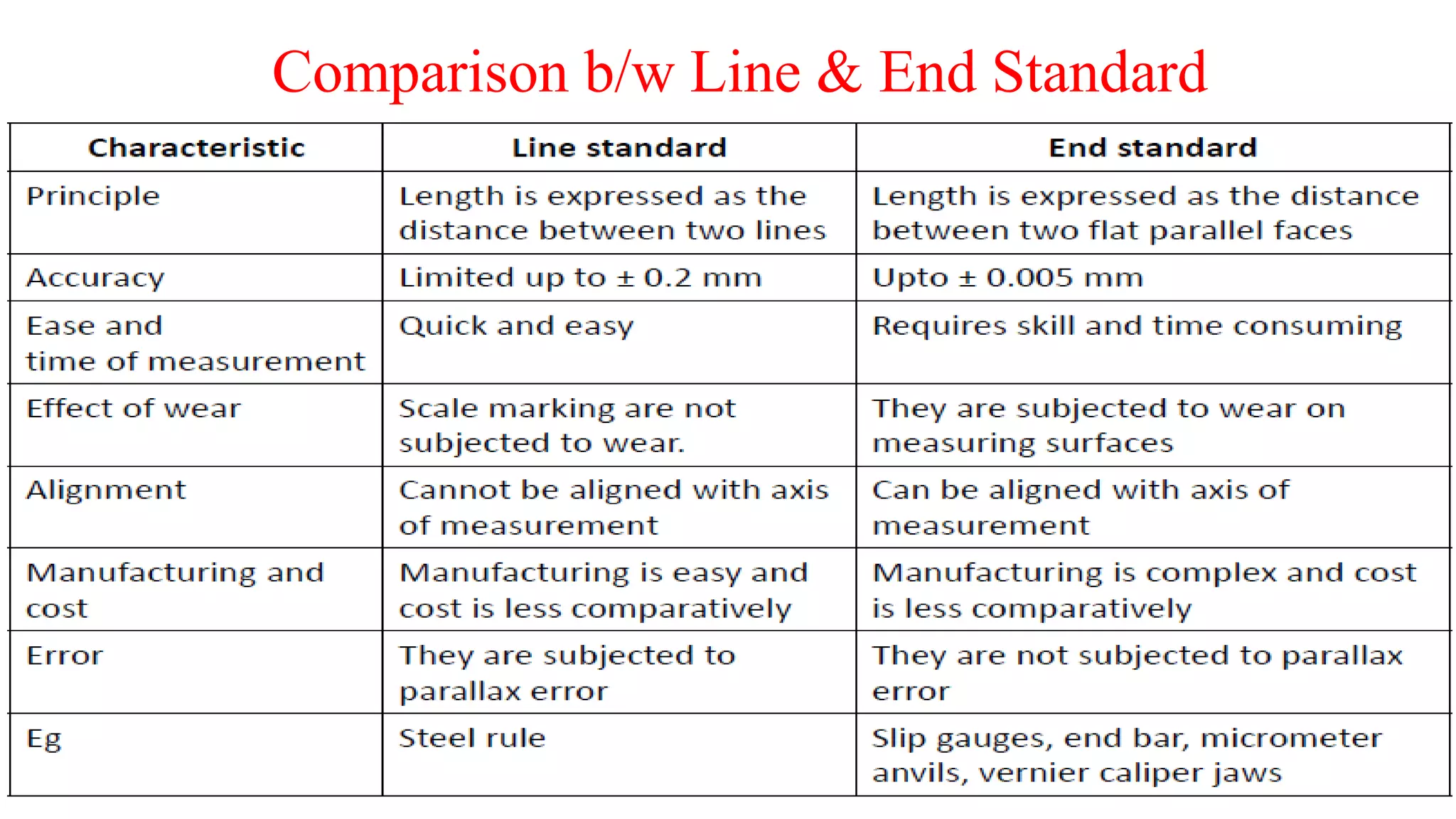
Comparison b/w Line & End Standard
Thank you

Line and end standard

  • 1.
    Line Standard andEnd Standard Instructor Mr. Gaurav Bharadwaj Assistant Prof. Department of ME GLA University
  • 2.
    Introduction • A lengthmay be measured as the distance between two points, two lines or as the distance between two parallel faces. • So, the instruments for direct measurement of linear dimensions fall into two categories. 1. Line standard 2. End standard
  • 3.
    Line Standard • Whenthe length is measured as the distance between centers of two engraved lines, it is called line standard. • Both material standards yard and meter are line standards. • The most common example of line measurements is the rule with divisions shown as lines marked on it.
  • 4.
    Characteristics of LineStandard 1. Scales can be accurately engraved but the engraved lines themselves possess thickness and it is not possible to take measurements with high accuracy. 2. A scale is quick and easy to use over a wide range of measurements. 3. The scale markings are not subjected to wear. However, the leading ends are subjected to wear and this may lead to undersize measurements. 4. A scale does not possess a ‘built in’ datum which would allow easy scale alignment with the axis of measurement, this again results in ‘under sizing’. 5. Scales are subjected to parallax effect, which is a source of both positive & negative reading errors’ 6. Also, the assistance of magnifying glass or microscope is required if sufficient accuracy is to be achieved.
  • 5.
    End Standard • Endstandard- When distance is measured between two parallel flat surfaces. •Examples: Slip gauges, Anvils of Micrometer, etc • The end faces are hardened, lapped flat and parallel to a very high degree of accuracy.
  • 6.
    Characteristics of EndStandard • End standards are highly accurate and are well suited for measurements of close tolerances as small as 0.0005 mm. •They are time consuming in use and prove only one dimension at a time. •End standards are subjected to wear on their measuring faces. •End standards have a ‘built in’ datum, because their measuring faces are flat & parallel and can be positively located on a datum surface. •They are not subjected to the parallax effect since their use depends on “feel”. •Group of slips can be "wrung" together to build up a given size; faulty wringing and careless use may lead to inaccurate results.
  • 7.
    Comparison b/w Line& End Standard
  • 8.