Introduction


• Abrasive machining is the process of using abrasive grit to
  remove material at high cutting speed and shallow depths of
  penetration.
• The abrasive particles may be
  – free;
  – mounted in resin on a belt (called coated product);
 or, most commonly
  – close packed into wheels or stones, with abrasive grits held
     together by bonding material (called bonded product or a
     grinding wheel).


                                                   Typical Grinding Wheel


           Surface grinding (infeed and cross feed)
           [cutting speeds VS and workpiece velocity VW.]


                                                                            1
Grinding Parameters


                                                   Abrasives


• An abrasive is a hard material that can cut or abrade other
  substances
• Natural abrasives
  – sandstone was used by ancient peoples to sharpen tools and
    weapons.
  – Emery, a mixture of alumina (Al2O3) and magnetite (Fe3O4),
    is another natural abrasive still in use today
  – Corundum (natural Al2O3) and diamonds are other naturally
    occurring abrasive materials.
  – Today, the only natural abrasives that have commercial
    importance are quartz, sand, garnets, and diamonds.


                                                                 2
Abrasives


•   1891 - silicon carbide (SiC) was first produced (artificial abrasive).
•   Other artificial abrasives used today include:
    – Aluminum oxide (Al2O3) is the most widely used artificial abrasive.
    – Diamonds are the hardest of all materials. Those that are used for
       abrasives are either natural, off-color stones that are not suitable for
       gems, or small, synthetic stones that are produced specifically for
       abrasive purposes.
    – Cubic boron nitride (CBN) is extremely hard. It is the second-hardest
       substance created by nature or manufactured and is often referred to,
       along with diamonds, as a superabrasive.


                                                                                  3
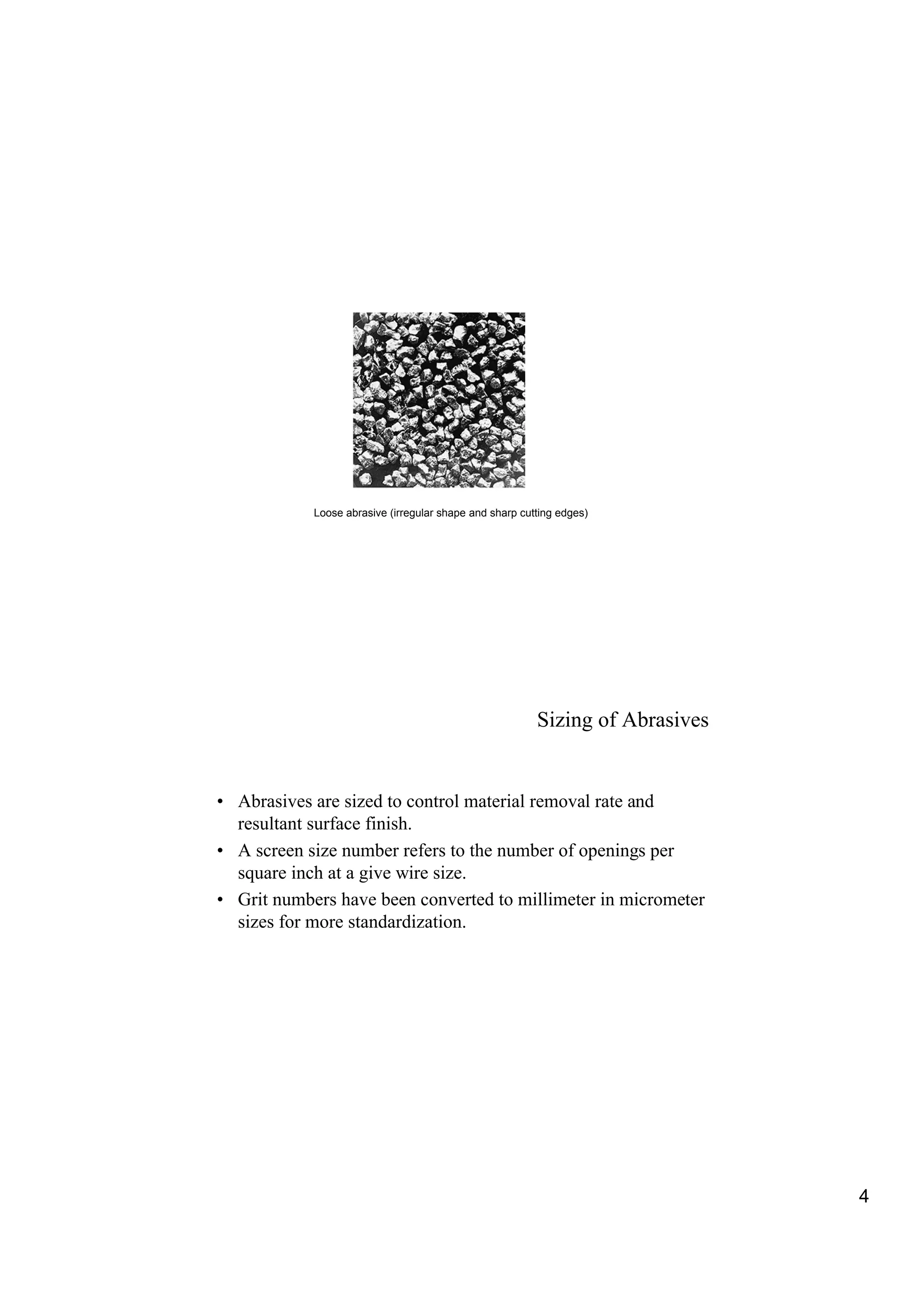
Loose abrasive (irregular shape and sharp cutting edges)


                                                         Sizing of Abrasives


• Abrasives are sized to control material removal rate and
  resultant surface finish.
• A screen size number refers to the number of openings per
  square inch at a give wire size.
• Grit numbers have been converted to millimeter in micrometer
  sizes for more standardization.


                                                                               4
Surface Finish versus Grit Size


                                                 Grit Geometry


• Abrasive grains are not uniform in shape and are randomly
  distributed across the surface.
• Not all grains cut at the optimum angle but due to distribution,
  the grinding surface is designed to the average distribution.
• Chips either cut, plow or rub on the surface.
• Grit density determines the chip loading.
• As grit material abrade, fracture, or are dislodged, new grit
  material is exposed, creating a continuous removal rate.


                                                                     5
Rake Angle


The rake angle of abrasive particles can be positive, zero, or negative.


                                                                     Grit Distribution


                                                                                         6
Grit Orientation


The grits interact with the surface in three ways: cutting,
plowing, and rubbing.


                                      Grinding Wheel Structure and Grade


 • Grinding is where the abrasive is bonded into a wheel, and is
   the most common abrasive method.
 • The grade of a wheel is a function of the rate of fracture of the
   abrasive from the surface.
 • A wheel is graded as hard if the dislodging force is high and
   soft if the abrasive dislodging force is small


                                                                                 7
G Ratio

•   The G ratio is defined as the ratio of workpiece material removed to
    grinding wheel material removed. Ratios of 20:1 to 80:1 are common.
•   Wheel performance is influenced by:
    – 1. The mean force required to dislodge a grain from the surface (the
       grade of the wheel)
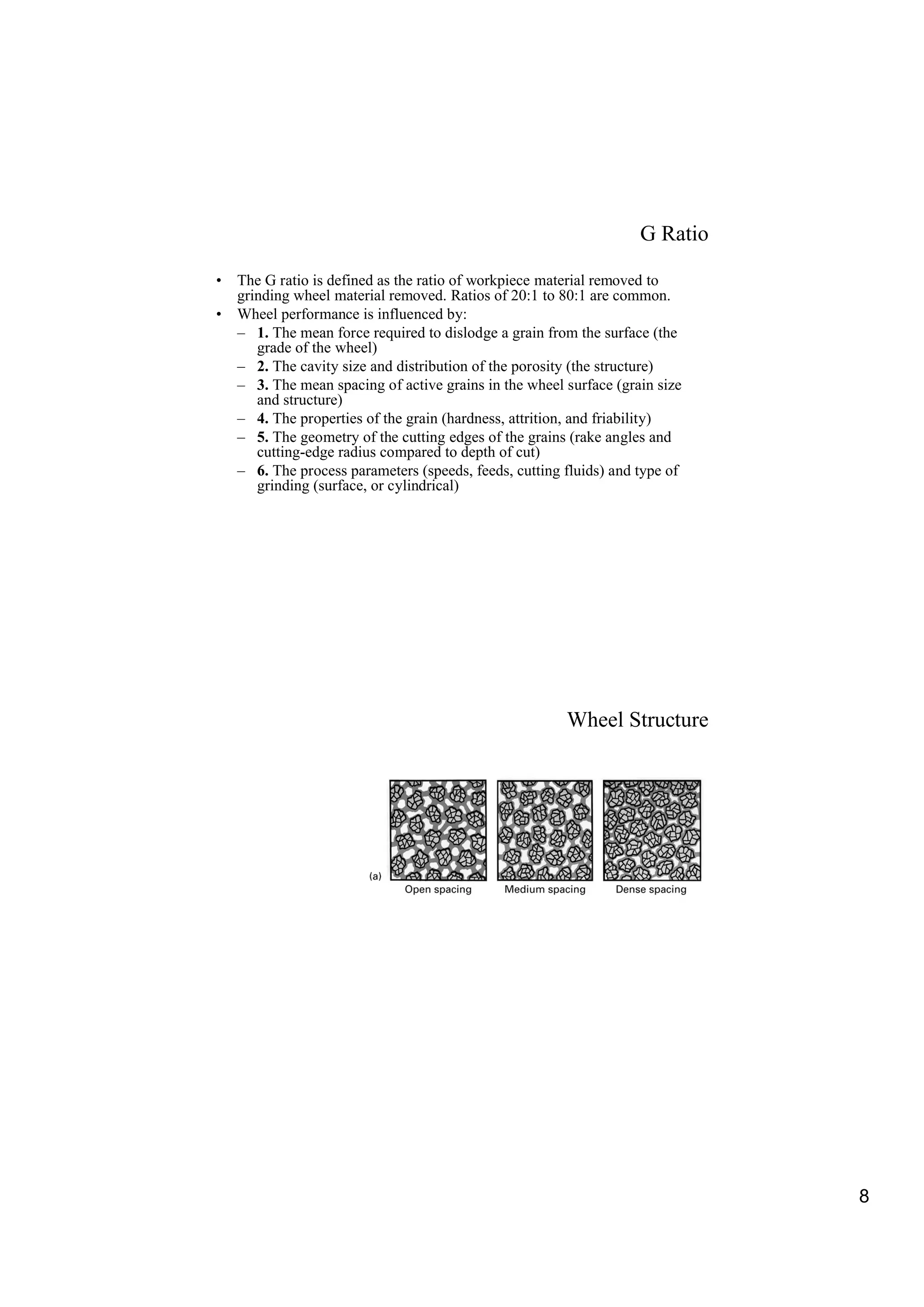
    – 2. The cavity size and distribution of the porosity (the structure)
    – 3. The mean spacing of active grains in the wheel surface (grain size
       and structure)
    – 4. The properties of the grain (hardness, attrition, and friability)
    – 5. The geometry of the cutting edges of the grains (rake angles and
       cutting-edge radius compared to depth of cut)
    – 6. The process parameters (speeds, feeds, cutting fluids) and type of
       grinding (surface, or cylindrical)


                                                        Wheel Structure


                                                                              8
Bonding Materials


•   Bonding materials in common use are the following:
    – 1. Vitrified bonds are composed of clays and other ceramic substances.
    – 2. Resinoid, or phenolic resins are used.
    – 3. Silicate wheels use silicate of soda (waterglass) as the bond material.
    – 4. Shellac-bonded wheels are made by mixing the abrasive grains with
      shellac in a heated mixture
    – 5. Rubber bonding is used to produce wheels that can operate at high
      speeds but must have a considerable degree of flexibility.
    – 6. Superabrasive wheels are either electroplated or a thin segmented
      drum of vitrified CBN surrounds on a steel core.


                           Grinding Wheel Truing and Dressing


• Grinding wheels lose their geometry with use, truing restores
  the original shape.
• Truing grinds a small amount of material to expose new
  grinding media, and new cutting edges on worn glazed grains.
• As grinding wheels are used then tend to become loaded with
  lodged metal chips in the cavities.
• Dressing is used to remove the lodged metal chips.


                                                                                   9
Truing Methods


Truing methods for restoring grinding geometry include nibs, rolls, disks, cups, and blocks.


                                                                                        Dressing


                 Stick dressing versus truing.


                                                                                                   10
Grinding Wheel Identification
 Standard Grinding Wheel Marking System Defined by the American National
  Standards Institute (ANSI).
 This Marking System Uses Numbers and Letters to Specify the FIVE Grinding
  Wheel Parameters (i.e. Abrasive Type, Abrasive Grit Size, Wheel Grade,
  Wheel Structure, and Bond Material).

Marking System for Conventional Grinding Wheels as Defined by ANSI Standard
         B74.13-1977 [ANSI77].


                                                          Z


                                     Grinding Wheel Identification
The ANSI Standard for Diamond and CBN Grinding Wheels is Slightly Different
than for Conventional Wheels.
Table 2 Presents the Marking System for these Newer Grinding Wheels.
TABLE 2: Marking System for Diamond and Cubic Boron Nitride (CBN) Grinding
       Wheels as Defined by ANSI Standard B74.13-1977.


                                                              Z


                                                                               11
Grinding Operations


•   The major use categories are the following:
    – 1. Cutting off: for slicing and slotting parts; use thin wheel, organic bond
    – 2. Cylindrical between centers: grinding outside diameters of cylindrical
       workpieces
    – 3. Cylindrical, centerless: grinding outside diameters with work rotated by
       regulating wheel
    – 4. Internal cylindrical: grinding bores and large holes
    – 5. Snagging:removing large amounts of metal without regard to surface finish or
       tolerances
    – 6. Surface grinding: grinding flat workpieces
    – 7. Tool grinding: for grinding cutting edges on tools such as drills, milling
       cutters, taps, reamers, and single-point high-speed-steel tools
    – 8. Offhand grinding: work or the grinding tool is handheld


                                                 Operational Parameters


•   Grinding Wheel Balance
    – Wheel balance in needed to ensure that vibration will not cause the
       wheel to break
    – Truing will often return a wheel to balance
•   Grinding Safety
    – Wheel accident the result of wheel being turn at too high of rpm
    – Abuse of wheels, such as dropping cause wheel weakness
    – Improver use, such a grinding on the side
    – Improper use of eye sheilds
•   Use of Cutting Fluids
    – Fluids wash away chips
    – Cool the workpiece


                                                                                        12
Grinding Machines


   • Grinding Machines are classified according to the surface they
     produce.


                                             Horizontal Spindle


Horizontal spindle
surface grinder


                                                                      13
Conventional Grinding


     Conventional grinding.


                                         Cylindrical Grinding


• Cylindrical grinding is used to produce external cylindrical
  surfaces
• In cylindrical grinding the workpiece is mounted and rotated
  on a longitudinal axis, the grinding wheel rotate in the same
  axis, but in opposite directions.
• With long workpieces, the workpiece typically is moved
  relative to the wheel.
• With smaller high production parts, a chuck-type external
  grinder is used, and the wheel moves relative to the workpiece.


                                                                    14
Center Grinding


Cylindrical grinding between centers.


                                            Centerless Grinding


  • In centerless grinding the workpiece can be ground internally
    or externally without requiring the material to be mounted in a
    center or chuck.
  • The workpiece rests between two wheels, one providing the
    grinding and the other providing regulation of the grinding
    speed.


                                                                      15
Centerless Grinding


Centerless grinding showing the
relationship among the grinding wheel, the regulating
wheel, and the workpiece in centerless method.


                                       Advantages of Centerless Grinding


 • Centerless grinding has several important advantages:
   – 1. It is very rapid; infeed centerless grinding is almost
     continuous.
   – 2. Very little skill is required of the operator.
   – 3. It can often be made automatic (single-cycle automatic).
   – 4. Where the cutting occurs, the work is fully supported by
     the work rest and the regulating wheel.This permits heavy
     cuts to be made.
   – 5. Because there is no distortion of the workpiece, accurate
     size control is easily achieved.
   – 6. Large grinding wheels can be used, thereby minimizing
     wheel wear.


                                                                              16
Disadvantages of Centerless Grinding


• The major disadvantages are as follows:
  – 1. Special machines are required that can do no other type
    of work.
  – 2. The work must be round—no flats, such as keyways, can
    be present.
  – 3. Its use on work having more than one diameter or on
    curved parts is limited.
  – 4. In grinding tubes, there is no guarantee that the OD and
    Internal Diameter (ID) are concentric.


                                                                Surface Grinding
•   Surface Grinding Machines are used to produce flat surfaces. The four basic types are:
    1. Horizontal spindle and reciprocating table
    2. Vertical spindle and reciprocating table
    3. Horizontal spindle and rotary table
    4. Vertical spindle and rotary table


                                                                                             17
• THANKYOU


             18

Grinding

  • 1.
    Introduction • Abrasive machiningis the process of using abrasive grit to remove material at high cutting speed and shallow depths of penetration. • The abrasive particles may be – free; – mounted in resin on a belt (called coated product); or, most commonly – close packed into wheels or stones, with abrasive grits held together by bonding material (called bonded product or a grinding wheel). Typical Grinding Wheel Surface grinding (infeed and cross feed) [cutting speeds VS and workpiece velocity VW.] 1
  • 2.
    Grinding Parameters Abrasives • An abrasive is a hard material that can cut or abrade other substances • Natural abrasives – sandstone was used by ancient peoples to sharpen tools and weapons. – Emery, a mixture of alumina (Al2O3) and magnetite (Fe3O4), is another natural abrasive still in use today – Corundum (natural Al2O3) and diamonds are other naturally occurring abrasive materials. – Today, the only natural abrasives that have commercial importance are quartz, sand, garnets, and diamonds. 2
  • 3.
    Abrasives • 1891 - silicon carbide (SiC) was first produced (artificial abrasive). • Other artificial abrasives used today include: – Aluminum oxide (Al2O3) is the most widely used artificial abrasive. – Diamonds are the hardest of all materials. Those that are used for abrasives are either natural, off-color stones that are not suitable for gems, or small, synthetic stones that are produced specifically for abrasive purposes. – Cubic boron nitride (CBN) is extremely hard. It is the second-hardest substance created by nature or manufactured and is often referred to, along with diamonds, as a superabrasive. 3
  • 4.
    Loose abrasive (irregularshape and sharp cutting edges) Sizing of Abrasives • Abrasives are sized to control material removal rate and resultant surface finish. • A screen size number refers to the number of openings per square inch at a give wire size. • Grit numbers have been converted to millimeter in micrometer sizes for more standardization. 4
  • 5.
    Surface Finish versusGrit Size Grit Geometry • Abrasive grains are not uniform in shape and are randomly distributed across the surface. • Not all grains cut at the optimum angle but due to distribution, the grinding surface is designed to the average distribution. • Chips either cut, plow or rub on the surface. • Grit density determines the chip loading. • As grit material abrade, fracture, or are dislodged, new grit material is exposed, creating a continuous removal rate. 5
  • 6.
    Rake Angle The rakeangle of abrasive particles can be positive, zero, or negative. Grit Distribution 6
  • 7.
    Grit Orientation The gritsinteract with the surface in three ways: cutting, plowing, and rubbing. Grinding Wheel Structure and Grade • Grinding is where the abrasive is bonded into a wheel, and is the most common abrasive method. • The grade of a wheel is a function of the rate of fracture of the abrasive from the surface. • A wheel is graded as hard if the dislodging force is high and soft if the abrasive dislodging force is small 7
  • 8.
    G Ratio • The G ratio is defined as the ratio of workpiece material removed to grinding wheel material removed. Ratios of 20:1 to 80:1 are common. • Wheel performance is influenced by: – 1. The mean force required to dislodge a grain from the surface (the grade of the wheel) – 2. The cavity size and distribution of the porosity (the structure) – 3. The mean spacing of active grains in the wheel surface (grain size and structure) – 4. The properties of the grain (hardness, attrition, and friability) – 5. The geometry of the cutting edges of the grains (rake angles and cutting-edge radius compared to depth of cut) – 6. The process parameters (speeds, feeds, cutting fluids) and type of grinding (surface, or cylindrical) Wheel Structure 8
  • 9.
    Bonding Materials • Bonding materials in common use are the following: – 1. Vitrified bonds are composed of clays and other ceramic substances. – 2. Resinoid, or phenolic resins are used. – 3. Silicate wheels use silicate of soda (waterglass) as the bond material. – 4. Shellac-bonded wheels are made by mixing the abrasive grains with shellac in a heated mixture – 5. Rubber bonding is used to produce wheels that can operate at high speeds but must have a considerable degree of flexibility. – 6. Superabrasive wheels are either electroplated or a thin segmented drum of vitrified CBN surrounds on a steel core. Grinding Wheel Truing and Dressing • Grinding wheels lose their geometry with use, truing restores the original shape. • Truing grinds a small amount of material to expose new grinding media, and new cutting edges on worn glazed grains. • As grinding wheels are used then tend to become loaded with lodged metal chips in the cavities. • Dressing is used to remove the lodged metal chips. 9
  • 10.
    Truing Methods Truing methodsfor restoring grinding geometry include nibs, rolls, disks, cups, and blocks. Dressing Stick dressing versus truing. 10
  • 11.
    Grinding Wheel Identification Standard Grinding Wheel Marking System Defined by the American National Standards Institute (ANSI).  This Marking System Uses Numbers and Letters to Specify the FIVE Grinding Wheel Parameters (i.e. Abrasive Type, Abrasive Grit Size, Wheel Grade, Wheel Structure, and Bond Material). Marking System for Conventional Grinding Wheels as Defined by ANSI Standard B74.13-1977 [ANSI77]. Z Grinding Wheel Identification The ANSI Standard for Diamond and CBN Grinding Wheels is Slightly Different than for Conventional Wheels. Table 2 Presents the Marking System for these Newer Grinding Wheels. TABLE 2: Marking System for Diamond and Cubic Boron Nitride (CBN) Grinding Wheels as Defined by ANSI Standard B74.13-1977. Z 11
  • 12.
    Grinding Operations • The major use categories are the following: – 1. Cutting off: for slicing and slotting parts; use thin wheel, organic bond – 2. Cylindrical between centers: grinding outside diameters of cylindrical workpieces – 3. Cylindrical, centerless: grinding outside diameters with work rotated by regulating wheel – 4. Internal cylindrical: grinding bores and large holes – 5. Snagging:removing large amounts of metal without regard to surface finish or tolerances – 6. Surface grinding: grinding flat workpieces – 7. Tool grinding: for grinding cutting edges on tools such as drills, milling cutters, taps, reamers, and single-point high-speed-steel tools – 8. Offhand grinding: work or the grinding tool is handheld Operational Parameters • Grinding Wheel Balance – Wheel balance in needed to ensure that vibration will not cause the wheel to break – Truing will often return a wheel to balance • Grinding Safety – Wheel accident the result of wheel being turn at too high of rpm – Abuse of wheels, such as dropping cause wheel weakness – Improver use, such a grinding on the side – Improper use of eye sheilds • Use of Cutting Fluids – Fluids wash away chips – Cool the workpiece 12
  • 13.
    Grinding Machines • Grinding Machines are classified according to the surface they produce. Horizontal Spindle Horizontal spindle surface grinder 13
  • 14.
    Conventional Grinding Conventional grinding. Cylindrical Grinding • Cylindrical grinding is used to produce external cylindrical surfaces • In cylindrical grinding the workpiece is mounted and rotated on a longitudinal axis, the grinding wheel rotate in the same axis, but in opposite directions. • With long workpieces, the workpiece typically is moved relative to the wheel. • With smaller high production parts, a chuck-type external grinder is used, and the wheel moves relative to the workpiece. 14
  • 15.
    Center Grinding Cylindrical grindingbetween centers. Centerless Grinding • In centerless grinding the workpiece can be ground internally or externally without requiring the material to be mounted in a center or chuck. • The workpiece rests between two wheels, one providing the grinding and the other providing regulation of the grinding speed. 15
  • 16.
    Centerless Grinding Centerless grindingshowing the relationship among the grinding wheel, the regulating wheel, and the workpiece in centerless method. Advantages of Centerless Grinding • Centerless grinding has several important advantages: – 1. It is very rapid; infeed centerless grinding is almost continuous. – 2. Very little skill is required of the operator. – 3. It can often be made automatic (single-cycle automatic). – 4. Where the cutting occurs, the work is fully supported by the work rest and the regulating wheel.This permits heavy cuts to be made. – 5. Because there is no distortion of the workpiece, accurate size control is easily achieved. – 6. Large grinding wheels can be used, thereby minimizing wheel wear. 16
  • 17.
    Disadvantages of CenterlessGrinding • The major disadvantages are as follows: – 1. Special machines are required that can do no other type of work. – 2. The work must be round—no flats, such as keyways, can be present. – 3. Its use on work having more than one diameter or on curved parts is limited. – 4. In grinding tubes, there is no guarantee that the OD and Internal Diameter (ID) are concentric. Surface Grinding • Surface Grinding Machines are used to produce flat surfaces. The four basic types are: 1. Horizontal spindle and reciprocating table 2. Vertical spindle and reciprocating table 3. Horizontal spindle and rotary table 4. Vertical spindle and rotary table 17
  • 18.