Surface Finishing Processes
About Surface Finishing
Surface finishing may be defined as any
process that alters the surface of a material
for aesthetic or functional purposes.
Objective :- Improve appearance and sales value
of product.
 The basis material (whose surface is being
altered) can be a metal, a plastic, concrete,
a ceramic; i.e. any material used for
engineering or decorative purposes.
Grinding
Grinding is the most common form of abrasive
machining.
It is a material cutting process which engages an
abrasive tool whose cutting elements are grains
of abrasive material known as grit.
These grits are characterized by sharp cutting
points, high hot hardness, chemical stability and
wear resistance. The grits are held together by
a suitable bonding material to give shape of an
abrasive tool.
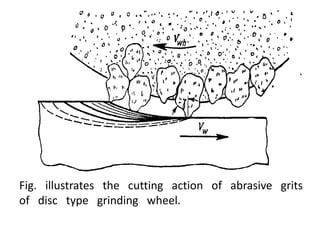
Fig. illustrates the cutting action of abrasive grits
of disc type grinding wheel.
Advantages:-
Dimensional accuracy.
Good surface finish.
Good form and locational accuracy.
Applicable to both hardened and unhardened
material.
Anodizing
Anodizing is the process by which the natural
film on aluminum is greatly increased in
thickness.
The oxide on aluminum is naturally corrosion
resistant, very hard, abrasion resistant, an
insulator and very tenacious. In its natural form
the oxide film on aluminum is less than 0.50
microns thick.
 Because the naturally occurring film is very thin
and attached to a soft ductile metal, it is easily
damaged.
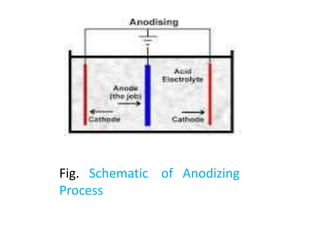
Fig. Schematic of Anodizing
Process
Advantages:-
Protects satellites from the harsh
environment of space.
Provides attractive, minimum-maintenance,
highly durable exteriors, roofs, curtain walls,
ceilings, floors, escalators, lobbies and
staircases in skyscrapers.
Considered environmentally safe, producing
few, if any, harmful effects on land, air, or
water.
Lapping
Lapping is regarded as the oldest method of
obtaining a fine finish.
Lapping is basically an abrasive process in
which loose abrasives function as cutting
points finding momentary support from the
laps.
Material removal in lapping usually ranges
from .003 to .03 mm but many reach 0.08
to 0.1 mm in certain cases.
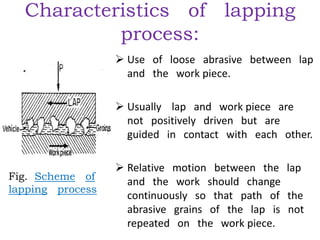
Characteristics of lapping
process:
 Use of loose abrasive between lap
and the work piece.
 Usually lap and work piece are
not positively driven but are
guided in contact with each other.
 Relative motion between the lap
and the work should change
continuously so that path of the
abrasive grains of the lap is not
repeated on the work piece.
Fig. Scheme of
lapping process
Advantages:-
 The Fastest & most accurate method of
achieving flatness with the ultimate degree
of surface finish.
Stress free process without thermal distortion.
Rapid turnaround of work! No fixing or
clamping required facilitating a rapid set up.
Honing
Honing is a finishing process, in which a tool
called hone carries out a combined rotary
and reciprocating motion while the work piece
does not perform any working motion.
The honing process is carried out by
mechanically rubbing the honing stone
(cutting tool) against the work piece surface
(normally internal) along the controlled path.
Fig. (i) Honing
tool
Fig. (ii)
Schematic
of Honing
Process
The abrasive
action of the
honing tool
removes material
from the work
piece's inside
diameter.
The tool rotates
and expands
while the work
piece reciprocates
(stroking) back and
forth.
Advantages:-
Good bore geometry such as roundness,
cylindricity, straightness and surface finish.
Lower friction across the interior surface.
Has a positive impact on productivity, owing
to smoother, faster inner surfaces.
Ensures consistency of dimensions.
PREFERENCES
 Google Images
http://machiningbymorley.wikispac
es.com
http://www.coatfab.com
http://www.ignou.ac.in
http://www.wikipedia.com
THANK YOU!

Surface finishing processes

  • 1.
  • 2.
    About Surface Finishing Surfacefinishing may be defined as any process that alters the surface of a material for aesthetic or functional purposes. Objective :- Improve appearance and sales value of product.  The basis material (whose surface is being altered) can be a metal, a plastic, concrete, a ceramic; i.e. any material used for engineering or decorative purposes.
  • 3.
    Grinding Grinding is themost common form of abrasive machining. It is a material cutting process which engages an abrasive tool whose cutting elements are grains of abrasive material known as grit. These grits are characterized by sharp cutting points, high hot hardness, chemical stability and wear resistance. The grits are held together by a suitable bonding material to give shape of an abrasive tool.
  • 4.
    Fig. illustrates thecutting action of abrasive grits of disc type grinding wheel.
  • 5.
    Advantages:- Dimensional accuracy. Good surfacefinish. Good form and locational accuracy. Applicable to both hardened and unhardened material.
  • 6.
    Anodizing Anodizing is theprocess by which the natural film on aluminum is greatly increased in thickness. The oxide on aluminum is naturally corrosion resistant, very hard, abrasion resistant, an insulator and very tenacious. In its natural form the oxide film on aluminum is less than 0.50 microns thick.  Because the naturally occurring film is very thin and attached to a soft ductile metal, it is easily damaged.
  • 7.
    Fig. Schematic ofAnodizing Process
  • 8.
    Advantages:- Protects satellites fromthe harsh environment of space. Provides attractive, minimum-maintenance, highly durable exteriors, roofs, curtain walls, ceilings, floors, escalators, lobbies and staircases in skyscrapers. Considered environmentally safe, producing few, if any, harmful effects on land, air, or water.
  • 9.
    Lapping Lapping is regardedas the oldest method of obtaining a fine finish. Lapping is basically an abrasive process in which loose abrasives function as cutting points finding momentary support from the laps. Material removal in lapping usually ranges from .003 to .03 mm but many reach 0.08 to 0.1 mm in certain cases.
  • 10.
    Characteristics of lapping process: Use of loose abrasive between lap and the work piece.  Usually lap and work piece are not positively driven but are guided in contact with each other.  Relative motion between the lap and the work should change continuously so that path of the abrasive grains of the lap is not repeated on the work piece. Fig. Scheme of lapping process
  • 11.
    Advantages:-  The Fastest& most accurate method of achieving flatness with the ultimate degree of surface finish. Stress free process without thermal distortion. Rapid turnaround of work! No fixing or clamping required facilitating a rapid set up.
  • 12.
    Honing Honing is afinishing process, in which a tool called hone carries out a combined rotary and reciprocating motion while the work piece does not perform any working motion. The honing process is carried out by mechanically rubbing the honing stone (cutting tool) against the work piece surface (normally internal) along the controlled path.
  • 13.
    Fig. (i) Honing tool Fig.(ii) Schematic of Honing Process The abrasive action of the honing tool removes material from the work piece's inside diameter. The tool rotates and expands while the work piece reciprocates (stroking) back and forth.
  • 14.
    Advantages:- Good bore geometrysuch as roundness, cylindricity, straightness and surface finish. Lower friction across the interior surface. Has a positive impact on productivity, owing to smoother, faster inner surfaces. Ensures consistency of dimensions.
  • 15.
  • 16.