DOMAIN THEORY
This theory was proposed by Weiss 1907. It explains the hysteresis
and the properties of ferromagnetic materials.
Magnetic Domains
 A ferromagnetic material is divided into a large number of small region is called
domains.
 Each domain is spontaneously magnetized.
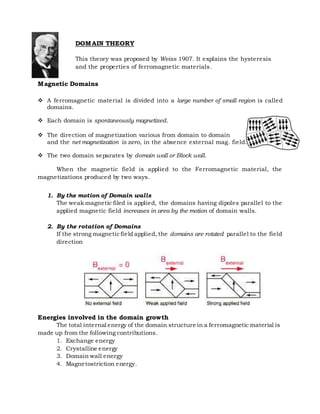
 The direction of magnetization various from domain to domain
and the net magnetization is zero, in the absence external mag. field.
 The two domain separates by domain wall or Block wall.
When the magnetic field is applied to the Ferromagnetic material, the
magnetizations produced by two ways.
1. By the motion of Domain walls
The weak magnetic filed is applied, the domains having dipoles parallel to the
applied magnetic field increases in area by the motion of domain walls.
2. By the rotation of Domains
If the strong magneticfield applied, the domains are rotated parallel to the field
direction
Energies involved in the domain growth
The total internal energy of the domain structure in a ferromagnetic material is
made up from the following contributions.
1. Exchange energy
2. Crystalline energy
3. Domain wall energy
4. Magnetostriction energy.
1. Exchange energy is define, “ The interaction energy which
makes the adjacent dipoles align themselves”
2. Anisotropy energy : In ferromagnetic materials there are two types of
directions of Magnetization namely,
a. Easy direction b. Hard direction
In easy direction of magnetization, weak field can be
applied and in hard direction of magnetization, strong field
should be applied.
For example, in BCC iron the easy direction is [100],
the medium direction is [110], and the hard direction [111].
The energy difference between hard and easy direction to
magnetize the material is about. This energy is very important in determining
the characteristic domain boundaries.
Domain wall energy or Bloch wall energy
Based on the spin alignments, two types of Bloch walls may arise, namely
a. Thick wall :
When the spins at the boundary are misaligned
and if the direction of the spin changes gradually
as shown figure,
b. Thin wall : When the spins at the boundaries
changes abruptly, as shown in fig.
Magnetostriction energy :
When a material is magnetized, it is found that it suffer a change in
dimensions. This phenomenon is known as Magnetostriction. The work done
by the magnetic field against these elastic restoring forces is called magneto-
elastic energy or Magnetosrictive energy.

domain theroy

  • 1.
    DOMAIN THEORY This theorywas proposed by Weiss 1907. It explains the hysteresis and the properties of ferromagnetic materials. Magnetic Domains  A ferromagnetic material is divided into a large number of small region is called domains.  Each domain is spontaneously magnetized.  The direction of magnetization various from domain to domain and the net magnetization is zero, in the absence external mag. field.  The two domain separates by domain wall or Block wall. When the magnetic field is applied to the Ferromagnetic material, the magnetizations produced by two ways. 1. By the motion of Domain walls The weak magnetic filed is applied, the domains having dipoles parallel to the applied magnetic field increases in area by the motion of domain walls. 2. By the rotation of Domains If the strong magneticfield applied, the domains are rotated parallel to the field direction Energies involved in the domain growth The total internal energy of the domain structure in a ferromagnetic material is made up from the following contributions. 1. Exchange energy 2. Crystalline energy 3. Domain wall energy 4. Magnetostriction energy.
  • 2.
    1. Exchange energyis define, “ The interaction energy which makes the adjacent dipoles align themselves” 2. Anisotropy energy : In ferromagnetic materials there are two types of directions of Magnetization namely, a. Easy direction b. Hard direction In easy direction of magnetization, weak field can be applied and in hard direction of magnetization, strong field should be applied. For example, in BCC iron the easy direction is [100], the medium direction is [110], and the hard direction [111]. The energy difference between hard and easy direction to magnetize the material is about. This energy is very important in determining the characteristic domain boundaries. Domain wall energy or Bloch wall energy Based on the spin alignments, two types of Bloch walls may arise, namely a. Thick wall : When the spins at the boundary are misaligned and if the direction of the spin changes gradually as shown figure, b. Thin wall : When the spins at the boundaries changes abruptly, as shown in fig. Magnetostriction energy : When a material is magnetized, it is found that it suffer a change in dimensions. This phenomenon is known as Magnetostriction. The work done by the magnetic field against these elastic restoring forces is called magneto- elastic energy or Magnetosrictive energy.