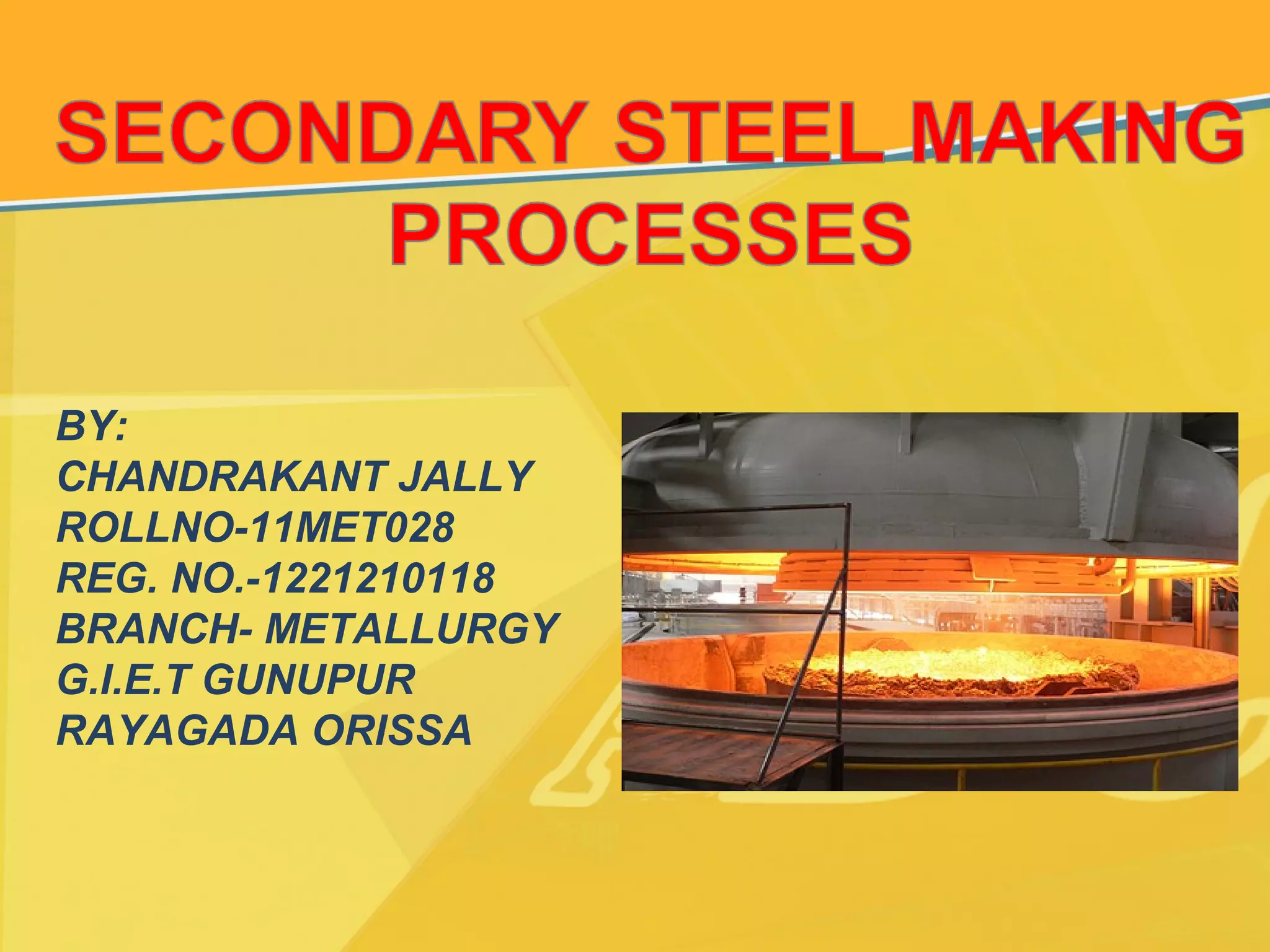
BY:
CHANDRAKANT JALLY
ROLLNO-11MET028
REG. NO.-1221210118
BRANCH- METALLURGY
G.I.E.T GUNUPUR
RAYAGADA ORISSA
1. INTRODUCTION OF STEEL
2. TYPES OF STEEL
3. STEEL MAKING ROUTES
4. SECONDARY STEEL MAKING
PROCESSES
(I)AOD PROCESS
(II)VOD PROCESS
(iii)CLU PROCESS
(iv)LADLE FURNACE
5. RH DEGASSER TECHNIQUE
What is
Steel is an alloy of Iron and Carbon containing less than 2% carbon.
Commonly used automotive and construction steels contain 0.05 – 0.5 % C
Modern steels often contain additional elements for improved properties
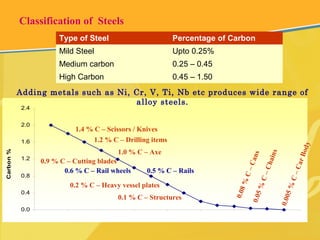
0.0
0.4
0.8
1.2
1.6
2.0
2.4
0 2 4 6 8 10 12 14 16
Carbon%
Classification of Steels
Type of Steel Percentage of Carbon
Mild Steel Upto 0.25%
Medium carbon 0.25 – 0.45
High Carbon 0.45 – 1.50
Adding metals such as Ni, Cr, V, Ti, Nb etc produces wide range of
alloy steels.
1.4 % C – Scissors / Knives
1.2 % C – Drilling items
1.0 % C – Axe
0.9 % C – Cutting blades
0.6 % C – Rail wheels 0.5 % C – Rails
0.2 % C – Heavy vessel plates
0.1 % C – Structures
0.08%C–Cans0.05%C–Chains
0.005%C–CarBody
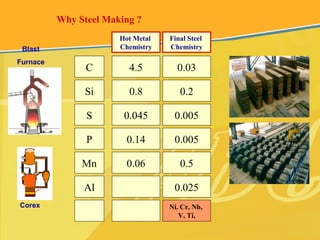
Why Steel Making ?
Blast
Furnace
Corex
Hot Metal
Chemistry
Final Steel
Chemistry
C 4.5 0.03
Si 0.8 0.2
S 0.045 0.005
Mn 0.06 0.5
Al 0.025
Ni. Cr, Nb,
V, Ti,
P 0.14 0.005
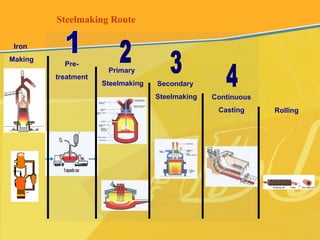
Steelmaking Route
Pre-
treatment
Primary
Steelmaking Secondary
Steelmaking Continuous
Casting Rolling
Iron
Making
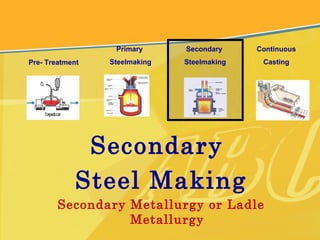
Secondary
Steel Making
Secondary Metallurgy or Ladle
Metallurgy
Pre- Treatment
Primary
Steelmaking
Secondary
Steelmaking
Continuous
Casting
Objectives of secondary steelmaking
 De-oxidation -Removal of Oxygen
 Desulphurization -To sulfur concentrations as low as
0.002%
 Alloying -Addition of alloying elements
 Micro cleanliness -Removal of nonmetallic inclusions
 Inclusion morphology -Changing the composition of
remaining impurities to improve the microstructure of
the steel
 Superheat Control - + / -5 degree C
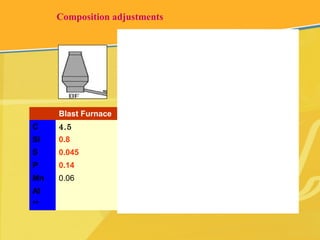
Composition adjustments
Blast Furnace Pre-Treatment Converter Caster
C 4.5 4.2 0.045 0.03
Si 0.8 0.15 0.005 0.20
S 0.045 0.010 0.010 0.005
P 0.14 0.010 0.010 0.005
Mn 0.06 0.05 0.01 0.50
Al 0.025
** Ni, Cr, Nb, V, T
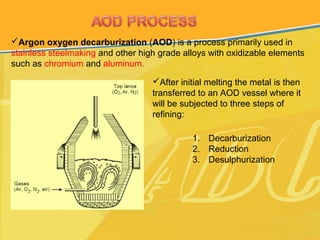
Argon oxygen decarburization (AOD) is a process primarily used in
stainless steelmaking and other high grade alloys with oxidizable elements
such as chromium and aluminum.
After initial melting the metal is then
transferred to an AOD vessel where it
will be subjected to three steps of
refining:
1. Decarburization
2. Reduction
3. Desulphurization
Decarburization:
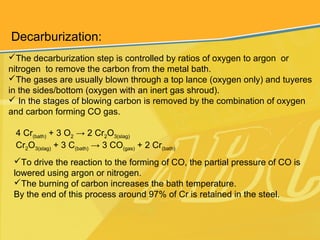
The decarburization step is controlled by ratios of oxygen to argon or
nitrogen to remove the carbon from the metal bath.
The gases are usually blown through a top lance (oxygen only) and tuyeres
in the sides/bottom (oxygen with an inert gas shroud).
 In the stages of blowing carbon is removed by the combination of oxygen
and carbon forming CO gas.
4 Cr(bath) + 3 O2 → 2 Cr2O3(slag)
Cr2O3(slag) + 3 C(bath) → 3 CO(gas) + 2 Cr(bath)
To drive the reaction to the forming of CO, the partial pressure of CO is
lowered using argon or nitrogen.
The burning of carbon increases the bath temperature.
By the end of this process around 97% of Cr is retained in the steel.
Reduction:
after a desired carbon and temperature level have been reached the
process moves to reduction.
 Reduction recovers the oxidized elements such as chromium from the
slag.
To achieve this, alloy additions are made with elements that have a higher
affinity for oxygen than chromium, using either a silicon alloy or aluminum.
The reduction mix also includes lime (CaO) and fluorspar (CaF2).
 The addition of lime and fluorspar help with driving the reduction of Cr2O3
and managing the slag, keeping the slag fluid and volume small.
Desulphurization:
Desulphurization is achieved by having a high lime concentration in the
slag and a low oxygen activity in the metal bath.
S(bath)
+ CaO(slag)
→ CaS(slag)
+ O(bath)
So, additions of lime are added to dilute sulfur in the metal bath. Also,
aluminum or silicon may be added to remove oxygen.
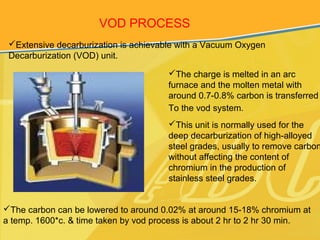
VOD PROCESS
Extensive decarburization is achievable with a Vacuum Oxygen
Decarburization (VOD) unit.
The charge is melted in an arc
furnace and the molten metal with
around 0.7-0.8% carbon is transferred
To the vod system.
This unit is normally used for the
deep decarburization of high-alloyed
steel grades, usually to remove carbon
without affecting the content of
chromium in the production of
stainless steel grades.
The carbon can be lowered to around 0.02% at around 15-18% chromium at
a temp. 1600*c. & time taken by vod process is about 2 hr to 2 hr 30 min.
ADVANTAGES:
Extensive decarburization with low chromium losses.
Flexibility to use high carbon alloying materials of lower cost.
High rate of chromium recovery by proper additions.
Chemical heating of liquid steel.
Improved conditions for desulfurization by proper additions.
Improved conditions for Inclusion flotation.
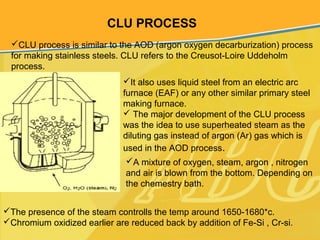
CLU PROCESS
CLU process is similar to the AOD (argon oxygen decarburization) process
for making stainless steels. CLU refers to the Creusot-Loire Uddeholm
process.
It also uses liquid steel from an electric arc
furnace (EAF) or any other similar primary steel
making furnace.
 The major development of the CLU process
was the idea to use superheated steam as the
diluting gas instead of argon (Ar) gas which is
used in the AOD process.
The presence of the steam controlls the temp around 1650-1680*c.
Chromium oxidized earlier are reduced back by addition of Fe-Si , Cr-si.
A mixture of oxygen, steam, argon , nitrogen
and air is blown from the bottom. Depending on
the chemestry bath.
H2O (g) + 241.9 kJ/mol = H2 (g) + 0.5 O2 (g)
The steam dissociates in the steel, and the hydrogen (H2) acts as a
flushing gas in the same way as Ar in the AOD process, and
the O2 acts as a refining medium.
The process the steel bath. This helps in controlling the temperature of the
steel bath. of dissociation of steam is endothermic and takes heat from
the steel bath. This helps in controlling the temperature of the steel bath.
ADVANTAGES
The possibility of controlling the temperature during the decarburization.
The cost of dilution gas is low.
The process uses low priced ferrochromium (Fe-Cr) with high Si and C
contents.
The low operating temperature.
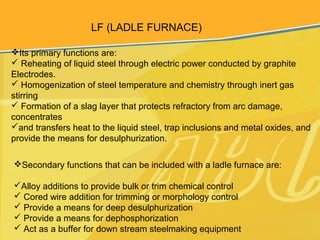
LF (LADLE FURNACE)
Its primary functions are:
 Reheating of liquid steel through electric power conducted by graphite
Electrodes.
 Homogenization of steel temperature and chemistry through inert gas
stirring
 Formation of a slag layer that protects refractory from arc damage,
concentrates
and transfers heat to the liquid steel, trap inclusions and metal oxides, and
provide the means for desulphurization.
Secondary functions that can be included with a ladle furnace are:
Alloy additions to provide bulk or trim chemical control
 Cored wire addition for trimming or morphology control
 Provide a means for deep desulphurization
 Provide a means for dephosphorization
 Act as a buffer for down stream steelmaking equipment
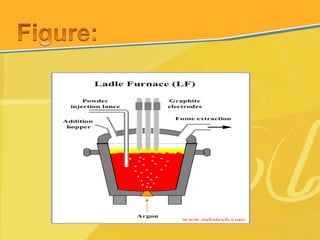
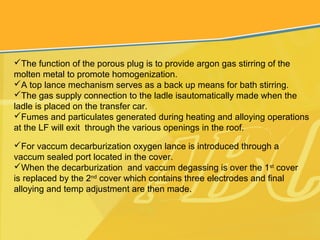
The function of the porous plug is to provide argon gas stirring of the
molten metal to promote homogenization.
A top lance mechanism serves as a back up means for bath stirring.
The gas supply connection to the ladle isautomatically made when the
ladle is placed on the transfer car.
Fumes and particulates generated during heating and alloying operations
at the LF will exit through the various openings in the roof.
For vaccum decarburization oxygen lance is introduced through a
vaccum sealed port located in the cover.
When the decarburization and vaccum degassing is over the 1st
cover
is replaced by the 2nd
cover which contains three electrodes and final
alloying and temp adjustment are then made.
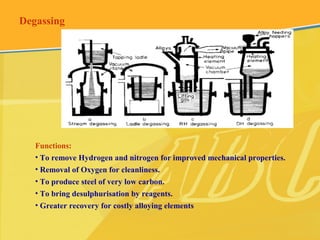
Degassing
Functions:
• To remove Hydrogen and nitrogen for improved mechanical properties.
• Removal of Oxygen for cleanliness.
• To produce steel of very low carbon.
• To bring desulphurisation by reagents.
• Greater recovery for costly alloying elements
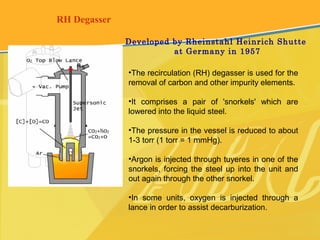
RH Degasser
•The recirculation (RH) degasser is used for the
removal of carbon and other impurity elements.
•It comprises a pair of 'snorkels' which are
lowered into the liquid steel.
•The pressure in the vessel is reduced to about
1-3 torr (1 torr = 1 mmHg).
•Argon is injected through tuyeres in one of the
snorkels, forcing the steel up into the unit and
out again through the other snorkel.
•In some units, oxygen is injected through a
lance in order to assist decarburization.
Developed by Rheinstahl Heinrich Shutte
at Germany in 1957
Secondary steel making processes

Secondary steel making processes

  • 1.
  • 2.
    1. INTRODUCTION OFSTEEL 2. TYPES OF STEEL 3. STEEL MAKING ROUTES 4. SECONDARY STEEL MAKING PROCESSES (I)AOD PROCESS (II)VOD PROCESS (iii)CLU PROCESS (iv)LADLE FURNACE 5. RH DEGASSER TECHNIQUE
  • 3.
    What is Steel isan alloy of Iron and Carbon containing less than 2% carbon. Commonly used automotive and construction steels contain 0.05 – 0.5 % C Modern steels often contain additional elements for improved properties
  • 4.
    0.0 0.4 0.8 1.2 1.6 2.0 2.4 0 2 46 8 10 12 14 16 Carbon% Classification of Steels Type of Steel Percentage of Carbon Mild Steel Upto 0.25% Medium carbon 0.25 – 0.45 High Carbon 0.45 – 1.50 Adding metals such as Ni, Cr, V, Ti, Nb etc produces wide range of alloy steels. 1.4 % C – Scissors / Knives 1.2 % C – Drilling items 1.0 % C – Axe 0.9 % C – Cutting blades 0.6 % C – Rail wheels 0.5 % C – Rails 0.2 % C – Heavy vessel plates 0.1 % C – Structures 0.08%C–Cans0.05%C–Chains 0.005%C–CarBody
  • 5.
    Why Steel Making? Blast Furnace Corex Hot Metal Chemistry Final Steel Chemistry C 4.5 0.03 Si 0.8 0.2 S 0.045 0.005 Mn 0.06 0.5 Al 0.025 Ni. Cr, Nb, V, Ti, P 0.14 0.005
  • 6.
  • 7.
    Secondary Steel Making Secondary Metallurgyor Ladle Metallurgy Pre- Treatment Primary Steelmaking Secondary Steelmaking Continuous Casting
  • 8.
    Objectives of secondarysteelmaking  De-oxidation -Removal of Oxygen  Desulphurization -To sulfur concentrations as low as 0.002%  Alloying -Addition of alloying elements  Micro cleanliness -Removal of nonmetallic inclusions  Inclusion morphology -Changing the composition of remaining impurities to improve the microstructure of the steel  Superheat Control - + / -5 degree C
  • 9.
    Composition adjustments Blast FurnacePre-Treatment Converter Caster C 4.5 4.2 0.045 0.03 Si 0.8 0.15 0.005 0.20 S 0.045 0.010 0.010 0.005 P 0.14 0.010 0.010 0.005 Mn 0.06 0.05 0.01 0.50 Al 0.025 ** Ni, Cr, Nb, V, T
  • 10.
    Argon oxygen decarburization(AOD) is a process primarily used in stainless steelmaking and other high grade alloys with oxidizable elements such as chromium and aluminum. After initial melting the metal is then transferred to an AOD vessel where it will be subjected to three steps of refining: 1. Decarburization 2. Reduction 3. Desulphurization
  • 11.
    Decarburization: The decarburization stepis controlled by ratios of oxygen to argon or nitrogen to remove the carbon from the metal bath. The gases are usually blown through a top lance (oxygen only) and tuyeres in the sides/bottom (oxygen with an inert gas shroud).  In the stages of blowing carbon is removed by the combination of oxygen and carbon forming CO gas. 4 Cr(bath) + 3 O2 → 2 Cr2O3(slag) Cr2O3(slag) + 3 C(bath) → 3 CO(gas) + 2 Cr(bath) To drive the reaction to the forming of CO, the partial pressure of CO is lowered using argon or nitrogen. The burning of carbon increases the bath temperature. By the end of this process around 97% of Cr is retained in the steel.
  • 12.
    Reduction: after a desiredcarbon and temperature level have been reached the process moves to reduction.  Reduction recovers the oxidized elements such as chromium from the slag. To achieve this, alloy additions are made with elements that have a higher affinity for oxygen than chromium, using either a silicon alloy or aluminum. The reduction mix also includes lime (CaO) and fluorspar (CaF2).  The addition of lime and fluorspar help with driving the reduction of Cr2O3 and managing the slag, keeping the slag fluid and volume small. Desulphurization: Desulphurization is achieved by having a high lime concentration in the slag and a low oxygen activity in the metal bath. S(bath) + CaO(slag) → CaS(slag) + O(bath) So, additions of lime are added to dilute sulfur in the metal bath. Also, aluminum or silicon may be added to remove oxygen.
  • 13.
    VOD PROCESS Extensive decarburizationis achievable with a Vacuum Oxygen Decarburization (VOD) unit. The charge is melted in an arc furnace and the molten metal with around 0.7-0.8% carbon is transferred To the vod system. This unit is normally used for the deep decarburization of high-alloyed steel grades, usually to remove carbon without affecting the content of chromium in the production of stainless steel grades. The carbon can be lowered to around 0.02% at around 15-18% chromium at a temp. 1600*c. & time taken by vod process is about 2 hr to 2 hr 30 min.
  • 14.
    ADVANTAGES: Extensive decarburization withlow chromium losses. Flexibility to use high carbon alloying materials of lower cost. High rate of chromium recovery by proper additions. Chemical heating of liquid steel. Improved conditions for desulfurization by proper additions. Improved conditions for Inclusion flotation.
  • 15.
    CLU PROCESS CLU processis similar to the AOD (argon oxygen decarburization) process for making stainless steels. CLU refers to the Creusot-Loire Uddeholm process. It also uses liquid steel from an electric arc furnace (EAF) or any other similar primary steel making furnace.  The major development of the CLU process was the idea to use superheated steam as the diluting gas instead of argon (Ar) gas which is used in the AOD process. The presence of the steam controlls the temp around 1650-1680*c. Chromium oxidized earlier are reduced back by addition of Fe-Si , Cr-si. A mixture of oxygen, steam, argon , nitrogen and air is blown from the bottom. Depending on the chemestry bath.
  • 16.
    H2O (g) +241.9 kJ/mol = H2 (g) + 0.5 O2 (g) The steam dissociates in the steel, and the hydrogen (H2) acts as a flushing gas in the same way as Ar in the AOD process, and the O2 acts as a refining medium. The process the steel bath. This helps in controlling the temperature of the steel bath. of dissociation of steam is endothermic and takes heat from the steel bath. This helps in controlling the temperature of the steel bath. ADVANTAGES The possibility of controlling the temperature during the decarburization. The cost of dilution gas is low. The process uses low priced ferrochromium (Fe-Cr) with high Si and C contents. The low operating temperature.
  • 17.
    LF (LADLE FURNACE) Itsprimary functions are:  Reheating of liquid steel through electric power conducted by graphite Electrodes.  Homogenization of steel temperature and chemistry through inert gas stirring  Formation of a slag layer that protects refractory from arc damage, concentrates and transfers heat to the liquid steel, trap inclusions and metal oxides, and provide the means for desulphurization. Secondary functions that can be included with a ladle furnace are: Alloy additions to provide bulk or trim chemical control  Cored wire addition for trimming or morphology control  Provide a means for deep desulphurization  Provide a means for dephosphorization  Act as a buffer for down stream steelmaking equipment
  • 19.
    The function ofthe porous plug is to provide argon gas stirring of the molten metal to promote homogenization. A top lance mechanism serves as a back up means for bath stirring. The gas supply connection to the ladle isautomatically made when the ladle is placed on the transfer car. Fumes and particulates generated during heating and alloying operations at the LF will exit through the various openings in the roof. For vaccum decarburization oxygen lance is introduced through a vaccum sealed port located in the cover. When the decarburization and vaccum degassing is over the 1st cover is replaced by the 2nd cover which contains three electrodes and final alloying and temp adjustment are then made.
  • 20.
    Degassing Functions: • To removeHydrogen and nitrogen for improved mechanical properties. • Removal of Oxygen for cleanliness. • To produce steel of very low carbon. • To bring desulphurisation by reagents. • Greater recovery for costly alloying elements
  • 21.
    RH Degasser •The recirculation(RH) degasser is used for the removal of carbon and other impurity elements. •It comprises a pair of 'snorkels' which are lowered into the liquid steel. •The pressure in the vessel is reduced to about 1-3 torr (1 torr = 1 mmHg). •Argon is injected through tuyeres in one of the snorkels, forcing the steel up into the unit and out again through the other snorkel. •In some units, oxygen is injected through a lance in order to assist decarburization. Developed by Rheinstahl Heinrich Shutte at Germany in 1957