Phase Diagrams
Contents 
• Definitions and basic concepts: 
 Component 
 System 
 Phases 
 Solubility limit 
 Microstructure 
 Phase Equilibrium 
• Phase Diagram 
• Interpretation of phase diagram
Contents 
• Lever’s Rule 
• Eutectic Reactions 
• Eutectoid Reactions 
• Peritectic Reactions 
• Cu-Ni Phase Diagram 
• Pb-Sn Phase Diagram 
• Al-Si Phase Diagram 
• Iron-Iron Carbide Diagram
Component and System 
• A component is defined as pure metals of 
which an alloy is composed. 
• A component is chemically recognizable, e.g. 
Fe and C are the components in carbon steel. 
• A binary alloy contains two components, and 
a ternary alloys contain three. 
• A system may relate to the series of possible 
alloys consisting of same components, but 
without regard to alloy composition.
Phase 
• A phase is defined as a homogenous portion 
of the system having uniform physical and 
chemical characteristics. 
• Every pure material is considered to be a 
single phase. 
• Each phase is separated by phase boundaries. 
• A phase may contain one or two component. 
• A single phase system is called as homogenous 
and systems with two or more phases are 
heterogeneous systems.
Solubility Limit 
• A maximum amount of solute that can be 
dissolved in the solvent to form a solid 
solution is termed as solubility limit. 
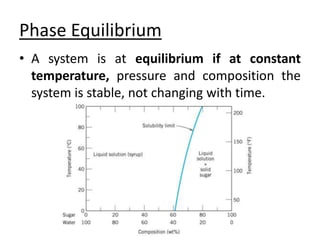
• For example, alcohol has unlimited solubility 
in water, sugar has limited solubility, and oil is 
insoluble in water. 
• Cu and Ni are mutually soluble in any amount, 
while C has limited solubility in Fe. 
• The addition of solute in excess of this limit 
results in the formation of two phase solution.
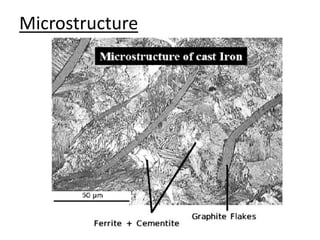
Microstructure 
• Material physical properties and mechanical 
behavior depend on microstructure. 
• The microstructure is specified by the number 
of phases, their proportions, and the manner 
in which they are distributed. 
• The microstructure of an alloy depends on 
a. Alloying elements 
b. Their concentrations and 
c. The grain size (controlled by heat-treatment 
process)
Microstructure
Phase Equilibrium 
• A system is at equilibrium if at constant 
temperature, pressure and composition the 
system is stable, not changing with time.
Phase Diagram 
• A phase diagram is a graphical representation 
of the combinations of temperature, pressure, 
composition, or other variables for which 
specific phases exist at equilibrium. 
• We will discuss phase diagrams for binary 
alloys only and will assume pressure to be 
constant at one atmosphere. 
• The mechanical properties of engineering 
materials depend strongly upon 
microstructure.
Phase Diagram 
• The purpose of phase diagram is to develop an 
understanding of the phase transformations, 
which occur under conditions of slow cooling 
• Using phase diagrams, we can easily predict 
the effects of compositional changes. 
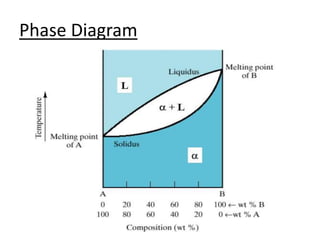
• Consider two components A and B, showing 
complete solid solubility both in liquid as well 
as solid state.
Phase Diagram
Phase Diagram 
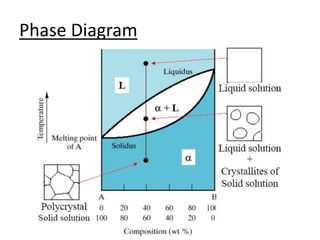
• Three phase region can be identified on the 
phase diagram; 
1. Liquid (L) 
2. solid + liquid (α +L) 
3. solid (α ) 
• Liquidus line separates liquid region from 
(liquid + solid) region, above this line there lies 
only liquid solution. 
• Solidus line separates solid region from (liquid 
+ solid) region, below this line only solid 
solution is present.
Phase Diagram
Interpretation of Phase Diagram 
For a given temperature and composition we 
can use phase diagrams to determine: 
1) The phases that are present 
2) Composition of the each phase 
3) The relative fractions of the phases
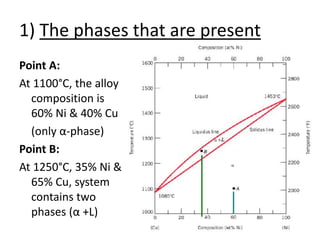
1) The phases that are present 
Point A: 
At 1100°C, the alloy 
composition is 
60% Ni & 40% Cu 
(only α-phase) 
Point B: 
At 1250°C, 35% Ni & 
65% Cu, system 
contains two 
phases (α +L)
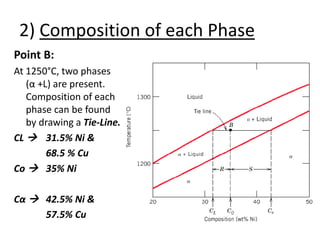
2) Composition of each Phase 
Point B: 
At 1250°C, two phases 
(α +L) are present. 
Composition of each 
phase can be found 
by drawing a Tie-Line. 
CL  31.5% Ni & 
68.5 % Cu 
Co  35% Ni 
Cα  42.5% Ni & 
57.5% Cu
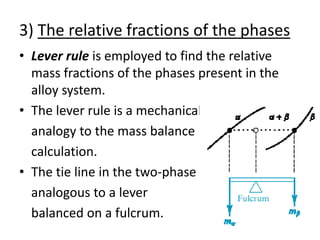
3) The relative fractions of the phases 
• Lever rule is employed to find the relative 
mass fractions of the phases present in the 
alloy system. 
• The lever rule is a mechanical 
analogy to the mass balance 
calculation. 
• The tie line in the two-phase region is 
analogous to a lever 
balanced on a fulcrum.
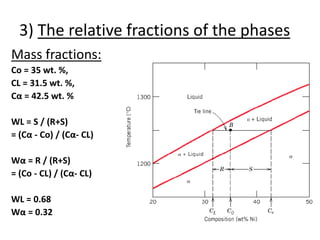
3) The relative fractions of the phases 
Mass fractions: 
Co = 35 wt. %, 
CL = 31.5 wt. %, 
Cα = 42.5 wt. % 
WL = S / (R+S) 
= (Cα - Co) / (Cα- CL) 
Wα = R / (R+S) 
= (Co - CL) / (Cα- CL) 
WL = 0.68 
Wα = 0.32
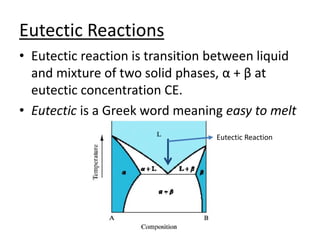
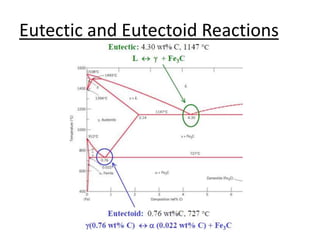
Eutectic Reactions 
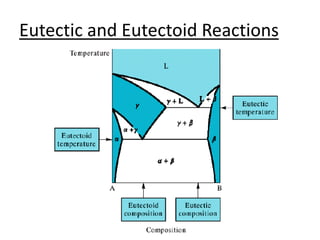
• Eutectic reaction is transition between liquid 
and mixture of two solid phases, α + β at 
eutectic concentration CE. 
• Eutectic is a Greek word meaning easy to melt 
Eutectic Reaction
Eutectoid Reactions 
• The eutectoid (eutectic-like in Greek) reaction 
is similar to the eutectic reaction but occurs 
from one solid phase to two new solid phases. 
• Upon cooling, a solid phase transforms into 
two other solid phases (γ ↔ α + β)
Eutectic and Eutectoid Reactions
Peritectic Reactions 
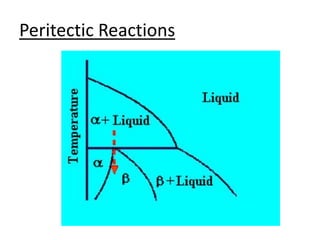
• A Peritectic reaction occurs when a solid and 
liquid phase will together form a second solid 
phase at a particular temperature and 
composition upon cooling as, 
L + α ↔ β 
• Peritectic reactions are not as common as 
eutectics and eutectoids, but they do occur in 
some alloy systems. 
• There is one in the Fe-C system
Peritectic Reactions
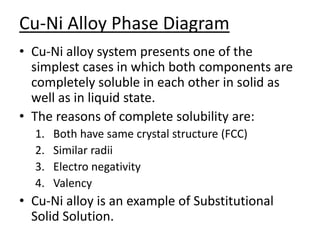
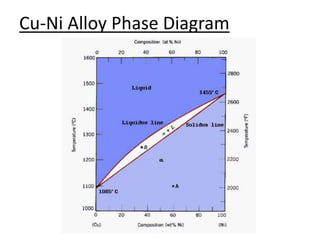
Cu-Ni Alloy Phase Diagram 
• Cu-Ni alloy system presents one of the 
simplest cases in which both components are 
completely soluble in each other in solid as 
well as in liquid state. 
• The reasons of complete solubility are: 
1. Both have same crystal structure (FCC) 
2. Similar radii 
3. Electro negativity 
4. Valency 
• Cu-Ni alloy is an example of Substitutional 
Solid Solution.
Cu-Ni Alloy Phase Diagram
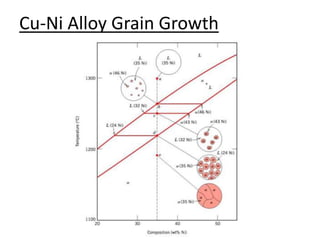
Cu-Ni Alloy Grain Growth
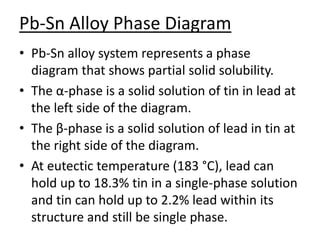
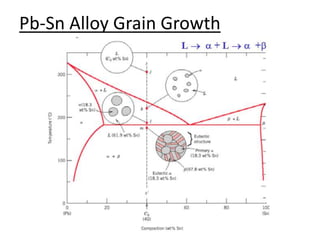
Pb-Sn Alloy Phase Diagram 
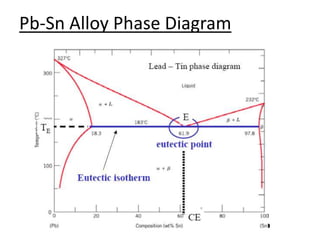
• Pb-Sn alloy system represents a phase 
diagram that shows partial solid solubility. 
• The α-phase is a solid solution of tin in lead at 
the left side of the diagram. 
• The β-phase is a solid solution of lead in tin at 
the right side of the diagram. 
• At eutectic temperature (183 °C), lead can 
hold up to 18.3% tin in a single-phase solution 
and tin can hold up to 2.2% lead within its 
structure and still be single phase.
Pb-Sn Alloy Phase Diagram
Pb-Sn Alloy Phase Diagram 
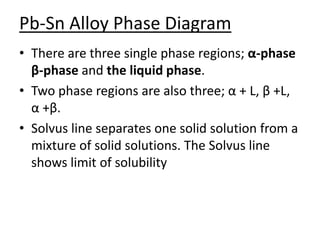
• There are three single phase regions; α-phase 
β-phase and the liquid phase. 
• Two phase regions are also three; α + L, β +L, 
α +β. 
• Solvus line separates one solid solution from a 
mixture of solid solutions. The Solvus line 
shows limit of solubility
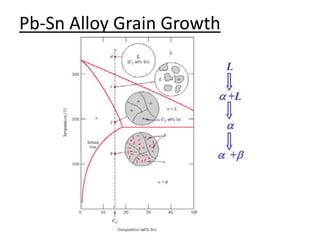
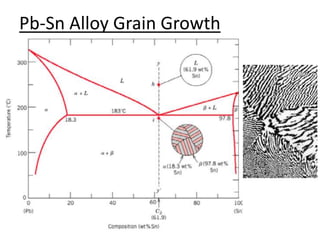
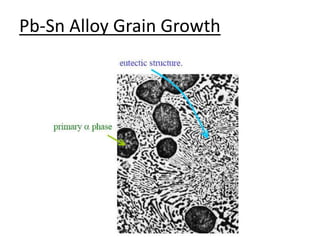
Pb-Sn Alloy Grain Growth
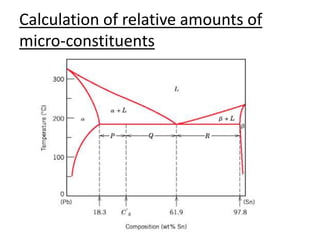
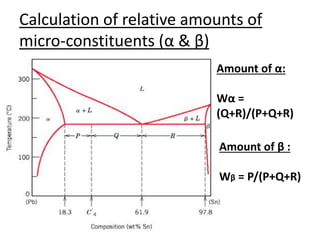
Calculation of relative amounts of 
micro-constituents
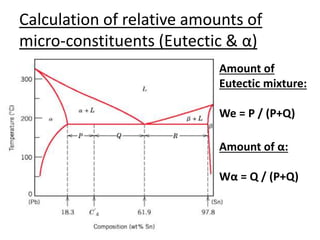
Calculation of relative amounts of 
micro-constituents (Eutectic & α) 
Amount of 
Eutectic mixture: 
We = P / (P+Q) 
Amount of α: 
Wα = Q / (P+Q)
Calculation of relative amounts of 
micro-constituents (α & β) 
Amount of α: 
Wα = 
(Q+R)/(P+Q+R) 
Amount of β : 
Wβ = P/(P+Q+R)
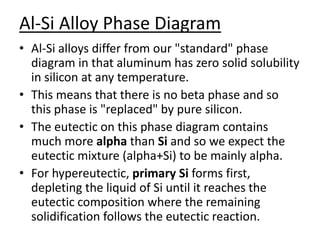
Al-Si Alloy Phase Diagram 
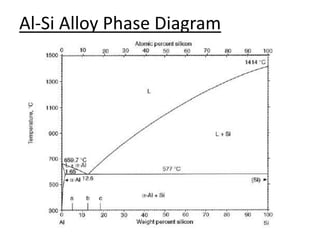
• Al-Si alloys differ from our "standard" phase 
diagram in that aluminum has zero solid solubility 
in silicon at any temperature. 
• This means that there is no beta phase and so 
this phase is "replaced" by pure silicon. 
• The eutectic on this phase diagram contains 
much more alpha than Si and so we expect the 
eutectic mixture (alpha+Si) to be mainly alpha. 
• For hypereutectic, primary Si forms first, 
depleting the liquid of Si until it reaches the 
eutectic composition where the remaining 
solidification follows the eutectic reaction.
Al-Si Alloy Phase Diagram
Fe-Fe3C Phase Diagram
Single Phase Regions in Fe-Fe3C Phase 
Diagram 
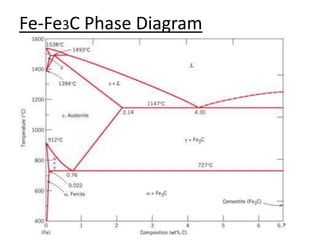
1. Fe-C liquid solution 
2. α-ferrite - solid solution of C in BCC Fe 
o Stable form of iron at room temperature. 
o The maximum solubility of C is 0.022 wt% 
o Transforms to FCC γ-austenite at 912 °C 
3. γ-austenite - solid solution of C in FCC Fe 
o The maximum solubility of C is 2.14 wt %. 
o Transforms to BCC δ-ferrite at 1395 °C 
o Is not stable below the eutectoid temperature 
(727 ° C) unless cooled rapidly
Single Phase Regions in Fe-Fe3C Phase 
Diagram 
3. δ-ferrite - solid solution of C in BCC Fe 
o The same structure as α-ferrite 
o Stable only at high T, above 1394 °C 
o Melts at 1538 °C 
4. Fe3C (iron carbide or cementite) 
This intermetallic compound is metastable, 
it remains as a compound indefinitely at room 
T, but decomposes (very slowly, within several 
years) into α-Fe and C (graphite) at 650 - 700 
°C
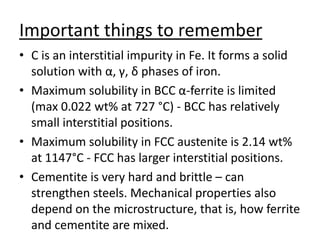
Important things to remember 
• C is an interstitial impurity in Fe. It forms a solid 
solution with α, γ, δ phases of iron. 
• Maximum solubility in BCC α-ferrite is limited 
(max 0.022 wt% at 727 °C) - BCC has relatively 
small interstitial positions. 
• Maximum solubility in FCC austenite is 2.14 wt% 
at 1147°C - FCC has larger interstitial positions. 
• Cementite is very hard and brittle – can 
strengthen steels. Mechanical properties also 
depend on the microstructure, that is, how ferrite 
and cementite are mixed.
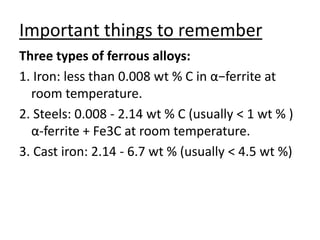
Important things to remember 
Three types of ferrous alloys: 
1. Iron: less than 0.008 wt % C in α−ferrite at 
room temperature. 
2. Steels: 0.008 - 2.14 wt % C (usually < 1 wt % ) 
α-ferrite + Fe3C at room temperature. 
3. Cast iron: 2.14 - 6.7 wt % (usually < 4.5 wt %)
Eutectic and Eutectoid Reactions
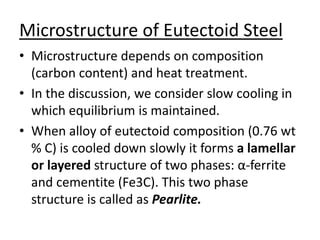
Microstructure of Eutectoid Steel 
• Microstructure depends on composition 
(carbon content) and heat treatment. 
• In the discussion, we consider slow cooling in 
which equilibrium is maintained. 
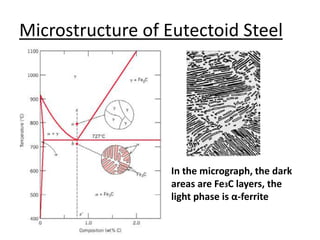
• When alloy of eutectoid composition (0.76 wt 
% C) is cooled down slowly it forms a lamellar 
or layered structure of two phases: α-ferrite 
and cementite (Fe3C). This two phase 
structure is called as Pearlite.
Microstructure of Eutectoid Steel 
In the micrograph, the dark 
areas are Fe3C layers, the 
light phase is α-ferrite
Microstructure of Hypo-eutectoid 
Steel 
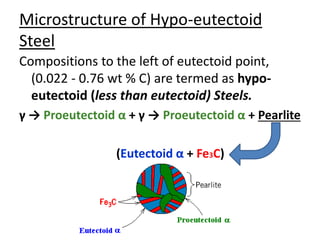
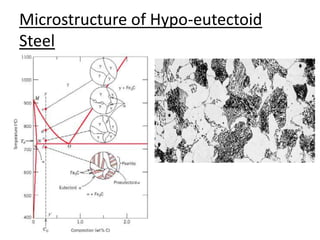
Compositions to the left of eutectoid point, 
(0.022 - 0.76 wt % C) are termed as hypo-eutectoid 
(less than eutectoid) Steels. 
γ → Proeutectoid α + γ → Proeutectoid α + Pearlite 
(Eutectoid α + Fe3C)
Microstructure of Hypo-eutectoid 
Steel
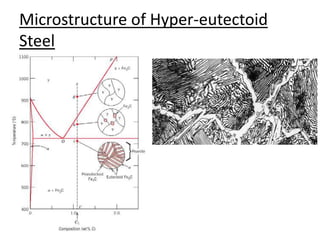
Microstructure of Hyper-eutectoid 
Steel 
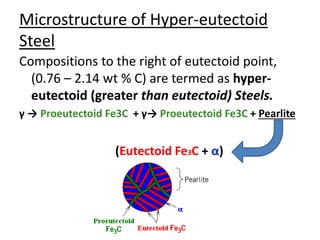
Compositions to the right of eutectoid point, 
(0.76 – 2.14 wt % C) are termed as hyper-eutectoid 
(greater than eutectoid) Steels. 
γ → Proeutectoid Fe3C + γ→ Proeutectoid Fe3C + Pearlite 
(Eutectoid Fe3C + α)
Microstructure of Hyper-eutectoid 
Steel

iron-iron carbide Phase diagrams

  • 1.
  • 2.
    Contents • Definitionsand basic concepts:  Component  System  Phases  Solubility limit  Microstructure  Phase Equilibrium • Phase Diagram • Interpretation of phase diagram
  • 3.
    Contents • Lever’sRule • Eutectic Reactions • Eutectoid Reactions • Peritectic Reactions • Cu-Ni Phase Diagram • Pb-Sn Phase Diagram • Al-Si Phase Diagram • Iron-Iron Carbide Diagram
  • 4.
    Component and System • A component is defined as pure metals of which an alloy is composed. • A component is chemically recognizable, e.g. Fe and C are the components in carbon steel. • A binary alloy contains two components, and a ternary alloys contain three. • A system may relate to the series of possible alloys consisting of same components, but without regard to alloy composition.
  • 5.
    Phase • Aphase is defined as a homogenous portion of the system having uniform physical and chemical characteristics. • Every pure material is considered to be a single phase. • Each phase is separated by phase boundaries. • A phase may contain one or two component. • A single phase system is called as homogenous and systems with two or more phases are heterogeneous systems.
  • 6.
    Solubility Limit •A maximum amount of solute that can be dissolved in the solvent to form a solid solution is termed as solubility limit. • For example, alcohol has unlimited solubility in water, sugar has limited solubility, and oil is insoluble in water. • Cu and Ni are mutually soluble in any amount, while C has limited solubility in Fe. • The addition of solute in excess of this limit results in the formation of two phase solution.
  • 7.
    Microstructure • Materialphysical properties and mechanical behavior depend on microstructure. • The microstructure is specified by the number of phases, their proportions, and the manner in which they are distributed. • The microstructure of an alloy depends on a. Alloying elements b. Their concentrations and c. The grain size (controlled by heat-treatment process)
  • 8.
  • 9.
    Phase Equilibrium •A system is at equilibrium if at constant temperature, pressure and composition the system is stable, not changing with time.
  • 10.
    Phase Diagram •A phase diagram is a graphical representation of the combinations of temperature, pressure, composition, or other variables for which specific phases exist at equilibrium. • We will discuss phase diagrams for binary alloys only and will assume pressure to be constant at one atmosphere. • The mechanical properties of engineering materials depend strongly upon microstructure.
  • 11.
    Phase Diagram •The purpose of phase diagram is to develop an understanding of the phase transformations, which occur under conditions of slow cooling • Using phase diagrams, we can easily predict the effects of compositional changes. • Consider two components A and B, showing complete solid solubility both in liquid as well as solid state.
  • 12.
  • 13.
    Phase Diagram •Three phase region can be identified on the phase diagram; 1. Liquid (L) 2. solid + liquid (α +L) 3. solid (α ) • Liquidus line separates liquid region from (liquid + solid) region, above this line there lies only liquid solution. • Solidus line separates solid region from (liquid + solid) region, below this line only solid solution is present.
  • 14.
  • 15.
    Interpretation of PhaseDiagram For a given temperature and composition we can use phase diagrams to determine: 1) The phases that are present 2) Composition of the each phase 3) The relative fractions of the phases
  • 16.
    1) The phasesthat are present Point A: At 1100°C, the alloy composition is 60% Ni & 40% Cu (only α-phase) Point B: At 1250°C, 35% Ni & 65% Cu, system contains two phases (α +L)
  • 17.
    2) Composition ofeach Phase Point B: At 1250°C, two phases (α +L) are present. Composition of each phase can be found by drawing a Tie-Line. CL  31.5% Ni & 68.5 % Cu Co  35% Ni Cα  42.5% Ni & 57.5% Cu
  • 18.
    3) The relativefractions of the phases • Lever rule is employed to find the relative mass fractions of the phases present in the alloy system. • The lever rule is a mechanical analogy to the mass balance calculation. • The tie line in the two-phase region is analogous to a lever balanced on a fulcrum.
  • 19.
    3) The relativefractions of the phases Mass fractions: Co = 35 wt. %, CL = 31.5 wt. %, Cα = 42.5 wt. % WL = S / (R+S) = (Cα - Co) / (Cα- CL) Wα = R / (R+S) = (Co - CL) / (Cα- CL) WL = 0.68 Wα = 0.32
  • 20.
    Eutectic Reactions •Eutectic reaction is transition between liquid and mixture of two solid phases, α + β at eutectic concentration CE. • Eutectic is a Greek word meaning easy to melt Eutectic Reaction
  • 21.
    Eutectoid Reactions •The eutectoid (eutectic-like in Greek) reaction is similar to the eutectic reaction but occurs from one solid phase to two new solid phases. • Upon cooling, a solid phase transforms into two other solid phases (γ ↔ α + β)
  • 22.
  • 23.
    Peritectic Reactions •A Peritectic reaction occurs when a solid and liquid phase will together form a second solid phase at a particular temperature and composition upon cooling as, L + α ↔ β • Peritectic reactions are not as common as eutectics and eutectoids, but they do occur in some alloy systems. • There is one in the Fe-C system
  • 24.
  • 25.
    Cu-Ni Alloy PhaseDiagram • Cu-Ni alloy system presents one of the simplest cases in which both components are completely soluble in each other in solid as well as in liquid state. • The reasons of complete solubility are: 1. Both have same crystal structure (FCC) 2. Similar radii 3. Electro negativity 4. Valency • Cu-Ni alloy is an example of Substitutional Solid Solution.
  • 26.
  • 27.
  • 28.
    Pb-Sn Alloy PhaseDiagram • Pb-Sn alloy system represents a phase diagram that shows partial solid solubility. • The α-phase is a solid solution of tin in lead at the left side of the diagram. • The β-phase is a solid solution of lead in tin at the right side of the diagram. • At eutectic temperature (183 °C), lead can hold up to 18.3% tin in a single-phase solution and tin can hold up to 2.2% lead within its structure and still be single phase.
  • 29.
  • 30.
    Pb-Sn Alloy PhaseDiagram • There are three single phase regions; α-phase β-phase and the liquid phase. • Two phase regions are also three; α + L, β +L, α +β. • Solvus line separates one solid solution from a mixture of solid solutions. The Solvus line shows limit of solubility
  • 31.
  • 32.
  • 33.
  • 34.
  • 35.
    Calculation of relativeamounts of micro-constituents
  • 36.
    Calculation of relativeamounts of micro-constituents (Eutectic & α) Amount of Eutectic mixture: We = P / (P+Q) Amount of α: Wα = Q / (P+Q)
  • 37.
    Calculation of relativeamounts of micro-constituents (α & β) Amount of α: Wα = (Q+R)/(P+Q+R) Amount of β : Wβ = P/(P+Q+R)
  • 38.
    Al-Si Alloy PhaseDiagram • Al-Si alloys differ from our "standard" phase diagram in that aluminum has zero solid solubility in silicon at any temperature. • This means that there is no beta phase and so this phase is "replaced" by pure silicon. • The eutectic on this phase diagram contains much more alpha than Si and so we expect the eutectic mixture (alpha+Si) to be mainly alpha. • For hypereutectic, primary Si forms first, depleting the liquid of Si until it reaches the eutectic composition where the remaining solidification follows the eutectic reaction.
  • 39.
  • 40.
  • 41.
    Single Phase Regionsin Fe-Fe3C Phase Diagram 1. Fe-C liquid solution 2. α-ferrite - solid solution of C in BCC Fe o Stable form of iron at room temperature. o The maximum solubility of C is 0.022 wt% o Transforms to FCC γ-austenite at 912 °C 3. γ-austenite - solid solution of C in FCC Fe o The maximum solubility of C is 2.14 wt %. o Transforms to BCC δ-ferrite at 1395 °C o Is not stable below the eutectoid temperature (727 ° C) unless cooled rapidly
  • 42.
    Single Phase Regionsin Fe-Fe3C Phase Diagram 3. δ-ferrite - solid solution of C in BCC Fe o The same structure as α-ferrite o Stable only at high T, above 1394 °C o Melts at 1538 °C 4. Fe3C (iron carbide or cementite) This intermetallic compound is metastable, it remains as a compound indefinitely at room T, but decomposes (very slowly, within several years) into α-Fe and C (graphite) at 650 - 700 °C
  • 43.
    Important things toremember • C is an interstitial impurity in Fe. It forms a solid solution with α, γ, δ phases of iron. • Maximum solubility in BCC α-ferrite is limited (max 0.022 wt% at 727 °C) - BCC has relatively small interstitial positions. • Maximum solubility in FCC austenite is 2.14 wt% at 1147°C - FCC has larger interstitial positions. • Cementite is very hard and brittle – can strengthen steels. Mechanical properties also depend on the microstructure, that is, how ferrite and cementite are mixed.
  • 44.
    Important things toremember Three types of ferrous alloys: 1. Iron: less than 0.008 wt % C in α−ferrite at room temperature. 2. Steels: 0.008 - 2.14 wt % C (usually < 1 wt % ) α-ferrite + Fe3C at room temperature. 3. Cast iron: 2.14 - 6.7 wt % (usually < 4.5 wt %)
  • 45.
  • 46.
    Microstructure of EutectoidSteel • Microstructure depends on composition (carbon content) and heat treatment. • In the discussion, we consider slow cooling in which equilibrium is maintained. • When alloy of eutectoid composition (0.76 wt % C) is cooled down slowly it forms a lamellar or layered structure of two phases: α-ferrite and cementite (Fe3C). This two phase structure is called as Pearlite.
  • 47.
    Microstructure of EutectoidSteel In the micrograph, the dark areas are Fe3C layers, the light phase is α-ferrite
  • 48.
    Microstructure of Hypo-eutectoid Steel Compositions to the left of eutectoid point, (0.022 - 0.76 wt % C) are termed as hypo-eutectoid (less than eutectoid) Steels. γ → Proeutectoid α + γ → Proeutectoid α + Pearlite (Eutectoid α + Fe3C)
  • 49.
  • 50.
    Microstructure of Hyper-eutectoid Steel Compositions to the right of eutectoid point, (0.76 – 2.14 wt % C) are termed as hyper-eutectoid (greater than eutectoid) Steels. γ → Proeutectoid Fe3C + γ→ Proeutectoid Fe3C + Pearlite (Eutectoid Fe3C + α)
  • 51.