Phase Transformation in
Solid/Metals
Dr. Muhammad Ali Siddiqui
Assistant Professor
Metallurgical Engineering Department
m.siddiqui@cloud.neduet.edu.pk
1
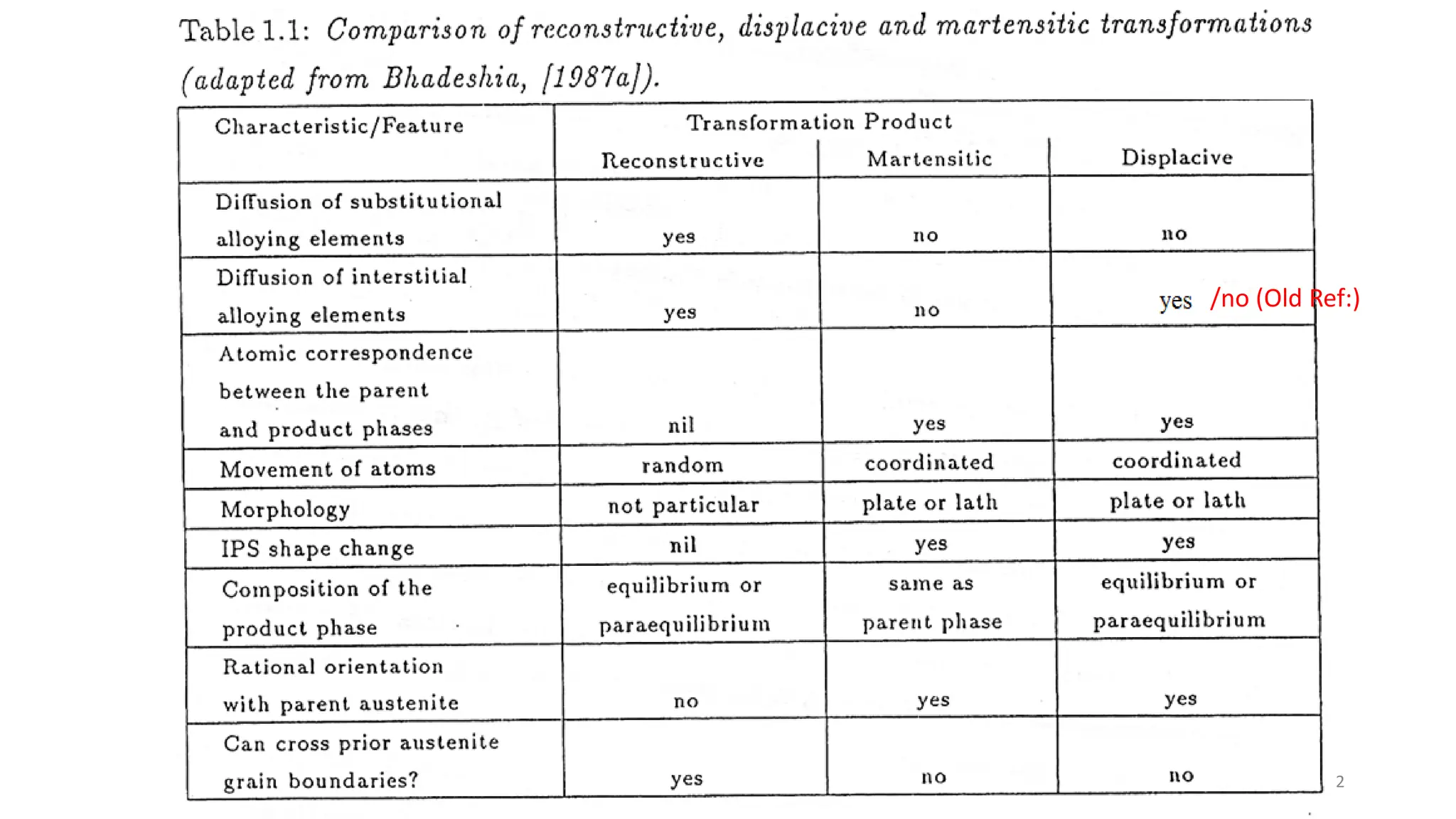
2
/no (Old Ref:)
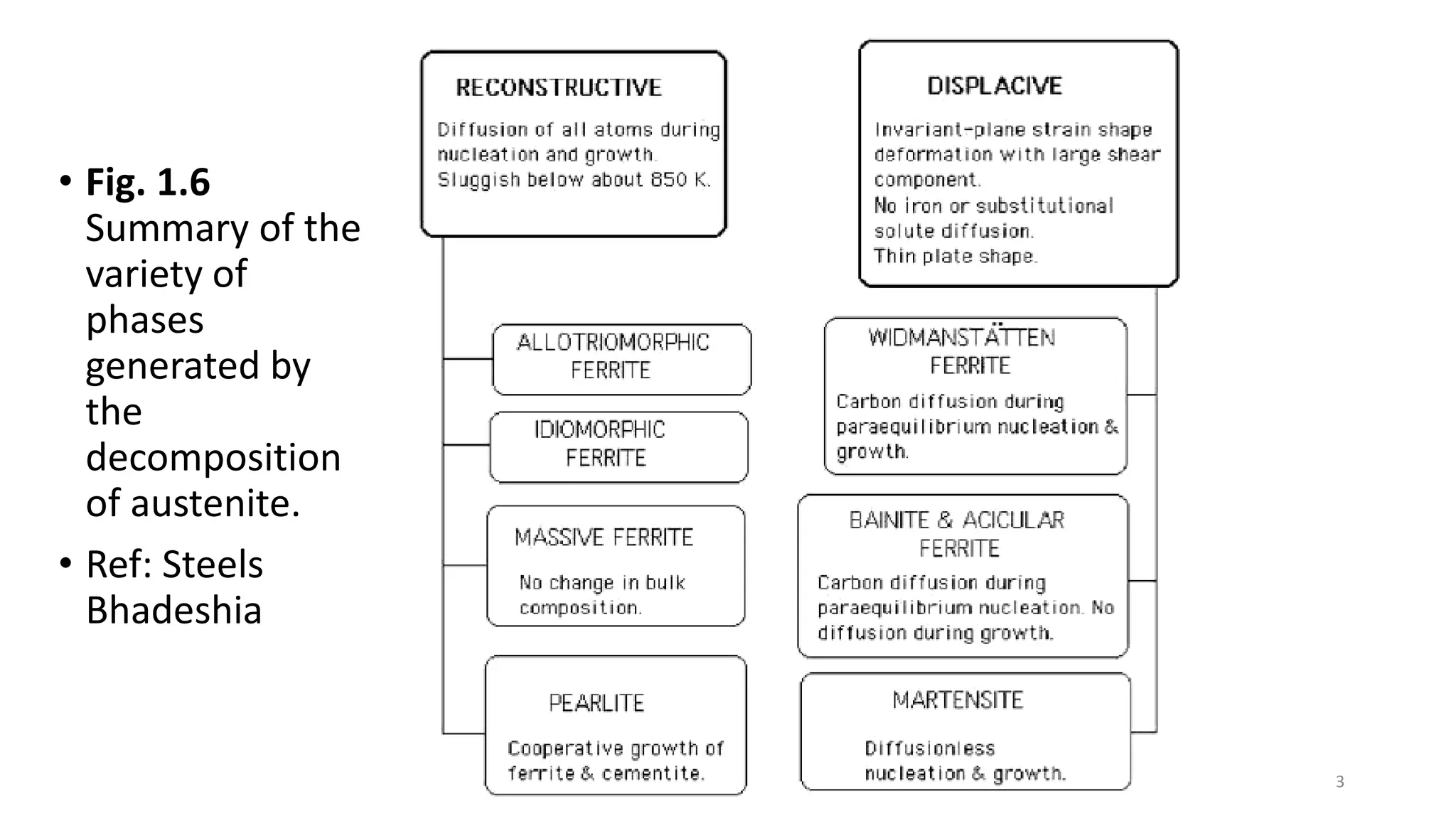
• Fig. 1.6
Summary of the
variety of
phases
generated by
the
decomposition
of austenite.
• Ref: Steels
Bhadeshia
3
Bainite
Widmenstatten Ferrite
Acicular Ferrite
4
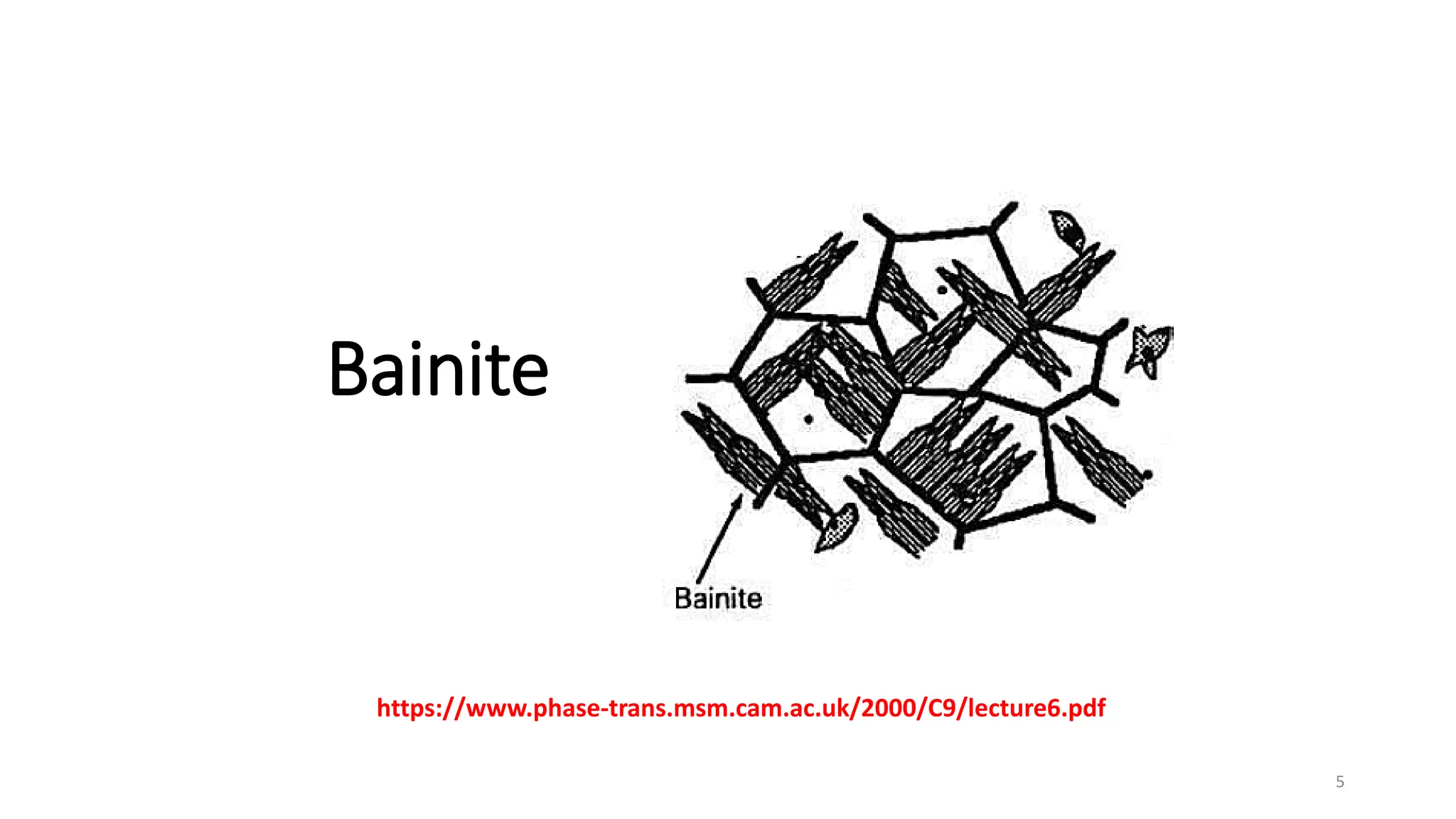
Bainite
5
https://www.phase-trans.msm.cam.ac.uk/2000/C9/lecture6.pdf
6
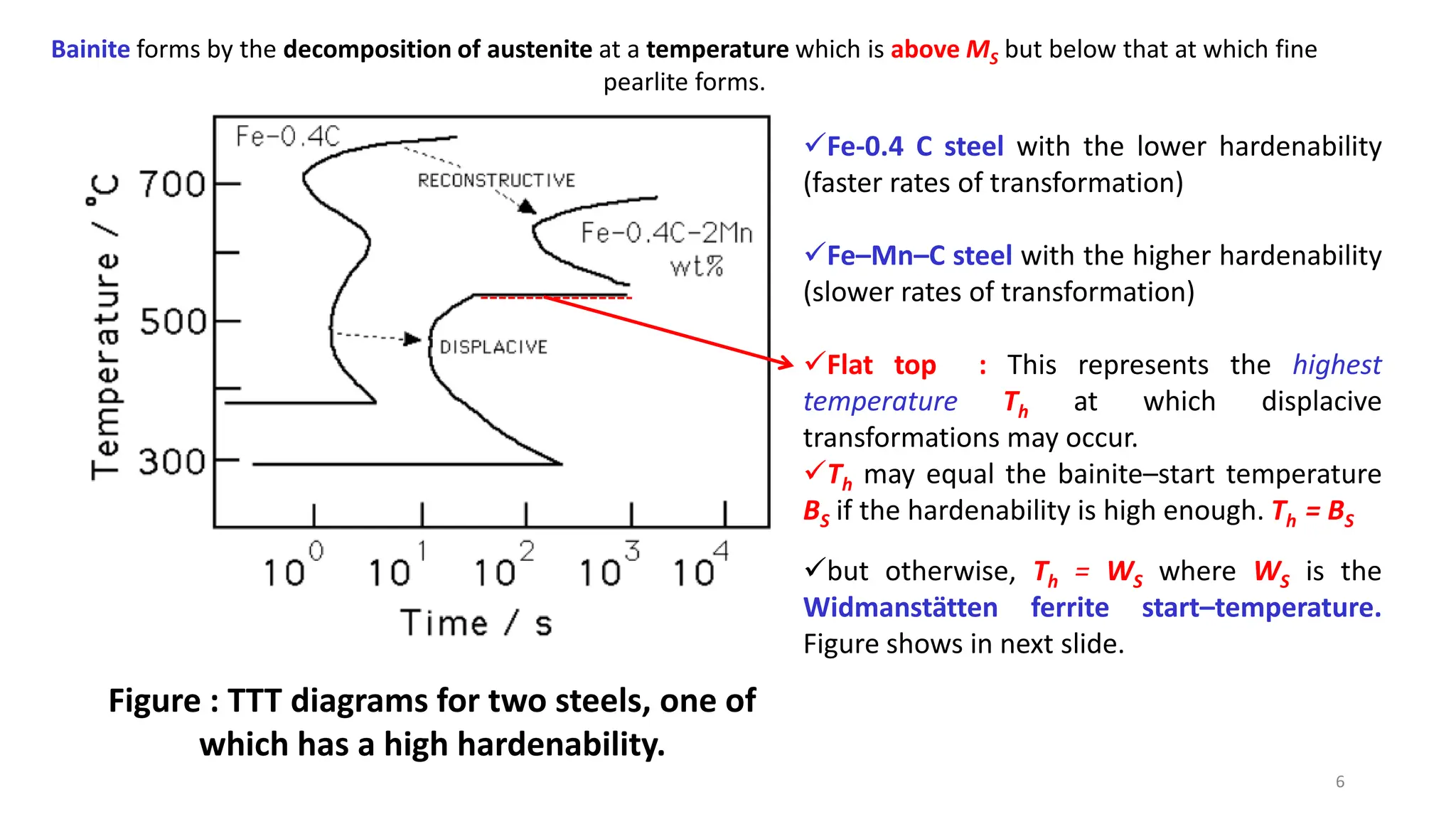
Figure : TTT diagrams for two steels, one of
which has a high hardenability.
Fe-0.4 C steel with the lower hardenability
(faster rates of transformation)
Fe–Mn–C steel with the higher hardenability
(slower rates of transformation)
Flat top : This represents the highest
temperature Th at which displacive
transformations may occur.
Th may equal the bainite–start temperature
BS if the hardenability is high enough. Th = BS
but otherwise, Th = WS where WS is the
Widmanstätten ferrite start–temperature.
Figure shows in next slide.
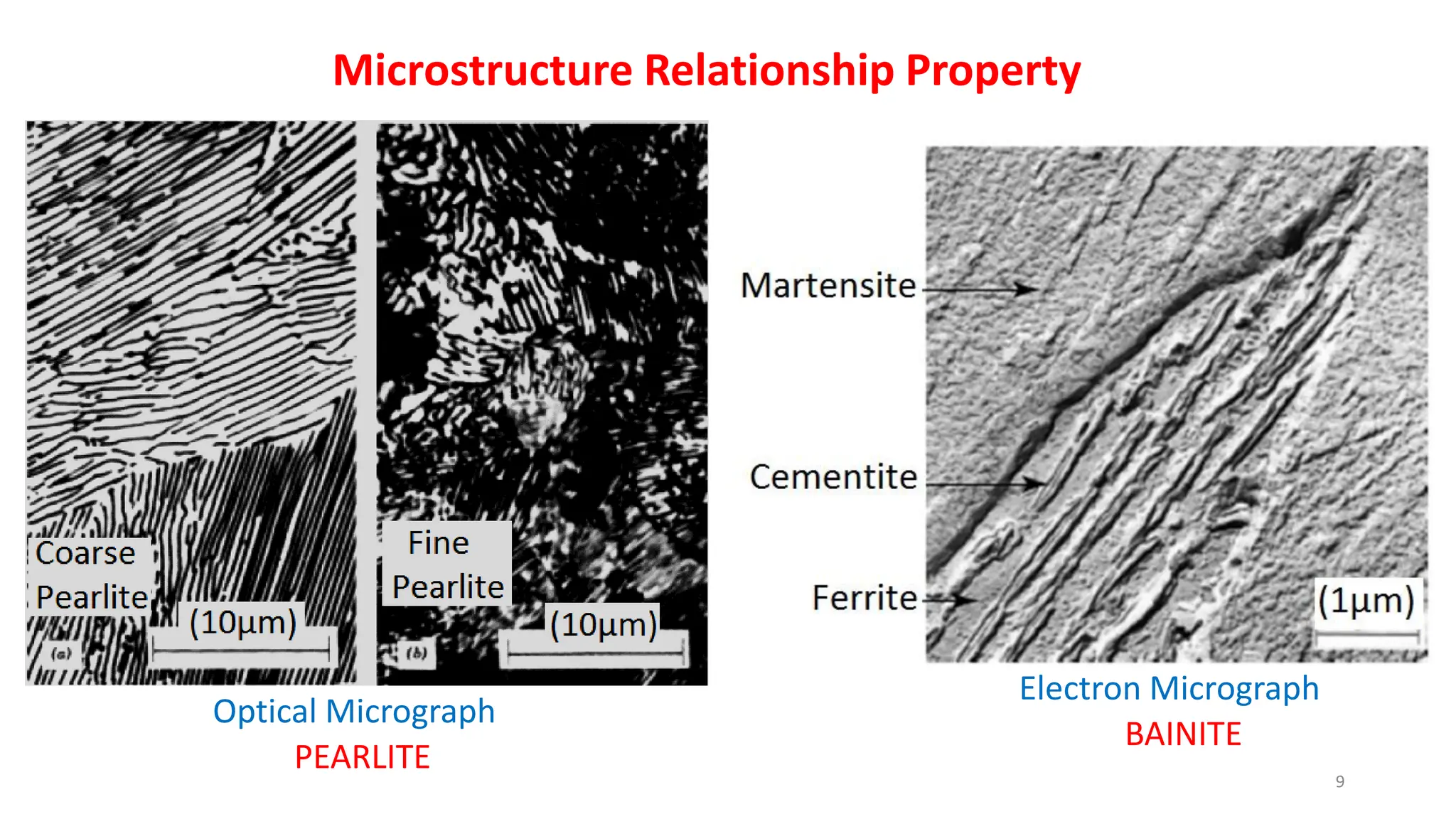
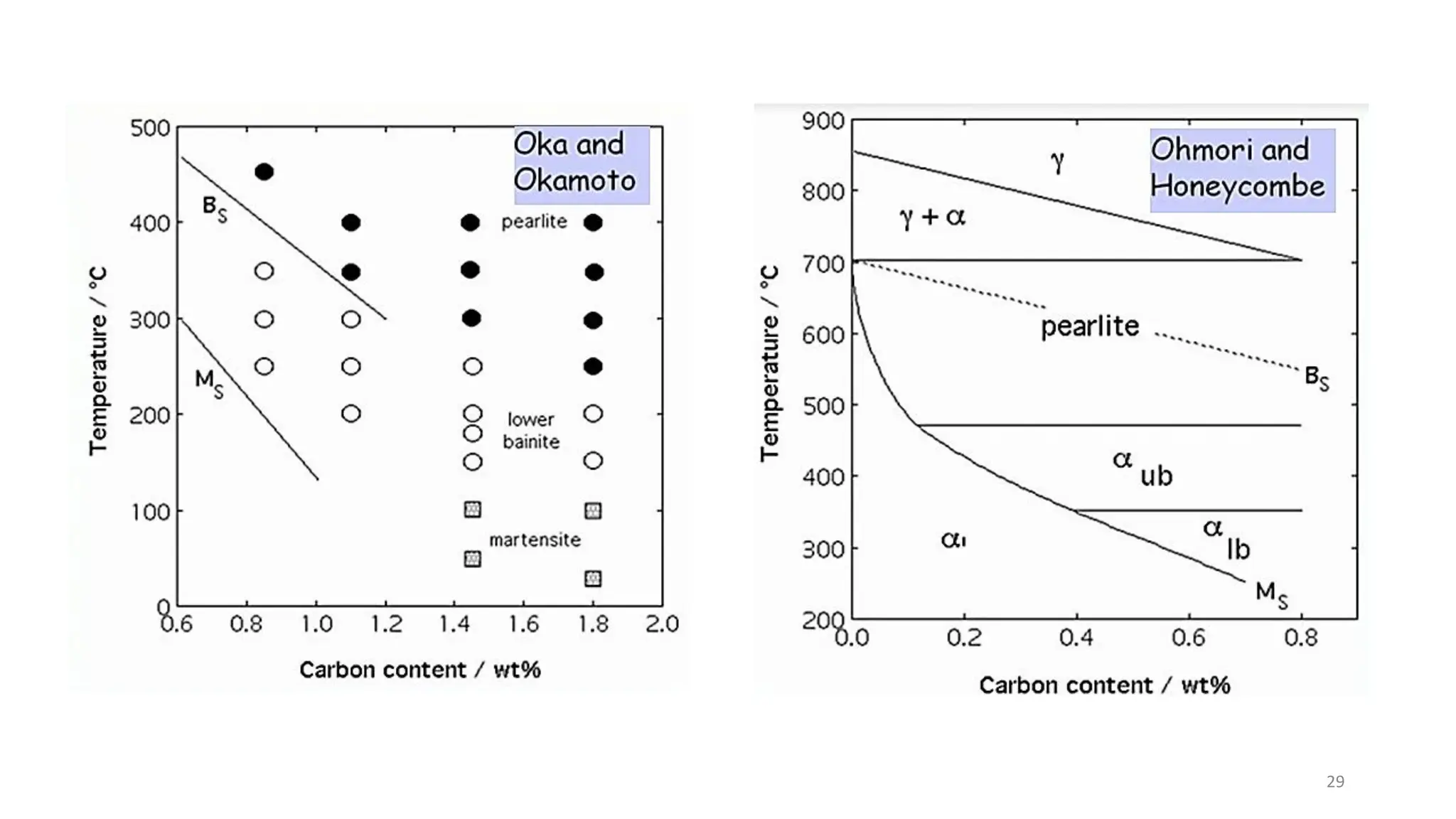
Bainite forms by the decomposition of austenite at a temperature which is above MS but below that at which fine
pearlite forms.
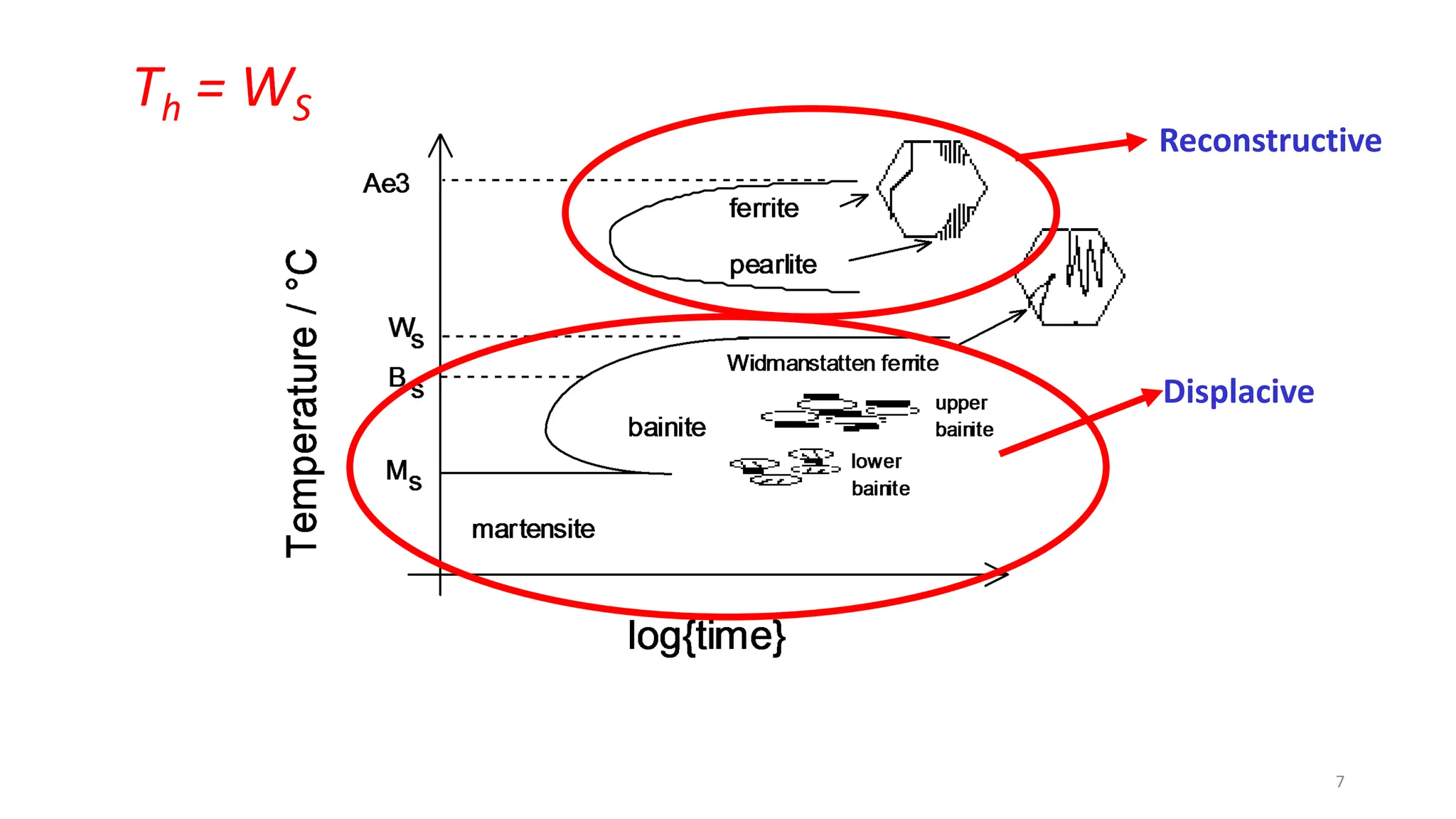
7
Reconstructive
Displacive
Th = WS
8
Optical Micrograph
PEARLITE
9
Microstructure Relationship Property
Electron Micrograph
BAINITE
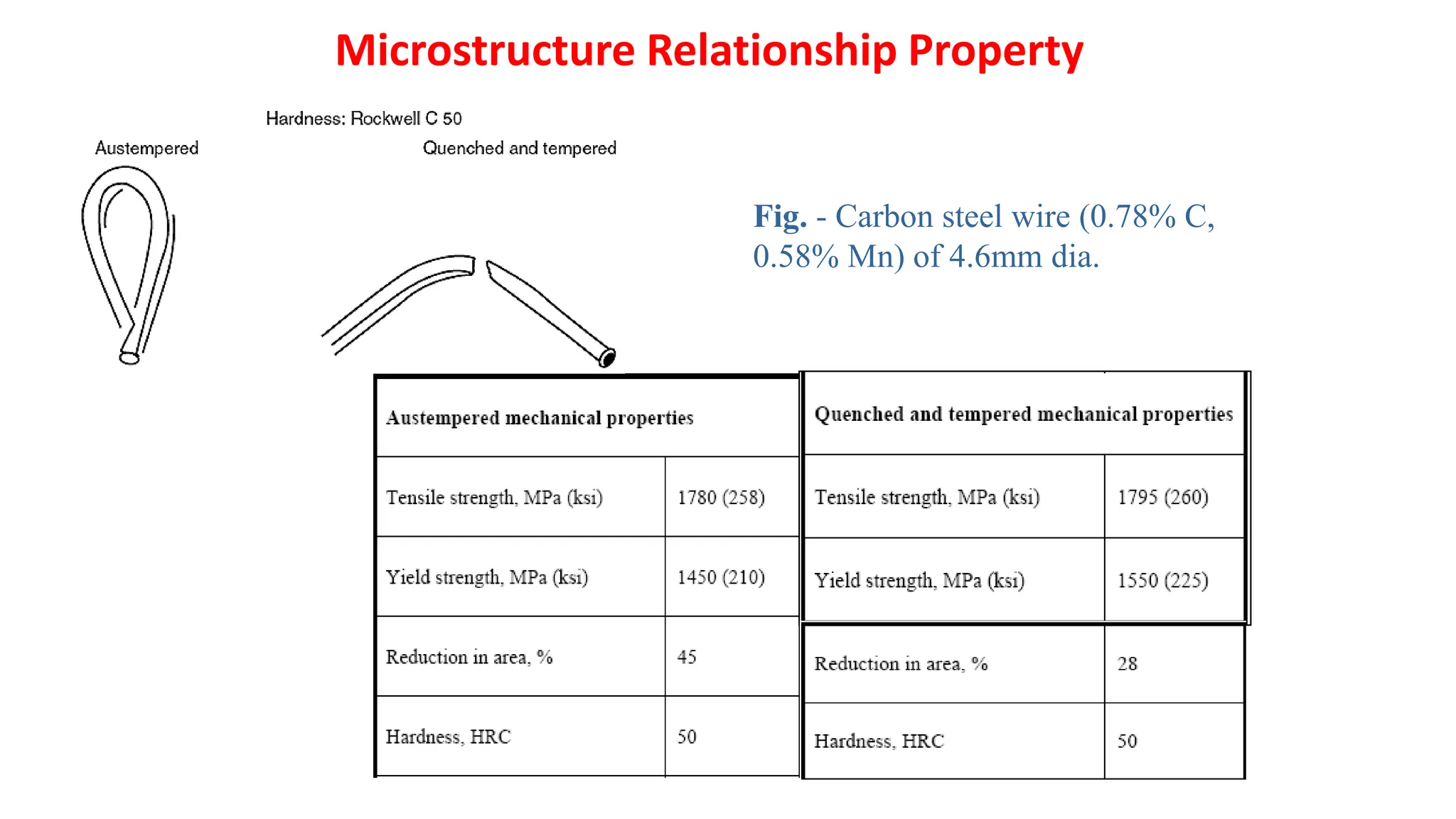
Fig. - Carbon steel wire (0.78% C,
0.58% Mn) of 4.6mm dia.
Microstructure Relationship Property
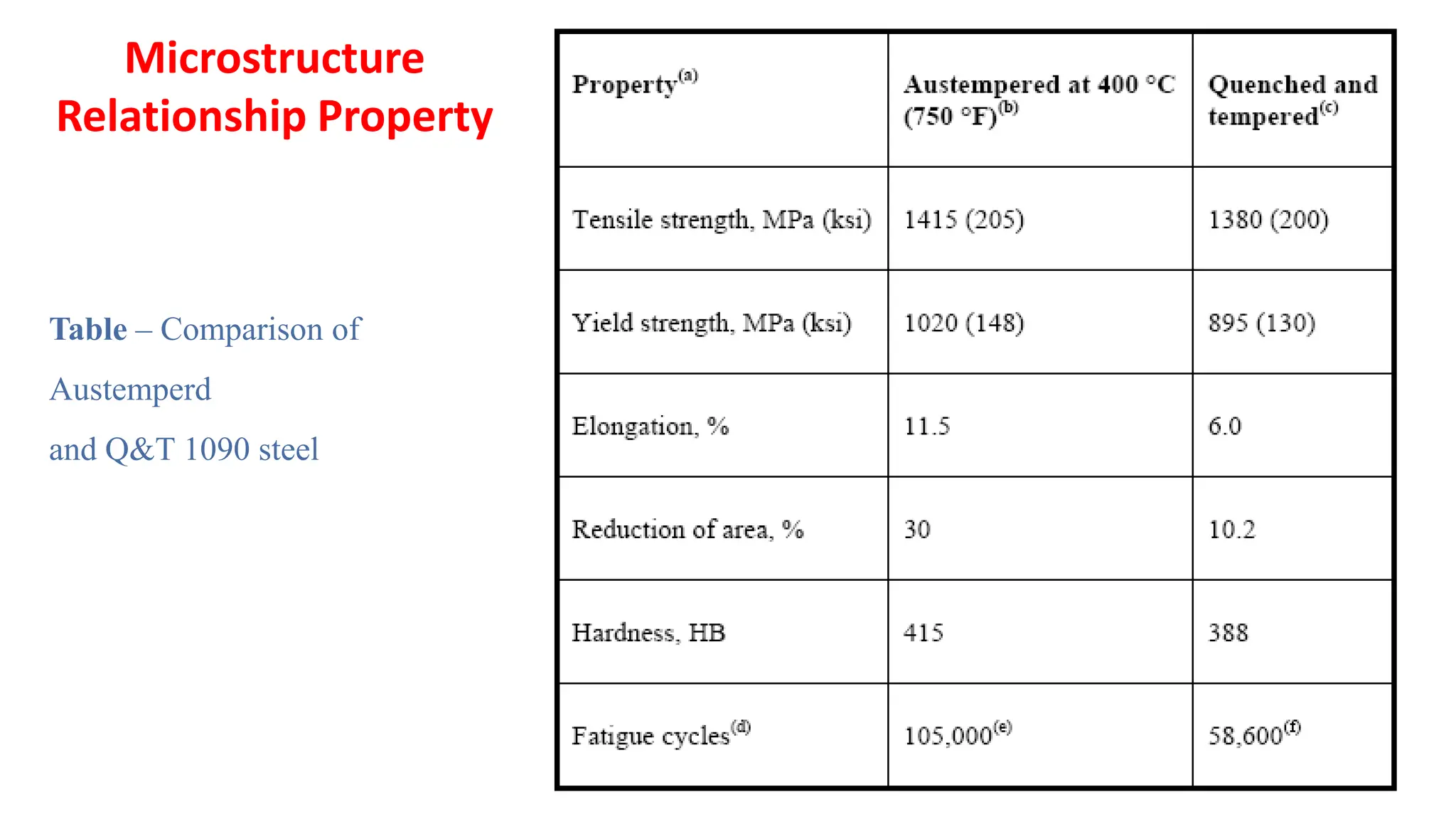
Table – Comparison of
Austemperd
and Q&T 1090 steel
Microstructure
Relationship Property
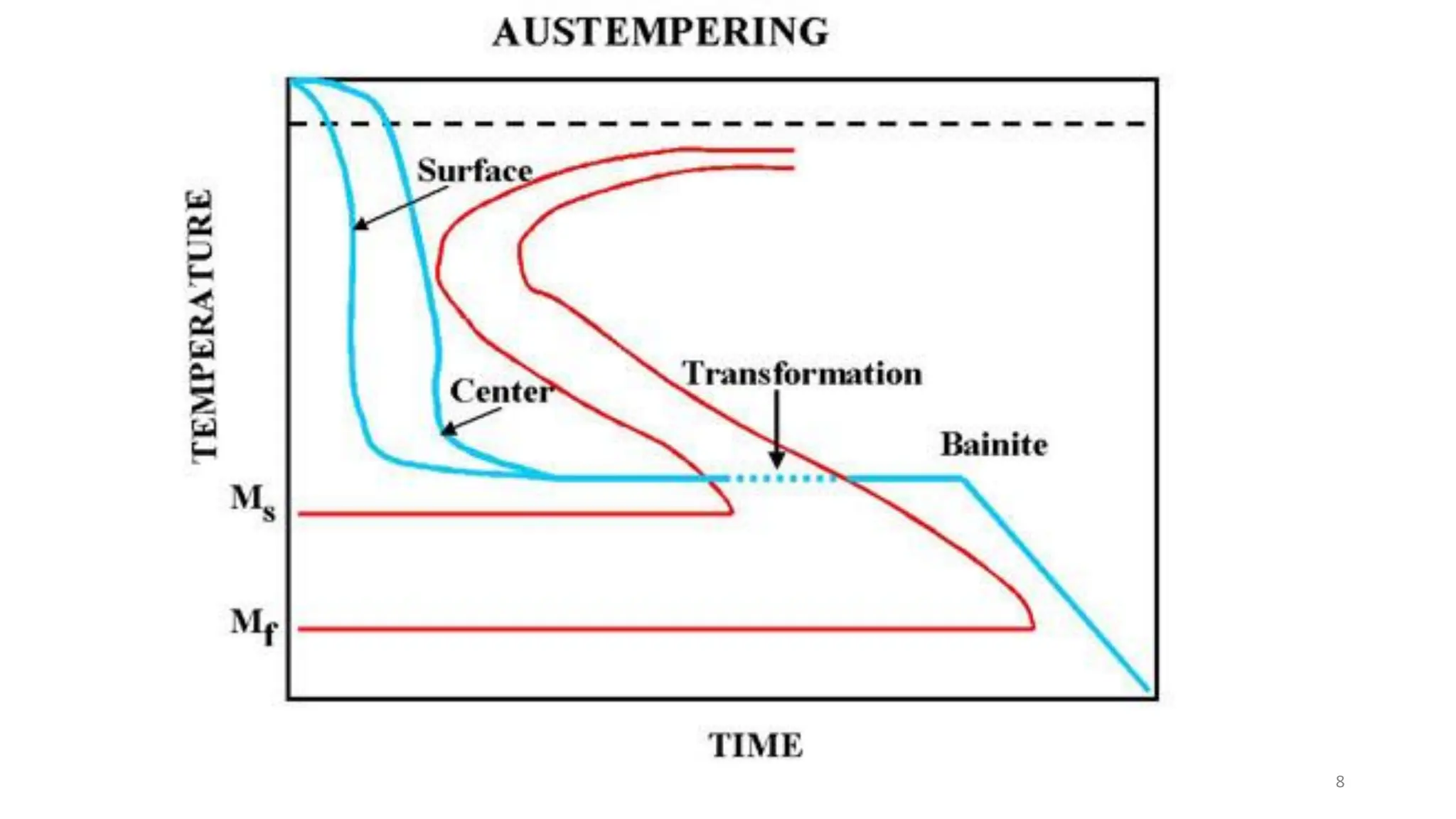
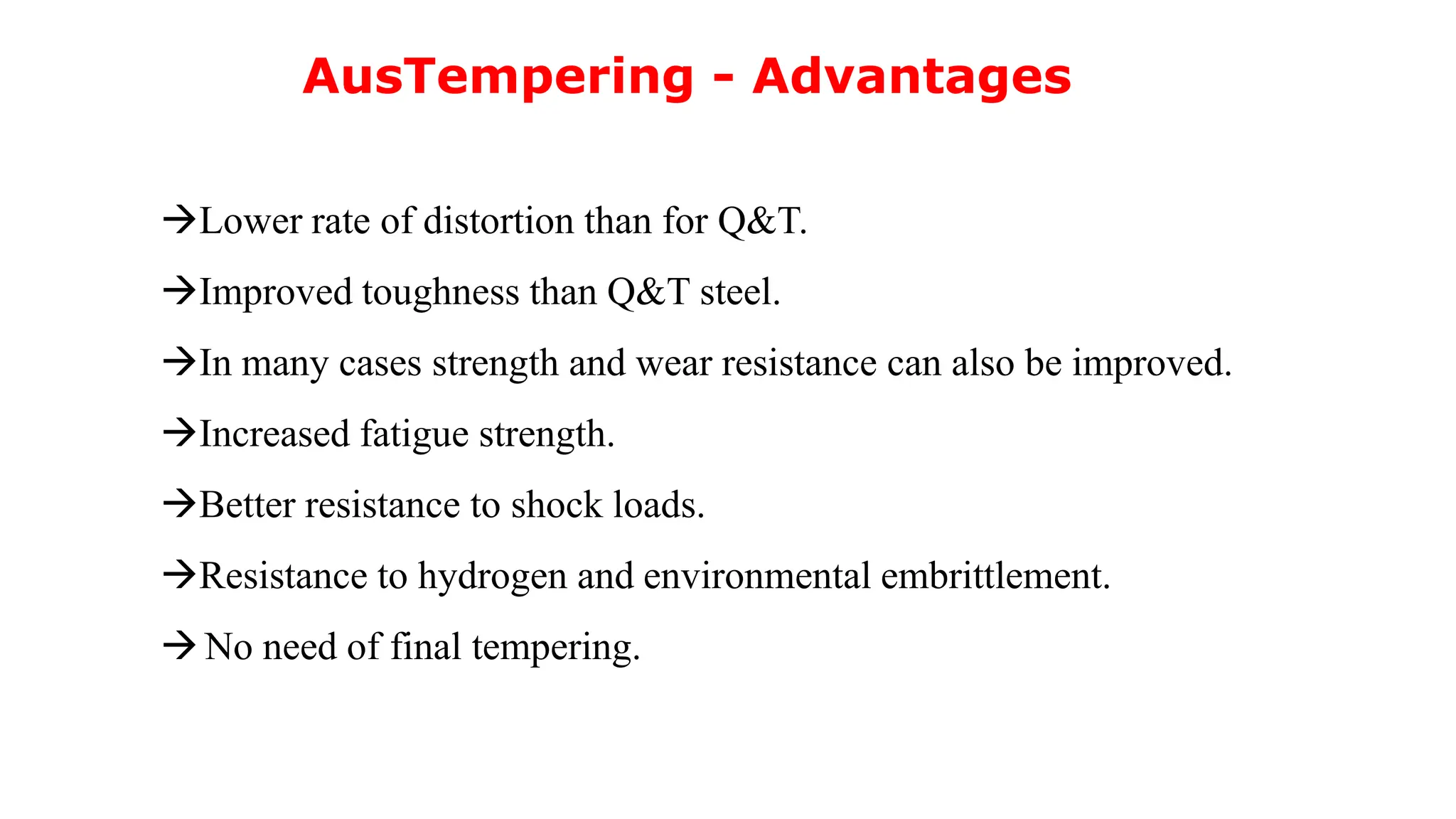
AusTempering - Advantages
Lower rate of distortion than for Q&T.
Improved toughness than Q&T steel.
In many cases strength and wear resistance can also be improved.
Increased fatigue strength.
Better resistance to shock loads.
Resistance to hydrogen and environmental embrittlement.
No need of final tempering.
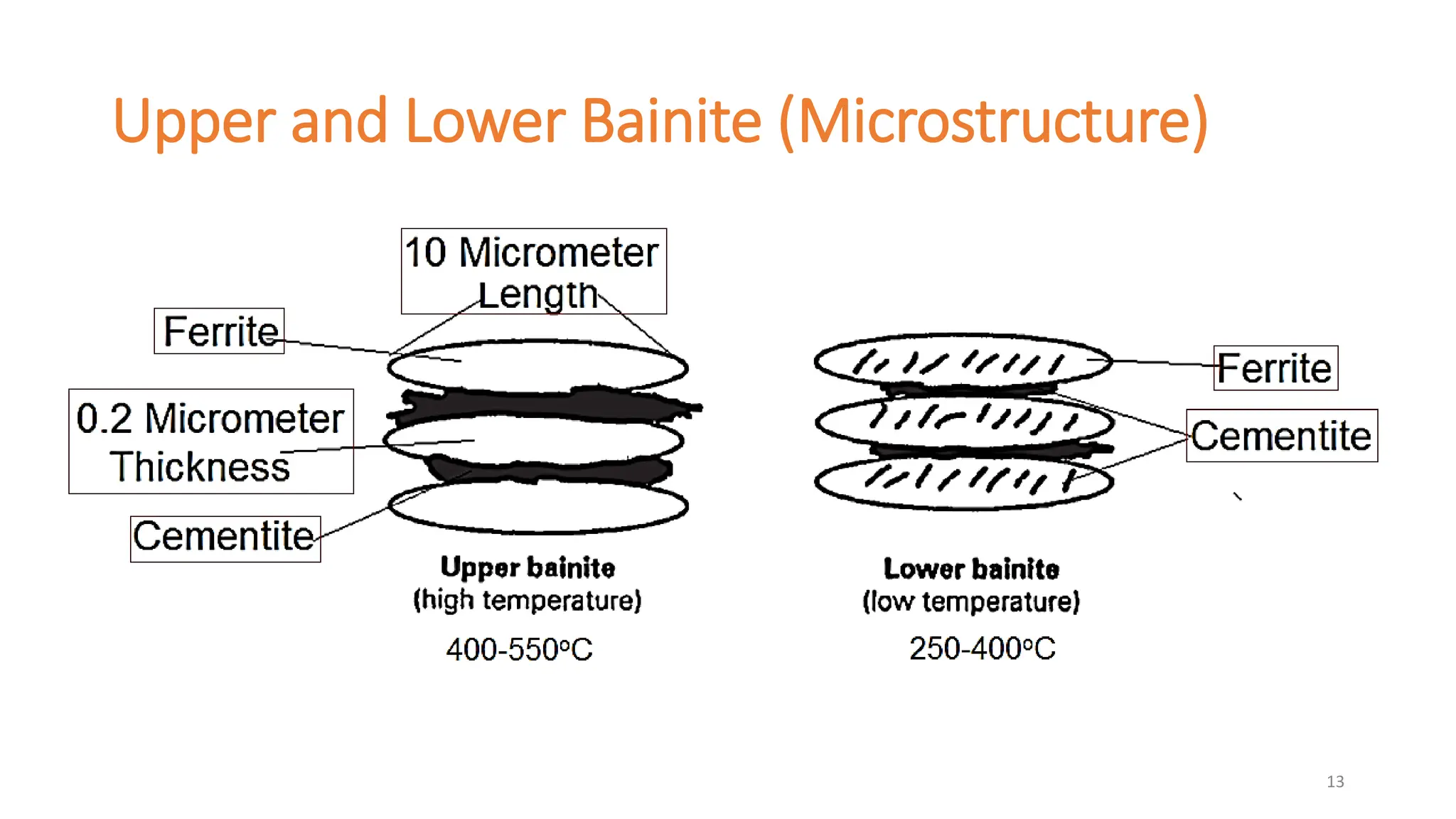
Upper and Lower Bainite (Microstructure)
13
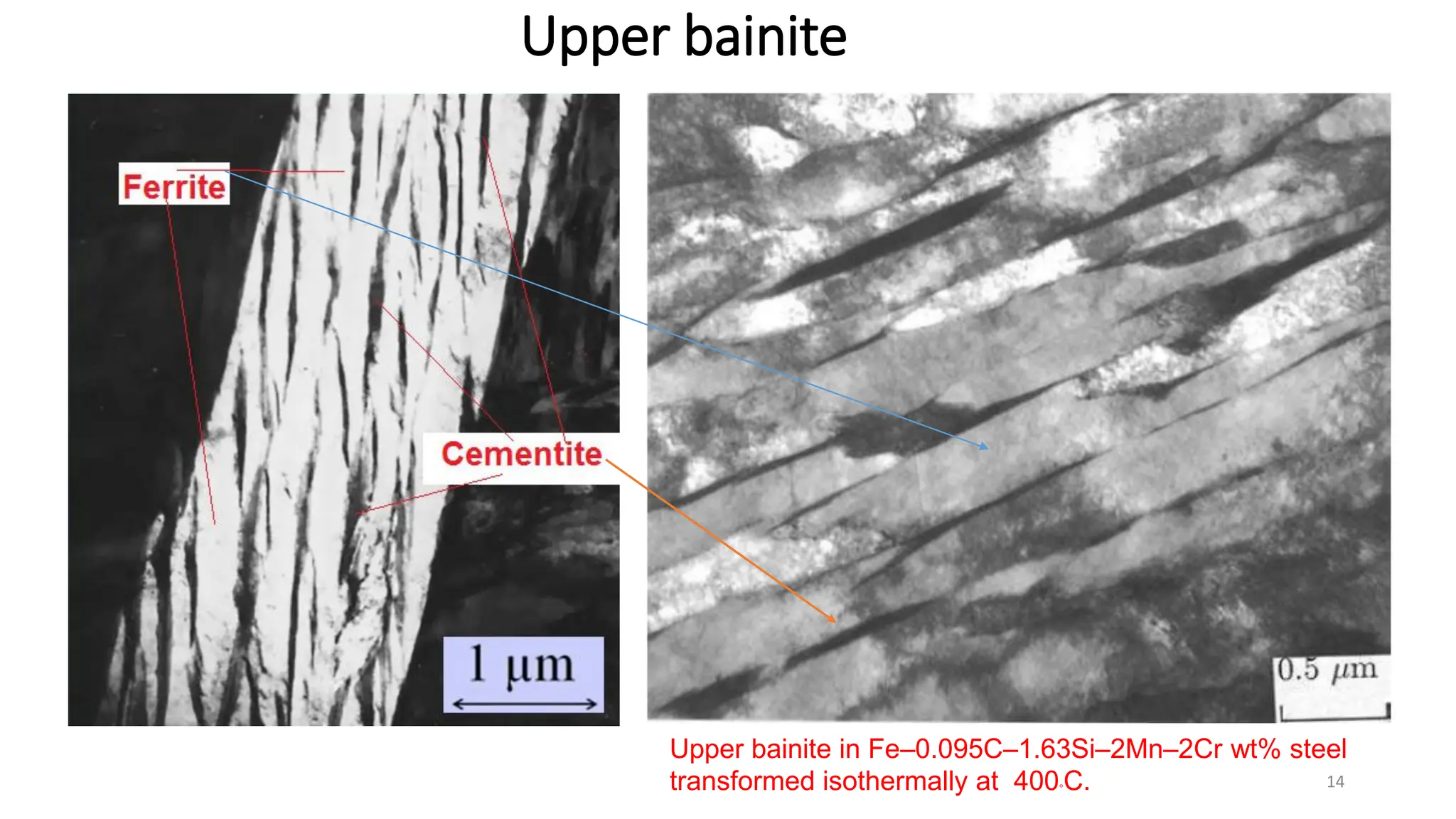
Upper bainite
14
Upper bainite in Fe–0.095C–1.63Si–2Mn–2Cr wt% steel
transformed isothermally at 400◦C.
15
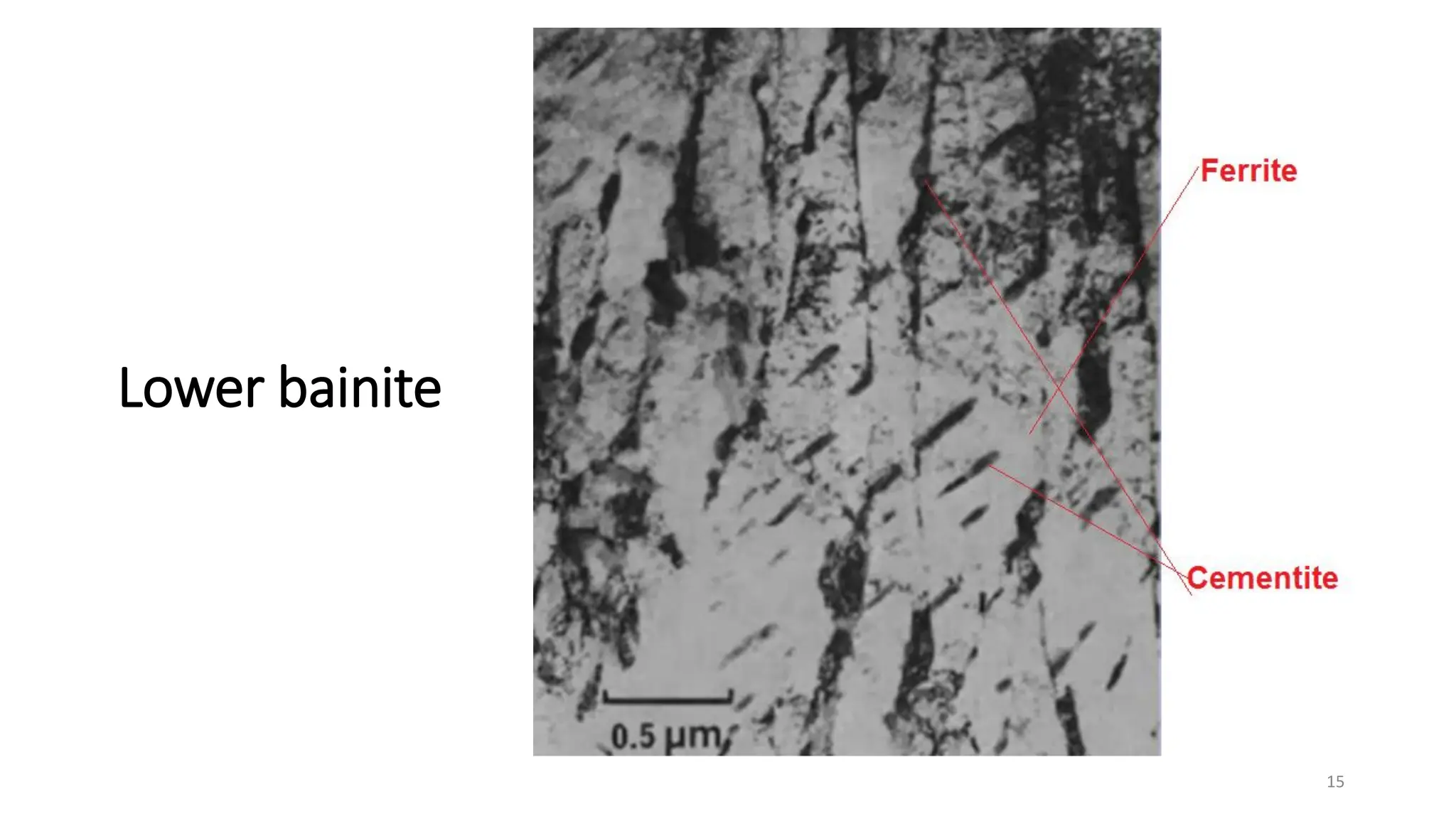
Lower bainite
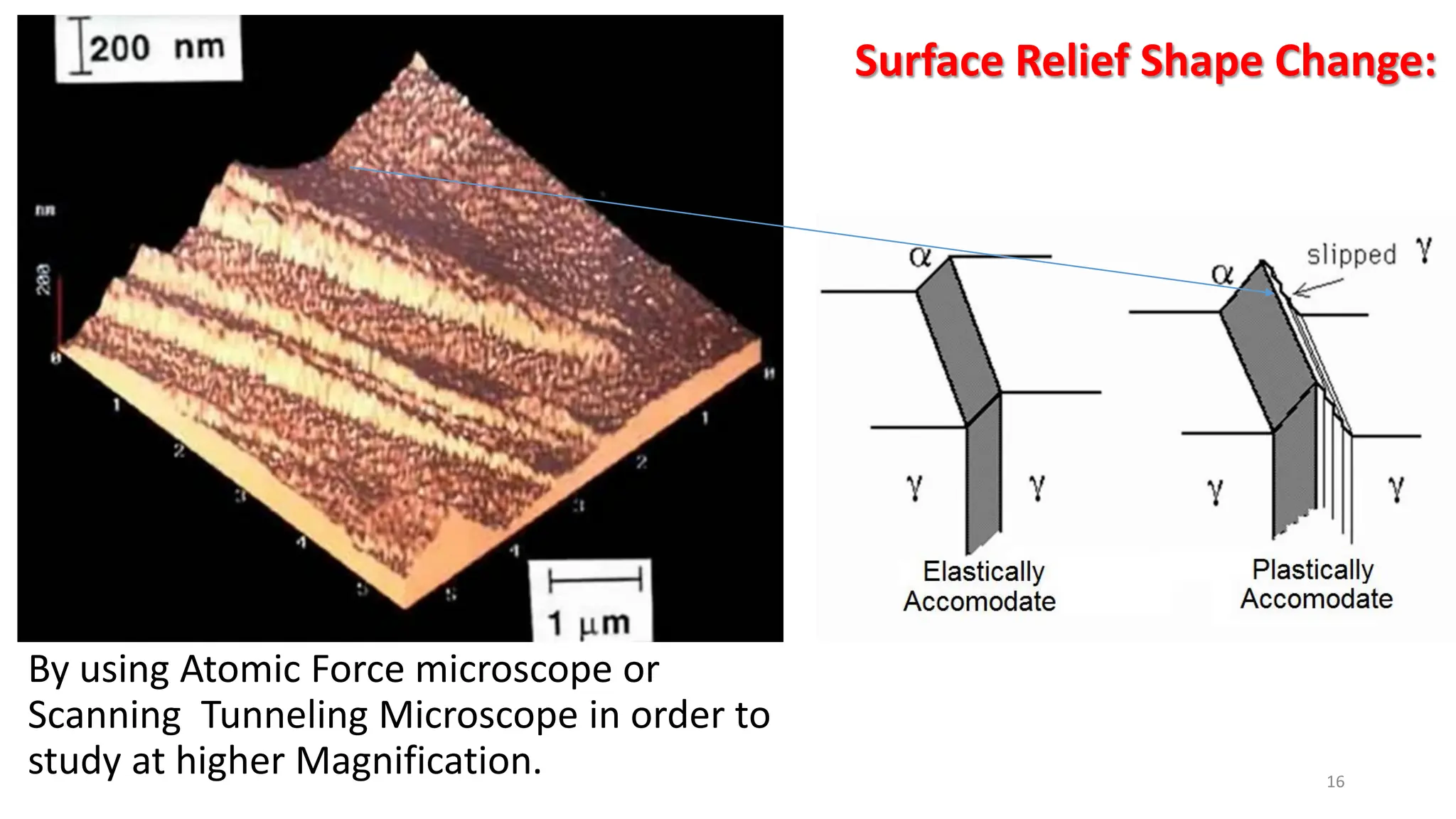
By using Atomic Force microscope or
Scanning Tunneling Microscope in order to
study at higher Magnification. 16
Surface Relief Shape Change:
17
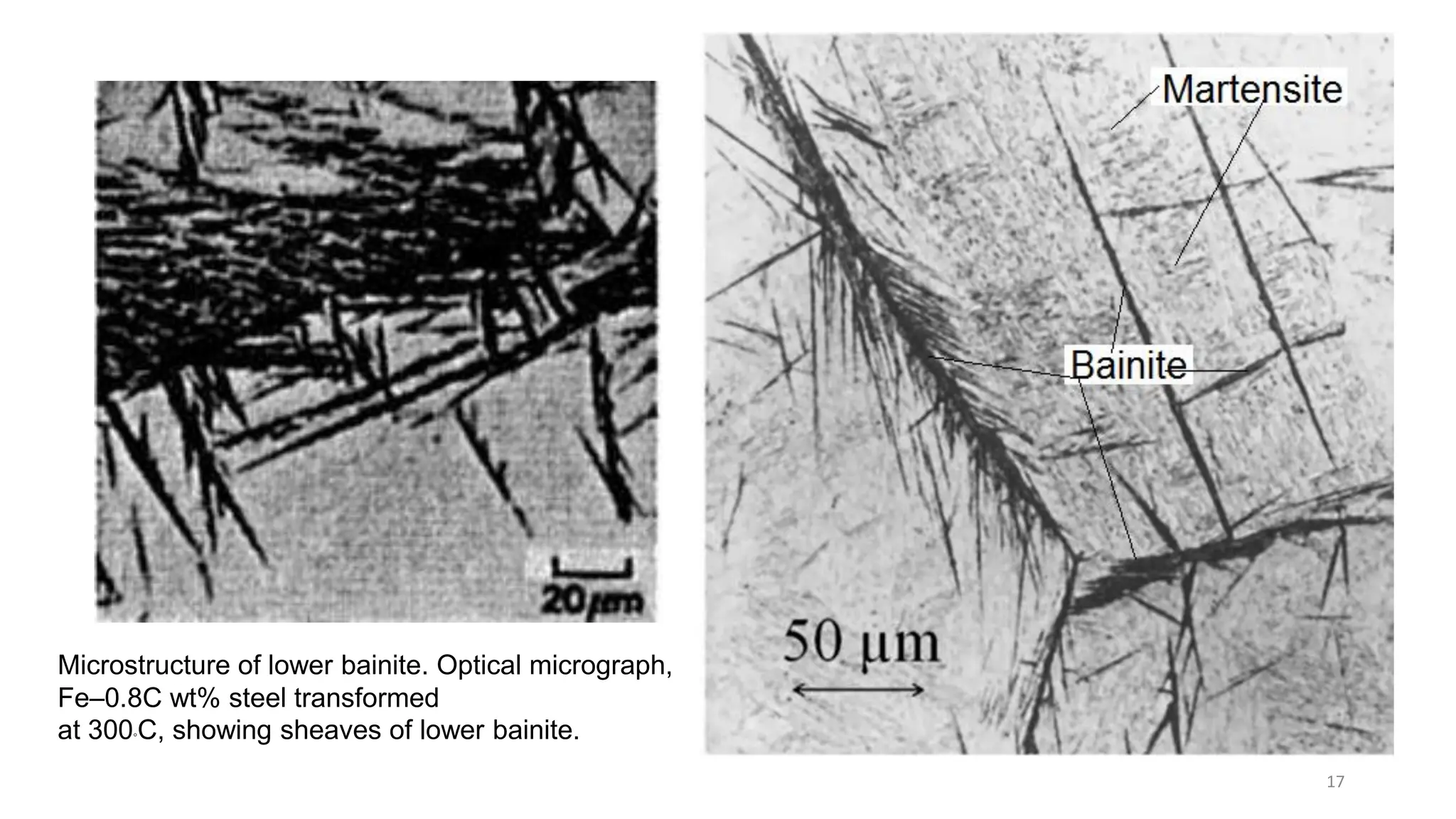
Microstructure of lower bainite. Optical micrograph,
Fe–0.8C wt% steel transformed
at 300◦C, showing sheaves of lower bainite.
18
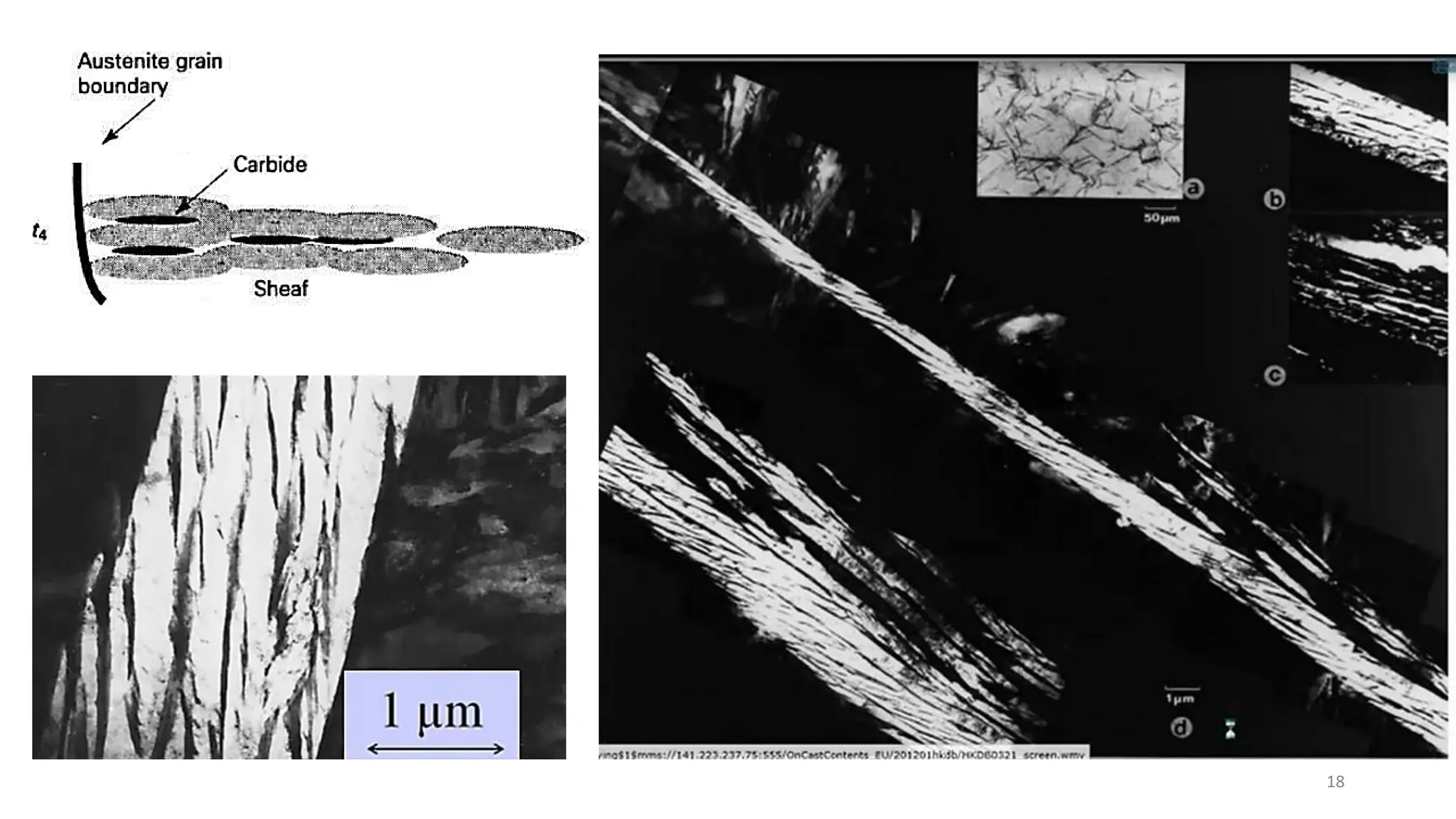
19
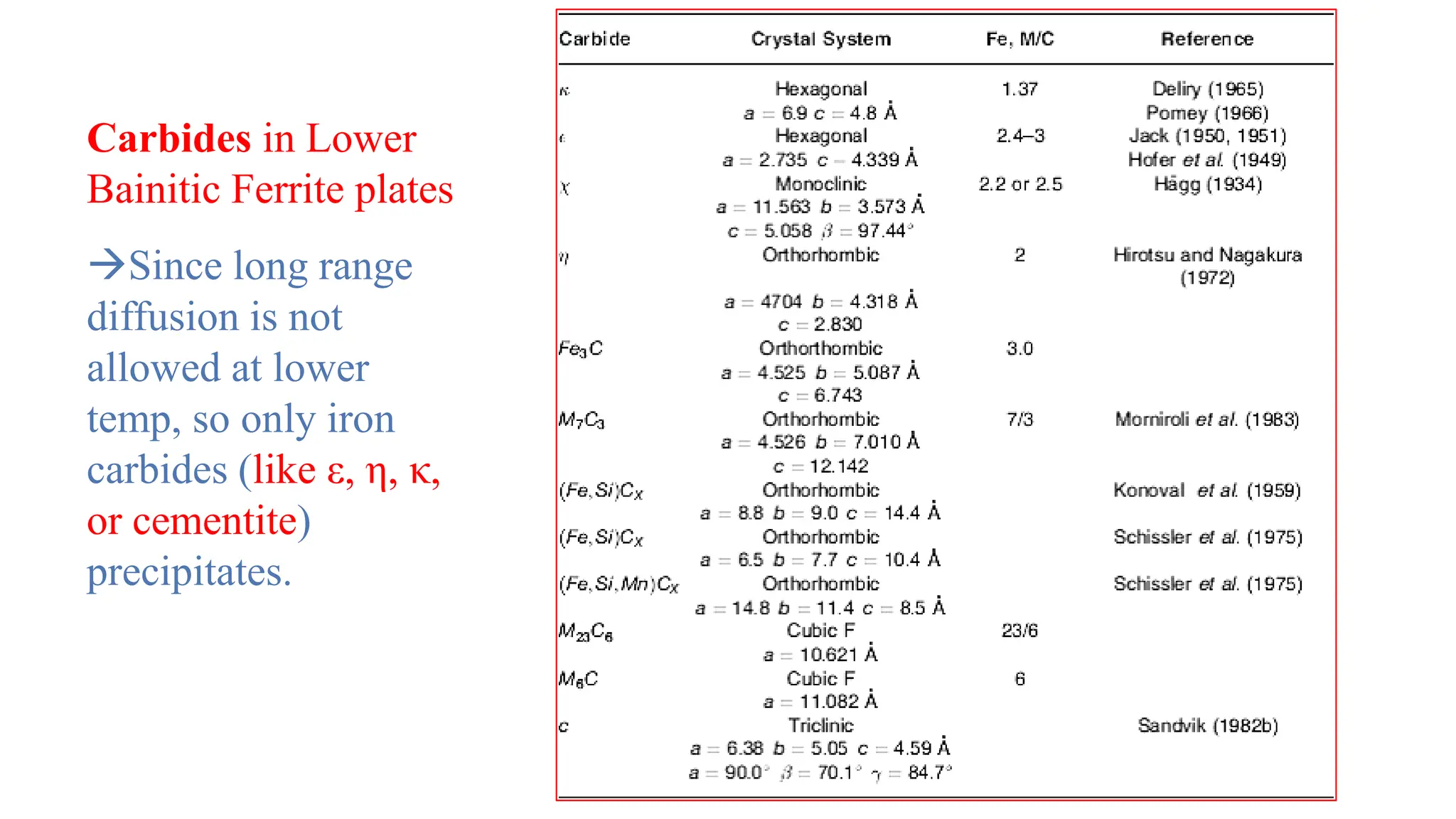
Carbides in Lower
Bainitic Ferrite plates
Since long range
diffusion is not
allowed at lower
temp, so only iron
carbides (like ε, η, κ,
or cementite)
precipitates.
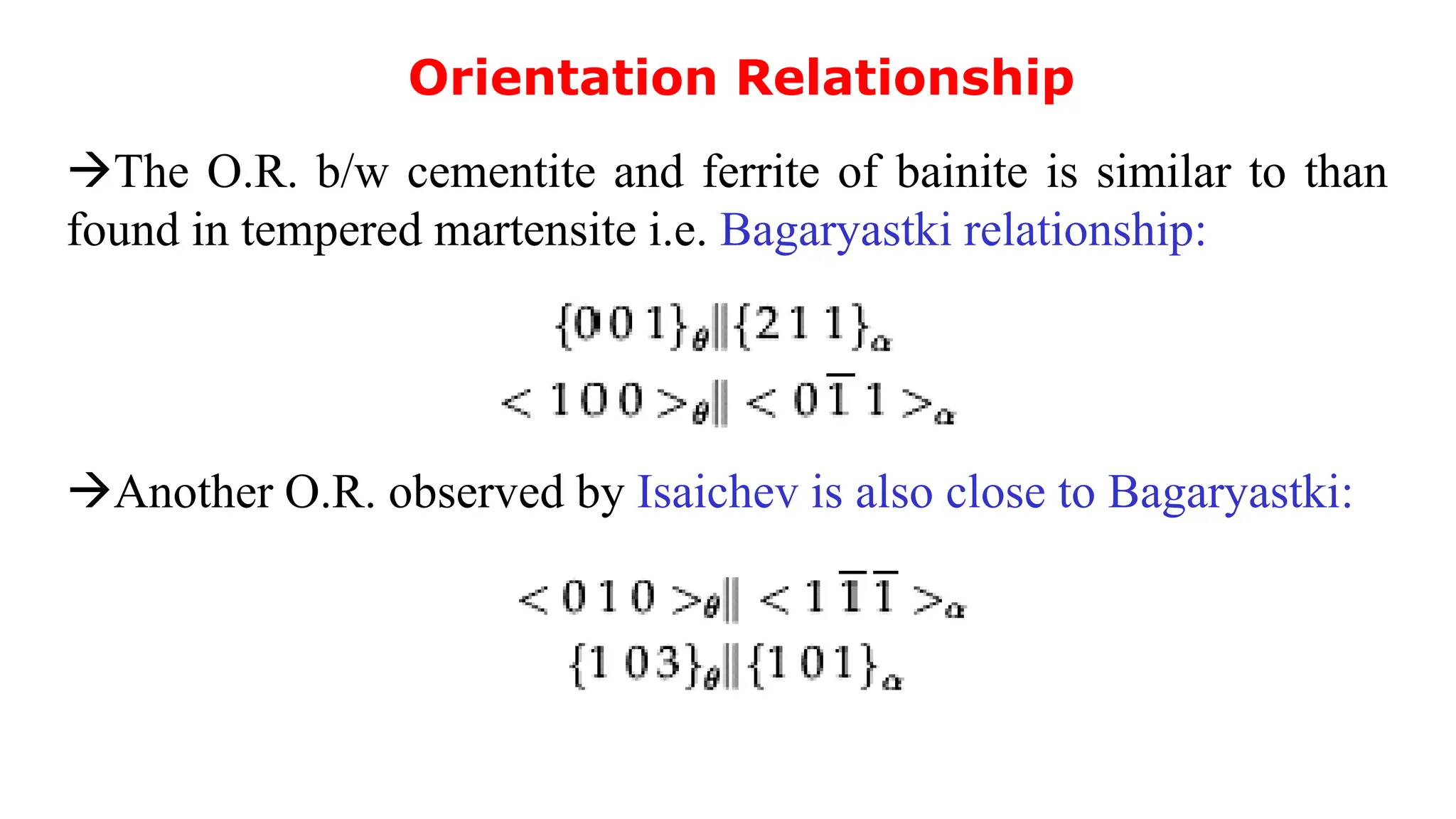
Orientation Relationship
The O.R. b/w cementite and ferrite of bainite is similar to than
found in tempered martensite i.e. Bagaryastki relationship:
Another O.R. observed by Isaichev is also close to Bagaryastki:
22
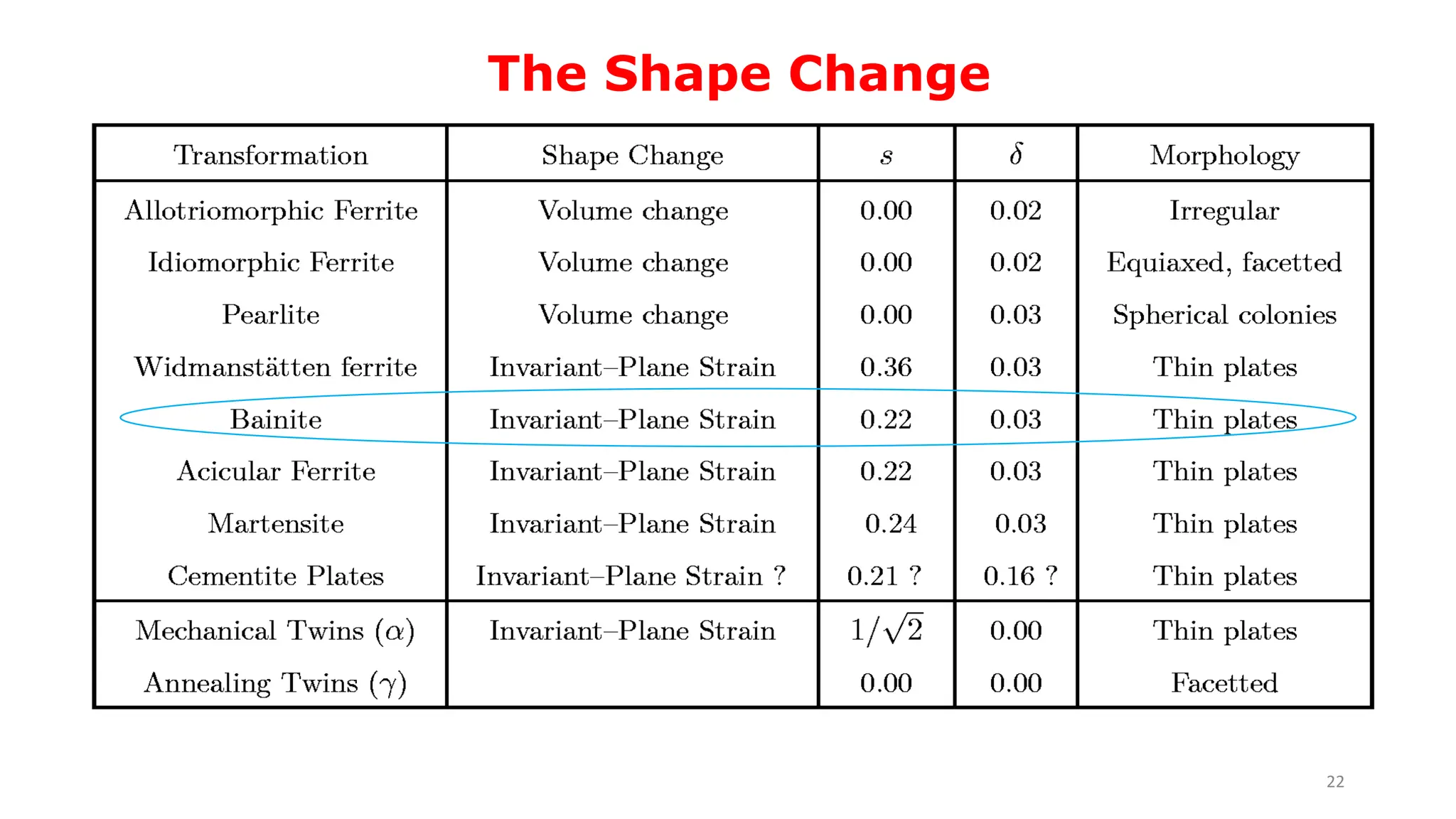
The Shape Change
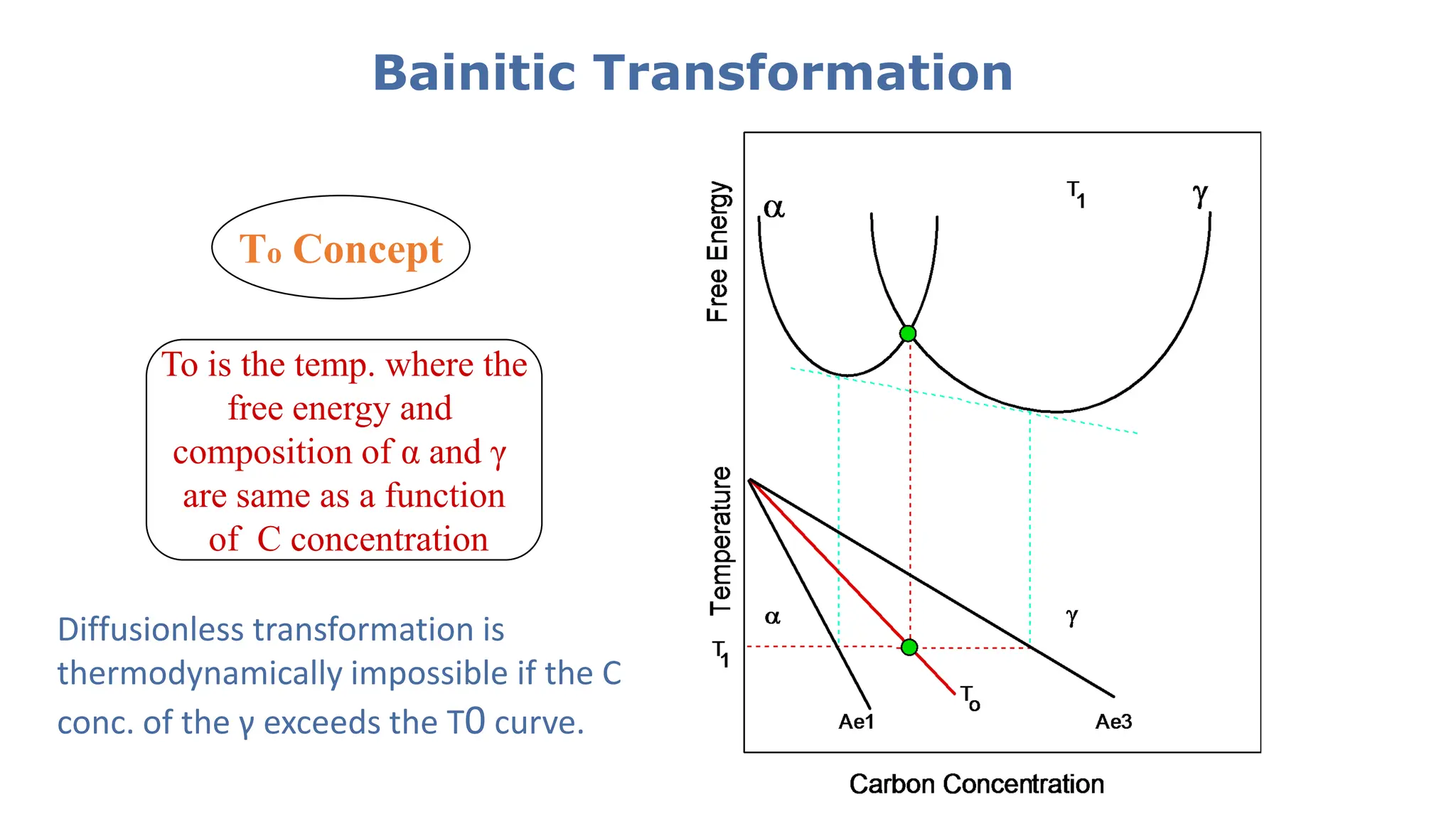
Bainitic Transformation
To is the temp. where the
free energy and
composition of α and γ
are same as a function
of C concentration
To Concept
Diffusionless transformation is
thermodynamically impossible if the C
conc. of the γ exceeds the T0 curve.
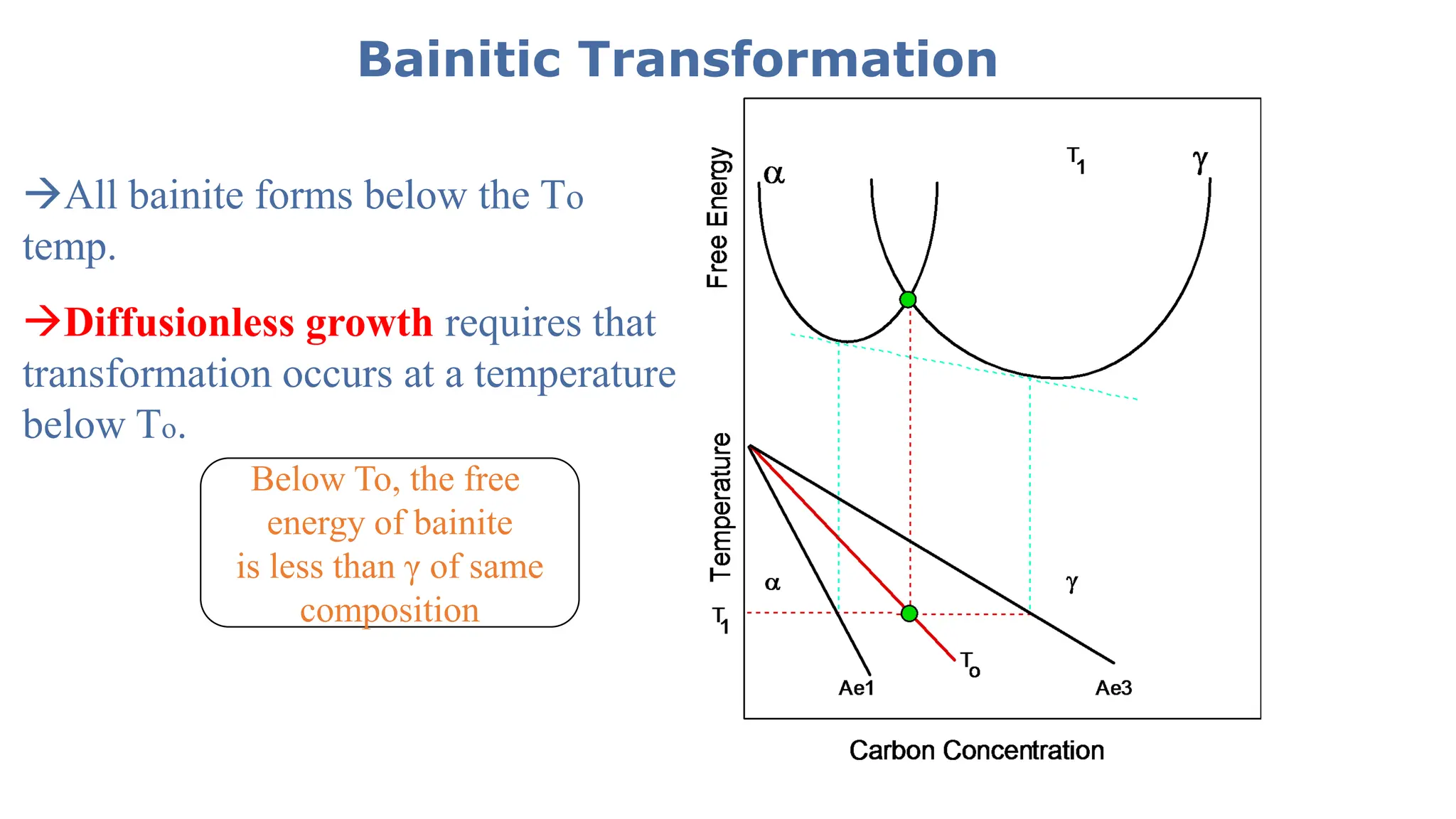
Bainitic Transformation
All bainite forms below the To
temp.
Diffusionless growth requires that
transformation occurs at a temperature
below To.
Below To, the free
energy of bainite
is less than γ of same
composition
Bainitic Transformation
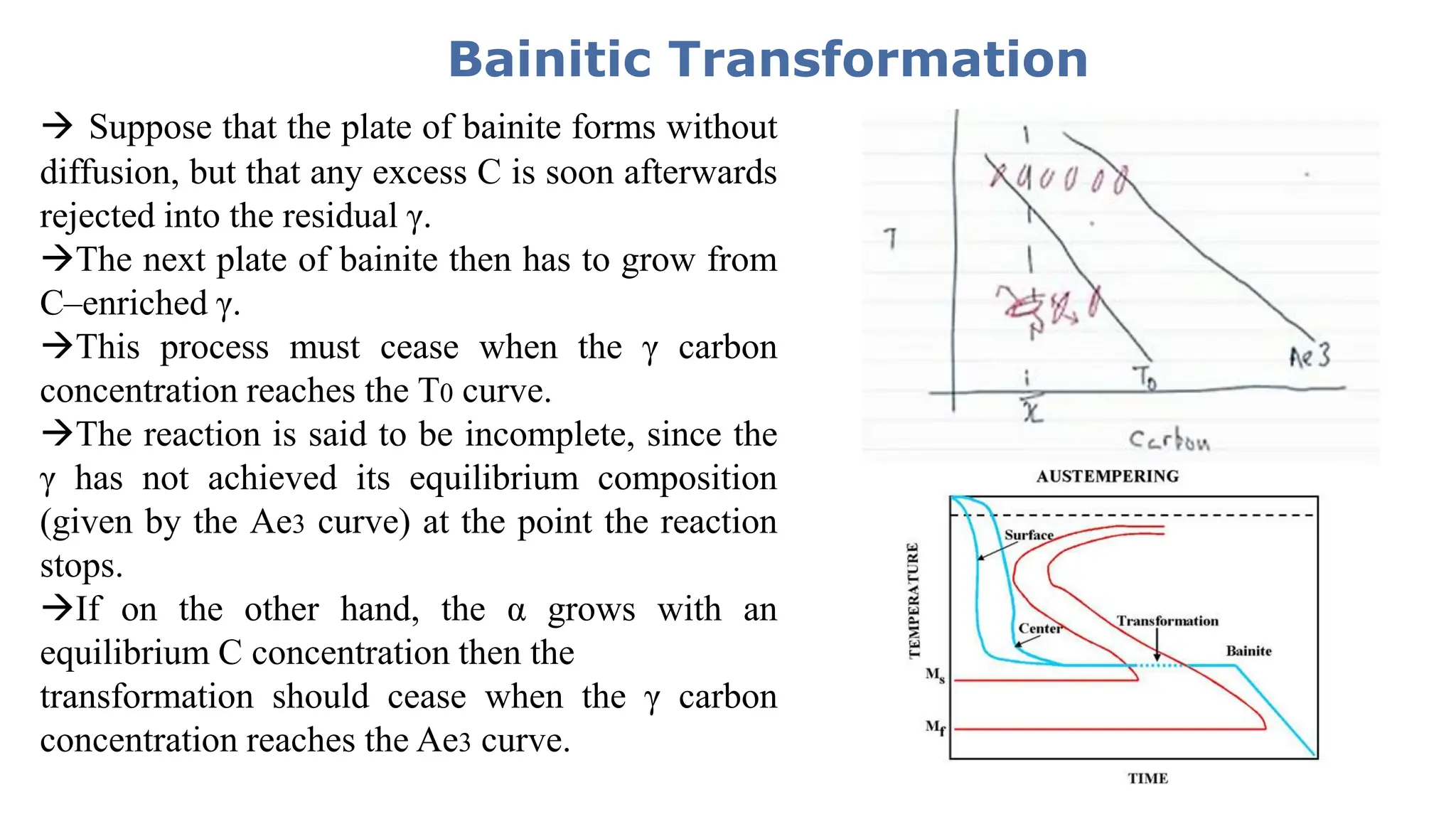
 Suppose that the plate of bainite forms without
diffusion, but that any excess C is soon afterwards
rejected into the residual γ.
The next plate of bainite then has to grow from
C–enriched γ.
This process must cease when the γ carbon
concentration reaches the T0 curve.
The reaction is said to be incomplete, since the
γ has not achieved its equilibrium composition
(given by the Ae3 curve) at the point the reaction
stops.
If on the other hand, the α grows with an
equilibrium C concentration then the
transformation should cease when the γ carbon
concentration reaches the Ae3 curve.
Bainitic Transformation
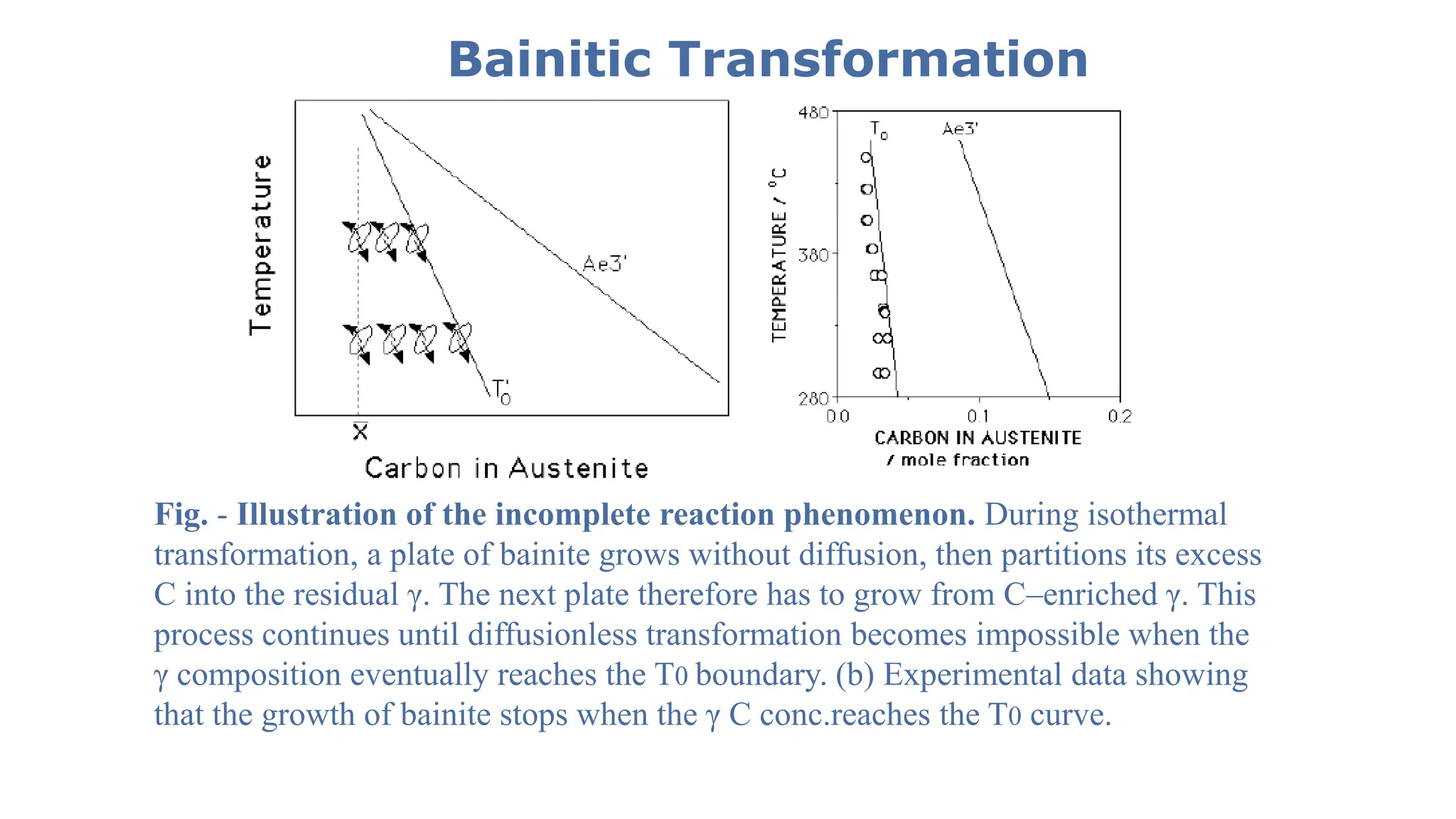
Fig. - Illustration of the incomplete reaction phenomenon. During isothermal
transformation, a plate of bainite grows without diffusion, then partitions its excess
C into the residual γ. The next plate therefore has to grow from C–enriched γ. This
process continues until diffusionless transformation becomes impossible when the
γ composition eventually reaches the T0 boundary. (b) Experimental data showing
that the growth of bainite stops when the γ C conc.reaches the T0 curve.
Bainitic Transformation
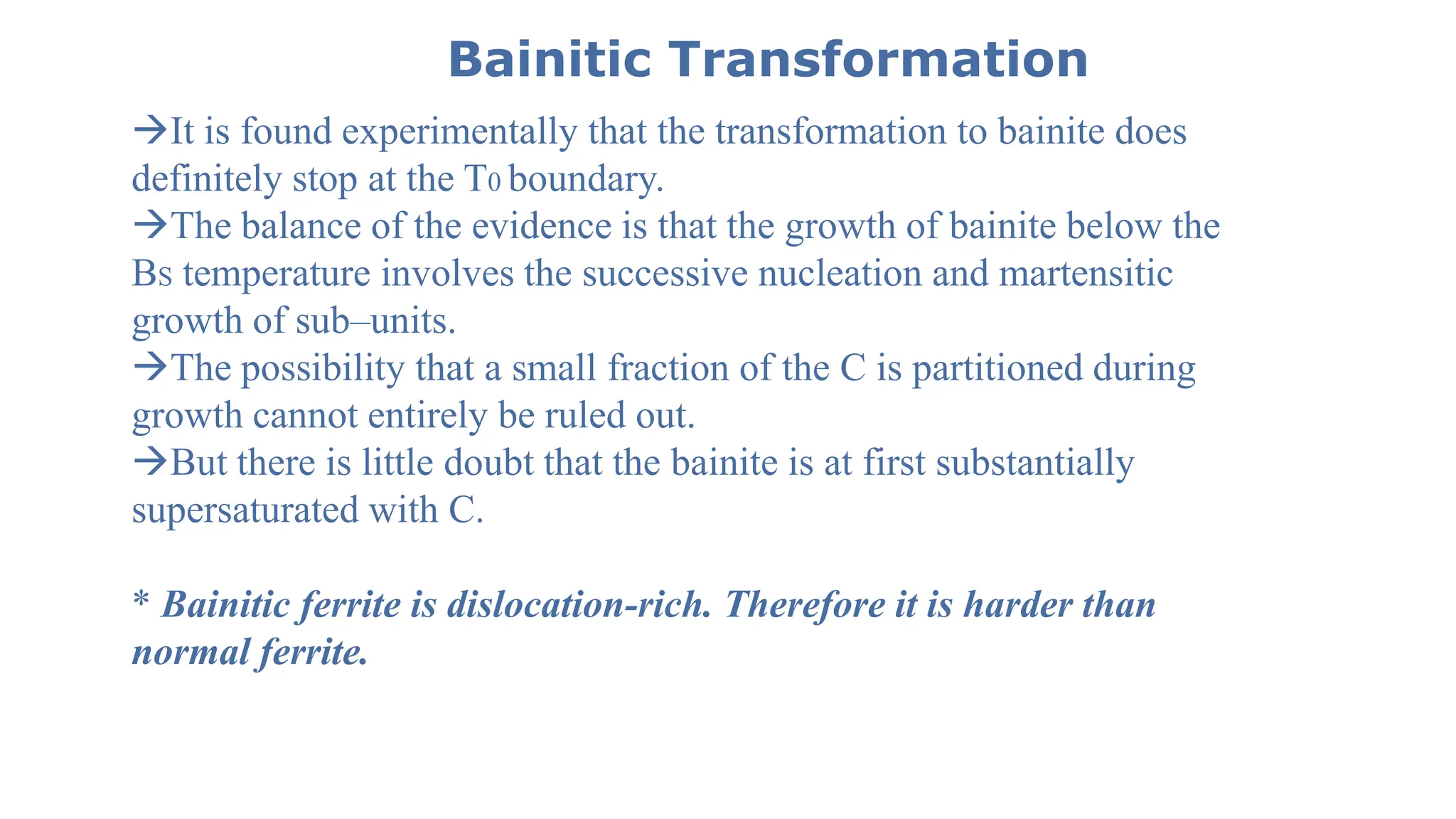
It is found experimentally that the transformation to bainite does
definitely stop at the T0 boundary.
The balance of the evidence is that the growth of bainite below the
BS temperature involves the successive nucleation and martensitic
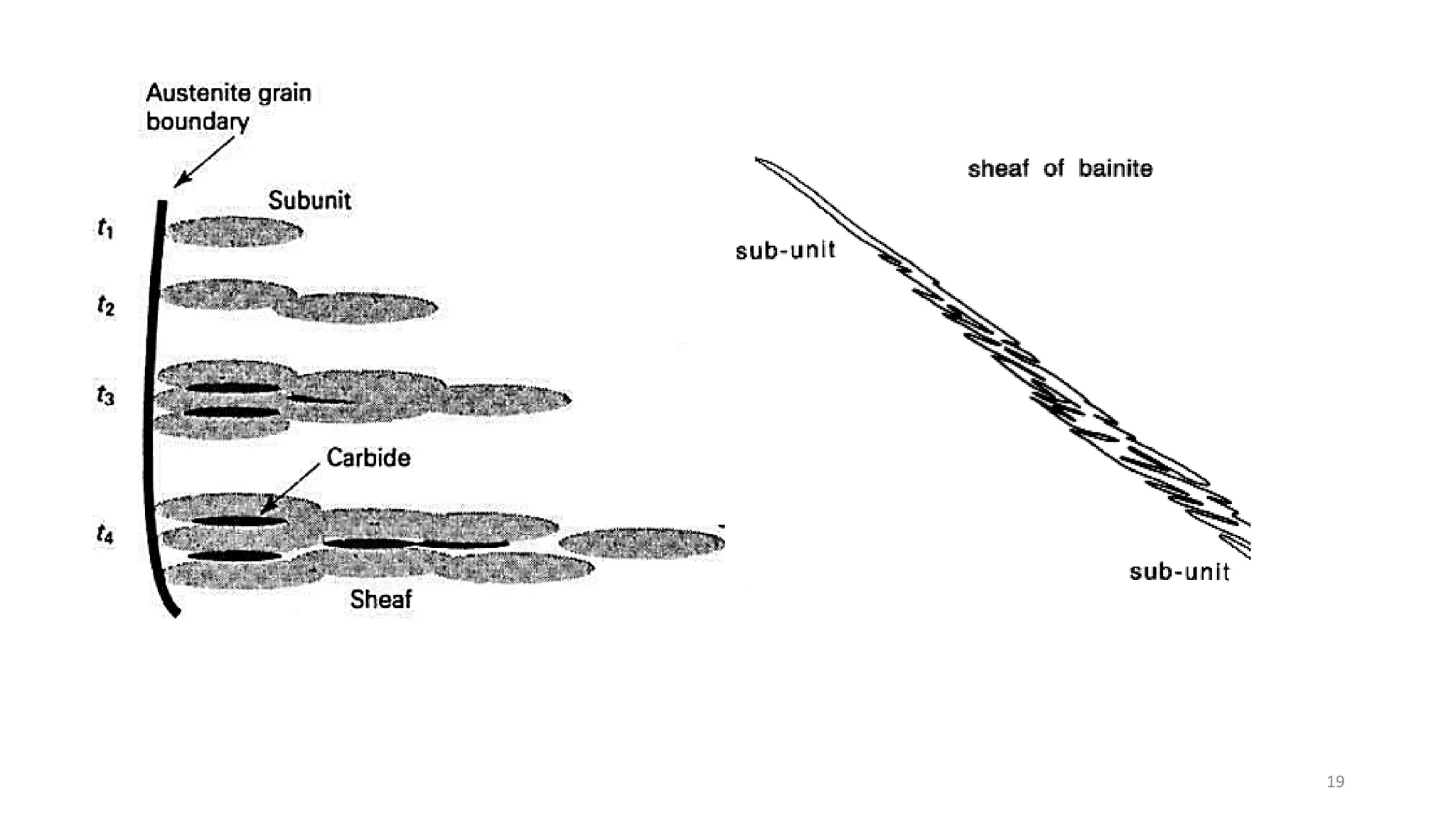
growth of sub–units.
The possibility that a small fraction of the C is partitioned during
growth cannot entirely be ruled out.
But there is little doubt that the bainite is at first substantially
supersaturated with C.
* Bainitic ferrite is dislocation-rich. Therefore it is harder than
normal ferrite.
28
29
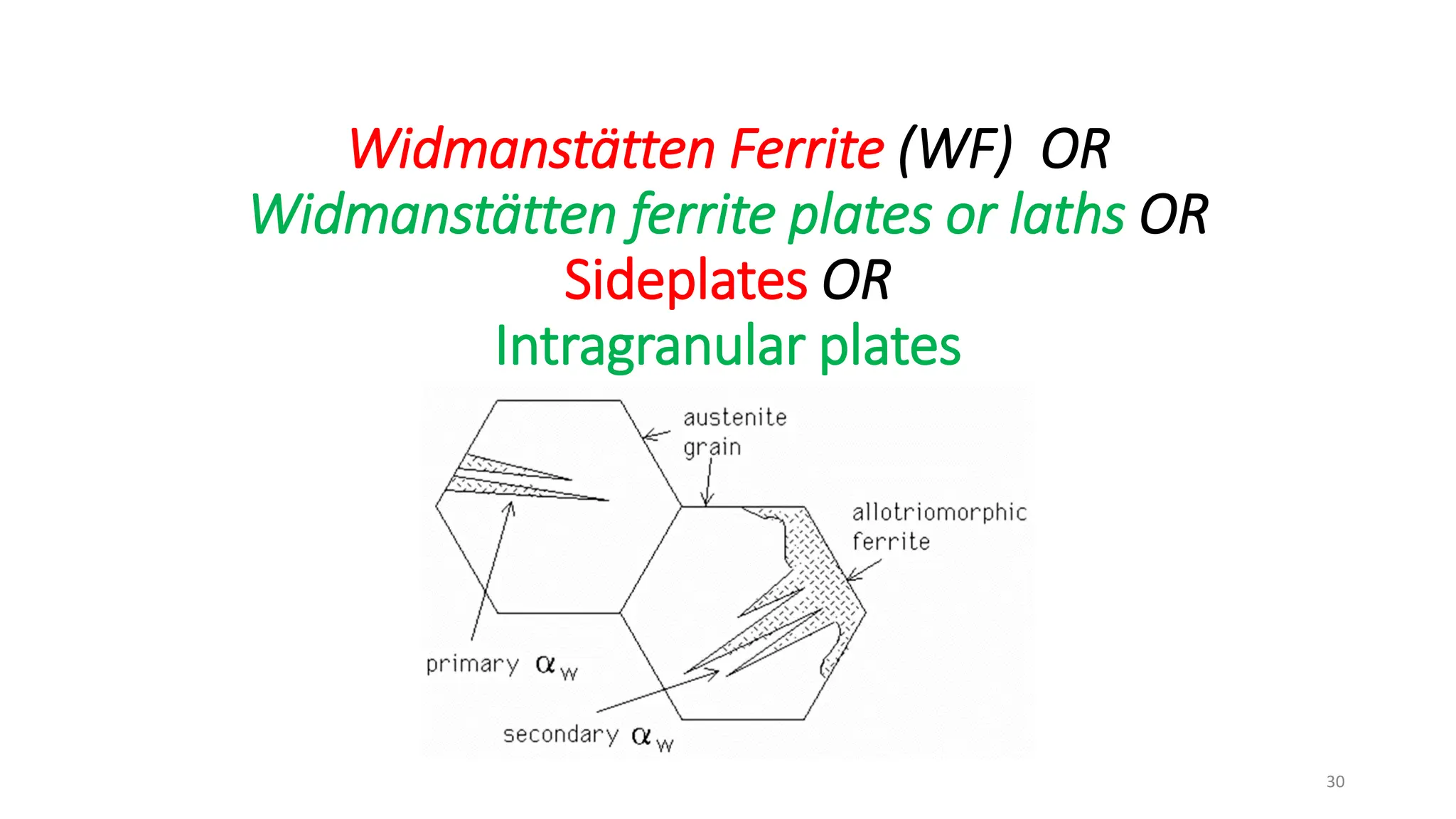
Widmanstätten Ferrite (WF) OR
Widmanstätten ferrite plates or laths OR
Sideplates OR
Intragranular plates
30
• Widmanstatten ferrite is a phase formed by the
transformation of austenite below Ae3.
• Widmanstatten ferrite which grows by a displacive
transformation mechanism, maintains an atomic
correspondence between the parent and product phases.
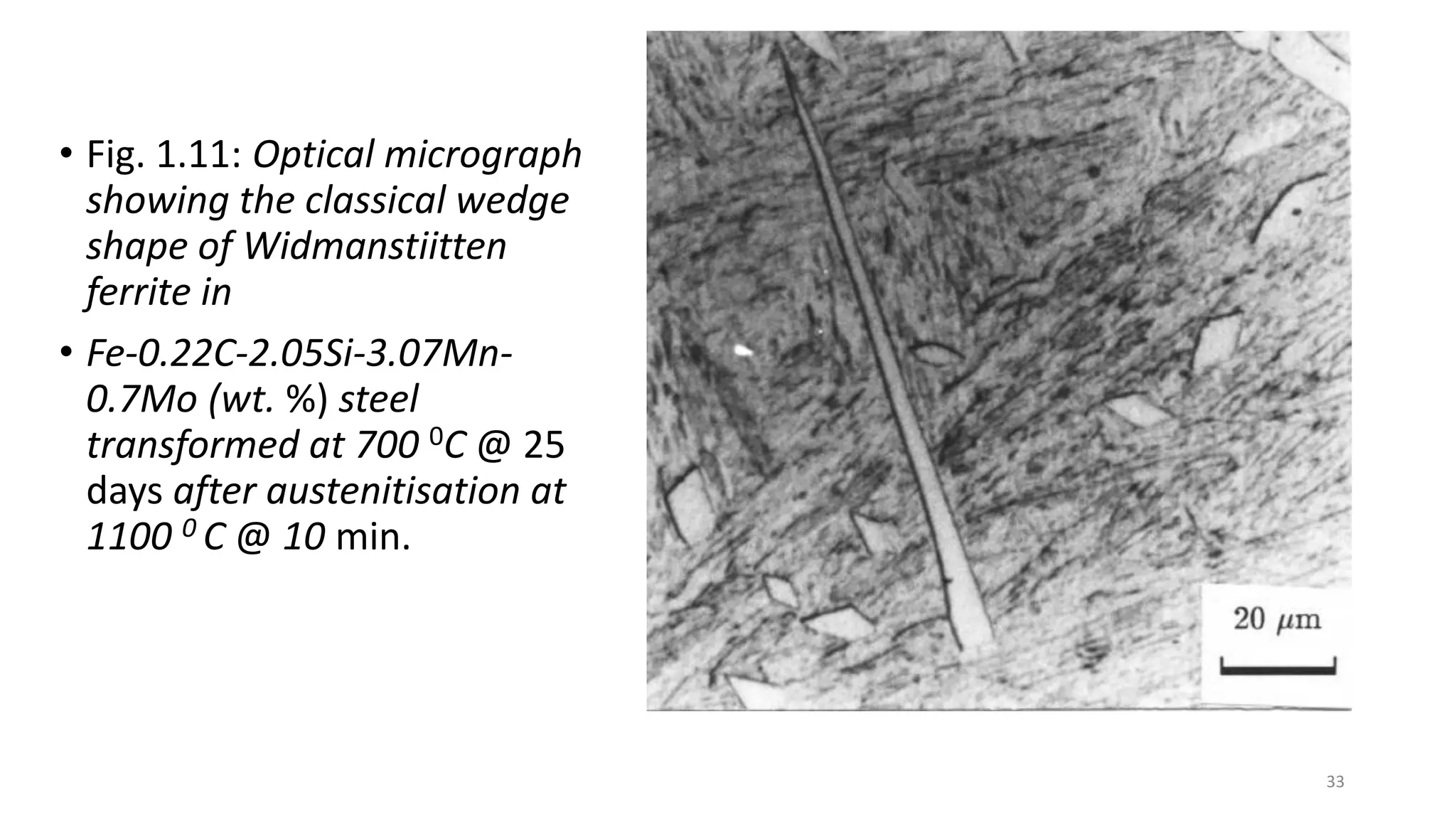
• On an optical scale, Widmanstatten ferrite has triangular
shape and it is called as thin wedge (Fig.), The actual shape
being somewhere between that of a plate and a lath.
31
Growth of Widmanstaetten ferrite in steel
https://www.youtube.com/watch?v=hXUmqM_8yJ4
32
• Fig. 1.11: Optical micrograph
showing the classical wedge
shape of Widmanstiitten
ferrite in
• Fe-0.22C-2.05Si-3.07Mn-
0.7Mo (wt. %) steel
transformed at 700 0C @ 25
days after austenitisation at
1100 0 C @ 10 min.
33
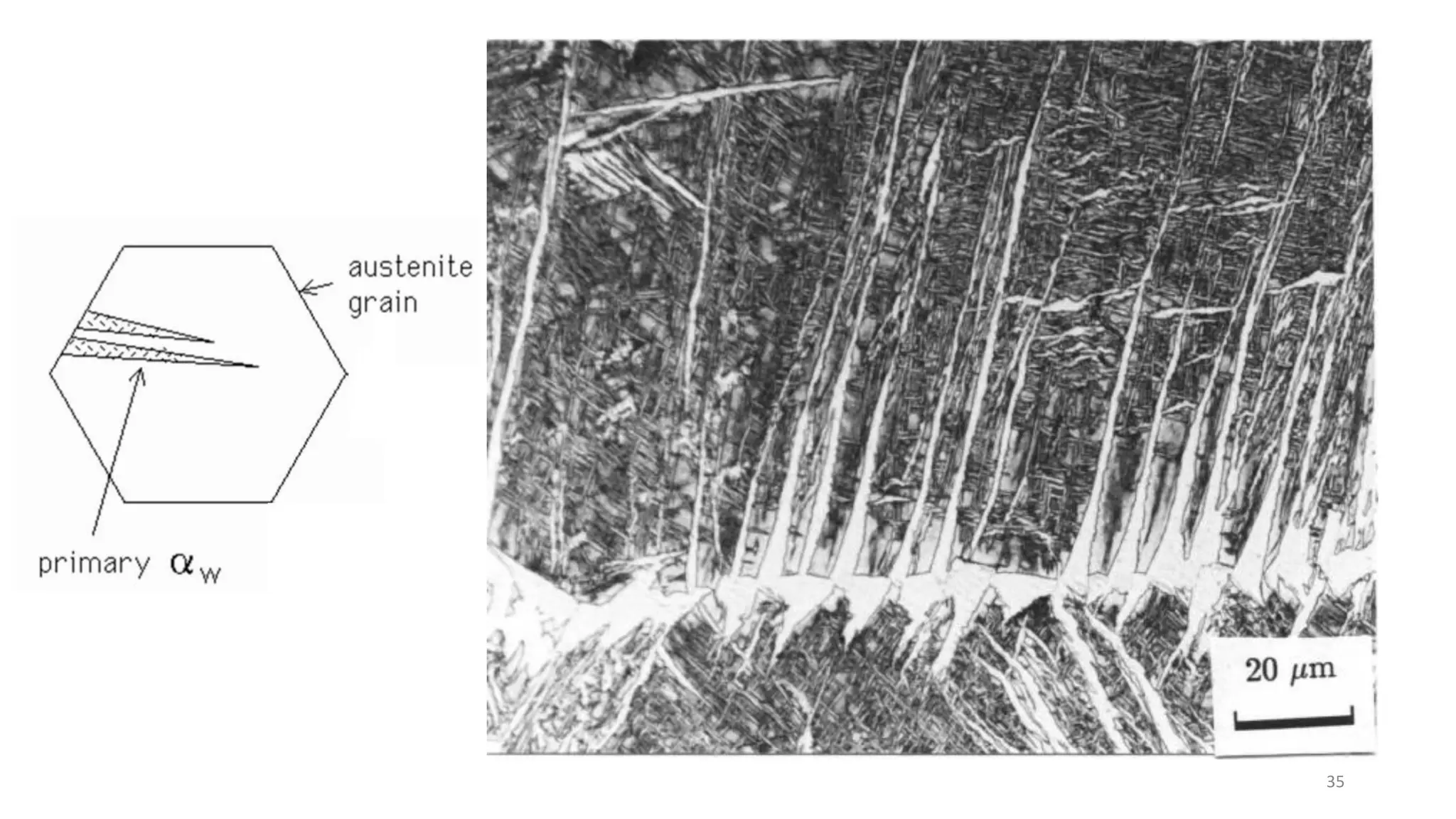
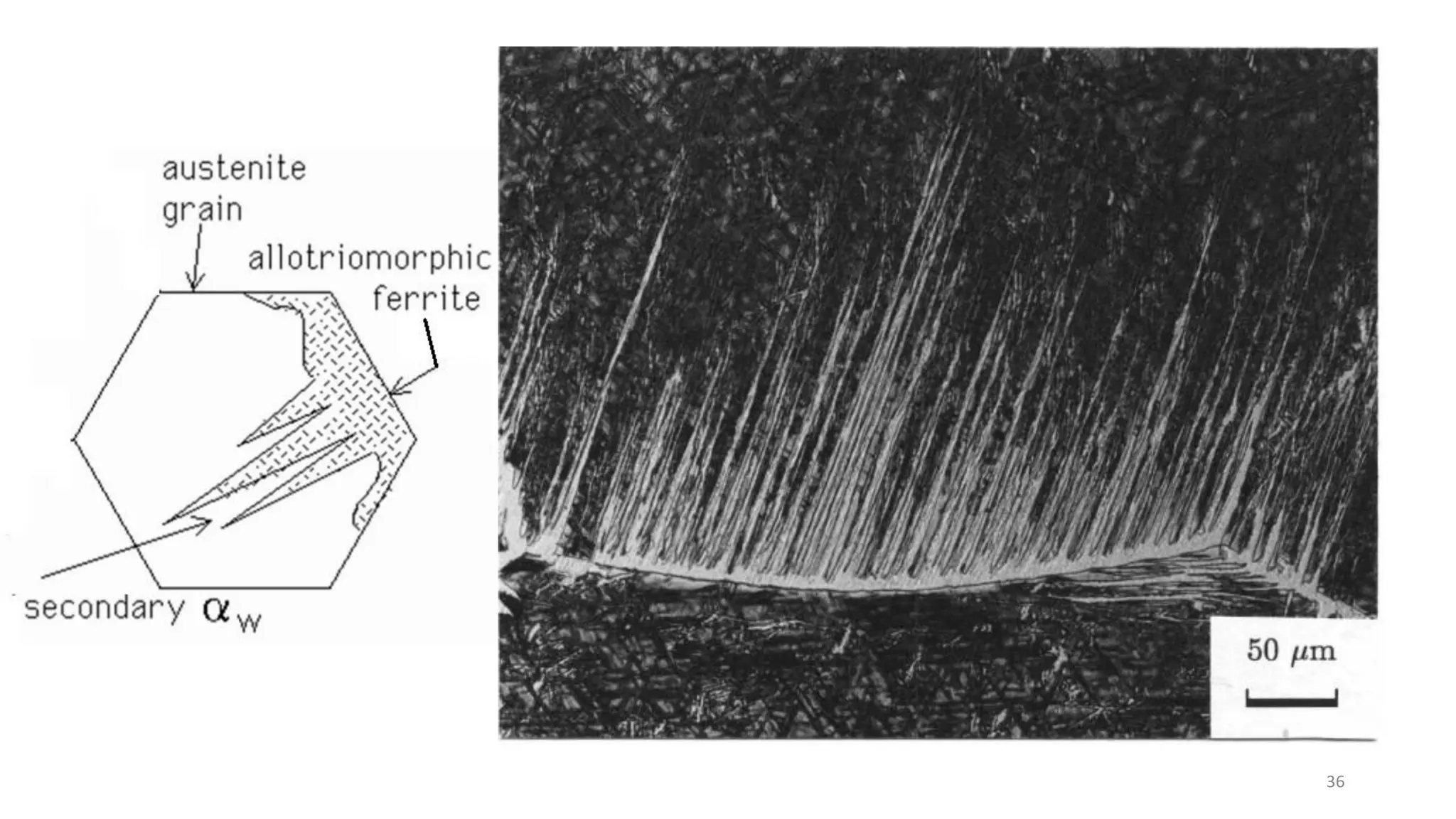
•Widmanstatten ferrite can nucleate directly from
austenite grain boundaries, called
"Widmanstatten ferrite primary side plates" or
•it can nucleate from previously formed grain
boundary allotriomorphic ferrite,
"Widmanstatten ferrite secondary side plates",
both morphologies are shown in Fig. 1.12.
34
35
36
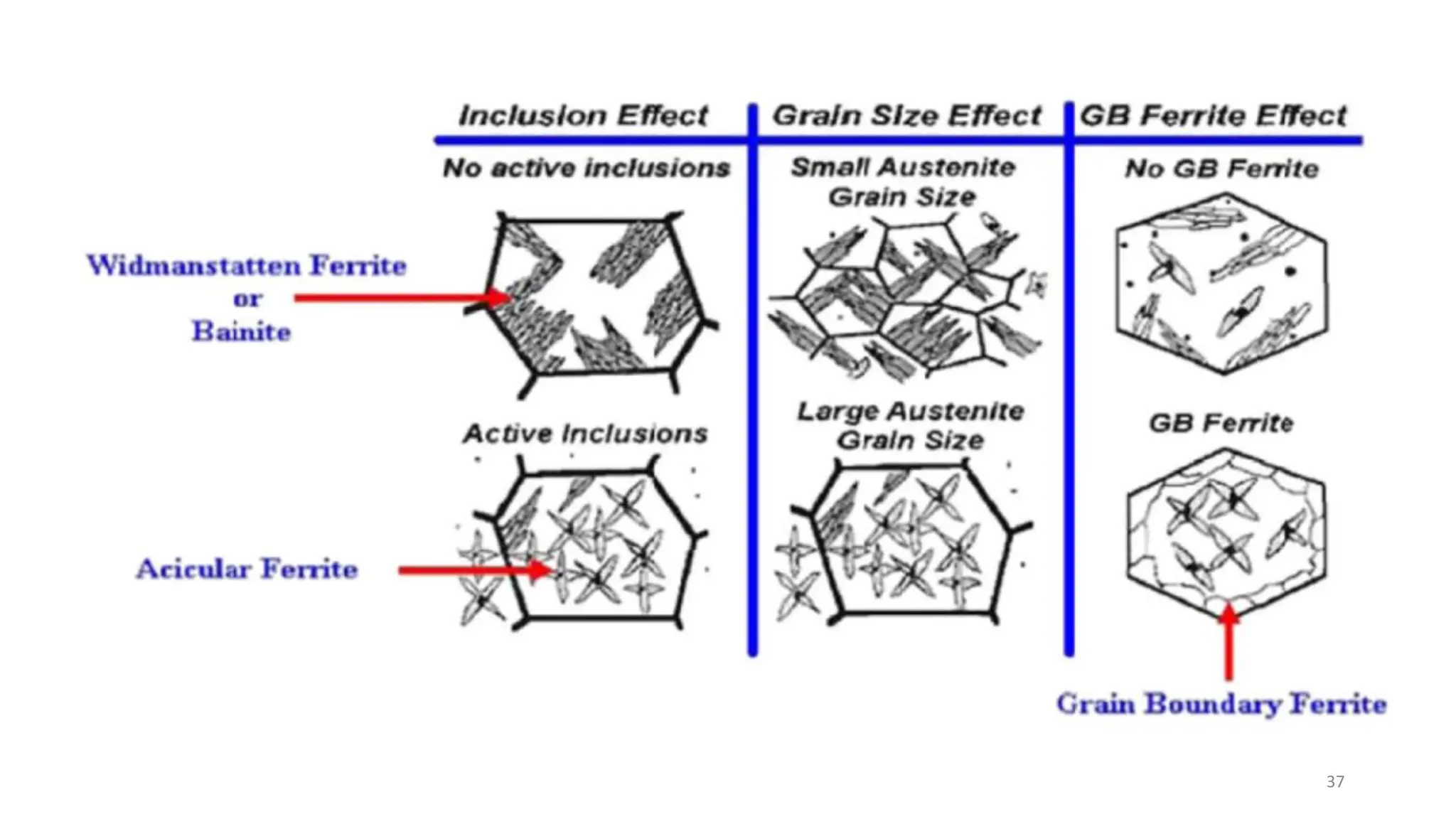
37
•This does not etch dark as in case of Bainite or
Martensite. Because Bainite and Martensite has
lot of structure inside what we see
microscopically.
•Widmenstatten Ferrite αw looks white and clean.
38
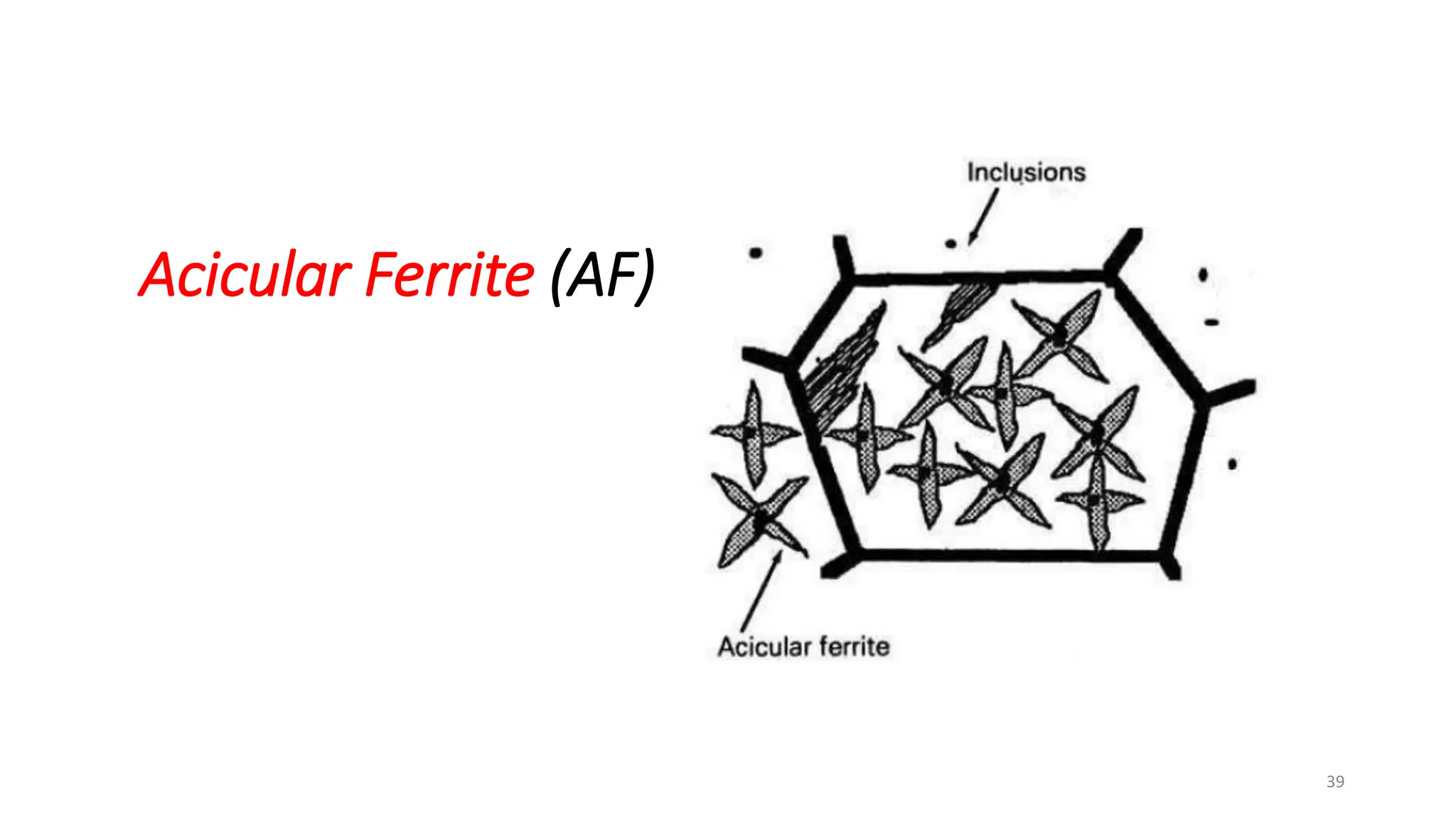
Acicular Ferrite (AF)
39
40
41
42
43
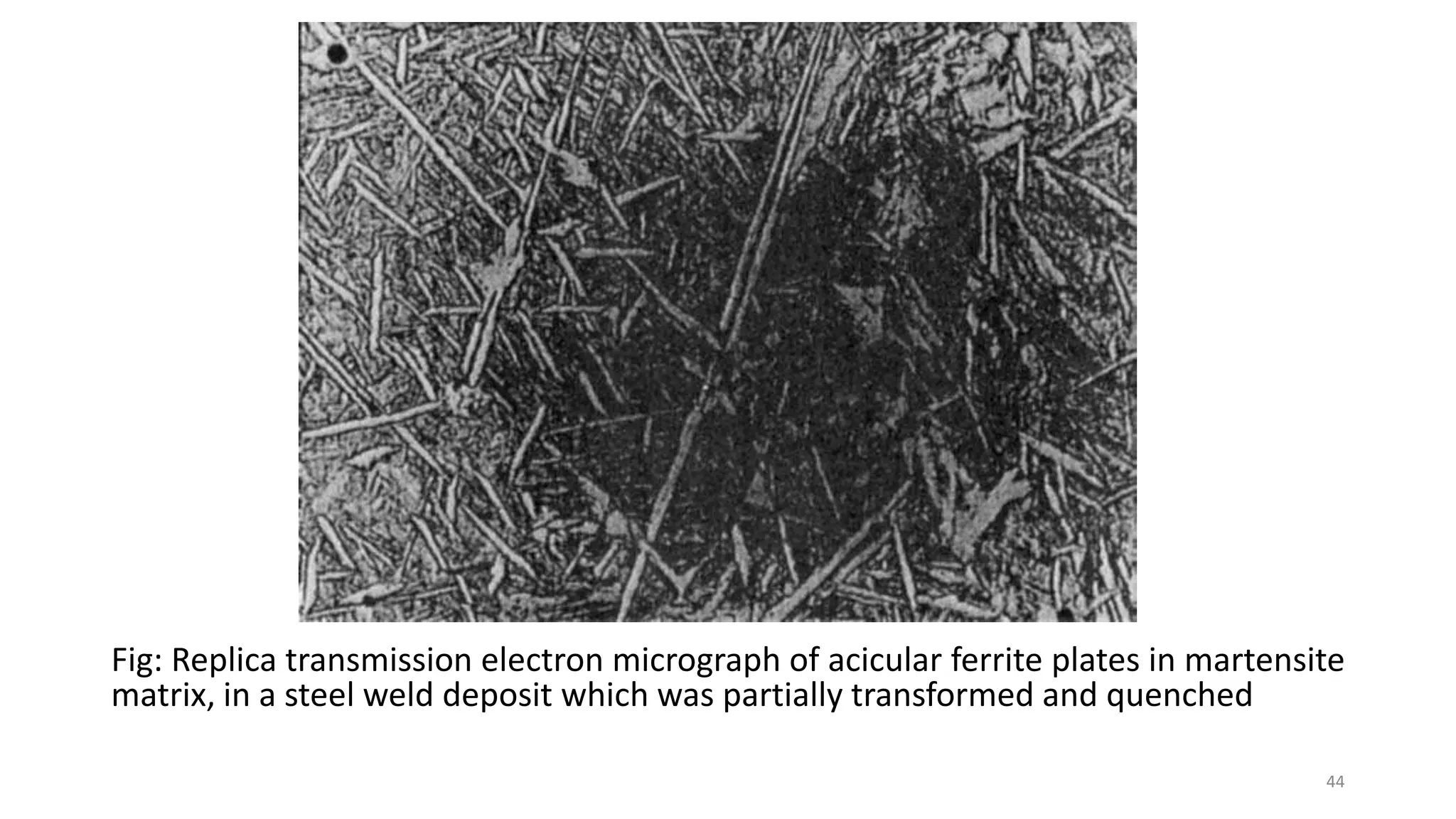
Fig: Replica transmission electron micrograph of acicular ferrite plates in martensite
matrix, in a steel weld deposit which was partially transformed and quenched
44
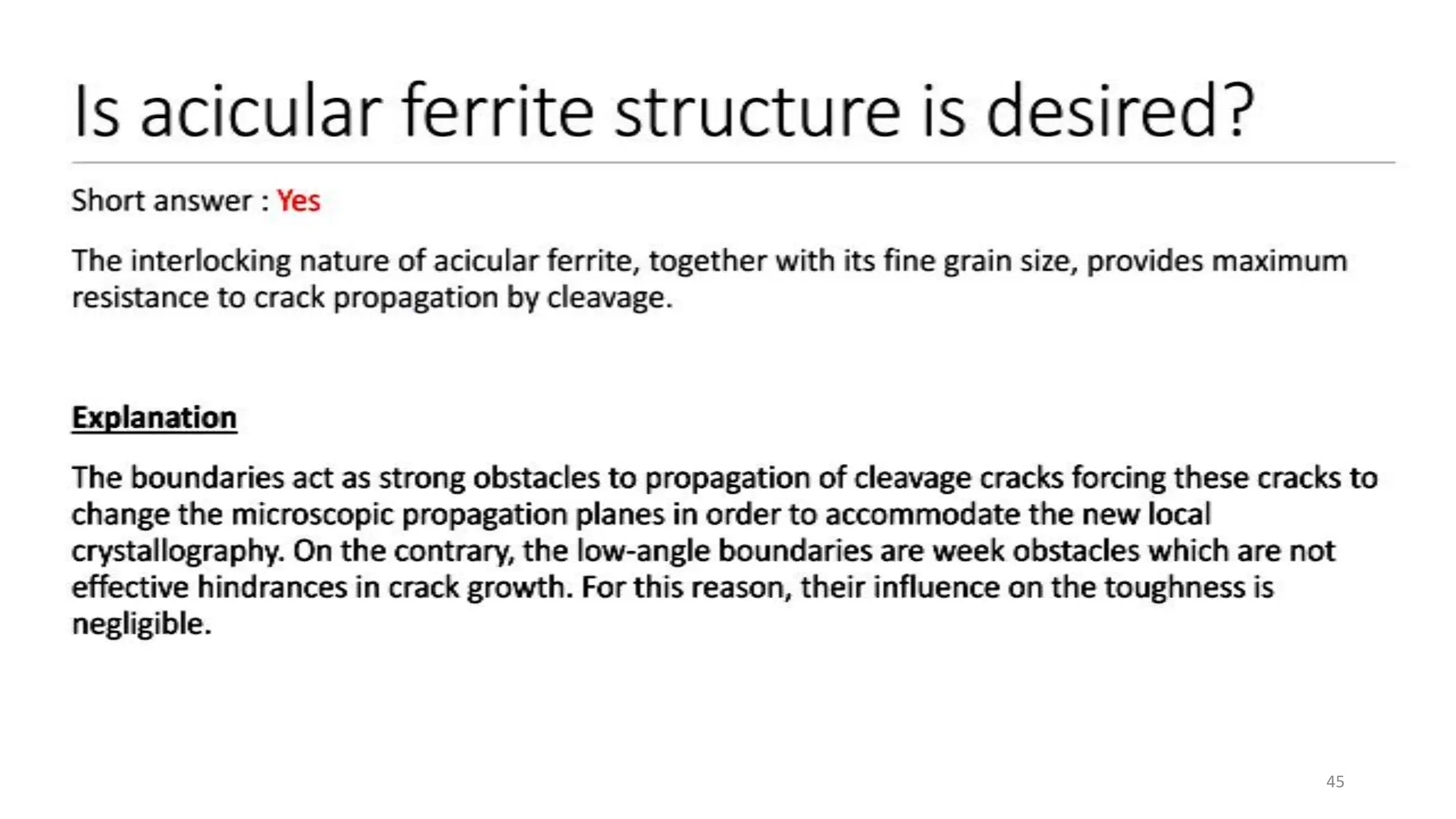
45
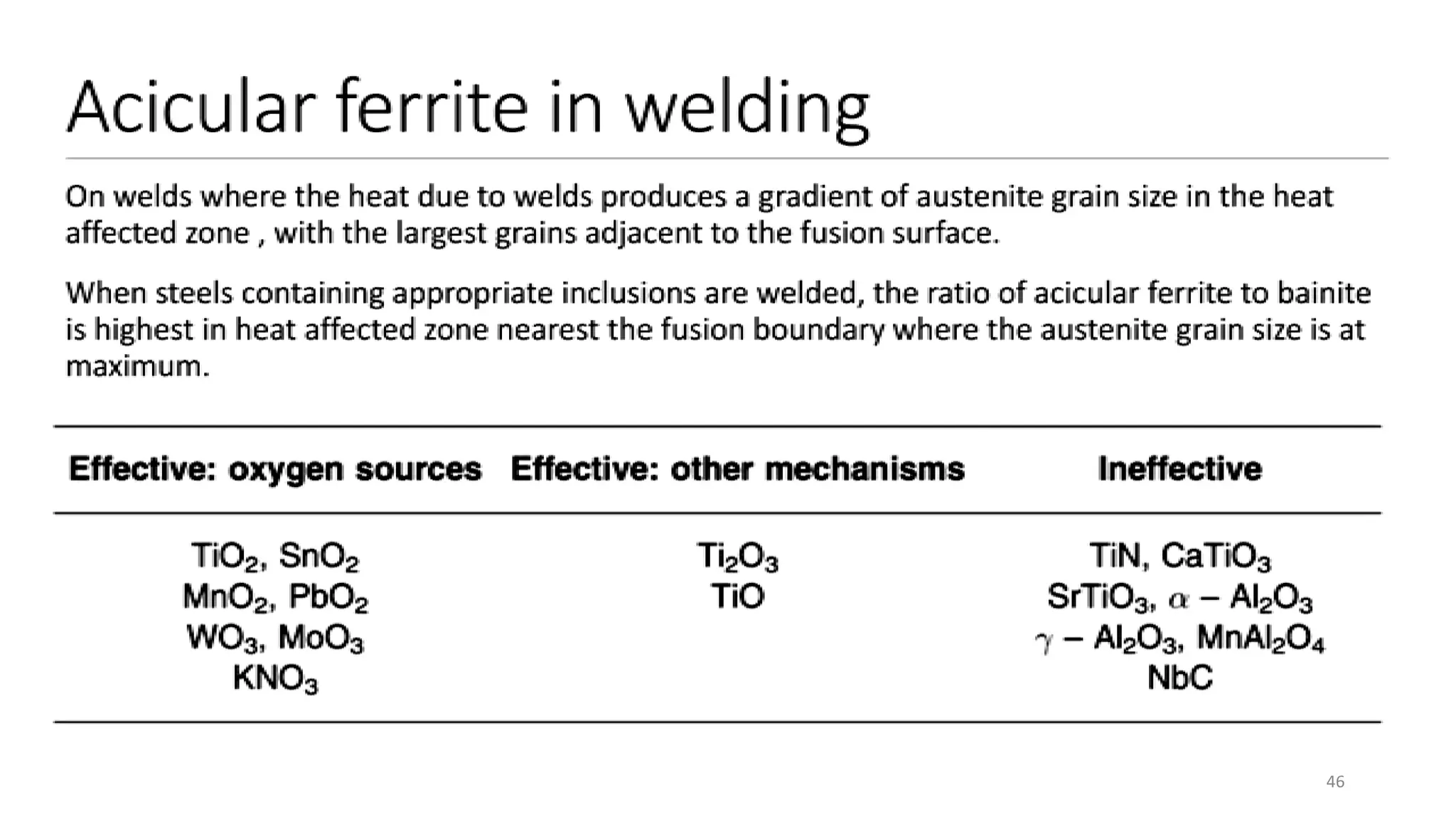
46
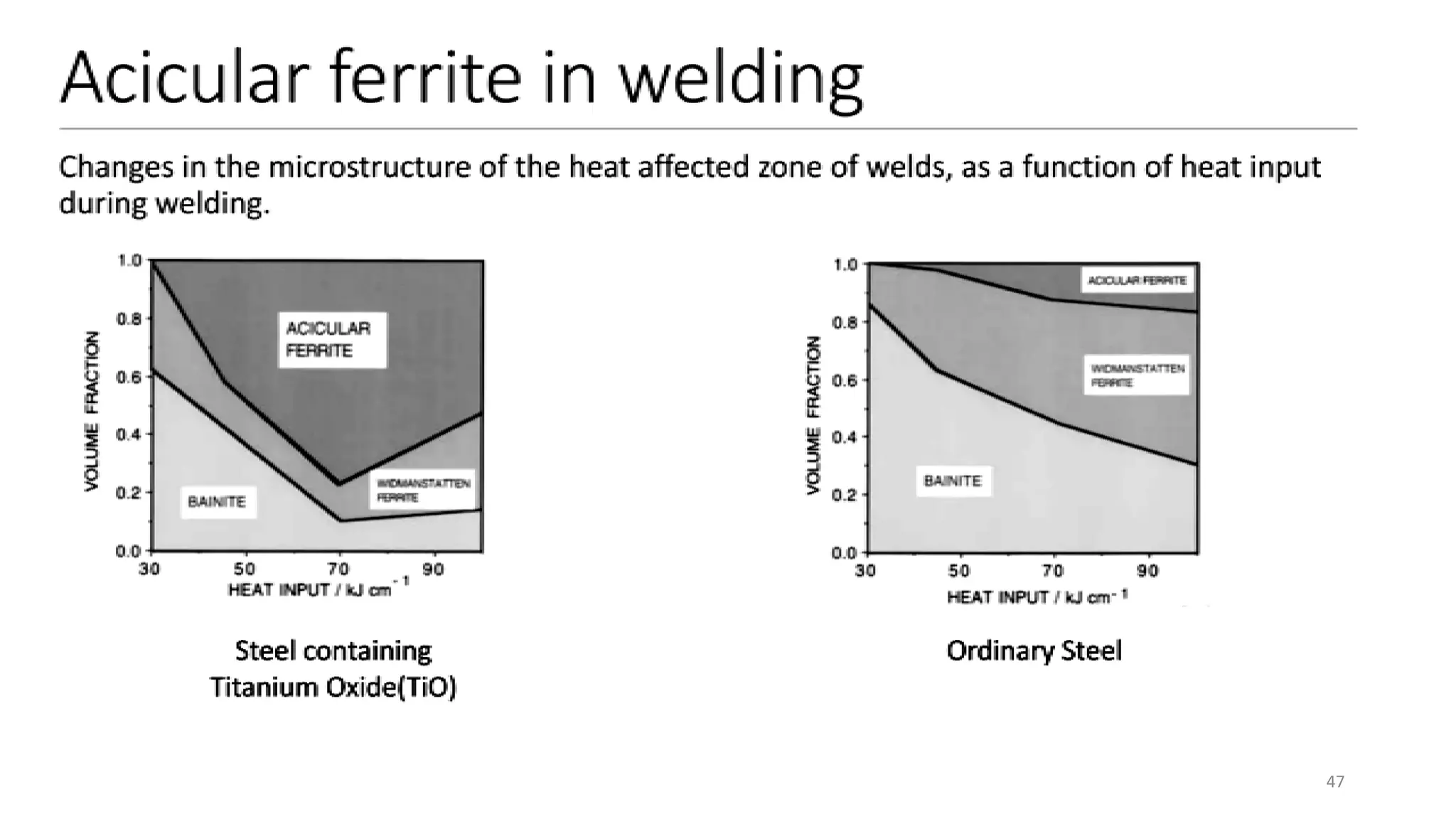
47
End of Displacive Transformation
50

Phase Transformation in Steel-Lecture Series- B (Displacive Transformation, Bainite).pdf

  • 1.
    Phase Transformation in Solid/Metals Dr.Muhammad Ali Siddiqui Assistant Professor Metallurgical Engineering Department m.siddiqui@cloud.neduet.edu.pk 1
  • 2.
  • 3.
    • Fig. 1.6 Summaryof the variety of phases generated by the decomposition of austenite. • Ref: Steels Bhadeshia 3
  • 4.
  • 5.
  • 6.
    6 Figure : TTTdiagrams for two steels, one of which has a high hardenability. Fe-0.4 C steel with the lower hardenability (faster rates of transformation) Fe–Mn–C steel with the higher hardenability (slower rates of transformation) Flat top : This represents the highest temperature Th at which displacive transformations may occur. Th may equal the bainite–start temperature BS if the hardenability is high enough. Th = BS but otherwise, Th = WS where WS is the Widmanstätten ferrite start–temperature. Figure shows in next slide. Bainite forms by the decomposition of austenite at a temperature which is above MS but below that at which fine pearlite forms.
  • 7.
  • 8.
  • 9.
  • 10.
    Fig. - Carbonsteel wire (0.78% C, 0.58% Mn) of 4.6mm dia. Microstructure Relationship Property
  • 11.
    Table – Comparisonof Austemperd and Q&T 1090 steel Microstructure Relationship Property
  • 12.
    AusTempering - Advantages Lowerrate of distortion than for Q&T. Improved toughness than Q&T steel. In many cases strength and wear resistance can also be improved. Increased fatigue strength. Better resistance to shock loads. Resistance to hydrogen and environmental embrittlement. No need of final tempering.
  • 13.
    Upper and LowerBainite (Microstructure) 13
  • 14.
    Upper bainite 14 Upper bainitein Fe–0.095C–1.63Si–2Mn–2Cr wt% steel transformed isothermally at 400◦C.
  • 15.
  • 16.
    By using AtomicForce microscope or Scanning Tunneling Microscope in order to study at higher Magnification. 16 Surface Relief Shape Change:
  • 17.
    17 Microstructure of lowerbainite. Optical micrograph, Fe–0.8C wt% steel transformed at 300◦C, showing sheaves of lower bainite.
  • 18.
  • 19.
  • 20.
    Carbides in Lower BainiticFerrite plates Since long range diffusion is not allowed at lower temp, so only iron carbides (like ε, η, κ, or cementite) precipitates.
  • 21.
    Orientation Relationship The O.R.b/w cementite and ferrite of bainite is similar to than found in tempered martensite i.e. Bagaryastki relationship: Another O.R. observed by Isaichev is also close to Bagaryastki:
  • 22.
  • 23.
    Bainitic Transformation To isthe temp. where the free energy and composition of α and γ are same as a function of C concentration To Concept Diffusionless transformation is thermodynamically impossible if the C conc. of the γ exceeds the T0 curve.
  • 24.
    Bainitic Transformation All bainiteforms below the To temp. Diffusionless growth requires that transformation occurs at a temperature below To. Below To, the free energy of bainite is less than γ of same composition
  • 25.
    Bainitic Transformation  Supposethat the plate of bainite forms without diffusion, but that any excess C is soon afterwards rejected into the residual γ. The next plate of bainite then has to grow from C–enriched γ. This process must cease when the γ carbon concentration reaches the T0 curve. The reaction is said to be incomplete, since the γ has not achieved its equilibrium composition (given by the Ae3 curve) at the point the reaction stops. If on the other hand, the α grows with an equilibrium C concentration then the transformation should cease when the γ carbon concentration reaches the Ae3 curve.
  • 26.
    Bainitic Transformation Fig. -Illustration of the incomplete reaction phenomenon. During isothermal transformation, a plate of bainite grows without diffusion, then partitions its excess C into the residual γ. The next plate therefore has to grow from C–enriched γ. This process continues until diffusionless transformation becomes impossible when the γ composition eventually reaches the T0 boundary. (b) Experimental data showing that the growth of bainite stops when the γ C conc.reaches the T0 curve.
  • 27.
    Bainitic Transformation It isfound experimentally that the transformation to bainite does definitely stop at the T0 boundary. The balance of the evidence is that the growth of bainite below the BS temperature involves the successive nucleation and martensitic growth of sub–units. The possibility that a small fraction of the C is partitioned during growth cannot entirely be ruled out. But there is little doubt that the bainite is at first substantially supersaturated with C. * Bainitic ferrite is dislocation-rich. Therefore it is harder than normal ferrite.
  • 28.
  • 29.
  • 30.
    Widmanstätten Ferrite (WF)OR Widmanstätten ferrite plates or laths OR Sideplates OR Intragranular plates 30
  • 31.
    • Widmanstatten ferriteis a phase formed by the transformation of austenite below Ae3. • Widmanstatten ferrite which grows by a displacive transformation mechanism, maintains an atomic correspondence between the parent and product phases. • On an optical scale, Widmanstatten ferrite has triangular shape and it is called as thin wedge (Fig.), The actual shape being somewhere between that of a plate and a lath. 31
  • 32.
    Growth of Widmanstaettenferrite in steel https://www.youtube.com/watch?v=hXUmqM_8yJ4 32
  • 33.
    • Fig. 1.11:Optical micrograph showing the classical wedge shape of Widmanstiitten ferrite in • Fe-0.22C-2.05Si-3.07Mn- 0.7Mo (wt. %) steel transformed at 700 0C @ 25 days after austenitisation at 1100 0 C @ 10 min. 33
  • 34.
    •Widmanstatten ferrite cannucleate directly from austenite grain boundaries, called "Widmanstatten ferrite primary side plates" or •it can nucleate from previously formed grain boundary allotriomorphic ferrite, "Widmanstatten ferrite secondary side plates", both morphologies are shown in Fig. 1.12. 34
  • 35.
  • 36.
  • 37.
  • 38.
    •This does notetch dark as in case of Bainite or Martensite. Because Bainite and Martensite has lot of structure inside what we see microscopically. •Widmenstatten Ferrite αw looks white and clean. 38
  • 39.
  • 40.
  • 41.
  • 42.
  • 43.
  • 44.
    Fig: Replica transmissionelectron micrograph of acicular ferrite plates in martensite matrix, in a steel weld deposit which was partially transformed and quenched 44
  • 45.
  • 46.
  • 47.
  • 48.
    End of DisplaciveTransformation 50