Muhammad Umair Bukhari

   Engr.umair.bukhari@gmail.com
      www.bzuiam.webs.com
         03136050151
 Polymers. Macromolecules.
 Natural & synthetic
 Their unique properties have allowed
  them to replace metals.
1. strength: weight ratio
2. Designing with plastics
3. Cost of using plastics
4. Ease of manufacturing
 plastic is cheaper than most metal
 weighs a lot less (better fuel economy).
 Plastic can be injection molded, vacuum
  molded, cast and generally machined or
  "worked" faster and cheaper than metal.
 for winter cold areas where the roads are
  salted, the corrosion resistance of plastics
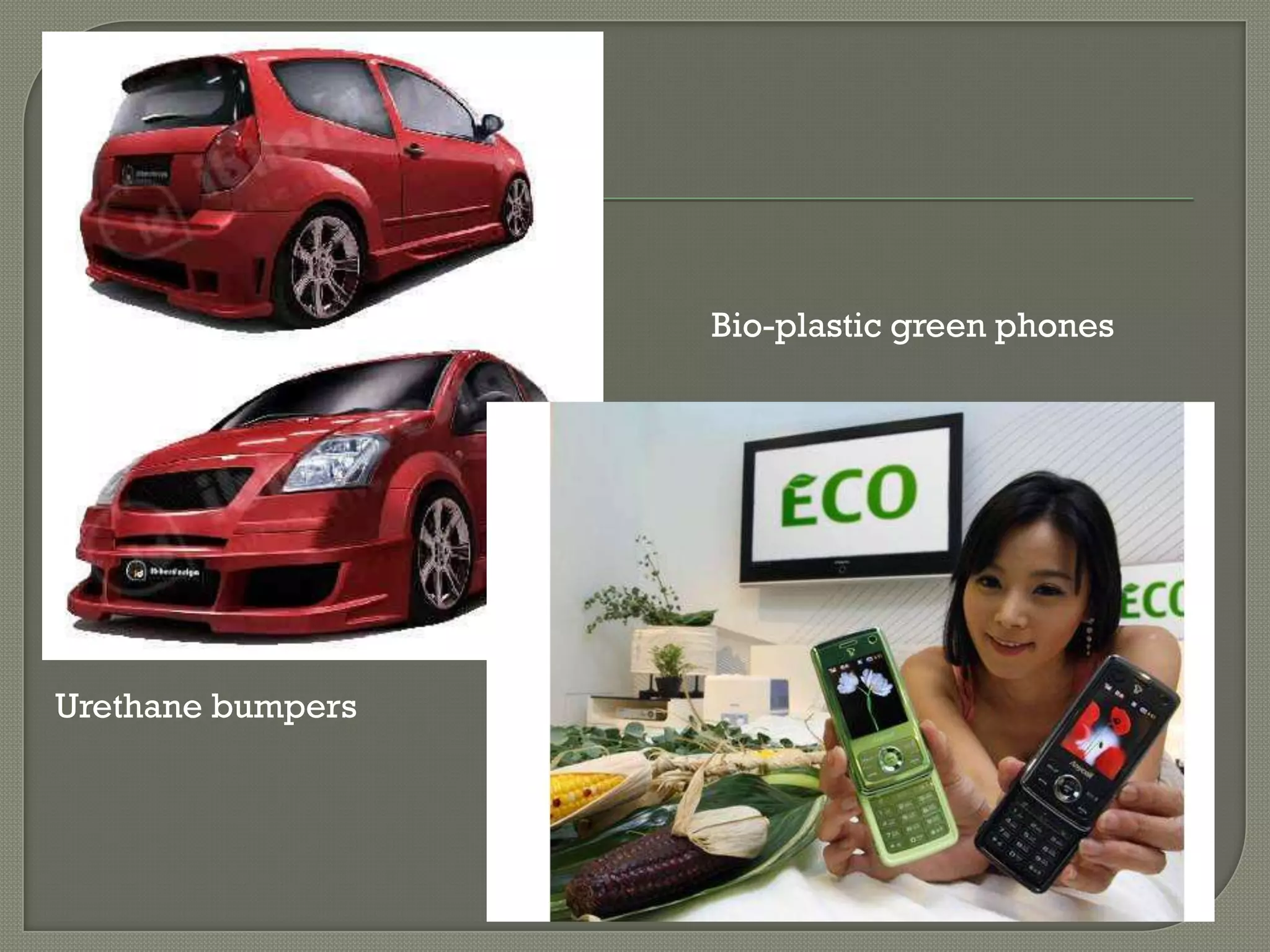
Bio-plastic green phones


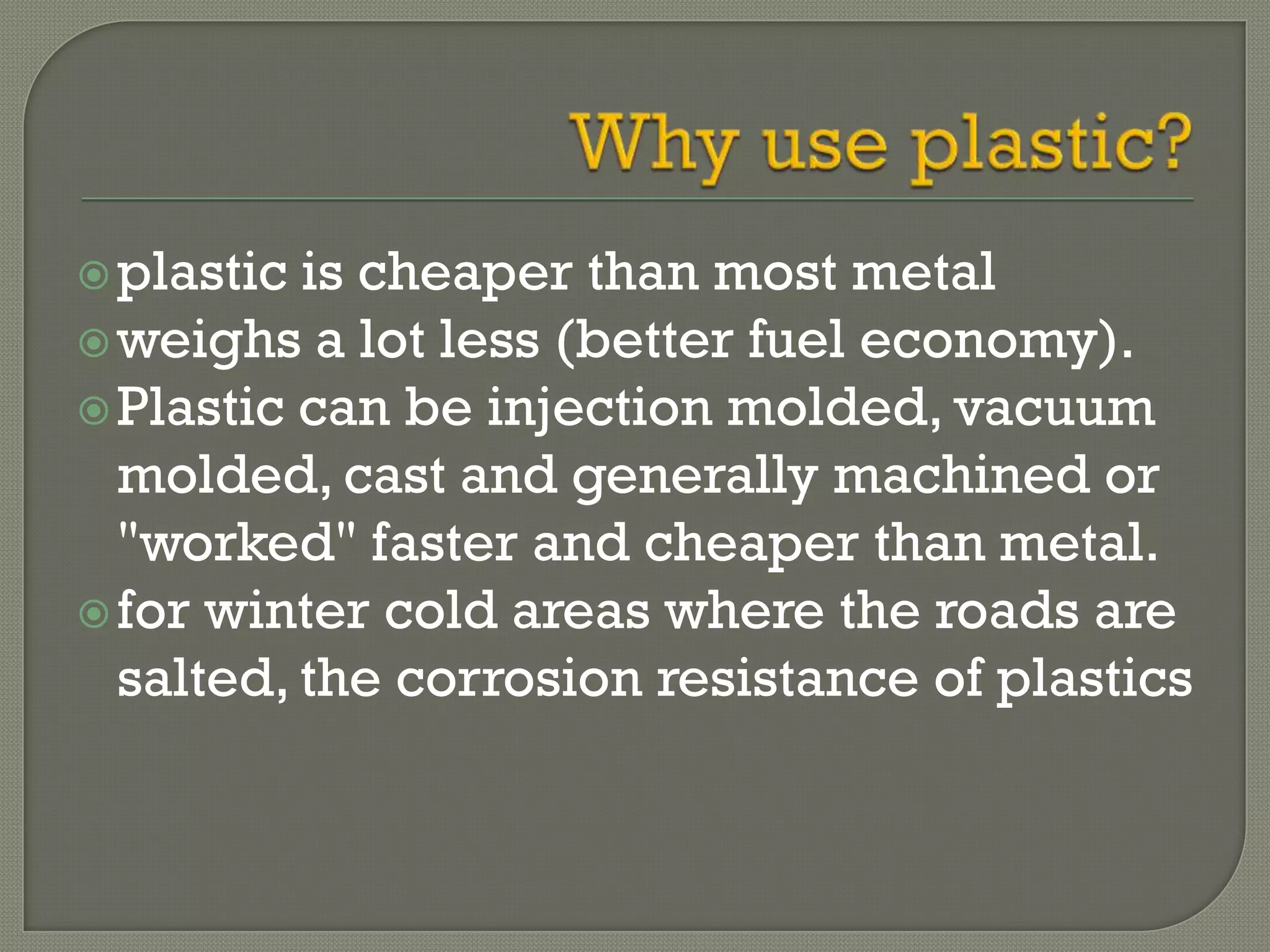
Urethane bumpers
 Thermoplastics:
Amorphous structure. Secondary bonds.
  Linear & branched polymers have weak
  secondary bonds. Return to their original
  hardness when cooled. Reversible
  heating possible.
 Examples: acrylics, nylon, PVC,
  polyethene
 Thermosets:
Cross-linked in a 3d network. Strength of
  bond. Hardness & strength in material not
  affected by temperature.
 Polymerization will require heat &
  pressure so that the shape of the part is
  permanently set.(curing)
 Irreversible. Decomposes. Chars.
 Tg not sharply defined. Become rubbery
  over a narrow range.
 Polymerization in 2 steps. At chemical
  plant & at parts-producing plant.
 Phenolics. Pots & pans.
 Possess better insulating, mechanical &
  chemical properties. Also better
  dimensional stability.
 they  need to be painted for UV
  protection.
 Tooling: Normally more expensive for
  plastic because of the surface finish
  required (in the mold) and the number of
  cavities are larger, thus increasing the
  cost.
 Various   chemical reactions were used to
  make cellulose in to cellulose acetate.
  Photographic films. Packaging sheets.
 So additives are added to impart certain
  specific properties.
 Modify properties like stiffness, strength,
  color, flammability, weatherability.
 Fillers: improve mechanical properties.
  Decreases the cost/unit weight.
 Plasticizers: add flexibility & softness to
  the polymer by reducing Tg .
 Stabilizers: UV rays & oxygen tend to
  weaken & break the primary bonds.
  Degradation.
 Colorants
 Flame retardants
 Cellulosics
 Fluorocarbons
 Polyamide  (nylons)
 Polycarbonates
 Polyesters
 Polyethylenes
 Polypropylenes
 Polystyrenes
 PVC
 Acrylic  is a useful, clear plastic that
  resembles glass, but has properties that
  make it superior to glass in many ways.
  Common brands of high-grade acrylic
  include Plexiglass.
 moderate strength, good optical quality &
  weather resistance. Transparent but can be
  made opaque. Generally resistant to
  chemicals.
 Typical applications: lenses, signs,
  automotive lenses, window glazing, artificial
  nails, paints
 For all of its advantages, there are two
  disadvantages of acrylic: it is more
  expensive than glass, and if exposed to a
  direct flame it will melt and eventually burn.
 Has good impact strength, higher than that
  of glass or polystyrene, but significantly
  lower than that of polycarbonate or
  engineering polymers. In the majority of
  applications, it will not shatter but instead
  breaks into large dull pieces.
 ABS  is impact resistant, abrasion &
  chemical resistant. Resistance to
  chemicals & corrosion. Does not ignite
  easily.
 Typical applications: pipes & fittings, tool
  handles, telephones & appliances.
 High performance at high & low
  temperatures. (-400 F to 1800 F)
 The   main disadvantage to using ABS pipe
  fittings are that it is not very durable
  when it comes to solvents or fatigue
  resistance. It also has minimal UV
  resistance, so should not be left exposed
  to the sun.
 The nitrile groups from neighboring
  chains, being polar, attract each other
  and bind the chains together, making
  ABS stronger than pure polystyrene
 PVC   has many advantages over pipes
  made of galvanized steel and copper.
 To begin with, it is the most lightweight of
  the three. This makes it easier to install.
  Also, it is the least expensive of the three
  types.
 Also, it can withstand higher water
  pressure than the copper. Also, PCV is
  non-conductive, will not rust, and is not as
  conducive to condensation.
 Another advantage is that PVC can be
 placed under concrete slab without
 reacting to the concrete. Moreover, it is
 self-insulating. That is why it can handle
 hotter temperature water.
 Even  though it can withstand hot water
  temperatures, it is less flame resistant.
  That is one of the biggest disadvantages
  of PVC.
 Also, PVC contains volatile compounds
  which are harmful to the environment.
  Furthermore, some people have
  complained that PVC pipes cause water
  to have a slight plastic taste.
 ElasticModulus & tensile strength
  decrease with increasing temperature.
  Toughness increases.
 Water absorption. Adverse affect.
 Solvents. Residual stresses.
 Radiation & visible light.
 Anisotropy due to cold rolling.
 Friction& wear (self-lubricating,
  TEFLON) (gears, roller skate wheels,
  prosthetic joints)
 Thermal & electrical conductivity
 Low specific gravity (0.9-2.2)
 High coefficient of thermal expansion

Plastics

  • 2.
    Muhammad Umair Bukhari Engr.umair.bukhari@gmail.com www.bzuiam.webs.com 03136050151
  • 3.
     Polymers. Macromolecules. Natural & synthetic  Their unique properties have allowed them to replace metals. 1. strength: weight ratio 2. Designing with plastics 3. Cost of using plastics 4. Ease of manufacturing
  • 4.
     plastic ischeaper than most metal  weighs a lot less (better fuel economy).  Plastic can be injection molded, vacuum molded, cast and generally machined or "worked" faster and cheaper than metal.  for winter cold areas where the roads are salted, the corrosion resistance of plastics
  • 5.
  • 6.
     Thermoplastics: Amorphous structure.Secondary bonds. Linear & branched polymers have weak secondary bonds. Return to their original hardness when cooled. Reversible heating possible.  Examples: acrylics, nylon, PVC, polyethene
  • 7.
     Thermosets: Cross-linked ina 3d network. Strength of bond. Hardness & strength in material not affected by temperature.  Polymerization will require heat & pressure so that the shape of the part is permanently set.(curing)  Irreversible. Decomposes. Chars.
  • 8.
     Tg notsharply defined. Become rubbery over a narrow range.  Polymerization in 2 steps. At chemical plant & at parts-producing plant.  Phenolics. Pots & pans.  Possess better insulating, mechanical & chemical properties. Also better dimensional stability.
  • 9.
     they need to be painted for UV protection.  Tooling: Normally more expensive for plastic because of the surface finish required (in the mold) and the number of cavities are larger, thus increasing the cost.
  • 10.
     Various chemical reactions were used to make cellulose in to cellulose acetate. Photographic films. Packaging sheets.  So additives are added to impart certain specific properties.  Modify properties like stiffness, strength, color, flammability, weatherability.
  • 11.
     Fillers: improvemechanical properties. Decreases the cost/unit weight.  Plasticizers: add flexibility & softness to the polymer by reducing Tg .  Stabilizers: UV rays & oxygen tend to weaken & break the primary bonds. Degradation.  Colorants  Flame retardants
  • 12.
     Cellulosics  Fluorocarbons Polyamide (nylons)  Polycarbonates  Polyesters  Polyethylenes  Polypropylenes  Polystyrenes  PVC
  • 14.
     Acrylic is a useful, clear plastic that resembles glass, but has properties that make it superior to glass in many ways. Common brands of high-grade acrylic include Plexiglass.  moderate strength, good optical quality & weather resistance. Transparent but can be made opaque. Generally resistant to chemicals.  Typical applications: lenses, signs, automotive lenses, window glazing, artificial nails, paints
  • 15.
     For allof its advantages, there are two disadvantages of acrylic: it is more expensive than glass, and if exposed to a direct flame it will melt and eventually burn.  Has good impact strength, higher than that of glass or polystyrene, but significantly lower than that of polycarbonate or engineering polymers. In the majority of applications, it will not shatter but instead breaks into large dull pieces.
  • 16.
     ABS is impact resistant, abrasion & chemical resistant. Resistance to chemicals & corrosion. Does not ignite easily.  Typical applications: pipes & fittings, tool handles, telephones & appliances.  High performance at high & low temperatures. (-400 F to 1800 F)
  • 17.
     The main disadvantage to using ABS pipe fittings are that it is not very durable when it comes to solvents or fatigue resistance. It also has minimal UV resistance, so should not be left exposed to the sun.  The nitrile groups from neighboring chains, being polar, attract each other and bind the chains together, making ABS stronger than pure polystyrene
  • 19.
     PVC has many advantages over pipes made of galvanized steel and copper.  To begin with, it is the most lightweight of the three. This makes it easier to install. Also, it is the least expensive of the three types.  Also, it can withstand higher water pressure than the copper. Also, PCV is non-conductive, will not rust, and is not as conducive to condensation.
  • 20.
     Another advantageis that PVC can be placed under concrete slab without reacting to the concrete. Moreover, it is self-insulating. That is why it can handle hotter temperature water.
  • 21.
     Even though it can withstand hot water temperatures, it is less flame resistant. That is one of the biggest disadvantages of PVC.  Also, PVC contains volatile compounds which are harmful to the environment. Furthermore, some people have complained that PVC pipes cause water to have a slight plastic taste.
  • 22.
     ElasticModulus &tensile strength decrease with increasing temperature. Toughness increases.  Water absorption. Adverse affect.  Solvents. Residual stresses.  Radiation & visible light.  Anisotropy due to cold rolling.
  • 23.
     Friction& wear(self-lubricating, TEFLON) (gears, roller skate wheels, prosthetic joints)  Thermal & electrical conductivity  Low specific gravity (0.9-2.2)  High coefficient of thermal expansion