Carbon is an effective, cheap, hardening
element for iron and hence a large
tonnage of commercial steels contains
very little alloying element.
They may be divided conveniently into
 low-carbon (<0.3% C),
medium-carbon (0.3–0.7% C) and
High carbon (0.7–1.7% C).
 The lowcarbon steels combine moderate
strength with excellent ductility and are
used extensively for their fabrication
properties in the annealed or normalized
condition for structural purposes, i.e.
bridges, buildings, cars and ships.
 Improved low-carbon steels (<0.2% C) are
produced by deoxidizing or ‘killing’ the
steel with Al or Si, or by adding Mn to
refine the grain size. It is now more
common, however, to add small amounts
(<0.1%) of Nb which reduces the carbon
content by forming NbC particles.
 These particles not only restrict grain growth but
also give rise to strengthening by precipitation-
hardening within the ferrite grains.
 Other carbide formers, such as Ti, may be used but
because Nb does not deoxidize, it is possible to
produce a semi-killed steel ingot which, because of
its reduced ingot pipe, gives increased tonnage yield
per ingot cast.
 Medium-carbon steels are capable of being quenched
to form martensite and tempered to develop
toughness with good strength. Tempering in higher-
temperature regions (i.e. 350–550°C) produces a
spheroidized carbide which toughens the steel
sufficiently for use as axles, shafts, gears and rails.
The high-carbon steels are usually quench
hardened and lightly tempered at 250°C to
develop considerable strength with
sufficient ductility for springs, dies and
cutting tools.
Their limitations stem from their poor
hardenability and their rapid softening
properties at moderate tempering
temperatures.
In general, as the carbon content increases the hardness of the
steel also increases. The tensile strength and the yield
strength also increase to about 0.83 % carbon. Thereafter, they
level out. This is shown in Figure
 The tensile strength and hardness are affected as the
ratio of ferrite to cementite in the structure of steel
changes. As the percentage of pearlite increases in the
hypoeutectoid steels, the tensile strength increases.
The hardness does not increase dramatically. The
hypereutectoid steels show only a slight increase in
strength as the cementite-to-ferrite ratio increases.
 The elongation and the reduction in area represent how
ductile or brittle a material is. Figure in the next slide
indicates the effect of carbon on the ductility and
impact resistance (toughness) of steels. The elongation
and the reduction in area drop sharply with increase in
carbon content, going almost to zero at about 1.5 %
carbon. This indicates that the carbon content of 1.5 %
or more will cause high brittleness. The impact
resistance also decreases very sharply up to about 0.83
% carbon and then levels out.
Element Effect
Aluminum Ferrite hardener
Graphite former
Deoxidizer
Chromium Mild ferrite hardener
Moderate effect on hardenability
Graphite former
Resists corrosion
Resists abrasion
Cobalt High effect on ferrite as a hardener
High red hardness
Molybdenum Strong effect on hardenability
Strong carbide former
High red hardness
Increases abrasion resistance
Manganese Strong ferrite hardener
Nickel Ferrite strengthener
Increases toughness of the hypoeutectoid steel
With chromium, retains austenite
Graphite former
Copper Austenite stabilizer
Improves resistance to corrosion
Silicon Ferrite hardener
Increases magnetic properties in steel
Phosphorus Ferrite hardener
Improves machinability
Increases hardenability
 Alloying elements have significant effect on the iron-iron
carbide equilibrium diagram. The addition of some of these
alloying elements will widen the temperature range through
which austenite (g -iron) is stable while other elements will
constrict the temperature range. What this means is that
some elements will raise and some elements will lower the
critical tempearture of steel.
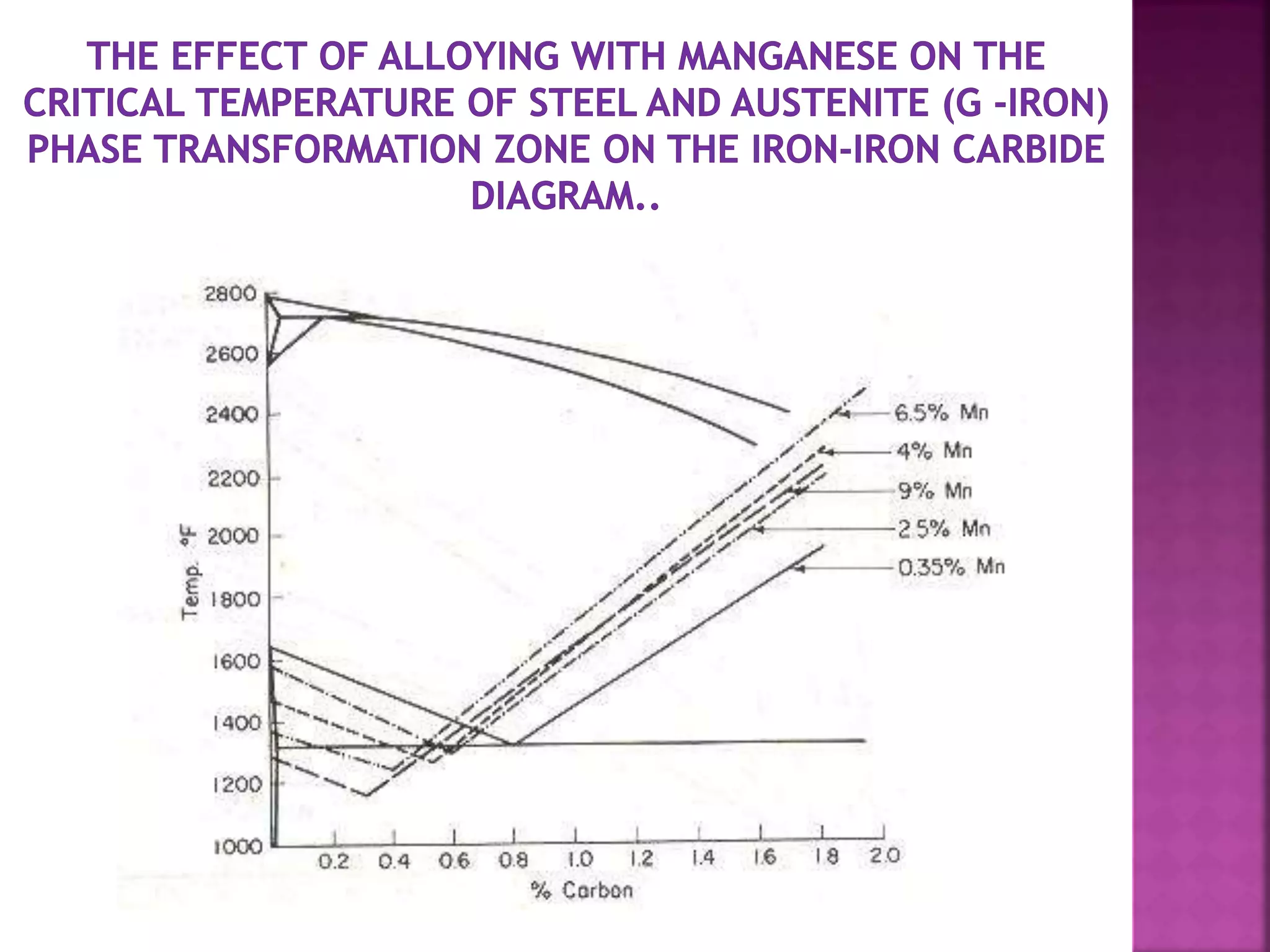
 Manganese, cobalt, and nickel increase the temperature
range through which austenite is stable. This also means that
the lower critical temperature of steel will be lowered by
these alloying elements. Other alloying elements that lower
the critical temperature of steel are carbon, copper and
zinc. The alloying elements that are used to reduce the
critical temperature are highly soluble in the gamma iron
(austenite). Figure shows the effect of manganese on the
critical temperature of steel.
 Alloys such as aluminum, chromiuim,
molybdenum, phosphorus, silicon, tungsten
tend to form solid solutions with alpha iron
(ferrite). This constricts the temperature
region through which gamma iron (austenite)
is stable. As shown in the figure in the next
slide, chromium at different percentages
constricts the critical temperature range
which results in a marked reduction of the
region where austenite is stable.
 The elements shown in the previous Figure
have the greatest solubility in ferrite and
also influence the hardenability of iron when
in the presence of carbon. With a slight
increase in the carbon content, they respond
markedly to heat treating, because carbon
acts as a ferrite strengthener. As indicated in
Figure, Phosphorus will improve the hardness
of the ferrite significantly by adding only a
very small percentage of Phosphorus, while
Chromium will not strengthen the ferrite
that well even at very high percentage of
Chromium addition to the steel
 The Figure shows the effect of furnace
cooling vs. air cooling on the tensile strength
of steel for three different percentages of
carbon in the presence of chromium. As this
figure indicates, furnace cooling has very
little effect on the tensile strength of the
material. The addition of chromium does not
change the tensile strength properties when
the steel is cooled in the furnace. If the
same steels are air cooled at the same rate,
the slope of the curves increases significantly
which means that a slight increase in the
chromium content increases the strength
drastically when air cooling is applied.
 In low/medium alloy steels, with total alloying content up to
about 5%, the alloy content is governed largely by the
hardenability and tempering requirements, although solid
solution hardening and carbide formation may also be
important.
 Some of these aspects have already been discussed, the
main conclusions being that Mn and Cr increase
hardenability and generally retard softening and tempering.
 Ni strengthens the ferrite and improves hardenability and
toughness; copper behaves similarly but also retards
tempering;
 Co strengthens ferrite and retards softening on tempering;
Si retards and reduces the volume change to martensite.
 Both Mo and V retard tempering and provide secondary
hardening.
Figure 9.2 Effect of (a) Ni and (b)
Cr on γ field
 In larger amounts, alloying elements either open
up the austenite phase field, as shown in Figure
9.2a, or close the γ field (Figure 9.2b).
 ‘Full’ metals with atoms like hard spheres (e.g.
Mn, Co, Ni) favour close packed structures and
open the γ field, whereas the stable bcc
transition metals (e.g. Ti, V, Cr, Mo) close the
field and form what is called a γ loop.
 The development of austenitic steels, an
important class of ferrous alloys, is dependent on
the opening of the γ phase field.
 The most common element added to iron to
achieve this effect is Ni.
 Interstitial C and N, which most ferrous alloys
contain, also expand the γ field because there
are larger interstices in the fcc than the bcc
structure.
 The steel is water quenched to produce
austenite. The fcc structure has good fracture
resistance and, having a low stacking fault
energy, work-hardens very rapidly.
 During the abrasion and work-hardening the
hardening is further intensified by a partial strain
transformation of the austenite to martensite;
this principle is used also in the sheet-forming of
stainless steels.
 To make the austenitic steels resistant to oxidation
and corrosion (see Chapter 12) the element Cr is
usually added in concentrations greater than 12%.
 Chromium closes the γ field, however, and with very
low carbon contents single-phase austenite cannot
be produced with the stainless (>12%) composition.
 These alloys form the stainless (ferritic) irons and
are easily fabricated for use as furnace
components.
 Increasing the carbon content expands the γ loop
and in the medium-carbon range Cr contents with
good stainless qualities (≈15–18%) can be quench
hardened for cutlery purposes where martensite is
required to give a hard, sharp cutting edge
 The combination of both Cr and Ni (i.e. 18/8)
produces the metastable austenitic stainless steel
which is used in chemical plant construction,
kitchenware and surgical instruments because of
its ductility, toughness and cold-working
properties.
 Metastable austenitic steels have good press-
forming properties because the strain induced
transformation to martensite provides an
additional strengthening mechanism to work-
hardening, and moreover counteracts any drawing
instability by forming martensite in the locally-
thinned, heavily deformed regions.
 High-strength transformable stainless steels with good
weldability to allow fabrication of aircraft and engine
components have been developed from the 0.05–0.1% C, 12% Cr,
stainless steels by secondary hardening addition (1.5–2% Mo; 0.3–
0.5% V).
 Small additions of Ni or Mn (2%) are also added to counteract the
ferrite-forming elements Mo and V to make the steel fully
austenitic at the high temperatures. Air quenching to give α
followed by tempering at 650°C to precipitate Mo2C produces a
steel with high yield strength (0.75 GN/m2), high TS (1.03
GN/m2) and good elongation and impact properties.
 Even higher strengths can be achieved with stainless (12–16% Cr;
0.05% C) steels which although austenitic at room temperature
(5% Ni, 2% Mn) transform on cooling to -78°C. The steel is easily
fabricated at room temperature, cooled to control the
transformation and finally tempered at 650–700°C to precipitate
Mo2C.
 Plain carbon steels, if used for cutting tools, lack
certain characteristics necessary for high-speed
production, such as red hardness and hot -strength
toughness. The effect of alloying elements in steel is of
great advantage and yields tool steels that overcome
many of the shortcomings of the plain carbon steels.
 Tool steels are defined as "carbon or alloy steels
capable of being hardened and tempered". Many alloy
steels would fit this loose definition. Tool steels usually
contain significantly more alloying elements than alloy
steels. However, the real factor that discriminates tool
steels from carbon or alloy steels is the manufacturing
practice.
 Many types of tool steels are available. One reason for
so many types of tool steels is evolutionary
development over a period of 80 years. The second
reason is the wide range of needs that they serve.
 Tool steel is generally used in a heat-treated state.
 With a carbon content between 0.7% and 1.5%, tool
steels are manufactured under carefully controlled
conditions to produce the required quality. The
manganese content is often kept low to minimize the
possibility of cracking during water quenching.
However, proper heat treating of these steels is
important for adequate performance, and there are
many suppliers who provide tooling blanks intended for
oil quenching.
 Tool steels are made to a number of grades for
different applications. The higher carbon grades are
typically used for such applications as stamping dies,
metal cutting tools, etc.
 Tool steels are also used for special applications like
injection molding because the resistance to abrasion is
an important criterion for a mold that will be used to
produce hundreds of thousands of parts.
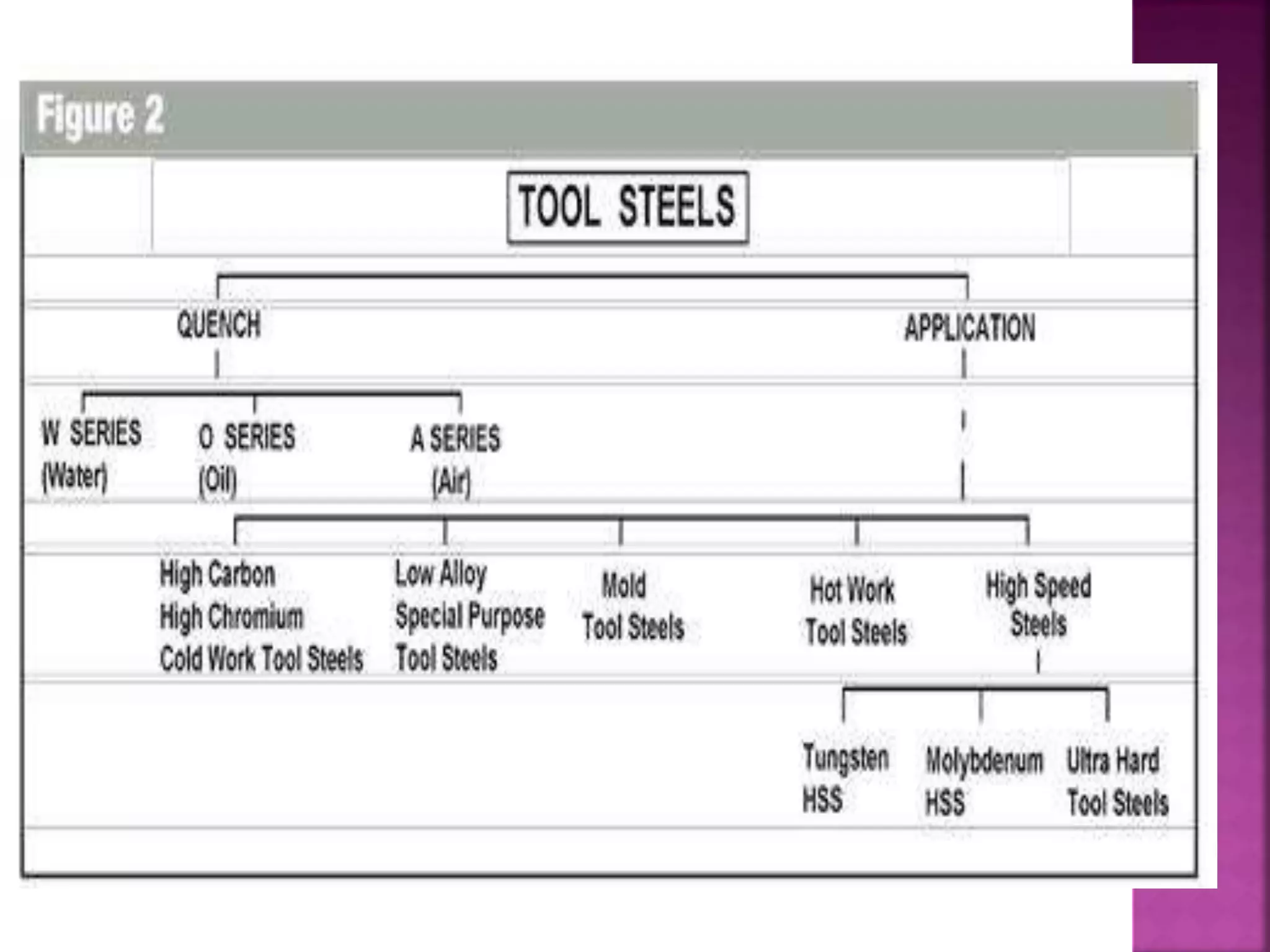
 Tool steels have properties that permit their use as
tools for cutting and shaping metals and other
materials both hot and cold. There are six major
categories one of which contains grades intended
for special purposes. A prefix letter is used in the
alloy identification system to show use category,
and the specific alloy in a particular category is
identified by one or two digits. For example:
 S1 = Shock resistant tool steel
 D2 = Cold-work tool steel
 H11 = Hot work tool steel
 M42 = High-speed tool steel
Tool Steel Type Prefix Specific Types
Cold Work W = Water Hardening
O = Oil Hardening
A = Medium alloy Air
Hardening
D = High Carbon, High
Chromium
W1, W2, W5
O1, O2, O6, O7
A2, A4, A6, A7, A8, A9, A10, A11
D2, D3, D4, D5, D7
Shock Resisting S S1, S2, S4, S5, S6, S7
Hot Work H H10-H19 Chromium types
H20-H39 Tungsten types
H40-H59 Molybdenum types
High Speed M
T
Molybdenum types (M1, M2, M3-1, M3-2, M4, M6, M7,
M10, M33, M34, M36, M41, M42, M46, M50
Tungsten types (T1, T4, T5, T6, T8, T15)
Mold Steels P P6, P20, P21
Special
Purpose
L and F series L2, L6
 Composition and physical properties vary significantly
(some tool steels have compositions that fit into the
composition ranges of carbon and alloy steels, but most
tool steels have alloy concentrations that are
significantly higher than the carbon and alloy steels),
 One important factor that should be kept in mind is
that the alloy additions do not improve corrosion
resistance even though some grades have as much
chromium as stainless steels. The reason for this is that
alloy elements are usually combined with carbon to
form carbides.
 The most significant metallurgical difference between
tool steels and the other steels is their microstructure.
A fully hardened carbon steel or alloy steel would have
only martensite as the predominant phase. Most tool
steels have a hardened structure of martensite and
alloy carbides.
 Require special heat treatment processes ,
 Higher cost than alloy steels,
 Better hardenability than most carbon and alloy
steels,
 High heat resistance
 Easier to heat treat,
 More difficult to machine than carbon and alloy
steels
 Most tool steels are sold as hot-finished shapes
such as rounds and bars,
 Cold-finished sheets are not available because it is
difficult to cold roll or cold finish these materials.
Cold work tool steels are used for
 gages
 Blanking
 drawing and piercing dies
 shears
 forming and banding rolls
 lathe centers
 mandrels
 broaches
 reamers
 taps
 threading dies
 plastic molds
 knurling tools.
Water Hardening Tool
Steels
(W series)
Oil Hardening Tool
Steels
(O-Series)
Medium Alloy
Air Hardening
Steels
(A-series)
High Carbon High
Chromium Steels
(D-series)
Essentially these are
carbon steels with
0.60 to 1.10 %
carbon.
Lowest cost tool
steels.
Soft core(for
toughness) with hard
shallow layer (for
wear resistance).
Use of w-series
steels is declining.
0.90 to 1.45 % Carbon
with Mn, Si, W, Mo, Cr.
They contain graphite
in the hardened
structure along with
martensite. (Graphite
acts as a lubricator
and also makes
machining easier.
Tungsten forms
tungsten carbide which
improves the abrasion
resistance and edge
retention in cutting
devices.
5 to 10 %
alloying
elements (Mn,
Si, W, Mo, Cr, V,
Ni) to improve
the
hardenability,
wear resistance,
toughness.
All D-series contain
12% Cr and over 1.5 %
C.
Air or oil quench.
Low distortion, high
abrasion resistance.
 There are about 12 hot-worked tool steels.
They are categorized by major alloying
elements into three subgroups.
 Chromium types
 Tungsten types
 Molybdenum types
 These steels are used in extrusion dies, forging
dies, die casting, hot shear blades, plastic
molds, punches and dies for piercing shells, hot
press, etc.
 These steels have 0.45 to 0.55 % carbon. The
alloys, silicon, and nickel are ferrite
strengtheners. Chromium increases wear
resistance and hardenability. The S-series of tool
steels were originally developed for chisel-type
applications, but the number of alloys in this
category has evolved to include steels with a
broad range of tool applications. This class of
steels has a very good shock resistant qualities
with excellent toughness.
 They are used in form tools, chisels, punches,
cutting blades, springs, trimming, and swaging
dies, concrete and rock drills, bolt cutters.
 These steels have 0.10 to 0.35 % carbon.
 They show high toughness.
 The low carbon mold steels cannot be quench
hardened.
 The carbon and alloy content is low to allow
hubbing of mold details.
 The desired mold shape is pressed into the steel
with a hub that is usually made from a high-speed
steel. Thus mold cavities can be made without
machining. Hubbed cavities are then carburized to
make a production injection molding cavity.
The L-type steels are low alloy steels with about 1 %
Cr that makes them a good low cost substitute for
cold work steels. The F-type steels are high in
carbon tungsten. They have high wear resistance,
good toughness, and medium hardenability. The L-
type steels are used in gages, broaches, drills, taps,
threading dies, ball and roller bearings, clutch
plates, knurls, files. The F-type steels are used as
finish machining tools.They have good wear
resistance and will maintain a sharp cutting edge.
They may be used in dies, cutting tools, form tools,
knives, etc.
These are the classes of steel that deep
harden, retain that hardness at elevated
temperatures, and have high resistance to
wear and abrasion. The carbon content of
these steels vary from 0.85 % to 1.50 %.
M-type:
The M-type tool steels are high in molybdenum content
and are used for lathe centers, blanking dies, hot forming
dies, lathe cutting tools, drills, taps, etc. They are used
in almost all cutting tools.
T-type:
The T-type high speed tool steels with high carbon
content have high wear resistance and very high
hardness. The ones with lower carbon content are
tougher but not as hard as the former group. As the
amount of tungsten increases, the toughness decreases.
This class of tool material has a substantial amount of
wear-resistant carbides in a very high heat resistant
matrix. These steels are used in machine cutting tools
such as tool bits, milling cutters, taps, reamers, drills,
broaches. In some instances it is used where high
temperature structural steel is needed.
INTRODUCTION OF HSS:
 In today’s World - for modern industrial production,
particularly on mechanical & CNC mass production,
tooling is one of the key factors pertaining for the
performance of shaping and forming processes.
 Almost all tools employed for this purpose are made
from high speed steels.
 The use of high speed steels has also gained increasing
importance for chipless shaping, e.g. for extrusion,
blanking and punching tools.
 HSS chemical composition distinctly differentiates
between W-, Mo- and W-Mo alloyed steel grades, which
contain different amounts of carbon, vanadium and
cobalt elements to strengthen its own occurrence.
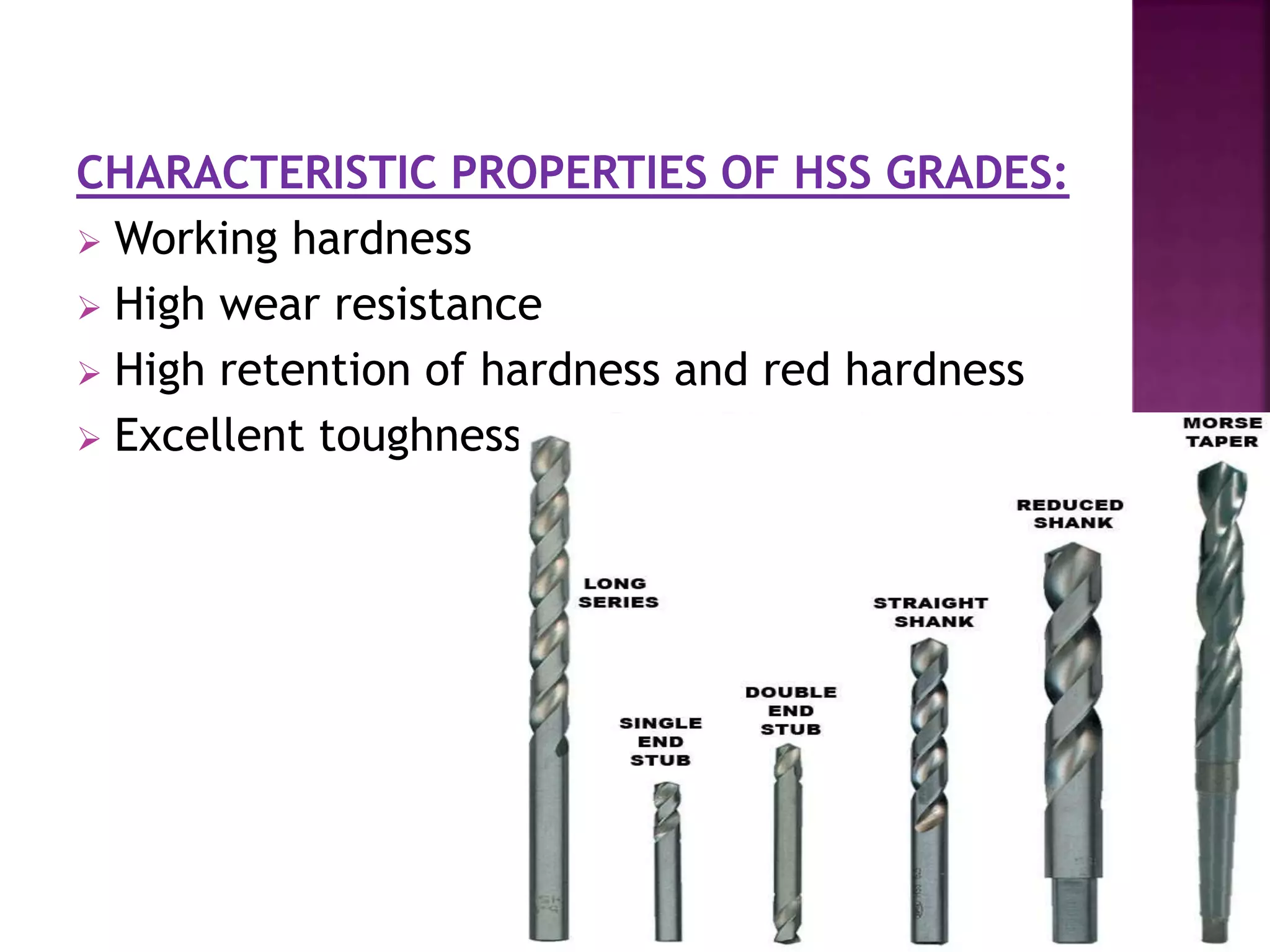
CHARACTERISTIC PROPERTIES OF HSS GRADES:
 Working hardness
 High wear resistance
 High retention of hardness and red hardness
 Excellent toughness
ALLOYING ELEMENTS PRESENT IN HSS PROPERTIES:
 Carbon : forms carbides, increases wear resistance, is
responsible for the basic matrix hardness.
 Tungsten and molybdenum : improve red hardness,
retention of hardness and high temperature strength of
the matrix, form special carbides of great hardness.
 Vanadium : forms special carbides of supreme hardness,
increases high temperature wear resistance, retention
of hardness and high temperature strength of the
matrix.
 Chromium : promotes depth hardening, produces
readily soluble carbides.
 Cobalt : improves red hardness and retention of
hardness of the matrix.
STEEL PROPERTIES:
 Standard grade for High Speed Steels; owing to its balanced
composition has good toughness and cutting performance,
hence many applications.
 HSS containing cobalt content is a high performance steel
with good cutting capability & ensures high red hardness and
tempering retention. It is particularly suitable in thermal
stress situations and for intermittent cutting.
 High Speed Steel with high molybdenum and carbon. It has
high wear resistance, high red hardness and good toughness.
With its low vanadium content, this grade has very good grind
ability.
SURFACE MODIFICATION:
 Lasers and electron beams can be used as sources of
intense heat at the surface for heat treatment,
remelting (glazing), and compositional modification.
 It is possible to achieve different molten pool shapes
and temperatures.
 Cooling rates range from 103 – 106 K s-1. Beneficially,
there is little or no cracking or porosity formation.
 While the possibilities of heat treating at the surface
should be readily apparent, the other applications beg
some explanation.
 At cooling rates in excess of 106 K s-1 eutectic
microconstituents disappear and there is extreme
segregation of substitutional alloying elements.
 This has the effect of providing the benefits of a
glazed part without the associated run in wear
damage.
 The alloy composition of a part or tool can also be
changed to form a high speed steel on the surface
of a lean alloy or to form an alloy or carbide
enriched layer on the surface of a high speed steel
part.
 Several methods can be used such as foils, pack
boronising, plasma spray powders, powder cored
strips, inert gas blow feeders, etc.
 Although this method has been reported to be both
beneficial and stable, it has yet to see widespread
commercial use.
COATINGS:
 To increase the life of high speed steel, tools are
sometimes coated. One such coating is TiN
(titanium nitride).
 Most coatings generally increase a tool's hardness
and/or lubricity.
 A coating allows the cutting edge of a tool to
cleanly pass through the material without having
the material gall (stick) to it.
 The coating also helps to decrease the temperature
associated with the cutting process and increase
the life of the tool.
APPLICATIONS:
 High performance Gear Cutting Hobs, Shapers, Milling
cutters, Bevel tools, of all kinds of highly stressed twist
bits and taps, shaped shear blades, for working high
strength materials, broaches.
 Cutting tools for roughing or finishing, such as: helical
bits, milling cutters of all types, taps, dies, spindles,
reamers, thread rolling tools, drill bits, circular saw
segments. Impact tools and those used for working
wood.
 Cold forming tools such as dies and punches for cold
extrusion and cutting and fine cutting tools.
GENERAL PURPOSE HIGH SPEED STEELS
Type CHEMICAL COMPOSITION
Carbon Tungsten Molybdenum Chromium Vanadium Hardness
Rockwell C
Term
M1 .80 1.50 8.00 4.00 1.00 63-65 "HSS"
M2 .85 6.00 5.00 4.00 1.90 63-65 "HSS"
M7 1.00 1.75 8.75 4.00 2.00 63-65 "HSS"
M50 .85 .10 4.25 4.00 1.00 63-65 "HSS"
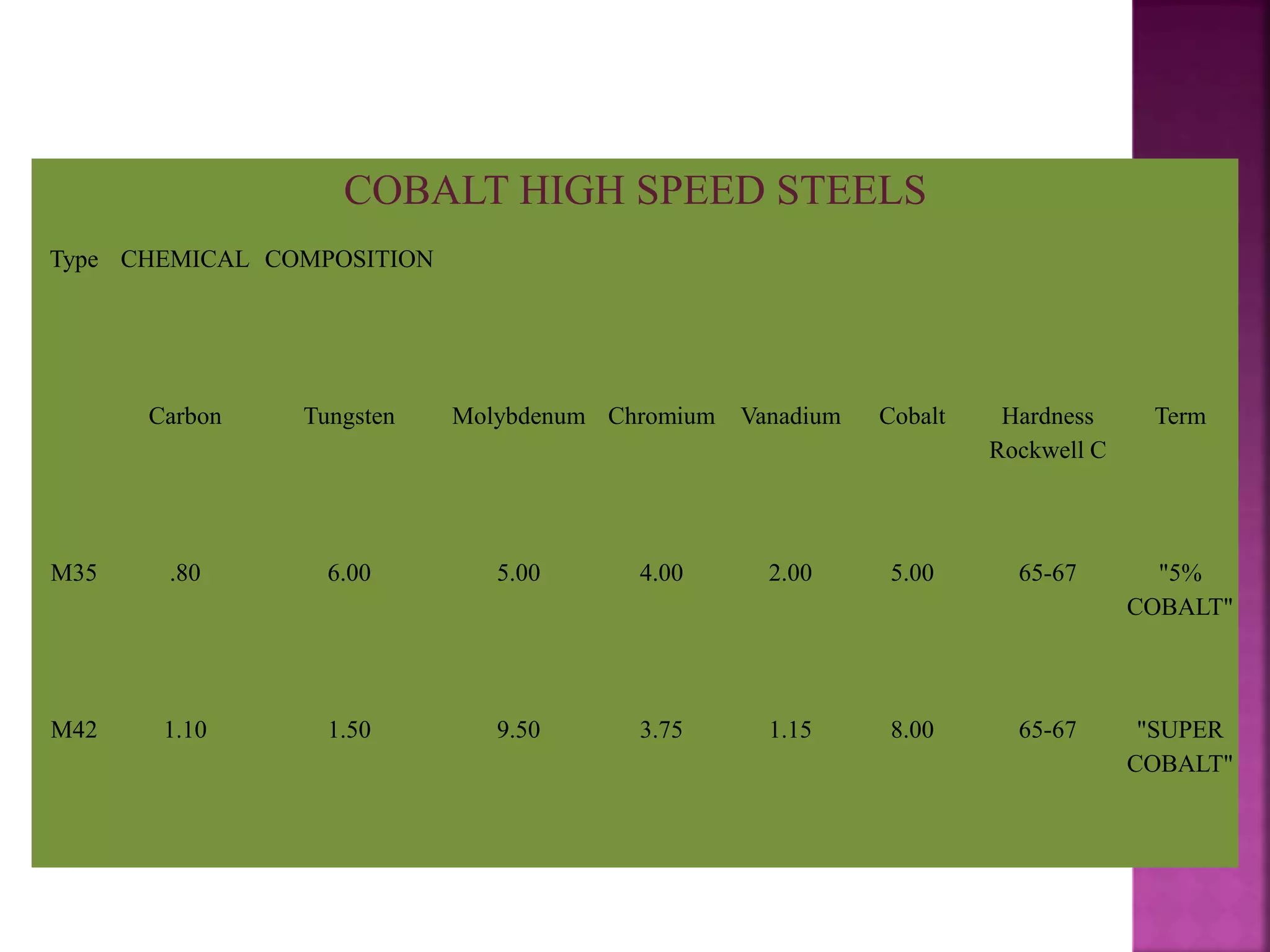
COBALT HIGH SPEED STEELS
Type CHEMICAL COMPOSITION
Carbon Tungsten Molybdenum Chromium Vanadium Cobalt Hardness
Rockwell C
Term
M35 .80 6.00 5.00 4.00 2.00 5.00 65-67 "5%
COBALT"
M42 1.10 1.50 9.50 3.75 1.15 8.00 65-67 "SUPER
COBALT"
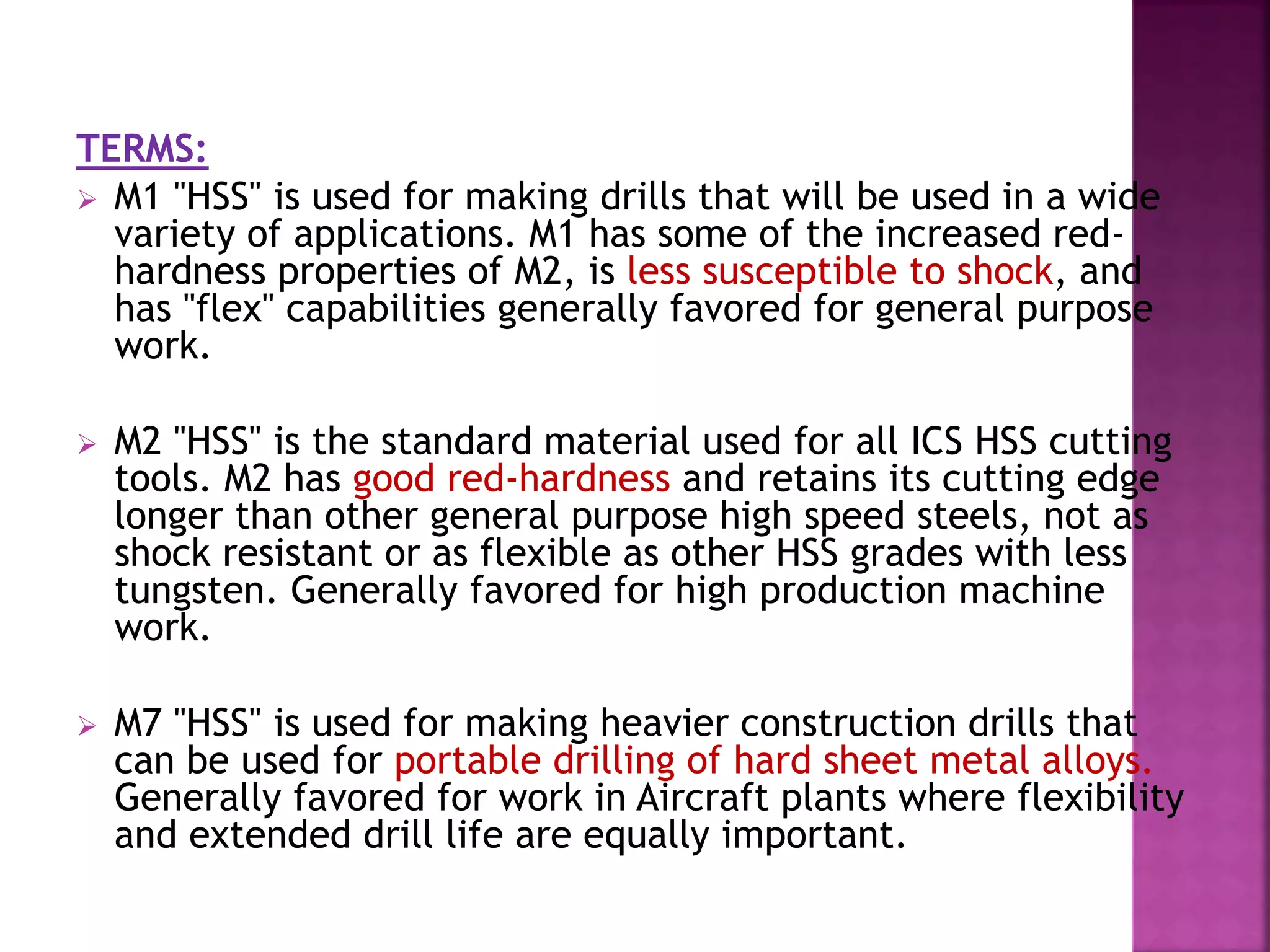
TERMS:
 M1 "HSS" is used for making drills that will be used in a wide
variety of applications. M1 has some of the increased red-
hardness properties of M2, is less susceptible to shock, and
has "flex" capabilities generally favored for general purpose
work.
 M2 "HSS" is the standard material used for all ICS HSS cutting
tools. M2 has good red-hardness and retains its cutting edge
longer than other general purpose high speed steels, not as
shock resistant or as flexible as other HSS grades with less
tungsten. Generally favored for high production machine
work.
 M7 "HSS" is used for making heavier construction drills that
can be used for portable drilling of hard sheet metal alloys.
Generally favored for work in Aircraft plants where flexibility
and extended drill life are equally important.
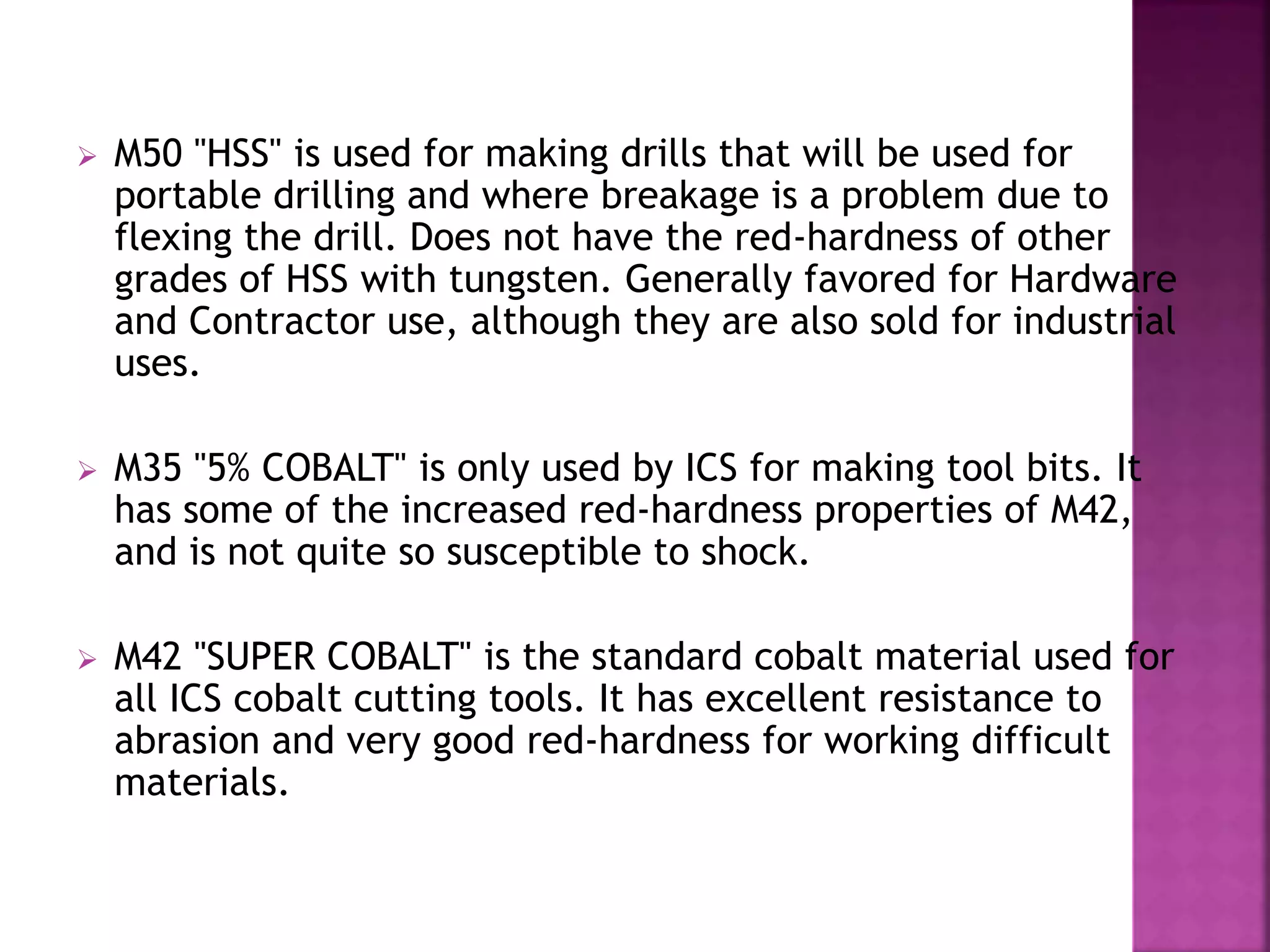
 M50 "HSS" is used for making drills that will be used for
portable drilling and where breakage is a problem due to
flexing the drill. Does not have the red-hardness of other
grades of HSS with tungsten. Generally favored for Hardware
and Contractor use, although they are also sold for industrial
uses.
 M35 "5% COBALT" is only used by ICS for making tool bits. It
has some of the increased red-hardness properties of M42,
and is not quite so susceptible to shock.
 M42 "SUPER COBALT" is the standard cobalt material used for
all ICS cobalt cutting tools. It has excellent resistance to
abrasion and very good red-hardness for working difficult
materials.
FIGURE SHOWING WEAR RESISTANT HSS
HIGH SPEED STEEL SELECTION:
 These steels are classified into four groups.
 Group I - General Purpose High Speed Steels.
 Group II - Abrasion Resistant High Speed Steels.
 Group III - High Red Hardness High Speed Steels.
 Group IV - Super High Speed Steels.
GROUP I GENERAL PURPOSE HIGH SPEED STEELS
 The Group I general purpose high speed steels provide
properties that permit efficient metal removal on 70
percent of the milling applications.
 The "M" steels contain molybdenum as their chief
alloying element.
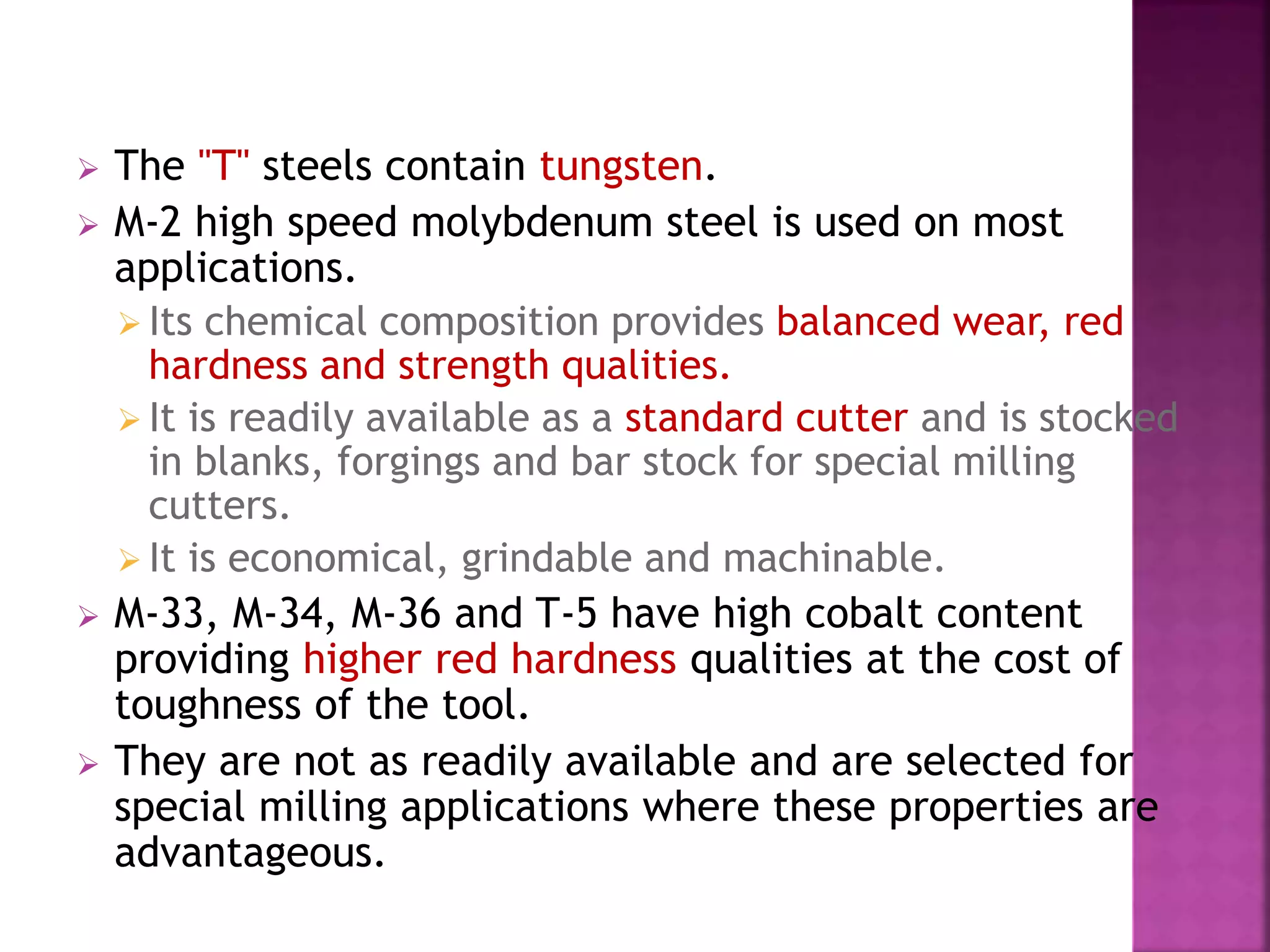
 The "T" steels contain tungsten.
 M-2 high speed molybdenum steel is used on most
applications.
 Its chemical composition provides balanced wear, red
hardness and strength qualities.
 It is readily available as a standard cutter and is stocked
in blanks, forgings and bar stock for special milling
cutters.
 It is economical, grindable and machinable.
 M-33, M-34, M-36 and T-5 have high cobalt content
providing higher red hardness qualities at the cost of
toughness of the tool.
 They are not as readily available and are selected for
special milling applications where these properties are
advantageous.
GROUP II – ABRASION RESISTANT HIGH SPEED STEELS.
 The Group II high speed steels contain higher vanadium
and carbon content.
 Higher vanadium carbide in M-3 provides superior wear
resistance than is available in the Group I general
purpose steels, with M-3 type II having the higher
vanadium.
 M-7 also has higher than usual carbon and is often
selected for milling cutters where greater wear
resistance is needed.
GROUP III – HIGH RED HARDNESS HIGH SPEED STEELS.
 The Group III high red hardness high speed steels can be
heat treated to 68 to 70 RC, but are generally heat
treated to 66 to 68 RC.
 The high cobalt, high carbon combination provides
higher red hardness than is available in the other
groups.
 They also have very good wear qualities, but once again
the improved red hardness and wear properties are at
the expense of toughness.
 The M-40 series steels are selected for milling hardened
steels up to 50 RC and as an alternate for T-15 on the
hard-to-machine super alloys.
GROUP IV-SUPER HIGH SPEED STEELS.
 The Group IV super high speed steels are hardened
between 66 and 68 RC.
 They are high tungsten, high carbon, high vanadium
steels; T-15 also contains cobalt.
 M-4 is slightly tougher than T-15 but does not have the
red hardness or wear resistance qualities of T-15.
 T-15 is used for milling hard metals and alloys,
particularly stainless steels and superalloys.
 It is available as a standard in a limited number of
milling cutters, but is readily available as a special on
milling applications where high resistance to abrasion is
needed.
 Each cutting tool material possesses ingredients that
impart cutting qualities that lend themselves to certain
conditions.
 Under normal operating conditions, it is usually best to
utilize standard milling cutter materials.
 If they do not perform, the cutter material selection
chart should be used to determine the properties
needed (abrasion resistance, red hardness, strength) for
the applications.
HEAT TREATMENT OF HIGH SPEED STEELS:
 The tool that you produce is only as good as the heat
treatment that it receives, and there is no such thing as
an acceptable shortcut in the heat treating of high
speed or tool steels.
 Heat treating is an inherently dangerous process, and
should be performed by a trained professional whenever
possible.
 There are four steps that should be followed in any heat
treating process. They include in order:
1. Preheating
2. Austenitizing
3. Quenching
4. Tempering
1.) PREHEATING:
 Preheating provides two important benefits.
 Since most tool and high speed steels are sensitive to
thermal shock, a sudden increase from room
temperature to the austenitizing temperature of
1500F/2250F may cause these tools to crack.
 Secondly, there is a phase transformation that the steel
undergoes as it is heated to the austenitizing
temperature that produces a change in density or
volume.
 If this volume change occurs in a non-uniform manner, it
can cause distortion of the tools.
 This problem is especially evident where differences in
geometry or section size can cause some parts of the
tool to transform before other parts have reached the
aim temperature.
 The material should be preheated to just below this
critical transformation temperature, and then held long
enough for the entire cross-section of the part to
equalize.
 Once the part is equalized, then further heating to the
austenitizing temperature will allow the material to
transform while undergoing a minimum amount of
distortion.
2.) AUSTENITIZING:
 The austenitizing temperature that is selected depends
strongly upon the alloy content of the steel.
 The aim properties including hardness, tensile strength,
grain size, etc. also factor into the temperature that is
chosen.
 In the annealed microstructure, the alloy content of the
steel is primarily contained in the carbide particles that
are uniformly distributed as tiny spheres. This condition
is typically referred to as a spheroidized annealed
microstructure.
 The idea behind austenitizing is to re-distribute this
alloy content throughout the matrix by heating the steel
to a suitably high temperature so that diffusion can take
place.
 Higher temperatures allow more alloy to diffuse, which
usually permits a higher hardness. (This is true as long
as the temperature does not exceed the incipient
melting temperature of the steel.)
 If lower austenitizing temperatures are used, then less
diffusion of alloy into the matrix occurs. The matrix is
therefore tougher, but may not develop as high a
hardness.
 The hold times that are used depend upon the size of
the part and the temperature that is used.
3.) QUENCHING:
 Once the alloy content has been redistributed
throughout the matrix, the steel must be cooled fast
enough to fully harden it. This process is called
quenching. By quenching the steel properly, a new
phase transformation occurs, and the microstructure
changes from austenite to martensite.
 How rapidly this process must take place depends upon
the chemical composition of the alloy.
 Generally, lower alloy steels such as 01 must be
quenched in oil in order to cool fast enough.
 Higher alloy content steels can develop fully hardened
properties by undergoing a slower quenching process.
 For some alloys, cooling in still air is sufficient. Other
mediums that are frequently used for quenching include
water, brine, and salt bath.
 Whatever quenching process is used, the resulting
microstructure is extremely brittle and under great
stress. If the tool is put into service in this condition, it
would likely shatter like glass.
 Some tools will even spontaneously crack if they are
left in this condition. For this reason, tools that are
quenched and cooled to hand warm (about 100F/150F)
should be tempered immediately.
4.) TEMPERING:
 Tempering is performed to soften the martensite that
was produced during quenching.
 Most steels have a wide range of temperatures that can
be used for tempering, and the one that is chosen
depends upon the aim hardness.
 Most tool and high speed steels require several tempers
before the part can be put into service.
 This is because these alloys will retain a certain
percentage of austenite when they are quenched, and
during the first temper some of this retained austenite
will transform to untempered martensite.
 By performing a second temper, this new martensite is
softened, thus reducing the chance of cracking.
 But by tempering a second time, some of the remaining
austenite is transformed to untempered martensite, and
so the process may need to be repeated several times.
MICROSTRUTURE SHOWING
HEAT TREATMENT OF HSS
 A serious limitation in producing high-strength steels is
the associated reduction in fracture toughness.
 Carbon is one of the elements which mostly affects
the toughness and hence in alloy steels it is reduced
to as low a level as possible, consistent with good
strength.
 Developments in the technology of high-alloy steels
have produced high strengths in steels with very low
carbon contents (<0.03%) by a combination of
martensite and age-hardening, called maraging.
 The maraging steels are based on an Fe–Ni containing
between 18% and 25% Ni to produce massive
martensite on air cooling to room temperature.
 The principal alloying element is 15 to 25% nickel.
 Secondary alloying elements are added to produce
intermetallic precipitates, which include cobalt,
molybdenum, and titanium.
 Additional hardening of the martensite is achieved by
precipitation of various intermetallic compounds, principally
Ni3Mo or Ni(Mo, Ti) brought about by the addition of roughly
5% Mo, 8% Co as well as small amounts of Ti and Al;
 Then the alloys are solution heat-treated at 815°C and aged
at about 485°C.
 Many substitutional elements can produce age-hardening in
Fe–Ni martensites, some strong (Ti, Be), some moderate (Al,
Nb, Mn, Mo, Si, Ta, V) and other weak (Co, Cu, Zr)
hardeners.
 It is found that A3B-type compounds are favoured at high Ni
or (Ni +Co) contents and A2B Laves phases at lower contents.
 In the unaged condition maraging steels have a yield
strength of about 0.7 GN/m2. On ageing this increases up to
2.0 GN/m2 and the precipitation-strengthening is due to an
Orowan mechanism according to the relation :
σ= σ0 (αµb/L) where σ0 is matrix strength, α constant and L
the interprecipitate spacing.
 The primary precipitation-strengthening effect arises from
the (Co + Mo)combination, but Ti plays a double role as a
supplementary hardener and a refining agent to tie up
residual carbon.
 The alloys generally have good weldability, resistance to
hydrogen embrittlement and stress-corrosion but are used
mainly (particularly the 18% Ni alloy) for their excellent
combination of high strength and toughness.
 Due to the low carbon content maraging steels have
good machinability. Prior to aging, they may also be
cold rolled to as much as 80–90% without cracking.
 Maraging steels offer good weldability, but must be
aged afterward to restore the properties of heat
affected zone
 When heat-treated the alloy has very little dimensional
change, so it is often machined to its final dimensions.
 Due to the high alloy content maraging steels have a
high hardenability.
 Since ductile FeNi martensites are formed upon
cooling, cracks are non-existent or negligible.
 The steels can be nitrided to increase case hardness,
and polished to a fine surface finish.
 Non-stainless varieties of maraging steel are
moderately corrosion-resistant, and resist stress
corrosion and hydrogen embrittlement.
 The requirement for structural steels to be
welded satisfactorily has led to steels with lower
C (<0.1%) content.
 Unfortunately, lowering the C content reduces
the strength and this has to be compensated for
by refining the grain size.
 This is difficult to achieve with plain C-steels
rolled in the austenite range but the addition of
small amounts of strong carbide-forming
elements (e.g. <0.1% Nb) causes the austenite
boundaries to be pinned by second-phase
particles and fine grain sizes (<10µm) to be
produced by controlled rolling.
 Nitrides and carbonitrides as well as carbides,
predominantly fcc and mutually soluble in each other,
may feature as suitable grain refiners in HSLA steels;
examples include AlN, Nb(CN), V(CN), (NbV)CN, TiC and
Ti(CN).
 The solubility of these particles in the austenite
decreases in the order VC, TiC, NbC while the nitrides,
with generally lower solubility, decrease in solubility in
the order VN, AlN, TiN and NbN.
 Because of the low solubility of NbC, Nb is perhaps the
most effective grain size controller.
 However, Al, V and Ti are effective in high-nitrogen
steels, Al because it forms only a nitride, V and Ti by
forming V(CN) and Ti(CN) which are less soluble in
austenite than either VC or TiC.
 The major strengthening mechanism in HSLA steels
is grain refinement but the required strength level
is obtained usually by additional precipitation
strengthening in the ferrite.
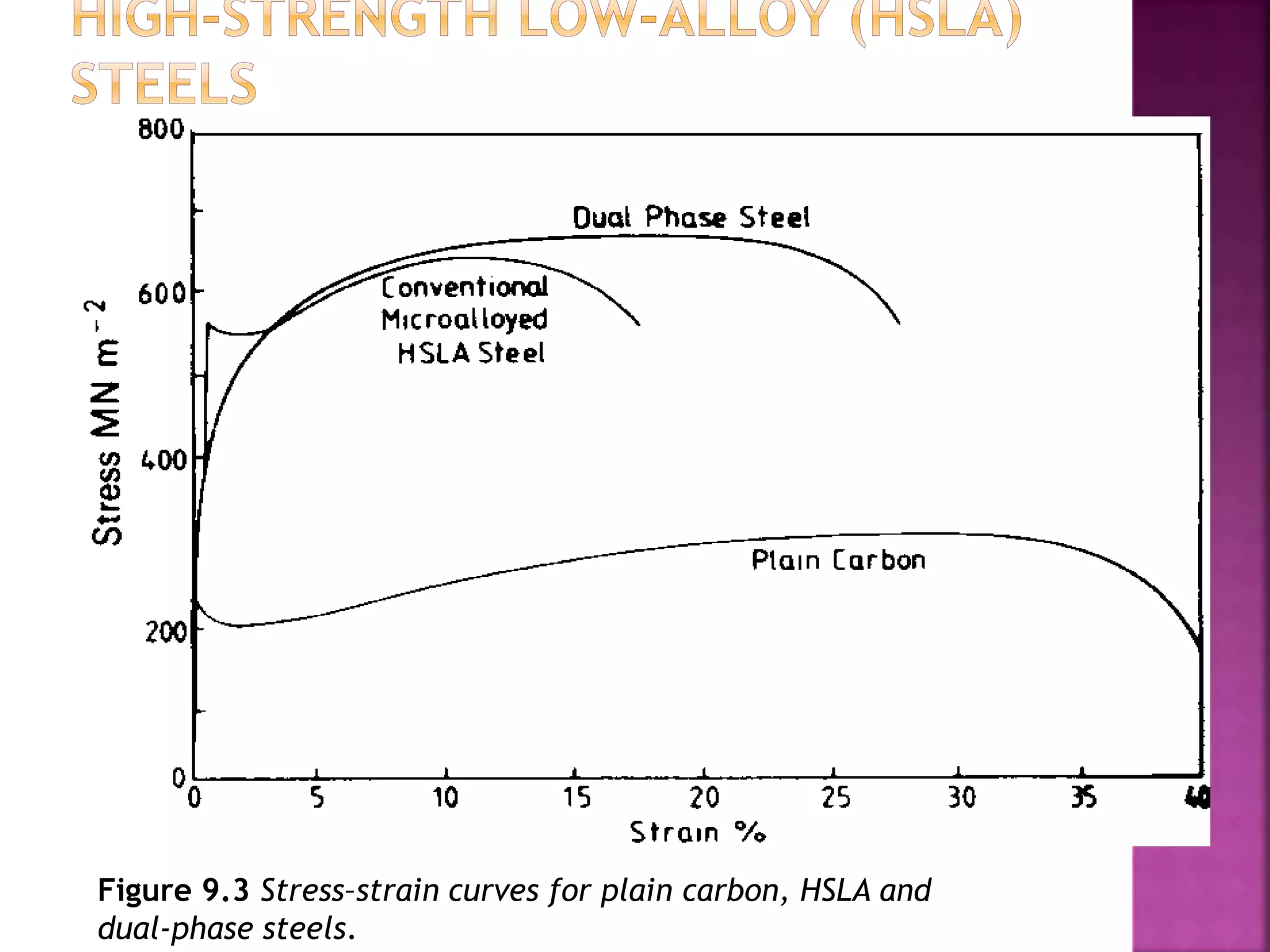
 Figure 9.3 shows a stress–strain curve from a
typical HSLA steel.
 Solid-solution strengthening of the ferrite is also
possible.
 Phosphorus is normally regarded as deleterious due
to grain boundary segregation, but it is a powerful
strengthener, second only to carbon
Figure 9.3 Stress–strain curves for plain carbon, HSLA and
dual-phase steels.
Microalloyed steel, or High Strength Low Alloy (is a
type of alloy steel that contains small amounts of
alloying elements. These are mild steels with carbon
0.03 to 0.15%, manganese around 1.5% and less than
0.1% of niobium, vanadium, titanium, aluminium,
molybdenum, zirconium, boron, and rare-earth
metals which have been given controlled rolling,
controlled cooling to obtain ultra-fine ferrite grains
of size below 5 micro-meter to attain yield strengths
of 290 to 550 Mpa, and tensile strengths of 415 to
700 Mpa with a ductile/brittle transition
temperature at -70oC.
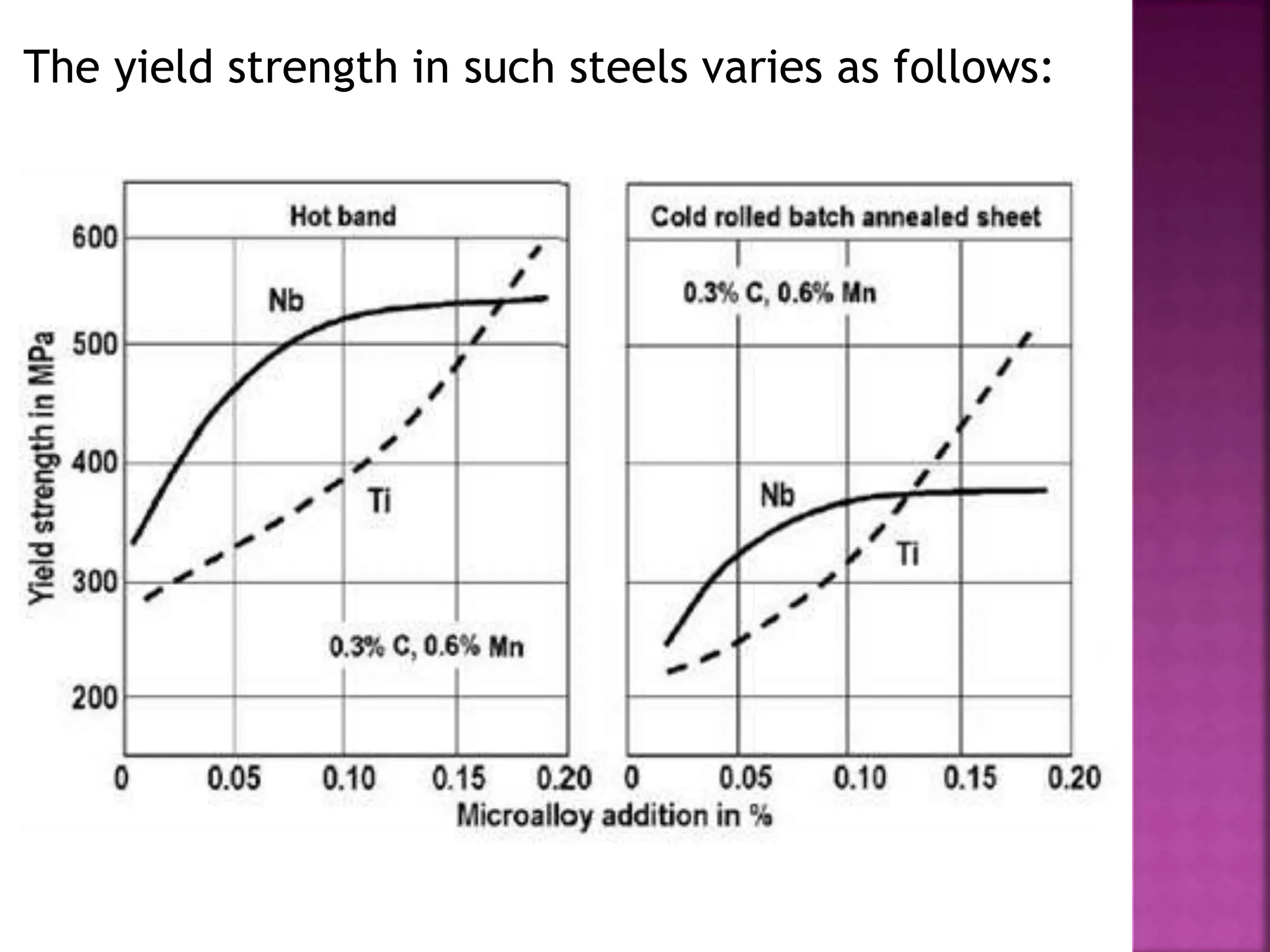
The yield strength in such steels varies as follows:
Alloying elements are also selected to influence
transformation temperatures so that the transformation
of austenite to ferrite and pearlite occurs at a lower
temperature during air cooling. This lowering of the
transformation temperature produces a finer-grain
transformation product, which is a major source of
strengthening.
At the low carbon levels typical of HSLA steels, elements
such as silicon, copper, nickel, and phosphorus are
particularly effective for producing fine pearlite.
Element such as, manganese and chromium, which are
present in both the cementite and ferrite, also
strengthen the ferrite by solid-solution strengthening in
proportion to the amount, dissolved in the ferrite.
 Nitrogen additions to high-strength steels containing
vanadium are limited to 0.005% and have become
commercially important because such additions enhance
precipitation hardening. The precipitation of vanadium
nitride in vanadium-nitrogen steels also improves grain
refinement because it has a lower solubility in austenite than
vanadium carbide.
 Manganese is the principal strengthening element in plain
carbon high-strength structural steels. It functions mainly as
a mild solid-solution strengthener in ferrite, but it also
provides a marked decrease in the austenite-to-ferrite
transformation temperature. In addition, manganese can
enhance the precipitation strengthening of vanadium steels
and. to a lesser extent, niobium steels.
 Copper in levels in excess of 0.50% also increases the
strength of both low- and medium-carbon steels by virtue of
ferrite strengthening, which is accompanied by only slight
decreases in ductility.
 One of the most important applications of silicon is its
use as a deoxidizer in molten steel. Silicon has a
strengthening effect in low-alloy structural steels. In
larger amounts, it increases resistance to scaling at
elevated temperatures. Silicon has a significant effect on
yield strength enhancement by solid-solution
strengthening and is widely used in HSLA steels for
riveted or bolted structures.
 The atmospheric-corrosion resistance of steel is increased
appreciably by the addition of phosphorus, and when small
amounts of copper are present in the steel, the effect of
the phosphorus is greatly enhanced. When both phosphorus
and copper are present, there is a greater beneficial effect
on corrosion resistance than the sum of the effects of the
individual elements.
 Molybdenum in hot-rolled HSLA steels is used primarily to
improve hardenability when transformation products other
than ferrite-pearlite are desired. Molybdenum (0.15 to
0.30%) in microalloyed steels also increases the solubility of
niobium in austenite, thereby enhancing the precipitation
of NbC (N) in the ferrite. This increases the precipitation-
strengthening effect of NbC (N).
 Aluminum is widely used as a deoxidizer and was the first
element used to control austenite grain growth during
reheating. During controlled rolling, niobium and titanium
are more effective grain refiners than aluminum.
 Vanadium strengthens HSLA steels by both precipitation
hardening the ferrite and refining the ferrite grain size.
The precipitation of vanadium carbonitride in ferrite can
develop a significant increase in strength that depends not
only on the rolling process used, but also on the base
composition. Carbon contents above 0.13 to 0.15% and
manganese content of 1% or more enhances the
precipitation hardening, particularly when the nitrogen
content is at least 0.01%.
 Chromium is often, added with copper to obtain improved
atmospheric-corrosion resistance.
 Nickel is often added to copper-bearing steels to minimize
hot shortness
 Titanium is unique among common alloying elements in
that it provides both precipitation strengthening and sulfide
shape control. Small amounts of titanium (<0.025%) are also
useful in limiting austenite grain growth. However, it is
useful only in fully killed steels because of its strong
deoxidizing effects; the versatility of titanium is limited
because variations in oxygen, nitrogen, and sulfur affect
the contribution of titanium as carbide strengthened.
 Zirconium can also be added to killed HSLA steels to
improve inclusion characteristics, particularly in the case of
sulfide inclusions, for which changes in inclusion shape
improve ductility in transverse bending.
 Boron has no effect on the strength of normal hot-rolled
steel but can considerably improve hardenability when
transformation products such as acicular ferrite are desired
in low-carbon hot-rolled plate.
 Treatment with calcium is preferred for sulfide inclusion
shape control.
 These steels lie, in terms of performance and cost,
between carbon steel and low alloy steel.
 Weldability is good, and can even be improved by
reducing carbon content while maintaining
strength.
 Fatigue life and wear resistance are superior to
similar heat treated steels.
 The disadvantages are that ductility and toughness
are not as good as quenched and tempered (Q&T)
steels.
 The ferrite in HSLA steels is typically strengthened
by grain refinement, precipitation hardening, and,
to a lesser extent, solid-solution strengthening.
Grain refinement is the most desirable
strengthening mechanism because it improves not
only strength but also toughness.
 The main factors responsible for increased strength
in HSLA steels are:
 1. Fine ferritic grain size
 2.Precipitation hardening
 3. Solid solution strengthening
 The very fine ferritic grain sizes in HSLA steels are
possible by the control of austenitic grain size by
the precipitation of carbonitrides during hot rolling
as the temperature of the steel falls. These fine
precipitate particles hinder the growth of austenitic
grains, and at still lower temperatures of rolling,
the particles inhibit even the recrystallization of the
deformed austenitic grains.
 To accomplish this, the fine precipitation of
carbonitrides should take place in the critical
rolling range of 1300oC to 925oC, when the
recrystallization of austenite could occur,
and that the volume of the precipitates
formed should be large. It is thus essential
that these carbonitrides have sufficient solid
solubility at the highest austenitising or
soaking temperature and that the solid
solubility should decrease fast with the fall
of temperature in this critical range.
 Complete dissolution of carbonitride precipitates occurs at
1140°C in a temperature interval between 1100 – 1200°C, the
above Illustrations showing dissolution of NbC, TiC and Vn
precipitates can be seen in Figure 1 where individual
isotherms show dissolubility of precipitates for different
carbon content in HSLA steels
Figure 1: Dissolubility of precipitates NbC, TiC and Vn according
to carbon content in HSLA steel
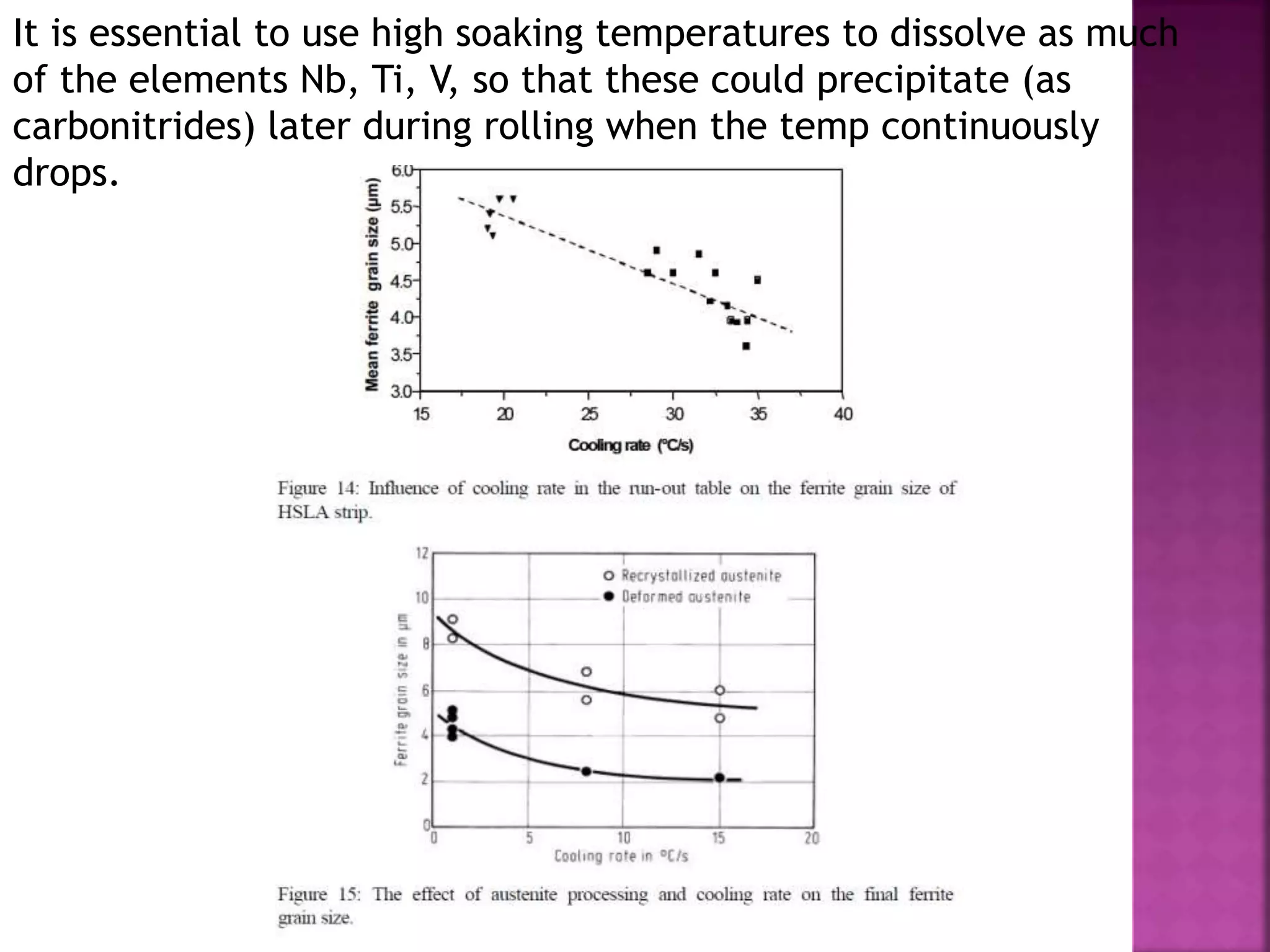
It is essential to use high soaking temperatures to dissolve as much
of the elements Nb, Ti, V, so that these could precipitate (as
carbonitrides) later during rolling when the temp continuously
drops.
 TiN is the most stable of precipitates and its
presence restricts the grain growth of austenite at
the soaking temperature, and during the dynamic
recrystallization of austenite during hot rolling at
high temperature. While TiN restricts grain growth
to some extent, the main refinement is achieved
during hot rolling from 1300oC to 925oC as the
temperature progressively falls and fine
carbonitrides are precipitated from austenite. Nb is
the most effective element in modifying the
recrystallization behavior of austenite during hot
rolling as niobium carbides and carbonitrides
precipitate during hot rolling of austenite and
hence is the most important micro-alloying
element.
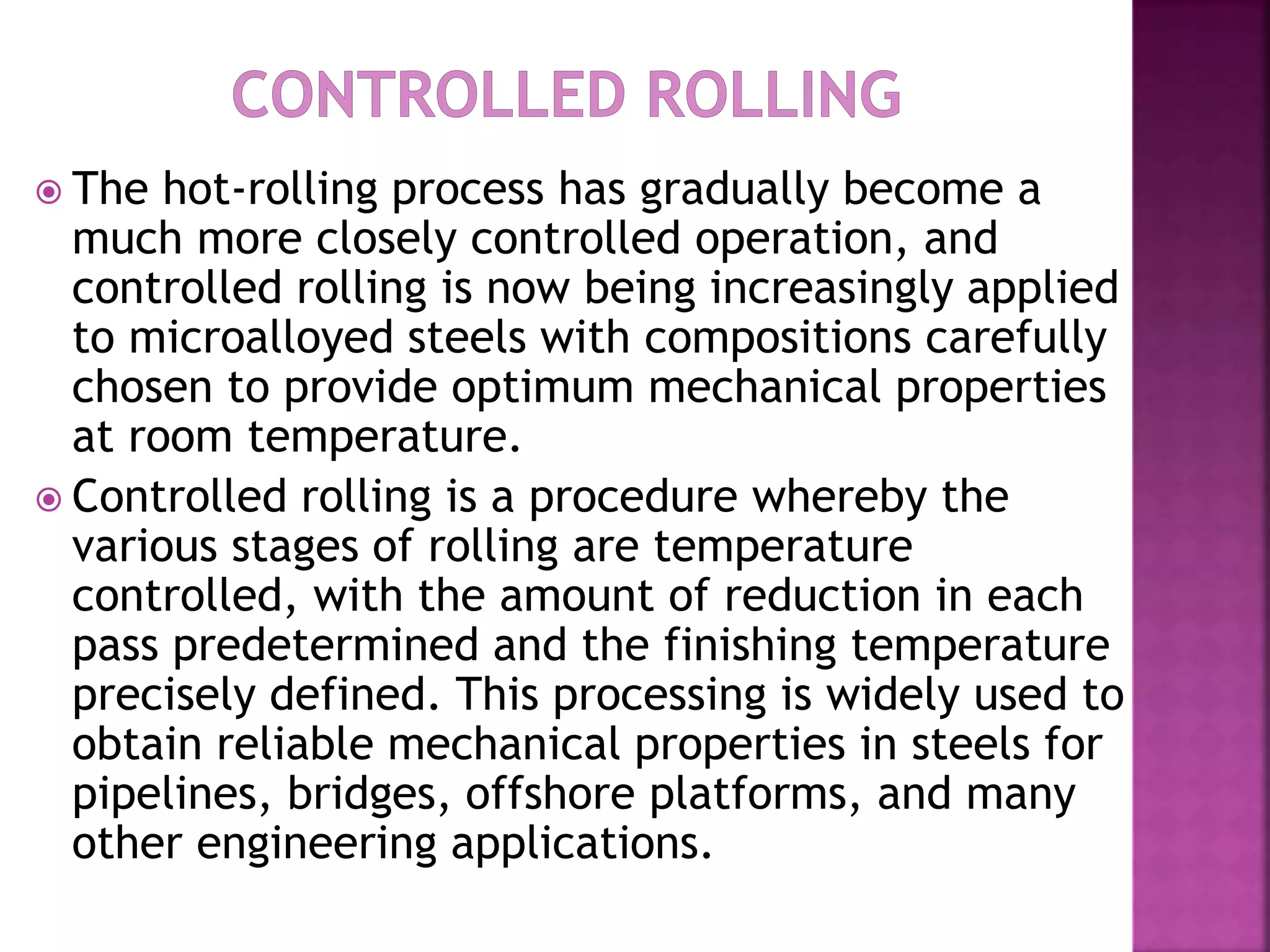
 The hot-rolling process has gradually become a
much more closely controlled operation, and
controlled rolling is now being increasingly applied
to microalloyed steels with compositions carefully
chosen to provide optimum mechanical properties
at room temperature.
 Controlled rolling is a procedure whereby the
various stages of rolling are temperature
controlled, with the amount of reduction in each
pass predetermined and the finishing temperature
precisely defined. This processing is widely used to
obtain reliable mechanical properties in steels for
pipelines, bridges, offshore platforms, and many
other engineering applications.
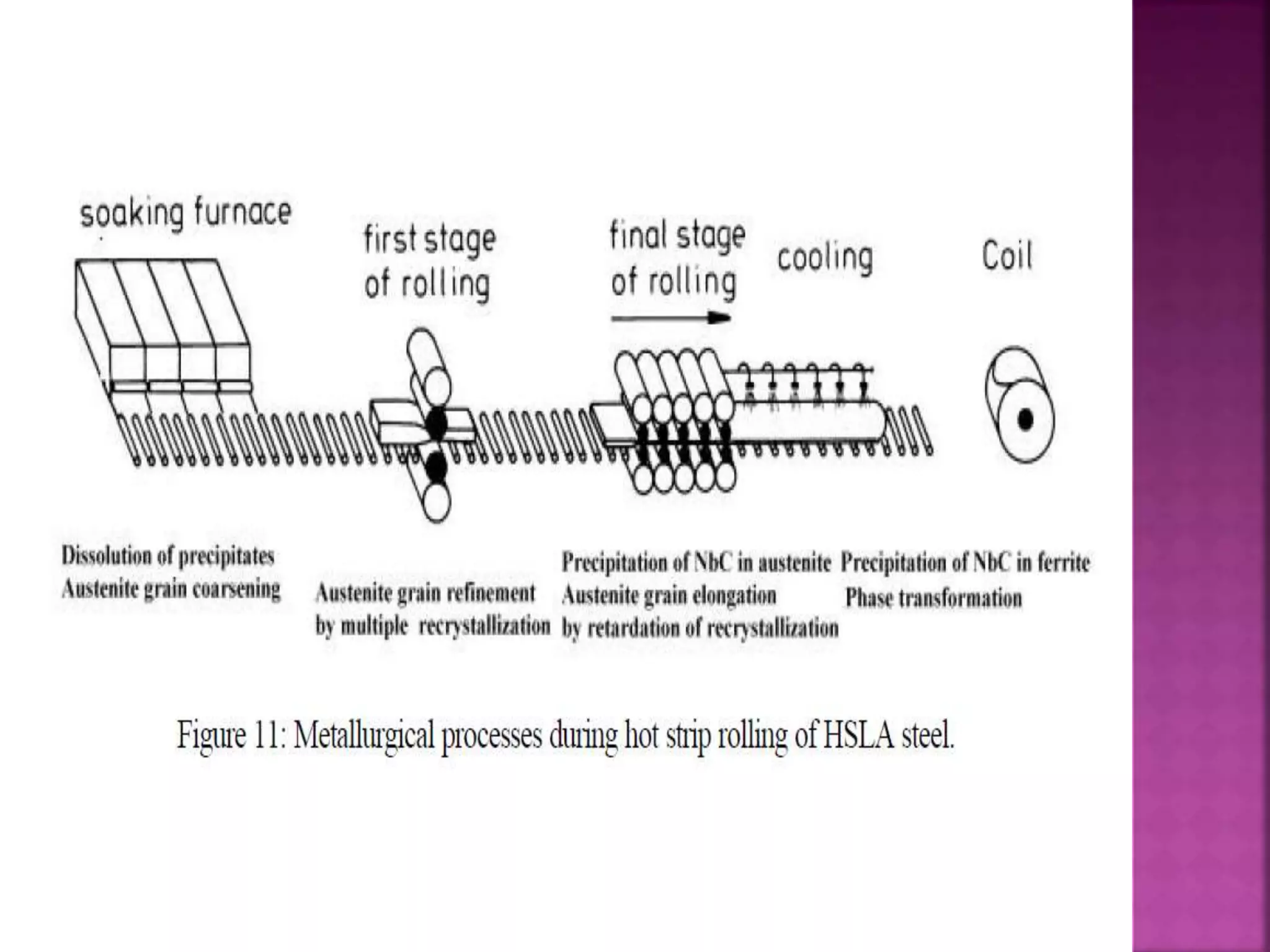
 The use of controlled rolling has resulted in improved
combinations of strength and toughness and further
reductions in the carbon content of microalloyed HSLA
steels. Controlled hot rolling of low carbon low alloy
high strength steels is done to obtain ultra fine and
uniform grains of ferrite and precipitation hardening.
The figure below illustrates the grain size of austenite at
different stages of hot rolling.
 High temperature soaking is required to dissolve as much
of alloying elements as possible. When austenite is
rolled at relatively high temperatures, it dynamically
recrystallizes and the grain growth occurs. Heavy
deformation and low finishing temperature is required in
the austenitic region, below about 925oC so that
austenite is unable to recrystallize.
 The finishing temperature is very important. Normally
all the deformation is done when the steel is austenitic
and the nature of transformation is changed by
increasing the cooling rate using water sprays following
rolling. The sub-critical transformation produces still
finer ferritic grains. Mechanical properties are improved
and the sharp yield point is invariably suppressed.
 Fig: Schematic controlled processing to obtain fine
ferrite grains in HSLA steels
 Precipitation hardening also contributes to the
increased strength of HSLA steels. The
precipitates present or formed at high
temperatures during controlled rolling cause
little strengthening as they are large sized,
widely spaced, and as most of them are present
at the grain boundaries controlling the grain
growth.
 The precipitate strengthening occurs by those
particles that form:
 In austenite at low temperature
 At the gamma/alpha interface during
transformation
 In ferrite during further cooling
 The main contribution to precipitation
strengthening is due to the precipitation of
carbides of Nb, Ti, and V which occurs during
the transformation of austenite to ferrite
progressively at interphase boundaries called
interphase precipitation. It occurs on a very fine
scale during the temperatures between 850oC
and 650oC. Because of high solubility in
austenite, vanadium carbide and nitride
precipitate at interphase boundaries and in
ferrite, with Ti and Nb in the decreasing order,
are most effective in increasing the strength by
precipitation.
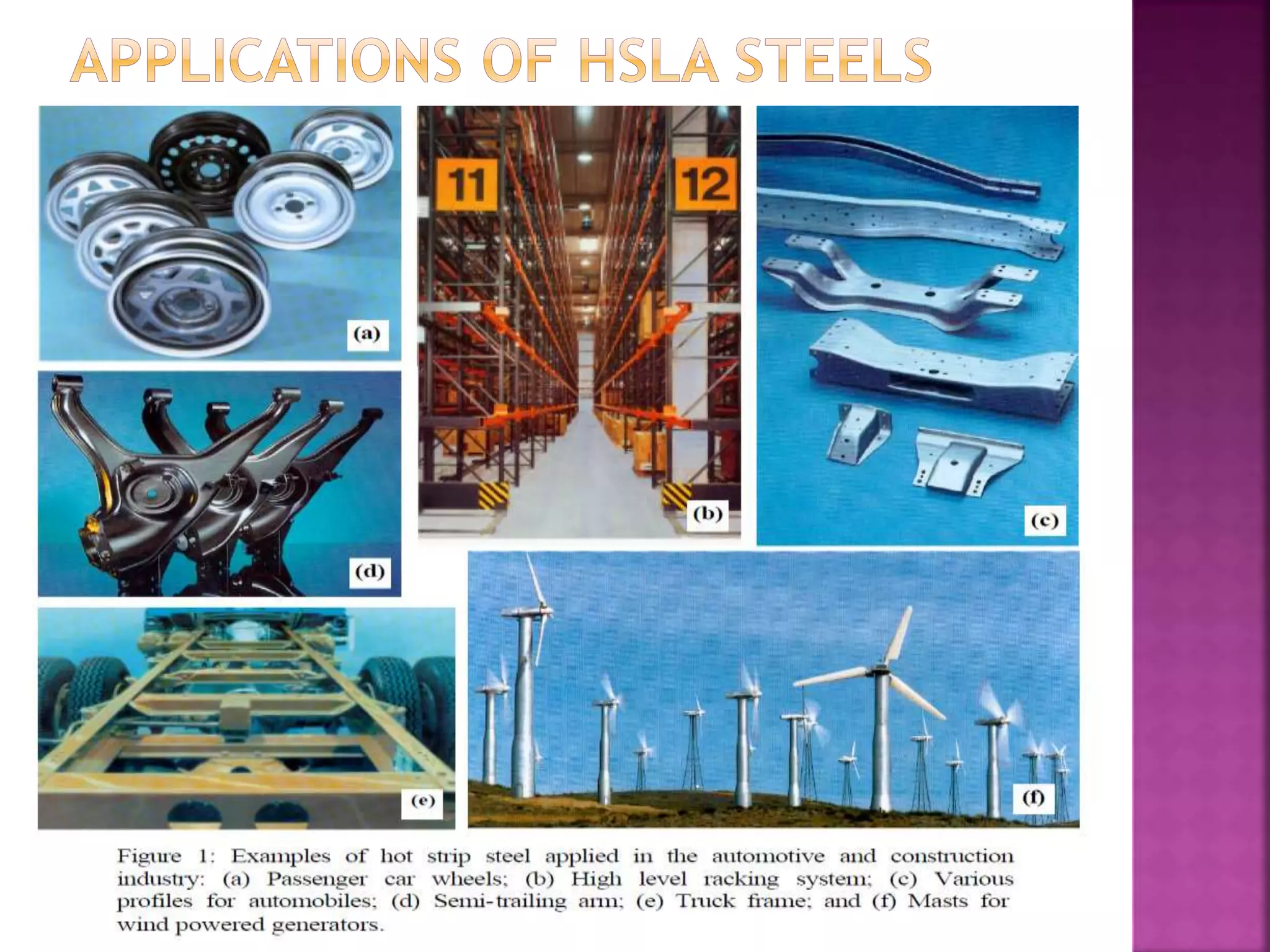
HSLA can be found in these applications:
 Bridges
 Suspension Components
 Building Structures
 Vehicles/Transportation
 Tubular Components
 Heavy Equipment
 Rails
 Off-shore/Platforms
 In recent years an improved strength–ductility
relationship has been found for low carbon, low-
alloy steels rapidly cooled from an annealing
temperature at which the steel consisted of a
mixture of ferrite and austenite.
 Such steels have a microstructure containing
principally low-carbon, fine-grained ferrite
intermixed with islands of fine martensite and are
known as dual phase steels.
 Typical properties of this group of steels would be
a TS of 620 MN m-2, a 0.2% offset flow stress of 380
MNm-2 and a 3% offset flow stress of 480 MN m-2
with a total elongation ≈28%.
 The implications of the improvement in mechanical
properties are evident from an examination of the nominal
stress–strain curves.
 The dual-phase steel exhibits no yield discontinuity but
work-hardens rapidly so as to be just as strong as the
conventional HSLA steel when both have been deformed by
about 5%.
 In contrast to ferrite–pearlite steels, the work-hardening
rate of dual-phase steel increases as the strength increases.
 The absence of discontinuous yielding in dual-phase steels
is an advantage during cold-pressing operations and this
feature combined with the way in which they sustain work
hardening to high strains makes them attractive materials
for sheet-forming operations.
 The dual phase is produced by annealing in the
(α+γ) region followed by cooling at a rate which
ensures that the γ phase transforms to martensite,
although some retained austenite is also usually
present leading to a mixed martensite–austenite
(M–A) constituent.
 To allow air-cooling after annealing, microalloying
elements are added to low-carbon–manganese–
silicon steel, particularly vanadium or molybdenum
and chromium.
 Vanadium in solid solution in the austenite increases the
hardenability but the enhanced hardenability is due mainly
to the presence of fine carbonitride precipitates which are
unlikely to dissolve in either the austenite or the ferrite at
the temperatures employed and thus inhibit the movement
of the austenite/ferrite interface during the post-anneal
cooling.
 The martensite structure found in dual-phase steels is
characteristic of plate martensite having internal
microtwins.
 The retained austenite can transform to martensite during
straining thereby contributing to the increased strength and
work-hardening.
 Low yield strength
 Low yield to tensile strength ratio (yield strength/
tensile strength = 0.5)
 High initial strain hardening rates
 Good uniform elongation
 A high strain rate sensitivity (the faster it is
crushed the more energy it absorbs)
 Good fatigue resistance
Due to these properties DPS is often used for
automotive body panels, wheels, and bumpers
 For strengthening at high temperatures, dispersion
strengthening with oxide, nitride or carbide particles is an
attractive possibility.
 Such dispersion-strengthened materials are usually
produced by powder processing., special form of which is
known as mechanical alloying (MA).
 Mechanical alloying is a dry powder, high-energy ball-milling
process in which the particles of elemental or pre-alloyed
powder are continuously welded together and broken apart
until a homogeneous mixture of the matrix material and
dispersoid is produced.
 Mechanical alloying is not simply mixing on a fine scale but
one in which true alloying occurs.
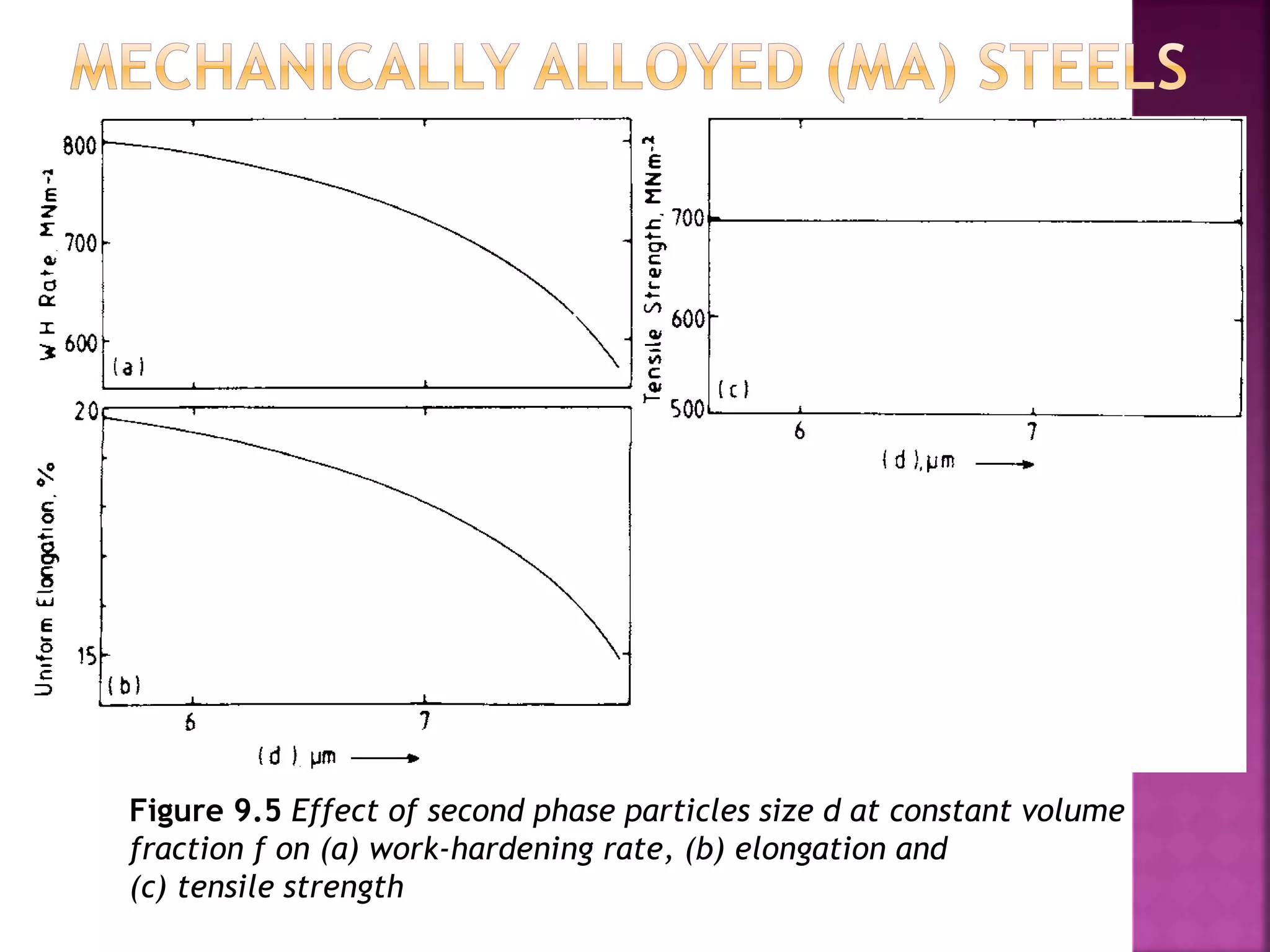
Figure 9.5 Effect of second phase particles size d at constant volume
fraction f on (a) work-hardening rate, (b) elongation and
(c) tensile strength
 Stainless steel is a generic term for a family of corrosion
resistant alloy steels containing 10.5% or more chromium.
All stainless steels have a high resistance to corrosion.
 Stainless steel does not corrode, rust or stain with water
as ordinary steel does, but despite the name it is not fully
stain-proof. It is also called corrosion-resistant steel or
CRES when the alloy type and grade are not detailed,
particularly in the aviation industry.
 Stainless steel is used where both the properties of steel
and resistance to corrosion are required.
 Stainless steel differs from carbon steel by the amount of
chromium present.
STRESS-STRAIN BEHAVIOUR OF CARBON STEEL
AND STAINLESS STEEL
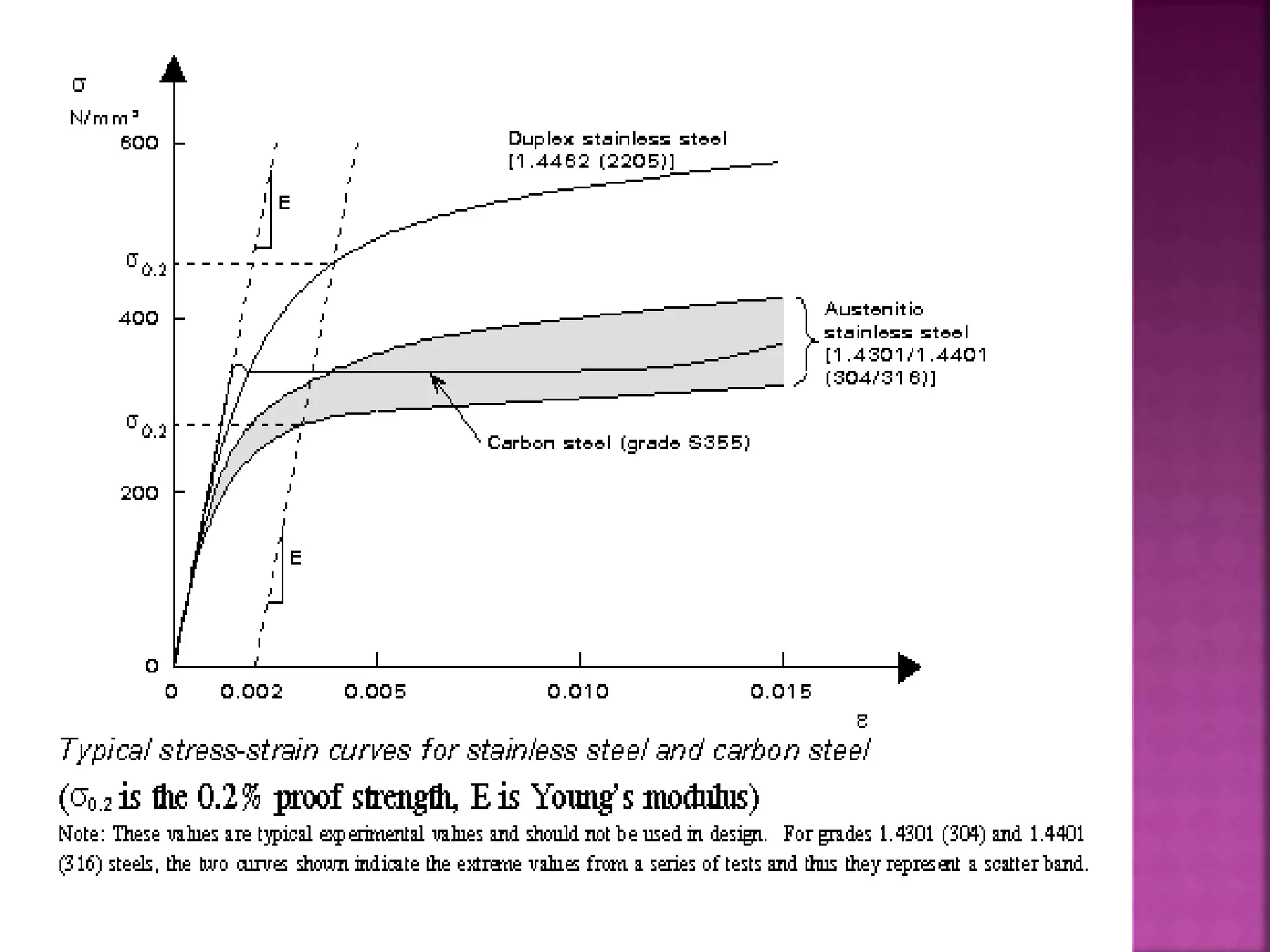
The stress-strain behaviour of stainless steel differs
from that of carbon steels in a number of respects.
The most important difference is in the shape of the
stress-strain curve. Whereas carbon steel typically
exhibits linear elastic behaviour up to the yield stress
and a plateau before strain hardening, stainless steel
has a more rounded response with no well-defined
yield stress as shown in the next figure
 No limitations on thickness in relation to brittle
fracture apply to stainless steel; the limitations for
carbon steel are not applicable due to the superior
toughness of stainless steel.
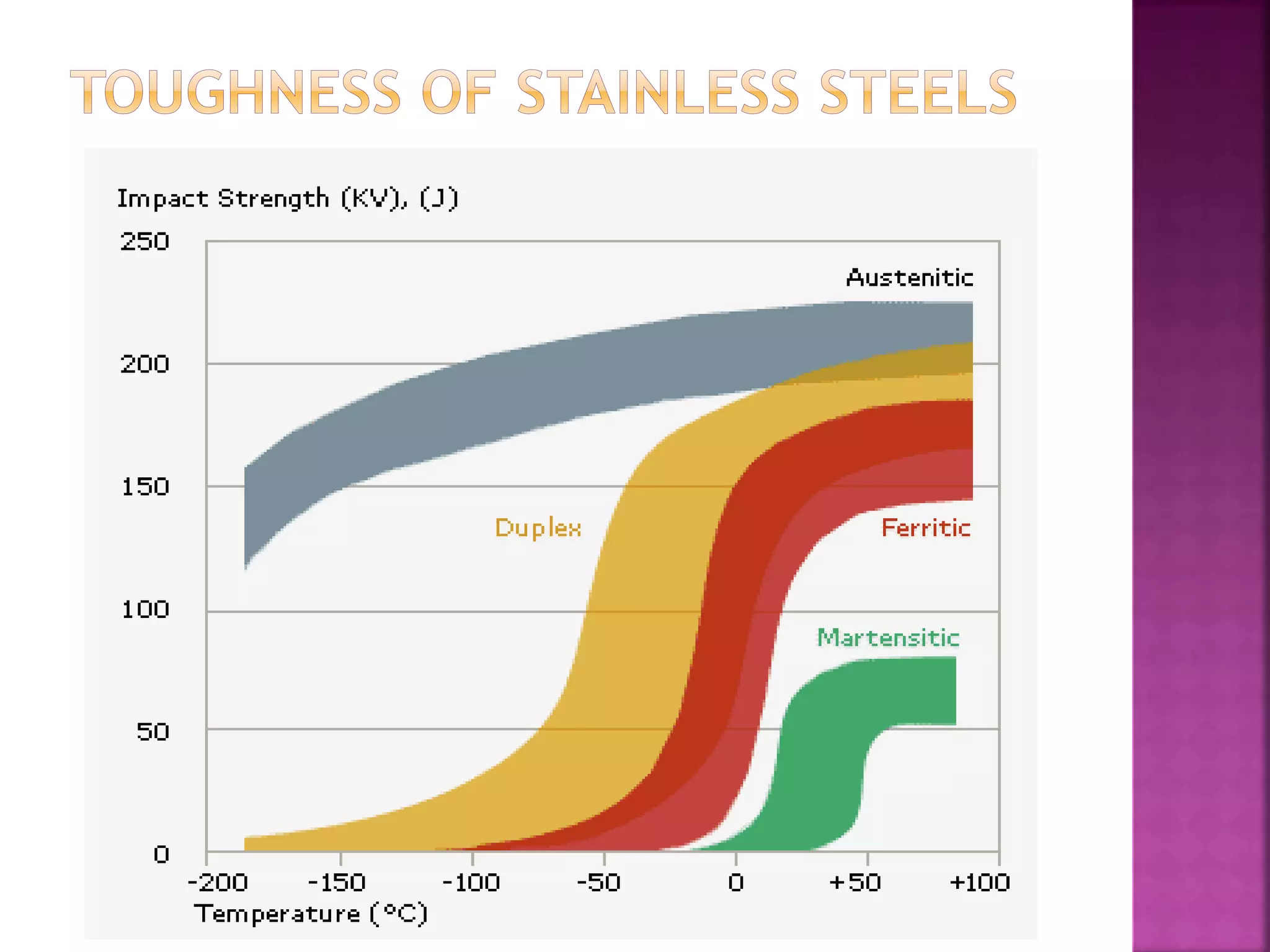
 The austenitic stainless steel grades do not show a
ductile-brittle impact strength transition as
temperatures are lowered.
 Stainless steels can absorb considerable impact
without fracturing due to their excellent ductility
and their strain-hardening characteristics
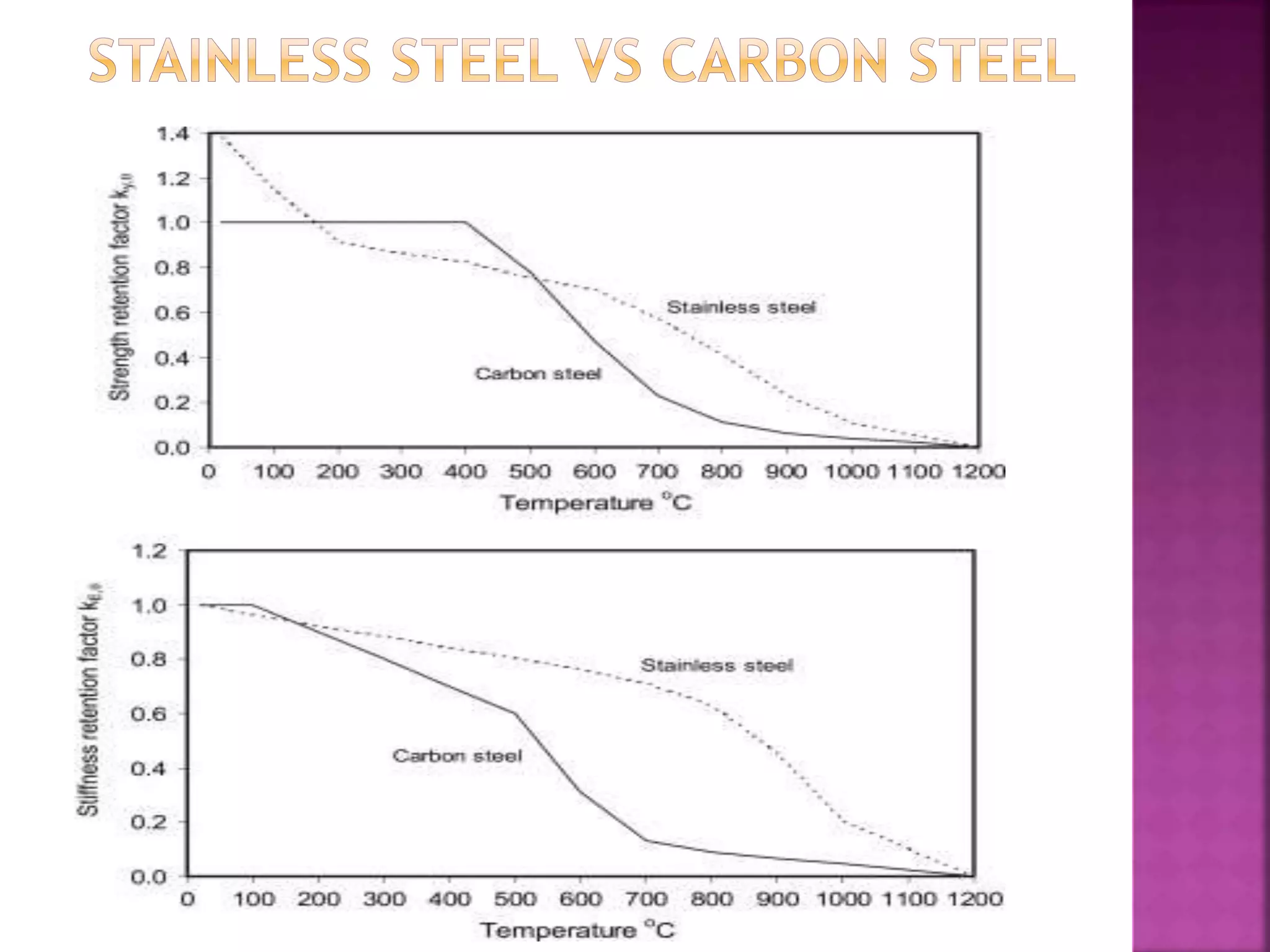
 The main reasons for the difference in structural behaviour
between carbon and stainless steel members are:
 The stress-strain curve for stainless steel departs from linearity
at a much lower stress than that for carbon steels
 Stainless steels have greater ductility and a greater capacity for
work hardening than carbon steels
 The material modulus of stainless steels reduces with increasing
stress, unlike that of carbon steels which is constant
 The residual stresses arising from fabrication are higher in
stainless steel than in carbon steels.
 As a result of this, different buckling curves are required
from those of carbon steel. This applies to:
 local (plate) buckling for elements in compression
 flexural, torsional, torsional-flexural buckling for members
subject to axial compression
 lateral-torsional buckling for beams with unrestrained
compression flanges
CORROSION RESISTANCE
All stainless steels have a high resistance to corrosion. Low
alloyed grades resist corrosion in atmospheric conditions;
highly alloyed grades can resist corrosion in most acids,
alkaline solutions, and chloride bearing environments,
even at elevated temperatures and pressures. This
resistance to attack is due to the naturally occurring
chromium-rich oxide film formed on the surface of the
steel. Although extremely thin, this invisible, inert film is
tightly adherent to the metal and extremely protective
in a wide range of corrosive media. The film is rapidly self
repairing in the presence of oxygen, and damage by
abrasion, cutting or machining is quickly repaired.
 HIGH AND LOW TEMPERATURE RESISTANCE
Some grades will resist scaling and maintain high strength at very
high temperatures, while others show exceptional toughness
at cryogenic temperatures. These steels show high resistance to
scaling and oxidation at elevated temperatures. Austenitic stainless
steels do not undergo ductile/brittle transition.
 EASE OF FABRICATION
The majority of stainless steels can be cut, welded, formed,
machined and fabricated readily. In other words, they have high
ductility, formability, machinability along with good weldability.
 STRENGTH
The cold work hardening properties of many
stainless steels can be used in design to reduce
material thickness and reduce weight and costs. Other
stainless steels may be heat treated to make very high
strength components.
HIGH OXIDATION RESISTANCE
High oxidation-resistance in air at ambient temperature
is normally achieved with additions of a minimum of
13% (by weight) chromium, and up to 26% is used for
harsh environments. The chromium forms a
passivation layer of chromium(III) oxide (Cr2O3) when
exposed to oxygen. The layer is too thin to be visible,
and the metal remains lustrous. The layer is impervious
to water and air, protecting the metal beneath. Also,
this layer quickly reforms when the surface is
scratched. This phenomenon is called passivation and is
seen in other metals, such as aluminium and titanium.
Corrosion-resistance can be adversely affected if the
component is used in a non-oxygenated environment, a
typical example being underwater keel bolts buried in
timber.
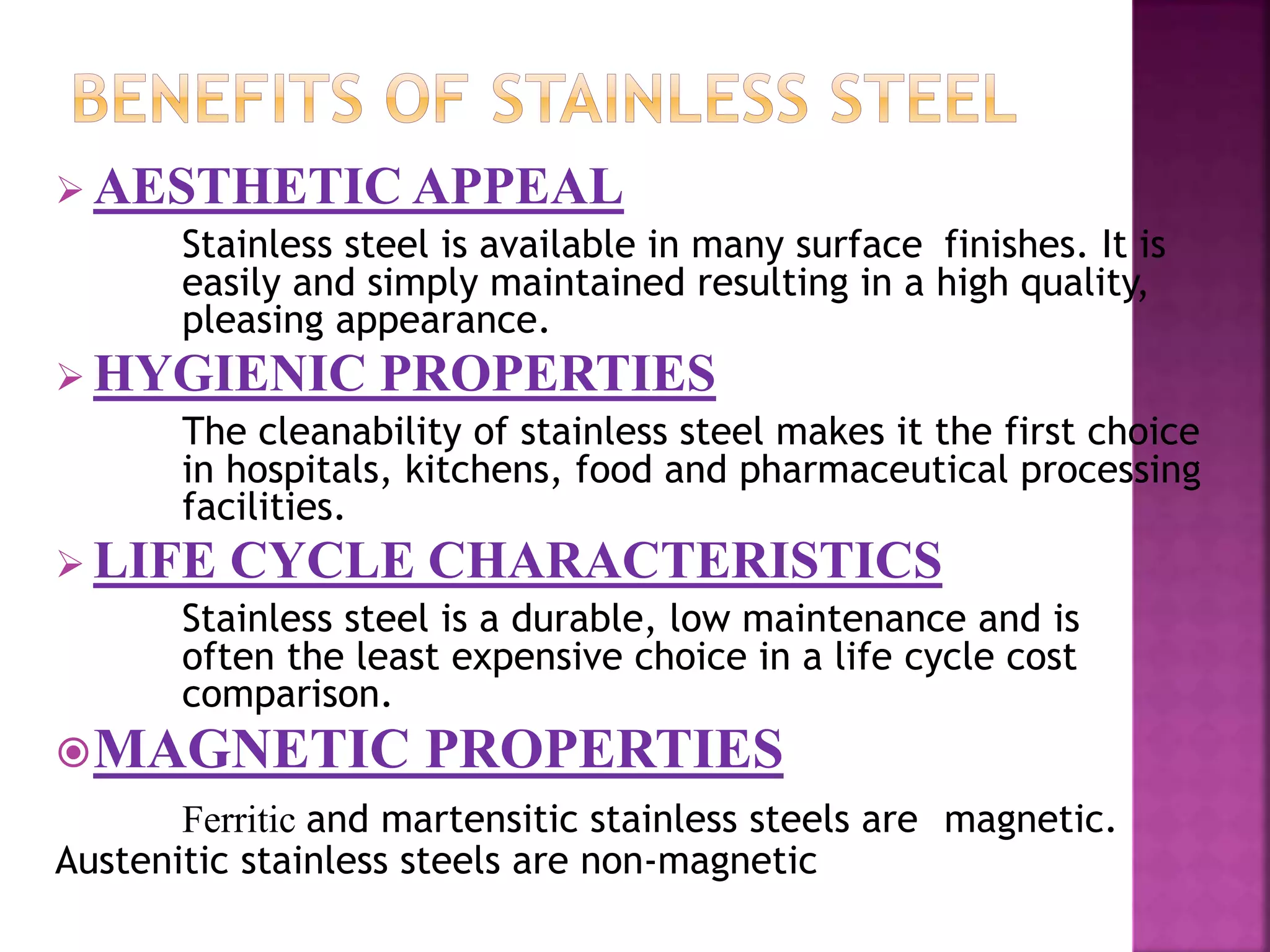
 AESTHETIC APPEAL
Stainless steel is available in many surface finishes. It is
easily and simply maintained resulting in a high quality,
pleasing appearance.
 HYGIENIC PROPERTIES
The cleanability of stainless steel makes it the first choice
in hospitals, kitchens, food and pharmaceutical processing
facilities.
 LIFE CYCLE CHARACTERISTICS
Stainless steel is a durable, low maintenance and is
often the least expensive choice in a life cycle cost
comparison.
MAGNETIC PROPERTIES
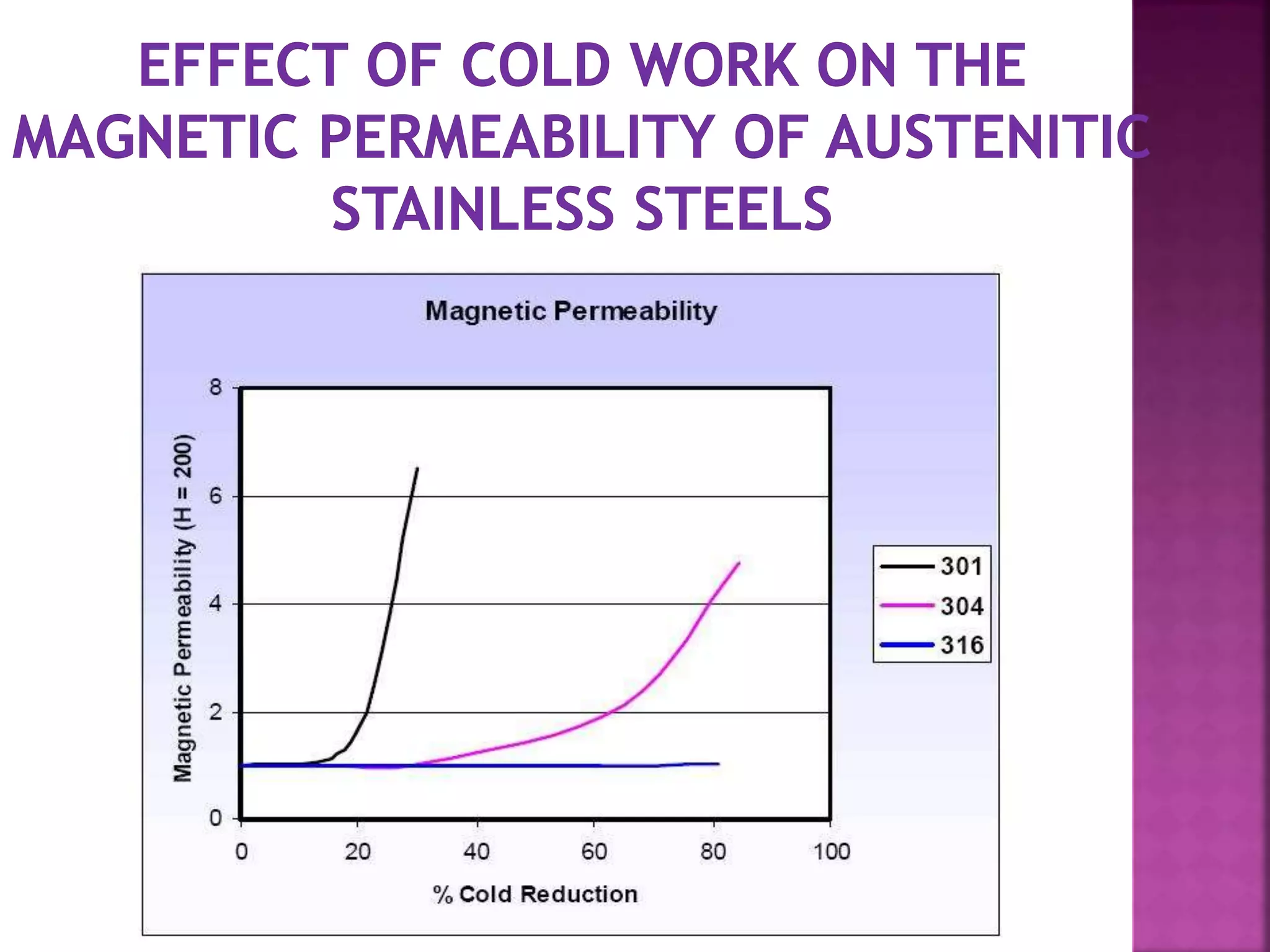
Ferritic and martensitic stainless steels are magnetic.
Austenitic stainless steels are non-magnetic
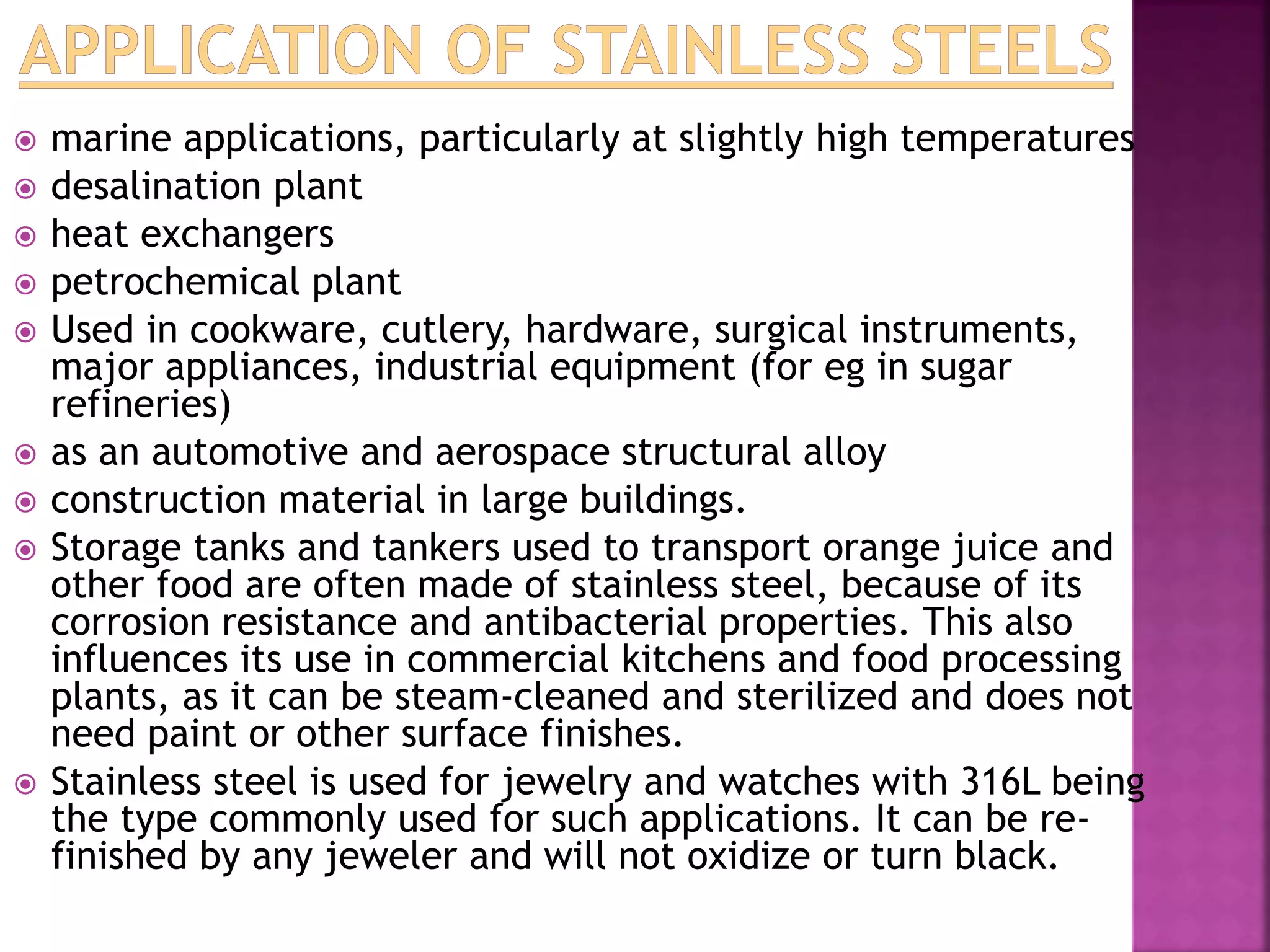
 marine applications, particularly at slightly high temperatures
 desalination plant
 heat exchangers
 petrochemical plant
 Used in cookware, cutlery, hardware, surgical instruments,
major appliances, industrial equipment (for eg in sugar
refineries)
 as an automotive and aerospace structural alloy
 construction material in large buildings.
 Storage tanks and tankers used to transport orange juice and
other food are often made of stainless steel, because of its
corrosion resistance and antibacterial properties. This also
influences its use in commercial kitchens and food processing
plants, as it can be steam-cleaned and sterilized and does not
need paint or other surface finishes.
 Stainless steel is used for jewelry and watches with 316L being
the type commonly used for such applications. It can be re-
finished by any jeweler and will not oxidize or turn black.
The pinnacle of New York's
Chrysler Building is clad with
type 302 stainless steel.[13]
The arch rises from the bottom
left of the picture and is shown
against a featureless clear sky
The 630-foot (192 m) high,
stainless-clad (type 304)
Gateway Arch defines St. Louis's
skyline.
In addition to chromium, nickel, molybdenum, titanium, niobium,
other elements may also be added to stainless steels in varying
quantities to produce a range of stainless steel grades, each with
different properties.
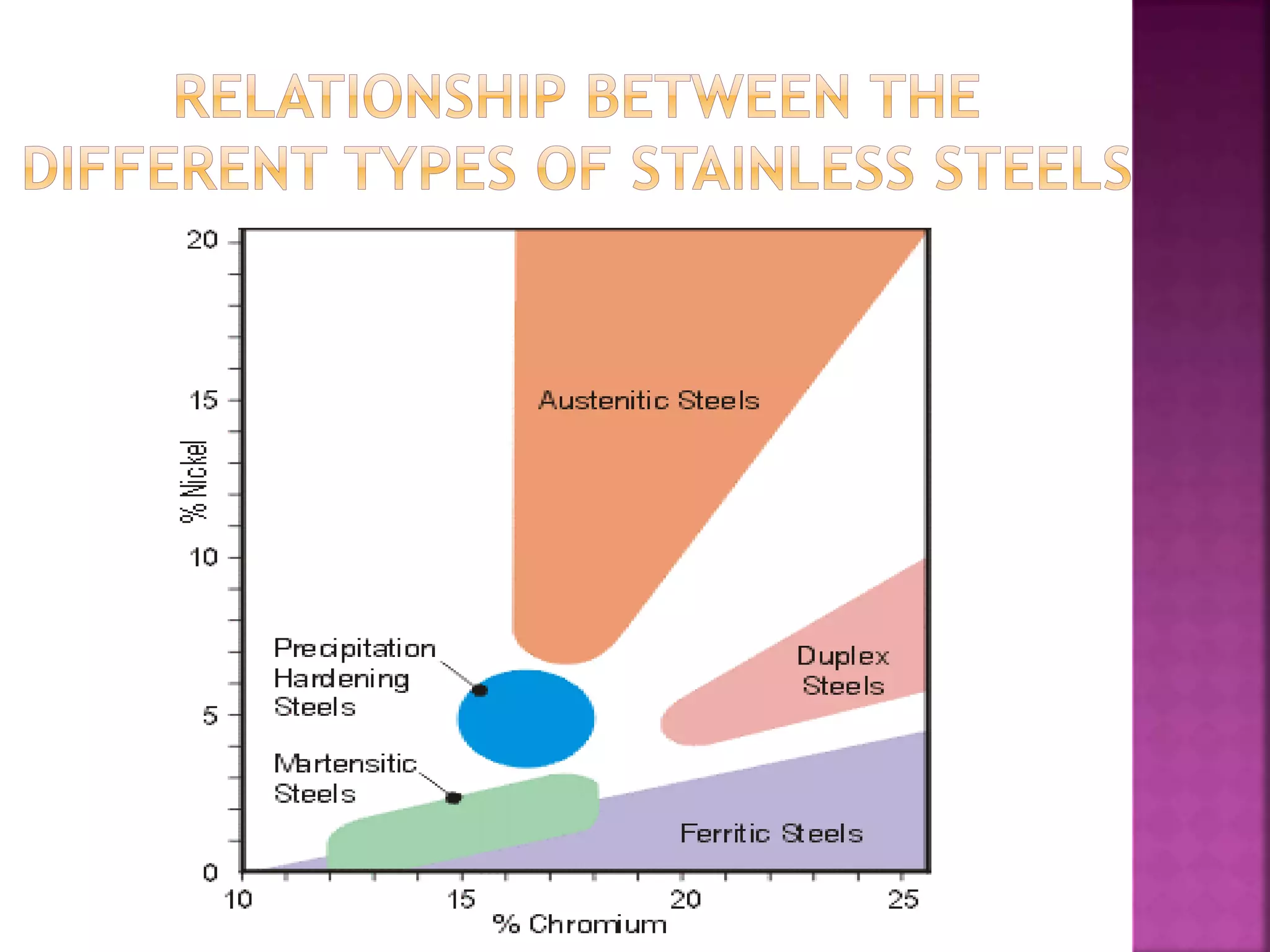
Stainless steels can be divided into five basic categories:
 Austenitic
 Ferritic
 Martensitic
 Duplex
 Precipitation hardening
These are named according to the microstructure inherent in
each steel group (a function of the primary alloying elements).
Austenitic and ferritic grades account for approximately 95% of
stainless steel applications.
 The basic composition of austenitic stainless steels is
16-25% chromium and sufficient amount of austenite-
stabilising elements like Ni, Mn, or Nitrogen.
 These steels are austenitic at room temperature.
 Austenitic grades are the most commonly used stainless
steels accounting for more than 70% of production
(type 304 is the most commonly specified grade by far).
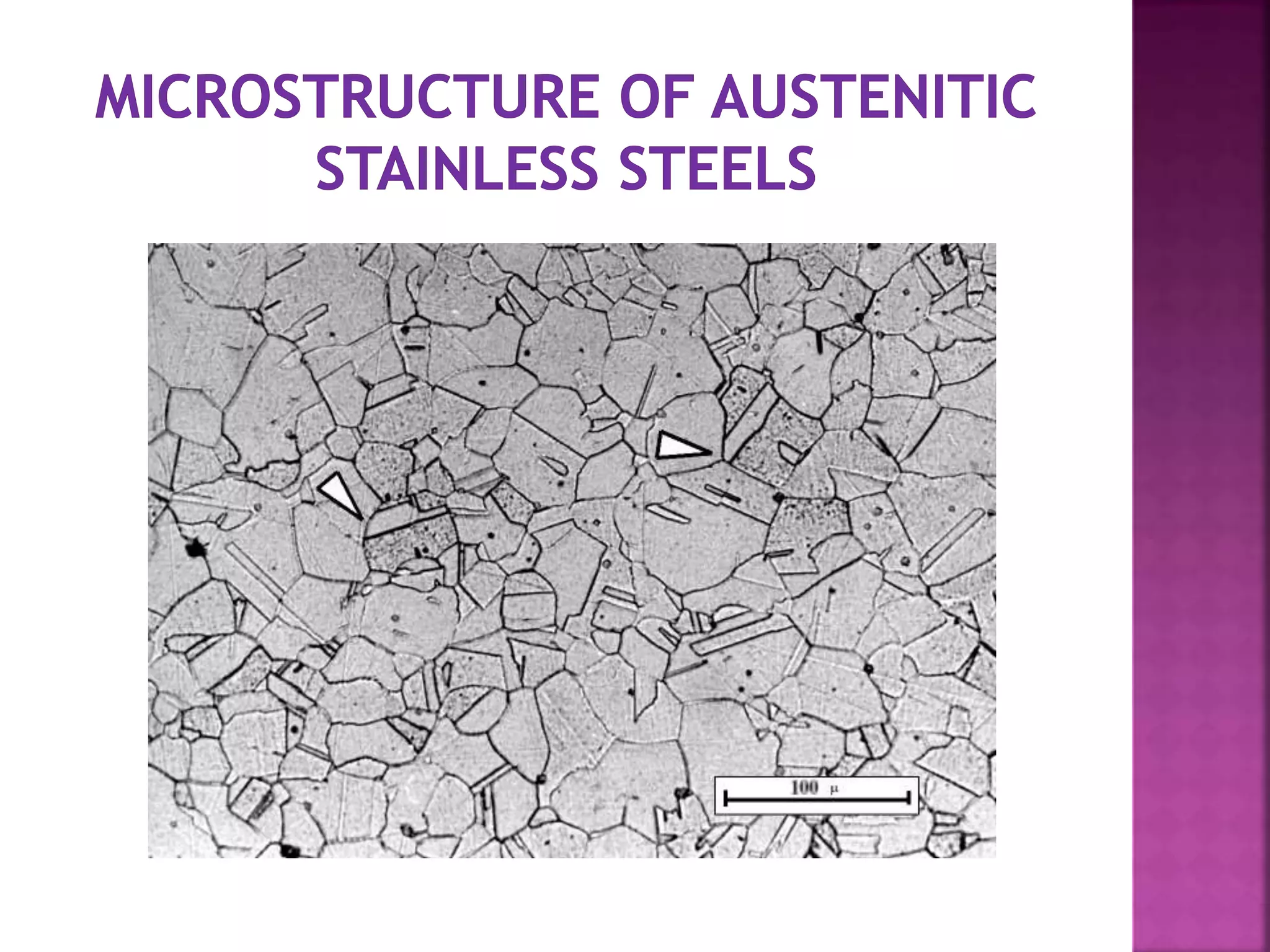
 Austenitic steels have austenite as their primary phase
(face centered cubic crystal)
 Austenitic steels are not hardenable by heat treatment
 Austenitic stainless steels have high ductility, low yield
stress and relatively high ultimate tensile strength,
when compared to a typical carbon steel.
 When nickel is added to stainless steel in
sufficient amounts the crystal structure changes
to "austenite“.
 excellent corrosion resistance in organic acid,
industrial and marine environments.
 excellent weldability
 excellent formability, fabricability and ductility
 excellent cleanability, and hygiene characteristics
 Austenitic steels have excellent toughness down to
true absolute (-273°C), with no steep ductile to
brittle transition.
 non magnetic in nature
 hardenable by cold work only (These alloys are not
hardenable by heat treatment)
 Cr/Ni austenitic steels are very resistant to high
temperature oxidation
302 304 316
Carbon 0.15% max.. 0.08% max 0.08% max
Chromium 17.00 to
19.00%
18.00 to
20.00%
16.00 to 18.00%
Manganese 2.0% max 2.0% max. 2.0% max.
Silicon 1.0% max. 1.0% max. 1.0% max.
Nickel 8.00 to 10.00% 8.00 to 10.50% 10.00 to 14.00%
Molybdenum ---- ---- 2.00 to 3.00%
302 304 316
Tensile strength
(Ksi)
90 -185 84-185 84-185
Yield strength (Ksi) 40-140 42-140 42-140
Elongation in 2
inches (Annealed)
50 % 55 % 50 %
Modulus of
elasticity (psi)
28 x 10 6 28 x 10 6 28 x 10 6
Hardness
(Annealed)
RB 75 -
RB90
RB 75 -
RB90
RB 75 - RB90
Hardness (Cold
work)
RC 25 -
RC39
RC 25 -
RC39
RC 25 - RC39
 As these steels are single phase FCC materials, these are
not very string materials.these steels can be strengthened
by:
 COLD WORKING
 It increases the low yield strength of 240 MPa to
1035 MPa when cold worked by 60%
 Tensile strength of 585 MPa gets doubled when
cold worked by 60%.
 But a major disadvantage accompanying the
process is the loss of strength at temperatures
above 600oC and also in the heat affected zones of
a weld
 SOLID SOLUTION STRENGTHENING
 Substitutional solutes show little increase of
strength of the steels but interstitial solutes are
very effective.
 If any part of stainless-steel is heated in the range
500 degrees to 800 degrees for any reasonable time
there is a risk that the chrome will form chrome
carbides (a compound formed with carbon) with
any carbon present in the steel. This reduces the
chrome available to provide the passive film and
leads to preferential corrosion, which can be
severe. This is often referred to as
sensitisation. Therefore it is advisable when
welding stainless steel to use low heat input and
restrict the maximum interpass temperature to
around 175°, although sensitisation of modern low
carbon grades is unlikely unless heated for
prolonged periods.
Small quantities of either titanium (321) or niobium (347)
added to stabilise the material will inhibit the formation
of chrome carbides.
 Prone to stress corrosion cracking
This type of corrosion forms deep cracks in the
material and is caused by the presence of
chlorides in the process fluid or heating
water/steam (Good water treatment is
essential ), at a temperature above 50°C, when
the material is subjected to a tensile stress
(this stress includes residual stress, which could
be up to yield point in magnitude). Significant
increases in Nickel and also Molybdenum will
reduce the risk.
 As they have high Ni content, they are expensive
 computer floppy disk shutters (304)
 computer keyboard key springs (301)
 kitchen sinks (304D)
 food processing equipment
 architectural applications
 chemical plant and equipment
 Plain chromium steels(12 to 27 percent chromium) with no
significant nickel content which results in lower corrosion
resistance than austenitic stainless steels and low carbon
content(to improve toughness and reduce sensitization)
 Ferritic stainless steels follow the simple relationship
Cr%-17%C>12.7
 These alloys are ferritic in structure upto the melting point
 They have slightly higher yield strengths and much lower
strain hardening than austenitics.
 Ferritic steels have body centered cubic crystal, are less
ductile than austenitic steel, and are not hardenable by heat
treatment like martensitic steels.
 Ferritics with high chromium content are used mainly for high
temperature (but below 475°C) applications, and those with
extremely low carbon and nitrogen content are used where
protection against stress corrosion cracking is required.
 moderate to good corrosion resistance increasing
with chromium content
 not hardenable by heat treatment and always
used in the annealed condition
 magnetic in nature
 formability not as good as the austenitic stainless
steel
 Yield strength in the annealed state could be 275-
415 Mpa
 Tensile strengths lie between 500-600 Mpa as
these steels work harden less
 As expensive Ni is not added, ferritic stainless
steels are much cheaper.
 Highly corrosion resistant.
 Immune to chloride to stress-corrosion cracking
 Good cold formability
 Excellent hot-ductility
 Good oxidation resistance at high temperature
 Good machinability, higher thermal conductivity,
lower thermal expansion than austenitic stainless
steels
 Get corroded in chloride and sulphur dioxid containing
atmospheres
 Grain refinement is difficult
 Due to its BCC structure, it shows ductile to brittle
transition
 Show stretcher strains during drawing or stretching
 Suffer from intergranular corrosion in the heat-
affected zone of the weld due to the precipitation of
chromium carbides.
 Brittle in nature
 weldability is poor
 computer floppy disk hubs (430)
 automotive trim (430)
 automotive exhausts (409)
 colliery equipment (3CR12)
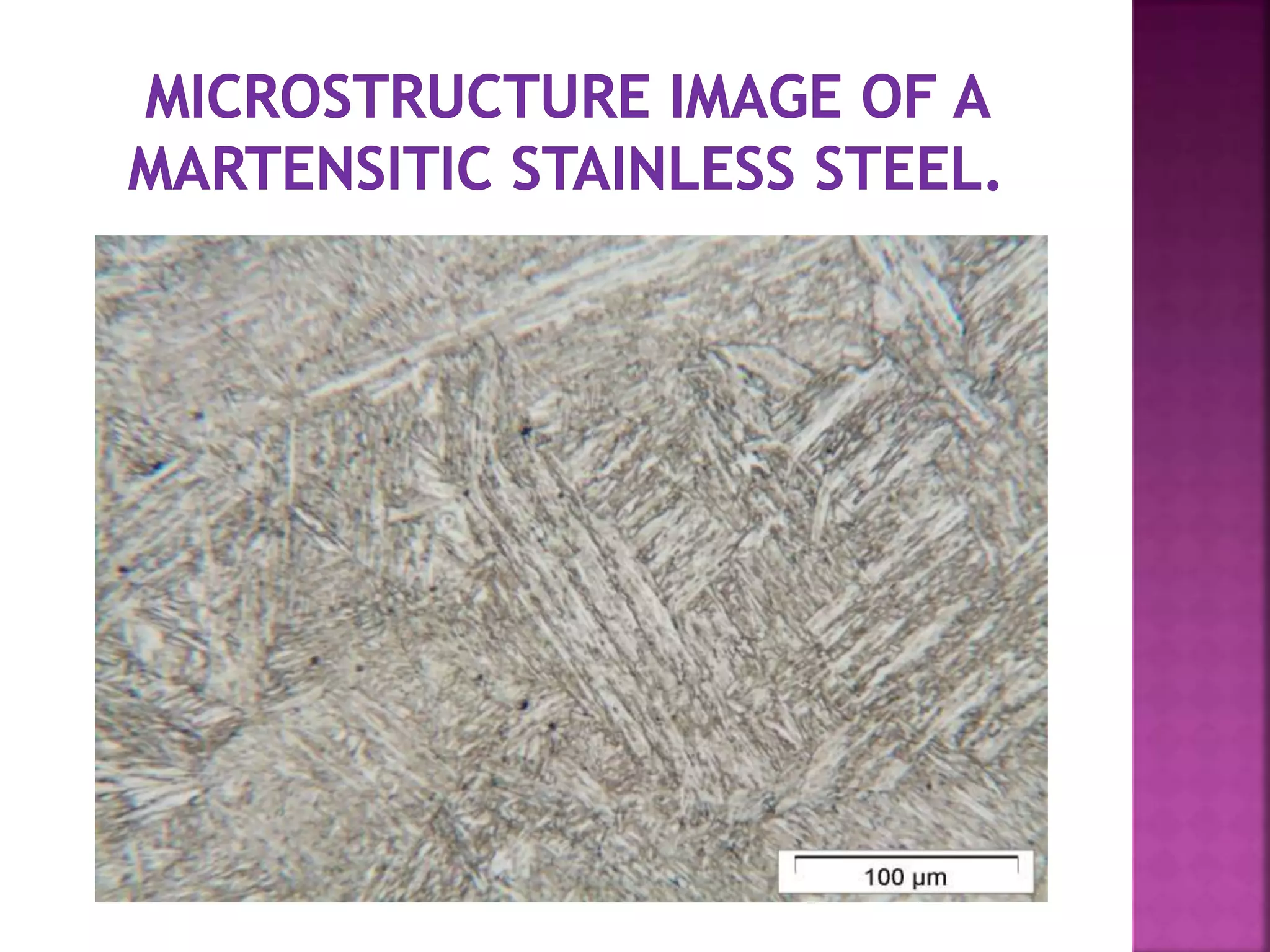
 hot water tanks (444)
 Martensitic stainless steels were the first stainless
steels commercially developed
 The main alloying element is chromium, typically
12 to 17%, molybdenum (0.2-1%), no nickel, except
for two grades, and 0.1-1.2% carbon.
 The following relationship shows the composition
of martensitic stainless steels:
(%Cr-17%C)<=12.7
 These steels are austenite at temperatures of 950-
1000oC, but transform to martensite on cooling.
 Increasing the carbon content increases the
strength and hardness potential but decreases
ductility and toughness
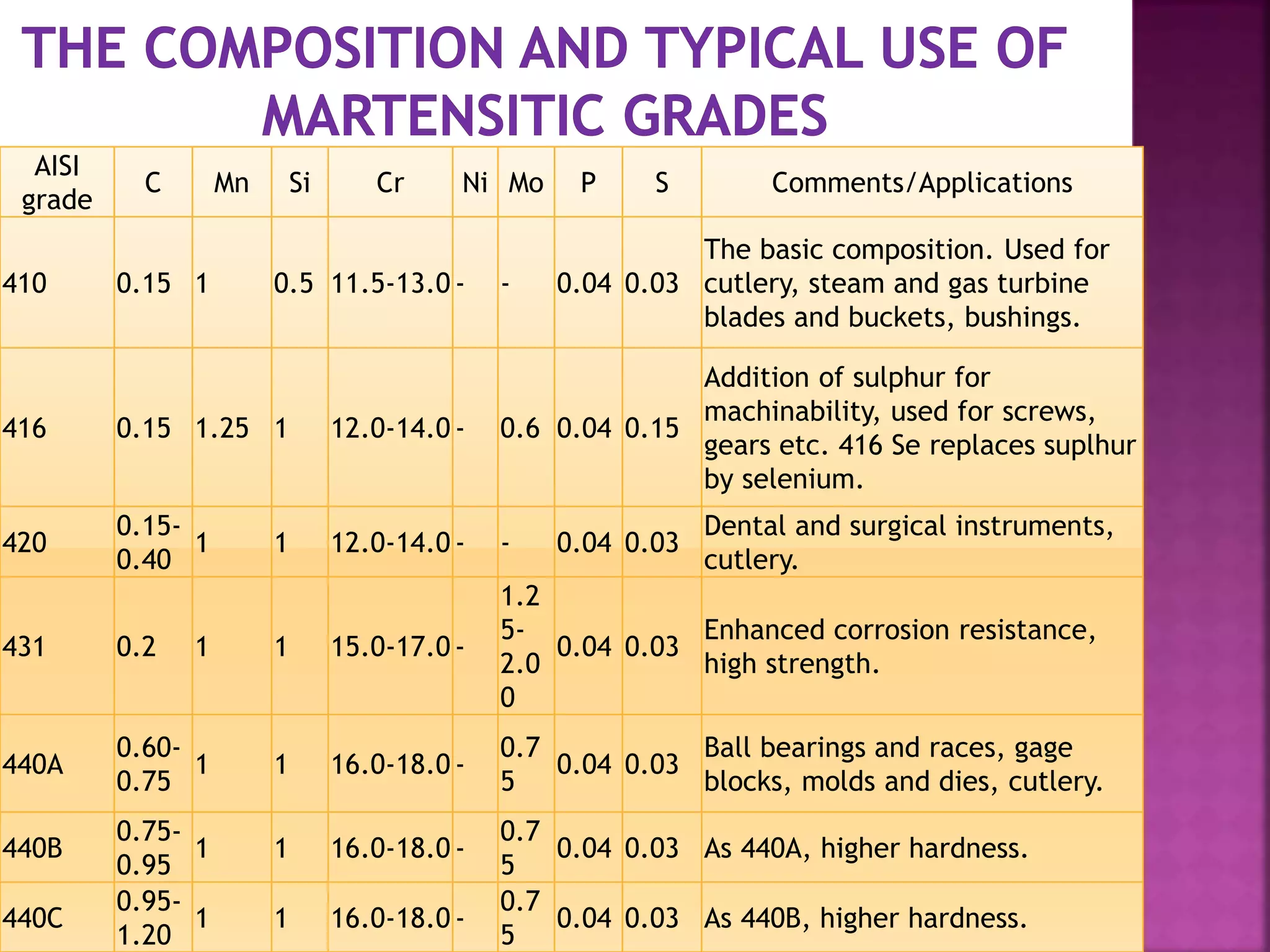
AISI
grade
C Mn Si Cr Ni Mo P S Comments/Applications
410 0.15 1 0.5 11.5-13.0 - - 0.04 0.03
The basic composition. Used for
cutlery, steam and gas turbine
blades and buckets, bushings.
416 0.15 1.25 1 12.0-14.0 - 0.6 0.04 0.15
Addition of sulphur for
machinability, used for screws,
gears etc. 416 Se replaces suplhur
by selenium.
420
0.15-
0.40
1 1 12.0-14.0 - - 0.04 0.03
Dental and surgical instruments,
cutlery.
431 0.2 1 1 15.0-17.0 -
1.2
5-
2.0
0
0.04 0.03
Enhanced corrosion resistance,
high strength.
440A
0.60-
0.75
1 1 16.0-18.0 -
0.7
5
0.04 0.03
Ball bearings and races, gage
blocks, molds and dies, cutlery.
440B
0.75-
0.95
1 1 16.0-18.0 -
0.7
5
0.04 0.03 As 440A, higher hardness.
440C
0.95-
1.20
1 1 16.0-18.0 -
0.7
5
0.04 0.03 As 440B, higher hardness.
 In comparison with the austenitic and ferritic
grades of stainless steels, martensitic stainless
steels are less resistant to corrosion
 can be hardened by heat treatment and therefore high
strength and hardness levels can be achieved
 poor weldability
 magnetic in nature
 Yield strength of 550-1860 MPa
 Poor machinability
 As Cr content increases, hardenability increases
 These steels have improved toughness
 Low carbon high strength martensitic
stainless steels
 High carbon high strength martensitic
stainless steels
 Carbon content is kept low ~0.1%
 Such steels are quenched in oil, or air from around
1050oC(fully austenitic) and then tempered.
 Low temperature tempering leads to high yiels
strength and tensile strength while high
temperature tempering leads to high toughness.
Tempering range of 440 to 540oC is avoided as it
causes reduction in impact strength
 Tensile strength is 1300 MN/m2
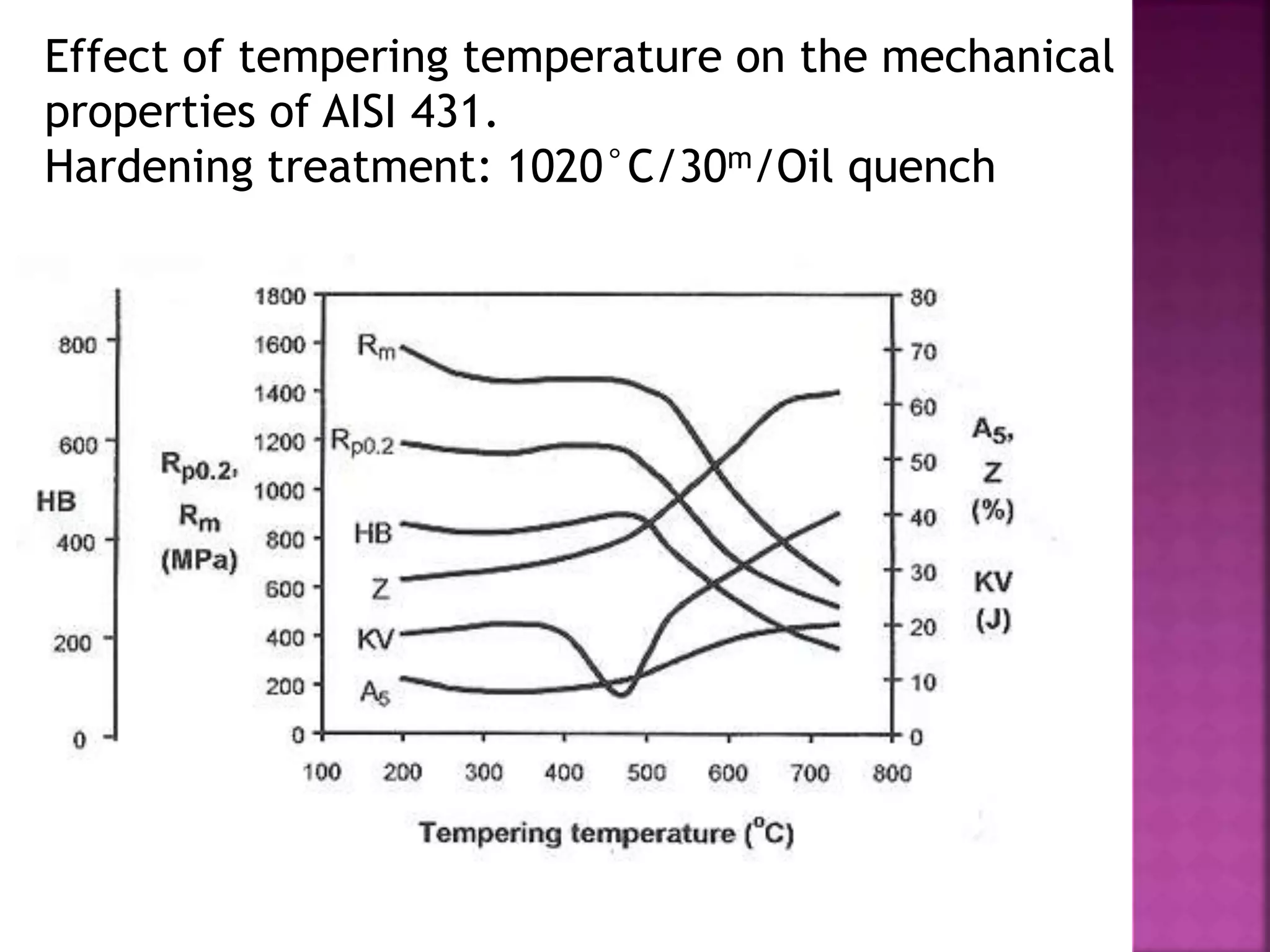
Effect of tempering temperature on the mechanical
properties of AISI 431.
Hardening treatment: 1020°C/30m/Oil quench
 Normally, increasing tempering temperatures below
about 400°C will lead to a small decrease tensile
strength and an increase in reduction of area while
hardness, elongation and yield strength are more or less
unaffected. Above this temperature there will be more
or less pronounced increase in yield strength, tensile
strength and hardness due to the secondary hardening
peak, around 450-500°C.
 In the temperature range around the secondary
hardening peak there is generally a dip in the impact
toughness curve. Above about 500°C there is a rapid
reduction in strength and hardness, and a corresponding
increase in ductility and toughness. Tempering at
temperatures above the 780°C for the steel in the
figure, will result in partial austenitizising and the
possible presence of untempered martensite after
cooling to room temperature.
APPLICATIONS of Low carbon
high strength martensitic stainless
steels
 Petrochemical and chemical plant construction
 Gas turbine engines
 Turbine blades
 Electrical generation plants
 Compressors and discs
 Aircraft structural and engine applications
 Propeller shafts in ships sailing in fresh water
 Strength and hardness of martensitic
stainless steels can be increased by
increasing the carbon content of the steels,
but it is at the expense of weldability, toughn
ess and even corrosion resistance.
 Increases carbon increases the amount of
carbides, and thus higher austenitising
temperatures have to be used to dissolve
them
APPLICATIONS OF High
carbon high strength
martensitic stainless steels
 Knives
 Needle-valves
 Gears
 Razor blades
 Surgical instruments
 Ball bearings for high temperature
applications
 Stainless steel bearings
 These are stainless steels containing relatively high
chromium (between 23 and 30%) and moderate amounts
of nickel (between 2.5 and 7%).
 Most duplex steels contain molybdenum in a range of
2.5 - 4% and titanium.
 These stainless steels contain ferrite and austente in
microstructure, thus combining the toughness and
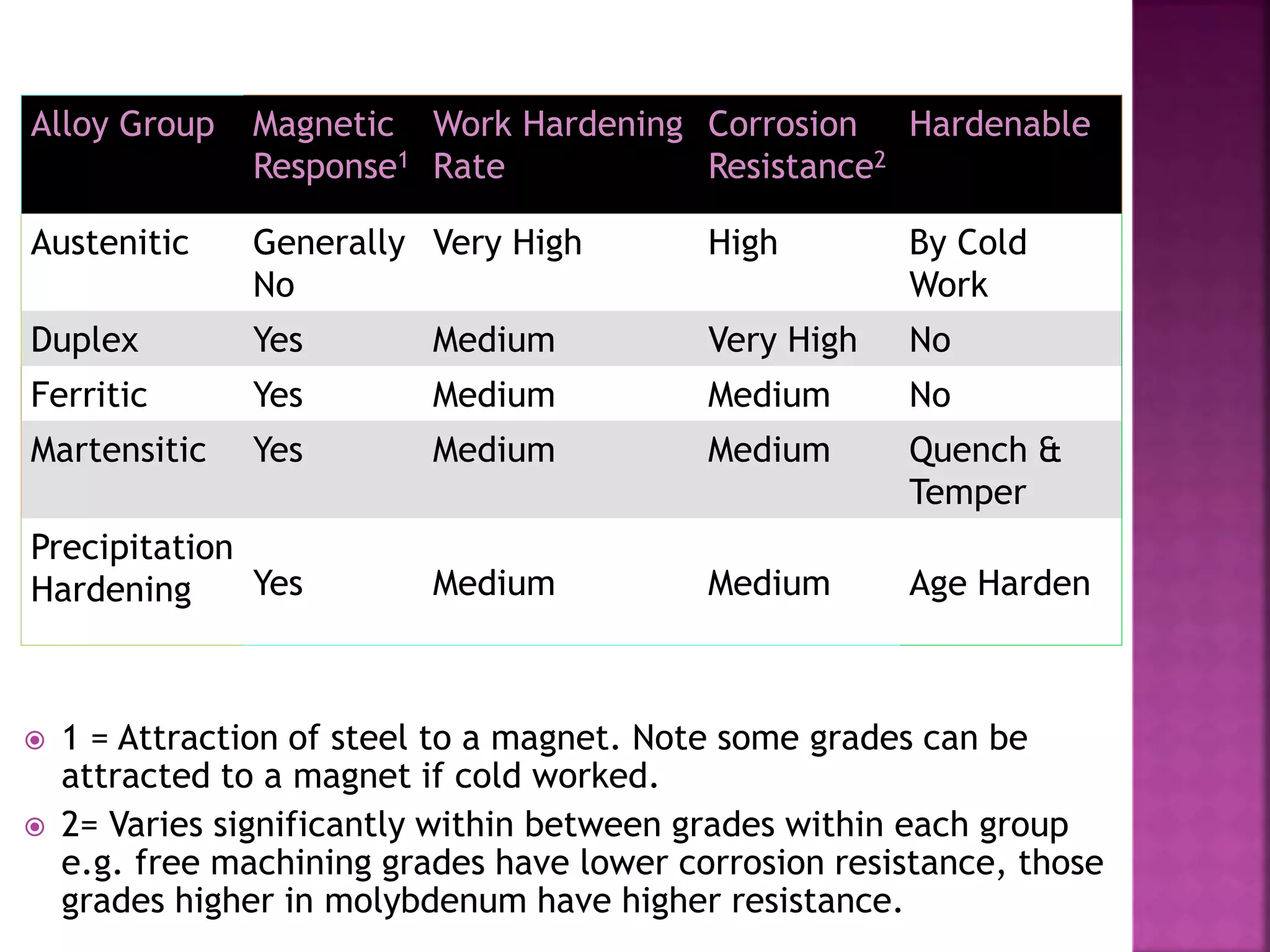
weldability of austenite with strengths and resistance to
localised corrosion of ferrite. The exact proportion of
the phases is controlled by heat treatment
 Duplex stainless steels are called “duplex” because
they have a two-phase microstructure consisting of
grains of ferritic and austenitic stainless steel.
 The figure in the next slide shows the yellow
austenitic phase as “islands” surrounded by the
blue ferritic phase.
 When duplex stainless steel is melted it solidifies
from the liquid phase to a completely ferritic
structure.
 As the material cools to room temperature, about
half of the ferritic grains transform to austenitic
grains (“islands”). The result is a microstructure of
roughly 50% austenite and 50% ferrite.
The nickel content is insufficient to generate a fully
austenitic structure and the resulting combination of
ferritic and austenitic structures is called duplex.
 high resistance to stress corrosion cracking as the
ferrite phase is immune to this type of failure
 Good corrosion resistance similar to austenitic stainless
steels
 increased resistance to chloride ion attack
 higher tensile and yield strength than austenitic or
ferritic steels
 good weldability and formability but micro-duplex
structure is destroyed in heat-affected zone.
 Due to presence of ferrite, duplex steels also have
ductile to brittle transition temperature
 These steels suffer from both type of embrittlement
effects: 475oC embrittlement as well as due to the
formation of sigma phase
 marine applications, particularly at slightly
elevated temperatures
 desalination plant
 heat exchangers
 petrochemical plant
 These steels have been formulated so that they can be
supplied in a solution treated condition, (in which they
are machinable) and can be hardened, after
fabrication, in a single low temperature "aging"
process.
 These alloys are restricted for use to high strength-to-
weight ratio applications as the steels may be required
to be vacuum melted.
 The matrix in precipitation-hardenabke stainless steels
could be austenite or martensite.
 The high tensile strengths of precipitation hardening
stainless steels come after a heat treatment process
that leads to precipitation hardening of a martensitic
or austenitic matrix.
 Hardening is achieved through the addition of one or
more of the elements Copper, Aluminium, Titanium,
Niobium, and Molybdenum.
 The most well known precipitation hardening steel is
17-4 PH
 The advantage of precipitation hardening steels is that
they can be supplied in a “solution treated” condition,
which is readily machineable. After machining or
another fabrication method, a single, low temperature
heat treatment can be applied to increase the strength
of the steel. This is known as ageing or age-hardening.
As it is carried out at low temperature, the component
undergoes no distortion.
 Age-hardening takes place due to coherency strains and
general dispersion-strengthening. Thus, its effects can
be increased by increasing the volume fraction of the
precipitates, or by intensifying the coherency strains by
increasing the misfit between the zones and the
matrix. The rate of overageing should be minimized
Typical mechanical properties achieved for 17-4 PH after solution
treating and age hardening are given in the following table. Condition
designations are given by the age hardening temperature in °F.
Cond.
Hardening Temp
and time
Hardness
(Rockwell C)
Tensile Strength
(MPa)
A Annealed 36 1100
H900 482°C, 1 hour 44 1310
H925 496°C, 4 hours 42 1170-1320
H1025 552°C, 4 hours 38 1070-1220
H1075 580°C, 4 hours 36 1000-1150
H1100 593°C, 4 hours 35 970-1120
H1150 621°C, 4 hours 33 930-1080
Temperat
ure
0.2 %
proof
stress
(N/mm2)
Tensile
strength
(N/mm2)
Elongatio
n, min.
(%)
Reduction
, min. (%)
Notch
impact
energy
(ISO-V),
min. (J)
480oC 1170 1310 10 40 -
495oC 1070 1170 10 44 7
550oC 1000 1070 12 45 20
595oC 795 965 14 45 34
620oC 725 930 16 50 41
760oC 515 795 18 55 75
 Precipitation hardening stainless steels are
characterised into one of three groups based on
their final microstructures after heat treatment.
The three types are:
 martensitic (e.g. 17-4 PH),
 semi-austenitic (e.g. 17-7 PH) and
 austenitic (e.g. A-286).
Martensitic Alloys
Martensitic precipitation hardening stainless
steels have a predominantly austenitic
structure at annealing temperatures of around
1040 to 1065°C. Upon cooling to room
temperature, they undergo a transformation
that changes the austenite to martensite.
Semi-austenitic Alloys
Unlike martensitic precipitation hardening
steels, annealed semi-austenitic precipitation
hardening steels are soft enough to be cold
worked. Semi-austenitc steels retain their
austenitic structure at room temperature but
will form martensite at very low temperatures.
Austenitic Alloys
Austenitic precipitation hardening steels
retain their austenitic structure after
annealing and hardening by ageing. At the
annealing temperature of 1095 to 1120°C the
precipitation hardening phase is soluble. It
remains in solution during rapid cooling.
When reheated to 650 to 760°C,
precipitation occurs. This increases the
hardness and strength of the material.
Hardness remains lower than that for
martensitic or semi-austenitic precipitation
hardening steels. Austenitic alloys remain
nonmagnetic.
BASIC PROPERTIES OF
PRECIPITATION-HARDENABLE
STAINLESS STEELS:
 Moderate to good corrosion resistance
 very high strength
 good weldability
 magnetic
 Yield strengths for precipitation-hardening stainless
steels are 515 to 1415 MPa.
 Tensile strengths range from 860 to 1520 MPa.
 Elongations are 1 to 25%. Cold working before
ageing can be used to facilitate even higher
strengths.
LIMITATIONS
 Expensive
 Difficult to hot-process
 At the maximun ageing temperatures of around 500oC,
maximum toughness cannot be obtained, and the
higher temperatures shall result in overageing to cause
loss of strength
COMMON USES
 Shafts for pumps and valves.
 High-temperature power plants
 Gears
 Valves and other engine components
 High strength shafts
 Turbine blades
 Moulding dies
 Nuclear waste casks
 1 = Attraction of steel to a magnet. Note some grades can be
attracted to a magnet if cold worked.
 2= Varies significantly within between grades within each group
e.g. free machining grades have lower corrosion resistance, those
grades higher in molybdenum have higher resistance.
Alloy Group Magnetic
Response1
Work Hardening
Rate
Corrosion
Resistance2
Hardenable
Austenitic Generally
No
Very High High By Cold
Work
Duplex Yes Medium Very High No
Ferritic Yes Medium Medium No
Martensitic Yes Medium Medium Quench &
Temper
Precipitation
Hardening Yes Medium Medium Age Harden
3= Measured by toughness or ductility at sub-zero
temperatures. Austenitic grades retain ductility to
cryogenic temperatures.
Alloy Group Ductility High
Temperatur
e Resistance
Low
Temperature
Resistance3
Weldability
Austenitic Very
High
Very High Very High Very High
Duplex Medium Low Medium High
Ferritic Medium High Low Low
Martensitic Low Low Low Low
Precipitatio
n Hardening
Medium Low Low High
The difference in the mechanical properties of different stainless
steels is perhaps seen most clearly in the stress-strain curves in the
chart At elevated temperatures the high temperature strength of
various stainless steel groups varies. The service temperature for
martensitic, ferritic and duplex stainless steels is generally more
limited than the service temperature for austenitic stainless steels.
 It is apparent from the diagram that there is a fundamental
difference at low temperatures between austenitic steels
on the one hand and martensitic, ferritic and duplex steels
on the other.
 Martensitic, ferritic and duplex steels are characterised by
a transition in toughness, from tough to brittle behaviour,
at a certain temperature, the transition temperature.
 For ferritic steel the transition temperature increases with
increasing carbon and nitrogen content, i.e. the steel
becomes brittle at successively higher temperatures.
 For duplex steels, an increased ferrite content gives a
higher transition temperature, i.e. more brittle behaviour.
 Martensitic stainless steels have transition temperatures
around or slightly below room temperature, while those for
ferritic and duplex steels are in the range 0 to - 50°C, with
ferritic steels in the upper part of this range.
 Austenitic steels do not exhibit a toughness transition as do
the other steel types, but have excellent toughness at all
temperatures, although the toughness decreases slightly
with decreasing temperature.
Types of steels in use

Types of steels in use

  • 3.
    Carbon is aneffective, cheap, hardening element for iron and hence a large tonnage of commercial steels contains very little alloying element. They may be divided conveniently into  low-carbon (<0.3% C), medium-carbon (0.3–0.7% C) and High carbon (0.7–1.7% C).
  • 5.
     The lowcarbonsteels combine moderate strength with excellent ductility and are used extensively for their fabrication properties in the annealed or normalized condition for structural purposes, i.e. bridges, buildings, cars and ships.  Improved low-carbon steels (<0.2% C) are produced by deoxidizing or ‘killing’ the steel with Al or Si, or by adding Mn to refine the grain size. It is now more common, however, to add small amounts (<0.1%) of Nb which reduces the carbon content by forming NbC particles.
  • 6.
     These particlesnot only restrict grain growth but also give rise to strengthening by precipitation- hardening within the ferrite grains.  Other carbide formers, such as Ti, may be used but because Nb does not deoxidize, it is possible to produce a semi-killed steel ingot which, because of its reduced ingot pipe, gives increased tonnage yield per ingot cast.  Medium-carbon steels are capable of being quenched to form martensite and tempered to develop toughness with good strength. Tempering in higher- temperature regions (i.e. 350–550°C) produces a spheroidized carbide which toughens the steel sufficiently for use as axles, shafts, gears and rails.
  • 7.
    The high-carbon steelsare usually quench hardened and lightly tempered at 250°C to develop considerable strength with sufficient ductility for springs, dies and cutting tools. Their limitations stem from their poor hardenability and their rapid softening properties at moderate tempering temperatures.
  • 8.
    In general, asthe carbon content increases the hardness of the steel also increases. The tensile strength and the yield strength also increase to about 0.83 % carbon. Thereafter, they level out. This is shown in Figure
  • 9.
     The tensilestrength and hardness are affected as the ratio of ferrite to cementite in the structure of steel changes. As the percentage of pearlite increases in the hypoeutectoid steels, the tensile strength increases. The hardness does not increase dramatically. The hypereutectoid steels show only a slight increase in strength as the cementite-to-ferrite ratio increases.  The elongation and the reduction in area represent how ductile or brittle a material is. Figure in the next slide indicates the effect of carbon on the ductility and impact resistance (toughness) of steels. The elongation and the reduction in area drop sharply with increase in carbon content, going almost to zero at about 1.5 % carbon. This indicates that the carbon content of 1.5 % or more will cause high brittleness. The impact resistance also decreases very sharply up to about 0.83 % carbon and then levels out.
  • 13.
    Element Effect Aluminum Ferritehardener Graphite former Deoxidizer Chromium Mild ferrite hardener Moderate effect on hardenability Graphite former Resists corrosion Resists abrasion Cobalt High effect on ferrite as a hardener High red hardness Molybdenum Strong effect on hardenability Strong carbide former High red hardness Increases abrasion resistance Manganese Strong ferrite hardener
  • 14.
    Nickel Ferrite strengthener Increasestoughness of the hypoeutectoid steel With chromium, retains austenite Graphite former Copper Austenite stabilizer Improves resistance to corrosion Silicon Ferrite hardener Increases magnetic properties in steel Phosphorus Ferrite hardener Improves machinability Increases hardenability
  • 15.
     Alloying elementshave significant effect on the iron-iron carbide equilibrium diagram. The addition of some of these alloying elements will widen the temperature range through which austenite (g -iron) is stable while other elements will constrict the temperature range. What this means is that some elements will raise and some elements will lower the critical tempearture of steel.  Manganese, cobalt, and nickel increase the temperature range through which austenite is stable. This also means that the lower critical temperature of steel will be lowered by these alloying elements. Other alloying elements that lower the critical temperature of steel are carbon, copper and zinc. The alloying elements that are used to reduce the critical temperature are highly soluble in the gamma iron (austenite). Figure shows the effect of manganese on the critical temperature of steel.
  • 17.
     Alloys suchas aluminum, chromiuim, molybdenum, phosphorus, silicon, tungsten tend to form solid solutions with alpha iron (ferrite). This constricts the temperature region through which gamma iron (austenite) is stable. As shown in the figure in the next slide, chromium at different percentages constricts the critical temperature range which results in a marked reduction of the region where austenite is stable.
  • 20.
     The elementsshown in the previous Figure have the greatest solubility in ferrite and also influence the hardenability of iron when in the presence of carbon. With a slight increase in the carbon content, they respond markedly to heat treating, because carbon acts as a ferrite strengthener. As indicated in Figure, Phosphorus will improve the hardness of the ferrite significantly by adding only a very small percentage of Phosphorus, while Chromium will not strengthen the ferrite that well even at very high percentage of Chromium addition to the steel
  • 22.
     The Figureshows the effect of furnace cooling vs. air cooling on the tensile strength of steel for three different percentages of carbon in the presence of chromium. As this figure indicates, furnace cooling has very little effect on the tensile strength of the material. The addition of chromium does not change the tensile strength properties when the steel is cooled in the furnace. If the same steels are air cooled at the same rate, the slope of the curves increases significantly which means that a slight increase in the chromium content increases the strength drastically when air cooling is applied.
  • 23.
     In low/mediumalloy steels, with total alloying content up to about 5%, the alloy content is governed largely by the hardenability and tempering requirements, although solid solution hardening and carbide formation may also be important.  Some of these aspects have already been discussed, the main conclusions being that Mn and Cr increase hardenability and generally retard softening and tempering.  Ni strengthens the ferrite and improves hardenability and toughness; copper behaves similarly but also retards tempering;  Co strengthens ferrite and retards softening on tempering; Si retards and reduces the volume change to martensite.  Both Mo and V retard tempering and provide secondary hardening.
  • 24.
    Figure 9.2 Effectof (a) Ni and (b) Cr on γ field
  • 25.
     In largeramounts, alloying elements either open up the austenite phase field, as shown in Figure 9.2a, or close the γ field (Figure 9.2b).  ‘Full’ metals with atoms like hard spheres (e.g. Mn, Co, Ni) favour close packed structures and open the γ field, whereas the stable bcc transition metals (e.g. Ti, V, Cr, Mo) close the field and form what is called a γ loop.  The development of austenitic steels, an important class of ferrous alloys, is dependent on the opening of the γ phase field.  The most common element added to iron to achieve this effect is Ni.
  • 26.
     Interstitial Cand N, which most ferrous alloys contain, also expand the γ field because there are larger interstices in the fcc than the bcc structure.  The steel is water quenched to produce austenite. The fcc structure has good fracture resistance and, having a low stacking fault energy, work-hardens very rapidly.  During the abrasion and work-hardening the hardening is further intensified by a partial strain transformation of the austenite to martensite; this principle is used also in the sheet-forming of stainless steels.
  • 27.
     To makethe austenitic steels resistant to oxidation and corrosion (see Chapter 12) the element Cr is usually added in concentrations greater than 12%.  Chromium closes the γ field, however, and with very low carbon contents single-phase austenite cannot be produced with the stainless (>12%) composition.  These alloys form the stainless (ferritic) irons and are easily fabricated for use as furnace components.  Increasing the carbon content expands the γ loop and in the medium-carbon range Cr contents with good stainless qualities (≈15–18%) can be quench hardened for cutlery purposes where martensite is required to give a hard, sharp cutting edge
  • 28.
     The combinationof both Cr and Ni (i.e. 18/8) produces the metastable austenitic stainless steel which is used in chemical plant construction, kitchenware and surgical instruments because of its ductility, toughness and cold-working properties.  Metastable austenitic steels have good press- forming properties because the strain induced transformation to martensite provides an additional strengthening mechanism to work- hardening, and moreover counteracts any drawing instability by forming martensite in the locally- thinned, heavily deformed regions.
  • 29.
     High-strength transformablestainless steels with good weldability to allow fabrication of aircraft and engine components have been developed from the 0.05–0.1% C, 12% Cr, stainless steels by secondary hardening addition (1.5–2% Mo; 0.3– 0.5% V).  Small additions of Ni or Mn (2%) are also added to counteract the ferrite-forming elements Mo and V to make the steel fully austenitic at the high temperatures. Air quenching to give α followed by tempering at 650°C to precipitate Mo2C produces a steel with high yield strength (0.75 GN/m2), high TS (1.03 GN/m2) and good elongation and impact properties.  Even higher strengths can be achieved with stainless (12–16% Cr; 0.05% C) steels which although austenitic at room temperature (5% Ni, 2% Mn) transform on cooling to -78°C. The steel is easily fabricated at room temperature, cooled to control the transformation and finally tempered at 650–700°C to precipitate Mo2C.
  • 31.
     Plain carbonsteels, if used for cutting tools, lack certain characteristics necessary for high-speed production, such as red hardness and hot -strength toughness. The effect of alloying elements in steel is of great advantage and yields tool steels that overcome many of the shortcomings of the plain carbon steels.  Tool steels are defined as "carbon or alloy steels capable of being hardened and tempered". Many alloy steels would fit this loose definition. Tool steels usually contain significantly more alloying elements than alloy steels. However, the real factor that discriminates tool steels from carbon or alloy steels is the manufacturing practice.  Many types of tool steels are available. One reason for so many types of tool steels is evolutionary development over a period of 80 years. The second reason is the wide range of needs that they serve.
  • 32.
     Tool steelis generally used in a heat-treated state.  With a carbon content between 0.7% and 1.5%, tool steels are manufactured under carefully controlled conditions to produce the required quality. The manganese content is often kept low to minimize the possibility of cracking during water quenching. However, proper heat treating of these steels is important for adequate performance, and there are many suppliers who provide tooling blanks intended for oil quenching.  Tool steels are made to a number of grades for different applications. The higher carbon grades are typically used for such applications as stamping dies, metal cutting tools, etc.  Tool steels are also used for special applications like injection molding because the resistance to abrasion is an important criterion for a mold that will be used to produce hundreds of thousands of parts.
  • 34.
     Tool steelshave properties that permit their use as tools for cutting and shaping metals and other materials both hot and cold. There are six major categories one of which contains grades intended for special purposes. A prefix letter is used in the alloy identification system to show use category, and the specific alloy in a particular category is identified by one or two digits. For example:  S1 = Shock resistant tool steel  D2 = Cold-work tool steel  H11 = Hot work tool steel  M42 = High-speed tool steel
  • 36.
    Tool Steel TypePrefix Specific Types Cold Work W = Water Hardening O = Oil Hardening A = Medium alloy Air Hardening D = High Carbon, High Chromium W1, W2, W5 O1, O2, O6, O7 A2, A4, A6, A7, A8, A9, A10, A11 D2, D3, D4, D5, D7 Shock Resisting S S1, S2, S4, S5, S6, S7 Hot Work H H10-H19 Chromium types H20-H39 Tungsten types H40-H59 Molybdenum types High Speed M T Molybdenum types (M1, M2, M3-1, M3-2, M4, M6, M7, M10, M33, M34, M36, M41, M42, M46, M50 Tungsten types (T1, T4, T5, T6, T8, T15) Mold Steels P P6, P20, P21 Special Purpose L and F series L2, L6
  • 37.
     Composition andphysical properties vary significantly (some tool steels have compositions that fit into the composition ranges of carbon and alloy steels, but most tool steels have alloy concentrations that are significantly higher than the carbon and alloy steels),  One important factor that should be kept in mind is that the alloy additions do not improve corrosion resistance even though some grades have as much chromium as stainless steels. The reason for this is that alloy elements are usually combined with carbon to form carbides.  The most significant metallurgical difference between tool steels and the other steels is their microstructure. A fully hardened carbon steel or alloy steel would have only martensite as the predominant phase. Most tool steels have a hardened structure of martensite and alloy carbides.
  • 38.
     Require specialheat treatment processes ,  Higher cost than alloy steels,  Better hardenability than most carbon and alloy steels,  High heat resistance  Easier to heat treat,  More difficult to machine than carbon and alloy steels  Most tool steels are sold as hot-finished shapes such as rounds and bars,  Cold-finished sheets are not available because it is difficult to cold roll or cold finish these materials.
  • 39.
    Cold work toolsteels are used for  gages  Blanking  drawing and piercing dies  shears  forming and banding rolls  lathe centers  mandrels  broaches  reamers  taps  threading dies  plastic molds  knurling tools.
  • 40.
    Water Hardening Tool Steels (Wseries) Oil Hardening Tool Steels (O-Series) Medium Alloy Air Hardening Steels (A-series) High Carbon High Chromium Steels (D-series) Essentially these are carbon steels with 0.60 to 1.10 % carbon. Lowest cost tool steels. Soft core(for toughness) with hard shallow layer (for wear resistance). Use of w-series steels is declining. 0.90 to 1.45 % Carbon with Mn, Si, W, Mo, Cr. They contain graphite in the hardened structure along with martensite. (Graphite acts as a lubricator and also makes machining easier. Tungsten forms tungsten carbide which improves the abrasion resistance and edge retention in cutting devices. 5 to 10 % alloying elements (Mn, Si, W, Mo, Cr, V, Ni) to improve the hardenability, wear resistance, toughness. All D-series contain 12% Cr and over 1.5 % C. Air or oil quench. Low distortion, high abrasion resistance.
  • 41.
     There areabout 12 hot-worked tool steels. They are categorized by major alloying elements into three subgroups.  Chromium types  Tungsten types  Molybdenum types  These steels are used in extrusion dies, forging dies, die casting, hot shear blades, plastic molds, punches and dies for piercing shells, hot press, etc.
  • 42.
     These steelshave 0.45 to 0.55 % carbon. The alloys, silicon, and nickel are ferrite strengtheners. Chromium increases wear resistance and hardenability. The S-series of tool steels were originally developed for chisel-type applications, but the number of alloys in this category has evolved to include steels with a broad range of tool applications. This class of steels has a very good shock resistant qualities with excellent toughness.  They are used in form tools, chisels, punches, cutting blades, springs, trimming, and swaging dies, concrete and rock drills, bolt cutters.
  • 43.
     These steelshave 0.10 to 0.35 % carbon.  They show high toughness.  The low carbon mold steels cannot be quench hardened.  The carbon and alloy content is low to allow hubbing of mold details.  The desired mold shape is pressed into the steel with a hub that is usually made from a high-speed steel. Thus mold cavities can be made without machining. Hubbed cavities are then carburized to make a production injection molding cavity.
  • 44.
    The L-type steelsare low alloy steels with about 1 % Cr that makes them a good low cost substitute for cold work steels. The F-type steels are high in carbon tungsten. They have high wear resistance, good toughness, and medium hardenability. The L- type steels are used in gages, broaches, drills, taps, threading dies, ball and roller bearings, clutch plates, knurls, files. The F-type steels are used as finish machining tools.They have good wear resistance and will maintain a sharp cutting edge. They may be used in dies, cutting tools, form tools, knives, etc.
  • 45.
    These are theclasses of steel that deep harden, retain that hardness at elevated temperatures, and have high resistance to wear and abrasion. The carbon content of these steels vary from 0.85 % to 1.50 %.
  • 46.
    M-type: The M-type toolsteels are high in molybdenum content and are used for lathe centers, blanking dies, hot forming dies, lathe cutting tools, drills, taps, etc. They are used in almost all cutting tools. T-type: The T-type high speed tool steels with high carbon content have high wear resistance and very high hardness. The ones with lower carbon content are tougher but not as hard as the former group. As the amount of tungsten increases, the toughness decreases. This class of tool material has a substantial amount of wear-resistant carbides in a very high heat resistant matrix. These steels are used in machine cutting tools such as tool bits, milling cutters, taps, reamers, drills, broaches. In some instances it is used where high temperature structural steel is needed.
  • 48.
    INTRODUCTION OF HSS: In today’s World - for modern industrial production, particularly on mechanical & CNC mass production, tooling is one of the key factors pertaining for the performance of shaping and forming processes.  Almost all tools employed for this purpose are made from high speed steels.  The use of high speed steels has also gained increasing importance for chipless shaping, e.g. for extrusion, blanking and punching tools.  HSS chemical composition distinctly differentiates between W-, Mo- and W-Mo alloyed steel grades, which contain different amounts of carbon, vanadium and cobalt elements to strengthen its own occurrence.
  • 49.
    CHARACTERISTIC PROPERTIES OFHSS GRADES:  Working hardness  High wear resistance  High retention of hardness and red hardness  Excellent toughness
  • 50.
    ALLOYING ELEMENTS PRESENTIN HSS PROPERTIES:  Carbon : forms carbides, increases wear resistance, is responsible for the basic matrix hardness.  Tungsten and molybdenum : improve red hardness, retention of hardness and high temperature strength of the matrix, form special carbides of great hardness.  Vanadium : forms special carbides of supreme hardness, increases high temperature wear resistance, retention of hardness and high temperature strength of the matrix.  Chromium : promotes depth hardening, produces readily soluble carbides.  Cobalt : improves red hardness and retention of hardness of the matrix.
  • 53.
    STEEL PROPERTIES:  Standardgrade for High Speed Steels; owing to its balanced composition has good toughness and cutting performance, hence many applications.  HSS containing cobalt content is a high performance steel with good cutting capability & ensures high red hardness and tempering retention. It is particularly suitable in thermal stress situations and for intermittent cutting.  High Speed Steel with high molybdenum and carbon. It has high wear resistance, high red hardness and good toughness. With its low vanadium content, this grade has very good grind ability.
  • 54.
    SURFACE MODIFICATION:  Lasersand electron beams can be used as sources of intense heat at the surface for heat treatment, remelting (glazing), and compositional modification.  It is possible to achieve different molten pool shapes and temperatures.  Cooling rates range from 103 – 106 K s-1. Beneficially, there is little or no cracking or porosity formation.  While the possibilities of heat treating at the surface should be readily apparent, the other applications beg some explanation.  At cooling rates in excess of 106 K s-1 eutectic microconstituents disappear and there is extreme segregation of substitutional alloying elements.
  • 55.
     This hasthe effect of providing the benefits of a glazed part without the associated run in wear damage.  The alloy composition of a part or tool can also be changed to form a high speed steel on the surface of a lean alloy or to form an alloy or carbide enriched layer on the surface of a high speed steel part.  Several methods can be used such as foils, pack boronising, plasma spray powders, powder cored strips, inert gas blow feeders, etc.  Although this method has been reported to be both beneficial and stable, it has yet to see widespread commercial use.
  • 56.
    COATINGS:  To increasethe life of high speed steel, tools are sometimes coated. One such coating is TiN (titanium nitride).  Most coatings generally increase a tool's hardness and/or lubricity.  A coating allows the cutting edge of a tool to cleanly pass through the material without having the material gall (stick) to it.  The coating also helps to decrease the temperature associated with the cutting process and increase the life of the tool.
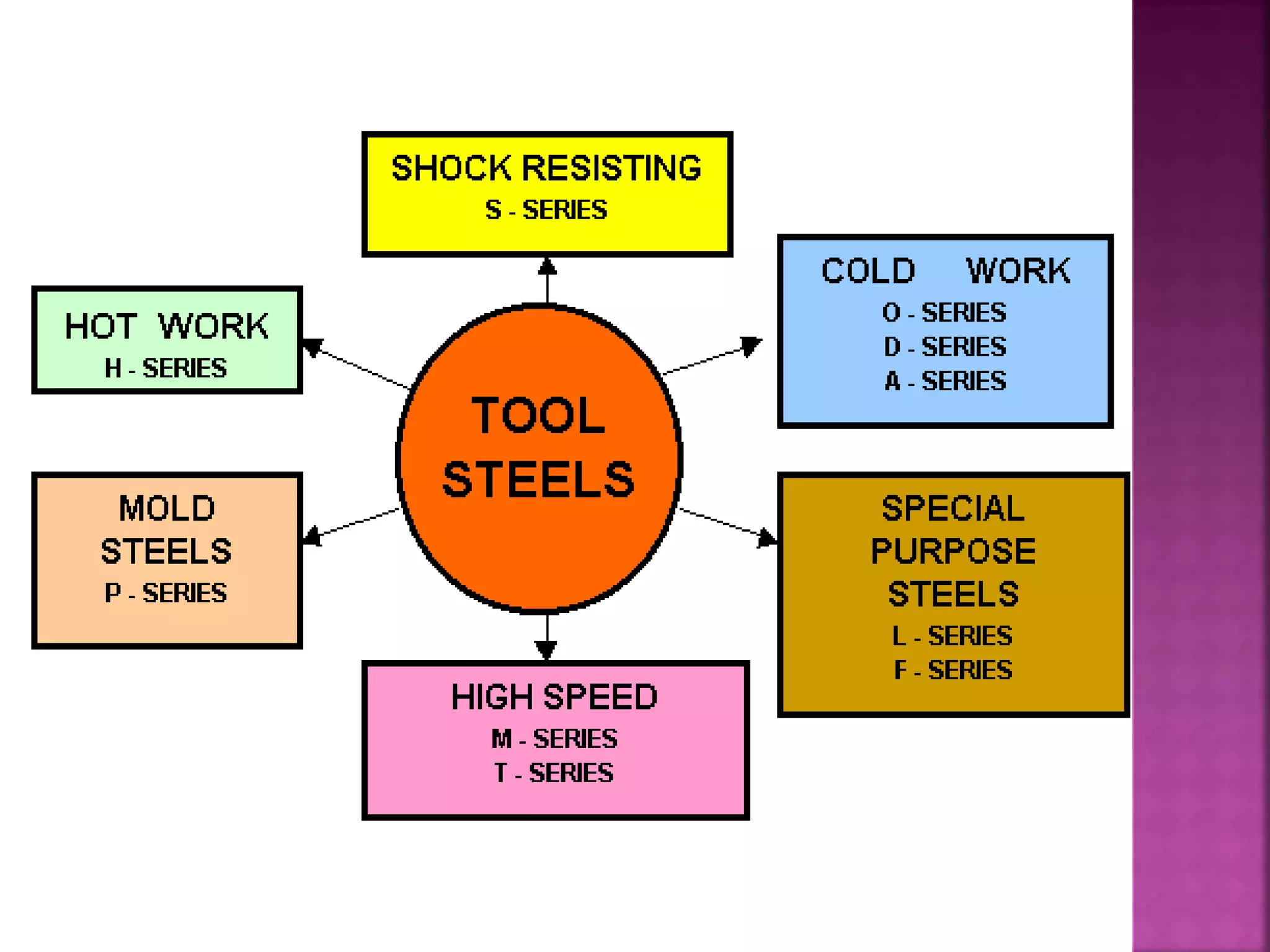
  • 57.
    APPLICATIONS:  High performanceGear Cutting Hobs, Shapers, Milling cutters, Bevel tools, of all kinds of highly stressed twist bits and taps, shaped shear blades, for working high strength materials, broaches.  Cutting tools for roughing or finishing, such as: helical bits, milling cutters of all types, taps, dies, spindles, reamers, thread rolling tools, drill bits, circular saw segments. Impact tools and those used for working wood.  Cold forming tools such as dies and punches for cold extrusion and cutting and fine cutting tools.
  • 58.
    GENERAL PURPOSE HIGHSPEED STEELS Type CHEMICAL COMPOSITION Carbon Tungsten Molybdenum Chromium Vanadium Hardness Rockwell C Term M1 .80 1.50 8.00 4.00 1.00 63-65 "HSS" M2 .85 6.00 5.00 4.00 1.90 63-65 "HSS" M7 1.00 1.75 8.75 4.00 2.00 63-65 "HSS" M50 .85 .10 4.25 4.00 1.00 63-65 "HSS"
  • 59.
    COBALT HIGH SPEEDSTEELS Type CHEMICAL COMPOSITION Carbon Tungsten Molybdenum Chromium Vanadium Cobalt Hardness Rockwell C Term M35 .80 6.00 5.00 4.00 2.00 5.00 65-67 "5% COBALT" M42 1.10 1.50 9.50 3.75 1.15 8.00 65-67 "SUPER COBALT"
  • 60.
    TERMS:  M1 "HSS"is used for making drills that will be used in a wide variety of applications. M1 has some of the increased red- hardness properties of M2, is less susceptible to shock, and has "flex" capabilities generally favored for general purpose work.  M2 "HSS" is the standard material used for all ICS HSS cutting tools. M2 has good red-hardness and retains its cutting edge longer than other general purpose high speed steels, not as shock resistant or as flexible as other HSS grades with less tungsten. Generally favored for high production machine work.  M7 "HSS" is used for making heavier construction drills that can be used for portable drilling of hard sheet metal alloys. Generally favored for work in Aircraft plants where flexibility and extended drill life are equally important.
  • 61.
     M50 "HSS"is used for making drills that will be used for portable drilling and where breakage is a problem due to flexing the drill. Does not have the red-hardness of other grades of HSS with tungsten. Generally favored for Hardware and Contractor use, although they are also sold for industrial uses.  M35 "5% COBALT" is only used by ICS for making tool bits. It has some of the increased red-hardness properties of M42, and is not quite so susceptible to shock.  M42 "SUPER COBALT" is the standard cobalt material used for all ICS cobalt cutting tools. It has excellent resistance to abrasion and very good red-hardness for working difficult materials.
  • 62.
    FIGURE SHOWING WEARRESISTANT HSS
  • 63.
    HIGH SPEED STEELSELECTION:  These steels are classified into four groups.  Group I - General Purpose High Speed Steels.  Group II - Abrasion Resistant High Speed Steels.  Group III - High Red Hardness High Speed Steels.  Group IV - Super High Speed Steels. GROUP I GENERAL PURPOSE HIGH SPEED STEELS  The Group I general purpose high speed steels provide properties that permit efficient metal removal on 70 percent of the milling applications.  The "M" steels contain molybdenum as their chief alloying element.
  • 64.
     The "T"steels contain tungsten.  M-2 high speed molybdenum steel is used on most applications.  Its chemical composition provides balanced wear, red hardness and strength qualities.  It is readily available as a standard cutter and is stocked in blanks, forgings and bar stock for special milling cutters.  It is economical, grindable and machinable.  M-33, M-34, M-36 and T-5 have high cobalt content providing higher red hardness qualities at the cost of toughness of the tool.  They are not as readily available and are selected for special milling applications where these properties are advantageous.
  • 65.
    GROUP II –ABRASION RESISTANT HIGH SPEED STEELS.  The Group II high speed steels contain higher vanadium and carbon content.  Higher vanadium carbide in M-3 provides superior wear resistance than is available in the Group I general purpose steels, with M-3 type II having the higher vanadium.  M-7 also has higher than usual carbon and is often selected for milling cutters where greater wear resistance is needed.
  • 66.
    GROUP III –HIGH RED HARDNESS HIGH SPEED STEELS.  The Group III high red hardness high speed steels can be heat treated to 68 to 70 RC, but are generally heat treated to 66 to 68 RC.  The high cobalt, high carbon combination provides higher red hardness than is available in the other groups.  They also have very good wear qualities, but once again the improved red hardness and wear properties are at the expense of toughness.  The M-40 series steels are selected for milling hardened steels up to 50 RC and as an alternate for T-15 on the hard-to-machine super alloys.
  • 67.
    GROUP IV-SUPER HIGHSPEED STEELS.  The Group IV super high speed steels are hardened between 66 and 68 RC.  They are high tungsten, high carbon, high vanadium steels; T-15 also contains cobalt.  M-4 is slightly tougher than T-15 but does not have the red hardness or wear resistance qualities of T-15.  T-15 is used for milling hard metals and alloys, particularly stainless steels and superalloys.  It is available as a standard in a limited number of milling cutters, but is readily available as a special on milling applications where high resistance to abrasion is needed.
  • 68.
     Each cuttingtool material possesses ingredients that impart cutting qualities that lend themselves to certain conditions.  Under normal operating conditions, it is usually best to utilize standard milling cutter materials.  If they do not perform, the cutter material selection chart should be used to determine the properties needed (abrasion resistance, red hardness, strength) for the applications.
  • 69.
    HEAT TREATMENT OFHIGH SPEED STEELS:  The tool that you produce is only as good as the heat treatment that it receives, and there is no such thing as an acceptable shortcut in the heat treating of high speed or tool steels.  Heat treating is an inherently dangerous process, and should be performed by a trained professional whenever possible.  There are four steps that should be followed in any heat treating process. They include in order: 1. Preheating 2. Austenitizing 3. Quenching 4. Tempering
  • 70.
    1.) PREHEATING:  Preheatingprovides two important benefits.  Since most tool and high speed steels are sensitive to thermal shock, a sudden increase from room temperature to the austenitizing temperature of 1500F/2250F may cause these tools to crack.  Secondly, there is a phase transformation that the steel undergoes as it is heated to the austenitizing temperature that produces a change in density or volume.  If this volume change occurs in a non-uniform manner, it can cause distortion of the tools.
  • 71.
     This problemis especially evident where differences in geometry or section size can cause some parts of the tool to transform before other parts have reached the aim temperature.  The material should be preheated to just below this critical transformation temperature, and then held long enough for the entire cross-section of the part to equalize.  Once the part is equalized, then further heating to the austenitizing temperature will allow the material to transform while undergoing a minimum amount of distortion.
  • 72.
    2.) AUSTENITIZING:  Theaustenitizing temperature that is selected depends strongly upon the alloy content of the steel.  The aim properties including hardness, tensile strength, grain size, etc. also factor into the temperature that is chosen.  In the annealed microstructure, the alloy content of the steel is primarily contained in the carbide particles that are uniformly distributed as tiny spheres. This condition is typically referred to as a spheroidized annealed microstructure.  The idea behind austenitizing is to re-distribute this alloy content throughout the matrix by heating the steel to a suitably high temperature so that diffusion can take place.
  • 73.
     Higher temperaturesallow more alloy to diffuse, which usually permits a higher hardness. (This is true as long as the temperature does not exceed the incipient melting temperature of the steel.)  If lower austenitizing temperatures are used, then less diffusion of alloy into the matrix occurs. The matrix is therefore tougher, but may not develop as high a hardness.  The hold times that are used depend upon the size of the part and the temperature that is used.
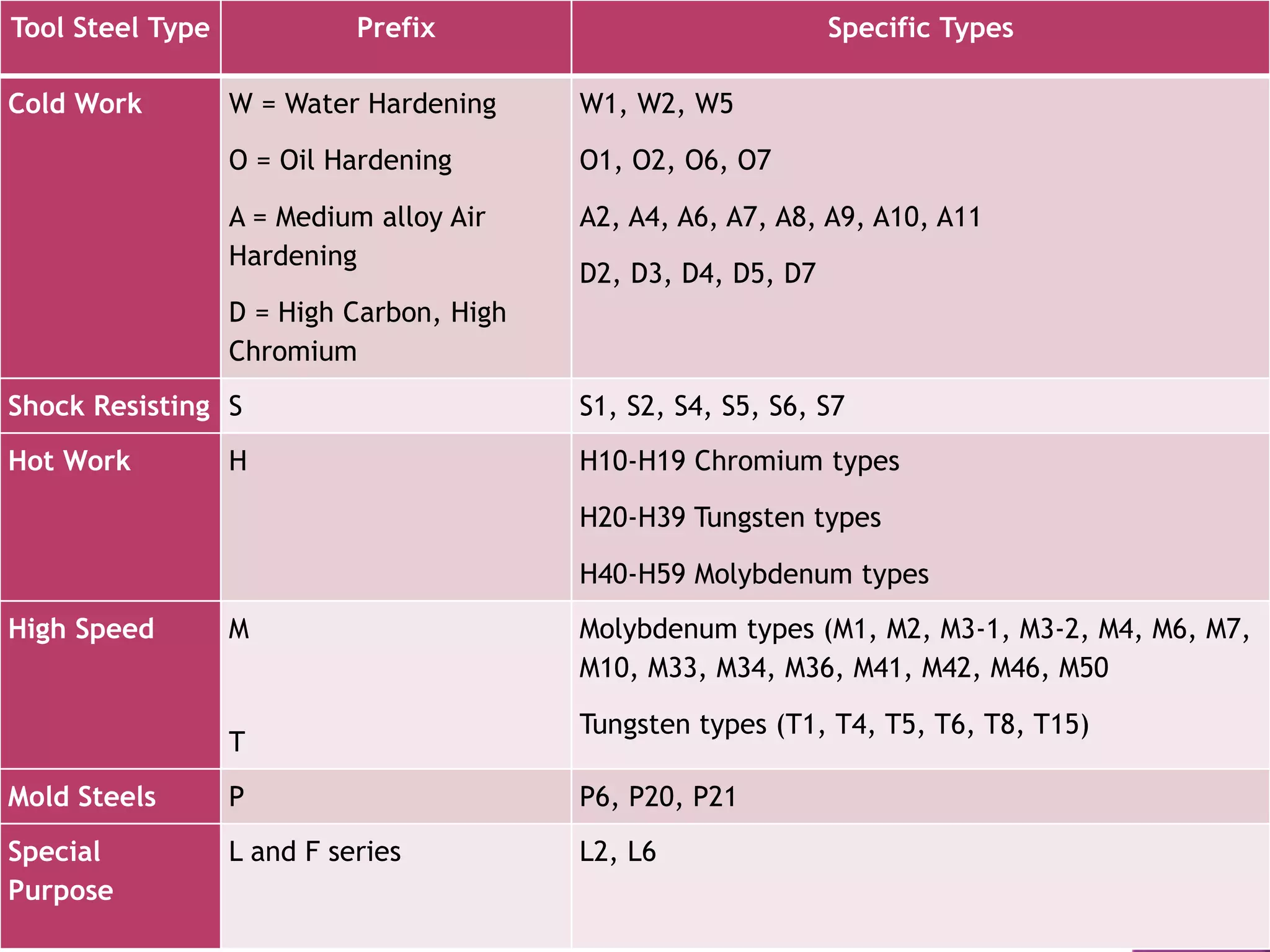
  • 74.
    3.) QUENCHING:  Oncethe alloy content has been redistributed throughout the matrix, the steel must be cooled fast enough to fully harden it. This process is called quenching. By quenching the steel properly, a new phase transformation occurs, and the microstructure changes from austenite to martensite.  How rapidly this process must take place depends upon the chemical composition of the alloy.  Generally, lower alloy steels such as 01 must be quenched in oil in order to cool fast enough.  Higher alloy content steels can develop fully hardened properties by undergoing a slower quenching process.
  • 75.
     For somealloys, cooling in still air is sufficient. Other mediums that are frequently used for quenching include water, brine, and salt bath.  Whatever quenching process is used, the resulting microstructure is extremely brittle and under great stress. If the tool is put into service in this condition, it would likely shatter like glass.  Some tools will even spontaneously crack if they are left in this condition. For this reason, tools that are quenched and cooled to hand warm (about 100F/150F) should be tempered immediately.
  • 76.
    4.) TEMPERING:  Temperingis performed to soften the martensite that was produced during quenching.  Most steels have a wide range of temperatures that can be used for tempering, and the one that is chosen depends upon the aim hardness.  Most tool and high speed steels require several tempers before the part can be put into service.  This is because these alloys will retain a certain percentage of austenite when they are quenched, and during the first temper some of this retained austenite will transform to untempered martensite.
  • 77.
     By performinga second temper, this new martensite is softened, thus reducing the chance of cracking.  But by tempering a second time, some of the remaining austenite is transformed to untempered martensite, and so the process may need to be repeated several times. MICROSTRUTURE SHOWING HEAT TREATMENT OF HSS
  • 79.
     A seriouslimitation in producing high-strength steels is the associated reduction in fracture toughness.  Carbon is one of the elements which mostly affects the toughness and hence in alloy steels it is reduced to as low a level as possible, consistent with good strength.  Developments in the technology of high-alloy steels have produced high strengths in steels with very low carbon contents (<0.03%) by a combination of martensite and age-hardening, called maraging.  The maraging steels are based on an Fe–Ni containing between 18% and 25% Ni to produce massive martensite on air cooling to room temperature.
  • 80.
     The principalalloying element is 15 to 25% nickel.  Secondary alloying elements are added to produce intermetallic precipitates, which include cobalt, molybdenum, and titanium.  Additional hardening of the martensite is achieved by precipitation of various intermetallic compounds, principally Ni3Mo or Ni(Mo, Ti) brought about by the addition of roughly 5% Mo, 8% Co as well as small amounts of Ti and Al;  Then the alloys are solution heat-treated at 815°C and aged at about 485°C.  Many substitutional elements can produce age-hardening in Fe–Ni martensites, some strong (Ti, Be), some moderate (Al, Nb, Mn, Mo, Si, Ta, V) and other weak (Co, Cu, Zr) hardeners.
  • 81.
     It isfound that A3B-type compounds are favoured at high Ni or (Ni +Co) contents and A2B Laves phases at lower contents.  In the unaged condition maraging steels have a yield strength of about 0.7 GN/m2. On ageing this increases up to 2.0 GN/m2 and the precipitation-strengthening is due to an Orowan mechanism according to the relation : σ= σ0 (αµb/L) where σ0 is matrix strength, α constant and L the interprecipitate spacing.  The primary precipitation-strengthening effect arises from the (Co + Mo)combination, but Ti plays a double role as a supplementary hardener and a refining agent to tie up residual carbon.  The alloys generally have good weldability, resistance to hydrogen embrittlement and stress-corrosion but are used mainly (particularly the 18% Ni alloy) for their excellent combination of high strength and toughness.
  • 84.
     Due tothe low carbon content maraging steels have good machinability. Prior to aging, they may also be cold rolled to as much as 80–90% without cracking.  Maraging steels offer good weldability, but must be aged afterward to restore the properties of heat affected zone  When heat-treated the alloy has very little dimensional change, so it is often machined to its final dimensions.  Due to the high alloy content maraging steels have a high hardenability.  Since ductile FeNi martensites are formed upon cooling, cracks are non-existent or negligible.  The steels can be nitrided to increase case hardness, and polished to a fine surface finish.  Non-stainless varieties of maraging steel are moderately corrosion-resistant, and resist stress corrosion and hydrogen embrittlement.
  • 86.
     The requirementfor structural steels to be welded satisfactorily has led to steels with lower C (<0.1%) content.  Unfortunately, lowering the C content reduces the strength and this has to be compensated for by refining the grain size.  This is difficult to achieve with plain C-steels rolled in the austenite range but the addition of small amounts of strong carbide-forming elements (e.g. <0.1% Nb) causes the austenite boundaries to be pinned by second-phase particles and fine grain sizes (<10µm) to be produced by controlled rolling.
  • 87.
     Nitrides andcarbonitrides as well as carbides, predominantly fcc and mutually soluble in each other, may feature as suitable grain refiners in HSLA steels; examples include AlN, Nb(CN), V(CN), (NbV)CN, TiC and Ti(CN).  The solubility of these particles in the austenite decreases in the order VC, TiC, NbC while the nitrides, with generally lower solubility, decrease in solubility in the order VN, AlN, TiN and NbN.  Because of the low solubility of NbC, Nb is perhaps the most effective grain size controller.  However, Al, V and Ti are effective in high-nitrogen steels, Al because it forms only a nitride, V and Ti by forming V(CN) and Ti(CN) which are less soluble in austenite than either VC or TiC.
  • 88.
     The majorstrengthening mechanism in HSLA steels is grain refinement but the required strength level is obtained usually by additional precipitation strengthening in the ferrite.  Figure 9.3 shows a stress–strain curve from a typical HSLA steel.  Solid-solution strengthening of the ferrite is also possible.  Phosphorus is normally regarded as deleterious due to grain boundary segregation, but it is a powerful strengthener, second only to carbon
  • 89.
    Figure 9.3 Stress–straincurves for plain carbon, HSLA and dual-phase steels.
  • 90.
    Microalloyed steel, orHigh Strength Low Alloy (is a type of alloy steel that contains small amounts of alloying elements. These are mild steels with carbon 0.03 to 0.15%, manganese around 1.5% and less than 0.1% of niobium, vanadium, titanium, aluminium, molybdenum, zirconium, boron, and rare-earth metals which have been given controlled rolling, controlled cooling to obtain ultra-fine ferrite grains of size below 5 micro-meter to attain yield strengths of 290 to 550 Mpa, and tensile strengths of 415 to 700 Mpa with a ductile/brittle transition temperature at -70oC.
  • 92.
    The yield strengthin such steels varies as follows:
  • 93.
    Alloying elements arealso selected to influence transformation temperatures so that the transformation of austenite to ferrite and pearlite occurs at a lower temperature during air cooling. This lowering of the transformation temperature produces a finer-grain transformation product, which is a major source of strengthening. At the low carbon levels typical of HSLA steels, elements such as silicon, copper, nickel, and phosphorus are particularly effective for producing fine pearlite. Element such as, manganese and chromium, which are present in both the cementite and ferrite, also strengthen the ferrite by solid-solution strengthening in proportion to the amount, dissolved in the ferrite.
  • 95.
     Nitrogen additionsto high-strength steels containing vanadium are limited to 0.005% and have become commercially important because such additions enhance precipitation hardening. The precipitation of vanadium nitride in vanadium-nitrogen steels also improves grain refinement because it has a lower solubility in austenite than vanadium carbide.  Manganese is the principal strengthening element in plain carbon high-strength structural steels. It functions mainly as a mild solid-solution strengthener in ferrite, but it also provides a marked decrease in the austenite-to-ferrite transformation temperature. In addition, manganese can enhance the precipitation strengthening of vanadium steels and. to a lesser extent, niobium steels.  Copper in levels in excess of 0.50% also increases the strength of both low- and medium-carbon steels by virtue of ferrite strengthening, which is accompanied by only slight decreases in ductility.
  • 96.
     One ofthe most important applications of silicon is its use as a deoxidizer in molten steel. Silicon has a strengthening effect in low-alloy structural steels. In larger amounts, it increases resistance to scaling at elevated temperatures. Silicon has a significant effect on yield strength enhancement by solid-solution strengthening and is widely used in HSLA steels for riveted or bolted structures.  The atmospheric-corrosion resistance of steel is increased appreciably by the addition of phosphorus, and when small amounts of copper are present in the steel, the effect of the phosphorus is greatly enhanced. When both phosphorus and copper are present, there is a greater beneficial effect on corrosion resistance than the sum of the effects of the individual elements.  Molybdenum in hot-rolled HSLA steels is used primarily to improve hardenability when transformation products other than ferrite-pearlite are desired. Molybdenum (0.15 to 0.30%) in microalloyed steels also increases the solubility of niobium in austenite, thereby enhancing the precipitation of NbC (N) in the ferrite. This increases the precipitation- strengthening effect of NbC (N).
  • 97.
     Aluminum iswidely used as a deoxidizer and was the first element used to control austenite grain growth during reheating. During controlled rolling, niobium and titanium are more effective grain refiners than aluminum.  Vanadium strengthens HSLA steels by both precipitation hardening the ferrite and refining the ferrite grain size. The precipitation of vanadium carbonitride in ferrite can develop a significant increase in strength that depends not only on the rolling process used, but also on the base composition. Carbon contents above 0.13 to 0.15% and manganese content of 1% or more enhances the precipitation hardening, particularly when the nitrogen content is at least 0.01%.  Chromium is often, added with copper to obtain improved atmospheric-corrosion resistance.  Nickel is often added to copper-bearing steels to minimize hot shortness
  • 98.
     Titanium isunique among common alloying elements in that it provides both precipitation strengthening and sulfide shape control. Small amounts of titanium (<0.025%) are also useful in limiting austenite grain growth. However, it is useful only in fully killed steels because of its strong deoxidizing effects; the versatility of titanium is limited because variations in oxygen, nitrogen, and sulfur affect the contribution of titanium as carbide strengthened.  Zirconium can also be added to killed HSLA steels to improve inclusion characteristics, particularly in the case of sulfide inclusions, for which changes in inclusion shape improve ductility in transverse bending.  Boron has no effect on the strength of normal hot-rolled steel but can considerably improve hardenability when transformation products such as acicular ferrite are desired in low-carbon hot-rolled plate.  Treatment with calcium is preferred for sulfide inclusion shape control.
  • 99.
     These steelslie, in terms of performance and cost, between carbon steel and low alloy steel.  Weldability is good, and can even be improved by reducing carbon content while maintaining strength.  Fatigue life and wear resistance are superior to similar heat treated steels.  The disadvantages are that ductility and toughness are not as good as quenched and tempered (Q&T) steels.
  • 100.
     The ferritein HSLA steels is typically strengthened by grain refinement, precipitation hardening, and, to a lesser extent, solid-solution strengthening. Grain refinement is the most desirable strengthening mechanism because it improves not only strength but also toughness.  The main factors responsible for increased strength in HSLA steels are:  1. Fine ferritic grain size  2.Precipitation hardening  3. Solid solution strengthening
  • 101.
     The veryfine ferritic grain sizes in HSLA steels are possible by the control of austenitic grain size by the precipitation of carbonitrides during hot rolling as the temperature of the steel falls. These fine precipitate particles hinder the growth of austenitic grains, and at still lower temperatures of rolling, the particles inhibit even the recrystallization of the deformed austenitic grains.
  • 103.
     To accomplishthis, the fine precipitation of carbonitrides should take place in the critical rolling range of 1300oC to 925oC, when the recrystallization of austenite could occur, and that the volume of the precipitates formed should be large. It is thus essential that these carbonitrides have sufficient solid solubility at the highest austenitising or soaking temperature and that the solid solubility should decrease fast with the fall of temperature in this critical range.
  • 105.
     Complete dissolutionof carbonitride precipitates occurs at 1140°C in a temperature interval between 1100 – 1200°C, the above Illustrations showing dissolution of NbC, TiC and Vn precipitates can be seen in Figure 1 where individual isotherms show dissolubility of precipitates for different carbon content in HSLA steels Figure 1: Dissolubility of precipitates NbC, TiC and Vn according to carbon content in HSLA steel
  • 106.
    It is essentialto use high soaking temperatures to dissolve as much of the elements Nb, Ti, V, so that these could precipitate (as carbonitrides) later during rolling when the temp continuously drops.
  • 107.
     TiN isthe most stable of precipitates and its presence restricts the grain growth of austenite at the soaking temperature, and during the dynamic recrystallization of austenite during hot rolling at high temperature. While TiN restricts grain growth to some extent, the main refinement is achieved during hot rolling from 1300oC to 925oC as the temperature progressively falls and fine carbonitrides are precipitated from austenite. Nb is the most effective element in modifying the recrystallization behavior of austenite during hot rolling as niobium carbides and carbonitrides precipitate during hot rolling of austenite and hence is the most important micro-alloying element.
  • 108.
     The hot-rollingprocess has gradually become a much more closely controlled operation, and controlled rolling is now being increasingly applied to microalloyed steels with compositions carefully chosen to provide optimum mechanical properties at room temperature.  Controlled rolling is a procedure whereby the various stages of rolling are temperature controlled, with the amount of reduction in each pass predetermined and the finishing temperature precisely defined. This processing is widely used to obtain reliable mechanical properties in steels for pipelines, bridges, offshore platforms, and many other engineering applications.
  • 110.
     The useof controlled rolling has resulted in improved combinations of strength and toughness and further reductions in the carbon content of microalloyed HSLA steels. Controlled hot rolling of low carbon low alloy high strength steels is done to obtain ultra fine and uniform grains of ferrite and precipitation hardening. The figure below illustrates the grain size of austenite at different stages of hot rolling.  High temperature soaking is required to dissolve as much of alloying elements as possible. When austenite is rolled at relatively high temperatures, it dynamically recrystallizes and the grain growth occurs. Heavy deformation and low finishing temperature is required in the austenitic region, below about 925oC so that austenite is unable to recrystallize.  The finishing temperature is very important. Normally all the deformation is done when the steel is austenitic and the nature of transformation is changed by increasing the cooling rate using water sprays following rolling. The sub-critical transformation produces still finer ferritic grains. Mechanical properties are improved and the sharp yield point is invariably suppressed.
  • 111.
     Fig: Schematiccontrolled processing to obtain fine ferrite grains in HSLA steels
  • 112.
     Precipitation hardeningalso contributes to the increased strength of HSLA steels. The precipitates present or formed at high temperatures during controlled rolling cause little strengthening as they are large sized, widely spaced, and as most of them are present at the grain boundaries controlling the grain growth.  The precipitate strengthening occurs by those particles that form:  In austenite at low temperature  At the gamma/alpha interface during transformation  In ferrite during further cooling
  • 113.
     The maincontribution to precipitation strengthening is due to the precipitation of carbides of Nb, Ti, and V which occurs during the transformation of austenite to ferrite progressively at interphase boundaries called interphase precipitation. It occurs on a very fine scale during the temperatures between 850oC and 650oC. Because of high solubility in austenite, vanadium carbide and nitride precipitate at interphase boundaries and in ferrite, with Ti and Nb in the decreasing order, are most effective in increasing the strength by precipitation.
  • 115.
    HSLA can befound in these applications:  Bridges  Suspension Components  Building Structures  Vehicles/Transportation  Tubular Components  Heavy Equipment  Rails  Off-shore/Platforms
  • 118.
     In recentyears an improved strength–ductility relationship has been found for low carbon, low- alloy steels rapidly cooled from an annealing temperature at which the steel consisted of a mixture of ferrite and austenite.  Such steels have a microstructure containing principally low-carbon, fine-grained ferrite intermixed with islands of fine martensite and are known as dual phase steels.  Typical properties of this group of steels would be a TS of 620 MN m-2, a 0.2% offset flow stress of 380 MNm-2 and a 3% offset flow stress of 480 MN m-2 with a total elongation ≈28%.
  • 119.
     The implicationsof the improvement in mechanical properties are evident from an examination of the nominal stress–strain curves.  The dual-phase steel exhibits no yield discontinuity but work-hardens rapidly so as to be just as strong as the conventional HSLA steel when both have been deformed by about 5%.  In contrast to ferrite–pearlite steels, the work-hardening rate of dual-phase steel increases as the strength increases.  The absence of discontinuous yielding in dual-phase steels is an advantage during cold-pressing operations and this feature combined with the way in which they sustain work hardening to high strains makes them attractive materials for sheet-forming operations.
  • 120.
     The dualphase is produced by annealing in the (α+γ) region followed by cooling at a rate which ensures that the γ phase transforms to martensite, although some retained austenite is also usually present leading to a mixed martensite–austenite (M–A) constituent.  To allow air-cooling after annealing, microalloying elements are added to low-carbon–manganese– silicon steel, particularly vanadium or molybdenum and chromium.
  • 121.
     Vanadium insolid solution in the austenite increases the hardenability but the enhanced hardenability is due mainly to the presence of fine carbonitride precipitates which are unlikely to dissolve in either the austenite or the ferrite at the temperatures employed and thus inhibit the movement of the austenite/ferrite interface during the post-anneal cooling.  The martensite structure found in dual-phase steels is characteristic of plate martensite having internal microtwins.  The retained austenite can transform to martensite during straining thereby contributing to the increased strength and work-hardening.
  • 122.
     Low yieldstrength  Low yield to tensile strength ratio (yield strength/ tensile strength = 0.5)  High initial strain hardening rates  Good uniform elongation  A high strain rate sensitivity (the faster it is crushed the more energy it absorbs)  Good fatigue resistance Due to these properties DPS is often used for automotive body panels, wheels, and bumpers
  • 124.
     For strengtheningat high temperatures, dispersion strengthening with oxide, nitride or carbide particles is an attractive possibility.  Such dispersion-strengthened materials are usually produced by powder processing., special form of which is known as mechanical alloying (MA).  Mechanical alloying is a dry powder, high-energy ball-milling process in which the particles of elemental or pre-alloyed powder are continuously welded together and broken apart until a homogeneous mixture of the matrix material and dispersoid is produced.  Mechanical alloying is not simply mixing on a fine scale but one in which true alloying occurs.
  • 125.
    Figure 9.5 Effectof second phase particles size d at constant volume fraction f on (a) work-hardening rate, (b) elongation and (c) tensile strength
  • 127.
     Stainless steelis a generic term for a family of corrosion resistant alloy steels containing 10.5% or more chromium. All stainless steels have a high resistance to corrosion.  Stainless steel does not corrode, rust or stain with water as ordinary steel does, but despite the name it is not fully stain-proof. It is also called corrosion-resistant steel or CRES when the alloy type and grade are not detailed, particularly in the aviation industry.  Stainless steel is used where both the properties of steel and resistance to corrosion are required.  Stainless steel differs from carbon steel by the amount of chromium present.
  • 129.
    STRESS-STRAIN BEHAVIOUR OFCARBON STEEL AND STAINLESS STEEL The stress-strain behaviour of stainless steel differs from that of carbon steels in a number of respects. The most important difference is in the shape of the stress-strain curve. Whereas carbon steel typically exhibits linear elastic behaviour up to the yield stress and a plateau before strain hardening, stainless steel has a more rounded response with no well-defined yield stress as shown in the next figure
  • 131.
     No limitationson thickness in relation to brittle fracture apply to stainless steel; the limitations for carbon steel are not applicable due to the superior toughness of stainless steel.  The austenitic stainless steel grades do not show a ductile-brittle impact strength transition as temperatures are lowered.  Stainless steels can absorb considerable impact without fracturing due to their excellent ductility and their strain-hardening characteristics
  • 132.
     The mainreasons for the difference in structural behaviour between carbon and stainless steel members are:  The stress-strain curve for stainless steel departs from linearity at a much lower stress than that for carbon steels  Stainless steels have greater ductility and a greater capacity for work hardening than carbon steels  The material modulus of stainless steels reduces with increasing stress, unlike that of carbon steels which is constant  The residual stresses arising from fabrication are higher in stainless steel than in carbon steels.  As a result of this, different buckling curves are required from those of carbon steel. This applies to:  local (plate) buckling for elements in compression  flexural, torsional, torsional-flexural buckling for members subject to axial compression  lateral-torsional buckling for beams with unrestrained compression flanges
  • 133.
    CORROSION RESISTANCE All stainlesssteels have a high resistance to corrosion. Low alloyed grades resist corrosion in atmospheric conditions; highly alloyed grades can resist corrosion in most acids, alkaline solutions, and chloride bearing environments, even at elevated temperatures and pressures. This resistance to attack is due to the naturally occurring chromium-rich oxide film formed on the surface of the steel. Although extremely thin, this invisible, inert film is tightly adherent to the metal and extremely protective in a wide range of corrosive media. The film is rapidly self repairing in the presence of oxygen, and damage by abrasion, cutting or machining is quickly repaired.
  • 135.
     HIGH ANDLOW TEMPERATURE RESISTANCE Some grades will resist scaling and maintain high strength at very high temperatures, while others show exceptional toughness at cryogenic temperatures. These steels show high resistance to scaling and oxidation at elevated temperatures. Austenitic stainless steels do not undergo ductile/brittle transition.  EASE OF FABRICATION The majority of stainless steels can be cut, welded, formed, machined and fabricated readily. In other words, they have high ductility, formability, machinability along with good weldability.  STRENGTH The cold work hardening properties of many stainless steels can be used in design to reduce material thickness and reduce weight and costs. Other stainless steels may be heat treated to make very high strength components.
  • 136.
    HIGH OXIDATION RESISTANCE Highoxidation-resistance in air at ambient temperature is normally achieved with additions of a minimum of 13% (by weight) chromium, and up to 26% is used for harsh environments. The chromium forms a passivation layer of chromium(III) oxide (Cr2O3) when exposed to oxygen. The layer is too thin to be visible, and the metal remains lustrous. The layer is impervious to water and air, protecting the metal beneath. Also, this layer quickly reforms when the surface is scratched. This phenomenon is called passivation and is seen in other metals, such as aluminium and titanium. Corrosion-resistance can be adversely affected if the component is used in a non-oxygenated environment, a typical example being underwater keel bolts buried in timber.
  • 137.
     AESTHETIC APPEAL Stainlesssteel is available in many surface finishes. It is easily and simply maintained resulting in a high quality, pleasing appearance.  HYGIENIC PROPERTIES The cleanability of stainless steel makes it the first choice in hospitals, kitchens, food and pharmaceutical processing facilities.  LIFE CYCLE CHARACTERISTICS Stainless steel is a durable, low maintenance and is often the least expensive choice in a life cycle cost comparison. MAGNETIC PROPERTIES Ferritic and martensitic stainless steels are magnetic. Austenitic stainless steels are non-magnetic
  • 138.
     marine applications,particularly at slightly high temperatures  desalination plant  heat exchangers  petrochemical plant  Used in cookware, cutlery, hardware, surgical instruments, major appliances, industrial equipment (for eg in sugar refineries)  as an automotive and aerospace structural alloy  construction material in large buildings.  Storage tanks and tankers used to transport orange juice and other food are often made of stainless steel, because of its corrosion resistance and antibacterial properties. This also influences its use in commercial kitchens and food processing plants, as it can be steam-cleaned and sterilized and does not need paint or other surface finishes.  Stainless steel is used for jewelry and watches with 316L being the type commonly used for such applications. It can be re- finished by any jeweler and will not oxidize or turn black.
  • 139.
    The pinnacle ofNew York's Chrysler Building is clad with type 302 stainless steel.[13] The arch rises from the bottom left of the picture and is shown against a featureless clear sky The 630-foot (192 m) high, stainless-clad (type 304) Gateway Arch defines St. Louis's skyline.
  • 141.
    In addition tochromium, nickel, molybdenum, titanium, niobium, other elements may also be added to stainless steels in varying quantities to produce a range of stainless steel grades, each with different properties. Stainless steels can be divided into five basic categories:  Austenitic  Ferritic  Martensitic  Duplex  Precipitation hardening These are named according to the microstructure inherent in each steel group (a function of the primary alloying elements). Austenitic and ferritic grades account for approximately 95% of stainless steel applications.
  • 143.
     The basiccomposition of austenitic stainless steels is 16-25% chromium and sufficient amount of austenite- stabilising elements like Ni, Mn, or Nitrogen.  These steels are austenitic at room temperature.  Austenitic grades are the most commonly used stainless steels accounting for more than 70% of production (type 304 is the most commonly specified grade by far).  Austenitic steels have austenite as their primary phase (face centered cubic crystal)  Austenitic steels are not hardenable by heat treatment  Austenitic stainless steels have high ductility, low yield stress and relatively high ultimate tensile strength, when compared to a typical carbon steel.
  • 145.
     When nickelis added to stainless steel in sufficient amounts the crystal structure changes to "austenite“.
  • 146.
     excellent corrosionresistance in organic acid, industrial and marine environments.  excellent weldability  excellent formability, fabricability and ductility  excellent cleanability, and hygiene characteristics  Austenitic steels have excellent toughness down to true absolute (-273°C), with no steep ductile to brittle transition.  non magnetic in nature  hardenable by cold work only (These alloys are not hardenable by heat treatment)  Cr/Ni austenitic steels are very resistant to high temperature oxidation
  • 148.
    302 304 316 Carbon0.15% max.. 0.08% max 0.08% max Chromium 17.00 to 19.00% 18.00 to 20.00% 16.00 to 18.00% Manganese 2.0% max 2.0% max. 2.0% max. Silicon 1.0% max. 1.0% max. 1.0% max. Nickel 8.00 to 10.00% 8.00 to 10.50% 10.00 to 14.00% Molybdenum ---- ---- 2.00 to 3.00%
  • 149.
    302 304 316 Tensilestrength (Ksi) 90 -185 84-185 84-185 Yield strength (Ksi) 40-140 42-140 42-140 Elongation in 2 inches (Annealed) 50 % 55 % 50 % Modulus of elasticity (psi) 28 x 10 6 28 x 10 6 28 x 10 6 Hardness (Annealed) RB 75 - RB90 RB 75 - RB90 RB 75 - RB90 Hardness (Cold work) RC 25 - RC39 RC 25 - RC39 RC 25 - RC39
  • 150.
     As thesesteels are single phase FCC materials, these are not very string materials.these steels can be strengthened by:  COLD WORKING  It increases the low yield strength of 240 MPa to 1035 MPa when cold worked by 60%  Tensile strength of 585 MPa gets doubled when cold worked by 60%.  But a major disadvantage accompanying the process is the loss of strength at temperatures above 600oC and also in the heat affected zones of a weld  SOLID SOLUTION STRENGTHENING  Substitutional solutes show little increase of strength of the steels but interstitial solutes are very effective.
  • 153.
     If anypart of stainless-steel is heated in the range 500 degrees to 800 degrees for any reasonable time there is a risk that the chrome will form chrome carbides (a compound formed with carbon) with any carbon present in the steel. This reduces the chrome available to provide the passive film and leads to preferential corrosion, which can be severe. This is often referred to as sensitisation. Therefore it is advisable when welding stainless steel to use low heat input and restrict the maximum interpass temperature to around 175°, although sensitisation of modern low carbon grades is unlikely unless heated for prolonged periods.
  • 154.
    Small quantities ofeither titanium (321) or niobium (347) added to stabilise the material will inhibit the formation of chrome carbides.
  • 155.
     Prone tostress corrosion cracking This type of corrosion forms deep cracks in the material and is caused by the presence of chlorides in the process fluid or heating water/steam (Good water treatment is essential ), at a temperature above 50°C, when the material is subjected to a tensile stress (this stress includes residual stress, which could be up to yield point in magnitude). Significant increases in Nickel and also Molybdenum will reduce the risk.  As they have high Ni content, they are expensive
  • 156.
     computer floppydisk shutters (304)  computer keyboard key springs (301)  kitchen sinks (304D)  food processing equipment  architectural applications  chemical plant and equipment
  • 157.
     Plain chromiumsteels(12 to 27 percent chromium) with no significant nickel content which results in lower corrosion resistance than austenitic stainless steels and low carbon content(to improve toughness and reduce sensitization)  Ferritic stainless steels follow the simple relationship Cr%-17%C>12.7  These alloys are ferritic in structure upto the melting point  They have slightly higher yield strengths and much lower strain hardening than austenitics.  Ferritic steels have body centered cubic crystal, are less ductile than austenitic steel, and are not hardenable by heat treatment like martensitic steels.  Ferritics with high chromium content are used mainly for high temperature (but below 475°C) applications, and those with extremely low carbon and nitrogen content are used where protection against stress corrosion cracking is required.
  • 159.
     moderate togood corrosion resistance increasing with chromium content  not hardenable by heat treatment and always used in the annealed condition  magnetic in nature  formability not as good as the austenitic stainless steel  Yield strength in the annealed state could be 275- 415 Mpa  Tensile strengths lie between 500-600 Mpa as these steels work harden less
  • 160.
     As expensiveNi is not added, ferritic stainless steels are much cheaper.  Highly corrosion resistant.  Immune to chloride to stress-corrosion cracking  Good cold formability  Excellent hot-ductility  Good oxidation resistance at high temperature  Good machinability, higher thermal conductivity, lower thermal expansion than austenitic stainless steels
  • 161.
     Get corrodedin chloride and sulphur dioxid containing atmospheres  Grain refinement is difficult  Due to its BCC structure, it shows ductile to brittle transition  Show stretcher strains during drawing or stretching  Suffer from intergranular corrosion in the heat- affected zone of the weld due to the precipitation of chromium carbides.  Brittle in nature  weldability is poor
  • 162.
     computer floppydisk hubs (430)  automotive trim (430)  automotive exhausts (409)  colliery equipment (3CR12)  hot water tanks (444)
  • 163.
     Martensitic stainlesssteels were the first stainless steels commercially developed  The main alloying element is chromium, typically 12 to 17%, molybdenum (0.2-1%), no nickel, except for two grades, and 0.1-1.2% carbon.  The following relationship shows the composition of martensitic stainless steels: (%Cr-17%C)<=12.7  These steels are austenite at temperatures of 950- 1000oC, but transform to martensite on cooling.  Increasing the carbon content increases the strength and hardness potential but decreases ductility and toughness
  • 165.
    AISI grade C Mn SiCr Ni Mo P S Comments/Applications 410 0.15 1 0.5 11.5-13.0 - - 0.04 0.03 The basic composition. Used for cutlery, steam and gas turbine blades and buckets, bushings. 416 0.15 1.25 1 12.0-14.0 - 0.6 0.04 0.15 Addition of sulphur for machinability, used for screws, gears etc. 416 Se replaces suplhur by selenium. 420 0.15- 0.40 1 1 12.0-14.0 - - 0.04 0.03 Dental and surgical instruments, cutlery. 431 0.2 1 1 15.0-17.0 - 1.2 5- 2.0 0 0.04 0.03 Enhanced corrosion resistance, high strength. 440A 0.60- 0.75 1 1 16.0-18.0 - 0.7 5 0.04 0.03 Ball bearings and races, gage blocks, molds and dies, cutlery. 440B 0.75- 0.95 1 1 16.0-18.0 - 0.7 5 0.04 0.03 As 440A, higher hardness. 440C 0.95- 1.20 1 1 16.0-18.0 - 0.7 5 0.04 0.03 As 440B, higher hardness.
  • 166.
     In comparisonwith the austenitic and ferritic grades of stainless steels, martensitic stainless steels are less resistant to corrosion  can be hardened by heat treatment and therefore high strength and hardness levels can be achieved  poor weldability  magnetic in nature  Yield strength of 550-1860 MPa  Poor machinability  As Cr content increases, hardenability increases  These steels have improved toughness
  • 167.
     Low carbonhigh strength martensitic stainless steels  High carbon high strength martensitic stainless steels
  • 168.
     Carbon contentis kept low ~0.1%  Such steels are quenched in oil, or air from around 1050oC(fully austenitic) and then tempered.  Low temperature tempering leads to high yiels strength and tensile strength while high temperature tempering leads to high toughness. Tempering range of 440 to 540oC is avoided as it causes reduction in impact strength  Tensile strength is 1300 MN/m2
  • 169.
    Effect of temperingtemperature on the mechanical properties of AISI 431. Hardening treatment: 1020°C/30m/Oil quench
  • 170.
     Normally, increasingtempering temperatures below about 400°C will lead to a small decrease tensile strength and an increase in reduction of area while hardness, elongation and yield strength are more or less unaffected. Above this temperature there will be more or less pronounced increase in yield strength, tensile strength and hardness due to the secondary hardening peak, around 450-500°C.  In the temperature range around the secondary hardening peak there is generally a dip in the impact toughness curve. Above about 500°C there is a rapid reduction in strength and hardness, and a corresponding increase in ductility and toughness. Tempering at temperatures above the 780°C for the steel in the figure, will result in partial austenitizising and the possible presence of untempered martensite after cooling to room temperature.
  • 171.
    APPLICATIONS of Lowcarbon high strength martensitic stainless steels  Petrochemical and chemical plant construction  Gas turbine engines  Turbine blades  Electrical generation plants  Compressors and discs  Aircraft structural and engine applications  Propeller shafts in ships sailing in fresh water
  • 172.
     Strength andhardness of martensitic stainless steels can be increased by increasing the carbon content of the steels, but it is at the expense of weldability, toughn ess and even corrosion resistance.  Increases carbon increases the amount of carbides, and thus higher austenitising temperatures have to be used to dissolve them
  • 173.
    APPLICATIONS OF High carbonhigh strength martensitic stainless steels  Knives  Needle-valves  Gears  Razor blades  Surgical instruments  Ball bearings for high temperature applications  Stainless steel bearings
  • 174.
     These arestainless steels containing relatively high chromium (between 23 and 30%) and moderate amounts of nickel (between 2.5 and 7%).  Most duplex steels contain molybdenum in a range of 2.5 - 4% and titanium.  These stainless steels contain ferrite and austente in microstructure, thus combining the toughness and weldability of austenite with strengths and resistance to localised corrosion of ferrite. The exact proportion of the phases is controlled by heat treatment
  • 175.
     Duplex stainlesssteels are called “duplex” because they have a two-phase microstructure consisting of grains of ferritic and austenitic stainless steel.  The figure in the next slide shows the yellow austenitic phase as “islands” surrounded by the blue ferritic phase.  When duplex stainless steel is melted it solidifies from the liquid phase to a completely ferritic structure.  As the material cools to room temperature, about half of the ferritic grains transform to austenitic grains (“islands”). The result is a microstructure of roughly 50% austenite and 50% ferrite.
  • 177.
    The nickel contentis insufficient to generate a fully austenitic structure and the resulting combination of ferritic and austenitic structures is called duplex.
  • 178.
     high resistanceto stress corrosion cracking as the ferrite phase is immune to this type of failure  Good corrosion resistance similar to austenitic stainless steels  increased resistance to chloride ion attack  higher tensile and yield strength than austenitic or ferritic steels  good weldability and formability but micro-duplex structure is destroyed in heat-affected zone.  Due to presence of ferrite, duplex steels also have ductile to brittle transition temperature  These steels suffer from both type of embrittlement effects: 475oC embrittlement as well as due to the formation of sigma phase
  • 179.
     marine applications,particularly at slightly elevated temperatures  desalination plant  heat exchangers  petrochemical plant
  • 180.
     These steelshave been formulated so that they can be supplied in a solution treated condition, (in which they are machinable) and can be hardened, after fabrication, in a single low temperature "aging" process.  These alloys are restricted for use to high strength-to- weight ratio applications as the steels may be required to be vacuum melted.  The matrix in precipitation-hardenabke stainless steels could be austenite or martensite.  The high tensile strengths of precipitation hardening stainless steels come after a heat treatment process that leads to precipitation hardening of a martensitic or austenitic matrix.
  • 182.
     Hardening isachieved through the addition of one or more of the elements Copper, Aluminium, Titanium, Niobium, and Molybdenum.  The most well known precipitation hardening steel is 17-4 PH  The advantage of precipitation hardening steels is that they can be supplied in a “solution treated” condition, which is readily machineable. After machining or another fabrication method, a single, low temperature heat treatment can be applied to increase the strength of the steel. This is known as ageing or age-hardening. As it is carried out at low temperature, the component undergoes no distortion.  Age-hardening takes place due to coherency strains and general dispersion-strengthening. Thus, its effects can be increased by increasing the volume fraction of the precipitates, or by intensifying the coherency strains by increasing the misfit between the zones and the matrix. The rate of overageing should be minimized
  • 184.
    Typical mechanical propertiesachieved for 17-4 PH after solution treating and age hardening are given in the following table. Condition designations are given by the age hardening temperature in °F. Cond. Hardening Temp and time Hardness (Rockwell C) Tensile Strength (MPa) A Annealed 36 1100 H900 482°C, 1 hour 44 1310 H925 496°C, 4 hours 42 1170-1320 H1025 552°C, 4 hours 38 1070-1220 H1075 580°C, 4 hours 36 1000-1150 H1100 593°C, 4 hours 35 970-1120 H1150 621°C, 4 hours 33 930-1080
  • 185.
    Temperat ure 0.2 % proof stress (N/mm2) Tensile strength (N/mm2) Elongatio n, min. (%) Reduction ,min. (%) Notch impact energy (ISO-V), min. (J) 480oC 1170 1310 10 40 - 495oC 1070 1170 10 44 7 550oC 1000 1070 12 45 20 595oC 795 965 14 45 34 620oC 725 930 16 50 41 760oC 515 795 18 55 75
  • 186.
     Precipitation hardeningstainless steels are characterised into one of three groups based on their final microstructures after heat treatment. The three types are:  martensitic (e.g. 17-4 PH),  semi-austenitic (e.g. 17-7 PH) and  austenitic (e.g. A-286).
  • 187.
    Martensitic Alloys Martensitic precipitationhardening stainless steels have a predominantly austenitic structure at annealing temperatures of around 1040 to 1065°C. Upon cooling to room temperature, they undergo a transformation that changes the austenite to martensite. Semi-austenitic Alloys Unlike martensitic precipitation hardening steels, annealed semi-austenitic precipitation hardening steels are soft enough to be cold worked. Semi-austenitc steels retain their austenitic structure at room temperature but will form martensite at very low temperatures.
  • 188.
    Austenitic Alloys Austenitic precipitationhardening steels retain their austenitic structure after annealing and hardening by ageing. At the annealing temperature of 1095 to 1120°C the precipitation hardening phase is soluble. It remains in solution during rapid cooling. When reheated to 650 to 760°C, precipitation occurs. This increases the hardness and strength of the material. Hardness remains lower than that for martensitic or semi-austenitic precipitation hardening steels. Austenitic alloys remain nonmagnetic.
  • 189.
    BASIC PROPERTIES OF PRECIPITATION-HARDENABLE STAINLESSSTEELS:  Moderate to good corrosion resistance  very high strength  good weldability  magnetic  Yield strengths for precipitation-hardening stainless steels are 515 to 1415 MPa.  Tensile strengths range from 860 to 1520 MPa.  Elongations are 1 to 25%. Cold working before ageing can be used to facilitate even higher strengths.
  • 191.
    LIMITATIONS  Expensive  Difficultto hot-process  At the maximun ageing temperatures of around 500oC, maximum toughness cannot be obtained, and the higher temperatures shall result in overageing to cause loss of strength COMMON USES  Shafts for pumps and valves.  High-temperature power plants  Gears  Valves and other engine components  High strength shafts  Turbine blades  Moulding dies  Nuclear waste casks
  • 193.
     1 =Attraction of steel to a magnet. Note some grades can be attracted to a magnet if cold worked.  2= Varies significantly within between grades within each group e.g. free machining grades have lower corrosion resistance, those grades higher in molybdenum have higher resistance. Alloy Group Magnetic Response1 Work Hardening Rate Corrosion Resistance2 Hardenable Austenitic Generally No Very High High By Cold Work Duplex Yes Medium Very High No Ferritic Yes Medium Medium No Martensitic Yes Medium Medium Quench & Temper Precipitation Hardening Yes Medium Medium Age Harden
  • 194.
    3= Measured bytoughness or ductility at sub-zero temperatures. Austenitic grades retain ductility to cryogenic temperatures. Alloy Group Ductility High Temperatur e Resistance Low Temperature Resistance3 Weldability Austenitic Very High Very High Very High Very High Duplex Medium Low Medium High Ferritic Medium High Low Low Martensitic Low Low Low Low Precipitatio n Hardening Medium Low Low High
  • 195.
    The difference inthe mechanical properties of different stainless steels is perhaps seen most clearly in the stress-strain curves in the chart At elevated temperatures the high temperature strength of various stainless steel groups varies. The service temperature for martensitic, ferritic and duplex stainless steels is generally more limited than the service temperature for austenitic stainless steels.
  • 197.
     It isapparent from the diagram that there is a fundamental difference at low temperatures between austenitic steels on the one hand and martensitic, ferritic and duplex steels on the other.  Martensitic, ferritic and duplex steels are characterised by a transition in toughness, from tough to brittle behaviour, at a certain temperature, the transition temperature.  For ferritic steel the transition temperature increases with increasing carbon and nitrogen content, i.e. the steel becomes brittle at successively higher temperatures.  For duplex steels, an increased ferrite content gives a higher transition temperature, i.e. more brittle behaviour.  Martensitic stainless steels have transition temperatures around or slightly below room temperature, while those for ferritic and duplex steels are in the range 0 to - 50°C, with ferritic steels in the upper part of this range.  Austenitic steels do not exhibit a toughness transition as do the other steel types, but have excellent toughness at all temperatures, although the toughness decreases slightly with decreasing temperature.