Phase Transformation
 MYO ZIN AUNG
 28J16121
 Ship Design Lab.
(NAOE)
Phase Transformation - Contents
1. Change of Crystal Structure (Micro)
2. Shape Memory
3. Temperature Dependency of Linear Expansion
Coefficient (Macro)
2
Why STUDY Phase Transformation?
• Tensile strength of iron-carbon alloy of eutectoid composition
can be varied between 700 MPa and 2000 MPa depending on
heat treatment employed.
• This shows that the desirable mechanical properties of a
material can be obtained as a result of phase transformations
using heat treatment processes.
• The time and temperature dependencies of phase
transformations are represented on phase diagrams.
• It is important to know how to use these phase diagrams in
order to design a heat treatment for alloy to obtain the
desired room-temperature mechanical properties.
3
Phase Diagram for Water
4
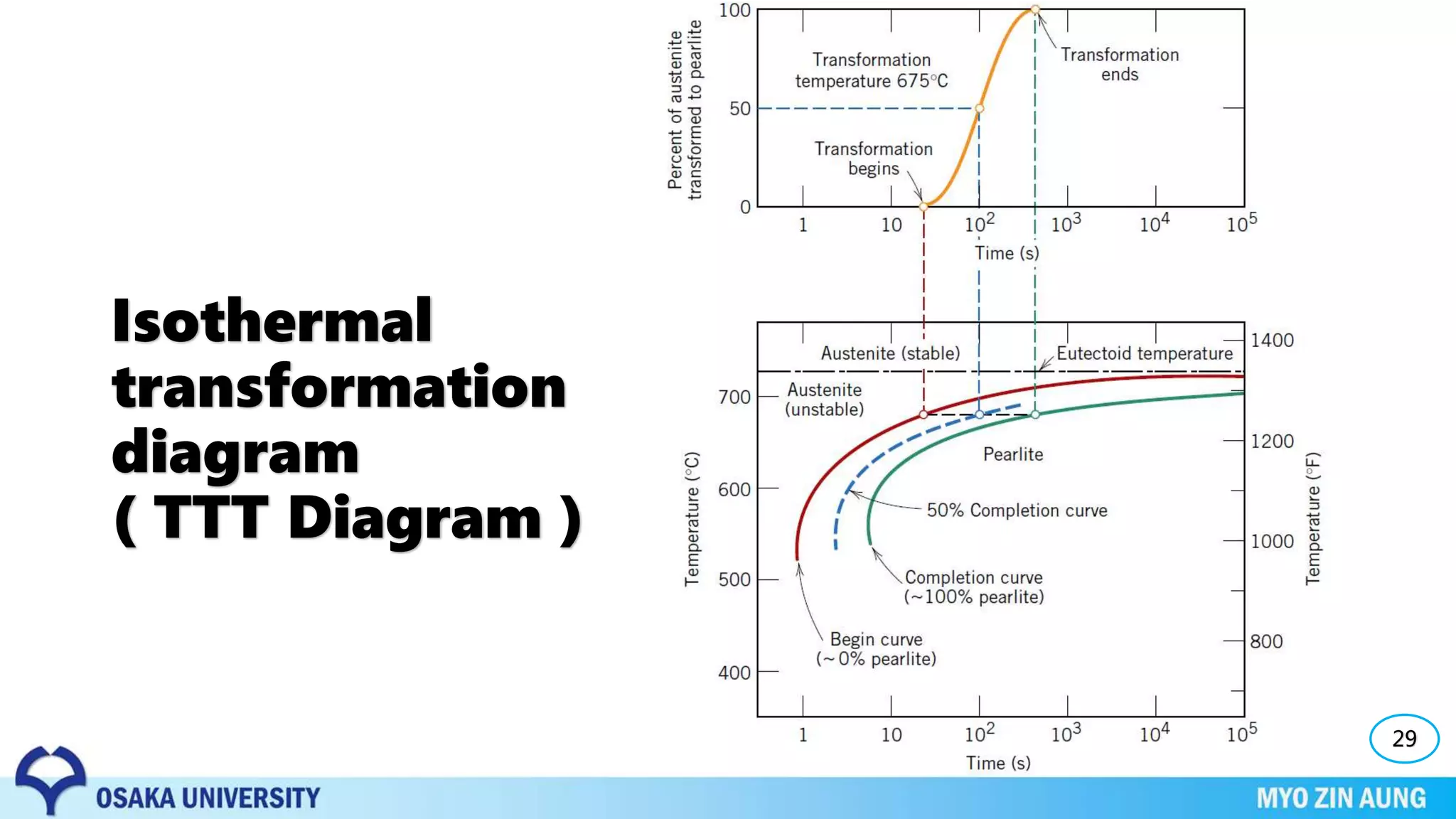
3 Phases
1.Solid
2.Liquid
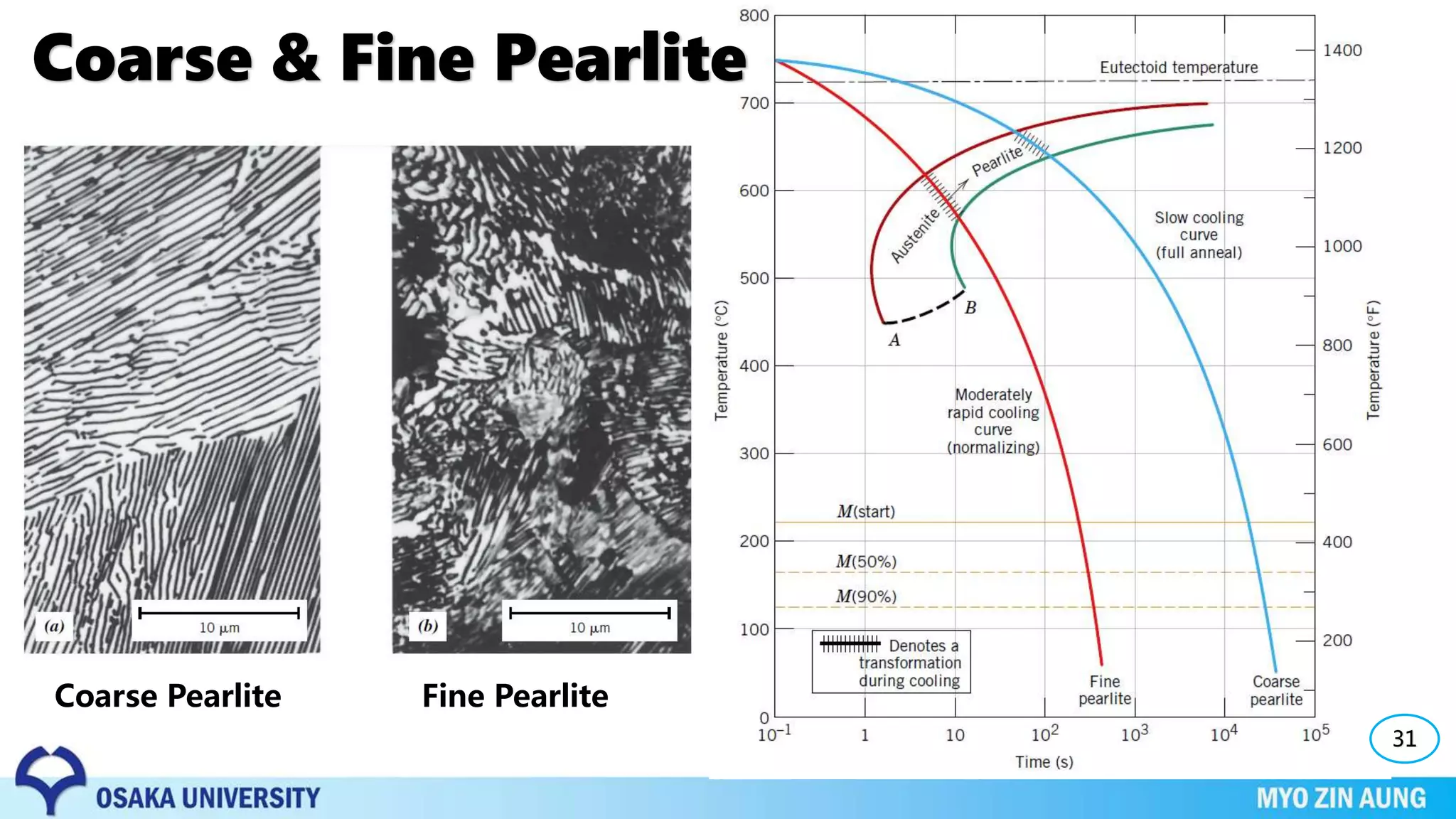
3.Vapor
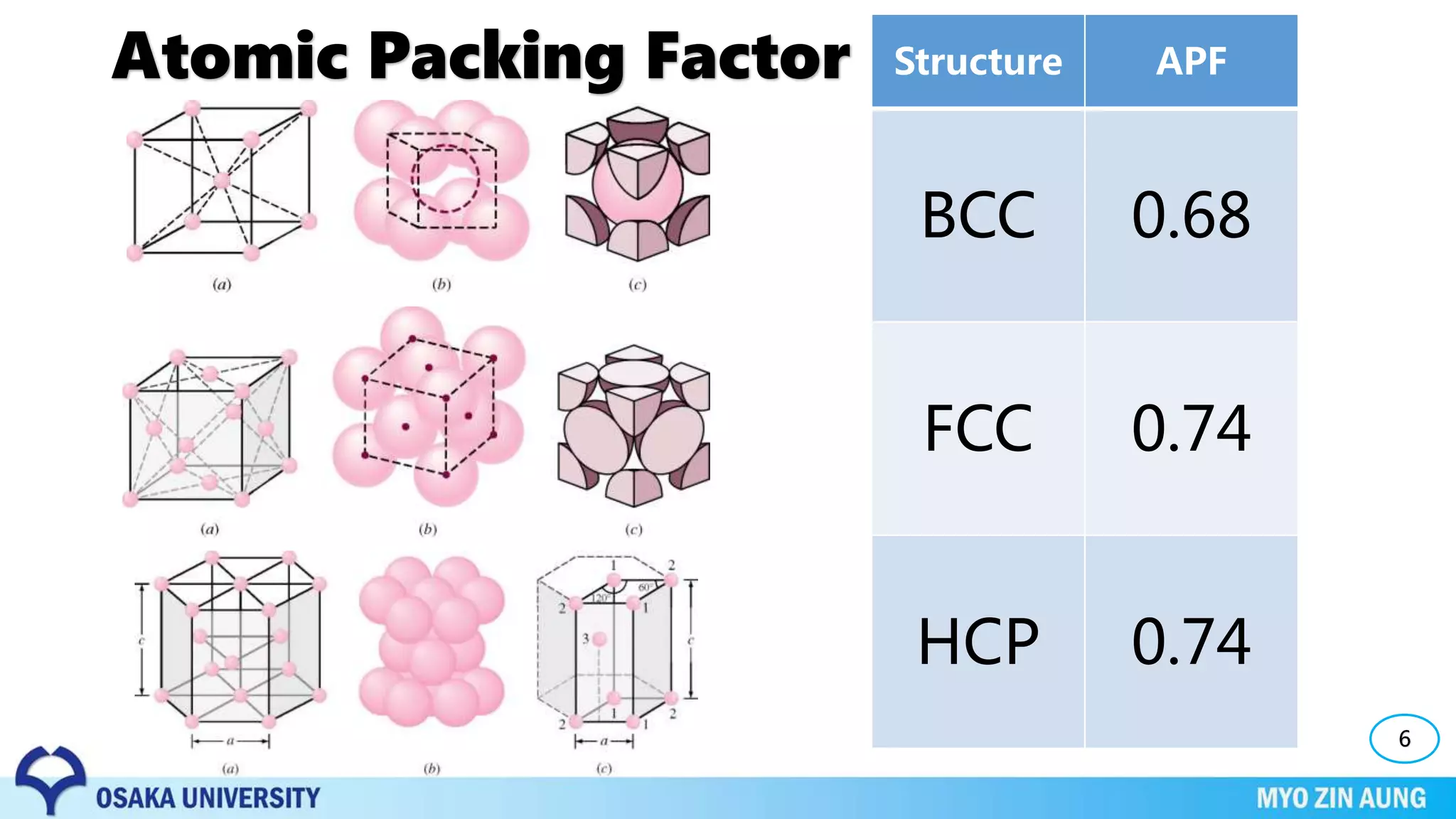
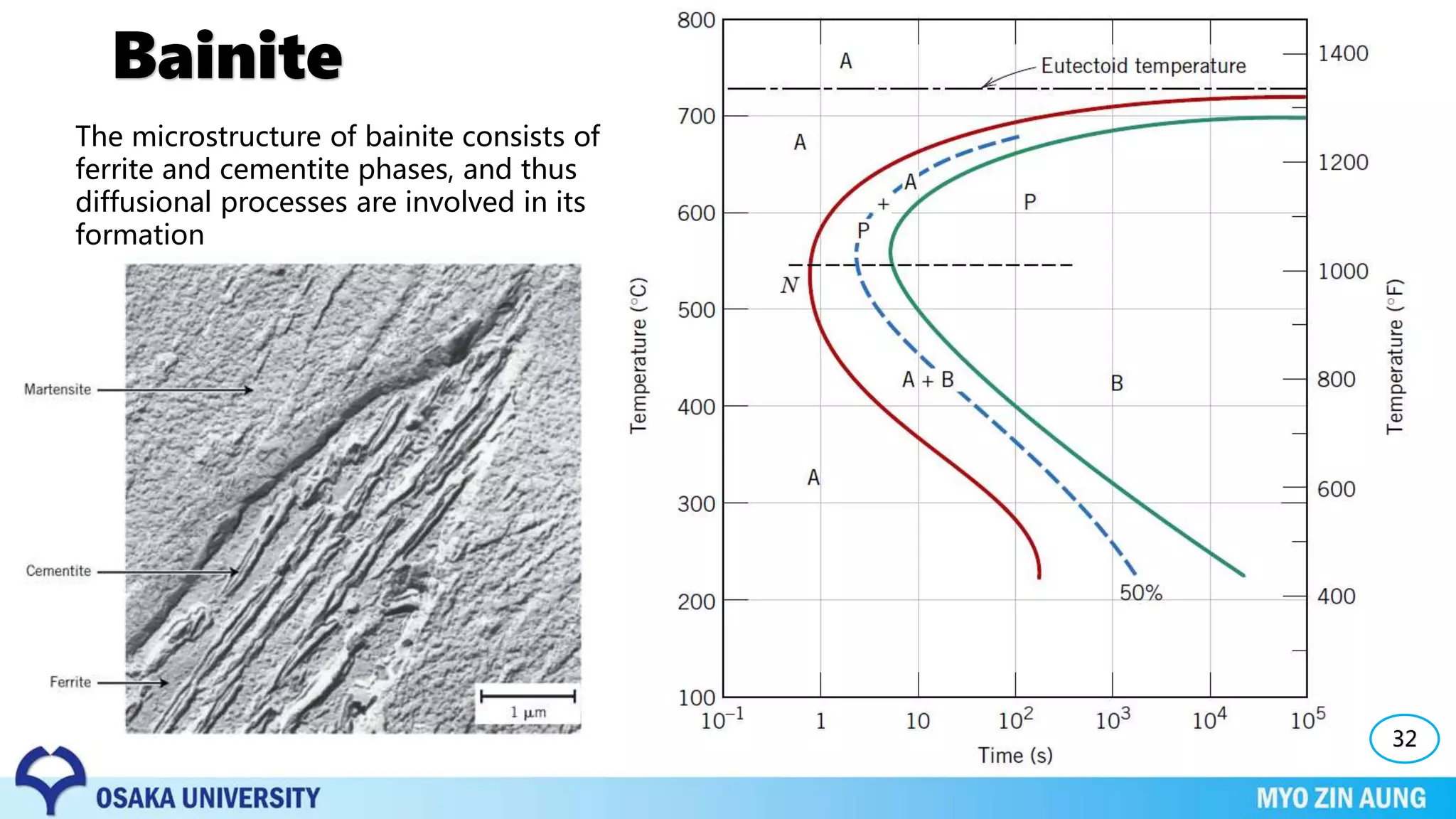
Crystal Structure
5
Face Centered Cubic
Crystal Structure (FCC)
Body-centered cubic crystal structure (BCC)
Hexagonal close-packed crystal structure (HCP)
Atomic Packing Factor
6
Structure APF
BCC 0.68
FCC 0.74
HCP 0.74
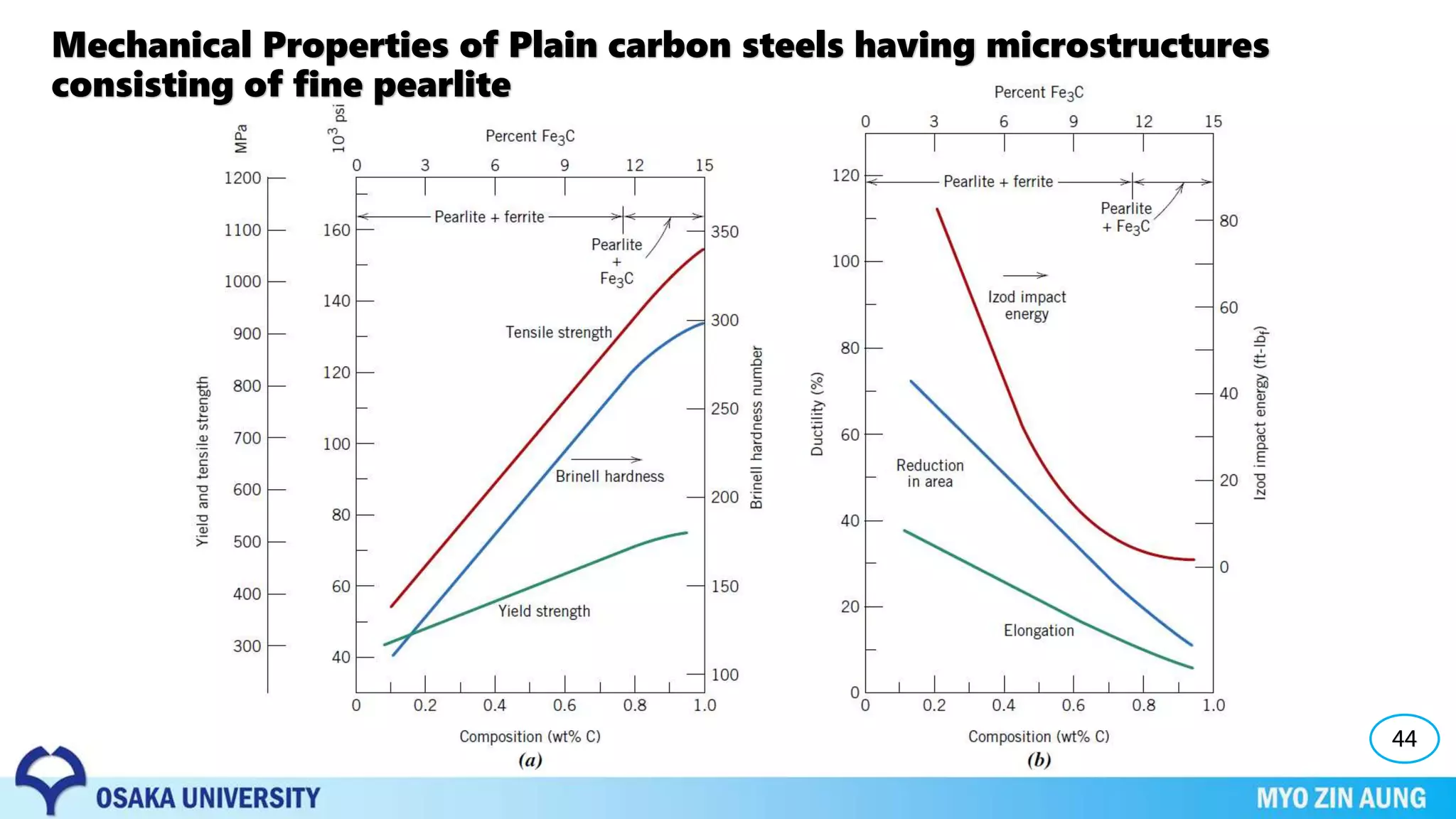
3 Classifications
1. Diffusion-dependent transformation (Simple)
No change in number or composition of the phases present
Solidification of a pure metal
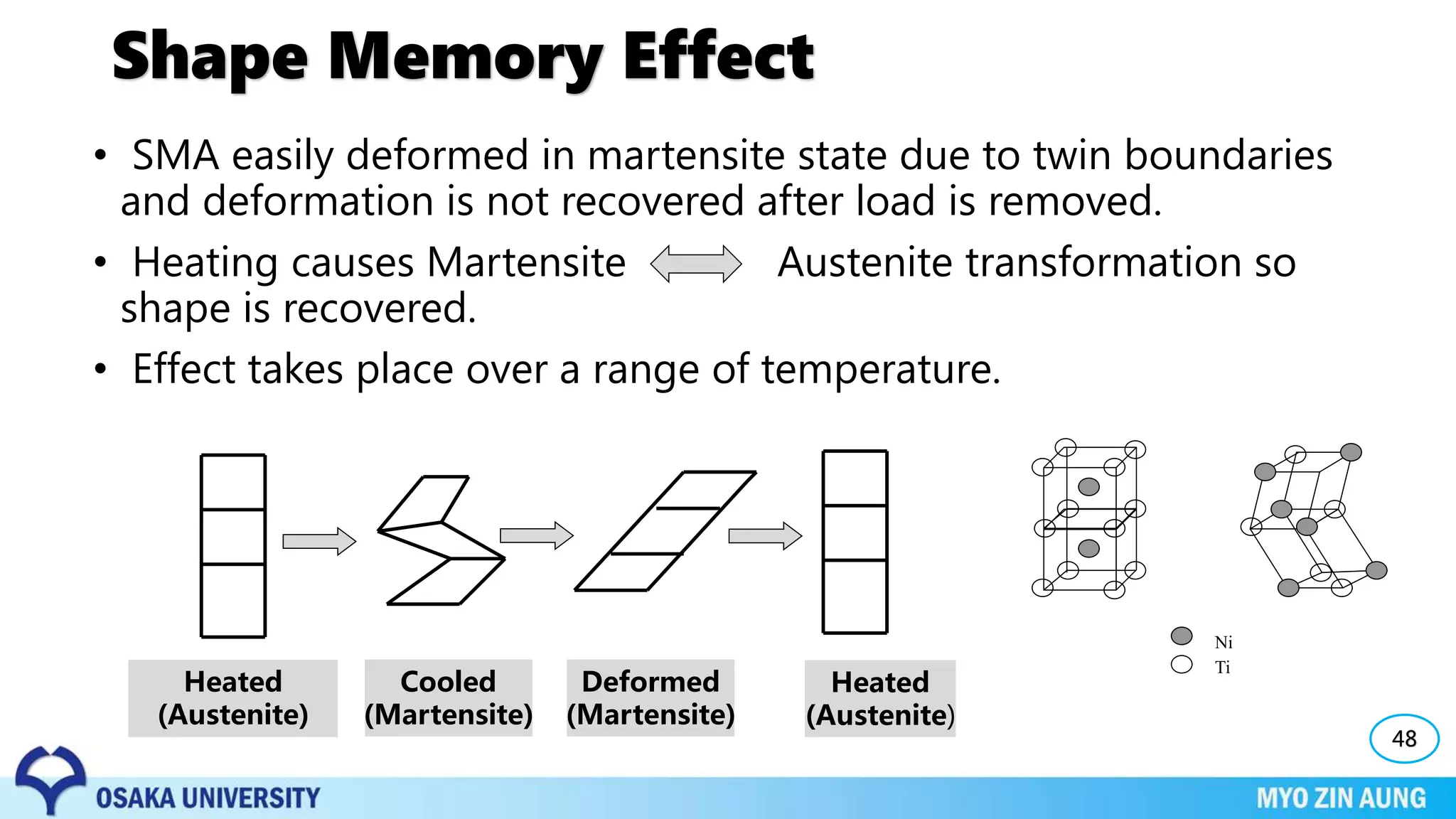
Allotropic Transformations
Recrystallization and Grain Growth
2. Diffusion-dependent transformation
Some alternation in phase compositions
Often alternation in the number of phases present
Final microstructure ordinarily consists of 2 phases
Eutectoid reaction
3. Diffusionless transformation
Metastable phase is produced
Martensitic transformation in some steel alloys 7
Polymorphism or Allotropy
8
Iron exists in both BCC and FCC form depending on the temperature.
Metals exist in more than one crystalline form
Change of these forms is called Allotropic Transformation
Phase Diagram of Pure Iron
9
3 Solid Phases
1.α Fe (BCC)
2.γ Fe (FCC)
3.δ Fe (BCC)
Cooling Curve of Pure Iron
10
Take times between Phases
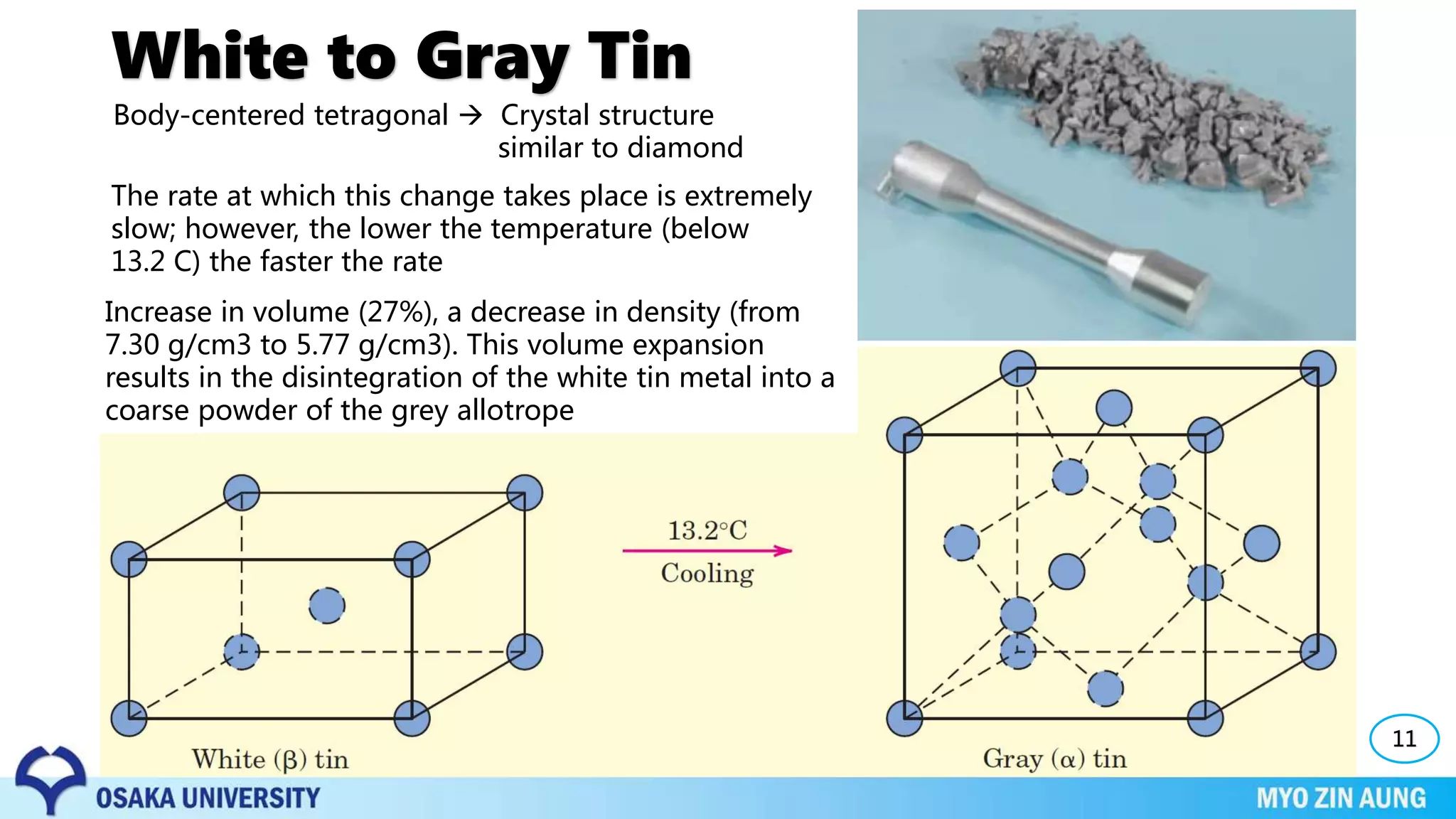
White to Gray Tin
11
Body-centered tetragonal  Crystal structure
similar to diamond
The rate at which this change takes place is extremely
slow; however, the lower the temperature (below
13.2 C) the faster the rate
Increase in volume (27%), a decrease in density (from
7.30 g/cm3 to 5.77 g/cm3). This volume expansion
results in the disintegration of the white tin metal into a
coarse powder of the grey allotrope
How transform?
• Most phase transformations do not occur instantaneously
• They begin by the formation of numerous small particles of the
new phase(s), which increase in size until the transformation has
reached completion
• 2 stages of Phase Transformation
1. Nucleation
• Nucleation involves the appearance of very small particles, or nuclei
of the new phase which are capable of growing.
2. Growth
• During the growth stage these nuclei increase in size, which results
in the disappearance of some (or all) of the parent phase.
12
Nucleation & Growth
13
↑ t
“For sufficient
Undercooling”
Iron-Carbon System (Steel)
• Fe-Fe3C (Iron-Iron Carbide) Phase Diagram
14
Type
Crystal
Structure
Temperature
Ferrite α-iron BCC
Room Temperature
(Stable Form)
Austenite γ-iron FCC @ 912 ˚C – 1394 ˚C
δ-ferrite BCC @ 1394 ˚C – 1538 ˚C
Liquid
No Crystal
Structure
@1538 ˚C - above
Cementite 𝐹𝑒3 𝐶 Compound
Phases of Iron-Carbon Alloys
15
Steel is stronger than pure iron because of the carbon atoms in the void space of unit cell.
16
α-ferrite Austenite (γ-iron)
Fe-Fe3C (Iron-Iron Carbide) Phase
Diagram
17
6.7 wt% C means 100%
Fe3C
Not interested in more than
6.7 wt% C
Mechanically, cementite is very
hard and brittle; the strength of
some steels is greatly enhanced
by its presence.
Steel
 Eutectoid composition - 0.76 wt% C
 Eutectoid temperature – 727 ˚C
Cast IronIron Cementite
0.008% 2.14% 6.7%
Eutectoid Alloys (0.76 wt% C)
18
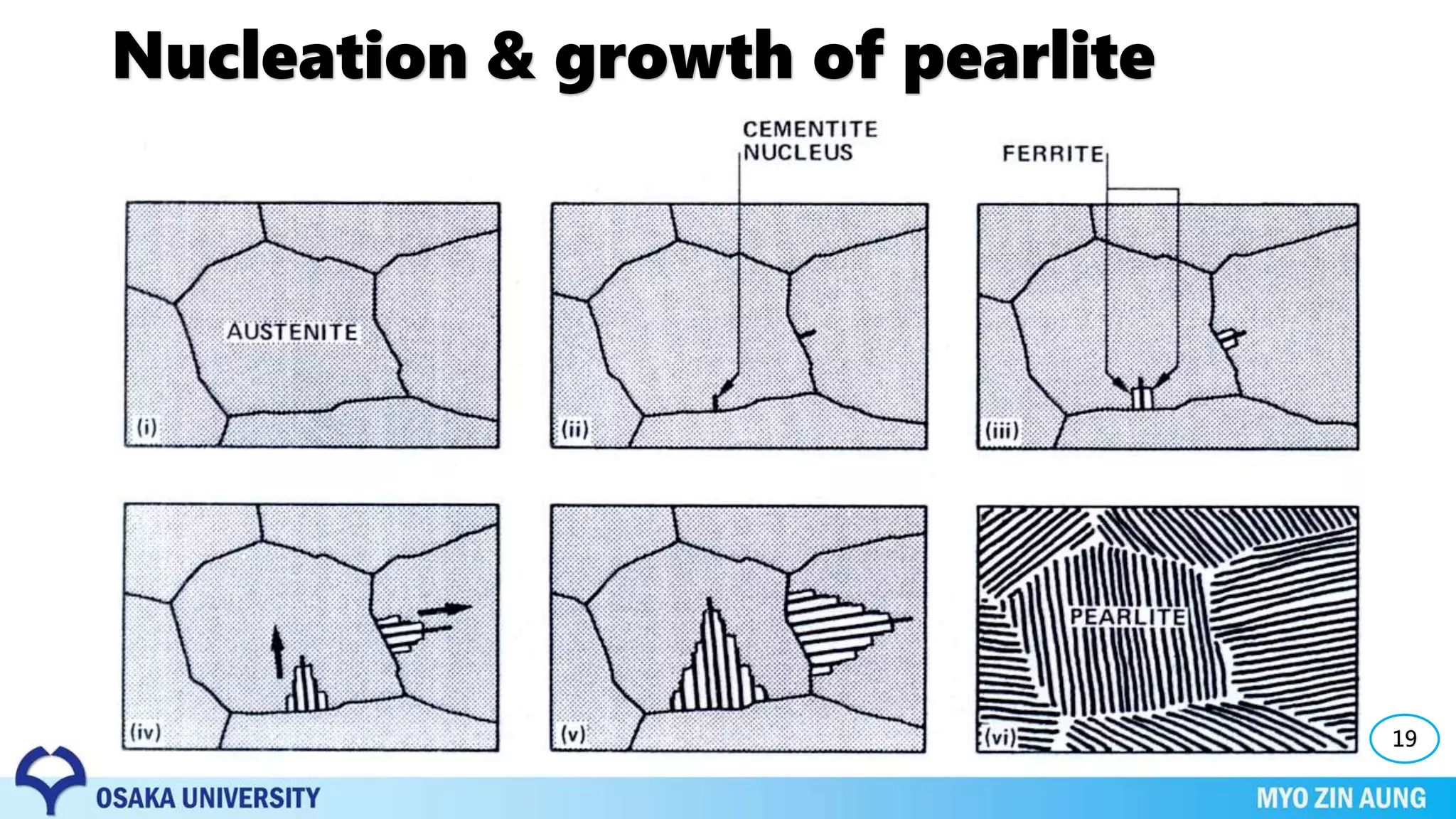
Pearlite: a micro-constituent consisting of alternating
layers of ferrite and cementite.
𝛾 → 𝛼 + 𝐹𝑒3 𝐶
Nucleation & growth of pearlite
19
Hypoeutectoid Alloys (< 0.76 wt% C)
20
𝛾 → 𝛾 + 𝛼 𝑃𝑟𝑜𝑒𝑢𝑡𝑒𝑐𝑡𝑜𝑖𝑑
𝛼 𝐸𝑢𝑡𝑒𝑐𝑡𝑜𝑖𝑑 + 𝐹𝑒3 𝐶 + 𝛼 (𝑃𝑟𝑜𝑒𝑢𝑡𝑒𝑐𝑡𝑜𝑖𝑑)
Hypereutectoid Alloys (> 0.76 wt%
C)
21
𝛾 → 𝛾 + 𝐹𝑒3 𝐶 𝑃𝑟𝑜𝑒𝑢𝑡𝑒𝑐𝑡𝑜𝑖𝑑
𝛼 + 𝐹𝑒3 𝐶 𝐸𝑢𝑡𝑒𝑐𝑡𝑜𝑖𝑑 + 𝐹𝑒3 𝐶 (𝑃𝑟𝑜𝑒𝑢𝑡𝑒𝑐𝑡𝑜𝑖𝑑)
Ferrite/Cementite Transformation
22
Properties of Different Phases of Steel
Type
Tensile
Strength (psi)
Hardness
(Rockwell)
Elongation
(2 in.)
Ferrite 40,000 C 0 or B 90 40 %
softest structure on the diagram
small amount of carbon dissolved
in α (BCC) iron
Ferromagnetic & Fairly ductile
Pearlite 120,000
C 20 or
B 95-100
20 %
α-Ferrite + Cementite
Austenite 150,000 ~ C 40 10 %
normally not stable at room
temperature. But, under certain
conditions it is possible to obtain
austenite at room temperature
Carbon dissolved in γ (F.C.C.) iron
Non-magnetic & ductile
Cementite ~ 5,000
Hardest structure in the diagram and Brittle
Classified as ceramic in pure form
Orthorhombic Crystal Structure 24
How to do “Phase Transformations”?
• By varying Temperature, Composition, and the external Pressure
• Temperature Changes by means of Heat Treatments are most
conveniently utilized
• Crossing a Phase Boundary on the Composition–Temperature
phase diagram as an alloy of given composition is heated or cooled
• Most phase transformations require some finite time to go to
completion (to get the equilibrium state) – need to wait to finish
• The speed or rate is often important in the relationship between the
heat treatment and the development of microstructure
• One limitation of phase diagrams is their inability to indicate the
time period required for the attainment of equilibrium
26
Equilibrium vs Metastable
• The rate of approach to equilibrium for solid systems is so slow.
• Equilibrium conditions are maintained only if heating or cooling
is carried out at extremely slow and unpractical rates.
• For other-than-equilibrium cooling, transformations are shifted to
lower temperatures than indicated by the phase diagram.
(Supercooling)
• for heating, the shift is to higher temperatures (Superheating)
• For many technologically important alloys, the preferred state or
microstructure is a metastable one (e.g. Martensite)
• Intermediate between the initial and equilibrium states
• It thus becomes imperative to investigate the influence of time
on phase transformations.
27
Austenite to Pearlite
28
Austenite
Pearlite
Eutectoid Steel (0.76 wt% C)
Eutectoid Temp = 727 ˚C
Isothermal
transformation
diagram
( TTT Diagram )
29
With superimposed isothermal heat
treatment curve (ABCD)
30
Shortest time interval for Transformation
31
Coarse & Fine Pearlite
Coarse Pearlite Fine Pearlite
Bainite
32
The microstructure of bainite consists of
ferrite and cementite phases, and thus
diffusional processes are involved in its
formation
Spheroidite
• If a steel alloy having either pearlitic or bainitic microstructures
is heated to, and left at, a temperature below the eutectoid for a
sufficiently long period of time—for example, at about 700C
(1300F) for between 18 and 24 h—yet another microstructure
will form called spheroidite
• Instead of the alternating ferrite and cementite lamellae
(pearlite) or the microstructure observed for bainite, the Fe3C
phase appears as spherelike particles embedded in a continuous
a–phase matrix.
• The kinetics of spheroidite formation is not included on
isothermal transformation diagrams.
33
Spheroidite
microstructure
34
Martensite
• Martensite is formed when austenite alloys are rapidly cooled
(or quenched) to a relatively low temperature (in the vicinity of
the ambient).
• Martensite is a nonequilibrium single-phase structure that
results from a diffusionless transformation of austenite.
• It may be thought of as a transformation product that is
competitive with pearlite and bainite.
• The martensitic transformation occurs when the quenching rate
is rapid enough to prevent carbon diffusion.
• Any diffusion whatsoever results in the formation of ferrite and
cementite phases.
35
Unit Cell of Martensite
36
Body-centered tetragonal (BCT) Structure
37
Ferrite
Cementite
Ferrite matrix
and elongated
particles of Fe3C
Pearlite
Bainite Diffusion Dependent
Austenite (FCC) Martensite (BCT)
• Diffusionless Transformation
• No enough time to form
Pearlite or Bainite
Very Hard and Brittle
Austenite
Very Rapid Cooling
(Quenching)
Cooling
Super-saturated solid
solution of carbon in ferrite
Martensite
38
The needleshape grains are the Martensite
phase, and the white regions are austenite
that failed to transform during the rapid
quench
Cooling Rate
39
Continuous-cooling transformation
diagram for a eutectoid iron–carbon
alloy and superimposed cooling curves,
demonstrating the dependence of the
final microstructure on the
transformations that occur during
cooling
Tempered Martensite
• In the as-quenched state, martensite, is very hard, but so brittle
• So it cannot be used for most applications
• Any internal stresses that may have been introduced during
quenching have a weakening effect.
• The ductility and toughness of martensite may be enhanced and
these internal stresses relieved by a heat treatment known as
tempering.
• By heating to a temperature below the eutectoid for a specified
time period
40
between 250˚C and 650˚C
Diffusion Process
Isothermal
transformation diagram
for an alloy steel (type
4340)
41
42
Continuous-cooling transformation
diagram for an alloy steel (type
4340) and several superimposed
cooling curves demonstrating
dependence of the final
microstructure of this alloy on the
transformations that occur during
cooling
Different transformed products of
Austenite
Austenite
43
Reheat
Reheat
Bainite
Temper
Martensite
Martensi
te
Pearlite
Coarse Fine
Spheroidite
Moderate
CoolingIsothermal
Treatment
Alloy
Steel
Plain Carbon
Steel
44
Mechanical Properties of Plain carbon steels having microstructures
consisting of fine pearlite
Mechanical Properties of Different
Microstructures
45
Microstructures and Mechanical Properties for Iron–Carbon Alloys
46
Shape Memory Alloys (SMA)
• SMA recover predefined shape when subjected to appropriate
heat treatment.
• Recovers strain and exerts forces
• Examples: AuCd, Cu-Zn-Al, Cu-Al-Ni, Ni-Ti
• Processed using hot and cold forming techniques and heat
treated at 500-800 0C at desired shape.
• At high temperature ---Regular cubic microstructure
• (Austenite)
• After cooling – Highly twinned platelets (Martensite)
47
Shape Memory Effect
48
• SMA easily deformed in martensite state due to twin boundaries
and deformation is not recovered after load is removed.
• Heating causes Martensite Austenite transformation so
shape is recovered.
• Effect takes place over a range of temperature.
Heated
(Austenite)
Cooled
(Martensite)
Deformed
(Martensite)
Heated
(Austenite)
Ni
Ti
The Shape Memory Effect
49
s
e
T
Cooling
Detwinning
Heating/Recovery
Stress
Temperature
Strain/ Defromation
50
51
52
53
54
Shape Memory Alloys
55
Alloy
Transformation
Composition
Transformation
Temp. Rang (°C)
Hysteresis (°C)
Ag-Cd 44/49 at % Cd -190 to -50 ~15
Au-Cd 46.5/50 at % Cd 30 to 100 ~15
Cu-Al-Ni
14/14.5 wt %Al,
3/4.5 wt %Ni
-140 to 100 ~35
Cu-Sn ~15 at % Sn -120 to 30 −
Cu-Zn 38.5/41.5 wt % Zn -180 to -10 ~10
Cu-Zn-X
(X=Si,Sn,Al)
few wt % X -180 to 200 ~10
In-Ti 18/23 at % Ti 60 to 100 ~4
Ni-Al 36/38 at % Al -180 to 100 ~10
Ni-Ti ~49/51 at % Ni -50 to 110 ~30
Fe-Pt ~25 at % Pt ~-130 ~4
Mn-Cu 5/35 wn % Cu -250 to 180 ~25
Fe-Mn-Si 32 wt % Mn -200 to 150 ~100
SMA Applications
56
• Micro-actuators
• Mobile phone antennas
• Orthodontic archwires
• Penile implant
• Pipe couplings
• Robot actuators
• Rock splitting
• Root canal drills
• Satellite antenna deployment
• Scoliosis correction
• Solar actuators
• Spectacle frames
• Steam valves
• Stents
• Switch vibration damper
• Thermostats
• Underwired bras
• Vibration dampers
• ZIF connectors
• Aids for disabled
• Aircraft flap/slat adjusters
• Anti-scald devices
• Arterial clips
• Automotive thermostats
• Braille print punch
• Catheter guide wires
• Cold start vehicle actuators
• Contraceptive devices
• Electrical circuit breakers
• Fibre-optic coupling
• Filter struts
• Fire dampers
• Fire sprinklers
• Gas discharge
• Graft stents
• Intraocular lens mount
• Kettle switches
• Keyhole instruments
• Key-hole surgery instruments
Applications of Shape Memory Alloys
57
58
Existing and potential SMA applications in the biomedical domain
59
SMAs in Bio-medical Devices
60Bone Anchors
Robotic
arms
Medical Stents
61
Existing and potential SMA applications in the automotive domain
62
Existing and potential SMA applications in the aerospace domain
Temperature Dependency of Linear Expansion
Coefficient
63Substances that expand at the same rate in every direction are called isotropic
Expansion Joints
64
If the body is constrained so that it cannot expand, then internal stress will be caused
(or changed) by a change in temperature.
Linear Expansion
• This equation works well as long as the linear-expansion coefficient does
not change much over the change in temperature ∆𝑇, and the fractional
change in length is small ∆𝐿/𝐿 ≪1.
• If either of these conditions does not hold, the equation must be
integrated. 65
• The change in the linear dimension can be estimated to be:
66The linear expansion coefficient α vs. temperature for ceramic AlN samples
67
Effect of High Pressure Heat Treatment on Microstructure and Thermal Expansion
Coefficients of CuAl Alloy
68
 High pressure heat treatment
involves three values: 1, 3 and 6 GPa.
 The samples were held at 750°C
under pressure for 10 min and
subsequently cooled to room
temperature by cutting off the
power supply with the holding
pressure unchanged.
 Finally, the pressure was taken off.
Thermal expansion coefficients of CuAl alloy vs
Temperature
69
 Same Material (Cu-Al Alloy)
 Different Heat Treatments
 Different Microstructures
 Different Thermal Expansion Coefficients
for Different Temperature
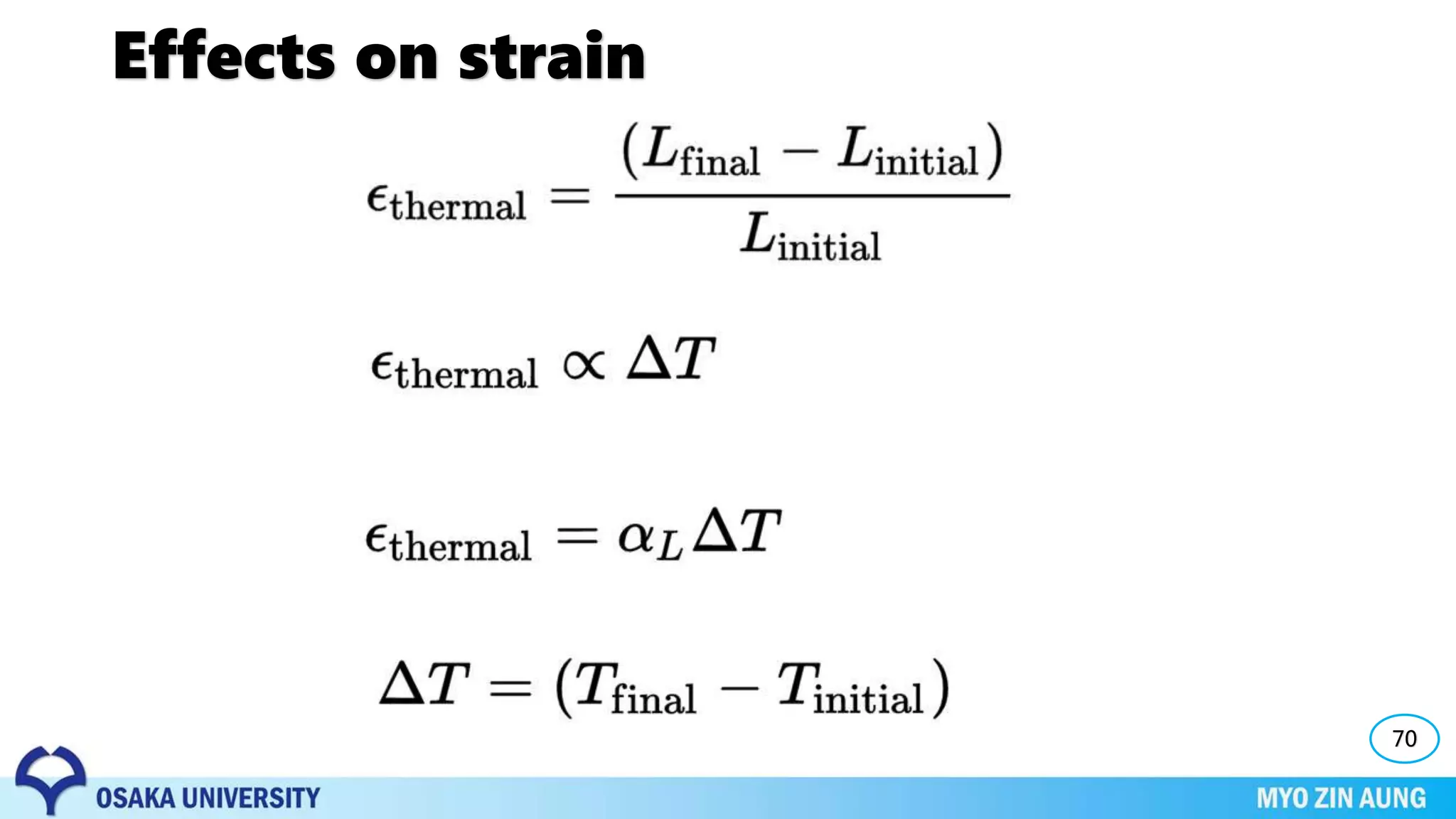
Effects on strain
70
References
1. Material Science & Engineering - An Introduction 9th Edition
(William D. Callister, Jr. & David G. Rethwisch)
2. An Introduction to Shape Memory Alloys (SMAs) (Mehrshad
Mehrpouya)
3. Thermal Expansion (Wikipedia)
4. Effect of High Pressure Heat Treatment on Microstructure and
Thermal Expansion Coefficients of CuAl Alloy (Ma Yu-quan)
71
72

Phase transformation (Material Science)

  • 1.
    Phase Transformation  MYOZIN AUNG  28J16121  Ship Design Lab. (NAOE)
  • 2.
    Phase Transformation -Contents 1. Change of Crystal Structure (Micro) 2. Shape Memory 3. Temperature Dependency of Linear Expansion Coefficient (Macro) 2
  • 3.
    Why STUDY PhaseTransformation? • Tensile strength of iron-carbon alloy of eutectoid composition can be varied between 700 MPa and 2000 MPa depending on heat treatment employed. • This shows that the desirable mechanical properties of a material can be obtained as a result of phase transformations using heat treatment processes. • The time and temperature dependencies of phase transformations are represented on phase diagrams. • It is important to know how to use these phase diagrams in order to design a heat treatment for alloy to obtain the desired room-temperature mechanical properties. 3
  • 4.
    Phase Diagram forWater 4 3 Phases 1.Solid 2.Liquid 3.Vapor
  • 5.
    Crystal Structure 5 Face CenteredCubic Crystal Structure (FCC) Body-centered cubic crystal structure (BCC) Hexagonal close-packed crystal structure (HCP)
  • 6.
    Atomic Packing Factor 6 StructureAPF BCC 0.68 FCC 0.74 HCP 0.74
  • 7.
    3 Classifications 1. Diffusion-dependenttransformation (Simple) No change in number or composition of the phases present Solidification of a pure metal Allotropic Transformations Recrystallization and Grain Growth 2. Diffusion-dependent transformation Some alternation in phase compositions Often alternation in the number of phases present Final microstructure ordinarily consists of 2 phases Eutectoid reaction 3. Diffusionless transformation Metastable phase is produced Martensitic transformation in some steel alloys 7
  • 8.
    Polymorphism or Allotropy 8 Ironexists in both BCC and FCC form depending on the temperature. Metals exist in more than one crystalline form Change of these forms is called Allotropic Transformation
  • 9.
    Phase Diagram ofPure Iron 9 3 Solid Phases 1.α Fe (BCC) 2.γ Fe (FCC) 3.δ Fe (BCC)
  • 10.
    Cooling Curve ofPure Iron 10 Take times between Phases
  • 11.
    White to GrayTin 11 Body-centered tetragonal  Crystal structure similar to diamond The rate at which this change takes place is extremely slow; however, the lower the temperature (below 13.2 C) the faster the rate Increase in volume (27%), a decrease in density (from 7.30 g/cm3 to 5.77 g/cm3). This volume expansion results in the disintegration of the white tin metal into a coarse powder of the grey allotrope
  • 12.
    How transform? • Mostphase transformations do not occur instantaneously • They begin by the formation of numerous small particles of the new phase(s), which increase in size until the transformation has reached completion • 2 stages of Phase Transformation 1. Nucleation • Nucleation involves the appearance of very small particles, or nuclei of the new phase which are capable of growing. 2. Growth • During the growth stage these nuclei increase in size, which results in the disappearance of some (or all) of the parent phase. 12
  • 13.
    Nucleation & Growth 13 ↑t “For sufficient Undercooling”
  • 14.
    Iron-Carbon System (Steel) •Fe-Fe3C (Iron-Iron Carbide) Phase Diagram 14 Type Crystal Structure Temperature Ferrite α-iron BCC Room Temperature (Stable Form) Austenite γ-iron FCC @ 912 ˚C – 1394 ˚C δ-ferrite BCC @ 1394 ˚C – 1538 ˚C Liquid No Crystal Structure @1538 ˚C - above Cementite 𝐹𝑒3 𝐶 Compound
  • 15.
    Phases of Iron-CarbonAlloys 15 Steel is stronger than pure iron because of the carbon atoms in the void space of unit cell.
  • 16.
  • 17.
    Fe-Fe3C (Iron-Iron Carbide)Phase Diagram 17 6.7 wt% C means 100% Fe3C Not interested in more than 6.7 wt% C Mechanically, cementite is very hard and brittle; the strength of some steels is greatly enhanced by its presence. Steel  Eutectoid composition - 0.76 wt% C  Eutectoid temperature – 727 ˚C Cast IronIron Cementite 0.008% 2.14% 6.7%
  • 18.
    Eutectoid Alloys (0.76wt% C) 18 Pearlite: a micro-constituent consisting of alternating layers of ferrite and cementite. 𝛾 → 𝛼 + 𝐹𝑒3 𝐶
  • 19.
    Nucleation & growthof pearlite 19
  • 20.
    Hypoeutectoid Alloys (<0.76 wt% C) 20 𝛾 → 𝛾 + 𝛼 𝑃𝑟𝑜𝑒𝑢𝑡𝑒𝑐𝑡𝑜𝑖𝑑 𝛼 𝐸𝑢𝑡𝑒𝑐𝑡𝑜𝑖𝑑 + 𝐹𝑒3 𝐶 + 𝛼 (𝑃𝑟𝑜𝑒𝑢𝑡𝑒𝑐𝑡𝑜𝑖𝑑)
  • 21.
    Hypereutectoid Alloys (>0.76 wt% C) 21 𝛾 → 𝛾 + 𝐹𝑒3 𝐶 𝑃𝑟𝑜𝑒𝑢𝑡𝑒𝑐𝑡𝑜𝑖𝑑 𝛼 + 𝐹𝑒3 𝐶 𝐸𝑢𝑡𝑒𝑐𝑡𝑜𝑖𝑑 + 𝐹𝑒3 𝐶 (𝑃𝑟𝑜𝑒𝑢𝑡𝑒𝑐𝑡𝑜𝑖𝑑)
  • 22.
  • 23.
    Properties of DifferentPhases of Steel Type Tensile Strength (psi) Hardness (Rockwell) Elongation (2 in.) Ferrite 40,000 C 0 or B 90 40 % softest structure on the diagram small amount of carbon dissolved in α (BCC) iron Ferromagnetic & Fairly ductile Pearlite 120,000 C 20 or B 95-100 20 % α-Ferrite + Cementite Austenite 150,000 ~ C 40 10 % normally not stable at room temperature. But, under certain conditions it is possible to obtain austenite at room temperature Carbon dissolved in γ (F.C.C.) iron Non-magnetic & ductile Cementite ~ 5,000 Hardest structure in the diagram and Brittle Classified as ceramic in pure form Orthorhombic Crystal Structure 24
  • 24.
    How to do“Phase Transformations”? • By varying Temperature, Composition, and the external Pressure • Temperature Changes by means of Heat Treatments are most conveniently utilized • Crossing a Phase Boundary on the Composition–Temperature phase diagram as an alloy of given composition is heated or cooled • Most phase transformations require some finite time to go to completion (to get the equilibrium state) – need to wait to finish • The speed or rate is often important in the relationship between the heat treatment and the development of microstructure • One limitation of phase diagrams is their inability to indicate the time period required for the attainment of equilibrium 26
  • 25.
    Equilibrium vs Metastable •The rate of approach to equilibrium for solid systems is so slow. • Equilibrium conditions are maintained only if heating or cooling is carried out at extremely slow and unpractical rates. • For other-than-equilibrium cooling, transformations are shifted to lower temperatures than indicated by the phase diagram. (Supercooling) • for heating, the shift is to higher temperatures (Superheating) • For many technologically important alloys, the preferred state or microstructure is a metastable one (e.g. Martensite) • Intermediate between the initial and equilibrium states • It thus becomes imperative to investigate the influence of time on phase transformations. 27
  • 26.
    Austenite to Pearlite 28 Austenite Pearlite EutectoidSteel (0.76 wt% C) Eutectoid Temp = 727 ˚C
  • 27.
  • 28.
    With superimposed isothermalheat treatment curve (ABCD) 30 Shortest time interval for Transformation
  • 29.
    31 Coarse & FinePearlite Coarse Pearlite Fine Pearlite
  • 30.
    Bainite 32 The microstructure ofbainite consists of ferrite and cementite phases, and thus diffusional processes are involved in its formation
  • 31.
    Spheroidite • If asteel alloy having either pearlitic or bainitic microstructures is heated to, and left at, a temperature below the eutectoid for a sufficiently long period of time—for example, at about 700C (1300F) for between 18 and 24 h—yet another microstructure will form called spheroidite • Instead of the alternating ferrite and cementite lamellae (pearlite) or the microstructure observed for bainite, the Fe3C phase appears as spherelike particles embedded in a continuous a–phase matrix. • The kinetics of spheroidite formation is not included on isothermal transformation diagrams. 33
  • 32.
  • 33.
    Martensite • Martensite isformed when austenite alloys are rapidly cooled (or quenched) to a relatively low temperature (in the vicinity of the ambient). • Martensite is a nonequilibrium single-phase structure that results from a diffusionless transformation of austenite. • It may be thought of as a transformation product that is competitive with pearlite and bainite. • The martensitic transformation occurs when the quenching rate is rapid enough to prevent carbon diffusion. • Any diffusion whatsoever results in the formation of ferrite and cementite phases. 35
  • 34.
    Unit Cell ofMartensite 36 Body-centered tetragonal (BCT) Structure
  • 35.
    37 Ferrite Cementite Ferrite matrix and elongated particlesof Fe3C Pearlite Bainite Diffusion Dependent Austenite (FCC) Martensite (BCT) • Diffusionless Transformation • No enough time to form Pearlite or Bainite Very Hard and Brittle Austenite Very Rapid Cooling (Quenching) Cooling Super-saturated solid solution of carbon in ferrite
  • 36.
    Martensite 38 The needleshape grainsare the Martensite phase, and the white regions are austenite that failed to transform during the rapid quench
  • 37.
    Cooling Rate 39 Continuous-cooling transformation diagramfor a eutectoid iron–carbon alloy and superimposed cooling curves, demonstrating the dependence of the final microstructure on the transformations that occur during cooling
  • 38.
    Tempered Martensite • Inthe as-quenched state, martensite, is very hard, but so brittle • So it cannot be used for most applications • Any internal stresses that may have been introduced during quenching have a weakening effect. • The ductility and toughness of martensite may be enhanced and these internal stresses relieved by a heat treatment known as tempering. • By heating to a temperature below the eutectoid for a specified time period 40 between 250˚C and 650˚C Diffusion Process
  • 39.
    Isothermal transformation diagram for analloy steel (type 4340) 41
  • 40.
    42 Continuous-cooling transformation diagram foran alloy steel (type 4340) and several superimposed cooling curves demonstrating dependence of the final microstructure of this alloy on the transformations that occur during cooling
  • 41.
    Different transformed productsof Austenite Austenite 43 Reheat Reheat Bainite Temper Martensite Martensi te Pearlite Coarse Fine Spheroidite Moderate CoolingIsothermal Treatment Alloy Steel Plain Carbon Steel
  • 42.
    44 Mechanical Properties ofPlain carbon steels having microstructures consisting of fine pearlite
  • 43.
    Mechanical Properties ofDifferent Microstructures 45
  • 44.
    Microstructures and MechanicalProperties for Iron–Carbon Alloys 46
  • 45.
    Shape Memory Alloys(SMA) • SMA recover predefined shape when subjected to appropriate heat treatment. • Recovers strain and exerts forces • Examples: AuCd, Cu-Zn-Al, Cu-Al-Ni, Ni-Ti • Processed using hot and cold forming techniques and heat treated at 500-800 0C at desired shape. • At high temperature ---Regular cubic microstructure • (Austenite) • After cooling – Highly twinned platelets (Martensite) 47
  • 46.
    Shape Memory Effect 48 •SMA easily deformed in martensite state due to twin boundaries and deformation is not recovered after load is removed. • Heating causes Martensite Austenite transformation so shape is recovered. • Effect takes place over a range of temperature. Heated (Austenite) Cooled (Martensite) Deformed (Martensite) Heated (Austenite) Ni Ti
  • 47.
    The Shape MemoryEffect 49 s e T Cooling Detwinning Heating/Recovery Stress Temperature Strain/ Defromation
  • 48.
  • 49.
  • 50.
  • 51.
  • 52.
  • 53.
    Shape Memory Alloys 55 Alloy Transformation Composition Transformation Temp.Rang (°C) Hysteresis (°C) Ag-Cd 44/49 at % Cd -190 to -50 ~15 Au-Cd 46.5/50 at % Cd 30 to 100 ~15 Cu-Al-Ni 14/14.5 wt %Al, 3/4.5 wt %Ni -140 to 100 ~35 Cu-Sn ~15 at % Sn -120 to 30 − Cu-Zn 38.5/41.5 wt % Zn -180 to -10 ~10 Cu-Zn-X (X=Si,Sn,Al) few wt % X -180 to 200 ~10 In-Ti 18/23 at % Ti 60 to 100 ~4 Ni-Al 36/38 at % Al -180 to 100 ~10 Ni-Ti ~49/51 at % Ni -50 to 110 ~30 Fe-Pt ~25 at % Pt ~-130 ~4 Mn-Cu 5/35 wn % Cu -250 to 180 ~25 Fe-Mn-Si 32 wt % Mn -200 to 150 ~100
  • 54.
    SMA Applications 56 • Micro-actuators •Mobile phone antennas • Orthodontic archwires • Penile implant • Pipe couplings • Robot actuators • Rock splitting • Root canal drills • Satellite antenna deployment • Scoliosis correction • Solar actuators • Spectacle frames • Steam valves • Stents • Switch vibration damper • Thermostats • Underwired bras • Vibration dampers • ZIF connectors • Aids for disabled • Aircraft flap/slat adjusters • Anti-scald devices • Arterial clips • Automotive thermostats • Braille print punch • Catheter guide wires • Cold start vehicle actuators • Contraceptive devices • Electrical circuit breakers • Fibre-optic coupling • Filter struts • Fire dampers • Fire sprinklers • Gas discharge • Graft stents • Intraocular lens mount • Kettle switches • Keyhole instruments • Key-hole surgery instruments
  • 55.
    Applications of ShapeMemory Alloys 57
  • 56.
    58 Existing and potentialSMA applications in the biomedical domain
  • 57.
  • 58.
  • 59.
    61 Existing and potentialSMA applications in the automotive domain
  • 60.
    62 Existing and potentialSMA applications in the aerospace domain
  • 61.
    Temperature Dependency ofLinear Expansion Coefficient 63Substances that expand at the same rate in every direction are called isotropic
  • 62.
    Expansion Joints 64 If thebody is constrained so that it cannot expand, then internal stress will be caused (or changed) by a change in temperature.
  • 63.
    Linear Expansion • Thisequation works well as long as the linear-expansion coefficient does not change much over the change in temperature ∆𝑇, and the fractional change in length is small ∆𝐿/𝐿 ≪1. • If either of these conditions does not hold, the equation must be integrated. 65 • The change in the linear dimension can be estimated to be:
  • 64.
    66The linear expansioncoefficient α vs. temperature for ceramic AlN samples
  • 65.
  • 66.
    Effect of HighPressure Heat Treatment on Microstructure and Thermal Expansion Coefficients of CuAl Alloy 68  High pressure heat treatment involves three values: 1, 3 and 6 GPa.  The samples were held at 750°C under pressure for 10 min and subsequently cooled to room temperature by cutting off the power supply with the holding pressure unchanged.  Finally, the pressure was taken off.
  • 67.
    Thermal expansion coefficientsof CuAl alloy vs Temperature 69  Same Material (Cu-Al Alloy)  Different Heat Treatments  Different Microstructures  Different Thermal Expansion Coefficients for Different Temperature
  • 68.
  • 69.
    References 1. Material Science& Engineering - An Introduction 9th Edition (William D. Callister, Jr. & David G. Rethwisch) 2. An Introduction to Shape Memory Alloys (SMAs) (Mehrshad Mehrpouya) 3. Thermal Expansion (Wikipedia) 4. Effect of High Pressure Heat Treatment on Microstructure and Thermal Expansion Coefficients of CuAl Alloy (Ma Yu-quan) 71
  • 70.

Editor's Notes

  • #12 This white-to-gray-tin transition produced some rather dramatic results in 1850 in Russia.The winter that year was particularly cold, and record low temperatures persisted for extended periods of time. The uniforms of some Russian soldiers had tin buttons, many of which crumbled because of these extreme cold conditions, as did also many of the tin church organ pipes. This problem came to be known as the “tin disease.”
  • #18 The iron–carbon alloys that contain between 0.008 and 2.14 wt% C are classified as steels.