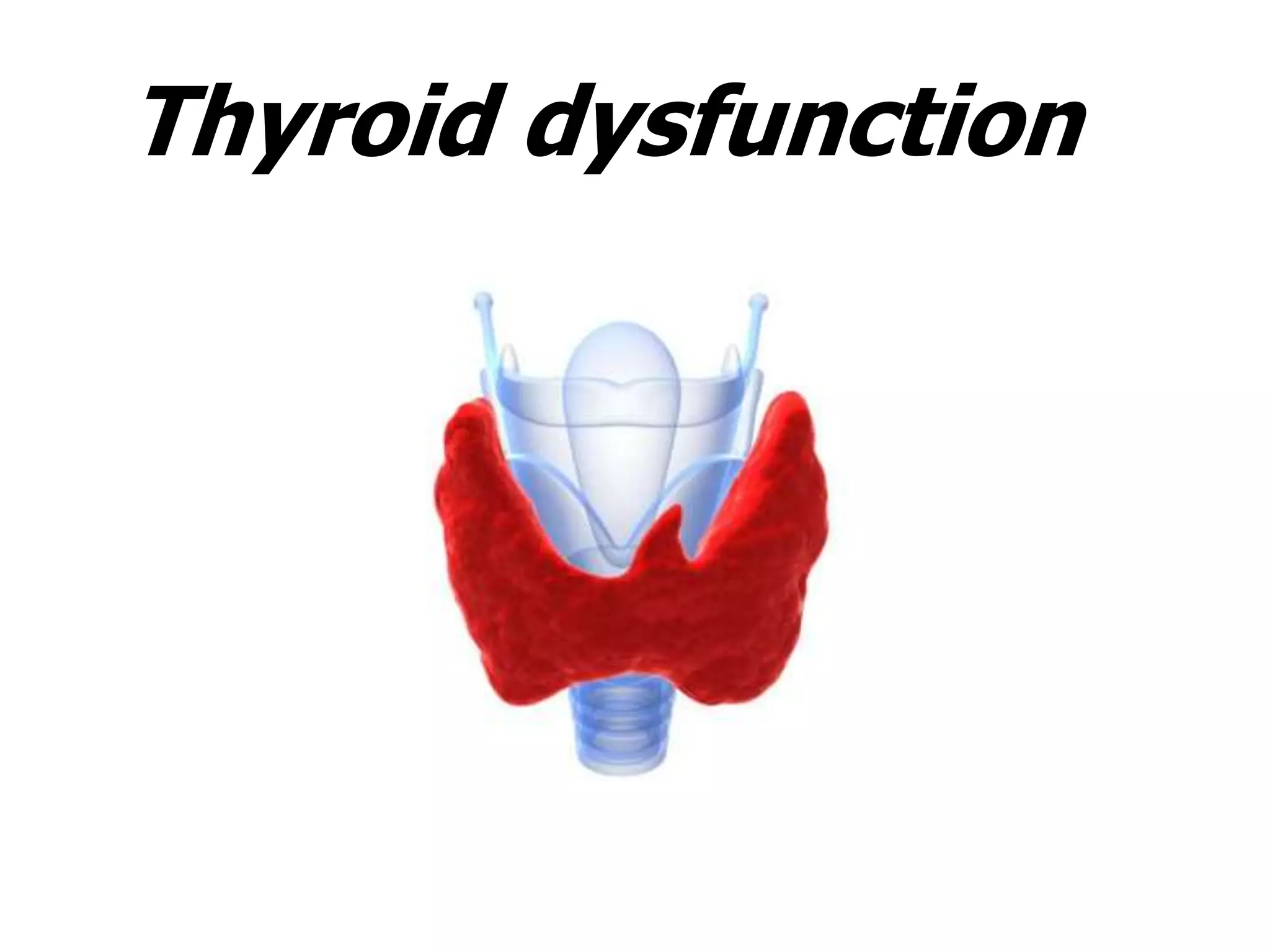
Thyroid dysfunction
What Is the Thyroid
Gland?
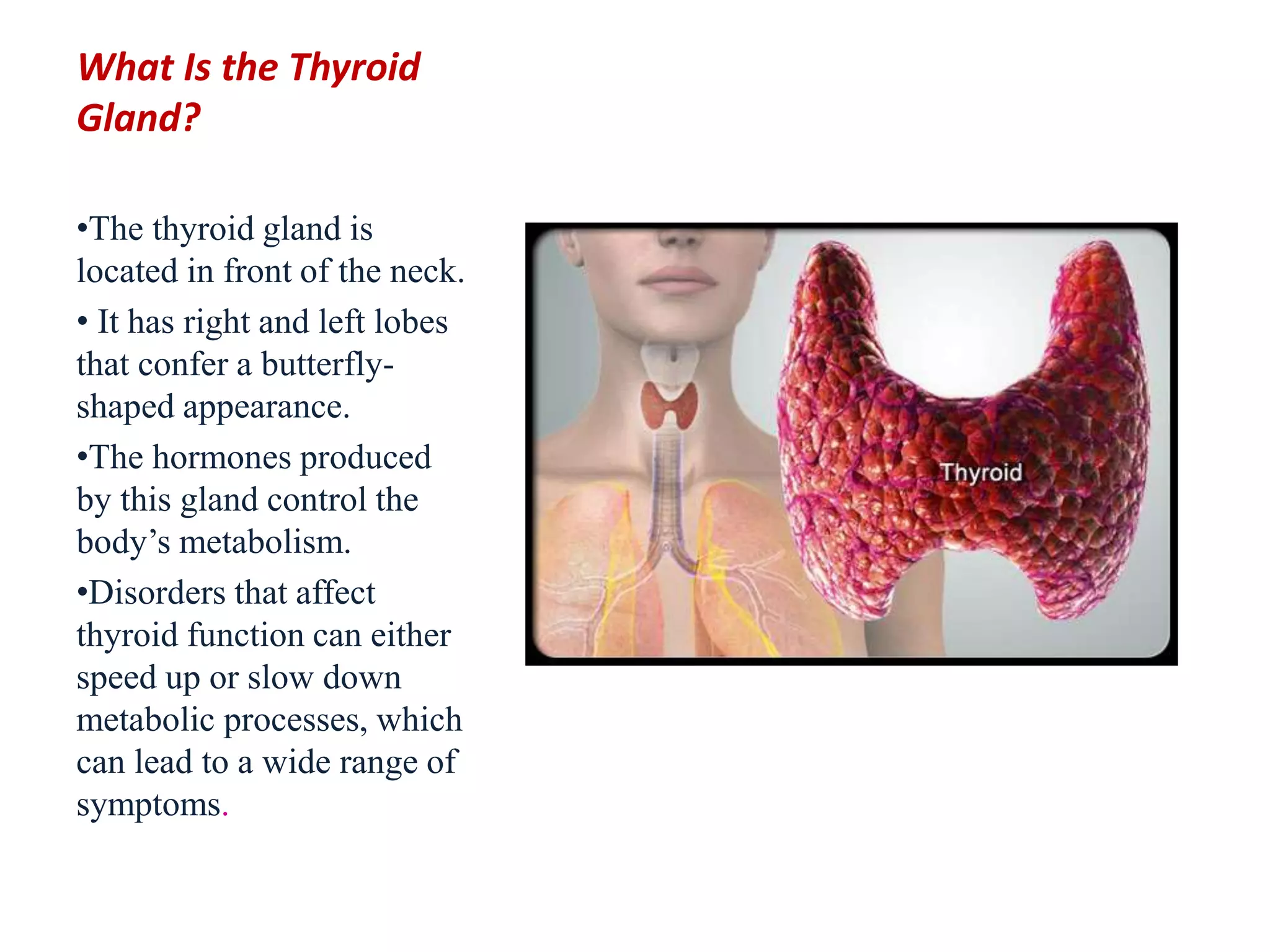
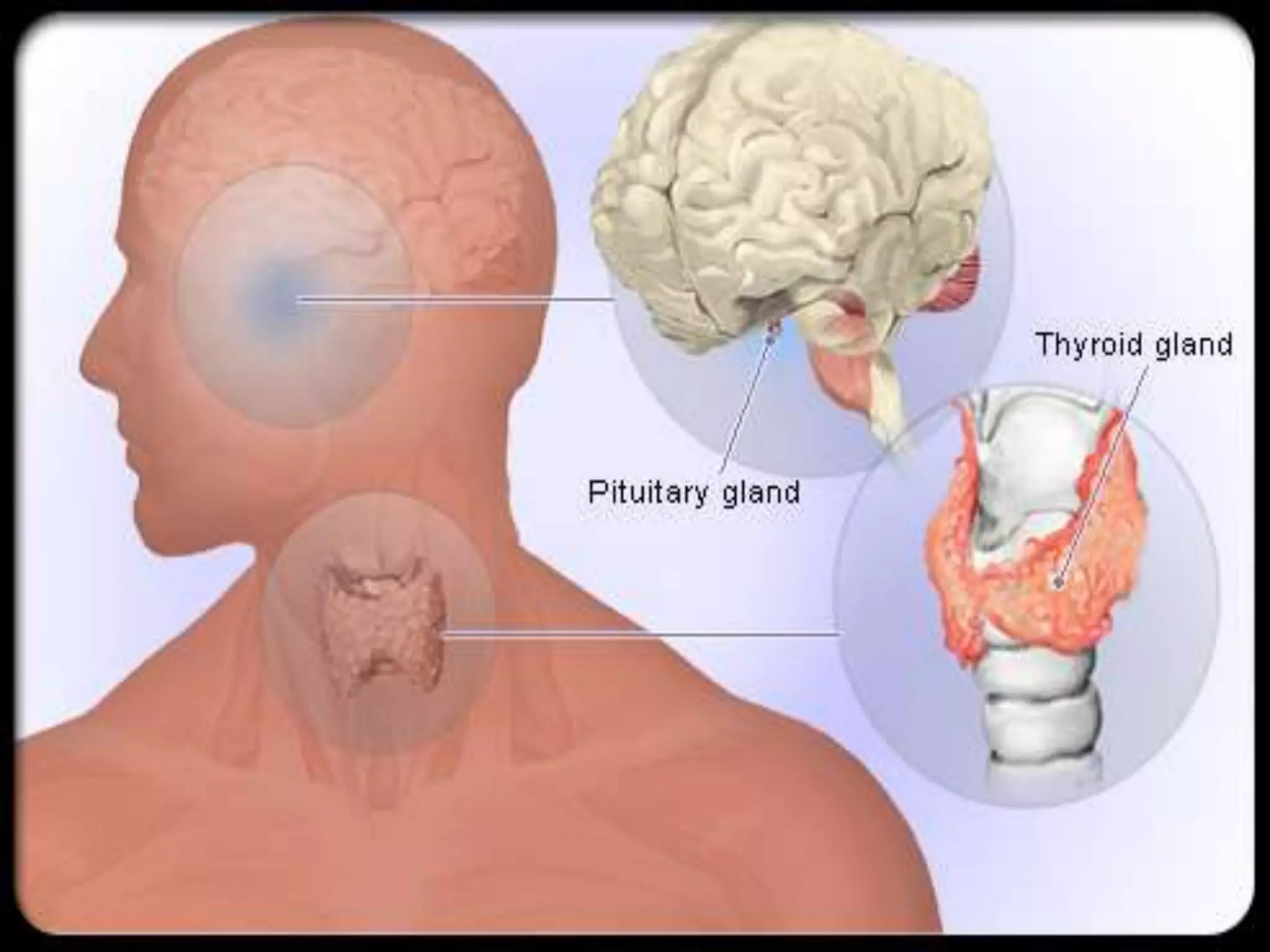
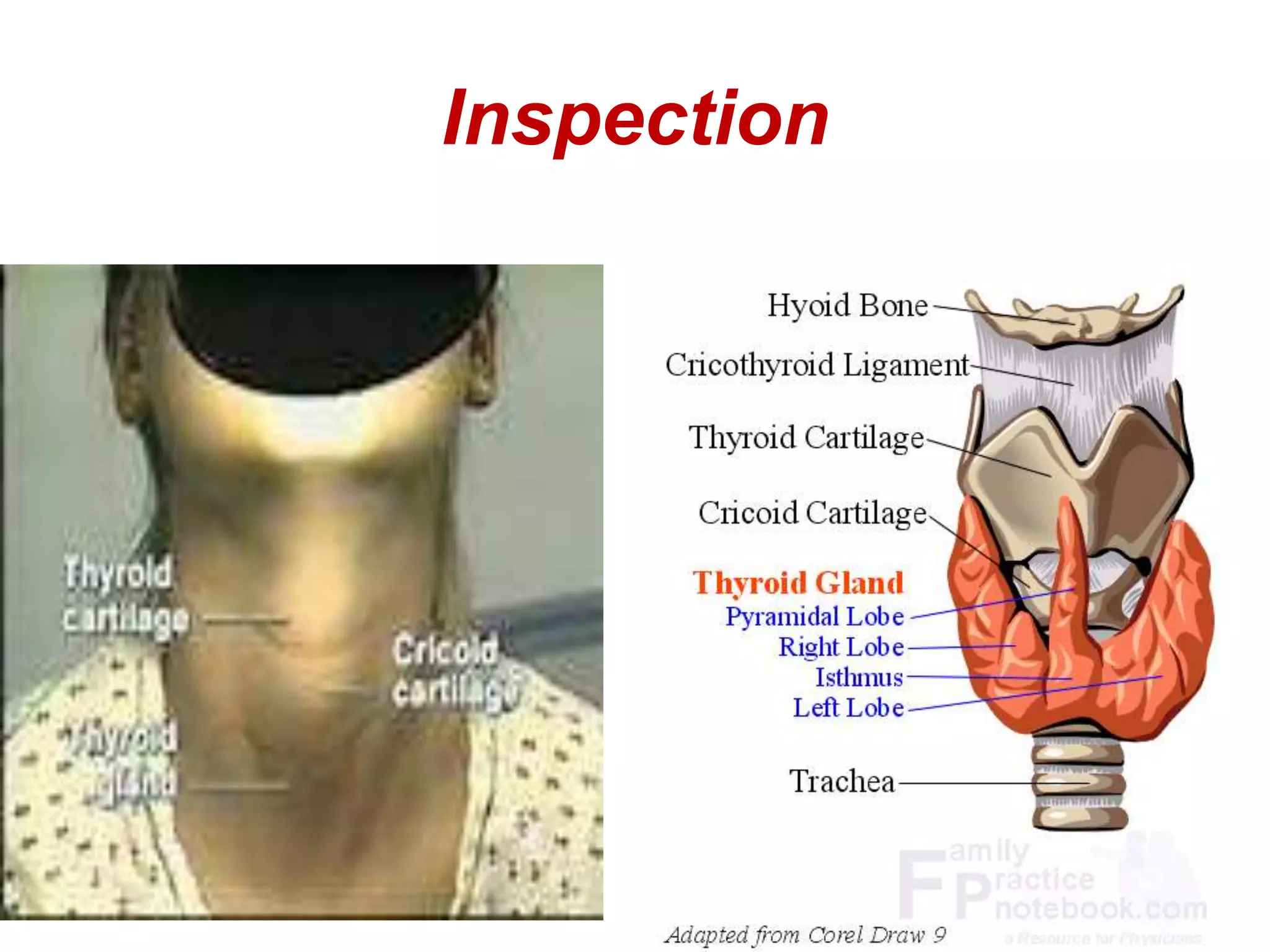
•The thyroid gland is
located in front of the neck.
• It has right and left lobes
that confer a butterfly-
shaped appearance.
•The hormones produced
by this gland control the
body’s metabolism.
•Disorders that affect
thyroid function can either
speed up or slow down
metabolic processes, which
can lead to a wide range of
symptoms.
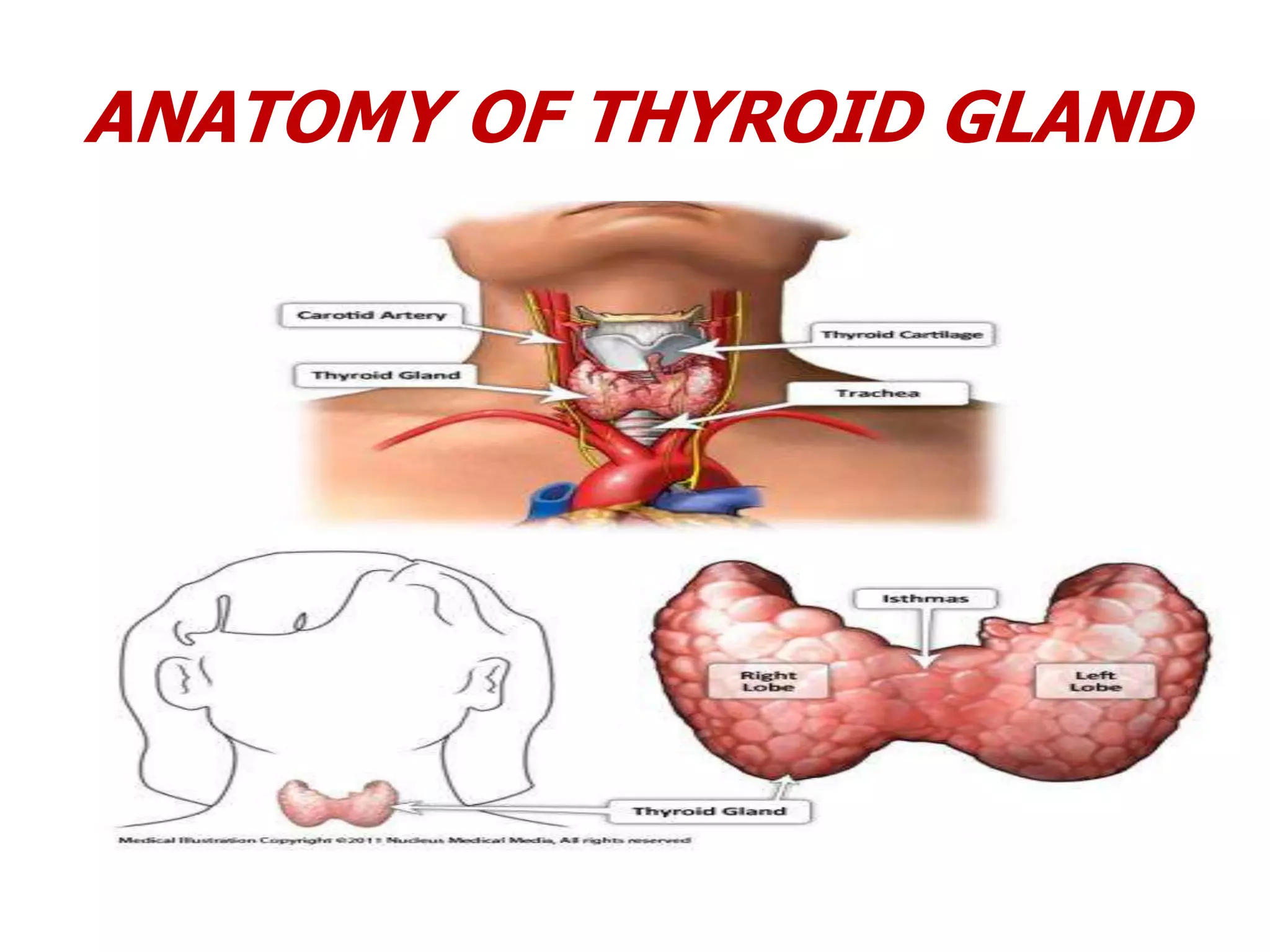
ANATOMY OF THYROID GLAND
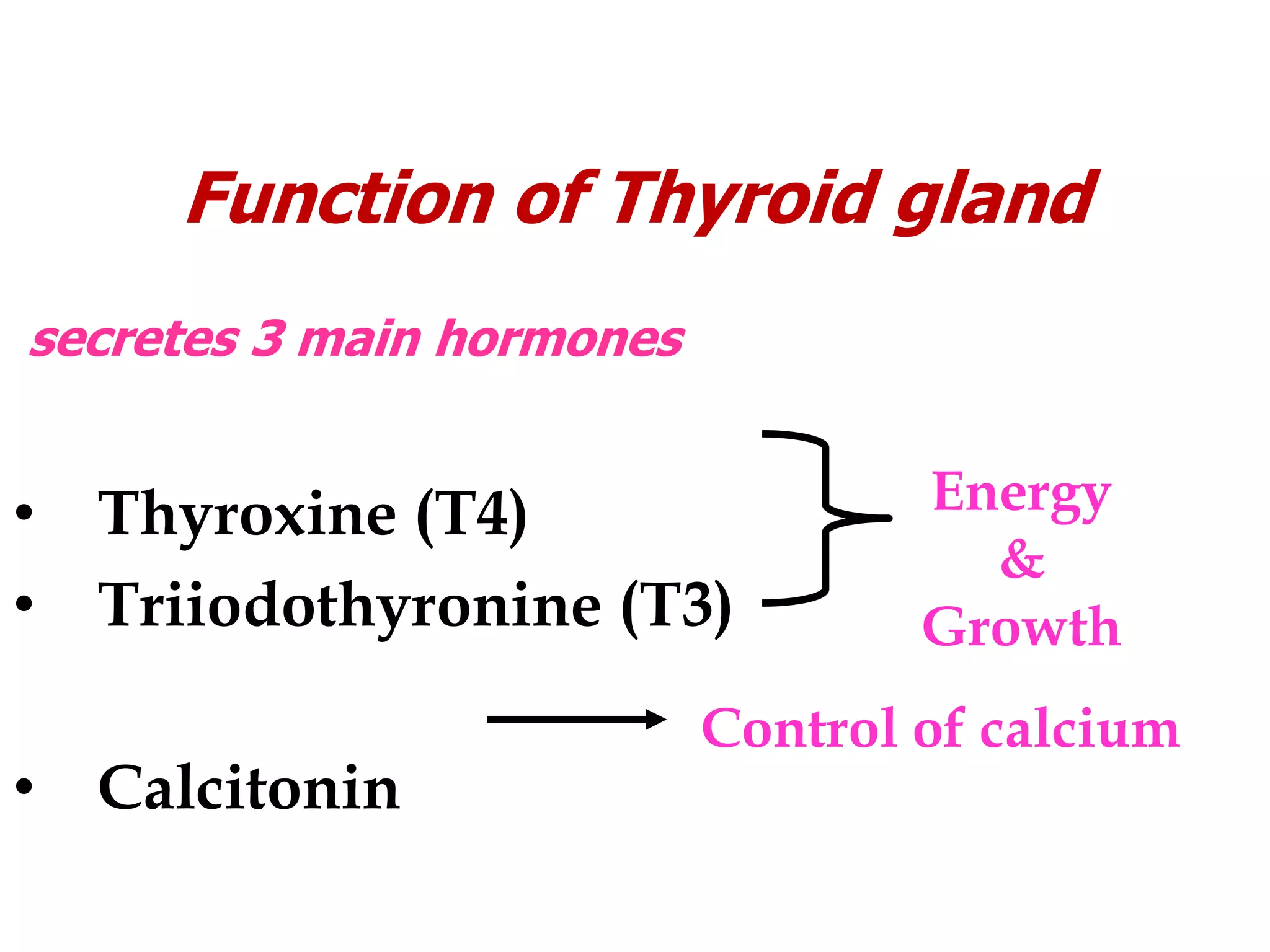
Function of Thyroid gland
secretes 3 main hormones
• Thyroxine (T4)
• Triiodothyronine (T3)
• Calcitonin
Energy
&
Growth
Control of calcium
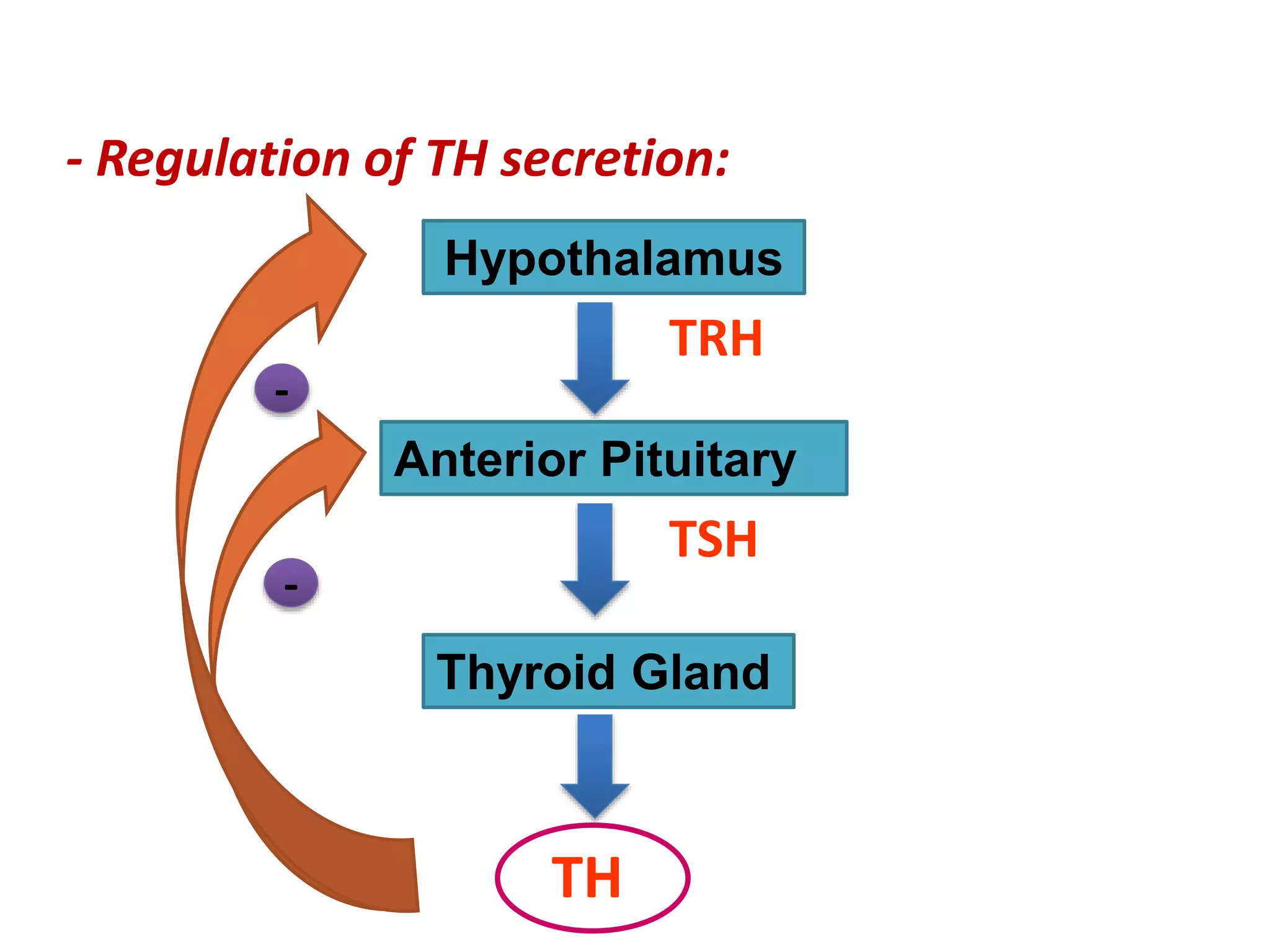
- Regulation of TH secretion:
Thyroid Gland
TH
TSH
Anterior Pituitary
Hypothalamus
TRH
-
-
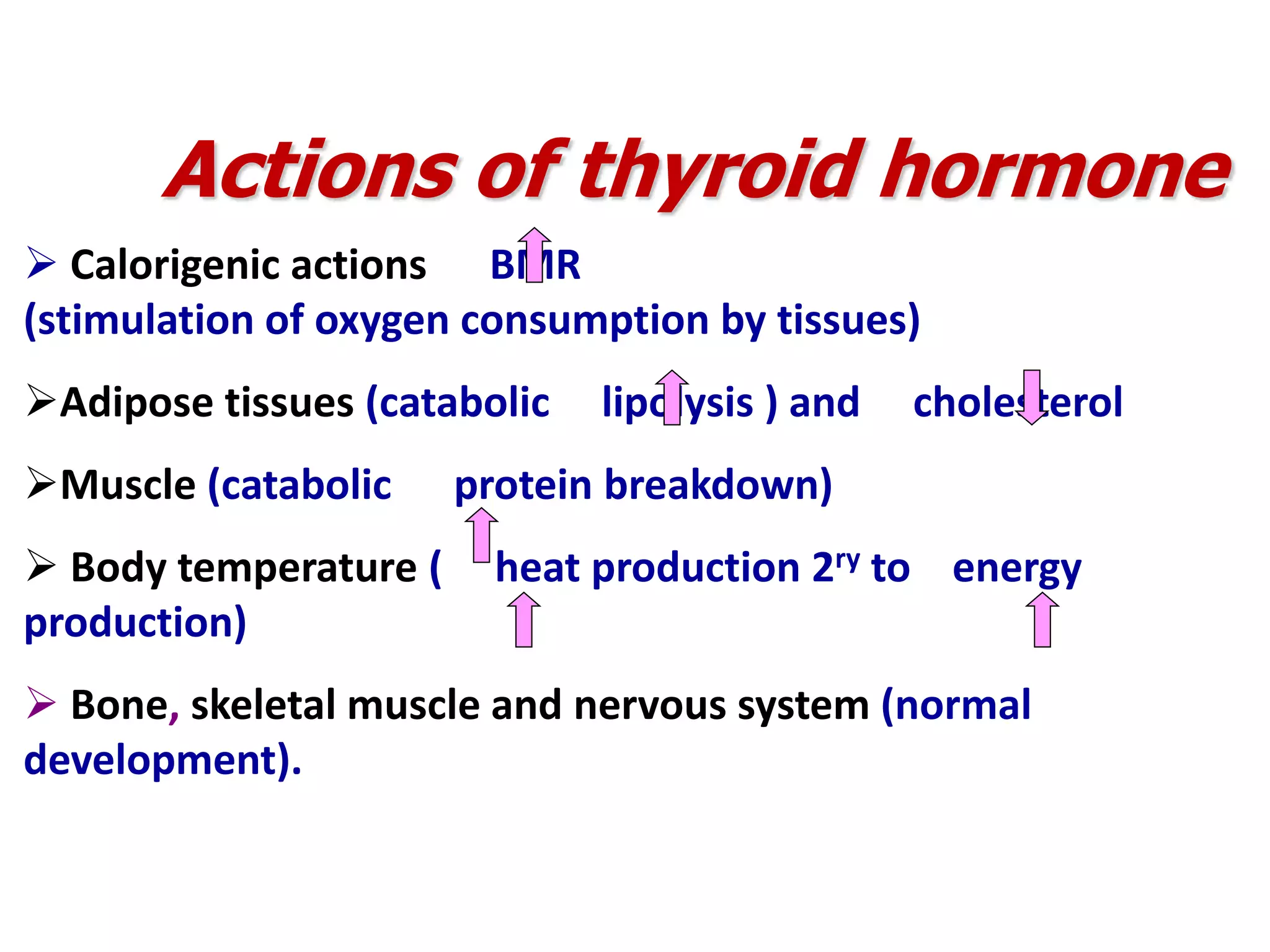
 Calorigenic actions BMR
(stimulation of oxygen consumption by tissues)
Adipose tissues (catabolic lipolysis ) and cholesterol
Muscle (catabolic protein breakdown)
 Body temperature ( heat production 2ry to energy
production)
 Bone, skeletal muscle and nervous system (normal
development).
Actions of thyroid hormone
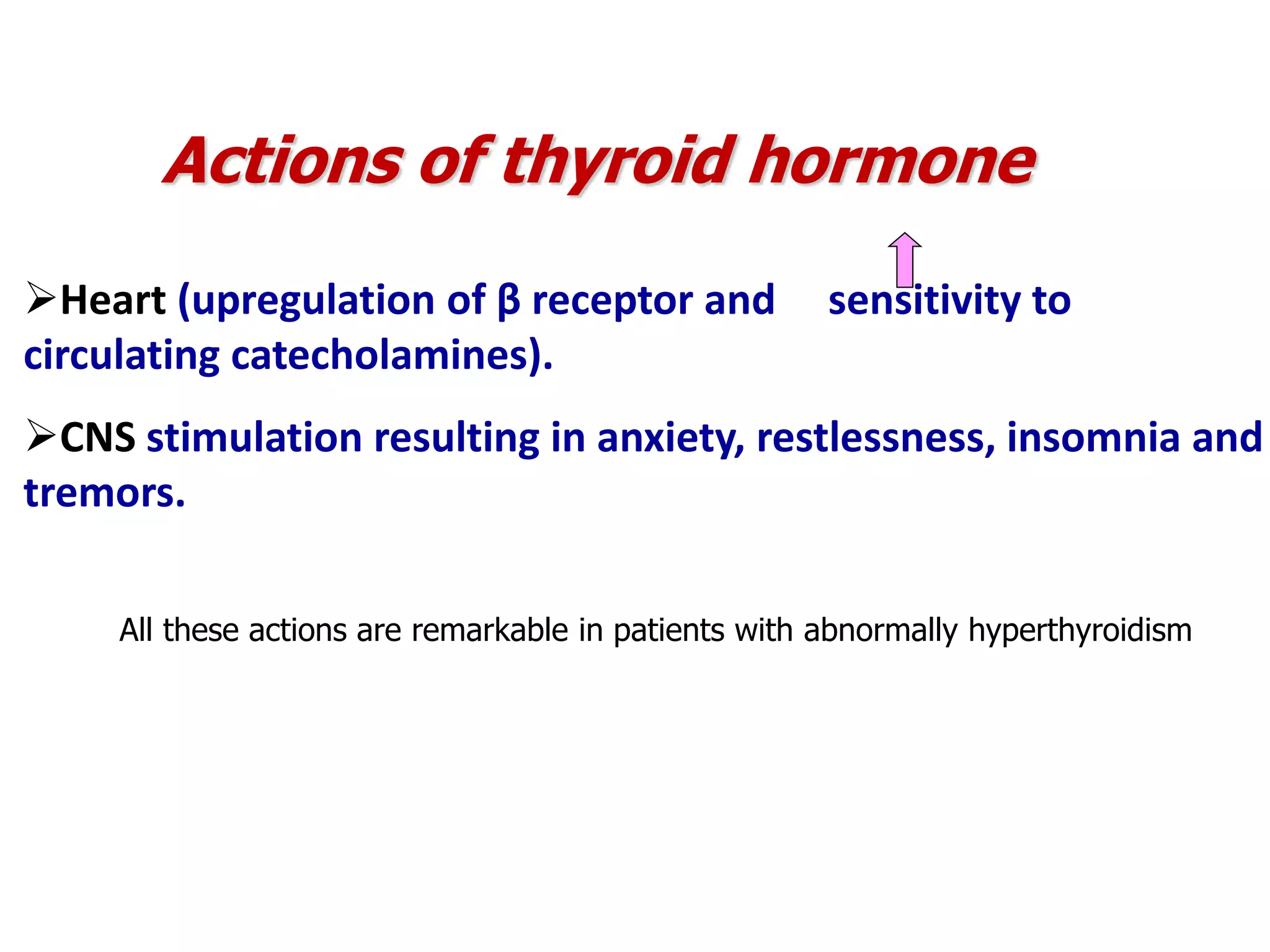
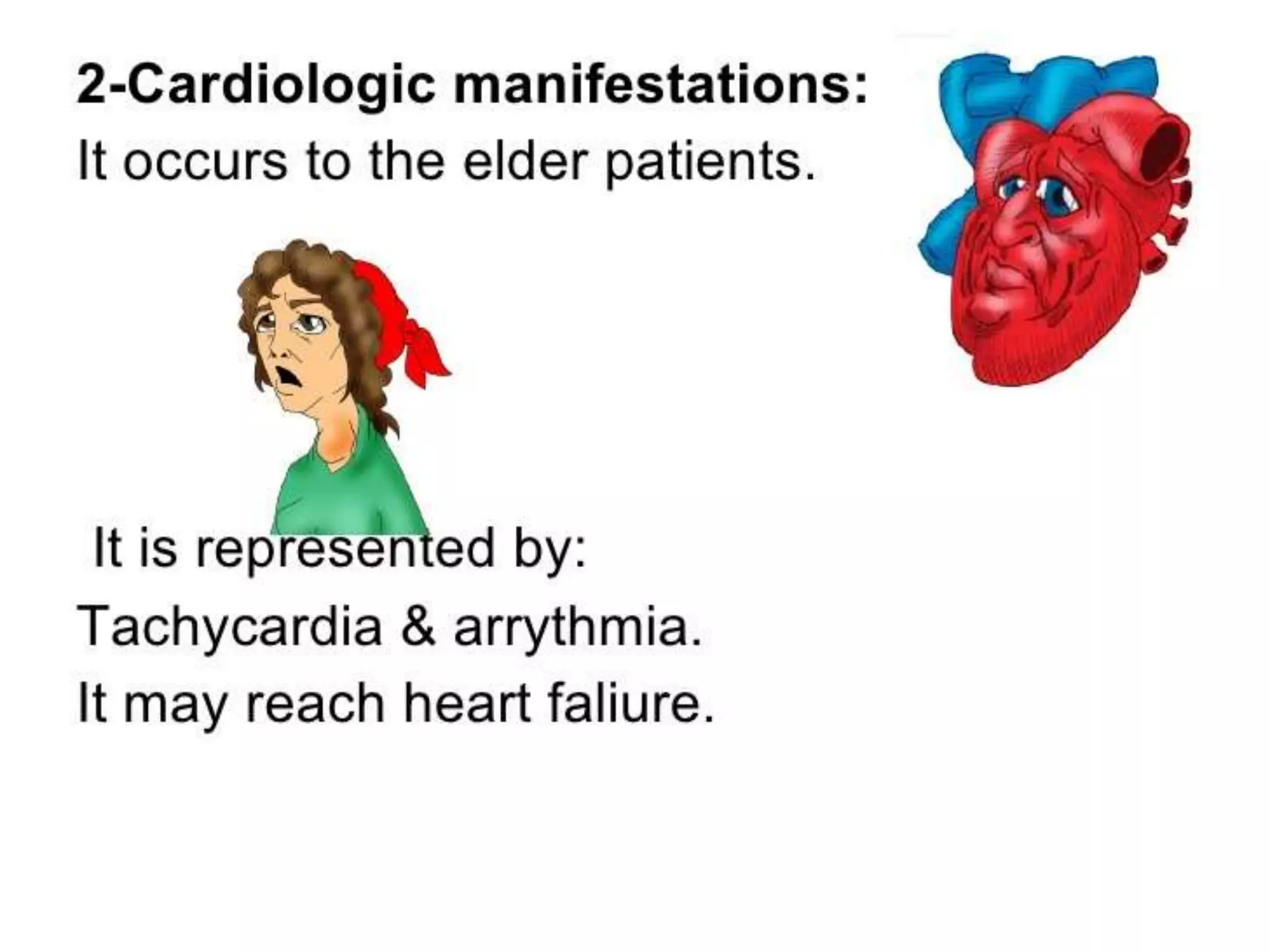
Heart (upregulation of β receptor and sensitivity to
circulating catecholamines).
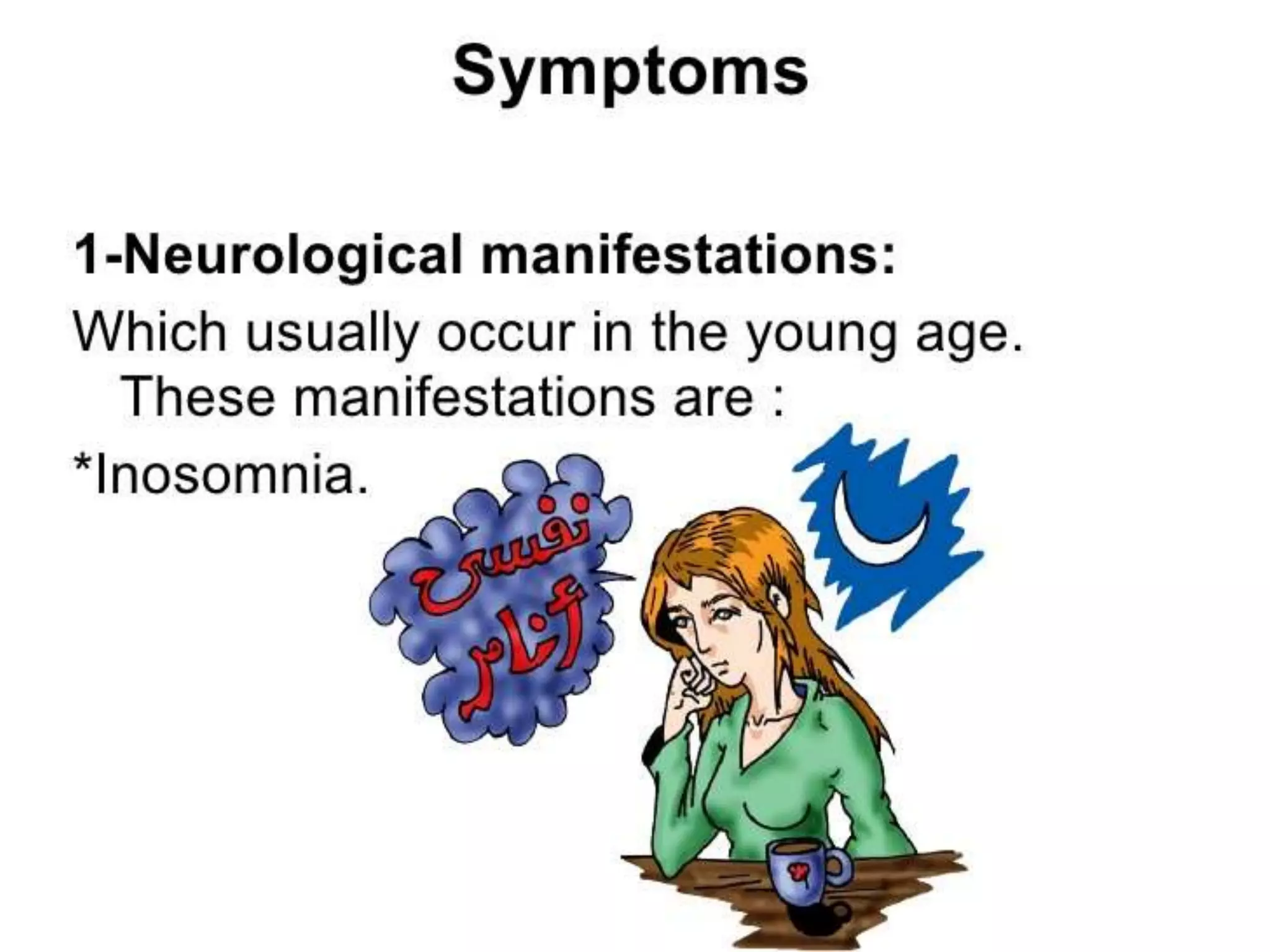
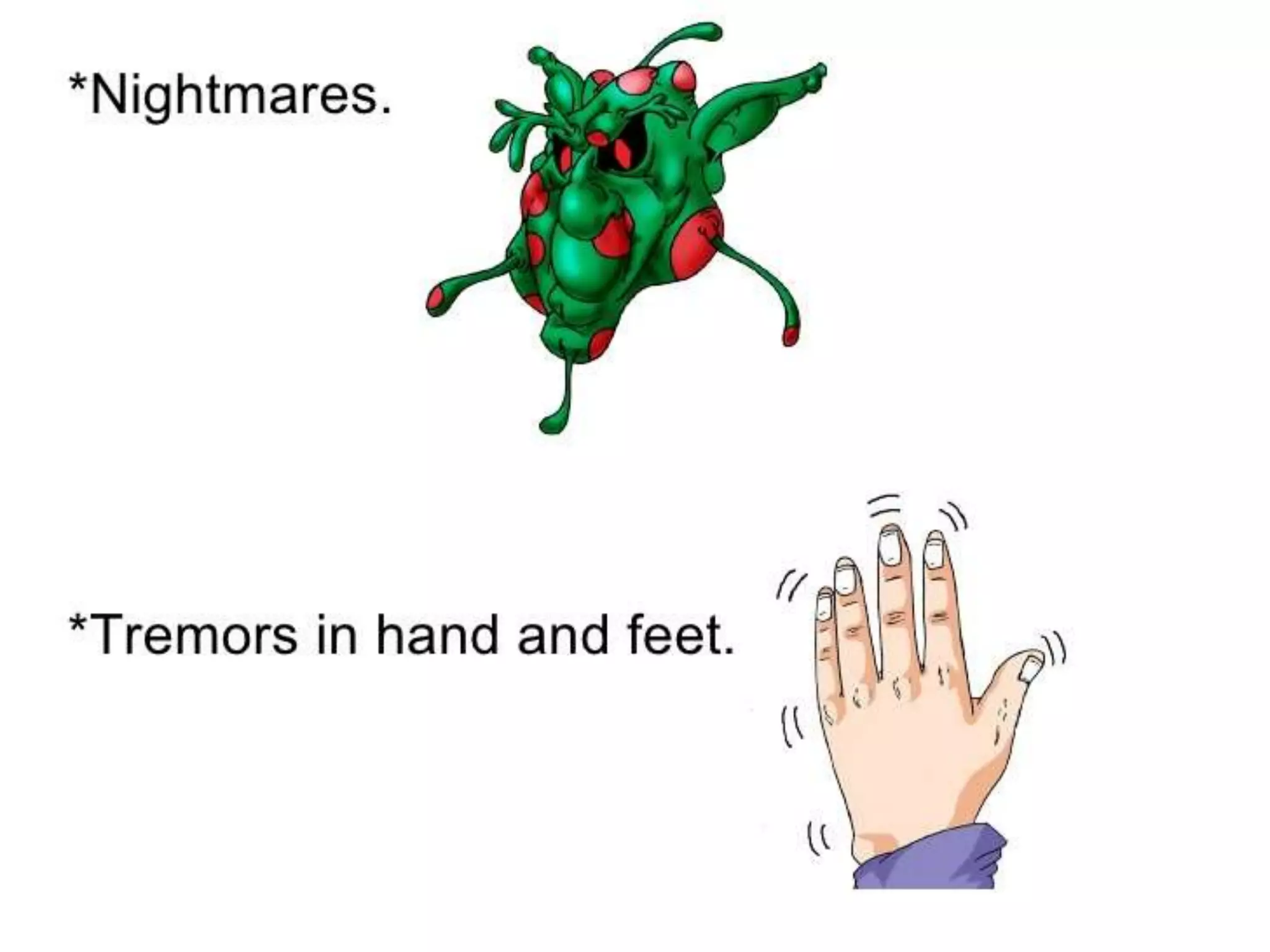
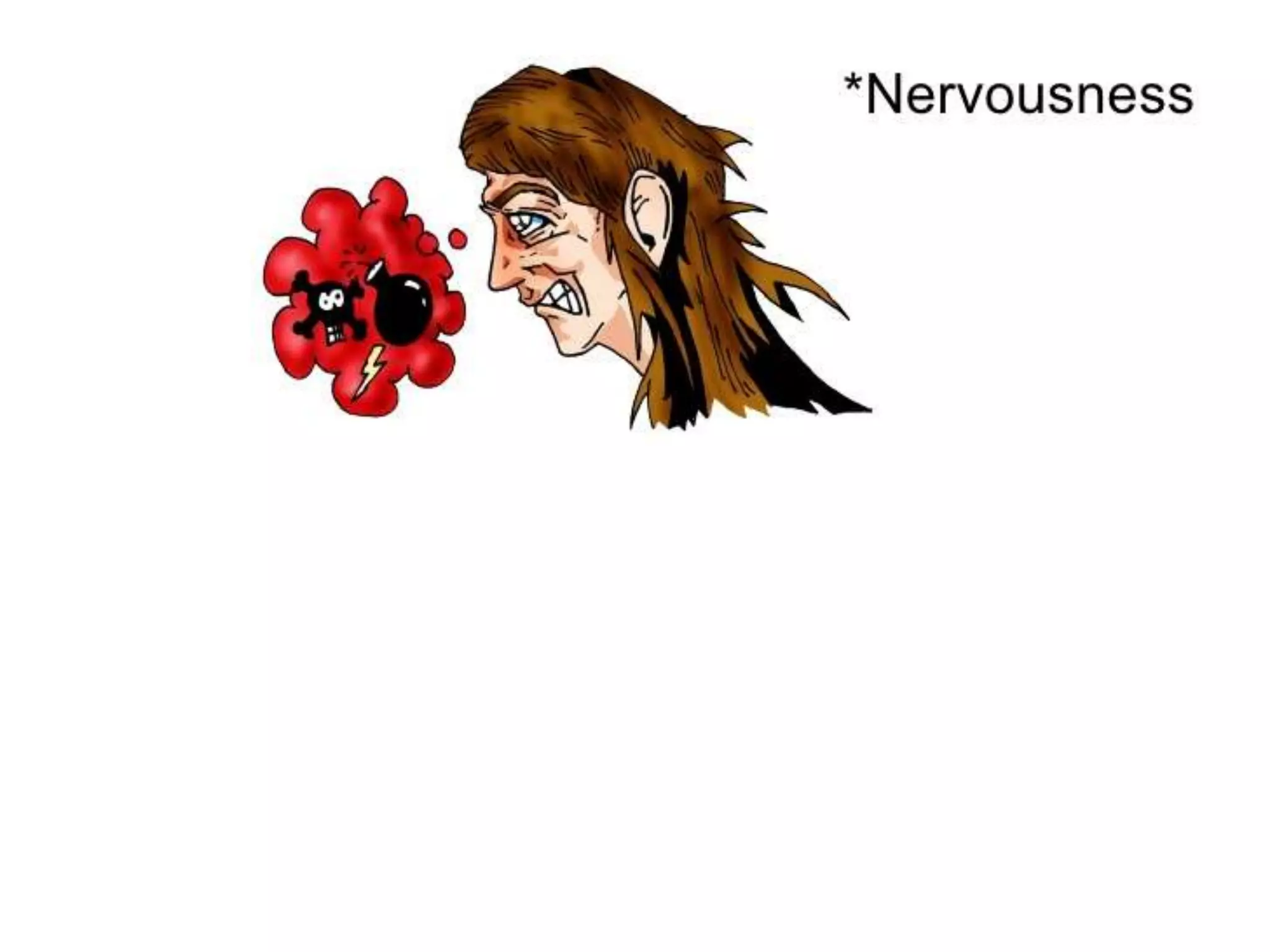
CNS stimulation resulting in anxiety, restlessness, insomnia and
tremors.
Actions of thyroid hormone
All these actions are remarkable in patients with abnormally hyperthyroidism
Classification of thyroid disorder
1- Hormonal disorder :
• Hypothyroidism
• Hyperthyroidism
2- Tumors as thyroid cancer.
3- Drug induced as amiodarone and interferon .
Hormonal disorder
• Hypothyroidism
• It refers to reduced
activity of the thyroid
gland (underactive
thyroid) leading to a
decrease in circulating
thyroid hormones. This
slows the metabolic
activity within the body.
• HYPERTHYROIDISM
• It refers to over activity
in the thyroid gland
leading to excessive
production of the
thyroid hormones and
accelerated metabolism
in the peripheral tissue.
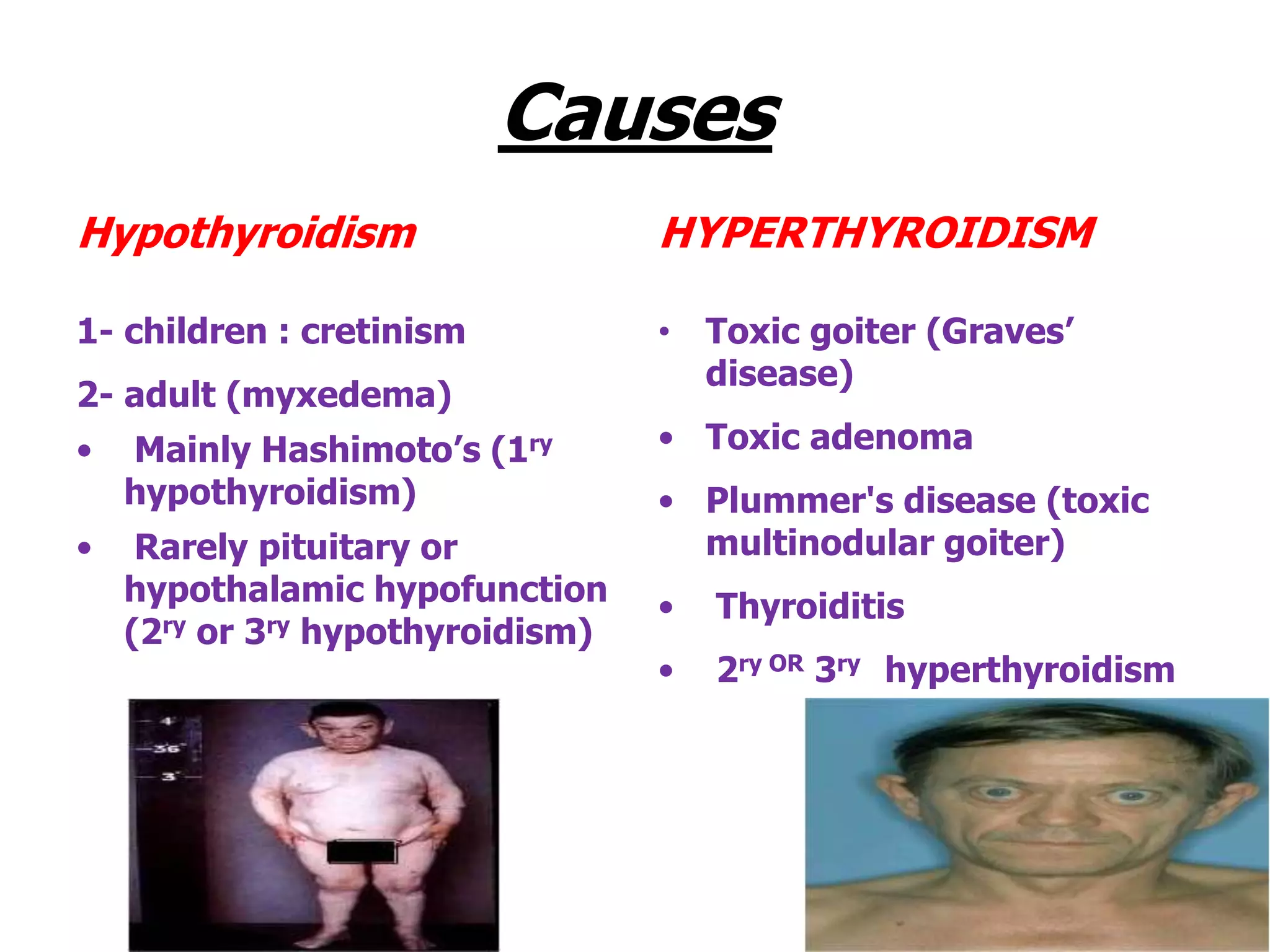
Causes
Hypothyroidism
1- children : cretinism
2- adult (myxedema)
• Mainly Hashimoto’s (1ry
hypothyroidism)
• Rarely pituitary or
hypothalamic hypofunction
(2ry or 3ry hypothyroidism)
HYPERTHYROIDISM
• Toxic goiter (Graves’
disease)
• Toxic adenoma
• Plummer's disease (toxic
multinodular goiter)
• Thyroiditis
• 2ry OR 3ry hyperthyroidism
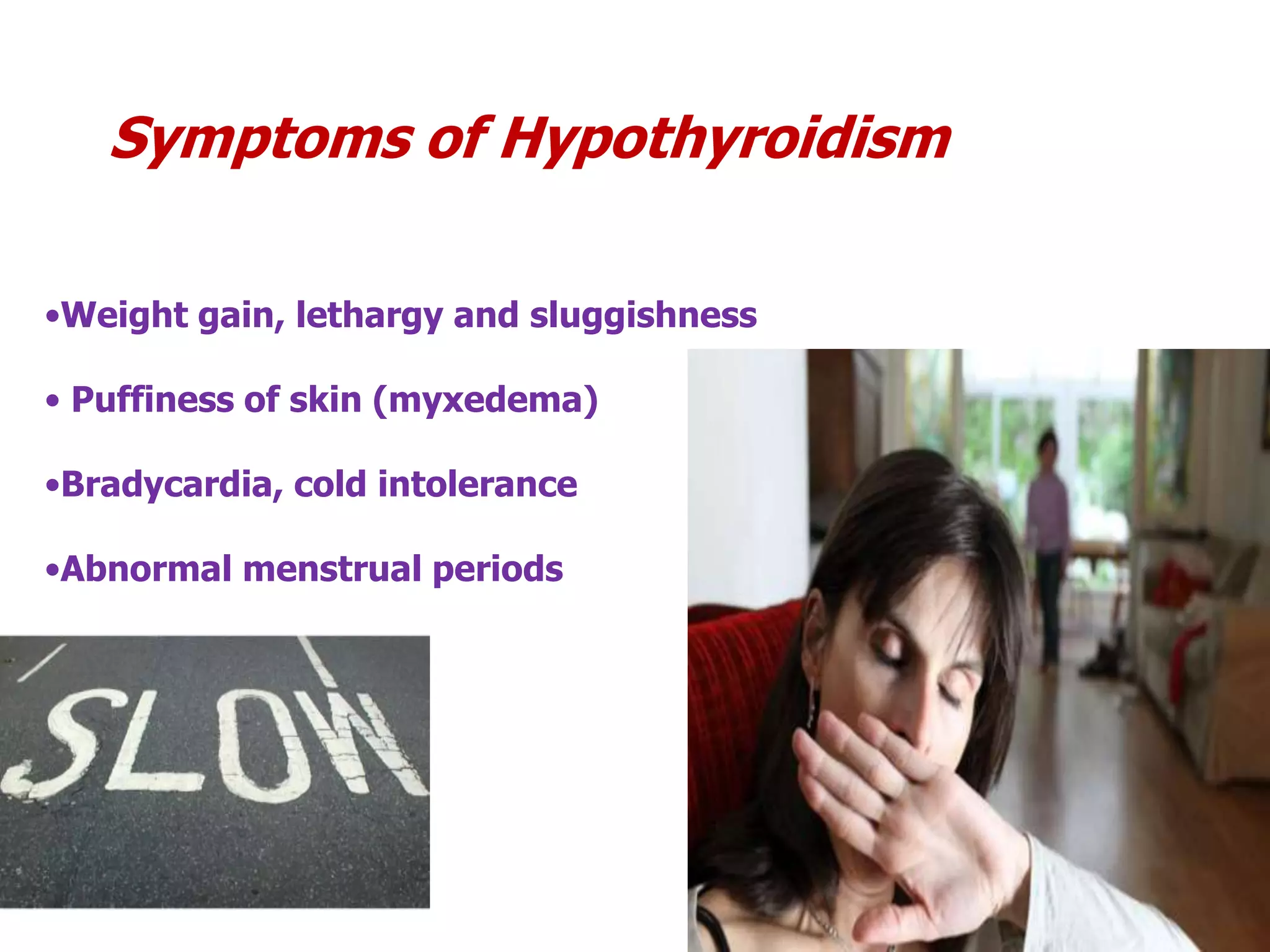
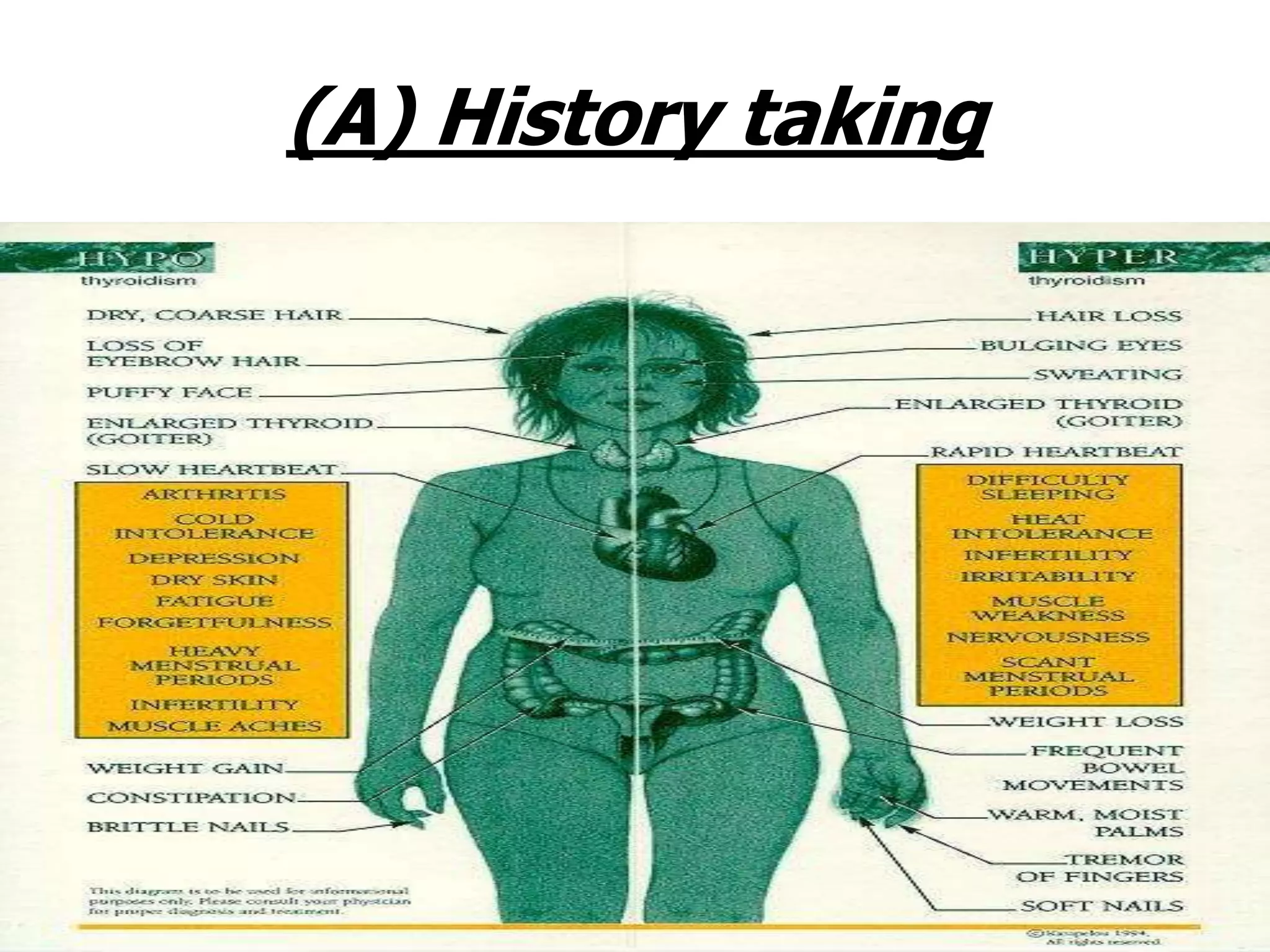
•Weight gain, lethargy and sluggishness
• Puffiness of skin (myxedema)
•Bradycardia, cold intolerance
•Abnormal menstrual periods
Symptoms of Hypothyroidism
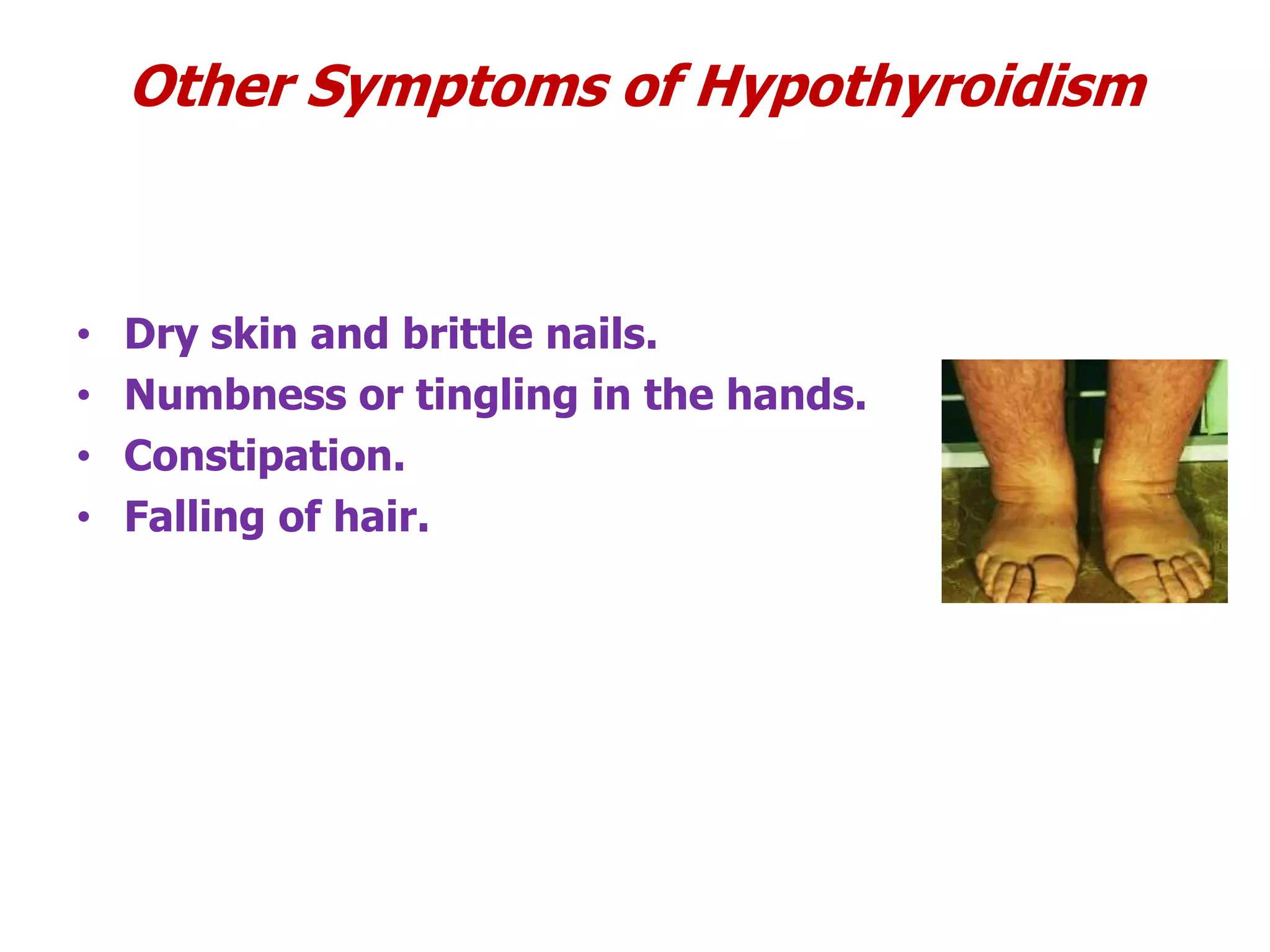
Other Symptoms of Hypothyroidism
• Dry skin and brittle nails.
• Numbness or tingling in the hands.
• Constipation.
• Falling of hair.
How to deal with a case of thyroid
dysfunction
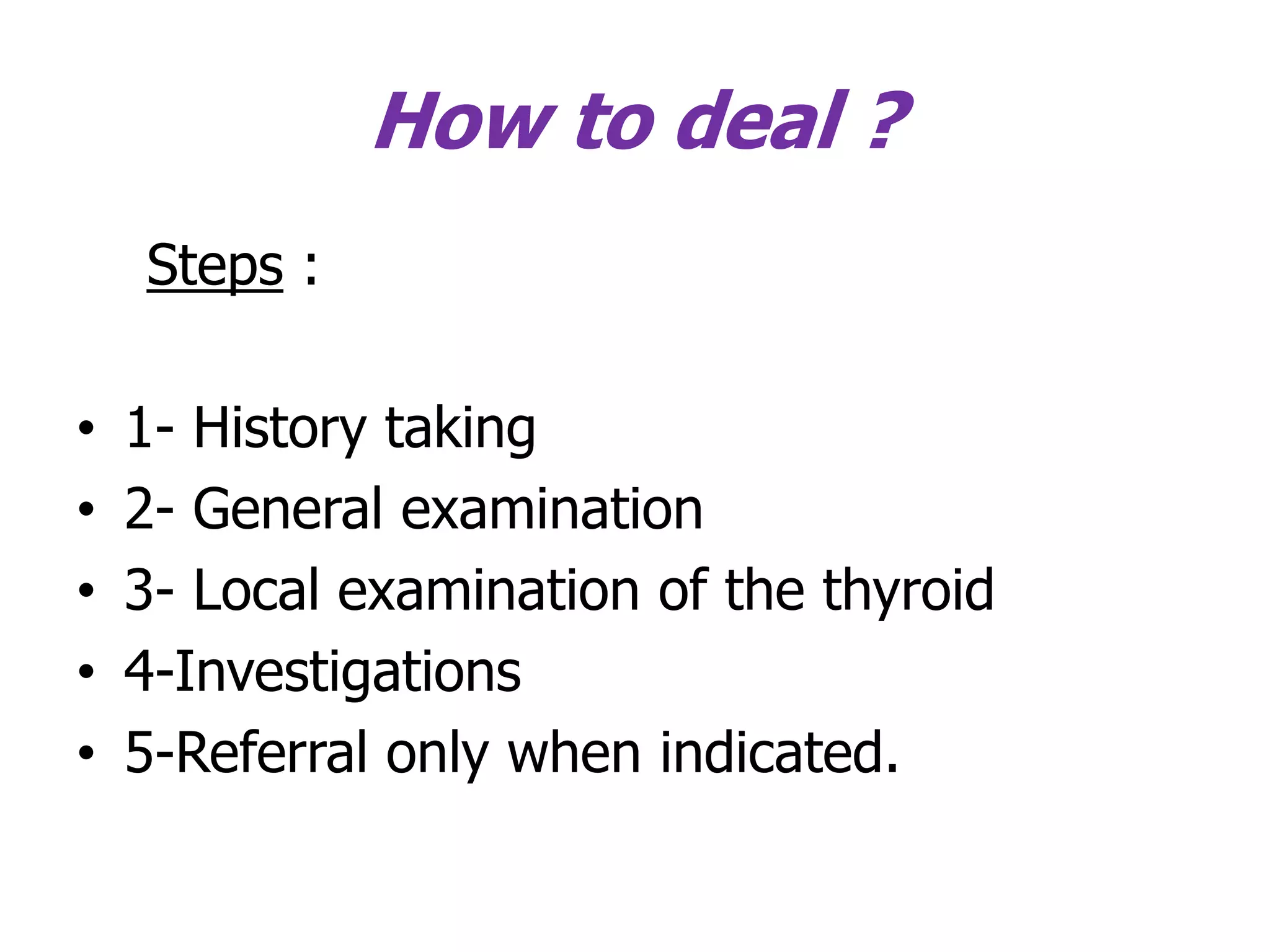
How we discover a case of thyroid
dysfunction in medical commission ?
• 1- Detected clinically during medical fitness
examination.
• 2- Detected by abnormal CXR.
How to deal ?
Steps :
• 1- History taking
• 2- General examination
• 3- Local examination of the thyroid
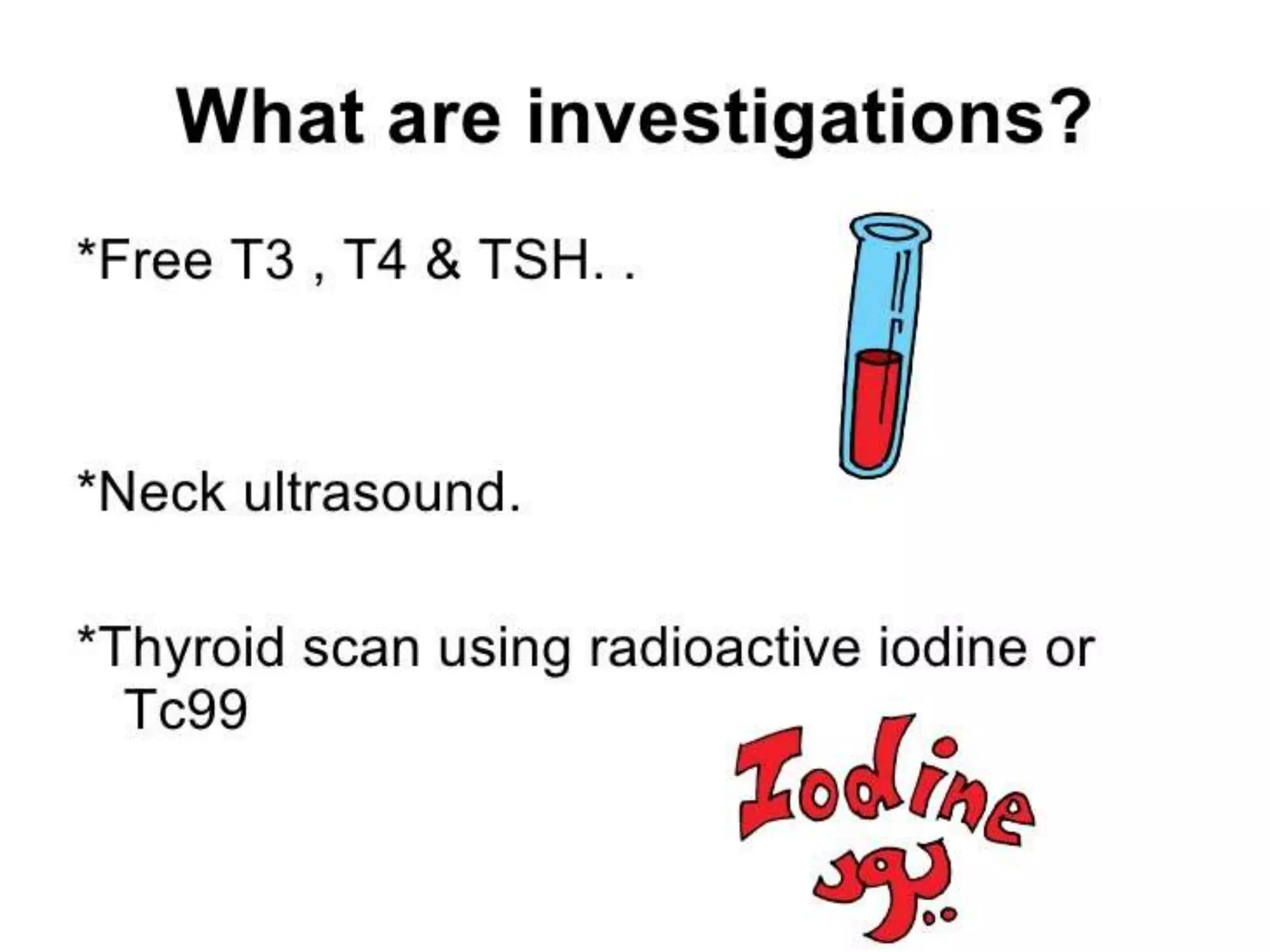
• 4-Investigations
• 5-Referral only when indicated.
(A) History taking
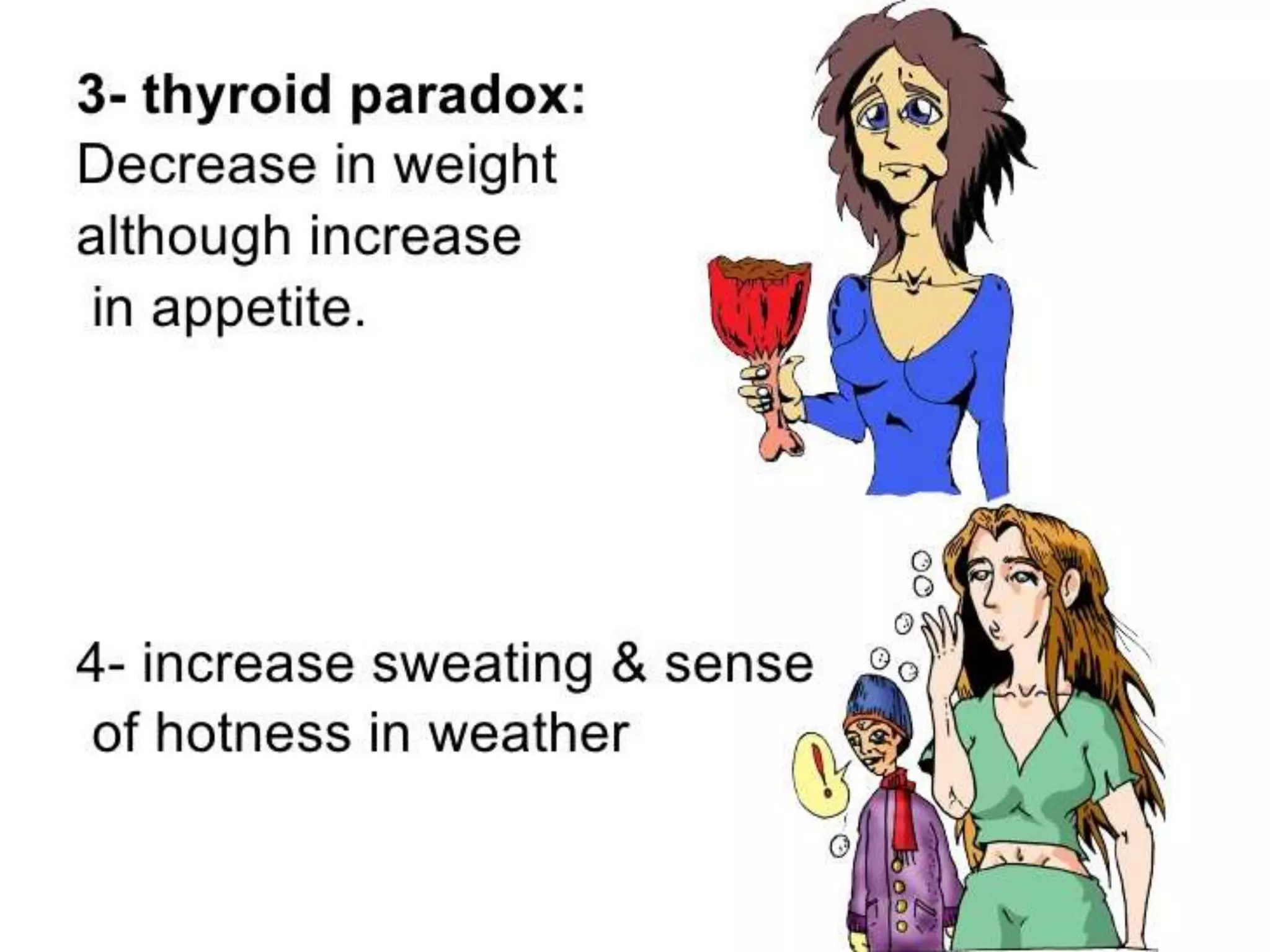
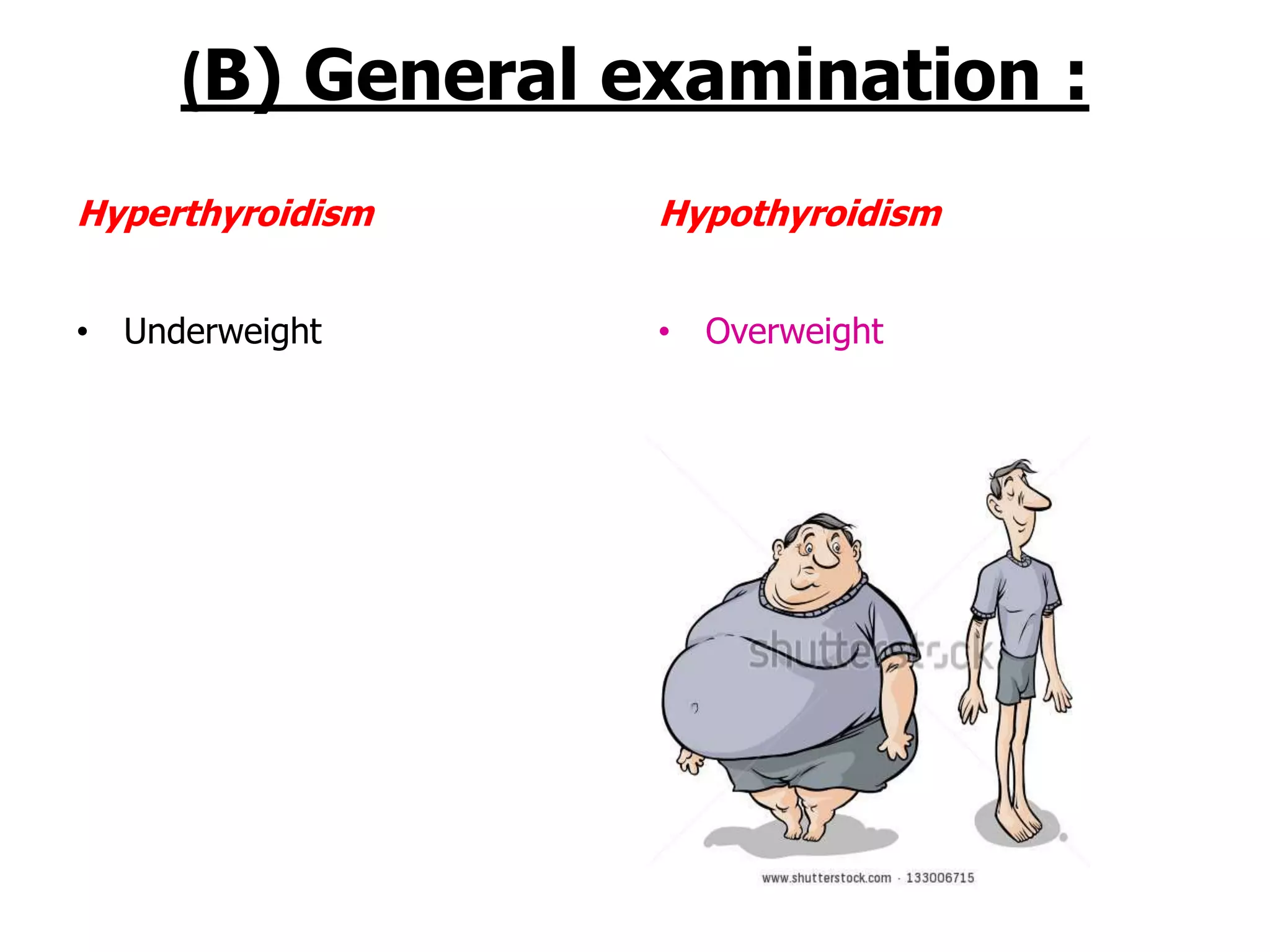
(B) General examination :
• Underweight • Overweight
Hyperthyroidism Hypothyroidism
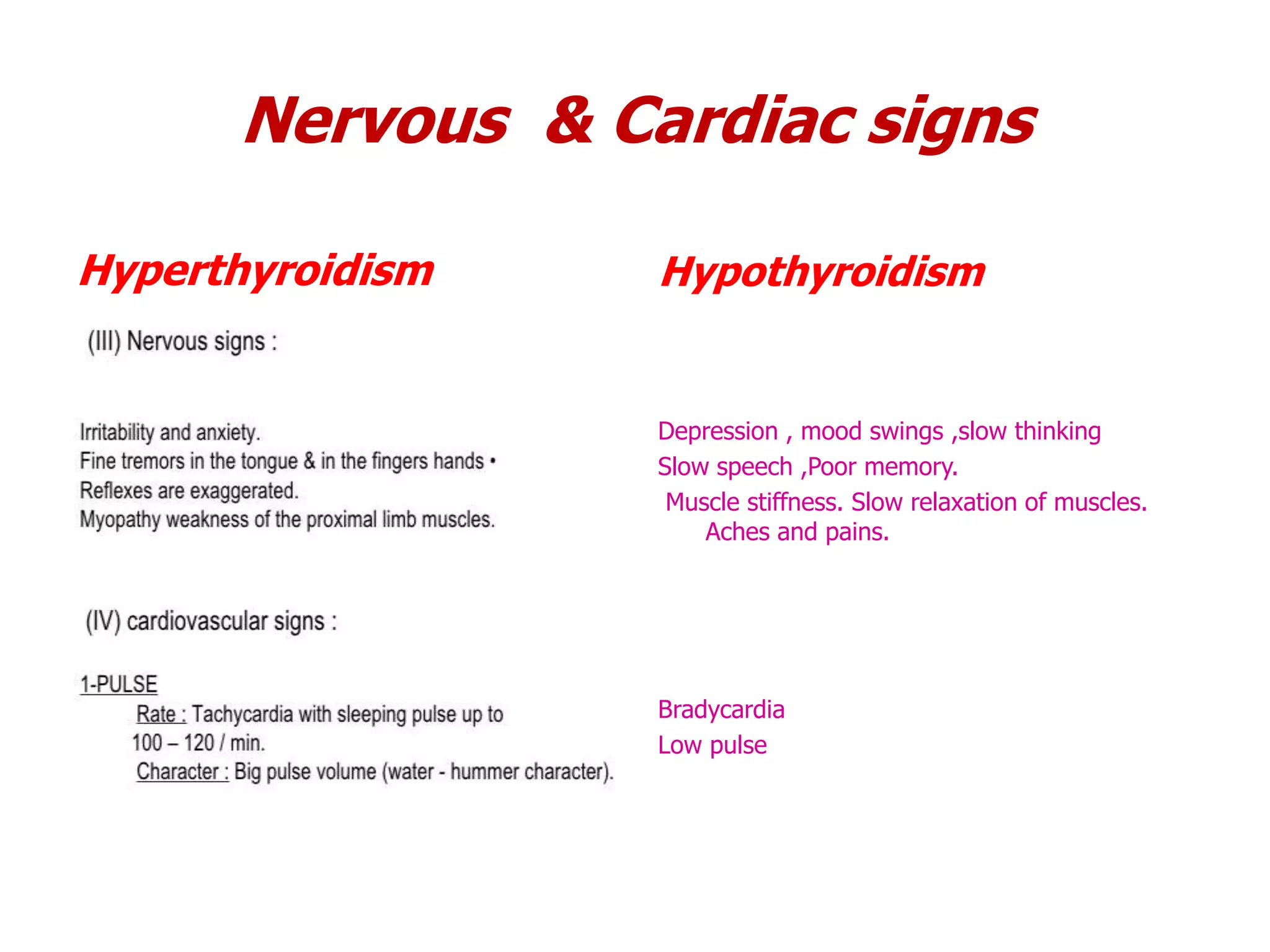
Nervous & Cardiac signs
Hyperthyroidism Hypothyroidism
Depression , mood swings ,slow thinking
Slow speech ,Poor memory.
Muscle stiffness. Slow relaxation of muscles.
Aches and pains.
Bradycardia
Low pulse
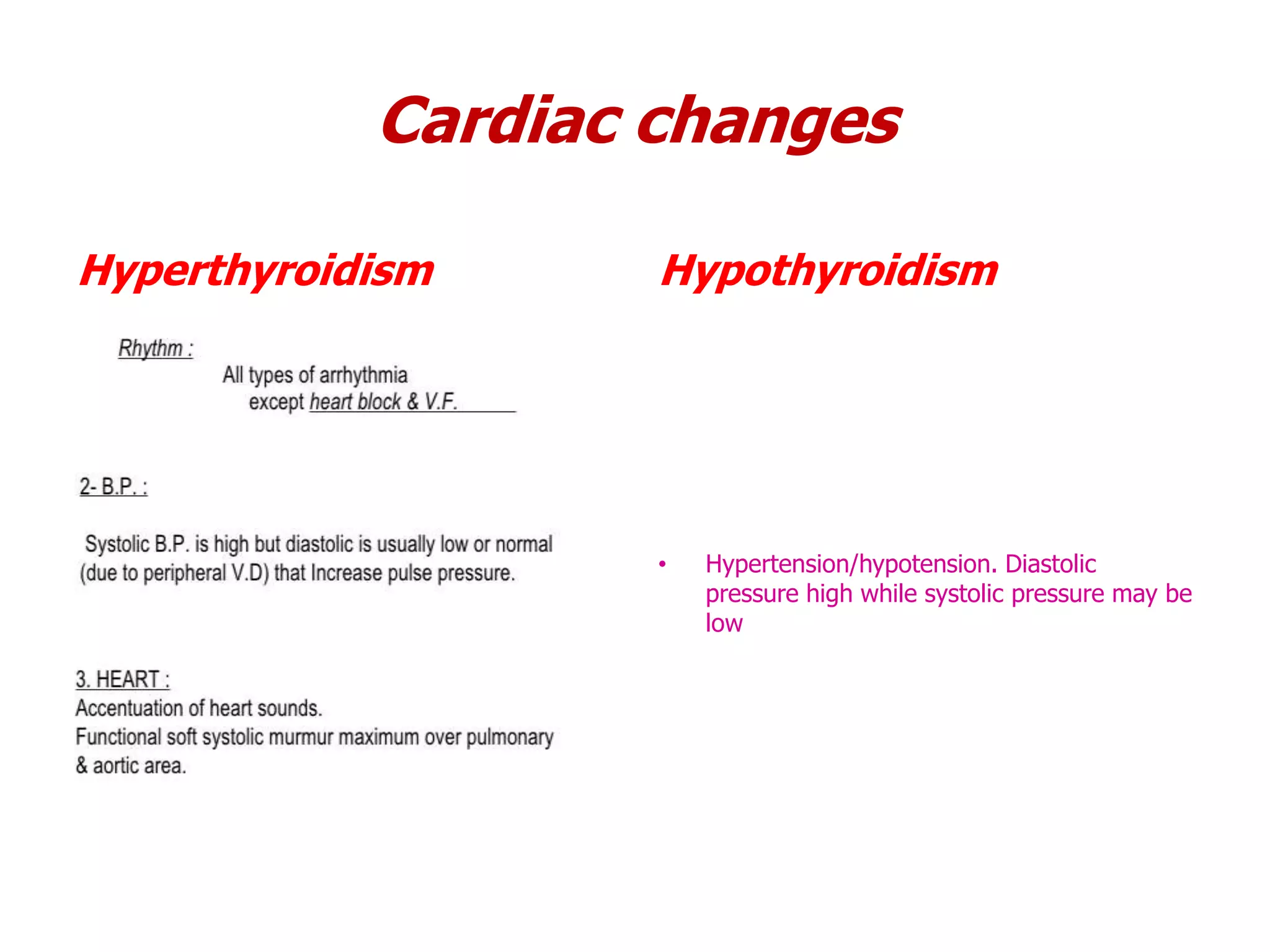
Cardiac changes
Hyperthyroidism Hypothyroidism
• Hypertension/hypotension. Diastolic
pressure high while systolic pressure may be
low
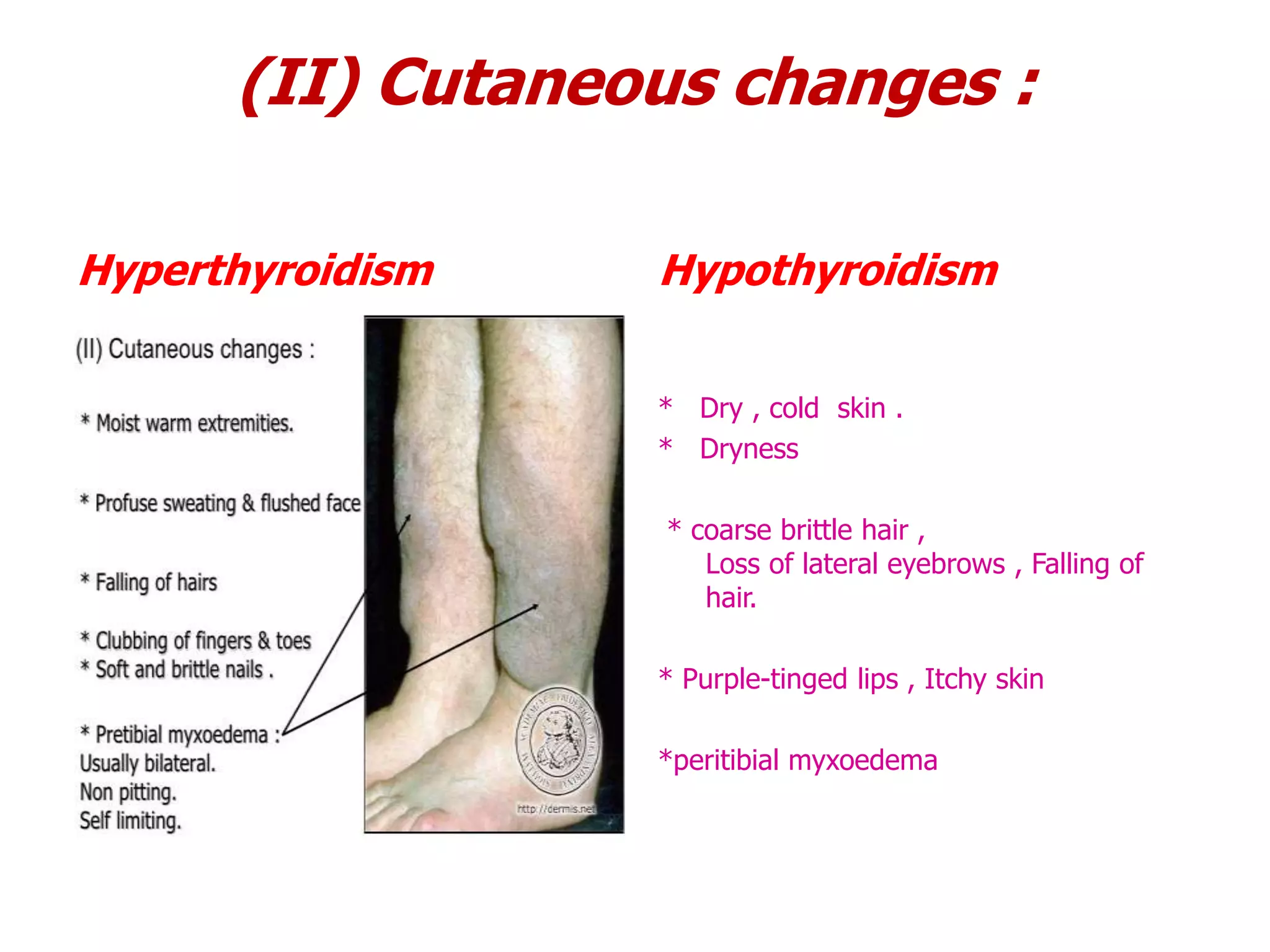
(II) Cutaneous changes :
Hypothyroidism
* Dry , cold skin .
* Dryness
* coarse brittle hair ,
Loss of lateral eyebrows , Falling of
hair.
* Purple-tinged lips , Itchy skin
*peritibial myxoedema
Hyperthyroidism
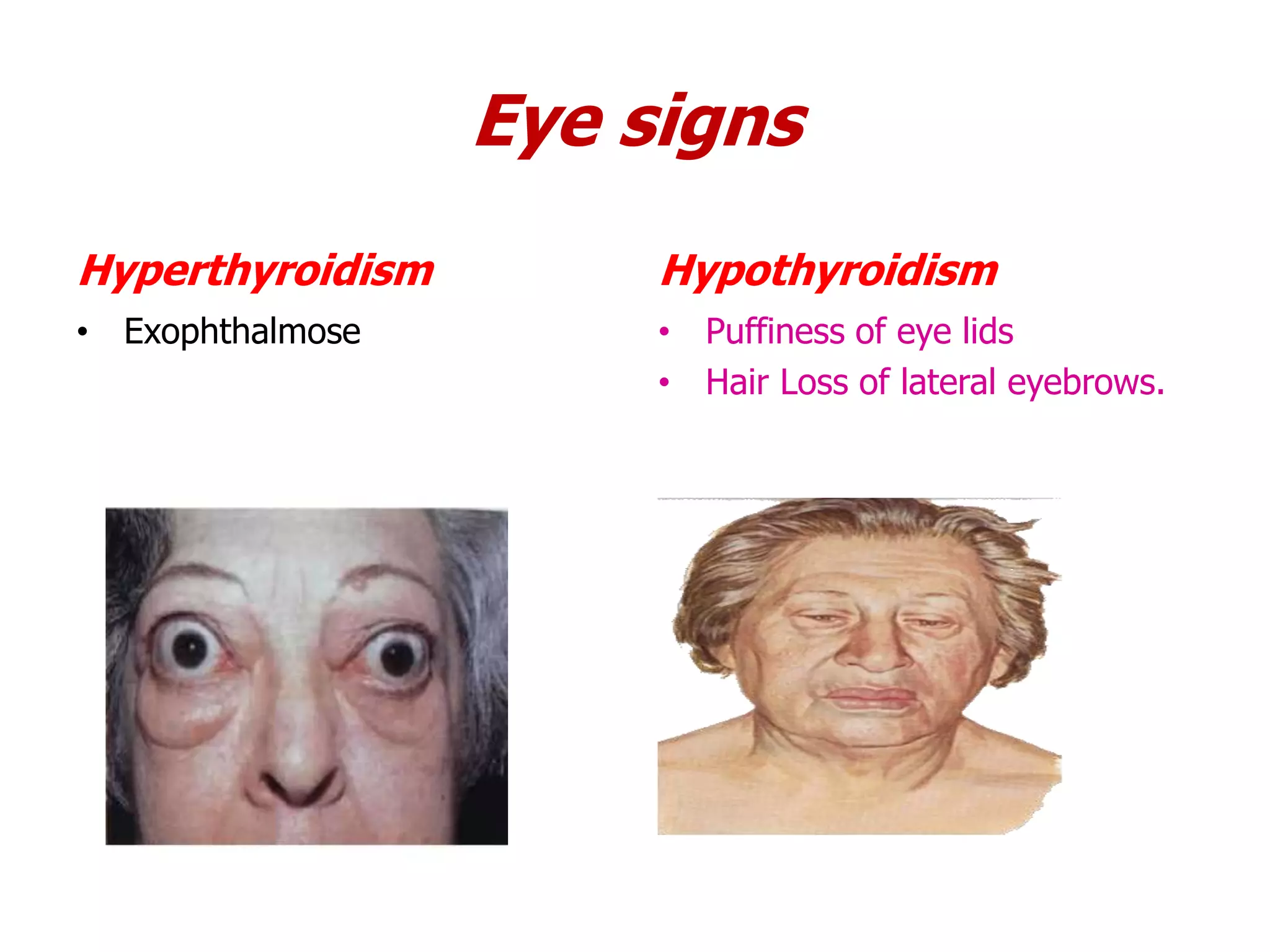
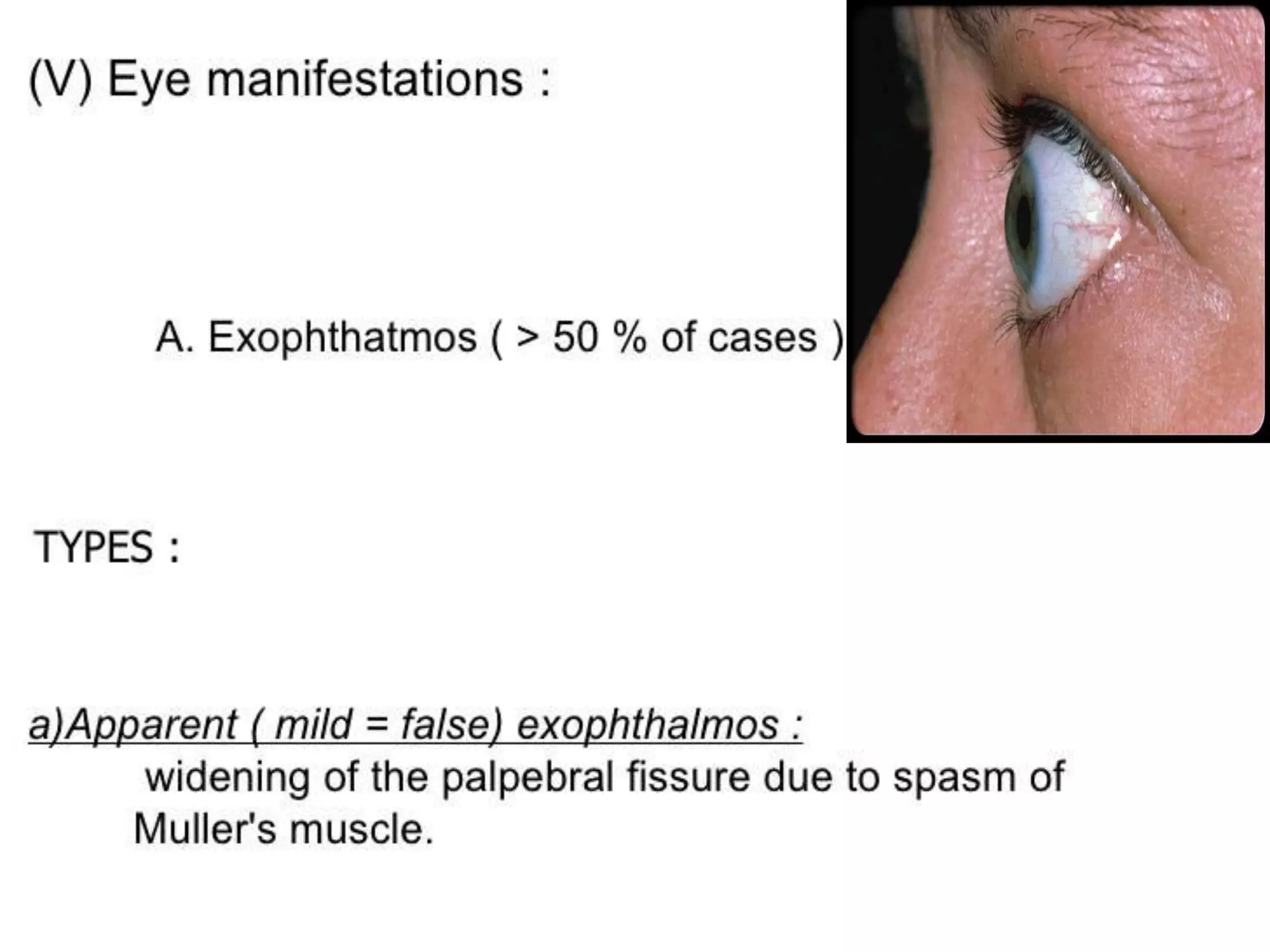
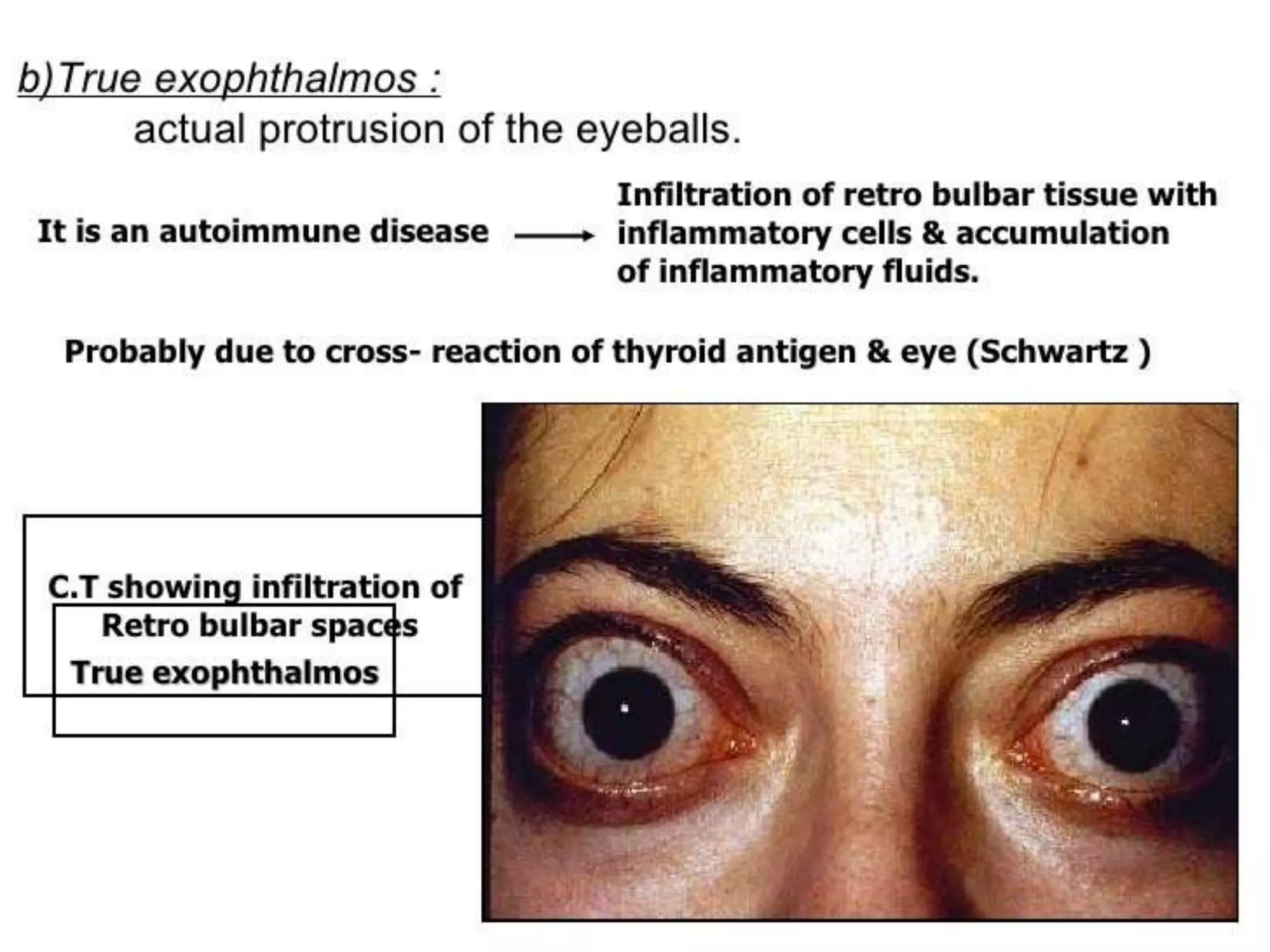
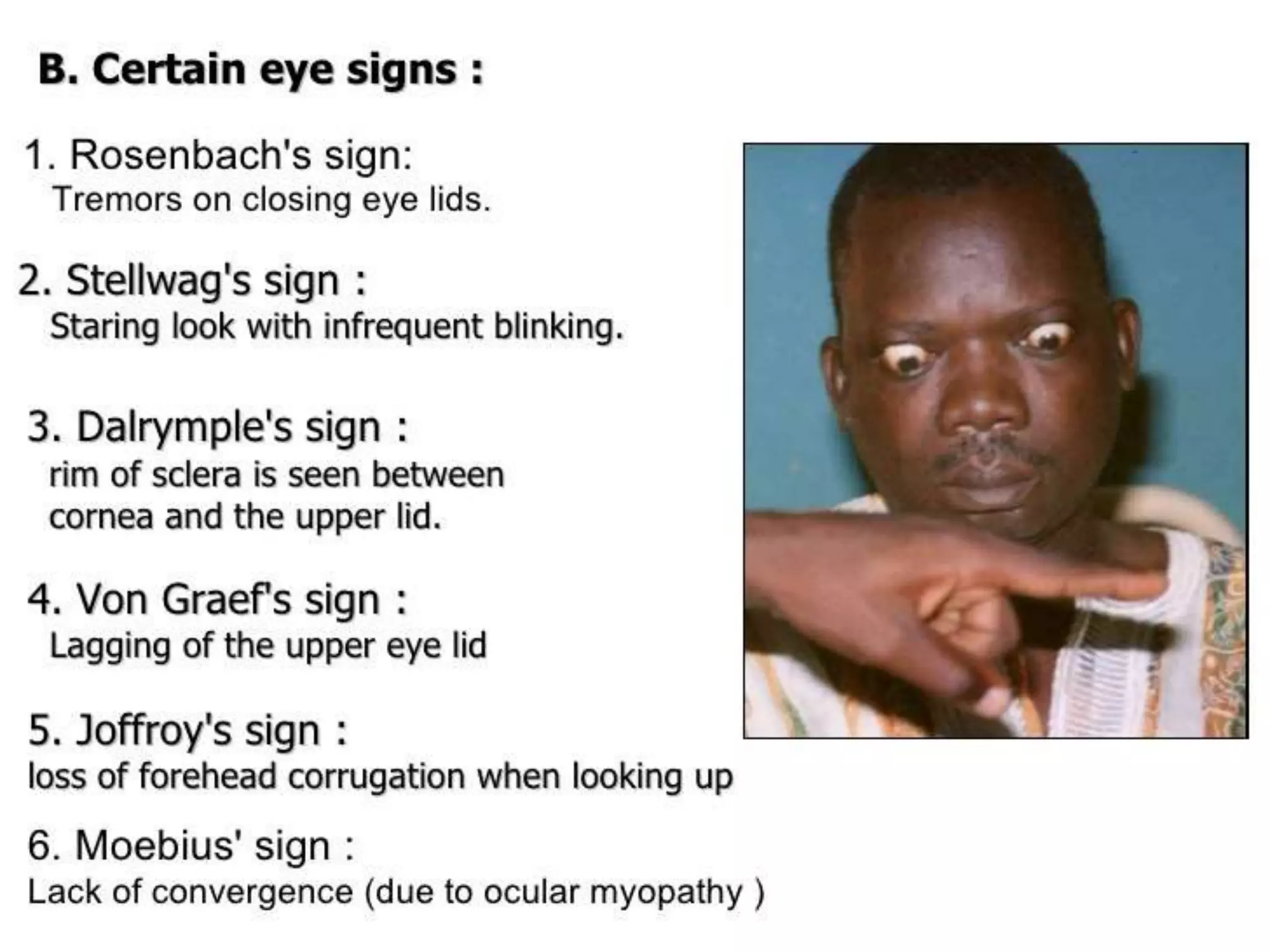
Eye signs
Hyperthyroidism
• Exophthalmose
Hypothyroidism
• Puffiness of eye lids
• Hair Loss of lateral eyebrows.
( C ) LOCAL Examination of thyroid
The examination consists of :
1- Inspection
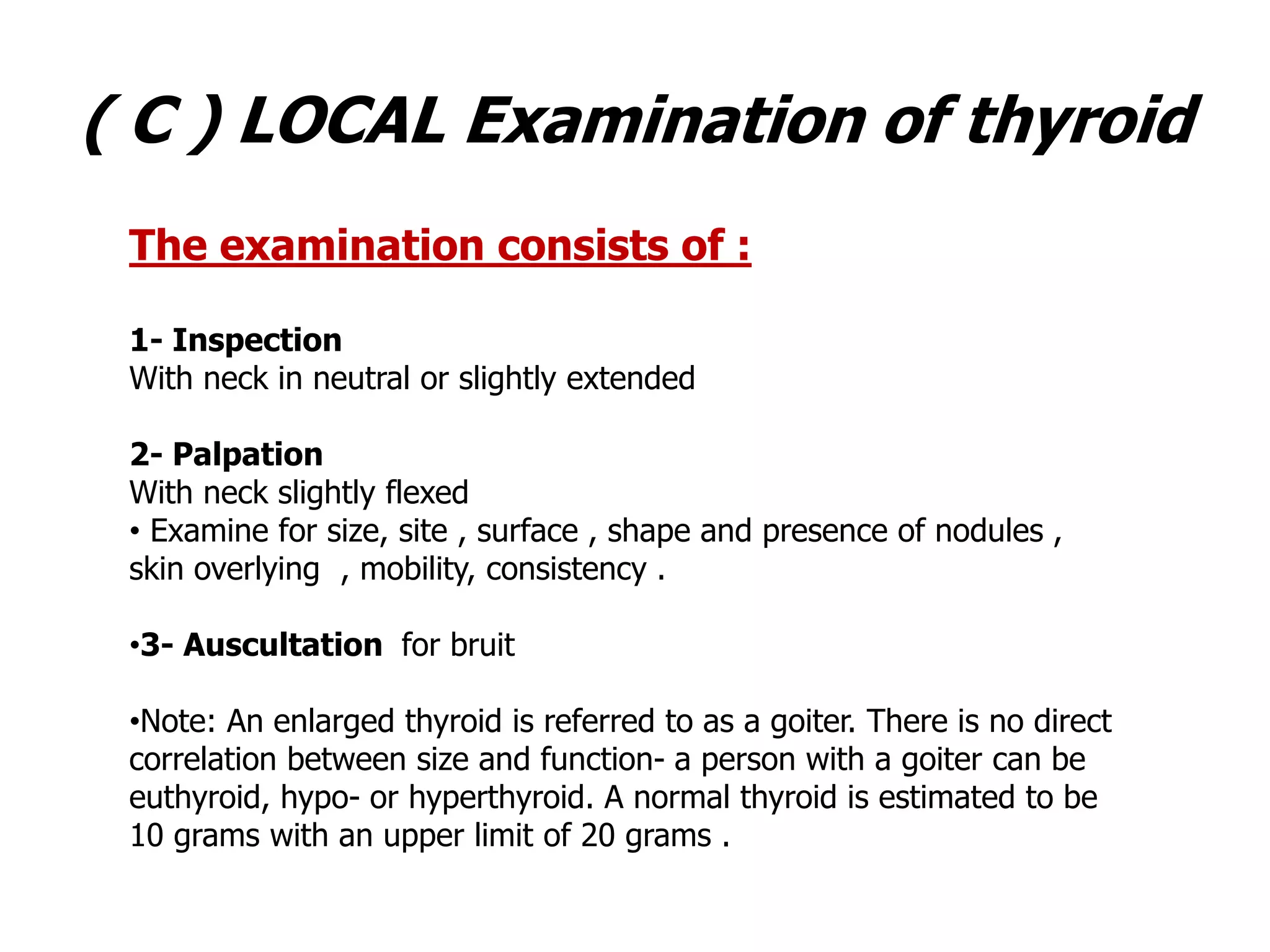
With neck in neutral or slightly extended
2- Palpation
With neck slightly flexed
• Examine for size, site , surface , shape and presence of nodules ,
skin overlying , mobility, consistency .
•3- Auscultation for bruit
•Note: An enlarged thyroid is referred to as a goiter. There is no direct
correlation between size and function- a person with a goiter can be
euthyroid, hypo- or hyperthyroid. A normal thyroid is estimated to be
10 grams with an upper limit of 20 grams .
Inspection
Inspection: Anterior
Approach
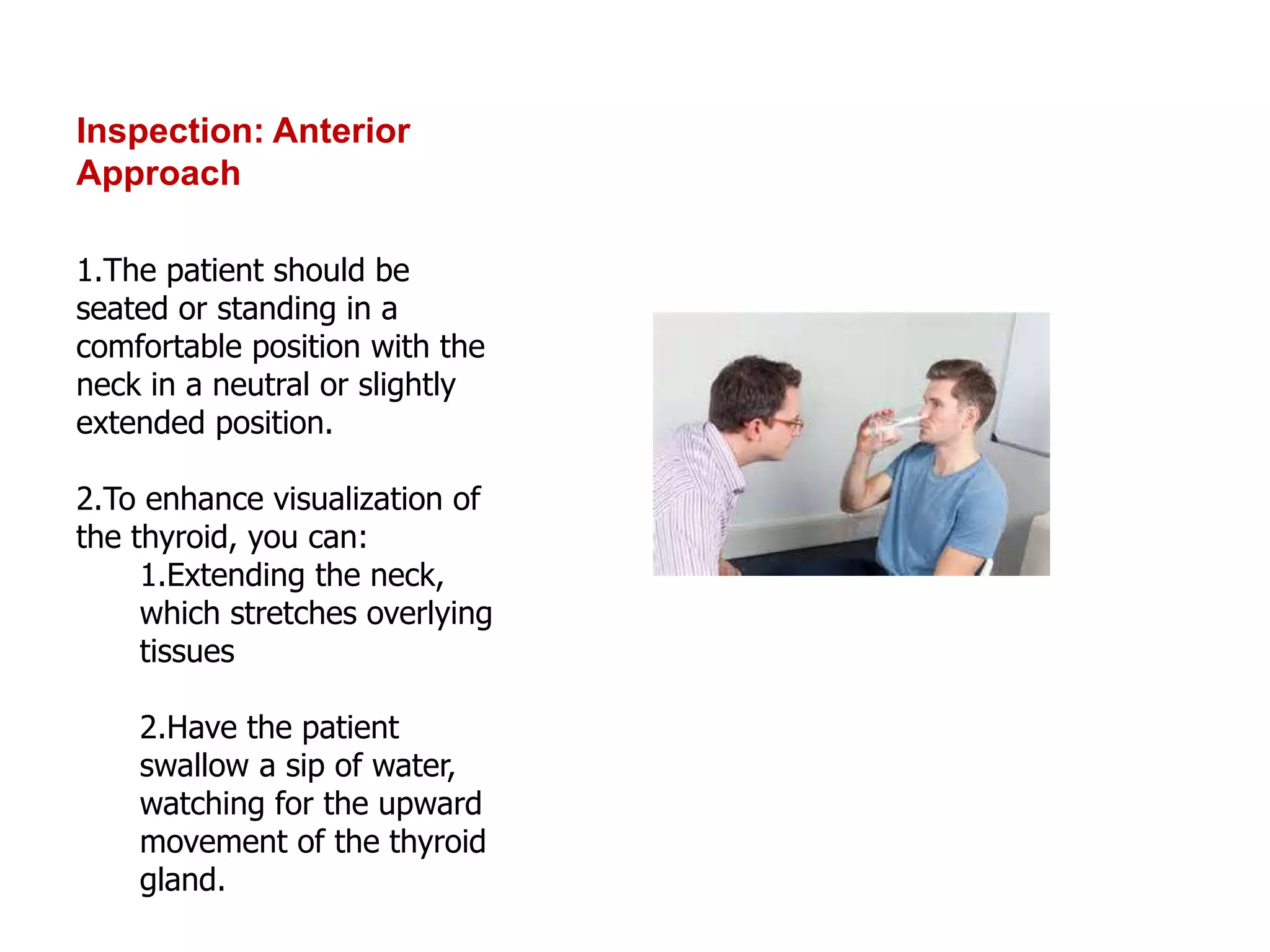
1.The patient should be
seated or standing in a
comfortable position with the
neck in a neutral or slightly
extended position.
2.To enhance visualization of
the thyroid, you can:
1.Extending the neck,
which stretches overlying
tissues
2.Have the patient
swallow a sip of water,
watching for the upward
movement of the thyroid
gland.
Inspection: Lateral
Approach
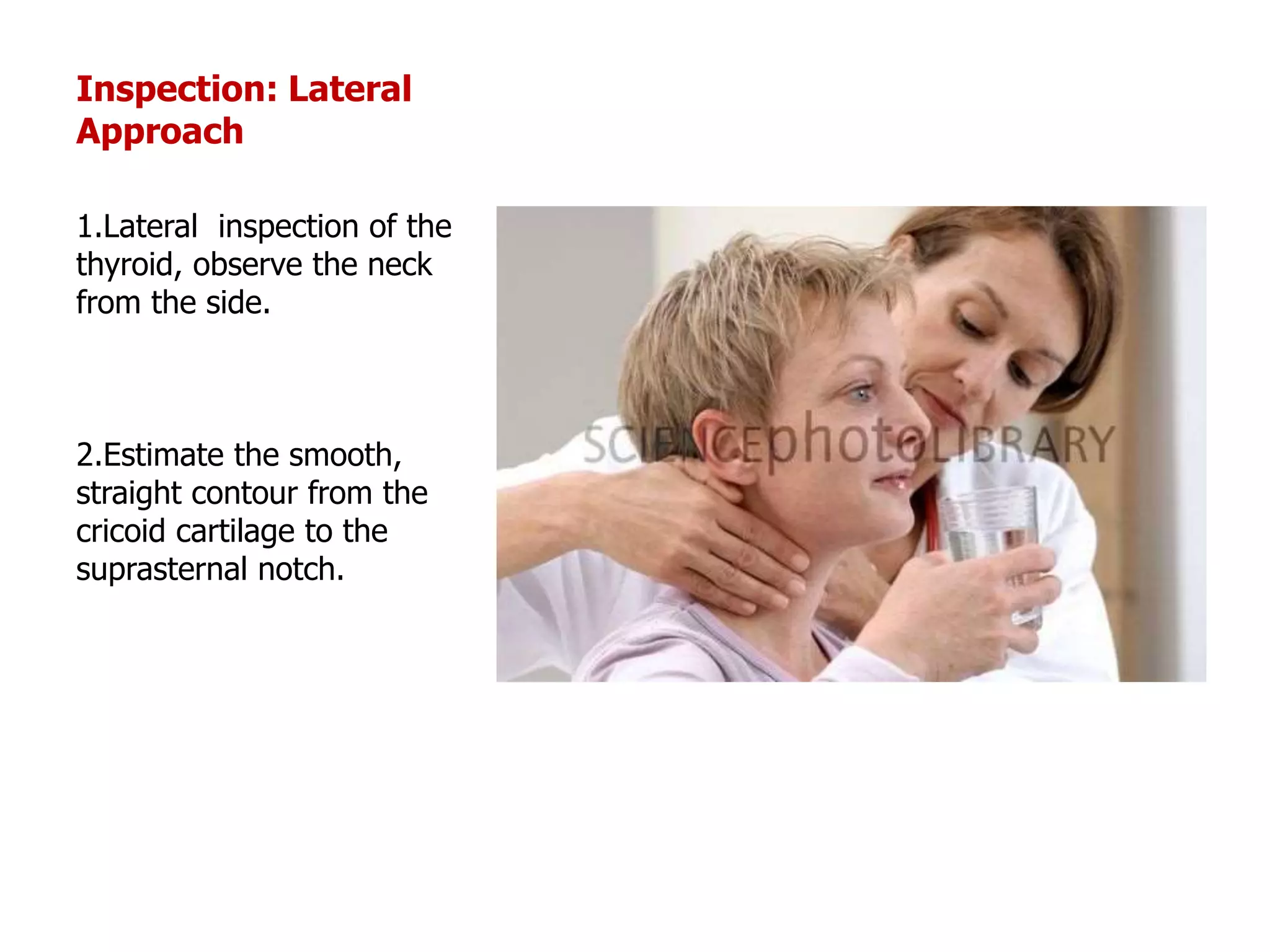
1.Lateral inspection of the
thyroid, observe the neck
from the side.
2.Estimate the smooth,
straight contour from the
cricoid cartilage to the
suprasternal notch.
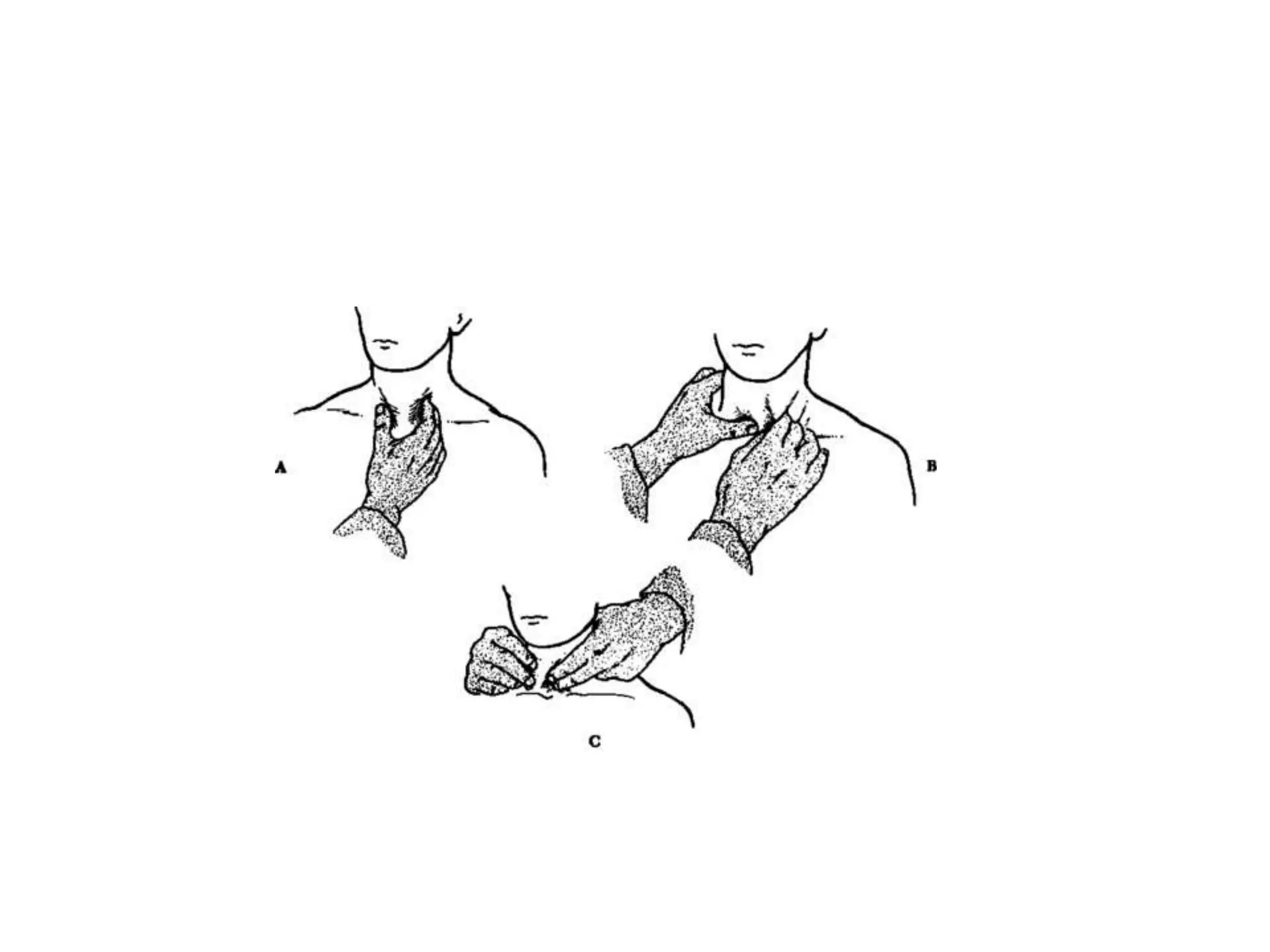
Palpation
• Note: There is no data comparing palpation using the
anterior approach to the posterior approach so
examiners should use the approach that they find most
comfortable.
Palpation: Anterior
Approach
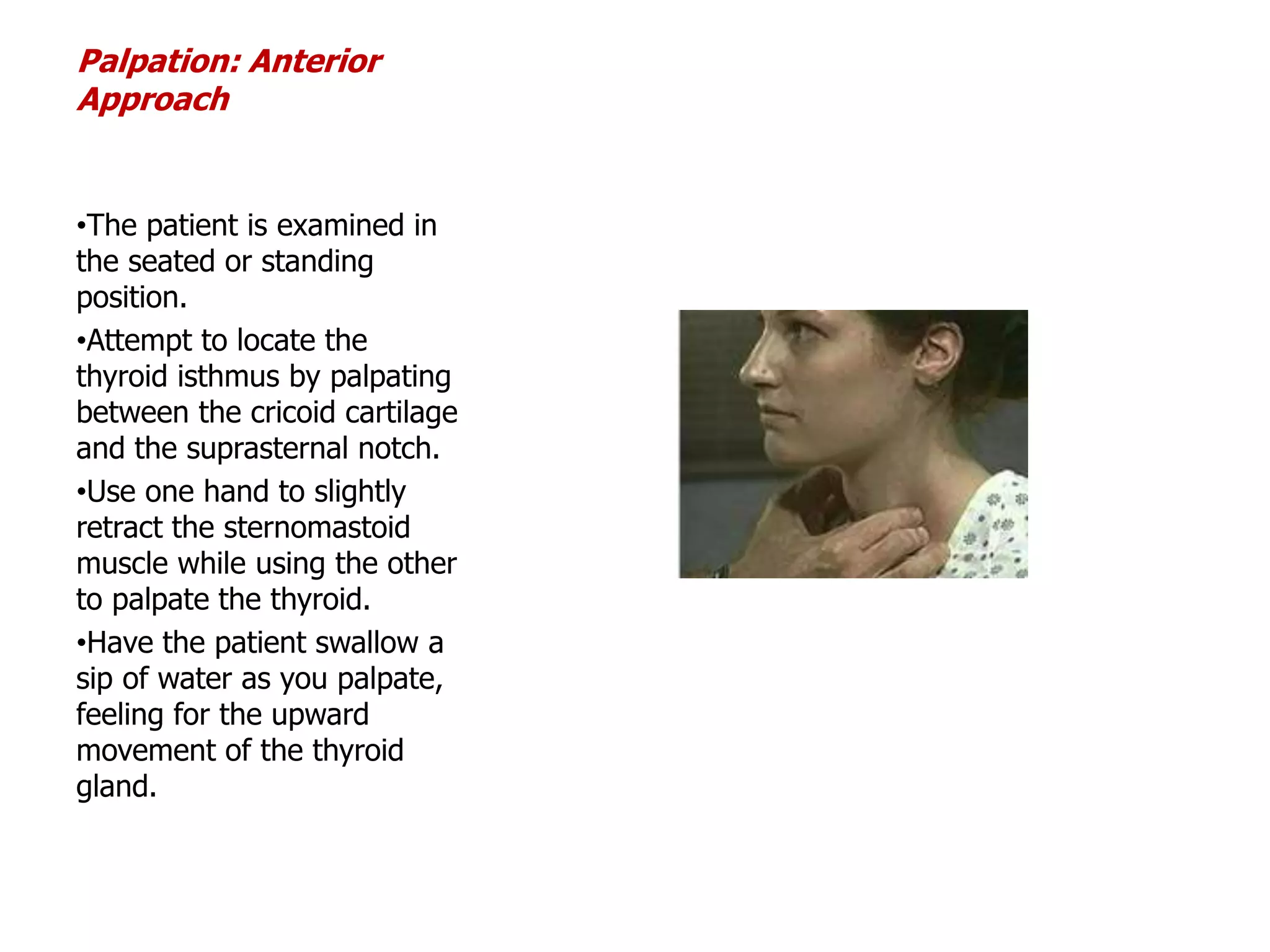
•The patient is examined in
the seated or standing
position.
•Attempt to locate the
thyroid isthmus by palpating
between the cricoid cartilage
and the suprasternal notch.
•Use one hand to slightly
retract the sternomastoid
muscle while using the other
to palpate the thyroid.
•Have the patient swallow a
sip of water as you palpate,
feeling for the upward
movement of the thyroid
gland.
Palpation: Posterior
Approach
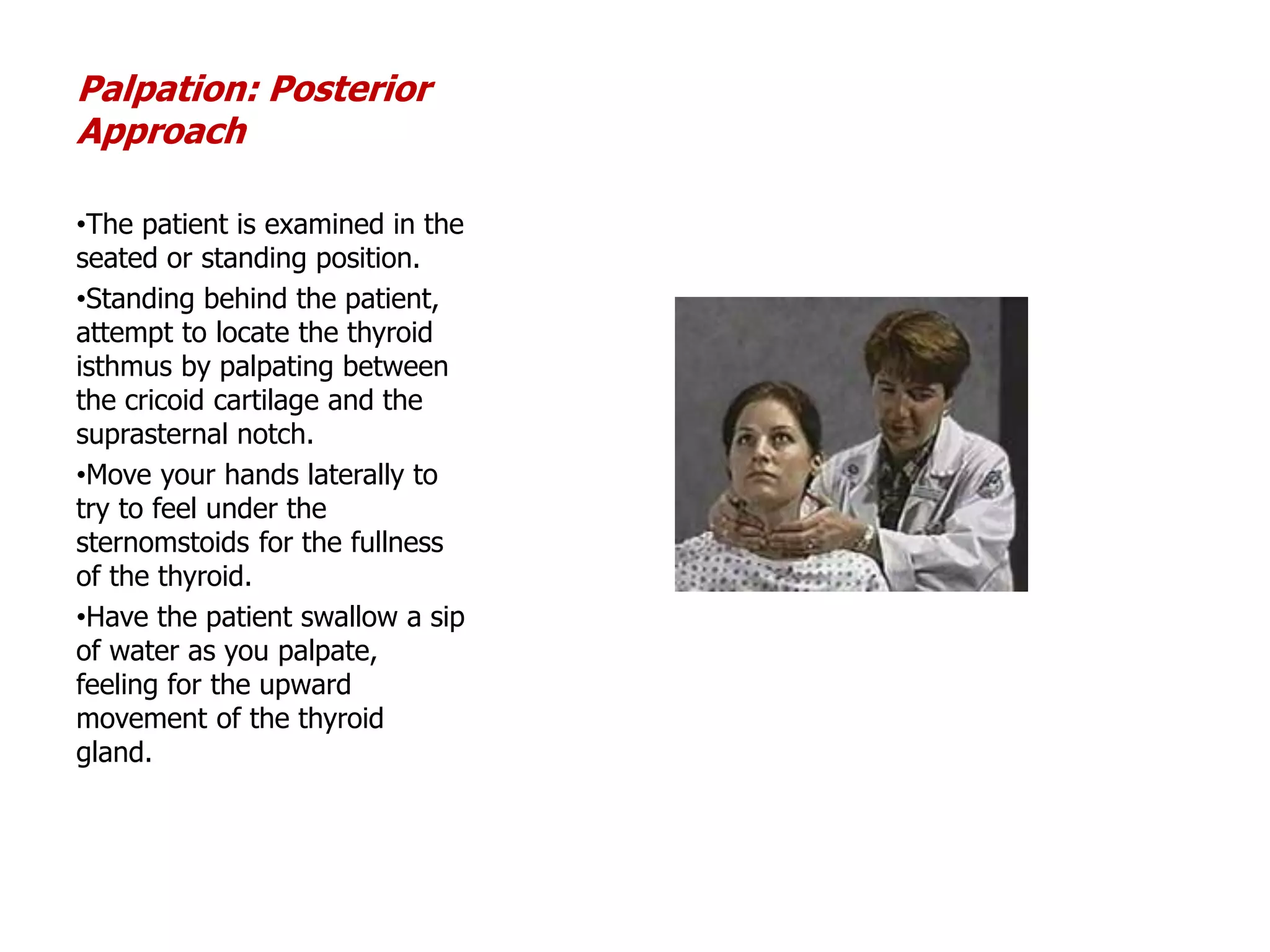
•The patient is examined in the
seated or standing position.
•Standing behind the patient,
attempt to locate the thyroid
isthmus by palpating between
the cricoid cartilage and the
suprasternal notch.
•Move your hands laterally to
try to feel under the
sternomstoids for the fullness
of the thyroid.
•Have the patient swallow a sip
of water as you palpate,
feeling for the upward
movement of the thyroid
gland.
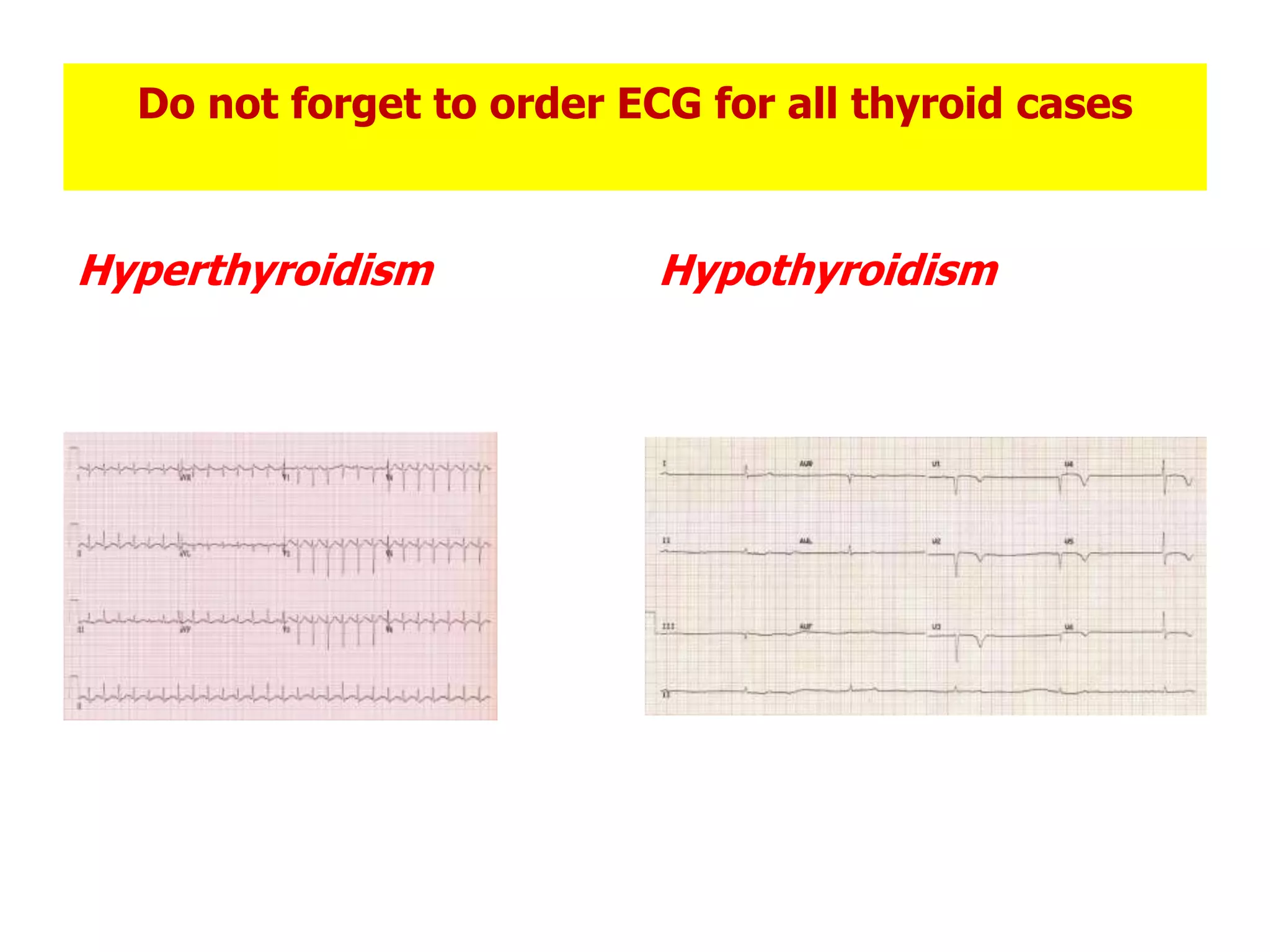
Do not forget to order ECG for all thyroid cases
Hyperthyroidism Hypothyroidism
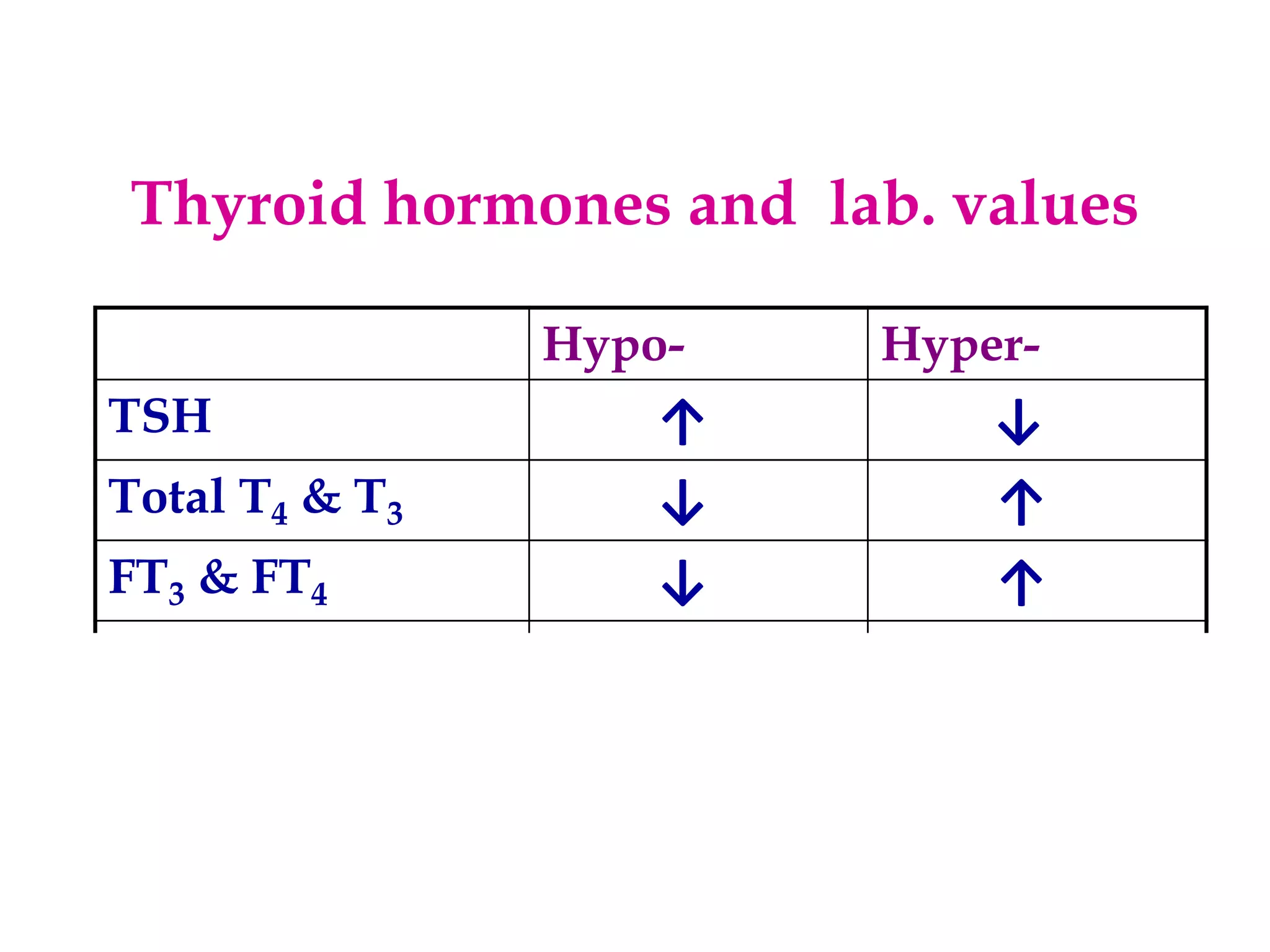
Thyroid hormones and lab. values
Hypo- Hyper-
TSH ↑ ↓
Total T4 & T3 ↓ ↑
FT3 & FT4 ↓ ↑
Total cholesterol ↑ ↓
LDL ↑ ↓
HDL ↓ ↑
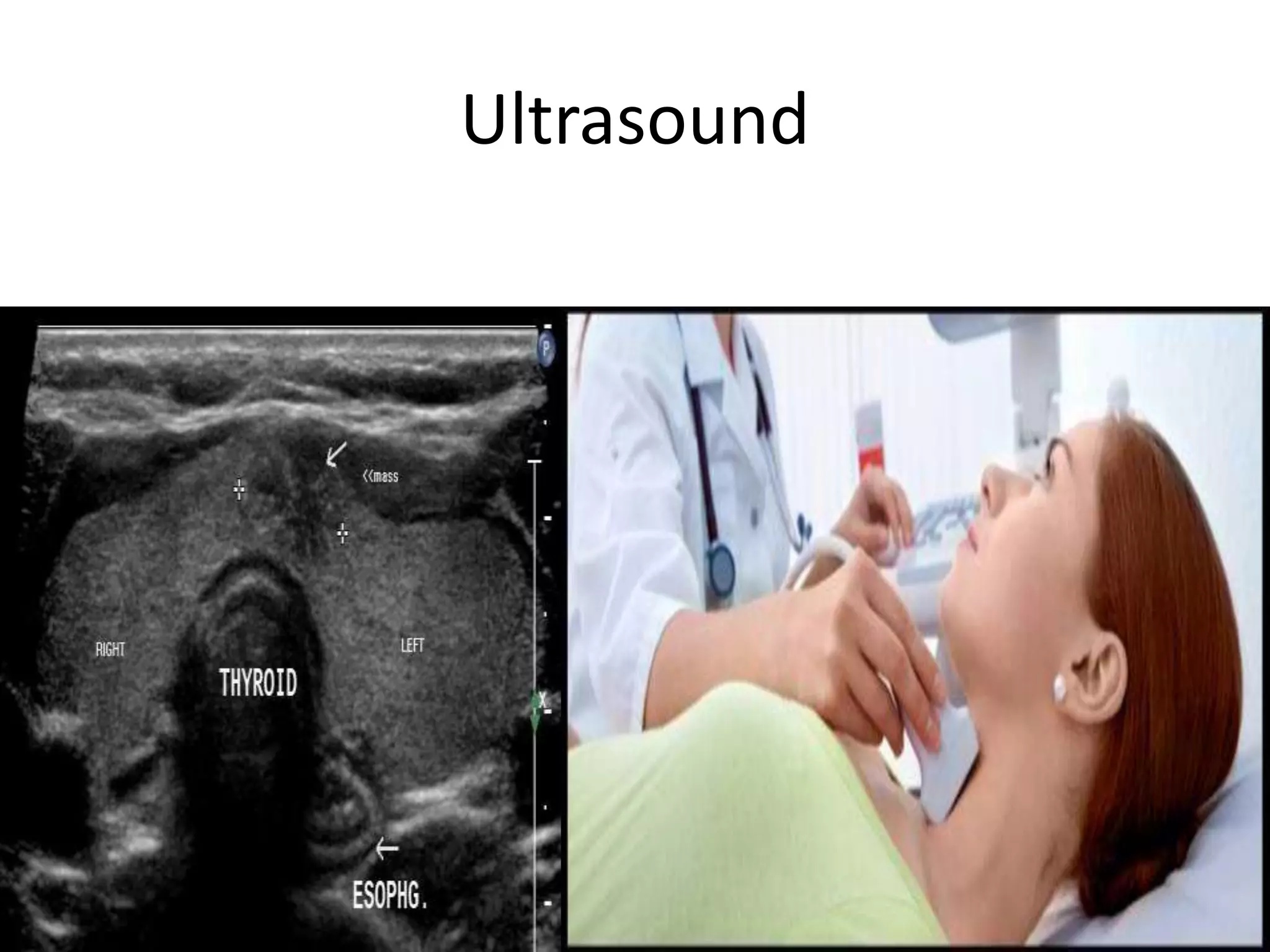
Ultrasound
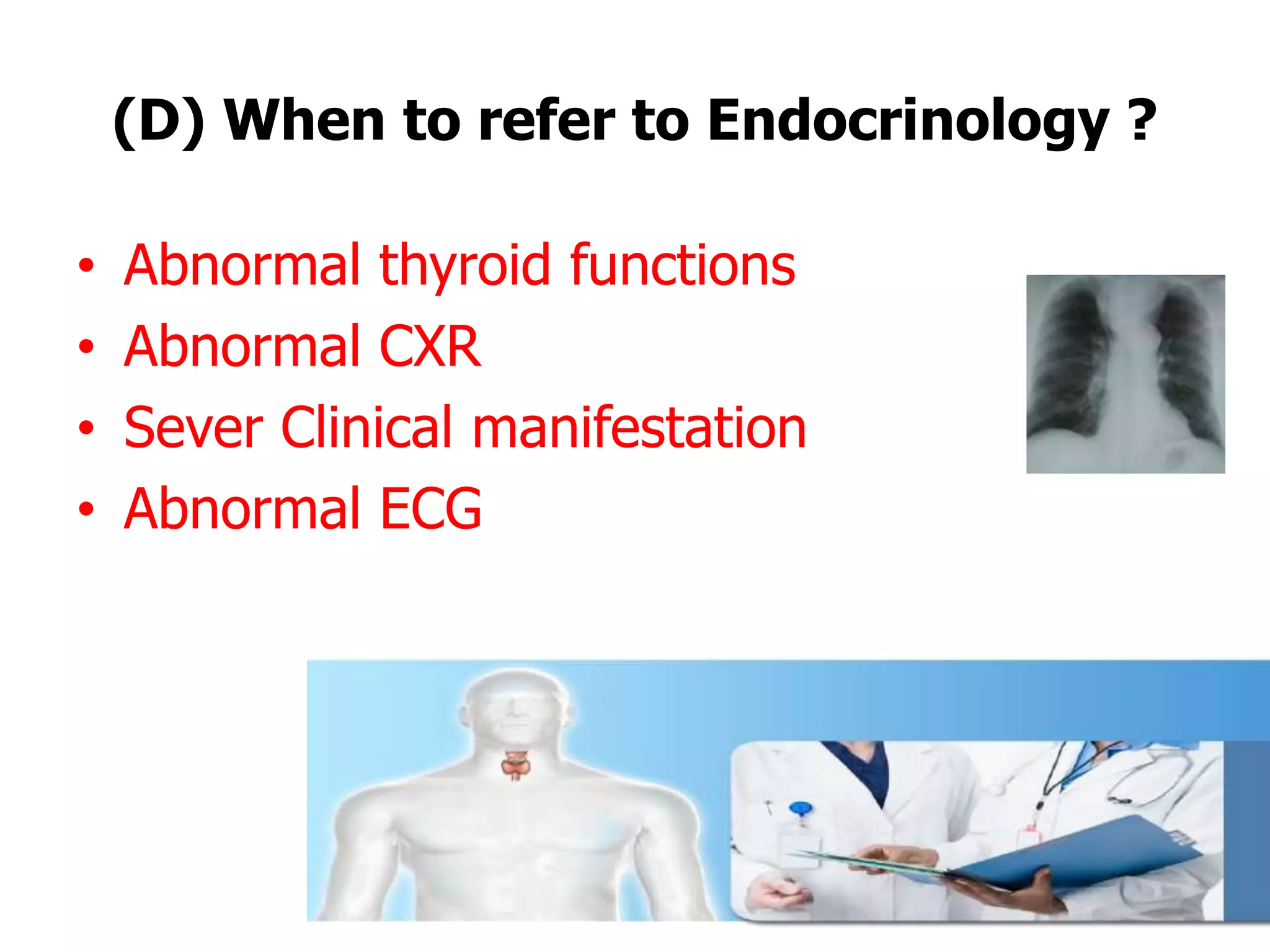
(D) When to refer to Endocrinology ?
• Abnormal thyroid functions
• Abnormal CXR
• Sever Clinical manifestation
• Abnormal ECG
Thyroid presentation

Thyroid presentation

  • 1.
  • 2.
    What Is theThyroid Gland? •The thyroid gland is located in front of the neck. • It has right and left lobes that confer a butterfly- shaped appearance. •The hormones produced by this gland control the body’s metabolism. •Disorders that affect thyroid function can either speed up or slow down metabolic processes, which can lead to a wide range of symptoms.
  • 3.
  • 4.
    Function of Thyroidgland secretes 3 main hormones • Thyroxine (T4) • Triiodothyronine (T3) • Calcitonin Energy & Growth Control of calcium
  • 5.
    - Regulation ofTH secretion: Thyroid Gland TH TSH Anterior Pituitary Hypothalamus TRH - -
  • 7.
     Calorigenic actionsBMR (stimulation of oxygen consumption by tissues) Adipose tissues (catabolic lipolysis ) and cholesterol Muscle (catabolic protein breakdown)  Body temperature ( heat production 2ry to energy production)  Bone, skeletal muscle and nervous system (normal development). Actions of thyroid hormone
  • 8.
    Heart (upregulation ofβ receptor and sensitivity to circulating catecholamines). CNS stimulation resulting in anxiety, restlessness, insomnia and tremors. Actions of thyroid hormone All these actions are remarkable in patients with abnormally hyperthyroidism
  • 9.
    Classification of thyroiddisorder 1- Hormonal disorder : • Hypothyroidism • Hyperthyroidism 2- Tumors as thyroid cancer. 3- Drug induced as amiodarone and interferon .
  • 10.
    Hormonal disorder • Hypothyroidism •It refers to reduced activity of the thyroid gland (underactive thyroid) leading to a decrease in circulating thyroid hormones. This slows the metabolic activity within the body. • HYPERTHYROIDISM • It refers to over activity in the thyroid gland leading to excessive production of the thyroid hormones and accelerated metabolism in the peripheral tissue.
  • 11.
    Causes Hypothyroidism 1- children :cretinism 2- adult (myxedema) • Mainly Hashimoto’s (1ry hypothyroidism) • Rarely pituitary or hypothalamic hypofunction (2ry or 3ry hypothyroidism) HYPERTHYROIDISM • Toxic goiter (Graves’ disease) • Toxic adenoma • Plummer's disease (toxic multinodular goiter) • Thyroiditis • 2ry OR 3ry hyperthyroidism
  • 19.
    •Weight gain, lethargyand sluggishness • Puffiness of skin (myxedema) •Bradycardia, cold intolerance •Abnormal menstrual periods Symptoms of Hypothyroidism
  • 20.
    Other Symptoms ofHypothyroidism • Dry skin and brittle nails. • Numbness or tingling in the hands. • Constipation. • Falling of hair.
  • 21.
    How to dealwith a case of thyroid dysfunction
  • 22.
    How we discovera case of thyroid dysfunction in medical commission ? • 1- Detected clinically during medical fitness examination. • 2- Detected by abnormal CXR.
  • 23.
    How to deal? Steps : • 1- History taking • 2- General examination • 3- Local examination of the thyroid • 4-Investigations • 5-Referral only when indicated.
  • 24.
  • 25.
    (B) General examination: • Underweight • Overweight Hyperthyroidism Hypothyroidism
  • 26.
    Nervous & Cardiacsigns Hyperthyroidism Hypothyroidism Depression , mood swings ,slow thinking Slow speech ,Poor memory. Muscle stiffness. Slow relaxation of muscles. Aches and pains. Bradycardia Low pulse
  • 27.
    Cardiac changes Hyperthyroidism Hypothyroidism •Hypertension/hypotension. Diastolic pressure high while systolic pressure may be low
  • 28.
    (II) Cutaneous changes: Hypothyroidism * Dry , cold skin . * Dryness * coarse brittle hair , Loss of lateral eyebrows , Falling of hair. * Purple-tinged lips , Itchy skin *peritibial myxoedema Hyperthyroidism
  • 29.
    Eye signs Hyperthyroidism • Exophthalmose Hypothyroidism •Puffiness of eye lids • Hair Loss of lateral eyebrows.
  • 33.
    ( C )LOCAL Examination of thyroid The examination consists of : 1- Inspection With neck in neutral or slightly extended 2- Palpation With neck slightly flexed • Examine for size, site , surface , shape and presence of nodules , skin overlying , mobility, consistency . •3- Auscultation for bruit •Note: An enlarged thyroid is referred to as a goiter. There is no direct correlation between size and function- a person with a goiter can be euthyroid, hypo- or hyperthyroid. A normal thyroid is estimated to be 10 grams with an upper limit of 20 grams .
  • 34.
  • 35.
    Inspection: Anterior Approach 1.The patientshould be seated or standing in a comfortable position with the neck in a neutral or slightly extended position. 2.To enhance visualization of the thyroid, you can: 1.Extending the neck, which stretches overlying tissues 2.Have the patient swallow a sip of water, watching for the upward movement of the thyroid gland.
  • 36.
    Inspection: Lateral Approach 1.Lateral inspectionof the thyroid, observe the neck from the side. 2.Estimate the smooth, straight contour from the cricoid cartilage to the suprasternal notch.
  • 37.
    Palpation • Note: Thereis no data comparing palpation using the anterior approach to the posterior approach so examiners should use the approach that they find most comfortable.
  • 38.
    Palpation: Anterior Approach •The patientis examined in the seated or standing position. •Attempt to locate the thyroid isthmus by palpating between the cricoid cartilage and the suprasternal notch. •Use one hand to slightly retract the sternomastoid muscle while using the other to palpate the thyroid. •Have the patient swallow a sip of water as you palpate, feeling for the upward movement of the thyroid gland.
  • 39.
    Palpation: Posterior Approach •The patientis examined in the seated or standing position. •Standing behind the patient, attempt to locate the thyroid isthmus by palpating between the cricoid cartilage and the suprasternal notch. •Move your hands laterally to try to feel under the sternomstoids for the fullness of the thyroid. •Have the patient swallow a sip of water as you palpate, feeling for the upward movement of the thyroid gland.
  • 43.
    Do not forgetto order ECG for all thyroid cases Hyperthyroidism Hypothyroidism
  • 44.
    Thyroid hormones andlab. values Hypo- Hyper- TSH ↑ ↓ Total T4 & T3 ↓ ↑ FT3 & FT4 ↓ ↑ Total cholesterol ↑ ↓ LDL ↑ ↓ HDL ↓ ↑
  • 45.
  • 47.
    (D) When torefer to Endocrinology ? • Abnormal thyroid functions • Abnormal CXR • Sever Clinical manifestation • Abnormal ECG