Adult Health Nursing
Endocrine
Disorders
October 21, 2022
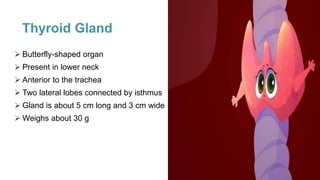
Thyroid Gland
 Butterfly-shaped organ
 Present in lower neck
 Anterior to the trachea
 Two lateral lobes connected by isthmus
 Gland is about 5 cm long and 3 cm wide
 Weighs about 30 g
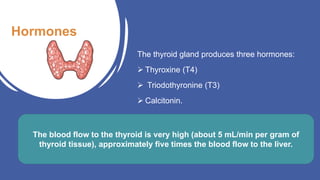
Hormones
The thyroid gland produces three hormones:
 Thyroxine (T4)
 Triodothyronine (T3)
 Calcitonin.
The blood flow to the thyroid is very high (about 5 mL/min per gram of
thyroid tissue), approximately five times the blood flow to the liver.
Functions of Thyroid Hormones
 Control cellular metabolic activity
 Influence cell replication
 Important in brain development
 Necessary for normal growth
Functions of Thyroid Hormones
 Heat production
 Regulates metabolism of carbohydrates, proteins and fats
 Enhance the effects of adrenaline and nor adrenaline
T4, a relatively weak hormone
T3 is about five times as potent as T4
Related Disorders
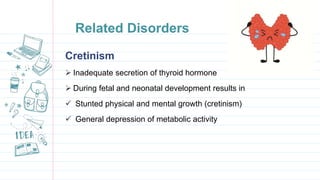
Cretinism
 Inadequate secretion of thyroid hormone
 During fetal and neonatal development results in
 Stunted physical and mental growth (cretinism)
 General depression of metabolic activity
Related Disorders
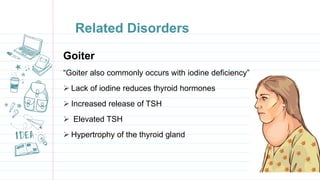
Goiter
“Goiter also commonly occurs with iodine deficiency”
 Lack of iodine reduces thyroid hormones
 Increased release of TSH
 Elevated TSH
 Hypertrophy of the thyroid gland
Physical Examination
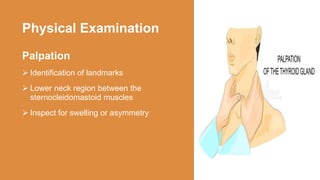
Palpation
 Identification of landmarks
 Lower neck region between the
sternocleidomastoid muscles
 Inspect for swelling or asymmetry
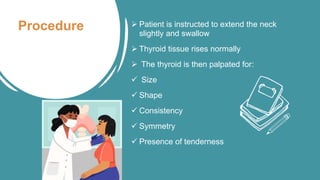
Procedure  Patient is instructed to extend the neck
slightly and swallow
 Thyroid tissue rises normally
 The thyroid is then palpated for:
 Size
 Shape
 Consistency
 Symmetry
 Presence of tenderness
Physical Examination
Auscultation
 Localized audible vibration of a bruit
 Indicates increased blood flow
through the thyroid gland
Thyroid Tests
Serum Thyroid-Stimulating
Hormone
Best screening test of thyroid function
Normal
Value: 0.5 to
5.0 mlU/L
Thyroid Tests
Serum Free T4
The test most commonly used to confirm an abnormal TSH
result is free T4.
Normal
Range: 0.9 to
1.7 ng/dL
Thyroid Tests
Serum T3 and T4
Measurement of total T3 or T4 includes protein bound and
free hormone levels that occur in response to TSH
secretion.
Normal Range T4: 4.5 to 11.5 g/dL
Normal Range T3: 70 to 220 ng/dL
Thyroid Tests
T3 Resin Uptake Test:
 Determine the amount of thyroid hormone bound to
TBG
 The number of available binding sites.
 This provides an index of the amount of thyroid
hormone already present in the circulation.
Normal Range:
Normal T3 uptake value is 25% to 35%
Thyroid Tests
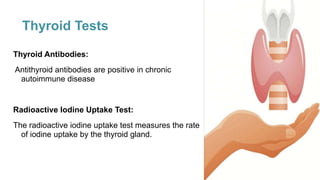
Thyroid Antibodies:
Antithyroid antibodies are positive in chronic
autoimmune disease
Radioactive Iodine Uptake Test:
The radioactive iodine uptake test measures the rate
of iodine uptake by the thyroid gland.
Thyroid Tests
Fine Needle Aspiration Biopsy
Use of a small-gauge needle to sample the thyroid tissue for
biopsy is a safe and accurate method of detecting
malignancy.
Thyroid Scan
Scans are helpful in determining the location, size, shape,
and anatomic function of the thyroid gland.
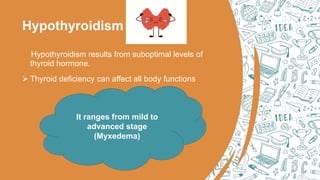
Hypothyroidism
Hypothyroidism results from suboptimal levels of
thyroid hormone.
 Thyroid deficiency can affect all body functions
It ranges from mild to
advanced stage
(Myxedema)
 Autoimmune disease (Hashimoto’s thyroiditis,
post Graves’ disease)
 Atrophy of thyroid gland with aging
 Therapy for hyperthyroidism
 Radioactive iodine (131I)
 Thyroidectomy
 Lithium
Causes
 Lithium
 Iodine compounds
 Antithyroid medications
 Radiation to head and neck
 Infiltrative diseases of the thyroid
(amyloidosis, scleroderma, lymphoma)
Iodine deficiency and iodine excess
Causes
Types
Primary or thyroidal hypothyroidism:
 Refers to dysfunction of the thyroid gland itself
 95% of people have thyroidal hypothyroidism
Central Hypothyroidism:
 Due to failure of the pituitary gland
 Failure of hypothalamus, or both
Types
Pituitary or Secondary Hypothyroidism
 Cause is entirely a pituitary disorder
 It is pituitary or secondary hypothyroidism
Hypothalamic or Tertiary Hypothyroidism
 Disorder of the hypothalamus
 Inadequate secretion of TSH
 It is hypothalamic or tertiary hypothyroidism
 Extreme fatigue
 Difficulty in completing daily activities
 Hair loss
 Brittle nails
 Dry skin
 Numbness and tingling of finger
 Husky voice
 Menorrhagia
 Amenorrhea
 Loss of libido
Clinical
Manifestations
 Subnormal body temperature
 Subnormal pulse rate
 Weight gain
 Cachexia
 Thickened skin (mucopolysaccharides
accumulation)
 Masklike face
 Hypothermia
 Irritability
 Dull mental processing
Clinical
Manifestations
 Slow speech
 Tongue enlargement
 Hand and feet enlarges in size
 Deafness
 Constipation
Clinical
Manifestations
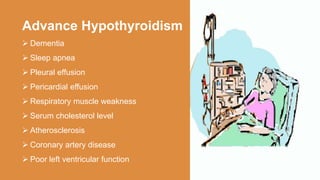
Advance Hypothyroidism
 Dementia
 Sleep apnea
 Pleural effusion
 Pericardial effusion
 Respiratory muscle weakness
 Serum cholesterol level
 Atherosclerosis
 Coronary artery disease
 Poor left ventricular function
Complications
Abnormal sensitivity to:
 Sedatives
 Opioids
 Anesthetic agents
Should
administered
with extreme
caution
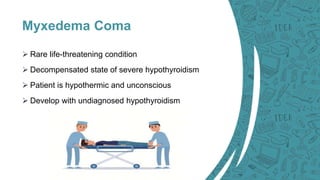
Myxedema Coma
 Rare life-threatening condition
 Decompensated state of severe hypothyroidism
 Patient is hypothermic and unconscious
 Develop with undiagnosed hypothyroidism
Precipitating Factors
 Infection
 Systemic disease
 Use of sedatives
 Opioid analgesic agents
 Among elderly women in the winter months
 Appears to be precipitated by cold
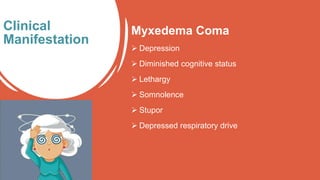
Myxedema Coma
 Depression
 Diminished cognitive status
 Lethargy
 Somnolence
 Stupor
 Depressed respiratory drive
Clinical
Manifestation
 Alveolar hypoventilation
 Progressive carbon dioxide
retention
 Narcosis
 Coma
 Cardiovascular collapse
 Shock
Clinical
Manifestation
Requires aggressive
supportive
hemodynamic
therapy
Nursing Alert
In all patients with hypothyroidism, the effects of analgesic
agents, sedatives, and anesthetic agents are prolonged;
special caution is necessary in administering these agents
to elderly patients because of concurrent changes in liver
and renal function!
Primary objective in the management is to restore
normal metabolic state by replacing the missing
hormone
Pharmacological Therapy
 Synthetic levothyroxine (Synthroid or Levothroid)
 Desiccated thyroid
Medical
Manangement
Prevention
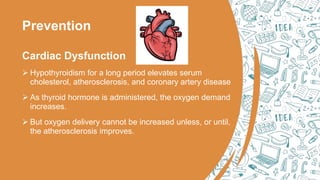
Cardiac Dysfunction
 Hypothyroidism for a long period elevates serum
cholesterol, atherosclerosis, and coronary artery disease
 As thyroid hormone is administered, the oxygen demand
increases.
 But oxygen delivery cannot be increased unless, or until,
the atherosclerosis improves.
Prevention
 The occurrence of angina is the signal that the oxygen needs
of the myocardium exceed its blood supply.
 If angina or dysrhythmias occur, thyroid hormone
administration must be discontinued immediately.
Nurse must be alert for
the signs of myocardial
ischemia
Prevention
Medication Interaction
 Thyroid hormones increase blood glucose levels
 Necessitate adjustment in the dosage of insulin
 Increase the effects of digitalis glycosides, anticoagulant
agents, and Indomethacin (Indocin)
Medication Interaction
 Phenytoin (Dilantin) and Tricyclic
antidepressant agents increase the effects of
thyroid hormone
 Bone loss and osteoporosis may also occur
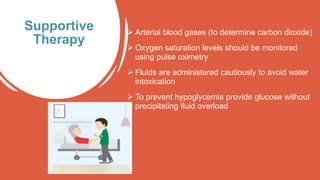
 Arterial blood gases (to determine carbon dioxide)
 Oxygen saturation levels should be monitored
using pulse oximetry
 Fluids are administered cautiously to avoid water
intoxication
 To prevent hypoglycemia provide glucose without
precipitating fluid overload
Supportive
Therapy
Teaching Patient’s Self Care
Oral and written instructions should be provided
regarding the following:
 Desired actions and side effects of medications
 Correct medication administration
 Importance of continuing medications
 When to seek medical attention
 Importance of nutrition and diet to promote weight
loss and normal bowel patterns
 Importance of periodic follow-up testing
Nursing
Management

Hypothyroidism_094334.pptx

  • 1.
  • 2.
    Thyroid Gland  Butterfly-shapedorgan  Present in lower neck  Anterior to the trachea  Two lateral lobes connected by isthmus  Gland is about 5 cm long and 3 cm wide  Weighs about 30 g
  • 3.
    Hormones The thyroid glandproduces three hormones:  Thyroxine (T4)  Triodothyronine (T3)  Calcitonin. The blood flow to the thyroid is very high (about 5 mL/min per gram of thyroid tissue), approximately five times the blood flow to the liver.
  • 4.
    Functions of ThyroidHormones  Control cellular metabolic activity  Influence cell replication  Important in brain development  Necessary for normal growth
  • 5.
    Functions of ThyroidHormones  Heat production  Regulates metabolism of carbohydrates, proteins and fats  Enhance the effects of adrenaline and nor adrenaline T4, a relatively weak hormone T3 is about five times as potent as T4
  • 6.
    Related Disorders Cretinism  Inadequatesecretion of thyroid hormone  During fetal and neonatal development results in  Stunted physical and mental growth (cretinism)  General depression of metabolic activity
  • 7.
    Related Disorders Goiter “Goiter alsocommonly occurs with iodine deficiency”  Lack of iodine reduces thyroid hormones  Increased release of TSH  Elevated TSH  Hypertrophy of the thyroid gland
  • 8.
    Physical Examination Palpation  Identificationof landmarks  Lower neck region between the sternocleidomastoid muscles  Inspect for swelling or asymmetry
  • 9.
    Procedure  Patientis instructed to extend the neck slightly and swallow  Thyroid tissue rises normally  The thyroid is then palpated for:  Size  Shape  Consistency  Symmetry  Presence of tenderness
  • 10.
    Physical Examination Auscultation  Localizedaudible vibration of a bruit  Indicates increased blood flow through the thyroid gland
  • 11.
    Thyroid Tests Serum Thyroid-Stimulating Hormone Bestscreening test of thyroid function Normal Value: 0.5 to 5.0 mlU/L
  • 12.
    Thyroid Tests Serum FreeT4 The test most commonly used to confirm an abnormal TSH result is free T4. Normal Range: 0.9 to 1.7 ng/dL
  • 13.
    Thyroid Tests Serum T3and T4 Measurement of total T3 or T4 includes protein bound and free hormone levels that occur in response to TSH secretion. Normal Range T4: 4.5 to 11.5 g/dL Normal Range T3: 70 to 220 ng/dL
  • 14.
    Thyroid Tests T3 ResinUptake Test:  Determine the amount of thyroid hormone bound to TBG  The number of available binding sites.  This provides an index of the amount of thyroid hormone already present in the circulation. Normal Range: Normal T3 uptake value is 25% to 35%
  • 15.
    Thyroid Tests Thyroid Antibodies: Antithyroidantibodies are positive in chronic autoimmune disease Radioactive Iodine Uptake Test: The radioactive iodine uptake test measures the rate of iodine uptake by the thyroid gland.
  • 16.
    Thyroid Tests Fine NeedleAspiration Biopsy Use of a small-gauge needle to sample the thyroid tissue for biopsy is a safe and accurate method of detecting malignancy. Thyroid Scan Scans are helpful in determining the location, size, shape, and anatomic function of the thyroid gland.
  • 17.
    Hypothyroidism Hypothyroidism results fromsuboptimal levels of thyroid hormone.  Thyroid deficiency can affect all body functions It ranges from mild to advanced stage (Myxedema)
  • 18.
     Autoimmune disease(Hashimoto’s thyroiditis, post Graves’ disease)  Atrophy of thyroid gland with aging  Therapy for hyperthyroidism  Radioactive iodine (131I)  Thyroidectomy  Lithium Causes
  • 19.
     Lithium  Iodinecompounds  Antithyroid medications  Radiation to head and neck  Infiltrative diseases of the thyroid (amyloidosis, scleroderma, lymphoma) Iodine deficiency and iodine excess Causes
  • 20.
    Types Primary or thyroidalhypothyroidism:  Refers to dysfunction of the thyroid gland itself  95% of people have thyroidal hypothyroidism Central Hypothyroidism:  Due to failure of the pituitary gland  Failure of hypothalamus, or both
  • 21.
    Types Pituitary or SecondaryHypothyroidism  Cause is entirely a pituitary disorder  It is pituitary or secondary hypothyroidism Hypothalamic or Tertiary Hypothyroidism  Disorder of the hypothalamus  Inadequate secretion of TSH  It is hypothalamic or tertiary hypothyroidism
  • 22.
     Extreme fatigue Difficulty in completing daily activities  Hair loss  Brittle nails  Dry skin  Numbness and tingling of finger  Husky voice  Menorrhagia  Amenorrhea  Loss of libido Clinical Manifestations
  • 23.
     Subnormal bodytemperature  Subnormal pulse rate  Weight gain  Cachexia  Thickened skin (mucopolysaccharides accumulation)  Masklike face  Hypothermia  Irritability  Dull mental processing Clinical Manifestations
  • 24.
     Slow speech Tongue enlargement  Hand and feet enlarges in size  Deafness  Constipation Clinical Manifestations
  • 25.
    Advance Hypothyroidism  Dementia Sleep apnea  Pleural effusion  Pericardial effusion  Respiratory muscle weakness  Serum cholesterol level  Atherosclerosis  Coronary artery disease  Poor left ventricular function
  • 26.
    Complications Abnormal sensitivity to: Sedatives  Opioids  Anesthetic agents Should administered with extreme caution
  • 27.
    Myxedema Coma  Rarelife-threatening condition  Decompensated state of severe hypothyroidism  Patient is hypothermic and unconscious  Develop with undiagnosed hypothyroidism
  • 28.
    Precipitating Factors  Infection Systemic disease  Use of sedatives  Opioid analgesic agents  Among elderly women in the winter months  Appears to be precipitated by cold
  • 29.
    Myxedema Coma  Depression Diminished cognitive status  Lethargy  Somnolence  Stupor  Depressed respiratory drive Clinical Manifestation
  • 30.
     Alveolar hypoventilation Progressive carbon dioxide retention  Narcosis  Coma  Cardiovascular collapse  Shock Clinical Manifestation Requires aggressive supportive hemodynamic therapy
  • 31.
    Nursing Alert In allpatients with hypothyroidism, the effects of analgesic agents, sedatives, and anesthetic agents are prolonged; special caution is necessary in administering these agents to elderly patients because of concurrent changes in liver and renal function!
  • 32.
    Primary objective inthe management is to restore normal metabolic state by replacing the missing hormone Pharmacological Therapy  Synthetic levothyroxine (Synthroid or Levothroid)  Desiccated thyroid Medical Manangement
  • 33.
    Prevention Cardiac Dysfunction  Hypothyroidismfor a long period elevates serum cholesterol, atherosclerosis, and coronary artery disease  As thyroid hormone is administered, the oxygen demand increases.  But oxygen delivery cannot be increased unless, or until, the atherosclerosis improves.
  • 34.
    Prevention  The occurrenceof angina is the signal that the oxygen needs of the myocardium exceed its blood supply.  If angina or dysrhythmias occur, thyroid hormone administration must be discontinued immediately. Nurse must be alert for the signs of myocardial ischemia
  • 35.
    Prevention Medication Interaction  Thyroidhormones increase blood glucose levels  Necessitate adjustment in the dosage of insulin  Increase the effects of digitalis glycosides, anticoagulant agents, and Indomethacin (Indocin)
  • 36.
    Medication Interaction  Phenytoin(Dilantin) and Tricyclic antidepressant agents increase the effects of thyroid hormone  Bone loss and osteoporosis may also occur
  • 37.
     Arterial bloodgases (to determine carbon dioxide)  Oxygen saturation levels should be monitored using pulse oximetry  Fluids are administered cautiously to avoid water intoxication  To prevent hypoglycemia provide glucose without precipitating fluid overload Supportive Therapy
  • 38.
    Teaching Patient’s SelfCare Oral and written instructions should be provided regarding the following:  Desired actions and side effects of medications  Correct medication administration  Importance of continuing medications  When to seek medical attention  Importance of nutrition and diet to promote weight loss and normal bowel patterns  Importance of periodic follow-up testing Nursing Management