Ratheesh.R
SLMGNC
INTRODUCTION
 Hyperthyroidism occurs when the thyroid becomes over-
active and produces more thyroid hormones than are
needed by the body. It is sometimes called thyrotoxicosis.
The most common cause of hyperthyroidism is Graves’
disease (when the body’s immune system turns against the
thyroid gland by producing antibodies). Hyperthyroidism is
also one of the phases that can occur in a condition
called viral thyroiditis, although this is extremely rare in
children. The hyperthyroid phase of viral thyroiditis
normally settles down without treatment.
DEFINITION
 Over activity of the thyroid gland, resulting in a
rapid heartbeat and an increased rate of
metabolism.
Simple:
It is an thyroid nontoxic goitre which may
be diffuse or nodular in nature.
Toxic:
It is a primary or secondary thyrotoxicosis, It
may be diffuse or solitory in nature and
associate with excessive production of thyroid
hormone.
ETIOLOGY
 Thyroiditis
 Excessive ingestion of thyroid hormone
 Over functioning of thyroid hormone
 Auto immune disorder
 Over treatment of myxedema.
PATHOPHYSIOLOGY
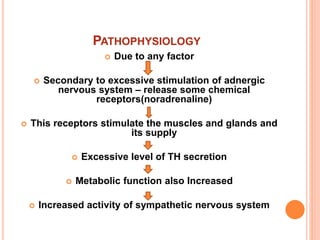
 Due to any factor
 Secondary to excessive stimulation of adnergic
nervous system – release some chemical
receptors(noradrenaline)
 This receptors stimulate the muscles and glands and
its supply
 Excessive level of TH secretion
 Metabolic function also Increased
 Increased activity of sympathetic nervous system
CONT….
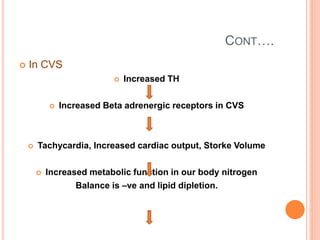
 In CVS
 Increased TH
 Increased Beta adrenergic receptors in CVS
 Tachycardia, Increased cardiac output, Storke Volume
 Increased metabolic function in our body nitrogen
Balance is –ve and lipid dipletion.
CONT….
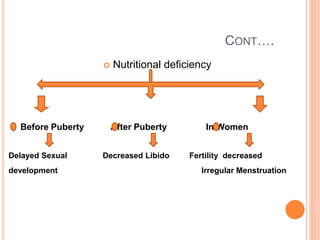
 Nutritional deficiency
Before Puberty After Puberty In Women
Delayed Sexual Decreased Libido Fertility decreased
development Irregular Menstruation
CLINICAL MANIFESTATION
 Nervousness
 Emotional lability
 Difficulty in sitting
quietly
 Heat intolerance
 Fine tremor of head
 Bulging eyes
 Muscles weakness
 Change in bowel habits
 Flushed Skin
 Rapid pulse
 Irritability
 Increased Appetite
 Weight loss
 Atrial Fibrillation.
DIAGNOSTIC EVALUATION
 History collection
 Physical examination
 Thyroid Scan
 MRI
 CT
 Thyroid function test
 Ultrasound
 Elevated T3 and T4
 Elevated Serum T3 (resin) Uptake
 Radio active iodine uptake scan.
MEDICAL MANAGEMENT
1) Drug that inhibit hormone formation
a) Thionamides => Propylthiouracil
=> Methimazole
2) Beta – adrenergic blockers such as propranolol
and calcium antagonists.
3) Gluco-Corticoids – decrease the peripheral
conversion of T4 and T3 .
4) Radio active Iodine – Limits secretion of thyroid
hormone
CONT….
Immediate Management:
i) Antithyroid medicine
ii) Radioactive Iodine
iii) Rx for Hyperthermia
iv) Rx for dehydration.
SURGICAL MANAGEMENT
i) Total Thyroidectomy:
Total removal of thyroid gland
ii) Subtotal or Partial Thyroidectomy:
COMPLICATION
 Myxedema (swelling of the face, limbs and hands, dry and
rough skin, loss of hair, slow pulse, abnormal temperature,
slowed metabolism and mental dullness)
 Infiltrative opthalmopathy
 Hypo-Thyroidism
 Radiation thyroiditis
 Vocal card Paralysis
NURSING DIAGNOSIS
 Less than body requirements r/t fluid loss through
diaphoresis.
 Risk for impaired skin integrity r/t disease process.
 Thought process r/t Insomnia and Irritability.
 Anxiety r/t condition and concern about upcoming
surgery/radio active iodine treatment.

Hyper thyroidism

  • 1.
  • 2.
    INTRODUCTION  Hyperthyroidism occurswhen the thyroid becomes over- active and produces more thyroid hormones than are needed by the body. It is sometimes called thyrotoxicosis. The most common cause of hyperthyroidism is Graves’ disease (when the body’s immune system turns against the thyroid gland by producing antibodies). Hyperthyroidism is also one of the phases that can occur in a condition called viral thyroiditis, although this is extremely rare in children. The hyperthyroid phase of viral thyroiditis normally settles down without treatment.
  • 3.
    DEFINITION  Over activityof the thyroid gland, resulting in a rapid heartbeat and an increased rate of metabolism. Simple: It is an thyroid nontoxic goitre which may be diffuse or nodular in nature. Toxic: It is a primary or secondary thyrotoxicosis, It may be diffuse or solitory in nature and associate with excessive production of thyroid hormone.
  • 4.
    ETIOLOGY  Thyroiditis  Excessiveingestion of thyroid hormone  Over functioning of thyroid hormone  Auto immune disorder  Over treatment of myxedema.
  • 5.
    PATHOPHYSIOLOGY  Due toany factor  Secondary to excessive stimulation of adnergic nervous system – release some chemical receptors(noradrenaline)  This receptors stimulate the muscles and glands and its supply  Excessive level of TH secretion  Metabolic function also Increased  Increased activity of sympathetic nervous system
  • 6.
    CONT….  In CVS Increased TH  Increased Beta adrenergic receptors in CVS  Tachycardia, Increased cardiac output, Storke Volume  Increased metabolic function in our body nitrogen Balance is –ve and lipid dipletion.
  • 7.
    CONT….  Nutritional deficiency BeforePuberty After Puberty In Women Delayed Sexual Decreased Libido Fertility decreased development Irregular Menstruation
  • 8.
    CLINICAL MANIFESTATION  Nervousness Emotional lability  Difficulty in sitting quietly  Heat intolerance  Fine tremor of head  Bulging eyes  Muscles weakness  Change in bowel habits  Flushed Skin  Rapid pulse  Irritability  Increased Appetite  Weight loss  Atrial Fibrillation.
  • 9.
    DIAGNOSTIC EVALUATION  Historycollection  Physical examination  Thyroid Scan  MRI  CT  Thyroid function test  Ultrasound  Elevated T3 and T4  Elevated Serum T3 (resin) Uptake  Radio active iodine uptake scan.
  • 10.
    MEDICAL MANAGEMENT 1) Drugthat inhibit hormone formation a) Thionamides => Propylthiouracil => Methimazole 2) Beta – adrenergic blockers such as propranolol and calcium antagonists. 3) Gluco-Corticoids – decrease the peripheral conversion of T4 and T3 . 4) Radio active Iodine – Limits secretion of thyroid hormone
  • 11.
    CONT…. Immediate Management: i) Antithyroidmedicine ii) Radioactive Iodine iii) Rx for Hyperthermia iv) Rx for dehydration.
  • 12.
    SURGICAL MANAGEMENT i) TotalThyroidectomy: Total removal of thyroid gland ii) Subtotal or Partial Thyroidectomy:
  • 13.
    COMPLICATION  Myxedema (swellingof the face, limbs and hands, dry and rough skin, loss of hair, slow pulse, abnormal temperature, slowed metabolism and mental dullness)  Infiltrative opthalmopathy  Hypo-Thyroidism  Radiation thyroiditis  Vocal card Paralysis
  • 14.
    NURSING DIAGNOSIS  Lessthan body requirements r/t fluid loss through diaphoresis.  Risk for impaired skin integrity r/t disease process.  Thought process r/t Insomnia and Irritability.  Anxiety r/t condition and concern about upcoming surgery/radio active iodine treatment.