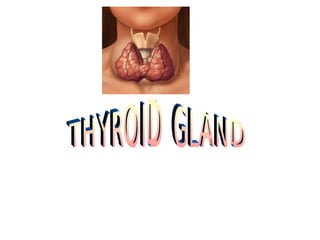
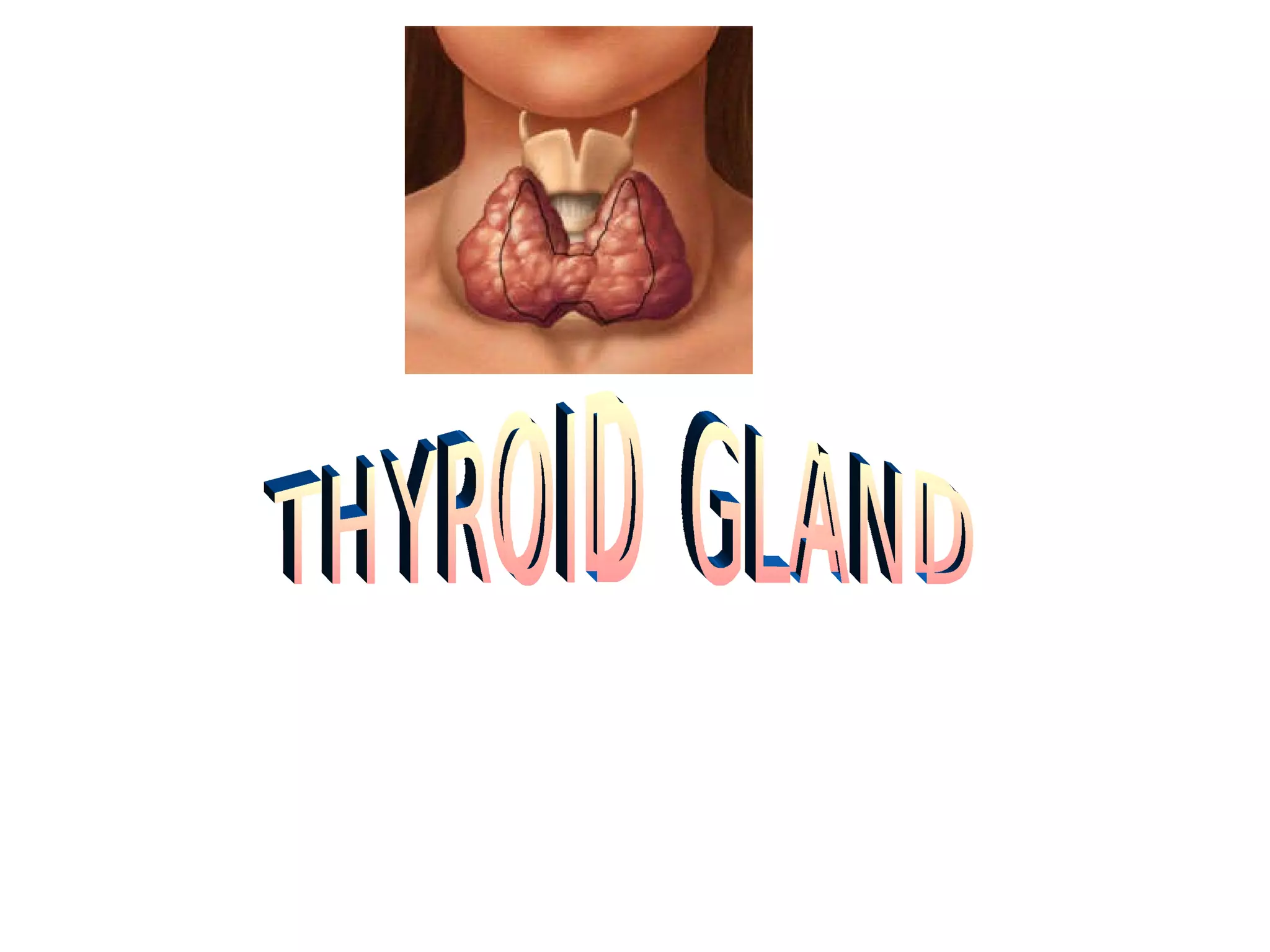
THYROID GLAND
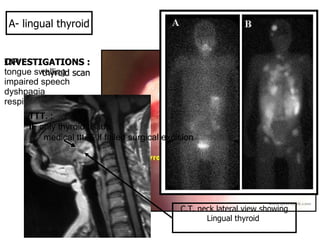
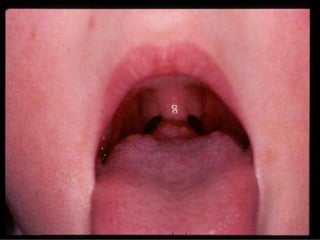
C/P : tongue swelling impaired speech dyshpagia respiratory obestruction A- lingual thyroid INVESTIGATIONS : thyroid scan C.T. neck lateral view showing Lingual thyroid  TTT. : IF  only thyroid tissue    medical ttt. & if failed surgical excision
 
Thyroglossal cyst & fistula INDEX
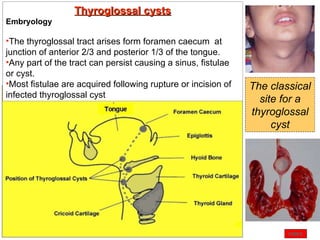
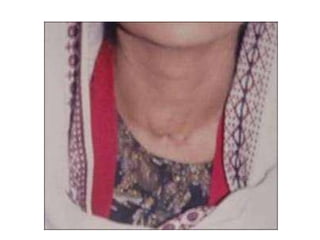
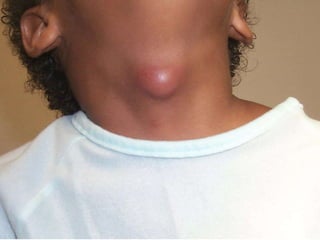
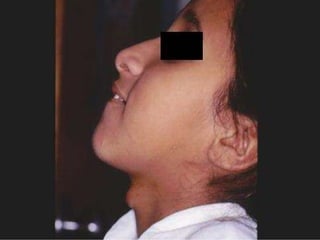
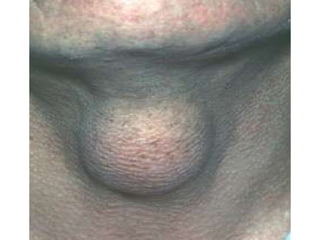
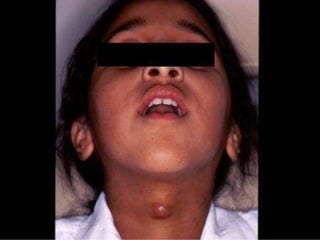
INDEX The classical site for a thyroglossal cyst Thyroglossal cysts Embryology The thyroglossal tract arises form foramen caecum  at junction of anterior 2/3 and posterior 1/3 of the tongue.  Any part of the tract can persist causing a sinus, fistulae or cyst.  Most fistulae are acquired following rupture or incision of infected thyroglossal cyst
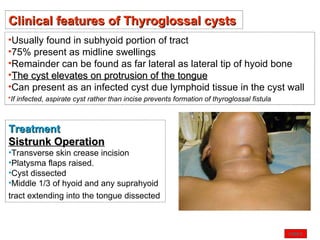
Usually found in subhyoid portion of tract  75% present as midline swellings  Remainder can be found as far lateral as lateral tip of hyoid bone  The cyst elevates on protrusion of the tongue   Can present as an infected cyst due lymphoid tissue in the cyst wall   If infected, aspirate cyst rather than incise prevents formation of thyroglossal fistula   Treatment Sistrunk Operation   Transverse skin crease incision  Platysma flaps raised.  Cyst dissected  Middle 1/3 of hyoid and any suprahyoid tract extending into the tongue dissected   Clinical features of Thyroglossal cysts INDEX
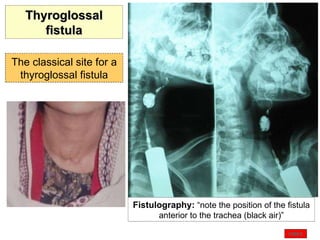
Fistulography:   “note the position of the fistula anterior to the trachea (black air)” The classical site for a thyroglossal fistula Thyroglossal fistula INDEX


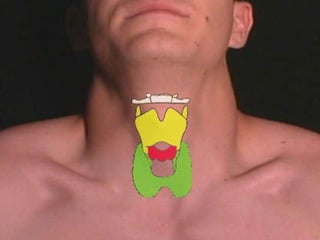
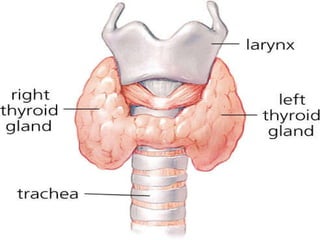
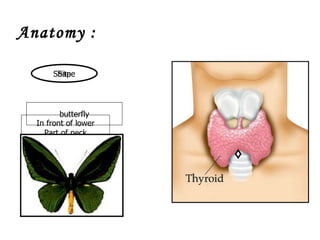
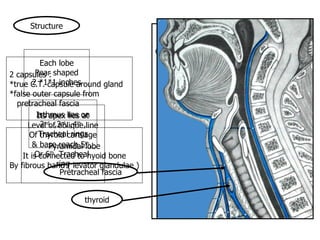
Anatomy : Site In front of lower Part of neck Shape butterfly
Structure Each lobe Pear shaped 2 *1*1 inches Its apex lies at Level of oblique line Of thyroid cartilage & base reach 5 th .  Or 6 th . Tracheal  ring Isthmus lies on 2 nd . ,3 rd . ,4 th  , Tracheal rings Pyramidal lobe It is connected to hyoid bone By fibrous band ( levator glandulae ) thyroid 2 capsules : *true C.T. capsule around gland *false outer capsule from  pretracheal fascia Pretracheal fascia
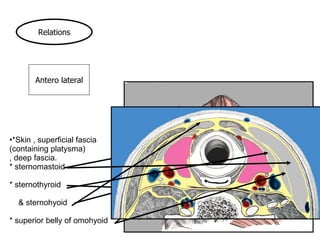
*Skin , superficial fascia  (containing platysma) , deep fascia. * sternomastoid * sternothyroid    & sternohyoid * superior belly of omohyoid Relations Antero lateral
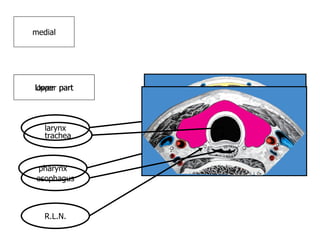
Upper part lower  part medial pharynx larynx R.L.N. trachea esophagus
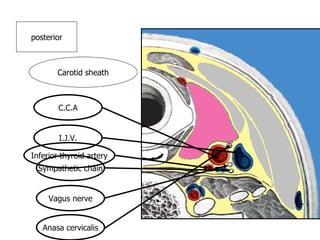
posterior Carotid sheath C.C.A I.J.V. Sympathetic chain Vagus nerve Anasa cervicalis Inferior thyroid artery
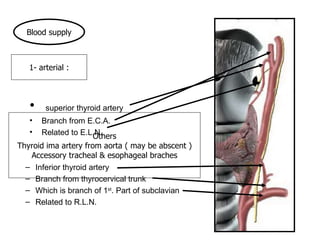
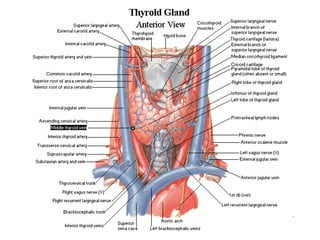
1- arterial : Blood supply superior thyroid artery Branch from E.C.A. Related to E.L.N. Inferior thyroid artery Branch from thyrocervical trunk Which is branch of 1 st . Part of subclavian Related to R.L.N.   Others Thyroid ima artery from aorta ( may be abscent ) Accessory tracheal & esophageal braches
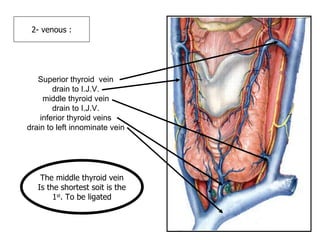
2- venous : Superior thyroid  vein drain to I.J.V. middle thyroid vein drain to I.J.V. inferior thyroid veins drain to left innominate vein The middle thyroid vein Is the shortest soit is the 1 st . To be ligated
 
 
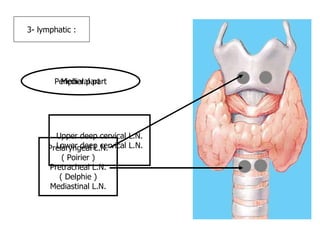
3- lymphatic : Medial part Peripheral part Prelaryngeal L.N. ( Poirier ) Pretracheal L.N. ( Delphie ) Mediastinal L.N. Upper deep cervical L.N. Lower deep cervical L.N.
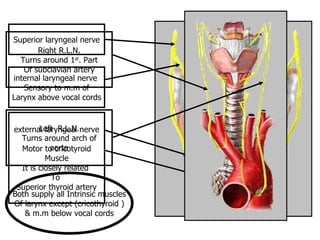
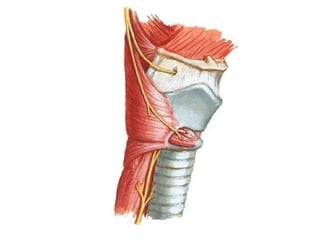
Superior laryngeal nerve internal laryngeal nerve  Sensory to m.m of Larynx above vocal cords external laryngeal nerve Motor to cricotyroid Muscle It is closely related  To  Superior thyroid artery Right R.L.N. Turns around 1 st . Part Of subclavian artery Left  R.L.N. Turns around arch of aorta Both supply all Intrinsic muscles Of larynx except (cricothyroid ) & m.m below vocal cords


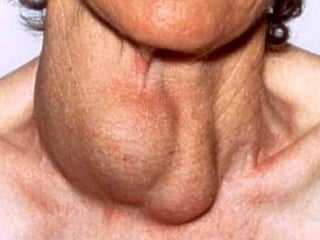
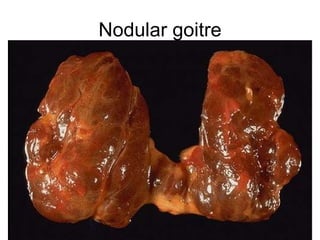
Nodular goitre
Thyrotoxicosis
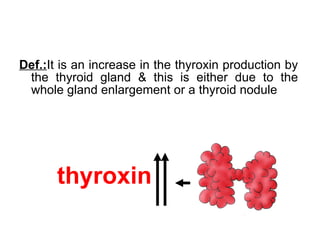
Def.: It is an increase in the thyroxin production by the thyroid gland & this is either due to the whole gland enlargement or a thyroid nodule  thyroxin
What happens? An increase in thyroxin secretion. Increase of response of the body cells to adrenaline. So signs & symptoms of the disease occur.
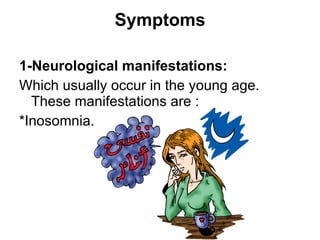
Symptoms 1-Neurological manifestations: Which usually occur in the young age. These manifestations are : *Inosomnia.
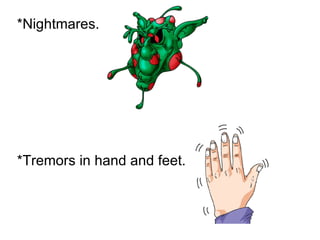
*Nightmares. *Tremors in hand and feet.
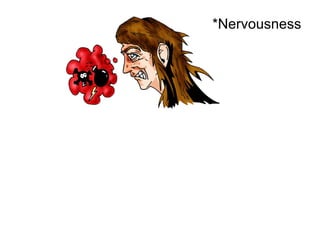
*Nervousness
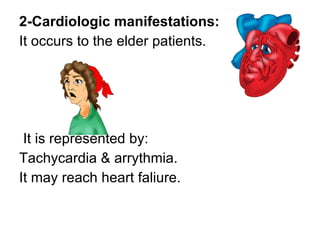
2-Cardiologic manifestations: It occurs to the elder patients. It is represented by: Tachycardia & arrythmia. It may reach heart faliure.
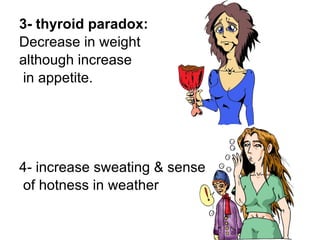
3- thyroid paradox: Decrease in weight  although increase in appetite. 4- increase sweating & sense of hotness in weather
5-Polyurea & diahrea 6-Fatigability
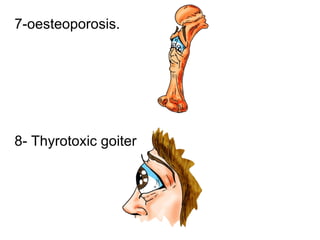
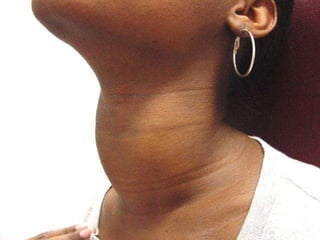
7-oesteoporosis. 8- Thyrotoxic goiter
 
Signs : (a) General examination : Body mass index ( BMI ) is usually less than 20 Kg/m2 (I) Underweight :
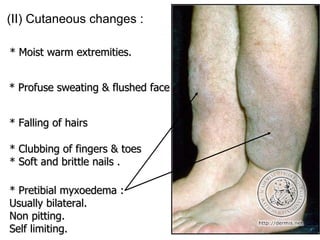
(II) Cutaneous changes : * Moist warm extremities. * Profuse sweating & flushed face * Falling of hairs * Clubbing of fingers & toes * Soft and brittle nails . * Pretibial myxoedema :  Usually bilateral. Non pitting. Self limiting.
(III) Nervous signs : Irritability and anxiety. Fine tremors in the tongue & in the fingers hands • Reflexes are exaggerated.  Myopathy weakness of the proximal limb muscles. (IV) cardiovascular signs : 1-PULSE   Rate :  Tachycardia with sleeping pulse up to  100 – 120 / min.   Character :  Big pulse volume (water - hummer character).
Rhythm :     All types of arrhythmia    except  heart block & V.F.  2- B.P. :   Systolic B.P. is high but diastolic is usually low or normal (due to peripheral V.D) that Increase pulse pressure. 3. HEART :   Accentuation of heart sounds. Functional soft systolic murmur maximum over pulmonary & aortic area.
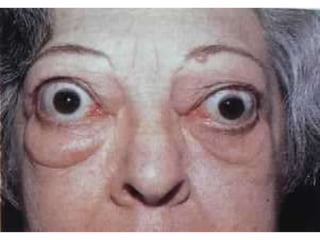
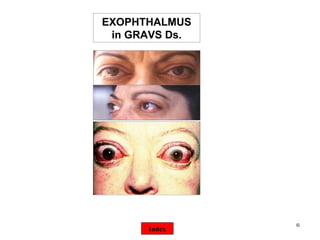
(V) Eye manifestations : A. Exophthatmos ( > 50 % of cases ) :  TYPES  :   a)Apparent ( mild = false) exophthalmos :  widening of the palpebral fissure due to spasm of Muller's muscle.
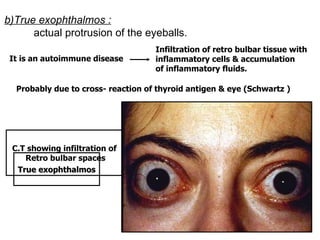
b)True exophthalmos :   actual protrusion of the eyeballs. It is an autoimmune disease Infiltration of retro bulbar tissue with  inflammatory cells & accumulation  of inflammatory fluids.  Probably due to cross- reaction of thyroid antigen & eye (Schwartz ) C.T showing infiltration of  Retro bulbar spaces True exophthalmos
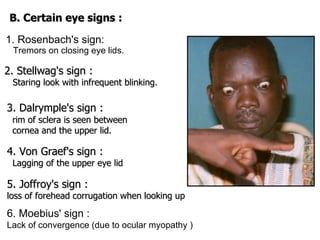
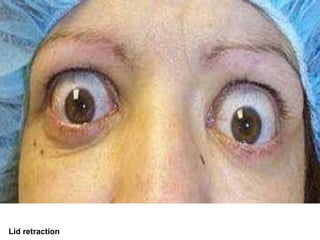
1. Rosenbach's sign:     Tremors on closing eye lids. B. Certain eye signs : 2. Stellwag's sign : Staring look with infrequent blinking. 3. Dalrymple's sign :   rim of sclera is seen between    cornea and the upper lid. 4. Von Graef's sign :   Lagging of the upper eye lid 5. Joffroy's sign :   loss of forehead corrugation when looking up  6. Moebius' sign :   Lack of convergence (due to ocular myopathy )
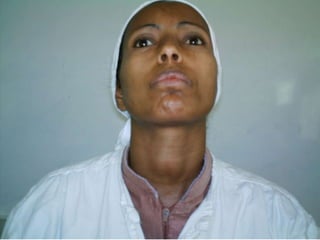
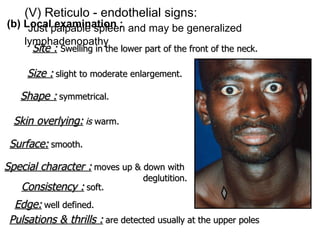
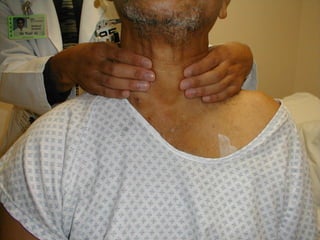
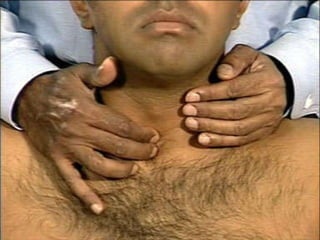
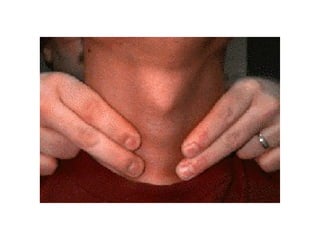
(b) Local examination : Site :   Swelling in the lower part of the front of the neck. Size :   slight to moderate enlargement. Shape :   symmetrical. Surface:   smooth. Skin overlying:   is  warm. Special character :   moves up & down with  deglutition. Consistency :   soft. Edge:   well defined. Pulsations & thrills :   are detected usually at the upper poles   (V) Reticulo - endothelial signs:   Just palpable spleen and may be generalized  lymphadenopathy
 
Lid retraction
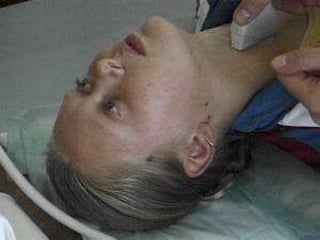
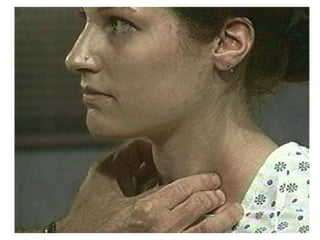
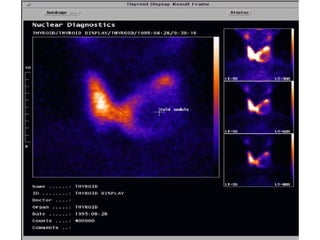
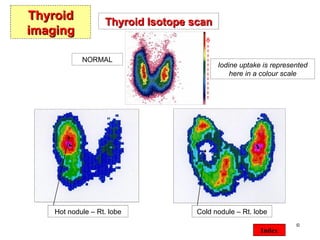
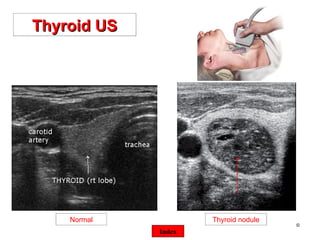
What are investigations? *Free T3 , T4 & TSH. . *Neck ultrasound. *Thyroid scan using radioactive iodine or Tc99
 
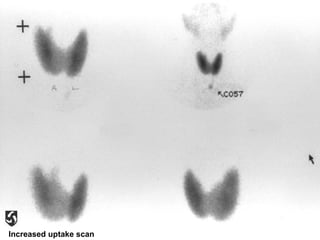
Increased uptake scan
Treatment There are 3 lines of treatment: 1-Medical treatment: A-Thiourea group. B-Indral.
2- Surgical intervention: We make subtotal  thyroidectomy after  preparation. 3-Treatment using radioactive iodine


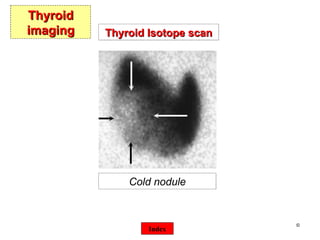
©  Thyroid Isotope scan Cold nodule Index Thyroid imaging
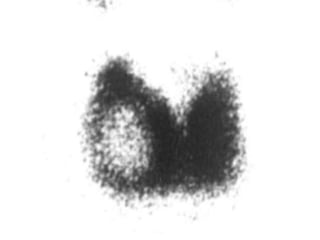
©  Index Thyroid imaging NORMAL Iodine uptake is represented here in a colour scale Hot nodule – Rt. lobe Cold nodule – Rt. lobe Thyroid Isotope scan
©  Thyroid US Index Normal Thyroid nodule
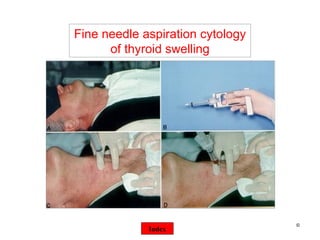
©  Fine needle aspiration cytology of thyroid swelling Index
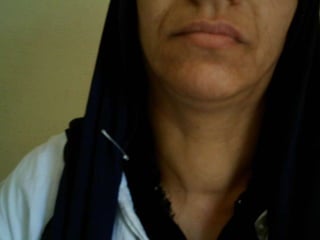
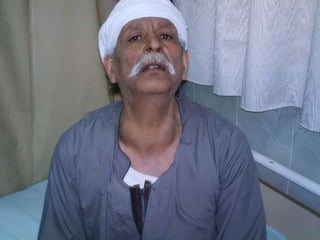
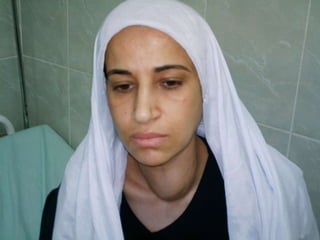
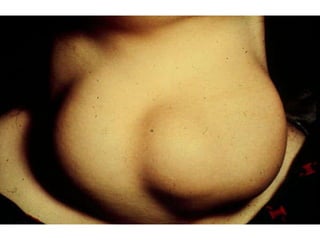
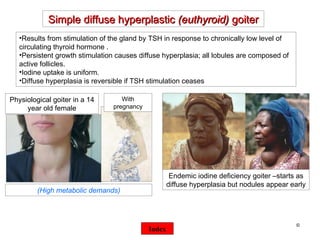
©  Physiological goiter in a 14 year old female Simple diffuse hyperplastic  (euthyroid)  goiter Results from stimulation of the gland by TSH in response to chronically low level of circulating thyroid hormone . Persistent growth stimulation causes diffuse hyperplasia; all lobules are composed of active follicles.  Iodine uptake is uniform. Diffuse hyperplasia is reversible if TSH stimulation ceases With pregnancy (High metabolic demands) Index Endemic iodine deficiency goiter –starts as diffuse hyperplasia but nodules appear early
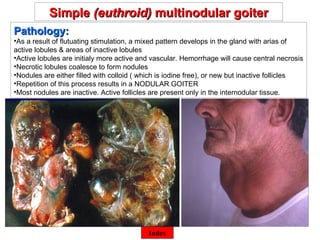
©  Simple  (euthroid)  multinodular goiter Pathology:  As a result of flutuating stimulation, a mixed pattern develops in the gland with arias of active lobules & areas of inactive lobules Active lobules are initialy more active and vascular. Hemorrhage will cause central necrosis Necrotic lobules coalesce to form nodules Nodules are either filled with colloid ( which is iodine free), or new but inactive follicles Repetition of this process results in a NODULAR GOITER Most nodules are inactive. Active follicles are present only in the internodular tissue.  Index
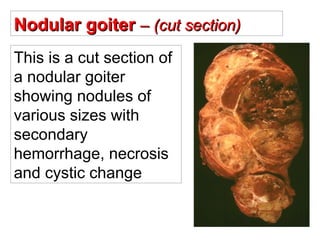
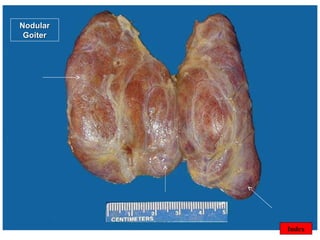
©  Nodular goiter  – (cut section) This is a cut section of a nodular goiter showing nodules of various sizes with secondary hemorrhage, necrosis and cystic change
©  Simple  (euthroid)  multinodular goiter One macroscopic nodule may predominate giving the impression of a solitary thyroid nodule. US is useful to detect other small nodules that are not palpable clinically Nodules may be colloid or cellular Common complications in thyroid nodules Cystic degeneration Hemorrhage  (nodule becomes painful and increases in size acutely) (D.D. carcinoma, autoimmune throiditis) Calcification  ( if extensive may give a hard sensation  confusing with malignancy) Complications of SNG : Tracheal obstruction  (by gross latera displacement or compression in retrosternal extension) 2ry thyrotoxicasis Carcinoma (uncommon but more found in endemic areas – usually follicular) Index
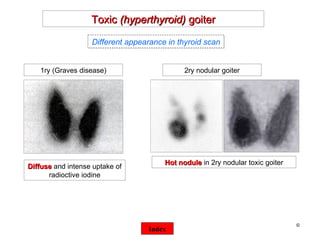
©  Toxic  (hyperthyroid)  goiter 1ry (Graves disease) 2ry nodular goiter Hot nodule  in 2ry nodular toxic goiter Diffuse  and intense uptake of radioctive iodine Different appearance in thyroid scan Index
©  EXOPHTHALMUS in GRAVS Ds. Index
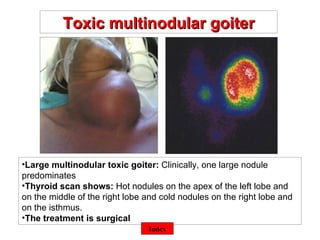
©  Large multinodular toxic goiter:  Clinically, one large nodule predominates Thyroid scan shows:  Hot nodules on the apex of the left lobe and on the middle of the right lobe and cold nodules on the right lobe and on the isthmus. The treatment is surgical Toxic multinodular goiter Index
©  Index Nodular Goiter
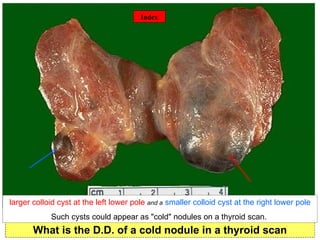
©  Simple nodular goiter What is the D.D. of a cold nodule in a thyroid scan Index larger colloid cyst at the left lower pole  and a   smaller colloid cyst at the right lower pole Such cysts could appear as "cold" nodules on a thyroid scan.  Index
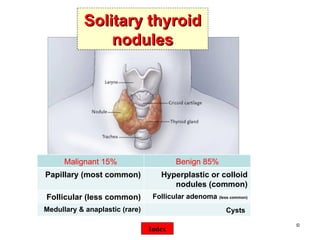
©  Solitary thyroid nodules Index Malignant 15% Benign 85% Papillary (most common) Hyperplastic or colloid nodules (common) Follicular (less common) Follicular adenoma  (less common) Medullary & anaplastic (rare) Cysts
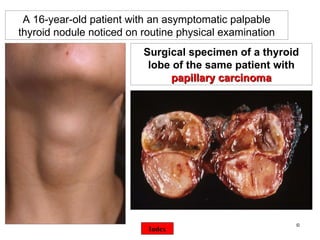
©  A 16-year-old patient with an asymptomatic palpable thyroid nodule noticed on routine physical examination Surgical specimen of a thyroid lobe of the same patient with  papillary carcinoma Index
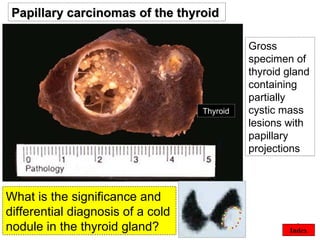
©  Gross specimen of thyroid gland containing partially cystic mass lesions with papillary projections  What is the significance and differential diagnosis of a cold nodule in the thyroid gland? Papillary carcinomas of the thyroid  Thyroid Index
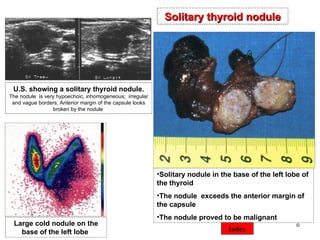
©  Solitary nodule   in the  base of the left lobe  of the thyroid The nodule   exceeds the anterior margin of the capsule The nodule proved to be malignant   U.S. showing a solitary thyroid nodule.  The nodule  is very hypoechoic, inhomogeneous;  irregular  and vague borders, Anterior margin of the capsule looks broken by the nodule   Large cold nodule on the base of the left lobe   Solitary thyroid nodule Index
©  Retrosternal Goiter Index
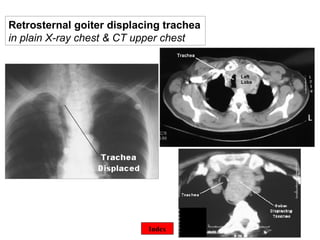
©  Retrosternal goiter displacing trachea  in plain X-ray chest & CT upper chest Index
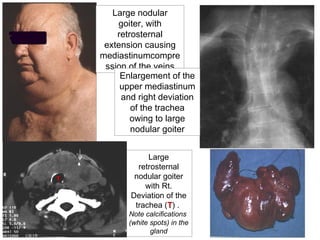
©  Large nodular goiter, with retrosternal extension causing mediastinumcompression of the veins Enlargement of the upper mediastinum and right deviation of the trachea owing to large nodular goiter Large retrosternal nodular goiter with Rt. Deviation of the trachea ( T ) .  Note calcifications  (white spots) in the gland T
Thank You

Thyroid presentation

  • 1.
  • 2.
    C/P : tongueswelling impaired speech dyshpagia respiratory obestruction A- lingual thyroid INVESTIGATIONS : thyroid scan C.T. neck lateral view showing Lingual thyroid TTT. : IF only thyroid tissue medical ttt. & if failed surgical excision
  • 3.
  • 4.
    Thyroglossal cyst &fistula INDEX
  • 5.
    INDEX The classicalsite for a thyroglossal cyst Thyroglossal cysts Embryology The thyroglossal tract arises form foramen caecum  at junction of anterior 2/3 and posterior 1/3 of the tongue. Any part of the tract can persist causing a sinus, fistulae or cyst. Most fistulae are acquired following rupture or incision of infected thyroglossal cyst
  • 6.
    Usually found insubhyoid portion of tract 75% present as midline swellings Remainder can be found as far lateral as lateral tip of hyoid bone The cyst elevates on protrusion of the tongue Can present as an infected cyst due lymphoid tissue in the cyst wall If infected, aspirate cyst rather than incise prevents formation of thyroglossal fistula Treatment Sistrunk Operation Transverse skin crease incision Platysma flaps raised. Cyst dissected Middle 1/3 of hyoid and any suprahyoid tract extending into the tongue dissected Clinical features of Thyroglossal cysts INDEX
  • 7.
    Fistulography: “note the position of the fistula anterior to the trachea (black air)” The classical site for a thyroglossal fistula Thyroglossal fistula INDEX
  • 8.
  • 9.
  • 10.
  • 11.
  • 12.
  • 13.
  • 14.
  • 15.
    Anatomy : SiteIn front of lower Part of neck Shape butterfly
  • 16.
    Structure Each lobePear shaped 2 *1*1 inches Its apex lies at Level of oblique line Of thyroid cartilage & base reach 5 th . Or 6 th . Tracheal ring Isthmus lies on 2 nd . ,3 rd . ,4 th , Tracheal rings Pyramidal lobe It is connected to hyoid bone By fibrous band ( levator glandulae ) thyroid 2 capsules : *true C.T. capsule around gland *false outer capsule from pretracheal fascia Pretracheal fascia
  • 17.
    *Skin , superficialfascia (containing platysma) , deep fascia. * sternomastoid * sternothyroid & sternohyoid * superior belly of omohyoid Relations Antero lateral
  • 18.
    Upper part lower part medial pharynx larynx R.L.N. trachea esophagus
  • 19.
    posterior Carotid sheathC.C.A I.J.V. Sympathetic chain Vagus nerve Anasa cervicalis Inferior thyroid artery
  • 20.
    1- arterial :Blood supply superior thyroid artery Branch from E.C.A. Related to E.L.N. Inferior thyroid artery Branch from thyrocervical trunk Which is branch of 1 st . Part of subclavian Related to R.L.N. Others Thyroid ima artery from aorta ( may be abscent ) Accessory tracheal & esophageal braches
  • 21.
    2- venous :Superior thyroid vein drain to I.J.V. middle thyroid vein drain to I.J.V. inferior thyroid veins drain to left innominate vein The middle thyroid vein Is the shortest soit is the 1 st . To be ligated
  • 22.
  • 23.
  • 24.
    3- lymphatic :Medial part Peripheral part Prelaryngeal L.N. ( Poirier ) Pretracheal L.N. ( Delphie ) Mediastinal L.N. Upper deep cervical L.N. Lower deep cervical L.N.
  • 25.
    Superior laryngeal nerveinternal laryngeal nerve Sensory to m.m of Larynx above vocal cords external laryngeal nerve Motor to cricotyroid Muscle It is closely related To Superior thyroid artery Right R.L.N. Turns around 1 st . Part Of subclavian artery Left R.L.N. Turns around arch of aorta Both supply all Intrinsic muscles Of larynx except (cricothyroid ) & m.m below vocal cords
  • 26.
  • 27.
  • 28.
  • 29.
  • 30.
  • 31.
  • 32.
  • 33.
  • 34.
  • 35.
    Def.: It isan increase in the thyroxin production by the thyroid gland & this is either due to the whole gland enlargement or a thyroid nodule thyroxin
  • 36.
    What happens? Anincrease in thyroxin secretion. Increase of response of the body cells to adrenaline. So signs & symptoms of the disease occur.
  • 37.
    Symptoms 1-Neurological manifestations:Which usually occur in the young age. These manifestations are : *Inosomnia.
  • 38.
  • 39.
  • 40.
    2-Cardiologic manifestations: Itoccurs to the elder patients. It is represented by: Tachycardia & arrythmia. It may reach heart faliure.
  • 41.
    3- thyroid paradox:Decrease in weight although increase in appetite. 4- increase sweating & sense of hotness in weather
  • 42.
    5-Polyurea & diahrea6-Fatigability
  • 43.
  • 44.
  • 45.
    Signs : (a)General examination : Body mass index ( BMI ) is usually less than 20 Kg/m2 (I) Underweight :
  • 46.
    (II) Cutaneous changes: * Moist warm extremities. * Profuse sweating & flushed face * Falling of hairs * Clubbing of fingers & toes * Soft and brittle nails . * Pretibial myxoedema : Usually bilateral. Non pitting. Self limiting.
  • 47.
    (III) Nervous signs: Irritability and anxiety. Fine tremors in the tongue & in the fingers hands • Reflexes are exaggerated. Myopathy weakness of the proximal limb muscles. (IV) cardiovascular signs : 1-PULSE Rate : Tachycardia with sleeping pulse up to 100 – 120 / min. Character : Big pulse volume (water - hummer character).
  • 48.
    Rhythm : All types of arrhythmia except heart block & V.F. 2- B.P. : Systolic B.P. is high but diastolic is usually low or normal (due to peripheral V.D) that Increase pulse pressure. 3. HEART : Accentuation of heart sounds. Functional soft systolic murmur maximum over pulmonary & aortic area.
  • 49.
    (V) Eye manifestations: A. Exophthatmos ( > 50 % of cases ) : TYPES : a)Apparent ( mild = false) exophthalmos : widening of the palpebral fissure due to spasm of Muller's muscle.
  • 50.
    b)True exophthalmos : actual protrusion of the eyeballs. It is an autoimmune disease Infiltration of retro bulbar tissue with inflammatory cells & accumulation of inflammatory fluids. Probably due to cross- reaction of thyroid antigen & eye (Schwartz ) C.T showing infiltration of Retro bulbar spaces True exophthalmos
  • 51.
    1. Rosenbach's sign: Tremors on closing eye lids. B. Certain eye signs : 2. Stellwag's sign : Staring look with infrequent blinking. 3. Dalrymple's sign : rim of sclera is seen between cornea and the upper lid. 4. Von Graef's sign : Lagging of the upper eye lid 5. Joffroy's sign : loss of forehead corrugation when looking up 6. Moebius' sign : Lack of convergence (due to ocular myopathy )
  • 52.
    (b) Local examination: Site : Swelling in the lower part of the front of the neck. Size : slight to moderate enlargement. Shape : symmetrical. Surface: smooth. Skin overlying: is warm. Special character : moves up & down with deglutition. Consistency : soft. Edge: well defined. Pulsations & thrills : are detected usually at the upper poles (V) Reticulo - endothelial signs: Just palpable spleen and may be generalized lymphadenopathy
  • 53.
  • 54.
  • 55.
    What are investigations?*Free T3 , T4 & TSH. . *Neck ultrasound. *Thyroid scan using radioactive iodine or Tc99
  • 56.
  • 57.
  • 58.
    Treatment There are3 lines of treatment: 1-Medical treatment: A-Thiourea group. B-Indral.
  • 59.
    2- Surgical intervention:We make subtotal thyroidectomy after preparation. 3-Treatment using radioactive iodine
  • 60.
  • 61.
  • 62.
  • 63.
  • 64.
  • 65.
  • 66.
    © ThyroidIsotope scan Cold nodule Index Thyroid imaging
  • 67.
    © IndexThyroid imaging NORMAL Iodine uptake is represented here in a colour scale Hot nodule – Rt. lobe Cold nodule – Rt. lobe Thyroid Isotope scan
  • 68.
    © ThyroidUS Index Normal Thyroid nodule
  • 69.
    © Fineneedle aspiration cytology of thyroid swelling Index
  • 70.
    © Physiologicalgoiter in a 14 year old female Simple diffuse hyperplastic (euthyroid) goiter Results from stimulation of the gland by TSH in response to chronically low level of circulating thyroid hormone . Persistent growth stimulation causes diffuse hyperplasia; all lobules are composed of active follicles. Iodine uptake is uniform. Diffuse hyperplasia is reversible if TSH stimulation ceases With pregnancy (High metabolic demands) Index Endemic iodine deficiency goiter –starts as diffuse hyperplasia but nodules appear early
  • 71.
    © Simple (euthroid) multinodular goiter Pathology: As a result of flutuating stimulation, a mixed pattern develops in the gland with arias of active lobules & areas of inactive lobules Active lobules are initialy more active and vascular. Hemorrhage will cause central necrosis Necrotic lobules coalesce to form nodules Nodules are either filled with colloid ( which is iodine free), or new but inactive follicles Repetition of this process results in a NODULAR GOITER Most nodules are inactive. Active follicles are present only in the internodular tissue. Index
  • 72.
    © Nodulargoiter – (cut section) This is a cut section of a nodular goiter showing nodules of various sizes with secondary hemorrhage, necrosis and cystic change
  • 73.
    © Simple (euthroid) multinodular goiter One macroscopic nodule may predominate giving the impression of a solitary thyroid nodule. US is useful to detect other small nodules that are not palpable clinically Nodules may be colloid or cellular Common complications in thyroid nodules Cystic degeneration Hemorrhage (nodule becomes painful and increases in size acutely) (D.D. carcinoma, autoimmune throiditis) Calcification ( if extensive may give a hard sensation confusing with malignancy) Complications of SNG : Tracheal obstruction (by gross latera displacement or compression in retrosternal extension) 2ry thyrotoxicasis Carcinoma (uncommon but more found in endemic areas – usually follicular) Index
  • 74.
    © Toxic (hyperthyroid) goiter 1ry (Graves disease) 2ry nodular goiter Hot nodule in 2ry nodular toxic goiter Diffuse and intense uptake of radioctive iodine Different appearance in thyroid scan Index
  • 75.
    © EXOPHTHALMUSin GRAVS Ds. Index
  • 76.
    © Largemultinodular toxic goiter: Clinically, one large nodule predominates Thyroid scan shows: Hot nodules on the apex of the left lobe and on the middle of the right lobe and cold nodules on the right lobe and on the isthmus. The treatment is surgical Toxic multinodular goiter Index
  • 77.
    © IndexNodular Goiter
  • 78.
    © Simplenodular goiter What is the D.D. of a cold nodule in a thyroid scan Index larger colloid cyst at the left lower pole and a smaller colloid cyst at the right lower pole Such cysts could appear as "cold" nodules on a thyroid scan. Index
  • 79.
    © Solitarythyroid nodules Index Malignant 15% Benign 85% Papillary (most common) Hyperplastic or colloid nodules (common) Follicular (less common) Follicular adenoma (less common) Medullary & anaplastic (rare) Cysts
  • 80.
    © A16-year-old patient with an asymptomatic palpable thyroid nodule noticed on routine physical examination Surgical specimen of a thyroid lobe of the same patient with papillary carcinoma Index
  • 81.
    © Grossspecimen of thyroid gland containing partially cystic mass lesions with papillary projections What is the significance and differential diagnosis of a cold nodule in the thyroid gland? Papillary carcinomas of the thyroid Thyroid Index
  • 82.
    © Solitarynodule in the base of the left lobe of the thyroid The nodule  exceeds the anterior margin of the capsule The nodule proved to be malignant U.S. showing a solitary thyroid nodule. The nodule  is very hypoechoic, inhomogeneous;  irregular and vague borders, Anterior margin of the capsule looks broken by the nodule Large cold nodule on the base of the left lobe Solitary thyroid nodule Index
  • 83.
    © RetrosternalGoiter Index
  • 84.
    © Retrosternalgoiter displacing trachea in plain X-ray chest & CT upper chest Index
  • 85.
    © Largenodular goiter, with retrosternal extension causing mediastinumcompression of the veins Enlargement of the upper mediastinum and right deviation of the trachea owing to large nodular goiter Large retrosternal nodular goiter with Rt. Deviation of the trachea ( T ) . Note calcifications (white spots) in the gland T
  • 86.