Dr.S.Sethupathy.M.D.,Ph.D.,
Professor of Biochemistry,
Rajah Muthiah Medical College,
Annamalai university.
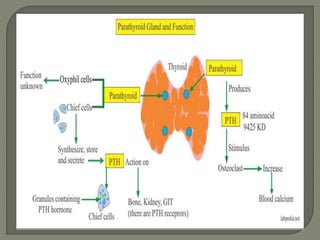
Parathyroid hormone (PTH),
parathormone or parathyrin, is
secreted by chief cells of parathyroid
glands.
A polypeptide contains 84 amino
acids.
 It increases the concentration of
calcium (Ca2+) in the blood.
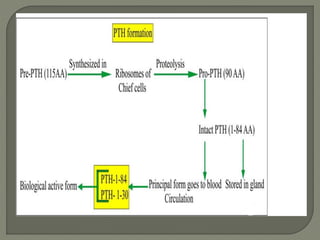
 The primary gene product is pre-proPTH (115
amino acids).
 The N-terminal signal sequence(25 amino acids)
is cleaved and proPTH( 90 amino acids) is
released.
 proPTH on further cleavage , releases PTH(84
amino acids).
 PTH1-34has full biologic activity. PTH25-34 is
responsible for receptor binding.
 Serum PTH concentration is dependent upon the release
of PTH stored and the synthesis of new PTH.
 Rapid PTH release from secretory granules in
hypocalcemic states is modulated by the binding of
Ca2+ to CaSRs on chief cells
 But long-term replenishment of PTH stores is dependent
on new PTH synthesis
 Hypocalcemia also retards the rate of degradation of
PTH within the parathyroid gland
 Phosphorus additionally alters PTH synthesis, but the
precise mechanisms are unknown
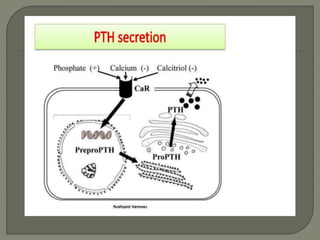
 Secretion of parathyroid hormone is controlled
chiefly by serum [Ca2+] through negative
feedback.
 Calcium-sensing receptors located on
parathyroid cells are activated when [Ca2+] is
low.
 PTH is continuously produced and degraded.
 When blood calcium is low, the degradation is
reduced and PTH is released.
 When blood calcium is high, degradation is
increased and PTH is not released.
 Secretion of parathyroid hormone is determined chiefly
by serum ionized calcium concentration thro negative
feedback.
 Calcium binds calcium-sensing receptors on the cell
surface.
 It results in activation of the Gq G-protein coupled
cascade through the action of phospholipase C
 This hydrolyzes phosphatidylinositol 4,5-
bisphosphate (PIP2) to liberate intracellular
messengers IP3 and diacylglycerol(DAG).
 It results in a release of calcium from intracellular stores
into the cytoplasmic space.
 It inhibits release of PTH.
 PTH is secreted when [Ca2+] is decreased
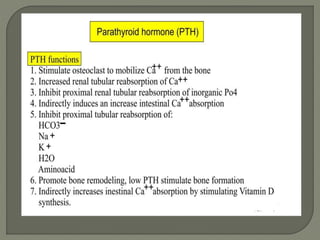
PTH increases blood calcium by acting
on parathyroid hormone 1 receptor (high
levels in bone and kidney)
The parathyroid hormone 2 receptor (high
levels in the central nervous system,
pancreas, testis, and placenta).
PTH half-life is approximately 4 minutes.
PTH uses G-protein mediated activation of
adenylyl cyclase and cAMP second
messenger for its actions.
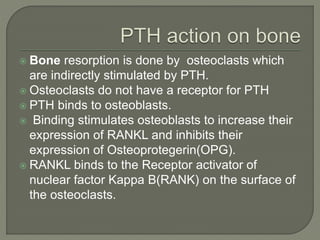
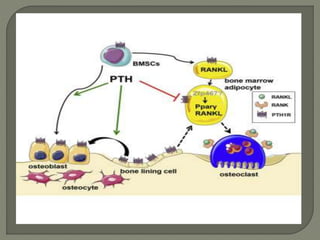
 Bone resorption is done by osteoclasts which
are indirectly stimulated by PTH.
 Osteoclasts do not have a receptor for PTH
 PTH binds to osteoblasts.
 Binding stimulates osteoblasts to increase their
expression of RANKL and inhibits their
expression of Osteoprotegerin(OPG).
 RANKL binds to the Receptor activator of
nuclear factor Kappa B(RANK) on the surface of
the osteoclasts.
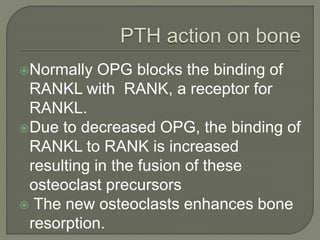
Normally OPG blocks the binding of
RANKL with RANK, a receptor for
RANKL.
Due to decreased OPG, the binding of
RANKL to RANK is increased
resulting in the fusion of these
osteoclast precursors
 The new osteoclasts enhances bone
resorption.
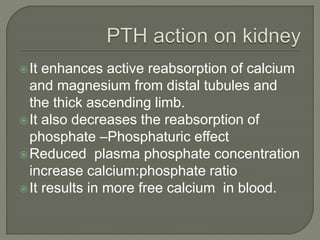
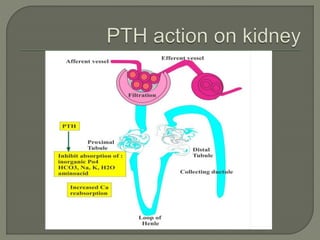
It enhances active reabsorption of calcium
and magnesium from distal tubules and
the thick ascending limb.
It also decreases the reabsorption of
phosphate –Phosphaturic effect
Reduced plasma phosphate concentration
increase calcium:phosphate ratio
It results in more free calcium in blood.
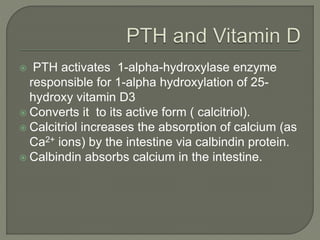
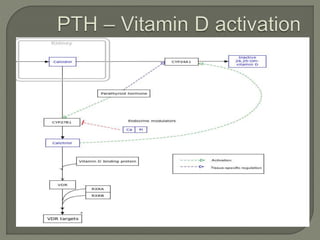
 PTH activates 1-alpha-hydroxylase enzyme
responsible for 1-alpha hydroxylation of 25-
hydroxy vitamin D3
 Converts it to its active form ( calcitriol).
 Calcitriol increases the absorption of calcium (as
Ca2+ ions) by the intestine via calbindin protein.
 Calbindin absorbs calcium in the intestine.
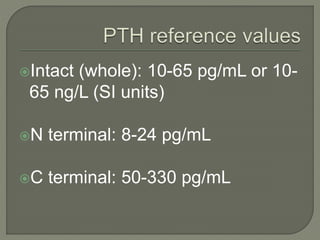
Intact (whole): 10-65 pg/mL or 10-
65 ng/L (SI units)
N terminal: 8-24 pg/mL
C terminal: 50-330 pg/mL
Primary hyperparathyroidism
- the unregulated overproduction
of parathyroid hormone (PTH)
resulting in abnormal calcium
homeostasis.
 In approximately 85% of cases, primary
hyperparathyroidism is caused by a single adenoma.
 In 15% of cases, multiple glands are involved (ie, either
multiple adenomas or hyperplasia).
 Primary hyperparathyroidism is caused by parathyroid
carcinoma.
 Familial cases can occur as either part of the multiple
endocrine neoplasia syndromes (MEN 1 or MEN 2a),
hyperparathyroid-jaw tumor (HPT-JT) syndrome, or
familial isolated hyperparathyroidism (FIHPT).
 Familial hypocalciuric hypercalcemia and neonatal
severe hyperparathyroidism
 An increase in the cell numbers is probably the cause.
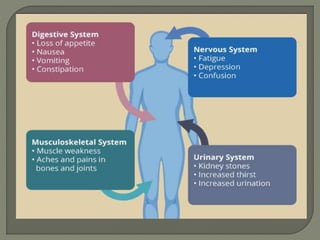
Bones, stones, abdominal groans, and
psychic moans
 Bone and joint pain, pseudogout, and
chondrocalcinosis
 Renal manifestations include polyuria, kidney
stones, hypercalciuria, and
rarely nephrocalcinosis.
 GI manifestations -anorexia, nausea, vomiting,
abdominal pain, constipation, peptic ulcer disease,
and acute pancreatitis.
Neuromuscular and psychologic
manifestations - proximal myopathy,
weakness and easy fatigability,
depression, inability to concentrate, and
memory problems
 75% of the patients - females ,usually
postmenopausal.
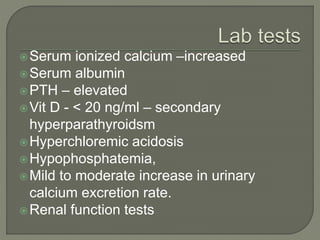
Serum ionized calcium –increased
Serum albumin
PTH – elevated
Vit D - < 20 ng/ml – secondary
hyperparathyroidsm
Hyperchloremic acidosis
Hypophosphatemia,
Mild to moderate increase in urinary
calcium excretion rate.
Renal function tests
It can be due to vitamin D deficiency or
renal failure.
 It can also occur in Paget’s disease,
multiple myeloma, bone metastases.
Serum calcium is normal or low with high
PTH level.
 Calcium and vitamin D supplements in
case of vitamin D deficiency
Calcitriol given in case of renal failure
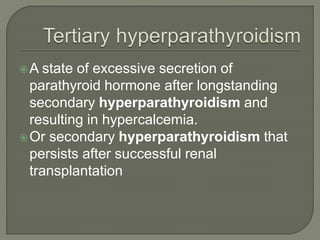
A state of excessive secretion of
parathyroid hormone after longstanding
secondary hyperparathyroidism and
resulting in hypercalcemia.
Or secondary hyperparathyroidism that
persists after successful renal
transplantation
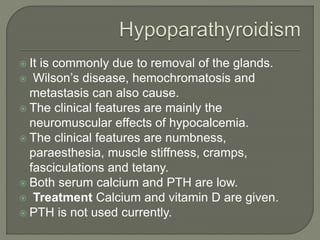
 It is commonly due to removal of the glands.
 Wilson’s disease, hemochromatosis and
metastasis can also cause.
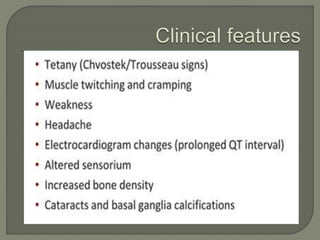
 The clinical features are mainly the
neuromuscular effects of hypocalcemia.
 The clinical features are numbness,
paraesthesia, muscle stiffness, cramps,
fasciculations and tetany.
 Both serum calcium and PTH are low.
 Treatment Calcium and vitamin D are given.
 PTH is not used currently.
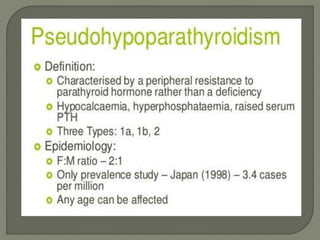
Serum calcium is low with normal PTH
level
It is due to end organ resistance.
 The clinical features are short stature,
round facies, mental retardation, dental
abscesses.
 vitamin D and calcium are given.
Calcitonin counteracts parathyroid
hormone (PTH).
It inhibits Ca2+ absorption by the
intestines.
It inhibits osteoclast activity in bones.
It inhibits renal tubular cell reabsorption of
Ca2+ and increases its excretion.
It inhibits phosphate reabsorption by the
kidney tubules.
The calcitonin receptor, found on
osteoclasts, and in kidney and regions of
the brain, is a Gs protein-coupled receptor
which activates adenylate cyclase and
increases cAMP in target cells.
Clinical applications
Calcitonin is used for the treatment of
Postmenopausal osteoporosis,
Hypercalcaemia, Paget's disease, Bone
metastases and Phantom limb pain.
Parathyroid hormone

Parathyroid hormone

  • 1.
    Dr.S.Sethupathy.M.D.,Ph.D., Professor of Biochemistry, RajahMuthiah Medical College, Annamalai university.
  • 2.
    Parathyroid hormone (PTH), parathormoneor parathyrin, is secreted by chief cells of parathyroid glands. A polypeptide contains 84 amino acids.  It increases the concentration of calcium (Ca2+) in the blood.
  • 4.
     The primarygene product is pre-proPTH (115 amino acids).  The N-terminal signal sequence(25 amino acids) is cleaved and proPTH( 90 amino acids) is released.  proPTH on further cleavage , releases PTH(84 amino acids).  PTH1-34has full biologic activity. PTH25-34 is responsible for receptor binding.
  • 7.
     Serum PTHconcentration is dependent upon the release of PTH stored and the synthesis of new PTH.  Rapid PTH release from secretory granules in hypocalcemic states is modulated by the binding of Ca2+ to CaSRs on chief cells  But long-term replenishment of PTH stores is dependent on new PTH synthesis  Hypocalcemia also retards the rate of degradation of PTH within the parathyroid gland  Phosphorus additionally alters PTH synthesis, but the precise mechanisms are unknown
  • 8.
     Secretion ofparathyroid hormone is controlled chiefly by serum [Ca2+] through negative feedback.  Calcium-sensing receptors located on parathyroid cells are activated when [Ca2+] is low.  PTH is continuously produced and degraded.  When blood calcium is low, the degradation is reduced and PTH is released.  When blood calcium is high, degradation is increased and PTH is not released.
  • 9.
     Secretion ofparathyroid hormone is determined chiefly by serum ionized calcium concentration thro negative feedback.  Calcium binds calcium-sensing receptors on the cell surface.  It results in activation of the Gq G-protein coupled cascade through the action of phospholipase C  This hydrolyzes phosphatidylinositol 4,5- bisphosphate (PIP2) to liberate intracellular messengers IP3 and diacylglycerol(DAG).  It results in a release of calcium from intracellular stores into the cytoplasmic space.  It inhibits release of PTH.  PTH is secreted when [Ca2+] is decreased
  • 10.
    PTH increases bloodcalcium by acting on parathyroid hormone 1 receptor (high levels in bone and kidney) The parathyroid hormone 2 receptor (high levels in the central nervous system, pancreas, testis, and placenta). PTH half-life is approximately 4 minutes. PTH uses G-protein mediated activation of adenylyl cyclase and cAMP second messenger for its actions.
  • 12.
     Bone resorptionis done by osteoclasts which are indirectly stimulated by PTH.  Osteoclasts do not have a receptor for PTH  PTH binds to osteoblasts.  Binding stimulates osteoblasts to increase their expression of RANKL and inhibits their expression of Osteoprotegerin(OPG).  RANKL binds to the Receptor activator of nuclear factor Kappa B(RANK) on the surface of the osteoclasts.
  • 13.
    Normally OPG blocksthe binding of RANKL with RANK, a receptor for RANKL. Due to decreased OPG, the binding of RANKL to RANK is increased resulting in the fusion of these osteoclast precursors  The new osteoclasts enhances bone resorption.
  • 15.
    It enhances activereabsorption of calcium and magnesium from distal tubules and the thick ascending limb. It also decreases the reabsorption of phosphate –Phosphaturic effect Reduced plasma phosphate concentration increase calcium:phosphate ratio It results in more free calcium in blood.
  • 17.
     PTH activates1-alpha-hydroxylase enzyme responsible for 1-alpha hydroxylation of 25- hydroxy vitamin D3  Converts it to its active form ( calcitriol).  Calcitriol increases the absorption of calcium (as Ca2+ ions) by the intestine via calbindin protein.  Calbindin absorbs calcium in the intestine.
  • 19.
    Intact (whole): 10-65pg/mL or 10- 65 ng/L (SI units) N terminal: 8-24 pg/mL C terminal: 50-330 pg/mL
  • 20.
    Primary hyperparathyroidism - theunregulated overproduction of parathyroid hormone (PTH) resulting in abnormal calcium homeostasis.
  • 21.
     In approximately85% of cases, primary hyperparathyroidism is caused by a single adenoma.  In 15% of cases, multiple glands are involved (ie, either multiple adenomas or hyperplasia).  Primary hyperparathyroidism is caused by parathyroid carcinoma.  Familial cases can occur as either part of the multiple endocrine neoplasia syndromes (MEN 1 or MEN 2a), hyperparathyroid-jaw tumor (HPT-JT) syndrome, or familial isolated hyperparathyroidism (FIHPT).  Familial hypocalciuric hypercalcemia and neonatal severe hyperparathyroidism  An increase in the cell numbers is probably the cause.
  • 22.
    Bones, stones, abdominalgroans, and psychic moans  Bone and joint pain, pseudogout, and chondrocalcinosis  Renal manifestations include polyuria, kidney stones, hypercalciuria, and rarely nephrocalcinosis.  GI manifestations -anorexia, nausea, vomiting, abdominal pain, constipation, peptic ulcer disease, and acute pancreatitis.
  • 23.
    Neuromuscular and psychologic manifestations- proximal myopathy, weakness and easy fatigability, depression, inability to concentrate, and memory problems  75% of the patients - females ,usually postmenopausal.
  • 25.
    Serum ionized calcium–increased Serum albumin PTH – elevated Vit D - < 20 ng/ml – secondary hyperparathyroidsm Hyperchloremic acidosis Hypophosphatemia, Mild to moderate increase in urinary calcium excretion rate. Renal function tests
  • 26.
    It can bedue to vitamin D deficiency or renal failure.  It can also occur in Paget’s disease, multiple myeloma, bone metastases. Serum calcium is normal or low with high PTH level.  Calcium and vitamin D supplements in case of vitamin D deficiency Calcitriol given in case of renal failure
  • 27.
    A state ofexcessive secretion of parathyroid hormone after longstanding secondary hyperparathyroidism and resulting in hypercalcemia. Or secondary hyperparathyroidism that persists after successful renal transplantation
  • 28.
     It iscommonly due to removal of the glands.  Wilson’s disease, hemochromatosis and metastasis can also cause.  The clinical features are mainly the neuromuscular effects of hypocalcemia.  The clinical features are numbness, paraesthesia, muscle stiffness, cramps, fasciculations and tetany.  Both serum calcium and PTH are low.  Treatment Calcium and vitamin D are given.  PTH is not used currently.
  • 31.
    Serum calcium islow with normal PTH level It is due to end organ resistance.  The clinical features are short stature, round facies, mental retardation, dental abscesses.  vitamin D and calcium are given.
  • 32.
    Calcitonin counteracts parathyroid hormone(PTH). It inhibits Ca2+ absorption by the intestines. It inhibits osteoclast activity in bones. It inhibits renal tubular cell reabsorption of Ca2+ and increases its excretion. It inhibits phosphate reabsorption by the kidney tubules.
  • 33.
    The calcitonin receptor,found on osteoclasts, and in kidney and regions of the brain, is a Gs protein-coupled receptor which activates adenylate cyclase and increases cAMP in target cells. Clinical applications Calcitonin is used for the treatment of Postmenopausal osteoporosis, Hypercalcaemia, Paget's disease, Bone metastases and Phantom limb pain.