Lecture 4: Hyperthyroidism and
hypothyroidism
Dr. Buuka Godfrey Zziwa
KIU
21/01/2014
Approach
• Introduction.
• Basic anatomy and physiology of the thyroid
gland
• Hyperthyroidism
• Hypothyroidism
• Thyroid dysfunction in the elderly patient
Introduction
• Diseases of thyroid gland often affect females
more than males.
• Prevalence of thyroid diseases in the population
is about 5-10%
• Thyroid hormones are involved in cellular
differentiation and metabolism in all nucleated
cells.
• Its failure in early childhood leads to cretinism
• Diseases of the thyroid gland can be structural
(Goitre, nodules,cycts, tumors etc) or functional.
Anatomy and physiology of the thyroid gland.
• Thyroid gland is located anterior to the trachea ,btn the
cricoid cartilage and suprasternal notch.
• Weighs about 12-20g.
• Has 2 main types of cells. Parafollicular which synthesis
calcitonin and follicular epithelial cells which are
responsible for synthesizing thyroid hormones (TH).
• Synthesis of thyroid hormone involves incorporation of
Iodine in the thyroglobulin.
• Dietary daily iodine intake of 100ug is needed to
maintain normal thyroid function
Physiology cont.
• Secretion of TH is regulated through a feed back loop
involving TRH,TSH, TH.
• The gland secretes predominantly thyroxine (T4)
which is converted to triidothyronine (T3) in the
peripheral tissues.
• Almost all TH (99%) is bound to the carrier protein
called the thyroxine binding globulin (TGB). TGB
bound TH is not metabolically active.
Cont.
• The remaining 1% which is unbound called Free
hormones is the one involved in metabolic
processes. It is responsible for the physiological
processes and for the negative loop to the pituitary
gland and thyroid gland.
• Hence for laboratory assessment of thyroid function,
we measure free T4, FT3 or TSH.
• Totals levels of TH vary with any factors that affect
the Binding globulin.
Hyperthyroidism
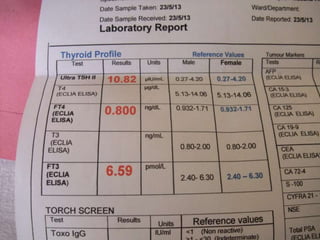
• This refers to excess secretion of thyroid hormone by
the thyroid gland characterized by low serum TSH, high
T4 & high T3.
• It can be primary or secondary hyperthyroidism
• Secondary is rare but may occur with increased activity
of the hypothalmus-pituitary axis.
• Thyrotoxicosis refers to an state of excess thyroid
hormone action. Here the excess T4/T3 may not
necessary be from the thyroid gland.
Hyperthyroidism
• Commonest cause of hyperthyroidism include:
 Graves disease.
 Toxic multinodular goiter.
 toxic adenoma.
• Graves accounts for 80% of all cases of
hyperthyroidism
Graves disease.
• Common especially in the young females presenting
with a diffuse goiter, eye changes and pre-tibial
myxoedema.
• It is caused by presence of Thyroid stimulating
immunoglobulins (TSI) directed to TSH receptors hence
stimulating the thyroid gland to uncontrollable secrete
TH.
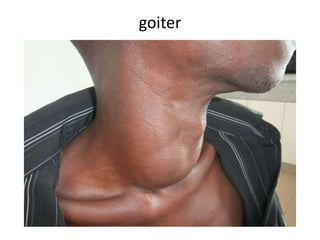
• Excessive stimulation of the gland leads to hyperplasia of
the gland giving a diffuse goiter.
• TSI are found in 80-95% of all patients with Graves’
disease
Toxic multi nodular goiter
• Here we have autonomously functioning nodules in the
gland that produce excess TH leading to Low TSH .
• There is a preceding uneven proliferation of the gland
with nodular formation. Later, upon exposure to excess
iodine, it leads to excess TH secretion.
• Other causes include solitary toxic nodule, thyroiditis.
goiter
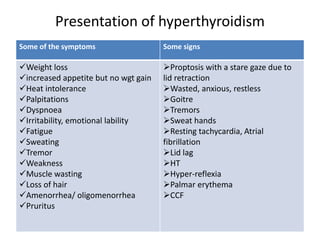
Presentation of hyperthyroidism
Some of the symptoms Some signs
Weight loss
increased appetite but no wgt gain
Heat intolerance
Palpitations
Dyspnoea
Irritability, emotional lability
Fatigue
Sweating
Tremor
Weakness
Muscle wasting
Loss of hair
Amenorrhea/ oligomenorrhea
Pruritus
Proptosis with a stare gaze due to
lid retraction
Wasted, anxious, restless
Goitre
Tremors
Sweat hands
Resting tachycardia, Atrial
fibrillation
Lid lag
HT
Hyper-reflexia
Palmar erythema
CCF
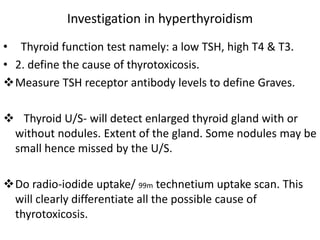
Investigation in hyperthyroidism
• Thyroid function test namely: a low TSH, high T4 & T3.
• 2. define the cause of thyrotoxicosis.
Measure TSH receptor antibody levels to define Graves.
 Thyroid U/S- will detect enlarged thyroid gland with or
without nodules. Extent of the gland. Some nodules may be
small hence missed by the U/S.
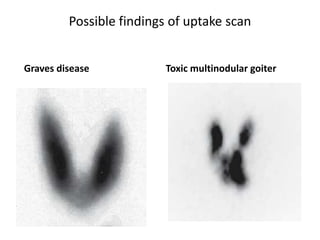
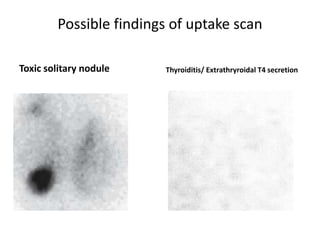
Do radio-iodide uptake/ 99m technetium uptake scan. This
will clearly differentiate all the possible cause of
thyrotoxicosis.
Possible findings of uptake scan
Graves disease Toxic multinodular goiter
Possible findings of uptake scan
Toxic solitary nodule Thyroiditis/ Extrathryroidal T4 secretion
Treatment of hyperthyroidism
• Medical treatment ( short term).
• Aim to broke TH synthesis and also counter the
sympathetic over activity.
• Drugs used:
• 1. Antithyroid drugs: Carbimazole, methimazole,
propythiouracil
• Add. Beta Blockers- Propranolol, Nadolol.
• Beta blockers alleviate symptoms faster.
Definitive treatment
• Will depend on the cause hyperthyroidism
• But in cases of primary hyperthyroidism,
radioactive iodine is preferred.
• Will give long term remission in most patients.
• Surgery (subtotal thyroidectomy) may be
done in selected patients.
Hypothyroidism
• Can be primary or secondary hypothyroidism.
• Primary hypothyroidism refers to a state of
decreased thyroid activity, hence we have low serum
T4 & T3 with high TSH.
• Secondary Hypothyroidism may secondary to
abnormality of the hypothalamic-pituitary axis. we
have low TSH and low T4&T3.
• Women are more affected than men ( 6:1)
Causes of hypothyroidism
Iodine deficiency leading cause of hypothyroidism (
associated with goiter) .
Auto immune thyroiditis ( Hashimoto’s )
Secondary to treatment for hyperthyroidism
Post thyroidectomy for a goiter.
Post irradiation of the neck, head and upper trunk for
cancer treatment.
 Failure of the pituitary and hypothalamus-irradiation,
brain trauma, granulomatous diseases etc.
Post partum thyroiditis
 congenital causes.
Clinical presentation
• Common symptoms of hypothyroidism are not specific
hence it requires a high index of suspicion so as not to
miss the diagnosis.
• The symptoms may be dependent on the severity and
duration of hypothyroidism
• Long standing, there is tissue infiltration with
mucopolysacchrides, hyaluronic acid, chondroitin
sulphate- lead to myxoedema, carpal tunnel
syndrome, periorbital odema, big tongue, low pitched
voice etc.
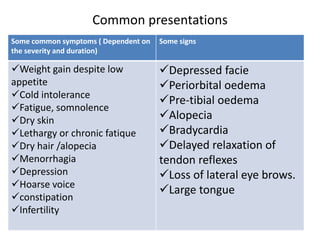
Common presentations
Some common symptoms ( Dependent on
the severity and duration)
Some signs
Weight gain despite low
appetite
Cold intolerance
Fatigue, somnolence
Dry skin
Lethargy or chronic fatique
Dry hair /alopecia
Menorrhagia
Depression
Hoarse voice
constipation
Infertility
Depressed facie
Periorbital oedema
Pre-tibial oedema
Alopecia
Bradycardia
Delayed relaxation of
tendon reflexes
Loss of lateral eye brows.
Large tongue
Investigations in Hypothyroidism
• Note about 80% of patients have primary
hypothyroidism hence tests that establish the
function of the gland are suffice in most cases
• Therefore thyroid function tests are done.
• We expect to find: High serumTSH, low serum
T4& T3.
• In case of low serum TSH and low serum T4,
then we suspect secondary hypothyroidism.
Treatment of hypothyroidism
•
• Very simple and involves thyroxine replacement.
• Young and middle aged patients, start with 50ug/day
of levothyroxine and later increase it to maintenance
dose of 100-150 ug/day.
• Follow up is by doing TSH and T4 levels with a target
of having TSH back to normal ranges every 6 weeks
until stable dose is achieved.
Thyroid dysfunction in the elderly
• Very common after 65 years
• Prevalence of hypothyroidism near 20%
• The classsical symptoms that are seen in young
patient are missing and where symptoms occur, they
are related to the ageing process or other cor-
morbids.
• Hence high suspicion and routine screening TSH is
recommended.
Reference
• Davidson Text book of medicine 21st Ed.
• Harrison Text Book of Medicine 17th ed.
• Washington Manual of medical Therapeutics

Hyperthyroidism.pptx

  • 1.
    Lecture 4: Hyperthyroidismand hypothyroidism Dr. Buuka Godfrey Zziwa KIU 21/01/2014
  • 2.
    Approach • Introduction. • Basicanatomy and physiology of the thyroid gland • Hyperthyroidism • Hypothyroidism • Thyroid dysfunction in the elderly patient
  • 3.
    Introduction • Diseases ofthyroid gland often affect females more than males. • Prevalence of thyroid diseases in the population is about 5-10% • Thyroid hormones are involved in cellular differentiation and metabolism in all nucleated cells. • Its failure in early childhood leads to cretinism • Diseases of the thyroid gland can be structural (Goitre, nodules,cycts, tumors etc) or functional.
  • 4.
    Anatomy and physiologyof the thyroid gland. • Thyroid gland is located anterior to the trachea ,btn the cricoid cartilage and suprasternal notch. • Weighs about 12-20g. • Has 2 main types of cells. Parafollicular which synthesis calcitonin and follicular epithelial cells which are responsible for synthesizing thyroid hormones (TH). • Synthesis of thyroid hormone involves incorporation of Iodine in the thyroglobulin. • Dietary daily iodine intake of 100ug is needed to maintain normal thyroid function
  • 5.
    Physiology cont. • Secretionof TH is regulated through a feed back loop involving TRH,TSH, TH. • The gland secretes predominantly thyroxine (T4) which is converted to triidothyronine (T3) in the peripheral tissues. • Almost all TH (99%) is bound to the carrier protein called the thyroxine binding globulin (TGB). TGB bound TH is not metabolically active.
  • 6.
    Cont. • The remaining1% which is unbound called Free hormones is the one involved in metabolic processes. It is responsible for the physiological processes and for the negative loop to the pituitary gland and thyroid gland. • Hence for laboratory assessment of thyroid function, we measure free T4, FT3 or TSH. • Totals levels of TH vary with any factors that affect the Binding globulin.
  • 7.
    Hyperthyroidism • This refersto excess secretion of thyroid hormone by the thyroid gland characterized by low serum TSH, high T4 & high T3. • It can be primary or secondary hyperthyroidism • Secondary is rare but may occur with increased activity of the hypothalmus-pituitary axis. • Thyrotoxicosis refers to an state of excess thyroid hormone action. Here the excess T4/T3 may not necessary be from the thyroid gland.
  • 8.
    Hyperthyroidism • Commonest causeof hyperthyroidism include:  Graves disease.  Toxic multinodular goiter.  toxic adenoma. • Graves accounts for 80% of all cases of hyperthyroidism
  • 9.
    Graves disease. • Commonespecially in the young females presenting with a diffuse goiter, eye changes and pre-tibial myxoedema. • It is caused by presence of Thyroid stimulating immunoglobulins (TSI) directed to TSH receptors hence stimulating the thyroid gland to uncontrollable secrete TH. • Excessive stimulation of the gland leads to hyperplasia of the gland giving a diffuse goiter. • TSI are found in 80-95% of all patients with Graves’ disease
  • 10.
    Toxic multi nodulargoiter • Here we have autonomously functioning nodules in the gland that produce excess TH leading to Low TSH . • There is a preceding uneven proliferation of the gland with nodular formation. Later, upon exposure to excess iodine, it leads to excess TH secretion. • Other causes include solitary toxic nodule, thyroiditis.
  • 11.
  • 12.
    Presentation of hyperthyroidism Someof the symptoms Some signs Weight loss increased appetite but no wgt gain Heat intolerance Palpitations Dyspnoea Irritability, emotional lability Fatigue Sweating Tremor Weakness Muscle wasting Loss of hair Amenorrhea/ oligomenorrhea Pruritus Proptosis with a stare gaze due to lid retraction Wasted, anxious, restless Goitre Tremors Sweat hands Resting tachycardia, Atrial fibrillation Lid lag HT Hyper-reflexia Palmar erythema CCF
  • 13.
    Investigation in hyperthyroidism •Thyroid function test namely: a low TSH, high T4 & T3. • 2. define the cause of thyrotoxicosis. Measure TSH receptor antibody levels to define Graves.  Thyroid U/S- will detect enlarged thyroid gland with or without nodules. Extent of the gland. Some nodules may be small hence missed by the U/S. Do radio-iodide uptake/ 99m technetium uptake scan. This will clearly differentiate all the possible cause of thyrotoxicosis.
  • 14.
    Possible findings ofuptake scan Graves disease Toxic multinodular goiter
  • 15.
    Possible findings ofuptake scan Toxic solitary nodule Thyroiditis/ Extrathryroidal T4 secretion
  • 16.
    Treatment of hyperthyroidism •Medical treatment ( short term). • Aim to broke TH synthesis and also counter the sympathetic over activity. • Drugs used: • 1. Antithyroid drugs: Carbimazole, methimazole, propythiouracil • Add. Beta Blockers- Propranolol, Nadolol. • Beta blockers alleviate symptoms faster.
  • 17.
    Definitive treatment • Willdepend on the cause hyperthyroidism • But in cases of primary hyperthyroidism, radioactive iodine is preferred. • Will give long term remission in most patients. • Surgery (subtotal thyroidectomy) may be done in selected patients.
  • 18.
    Hypothyroidism • Can beprimary or secondary hypothyroidism. • Primary hypothyroidism refers to a state of decreased thyroid activity, hence we have low serum T4 & T3 with high TSH. • Secondary Hypothyroidism may secondary to abnormality of the hypothalamic-pituitary axis. we have low TSH and low T4&T3. • Women are more affected than men ( 6:1)
  • 20.
    Causes of hypothyroidism Iodinedeficiency leading cause of hypothyroidism ( associated with goiter) . Auto immune thyroiditis ( Hashimoto’s ) Secondary to treatment for hyperthyroidism Post thyroidectomy for a goiter. Post irradiation of the neck, head and upper trunk for cancer treatment.  Failure of the pituitary and hypothalamus-irradiation, brain trauma, granulomatous diseases etc. Post partum thyroiditis  congenital causes.
  • 21.
    Clinical presentation • Commonsymptoms of hypothyroidism are not specific hence it requires a high index of suspicion so as not to miss the diagnosis. • The symptoms may be dependent on the severity and duration of hypothyroidism • Long standing, there is tissue infiltration with mucopolysacchrides, hyaluronic acid, chondroitin sulphate- lead to myxoedema, carpal tunnel syndrome, periorbital odema, big tongue, low pitched voice etc.
  • 22.
    Common presentations Some commonsymptoms ( Dependent on the severity and duration) Some signs Weight gain despite low appetite Cold intolerance Fatigue, somnolence Dry skin Lethargy or chronic fatique Dry hair /alopecia Menorrhagia Depression Hoarse voice constipation Infertility Depressed facie Periorbital oedema Pre-tibial oedema Alopecia Bradycardia Delayed relaxation of tendon reflexes Loss of lateral eye brows. Large tongue
  • 23.
    Investigations in Hypothyroidism •Note about 80% of patients have primary hypothyroidism hence tests that establish the function of the gland are suffice in most cases • Therefore thyroid function tests are done. • We expect to find: High serumTSH, low serum T4& T3. • In case of low serum TSH and low serum T4, then we suspect secondary hypothyroidism.
  • 24.
    Treatment of hypothyroidism • •Very simple and involves thyroxine replacement. • Young and middle aged patients, start with 50ug/day of levothyroxine and later increase it to maintenance dose of 100-150 ug/day. • Follow up is by doing TSH and T4 levels with a target of having TSH back to normal ranges every 6 weeks until stable dose is achieved.
  • 25.
    Thyroid dysfunction inthe elderly • Very common after 65 years • Prevalence of hypothyroidism near 20% • The classsical symptoms that are seen in young patient are missing and where symptoms occur, they are related to the ageing process or other cor- morbids. • Hence high suspicion and routine screening TSH is recommended.
  • 26.
    Reference • Davidson Textbook of medicine 21st Ed. • Harrison Text Book of Medicine 17th ed. • Washington Manual of medical Therapeutics