ORGANIZING PNEUMONIA
BRONCHIOLITIS OBLITERANS
ORGANISING PNEUMONIA
Presented by
Dr. MohamedA/AzizOmerMustafa
Consultantchestphysician
MD Respirato ry medicine
SMSB
Idiopathic
BRONCHIOLITIS OBLITERANS
ORGANISING PNEUMONIA (BOOP)
CRYPTOGENIC ORGANISING
PNEUMONIA (COP)
SECONDRY ORGANIZING
PNEUMONIA (SOP)
Terms
• Bronchiolitis
Bronchiolitis obliterans (BO)
Obliterative bronchiolitis (OB)
Constrictive bronchiolitis(CB)
• Bronchiolitis obliterans syndrome (BOS)
• Pneumonia
• Organizing pneumonia
• Idiopathic interstitial pneumonia ( diffuse alveolar damage)
Bronchiolitis
• Is an inflammatory reaction that follows damage to the
bronchiolar epithelium of the small conducting airways
Subsequent healing leads to excessive proliferation of granulation
tissue within the airway walls , lumen or both.
Depending on disease stage the repair process may cause
narrowing and distortion of the small airway (constrictive
bronchiolitis ) or complete obliteration ( bronchiolitis obliterans)
BRONCHIOLITIS OBLITERANS
• Rare form of non-reversible Obstructive lung disease
• Scarring
• Polyploidy obliteration of the lumen of the bronchioles without involving of
the distal lung parenchyma.
• Infants - adenovirus
BRONCHIOLITIS OBLITERANS
• Rare form of non-reversible Obstructive lung disease
• Scarring
• Polyploidy obliteration of the lumen of the bronchioles without
involving of the distal lung parenchyma.
• Infants - adenovirus
BRONCHIOLITIS OBLITERANS
SYMPTOMS & SIGNS
• Dry cough
• SOB
• WHEEZES
• FEV1 16-21%
• Desaturation
BRONCHIOLITIS OBLITERANS
CAUSES
• Viruses
• Collagen vascular diseases
• Transplant rejection
• Stevens-Jonson's syndrome
• Pneumocystis Juversi pneumonia
• Drug reaction
• Aspiration
• Bronchopulmonary dysplasia-prematurity
• Toxic fumes
BOS
a distinct clinical entity
occurring in the transplanted lung
involves the small airways primarily
should not be confused with BO or BOOP
PNEUMONIA - PNEUMONITIS
• Inflammatory condition of the lung affecting primarily the microscopic
airspaces known as alveoli .
• Congestion , hepatization , resolution
• …. Viruses , bacteria ,fungi , parasites
• > 100 strains identified
• Mixed infection 45% children : 15% adults
• Isolation of causative agent 50% despite careful testing
Pneumonitis
• Certain drugs
• Chemical burns
• Autoimmune diseases
• Radiation
• Thermal injuries
HISTORY
• HIPPOCRATES 460-370 BC
• 12 November world pneumonia day
• 450 million /year
• 4 million deaths /year
• 7% world’s total deaths
• Greatest < 5 >75 yrs
• 8th
leading death in the states 2009
PNEUMONIA IMAGING
• CXR does not always match the severity of pneumonia
• Not reliably separate between bacterial infection and
viral infection
• CXR typically clear within one month
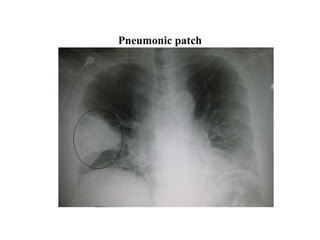
Pneumonic patch
Interstitial lung disease
• Is a class of diffuse lung diseases .
• It is a common pathological response of the lung to a wide variety
of known & unknown cause .
• It is often referred to interstitial pneumonia , IP or interstitial lung
disease ILD
• Until 1960 IPF remained largely a clinical diagnosis considered as
a single entity
• Has been felt to be a terminal disease with poor prognosis
because of lack of response to immunosuppressive therapy only
30% respond
• only 30% histopathology done
ILD
Several acute and chronic lung disorders with variable degrees of
pulmonary fibrosis ,variable degree of disease progression &
variable response to treatment.
Retrospective review of clinical & histopathology data allows
IPF to be classified into distinct subsets that differ in clinical
course , prognosis & response to treatment .
ILD
• NSIP , LIP , DIP ,RBI lung disease , UIP , OP
• In some ILDs , the small airways- the respiratory and terminal
bronchioles- are primarily affected .
respiratory bronchiolitis-associated interstitial lung disease
(RBILD)
idiopathic , smoking related in contrast to BO .
Known factors or insults lead to
Interstitial lung disease
• Drugs : antineoplastic (bleomycin , methotrexate )
: antimicrobial (nitrofrantoin , penicillin )
:amidorone
: hydroclorothiazide
• Hypersensitivity pneumonia
Farmer’s lung , pigeon breeder’s lung
. Dusts:
Asbestos , silica
Viral agents … mycoplasma pneumonia
. CD
ILD
.
It is important to differentiate terms used to define clinical entities
and terms describing the pathologic lesions of these disorders .
Clinical syndromes IPF,CFA ,idiopathic BOOP,COP,BO,BOS
,Hamman-Rich syndrome .
Pathological:UIP , LIP , giant cell interstitial pneumonitis ,
diffuse alveolar damage, non classifiable interstitial pneumonia ,
BOOP .
DD
ILD
• Clinical setting:-
• First: requires consideration of a variety of other pathological processes that
mimic the interstitial disorders in appropriate clinical setting
• Second: Physician should be aware of at least 150 other clinical entities &
situations associated with ILD
• Third: Owing the broad DD & the availability of various evolving invasive &
non-invasive diagnostic techniques, the best approach to use is to establish a
specific diagnosis which is frequently difficult to determine
• Fourth: In a significant proportion of patients a conclusive cause can't be
ascertained even when the most invasive diagnostic pathways are taken.
• Finally , even when a specific diagnosis is made, an effective therapeutic
regimen is not available for many patients with ILD
????????
BOOP
Bronchiolitis obliterans organizing pneumonia
Is a type of diffuse INTERSTITIAL LUNG DISEASE that
affects the distal bronchioles , respiratory bronchioles , alveolar
ducts and alveolar wall.
Type of lung injury and repair
Failure of resolution of acute pneumonia
The primary area of injury is within the alveolar wall.
BOOP Hx
• As a distinct clinical entity 1st described by Davison in 1983
• Gary Epler 1985 gave the name BOOP
• Inflammation of the bronchioles & surrounding tissue in the
lung.
• Non infectious- infectious
• Complication of an existing chronic inflammatory disease such as
RA
• Side effect of certain medication such as amidarone
• MF 1:1
• Age 50-60  20-80
• No relation to smoking
Organizing pneumonia
• Refers to unresolved pneumonia in which alveolar exudates
persists & eventually undergo fibrosis .
. presence of buds of granulation tissue progressing from fibrin
exudates to loose collagen containing fibroblast.
Accessory finding in other inflammatory diseases such as
vasculitis
. It may also be a feature of organizing stage of ARDS
• A complication of an existing chronic inflammatory disease
or a side effect of certain medication .
• organizing Pneumonia of determined causes
• organizing Pneumonia of unknown cause occurring in a
specific context causes
• Cryptogenic organizing pneumonia
Undetermined causes of organizing
Pneumonia
• RA , Sjorgen syndrome---------- SLE ,SS
• Sweet”s disease
• HCV thyroiditis
• Crhons disease…..UC
• Behcets”s …. Wegener”s granulomatosis ….PN
• Polymyalgia Rheumatica
• Myelodysplasia
• Leukemia ….. Cancer
• Mesangiocapillary GN
• Chronic rejection …. Graft versus host disease
Determined causes of organizing Pneumonia
• Infection
• Drugs
• Radiation
• It was long been known that radiation may induce radiation
pneumonitis
• However a syndrome similar to COP has been identified recently
• It differs strikingly from usual radiation pneumonitis in that the
pulmonary infiltrate occur or migrate outside the radiation fields
add respond good to steroids.
• Interestingly, unilateral breast irradiation, whether or not it results
in pneumonitis , has been shown to induce bilateral lymphocytic
alveolitis with activated CD4+Tcells
Infectious causes of organising
pneumonia
• Bacteria
Chlamydia pneumoniae
Coxiella burnetii
Legionella pneumophila
Mycoplasma pneumoniae
Nocardia asteroides
Pseudomonas aeruginosa
Serratia marcescens
Staphylococcus aureus
Streptococcus group B (newborn treated by extracorporeal oxygenation)
Streptococcus pneumoniae
Infectious causes of organising pneumonia
cont…..
• Viruses
Herpes virus
Human immunodeficiency virus
Influenza virus
Parainfluenza virus
• Parasites
Plasmodium vivax
• Fungi
Cryptococcus neoformans
Penicillium janthinellum
Pneumocystis carinii (in AIDS )
Clinical approach
• Medical Hx , environmental factors, occupational exposures,
medication & drug usage, FH
• Age , smoking, sex
• Onset & Duration of symptoms
• Rate of disease progression
• Extra pulmonary symptoms
Clinical approach …cont.
• Acquired immunodeficiency & transplant
• Diffuse neoplasia
• CHF
• Pulmonary vascular disorder
• CBC, ESR, LFT, electrolytes, RFT
BOOP diagnosis
• Diagnosis is suspected after no response to multiple antibiotics & blood &
sputum cultures are –ve for organisms
. Clinical picture & radiological images resemble infectious pneumonia
• CXR similar to an extensive pneumonia wide spread white patches
small nodular opacities 50% & large nodules in 15%
• Preservation of normal lung volume
• Migrate
• Persists or progresses
BOOP – CT
• CT may be used to confirm the diagnosis ( findings are typical enough to allow
the doctor to make the diagnosis without ordering additional tests)
• …airspace consolidation with airbronchogram , lower zone predominance ,
sub pleural or peribronchial distribution 50%.
• Ground glass appearance in most pt , honeycombing in some
• Diffuse bilateral infiltratation
• as a solitary focal lesion associated usually with subacute or chronic
inflammatory illness, it occurs in the upper lobes and may cavitate.
• .
BOOP - histopathology
• Confirmation
• Broncoscopic biopsy !
• VATS
• Histology: presence of polyploidy plugs of loose organizing connective tissue
( Masson bodies ) within the alveolar ducts , alveoli , bronchioles .
• Intraluminal polyps in respiratory bronchioles , alveolar ducts , alveolar spaces .
• Accompanied by organizing pneumonia in the more distant parenchyma
( proliferative bronchitis)
Diagnosis of exclusion
• COP is a diagnosis of exclusion .
• Once confirmation done , physician has to rule out :-
Chronic esinophilic pneumonia
Hypersensitivity pneumonia
Bacterial …. Viral
CD
Drug reaction
TREATMENT
• Spontaneous
• Macroloids
• Steroids
• Cytotoxic drugs
• Transforming growth factor , pirfenidone
BOOP
Typical imaging pattern of organising pneumonia with patchy alveolar opacities on
chest radiograph.
Cordier J Thorax 2000;55:318-328
Copyright © BMJ Publishing Group Ltd & British Thoracic Society. All rights reserved.
THANK YOU

Organizing pneumonia

  • 1.
    ORGANIZING PNEUMONIA BRONCHIOLITIS OBLITERANS ORGANISINGPNEUMONIA Presented by Dr. MohamedA/AzizOmerMustafa Consultantchestphysician MD Respirato ry medicine SMSB
  • 2.
    Idiopathic BRONCHIOLITIS OBLITERANS ORGANISING PNEUMONIA(BOOP) CRYPTOGENIC ORGANISING PNEUMONIA (COP) SECONDRY ORGANIZING PNEUMONIA (SOP)
  • 3.
    Terms • Bronchiolitis Bronchiolitis obliterans(BO) Obliterative bronchiolitis (OB) Constrictive bronchiolitis(CB) • Bronchiolitis obliterans syndrome (BOS) • Pneumonia • Organizing pneumonia • Idiopathic interstitial pneumonia ( diffuse alveolar damage)
  • 4.
    Bronchiolitis • Is aninflammatory reaction that follows damage to the bronchiolar epithelium of the small conducting airways Subsequent healing leads to excessive proliferation of granulation tissue within the airway walls , lumen or both. Depending on disease stage the repair process may cause narrowing and distortion of the small airway (constrictive bronchiolitis ) or complete obliteration ( bronchiolitis obliterans)
  • 5.
    BRONCHIOLITIS OBLITERANS • Rareform of non-reversible Obstructive lung disease • Scarring • Polyploidy obliteration of the lumen of the bronchioles without involving of the distal lung parenchyma. • Infants - adenovirus
  • 6.
    BRONCHIOLITIS OBLITERANS • Rareform of non-reversible Obstructive lung disease • Scarring • Polyploidy obliteration of the lumen of the bronchioles without involving of the distal lung parenchyma. • Infants - adenovirus
  • 7.
    BRONCHIOLITIS OBLITERANS SYMPTOMS &SIGNS • Dry cough • SOB • WHEEZES • FEV1 16-21% • Desaturation
  • 8.
    BRONCHIOLITIS OBLITERANS CAUSES • Viruses •Collagen vascular diseases • Transplant rejection • Stevens-Jonson's syndrome • Pneumocystis Juversi pneumonia • Drug reaction • Aspiration • Bronchopulmonary dysplasia-prematurity • Toxic fumes
  • 9.
    BOS a distinct clinicalentity occurring in the transplanted lung involves the small airways primarily should not be confused with BO or BOOP
  • 10.
    PNEUMONIA - PNEUMONITIS •Inflammatory condition of the lung affecting primarily the microscopic airspaces known as alveoli . • Congestion , hepatization , resolution • …. Viruses , bacteria ,fungi , parasites • > 100 strains identified • Mixed infection 45% children : 15% adults • Isolation of causative agent 50% despite careful testing
  • 11.
    Pneumonitis • Certain drugs •Chemical burns • Autoimmune diseases • Radiation • Thermal injuries
  • 12.
    HISTORY • HIPPOCRATES 460-370BC • 12 November world pneumonia day • 450 million /year • 4 million deaths /year • 7% world’s total deaths • Greatest < 5 >75 yrs • 8th leading death in the states 2009
  • 13.
    PNEUMONIA IMAGING • CXRdoes not always match the severity of pneumonia • Not reliably separate between bacterial infection and viral infection • CXR typically clear within one month
  • 16.
  • 17.
    Interstitial lung disease •Is a class of diffuse lung diseases . • It is a common pathological response of the lung to a wide variety of known & unknown cause . • It is often referred to interstitial pneumonia , IP or interstitial lung disease ILD • Until 1960 IPF remained largely a clinical diagnosis considered as a single entity • Has been felt to be a terminal disease with poor prognosis because of lack of response to immunosuppressive therapy only 30% respond • only 30% histopathology done
  • 18.
    ILD Several acute andchronic lung disorders with variable degrees of pulmonary fibrosis ,variable degree of disease progression & variable response to treatment. Retrospective review of clinical & histopathology data allows IPF to be classified into distinct subsets that differ in clinical course , prognosis & response to treatment .
  • 19.
    ILD • NSIP ,LIP , DIP ,RBI lung disease , UIP , OP • In some ILDs , the small airways- the respiratory and terminal bronchioles- are primarily affected . respiratory bronchiolitis-associated interstitial lung disease (RBILD) idiopathic , smoking related in contrast to BO .
  • 20.
    Known factors orinsults lead to Interstitial lung disease • Drugs : antineoplastic (bleomycin , methotrexate ) : antimicrobial (nitrofrantoin , penicillin ) :amidorone : hydroclorothiazide • Hypersensitivity pneumonia Farmer’s lung , pigeon breeder’s lung . Dusts: Asbestos , silica Viral agents … mycoplasma pneumonia . CD
  • 21.
    ILD . It is importantto differentiate terms used to define clinical entities and terms describing the pathologic lesions of these disorders . Clinical syndromes IPF,CFA ,idiopathic BOOP,COP,BO,BOS ,Hamman-Rich syndrome . Pathological:UIP , LIP , giant cell interstitial pneumonitis , diffuse alveolar damage, non classifiable interstitial pneumonia , BOOP .
  • 22.
    DD ILD • Clinical setting:- •First: requires consideration of a variety of other pathological processes that mimic the interstitial disorders in appropriate clinical setting • Second: Physician should be aware of at least 150 other clinical entities & situations associated with ILD • Third: Owing the broad DD & the availability of various evolving invasive & non-invasive diagnostic techniques, the best approach to use is to establish a specific diagnosis which is frequently difficult to determine • Fourth: In a significant proportion of patients a conclusive cause can't be ascertained even when the most invasive diagnostic pathways are taken. • Finally , even when a specific diagnosis is made, an effective therapeutic regimen is not available for many patients with ILD
  • 23.
    ???????? BOOP Bronchiolitis obliterans organizingpneumonia Is a type of diffuse INTERSTITIAL LUNG DISEASE that affects the distal bronchioles , respiratory bronchioles , alveolar ducts and alveolar wall. Type of lung injury and repair Failure of resolution of acute pneumonia The primary area of injury is within the alveolar wall.
  • 24.
    BOOP Hx • Asa distinct clinical entity 1st described by Davison in 1983 • Gary Epler 1985 gave the name BOOP • Inflammation of the bronchioles & surrounding tissue in the lung. • Non infectious- infectious • Complication of an existing chronic inflammatory disease such as RA • Side effect of certain medication such as amidarone • MF 1:1 • Age 50-60 20-80 • No relation to smoking
  • 25.
    Organizing pneumonia • Refersto unresolved pneumonia in which alveolar exudates persists & eventually undergo fibrosis . . presence of buds of granulation tissue progressing from fibrin exudates to loose collagen containing fibroblast. Accessory finding in other inflammatory diseases such as vasculitis . It may also be a feature of organizing stage of ARDS • A complication of an existing chronic inflammatory disease or a side effect of certain medication .
  • 26.
    • organizing Pneumoniaof determined causes • organizing Pneumonia of unknown cause occurring in a specific context causes • Cryptogenic organizing pneumonia
  • 27.
    Undetermined causes oforganizing Pneumonia • RA , Sjorgen syndrome---------- SLE ,SS • Sweet”s disease • HCV thyroiditis • Crhons disease…..UC • Behcets”s …. Wegener”s granulomatosis ….PN • Polymyalgia Rheumatica • Myelodysplasia • Leukemia ….. Cancer • Mesangiocapillary GN • Chronic rejection …. Graft versus host disease
  • 28.
    Determined causes oforganizing Pneumonia • Infection • Drugs • Radiation
  • 29.
    • It waslong been known that radiation may induce radiation pneumonitis • However a syndrome similar to COP has been identified recently • It differs strikingly from usual radiation pneumonitis in that the pulmonary infiltrate occur or migrate outside the radiation fields add respond good to steroids. • Interestingly, unilateral breast irradiation, whether or not it results in pneumonitis , has been shown to induce bilateral lymphocytic alveolitis with activated CD4+Tcells
  • 30.
    Infectious causes oforganising pneumonia • Bacteria Chlamydia pneumoniae Coxiella burnetii Legionella pneumophila Mycoplasma pneumoniae Nocardia asteroides Pseudomonas aeruginosa Serratia marcescens Staphylococcus aureus Streptococcus group B (newborn treated by extracorporeal oxygenation) Streptococcus pneumoniae
  • 31.
    Infectious causes oforganising pneumonia cont….. • Viruses Herpes virus Human immunodeficiency virus Influenza virus Parainfluenza virus • Parasites Plasmodium vivax • Fungi Cryptococcus neoformans Penicillium janthinellum Pneumocystis carinii (in AIDS )
  • 32.
    Clinical approach • MedicalHx , environmental factors, occupational exposures, medication & drug usage, FH • Age , smoking, sex • Onset & Duration of symptoms • Rate of disease progression • Extra pulmonary symptoms
  • 33.
    Clinical approach …cont. •Acquired immunodeficiency & transplant • Diffuse neoplasia • CHF • Pulmonary vascular disorder • CBC, ESR, LFT, electrolytes, RFT
  • 34.
    BOOP diagnosis • Diagnosisis suspected after no response to multiple antibiotics & blood & sputum cultures are –ve for organisms . Clinical picture & radiological images resemble infectious pneumonia • CXR similar to an extensive pneumonia wide spread white patches small nodular opacities 50% & large nodules in 15% • Preservation of normal lung volume • Migrate • Persists or progresses
  • 35.
    BOOP – CT •CT may be used to confirm the diagnosis ( findings are typical enough to allow the doctor to make the diagnosis without ordering additional tests) • …airspace consolidation with airbronchogram , lower zone predominance , sub pleural or peribronchial distribution 50%. • Ground glass appearance in most pt , honeycombing in some • Diffuse bilateral infiltratation • as a solitary focal lesion associated usually with subacute or chronic inflammatory illness, it occurs in the upper lobes and may cavitate. • .
  • 36.
    BOOP - histopathology •Confirmation • Broncoscopic biopsy ! • VATS • Histology: presence of polyploidy plugs of loose organizing connective tissue ( Masson bodies ) within the alveolar ducts , alveoli , bronchioles . • Intraluminal polyps in respiratory bronchioles , alveolar ducts , alveolar spaces . • Accompanied by organizing pneumonia in the more distant parenchyma ( proliferative bronchitis)
  • 37.
    Diagnosis of exclusion •COP is a diagnosis of exclusion . • Once confirmation done , physician has to rule out :- Chronic esinophilic pneumonia Hypersensitivity pneumonia Bacterial …. Viral CD Drug reaction
  • 38.
    TREATMENT • Spontaneous • Macroloids •Steroids • Cytotoxic drugs • Transforming growth factor , pirfenidone
  • 39.
  • 40.
    Typical imaging patternof organising pneumonia with patchy alveolar opacities on chest radiograph. Cordier J Thorax 2000;55:318-328 Copyright © BMJ Publishing Group Ltd & British Thoracic Society. All rights reserved.
  • 47.

Editor's Notes

  • #41 Typical imaging pattern of organising pneumonia with patchy alveolar opacities on chest radiograph.
  • #48 THANK YOU