Presented by :
Mr. Nirav S. Vachhani
M.Pharm Pharmacology (Sem-2)


Guided by:
Dr. Rina H. Gokani
S. J. Thakkar pharmacy college, Rajkot.
2
Introduction:
      The thyroid gland was described by Galen
and was named "glandulae thyroidaeae" by
Wharton in 1656.
      The thyroid gland is the source of two
fundamentally different types of hormones.
      The iodothyronine hormones include
1. Thyroxine (T4) and
2. 3,5,3’-triiodothyronine (T3)
      They are essential for normal growth and
development and play an important role in
energy metabolism.


                                                 3
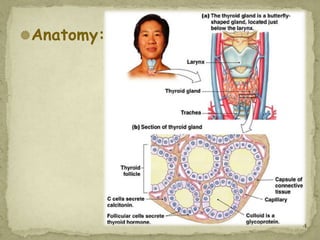
Anatomy:


            4
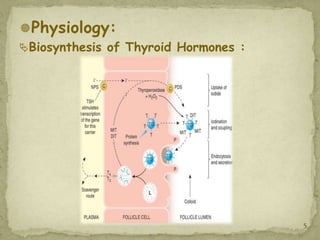
Physiology:
Biosynthesis of Thyroid Hormones :


                                      5
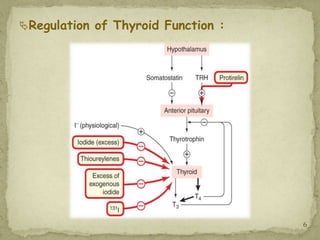
Regulation of Thyroid Function :


                                    6
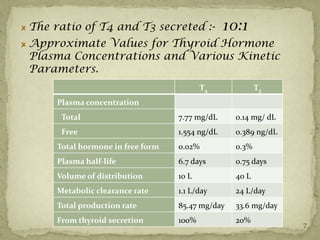
The ratio of T4 and T3 secreted :-              10:1
Approximate Values for Thyroid Hormone
Plasma Concentrations and Various Kinetic
Parameters.
                                          T4             T3
     Plasma concentration
      Total                       7.77 mg/dL      0.14 mg/ dL
      Free                        1.554 ng/dL     0.389 ng/dL
     Total hormone in free form   0.02%           0.3%
     Plasma half-life             6.7 days        0.75 days
     Volume of distribution       10 L            40 L
     Metabolic clearance rate     1.1 L/day       24 L/day
     Total production rate        85.47 mg/day    33.6 mg/day
     From thyroid secretion       100%            20%           7
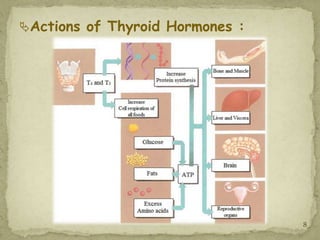
Actions of Thyroid Hormones :


                                 8
Evaluation of Thyroid            Diseases:
Thyroid Function test :
  commonly in use for estimating the iodine,
  TBG, free T4 and free T3 concentrations are as
  follow:
• Protein-bound iodine:
     It is a measure of organically bound iodine
     in blood (normal 4-8 ug/dl: myxoedema
     2ug/dl; thyrotoxicosis 10-12 ug/dl).
• Serum T4:
     It is measured by radio-immuno assay
     (normal 5-12 ug/dl). Serum T3 assay can also
     be done (normal 80-180 ng/dl).

                                                    9
•Serum TBG:
     It is measured by radio-immuno assay or immuno
     electrophoresis, and the ratio of T4 to TBG is used
     as an index of free hormone activity.
• Free thyroxine index and effective thyroxine ratio:
     These are calculated from the serum T4 and
     serum TBG level. There is a good correlation
     between these values and free T4 levels. Direct
     free T4 measurement are tedious and difficult.
• Scintillography:
     The radio iodine uptake by the gland is recorded
     photographically and scanned.


                                                      10
• T3 suppression test:
     In the standard test, the pretreatment
     radioactive iodine uptake (RAIU) is determined.
     Then T3 (as Cytomel) 25 ug tid, is given for 7-10
     days. On the last day a repeat RAIU is
     performed. In a normal person the RAIU will be
     suppressed by 50% or less of the original value.
     Whereas in Graves’ disease there is no suppresion
     as the thyroid is functioning autonomously.
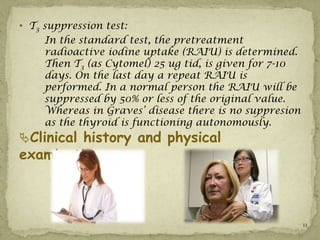
Clinical history and physical
examination :


                                                         11
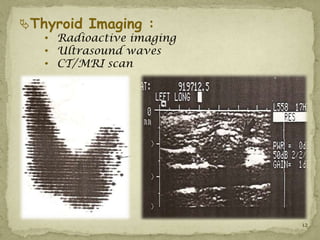
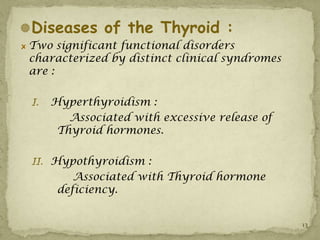
Thyroid Imaging :
   • Radioactive imaging
   • Ultrasound waves
   • CT/MRI scan


                           12
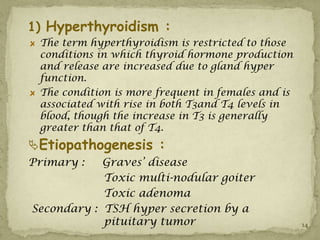
Diseases of the Thyroid :
 Two significant functional disorders
 characterized by distinct clinical syndromes
 are :

 I.   Hyperthyroidism :
         Associated with excessive release of
       Thyroid hormones.

 II. Hypothyroidism :
          Associated with Thyroid hormone
       deficiency.


                                                13
1) Hyperthyroidism :
 The term hyperthyroidism is restricted to those
 conditions in which thyroid hormone production
 and release are increased due to gland hyper
 function.
 The condition is more frequent in females and is
 associated with rise in both T3and T4 levels in
 blood, though the increase in T3 is generally
 greater than that of T4.
Etiopathogenesis :
Primary :   Graves’ disease
            Toxic multi-nodular goiter
            Toxic adenoma
Secondary : TSH hyper secretion by a
            pituitary tumor                         14
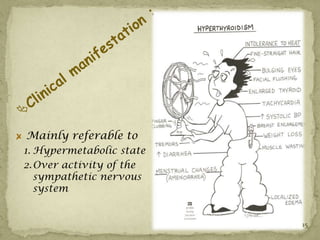
Mainly referable to
1. Hypermetabolic state
2. Over activity of the
   sympathetic nervous
   system


                          15
Diagnosis :
    Autonomous thyroid function
       Low TSH
       Elevated T3 / T4
    Thyroid scan
       diffuse elevated iodine uptake
    Thyroid ultrasound


                                         16
Treatment :
  Choices:
   1. Antithyroid drugs
   2. Radioactive iodine therapy
   3. Surgery
  Choice depends on:
   1. Age
   2. Severity of the disease
   3. Size of the gland
   4. Coexistent pathology (Ophthalmoplegia)
   5. Other factors:
       Patient’s preference
       Pregnancy
                                               17
1. Antithyroid drugs :
 Propyl thiouracil (PTU) = 100-300 mg TID
 Methimazole (Tapazole) = 10-20 mg TID then OD
 Carbimazole             = 40 mg OD


MOA :
 Inhibits the organic binding of iodine and
  coupling of iodotyrosine
 PTU can also lower conversion of T4 to T3; it can
  also decrease thyroid autoantibody levels.


                                                      18
Disadvantages of these drugs :
   Crosses the placenta --> inhibits fetal thyroid
                             function
   Excreted in breast milk
   Side effects:
    Skin rashes
    Fever
    Peripheral neuritis
    Polyarthritis
    Granulocytopenia (reversible)


                                                     19
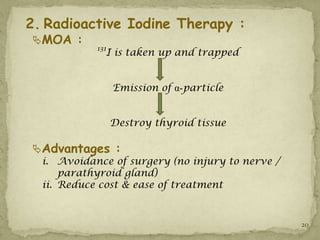
2. Radioactive Iodine Therapy :
MOA :
            131
              I is taken up and trapped


                  Emission of α-particle


                  Destroy thyroid tissue

Advantages :
  i. Avoidance of surgery (no injury to nerve /
      parathyroid gland)
  ii. Reduce cost & ease of treatment


                                                  20
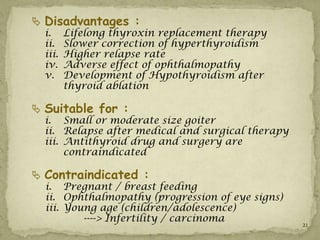
 Disadvantages :
  i.     Lifelong thyroxin replacement therapy
  ii.    Slower correction of hyperthyroidism
  iii.   Higher relapse rate
  iv.    Adverse effect of ophthalmopathy
  v.     Development of Hypothyroidism after
         thyroid ablation

 Suitable for :
  i. Small or moderate size goiter
  ii. Relapse after medical and surgical therapy
  iii. Antithyroid drug and surgery are
       contraindicated

 Contraindicated :
  i. Pregnant / breast feeding
  ii. Ophthalmopathy (progression of eye signs)
  iii. Young age (children/adolescence)
          ----> Infertility / carcinoma
                                                   21
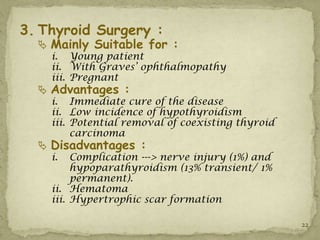
3. Thyroid Surgery :
   Mainly Suitable for :
    i. Young patient
    ii. With Graves’ ophthalmopathy
    iii. Pregnant
   Advantages :
    i. Immediate cure of the disease
    ii. Low incidence of hypothyroidism
    iii. Potential removal of coexisting thyroid
         carcinoma
   Disadvantages :
    i.   Complication ---> nerve injury (1%) and
         hypoparathyroidism (13% transient/ 1%
         permanent).
    ii. Hematoma
    iii. Hypertrophic scar formation

                                                   22
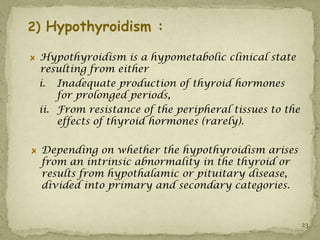
2) Hypothyroidism :

 Hypothyroidism is a hypometabolic clinical state
 resulting from either
 i. Inadequate production of thyroid hormones
     for prolonged periods,
 ii. From resistance of the peripheral tissues to the
     effects of thyroid hormones (rarely).

 Depending on whether the hypothyroidism arises
 from an intrinsic abnormality in the thyroid or
 results from hypothalamic or pituitary disease,
 divided into primary and secondary categories.


                                                        23
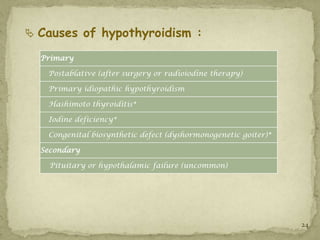
 Causes of hypothyroidism :

  Primary

   Postablative (after surgery or radioiodine therapy)

   Primary idiopathic hypothyroidism

   Hashimoto thyroiditis*

   Iodine deficiency*

   Congenital biosynthetic defect (dyshormonogenetic goiter)*

  Secondary

    Pituitary or hypothalamic failure (uncommon)


                                                                24
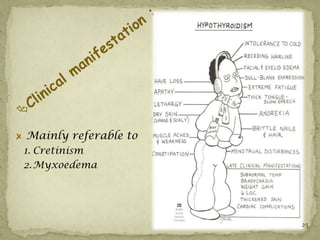
Mainly referable to
1. Cretinism
2. Myxoedema


                      25
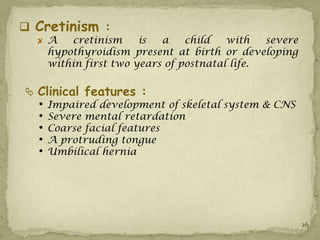
 Cretinism :
      A   cretinism     is  a    child   with   severe
      hypothyroidism present at birth or developing
      within first two years of postnatal life.

 Clinical features :
  •   Impaired development of skeletal system & CNS
  •   Severe mental retardation
  •   Coarse facial features
  •   A protruding tongue
  •   Umbilical hernia


                                                         26
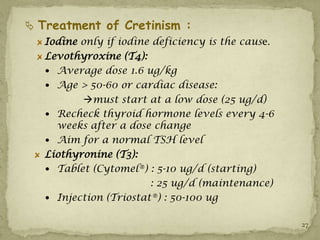
 Treatment of Cretinism :
   Iodine only if iodine deficiency is the cause.
   Levothyroxine (T4):
    Average dose 1.6 ug/kg
    Age > 50-60 or cardiac disease:
          must start at a low dose (25 ug/d)
    Recheck thyroid hormone levels every 4-6
     weeks after a dose change
    Aim for a normal TSH level
   Liothyronine (T3):
    Tablet (Cytomel®) : 5-10 ug/d (starting)
                        : 25 ug/d (maintenance)
    Injection (Triostat®) : 50-100 ug


                                                    27
 Myxoedema :

   Myxoedema coma is a rare syndrome that
   represents the extreme expression of severe, long-
   standing hypothyroidism.
   Common precipitating factors include :
    1. Pulmonary infections,
    2. Cerebrovascular accidents,
    3. Congestive heart failure

  Clinical features :
   •   Hypothermia, which may be profound;
   •   Respiratory depression
   •   Unconsciousness
   •   Dry & rough skin
                                                        28
 Treatment of Myxoedema :

  Levothyroxine
        500 mg/day

  Livothyronine
        75 mg/day

  Other
   Rewarming with blankets
   Correction of hyponatremia
   Treatment of the precipitating incident

                                              29
30
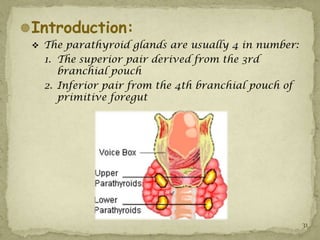
Introduction:
  The parathyroid glands are usually 4 in number:
   1. The superior pair derived from the 3rd
      branchial pouch
   2. Inferior pair from the 4th branchial pouch of
      primitive foregut


                                                      31
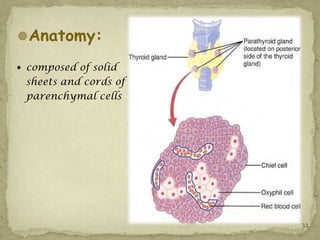
Anatomy:

 composed of solid
 sheets and cords of
 parenchymal cells


                       32
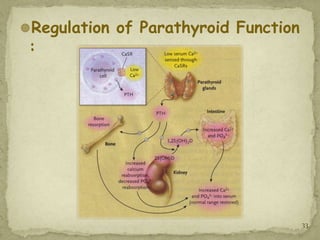
Regulation of Parathyroid Function
 :


                                      33
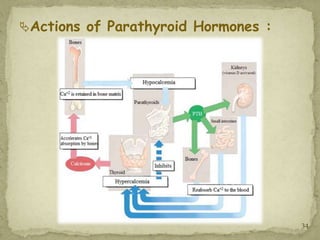
Actions of Parathyroid Hormones :


                                     34
Diseases of the Parathyroid :

  The major parathyroid disorders are its
  functional disorders:

  1. Hypoparathyroidism

  2. Hyperparathyroidism


                                            35
1) Hypoparathyroidism :
When the parathyroid glands do not secrete
sufficient PTH, the osteocytic reabsorption of
exchangeable calcium decreases and the osteoclasts
become almost totally inactive.
As a result, calcium reabsorption from the bones is
so depressed that the level of calcium in the body
fluids decreases.
When the parathyroid glands are suddenly
removed, the calcium level in the blood falls from
the normal of 9.4 mg/dl to 6 to 7 mg/dl within 2 to 3
days.


                                                        36
 Aetiology:
Most common cause : Surgery for thyroid diseases
                    Neck exploration
                    Adenoma


 Clinical manifestation:
 Most of due to Hypocalcaemia
          Increased neuromuscular excitablity
 Major symptoms
 •   Numbness around mouth
 •   Muscle spasm
 •   Irritability
 •    Cataract
 •    Positive chvostek’s sign
 •    Positive trousseau’s sign                    37
 Treatment:
For sever, acute treatment:
     10% calcium gluconate IV injection

For chronic treatment:
     PTH therapy (not currently practised)

Maintenance treatment:
    Vitamin D preparations


                                             38
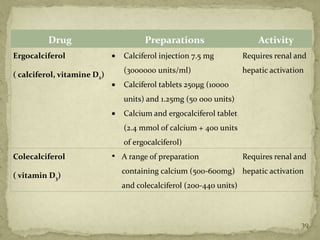
Drug                        Preparations                      Activity
Ergocalciferol                  Calciferol injection 7.5 mg         Requires renal and
                                (3000000 units/ml)                  hepatic activation
( calciferol, vitamine D2)
                                Calciferol tablets 250µg (10000
                                units) and 1.25mg (50 000 units)
                                Calcium and ergocalciferol tablet
                                (2.4 mmol of calcium + 400 units
                                of ergocalciferol)
Colecalciferol               • A range of preparation               Requires renal and
                               containing calcium (500-600mg) hepatic activation
( vitamin D3)
                               and colecalciferol (200-440 units)


                                                                                     39
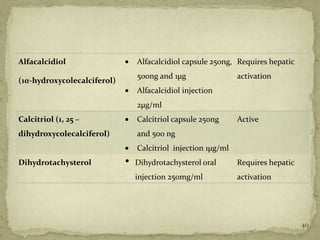
Alfacalcidiol                    Alfacalcidiol capsule 250ng, Requires hepatic
                                 500ng and 1µg                 activation
(1α-hydroxycolecalciferol)
                                 Alfacalcidiol injection
                                 2µg/ml
Calcitriol (1, 25 –              Calcitriol capsule 250ng      Active
dihydroxycolecalciferol)         and 500 ng
                                 Calcitriol injection 1µg/ml
Dihydrotachysterol           •   Dihydrotachysterol oral       Requires hepatic
                                 injection 250mg/ml            activation


                                                                                  40
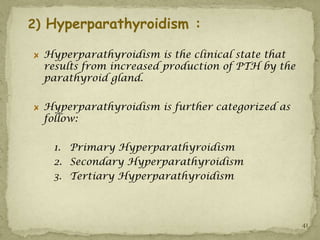
2) Hyperparathyroidism :

  Hyperparathyroidism is the clinical state that
  results from increased production of PTH by the
  parathyroid gland.

  Hyperparathyroidism is further categorized as
  follow:

   1. Primary Hyperparathyroidism
   2. Secondary Hyperparathyroidism
   3. Tertiary Hyperparathyroidism


                                                    41
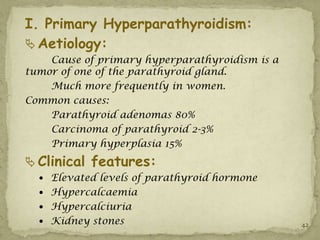
I. Primary Hyperparathyroidism:
 Aetiology:
    Cause of primary hyperparathyroidism is a
tumor of one of the parathyroid gland.
    Much more frequently in women.
Common causes:
    Parathyroid adenomas 80%
    Carcinoma of parathyroid 2-3%
    Primary hyperplasia 15%
 Clinical features:
   Elevated levels of parathyroid hormone
   Hypercalcaemia
   Hypercalciuria
   Kidney stones                               42
II.Secondary Hyperparathyroidism:
  In secondary hyperparathyroidism, high levels of
   PTH occur as a compensation for hypocalcemia
   rather than as a primary abnormality of the
   parathyroid glands.
 Etiology:
    Chronic renal insufficiency
    Vitamin D deficiency
    Intestinal malabsorption syndromes
 Clinical features:
    Mild hypocalcaemia
    Renal osteodystrophy
    Soft tissue calcification

                                                      43
III.Tertiary Hyperparathyroidism:

  Tertiary hyperparathyroidism is a complication
   of secondary hyperparathyroidism in which
   hyper function in spit of removal of the cause of
   secondary hyperplasia.

  Possibly, hyperplastic nodule in the parathyroid
   gland   develops    which    becomes partially
   autonomous and continue to secrete large
   quantities of parathyroid hormone without
   regard to the needs of the body.


                                                       44
 Treatment of Hyperparathyroidism:
(i) Surgical removal of the diseased gland.
(ii) Intravenous saline infusion to correct
     dehydration.
(iii) Intravenous infusion of 0.1 M solution of basic
     sodium phosphate to promote calcium excretion.
(iv) Isotonic sodium sulphate and sodium chloride
     administered intravenously to induce calciuresis.
(v) Disodium edetate (EDTA). It chelates calcium, but
     is too toxic for routine use. In an emergency 50
     mg/kg in 500 ml saline may be given
     intravenously.
(vi) Mithramycin. It is a cytotoxic agent and reduces
     serum calcium levels. In an emergency 25
     mcg/kg/day may be given IV for 3 to 4 days.
                                                         45
(vii)  Calcitonin 5 to 25 mcg/kg may be of therapeutic
       value, but experience with this agent is limited.
(viii) Glucocorticosteroids may be tried. They are
       claimed to be effective in hypercalcaemia of
       vitamin D therapy.
(ix) Haemodialysis may be of value when all other
       measures have failed.

  Thus, effective pharmacotherapy for
    hyperparathyroidism is not available. Mainly the
    treatment is operative.


                                                           46
Summery:
 The thyroid gland is the source of two
    fundamentally different types of hormones.
      1. Thyroxine (T4) and
      2. 3,5,3’-triiodothyronine (T3)
   The ratio of T4 and T3 secreted :- 10:1
   The evaluation of Thyroid function is maninly done
    by Thyroid function test.
   Diseases of Thyroid include
      1. Hyperthyroidism
      2. Hypothyroidism
   Treatment of these include
      1. Antithyroid drugs
      2. Radioactive iodine therapy
      3. Surgery                                         47
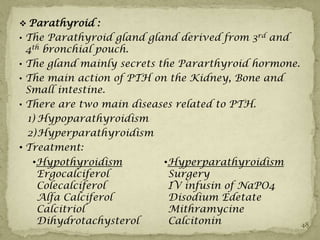
 Parathyroid :
• The Parathyroid gland gland derived from 3rd and
  4th bronchial pouch.
• The gland mainly secrets the Pararthyroid hormone.
• The main action of PTH on the Kidney, Bone and
  Small intestine.
• There are two main diseases related to PTH.
  1) Hypoparathyroidism
  2) Hyperparathyroidism
• Treatment:
  •Hypothyroidism         •Hyperparathyroidism
   Ergocalciferol          Surgery
   Colecalciferol          IV infusin of NaPO4
   Alfa Calciferol         Disodium Edetate
   Calcitriol              Mithramycine
   Dihydrotachysterol      Calcitonin                  48
References:


               49
50

Thyroid and Parathyroid

  • 1.
    Presented by : Mr.Nirav S. Vachhani M.Pharm Pharmacology (Sem-2) Guided by: Dr. Rina H. Gokani S. J. Thakkar pharmacy college, Rajkot.
  • 2.
  • 3.
    Introduction: The thyroid gland was described by Galen and was named "glandulae thyroidaeae" by Wharton in 1656. The thyroid gland is the source of two fundamentally different types of hormones. The iodothyronine hormones include 1. Thyroxine (T4) and 2. 3,5,3’-triiodothyronine (T3) They are essential for normal growth and development and play an important role in energy metabolism. 3
  • 4.
  • 5.
  • 6.
  • 7.
    The ratio ofT4 and T3 secreted :- 10:1 Approximate Values for Thyroid Hormone Plasma Concentrations and Various Kinetic Parameters. T4 T3 Plasma concentration Total 7.77 mg/dL 0.14 mg/ dL Free 1.554 ng/dL 0.389 ng/dL Total hormone in free form 0.02% 0.3% Plasma half-life 6.7 days 0.75 days Volume of distribution 10 L 40 L Metabolic clearance rate 1.1 L/day 24 L/day Total production rate 85.47 mg/day 33.6 mg/day From thyroid secretion 100% 20% 7
  • 8.
  • 9.
    Evaluation of Thyroid Diseases: Thyroid Function test : commonly in use for estimating the iodine, TBG, free T4 and free T3 concentrations are as follow: • Protein-bound iodine: It is a measure of organically bound iodine in blood (normal 4-8 ug/dl: myxoedema 2ug/dl; thyrotoxicosis 10-12 ug/dl). • Serum T4: It is measured by radio-immuno assay (normal 5-12 ug/dl). Serum T3 assay can also be done (normal 80-180 ng/dl). 9
  • 10.
    •Serum TBG: It is measured by radio-immuno assay or immuno electrophoresis, and the ratio of T4 to TBG is used as an index of free hormone activity. • Free thyroxine index and effective thyroxine ratio: These are calculated from the serum T4 and serum TBG level. There is a good correlation between these values and free T4 levels. Direct free T4 measurement are tedious and difficult. • Scintillography: The radio iodine uptake by the gland is recorded photographically and scanned. 10
  • 11.
    • T3 suppressiontest: In the standard test, the pretreatment radioactive iodine uptake (RAIU) is determined. Then T3 (as Cytomel) 25 ug tid, is given for 7-10 days. On the last day a repeat RAIU is performed. In a normal person the RAIU will be suppressed by 50% or less of the original value. Whereas in Graves’ disease there is no suppresion as the thyroid is functioning autonomously. Clinical history and physical examination : 11
  • 12.
    Thyroid Imaging : • Radioactive imaging • Ultrasound waves • CT/MRI scan 12
  • 13.
    Diseases of theThyroid : Two significant functional disorders characterized by distinct clinical syndromes are : I. Hyperthyroidism : Associated with excessive release of Thyroid hormones. II. Hypothyroidism : Associated with Thyroid hormone deficiency. 13
  • 14.
    1) Hyperthyroidism : The term hyperthyroidism is restricted to those conditions in which thyroid hormone production and release are increased due to gland hyper function. The condition is more frequent in females and is associated with rise in both T3and T4 levels in blood, though the increase in T3 is generally greater than that of T4. Etiopathogenesis : Primary : Graves’ disease Toxic multi-nodular goiter Toxic adenoma Secondary : TSH hyper secretion by a pituitary tumor 14
  • 15.
    Mainly referable to 1.Hypermetabolic state 2. Over activity of the sympathetic nervous system 15
  • 16.
    Diagnosis : Autonomous thyroid function  Low TSH  Elevated T3 / T4 Thyroid scan  diffuse elevated iodine uptake Thyroid ultrasound 16
  • 17.
    Treatment : Choices: 1. Antithyroid drugs 2. Radioactive iodine therapy 3. Surgery Choice depends on: 1. Age 2. Severity of the disease 3. Size of the gland 4. Coexistent pathology (Ophthalmoplegia) 5. Other factors:  Patient’s preference  Pregnancy 17
  • 18.
    1. Antithyroid drugs:  Propyl thiouracil (PTU) = 100-300 mg TID  Methimazole (Tapazole) = 10-20 mg TID then OD  Carbimazole = 40 mg OD MOA :  Inhibits the organic binding of iodine and coupling of iodotyrosine  PTU can also lower conversion of T4 to T3; it can also decrease thyroid autoantibody levels. 18
  • 19.
    Disadvantages of thesedrugs : Crosses the placenta --> inhibits fetal thyroid function Excreted in breast milk Side effects:  Skin rashes  Fever  Peripheral neuritis  Polyarthritis  Granulocytopenia (reversible) 19
  • 20.
    2. Radioactive IodineTherapy : MOA : 131 I is taken up and trapped Emission of α-particle Destroy thyroid tissue Advantages : i. Avoidance of surgery (no injury to nerve / parathyroid gland) ii. Reduce cost & ease of treatment 20
  • 21.
     Disadvantages : i. Lifelong thyroxin replacement therapy ii. Slower correction of hyperthyroidism iii. Higher relapse rate iv. Adverse effect of ophthalmopathy v. Development of Hypothyroidism after thyroid ablation  Suitable for : i. Small or moderate size goiter ii. Relapse after medical and surgical therapy iii. Antithyroid drug and surgery are contraindicated  Contraindicated : i. Pregnant / breast feeding ii. Ophthalmopathy (progression of eye signs) iii. Young age (children/adolescence) ----> Infertility / carcinoma 21
  • 22.
    3. Thyroid Surgery:  Mainly Suitable for : i. Young patient ii. With Graves’ ophthalmopathy iii. Pregnant  Advantages : i. Immediate cure of the disease ii. Low incidence of hypothyroidism iii. Potential removal of coexisting thyroid carcinoma  Disadvantages : i. Complication ---> nerve injury (1%) and hypoparathyroidism (13% transient/ 1% permanent). ii. Hematoma iii. Hypertrophic scar formation 22
  • 23.
    2) Hypothyroidism : Hypothyroidism is a hypometabolic clinical state resulting from either i. Inadequate production of thyroid hormones for prolonged periods, ii. From resistance of the peripheral tissues to the effects of thyroid hormones (rarely). Depending on whether the hypothyroidism arises from an intrinsic abnormality in the thyroid or results from hypothalamic or pituitary disease, divided into primary and secondary categories. 23
  • 24.
     Causes ofhypothyroidism : Primary Postablative (after surgery or radioiodine therapy) Primary idiopathic hypothyroidism Hashimoto thyroiditis* Iodine deficiency* Congenital biosynthetic defect (dyshormonogenetic goiter)* Secondary Pituitary or hypothalamic failure (uncommon) 24
  • 25.
    Mainly referable to 1.Cretinism 2. Myxoedema 25
  • 26.
     Cretinism : A cretinism is a child with severe hypothyroidism present at birth or developing within first two years of postnatal life.  Clinical features : • Impaired development of skeletal system & CNS • Severe mental retardation • Coarse facial features • A protruding tongue • Umbilical hernia 26
  • 27.
     Treatment ofCretinism : Iodine only if iodine deficiency is the cause. Levothyroxine (T4):  Average dose 1.6 ug/kg  Age > 50-60 or cardiac disease: must start at a low dose (25 ug/d)  Recheck thyroid hormone levels every 4-6 weeks after a dose change  Aim for a normal TSH level Liothyronine (T3):  Tablet (Cytomel®) : 5-10 ug/d (starting) : 25 ug/d (maintenance)  Injection (Triostat®) : 50-100 ug 27
  • 28.
     Myxoedema : Myxoedema coma is a rare syndrome that represents the extreme expression of severe, long- standing hypothyroidism. Common precipitating factors include : 1. Pulmonary infections, 2. Cerebrovascular accidents, 3. Congestive heart failure  Clinical features : • Hypothermia, which may be profound; • Respiratory depression • Unconsciousness • Dry & rough skin 28
  • 29.
     Treatment ofMyxoedema : Levothyroxine 500 mg/day Livothyronine 75 mg/day Other  Rewarming with blankets  Correction of hyponatremia  Treatment of the precipitating incident 29
  • 30.
  • 31.
    Introduction:  Theparathyroid glands are usually 4 in number: 1. The superior pair derived from the 3rd branchial pouch 2. Inferior pair from the 4th branchial pouch of primitive foregut 31
  • 32.
    Anatomy:  composed ofsolid sheets and cords of parenchymal cells 32
  • 33.
  • 34.
  • 35.
    Diseases of theParathyroid : The major parathyroid disorders are its functional disorders: 1. Hypoparathyroidism 2. Hyperparathyroidism 35
  • 36.
    1) Hypoparathyroidism : Whenthe parathyroid glands do not secrete sufficient PTH, the osteocytic reabsorption of exchangeable calcium decreases and the osteoclasts become almost totally inactive. As a result, calcium reabsorption from the bones is so depressed that the level of calcium in the body fluids decreases. When the parathyroid glands are suddenly removed, the calcium level in the blood falls from the normal of 9.4 mg/dl to 6 to 7 mg/dl within 2 to 3 days. 36
  • 37.
     Aetiology: Most commoncause : Surgery for thyroid diseases Neck exploration Adenoma  Clinical manifestation: Most of due to Hypocalcaemia Increased neuromuscular excitablity Major symptoms • Numbness around mouth • Muscle spasm • Irritability • Cataract • Positive chvostek’s sign • Positive trousseau’s sign 37
  • 38.
     Treatment: For sever,acute treatment: 10% calcium gluconate IV injection For chronic treatment: PTH therapy (not currently practised) Maintenance treatment: Vitamin D preparations 38
  • 39.
    Drug Preparations Activity Ergocalciferol Calciferol injection 7.5 mg Requires renal and (3000000 units/ml) hepatic activation ( calciferol, vitamine D2) Calciferol tablets 250µg (10000 units) and 1.25mg (50 000 units) Calcium and ergocalciferol tablet (2.4 mmol of calcium + 400 units of ergocalciferol) Colecalciferol • A range of preparation Requires renal and containing calcium (500-600mg) hepatic activation ( vitamin D3) and colecalciferol (200-440 units) 39
  • 40.
    Alfacalcidiol Alfacalcidiol capsule 250ng, Requires hepatic 500ng and 1µg activation (1α-hydroxycolecalciferol) Alfacalcidiol injection 2µg/ml Calcitriol (1, 25 – Calcitriol capsule 250ng Active dihydroxycolecalciferol) and 500 ng Calcitriol injection 1µg/ml Dihydrotachysterol • Dihydrotachysterol oral Requires hepatic injection 250mg/ml activation 40
  • 41.
    2) Hyperparathyroidism : Hyperparathyroidism is the clinical state that results from increased production of PTH by the parathyroid gland. Hyperparathyroidism is further categorized as follow: 1. Primary Hyperparathyroidism 2. Secondary Hyperparathyroidism 3. Tertiary Hyperparathyroidism 41
  • 42.
    I. Primary Hyperparathyroidism: Aetiology: Cause of primary hyperparathyroidism is a tumor of one of the parathyroid gland. Much more frequently in women. Common causes: Parathyroid adenomas 80% Carcinoma of parathyroid 2-3% Primary hyperplasia 15%  Clinical features:  Elevated levels of parathyroid hormone  Hypercalcaemia  Hypercalciuria  Kidney stones 42
  • 43.
    II.Secondary Hyperparathyroidism: In secondary hyperparathyroidism, high levels of PTH occur as a compensation for hypocalcemia rather than as a primary abnormality of the parathyroid glands.  Etiology: Chronic renal insufficiency Vitamin D deficiency Intestinal malabsorption syndromes  Clinical features:  Mild hypocalcaemia  Renal osteodystrophy  Soft tissue calcification 43
  • 44.
    III.Tertiary Hyperparathyroidism: Tertiary hyperparathyroidism is a complication of secondary hyperparathyroidism in which hyper function in spit of removal of the cause of secondary hyperplasia.  Possibly, hyperplastic nodule in the parathyroid gland develops which becomes partially autonomous and continue to secrete large quantities of parathyroid hormone without regard to the needs of the body. 44
  • 45.
     Treatment ofHyperparathyroidism: (i) Surgical removal of the diseased gland. (ii) Intravenous saline infusion to correct dehydration. (iii) Intravenous infusion of 0.1 M solution of basic sodium phosphate to promote calcium excretion. (iv) Isotonic sodium sulphate and sodium chloride administered intravenously to induce calciuresis. (v) Disodium edetate (EDTA). It chelates calcium, but is too toxic for routine use. In an emergency 50 mg/kg in 500 ml saline may be given intravenously. (vi) Mithramycin. It is a cytotoxic agent and reduces serum calcium levels. In an emergency 25 mcg/kg/day may be given IV for 3 to 4 days. 45
  • 46.
    (vii) Calcitonin5 to 25 mcg/kg may be of therapeutic value, but experience with this agent is limited. (viii) Glucocorticosteroids may be tried. They are claimed to be effective in hypercalcaemia of vitamin D therapy. (ix) Haemodialysis may be of value when all other measures have failed.  Thus, effective pharmacotherapy for hyperparathyroidism is not available. Mainly the treatment is operative. 46
  • 47.
    Summery:  The thyroidgland is the source of two fundamentally different types of hormones. 1. Thyroxine (T4) and 2. 3,5,3’-triiodothyronine (T3)  The ratio of T4 and T3 secreted :- 10:1  The evaluation of Thyroid function is maninly done by Thyroid function test.  Diseases of Thyroid include 1. Hyperthyroidism 2. Hypothyroidism  Treatment of these include 1. Antithyroid drugs 2. Radioactive iodine therapy 3. Surgery 47
  • 48.
     Parathyroid : •The Parathyroid gland gland derived from 3rd and 4th bronchial pouch. • The gland mainly secrets the Pararthyroid hormone. • The main action of PTH on the Kidney, Bone and Small intestine. • There are two main diseases related to PTH. 1) Hypoparathyroidism 2) Hyperparathyroidism • Treatment: •Hypothyroidism •Hyperparathyroidism Ergocalciferol Surgery Colecalciferol IV infusin of NaPO4 Alfa Calciferol Disodium Edetate Calcitriol Mithramycine Dihydrotachysterol Calcitonin 48
  • 49.
  • 50.