PRESENTATION
ON
HESS’S LAW
BY
MUHAMMAD TAHIR AZIZ
19ME140
STATEMENT
 What is Hess Law?
 Hess’ law also known as Hess’s law of constant heat summation states, “at constant
temperature, heat energy changes (enthalpy – ΔHrec) accompanying a chemical
reaction will remain constant, irrespective of the way the reactants react to form
product”.
 Hess’ law is based on the state function character of enthalpy and the first law of
thermodynamics. Energy (enthalpy) of a system (molecule) is a state function. So,
enthalpy of reactant and product molecules is a constant and does not change with
origin and path of formation.
IMPORTANCE OF HESS’S LAW
 Every substance (atom/ molecules) possess energy within. The internal energy
depends on the nature of force existing in the substance and the temperature.
When the substance undergoes chemical reactions, some bonds connecting some
atoms are broken and some bonds are made new. The breaking and making of
bonds involve energy.
 So, in reactions, product substances may have either less or the same or more
energy than the reacting substances. Reactions accordingly may release heat to
become exothermic or absorb heat to become endothermic. Reactants may further
react to give the product:
 In single-step or
 In multi-steps or
 Along with other products.
APPLICATION OF HESS’S LAW
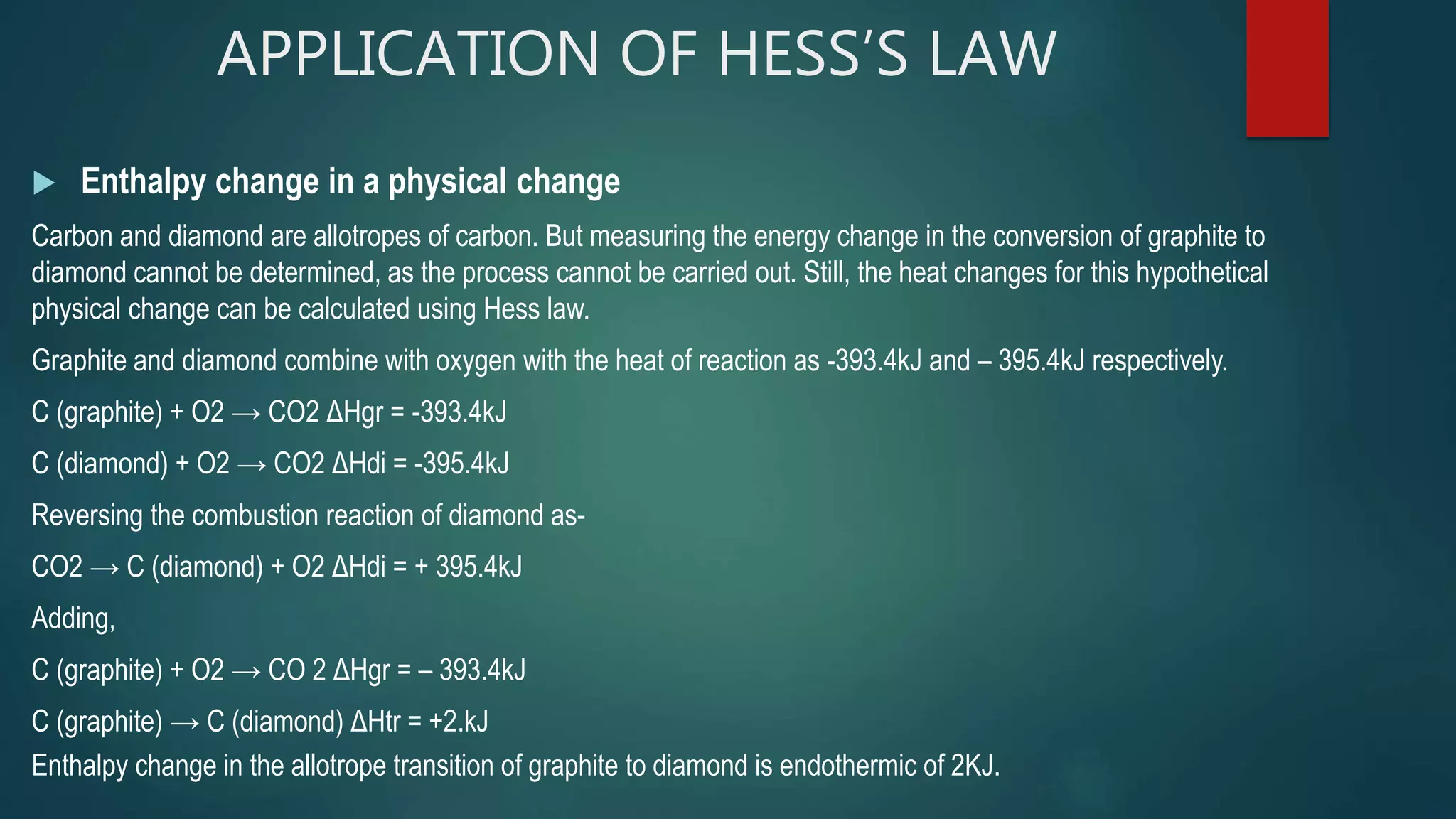
 Enthalpy change in a physical change
Carbon and diamond are allotropes of carbon. But measuring the energy change in the conversion of graphite to
diamond cannot be determined, as the process cannot be carried out. Still, the heat changes for this hypothetical
physical change can be calculated using Hess law.
Graphite and diamond combine with oxygen with the heat of reaction as -393.4kJ and – 395.4kJ respectively.
C (graphite) + O2 → CO2 ΔHgr = -393.4kJ
C (diamond) + O2 → CO2 ΔHdi = -395.4kJ
Reversing the combustion reaction of diamond as-
CO2 → C (diamond) + O2 ΔHdi = + 395.4kJ
Adding,
C (graphite) + O2 → CO 2 ΔHgr = – 393.4kJ
C (graphite) → C (diamond) ΔHtr = +2.kJ
Enthalpy change in the allotrope transition of graphite to diamond is endothermic of 2KJ.
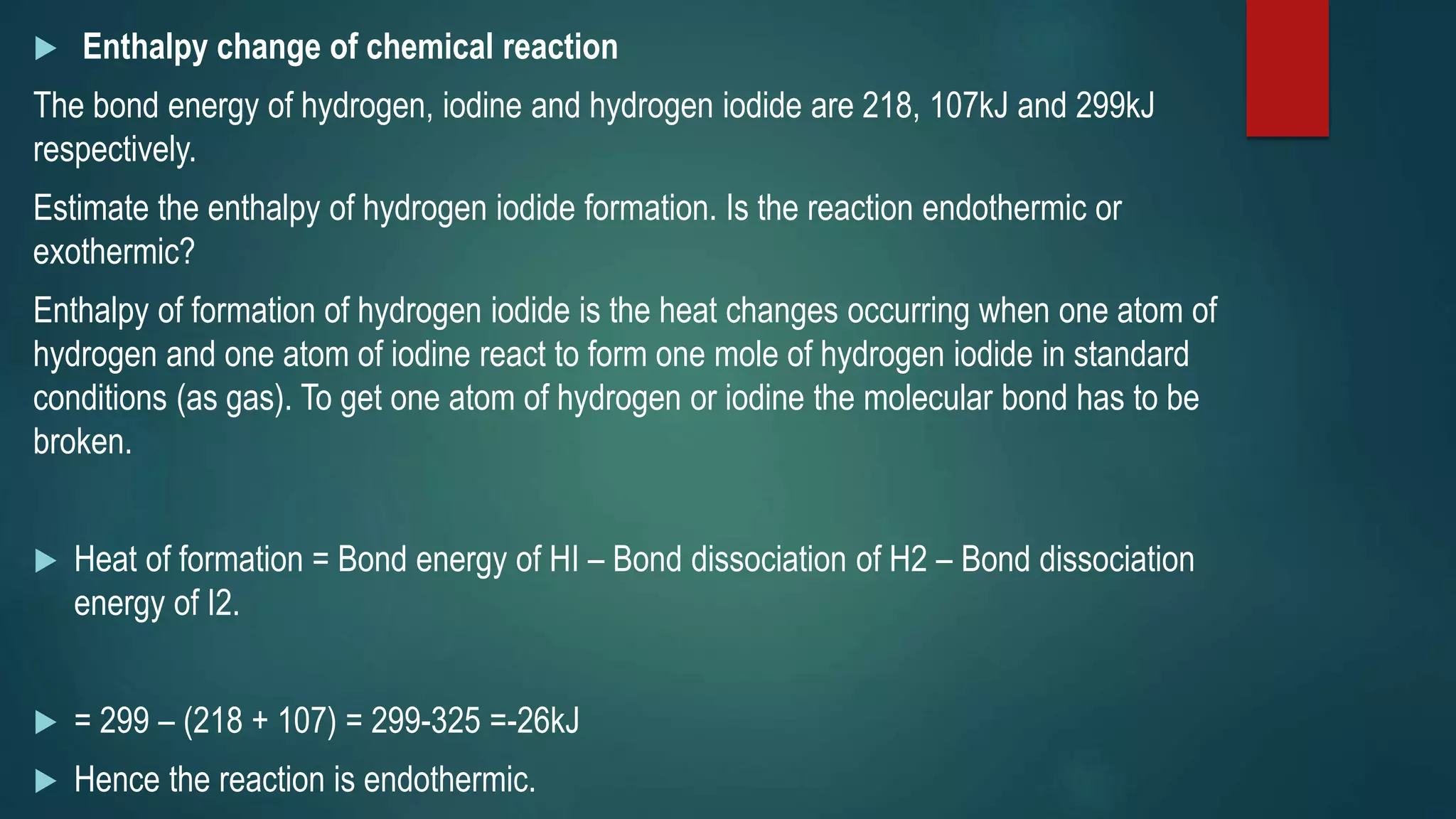
 Enthalpy change of chemical reaction
The bond energy of hydrogen, iodine and hydrogen iodide are 218, 107kJ and 299kJ
respectively.
Estimate the enthalpy of hydrogen iodide formation. Is the reaction endothermic or
exothermic?
Enthalpy of formation of hydrogen iodide is the heat changes occurring when one atom of
hydrogen and one atom of iodine react to form one mole of hydrogen iodide in standard
conditions (as gas). To get one atom of hydrogen or iodine the molecular bond has to be
broken.
 Heat of formation = Bond energy of HI – Bond dissociation of H2 – Bond dissociation
energy of I2.
 = 299 – (218 + 107) = 299-325 =-26kJ
 Hence the reaction is endothermic.
 Enthalpy of formation
When carbon combines with hydrogen, many hydrocarbons can be formed. Hence, the heat of
formation of benzene cannot be determined experimentally. The heat change can be calculated by
Hess law.
6C + 3H2 → C6H6 ΔH C6H6 = ?
Heat of formation of carbon dioxide and water are -393.5kJand -285.8KJ respectively. Heat of
combustion of benzene is -3301kJ.
C + O2 → CO2 ΔH1 = -393.5kJ…..1
H2 + O2 → H2 O ΔH2 = -285.8kJ……2
C6H6 + 9O2 → 6CO2 + 3H2 O ΔH3 = -3301kJ …….3
6 x Reaction 1: 6C + 6O2 → 6CO2 6ΔH1 = -2361kJ…..1
3 x Reaction2: 3H2 + 3O2 → 3H2 O 3ΔH2 = -857.4kJ……2
Reverse of reaction 3: 6CO2 + 3H2O → C6H6 + 9O2 -ΔH3 = +3301kJ …….3
Adding the three reactions- 6C + 3H2 → C6H6 ΔH= +82.6kJ
Heat of formation of benzene is 82.6kJ.
Hess's Law With Importance and Application

Hess's Law With Importance and Application

  • 1.
  • 2.
    STATEMENT  What isHess Law?  Hess’ law also known as Hess’s law of constant heat summation states, “at constant temperature, heat energy changes (enthalpy – ΔHrec) accompanying a chemical reaction will remain constant, irrespective of the way the reactants react to form product”.  Hess’ law is based on the state function character of enthalpy and the first law of thermodynamics. Energy (enthalpy) of a system (molecule) is a state function. So, enthalpy of reactant and product molecules is a constant and does not change with origin and path of formation.
  • 4.
    IMPORTANCE OF HESS’SLAW  Every substance (atom/ molecules) possess energy within. The internal energy depends on the nature of force existing in the substance and the temperature. When the substance undergoes chemical reactions, some bonds connecting some atoms are broken and some bonds are made new. The breaking and making of bonds involve energy.  So, in reactions, product substances may have either less or the same or more energy than the reacting substances. Reactions accordingly may release heat to become exothermic or absorb heat to become endothermic. Reactants may further react to give the product:  In single-step or  In multi-steps or  Along with other products.
  • 5.
    APPLICATION OF HESS’SLAW  Enthalpy change in a physical change Carbon and diamond are allotropes of carbon. But measuring the energy change in the conversion of graphite to diamond cannot be determined, as the process cannot be carried out. Still, the heat changes for this hypothetical physical change can be calculated using Hess law. Graphite and diamond combine with oxygen with the heat of reaction as -393.4kJ and – 395.4kJ respectively. C (graphite) + O2 → CO2 ΔHgr = -393.4kJ C (diamond) + O2 → CO2 ΔHdi = -395.4kJ Reversing the combustion reaction of diamond as- CO2 → C (diamond) + O2 ΔHdi = + 395.4kJ Adding, C (graphite) + O2 → CO 2 ΔHgr = – 393.4kJ C (graphite) → C (diamond) ΔHtr = +2.kJ Enthalpy change in the allotrope transition of graphite to diamond is endothermic of 2KJ.
  • 6.
     Enthalpy changeof chemical reaction The bond energy of hydrogen, iodine and hydrogen iodide are 218, 107kJ and 299kJ respectively. Estimate the enthalpy of hydrogen iodide formation. Is the reaction endothermic or exothermic? Enthalpy of formation of hydrogen iodide is the heat changes occurring when one atom of hydrogen and one atom of iodine react to form one mole of hydrogen iodide in standard conditions (as gas). To get one atom of hydrogen or iodine the molecular bond has to be broken.  Heat of formation = Bond energy of HI – Bond dissociation of H2 – Bond dissociation energy of I2.  = 299 – (218 + 107) = 299-325 =-26kJ  Hence the reaction is endothermic.
  • 7.
     Enthalpy offormation When carbon combines with hydrogen, many hydrocarbons can be formed. Hence, the heat of formation of benzene cannot be determined experimentally. The heat change can be calculated by Hess law. 6C + 3H2 → C6H6 ΔH C6H6 = ? Heat of formation of carbon dioxide and water are -393.5kJand -285.8KJ respectively. Heat of combustion of benzene is -3301kJ. C + O2 → CO2 ΔH1 = -393.5kJ…..1 H2 + O2 → H2 O ΔH2 = -285.8kJ……2 C6H6 + 9O2 → 6CO2 + 3H2 O ΔH3 = -3301kJ …….3 6 x Reaction 1: 6C + 6O2 → 6CO2 6ΔH1 = -2361kJ…..1 3 x Reaction2: 3H2 + 3O2 → 3H2 O 3ΔH2 = -857.4kJ……2 Reverse of reaction 3: 6CO2 + 3H2O → C6H6 + 9O2 -ΔH3 = +3301kJ …….3 Adding the three reactions- 6C + 3H2 → C6H6 ΔH= +82.6kJ Heat of formation of benzene is 82.6kJ.