Balancing Chemical Equation
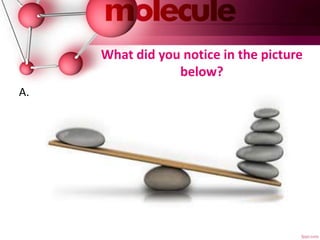
What did you notice in the picture
below?
A.
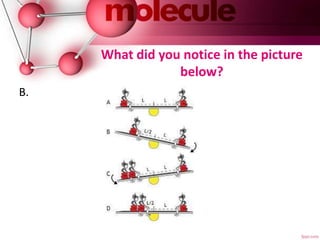
What did you notice in the picture
below?
B.
Chemical Equation
• Is the chemist’s shorthand
process of describing the
course of chemical of a
chemical reaction.
Chemical Equation
• A chemical equation describes
what happens in a
chemical reaction. The equation
identifies the reactants (starting
materials) and products (resulting
substance)
Evidence of chemical reaction
• When there is a gas being
released
• Substance being dissolved
• Formation of precipitate
• Change in intrinsic property
Balancing a chemical equation
• refers to establishing the
mathematical relationship
between the quantity of
reactants and products.
–The quantities are expressed as
grams or moles.
There are essentially three
steps to the process:
• Sample problem
–Tin oxide is heated with
hydrogen gas to form tin metal
and water vapor. Write the
balanced equation that
describes this reaction.
There are essentially three
steps to the process:
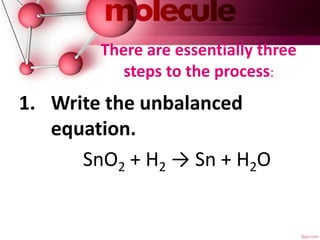
1. Write the unbalanced
equation.
SnO2 + H2 → Sn + H2O
There are essentially three
steps to the process:
2. Balance the equation.
 Apply the Law of Conservation of Mass to
get the same number of atoms of every
element on each side of the equation.
Tip: Start by balancing an element that
appears in only one reactant and product.
There are essentially three
steps to the process:
2. Balance the equation.
Once one element is balanced,
proceed to balance another, and
another, until all elements are
balanced.
There are essentially three
steps to the process:
2. Balance the equation.
 Balance chemical formulas by placing
coefficients in front of them. Do not
add subscripts, because this will
change the formulas.
There are essentially three
steps to the process:
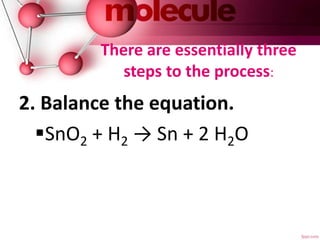
2. Balance the equation.
SnO2 + H2 → Sn + 2 H2O
There are essentially three
steps to the process:
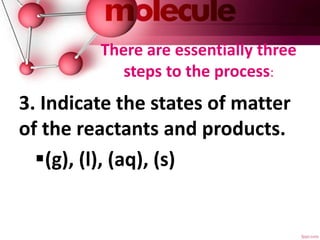
3. Indicate the states of matter
of the reactants and products.
(g), (l), (aq), (s)
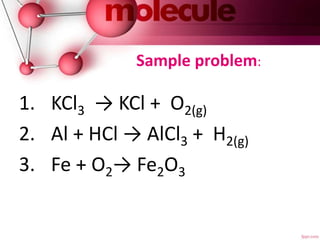
Sample problem:
1. KCl3 → KCl + O2(g)
2. Al + HCl → AlCl3 + H2(g)
3. Fe + O2→ Fe2O3
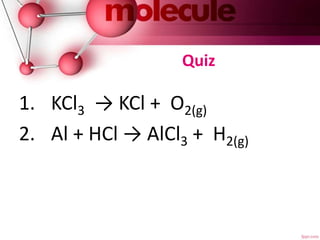
Quiz
1. KCl3 → KCl + O2(g)
2. Al + HCl → AlCl3 + H2(g)

Balancing chemical equation

  • 1.
  • 2.
    What did younotice in the picture below? A.
  • 3.
    What did younotice in the picture below? B.
  • 4.
    Chemical Equation • Isthe chemist’s shorthand process of describing the course of chemical of a chemical reaction.
  • 5.
    Chemical Equation • Achemical equation describes what happens in a chemical reaction. The equation identifies the reactants (starting materials) and products (resulting substance)
  • 6.
    Evidence of chemicalreaction • When there is a gas being released • Substance being dissolved • Formation of precipitate • Change in intrinsic property
  • 7.
    Balancing a chemicalequation • refers to establishing the mathematical relationship between the quantity of reactants and products. –The quantities are expressed as grams or moles.
  • 8.
    There are essentiallythree steps to the process: • Sample problem –Tin oxide is heated with hydrogen gas to form tin metal and water vapor. Write the balanced equation that describes this reaction.
  • 9.
    There are essentiallythree steps to the process: 1. Write the unbalanced equation. SnO2 + H2 → Sn + H2O
  • 10.
    There are essentiallythree steps to the process: 2. Balance the equation.  Apply the Law of Conservation of Mass to get the same number of atoms of every element on each side of the equation. Tip: Start by balancing an element that appears in only one reactant and product.
  • 11.
    There are essentiallythree steps to the process: 2. Balance the equation. Once one element is balanced, proceed to balance another, and another, until all elements are balanced.
  • 12.
    There are essentiallythree steps to the process: 2. Balance the equation.  Balance chemical formulas by placing coefficients in front of them. Do not add subscripts, because this will change the formulas.
  • 13.
    There are essentiallythree steps to the process: 2. Balance the equation. SnO2 + H2 → Sn + 2 H2O
  • 14.
    There are essentiallythree steps to the process: 3. Indicate the states of matter of the reactants and products. (g), (l), (aq), (s)
  • 15.
    Sample problem: 1. KCl3→ KCl + O2(g) 2. Al + HCl → AlCl3 + H2(g) 3. Fe + O2→ Fe2O3
  • 16.
    Quiz 1. KCl3 →KCl + O2(g) 2. Al + HCl → AlCl3 + H2(g)