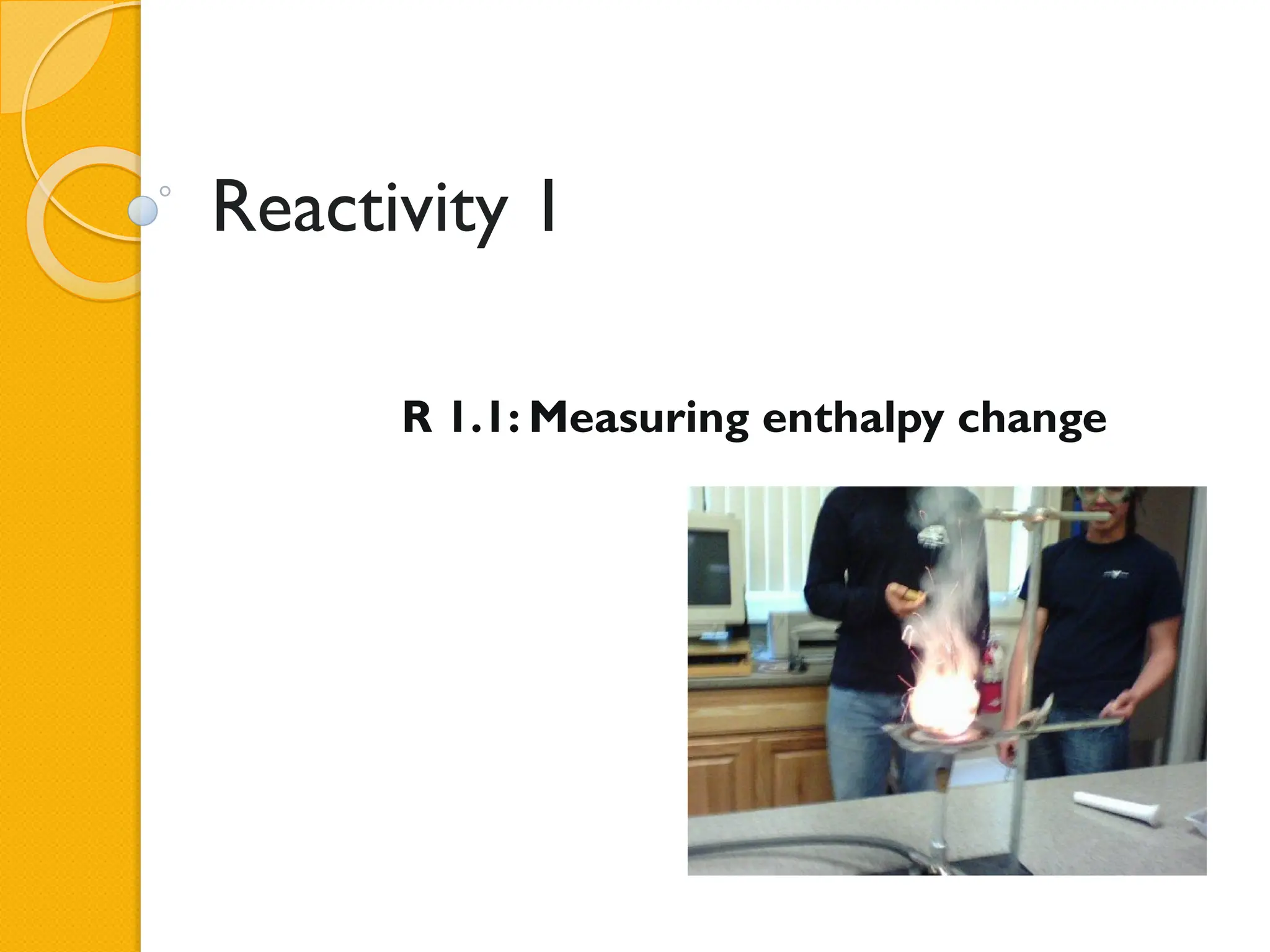
Reactivity 1
R 1.1: Measuring enthalpy change
Energy: a measure of the ability to do work.
⚫ Work: to move an object against an
opposing force.
⚫ Energy (J) = Force (N) x Distance (m)
⚫ Forms of energy include: heat, light, sound,
electricity, and chemical energy (energy
released or absorbed during chemical rxns)
Enthalpy (H): a measure of internal energy
stored in a substance.
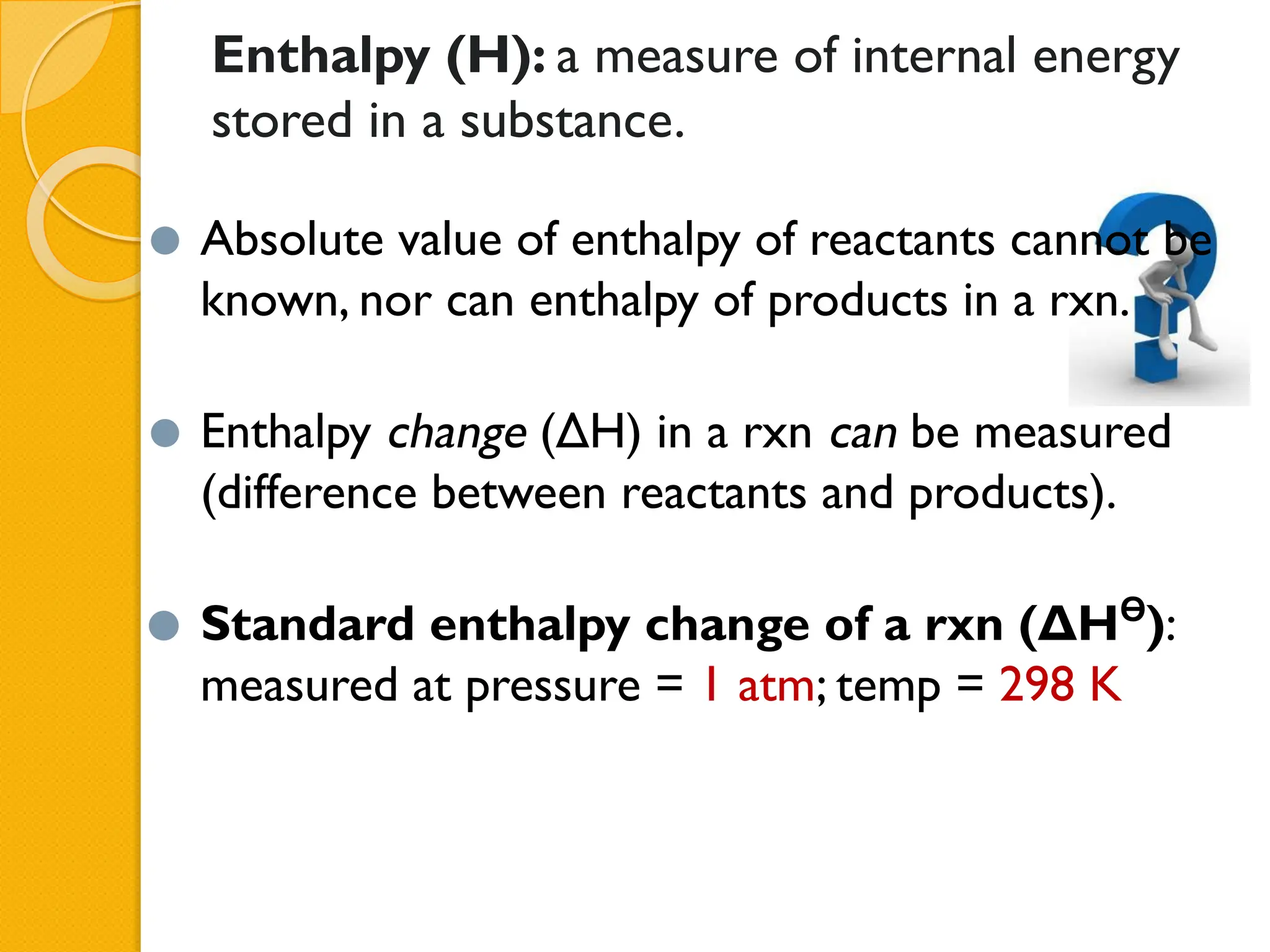
⚫ Absolute value of enthalpy of reactants cannot be
known, nor can enthalpy of products in a rxn.
⚫ Enthalpy change (ΔH) in a rxn can be measured
(difference between reactants and products).
⚫ Standard enthalpy change of a rxn (ΔHϴ
):
measured at pressure = 1 atm; temp = 298 K
EXOTHERMIC & ENDOTHERMIC
RXNS
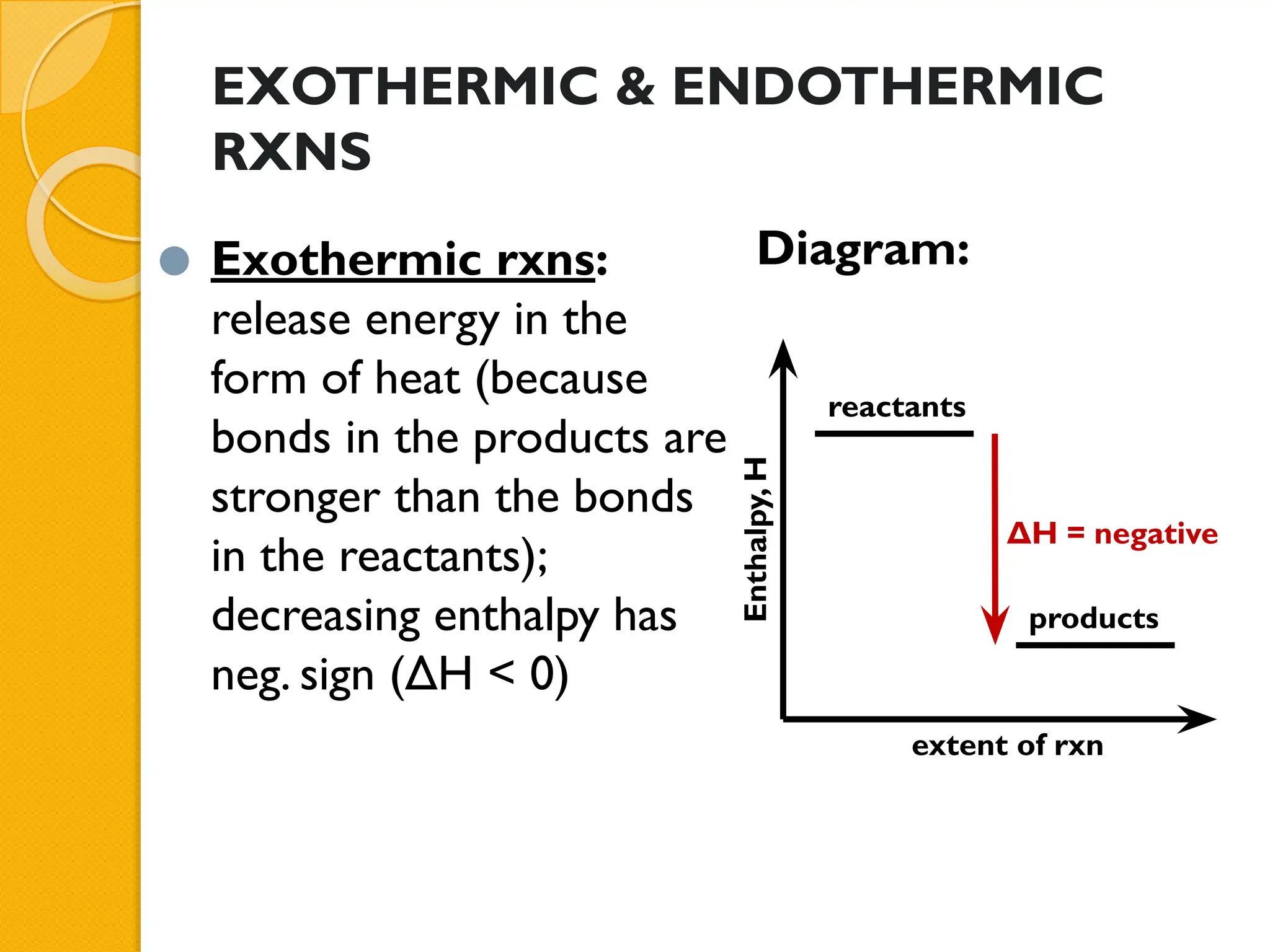
⚫ Exothermic rxns:
release energy in the
form of heat (because
bonds in the products are
stronger than the bonds
in the reactants);
decreasing enthalpy has
neg. sign (ΔH < 0)
Diagram:
Enthalpy,
H
reactants
products
extent of rxn
ΔH = negative
EXOTHERMIC & ENDOTHERMIC
RXNS
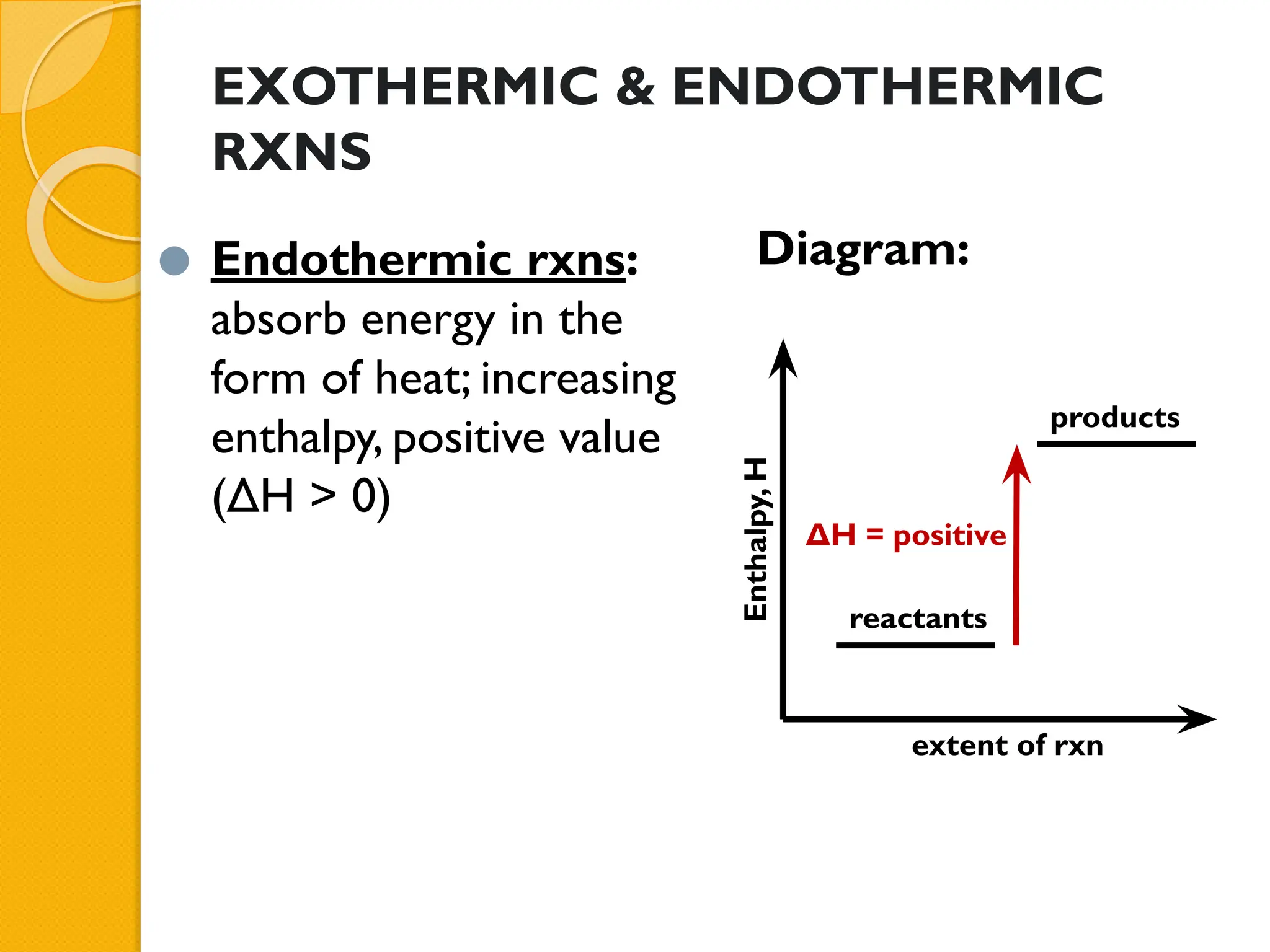
⚫ Endothermic rxns:
absorb energy in the
form of heat; increasing
enthalpy, positive value
(ΔH > 0)
Diagram:
Enthalpy,
H
reactants
products
extent of rxn
ΔH = positive
TEMPERATURE AND HEAT
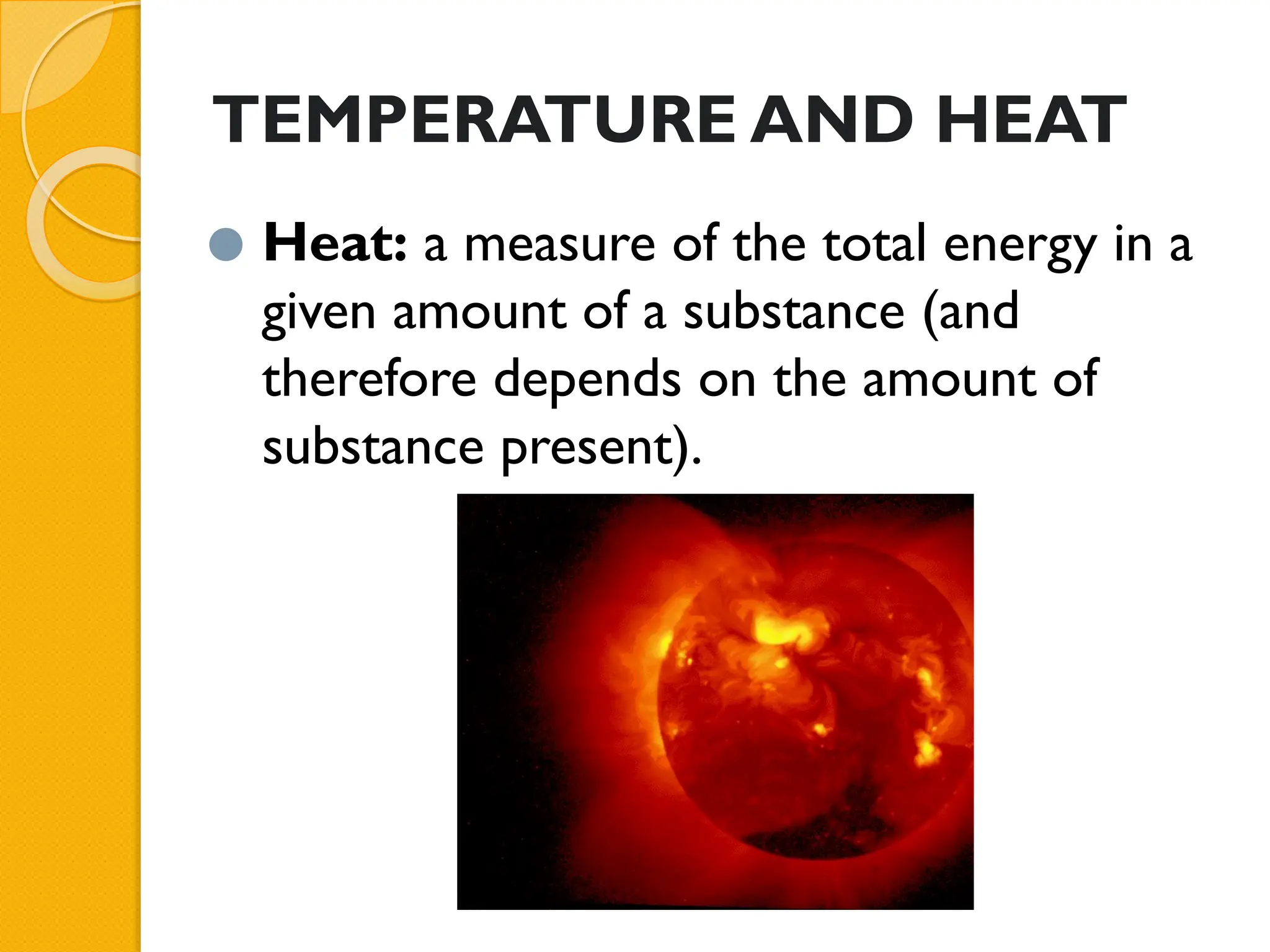
⚫ Heat: a measure of the total energy in a
given amount of a substance (and
therefore depends on the amount of
substance present).
TEMPERATURE AND HEAT
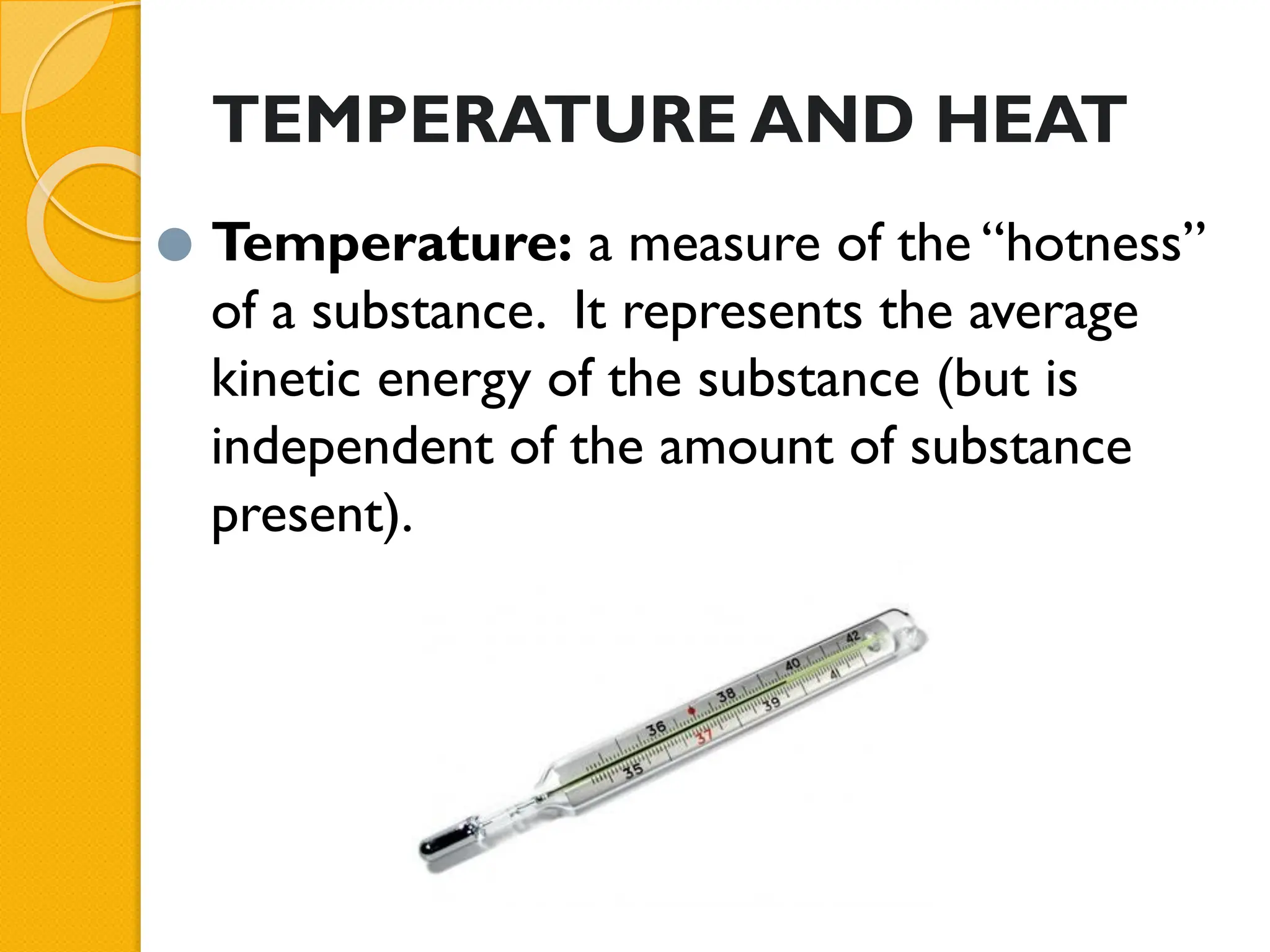
⚫ Temperature: a measure of the “hotness”
of a substance. It represents the average
kinetic energy of the substance (but is
independent of the amount of substance
present).
TEMPERATURE AND HEAT
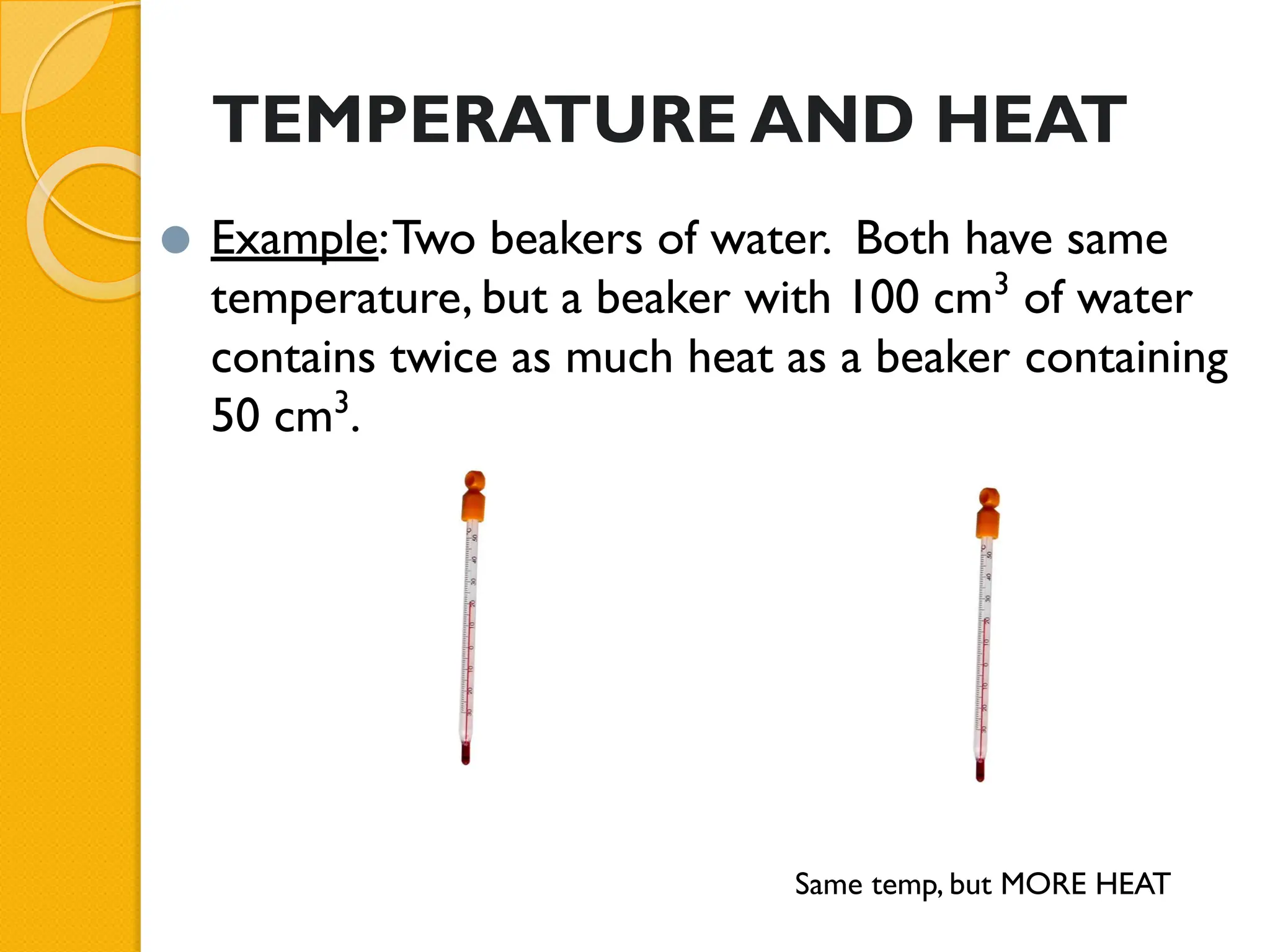
⚫ Example:Two beakers of water. Both have same
temperature, but a beaker with 100 cm3
of water
contains twice as much heat as a beaker containing
50 cm3
.
Same temp, but MORE HEAT
TEMPERATURE AND HEAT
⚫ The increase in temp. when an object is heated
depends on
●The mass of the object
●The heat added
●The nature of the substance (different
substances have different “specific heat” values)
CALORIMETRY
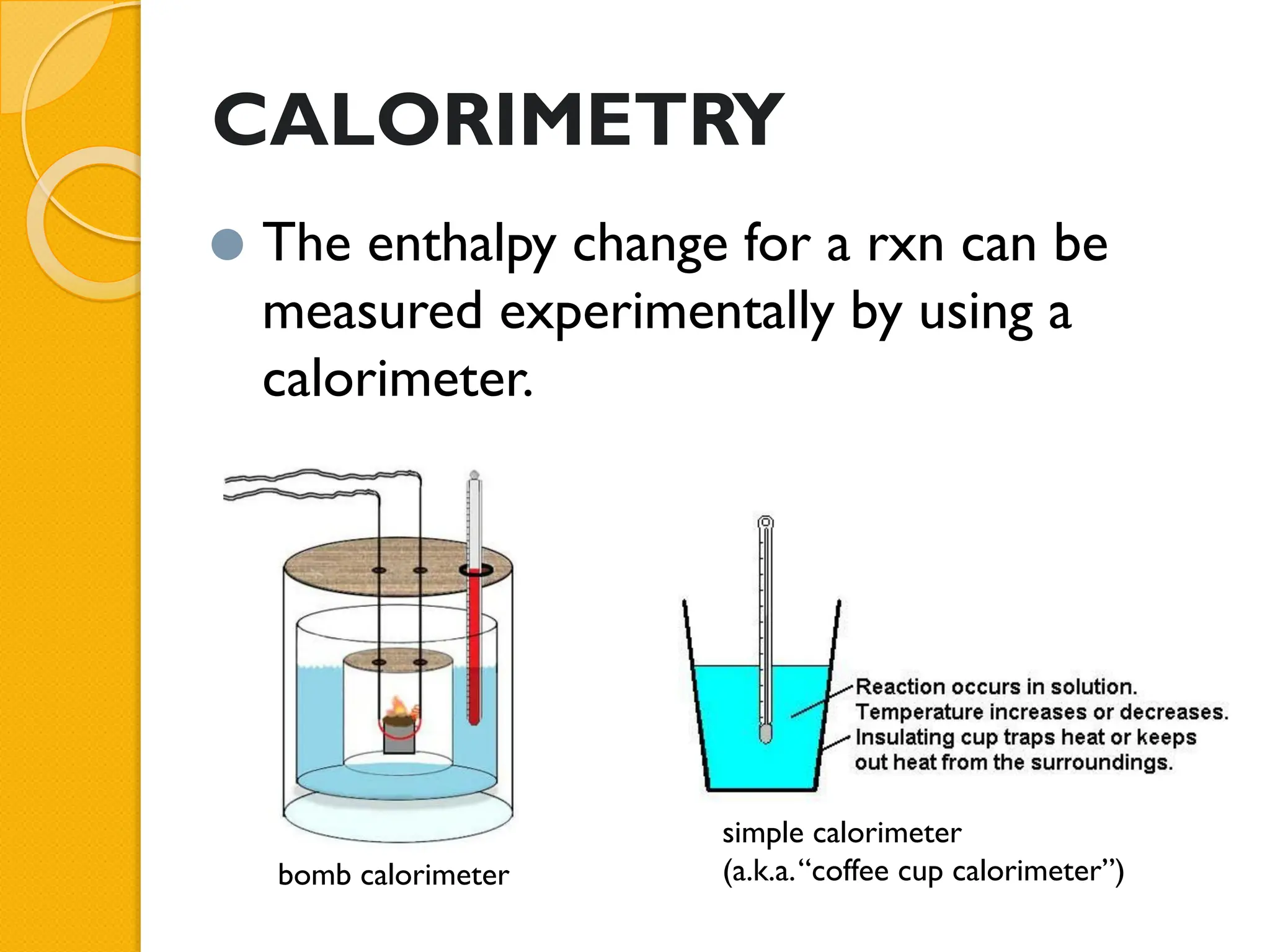
⚫ The enthalpy change for a rxn can be
measured experimentally by using a
calorimeter.
bomb calorimeter
simple calorimeter
(a.k.a.“coffee cup calorimeter”)
CALORIMETRY
⚫ In a simple “coffee cup” calorimeter, all heat
evolved by an exothermic rxn is used to
raise temp. of a known mass of H2
O.
⚫ For endothermic rxns, heat transferred
from the H2
O to the rxn can be calculated
by measuring the lowering of the
temperature of a known mass of water.
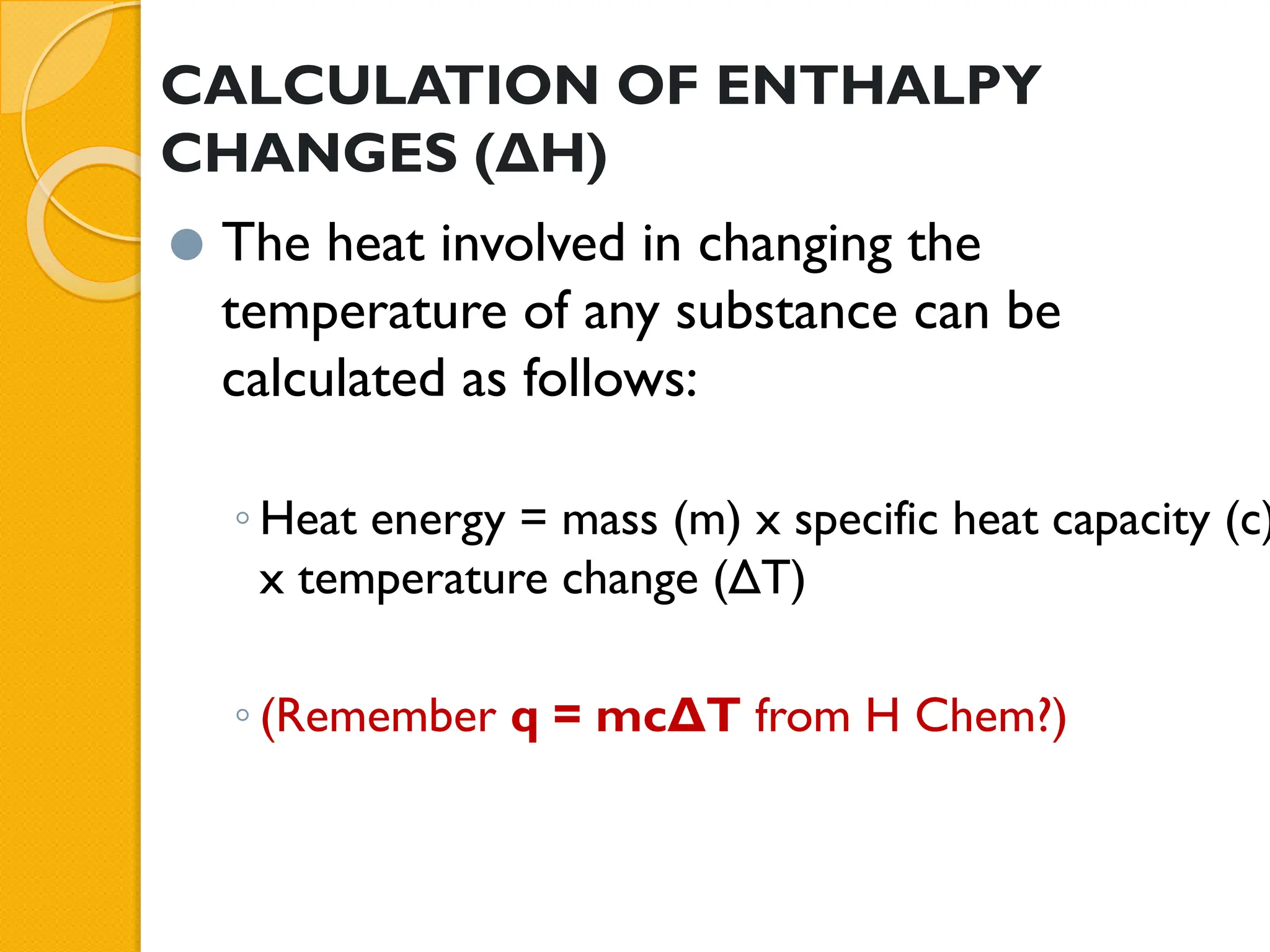
Compensating for heat loss:
Graph temp. v. time
By extrapolating the graph, the temp rise that would
have taken place had the rxn been instantaneous
can be calculated.
ΔT
cooling trendline
T1
T2
T3
T1
= initial temp.
T2
= max temp. measured
T3
= max temp. if no heat loss
ΔT =T3
-T1
CALCULATION OF ENTHALPY
CHANGES (ΔH)
⚫ The heat involved in changing the
temperature of any substance can be
calculated as follows:
◦ Heat energy = mass (m) x specific heat capacity (c)
x temperature change (ΔT)
◦ (Remember q = mcΔT from H Chem?)
CALCULATION OF ENTHALPY
CHANGES (ΔH)
⚫ Specific heat capacity of H2
O = 4.18 kJ kg-1
K-1
◦ Thus, 4.18 kJ of energy are required to raise the
temp of 1 kg of water by one Kelvin.
◦ Note that this is effectively the same as the
complex unit J/g⋅°C (from Honors Chem)
CALCULATION OF ENTHALPY
CHANGES (ΔH)
⚫ Enthalpy changes are normally quoted in kJ
mol-1
for either a reactant or product, so it is
also necessary to work out the number of
moles involved in the reaction which produces
the heat change in the water.
Example 1: 50.0 cm3
of 1.00 mol dm-3
hydrochloric acid solution was added to 50.0 cm3
of 1.00
mol dm-3
sodium hydroxide solution in a polystyrene beaker. The initial temperature of both
solutions was 16.7 °C. After stirring and accounting for heat loss the highest temperature
reached was 23.5 °C. Calculate the enthalpy change for this reaction.
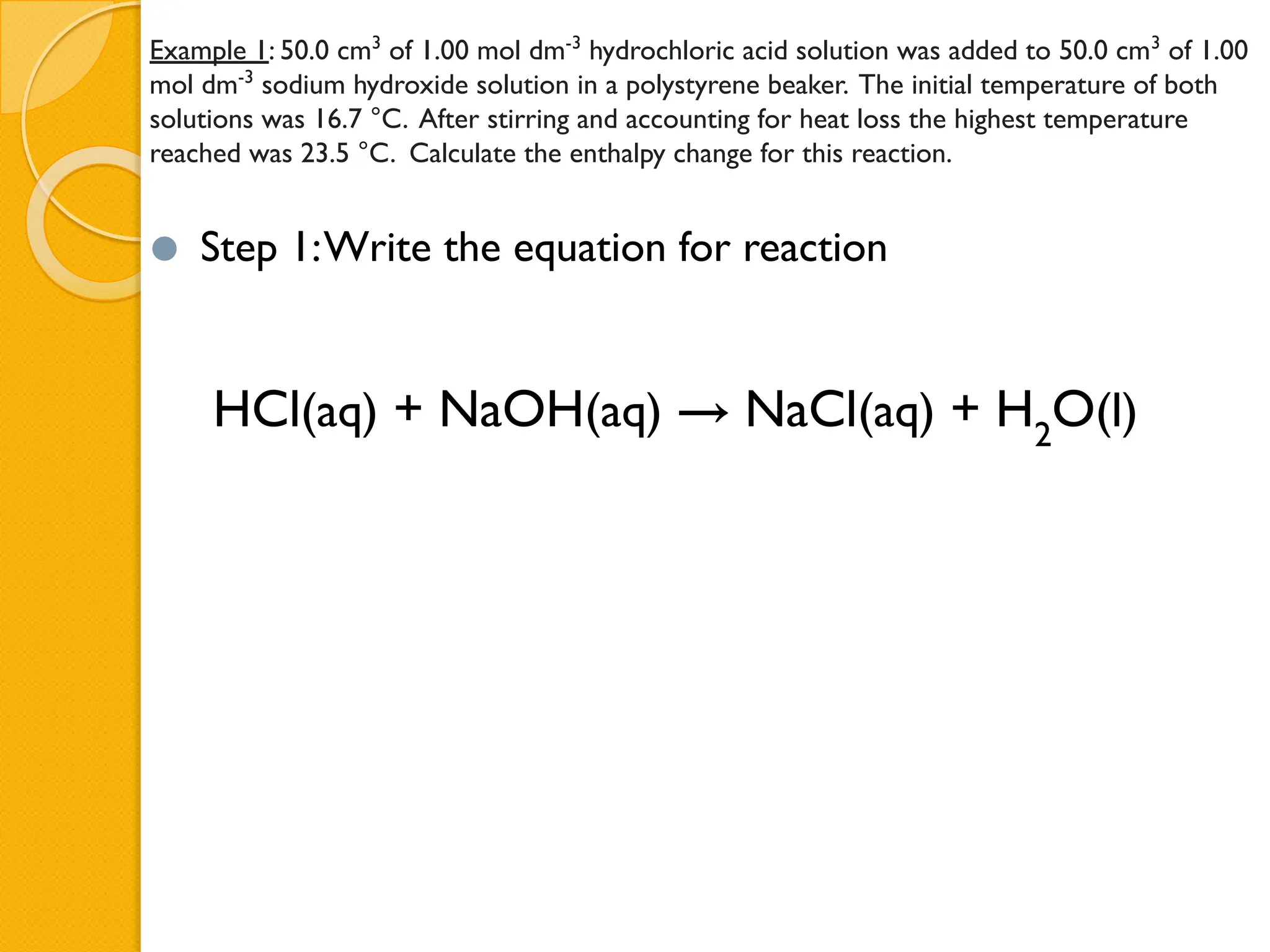
⚫ Step 1:Write the equation for reaction
HCl(aq) + NaOH(aq) → NaCl(aq) + H2
O(l)
Example 1: 50.0 cm3
of 1.00 mol dm-3
hydrochloric acid solution was added to 50.0 cm3
of 1.00
mol dm-3
sodium hydroxide solution in a polystyrene beaker. The initial temperature of both
solutions was 16.7 °C. After stirring and accounting for heat loss the highest temperature
reached was 23.5 °C. Calculate the enthalpy change for this reaction.
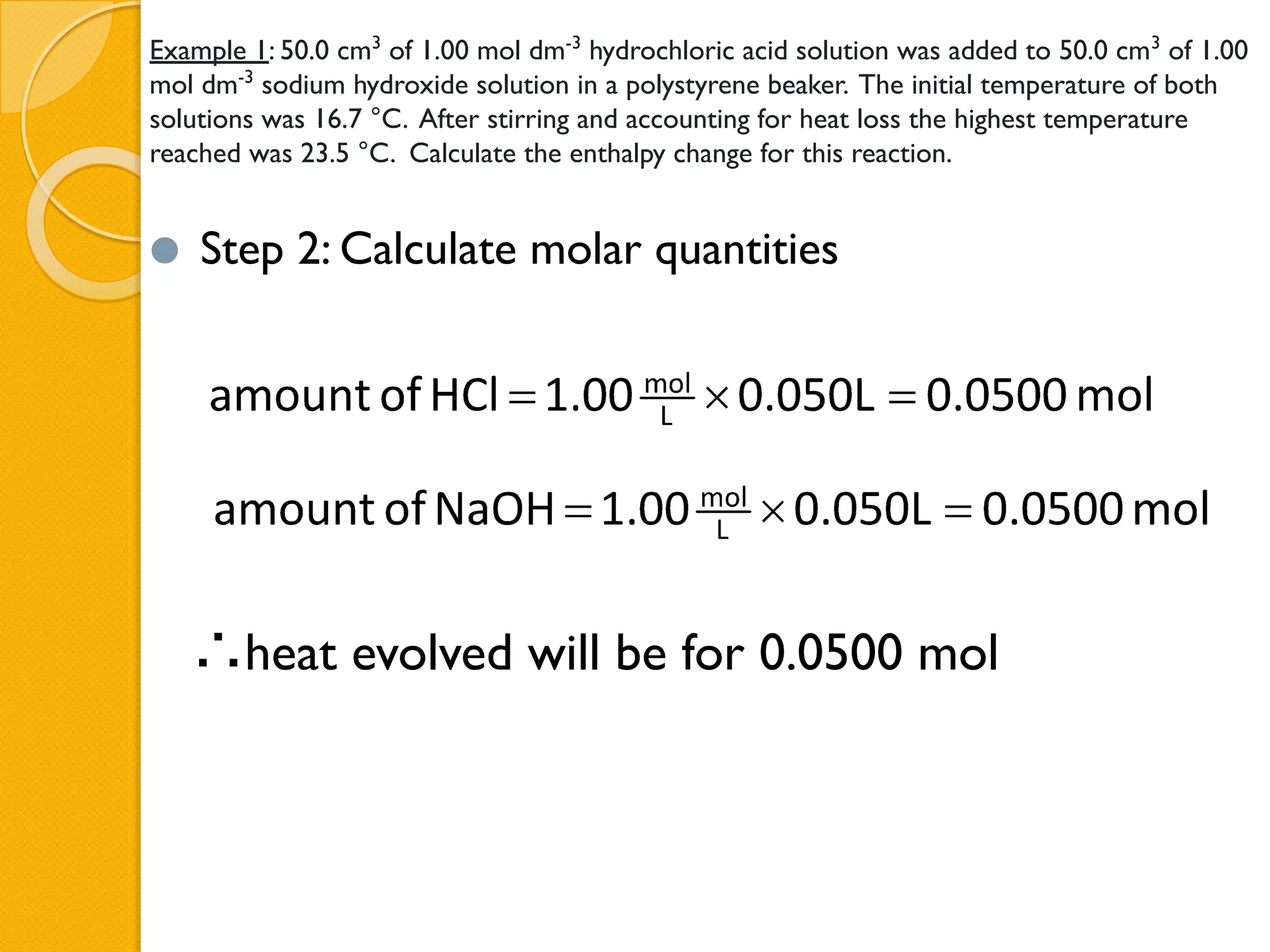
⚫ Step 2: Calculate molar quantities
∴heat evolved will be for 0.0500 mol
Example 1: 50.0 cm3
of 1.00 mol dm-3
hydrochloric acid solution was added to 50.0 cm3
of 1.00
mol dm-3
sodium hydroxide solution in a polystyrene beaker. The initial temperature of both
solutions was 16.7 °C. After stirring and accounting for heat loss the highest temperature
reached was 23.5 °C. Calculate the enthalpy change for this reaction.
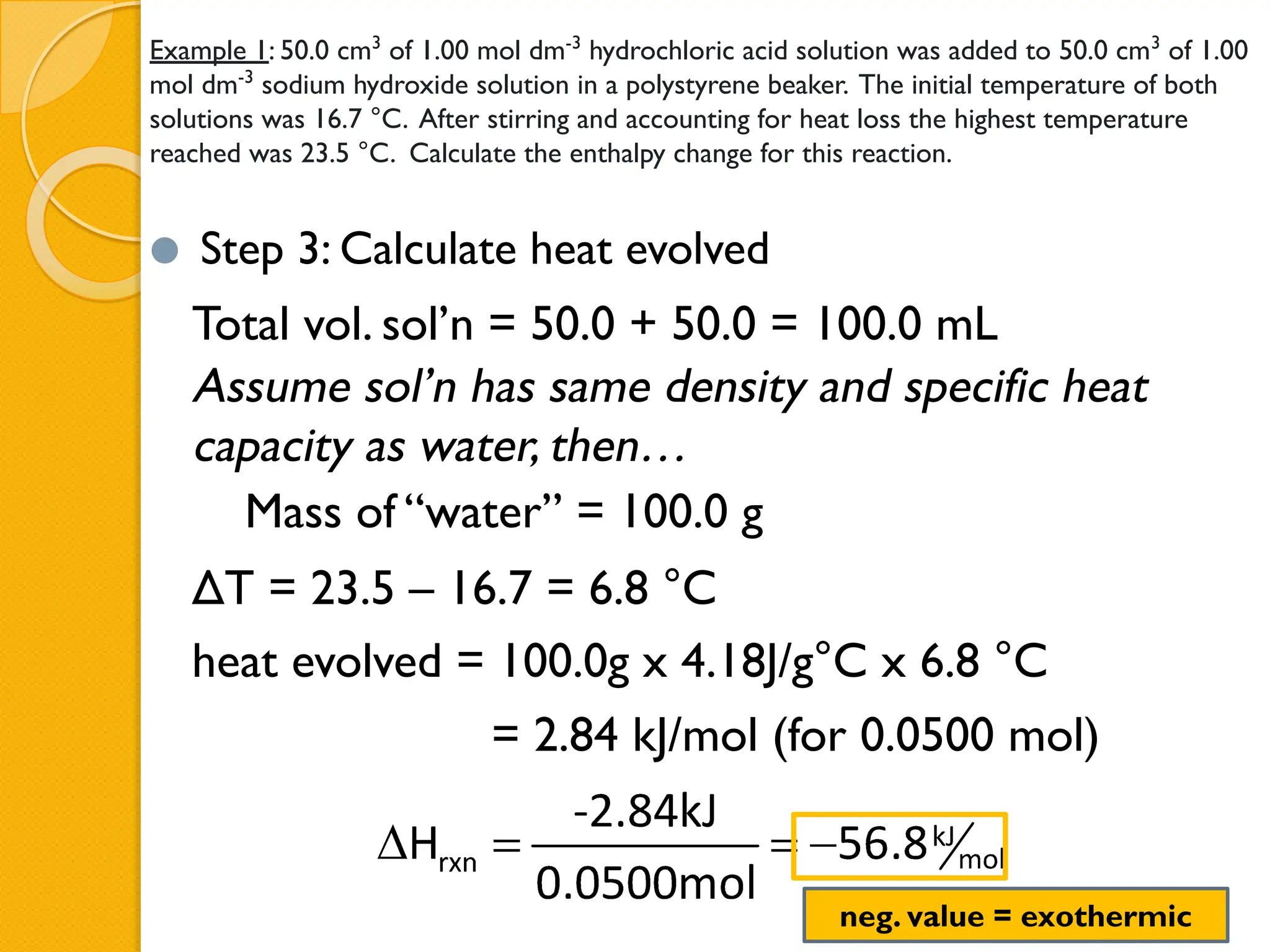
⚫ Step 3: Calculate heat evolved
Total vol. sol’n = 50.0 + 50.0 = 100.0 mL
Assume sol’n has same density and specific heat
capacity as water, then…
Mass of “water” = 100.0 g
ΔT = 23.5 – 16.7 = 6.8 °C
heat evolved = 100.0g x 4.18J/g°C x 6.8 °C
= 2.84 kJ/mol (for 0.0500 mol)
neg. value = exothermic
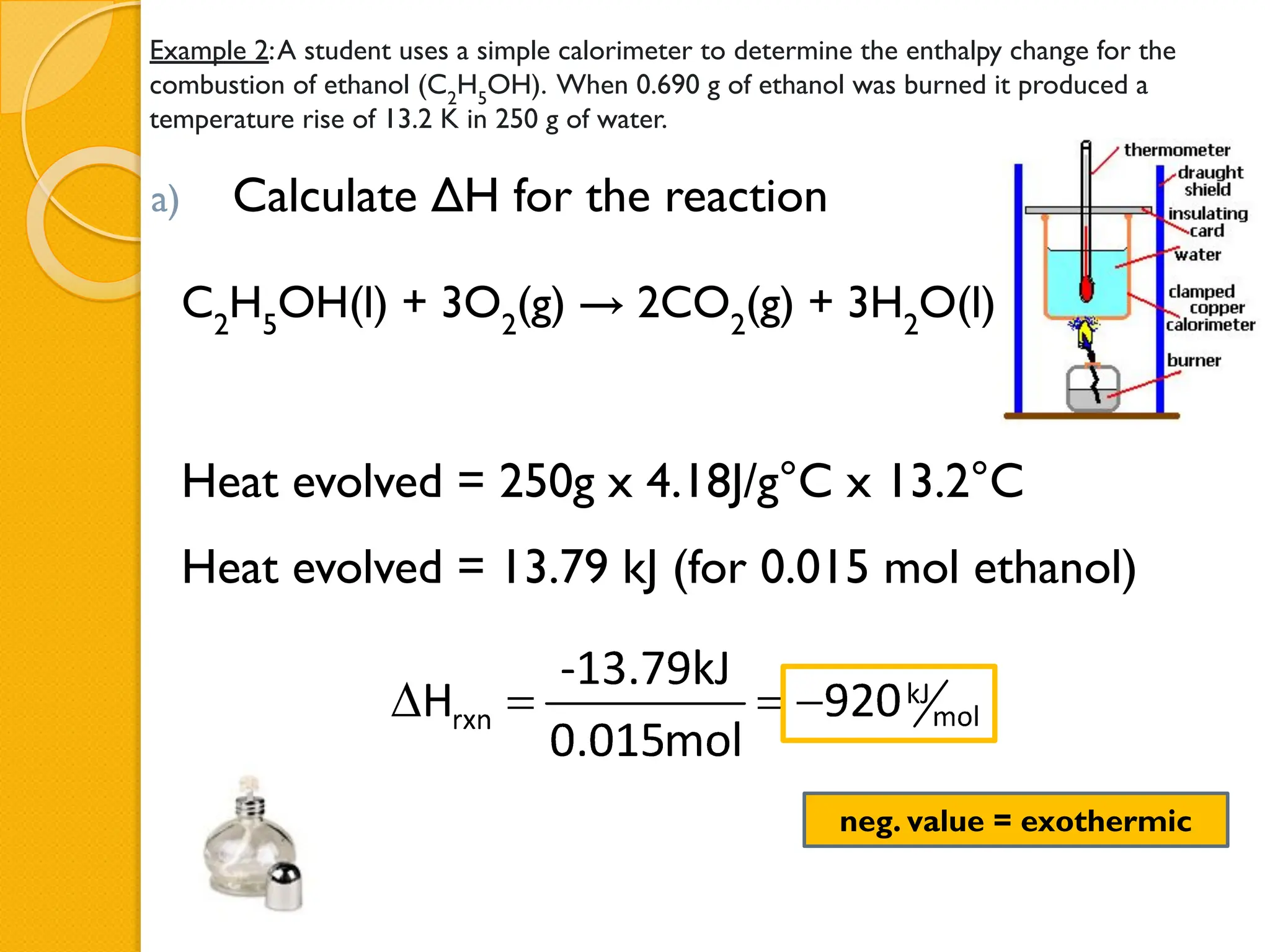
Example 2:A student uses a simple calorimeter to determine the enthalpy change for the
combustion of ethanol (C2
H5
OH). When 0.690 g of ethanol was burned it produced a
temperature rise of 13.2 K in 250 g of water.
a) Calculate ΔH for the reaction
C2
H5
OH(l) + 3O2
(g) → 2CO2
(g) + 3H2
O(l)
Heat evolved = 250g x 4.18J/g°C x 13.2°C
Heat evolved = 13.79 kJ (for 0.015 mol ethanol)
neg. value = exothermic
Example 2:A student uses a simple calorimeter to determine the enthalpy change for
the combustion of ethanol (C2
H5
OH). When 0.690 g of ethanol was burned it
produced a temperature rise of 13.2 K in 250 g of water.
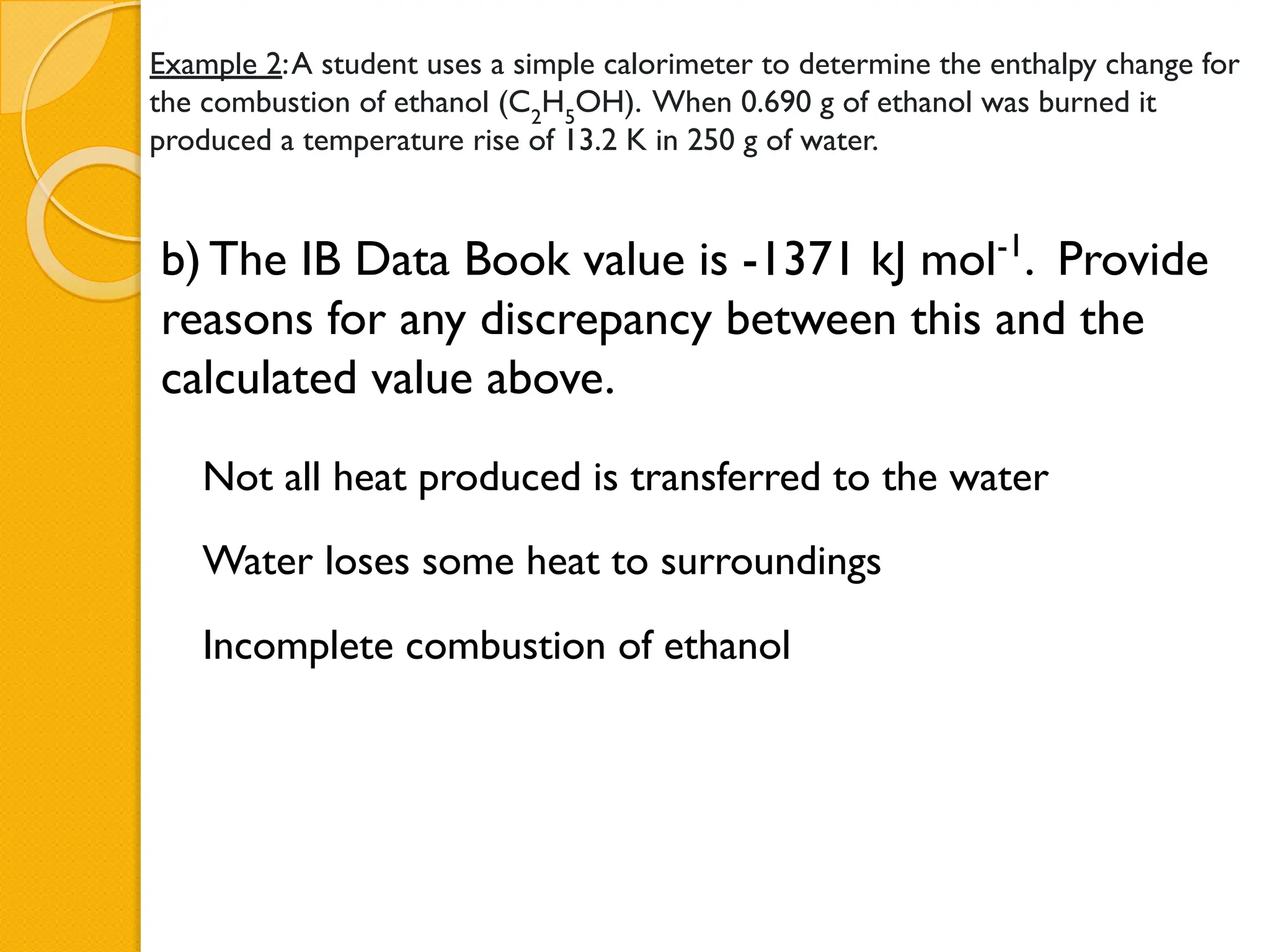
b) The IB Data Book value is -1371 kJ mol-1
. Provide
reasons for any discrepancy between this and the
calculated value above.
Not all heat produced is transferred to the water
Water loses some heat to surroundings
Incomplete combustion of ethanol
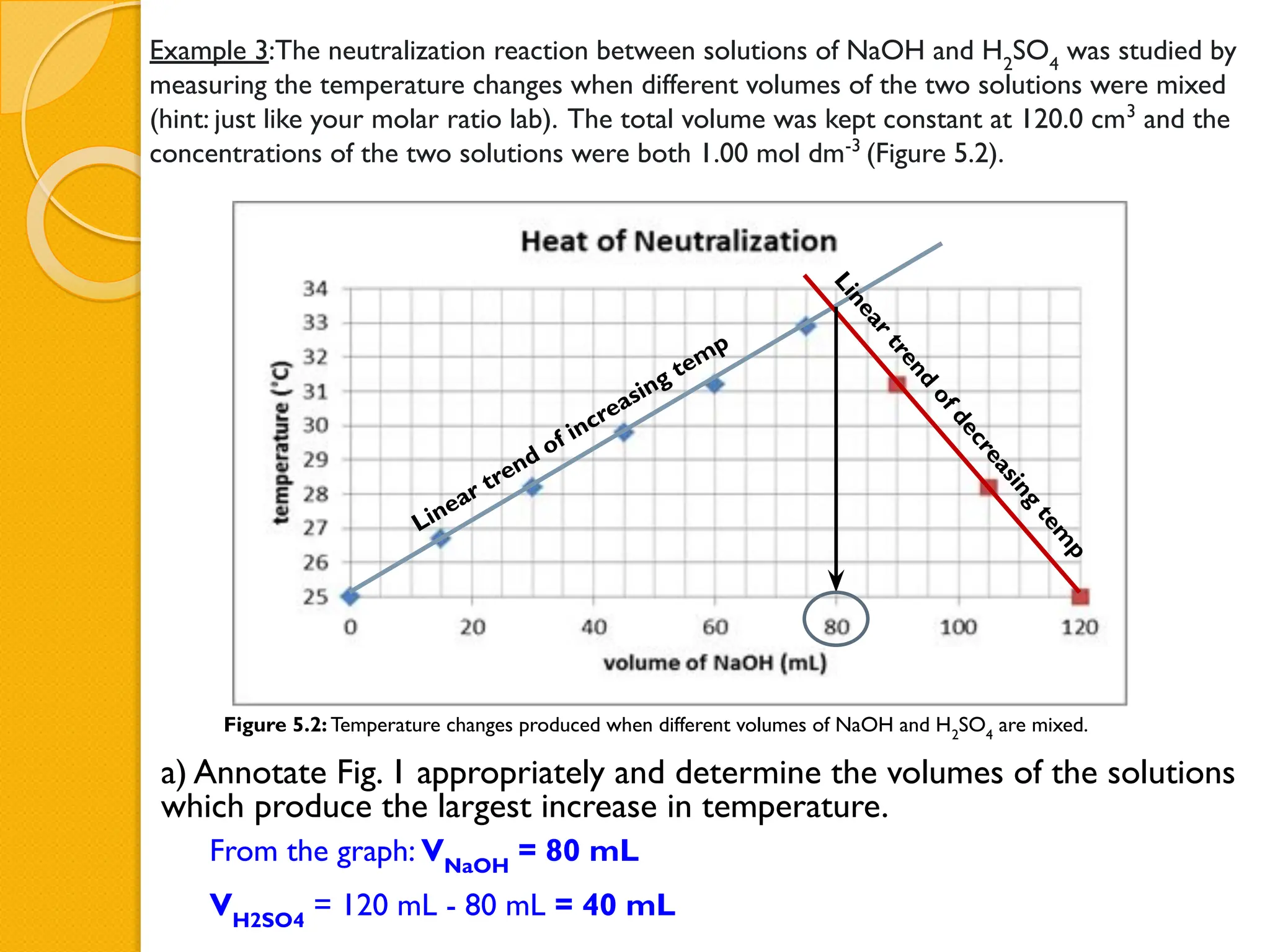
Example 3:The neutralization reaction between solutions of NaOH and H2
SO4
was studied by
measuring the temperature changes when different volumes of the two solutions were mixed
(hint: just like your molar ratio lab). The total volume was kept constant at 120.0 cm3
and the
concentrations of the two solutions were both 1.00 mol dm-3
(Figure 5.2).
a) Annotate Fig. 1 appropriately and determine the volumes of the solutions
which produce the largest increase in temperature.
Figure 5.2: Temperature changes produced when different volumes of NaOH and H2
SO4
are mixed.
From the graph: VNaOH
= 80 mL
VH2SO4
= 120 mL - 80 mL = 40 mL
Linear trend of increasing temp
L
i
n
e
a
r
t
r
e
n
d
o
f
d
e
c
r
e
a
s
i
n
g
t
e
m
p
Example 3:The neutralization reaction between solutions of NaOH and H2
SO4
was studied by
measuring the temperature changes when different volumes of the two solutions were mixed
(hint: just like your molar ratio lab). The total volume was kept constant at 120.0 cm3
and the
concentrations of the two solutions were both 1.00 mol dm-3
(Figure 5.2).
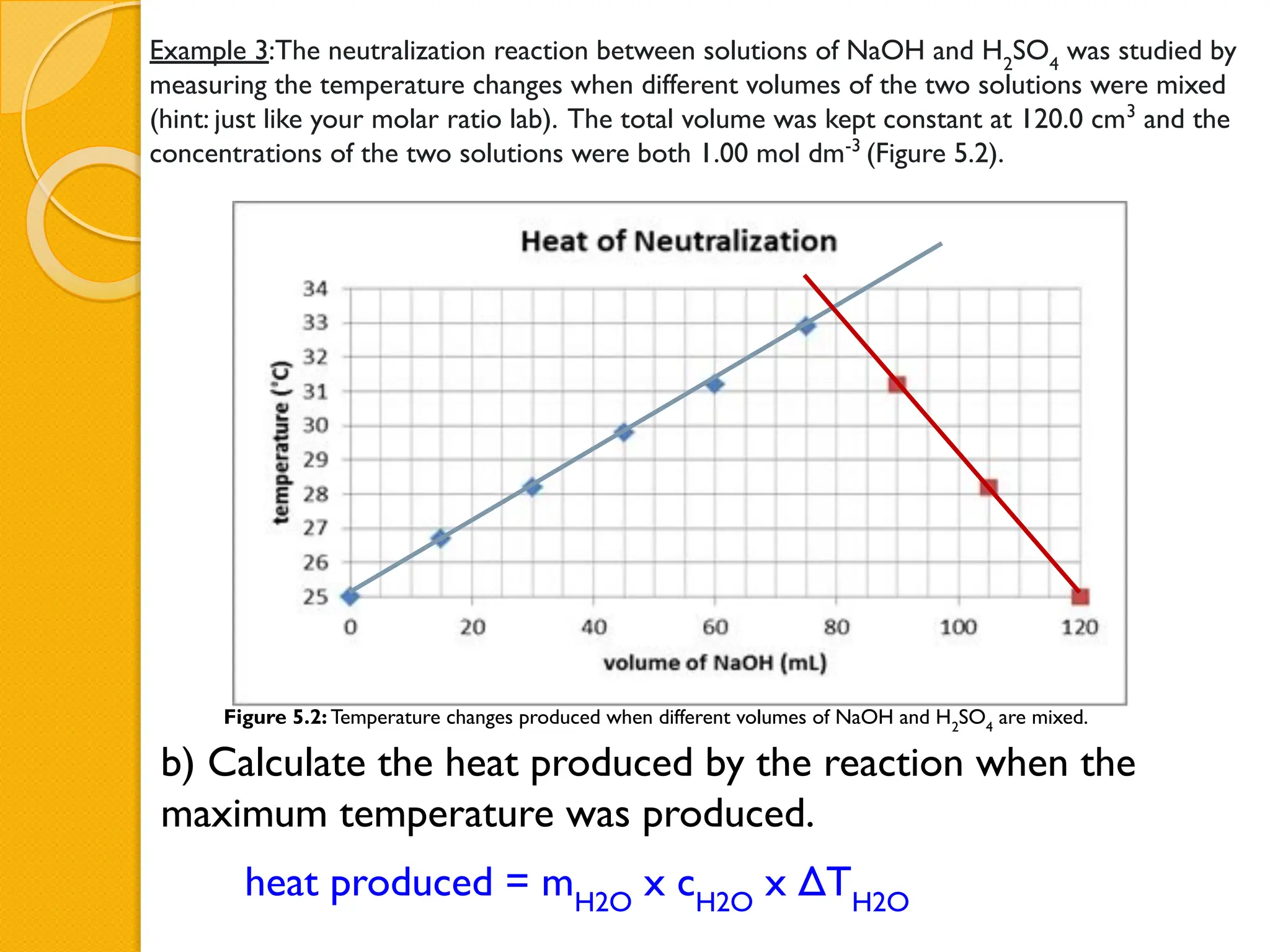
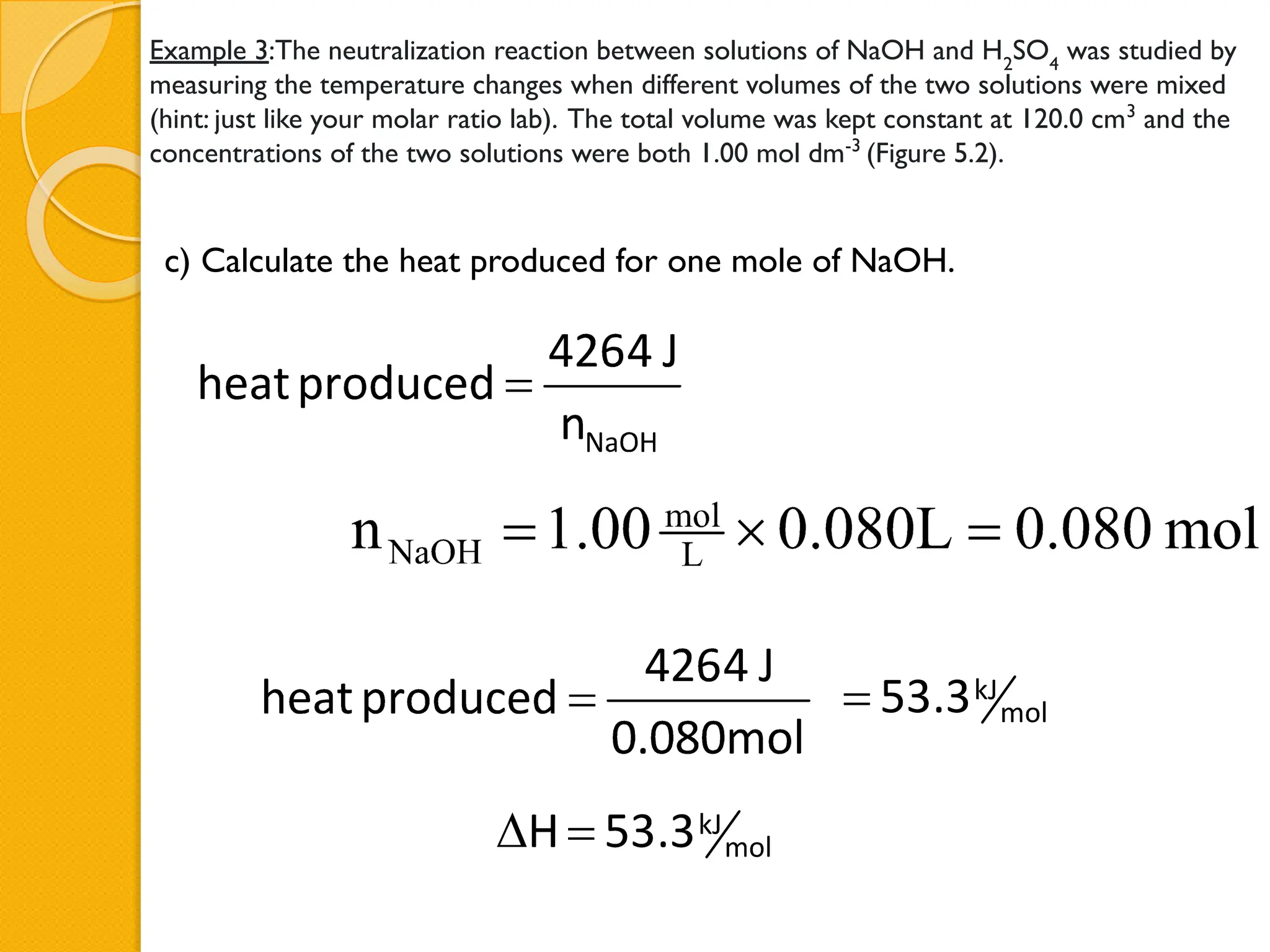
b) Calculate the heat produced by the reaction when the
maximum temperature was produced.
Figure 5.2: Temperature changes produced when different volumes of NaOH and H2
SO4
are mixed.
heat produced = mH2O
x cH2O
x ΔTH2O
Example 3:The neutralization reaction between solutions of NaOH and H2
SO4
was studied by
measuring the temperature changes when different volumes of the two solutions were mixed
(hint: just like your molar ratio lab). The total volume was kept constant at 120.0 cm3
and the
concentrations of the two solutions were both 1.00 mol dm-3
(Figure 5.2).
b) Calculate the heat produced by the reaction when the
maximum temperature was produced.
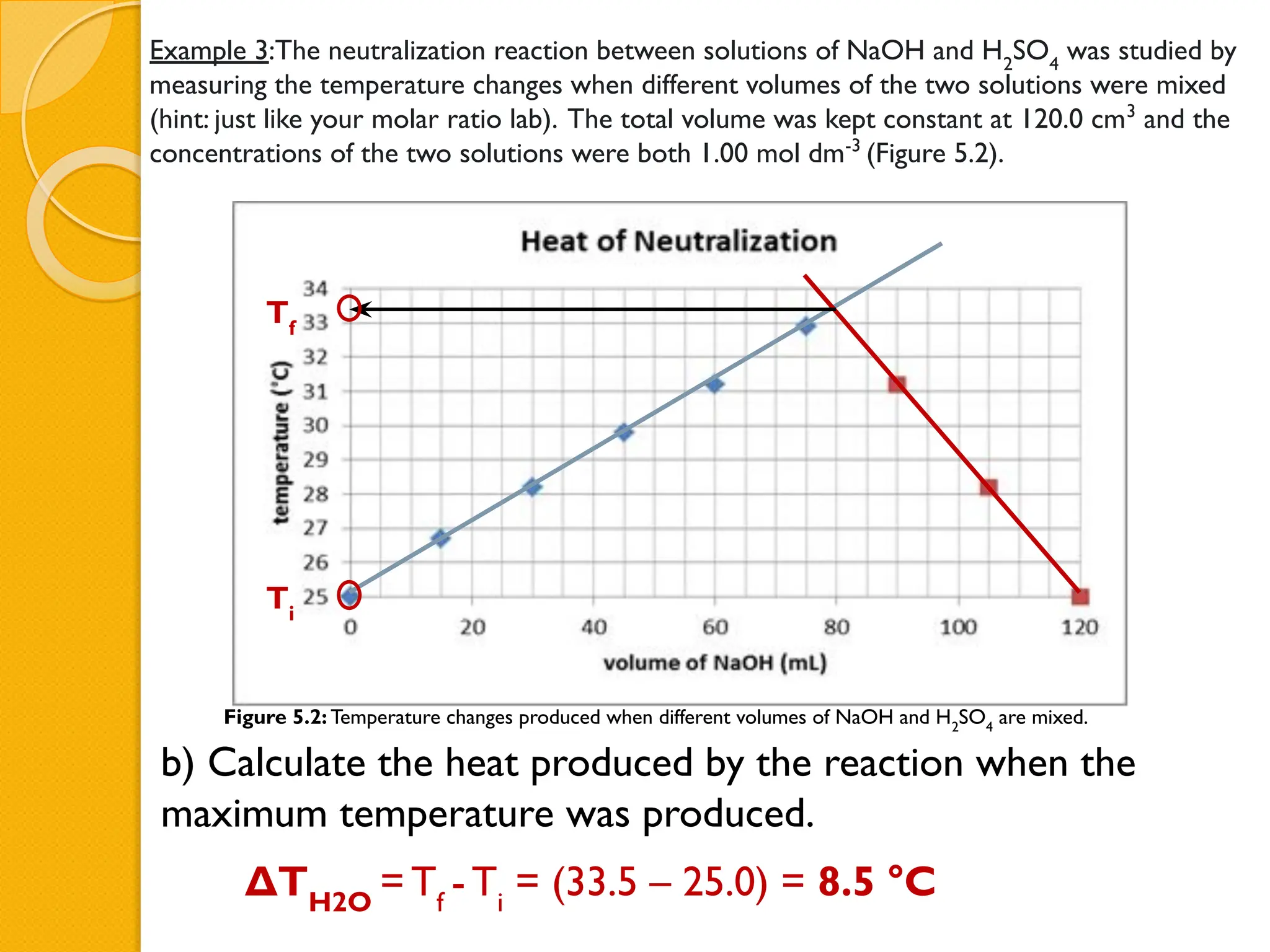
Figure 5.2: Temperature changes produced when different volumes of NaOH and H2
SO4
are mixed.
ΔTH2O
= Tf
- Ti
= (33.5 – 25.0) = 8.5 °C
Ti
Tf
Example 3:The neutralization reaction between solutions of NaOH and H2
SO4
was studied by
measuring the temperature changes when different volumes of the two solutions were mixed
(hint: just like your molar ratio lab). The total volume was kept constant at 120.0 cm3
and the
concentrations of the two solutions were both 1.00 mol dm-3
(Figure 5.2).
b) Calculate the heat produced by the reaction when the
maximum temperature was produced.
Figure 5.2: Temperature changes produced when different volumes of NaOH and H2
SO4
are mixed.
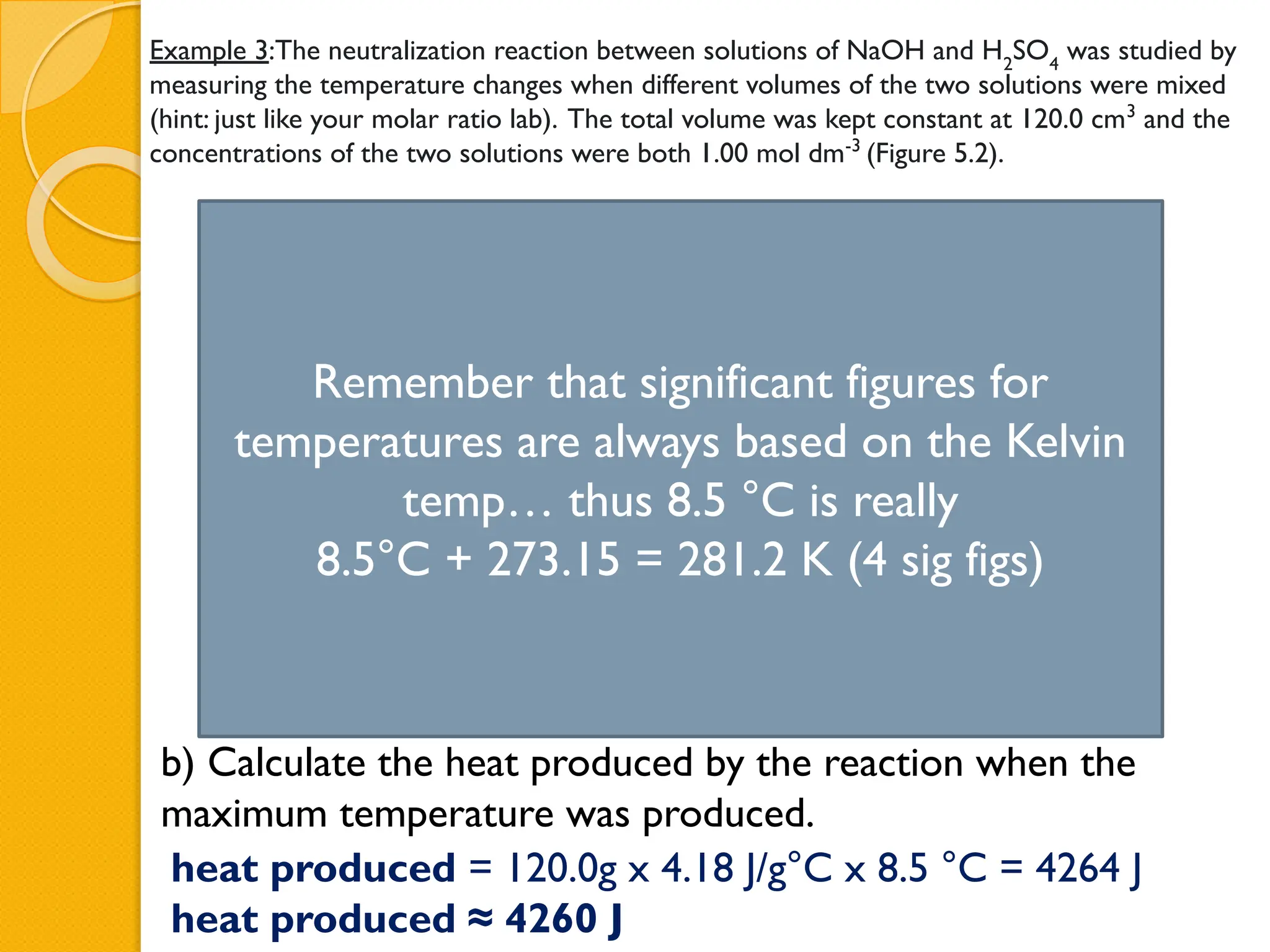
heat produced = 120.0g x 4.18 J/g°C x 8.5 °C = 4264 J
heat produced ≈ 4260 J
Ti
Tf
Remember that significant figures for
temperatures are always based on the Kelvin
temp… thus 8.5 °C is really
8.5°C + 273.15 = 281.2 K (4 sig figs)
Example 3:The neutralization reaction between solutions of NaOH and H2
SO4
was studied by
measuring the temperature changes when different volumes of the two solutions were mixed
(hint: just like your molar ratio lab). The total volume was kept constant at 120.0 cm3
and the
concentrations of the two solutions were both 1.00 mol dm-3
(Figure 5.2).
c) Calculate the heat produced for one mole of NaOH.
Example 3:The neutralization reaction between solutions of NaOH and H2
SO4
was studied by
measuring the temperature changes when different volumes of the two solutions were mixed
(hint: just like your molar ratio lab). The total volume was kept constant at 120.0 cm3
and the
concentrations of the two solutions were both 1.00 mol dm-3
(Figure 5.2).
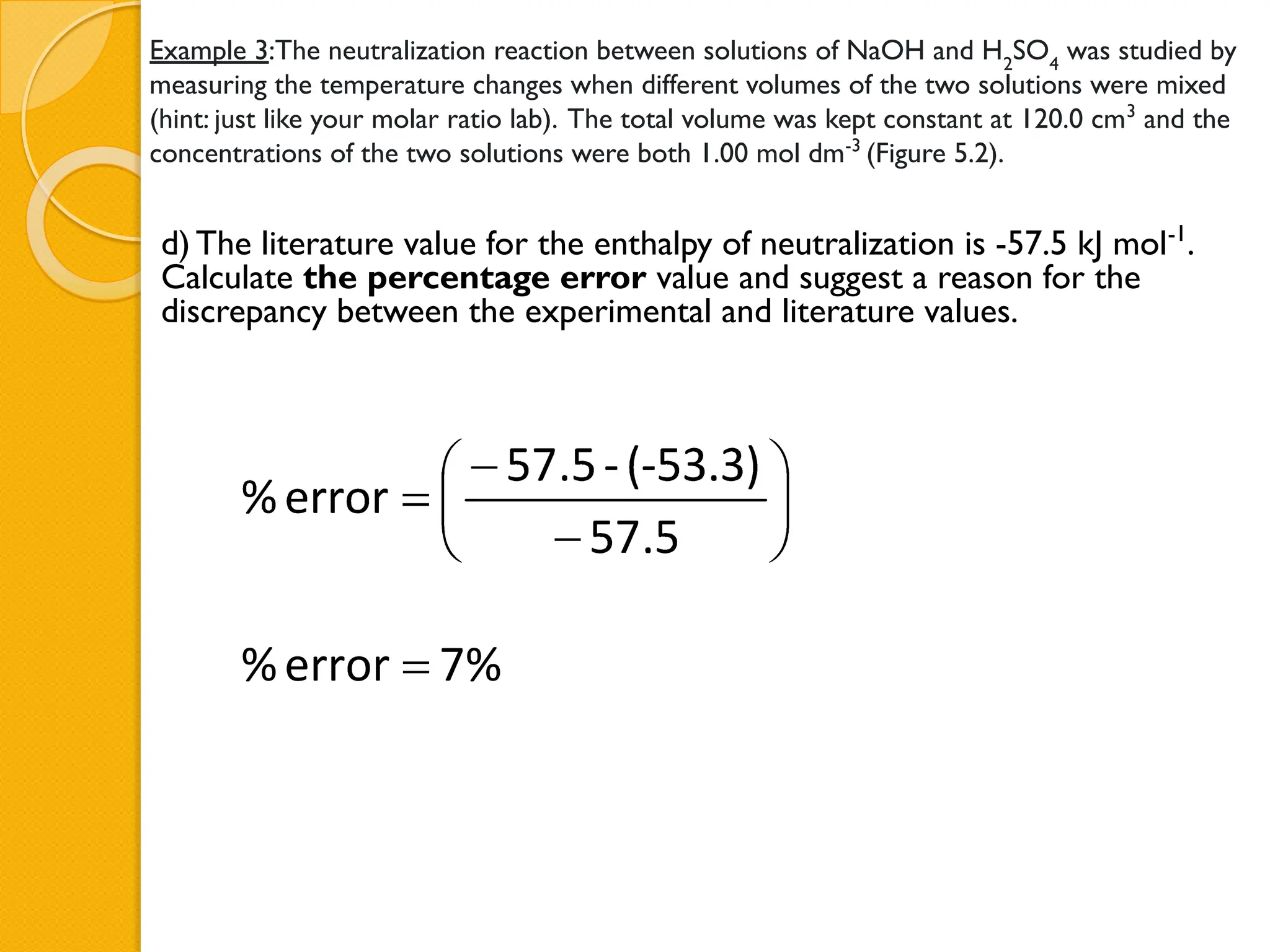
d) The literature value for the enthalpy of neutralization is -57.5 kJ mol-1
.
Calculate the percentage error value and suggest a reason for the
discrepancy between the experimental and literature values.
Example 3:The neutralization reaction between solutions of NaOH and H2
SO4
was studied by
measuring the temperature changes when different volumes of the two solutions were mixed
(hint: just like your molar ratio lab). The total volume was kept constant at 120.0 cm3
and the
concentrations of the two solutions were both 1.00 mol dm-3
(Figure 5.2).
d) The literature value for the enthalpy of neutralization is -57.5 kJ mol-1
.
Calculate the percentage error value and suggest a reason for the
discrepancy between the experimental and literature values.
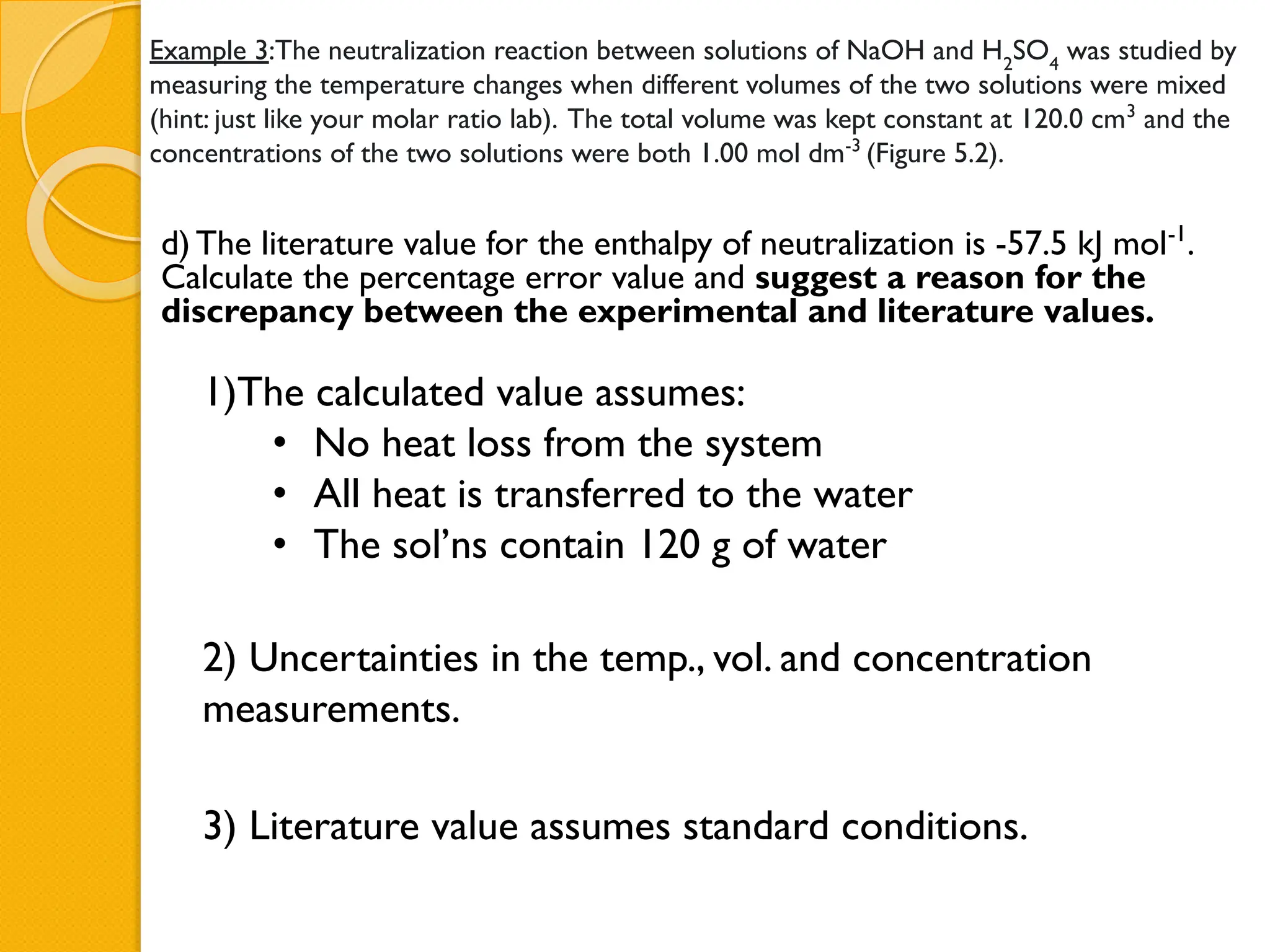
1)The calculated value assumes:
• No heat loss from the system
• All heat is transferred to the water
• The sol’ns contain 120 g of water
2) Uncertainties in the temp., vol. and concentration
measurements.
3) Literature value assumes standard conditions.
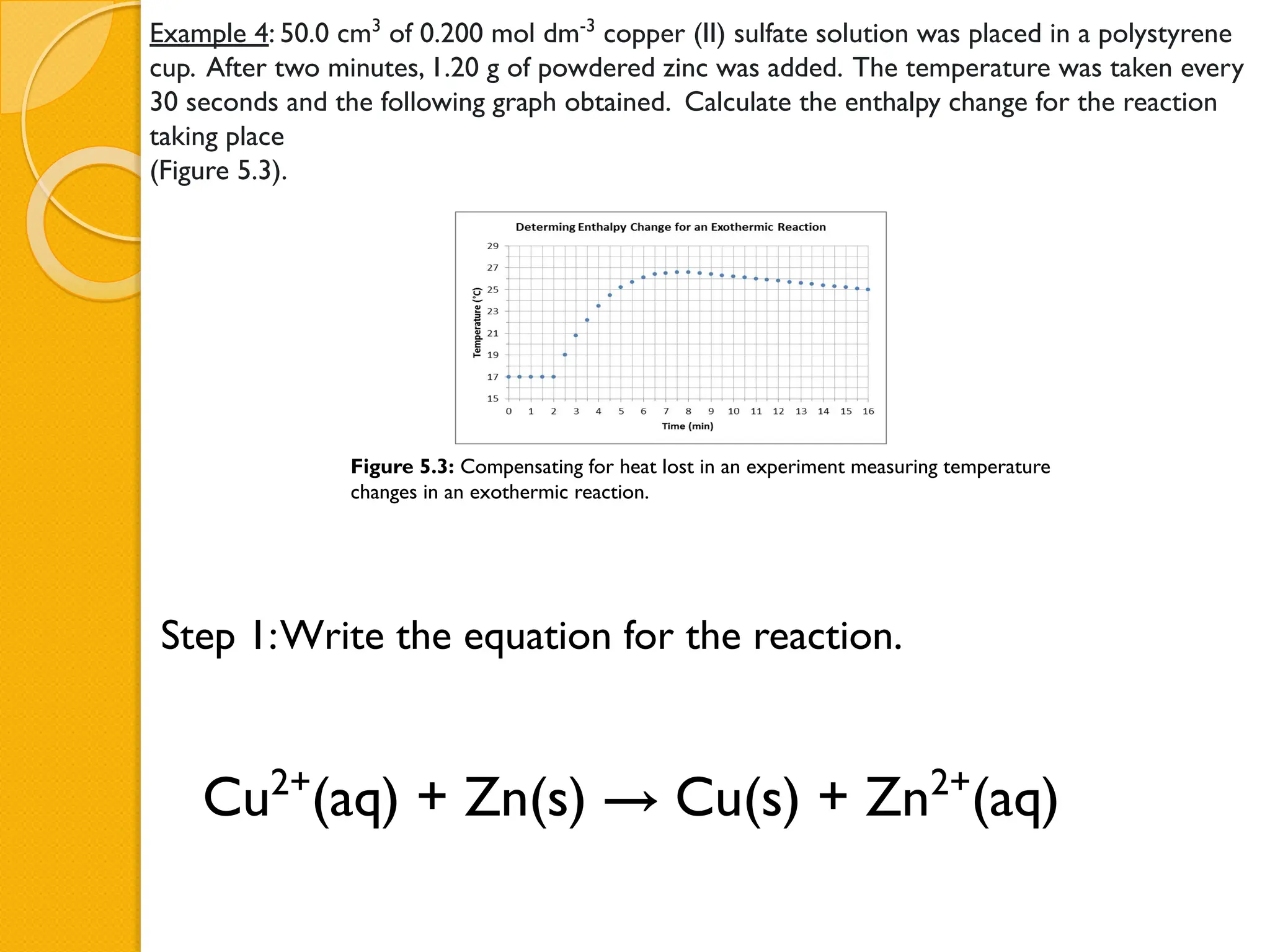
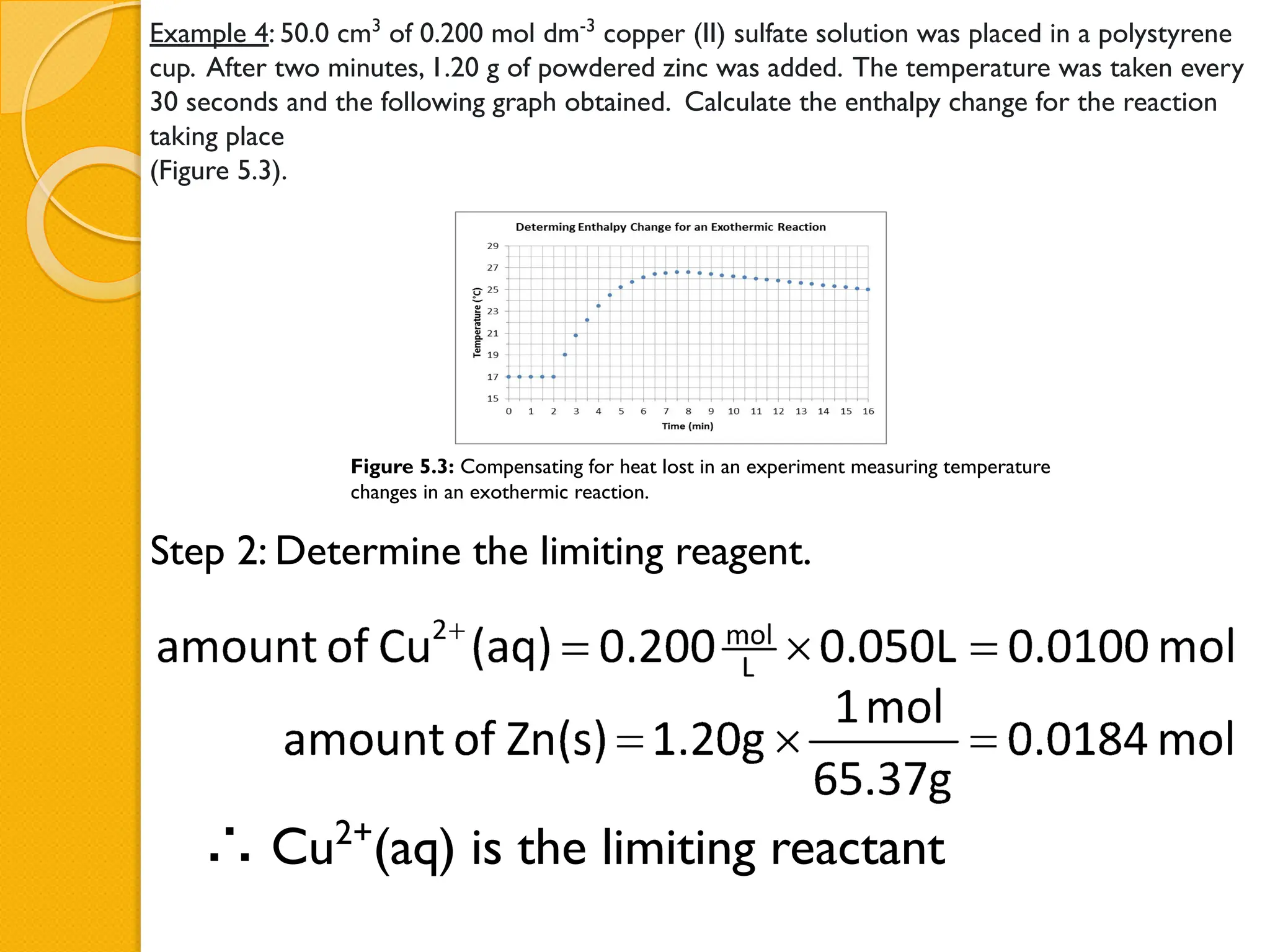
Example 4: 50.0 cm3
of 0.200 mol dm-3
copper (II) sulfate solution was placed in a polystyrene
cup. After two minutes, 1.20 g of powdered zinc was added. The temperature was taken every
30 seconds and the following graph obtained. Calculate the enthalpy change for the reaction
taking place
(Figure 5.3).
Step 1:Write the equation for the reaction.
Figure 5.3: Compensating for heat lost in an experiment measuring temperature
changes in an exothermic reaction.
Cu2+
(aq) + Zn(s) → Cu(s) + Zn2+
(aq)
Example 4: 50.0 cm3
of 0.200 mol dm-3
copper (II) sulfate solution was placed in a polystyrene
cup. After two minutes, 1.20 g of powdered zinc was added. The temperature was taken every
30 seconds and the following graph obtained. Calculate the enthalpy change for the reaction
taking place
(Figure 5.3).
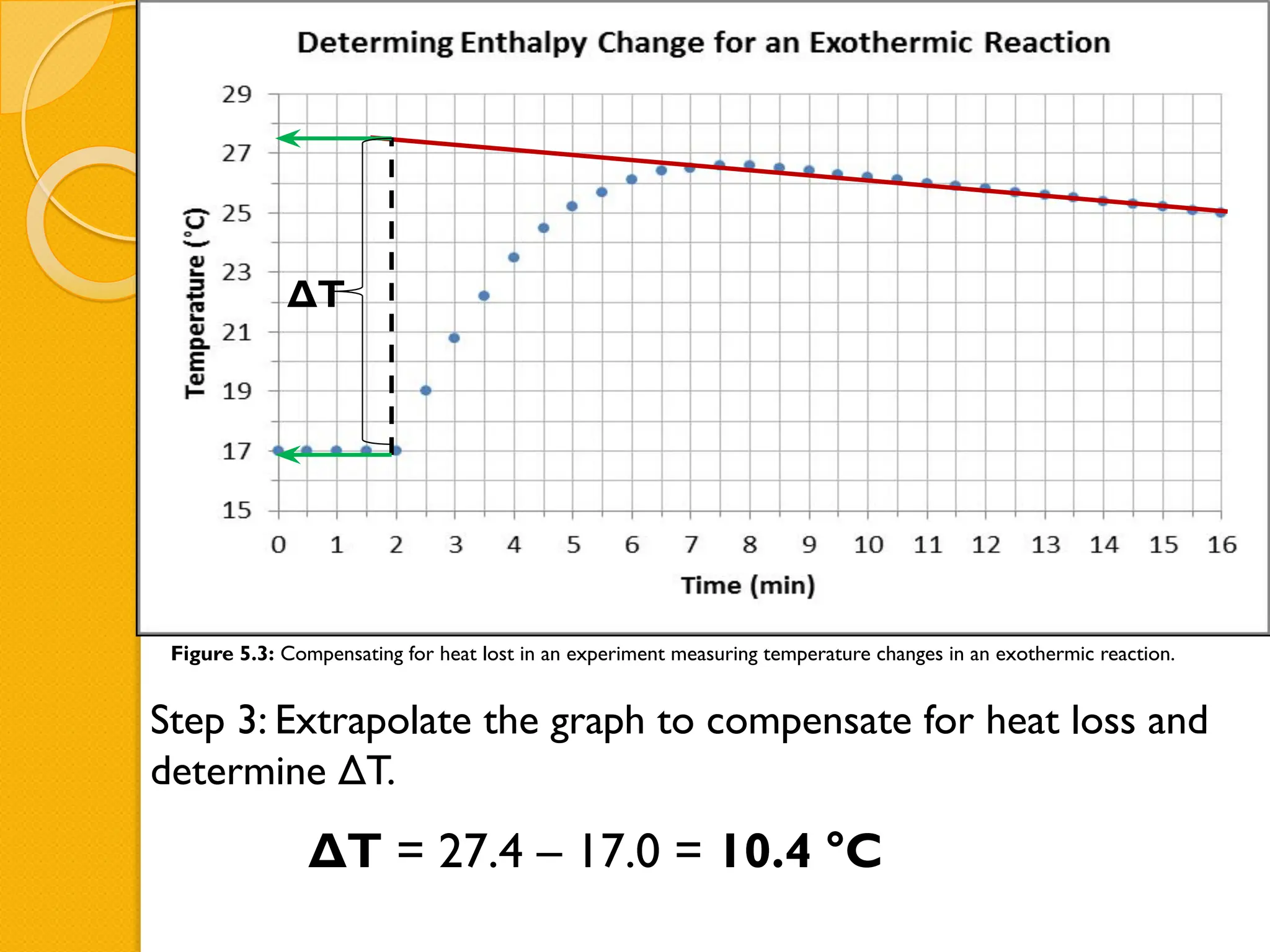
Step 2: Determine the limiting reagent.
∴ Cu2+
(aq) is the limiting reactant
Figure 5.3: Compensating for heat lost in an experiment measuring temperature
changes in an exothermic reaction.
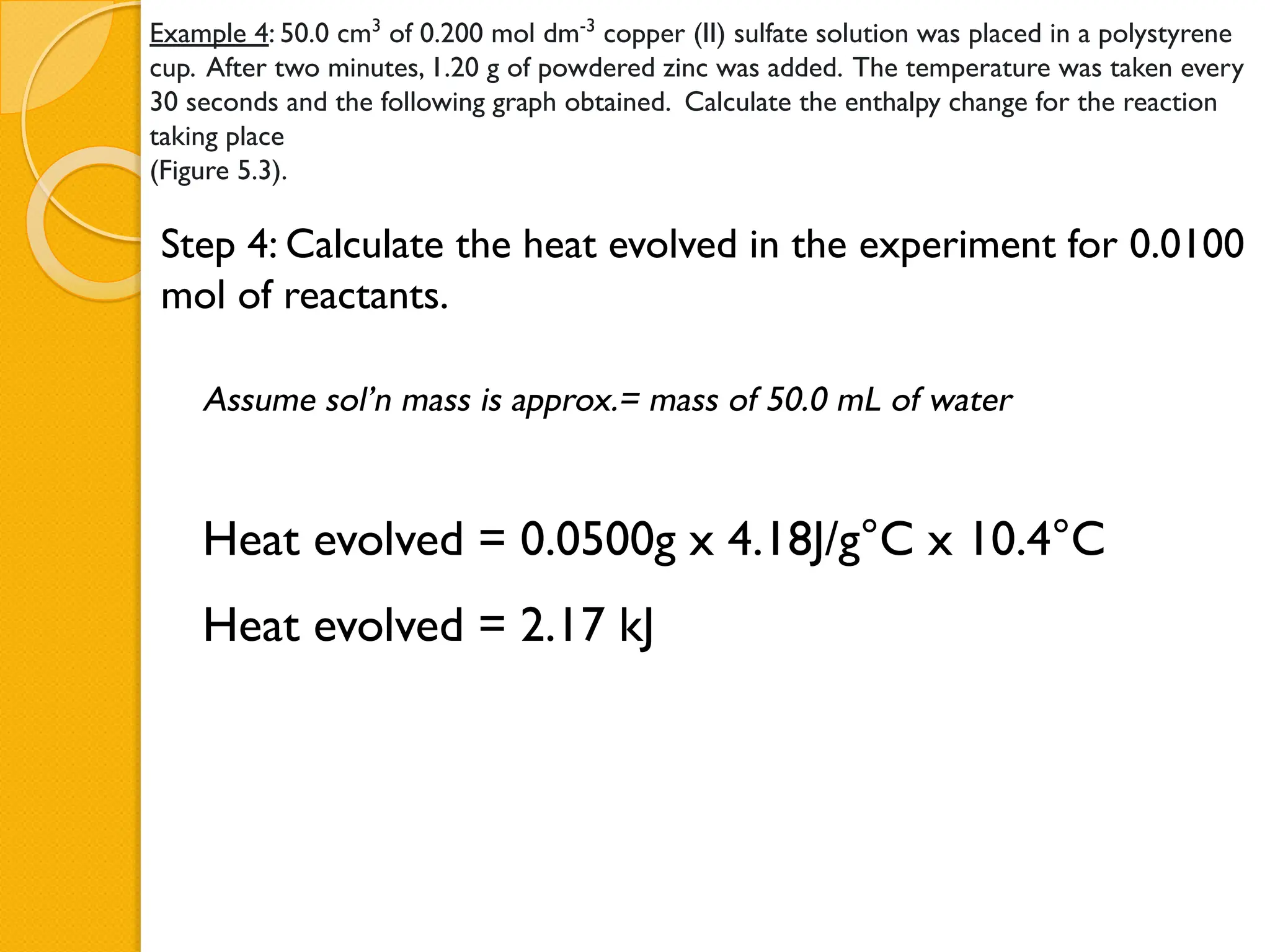
Step 3: Extrapolate the graph to compensate for heat loss and
determine ΔT.
Figure 5.3: Compensating for heat lost in an experiment measuring temperature changes in an exothermic reaction.
ΔT = 27.4 – 17.0 = 10.4 °C
ΔT
Example 4: 50.0 cm3
of 0.200 mol dm-3
copper (II) sulfate solution was placed in a polystyrene
cup. After two minutes, 1.20 g of powdered zinc was added. The temperature was taken every
30 seconds and the following graph obtained. Calculate the enthalpy change for the reaction
taking place
(Figure 5.3).
Step 4: Calculate the heat evolved in the experiment for 0.0100
mol of reactants.
Heat evolved = 0.0500g x 4.18J/g°C x 10.4°C
Heat evolved = 2.17 kJ
Assume sol’n mass is approx.= mass of 50.0 mL of water
Example 4: 50.0 cm3
of 0.200 mol dm-3
copper (II) sulfate solution was placed in a polystyrene
cup. After two minutes, 1.20 g of powdered zinc was added. The temperature was taken every
30 seconds and the following graph obtained. Calculate the enthalpy change for the reaction
taking place
(Figure 5.3).
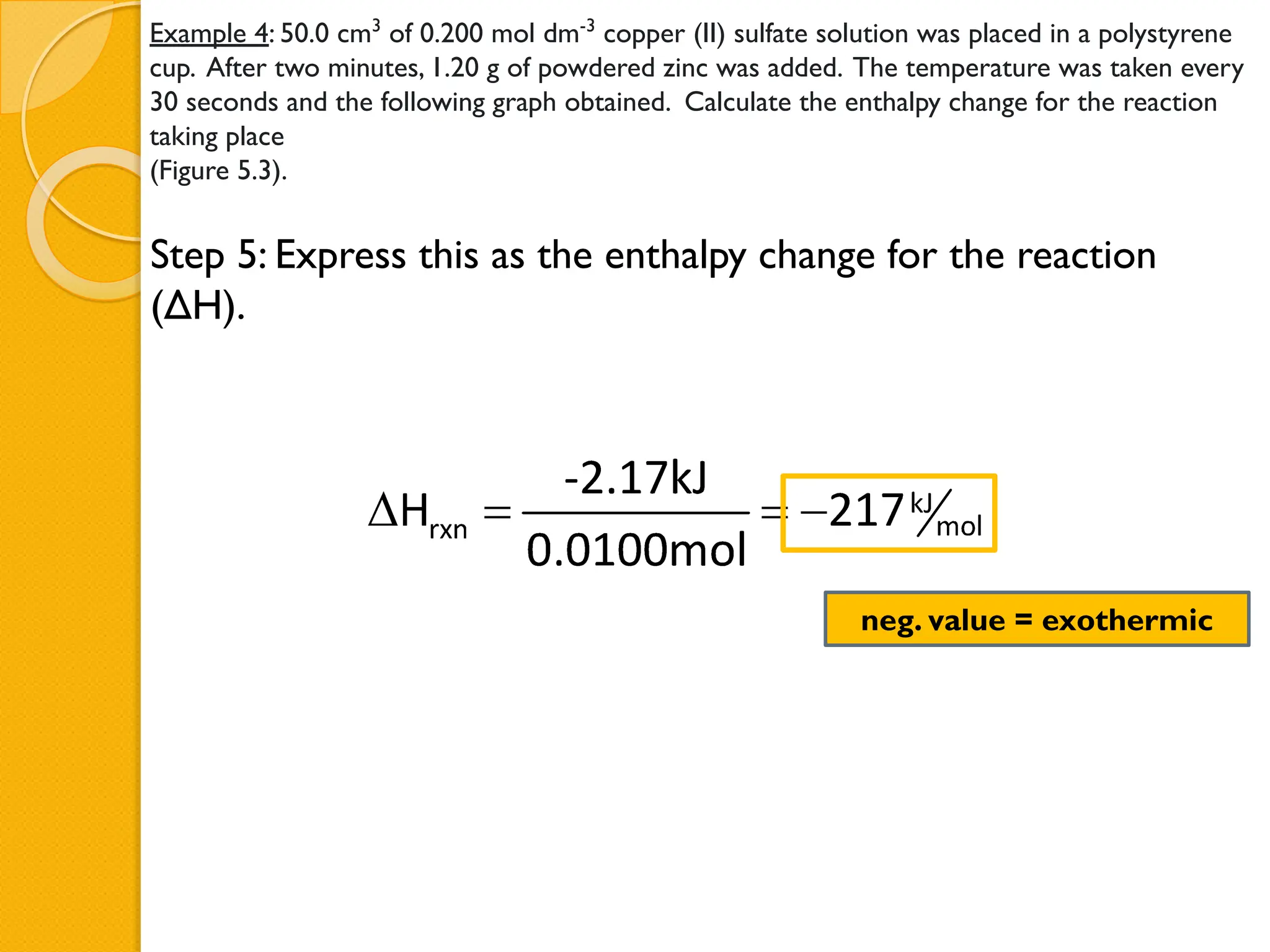
Step 5: Express this as the enthalpy change for the reaction
(ΔH).
neg. value = exothermic
Reactivity 1.1 measure of enthalpy change.pdf

  • 1.
    Reactivity 1 R 1.1:Measuring enthalpy change
  • 2.
    Energy: a measureof the ability to do work. ⚫ Work: to move an object against an opposing force. ⚫ Energy (J) = Force (N) x Distance (m) ⚫ Forms of energy include: heat, light, sound, electricity, and chemical energy (energy released or absorbed during chemical rxns)
  • 3.
    Enthalpy (H): ameasure of internal energy stored in a substance. ⚫ Absolute value of enthalpy of reactants cannot be known, nor can enthalpy of products in a rxn. ⚫ Enthalpy change (ΔH) in a rxn can be measured (difference between reactants and products). ⚫ Standard enthalpy change of a rxn (ΔHϴ ): measured at pressure = 1 atm; temp = 298 K
  • 4.
    EXOTHERMIC & ENDOTHERMIC RXNS ⚫Exothermic rxns: release energy in the form of heat (because bonds in the products are stronger than the bonds in the reactants); decreasing enthalpy has neg. sign (ΔH < 0) Diagram: Enthalpy, H reactants products extent of rxn ΔH = negative
  • 5.
    EXOTHERMIC & ENDOTHERMIC RXNS ⚫Endothermic rxns: absorb energy in the form of heat; increasing enthalpy, positive value (ΔH > 0) Diagram: Enthalpy, H reactants products extent of rxn ΔH = positive
  • 6.
    TEMPERATURE AND HEAT ⚫Heat: a measure of the total energy in a given amount of a substance (and therefore depends on the amount of substance present).
  • 7.
    TEMPERATURE AND HEAT ⚫Temperature: a measure of the “hotness” of a substance. It represents the average kinetic energy of the substance (but is independent of the amount of substance present).
  • 8.
    TEMPERATURE AND HEAT ⚫Example:Two beakers of water. Both have same temperature, but a beaker with 100 cm3 of water contains twice as much heat as a beaker containing 50 cm3 . Same temp, but MORE HEAT
  • 9.
    TEMPERATURE AND HEAT ⚫The increase in temp. when an object is heated depends on ●The mass of the object ●The heat added ●The nature of the substance (different substances have different “specific heat” values)
  • 10.
    CALORIMETRY ⚫ The enthalpychange for a rxn can be measured experimentally by using a calorimeter. bomb calorimeter simple calorimeter (a.k.a.“coffee cup calorimeter”)
  • 11.
    CALORIMETRY ⚫ In asimple “coffee cup” calorimeter, all heat evolved by an exothermic rxn is used to raise temp. of a known mass of H2 O. ⚫ For endothermic rxns, heat transferred from the H2 O to the rxn can be calculated by measuring the lowering of the temperature of a known mass of water.
  • 12.
    Compensating for heatloss: Graph temp. v. time By extrapolating the graph, the temp rise that would have taken place had the rxn been instantaneous can be calculated. ΔT cooling trendline T1 T2 T3 T1 = initial temp. T2 = max temp. measured T3 = max temp. if no heat loss ΔT =T3 -T1
  • 13.
    CALCULATION OF ENTHALPY CHANGES(ΔH) ⚫ The heat involved in changing the temperature of any substance can be calculated as follows: ◦ Heat energy = mass (m) x specific heat capacity (c) x temperature change (ΔT) ◦ (Remember q = mcΔT from H Chem?)
  • 14.
    CALCULATION OF ENTHALPY CHANGES(ΔH) ⚫ Specific heat capacity of H2 O = 4.18 kJ kg-1 K-1 ◦ Thus, 4.18 kJ of energy are required to raise the temp of 1 kg of water by one Kelvin. ◦ Note that this is effectively the same as the complex unit J/g⋅°C (from Honors Chem)
  • 15.
    CALCULATION OF ENTHALPY CHANGES(ΔH) ⚫ Enthalpy changes are normally quoted in kJ mol-1 for either a reactant or product, so it is also necessary to work out the number of moles involved in the reaction which produces the heat change in the water.
  • 16.
    Example 1: 50.0cm3 of 1.00 mol dm-3 hydrochloric acid solution was added to 50.0 cm3 of 1.00 mol dm-3 sodium hydroxide solution in a polystyrene beaker. The initial temperature of both solutions was 16.7 °C. After stirring and accounting for heat loss the highest temperature reached was 23.5 °C. Calculate the enthalpy change for this reaction. ⚫ Step 1:Write the equation for reaction HCl(aq) + NaOH(aq) → NaCl(aq) + H2 O(l)
  • 17.
    Example 1: 50.0cm3 of 1.00 mol dm-3 hydrochloric acid solution was added to 50.0 cm3 of 1.00 mol dm-3 sodium hydroxide solution in a polystyrene beaker. The initial temperature of both solutions was 16.7 °C. After stirring and accounting for heat loss the highest temperature reached was 23.5 °C. Calculate the enthalpy change for this reaction. ⚫ Step 2: Calculate molar quantities ∴heat evolved will be for 0.0500 mol
  • 18.
    Example 1: 50.0cm3 of 1.00 mol dm-3 hydrochloric acid solution was added to 50.0 cm3 of 1.00 mol dm-3 sodium hydroxide solution in a polystyrene beaker. The initial temperature of both solutions was 16.7 °C. After stirring and accounting for heat loss the highest temperature reached was 23.5 °C. Calculate the enthalpy change for this reaction. ⚫ Step 3: Calculate heat evolved Total vol. sol’n = 50.0 + 50.0 = 100.0 mL Assume sol’n has same density and specific heat capacity as water, then… Mass of “water” = 100.0 g ΔT = 23.5 – 16.7 = 6.8 °C heat evolved = 100.0g x 4.18J/g°C x 6.8 °C = 2.84 kJ/mol (for 0.0500 mol) neg. value = exothermic
  • 19.
    Example 2:A studentuses a simple calorimeter to determine the enthalpy change for the combustion of ethanol (C2 H5 OH). When 0.690 g of ethanol was burned it produced a temperature rise of 13.2 K in 250 g of water. a) Calculate ΔH for the reaction C2 H5 OH(l) + 3O2 (g) → 2CO2 (g) + 3H2 O(l) Heat evolved = 250g x 4.18J/g°C x 13.2°C Heat evolved = 13.79 kJ (for 0.015 mol ethanol) neg. value = exothermic
  • 20.
    Example 2:A studentuses a simple calorimeter to determine the enthalpy change for the combustion of ethanol (C2 H5 OH). When 0.690 g of ethanol was burned it produced a temperature rise of 13.2 K in 250 g of water. b) The IB Data Book value is -1371 kJ mol-1 . Provide reasons for any discrepancy between this and the calculated value above. Not all heat produced is transferred to the water Water loses some heat to surroundings Incomplete combustion of ethanol
  • 21.
    Example 3:The neutralizationreaction between solutions of NaOH and H2 SO4 was studied by measuring the temperature changes when different volumes of the two solutions were mixed (hint: just like your molar ratio lab). The total volume was kept constant at 120.0 cm3 and the concentrations of the two solutions were both 1.00 mol dm-3 (Figure 5.2). a) Annotate Fig. 1 appropriately and determine the volumes of the solutions which produce the largest increase in temperature. Figure 5.2: Temperature changes produced when different volumes of NaOH and H2 SO4 are mixed. From the graph: VNaOH = 80 mL VH2SO4 = 120 mL - 80 mL = 40 mL Linear trend of increasing temp L i n e a r t r e n d o f d e c r e a s i n g t e m p
  • 22.
    Example 3:The neutralizationreaction between solutions of NaOH and H2 SO4 was studied by measuring the temperature changes when different volumes of the two solutions were mixed (hint: just like your molar ratio lab). The total volume was kept constant at 120.0 cm3 and the concentrations of the two solutions were both 1.00 mol dm-3 (Figure 5.2). b) Calculate the heat produced by the reaction when the maximum temperature was produced. Figure 5.2: Temperature changes produced when different volumes of NaOH and H2 SO4 are mixed. heat produced = mH2O x cH2O x ΔTH2O
  • 23.
    Example 3:The neutralizationreaction between solutions of NaOH and H2 SO4 was studied by measuring the temperature changes when different volumes of the two solutions were mixed (hint: just like your molar ratio lab). The total volume was kept constant at 120.0 cm3 and the concentrations of the two solutions were both 1.00 mol dm-3 (Figure 5.2). b) Calculate the heat produced by the reaction when the maximum temperature was produced. Figure 5.2: Temperature changes produced when different volumes of NaOH and H2 SO4 are mixed. ΔTH2O = Tf - Ti = (33.5 – 25.0) = 8.5 °C Ti Tf
  • 24.
    Example 3:The neutralizationreaction between solutions of NaOH and H2 SO4 was studied by measuring the temperature changes when different volumes of the two solutions were mixed (hint: just like your molar ratio lab). The total volume was kept constant at 120.0 cm3 and the concentrations of the two solutions were both 1.00 mol dm-3 (Figure 5.2). b) Calculate the heat produced by the reaction when the maximum temperature was produced. Figure 5.2: Temperature changes produced when different volumes of NaOH and H2 SO4 are mixed. heat produced = 120.0g x 4.18 J/g°C x 8.5 °C = 4264 J heat produced ≈ 4260 J Ti Tf Remember that significant figures for temperatures are always based on the Kelvin temp… thus 8.5 °C is really 8.5°C + 273.15 = 281.2 K (4 sig figs)
  • 25.
    Example 3:The neutralizationreaction between solutions of NaOH and H2 SO4 was studied by measuring the temperature changes when different volumes of the two solutions were mixed (hint: just like your molar ratio lab). The total volume was kept constant at 120.0 cm3 and the concentrations of the two solutions were both 1.00 mol dm-3 (Figure 5.2). c) Calculate the heat produced for one mole of NaOH.
  • 26.
    Example 3:The neutralizationreaction between solutions of NaOH and H2 SO4 was studied by measuring the temperature changes when different volumes of the two solutions were mixed (hint: just like your molar ratio lab). The total volume was kept constant at 120.0 cm3 and the concentrations of the two solutions were both 1.00 mol dm-3 (Figure 5.2). d) The literature value for the enthalpy of neutralization is -57.5 kJ mol-1 . Calculate the percentage error value and suggest a reason for the discrepancy between the experimental and literature values.
  • 27.
    Example 3:The neutralizationreaction between solutions of NaOH and H2 SO4 was studied by measuring the temperature changes when different volumes of the two solutions were mixed (hint: just like your molar ratio lab). The total volume was kept constant at 120.0 cm3 and the concentrations of the two solutions were both 1.00 mol dm-3 (Figure 5.2). d) The literature value for the enthalpy of neutralization is -57.5 kJ mol-1 . Calculate the percentage error value and suggest a reason for the discrepancy between the experimental and literature values. 1)The calculated value assumes: • No heat loss from the system • All heat is transferred to the water • The sol’ns contain 120 g of water 2) Uncertainties in the temp., vol. and concentration measurements. 3) Literature value assumes standard conditions.
  • 28.
    Example 4: 50.0cm3 of 0.200 mol dm-3 copper (II) sulfate solution was placed in a polystyrene cup. After two minutes, 1.20 g of powdered zinc was added. The temperature was taken every 30 seconds and the following graph obtained. Calculate the enthalpy change for the reaction taking place (Figure 5.3). Step 1:Write the equation for the reaction. Figure 5.3: Compensating for heat lost in an experiment measuring temperature changes in an exothermic reaction. Cu2+ (aq) + Zn(s) → Cu(s) + Zn2+ (aq)
  • 29.
    Example 4: 50.0cm3 of 0.200 mol dm-3 copper (II) sulfate solution was placed in a polystyrene cup. After two minutes, 1.20 g of powdered zinc was added. The temperature was taken every 30 seconds and the following graph obtained. Calculate the enthalpy change for the reaction taking place (Figure 5.3). Step 2: Determine the limiting reagent. ∴ Cu2+ (aq) is the limiting reactant Figure 5.3: Compensating for heat lost in an experiment measuring temperature changes in an exothermic reaction.
  • 30.
    Step 3: Extrapolatethe graph to compensate for heat loss and determine ΔT. Figure 5.3: Compensating for heat lost in an experiment measuring temperature changes in an exothermic reaction. ΔT = 27.4 – 17.0 = 10.4 °C ΔT
  • 31.
    Example 4: 50.0cm3 of 0.200 mol dm-3 copper (II) sulfate solution was placed in a polystyrene cup. After two minutes, 1.20 g of powdered zinc was added. The temperature was taken every 30 seconds and the following graph obtained. Calculate the enthalpy change for the reaction taking place (Figure 5.3). Step 4: Calculate the heat evolved in the experiment for 0.0100 mol of reactants. Heat evolved = 0.0500g x 4.18J/g°C x 10.4°C Heat evolved = 2.17 kJ Assume sol’n mass is approx.= mass of 50.0 mL of water
  • 32.
    Example 4: 50.0cm3 of 0.200 mol dm-3 copper (II) sulfate solution was placed in a polystyrene cup. After two minutes, 1.20 g of powdered zinc was added. The temperature was taken every 30 seconds and the following graph obtained. Calculate the enthalpy change for the reaction taking place (Figure 5.3). Step 5: Express this as the enthalpy change for the reaction (ΔH). neg. value = exothermic