Chapter 10
The Shapes of Molecules
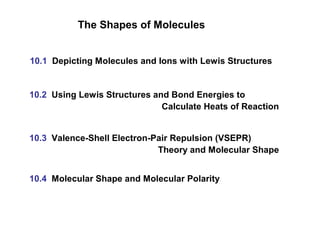
10.1 Depicting Molecules and Ions with Lewis Structures
10.2 Using Lewis Structures and Bond Energies to
Calculate Heats of Reaction
10.3 Valence-Shell Electron-Pair Repulsion (VSEPR)
Theory and Molecular Shape
10.4 Molecular Shape and Molecular Polarity
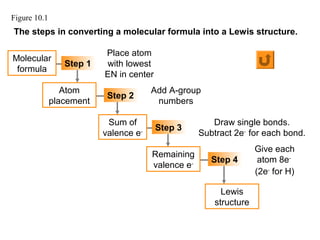
Figure 10.1
The steps in converting a molecular formula into a Lewis structure.
Molecular
formula
Atom
placement
Sum of
valence e-
Remaining
valence e-
Lewis
structure
Place atom
with lowest
EN in center
Add A-group
numbers
Draw single bonds.
Subtract 2e-
for each bond.
Give each
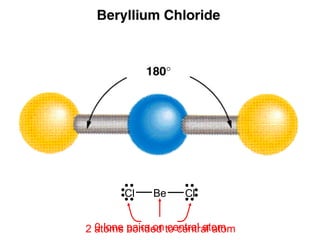
atom 8e-
(2e-
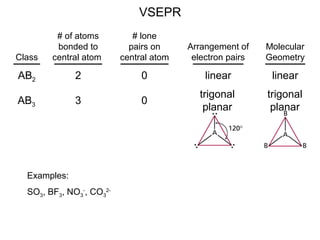
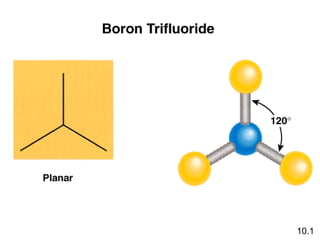
for H)
Step 1
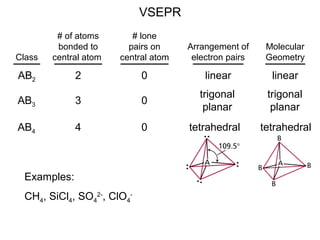
Step 2
Step 3
Step 4
Molecular
formula
Atom
placement
Sum of
valence e-
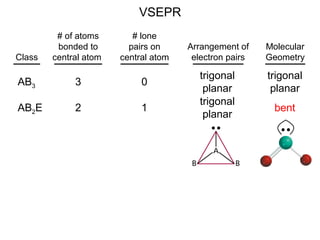
Remaining
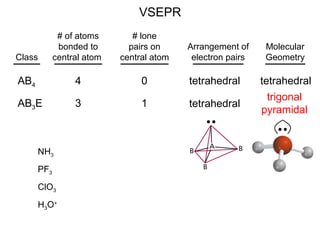
valence e-
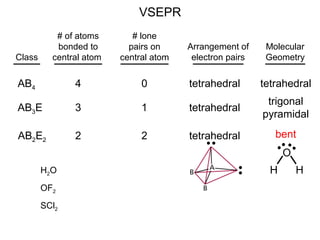
Lewis
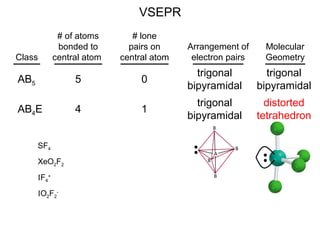
structure
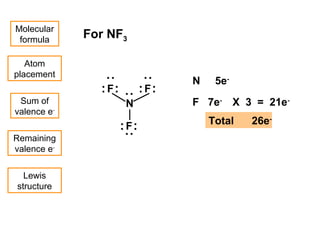
For NF3
N
FF
F
N 5e-
F 7e-
X 3 = 21e-
Total 26e-
:
: :
::
:
:
::
:
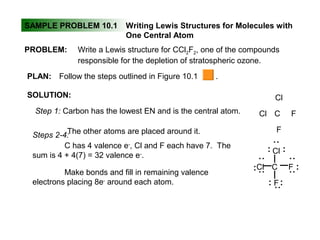
SAMPLE PROBLEM 10.1 Writing Lewis Structures for Molecules with
One Central Atom
SOLUTION:
PROBLEM: Write a Lewis structure for CCl2F2, one of the compounds
responsible for the depletion of stratospheric ozone.
PLAN: Follow the steps outlined in Figure 10.1 .
Step 1: Carbon has the lowest EN and is the central atom.
The other atoms are placed around it.
C
Steps 2-4:
C has 4 valence e-
, Cl and F each have 7. The
sum is 4 + 4(7) = 32 valence e-
.
Cl
Cl F
F
C
Cl
Cl F
F
Make bonds and fill in remaining valence
electrons placing 8e-
around each atom.
:
::
::
:
:
::
: :
:
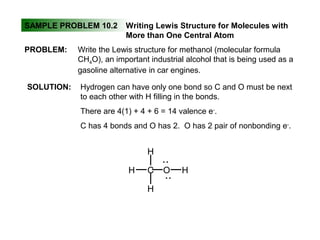
SAMPLE PROBLEM 10.2 Writing Lewis Structure for Molecules with
More than One Central Atom
PROBLEM: Write the Lewis structure for methanol (molecular formula
CH4O), an important industrial alcohol that is being used as a
gasoline alternative in car engines.
SOLUTION: Hydrogen can have only one bond so C and O must be next
to each other with H filling in the bonds.
There are 4(1) + 4 + 6 = 14 valence e-
.
C has 4 bonds and O has 2. O has 2 pair of nonbonding e-
.
C O H
H
H
H
::
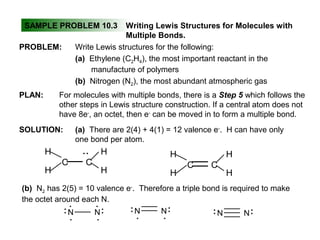
SAMPLE PROBLEM 10.3 Writing Lewis Structures for Molecules with
Multiple Bonds.
PLAN:
SOLUTION:
PROBLEM: Write Lewis structures for the following:
(a) Ethylene (C2H4), the most important reactant in the
manufacture of polymers
(b) Nitrogen (N2), the most abundant atmospheric gas
For molecules with multiple bonds, there is a Step 5 which follows the
other steps in Lewis structure construction. If a central atom does not
have 8e-
, an octet, then e-
can be moved in to form a multiple bond.
(a) There are 2(4) + 4(1) = 12 valence e-
. H can have only
one bond per atom.
CC
H
H H
H
:
CC
H
H H
H
(b) N2 has 2(5) = 10 valence e-
. Therefore a triple bond is required to make
the octet around each N.
N
:
N
:
. .
..
N
:
N
:
. . N
:
N
:
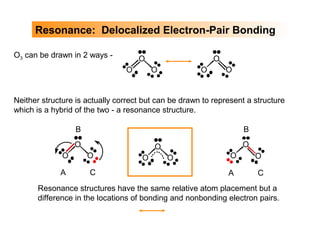
Resonance: Delocalized Electron-Pair Bonding
Resonance structures have the same relative atom placement but a
difference in the locations of bonding and nonbonding electron pairs.
O
O O
A
B
C
O
O O
A
B
C
O3 can be drawn in 2 ways - O
O O
O
O O
Neither structure is actually correct but can be drawn to represent a structure
which is a hybrid of the two - a resonance structure.
O
O O
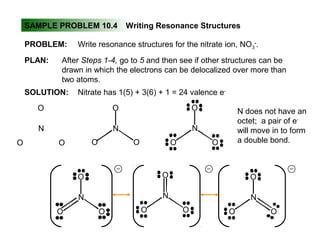
SAMPLE PROBLEM 10.4 Writing Resonance Structures
PLAN:
SOLUTION:
PROBLEM: Write resonance structures for the nitrate ion, NO3
-
.
After Steps 1-4, go to 5 and then see if other structures can be
drawn in which the electrons can be delocalized over more than
two atoms.
Nitrate has 1(5) + 3(6) + 1 = 24 valence e-
N
O
O O
N
O
O O
N
O
O O
N does not have an
octet; a pair of e-
will move in to form
a double bond.
N
O
O O
N
O
O O
N
O
O O
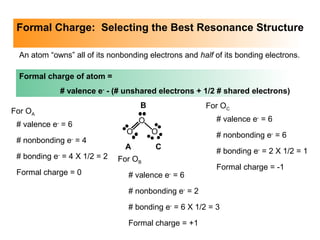
Formal Charge: Selecting the Best Resonance Structure
An atom “owns” all of its nonbonding electrons and half of its bonding electrons.
Formal charge of atom =
# valence e-
- (# unshared electrons + 1/2 # shared electrons)
O
O O
A
B
C
For OA
# valence e-
= 6
# nonbonding e-
= 4
# bonding e-
= 4 X 1/2 = 2
Formal charge = 0
For OB
# valence e-
= 6
# nonbonding e-
= 2
# bonding e-
= 6 X 1/2 = 3
Formal charge = +1
For OC
# valence e-
= 6
# nonbonding e-
= 6
# bonding e-
= 2 X 1/2 = 1
Formal charge = -1
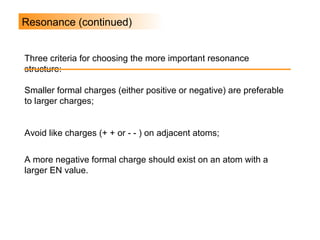
Resonance (continued)
Smaller formal charges (either positive or negative) are preferable
to larger charges;
Avoid like charges (+ + or - - ) on adjacent atoms;
A more negative formal charge should exist on an atom with a
larger EN value.
Three criteria for choosing the more important resonance
structure:
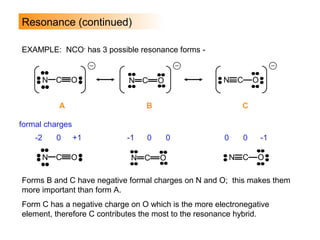
EXAMPLE: NCO-
has 3 possible resonance forms -
Resonance (continued)
N C O
A
N C O
B
N C O
C
N C O N C O N C O
formal charges
-2 0 +1 -1 0 0 0 0 -1
Forms B and C have negative formal charges on N and O; this makes them
more important than form A.
Form C has a negative charge on O which is the more electronegative
element, therefore C contributes the most to the resonance hybrid.
SAMPLE PROBLEM 10.5 Writing Lewis Structures for Exceptions to the
Octet Rule.
PLAN:
SOLUTION:
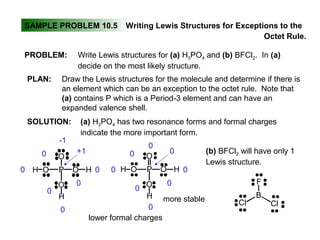
PROBLEM: Write Lewis structures for (a) H3PO4 and (b) BFCl2. In (a)
decide on the most likely structure.
Draw the Lewis structures for the molecule and determine if there is
an element which can be an exception to the octet rule. Note that
(a) contains P which is a Period-3 element and can have an
expanded valence shell.
(a) H3PO4 has two resonance forms and formal charges
indicate the more important form.
O
PO O
O
H
H
H
O
PO O
O
H
H
H
-1
0
0
0
0
0
0
+1
0
0
0
0
0
0
0
0
lower formal charges
more stable
(b) BFCl2 will have only 1
Lewis structure.
F
B
Cl Cl
10.2 Using Lewis Structures and Bond Energies to
Calculate Heats of Reaction
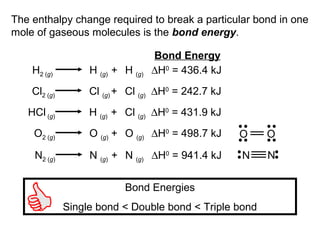
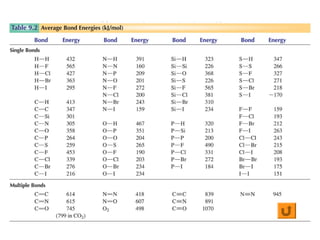
The enthalpy change required to break a particular bond in one
mole of gaseous molecules is the bond energy.
H2 (g) H (g) + H (g) ∆H0
= 436.4 kJ
Cl2 (g) Cl (g) + Cl (g) ∆H0
= 242.7 kJ
HCl (g) H (g) + Cl (g) ∆H0
= 431.9 kJ
O2 (g) O (g) + O (g) ∆H0
= 498.7 kJ O O
N2 (g) N (g) + N (g) ∆H0
= 941.4 kJ N N
Bond Energy
Bond Energies
Single bond < Double bond < Triple bond
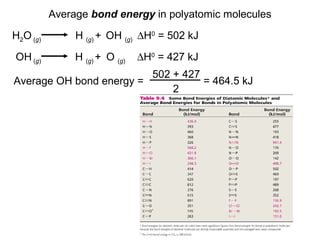
Average bond energy in polyatomic molecules
H2O (g) H (g) + OH (g) ∆H0
= 502 kJ
OH (g) H (g) + O (g) ∆H0
= 427 kJ
Average OH bond energy =
502 + 427
2
= 464.5 kJ
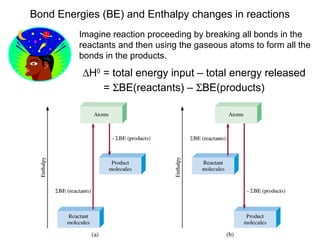
Bond Energies (BE) and Enthalpy changes in reactions
∆H0
= total energy input – total energy released
= ΣBE(reactants) – ΣBE(products)
Imagine reaction proceeding by breaking all bonds in the
reactants and then using the gaseous atoms to form all the
bonds in the products.
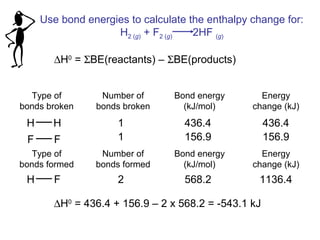
Use bond energies to calculate the enthalpy change for:
H2 (g) + F2 (g) 2HF (g)
∆H0
= ΣBE(reactants) – ΣBE(products)
Type of
bonds broken
Number of
bonds broken
Bond energy
(kJ/mol)
Energy
change (kJ)
H H 1 436.4 436.4
F F 1 156.9 156.9
Type of
bonds formed
Number of
bonds formed
Bond energy
(kJ/mol)
Energy
change (kJ)
H F 2 568.2 1136.4
∆H0
= 436.4 + 156.9 – 2 x 568.2 = -543.1 kJ
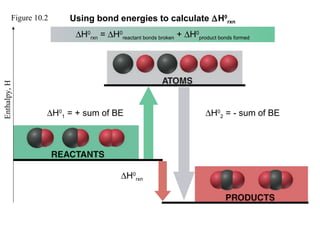
Figure 10.2 Using bond energies to calculate ∆H0
rxn
∆H0
rxn = ∆H0
reactant bonds broken + ∆H0
product bonds formed
∆H0
1 = + sum of BE ∆H0
2 = - sum of BE
∆H0
rxn
Enthalpy,H
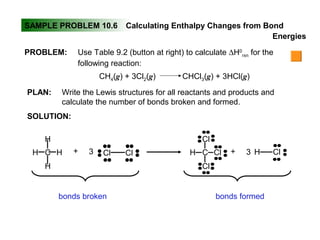
SAMPLE PROBLEM 10.6 Calculating Enthalpy Changes from Bond
Energies
SOLUTION:
PROBLEM: Use Table 9.2 (button at right) to calculate ∆H0
rxn for the
following reaction:
CH4(g) + 3Cl2(g) CHCl3(g) + 3HCl(g)
PLAN: Write the Lewis structures for all reactants and products and
calculate the number of bonds broken and formed.
H
C H
H
H + Cl Cl3
Cl
C Cl
Cl
H + H Cl3
bonds broken bonds formed
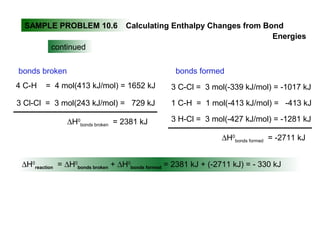
SAMPLE PROBLEM 10.6 Calculating Enthalpy Changes from Bond
Energies
continued
bonds broken bonds formed
4 C-H = 4 mol(413 kJ/mol) = 1652 kJ
3 Cl-Cl = 3 mol(243 kJ/mol) = 729 kJ
∆H0
bonds broken = 2381 kJ
3 C-Cl = 3 mol(-339 kJ/mol) = -1017 kJ
1 C-H = 1 mol(-413 kJ/mol) = -413 kJ
∆H0
bonds formed = -2711 kJ
3 H-Cl = 3 mol(-427 kJ/mol) = -1281 kJ
∆H0
reaction = ∆H0
bonds broken + ∆H0
bonds formed = 2381 kJ + (-2711 kJ) = - 330 kJ
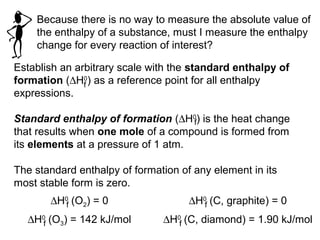
Because there is no way to measure the absolute value of
the enthalpy of a substance, must I measure the enthalpy
change for every reaction of interest?
Establish an arbitrary scale with the standard enthalpy of
formation (∆H0
) as a reference point for all enthalpy
expressions.
f
Standard enthalpy of formation (∆H0
) is the heat change
that results when one mole of a compound is formed from
its elements at a pressure of 1 atm.
f
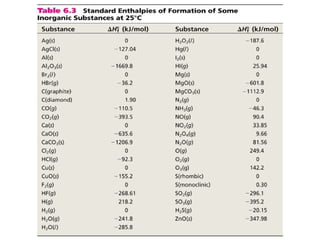
The standard enthalpy of formation of any element in its
most stable form is zero.
∆H0
(O2) = 0f
∆H0
(O3) = 142 kJ/molf
∆H0
(C, graphite) = 0f
∆H0
(C, diamond) = 1.90 kJ/molf
The standard enthalpy of reaction (∆H0
) as the enthalpy of
a reaction carried out at 1 atm.
rxn
aA + bB cC + dD
∆H0
rxn d∆H0
(D)fc∆H0
(C)f= [ + ] - b∆H0
(B)fa∆H0
(A)f[ + ]
∆H0
rxn n∆H0
(products)f= Σ m∆H0
(reactants)fΣ-
Hess’s Law: When reactants are converted to products,
the change in enthalpy is the same whether the reaction
takes place in one step or in a series of steps.
(Enthalpy is a state function. It doesn’t matter how you get
there, only where you start and end.)
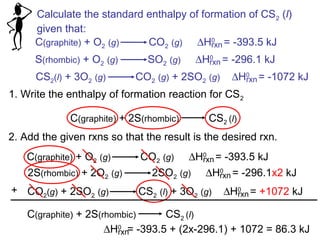
Calculate the standard enthalpy of formation of CS2 (l)
given that:
C(graphite) + O2 (g) CO2 (g) ∆H0
= -393.5 kJrxn
S(rhombic) + O2 (g) SO2 (g) ∆H0
= -296.1 kJrxn
CS2(l) + 3O2 (g) CO2 (g) + 2SO2 (g) ∆H0
= -1072 kJrxn
1. Write the enthalpy of formation reaction for CS2
C(graphite) + 2S(rhombic) CS2 (l)
2. Add the given rxns so that the result is the desired rxn.
rxnC(graphite) + O2 (g) CO2 (g) ∆H0
= -393.5 kJ
2S(rhombic) + 2O2 (g) 2SO2 (g) ∆H0
= -296.1x2 kJrxn
CO2(g) + 2SO2 (g) CS2 (l) + 3O2 (g) ∆H0
= +1072 kJrxn+
C(graphite) + 2S(rhombic) CS2 (l)
∆H0
= -393.5 + (2x-296.1) + 1072 = 86.3 kJrxn
Benzene (C6H6) burns in air to produce carbon dioxide and
liquid water. What is the heat released per mole of
benzene combusted? The standard enthalpy of formation
of benzene is 49.04 kJ/mol.
2C6H6 (l) + 15O2 (g) 12CO2 (g) + 6H2O (l)
∆H0
rxn n∆H0
(products)f= Σ m∆H0
(reactants)fΣ-
∆H0
rxn 6∆H0
(H2O)f12∆H0
(CO2)f= [ + ] - 2∆H0
(C6H6)f[ ]
∆H0
rxn = [ 12x–393.5 + 6x–187.6 ] – [ 2x49.04 ] = -5946 kJ
-5946 kJ
2 mol
= 2973 kJ/mol C6H6
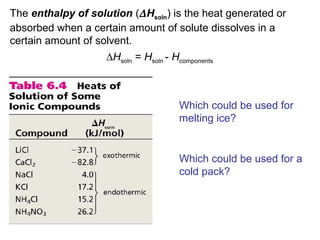
The enthalpy of solution (∆Hsoln) is the heat generated or
absorbed when a certain amount of solute dissolves in a
certain amount of solvent.
∆Hsoln = Hsoln - Hcomponents
Which could be used for
melting ice?
Which could be used for a
cold pack?
Valence shell electron pair repulsion
(VSEPR) model:
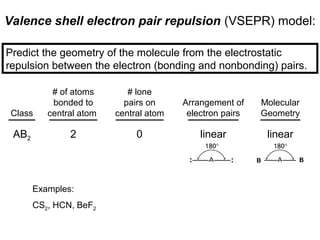
Valence shell electron pair repulsion (VSEPR) model:
Predict the geometry of the molecule from the electrostatic
repulsion between the electron (bonding and nonbonding) pairs.
AB2 2 0
Class
# of atoms
bonded to
central atom
# lone
pairs on
central atom
Arrangement of
electron pairs
Molecular
Geometry
linear linear
B B
Examples:
CS2, HCN, BeF2
Cl ClBe
2 atoms bonded to central atom0 lone pairs on central atom
AB2 2 0 linear linear
Class
# of atoms
bonded to
central atom
# lone
pairs on
central atom
Arrangement of
electron pairs
Molecular
Geometry
VSEPR
AB3 3 0
trigonal
planar
trigonal
planar
Examples:
SO3, BF3, NO3
-
, CO3
2-
10.1
AB2 2 0 linear linear
Class
# of atoms
bonded to
central atom
# lone
pairs on
central atom
Arrangement of
electron pairs
Molecular
Geometry
VSEPR
AB3 3 0
trigonal
planar
trigonal
planar
AB4 4 0 tetrahedral tetrahedral
Examples:
CH4, SiCl4, SO4
2-
, ClO4
-
AB2 2 0 linear linear
Class
# of atoms
bonded to
central atom
# lone
pairs on
central atom
Arrangement of
electron pairs
Molecular
Geometry
VSEPR
AB3 3 0
trigonal
planar
trigonal
planar
AB4 4 0 tetrahedral tetrahedral
AB5 5 0
trigonal
bipyramidal
trigonal
bipyramidal
Examples: PF5
AsF5
SOF4
AB2 2 0 linear linear
Class
# of atoms
bonded to
central atom
# lone
pairs on
central atom
Arrangement of
electron pairs
Molecular
Geometry
VSEPR
AB3 3 0
trigonal
planar
trigonal
planar
AB4 4 0 tetrahedral tetrahedral
AB5 5 0
trigonal
bipyramidal
trigonal
bipyramidal
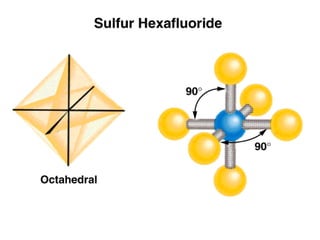
AB6 6 0 octahedraloctahedral
SF6
IOF5
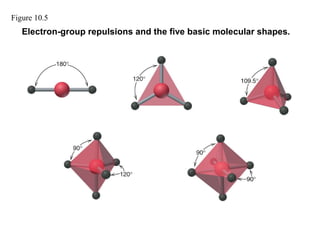
Figure 10.5
Electron-group repulsions and the five basic molecular shapes.
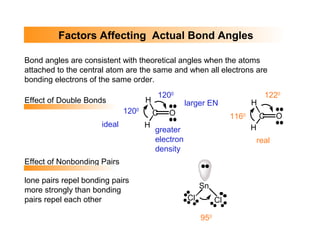
Factors Affecting Actual Bond Angles
Bond angles are consistent with theoretical angles when the atoms
attached to the central atom are the same and when all electrons are
bonding electrons of the same order.
C O
H
Hideal
1200
1200
larger EN
greater
electron
density
C O
H
H
1220
1160
real
lone pairs repel bonding pairs
more strongly than bonding
pairs repel each other
Sn
Cl Cl
950
Effect of Double Bonds
Effect of Nonbonding Pairs
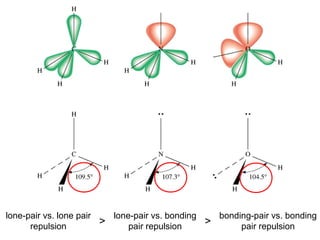
bonding-pair vs. bonding
pair repulsion
lone-pair vs. lone pair
repulsion
lone-pair vs. bonding
pair repulsion
> >
Class
# of atoms
bonded to
central atom
# lone
pairs on
central atom
Arrangement of
electron pairs
Molecular
Geometry
VSEPR
AB3 3 0
trigonal
planar
trigonal
planar
AB2E 2 1
trigonal
planar
bent
Class
# of atoms
bonded to
central atom
# lone
pairs on
central atom
Arrangement of
electron pairs
Molecular
Geometry
VSEPR
AB3E 3 1
AB4 4 0 tetrahedral tetrahedral
tetrahedral
trigonal
pyramidal
NH3
PF3
ClO3
H3O+
Class
# of atoms
bonded to
central atom
# lone
pairs on
central atom
Arrangement of
electron pairs
Molecular
Geometry
VSEPR
AB4 4 0 tetrahedral tetrahedral
AB3E 3 1 tetrahedral
trigonal
pyramidal
AB2E2 2 2 tetrahedral bent
H
O
HH2O
OF2
SCl2
Class
# of atoms
bonded to
central atom
# lone
pairs on
central atom
Arrangement of
electron pairs
Molecular
Geometry
VSEPR
AB5 5 0
trigonal
bipyramidal
trigonal
bipyramidal
AB4E 4 1
trigonal
bipyramidal
distorted
tetrahedron
SF4
XeO2F2
IF4
+
IO2F2
-
Class
# of atoms
bonded to
central atom
# lone
pairs on
central atom
Arrangement of
electron pairs
Molecular
Geometry
VSEPR
AB5 5 0
trigonal
bipyramidal
trigonal
bipyramidal
AB4E 4 1
trigonal
bipyramidal
distorted
tetrahedron
AB3E2 3 2
trigonal
bipyramidal
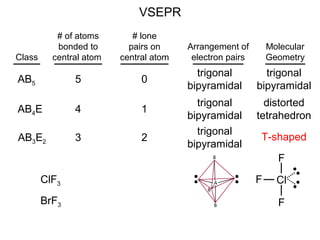
T-shaped
ClF
F
F
ClF3
BrF3
Class
# of atoms
bonded to
central atom
# lone
pairs on
central atom
Arrangement of
electron pairs
Molecular
Geometry
VSEPR
AB5 5 0
trigonal
bipyramidal
trigonal
bipyramidal
AB4E 4 1
trigonal
bipyramidal
distorted
tetrahedron
AB3E2 3 2
trigonal
bipyramidal
T-shaped
AB2E3 2 3
trigonal
bipyramidal
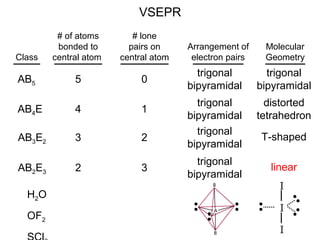
linear
I
I
I
H2O
OF2
Class
# of atoms
bonded to
central atom
# lone
pairs on
central atom
Arrangement of
electron pairs
Molecular
Geometry
VSEPR
AB6 6 0 octahedraloctahedral
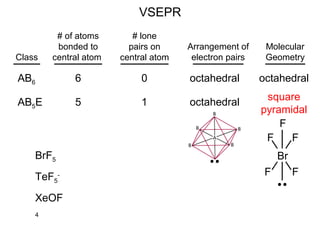
AB5E 5 1 octahedral square
pyramidal
Br
F F
FF
F
BrF5
TeF5
-
XeOF
4
Class
# of atoms
bonded to
central atom
# lone
pairs on
central atom
Arrangement of
electron pairs
Molecular
Geometry
VSEPR
AB6 6 0 octahedraloctahedral
AB5E 5 1 octahedral square
pyramidal
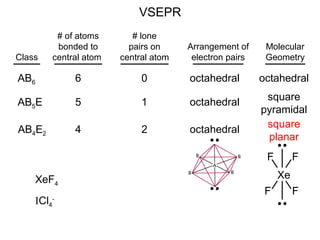
AB4E2 4 2 octahedral
square
planar
Xe
F F
FF
XeF4
ICl4
-
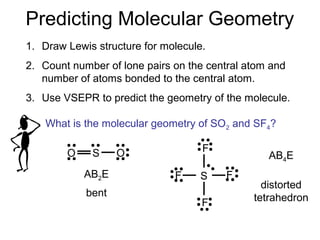
Predicting Molecular Geometry
1. Draw Lewis structure for molecule.
2. Count number of lone pairs on the central atom and
number of atoms bonded to the central atom.
3. Use VSEPR to predict the geometry of the molecule.
What is the molecular geometry of SO2 and SF4?
SO O
AB2E
bent
S
F
F
F F
AB4E
distorted
tetrahedron
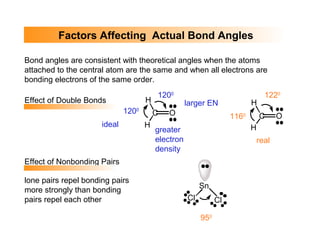
Factors Affecting Actual Bond Angles
Bond angles are consistent with theoretical angles when the atoms
attached to the central atom are the same and when all electrons are
bonding electrons of the same order.
C O
H
Hideal
1200
1200
larger EN
greater
electron
density
C O
H
H
1220
1160
real
lone pairs repel bonding pairs
more strongly than bonding
pairs repel each other
Sn
Cl Cl
950
Effect of Double Bonds
Effect of Nonbonding Pairs
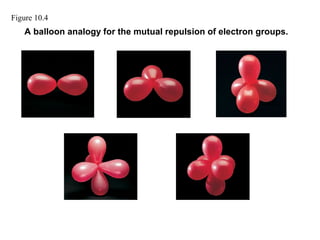
Figure 10.4
A balloon analogy for the mutual repulsion of electron groups.
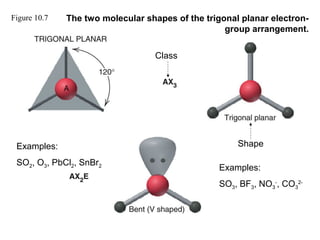
Figure 10.7 The two molecular shapes of the trigonal planar electron-
group arrangement.
Class
Shape
Examples:
SO3, BF3, NO3
-
, CO3
2-
Examples:
SO2, O3, PbCl2, SnBr2
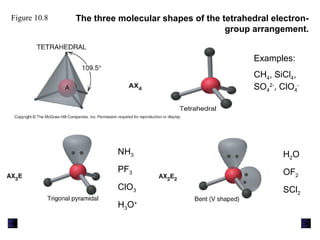
Figure 10.8 The three molecular shapes of the tetrahedral electron-
group arrangement.
Examples:
CH4, SiCl4,
SO4
2-
, ClO4
-
NH3
PF3
ClO3
H3O+
H2O
OF2
SCl2
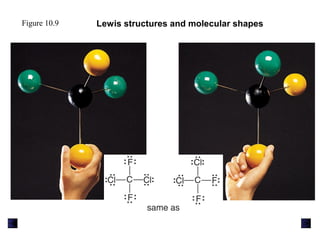
Figure 10.9 Lewis structures and molecular shapes
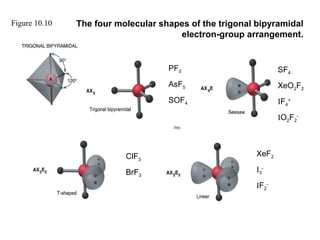
Figure 10.10 The four molecular shapes of the trigonal bipyramidal
electron-group arrangement.
SF4
XeO2F2
IF4
+
IO2F2
-
ClF3
BrF3
XeF2
I3
-
IF2
-
PF5
AsF5
SOF4
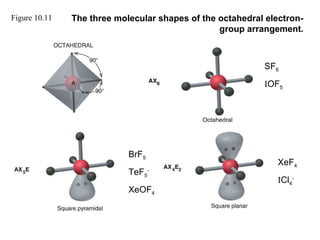
Figure 10.11 The three molecular shapes of the octahedral electron-
group arrangement.
SF6
IOF5
BrF5
TeF5
-
XeOF4
XeF4
ICl4
-
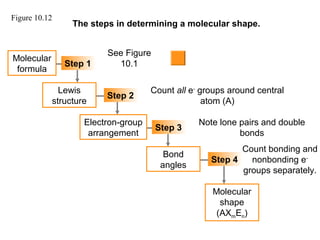
Figure 10.12
The steps in determining a molecular shape.
Molecular
formula
Lewis
structure
Electron-group
arrangement
Bond
angles
Molecular
shape
(AXmEn)
Count all e-
groups around central
atom (A)
Note lone pairs and double
bonds
Count bonding and
nonbonding e-
groups separately.
Step 1
Step 2
Step 3
Step 4
See Figure
10.1
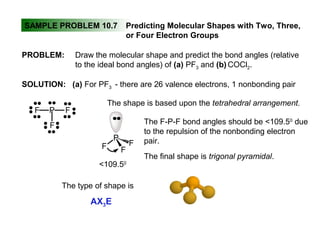
SAMPLE PROBLEM 10.7 Predicting Molecular Shapes with Two, Three,
or Four Electron Groups
PROBLEM: Draw the molecular shape and predict the bond angles (relative
to the ideal bond angles) of (a) PF3 and (b) COCl2.
SOLUTION: (a) For PF3 - there are 26 valence electrons, 1 nonbonding pair
PF F
F
The shape is based upon the tetrahedral arrangement.
The F-P-F bond angles should be <109.50
due
to the repulsion of the nonbonding electron
pair.
The final shape is trigonal pyramidal.
P
F F
F
<109.50
The type of shape is
AX3E
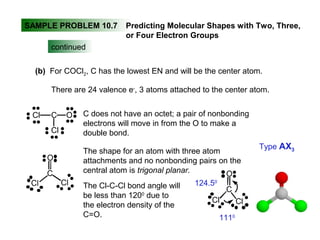
SAMPLE PROBLEM 10.7 Predicting Molecular Shapes with Two, Three,
or Four Electron Groups
continued
(b) For COCl2, C has the lowest EN and will be the center atom.
There are 24 valence e-
, 3 atoms attached to the center atom.
CCl O
Cl
C does not have an octet; a pair of nonbonding
electrons will move in from the O to make a
double bond.
The shape for an atom with three atom
attachments and no nonbonding pairs on the
central atom is trigonal planar.C
Cl
O
Cl The Cl-C-Cl bond angle will
be less than 1200
due to
the electron density of the
C=O.
C
Cl
O
Cl
124.50
1110
Type AX3
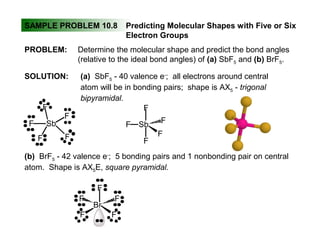
SAMPLE PROBLEM 10.8 Predicting Molecular Shapes with Five or Six
Electron Groups
PROBLEM: Determine the molecular shape and predict the bond angles
(relative to the ideal bond angles) of (a) SbF5 and (b) BrF5.
SOLUTION: (a) SbF5 - 40 valence e-
; all electrons around central
atom will be in bonding pairs; shape is AX5 - trigonal
bipyramidal.
F
SbF
F F
F
F Sb
F
F
F
F
(b) BrF5 - 42 valence e-
; 5 bonding pairs and 1 nonbonding pair on central
atom. Shape is AX5E, square pyramidal.
Br
F
F F
F
F
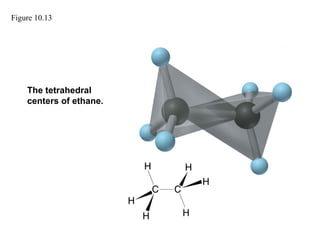
Figure 10.13
The tetrahedral
centers of ethane.
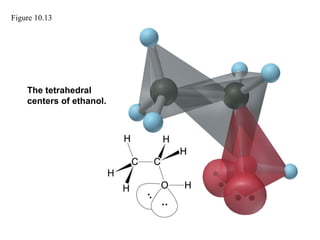
Figure 10.13
The tetrahedral
centers of ethanol.
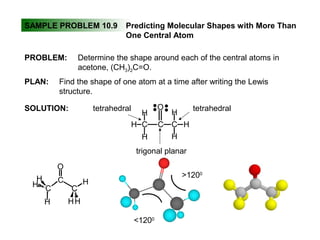
SAMPLE PROBLEM 10.9 Predicting Molecular Shapes with More Than
One Central Atom
SOLUTION:
PROBLEM: Determine the shape around each of the central atoms in
acetone, (CH3)2C=O.
PLAN: Find the shape of one atom at a time after writing the Lewis
structure.
C C C
O
H
H
H
HH
H
tetrahedral tetrahedral
trigonal planar
C
O
H
C
HHH
C
H
H
>1200
<1200
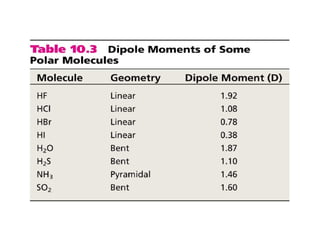
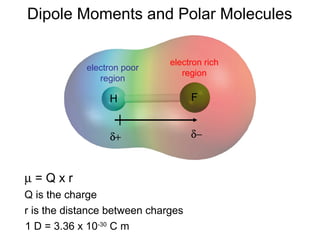
Dipole Moments and Polar Molecules
H F
electron rich
region
electron poor
region
δ+ δ−
µ = Q x r
Q is the charge
r is the distance between charges
1 D = 3.36 x 10⁻³⁰
C m
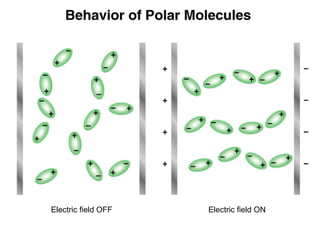
Electric field OFF Electric field ON
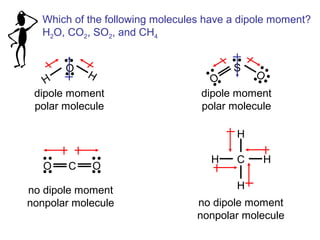
Which of the following molecules have a dipole moment?
H2O, CO2, SO2, and CH4
O
H
H
dipole moment
polar molecule
S
O
O
CO O
no dipole moment
nonpolar molecule
dipole moment
polar molecule
C
H
H
HH
no dipole moment
nonpolar molecule
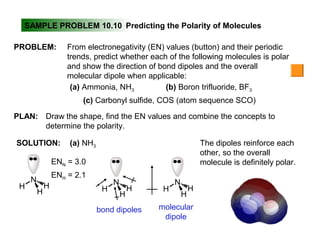
SAMPLE PROBLEM 10.10 Predicting the Polarity of Molecules
(a) Ammonia, NH3 (b) Boron trifluoride, BF3
(c) Carbonyl sulfide, COS (atom sequence SCO)
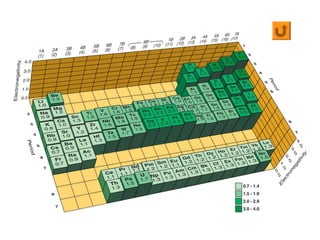
PROBLEM: From electronegativity (EN) values (button) and their periodic
trends, predict whether each of the following molecules is polar
and show the direction of bond dipoles and the overall
molecular dipole when applicable:
PLAN: Draw the shape, find the EN values and combine the concepts to
determine the polarity.
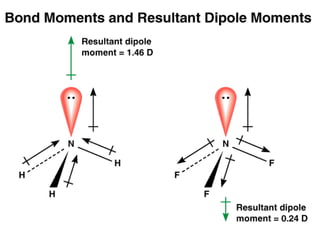
SOLUTION: (a) NH3
N
H
H
H
ENN = 3.0
ENH = 2.1
N
H
H
H
N
H
H
H
bond dipoles molecular
dipole
The dipoles reinforce each
other, so the overall
molecule is definitely polar.
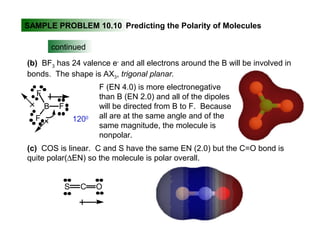
SAMPLE PROBLEM 10.10 Predicting the Polarity of Molecules
continued
(b) BF3 has 24 valence e-
and all electrons around the B will be involved in
bonds. The shape is AX3, trigonal planar.
F
B
F
F
F (EN 4.0) is more electronegative
than B (EN 2.0) and all of the dipoles
will be directed from B to F. Because
all are at the same angle and of the
same magnitude, the molecule is
nonpolar.
1200
(c) COS is linear. C and S have the same EN (2.0) but the C=O bond is
quite polar(∆EN) so the molecule is polar overall.
S C O
The Shapes Of Molecules

The Shapes Of Molecules

  • 1.
  • 2.
    The Shapes ofMolecules 10.1 Depicting Molecules and Ions with Lewis Structures 10.2 Using Lewis Structures and Bond Energies to Calculate Heats of Reaction 10.3 Valence-Shell Electron-Pair Repulsion (VSEPR) Theory and Molecular Shape 10.4 Molecular Shape and Molecular Polarity
  • 3.
    Figure 10.1 The stepsin converting a molecular formula into a Lewis structure. Molecular formula Atom placement Sum of valence e- Remaining valence e- Lewis structure Place atom with lowest EN in center Add A-group numbers Draw single bonds. Subtract 2e- for each bond. Give each atom 8e- (2e- for H) Step 1 Step 2 Step 3 Step 4
  • 4.
    Molecular formula Atom placement Sum of valence e- Remaining valencee- Lewis structure For NF3 N FF F N 5e- F 7e- X 3 = 21e- Total 26e- : : : :: : : :: :
  • 5.
    SAMPLE PROBLEM 10.1Writing Lewis Structures for Molecules with One Central Atom SOLUTION: PROBLEM: Write a Lewis structure for CCl2F2, one of the compounds responsible for the depletion of stratospheric ozone. PLAN: Follow the steps outlined in Figure 10.1 . Step 1: Carbon has the lowest EN and is the central atom. The other atoms are placed around it. C Steps 2-4: C has 4 valence e- , Cl and F each have 7. The sum is 4 + 4(7) = 32 valence e- . Cl Cl F F C Cl Cl F F Make bonds and fill in remaining valence electrons placing 8e- around each atom. : :: :: : : :: : : :
  • 6.
    SAMPLE PROBLEM 10.2Writing Lewis Structure for Molecules with More than One Central Atom PROBLEM: Write the Lewis structure for methanol (molecular formula CH4O), an important industrial alcohol that is being used as a gasoline alternative in car engines. SOLUTION: Hydrogen can have only one bond so C and O must be next to each other with H filling in the bonds. There are 4(1) + 4 + 6 = 14 valence e- . C has 4 bonds and O has 2. O has 2 pair of nonbonding e- . C O H H H H ::
  • 7.
    SAMPLE PROBLEM 10.3Writing Lewis Structures for Molecules with Multiple Bonds. PLAN: SOLUTION: PROBLEM: Write Lewis structures for the following: (a) Ethylene (C2H4), the most important reactant in the manufacture of polymers (b) Nitrogen (N2), the most abundant atmospheric gas For molecules with multiple bonds, there is a Step 5 which follows the other steps in Lewis structure construction. If a central atom does not have 8e- , an octet, then e- can be moved in to form a multiple bond. (a) There are 2(4) + 4(1) = 12 valence e- . H can have only one bond per atom. CC H H H H : CC H H H H (b) N2 has 2(5) = 10 valence e- . Therefore a triple bond is required to make the octet around each N. N : N : . . .. N : N : . . N : N :
  • 8.
    Resonance: Delocalized Electron-PairBonding Resonance structures have the same relative atom placement but a difference in the locations of bonding and nonbonding electron pairs. O O O A B C O O O A B C O3 can be drawn in 2 ways - O O O O O O Neither structure is actually correct but can be drawn to represent a structure which is a hybrid of the two - a resonance structure. O O O
  • 9.
    SAMPLE PROBLEM 10.4Writing Resonance Structures PLAN: SOLUTION: PROBLEM: Write resonance structures for the nitrate ion, NO3 - . After Steps 1-4, go to 5 and then see if other structures can be drawn in which the electrons can be delocalized over more than two atoms. Nitrate has 1(5) + 3(6) + 1 = 24 valence e- N O O O N O O O N O O O N does not have an octet; a pair of e- will move in to form a double bond. N O O O N O O O N O O O
  • 10.
    Formal Charge: Selectingthe Best Resonance Structure An atom “owns” all of its nonbonding electrons and half of its bonding electrons. Formal charge of atom = # valence e- - (# unshared electrons + 1/2 # shared electrons) O O O A B C For OA # valence e- = 6 # nonbonding e- = 4 # bonding e- = 4 X 1/2 = 2 Formal charge = 0 For OB # valence e- = 6 # nonbonding e- = 2 # bonding e- = 6 X 1/2 = 3 Formal charge = +1 For OC # valence e- = 6 # nonbonding e- = 6 # bonding e- = 2 X 1/2 = 1 Formal charge = -1
  • 11.
    Resonance (continued) Smaller formalcharges (either positive or negative) are preferable to larger charges; Avoid like charges (+ + or - - ) on adjacent atoms; A more negative formal charge should exist on an atom with a larger EN value. Three criteria for choosing the more important resonance structure:
  • 12.
    EXAMPLE: NCO- has 3possible resonance forms - Resonance (continued) N C O A N C O B N C O C N C O N C O N C O formal charges -2 0 +1 -1 0 0 0 0 -1 Forms B and C have negative formal charges on N and O; this makes them more important than form A. Form C has a negative charge on O which is the more electronegative element, therefore C contributes the most to the resonance hybrid.
  • 13.
    SAMPLE PROBLEM 10.5Writing Lewis Structures for Exceptions to the Octet Rule. PLAN: SOLUTION: PROBLEM: Write Lewis structures for (a) H3PO4 and (b) BFCl2. In (a) decide on the most likely structure. Draw the Lewis structures for the molecule and determine if there is an element which can be an exception to the octet rule. Note that (a) contains P which is a Period-3 element and can have an expanded valence shell. (a) H3PO4 has two resonance forms and formal charges indicate the more important form. O PO O O H H H O PO O O H H H -1 0 0 0 0 0 0 +1 0 0 0 0 0 0 0 0 lower formal charges more stable (b) BFCl2 will have only 1 Lewis structure. F B Cl Cl
  • 14.
    10.2 Using LewisStructures and Bond Energies to Calculate Heats of Reaction
  • 15.
    The enthalpy changerequired to break a particular bond in one mole of gaseous molecules is the bond energy. H2 (g) H (g) + H (g) ∆H0 = 436.4 kJ Cl2 (g) Cl (g) + Cl (g) ∆H0 = 242.7 kJ HCl (g) H (g) + Cl (g) ∆H0 = 431.9 kJ O2 (g) O (g) + O (g) ∆H0 = 498.7 kJ O O N2 (g) N (g) + N (g) ∆H0 = 941.4 kJ N N Bond Energy Bond Energies Single bond < Double bond < Triple bond
  • 16.
    Average bond energyin polyatomic molecules H2O (g) H (g) + OH (g) ∆H0 = 502 kJ OH (g) H (g) + O (g) ∆H0 = 427 kJ Average OH bond energy = 502 + 427 2 = 464.5 kJ
  • 17.
    Bond Energies (BE)and Enthalpy changes in reactions ∆H0 = total energy input – total energy released = ΣBE(reactants) – ΣBE(products) Imagine reaction proceeding by breaking all bonds in the reactants and then using the gaseous atoms to form all the bonds in the products.
  • 18.
    Use bond energiesto calculate the enthalpy change for: H2 (g) + F2 (g) 2HF (g) ∆H0 = ΣBE(reactants) – ΣBE(products) Type of bonds broken Number of bonds broken Bond energy (kJ/mol) Energy change (kJ) H H 1 436.4 436.4 F F 1 156.9 156.9 Type of bonds formed Number of bonds formed Bond energy (kJ/mol) Energy change (kJ) H F 2 568.2 1136.4 ∆H0 = 436.4 + 156.9 – 2 x 568.2 = -543.1 kJ
  • 19.
    Figure 10.2 Usingbond energies to calculate ∆H0 rxn ∆H0 rxn = ∆H0 reactant bonds broken + ∆H0 product bonds formed ∆H0 1 = + sum of BE ∆H0 2 = - sum of BE ∆H0 rxn Enthalpy,H
  • 20.
    SAMPLE PROBLEM 10.6Calculating Enthalpy Changes from Bond Energies SOLUTION: PROBLEM: Use Table 9.2 (button at right) to calculate ∆H0 rxn for the following reaction: CH4(g) + 3Cl2(g) CHCl3(g) + 3HCl(g) PLAN: Write the Lewis structures for all reactants and products and calculate the number of bonds broken and formed. H C H H H + Cl Cl3 Cl C Cl Cl H + H Cl3 bonds broken bonds formed
  • 21.
    SAMPLE PROBLEM 10.6Calculating Enthalpy Changes from Bond Energies continued bonds broken bonds formed 4 C-H = 4 mol(413 kJ/mol) = 1652 kJ 3 Cl-Cl = 3 mol(243 kJ/mol) = 729 kJ ∆H0 bonds broken = 2381 kJ 3 C-Cl = 3 mol(-339 kJ/mol) = -1017 kJ 1 C-H = 1 mol(-413 kJ/mol) = -413 kJ ∆H0 bonds formed = -2711 kJ 3 H-Cl = 3 mol(-427 kJ/mol) = -1281 kJ ∆H0 reaction = ∆H0 bonds broken + ∆H0 bonds formed = 2381 kJ + (-2711 kJ) = - 330 kJ
  • 22.
    Because there isno way to measure the absolute value of the enthalpy of a substance, must I measure the enthalpy change for every reaction of interest? Establish an arbitrary scale with the standard enthalpy of formation (∆H0 ) as a reference point for all enthalpy expressions. f Standard enthalpy of formation (∆H0 ) is the heat change that results when one mole of a compound is formed from its elements at a pressure of 1 atm. f The standard enthalpy of formation of any element in its most stable form is zero. ∆H0 (O2) = 0f ∆H0 (O3) = 142 kJ/molf ∆H0 (C, graphite) = 0f ∆H0 (C, diamond) = 1.90 kJ/molf
  • 24.
    The standard enthalpyof reaction (∆H0 ) as the enthalpy of a reaction carried out at 1 atm. rxn aA + bB cC + dD ∆H0 rxn d∆H0 (D)fc∆H0 (C)f= [ + ] - b∆H0 (B)fa∆H0 (A)f[ + ] ∆H0 rxn n∆H0 (products)f= Σ m∆H0 (reactants)fΣ- Hess’s Law: When reactants are converted to products, the change in enthalpy is the same whether the reaction takes place in one step or in a series of steps. (Enthalpy is a state function. It doesn’t matter how you get there, only where you start and end.)
  • 25.
    Calculate the standardenthalpy of formation of CS2 (l) given that: C(graphite) + O2 (g) CO2 (g) ∆H0 = -393.5 kJrxn S(rhombic) + O2 (g) SO2 (g) ∆H0 = -296.1 kJrxn CS2(l) + 3O2 (g) CO2 (g) + 2SO2 (g) ∆H0 = -1072 kJrxn 1. Write the enthalpy of formation reaction for CS2 C(graphite) + 2S(rhombic) CS2 (l) 2. Add the given rxns so that the result is the desired rxn. rxnC(graphite) + O2 (g) CO2 (g) ∆H0 = -393.5 kJ 2S(rhombic) + 2O2 (g) 2SO2 (g) ∆H0 = -296.1x2 kJrxn CO2(g) + 2SO2 (g) CS2 (l) + 3O2 (g) ∆H0 = +1072 kJrxn+ C(graphite) + 2S(rhombic) CS2 (l) ∆H0 = -393.5 + (2x-296.1) + 1072 = 86.3 kJrxn
  • 26.
    Benzene (C6H6) burnsin air to produce carbon dioxide and liquid water. What is the heat released per mole of benzene combusted? The standard enthalpy of formation of benzene is 49.04 kJ/mol. 2C6H6 (l) + 15O2 (g) 12CO2 (g) + 6H2O (l) ∆H0 rxn n∆H0 (products)f= Σ m∆H0 (reactants)fΣ- ∆H0 rxn 6∆H0 (H2O)f12∆H0 (CO2)f= [ + ] - 2∆H0 (C6H6)f[ ] ∆H0 rxn = [ 12x–393.5 + 6x–187.6 ] – [ 2x49.04 ] = -5946 kJ -5946 kJ 2 mol = 2973 kJ/mol C6H6
  • 27.
    The enthalpy ofsolution (∆Hsoln) is the heat generated or absorbed when a certain amount of solute dissolves in a certain amount of solvent. ∆Hsoln = Hsoln - Hcomponents Which could be used for melting ice? Which could be used for a cold pack?
  • 28.
    Valence shell electronpair repulsion (VSEPR) model:
  • 29.
    Valence shell electronpair repulsion (VSEPR) model: Predict the geometry of the molecule from the electrostatic repulsion between the electron (bonding and nonbonding) pairs. AB2 2 0 Class # of atoms bonded to central atom # lone pairs on central atom Arrangement of electron pairs Molecular Geometry linear linear B B Examples: CS2, HCN, BeF2
  • 30.
    Cl ClBe 2 atomsbonded to central atom0 lone pairs on central atom
  • 31.
    AB2 2 0linear linear Class # of atoms bonded to central atom # lone pairs on central atom Arrangement of electron pairs Molecular Geometry VSEPR AB3 3 0 trigonal planar trigonal planar Examples: SO3, BF3, NO3 - , CO3 2-
  • 32.
  • 33.
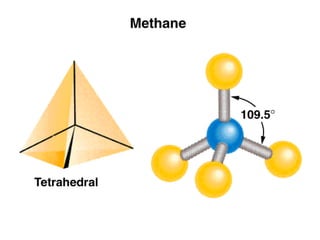
    AB2 2 0linear linear Class # of atoms bonded to central atom # lone pairs on central atom Arrangement of electron pairs Molecular Geometry VSEPR AB3 3 0 trigonal planar trigonal planar AB4 4 0 tetrahedral tetrahedral Examples: CH4, SiCl4, SO4 2- , ClO4 -
  • 35.
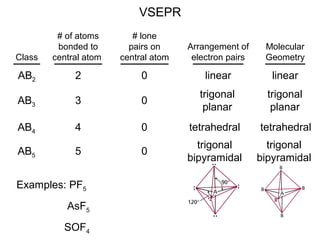
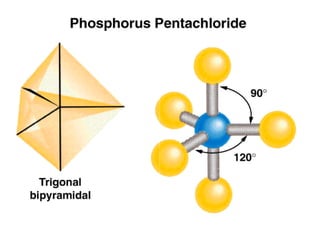
    AB2 2 0linear linear Class # of atoms bonded to central atom # lone pairs on central atom Arrangement of electron pairs Molecular Geometry VSEPR AB3 3 0 trigonal planar trigonal planar AB4 4 0 tetrahedral tetrahedral AB5 5 0 trigonal bipyramidal trigonal bipyramidal Examples: PF5 AsF5 SOF4
  • 37.
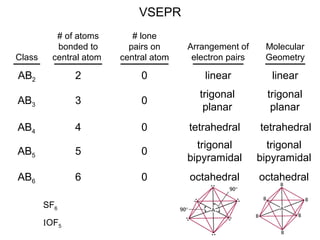
    AB2 2 0linear linear Class # of atoms bonded to central atom # lone pairs on central atom Arrangement of electron pairs Molecular Geometry VSEPR AB3 3 0 trigonal planar trigonal planar AB4 4 0 tetrahedral tetrahedral AB5 5 0 trigonal bipyramidal trigonal bipyramidal AB6 6 0 octahedraloctahedral SF6 IOF5
  • 39.
    Figure 10.5 Electron-group repulsionsand the five basic molecular shapes.
  • 40.
    Factors Affecting ActualBond Angles Bond angles are consistent with theoretical angles when the atoms attached to the central atom are the same and when all electrons are bonding electrons of the same order. C O H Hideal 1200 1200 larger EN greater electron density C O H H 1220 1160 real lone pairs repel bonding pairs more strongly than bonding pairs repel each other Sn Cl Cl 950 Effect of Double Bonds Effect of Nonbonding Pairs
  • 41.
    bonding-pair vs. bonding pairrepulsion lone-pair vs. lone pair repulsion lone-pair vs. bonding pair repulsion > >
  • 42.
    Class # of atoms bondedto central atom # lone pairs on central atom Arrangement of electron pairs Molecular Geometry VSEPR AB3 3 0 trigonal planar trigonal planar AB2E 2 1 trigonal planar bent
  • 43.
    Class # of atoms bondedto central atom # lone pairs on central atom Arrangement of electron pairs Molecular Geometry VSEPR AB3E 3 1 AB4 4 0 tetrahedral tetrahedral tetrahedral trigonal pyramidal NH3 PF3 ClO3 H3O+
  • 44.
    Class # of atoms bondedto central atom # lone pairs on central atom Arrangement of electron pairs Molecular Geometry VSEPR AB4 4 0 tetrahedral tetrahedral AB3E 3 1 tetrahedral trigonal pyramidal AB2E2 2 2 tetrahedral bent H O HH2O OF2 SCl2
  • 45.
    Class # of atoms bondedto central atom # lone pairs on central atom Arrangement of electron pairs Molecular Geometry VSEPR AB5 5 0 trigonal bipyramidal trigonal bipyramidal AB4E 4 1 trigonal bipyramidal distorted tetrahedron SF4 XeO2F2 IF4 + IO2F2 -
  • 46.
    Class # of atoms bondedto central atom # lone pairs on central atom Arrangement of electron pairs Molecular Geometry VSEPR AB5 5 0 trigonal bipyramidal trigonal bipyramidal AB4E 4 1 trigonal bipyramidal distorted tetrahedron AB3E2 3 2 trigonal bipyramidal T-shaped ClF F F ClF3 BrF3
  • 47.
    Class # of atoms bondedto central atom # lone pairs on central atom Arrangement of electron pairs Molecular Geometry VSEPR AB5 5 0 trigonal bipyramidal trigonal bipyramidal AB4E 4 1 trigonal bipyramidal distorted tetrahedron AB3E2 3 2 trigonal bipyramidal T-shaped AB2E3 2 3 trigonal bipyramidal linear I I I H2O OF2
  • 48.
    Class # of atoms bondedto central atom # lone pairs on central atom Arrangement of electron pairs Molecular Geometry VSEPR AB6 6 0 octahedraloctahedral AB5E 5 1 octahedral square pyramidal Br F F FF F BrF5 TeF5 - XeOF 4
  • 49.
    Class # of atoms bondedto central atom # lone pairs on central atom Arrangement of electron pairs Molecular Geometry VSEPR AB6 6 0 octahedraloctahedral AB5E 5 1 octahedral square pyramidal AB4E2 4 2 octahedral square planar Xe F F FF XeF4 ICl4 -
  • 50.
    Predicting Molecular Geometry 1.Draw Lewis structure for molecule. 2. Count number of lone pairs on the central atom and number of atoms bonded to the central atom. 3. Use VSEPR to predict the geometry of the molecule. What is the molecular geometry of SO2 and SF4? SO O AB2E bent S F F F F AB4E distorted tetrahedron
  • 51.
    Factors Affecting ActualBond Angles Bond angles are consistent with theoretical angles when the atoms attached to the central atom are the same and when all electrons are bonding electrons of the same order. C O H Hideal 1200 1200 larger EN greater electron density C O H H 1220 1160 real lone pairs repel bonding pairs more strongly than bonding pairs repel each other Sn Cl Cl 950 Effect of Double Bonds Effect of Nonbonding Pairs
  • 52.
    Figure 10.4 A balloonanalogy for the mutual repulsion of electron groups.
  • 53.
    Figure 10.7 Thetwo molecular shapes of the trigonal planar electron- group arrangement. Class Shape Examples: SO3, BF3, NO3 - , CO3 2- Examples: SO2, O3, PbCl2, SnBr2
  • 54.
    Figure 10.8 Thethree molecular shapes of the tetrahedral electron- group arrangement. Examples: CH4, SiCl4, SO4 2- , ClO4 - NH3 PF3 ClO3 H3O+ H2O OF2 SCl2
  • 55.
    Figure 10.9 Lewisstructures and molecular shapes
  • 56.
    Figure 10.10 Thefour molecular shapes of the trigonal bipyramidal electron-group arrangement. SF4 XeO2F2 IF4 + IO2F2 - ClF3 BrF3 XeF2 I3 - IF2 - PF5 AsF5 SOF4
  • 57.
    Figure 10.11 Thethree molecular shapes of the octahedral electron- group arrangement. SF6 IOF5 BrF5 TeF5 - XeOF4 XeF4 ICl4 -
  • 58.
    Figure 10.12 The stepsin determining a molecular shape. Molecular formula Lewis structure Electron-group arrangement Bond angles Molecular shape (AXmEn) Count all e- groups around central atom (A) Note lone pairs and double bonds Count bonding and nonbonding e- groups separately. Step 1 Step 2 Step 3 Step 4 See Figure 10.1
  • 59.
    SAMPLE PROBLEM 10.7Predicting Molecular Shapes with Two, Three, or Four Electron Groups PROBLEM: Draw the molecular shape and predict the bond angles (relative to the ideal bond angles) of (a) PF3 and (b) COCl2. SOLUTION: (a) For PF3 - there are 26 valence electrons, 1 nonbonding pair PF F F The shape is based upon the tetrahedral arrangement. The F-P-F bond angles should be <109.50 due to the repulsion of the nonbonding electron pair. The final shape is trigonal pyramidal. P F F F <109.50 The type of shape is AX3E
  • 60.
    SAMPLE PROBLEM 10.7Predicting Molecular Shapes with Two, Three, or Four Electron Groups continued (b) For COCl2, C has the lowest EN and will be the center atom. There are 24 valence e- , 3 atoms attached to the center atom. CCl O Cl C does not have an octet; a pair of nonbonding electrons will move in from the O to make a double bond. The shape for an atom with three atom attachments and no nonbonding pairs on the central atom is trigonal planar.C Cl O Cl The Cl-C-Cl bond angle will be less than 1200 due to the electron density of the C=O. C Cl O Cl 124.50 1110 Type AX3
  • 61.
    SAMPLE PROBLEM 10.8Predicting Molecular Shapes with Five or Six Electron Groups PROBLEM: Determine the molecular shape and predict the bond angles (relative to the ideal bond angles) of (a) SbF5 and (b) BrF5. SOLUTION: (a) SbF5 - 40 valence e- ; all electrons around central atom will be in bonding pairs; shape is AX5 - trigonal bipyramidal. F SbF F F F F Sb F F F F (b) BrF5 - 42 valence e- ; 5 bonding pairs and 1 nonbonding pair on central atom. Shape is AX5E, square pyramidal. Br F F F F F
  • 62.
  • 63.
  • 64.
    SAMPLE PROBLEM 10.9Predicting Molecular Shapes with More Than One Central Atom SOLUTION: PROBLEM: Determine the shape around each of the central atoms in acetone, (CH3)2C=O. PLAN: Find the shape of one atom at a time after writing the Lewis structure. C C C O H H H HH H tetrahedral tetrahedral trigonal planar C O H C HHH C H H >1200 <1200
  • 65.
    Dipole Moments andPolar Molecules H F electron rich region electron poor region δ+ δ− µ = Q x r Q is the charge r is the distance between charges 1 D = 3.36 x 10⁻³⁰ C m
  • 66.
    Electric field OFFElectric field ON
  • 68.
    Which of thefollowing molecules have a dipole moment? H2O, CO2, SO2, and CH4 O H H dipole moment polar molecule S O O CO O no dipole moment nonpolar molecule dipole moment polar molecule C H H HH no dipole moment nonpolar molecule
  • 70.
    SAMPLE PROBLEM 10.10Predicting the Polarity of Molecules (a) Ammonia, NH3 (b) Boron trifluoride, BF3 (c) Carbonyl sulfide, COS (atom sequence SCO) PROBLEM: From electronegativity (EN) values (button) and their periodic trends, predict whether each of the following molecules is polar and show the direction of bond dipoles and the overall molecular dipole when applicable: PLAN: Draw the shape, find the EN values and combine the concepts to determine the polarity. SOLUTION: (a) NH3 N H H H ENN = 3.0 ENH = 2.1 N H H H N H H H bond dipoles molecular dipole The dipoles reinforce each other, so the overall molecule is definitely polar.
  • 71.
    SAMPLE PROBLEM 10.10Predicting the Polarity of Molecules continued (b) BF3 has 24 valence e- and all electrons around the B will be involved in bonds. The shape is AX3, trigonal planar. F B F F F (EN 4.0) is more electronegative than B (EN 2.0) and all of the dipoles will be directed from B to F. Because all are at the same angle and of the same magnitude, the molecule is nonpolar. 1200 (c) COS is linear. C and S have the same EN (2.0) but the C=O bond is quite polar(∆EN) so the molecule is polar overall. S C O