UNIT 4
MODULE 3:
HEAT, WORK AND
ENERGY
1
JANET BRIGIDA A. CATIPON
MHS Teacher, MAE-Chemistry
OBJECTIVES
2
1. Define Thermodynamics and Internal
Energy
2. Explain the 1st law of thermodynamics.
3. Demonstrate that heat can be turned
into work.
4. Predict the convention signs of heat and
work in a system.
5. Calculate the change in internal energy
within a system.
WHATIS THIS?
3
LET’S PLAYAGAME
“FOUR PICS– ONE WORD”
4
HEAT (Q)
5
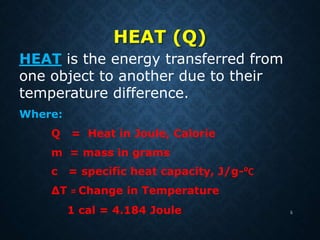
HEAT is the energy transferred from
one object to another due to their
temperature difference.
Where:
Q = Heat in Joule, Calorie
m = mass in grams
c = specific heat capacity, J/g-⁰C
∆T = Change in Temperature
1 cal = 4.184 Joule
6
WORK (W)
7
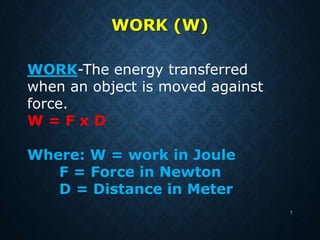
WORK-The energy transferred
when an object is moved against
force.
W = F x D
Where: W = work in Joule
F = Force in Newton
D = Distance in Meter
8
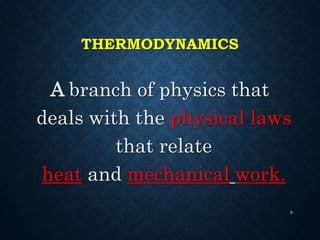
THERMODYNAMICS
A branch of physics that
deals with the physical laws
that relate
heat and mechanical work.
9
FIRST LAW OF THERMODYNAMICS
CONSERVATION OF ENERGY
HEAT AND WORK
SYSTEM-SURROUNDINGS
INTERNAL ENERGY
10
FIRST LAW OF THERMODYNAMICS
Conservation of Energy
• states that the total energy of an isolated system is
constant; energy can be transformed from one form to
another, but cannot be created or destroyed.
• The 1st law of Thermodynamics provides a
generalization of this Law Of Conservation Of Energy
in terms of the relationship among the heat transferred
to a system.
11
SYSTEM-SURROUNDINGS
DIAGRAM
12
SYSTEM
SURROUNDINGS
BOUNDARY
W < 0
(-)
W >0
(+)
Q > 0
(+)
Q < 0
(-)
UNIVERS
E
TERMS ON THE SUR-SYS
DIAGRAM
• Universe – the observable, physical world.
• System – the limited, defined part of the universe
• Boundary - the edge of a thermodynamic system
across which heat, mass, or work can flow.
• Surroundings – all parts of the universe not included
in the defined system.
13
ENERGY TRANSFER
(HEAT & WORK)
• Open system –allows matter and energy
to enter or/and leave the system
• Closed system–is a system wherein in no
matter enters or leaves the system. It only
interacts with its surroundings in terms of
energy transfers.
• Isolated system – is a system where
neither matter nor energy enters or leaves
the system.
14
INTERNAL ENERGY (U)
15
 It refers to energy contained
within the system.
 The internal energy of a system
can be changed by (1) heating the
system, or (2) by doing work on it,
or (3) by adding or taking away
matter.
16
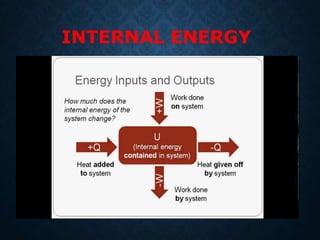
INTERNAL ENERGY
REMEMBER   !!!
• Q > 0 (+) heat transfer to the
system
• Q < 0 (-) heat transfer from the
system
• W < 0 (-) is work done on the
system
• W > 0 (+) is work done by the
system
17
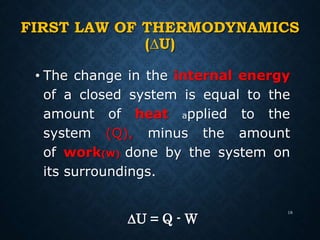
FIRST LAW OF THERMODYNAMICS
(∆U)
• The change in the internal energy
of a closed system is equal to the
amount of heat applied to the
system (Q), minus the amount
of work(W) done by the system on
its surroundings.
∆U = Q - W
18
EXAMPLE
19
UNITS OF HEAT & WORK
• Joule or KiloJoule
• Calorie or Kilocalorie
• BTU
20
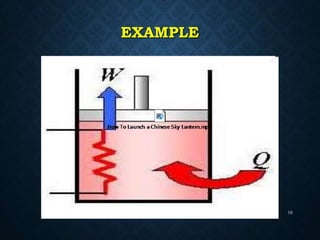
EXPLANATION TO THE GIVEN
EXAMPLE
• Heat (Q) is added to the system, therefore the system absorbs heat
causing expansion within the system. (Q is positive)
• Work (W) it expands while it is being heated. (W is negative)
• ∆U, the change in Internal Energy, if the heat added is 30kJ, and
the Work done by the system is 15kJ, therefore, ∆U is 45kJ.
21
APPLICATION OF THE1ST LAW OF
THERMODYNAMICS
22
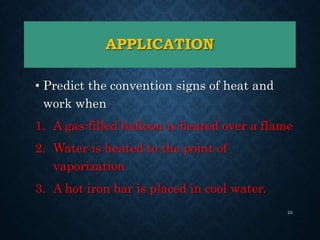
APPLICATION
• Predict the convention signs of heat and
work when
1. A gas-filled balloon is heated over a flame
2. Water is heated to the point of
vaporization
3. A hot iron bar is placed in cool water.
23
ANSWER
1. Heat is positive and work is
negative.
2. Heat is positive and work is
negative.
3. Heat is negative and the work is
positive.
24
APPLICATION
• Added heat of 51 kJ, Work of 15 kJ
done by the system
• Added heat of 100 kJ, Work of 65 kJ
done by the system
• Released heat of 65 kJ, Work of 20
kJ done by the system
25
Calculate ∆U for each of the following
cases:
ANSWER
•∆U = +36 kJ
•∆U = +35 KJ
•∆U = -85 KJ
26
SUMMARIZE IT...!!!
• What is Heat, Work and Thermodynamics?
• What is the 1st Law of Thermodynamics?
Explain it.
• How can you determine the sign of heat and
work if they are done by or on the system?
• How to compute for the Internal Energy of a
system?
27
EVALUATION
A. Prediction of Convention Signs (2pts each)
• A system undergoes a process consisting of the
following two steps:
Step 1: The system absorbs 73 J of heat while 35 J
of work is done on it.
Step 2: The system absorbs 35 J of heat while
performing 72 J of work.
28
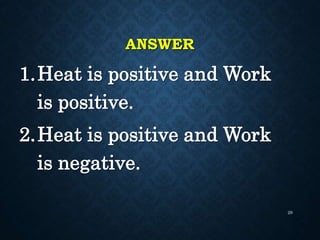
ANSWER
1.Heat is positive and Work
is positive.
2.Heat is positive and Work
is negative.
29
EVALUATION
B. Problem Solving
• A system releases 125 kJ of heat while 104 kJ of
work is done on the system. Calculate the change in
internal energy (in kJ). (2pts)
• Calculate w for a system that absorbs 260 kJ of
heat and for which ∆U= 157 kJ. Is the work done on
or by the system? Does the system expand or
contract? (4pts)
30
ANSWER
1. ∆U = -21kJ
2. W = 103 kJ,
work done on
the system
31
DO NOT FORGET...
• Prepare the following materials for
tomorrow’s activity.
1. Water
2. Beaker
3. Tripod
4. Burner/alcohol lamp
5. Match
• Read about Thermodynamic Engines
32
WORDS TO LIVE BY….
Being busy does not always mean real work.
The object of all work is production or
accomplishment and to either of these ends
there must be forethought, system, planning,
intelligence, and honest purpose, as well as
perspiration. Seeming to do is not doing…
33

Heat and work

  • 1.
    UNIT 4 MODULE 3: HEAT,WORK AND ENERGY 1 JANET BRIGIDA A. CATIPON MHS Teacher, MAE-Chemistry
  • 2.
    OBJECTIVES 2 1. Define Thermodynamicsand Internal Energy 2. Explain the 1st law of thermodynamics. 3. Demonstrate that heat can be turned into work. 4. Predict the convention signs of heat and work in a system. 5. Calculate the change in internal energy within a system.
  • 3.
  • 4.
  • 5.
    HEAT (Q) 5 HEAT isthe energy transferred from one object to another due to their temperature difference. Where: Q = Heat in Joule, Calorie m = mass in grams c = specific heat capacity, J/g-⁰C ∆T = Change in Temperature 1 cal = 4.184 Joule
  • 6.
  • 7.
    WORK (W) 7 WORK-The energytransferred when an object is moved against force. W = F x D Where: W = work in Joule F = Force in Newton D = Distance in Meter
  • 8.
  • 9.
    THERMODYNAMICS A branch ofphysics that deals with the physical laws that relate heat and mechanical work. 9
  • 10.
    FIRST LAW OFTHERMODYNAMICS CONSERVATION OF ENERGY HEAT AND WORK SYSTEM-SURROUNDINGS INTERNAL ENERGY 10
  • 11.
    FIRST LAW OFTHERMODYNAMICS Conservation of Energy • states that the total energy of an isolated system is constant; energy can be transformed from one form to another, but cannot be created or destroyed. • The 1st law of Thermodynamics provides a generalization of this Law Of Conservation Of Energy in terms of the relationship among the heat transferred to a system. 11
  • 12.
  • 13.
    TERMS ON THESUR-SYS DIAGRAM • Universe – the observable, physical world. • System – the limited, defined part of the universe • Boundary - the edge of a thermodynamic system across which heat, mass, or work can flow. • Surroundings – all parts of the universe not included in the defined system. 13
  • 14.
    ENERGY TRANSFER (HEAT &WORK) • Open system –allows matter and energy to enter or/and leave the system • Closed system–is a system wherein in no matter enters or leaves the system. It only interacts with its surroundings in terms of energy transfers. • Isolated system – is a system where neither matter nor energy enters or leaves the system. 14
  • 15.
    INTERNAL ENERGY (U) 15 It refers to energy contained within the system.  The internal energy of a system can be changed by (1) heating the system, or (2) by doing work on it, or (3) by adding or taking away matter.
  • 16.
  • 17.
    REMEMBER  !!! • Q > 0 (+) heat transfer to the system • Q < 0 (-) heat transfer from the system • W < 0 (-) is work done on the system • W > 0 (+) is work done by the system 17
  • 18.
    FIRST LAW OFTHERMODYNAMICS (∆U) • The change in the internal energy of a closed system is equal to the amount of heat applied to the system (Q), minus the amount of work(W) done by the system on its surroundings. ∆U = Q - W 18
  • 19.
  • 20.
    UNITS OF HEAT& WORK • Joule or KiloJoule • Calorie or Kilocalorie • BTU 20
  • 21.
    EXPLANATION TO THEGIVEN EXAMPLE • Heat (Q) is added to the system, therefore the system absorbs heat causing expansion within the system. (Q is positive) • Work (W) it expands while it is being heated. (W is negative) • ∆U, the change in Internal Energy, if the heat added is 30kJ, and the Work done by the system is 15kJ, therefore, ∆U is 45kJ. 21
  • 22.
    APPLICATION OF THE1STLAW OF THERMODYNAMICS 22
  • 23.
    APPLICATION • Predict theconvention signs of heat and work when 1. A gas-filled balloon is heated over a flame 2. Water is heated to the point of vaporization 3. A hot iron bar is placed in cool water. 23
  • 24.
    ANSWER 1. Heat ispositive and work is negative. 2. Heat is positive and work is negative. 3. Heat is negative and the work is positive. 24
  • 25.
    APPLICATION • Added heatof 51 kJ, Work of 15 kJ done by the system • Added heat of 100 kJ, Work of 65 kJ done by the system • Released heat of 65 kJ, Work of 20 kJ done by the system 25 Calculate ∆U for each of the following cases:
  • 26.
    ANSWER •∆U = +36kJ •∆U = +35 KJ •∆U = -85 KJ 26
  • 27.
    SUMMARIZE IT...!!! • Whatis Heat, Work and Thermodynamics? • What is the 1st Law of Thermodynamics? Explain it. • How can you determine the sign of heat and work if they are done by or on the system? • How to compute for the Internal Energy of a system? 27
  • 28.
    EVALUATION A. Prediction ofConvention Signs (2pts each) • A system undergoes a process consisting of the following two steps: Step 1: The system absorbs 73 J of heat while 35 J of work is done on it. Step 2: The system absorbs 35 J of heat while performing 72 J of work. 28
  • 29.
    ANSWER 1.Heat is positiveand Work is positive. 2.Heat is positive and Work is negative. 29
  • 30.
    EVALUATION B. Problem Solving •A system releases 125 kJ of heat while 104 kJ of work is done on the system. Calculate the change in internal energy (in kJ). (2pts) • Calculate w for a system that absorbs 260 kJ of heat and for which ∆U= 157 kJ. Is the work done on or by the system? Does the system expand or contract? (4pts) 30
  • 31.
    ANSWER 1. ∆U =-21kJ 2. W = 103 kJ, work done on the system 31
  • 32.
    DO NOT FORGET... •Prepare the following materials for tomorrow’s activity. 1. Water 2. Beaker 3. Tripod 4. Burner/alcohol lamp 5. Match • Read about Thermodynamic Engines 32
  • 33.
    WORDS TO LIVEBY…. Being busy does not always mean real work. The object of all work is production or accomplishment and to either of these ends there must be forethought, system, planning, intelligence, and honest purpose, as well as perspiration. Seeming to do is not doing… 33