ALLPPT.com _ Free PowerPoint Templates, Diagrams and Charts
BUILDING MATERIALS
& CONSTRUCTIONS
POORNIMA COLLEGE OF ENGINEERING, JAIPUR
DEPARTMENT OF CIVIL ENGINEERING
Temporary structures
DIVYA VISHNOI
ASSISTANT PROFESSOR
What are temporaryworks?
O Temporary works (TW) are the parts of a construction
project that are needed to enable the permanent work
s to be
built. Usually the TW are removed after
use.
O EX- Scaffolding
Shoring
Underpinning
What is Scaffolding?
 Scaffolding, also called staging, is a temporary
structure used to support people and material in the
Construction or repair of building and other structures.
O Types ofscaffolding
I. Single scaffolding
II. Double scaffolding
III. Needle scaffolding
IV. Trestle scaffolding
V. Suspended scaffolding
VI. Steel scaffolding
VII. Patented scaffolding
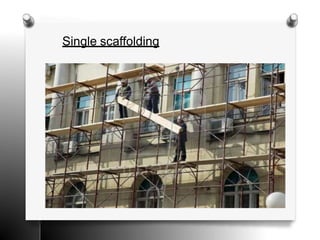
Single scaffolding
 This is the most common type of scaffolding
and is widely use in the construction of brick
work..
 It consist of a single row of standards placed at a
distance of about 1.20m from the wall.
 Standard are placed at 2 to 2.5 m interval.
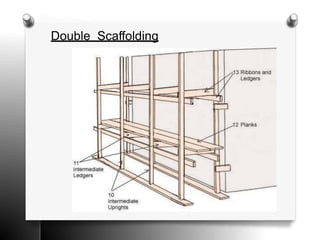
Double Scaffolding
 This scaffolding is stronger than the single
scaffolding.
 It is used in the construction of stonework.
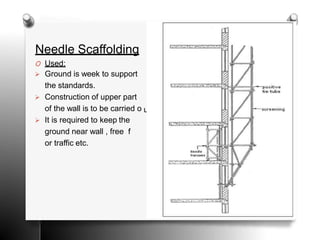
Needle Scaffolding
ut.
O Used:
 Ground is week to support
the standards.
 Construction of upper part
of the wall is to be carried o
 It is required to keep the
ground near wall , free f
or traffic etc.
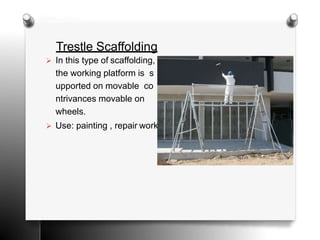
Trestle Scaffolding
 In this type of scaffolding,
the working platform is s
upported on movable co
ntrivances movable on
wheels.
 Use: painting , repair work
What is Shoring?
 Shoring is the construction of a temporary
structure to support temporarily an unsafe
structure.
Types of Shoring
 Raking Shores
 Flying Shores
 Dead Shores
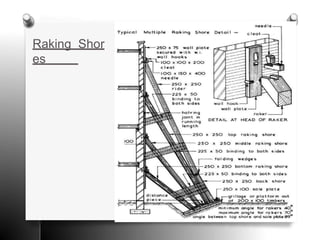
Raking Shor
es
 This is a system of giving temporary
support to an unsafe wall.
 The construction of raking shore, varies
with the condition at site.
 In this method In this method inclined
members called rakers are used to give
lateral support to the wall.
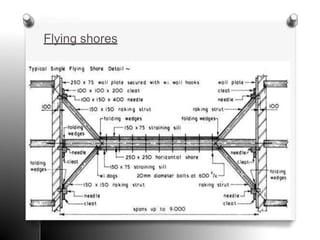
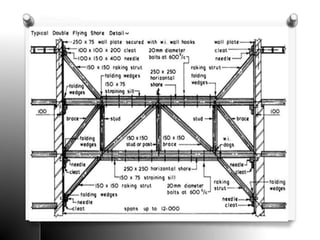
Flying shores
 In this type of shoring horizontal supports are pr
ovided for supporting temporarily the parallel wal
ls of the two adjacent buildings which may tend t
o collapse or damage.
 If the walls are quite near to each other (up to
9m) single flying shore can be constructed.
 When the distance between two parallel walls is
more than 9m a double shore can be constructed
.
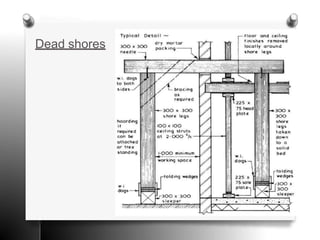
Dead shores
Such type of shoring is provided for the
following purposes:
 Rebuild the defective lower part of the
wall.
 Rebuild the existing foundation.
 To make large opening in the existing wall.
Underpinning
The term underpinning is applied to the construction of a
new foundation underneath the existing one for strengthening
purposes.
Types ofunderpinning
Pit Method
Pile Method
Miscellaneous Method
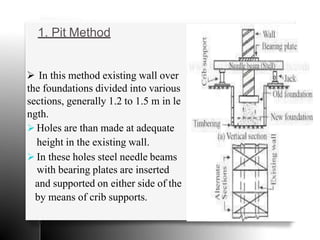
1. Pit Method
 In this method existing wall over
the foundations divided into various
sections, generally 1.2 to 1.5 m in le
ngth.
 Holes are than made at adequate
height in the existing wall.
 In these holes steel needle beams
with bearing plates are inserted
and supported on either side of the
by means of crib supports.
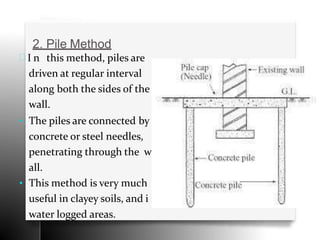
2. Pile Method
n
 I n this method, piles are
driven at regular interval
along both the sides of the
wall.
• The piles are connected by
concrete or steel needles,
penetrating through the w
all.
• This method is very much
useful in clayey soils, and i
water logged areas.
3. Miscellaneous method
1) Cement grouting
2) Chemical consolidation
3) Freezing
4) Vibroflotation
References
1) “Building Construction” authored by S.C. Rangwala, Char
otar publishing house Pvt. Ltd.
2) “Building Construction” authored by Bindra and Arora, Dh
anpat Rai publication.
3) “Building Construction” authored by M.L. Gambhir, Tata
Meghraw Hills publication.
Temporary structures

Temporary structures

  • 1.
    ALLPPT.com _ FreePowerPoint Templates, Diagrams and Charts BUILDING MATERIALS & CONSTRUCTIONS POORNIMA COLLEGE OF ENGINEERING, JAIPUR DEPARTMENT OF CIVIL ENGINEERING Temporary structures DIVYA VISHNOI ASSISTANT PROFESSOR
  • 2.
    What are temporaryworks? OTemporary works (TW) are the parts of a construction project that are needed to enable the permanent work s to be built. Usually the TW are removed after use. O EX- Scaffolding Shoring Underpinning
  • 3.
    What is Scaffolding? Scaffolding, also called staging, is a temporary structure used to support people and material in the Construction or repair of building and other structures.
  • 4.
    O Types ofscaffolding I.Single scaffolding II. Double scaffolding III. Needle scaffolding IV. Trestle scaffolding V. Suspended scaffolding VI. Steel scaffolding VII. Patented scaffolding
  • 5.
  • 6.
     This isthe most common type of scaffolding and is widely use in the construction of brick work..  It consist of a single row of standards placed at a distance of about 1.20m from the wall.  Standard are placed at 2 to 2.5 m interval.
  • 7.
  • 8.
     This scaffoldingis stronger than the single scaffolding.  It is used in the construction of stonework.
  • 9.
    Needle Scaffolding ut. O Used: Ground is week to support the standards.  Construction of upper part of the wall is to be carried o  It is required to keep the ground near wall , free f or traffic etc.
  • 10.
    Trestle Scaffolding  Inthis type of scaffolding, the working platform is s upported on movable co ntrivances movable on wheels.  Use: painting , repair work
  • 11.
    What is Shoring? Shoring is the construction of a temporary structure to support temporarily an unsafe structure. Types of Shoring  Raking Shores  Flying Shores  Dead Shores
  • 12.
  • 13.
     This isa system of giving temporary support to an unsafe wall.  The construction of raking shore, varies with the condition at site.  In this method In this method inclined members called rakers are used to give lateral support to the wall.
  • 14.
  • 16.
     In thistype of shoring horizontal supports are pr ovided for supporting temporarily the parallel wal ls of the two adjacent buildings which may tend t o collapse or damage.  If the walls are quite near to each other (up to 9m) single flying shore can be constructed.  When the distance between two parallel walls is more than 9m a double shore can be constructed .
  • 17.
  • 18.
    Such type ofshoring is provided for the following purposes:  Rebuild the defective lower part of the wall.  Rebuild the existing foundation.  To make large opening in the existing wall.
  • 19.
    Underpinning The term underpinningis applied to the construction of a new foundation underneath the existing one for strengthening purposes. Types ofunderpinning Pit Method Pile Method Miscellaneous Method
  • 20.
    1. Pit Method In this method existing wall over the foundations divided into various sections, generally 1.2 to 1.5 m in le ngth.  Holes are than made at adequate height in the existing wall.  In these holes steel needle beams with bearing plates are inserted and supported on either side of the by means of crib supports.
  • 21.
    2. Pile Method n I n this method, piles are driven at regular interval along both the sides of the wall. • The piles are connected by concrete or steel needles, penetrating through the w all. • This method is very much useful in clayey soils, and i water logged areas.
  • 22.
    3. Miscellaneous method 1)Cement grouting 2) Chemical consolidation 3) Freezing 4) Vibroflotation
  • 23.
    References 1) “Building Construction”authored by S.C. Rangwala, Char otar publishing house Pvt. Ltd. 2) “Building Construction” authored by Bindra and Arora, Dh anpat Rai publication. 3) “Building Construction” authored by M.L. Gambhir, Tata Meghraw Hills publication.