PARTITION WALLS
Building Materials & Construction
Civil Engineering Department
S.V.N.I.T,Surat.
IntroductionIntroduction
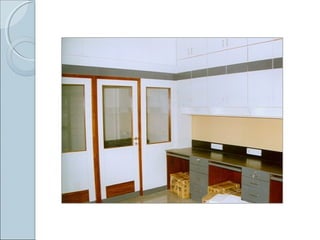
A partition wall may be defined as a wall or
division made up of bricks, studding, glass or
other such material and provided for the
purpose of dividing one room or portion of a
room from another.
Partition walls are designed as non-load
bearing walls. It may be of folding,
collapsible or fixed type.
If partition walls are load bearing then they
are called as ‘internal wall’.
Advantages of partition walls
Divide the whole area into a number of
rooms.
Provide privacy to the inmates from sight
and sound.
Are light in weight and cheaper in cost of
construction.
Occupy lesser area
Easily constructed in any position.
Requirements of a Good Partition Wall:Requirements of a Good Partition Wall:
Thin in cross-section so that maximum floor area can
be utilized.
Provide adequate privacy in rooms both in respect of
sight and sound.
Constructed from light, sound, uniform,
homogeneous, durable and sound insulated materials.
Simple in nature, easy and economical in
construction having proper coherence with the type
of building structure.
Offer sufficient resistance against fire, heat,
dampness, white ant or fungus, etc.
Rigid enough to take the vibrations caused due to
loads.
Strong enough to support sanitary fittings and heavy
fixtures.
Types of partition walls:Types of partition walls:
Brick partitions,
Hollow block partitions,
Clay block partitions,
Concrete partitions,
Glass block partitions,
Wooden partitions,
Straw board partitions,
Plaster slab partitions,
Metal partitions,
Asbestos cement partitions, and
Double glazed window.
Brick partitionBrick partition
Constructed with plain bricks, Reinforced
bricks, bricks-nogged or hollow bricks.
Plain brick partition of half brick thickness is
not more than 2m in height.
In reinforced brick partition of half brick
thickness, reinforcement in the form of wire
mesh or hoop iron or steel bars is provided.
Brick nogging partition wall consists of
brickwork built up within a framework of
wooden members.
Brick partition is fire-resistant and sound-
proof.
Hollow Block and Clay Block PartitionsHollow Block and Clay Block Partitions
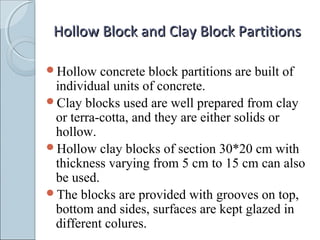
Hollow concrete block partitions are built of
individual units of concrete.
Clay blocks used are well prepared from clay
or terra-cotta, and they are either solids or
hollow.
Hollow clay blocks of section 30*20 cm with
thickness varying from 5 cm to 15 cm can also
be used.
The blocks are provided with grooves on top,
bottom and sides, surfaces are kept glazed in
different colures.
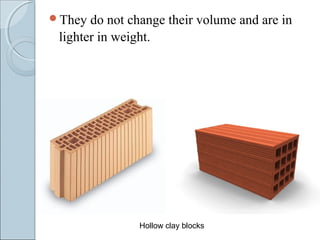
They do not change their volume and are in
lighter in weight.
Hollow clay blocks
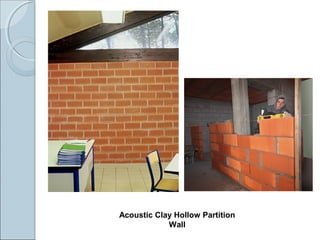
Acoustic Clay Hollow Partition
Wall
Concrete partitionConcrete partition
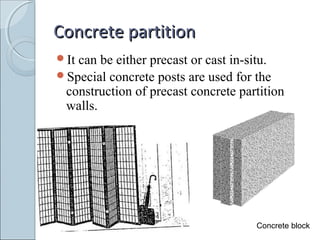
It can be either precast or cast in-situ.
Special concrete posts are used for the
construction of precast concrete partition
walls.
Concrete block
Glass partitionGlass partition
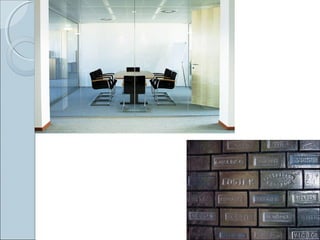
Are made from sheet glass or hollow glass
blocks.
Provides good aesthetics and allow light
Are damp, sound and heat proof.
Easy to clean and maintain.
Sheets of glass are fixed in the frame work of
wooden or metal.
Hollow blocks doesn’t need timber
framework.
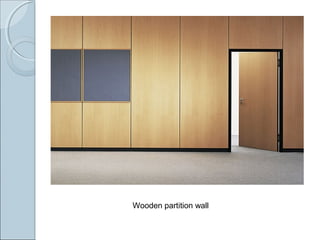
Wooden partitionWooden partition
Lighter in weight and easy to construct.
Neither sound-proof nor fire-proof.
Not suitable for damp locations.
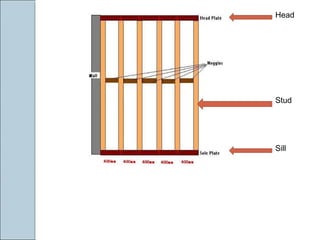
Head
Sill
Stud
Wooden partition wall
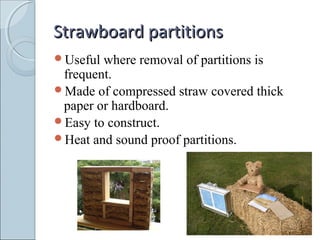
Strawboard partitionsStrawboard partitions
Useful where removal of partitions is
frequent.
Made of compressed straw covered thick
paper or hardboard.
Easy to construct.
Heat and sound proof partitions.
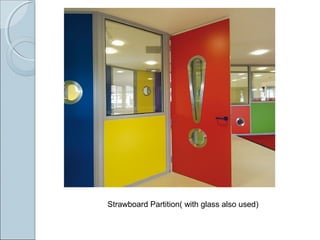
Strawboard Partition( with glass also used)
Plaster slab partitionsPlaster slab partitions
Are made of burnt gypsum or plaster of paris
mixed with sawdust.
5cm to 10cm thick slabs are prepared in iron
or timber moulds.
To form rigid joints suitable grooves are
provided in the plaster slabs.
Nails and screws can be easily driven into
these slabs.
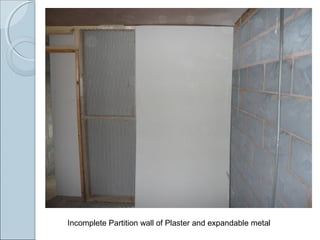
Incomplete Partition wall of Plaster and expandable metal
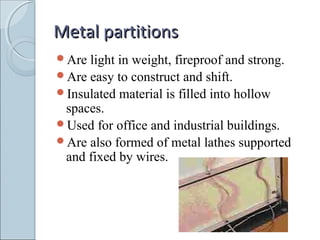
Metal partitionsMetal partitions
Are light in weight, fireproof and strong.
Are easy to construct and shift.
Insulated material is filled into hollow
spaces.
Used for office and industrial buildings.
Are also formed of metal lathes supported
and fixed by wires.
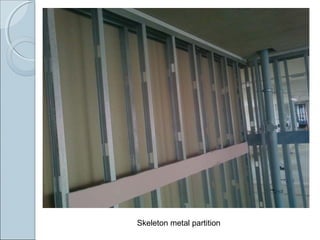
Skeleton metal partition
Asbestos Cement partitionsAsbestos Cement partitions
Light in weight, impervious, durable, water
tight and fire-proof.
Asbestos cement sheets are made of asbestos
cement sheets and fixed into timber
framework.
Sheets are placed in position and joined by
cement mortar.
Are mostly adopted in works of temporary
character.
Double Glazed windowDouble Glazed window
Used for acoustic insulation.
Air space between two panes is kept 50mm
or more.
Air contained within narrow cavity is quite
‘stiff’
Transmits vibration at low frequencies.
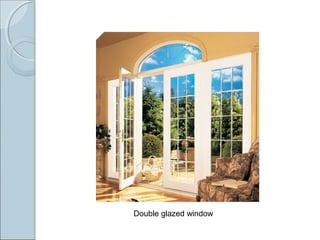
Double glazed window
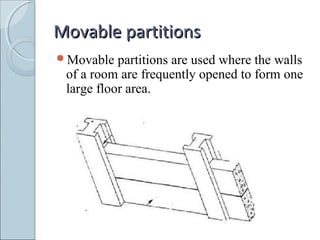
Movable partitionsMovable partitions
Movable partitions are used where the walls
of a room are frequently opened to form one
large floor area.
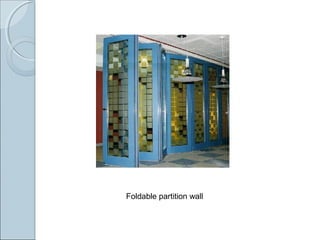
Foldable partition wall
Portable PartitionsPortable Partitions
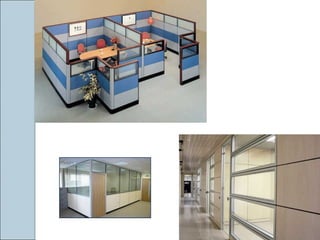
Rolling mobile folding partitions which
provide temporary walls
The portable wall partition has two full panel
end members which provide support,
rigidity, privacy, and noise reduction.
They fold and are on wheels enabling
mobility and ease of storage.
Three common uses are:Three common uses are:
To divide space quickly where non-mobile
permanent room dividers may be unavailable
or unpractical.
As a cost effective way to create a classroom
or meeting room in existing space.
Convenient sight divider to conceal door
openings to restrooms, commercial kitchens,
and other backroom areas.
Portable Partitions are commonly used in:Portable Partitions are commonly used in:
Arena’s
Churches/Houses of Worship/Funeral Homes
Conference/Convention Centres
Government/Corporate offices
Hotels/Restaurants
Residences
Salons and Spas
Schools of all levels
References:References:
Dr B.C.Punamia, Building Construction
S.P.Arora and S.P.Bindra, Building
Construction
Robert Jantschek, Portable wall partition with
full panel end members.
www.niceduniya.com,Principles of design of
partitions walls.
Images are taken from google image search

Partition walls

  • 1.
    PARTITION WALLS Building Materials& Construction Civil Engineering Department S.V.N.I.T,Surat.
  • 2.
    IntroductionIntroduction A partition wallmay be defined as a wall or division made up of bricks, studding, glass or other such material and provided for the purpose of dividing one room or portion of a room from another. Partition walls are designed as non-load bearing walls. It may be of folding, collapsible or fixed type. If partition walls are load bearing then they are called as ‘internal wall’.
  • 4.
    Advantages of partitionwalls Divide the whole area into a number of rooms. Provide privacy to the inmates from sight and sound. Are light in weight and cheaper in cost of construction. Occupy lesser area Easily constructed in any position.
  • 5.
    Requirements of aGood Partition Wall:Requirements of a Good Partition Wall: Thin in cross-section so that maximum floor area can be utilized. Provide adequate privacy in rooms both in respect of sight and sound. Constructed from light, sound, uniform, homogeneous, durable and sound insulated materials. Simple in nature, easy and economical in construction having proper coherence with the type of building structure. Offer sufficient resistance against fire, heat, dampness, white ant or fungus, etc. Rigid enough to take the vibrations caused due to loads. Strong enough to support sanitary fittings and heavy fixtures.
  • 6.
    Types of partitionwalls:Types of partition walls: Brick partitions, Hollow block partitions, Clay block partitions, Concrete partitions, Glass block partitions, Wooden partitions, Straw board partitions, Plaster slab partitions, Metal partitions, Asbestos cement partitions, and Double glazed window.
  • 7.
    Brick partitionBrick partition Constructedwith plain bricks, Reinforced bricks, bricks-nogged or hollow bricks. Plain brick partition of half brick thickness is not more than 2m in height. In reinforced brick partition of half brick thickness, reinforcement in the form of wire mesh or hoop iron or steel bars is provided.
  • 8.
    Brick nogging partitionwall consists of brickwork built up within a framework of wooden members. Brick partition is fire-resistant and sound- proof.
  • 9.
    Hollow Block andClay Block PartitionsHollow Block and Clay Block Partitions Hollow concrete block partitions are built of individual units of concrete. Clay blocks used are well prepared from clay or terra-cotta, and they are either solids or hollow. Hollow clay blocks of section 30*20 cm with thickness varying from 5 cm to 15 cm can also be used. The blocks are provided with grooves on top, bottom and sides, surfaces are kept glazed in different colures.
  • 10.
    They do notchange their volume and are in lighter in weight. Hollow clay blocks
  • 11.
    Acoustic Clay HollowPartition Wall
  • 12.
    Concrete partitionConcrete partition Itcan be either precast or cast in-situ. Special concrete posts are used for the construction of precast concrete partition walls. Concrete block
  • 13.
    Glass partitionGlass partition Aremade from sheet glass or hollow glass blocks. Provides good aesthetics and allow light Are damp, sound and heat proof. Easy to clean and maintain. Sheets of glass are fixed in the frame work of wooden or metal. Hollow blocks doesn’t need timber framework.
  • 15.
    Wooden partitionWooden partition Lighterin weight and easy to construct. Neither sound-proof nor fire-proof. Not suitable for damp locations.
  • 16.
  • 17.
  • 18.
    Strawboard partitionsStrawboard partitions Usefulwhere removal of partitions is frequent. Made of compressed straw covered thick paper or hardboard. Easy to construct. Heat and sound proof partitions.
  • 19.
  • 20.
    Plaster slab partitionsPlasterslab partitions Are made of burnt gypsum or plaster of paris mixed with sawdust. 5cm to 10cm thick slabs are prepared in iron or timber moulds. To form rigid joints suitable grooves are provided in the plaster slabs. Nails and screws can be easily driven into these slabs.
  • 21.
    Incomplete Partition wallof Plaster and expandable metal
  • 22.
    Metal partitionsMetal partitions Arelight in weight, fireproof and strong. Are easy to construct and shift. Insulated material is filled into hollow spaces. Used for office and industrial buildings. Are also formed of metal lathes supported and fixed by wires.
  • 23.
  • 24.
    Asbestos Cement partitionsAsbestosCement partitions Light in weight, impervious, durable, water tight and fire-proof. Asbestos cement sheets are made of asbestos cement sheets and fixed into timber framework. Sheets are placed in position and joined by cement mortar. Are mostly adopted in works of temporary character.
  • 25.
    Double Glazed windowDoubleGlazed window Used for acoustic insulation. Air space between two panes is kept 50mm or more. Air contained within narrow cavity is quite ‘stiff’ Transmits vibration at low frequencies.
  • 26.
  • 27.
    Movable partitionsMovable partitions Movablepartitions are used where the walls of a room are frequently opened to form one large floor area.
  • 29.
  • 30.
    Portable PartitionsPortable Partitions Rollingmobile folding partitions which provide temporary walls The portable wall partition has two full panel end members which provide support, rigidity, privacy, and noise reduction. They fold and are on wheels enabling mobility and ease of storage.
  • 31.
    Three common usesare:Three common uses are: To divide space quickly where non-mobile permanent room dividers may be unavailable or unpractical. As a cost effective way to create a classroom or meeting room in existing space. Convenient sight divider to conceal door openings to restrooms, commercial kitchens, and other backroom areas.
  • 32.
    Portable Partitions arecommonly used in:Portable Partitions are commonly used in: Arena’s Churches/Houses of Worship/Funeral Homes Conference/Convention Centres Government/Corporate offices Hotels/Restaurants Residences Salons and Spas Schools of all levels
  • 34.
    References:References: Dr B.C.Punamia, BuildingConstruction S.P.Arora and S.P.Bindra, Building Construction Robert Jantschek, Portable wall partition with full panel end members. www.niceduniya.com,Principles of design of partitions walls. Images are taken from google image search