By
GOKULNATH HARI.M
HARI ILAM VAZHUTHI.N
SHABBEER HUSSAIN.Z
NISHANT.V

Scaffolding
Shoring
Underpinning
formwork
Temporary structures

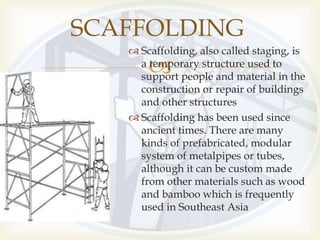
 Scaffolding, also called staging, is
a temporary structure used to
support people and material in the
construction or repair of buildings
and other structures
 Scaffolding has been used since
ancient times. There are many
kinds of prefabricated, modular
system of metalpipes or tubes,
although it can be custom made
from other materials such as wood
and bamboo which is frequently
used in Southeast Asia
SCAFFOLDING

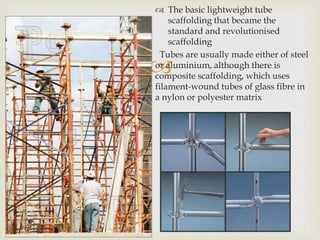
 The basic lightweight tube
scaffolding that became the
standard and revolutionised
scaffolding
Tubes are usually made either of steel
or aluminium, although there is
composite scaffolding, which uses
filament-wound tubes of glass fibre in
a nylon or polyester matrix

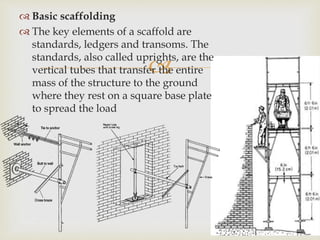
 Basic scaffolding
 The key elements of a scaffold are
standards, ledgers and transoms. The
standards, also called uprights, are the
vertical tubes that transfer the entire
mass of the structure to the ground
where they rest on a square base plate
to spread the load

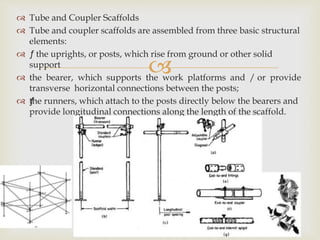
 Tube and Coupler Scaffolds
 Tube and coupler scaffolds are assembled from three basic structural
elements:
 ƒ the uprights, or posts, which rise from ground or other solid
support
 the bearer, which supports the work platforms and / or provide
transverse horizontal connections between the posts;
 ƒthe runners, which attach to the posts directly below the bearers and
provide longitudinal connections along the length of the scaffold.

 Shoring is the process of supporting a building,
vessel, structure, or trench with shores (props) when
in danger of collapse or during repairs or alterations.
Shoring comes fromshore a timber or metal prop.[1]
Shoring may be vertical, angled, or horizontal.
SHORING

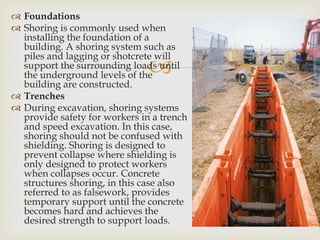
 Foundations
 Shoring is commonly used when
installing the foundation of a
building. A shoring system such as
piles and lagging or shotcrete will
support the surrounding loads until
the underground levels of the
building are constructed.
 Trenches
 During excavation, shoring systems
provide safety for workers in a trench
and speed excavation. In this case,
shoring should not be confused with
shielding. Shoring is designed to
prevent collapse where shielding is
only designed to protect workers
when collapses occur. Concrete
structures shoring, in this case also
referred to as falsework, provides
temporary support until the concrete
becomes hard and achieves the
desired strength to support loads.

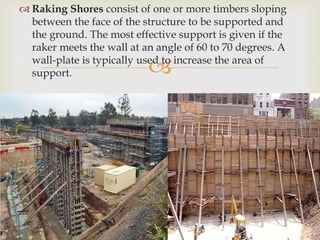
 Raking Shores consist of one or more timbers sloping
between the face of the structure to be supported and
the ground. The most effective support is given if the
raker meets the wall at an angle of 60 to 70 degrees. A
wall-plate is typically used to increase the area of
support.

 Hydraulic Shoring
 Hydraulic shoring is the use of hydraulic pistons that can
be pumped outward until they press up against the trench
walls. They are typically combined with steel plate or
plywood, either being 1-1/8" thick plywood, or special
heavy Finland Form (FINFORM) 7/8" thick.
 Beam and Plate
 Beam and Plate steel I-beams are driven into the ground
and steel plates are slid in amongst them. A similar method
that uses wood planks is called soldier boarding.
Hydraulics tend to be faster and easier; the other methods
tend to be used for longer term applications or larger
excavations.
 Soil Nailing
 Soil nailing is a technique in which soil slopes, excavations
or retaining walls are reinforced by the insertion of
relatively slender elements - normally steel reinforcing
bars. The bars are usually installed into a pre-drilled hole
and then grouted into place or drilled and grouted
simultaneously. They are usually installed untensioned at a
slight downward inclination. A rigid or flexible facing
(often sprayed concrete) or isolated soil nail heads may be
used at the surface.

 Square Shoring
 This consists of a timber member jammed on a pad piece
on either the deck or deck head depending on water
levels in the compartment and a strong point, this is
called the proud. then the is a horizontal timber cut to
size to fit between this and what it is shoring up, e.g. a
splinter box, bulkhead or door. Timber wedges are then
used to tighten up the structure if necessary
 Vertical Shoring
 This is to support a hatch or splint box on the deck,
consisting of a vertical timber between the deck and
deck head, with to wedges used opposing each other to
tighten it. pad pieces are used to spread the load on
weak structures.

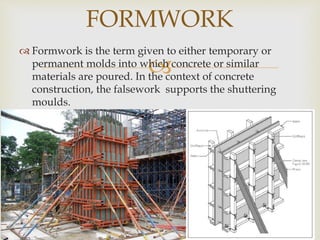
 Formwork is the term given to either temporary or
permanent molds into which concrete or similar
materials are poured. In the context of concrete
construction, the falsework supports the shuttering
moulds.
FORMWORK

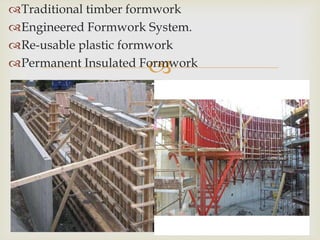
Traditional timber formwork
Engineered Formwork System.
Re-usable plastic formwork
Permanent Insulated Formwork

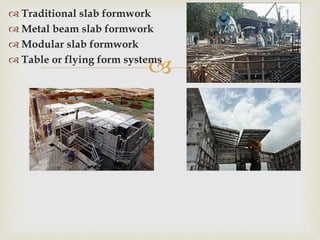
 Traditional slab formwork
 Metal beam slab formwork
 Modular slab formwork
 Table or flying form systems

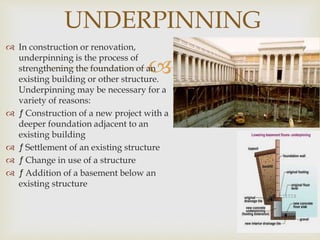
 In construction or renovation,
underpinning is the process of
strengthening the foundation of an
existing building or other structure.
Underpinning may be necessary for a
variety of reasons:
 ƒ Construction of a new project with a
deeper foundation adjacent to an
existing building
 ƒ Settlement of an existing structure
 ƒ Change in use of a structure
 ƒ Addition of a basement below an
existing structure
UNDERPINNING

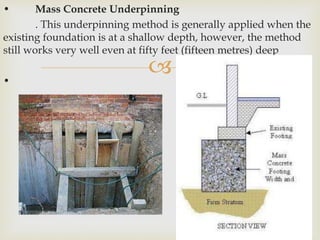
• Mass Concrete Underpinning
. This underpinning method is generally applied when the
existing foundation is at a shallow depth, however, the method
still works very well even at fifty feet (fifteen metres) deep
•

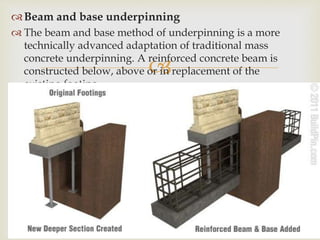
Beam and base underpinning
 The beam and base method of underpinning is a more
technically advanced adaptation of traditional mass
concrete underpinning. A reinforced concrete beam is
constructed below, above or in replacement of the
existing footing.
•

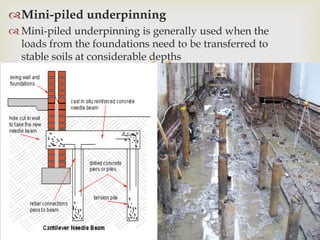
Mini-piled underpinning
 Mini-piled underpinning is generally used when the
loads from the foundations need to be transferred to
stable soils at considerable depths

Group no 9

  • 1.
    By GOKULNATH HARI.M HARI ILAMVAZHUTHI.N SHABBEER HUSSAIN.Z NISHANT.V
  • 2.
  • 3.
      Scaffolding, alsocalled staging, is a temporary structure used to support people and material in the construction or repair of buildings and other structures  Scaffolding has been used since ancient times. There are many kinds of prefabricated, modular system of metalpipes or tubes, although it can be custom made from other materials such as wood and bamboo which is frequently used in Southeast Asia SCAFFOLDING
  • 4.
      The basiclightweight tube scaffolding that became the standard and revolutionised scaffolding Tubes are usually made either of steel or aluminium, although there is composite scaffolding, which uses filament-wound tubes of glass fibre in a nylon or polyester matrix
  • 5.
      Basic scaffolding The key elements of a scaffold are standards, ledgers and transoms. The standards, also called uprights, are the vertical tubes that transfer the entire mass of the structure to the ground where they rest on a square base plate to spread the load
  • 6.
      Tube andCoupler Scaffolds  Tube and coupler scaffolds are assembled from three basic structural elements:  ƒ the uprights, or posts, which rise from ground or other solid support  the bearer, which supports the work platforms and / or provide transverse horizontal connections between the posts;  ƒthe runners, which attach to the posts directly below the bearers and provide longitudinal connections along the length of the scaffold.
  • 7.
      Shoring isthe process of supporting a building, vessel, structure, or trench with shores (props) when in danger of collapse or during repairs or alterations. Shoring comes fromshore a timber or metal prop.[1] Shoring may be vertical, angled, or horizontal. SHORING
  • 8.
      Foundations  Shoringis commonly used when installing the foundation of a building. A shoring system such as piles and lagging or shotcrete will support the surrounding loads until the underground levels of the building are constructed.  Trenches  During excavation, shoring systems provide safety for workers in a trench and speed excavation. In this case, shoring should not be confused with shielding. Shoring is designed to prevent collapse where shielding is only designed to protect workers when collapses occur. Concrete structures shoring, in this case also referred to as falsework, provides temporary support until the concrete becomes hard and achieves the desired strength to support loads.
  • 9.
      Raking Shoresconsist of one or more timbers sloping between the face of the structure to be supported and the ground. The most effective support is given if the raker meets the wall at an angle of 60 to 70 degrees. A wall-plate is typically used to increase the area of support.
  • 10.
      Hydraulic Shoring Hydraulic shoring is the use of hydraulic pistons that can be pumped outward until they press up against the trench walls. They are typically combined with steel plate or plywood, either being 1-1/8" thick plywood, or special heavy Finland Form (FINFORM) 7/8" thick.  Beam and Plate  Beam and Plate steel I-beams are driven into the ground and steel plates are slid in amongst them. A similar method that uses wood planks is called soldier boarding. Hydraulics tend to be faster and easier; the other methods tend to be used for longer term applications or larger excavations.  Soil Nailing  Soil nailing is a technique in which soil slopes, excavations or retaining walls are reinforced by the insertion of relatively slender elements - normally steel reinforcing bars. The bars are usually installed into a pre-drilled hole and then grouted into place or drilled and grouted simultaneously. They are usually installed untensioned at a slight downward inclination. A rigid or flexible facing (often sprayed concrete) or isolated soil nail heads may be used at the surface.
  • 11.
      Square Shoring This consists of a timber member jammed on a pad piece on either the deck or deck head depending on water levels in the compartment and a strong point, this is called the proud. then the is a horizontal timber cut to size to fit between this and what it is shoring up, e.g. a splinter box, bulkhead or door. Timber wedges are then used to tighten up the structure if necessary  Vertical Shoring  This is to support a hatch or splint box on the deck, consisting of a vertical timber between the deck and deck head, with to wedges used opposing each other to tighten it. pad pieces are used to spread the load on weak structures.
  • 12.
      Formwork isthe term given to either temporary or permanent molds into which concrete or similar materials are poured. In the context of concrete construction, the falsework supports the shuttering moulds. FORMWORK
  • 13.
     Traditional timber formwork EngineeredFormwork System. Re-usable plastic formwork Permanent Insulated Formwork
  • 14.
      Traditional slabformwork  Metal beam slab formwork  Modular slab formwork  Table or flying form systems
  • 15.
      In constructionor renovation, underpinning is the process of strengthening the foundation of an existing building or other structure. Underpinning may be necessary for a variety of reasons:  ƒ Construction of a new project with a deeper foundation adjacent to an existing building  ƒ Settlement of an existing structure  ƒ Change in use of a structure  ƒ Addition of a basement below an existing structure UNDERPINNING
  • 16.
     • Mass ConcreteUnderpinning . This underpinning method is generally applied when the existing foundation is at a shallow depth, however, the method still works very well even at fifty feet (fifteen metres) deep •
  • 17.
     Beam and baseunderpinning  The beam and base method of underpinning is a more technically advanced adaptation of traditional mass concrete underpinning. A reinforced concrete beam is constructed below, above or in replacement of the existing footing. •
  • 18.
     Mini-piled underpinning  Mini-piledunderpinning is generally used when the loads from the foundations need to be transferred to stable soils at considerable depths