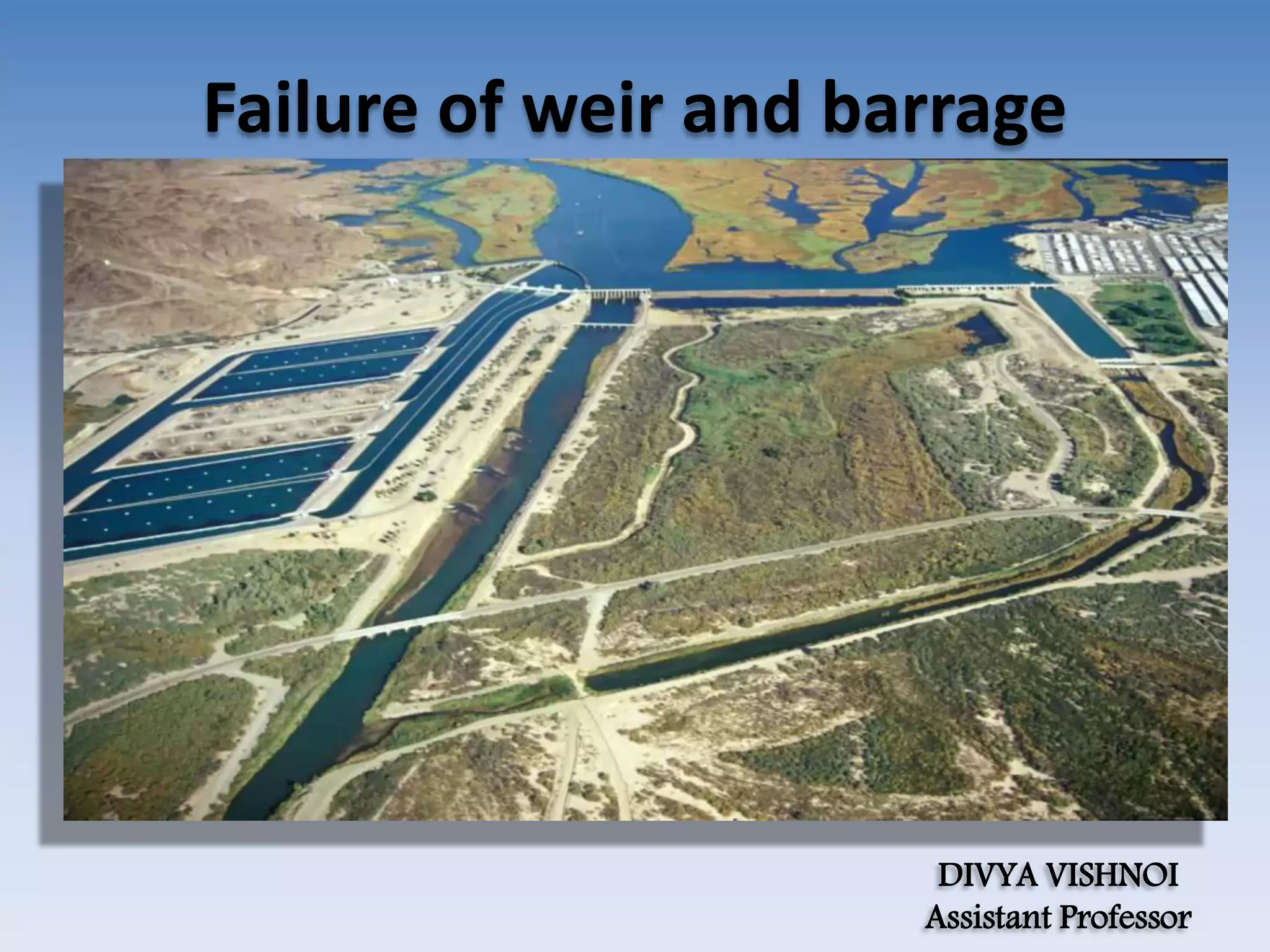
Failure of weir and barrage
DIVYA VISHNOI
Assistant Professor
Causes of Failure of weir or barrage
on permeable foundation
The combined effect of surface flow and surface flow may
cause the failure of the weir or barrage.
(i) Failure due to subsurface flow
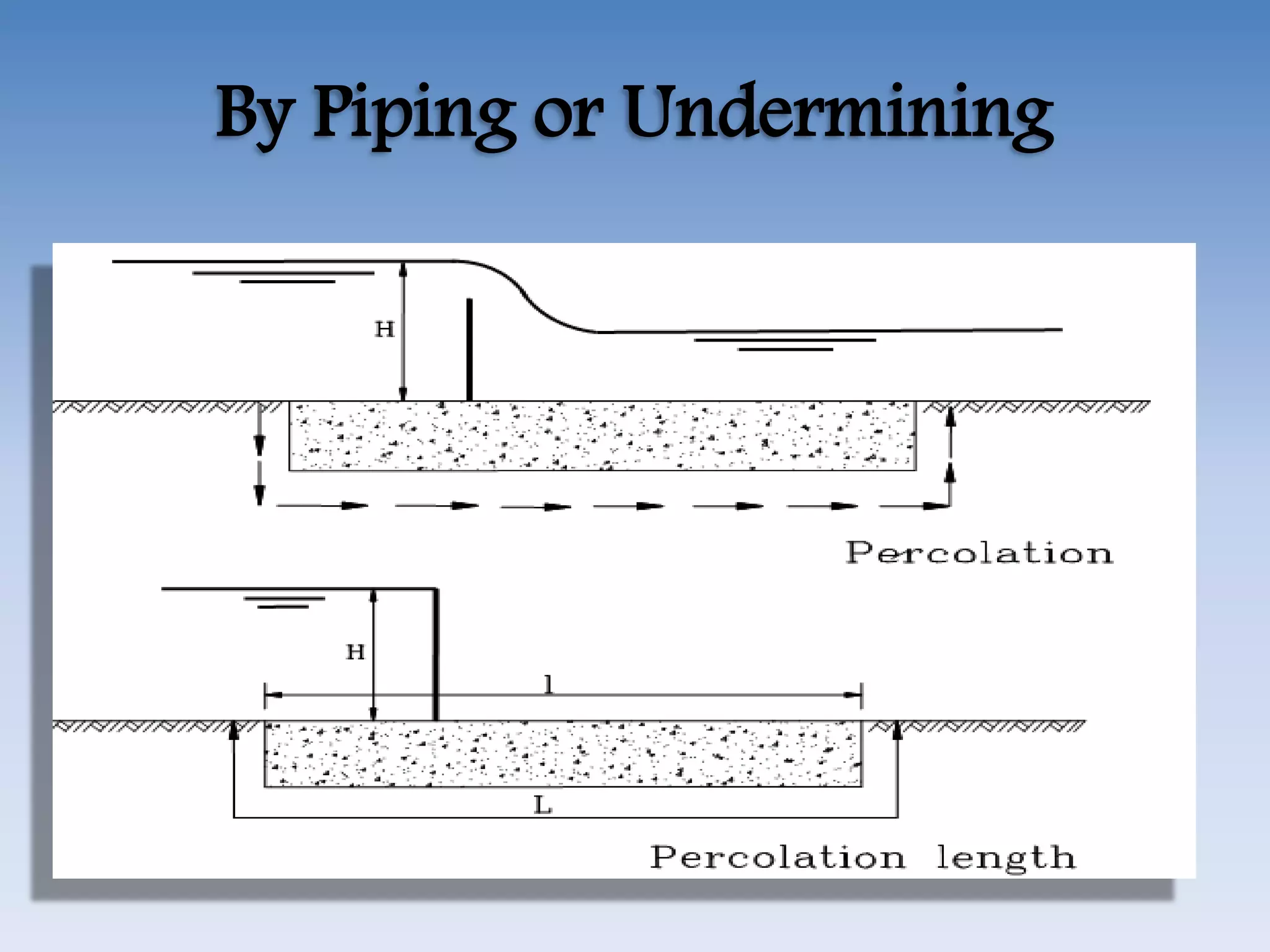
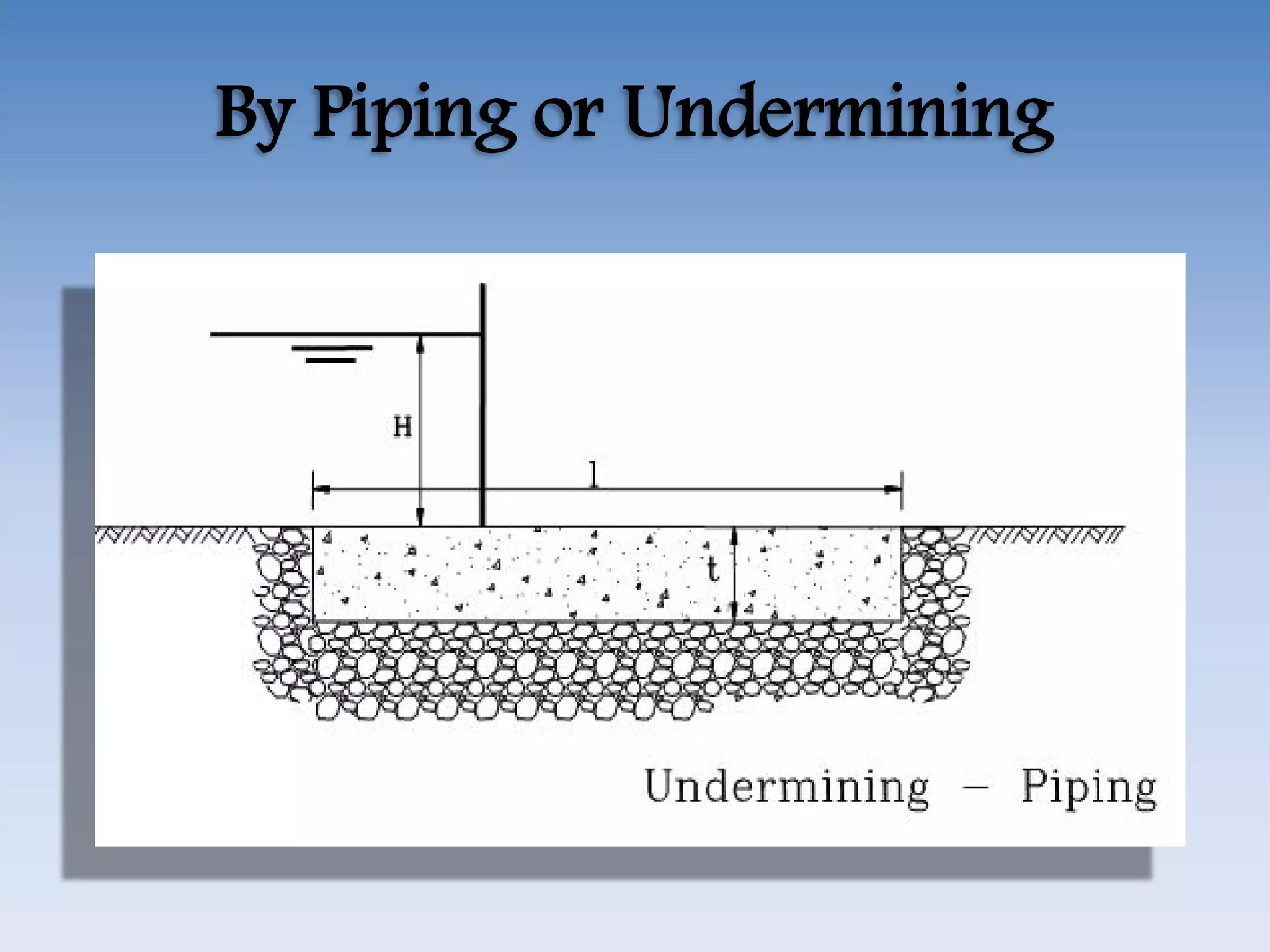
(a) By piping or undermining: The water from the
upstream side continuously percolates through the bottom
of the foundation and emerges at the downstream end of
the weir or barrage floor. The force of percolating water
removes the soil particles by scouring at the point of
emergence. As the process of removal of soil particles goes
on continuously, a depression is formed which extends
backwards towards the upstream through the bottom of
the foundation. A hollow pipe like formation thus develops
under the foundation due to which the weir or barrage
may fail by subsiding. This phenomenon is known as
failure by piping or undermining.
By Piping or Undermining
Causes of Failure of weir or barrage
on permeable foundation
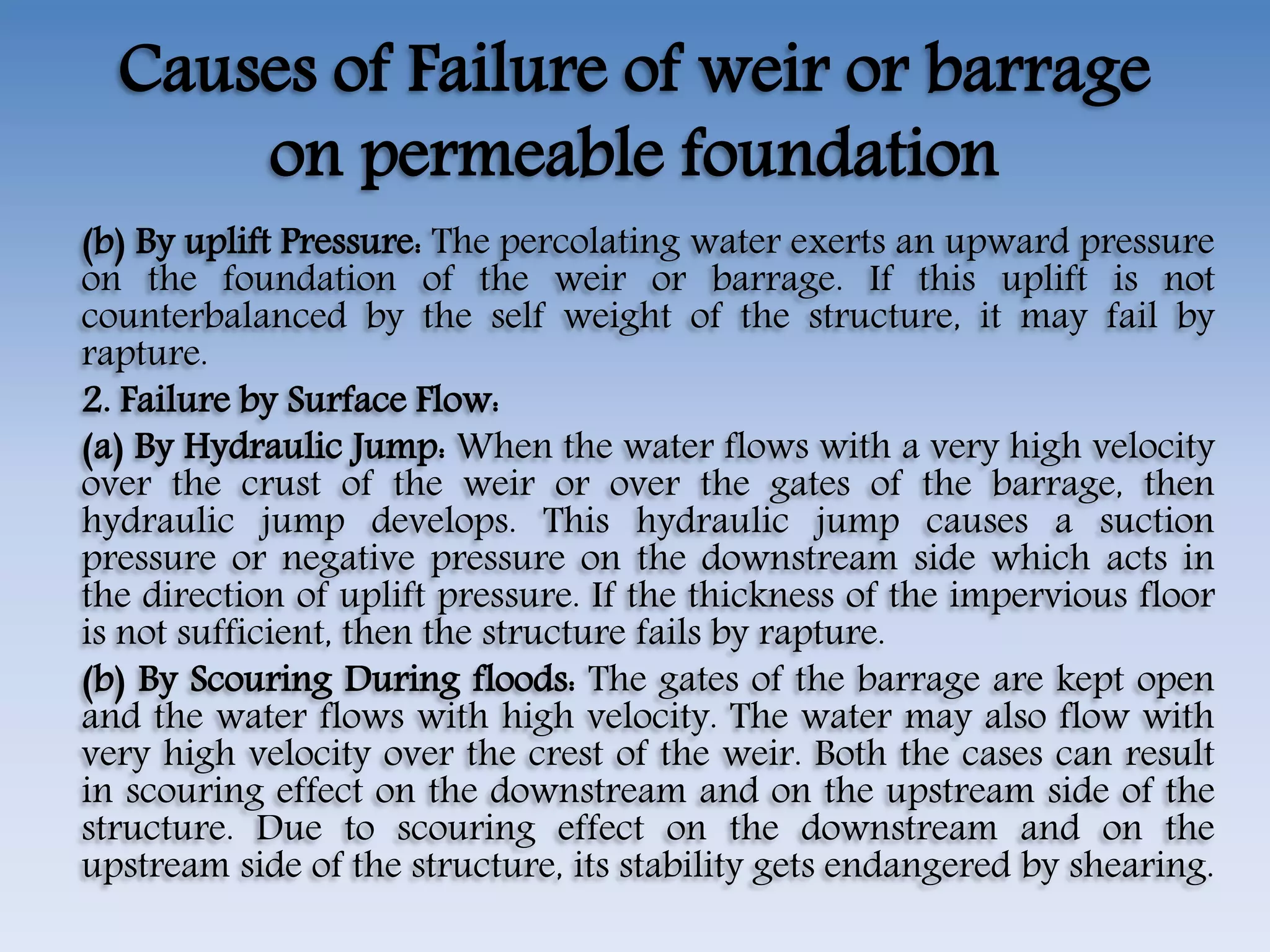
(b) By uplift Pressure: The percolating water exerts an upward pressure
on the foundation of the weir or barrage. If this uplift is not
counterbalanced by the self weight of the structure, it may fail by
rapture.
2. Failure by Surface Flow:
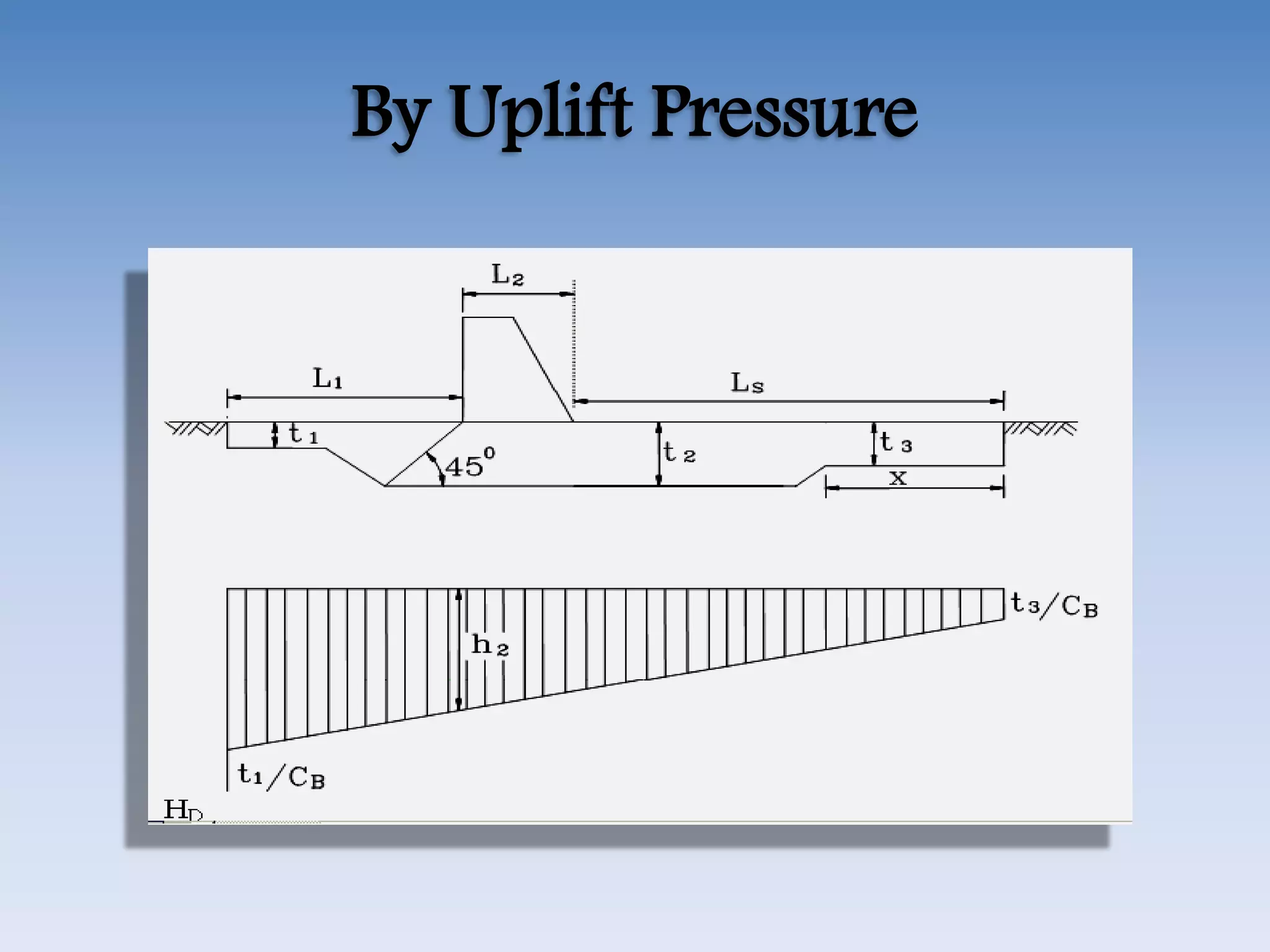
(a) By Hydraulic Jump: When the water flows with a very high velocity
over the crust of the weir or over the gates of the barrage, then
hydraulic jump develops. This hydraulic jump causes a suction
pressure or negative pressure on the downstream side which acts in
the direction of uplift pressure. If the thickness of the impervious floor
is not sufficient, then the structure fails by rapture.
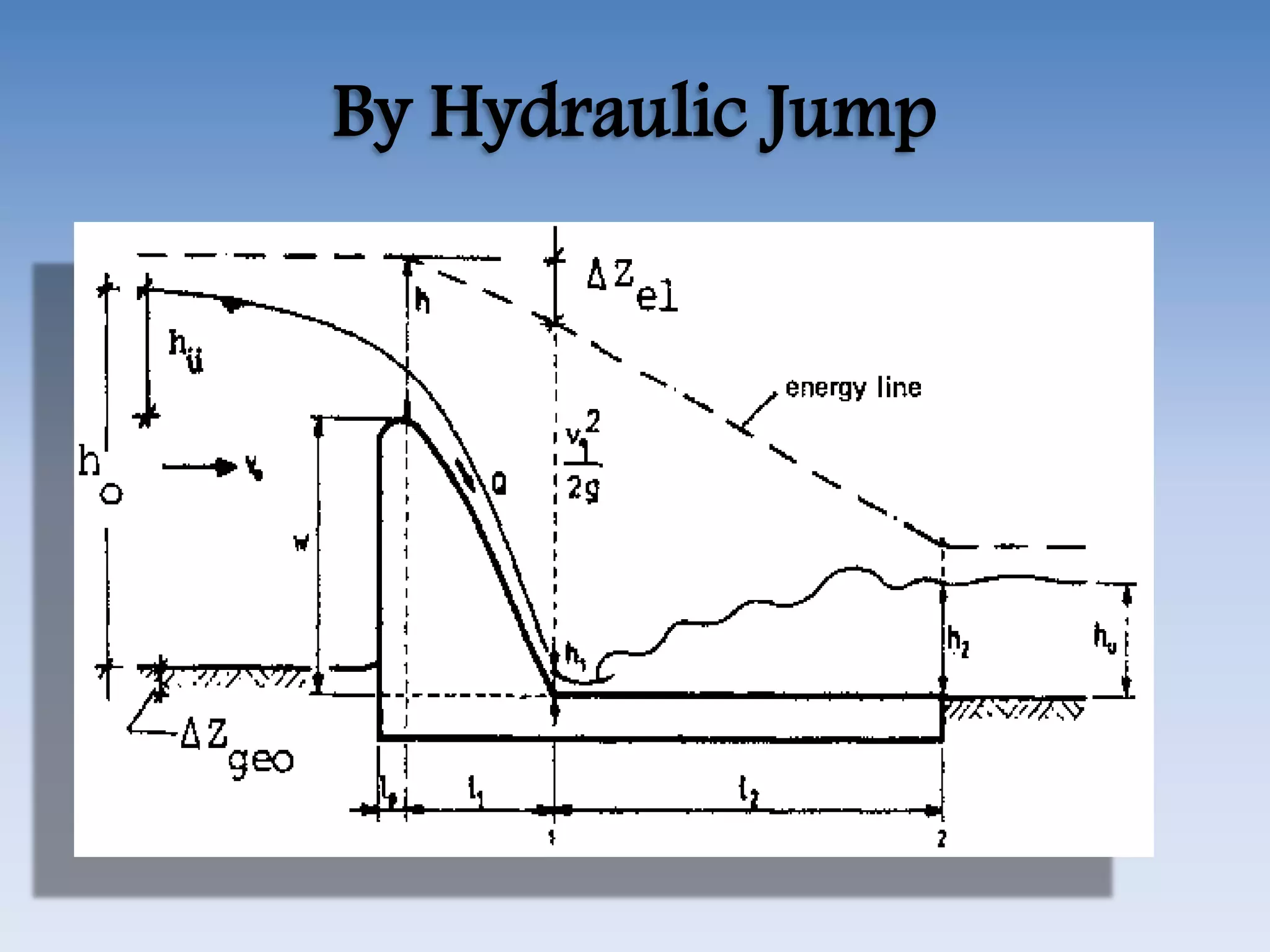
(b) By Scouring During floods: The gates of the barrage are kept open
and the water flows with high velocity. The water may also flow with
very high velocity over the crest of the weir. Both the cases can result
in scouring effect on the downstream and on the upstream side of the
structure. Due to scouring effect on the downstream and on the
upstream side of the structure, its stability gets endangered by shearing.
By Uplift Pressure
By Hydraulic Jump
By Scouring During floods
Causes of Failure of Weir, and
Remedies
• If a weir is constructed on permeable soil, weir may fail
by piping, uplift force, suction caused by standing wave
and scouring on both upstream and downstream of the
weir.
• When hydraulic gradient or exit gradient exceeds the
critical value of soil, surface soil at down end starts
boiling first and is washed away by percolating water.
This process of removal or washing out of soil continuous
and eventually a channel in the form of pipe is formed by
seepage water. This is called piping which may cause the
failure of foundation. Similarly uplift force of percolating
water is acting on ther floor from bottom and if the
weight of floor is not enough to resist this uplift force,
floor may fail by cracking or bursting.
Causes of Failure of Weir, and
Remedies
• The main remedies against failure are:
• Path of percolation or creep length of seepage
water should be increased by providing sheet
piles at upstream, downstream or at
intermediate point to reduce the hydraulic
gradient.
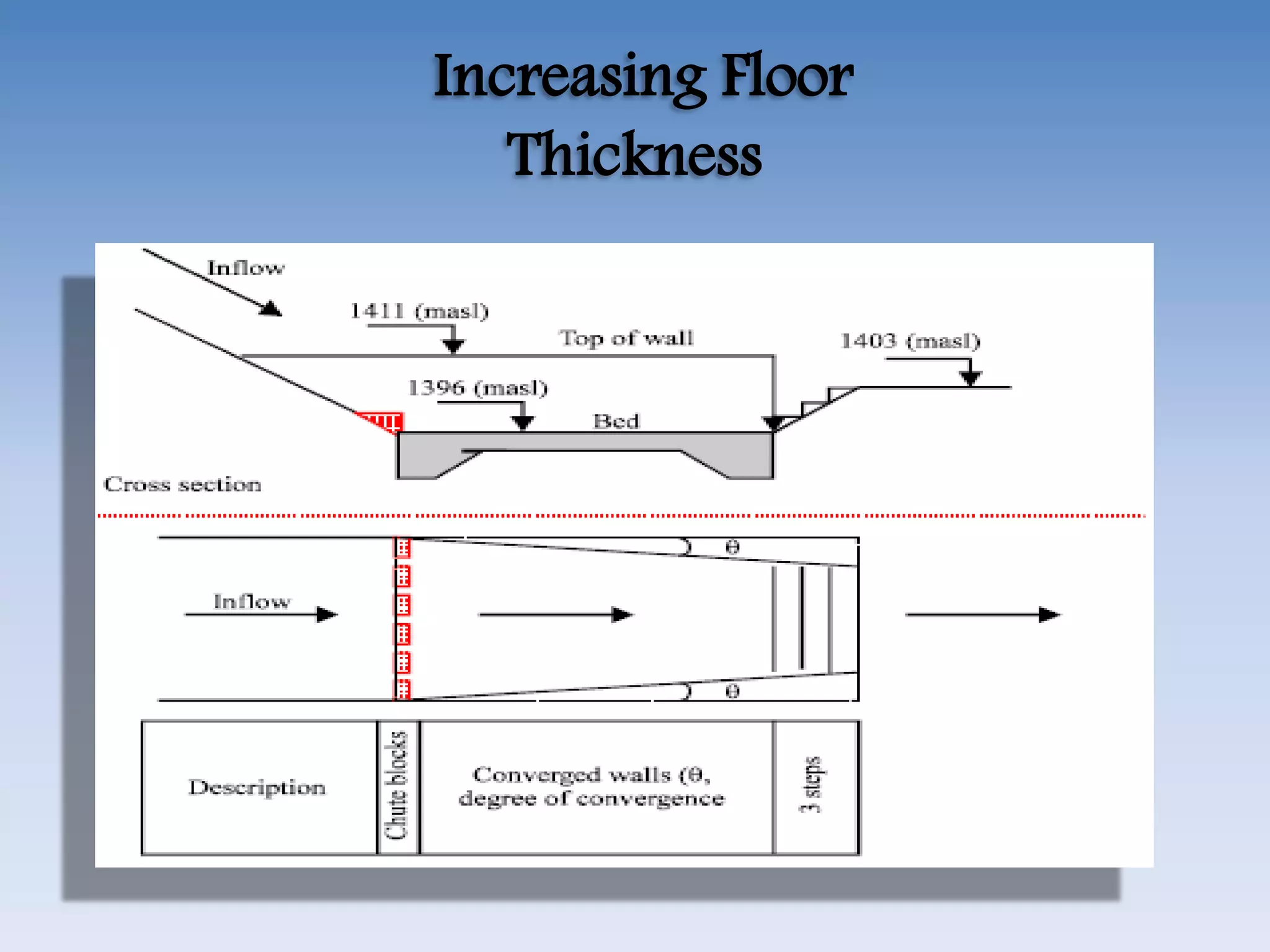
• Floor thickness should be increased to
increase its self weight to balance the uplift
force.
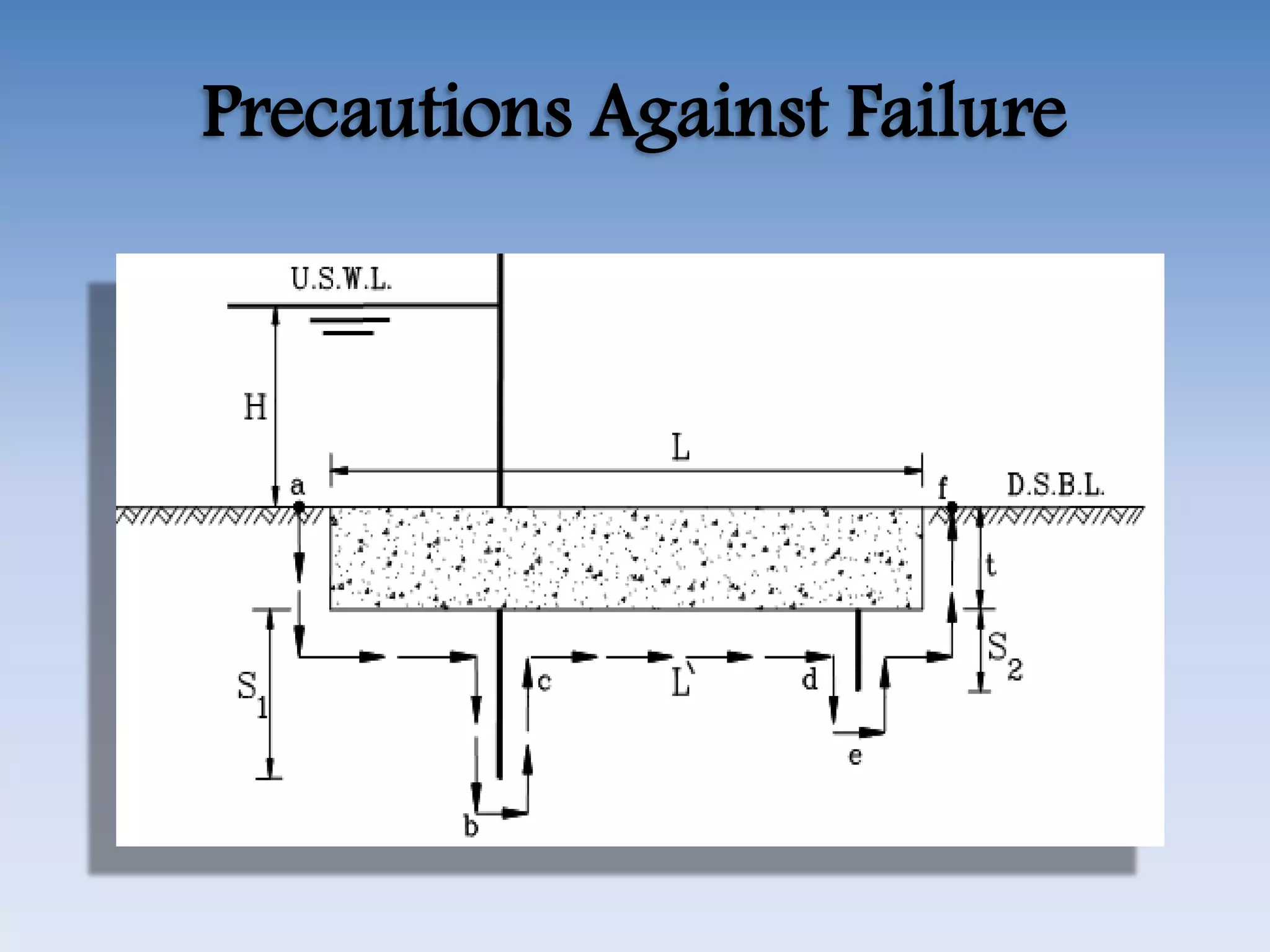
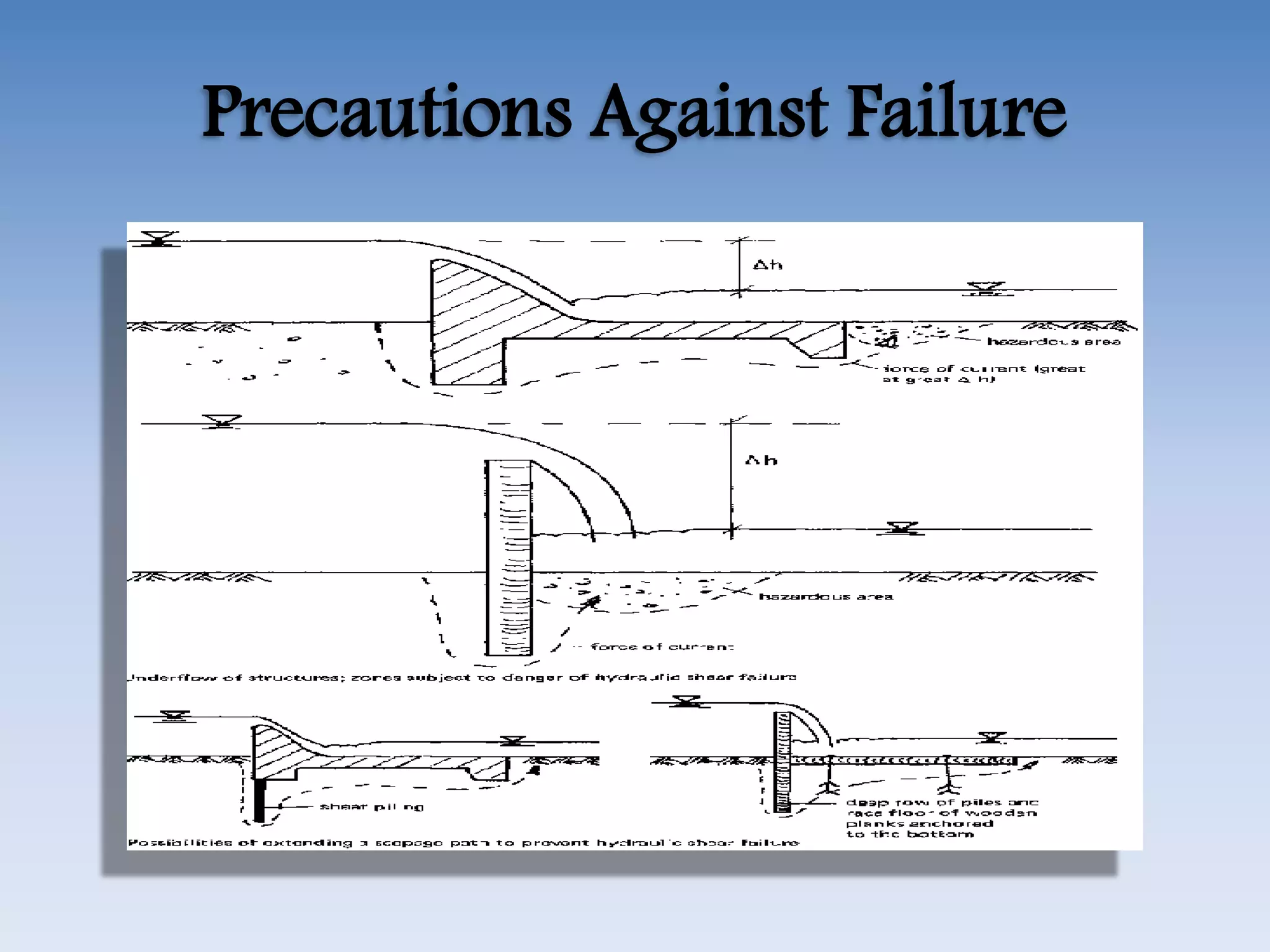
Precautions Against Failure
• The following precautions can be taken to prevent
failure.
• (a) The length of the impervious layer should be
carefully designed so that the path of the percolating
water is increased consequently reducing the exit
gradient.
• (b) Sheet piles should be provided on the upstream
side and the downstream side of the impervious
floor to increase to the length of percolating water
so that the uplift pressure is considerable reduced.
• (c) The thickness of the impervious floor should be
such that the weight of the floor is a sufficient to
counterbalance the uplift pressure.
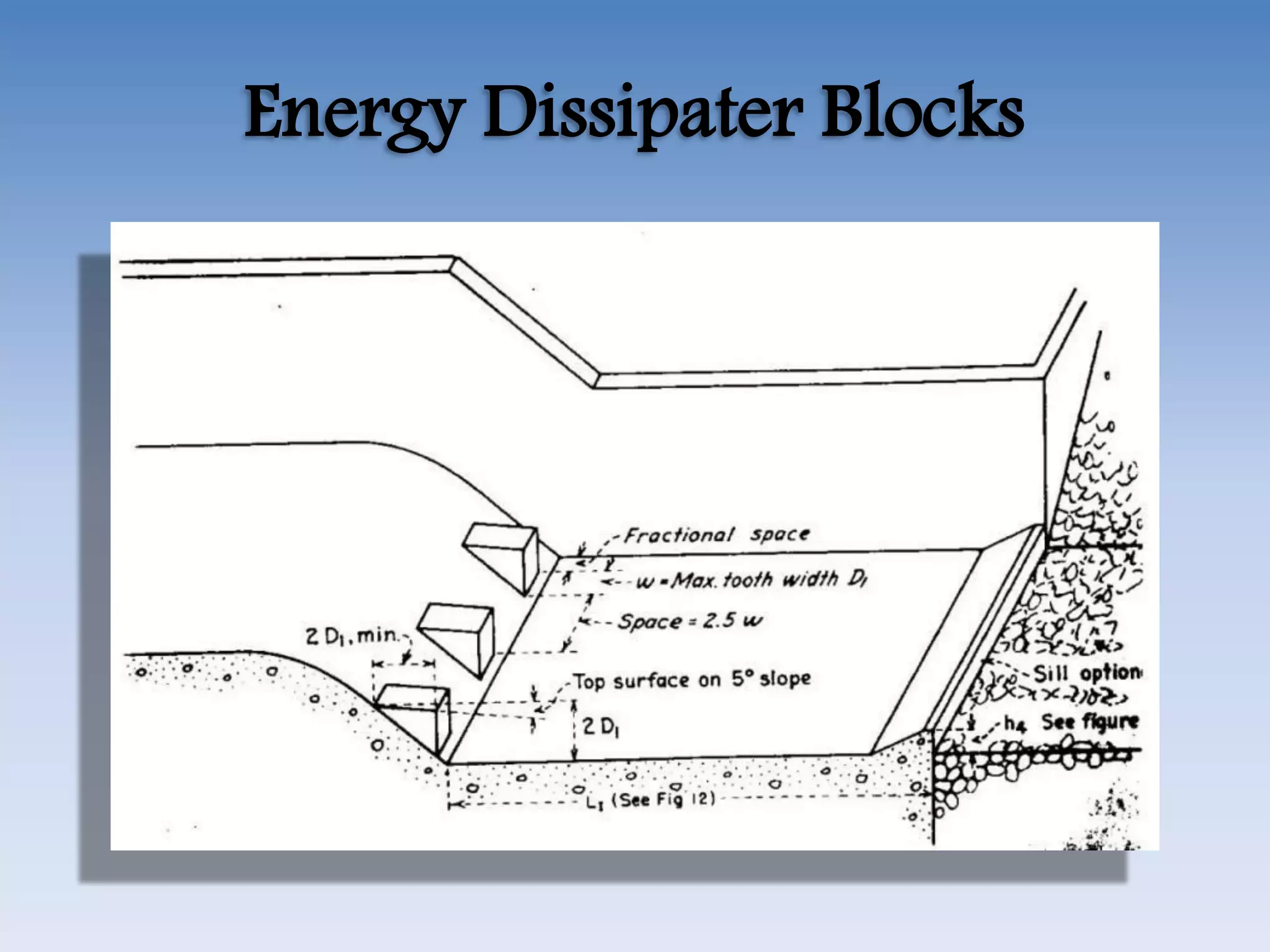
Precautions Against Failure
• (d) Energy dissipater blocks like friction
blocks, impact blocks, should be provided.
• (e) Inverted filter should be provided with
concrete blocks on the top so that the
percolating water does not wash out the soil
particles.
• Deep foundation like well foundation should
be provided for the barrage piers
Precautions Against Failure
Energy Dissipater Blocks
Increasing Floor
Thickness
References
• Irrigation Engineering & Water Power Engineering
– By Prof B.C.PUNMIA
– Laxmi Publication
• Irrigation Engineering & Hydraulic Structures
– By Prof. Santosh Kumar Garg
– Khanna Publishers
• Irrigation, Water Power Engineering & Hydraulic Structures
– By Prof K.R. Arora
– Standard Publishers Distributions
• Internet Websites
• http://www.aboutcivil.org/
• http://nptel.ac.in/courses/105105110/
Thanks

Failure of weir and barrage

  • 1.
    Failure of weirand barrage DIVYA VISHNOI Assistant Professor
  • 2.
    Causes of Failureof weir or barrage on permeable foundation The combined effect of surface flow and surface flow may cause the failure of the weir or barrage. (i) Failure due to subsurface flow (a) By piping or undermining: The water from the upstream side continuously percolates through the bottom of the foundation and emerges at the downstream end of the weir or barrage floor. The force of percolating water removes the soil particles by scouring at the point of emergence. As the process of removal of soil particles goes on continuously, a depression is formed which extends backwards towards the upstream through the bottom of the foundation. A hollow pipe like formation thus develops under the foundation due to which the weir or barrage may fail by subsiding. This phenomenon is known as failure by piping or undermining.
  • 3.
    By Piping orUndermining
  • 4.
    By Piping orUndermining
  • 5.
    Causes of Failureof weir or barrage on permeable foundation (b) By uplift Pressure: The percolating water exerts an upward pressure on the foundation of the weir or barrage. If this uplift is not counterbalanced by the self weight of the structure, it may fail by rapture. 2. Failure by Surface Flow: (a) By Hydraulic Jump: When the water flows with a very high velocity over the crust of the weir or over the gates of the barrage, then hydraulic jump develops. This hydraulic jump causes a suction pressure or negative pressure on the downstream side which acts in the direction of uplift pressure. If the thickness of the impervious floor is not sufficient, then the structure fails by rapture. (b) By Scouring During floods: The gates of the barrage are kept open and the water flows with high velocity. The water may also flow with very high velocity over the crest of the weir. Both the cases can result in scouring effect on the downstream and on the upstream side of the structure. Due to scouring effect on the downstream and on the upstream side of the structure, its stability gets endangered by shearing.
  • 6.
  • 7.
  • 8.
  • 9.
    Causes of Failureof Weir, and Remedies • If a weir is constructed on permeable soil, weir may fail by piping, uplift force, suction caused by standing wave and scouring on both upstream and downstream of the weir. • When hydraulic gradient or exit gradient exceeds the critical value of soil, surface soil at down end starts boiling first and is washed away by percolating water. This process of removal or washing out of soil continuous and eventually a channel in the form of pipe is formed by seepage water. This is called piping which may cause the failure of foundation. Similarly uplift force of percolating water is acting on ther floor from bottom and if the weight of floor is not enough to resist this uplift force, floor may fail by cracking or bursting.
  • 10.
    Causes of Failureof Weir, and Remedies • The main remedies against failure are: • Path of percolation or creep length of seepage water should be increased by providing sheet piles at upstream, downstream or at intermediate point to reduce the hydraulic gradient. • Floor thickness should be increased to increase its self weight to balance the uplift force.
  • 11.
    Precautions Against Failure •The following precautions can be taken to prevent failure. • (a) The length of the impervious layer should be carefully designed so that the path of the percolating water is increased consequently reducing the exit gradient. • (b) Sheet piles should be provided on the upstream side and the downstream side of the impervious floor to increase to the length of percolating water so that the uplift pressure is considerable reduced. • (c) The thickness of the impervious floor should be such that the weight of the floor is a sufficient to counterbalance the uplift pressure.
  • 12.
    Precautions Against Failure •(d) Energy dissipater blocks like friction blocks, impact blocks, should be provided. • (e) Inverted filter should be provided with concrete blocks on the top so that the percolating water does not wash out the soil particles. • Deep foundation like well foundation should be provided for the barrage piers
  • 13.
  • 14.
  • 15.
  • 16.
  • 17.
    References • Irrigation Engineering& Water Power Engineering – By Prof B.C.PUNMIA – Laxmi Publication • Irrigation Engineering & Hydraulic Structures – By Prof. Santosh Kumar Garg – Khanna Publishers • Irrigation, Water Power Engineering & Hydraulic Structures – By Prof K.R. Arora – Standard Publishers Distributions • Internet Websites • http://www.aboutcivil.org/ • http://nptel.ac.in/courses/105105110/
  • 18.