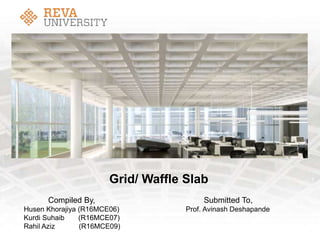
Grid/ Waffle Slab
Compiled By, Submitted To,
Husen Khorajiya (R16MCE06) Prof. Avinash Deshapande
Kurdi Suhaib (R16MCE07)
Rahil Aziz (R16MCE09)
Outline of Presentation
 Definition
 Where this system can be used
 Features of the Grid Slab
 Decorative grid slabs in historical structures
 Types of Grid Slab
 Comparison: Long Span Structures
 Construction
 Construction Technique
 Formwork Required
 Reinforcements Details
 Modification in Grid Slab for Utility
 Services Provided in Grid Slab
 Benefits
 Iconic Landmarks using Grid Slabs
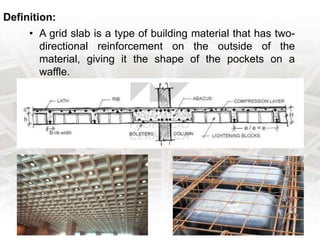
• A grid slab is a type of building material that has two-
directional reinforcement on the outside of the
material, giving it the shape of the pockets on a
waffle.
Definition:
Where this system can be used ?
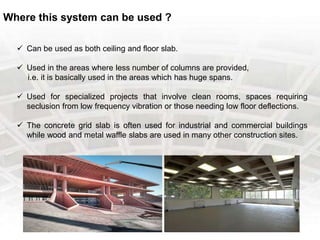
 Can be used as both ceiling and floor slab.
 Used in the areas where less number of columns are provided,
i.e. it is basically used in the areas which has huge spans.
 Used for specialized projects that involve clean rooms, spaces requiring
seclusion from low frequency vibration or those needing low floor deflections.
 The concrete grid slab is often used for industrial and commercial buildings
while wood and metal waffle slabs are used in many other construction sites.
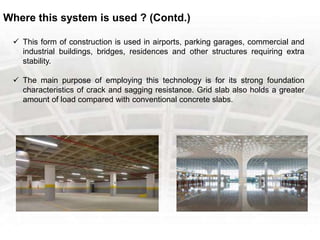
 This form of construction is used in airports, parking garages, commercial and
industrial buildings, bridges, residences and other structures requiring extra
stability.
 The main purpose of employing this technology is for its strong foundation
characteristics of crack and sagging resistance. Grid slab also holds a greater
amount of load compared with conventional concrete slabs.
Where this system is used ? (Contd.)
Features of the Grid Slab
 They are used on flat sites.
 No beam excavation is required.
 No controlled or rolled fill is used.
 Cardboard slab panel/void formers
are used.
 Slab panels are on 1 metre grids
(approximately).
 Trench mesh or individual bars can
be used.
 Slab thickness is 85 - 100 mm.
 Internal beams are 110 – 200 mm
wide.
 There is minimal concrete volume.
 No beam down drag from clay (above
ground slab) occurs.
 Shrinkage of slab is lower than
stiffened rafts and footing slabs.
 They use 30% less concrete than a
stiffened raft.
 They use 20% less steel than a
stiffened raft.
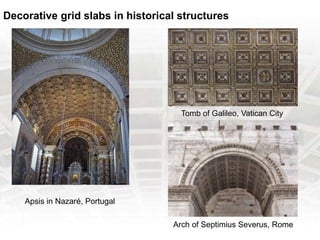
Decorative grid slabs in historical structures
Apsis in Nazaré, Portugal
Tomb of Galileo, Vatican City
Arch of Septimius Severus, Rome
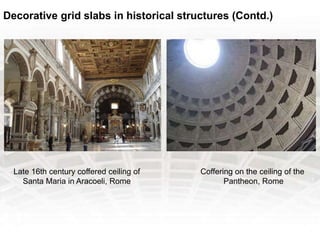
Decorative grid slabs in historical structures (Contd.)
Late 16th century coffered ceiling of
Santa Maria in Aracoeli, Rome
Coffering on the ceiling of the
Pantheon, Rome
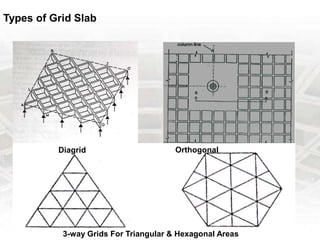
Types of Grid Slab
Diagrid Orthogonal
3-way Grids For Triangular & Hexagonal Areas
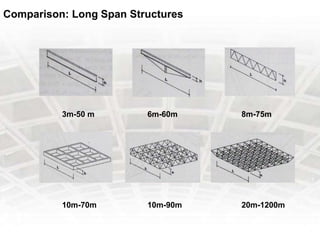
Comparison: Long Span Structures
3m-50 m 6m-60m 8m-75m
10m-70m 10m-90m 20m-1200m
Construction
 Grids are generally limited to the interior
of a slab, leaving one or two of the
forms out to create a solid fill around the
supports.
 The solid fills provide the strength
required for shear transfer to the
supports.
 The fills also reduce the compression
stresses at the soffit of the floor around
the supports, thus avoiding the
necessity of bottom reinforcement in this
region.
 Picture illustrate typical grid
constructions using unbounded tendons.
 A light top mesh over the grid is
generally the only top reinforcement at
the interior of the floor panels.
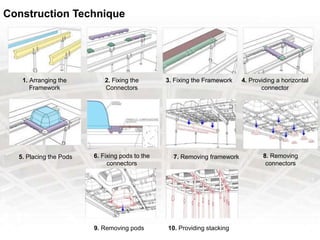
Construction Technique
1. Arranging the
Framework
2. Fixing the
Connectors
3. Fixing the Framework 4. Providing a horizontal
connector
5. Placing the Pods 6. Fixing pods to the
connectors
7. Removing framework 8. Removing
connectors
9. Removing pods 10. Providing stacking
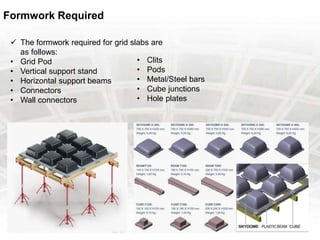
Formwork Required
 The formwork required for grid slabs are
as follows:
• Grid Pod
• Vertical support stand
• Horizontal support beams
• Connectors
• Wall connectors
• Clits
• Pods
• Metal/Steel bars
• Cube junctions
• Hole plates
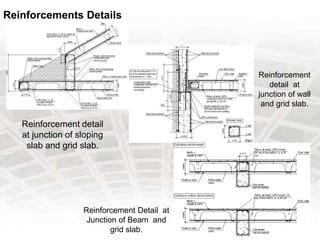
Reinforcements Details
Reinforcement detail
at junction of sloping
slab and grid slab.
Reinforcement
detail at
junction of wall
and grid slab.
Reinforcement Detail at
Junction of Beam and
grid slab.
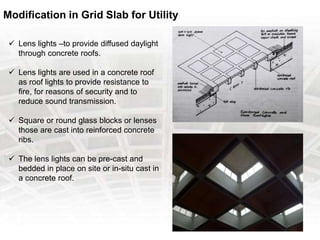
Modification in Grid Slab for Utility
 Lens lights –to provide diffused daylight
through concrete roofs.
 Lens lights are used in a concrete roof
as roof lights to provide resistance to
fire, for reasons of security and to
reduce sound transmission.
 Square or round glass blocks or lenses
those are cast into reinforced concrete
ribs.
 The lens lights can be pre-cast and
bedded in place on site or in-situ cast in
a concrete roof.
Services Provided in Grid Slab
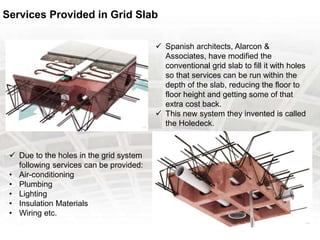
 Spanish architects, Alarcon &
Associates, have modified the
conventional grid slab to fill it with holes
so that services can be run within the
depth of the slab, reducing the floor to
floor height and getting some of that
extra cost back.
 This new system they invented is called
the Holedeck.
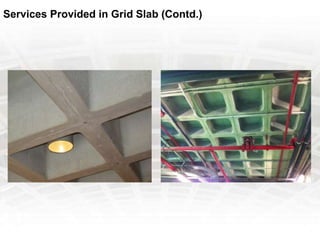
 Due to the holes in the grid system
following services can be provided:
• Air-conditioning
• Plumbing
• Lighting
• Insulation Materials
• Wiring etc.
Services Provided in Grid Slab (Contd.)
Benefits
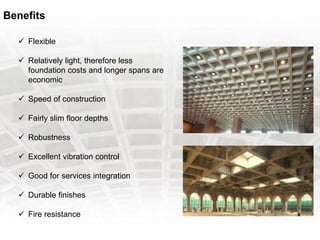
 Flexible
 Relatively light, therefore less
foundation costs and longer spans are
economic
 Speed of construction
 Fairly slim floor depths
 Robustness
 Excellent vibration control
 Good for services integration
 Durable finishes
 Fire resistance
Iconic Landmarks using Grid Slabs
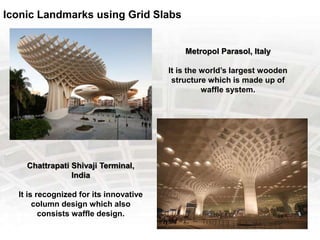
Chattrapati Shivaji Terminal,
India
It is recognized for its innovative
column design which also
consists waffle design.
Metropol Parasol, Italy
It is the world’s largest wooden
structure which is made up of
waffle system.
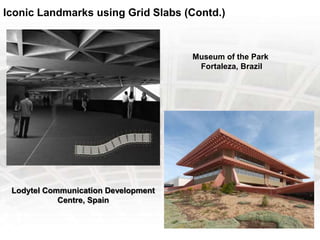
Museum of the Park
Fortaleza, Brazil
Lodytel Communication Development
Centre, Spain
Iconic Landmarks using Grid Slabs (Contd.)
Thank You

Grid/ Waffle Slabs

  • 1.
    Grid/ Waffle Slab CompiledBy, Submitted To, Husen Khorajiya (R16MCE06) Prof. Avinash Deshapande Kurdi Suhaib (R16MCE07) Rahil Aziz (R16MCE09)
  • 2.
    Outline of Presentation Definition  Where this system can be used  Features of the Grid Slab  Decorative grid slabs in historical structures  Types of Grid Slab  Comparison: Long Span Structures  Construction  Construction Technique  Formwork Required  Reinforcements Details  Modification in Grid Slab for Utility  Services Provided in Grid Slab  Benefits  Iconic Landmarks using Grid Slabs
  • 3.
    • A gridslab is a type of building material that has two- directional reinforcement on the outside of the material, giving it the shape of the pockets on a waffle. Definition:
  • 4.
    Where this systemcan be used ?  Can be used as both ceiling and floor slab.  Used in the areas where less number of columns are provided, i.e. it is basically used in the areas which has huge spans.  Used for specialized projects that involve clean rooms, spaces requiring seclusion from low frequency vibration or those needing low floor deflections.  The concrete grid slab is often used for industrial and commercial buildings while wood and metal waffle slabs are used in many other construction sites.
  • 5.
     This formof construction is used in airports, parking garages, commercial and industrial buildings, bridges, residences and other structures requiring extra stability.  The main purpose of employing this technology is for its strong foundation characteristics of crack and sagging resistance. Grid slab also holds a greater amount of load compared with conventional concrete slabs. Where this system is used ? (Contd.)
  • 6.
    Features of theGrid Slab  They are used on flat sites.  No beam excavation is required.  No controlled or rolled fill is used.  Cardboard slab panel/void formers are used.  Slab panels are on 1 metre grids (approximately).  Trench mesh or individual bars can be used.  Slab thickness is 85 - 100 mm.  Internal beams are 110 – 200 mm wide.  There is minimal concrete volume.  No beam down drag from clay (above ground slab) occurs.  Shrinkage of slab is lower than stiffened rafts and footing slabs.  They use 30% less concrete than a stiffened raft.  They use 20% less steel than a stiffened raft.
  • 7.
    Decorative grid slabsin historical structures Apsis in Nazaré, Portugal Tomb of Galileo, Vatican City Arch of Septimius Severus, Rome
  • 8.
    Decorative grid slabsin historical structures (Contd.) Late 16th century coffered ceiling of Santa Maria in Aracoeli, Rome Coffering on the ceiling of the Pantheon, Rome
  • 9.
    Types of GridSlab Diagrid Orthogonal 3-way Grids For Triangular & Hexagonal Areas
  • 10.
    Comparison: Long SpanStructures 3m-50 m 6m-60m 8m-75m 10m-70m 10m-90m 20m-1200m
  • 11.
    Construction  Grids aregenerally limited to the interior of a slab, leaving one or two of the forms out to create a solid fill around the supports.  The solid fills provide the strength required for shear transfer to the supports.  The fills also reduce the compression stresses at the soffit of the floor around the supports, thus avoiding the necessity of bottom reinforcement in this region.  Picture illustrate typical grid constructions using unbounded tendons.  A light top mesh over the grid is generally the only top reinforcement at the interior of the floor panels.
  • 12.
    Construction Technique 1. Arrangingthe Framework 2. Fixing the Connectors 3. Fixing the Framework 4. Providing a horizontal connector 5. Placing the Pods 6. Fixing pods to the connectors 7. Removing framework 8. Removing connectors 9. Removing pods 10. Providing stacking
  • 13.
    Formwork Required  Theformwork required for grid slabs are as follows: • Grid Pod • Vertical support stand • Horizontal support beams • Connectors • Wall connectors • Clits • Pods • Metal/Steel bars • Cube junctions • Hole plates
  • 14.
    Reinforcements Details Reinforcement detail atjunction of sloping slab and grid slab. Reinforcement detail at junction of wall and grid slab. Reinforcement Detail at Junction of Beam and grid slab.
  • 15.
    Modification in GridSlab for Utility  Lens lights –to provide diffused daylight through concrete roofs.  Lens lights are used in a concrete roof as roof lights to provide resistance to fire, for reasons of security and to reduce sound transmission.  Square or round glass blocks or lenses those are cast into reinforced concrete ribs.  The lens lights can be pre-cast and bedded in place on site or in-situ cast in a concrete roof.
  • 16.
    Services Provided inGrid Slab  Spanish architects, Alarcon & Associates, have modified the conventional grid slab to fill it with holes so that services can be run within the depth of the slab, reducing the floor to floor height and getting some of that extra cost back.  This new system they invented is called the Holedeck.  Due to the holes in the grid system following services can be provided: • Air-conditioning • Plumbing • Lighting • Insulation Materials • Wiring etc.
  • 17.
    Services Provided inGrid Slab (Contd.)
  • 18.
    Benefits  Flexible  Relativelylight, therefore less foundation costs and longer spans are economic  Speed of construction  Fairly slim floor depths  Robustness  Excellent vibration control  Good for services integration  Durable finishes  Fire resistance
  • 19.
    Iconic Landmarks usingGrid Slabs Chattrapati Shivaji Terminal, India It is recognized for its innovative column design which also consists waffle design. Metropol Parasol, Italy It is the world’s largest wooden structure which is made up of waffle system.
  • 20.
    Museum of thePark Fortaleza, Brazil Lodytel Communication Development Centre, Spain Iconic Landmarks using Grid Slabs (Contd.)
  • 21.