Prepared By
Prof. Karan S. Chauhan
Assistant Professor
Department Of Civil Engineering
@ Shri Labhubhai Trivedi Institute Of
Engineering And Technology,Rajkot
Temporary WorksTemporary Works
(Timbering of Trenches, Shoring, Underpinning &
Scaffolding)
Subject :- Building Construction
Subject Code : 2130607
Introduction Temporary Structure
 Any structure that is not attached to a permanent
foundation. A structure which is permitted within a land
use district without any foundation or footing and which is
removed when the designated time period, activity, or use
for which the temporary structure was erected has
ceased.
Timbering of Trenches
 When depth of trench is large or when the sub-soil is loose the sides of
the trench may cave in. the problem can be solved by adopting a suitable
method of timbering.
 Timbering of trench sometimes also known as Shoring consist of providing
timber plank or boards and strut to give temporary support to the sides of the
trench.
The methods are used
1.Stay Bracing
2.Box sheeting
3.Vertical sheeting
4.Runner system
5.Sheet piling
Stay Bracing:
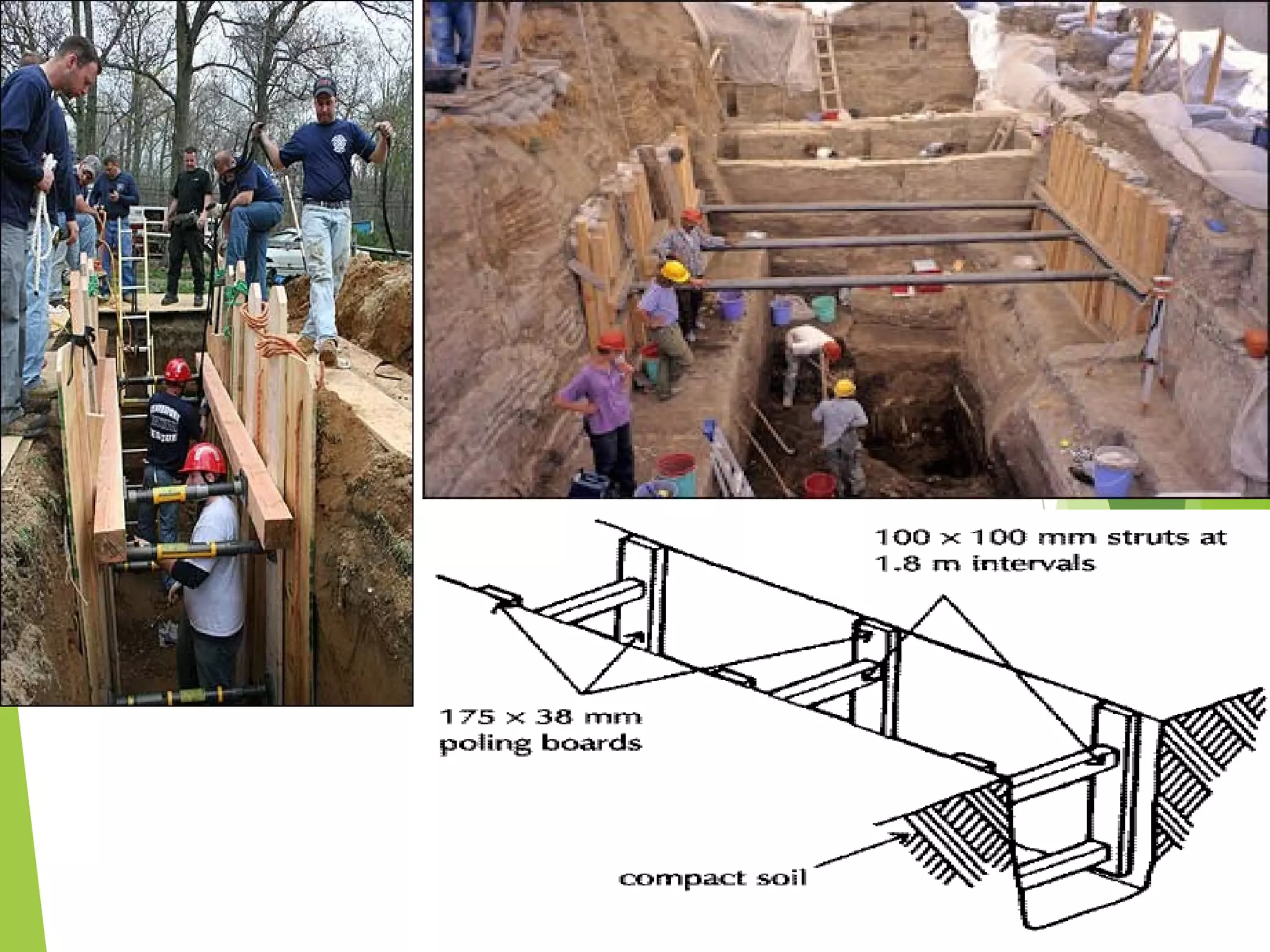
 This method is used for supporting the sides or a bench excavated in
fairly firm soil, when the depth of excavation does not exceed about 2
metres.
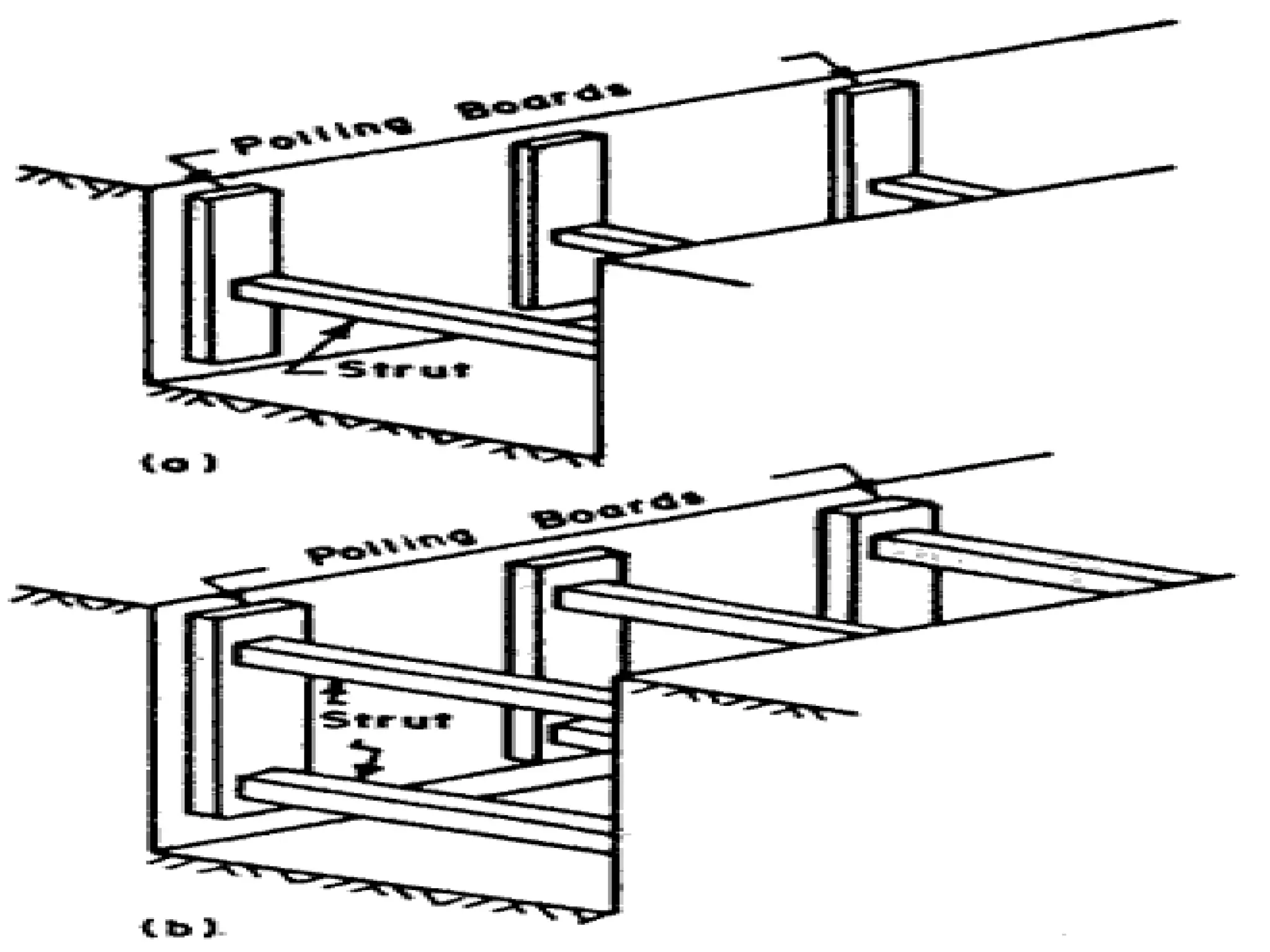
 The method consists of placing vertical sheets called sheathing or
polling boards opposite each other against the two walls of the trench
and holding them in position by one or two rows of struts.
 The sheets are placed at an interval of 2 to 4 metres and generally,
they extend to the full height of the trench.
 The polling boards may have width of about 200 mm and thickness of
44 to 50 mm. The struts may have size 1OO x 100 mm for trench up
to 2 m width and 200 x 200 mm for trench up to 4 m width.
Box sheeting:
 This method is adopted in loose soils, when the depth of excavation
does not exceed 4 metres. 
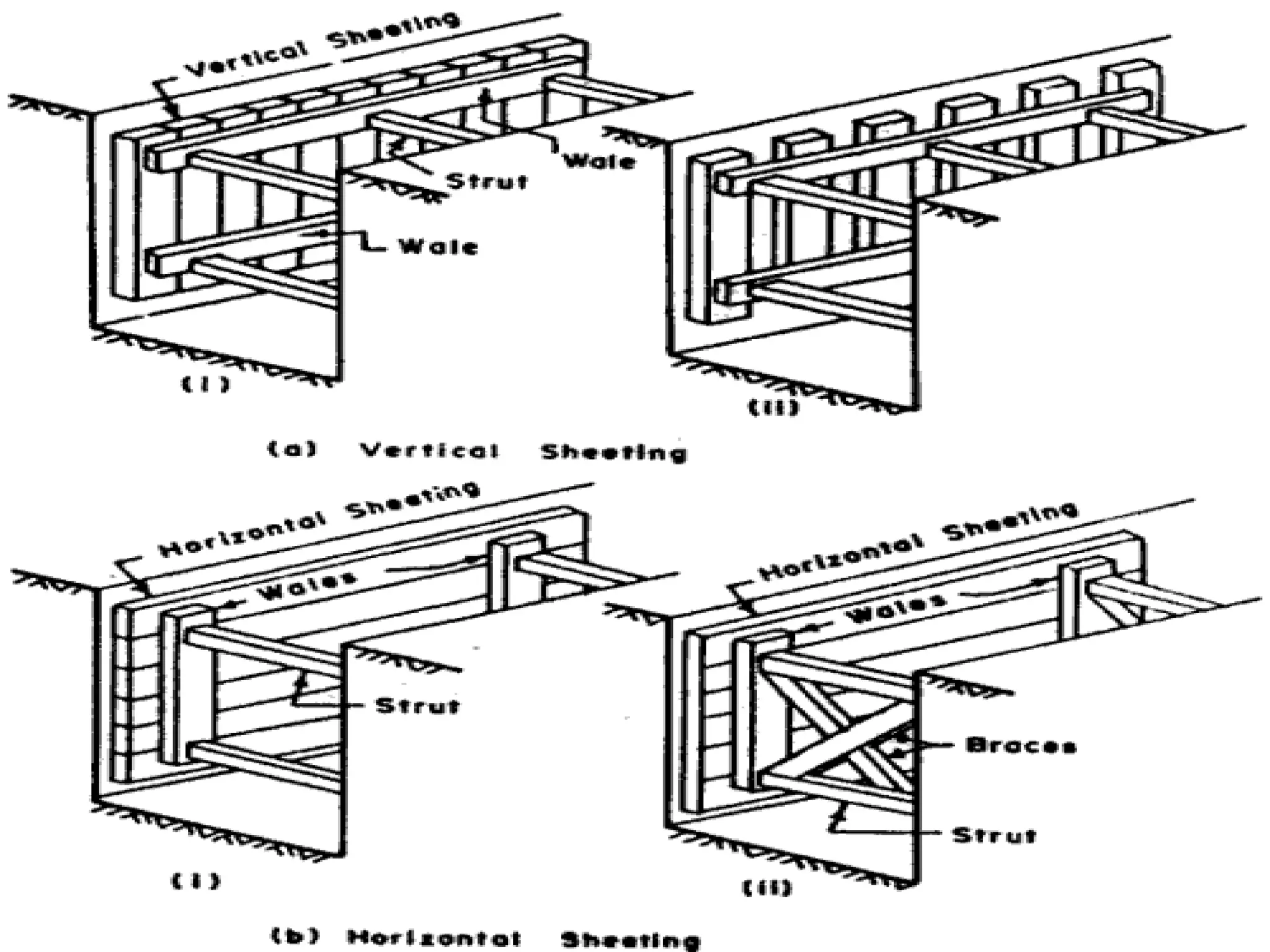
 Fig. shows the box like structure, consisting of vertical sheets placed
very near to each other (some times touching each other) and keeping
them in position by longitudinal rows (usually two) of wales. Struts are
then provided across the wales.
 Another system of box sheeting, shown in Fig, is adopted for very
loose soils.
 In this system, the sheeting is provided longitudinally, and they are
supported by vertical wales and horizontal  struts. If the height is
more, braces are also provided along with struts.
Vertical sheeting:
 This system is adopted for deep trenches (upto 10 m depth) in soft
ground.
 The method is similar to the box sheeting except that the excavation
is carried out in stages and at the end of each stage, an offset is
provided, so that the width of the trench goes on decreasing as the
depth increases.
 Each stage is limited to about 3 m in height and the offset may vary
from 25 to 50 cm per stage. For each stage, separate vertical
sheeting, supported by horizontal wailings and struts are provided
(Fig. 2.33)
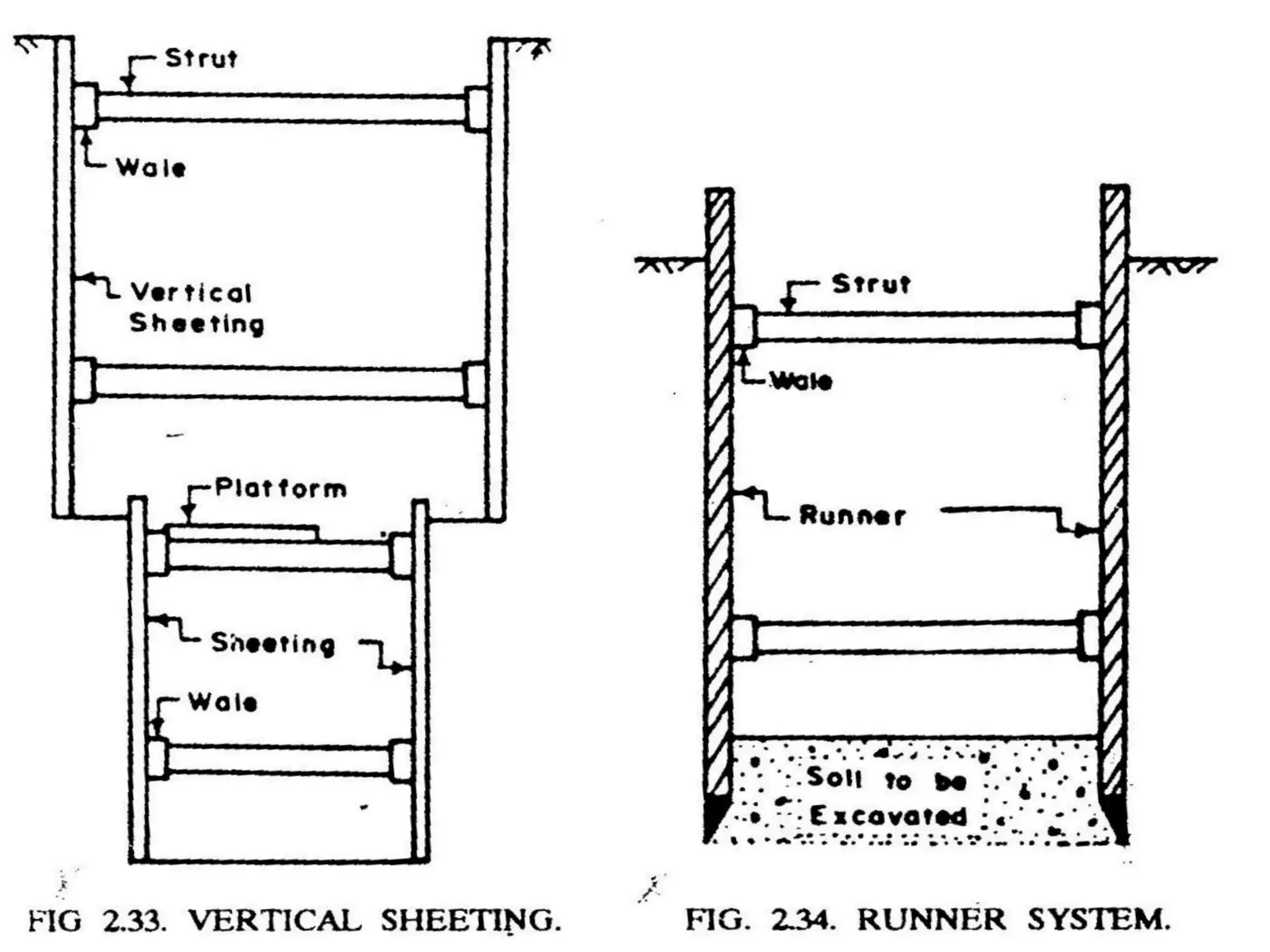
Runner system:
 This system is used in extremely loose and soft ground,
which needs immediate support as excavation progresses.
The system is similar to vertical sheeting of box system,
except that in the place of vertical sheeting, runners,
made of long thick wooden sheets or planks with iron shoe
at the ends, are provided. Wales and struts are provided
as usual. These runners are driven about 30 cm in advance
of the progress of the work, by hammering.
Sheet piling:
 This method is adopted when
 (i) soil to be excavated is soft or loose
 (ii) depth of excavation is large
 (iii) width of trench is also large and
 (iv) there is sub-soil water.
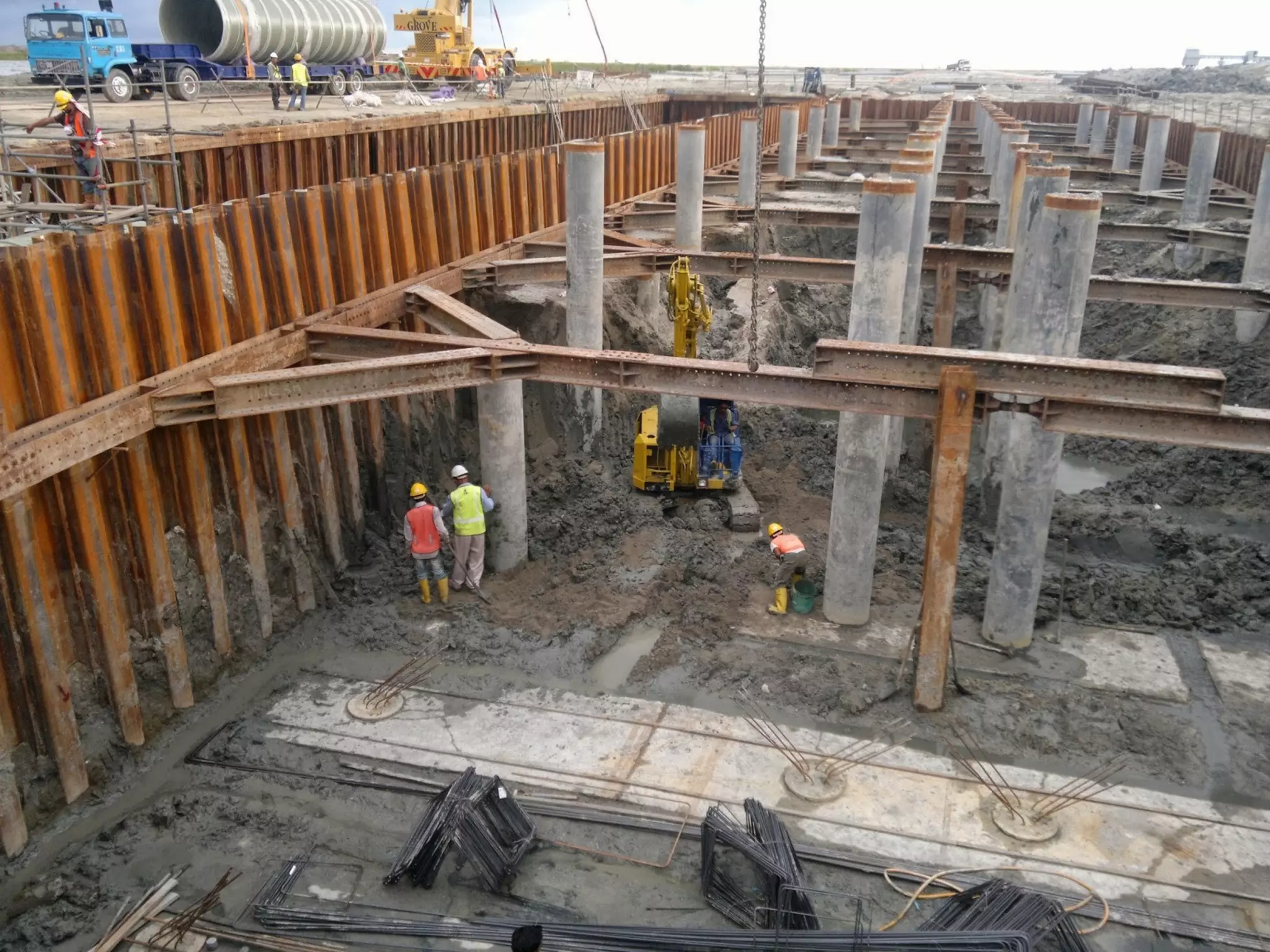
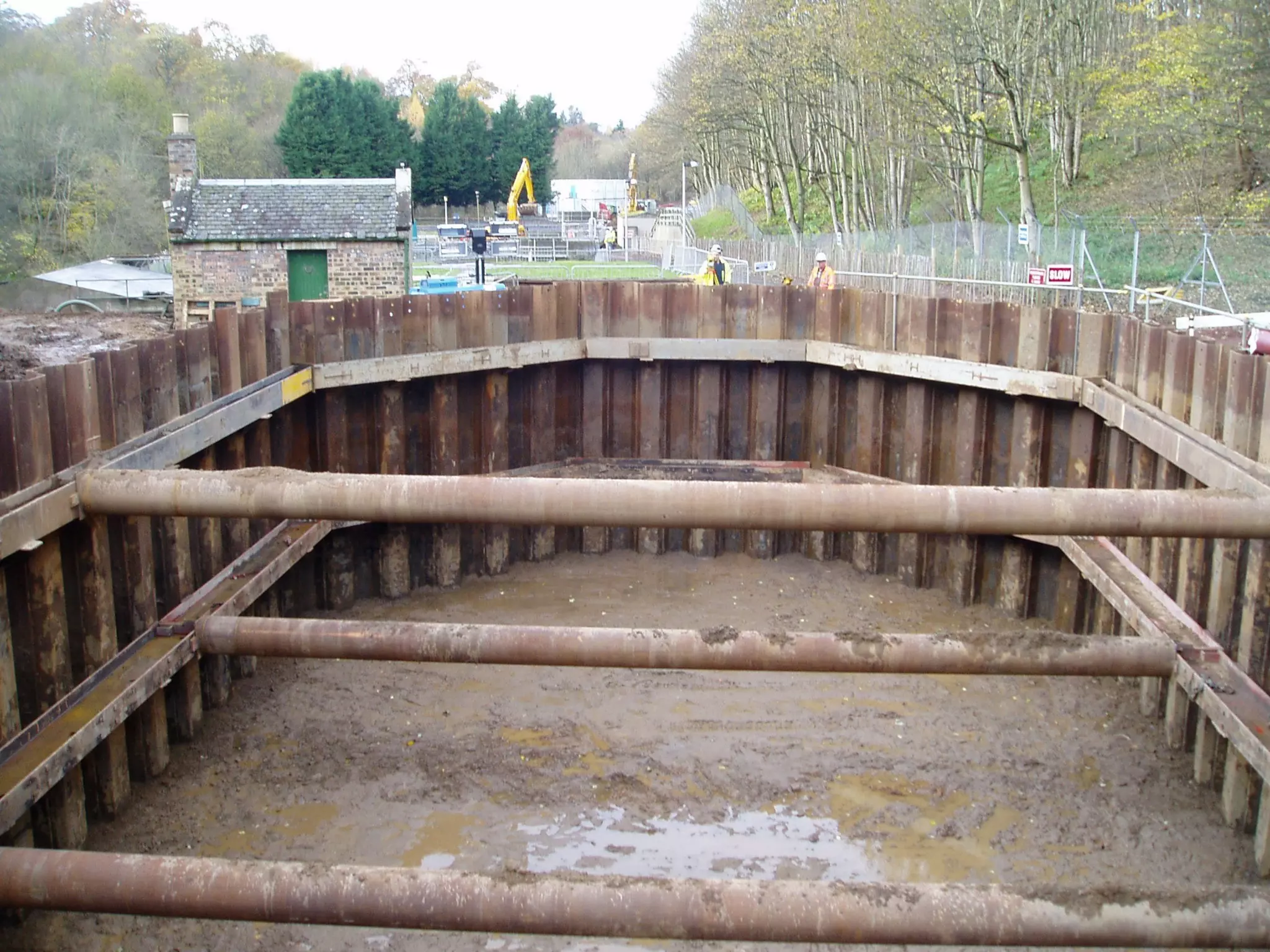
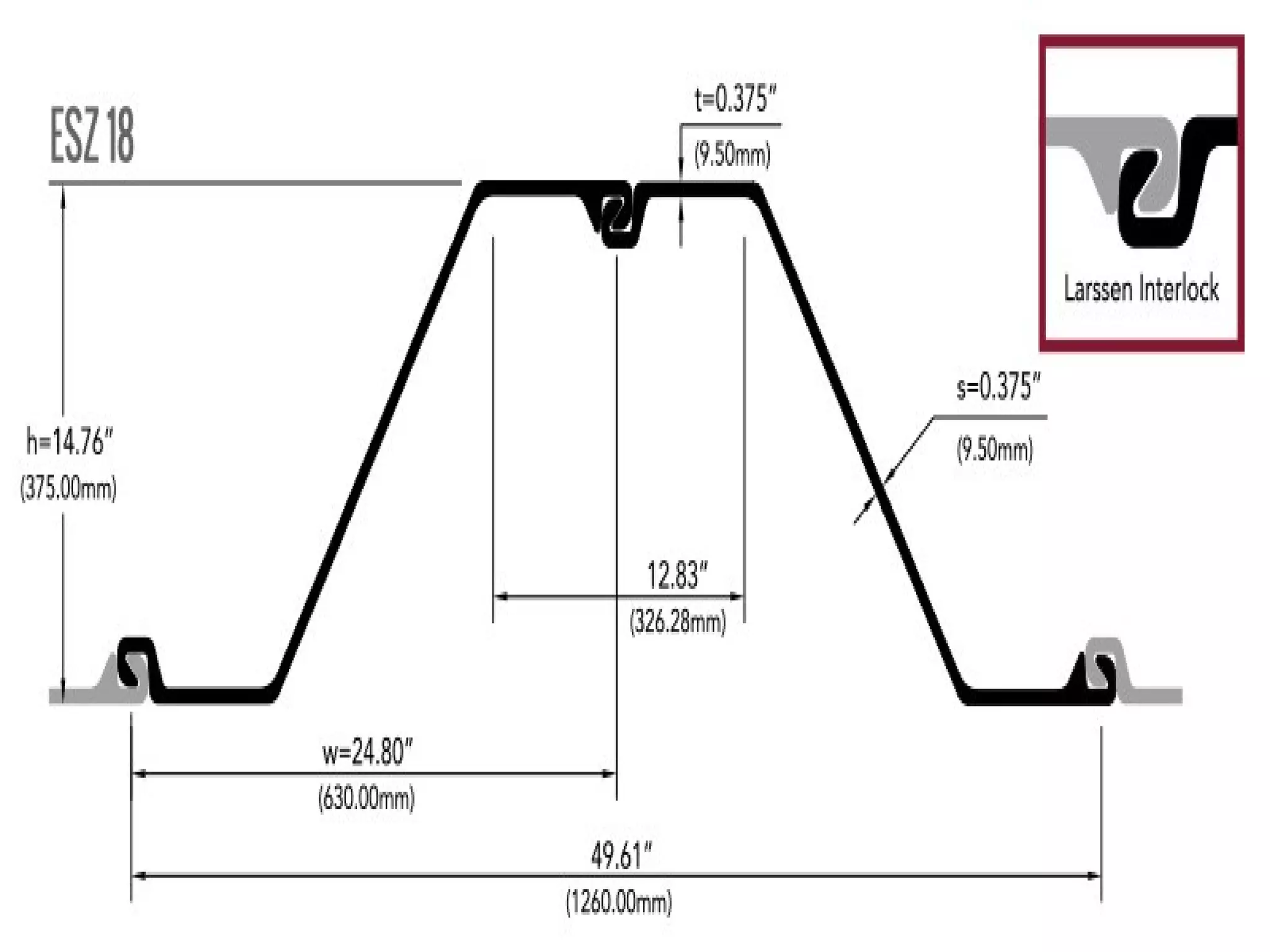
 Sheet piles are designed to resist lateral earth pressure. These are
driven in the ground by mechanical means (pile driving equipment).
They can be used for excavating to a very large depth.
Shoring:
 Shoring is the construction of a temporary structure to support
temporarily an unsafe structure. These support walls laterally.
 They can be used under the following circumstances:
1. When walls bulge out due to bad workmanship
2. When walls crack due to unequal settlement of foundation and
repairs are to be carried out to the cracked wall.
3. When an adjacent structure needs pulling down/dismantled.
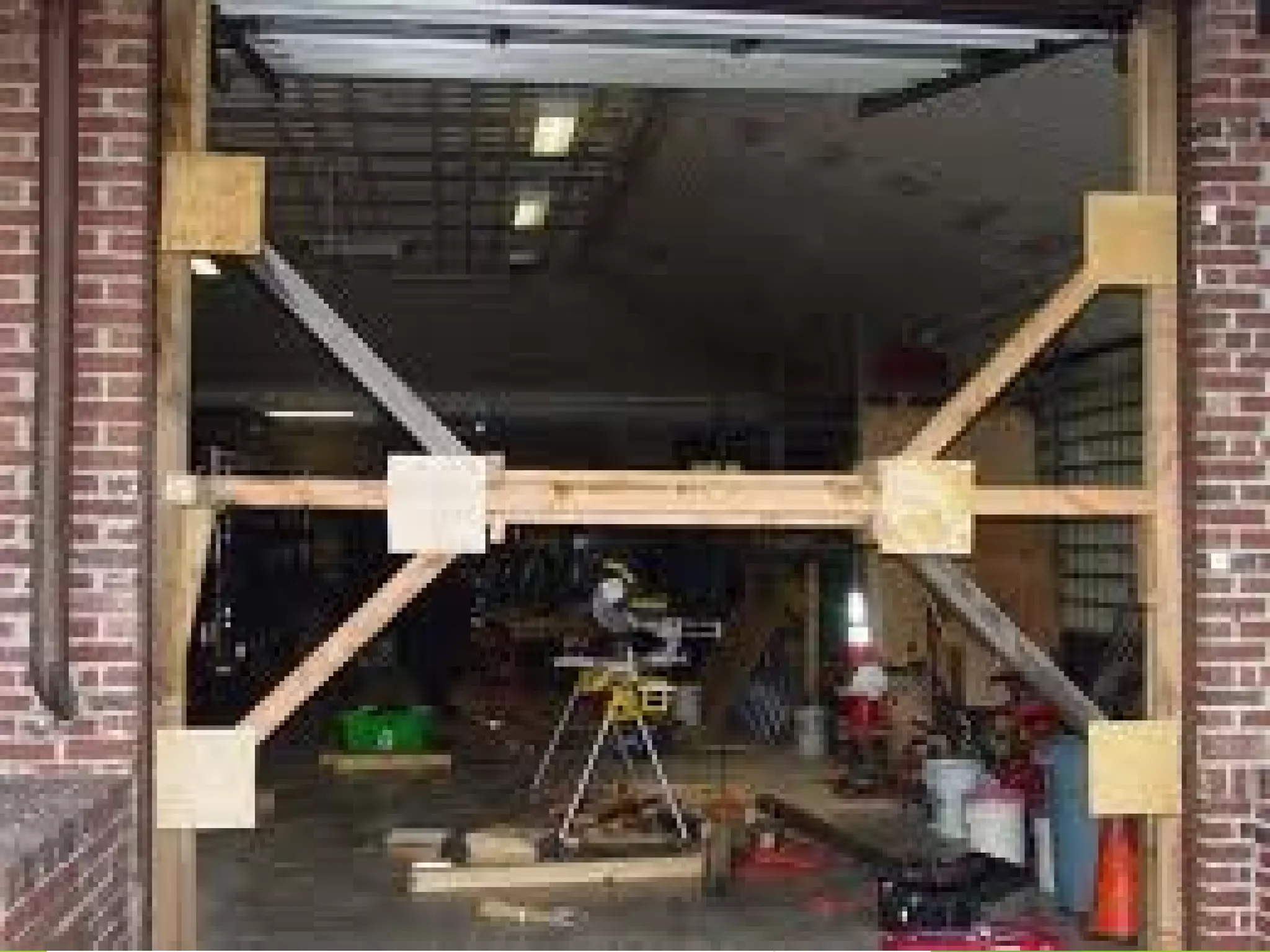
4. When openings are to be newly made or enlarged in a wall.
Types of Shoring:
1. Raking shores
2. Flying shores
3. Dead shores
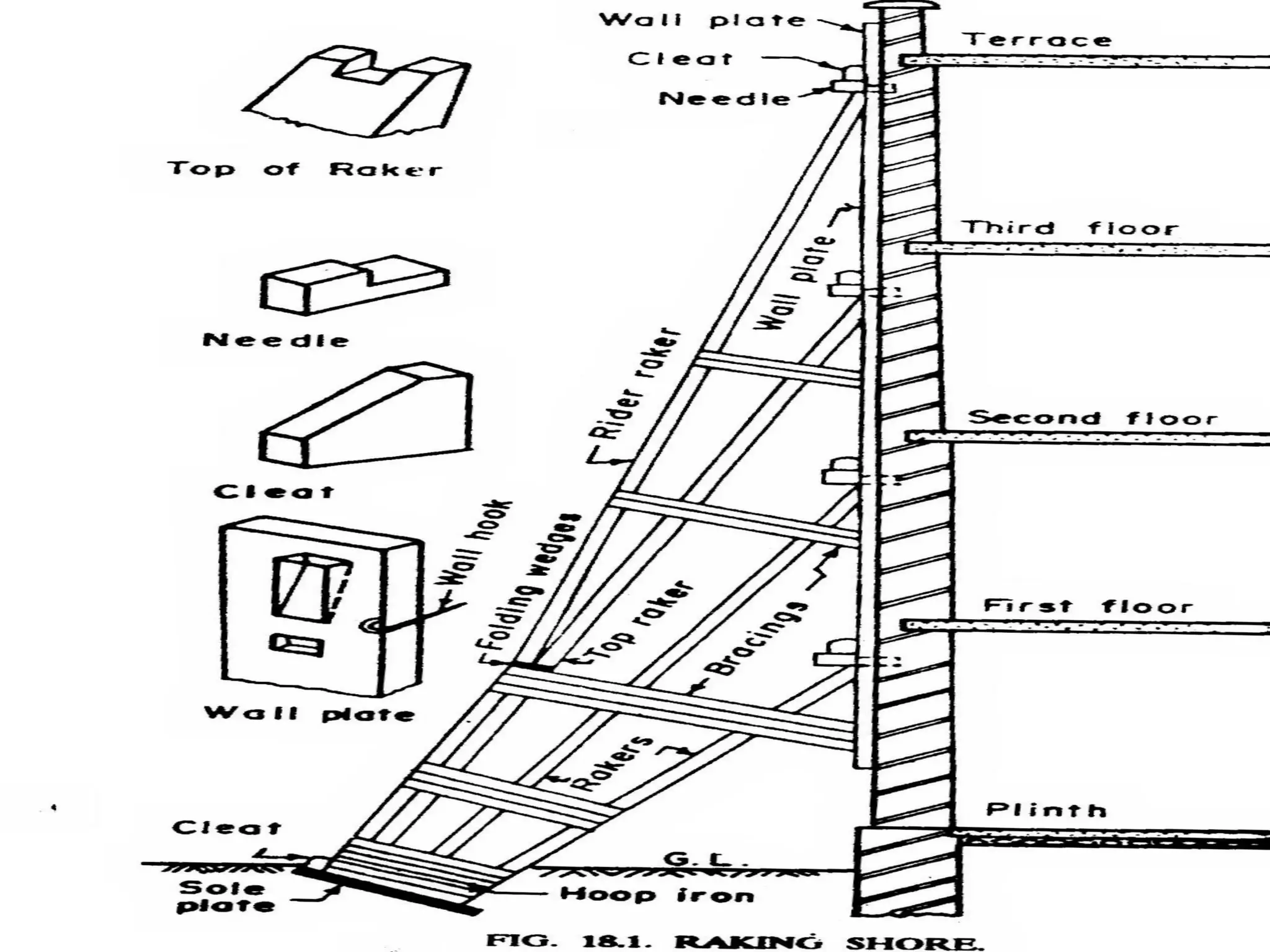
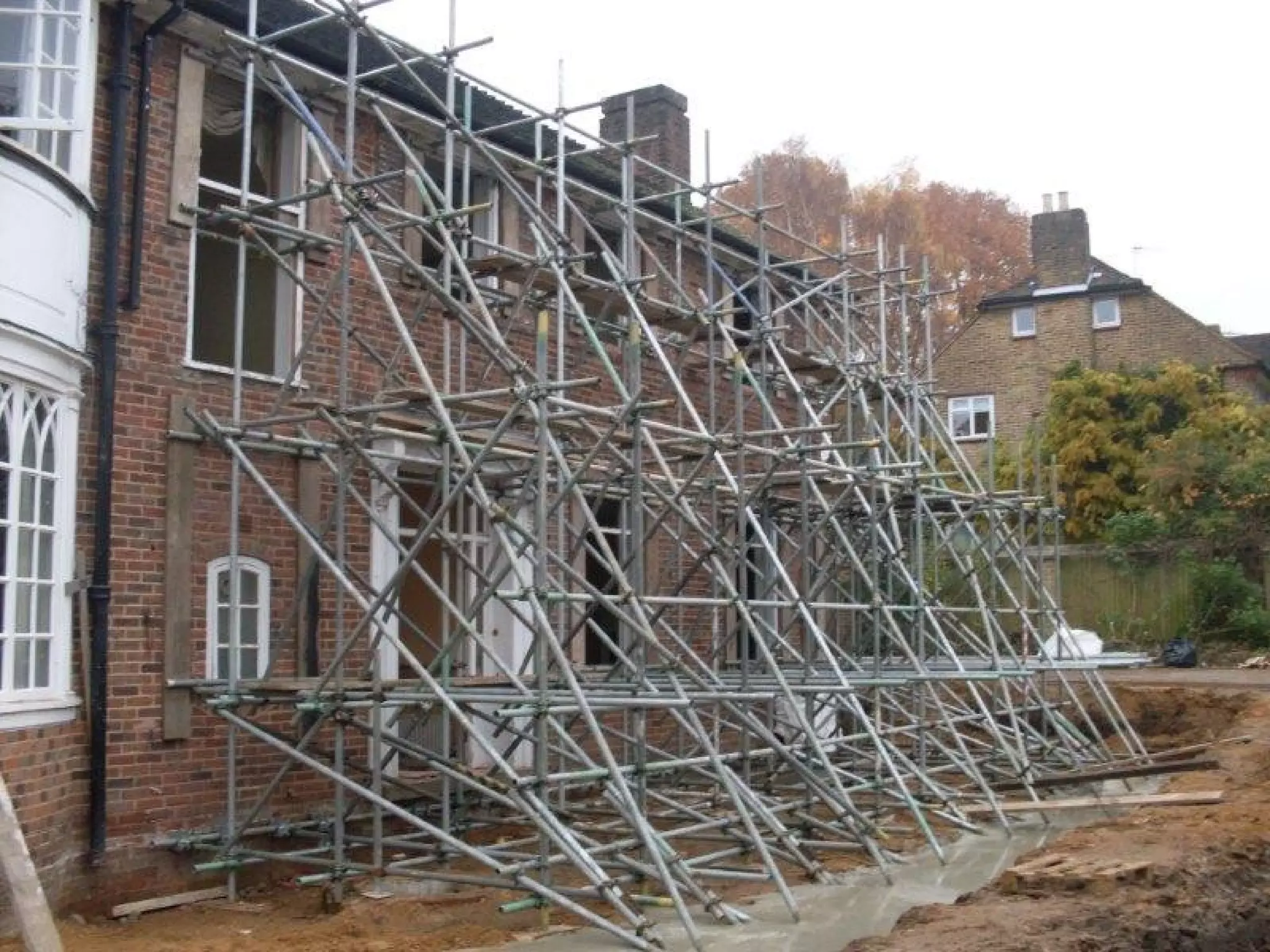
Raking Shores (Inclined Shores):
 In this method, inclined members known as rakers are used
to give lateral supports to walls. A raking shore consists of
the following components:
1. Rakers or Inclined member
2. Wall plate
3. Needles
4. Cleats
5. Bracing
6. Sole plate
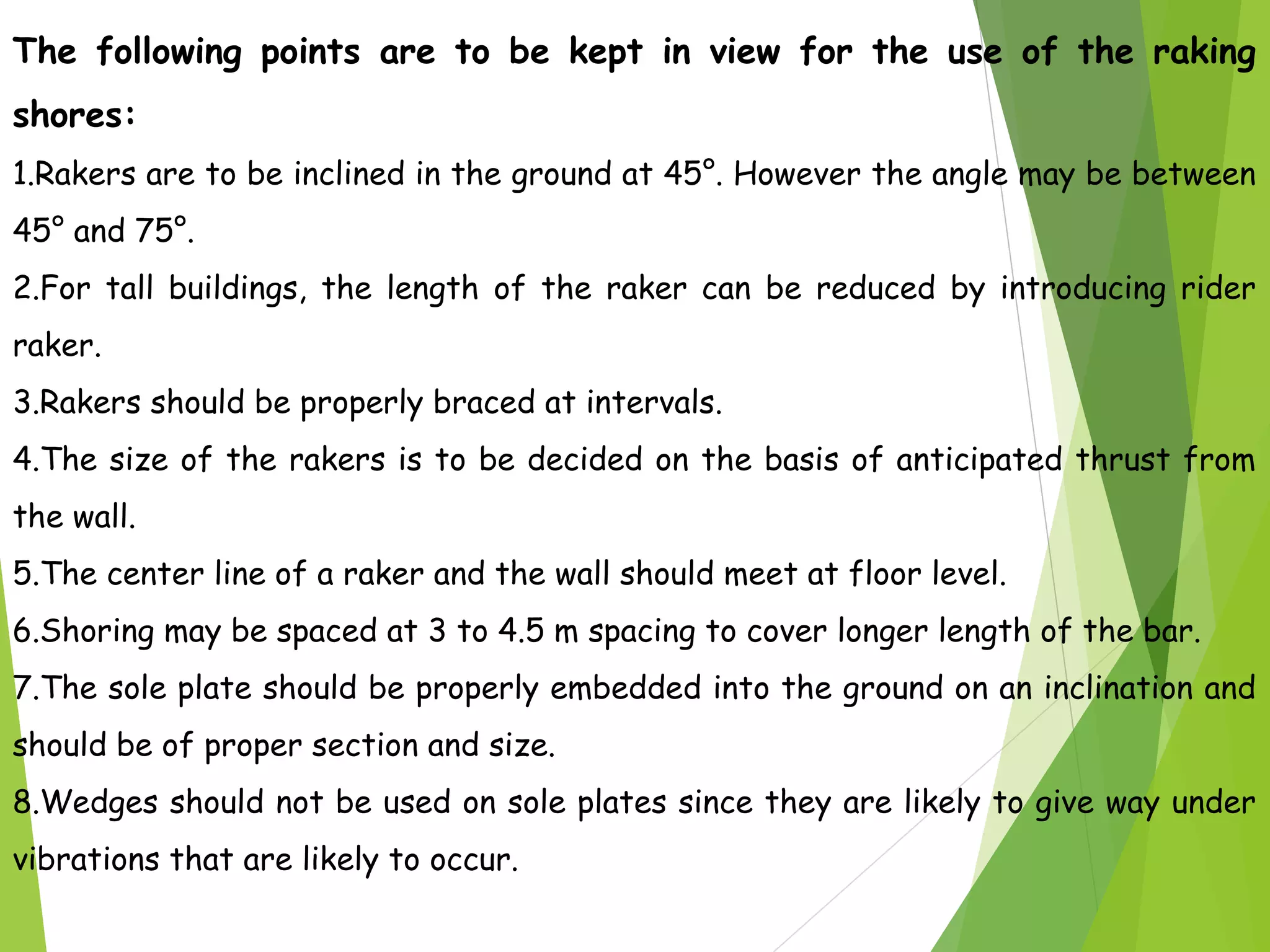
The following points are to be kept in view for the use of the raking
shores:
1.Rakers are to be inclined in the ground at 45°. However the angle may be between
45° and 75°.
2.For tall buildings, the length of the raker can be reduced by introducing rider
raker.
3.Rakers should be properly braced at intervals.
4.The size of the rakers is to be decided on the basis of anticipated thrust from
the wall.
5.The center line of a raker and the wall should meet at floor level.
6.Shoring may be spaced at 3 to 4.5 m spacing to cover longer length of the bar.
7.The sole plate should be properly embedded into the ground on an inclination and
should be of proper section and size.
8.Wedges should not be used on sole plates since they are likely to give way under
vibrations that are likely to occur.
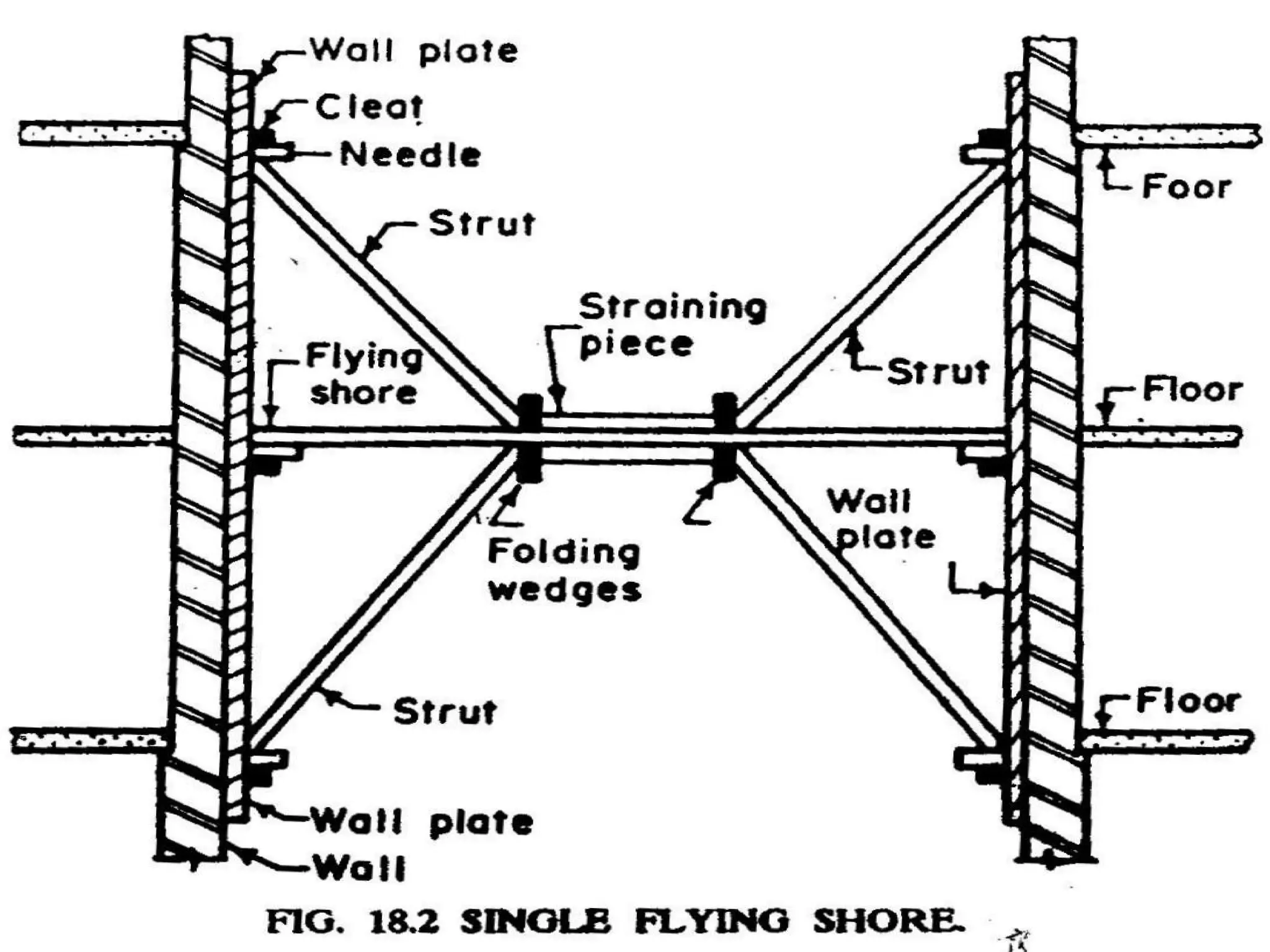
Flying Shores (Horizontal Shores):
 It is a system of providing temporary supports to the party walls of the two
buildings where the intermediate building is to be pulled down and rebuilt.
 All types of arrangements of supporting the unsafe structure in which the
shores do not reach the ground come under this category.
 They flying shore consists of wall plates, needles, cleats, horizontal struts
(commonly known as horizontal shores) and inclined struts arranged in different
forms which varies with the situation.
 In this system also the wall plates are placed against the wall and secured to it.
 A horizontal strut is placed between the wall plates and is supported by a
system of needle and cleats.
 The inclined struts are supported by the needle at their top and by straining
pieces at their feet.
 The straining piece is also known as straining sill and is spiked to the horizontal
shore. The width of straining piece is the same as that of the strut.
 If the walls are quit near to each other (distance upto 9 m) called as
Single flying shore.
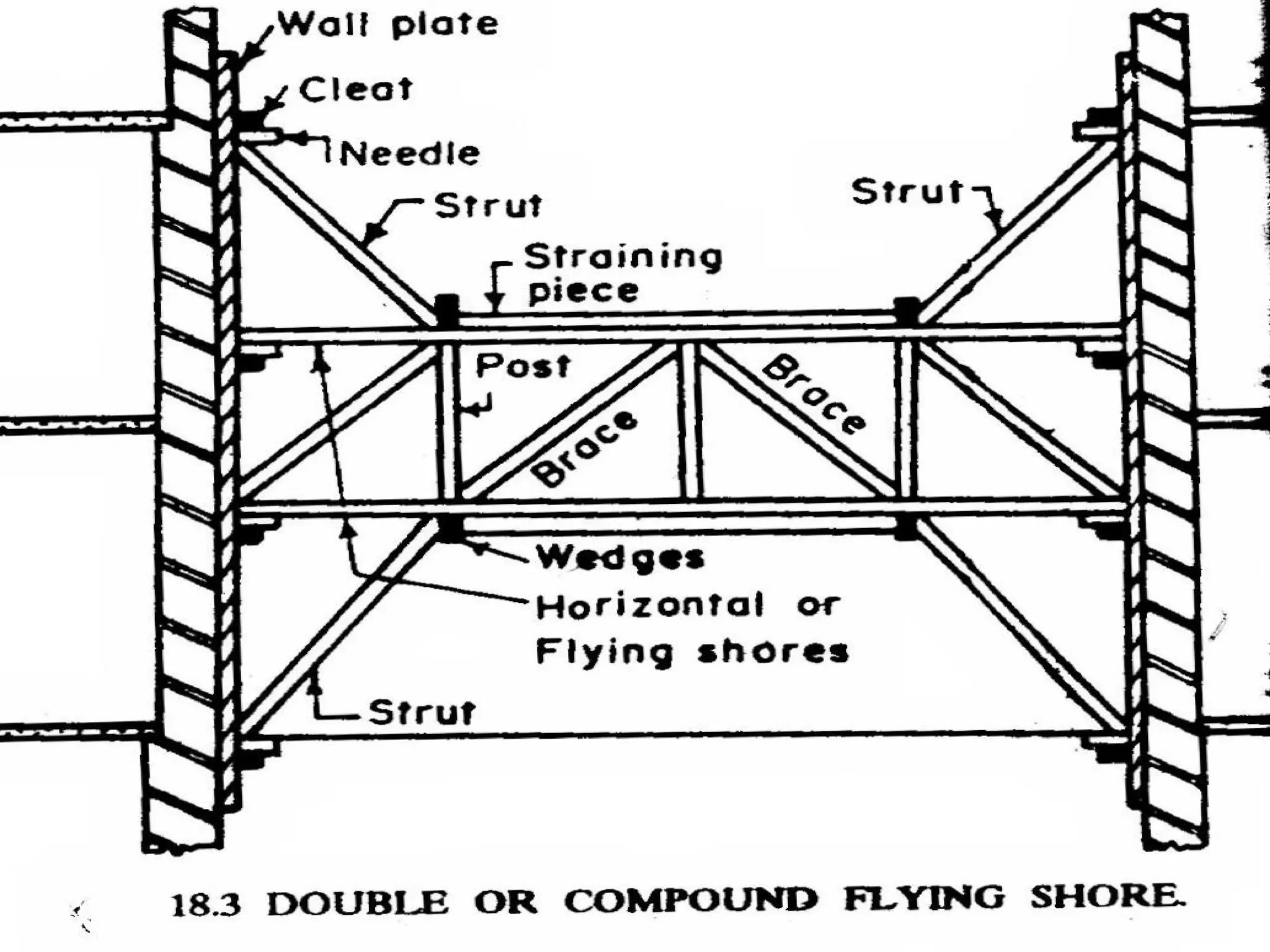
 When the distance between the walls is more than 9 m a compound or
double flying shore will be provided.
Points kept in mind:-
 Struts should preferably be inclined at 45 degree. In no case it should
be exceed 60 degree.
 Single shore used only upto 9 m wall for greater distance double shore
should be provided.
 Factor of safety should be taken. It should be inserted when the old
building is being removing and it should be kept in position till the new
unit is constructed.
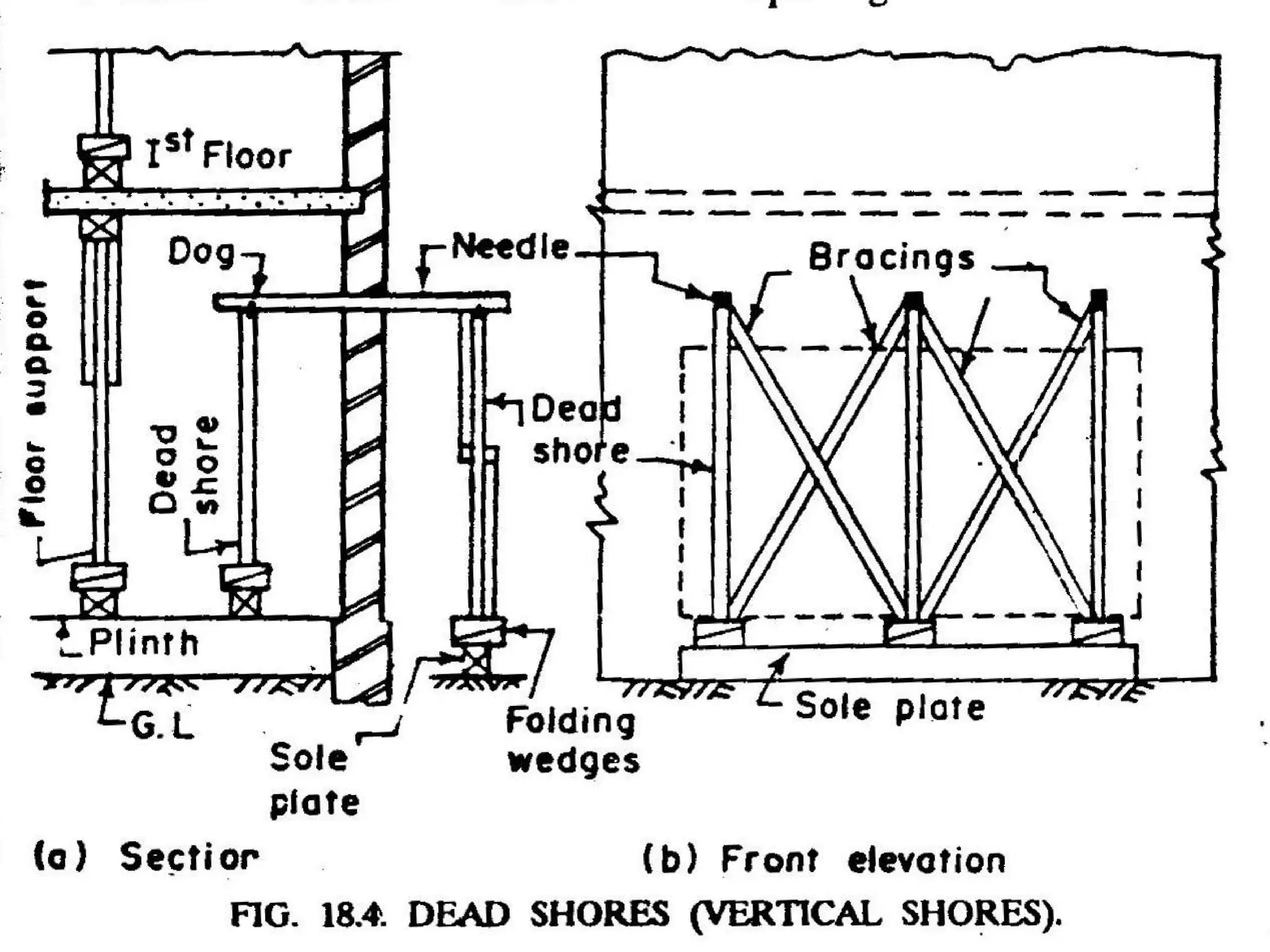
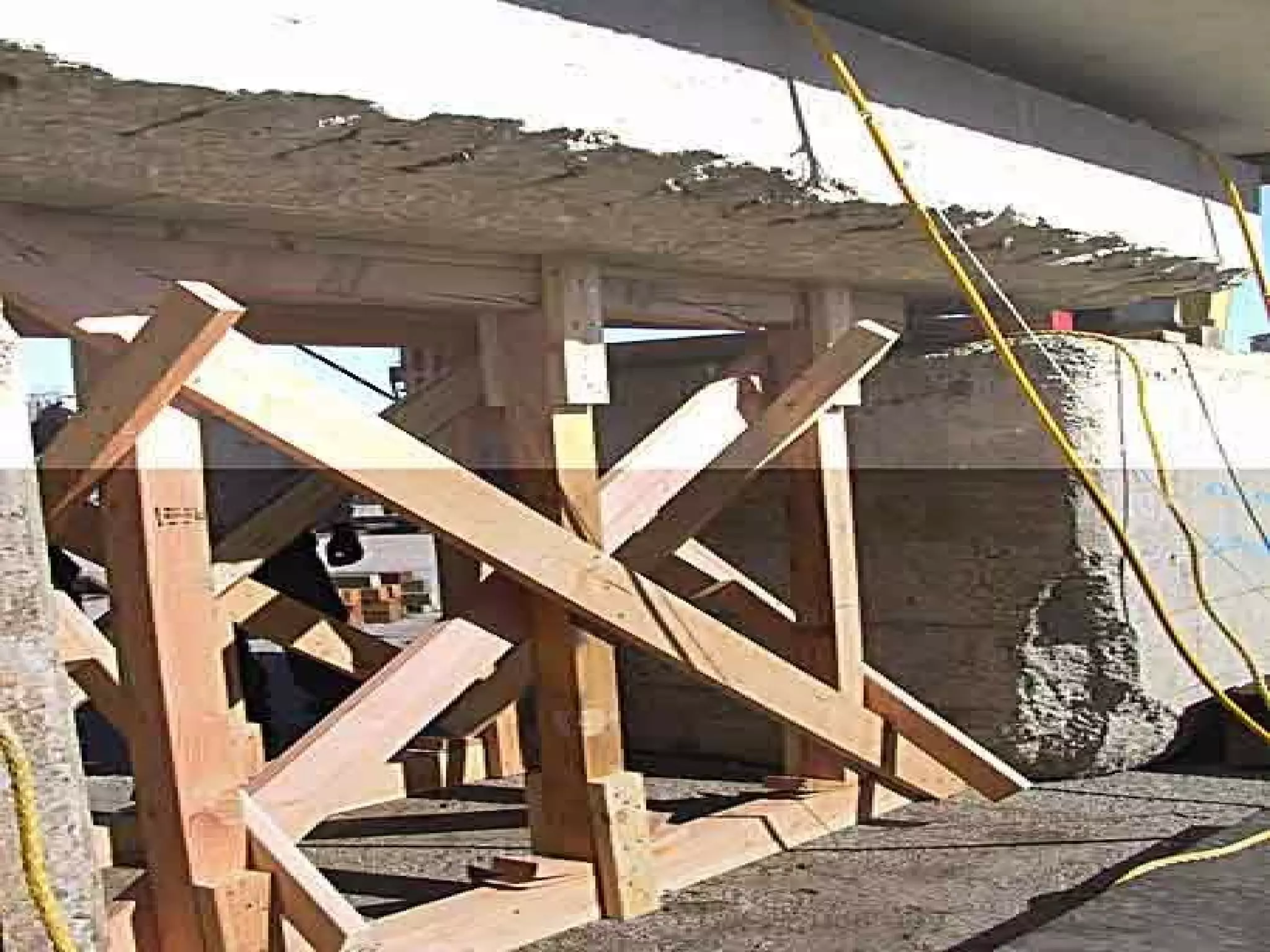
Dead Shores:
 This is consist vertical members known as Dead shores supporting
horizontal member known as needles.
 The needle transfer the load of the wall etc. to the dead shores. Such
shoring is provided to serve for following purpose.
1. To rebuild the defective lower part of the wall.
2. To rebuild or deepen the existing foundation.
3. To make large opening in the existing wall at lower level.
 Holes are made in the wall at suitable height needles which are made of
thick wooden sections or of steel are inserted in the holes.
 Each needle is supported at its two ends by vertical posts or dead
shores.
 Dead shores are supported on sole plates and folding wedges.
 Points to be kept in mind :-
 The section of needle and dead shore should be adequate to transfer the
load, which can estimated with fair degree of accuracy
 Needles are spaced at 1 to 2 metres minimum three needles used for an
opening.
 If the opening is made in an external wall, the length of outer dead shore
will be greater than the inner ones.
 If the external wall is week raking shore may be provided in addition to the
dead shores.
 Shores should be removed only when the new work has gained sufficient
strength. But in no case earlier than 7 days of the completion of new work.
The new work should have proper strutting.
 Sequence of removal should be ..1 needles…2 strutting from opening.....3
Floor strutting…4 raking shore if any.
 An interval of 2 days should be allowed between each one of these removal
operations.
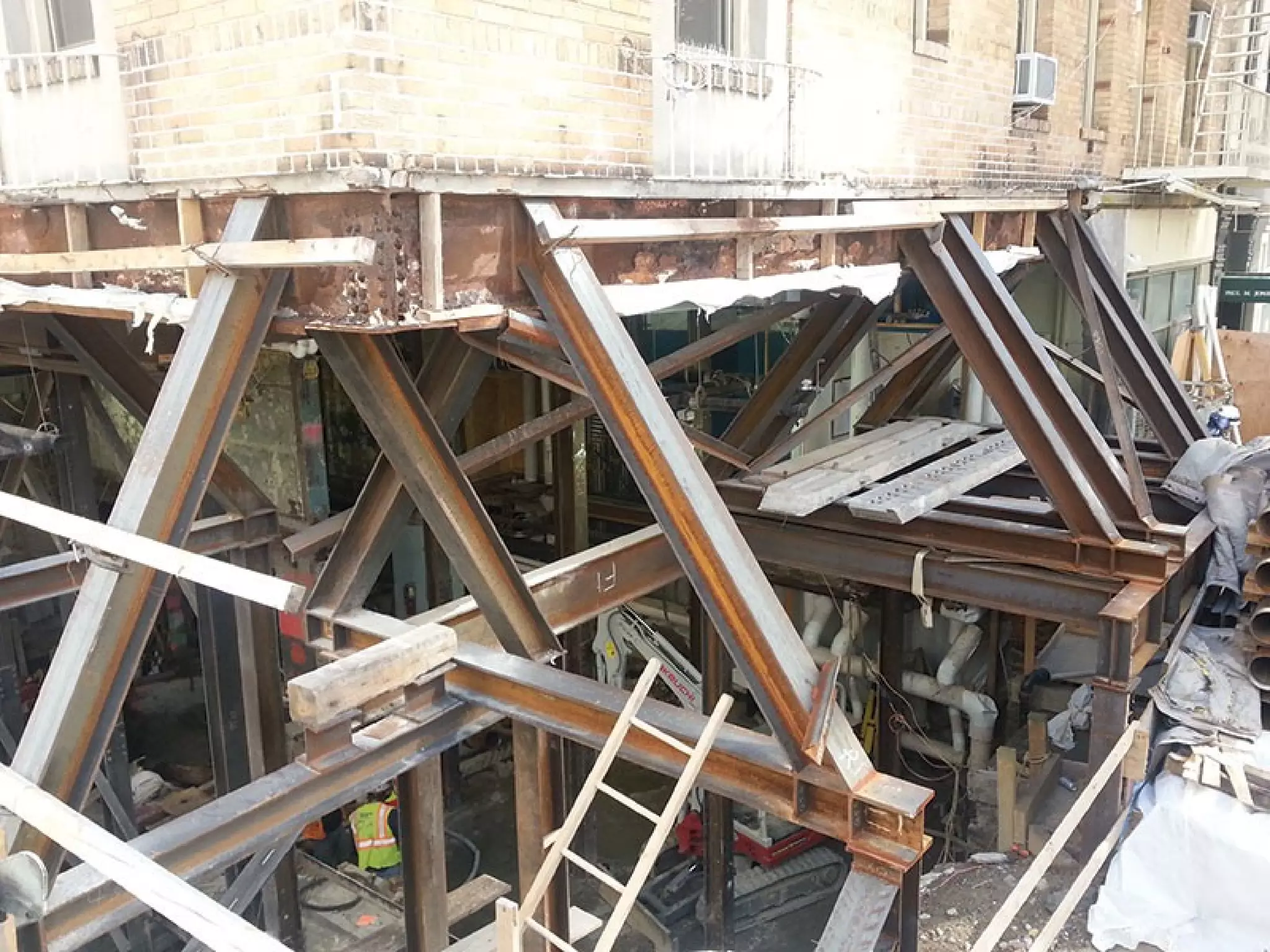
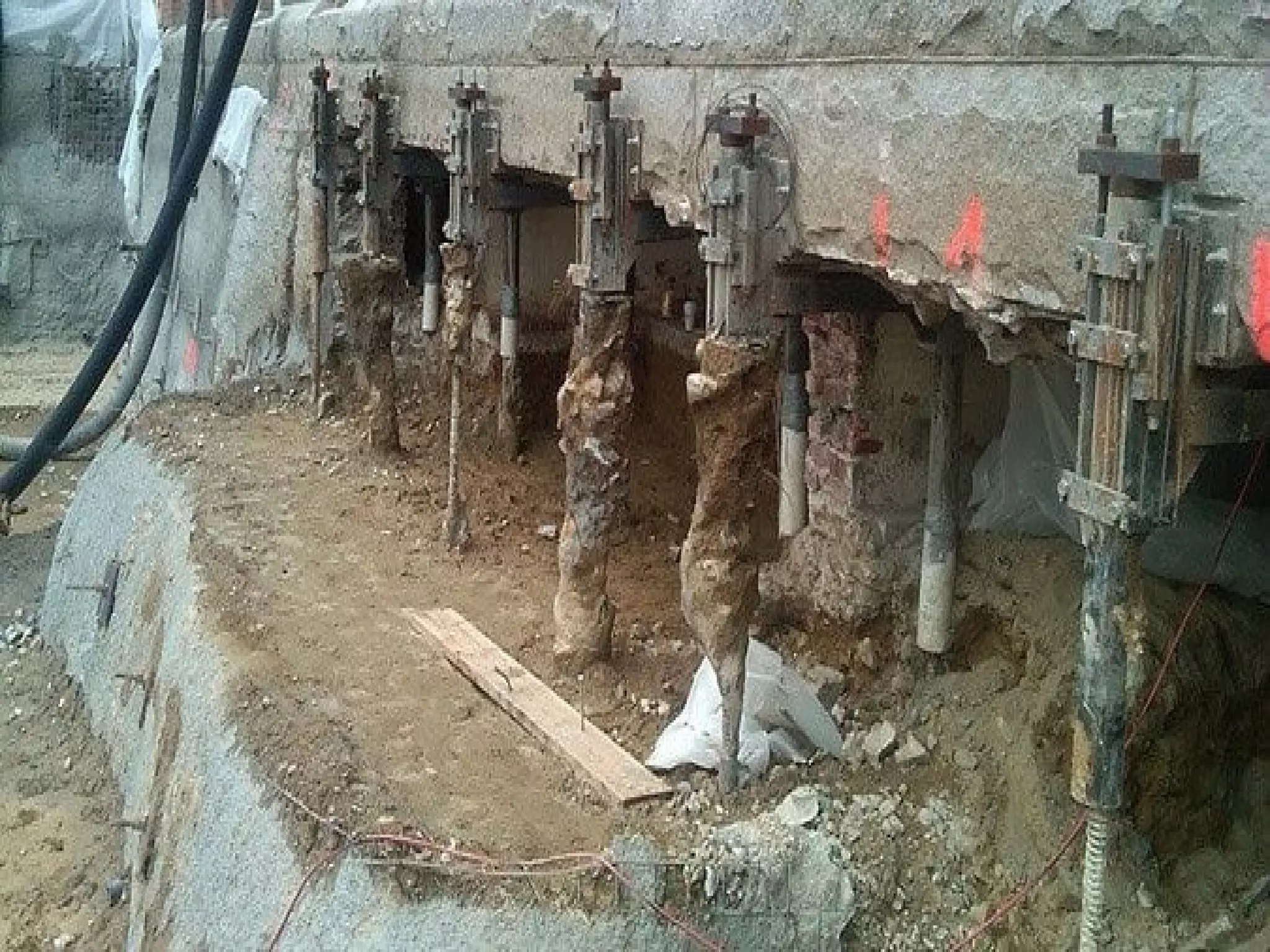
Underpinning:
 The process of placing a new foundation under an existing one or
strengthening an existing foundation is called underpinning of
foundation.
 It may required to serve following purposes:
 To strengthen the shallow foundation of existing building when a
building with deep foundation is to be constructed adjoining it.
 To strengthen existing foundation which has settled and caused cracks
in the wall
 To deepen the existing foundation (resting on poor strata) so as to rest
it on deeper soil strata of higher bearing capacity.
 To construct a basement under an existing building.
There are two underpinning Methods. They are:
 Pit Method
 Pile Method
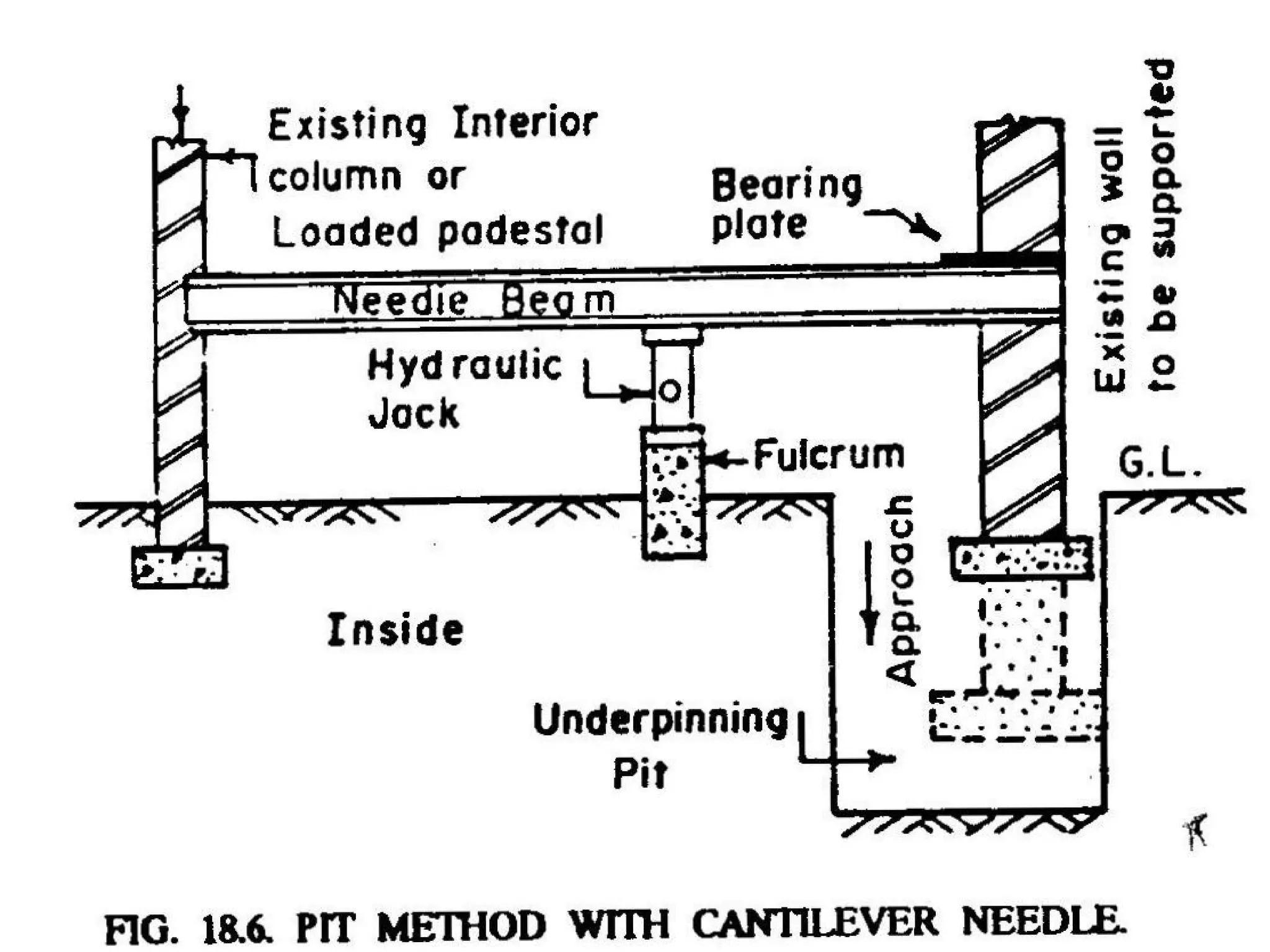
Pit Method:
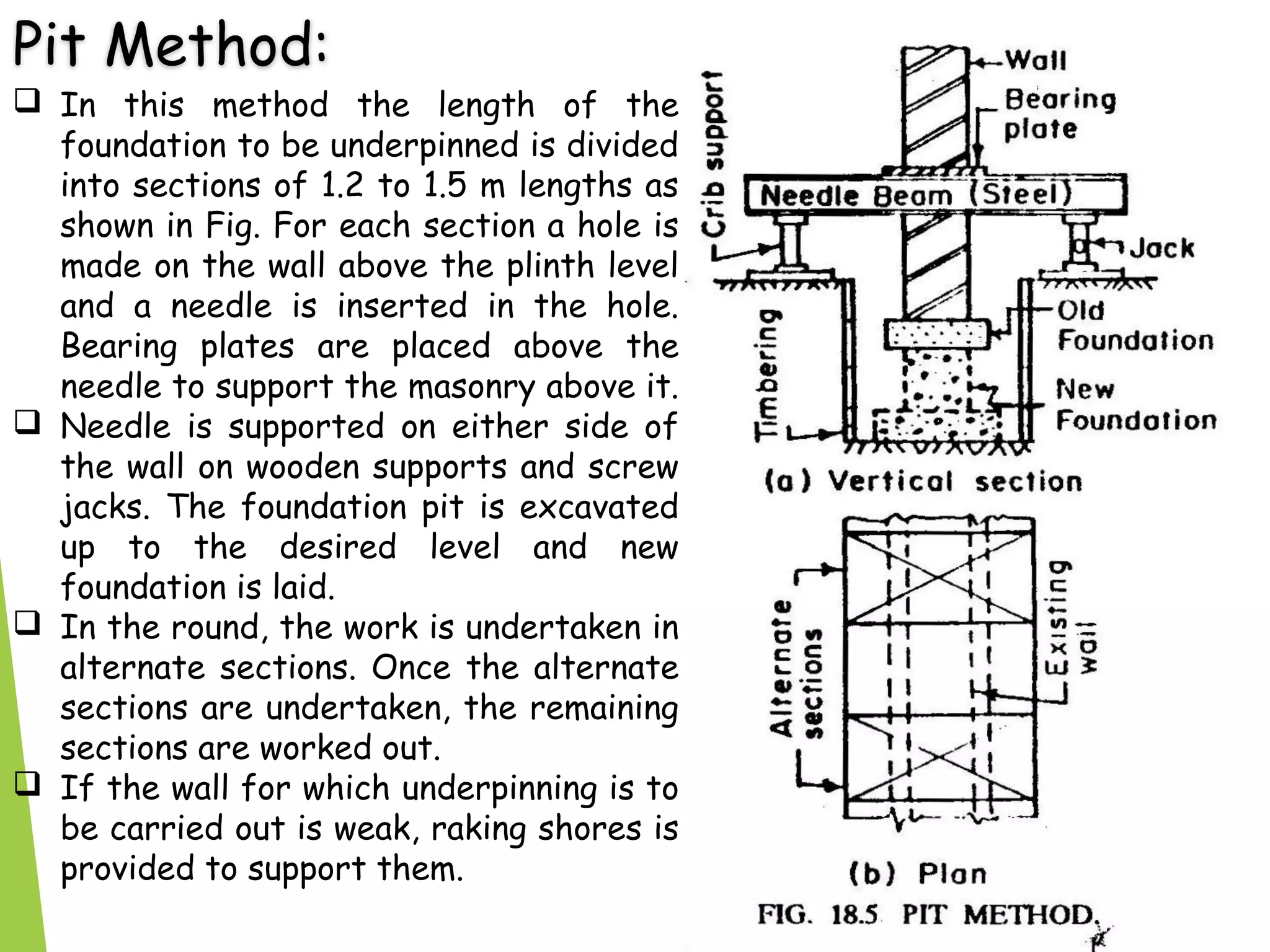
 In this method the length of the
foundation to be underpinned is divided
into sections of 1.2 to 1.5 m lengths as
shown in Fig. For each section a hole is
made on the wall above the plinth level
and a needle is inserted in the hole.
Bearing plates are placed above the
needle to support the masonry above it.
 Needle is supported on either side of
the wall on wooden supports and screw
jacks. The foundation pit is excavated
up to the desired level and new
foundation is laid.
 In the round, the work is undertaken in
alternate sections. Once the alternate
sections are undertaken, the remaining
sections are worked out.
 If the wall for which underpinning is to
be carried out is weak, raking shores is
provided to support them.
 In pit method of underpinning, the following points are
noteworthy.
1. Alternate sections are taken up in the round. Remaining
sections should be taken next.
2. For long wall the work should be started from the middle
and worked outwards.
3. If the foundation is deeper, proper timbering of the
foundation trench may be done.
4. The needle beam should be removed only when the new
foundation has gained strength.
5. It is desirable to do the new foundation work in concrete.
6. The needle should be closed in masonry using cement mortar.
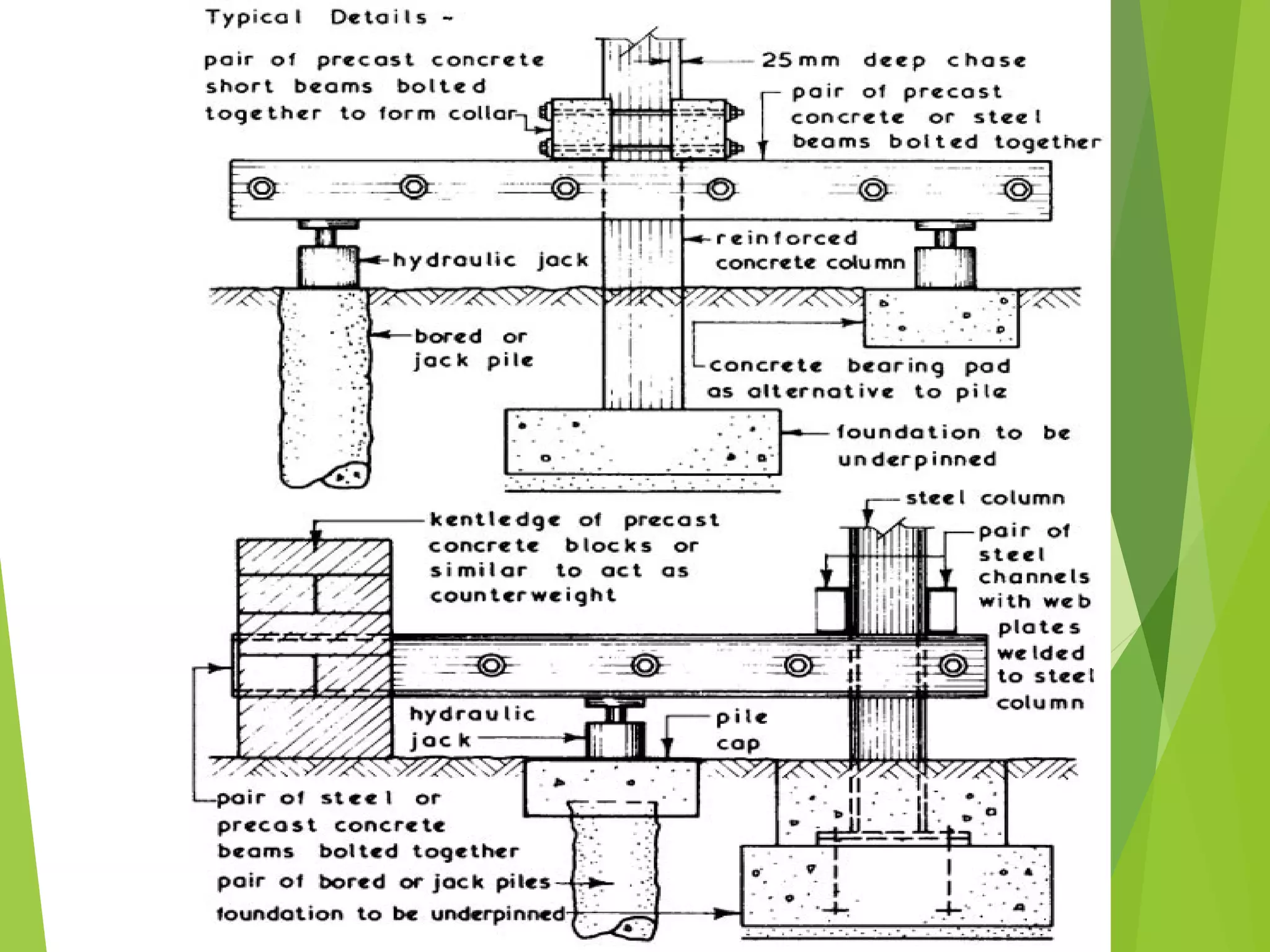
Pile Method:
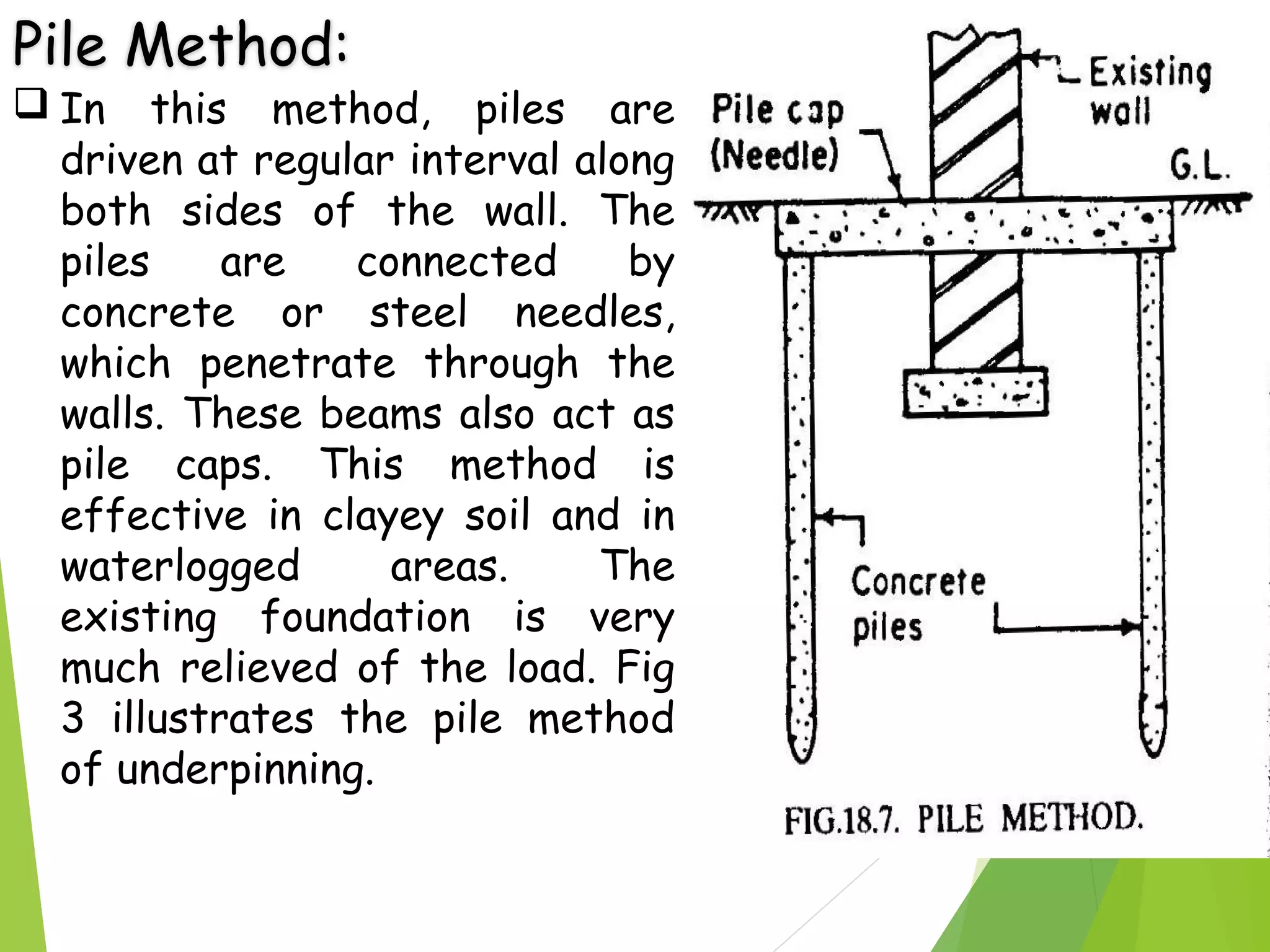
 In this method, piles are
driven at regular interval along
both sides of the wall. The
piles are connected by
concrete or steel needles,
which penetrate through the
walls. These beams also act as
pile caps. This method is
effective in clayey soil and in
waterlogged areas. The
existing foundation is very
much relieved of the load. Fig
3 illustrates the pile method
of underpinning.
ScaffoldingScaffolding:
 When the height of wall or column or other structural member of a
building exceed about 1.5 m, temporary structure are needed to support
the platform over which the workmen can sit and carry on the
constructions. These temporary structure, constructed very close to
the wall, is in the form of timber or steel framework, commonly called
scaffolding.
 It is also needed for the repairs or even demolition of a building.
 It should be stable and strong enough to support workmen and other
construction material placed on the platform supported by the
scaffolding.
 The height of the scaffolding goes on increasing as the height of
construction increases.
Types of Scaffolding used in Construction:
1. Single Scaffolding
2. Double Scaffolding
3. Cantilever Scaffolding
4. Suspended Scaffolding
5. Trestle Scaffolding
6. Steel Scaffolding
7. Patented Scaffolding
Single Scaffolding:
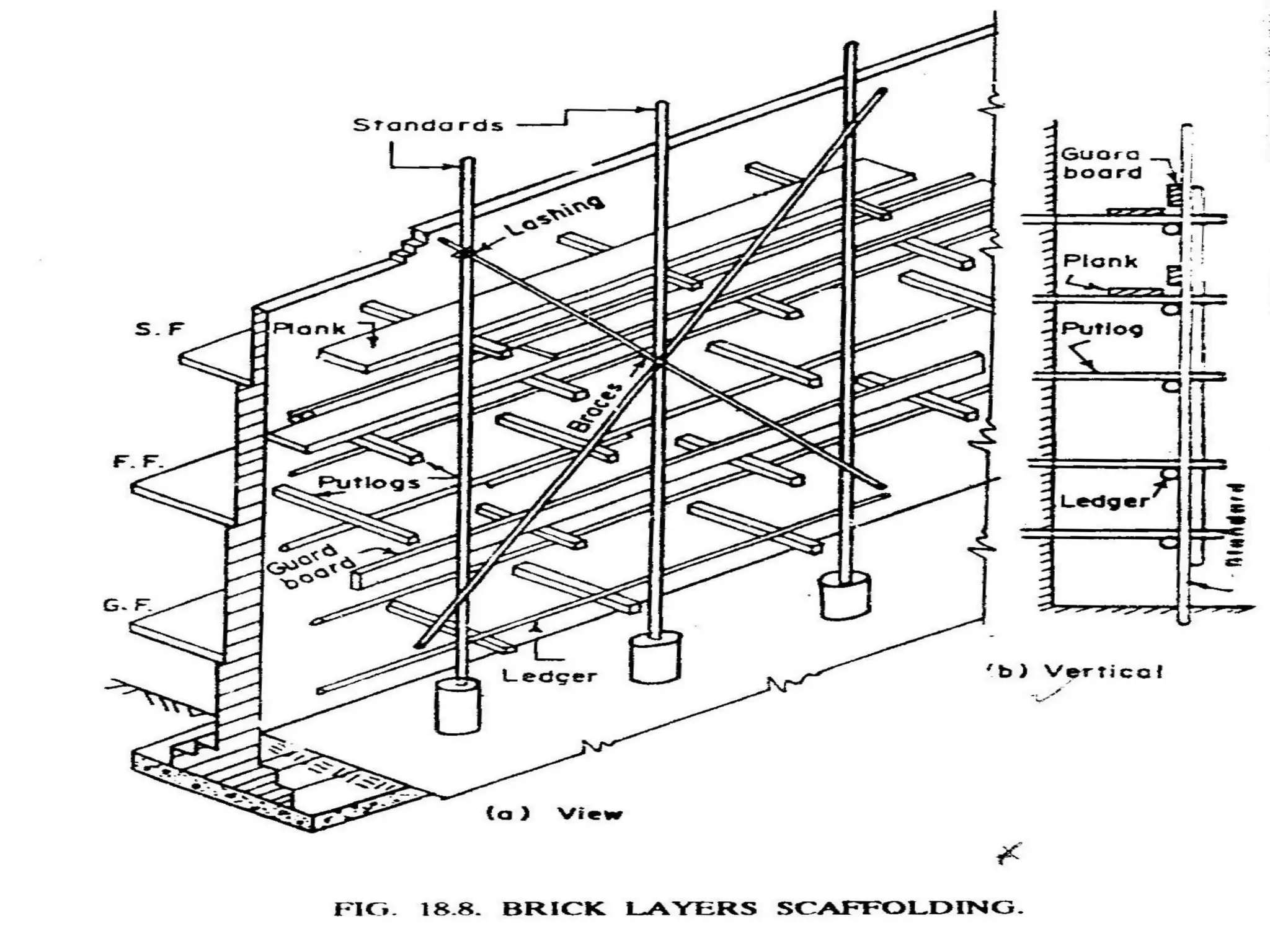
 Single scaffolding is generally used for brick masonry and
is also called as brick layer’s scaffolding & Putlog
scaffolding. Single scaffolding consists of standards,
ledgers, putlogs etc., which is parallel to the wall at a
distance of about 1.2 m. Distance between the standards is
about 2 to 2.5 m. Ledgers connect the standards at
vertical interval of 1.2 to 1.5 m. Putlogs are taken out from
the hole left in the wall to one end of the ledgers. Putlogs
are placed at an interval of 1.2 to 1.5 m.
Double Scaffolding:
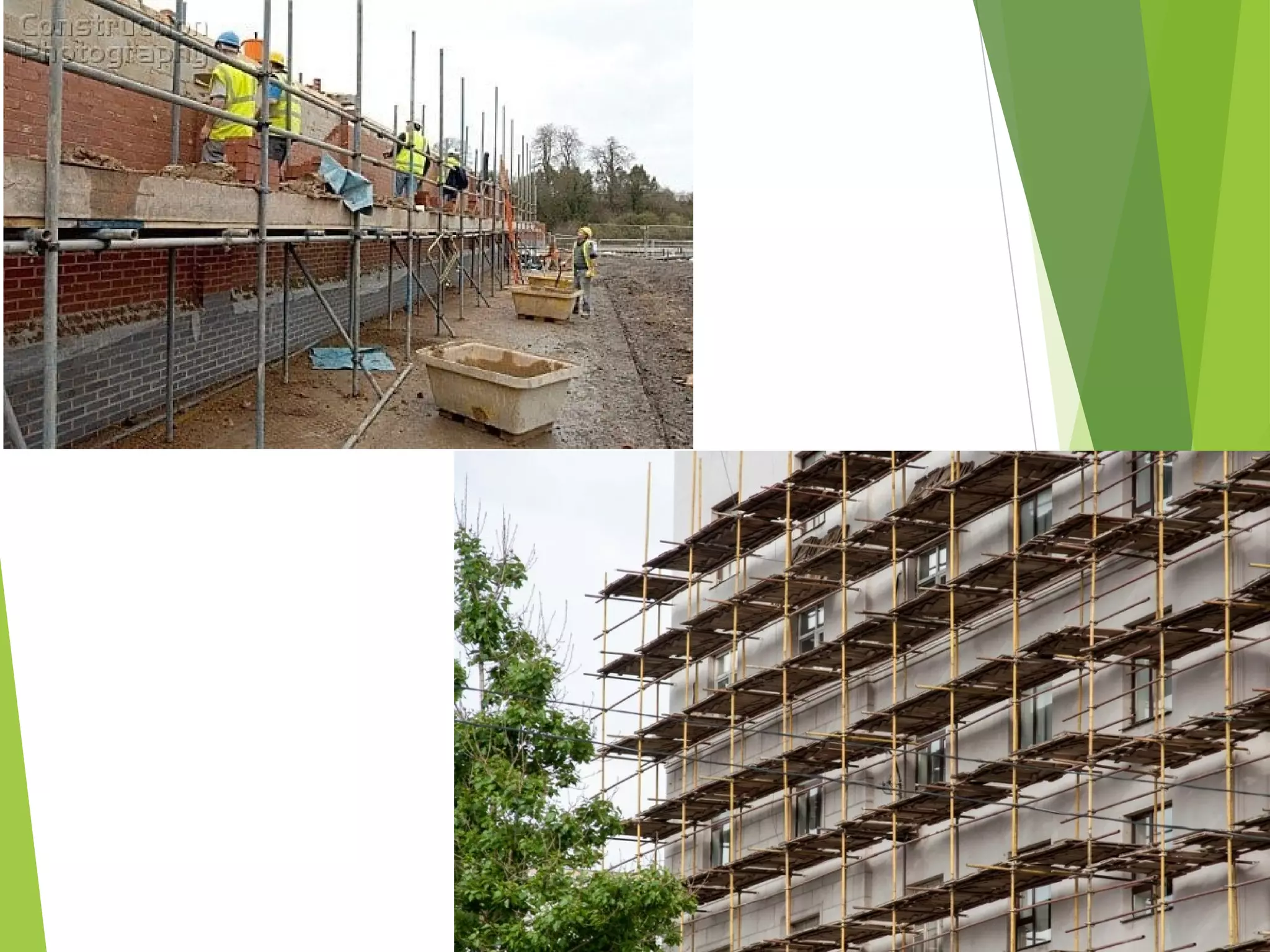
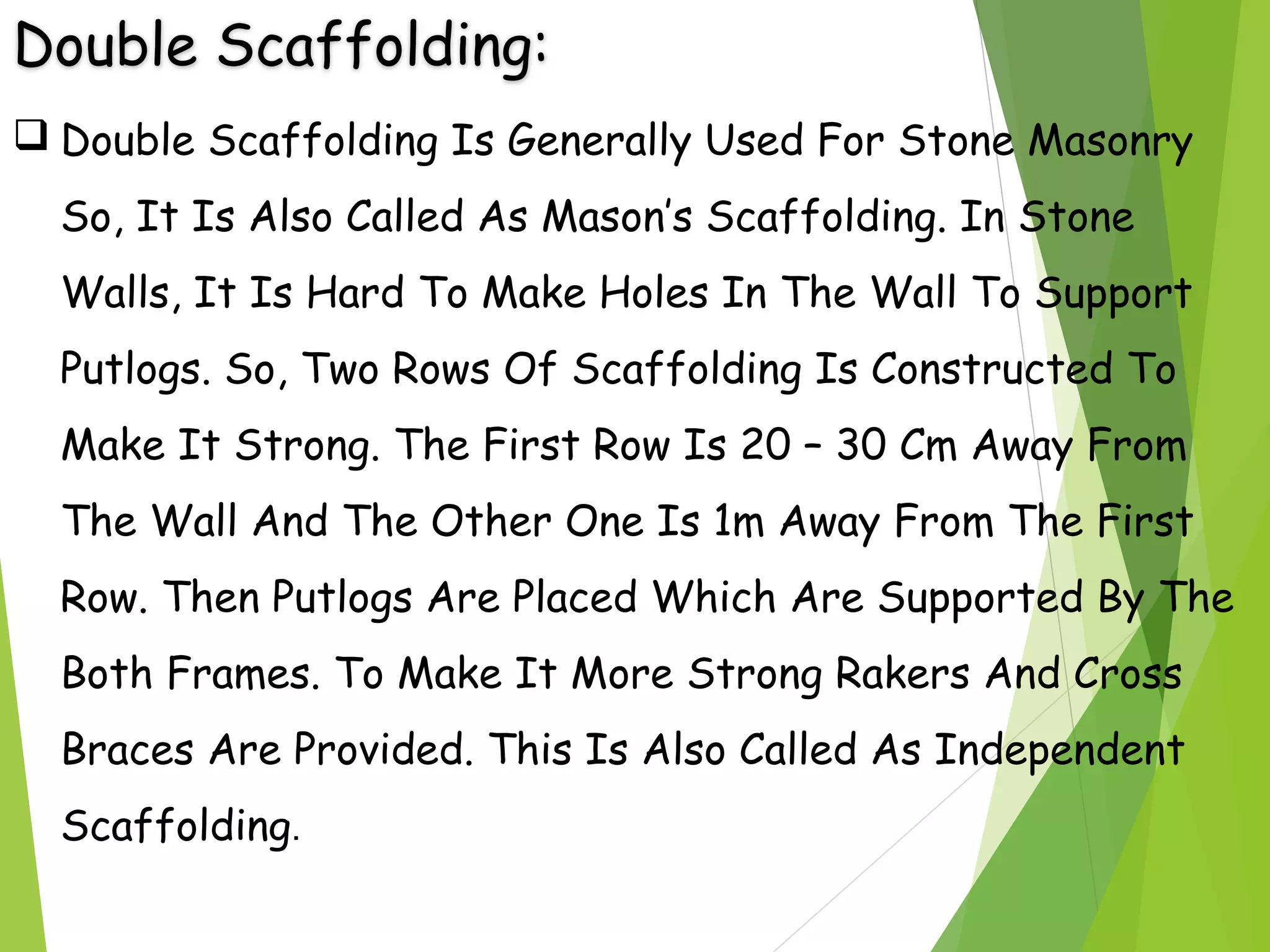
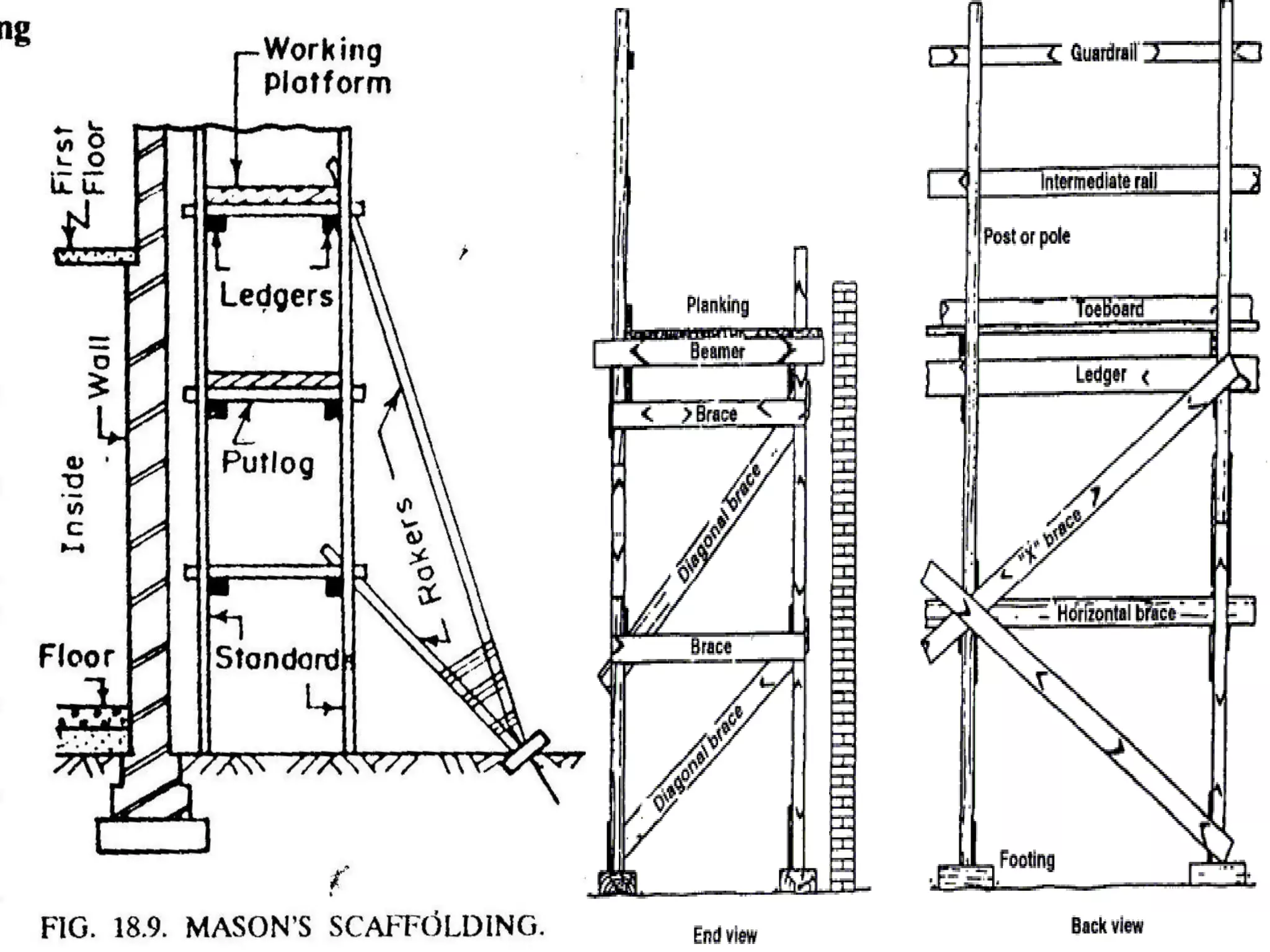
 Double Scaffolding Is Generally Used For Stone Masonry
So, It Is Also Called As Mason’s Scaffolding. In Stone
Walls, It Is Hard To Make Holes In The Wall To Support
Putlogs. So, Two Rows Of Scaffolding Is Constructed To
Make It Strong. The First Row Is 20 – 30 Cm Away From
The Wall And The Other One Is 1m Away From The First
Row. Then Putlogs Are Placed Which Are Supported By The
Both Frames. To Make It More Strong Rakers And Cross
Braces Are Provided. This Is Also Called As Independent
Scaffolding.
Cantilever Scaffolding:
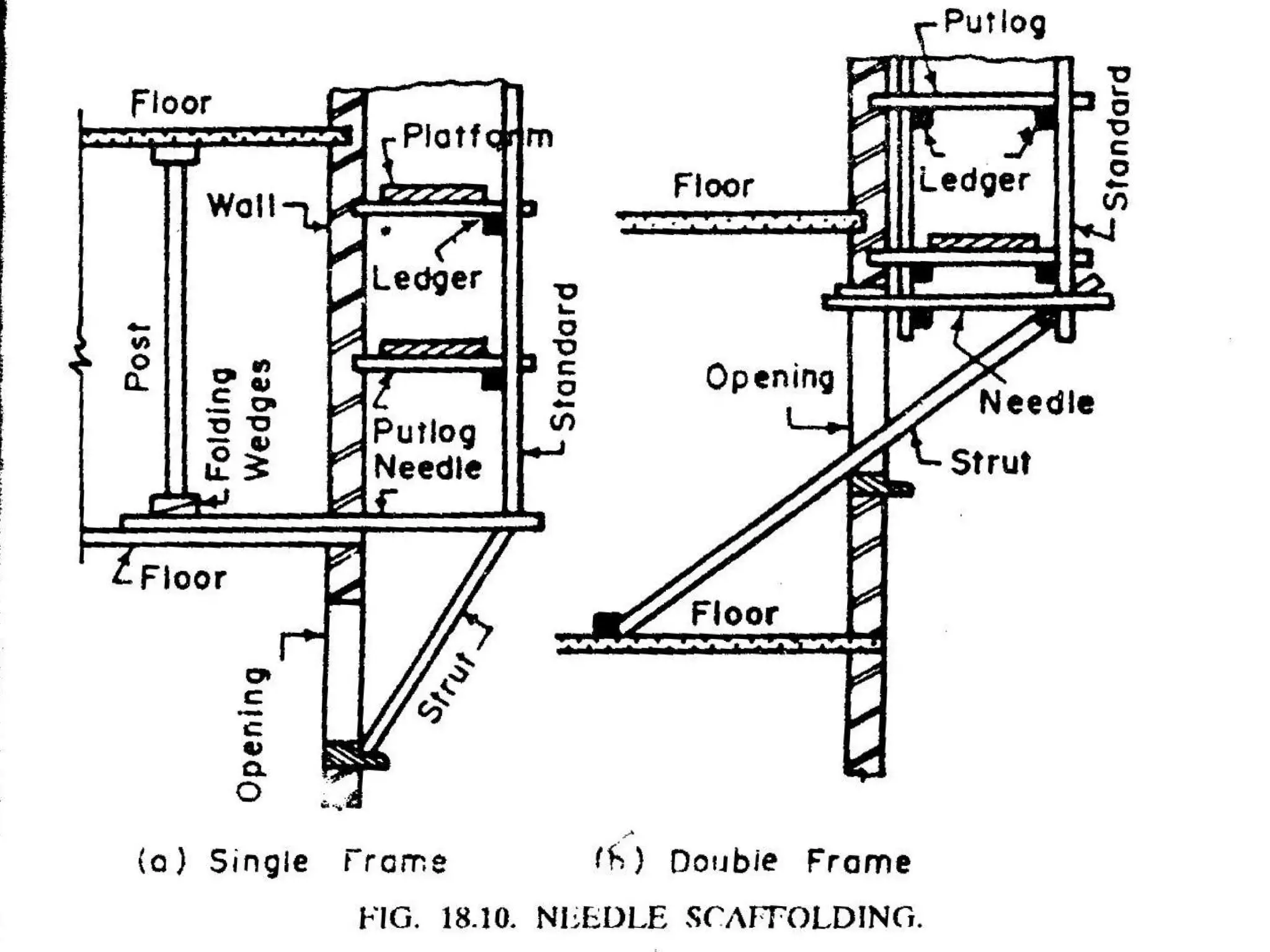
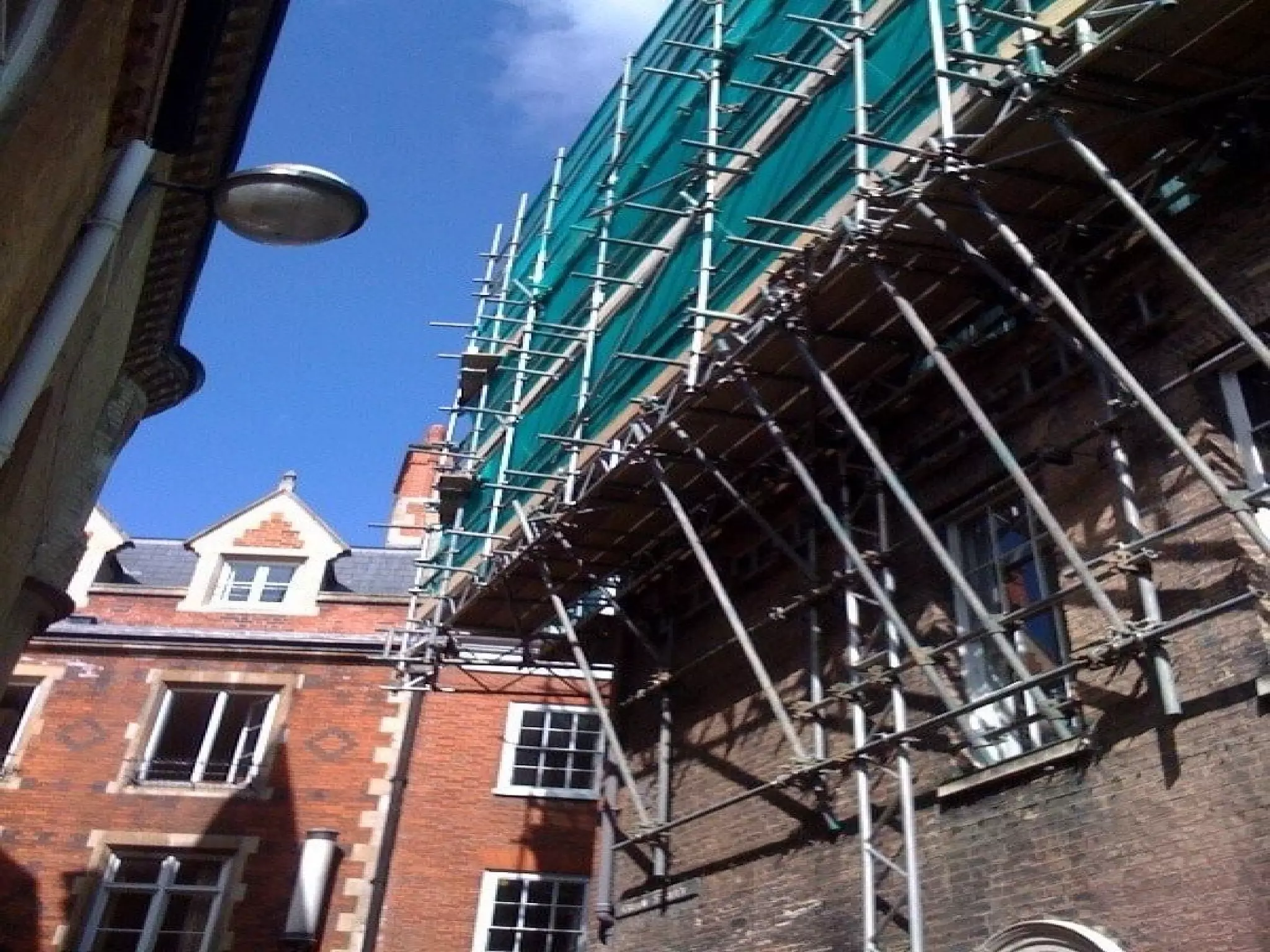
 This a type of scaffolding in which the standards are supported on
series of needles and these needles are taken out through holes in the
wall. This is called single frame type scaffolding.
 In the other type needles are strutted inside the floors through the
openings and this is called independent or double frame type
scaffolding. Care should be taken while construction of cantilever
scaffolding.
Generally cantilever scaffoldings are used under conditions such as
When the ground does not having the capacity to support standards,
When the Ground near the wall is to be free from traffic,
When upper part of the wall is under construction.
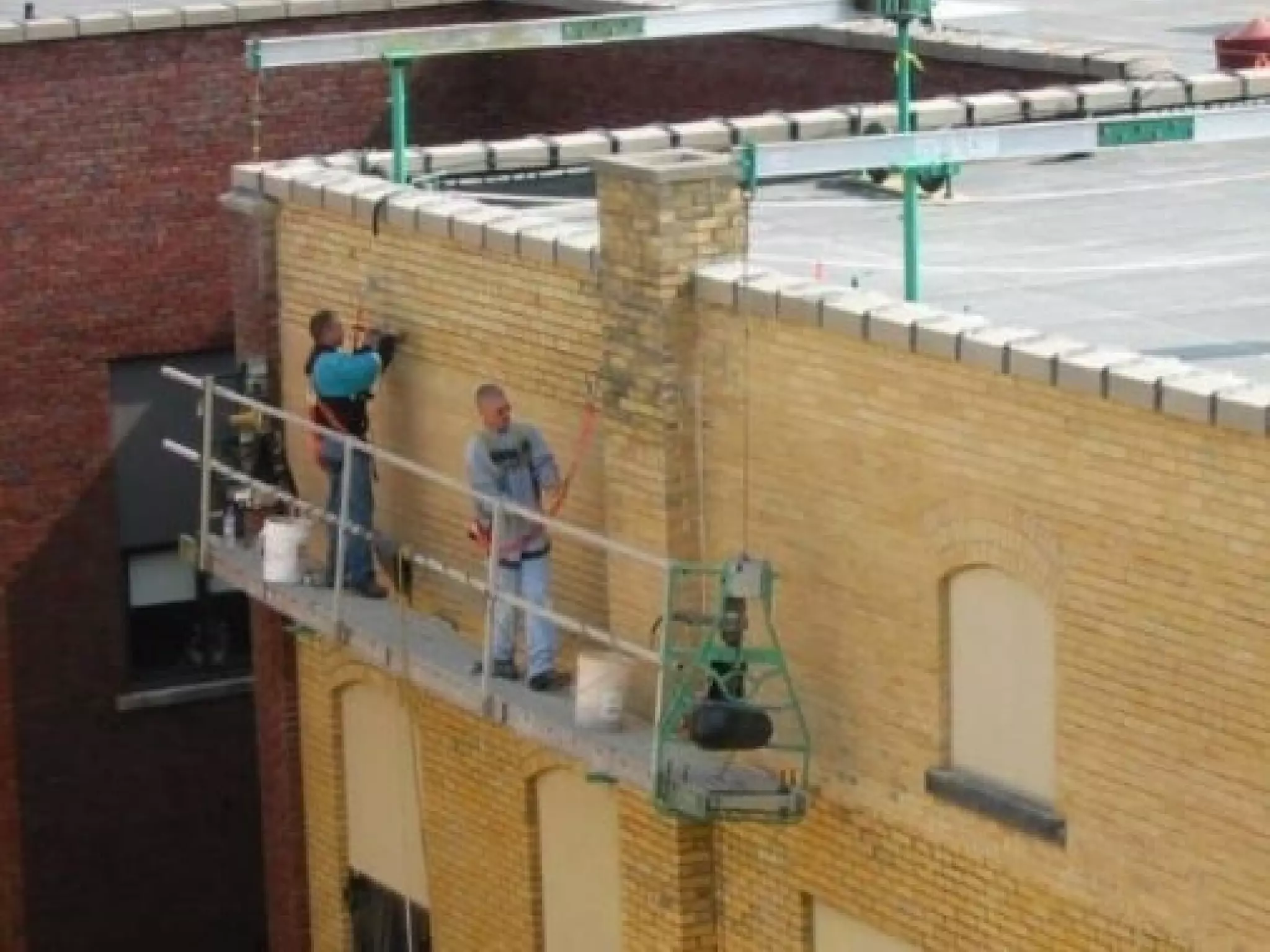
Suspended Scaffolding:
 In suspended scaffolding, the working platform is
suspended from roofs with the help of wire ropes or chains
etc., it can be raised or lowered to our required level.
 This type of Scaffolding is used for repair works, pointing,
paintings etc..
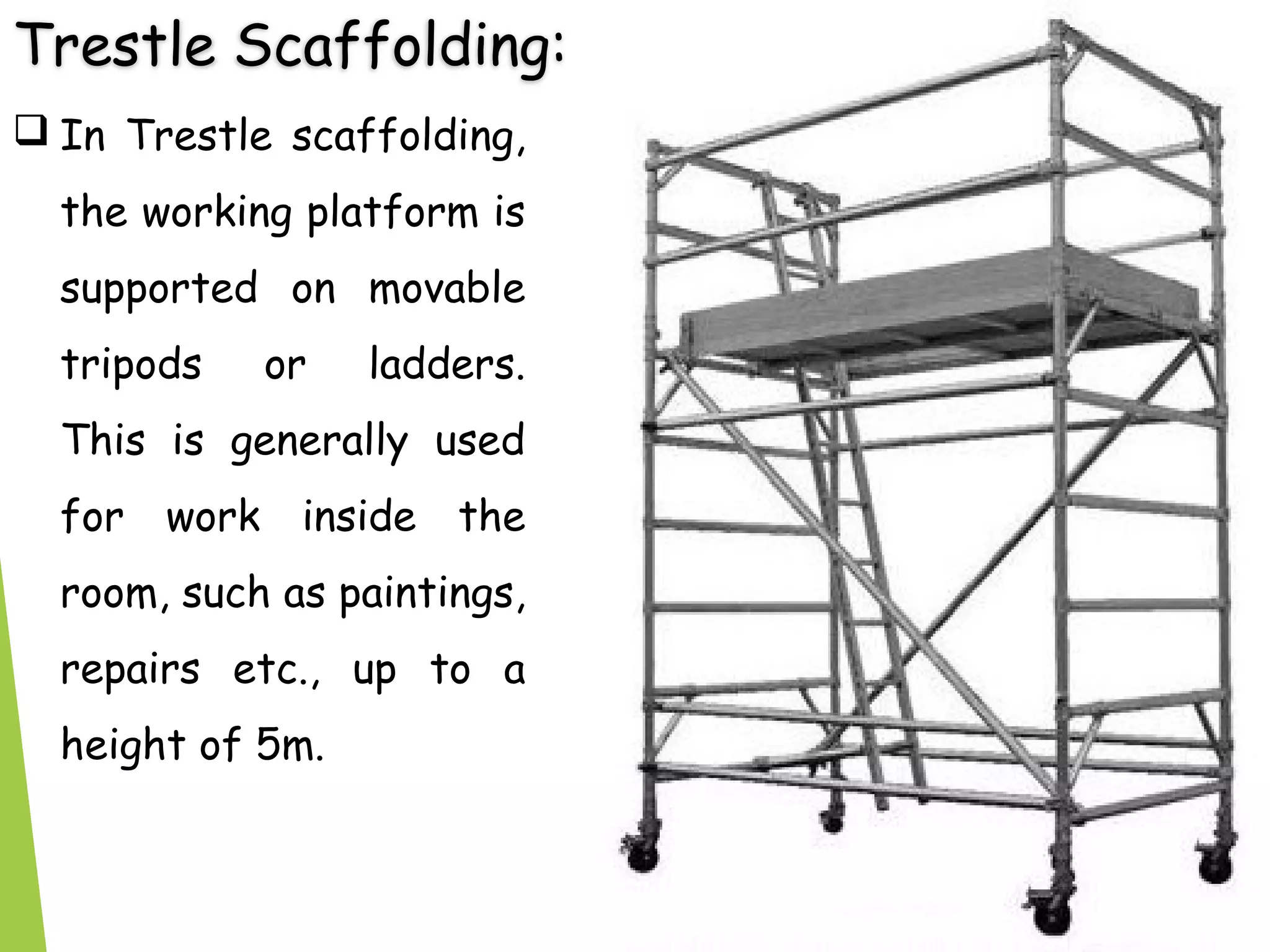
Trestle Scaffolding:
 In Trestle scaffolding,
the working platform is
supported on movable
tripods or ladders.
This is generally used
for work inside the
room, such as paintings,
repairs etc., up to a
height of 5m.
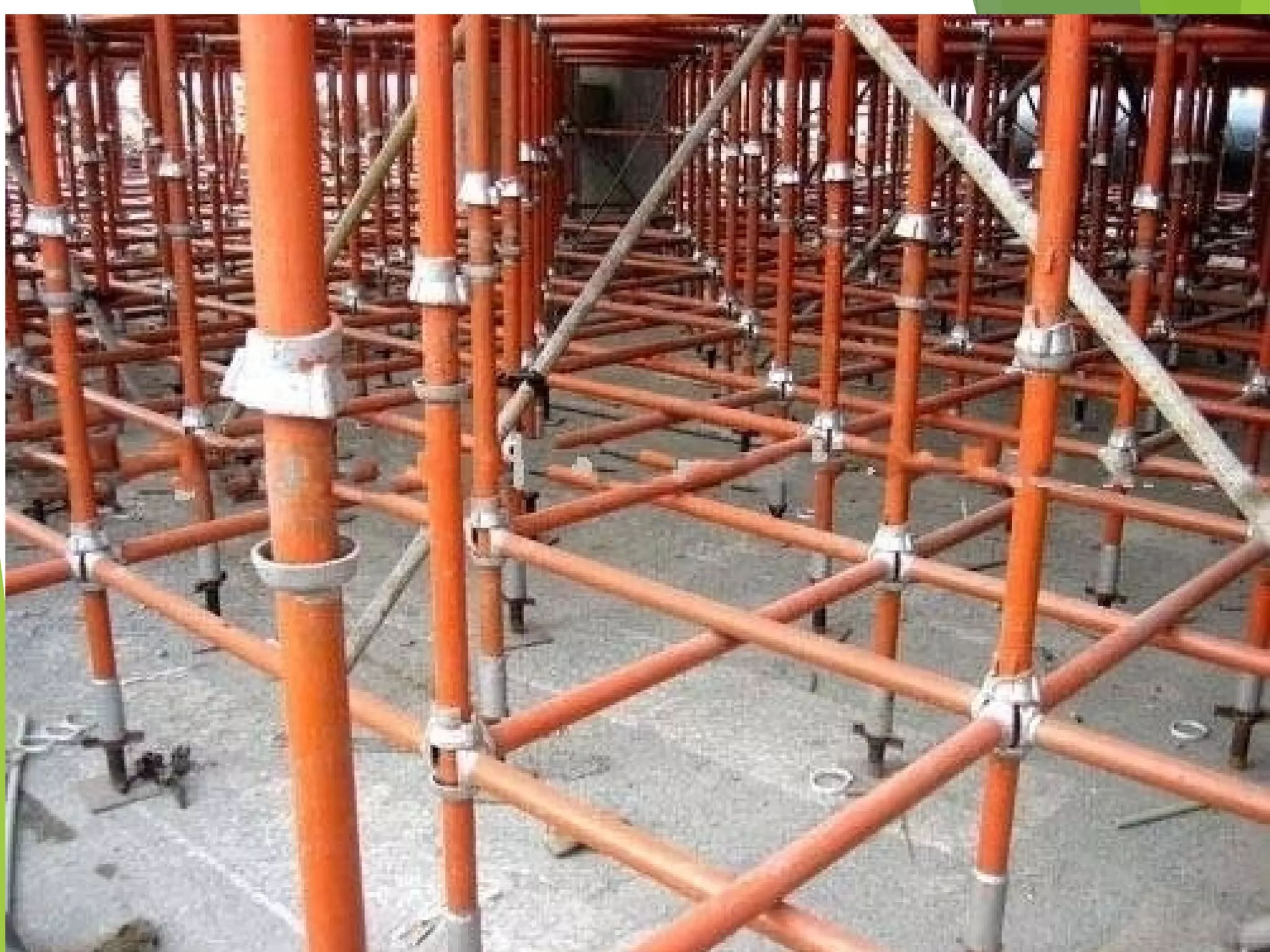
Steel Scaffolding:
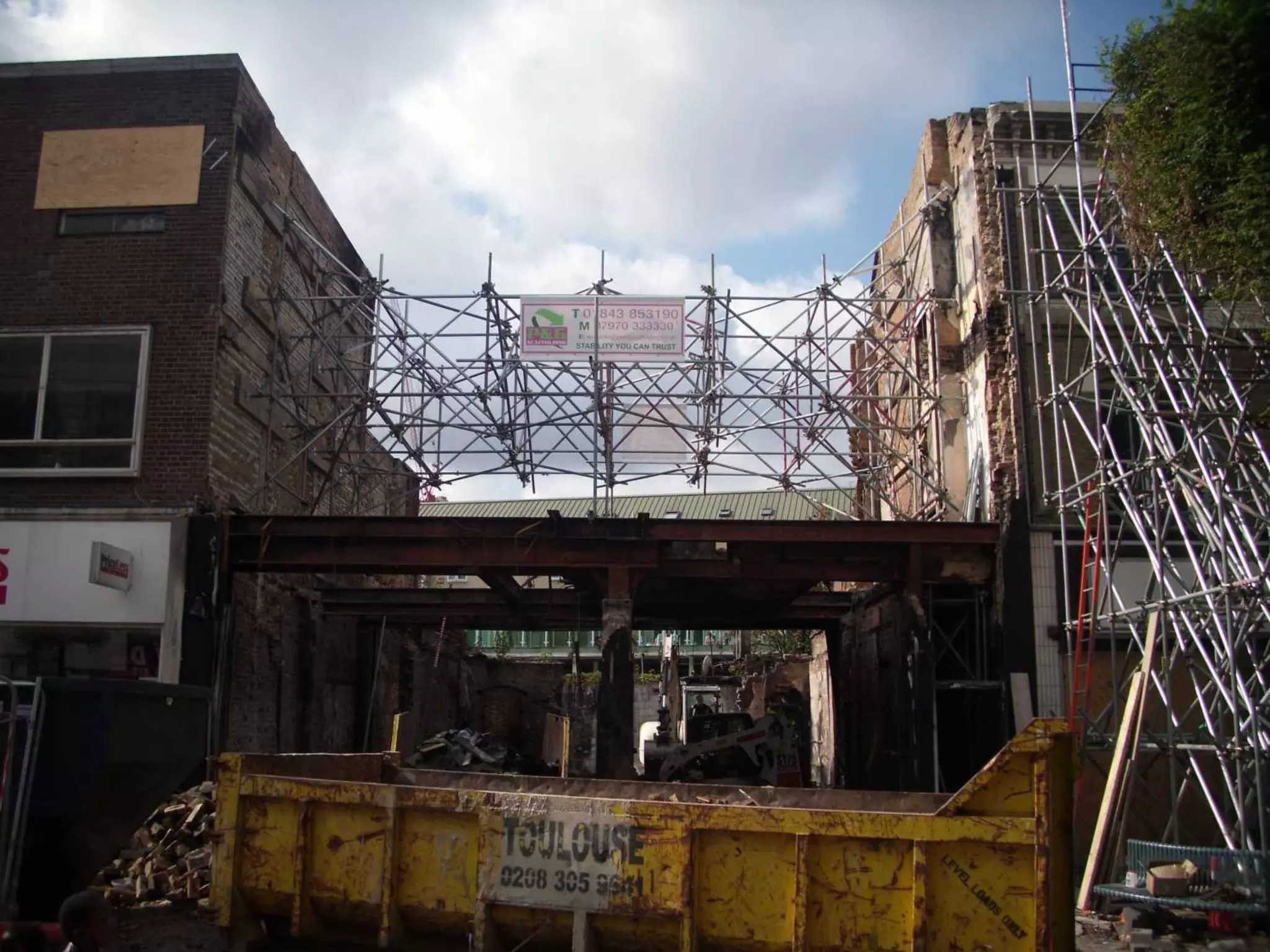
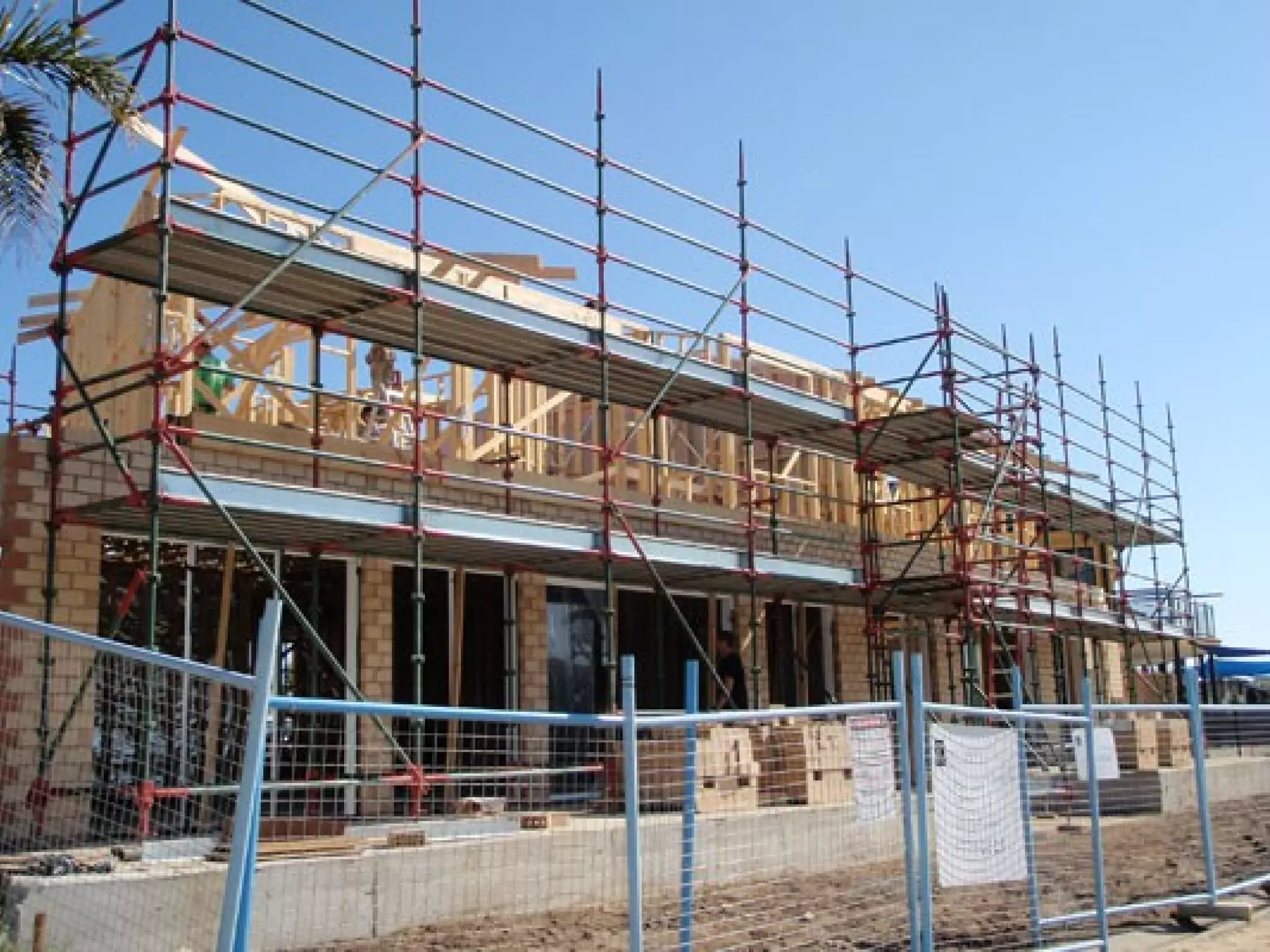
 Steel scaffolding is constructed by steel tubes which are
fixed together by steel couplers or fittings. It is very easy
to construct or dismantle. It has greater strength, greater
durability and higher fire resistance. It is not economical
but will give more safety for workers. So, it is used
extensively nowadays.
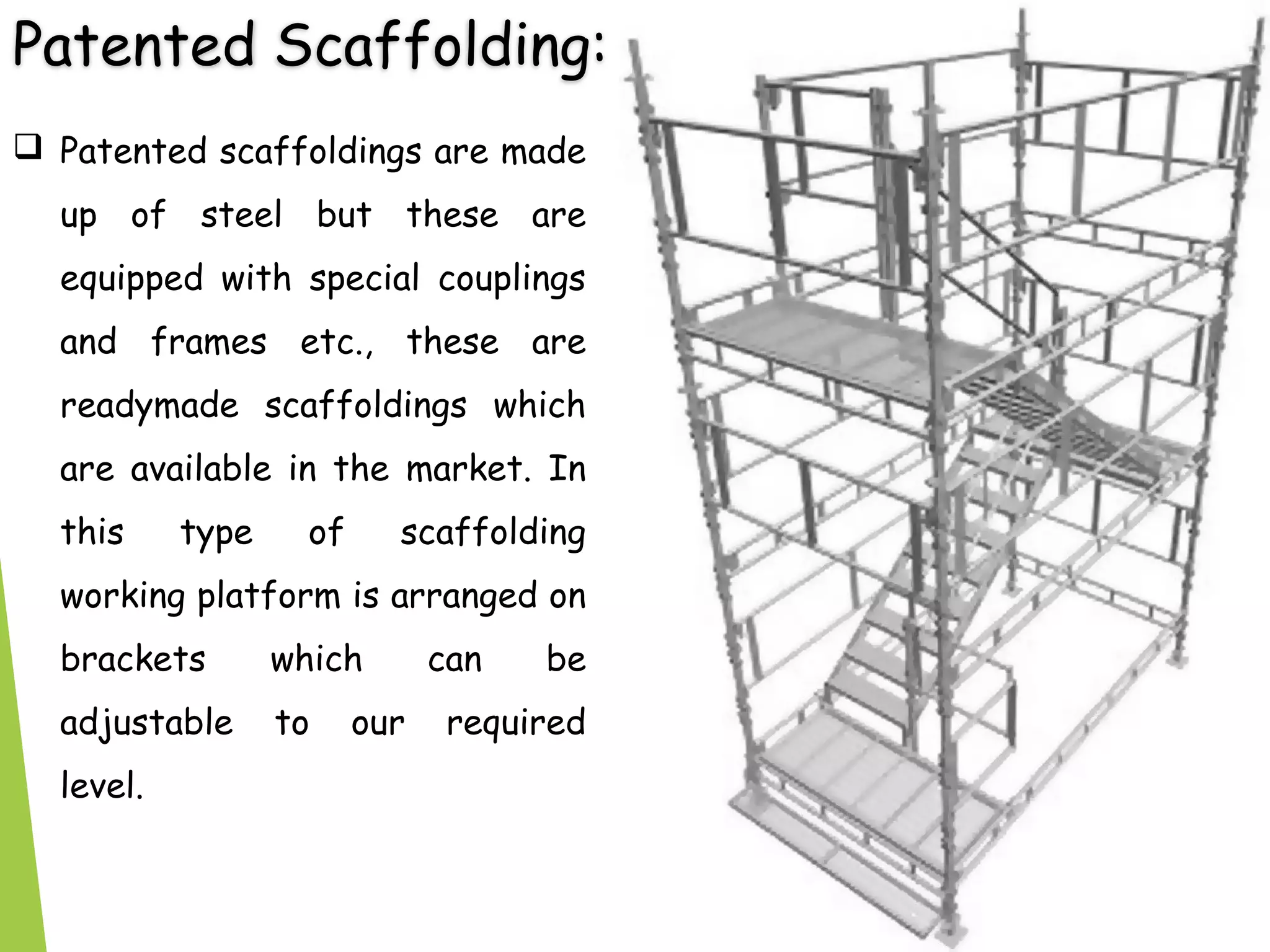
Patented Scaffolding:
 Patented scaffoldings are made
up of steel but these are
equipped with special couplings
and frames etc., these are
readymade scaffoldings which
are available in the market. In
this type of scaffolding
working platform is arranged on
brackets which can be
adjustable to our required
level.
Temporary Work in Building Construction

Temporary Work in Building Construction

  • 1.
    Prepared By Prof. KaranS. Chauhan Assistant Professor Department Of Civil Engineering @ Shri Labhubhai Trivedi Institute Of Engineering And Technology,Rajkot Temporary WorksTemporary Works (Timbering of Trenches, Shoring, Underpinning & Scaffolding) Subject :- Building Construction Subject Code : 2130607
  • 2.
    Introduction Temporary Structure Any structure that is not attached to a permanent foundation. A structure which is permitted within a land use district without any foundation or footing and which is removed when the designated time period, activity, or use for which the temporary structure was erected has ceased.
  • 3.
    Timbering of Trenches When depth of trench is large or when the sub-soil is loose the sides of the trench may cave in. the problem can be solved by adopting a suitable method of timbering.  Timbering of trench sometimes also known as Shoring consist of providing timber plank or boards and strut to give temporary support to the sides of the trench. The methods are used 1.Stay Bracing 2.Box sheeting 3.Vertical sheeting 4.Runner system 5.Sheet piling
  • 4.
    Stay Bracing:  Thismethod is used for supporting the sides or a bench excavated in fairly firm soil, when the depth of excavation does not exceed about 2 metres.  The method consists of placing vertical sheets called sheathing or polling boards opposite each other against the two walls of the trench and holding them in position by one or two rows of struts.  The sheets are placed at an interval of 2 to 4 metres and generally, they extend to the full height of the trench.  The polling boards may have width of about 200 mm and thickness of 44 to 50 mm. The struts may have size 1OO x 100 mm for trench up to 2 m width and 200 x 200 mm for trench up to 4 m width.
  • 6.
    Box sheeting:  Thismethod is adopted in loose soils, when the depth of excavation does not exceed 4 metres.   Fig. shows the box like structure, consisting of vertical sheets placed very near to each other (some times touching each other) and keeping them in position by longitudinal rows (usually two) of wales. Struts are then provided across the wales.  Another system of box sheeting, shown in Fig, is adopted for very loose soils.  In this system, the sheeting is provided longitudinally, and they are supported by vertical wales and horizontal  struts. If the height is more, braces are also provided along with struts.
  • 8.
    Vertical sheeting:  Thissystem is adopted for deep trenches (upto 10 m depth) in soft ground.  The method is similar to the box sheeting except that the excavation is carried out in stages and at the end of each stage, an offset is provided, so that the width of the trench goes on decreasing as the depth increases.  Each stage is limited to about 3 m in height and the offset may vary from 25 to 50 cm per stage. For each stage, separate vertical sheeting, supported by horizontal wailings and struts are provided (Fig. 2.33)
  • 9.
    Runner system:  Thissystem is used in extremely loose and soft ground, which needs immediate support as excavation progresses. The system is similar to vertical sheeting of box system, except that in the place of vertical sheeting, runners, made of long thick wooden sheets or planks with iron shoe at the ends, are provided. Wales and struts are provided as usual. These runners are driven about 30 cm in advance of the progress of the work, by hammering.
  • 12.
    Sheet piling:  Thismethod is adopted when  (i) soil to be excavated is soft or loose  (ii) depth of excavation is large  (iii) width of trench is also large and  (iv) there is sub-soil water.  Sheet piles are designed to resist lateral earth pressure. These are driven in the ground by mechanical means (pile driving equipment). They can be used for excavating to a very large depth.
  • 16.
    Shoring:  Shoring is theconstruction of a temporary structure to support temporarily an unsafe structure. These support walls laterally.  They can be used under the following circumstances: 1. When walls bulge out due to bad workmanship 2. When walls crack due to unequal settlement of foundation and repairs are to be carried out to the cracked wall. 3. When an adjacent structure needs pulling down/dismantled. 4. When openings are to be newly made or enlarged in a wall. Types of Shoring: 1. Raking shores 2. Flying shores 3. Dead shores
  • 17.
    Raking Shores (InclinedShores):  In this method, inclined members known as rakers are used to give lateral supports to walls. A raking shore consists of the following components: 1. Rakers or Inclined member 2. Wall plate 3. Needles 4. Cleats 5. Bracing 6. Sole plate
  • 20.
    The following pointsare to be kept in view for the use of the raking shores: 1.Rakers are to be inclined in the ground at 45°. However the angle may be between 45° and 75°. 2.For tall buildings, the length of the raker can be reduced by introducing rider raker. 3.Rakers should be properly braced at intervals. 4.The size of the rakers is to be decided on the basis of anticipated thrust from the wall. 5.The center line of a raker and the wall should meet at floor level. 6.Shoring may be spaced at 3 to 4.5 m spacing to cover longer length of the bar. 7.The sole plate should be properly embedded into the ground on an inclination and should be of proper section and size. 8.Wedges should not be used on sole plates since they are likely to give way under vibrations that are likely to occur.
  • 21.
    Flying Shores (HorizontalShores):  It is a system of providing temporary supports to the party walls of the two buildings where the intermediate building is to be pulled down and rebuilt.  All types of arrangements of supporting the unsafe structure in which the shores do not reach the ground come under this category.  They flying shore consists of wall plates, needles, cleats, horizontal struts (commonly known as horizontal shores) and inclined struts arranged in different forms which varies with the situation.  In this system also the wall plates are placed against the wall and secured to it.  A horizontal strut is placed between the wall plates and is supported by a system of needle and cleats.  The inclined struts are supported by the needle at their top and by straining pieces at their feet.  The straining piece is also known as straining sill and is spiked to the horizontal shore. The width of straining piece is the same as that of the strut.
  • 22.
     If thewalls are quit near to each other (distance upto 9 m) called as Single flying shore.  When the distance between the walls is more than 9 m a compound or double flying shore will be provided. Points kept in mind:-  Struts should preferably be inclined at 45 degree. In no case it should be exceed 60 degree.  Single shore used only upto 9 m wall for greater distance double shore should be provided.  Factor of safety should be taken. It should be inserted when the old building is being removing and it should be kept in position till the new unit is constructed.
  • 27.
    Dead Shores:  Thisis consist vertical members known as Dead shores supporting horizontal member known as needles.  The needle transfer the load of the wall etc. to the dead shores. Such shoring is provided to serve for following purpose. 1. To rebuild the defective lower part of the wall. 2. To rebuild or deepen the existing foundation. 3. To make large opening in the existing wall at lower level.  Holes are made in the wall at suitable height needles which are made of thick wooden sections or of steel are inserted in the holes.  Each needle is supported at its two ends by vertical posts or dead shores.  Dead shores are supported on sole plates and folding wedges.
  • 28.
     Points tobe kept in mind :-  The section of needle and dead shore should be adequate to transfer the load, which can estimated with fair degree of accuracy  Needles are spaced at 1 to 2 metres minimum three needles used for an opening.  If the opening is made in an external wall, the length of outer dead shore will be greater than the inner ones.  If the external wall is week raking shore may be provided in addition to the dead shores.  Shores should be removed only when the new work has gained sufficient strength. But in no case earlier than 7 days of the completion of new work. The new work should have proper strutting.  Sequence of removal should be ..1 needles…2 strutting from opening.....3 Floor strutting…4 raking shore if any.  An interval of 2 days should be allowed between each one of these removal operations.
  • 32.
    Underpinning:  The processof placing a new foundation under an existing one or strengthening an existing foundation is called underpinning of foundation.  It may required to serve following purposes:  To strengthen the shallow foundation of existing building when a building with deep foundation is to be constructed adjoining it.  To strengthen existing foundation which has settled and caused cracks in the wall  To deepen the existing foundation (resting on poor strata) so as to rest it on deeper soil strata of higher bearing capacity.  To construct a basement under an existing building. There are two underpinning Methods. They are:  Pit Method  Pile Method
  • 33.
    Pit Method:  Inthis method the length of the foundation to be underpinned is divided into sections of 1.2 to 1.5 m lengths as shown in Fig. For each section a hole is made on the wall above the plinth level and a needle is inserted in the hole. Bearing plates are placed above the needle to support the masonry above it.  Needle is supported on either side of the wall on wooden supports and screw jacks. The foundation pit is excavated up to the desired level and new foundation is laid.  In the round, the work is undertaken in alternate sections. Once the alternate sections are undertaken, the remaining sections are worked out.  If the wall for which underpinning is to be carried out is weak, raking shores is provided to support them.
  • 37.
     In pitmethod of underpinning, the following points are noteworthy. 1. Alternate sections are taken up in the round. Remaining sections should be taken next. 2. For long wall the work should be started from the middle and worked outwards. 3. If the foundation is deeper, proper timbering of the foundation trench may be done. 4. The needle beam should be removed only when the new foundation has gained strength. 5. It is desirable to do the new foundation work in concrete. 6. The needle should be closed in masonry using cement mortar.
  • 38.
    Pile Method:  Inthis method, piles are driven at regular interval along both sides of the wall. The piles are connected by concrete or steel needles, which penetrate through the walls. These beams also act as pile caps. This method is effective in clayey soil and in waterlogged areas. The existing foundation is very much relieved of the load. Fig 3 illustrates the pile method of underpinning.
  • 40.
    ScaffoldingScaffolding:  When theheight of wall or column or other structural member of a building exceed about 1.5 m, temporary structure are needed to support the platform over which the workmen can sit and carry on the constructions. These temporary structure, constructed very close to the wall, is in the form of timber or steel framework, commonly called scaffolding.  It is also needed for the repairs or even demolition of a building.  It should be stable and strong enough to support workmen and other construction material placed on the platform supported by the scaffolding.  The height of the scaffolding goes on increasing as the height of construction increases.
  • 41.
    Types of Scaffoldingused in Construction: 1. Single Scaffolding 2. Double Scaffolding 3. Cantilever Scaffolding 4. Suspended Scaffolding 5. Trestle Scaffolding 6. Steel Scaffolding 7. Patented Scaffolding
  • 42.
    Single Scaffolding:  Singlescaffolding is generally used for brick masonry and is also called as brick layer’s scaffolding & Putlog scaffolding. Single scaffolding consists of standards, ledgers, putlogs etc., which is parallel to the wall at a distance of about 1.2 m. Distance between the standards is about 2 to 2.5 m. Ledgers connect the standards at vertical interval of 1.2 to 1.5 m. Putlogs are taken out from the hole left in the wall to one end of the ledgers. Putlogs are placed at an interval of 1.2 to 1.5 m.
  • 45.
    Double Scaffolding:  DoubleScaffolding Is Generally Used For Stone Masonry So, It Is Also Called As Mason’s Scaffolding. In Stone Walls, It Is Hard To Make Holes In The Wall To Support Putlogs. So, Two Rows Of Scaffolding Is Constructed To Make It Strong. The First Row Is 20 – 30 Cm Away From The Wall And The Other One Is 1m Away From The First Row. Then Putlogs Are Placed Which Are Supported By The Both Frames. To Make It More Strong Rakers And Cross Braces Are Provided. This Is Also Called As Independent Scaffolding.
  • 48.
    Cantilever Scaffolding:  Thisa type of scaffolding in which the standards are supported on series of needles and these needles are taken out through holes in the wall. This is called single frame type scaffolding.  In the other type needles are strutted inside the floors through the openings and this is called independent or double frame type scaffolding. Care should be taken while construction of cantilever scaffolding. Generally cantilever scaffoldings are used under conditions such as When the ground does not having the capacity to support standards, When the Ground near the wall is to be free from traffic, When upper part of the wall is under construction.
  • 51.
    Suspended Scaffolding:  Insuspended scaffolding, the working platform is suspended from roofs with the help of wire ropes or chains etc., it can be raised or lowered to our required level.  This type of Scaffolding is used for repair works, pointing, paintings etc..
  • 53.
    Trestle Scaffolding:  InTrestle scaffolding, the working platform is supported on movable tripods or ladders. This is generally used for work inside the room, such as paintings, repairs etc., up to a height of 5m.
  • 54.
    Steel Scaffolding:  Steelscaffolding is constructed by steel tubes which are fixed together by steel couplers or fittings. It is very easy to construct or dismantle. It has greater strength, greater durability and higher fire resistance. It is not economical but will give more safety for workers. So, it is used extensively nowadays.
  • 56.
    Patented Scaffolding:  Patentedscaffoldings are made up of steel but these are equipped with special couplings and frames etc., these are readymade scaffoldings which are available in the market. In this type of scaffolding working platform is arranged on brackets which can be adjustable to our required level.