Mehran University Campus of Engg: & Technology Khairpur
CONSTRUCTION ENGINEERING
2nd Term 2nd Year B.E.Civil
3
Damp-Proofing
and
Water Proofing
4
Damp-Proofing and
Water Proofing
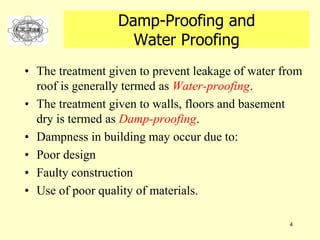
• The treatment given to prevent leakage of water from
roof is generally termed as Water-proofing.
• The treatment given to walls, floors and basement
dry is termed as Damp-proofing.
• Dampness in building may occur due to:
• Poor design
• Faulty construction
• Use of poor quality of materials.
G.S.SOLANGI 5
Defects caused by Dampness
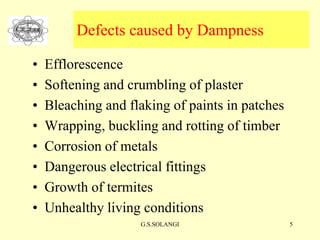
• Efflorescence
• Softening and crumbling of plaster
• Bleaching and flaking of paints in patches
• Wrapping, buckling and rotting of timber
• Corrosion of metals
• Dangerous electrical fittings
• Growth of termites
• Unhealthy living conditions
G.S.SOLANGI 6
Sources of Dampness
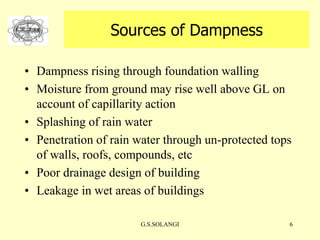
• Dampness rising through foundation walling
• Moisture from ground may rise well above GL on
account of capillarity action
• Splashing of rain water
• Penetration of rain water through un-protected tops
of walls, roofs, compounds, etc
• Poor drainage design of building
• Leakage in wet areas of buildings
7
Methods of Damp-Proofing
Membrane Damp-Proofing
• This consists in providing layer or membrane of
water proofing material
• This material is usually provided between the source
of dampness and the part of the structure adjacent to
it
• This method is known as DPC
G.S.SOLANGI 8
Methods of Damp-Proofing
Membrane Damp-proofing
Materials :
• Bitumen
• Asphalt
• Silicon
• Epoxy
• Plastics or Polythene sheets
• Cement concrete
G.S.SOLANGI 9
Methods of Damp-Proofing
Membrane Damp-Proofing
General Principles:
• The DPC should cover full thickness of walls
• The mortar bed should be leveled, even and free
from projections
• Each DPC should be placed in correct relation to
other junction
• This will ensure a complete and continuous barrier to
the passage of dampness
10
Methods of Damp-Proofing
Integral Damp-Proofing
• Adding certain water proofing compounds with the
concrete mix to increase its impermeability
• These compounds are available in the market under
different brand names
• Could be in powdered form or liquid form
• The compounds made from clay, sand or lime help in
filling the voids in concrete and make it water proof
• Alkaline, silicates, aluminum sulphates, calcium
chlorides react chemically when mixed in concrete to
produce water proof concrete.
11
Methods of Damp-Proofing
Integral Damp-Proofing
• Pudlo, Permo, Impermo are few examples
• Generally 1 kg of water proofing material to be mixed
with one bag of cement to produce good water proofing
material.
12
Surface Treatment Method
• To check the entry of the moisture into the pores
• So as to stop its penetration inside the structure
• Those cracks, pores or entry points must be filled up
• Surface treatment method consists in filling up the
pores of the surfaces subjected to dampness
• Bituminous solution, cement coating, paints
• For wall treatment usually, cement, lime and sand
mixed in proportions of 1:1:6 is used
• This method is found very effective to serve the
purpose of preventing dampness in the wall due to rain
effectively.
G.S.SOLANGI 13
Characteristics of the Materials
Used for Damp Proofing
• Damp proofing materials
• Should be impervious
• Should be strong and durable
• Should be dimensionally stable
• Should be free from salts like sulphates, chlorides
and nitrates
G.S.SOLANGI 14
Materials Used for Damp Proofing
• Flexible material: Material like bitumen felts (either
hessian based or fiber /glass fiber based), plastic
sheeting, etc
• Semi-rigid materials: Like asphalt or combination of
other materials or layers
• Rigid materials: First class bricks, stones, slates,
cement concrete
• Grout: Consists of cement slurry and acrylic based
chemically polymers.
G.S.SOLANGI 15
Types of Damp Proof Courses
(D.P.C)
Depending on the material used DPCs are divided as
under:
1. Flexible Damp Proof Course
2. Semi-rigid Damp Proof Course
3. Rigid Damp Proof Course
G.S.SOLANGI 16
Flexible Damp Proof Course
• Lead :
i. Lead DPC should weigh not less than 19.5 kg/m2 .
ii. It is an effective barrier to moisture and water.
iii. It is liable to corrosion in contact with freshly laid
lime or cement mortar and could be protected by a
coating of bitumen.
iv. It is durable and flexible.
v. It is an expensive material so rarely used.
vi. Lead should be laid in rolls up to full thickness of
the wall.
G.S.SOLANGI 17
Flexible Damp Proof Course
• Copper :
i. It is an effective barrier to moisture and water.
ii. Flexible, has a high tensile strength.
iii. It is an expensive material so rarely used.
iv. Copper as a DPC should be annealed, at least 0.25
mm thickness and have a nominal weight of 2.28
kg/m2
G.S.SOLANGI 18
Flexible Damp Proof Course
• Bitumen :
i. It is reasonable flexible.
ii. It is made in rolls to suit the thickness of the walls,
are bedded on a level bed of mortar and lapped at
least 100 mm.
iii. It is economical, reasonably durable and convenient
to lay.
iv. It can also be used in conjunction with other
materials such as hessian, fiber, rubber or polymers
to make a durable and workable DPC.
G.S.SOLANGI 19
Flexible Damp Proof Course
• Polythene Sheets:
i. These should be of low-density polythene sheet of
single thickness not less than 0.46 mm, weight
approximately 0.48 kg/m2.
ii. Flexible, an effective barrier against moisture.
iii. Its disadvantage is that, it is fairly damaged by
sharp particles in mortar or the coarse edges of
bricks.
G.S.SOLANGI 20
Flexible Damp Proof Course
• Polymer-based Sheets :
i. These are thinner than bitumen sheets and are used
where the thicker bitumen DPC mortar joint would
be unsightly .
ii. This DPC material which has its laps sealed with
adhesive, may be punctured by sharp particles and
edges.
G.S.SOLANGI 21
Semi-rigid Damp Proof Course
• Mastic Asphalt :
i. Spread hot in one coat to a thickness of 13 mm
ii. It is a semi-rigid DPC
iii. It is impervious to moisture and water.
iv. Moderate settlement in wall may crack in the
asphalt.
v. Expensive hence rarely used.
G.S.SOLANGI 22
Rigid Damp Proof Course
• Slate:
i. Thin slates are used as impermeable material for
DPC.
ii. Slates are laid on a bed of mortar in two courses.
iii. It is effective where moderate settlement occurs.
iv. Rarely used today.
G.S.SOLANGI 23
Rigid Damp Proof Course
• Brick:
i. Two or three courses of dense engineering bricks
may be form an effective DPC.
ii. It is rarely used these days other than as
architectural feature at the base of the building.
iii. The effectiveness of the DPC is determined more
by the permeability of the joining material than the
brick.
G.S.SOLANGI 24
Damp-Proofing Treatment in
Buildings:
Treatment in buildings can be broadly divided into
the following categories:
• To Foundations
• To Floors
• To Walls
• To Flat Roofs
• To Parapet walls
• To Pitched Roofs
G.S.SOLANGI 25
Treatment to Floors
Where water table is not high and not much of
rainfall.
• 75 mm to 100 mm thick layer of coarse sand is first
spread over the entire area of flooring.
• Then its is rammed properly.
• Then lean concrete (1:3:6) or (1:4:8) is thereafter laid
over the base course.
G.S.SOLANGI 26
Treatment to Walls
• For wall treatment usually, cement, lime and sand
mixed in proportion of 1:1:6 is used.
• Some water proofing agents can also be added such
as: Pudlo, Permo, etc.
THE END

Damp proofing ppt

  • 2.
    Mehran University Campusof Engg: & Technology Khairpur CONSTRUCTION ENGINEERING 2nd Term 2nd Year B.E.Civil
  • 3.
  • 4.
    4 Damp-Proofing and Water Proofing •The treatment given to prevent leakage of water from roof is generally termed as Water-proofing. • The treatment given to walls, floors and basement dry is termed as Damp-proofing. • Dampness in building may occur due to: • Poor design • Faulty construction • Use of poor quality of materials.
  • 5.
    G.S.SOLANGI 5 Defects causedby Dampness • Efflorescence • Softening and crumbling of plaster • Bleaching and flaking of paints in patches • Wrapping, buckling and rotting of timber • Corrosion of metals • Dangerous electrical fittings • Growth of termites • Unhealthy living conditions
  • 6.
    G.S.SOLANGI 6 Sources ofDampness • Dampness rising through foundation walling • Moisture from ground may rise well above GL on account of capillarity action • Splashing of rain water • Penetration of rain water through un-protected tops of walls, roofs, compounds, etc • Poor drainage design of building • Leakage in wet areas of buildings
  • 7.
    7 Methods of Damp-Proofing MembraneDamp-Proofing • This consists in providing layer or membrane of water proofing material • This material is usually provided between the source of dampness and the part of the structure adjacent to it • This method is known as DPC
  • 8.
    G.S.SOLANGI 8 Methods ofDamp-Proofing Membrane Damp-proofing Materials : • Bitumen • Asphalt • Silicon • Epoxy • Plastics or Polythene sheets • Cement concrete
  • 9.
    G.S.SOLANGI 9 Methods ofDamp-Proofing Membrane Damp-Proofing General Principles: • The DPC should cover full thickness of walls • The mortar bed should be leveled, even and free from projections • Each DPC should be placed in correct relation to other junction • This will ensure a complete and continuous barrier to the passage of dampness
  • 10.
    10 Methods of Damp-Proofing IntegralDamp-Proofing • Adding certain water proofing compounds with the concrete mix to increase its impermeability • These compounds are available in the market under different brand names • Could be in powdered form or liquid form • The compounds made from clay, sand or lime help in filling the voids in concrete and make it water proof • Alkaline, silicates, aluminum sulphates, calcium chlorides react chemically when mixed in concrete to produce water proof concrete.
  • 11.
    11 Methods of Damp-Proofing IntegralDamp-Proofing • Pudlo, Permo, Impermo are few examples • Generally 1 kg of water proofing material to be mixed with one bag of cement to produce good water proofing material.
  • 12.
    12 Surface Treatment Method •To check the entry of the moisture into the pores • So as to stop its penetration inside the structure • Those cracks, pores or entry points must be filled up • Surface treatment method consists in filling up the pores of the surfaces subjected to dampness • Bituminous solution, cement coating, paints • For wall treatment usually, cement, lime and sand mixed in proportions of 1:1:6 is used • This method is found very effective to serve the purpose of preventing dampness in the wall due to rain effectively.
  • 13.
    G.S.SOLANGI 13 Characteristics ofthe Materials Used for Damp Proofing • Damp proofing materials • Should be impervious • Should be strong and durable • Should be dimensionally stable • Should be free from salts like sulphates, chlorides and nitrates
  • 14.
    G.S.SOLANGI 14 Materials Usedfor Damp Proofing • Flexible material: Material like bitumen felts (either hessian based or fiber /glass fiber based), plastic sheeting, etc • Semi-rigid materials: Like asphalt or combination of other materials or layers • Rigid materials: First class bricks, stones, slates, cement concrete • Grout: Consists of cement slurry and acrylic based chemically polymers.
  • 15.
    G.S.SOLANGI 15 Types ofDamp Proof Courses (D.P.C) Depending on the material used DPCs are divided as under: 1. Flexible Damp Proof Course 2. Semi-rigid Damp Proof Course 3. Rigid Damp Proof Course
  • 16.
    G.S.SOLANGI 16 Flexible DampProof Course • Lead : i. Lead DPC should weigh not less than 19.5 kg/m2 . ii. It is an effective barrier to moisture and water. iii. It is liable to corrosion in contact with freshly laid lime or cement mortar and could be protected by a coating of bitumen. iv. It is durable and flexible. v. It is an expensive material so rarely used. vi. Lead should be laid in rolls up to full thickness of the wall.
  • 17.
    G.S.SOLANGI 17 Flexible DampProof Course • Copper : i. It is an effective barrier to moisture and water. ii. Flexible, has a high tensile strength. iii. It is an expensive material so rarely used. iv. Copper as a DPC should be annealed, at least 0.25 mm thickness and have a nominal weight of 2.28 kg/m2
  • 18.
    G.S.SOLANGI 18 Flexible DampProof Course • Bitumen : i. It is reasonable flexible. ii. It is made in rolls to suit the thickness of the walls, are bedded on a level bed of mortar and lapped at least 100 mm. iii. It is economical, reasonably durable and convenient to lay. iv. It can also be used in conjunction with other materials such as hessian, fiber, rubber or polymers to make a durable and workable DPC.
  • 19.
    G.S.SOLANGI 19 Flexible DampProof Course • Polythene Sheets: i. These should be of low-density polythene sheet of single thickness not less than 0.46 mm, weight approximately 0.48 kg/m2. ii. Flexible, an effective barrier against moisture. iii. Its disadvantage is that, it is fairly damaged by sharp particles in mortar or the coarse edges of bricks.
  • 20.
    G.S.SOLANGI 20 Flexible DampProof Course • Polymer-based Sheets : i. These are thinner than bitumen sheets and are used where the thicker bitumen DPC mortar joint would be unsightly . ii. This DPC material which has its laps sealed with adhesive, may be punctured by sharp particles and edges.
  • 21.
    G.S.SOLANGI 21 Semi-rigid DampProof Course • Mastic Asphalt : i. Spread hot in one coat to a thickness of 13 mm ii. It is a semi-rigid DPC iii. It is impervious to moisture and water. iv. Moderate settlement in wall may crack in the asphalt. v. Expensive hence rarely used.
  • 22.
    G.S.SOLANGI 22 Rigid DampProof Course • Slate: i. Thin slates are used as impermeable material for DPC. ii. Slates are laid on a bed of mortar in two courses. iii. It is effective where moderate settlement occurs. iv. Rarely used today.
  • 23.
    G.S.SOLANGI 23 Rigid DampProof Course • Brick: i. Two or three courses of dense engineering bricks may be form an effective DPC. ii. It is rarely used these days other than as architectural feature at the base of the building. iii. The effectiveness of the DPC is determined more by the permeability of the joining material than the brick.
  • 24.
    G.S.SOLANGI 24 Damp-Proofing Treatmentin Buildings: Treatment in buildings can be broadly divided into the following categories: • To Foundations • To Floors • To Walls • To Flat Roofs • To Parapet walls • To Pitched Roofs
  • 25.
    G.S.SOLANGI 25 Treatment toFloors Where water table is not high and not much of rainfall. • 75 mm to 100 mm thick layer of coarse sand is first spread over the entire area of flooring. • Then its is rammed properly. • Then lean concrete (1:3:6) or (1:4:8) is thereafter laid over the base course.
  • 26.
    G.S.SOLANGI 26 Treatment toWalls • For wall treatment usually, cement, lime and sand mixed in proportion of 1:1:6 is used. • Some water proofing agents can also be added such as: Pudlo, Permo, etc.
  • 27.