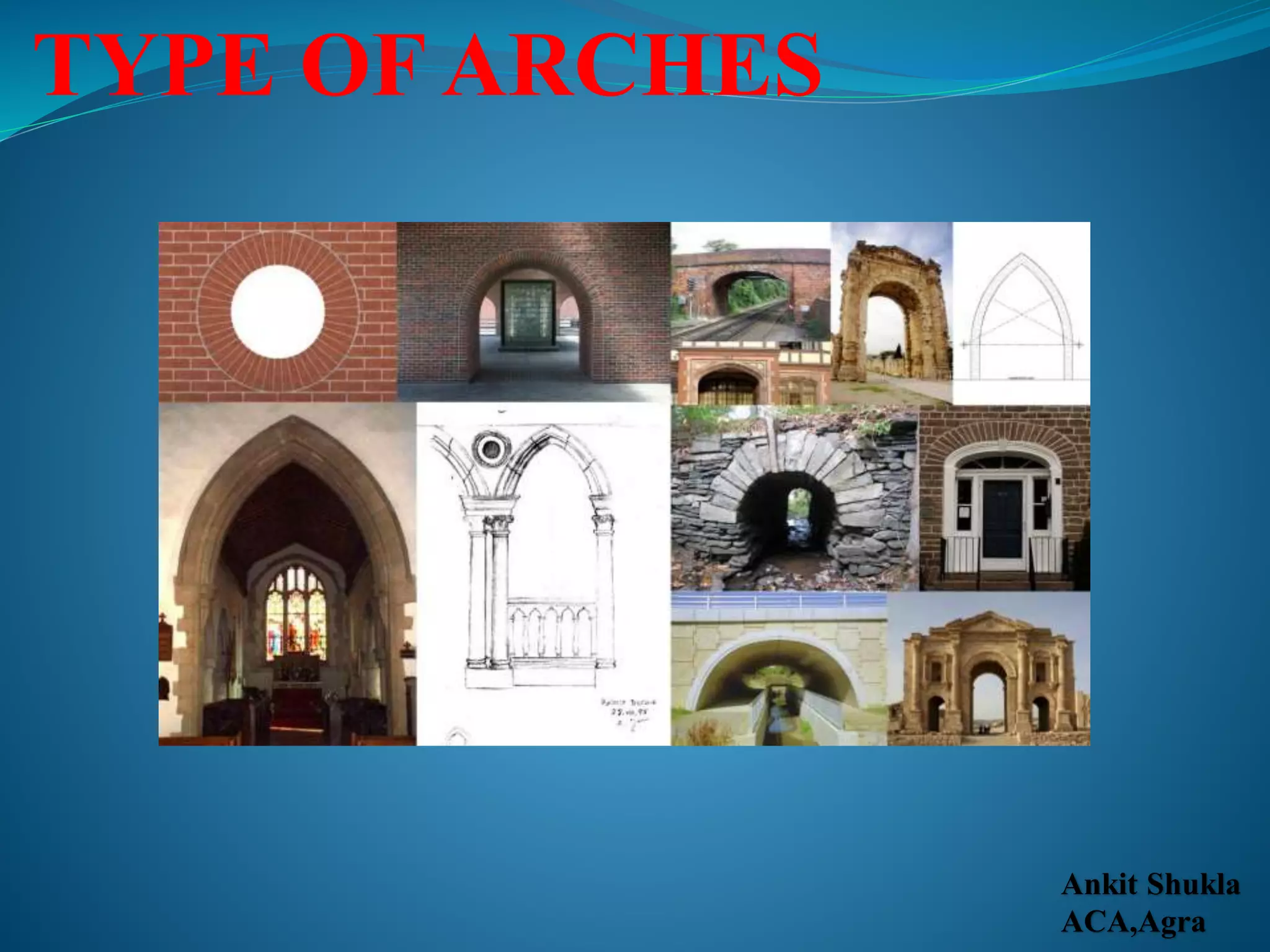
TYPE OF ARCHES
Ankit Shukla
ACA,Agra
ARCH
What is an Arch?
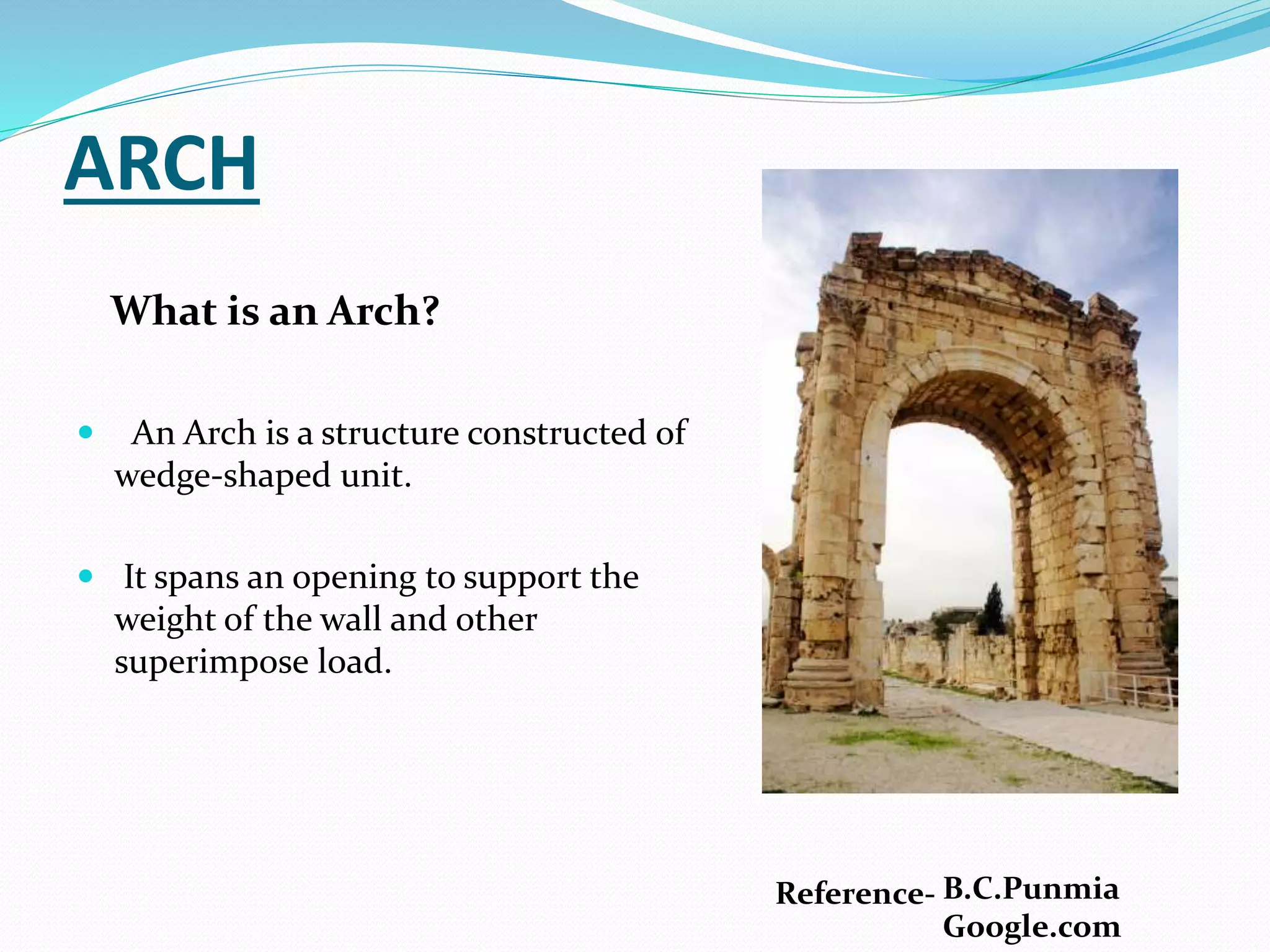
 An Arch is a structure constructed of
wedge-shaped unit.
 It spans an opening to support the
weight of the wall and other
superimpose load.
B.C.Punmia
Google.com
Reference-
Terminology
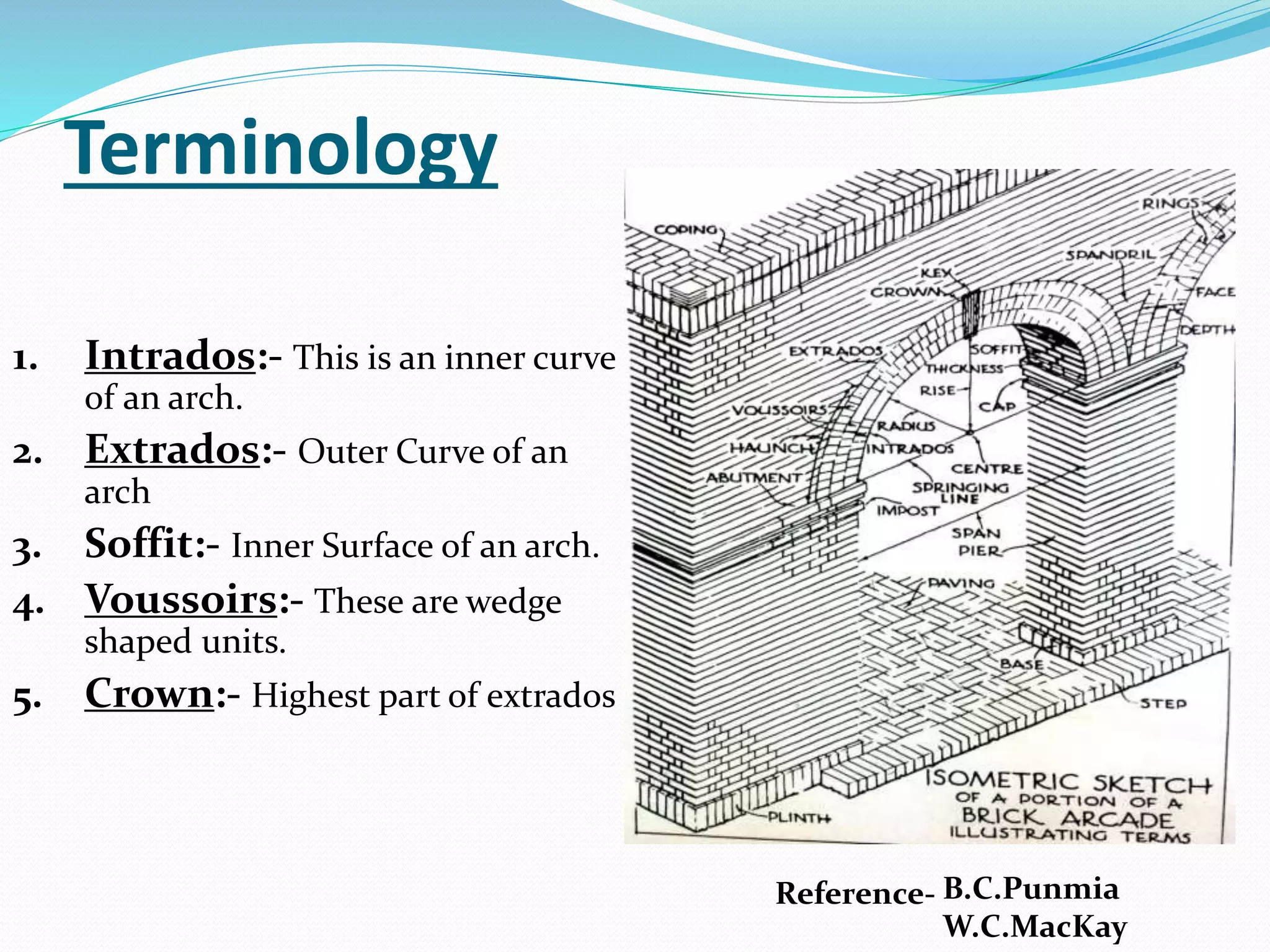
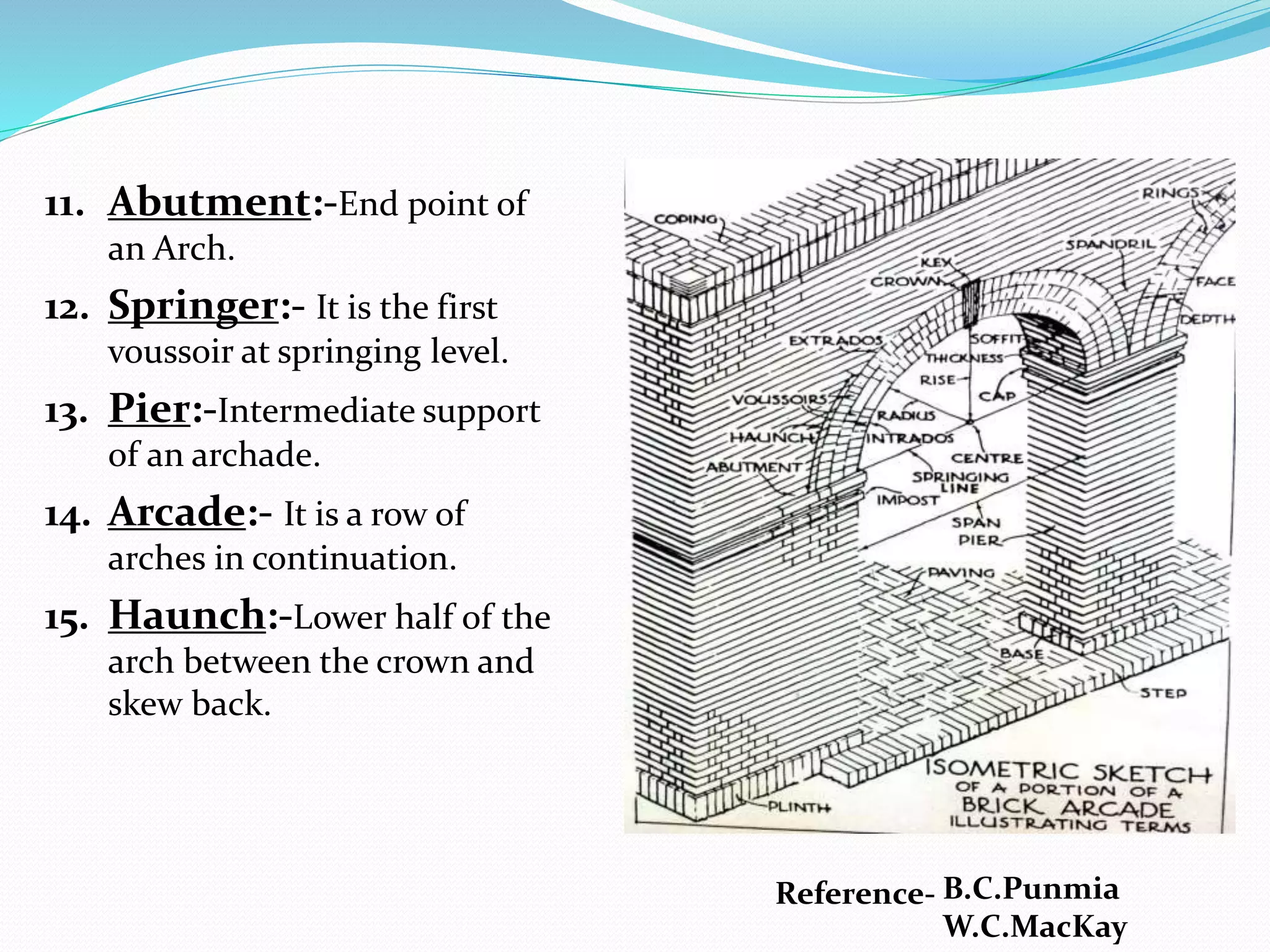
1. Intrados:- This is an inner curve
of an arch.
2. Extrados:- Outer Curve of an
arch
3. Soffit:- Inner Surface of an arch.
4. Voussoirs:- These are wedge
shaped units.
5. Crown:- Highest part of extrados
B.C.Punmia
W.C.MacKay
Reference-
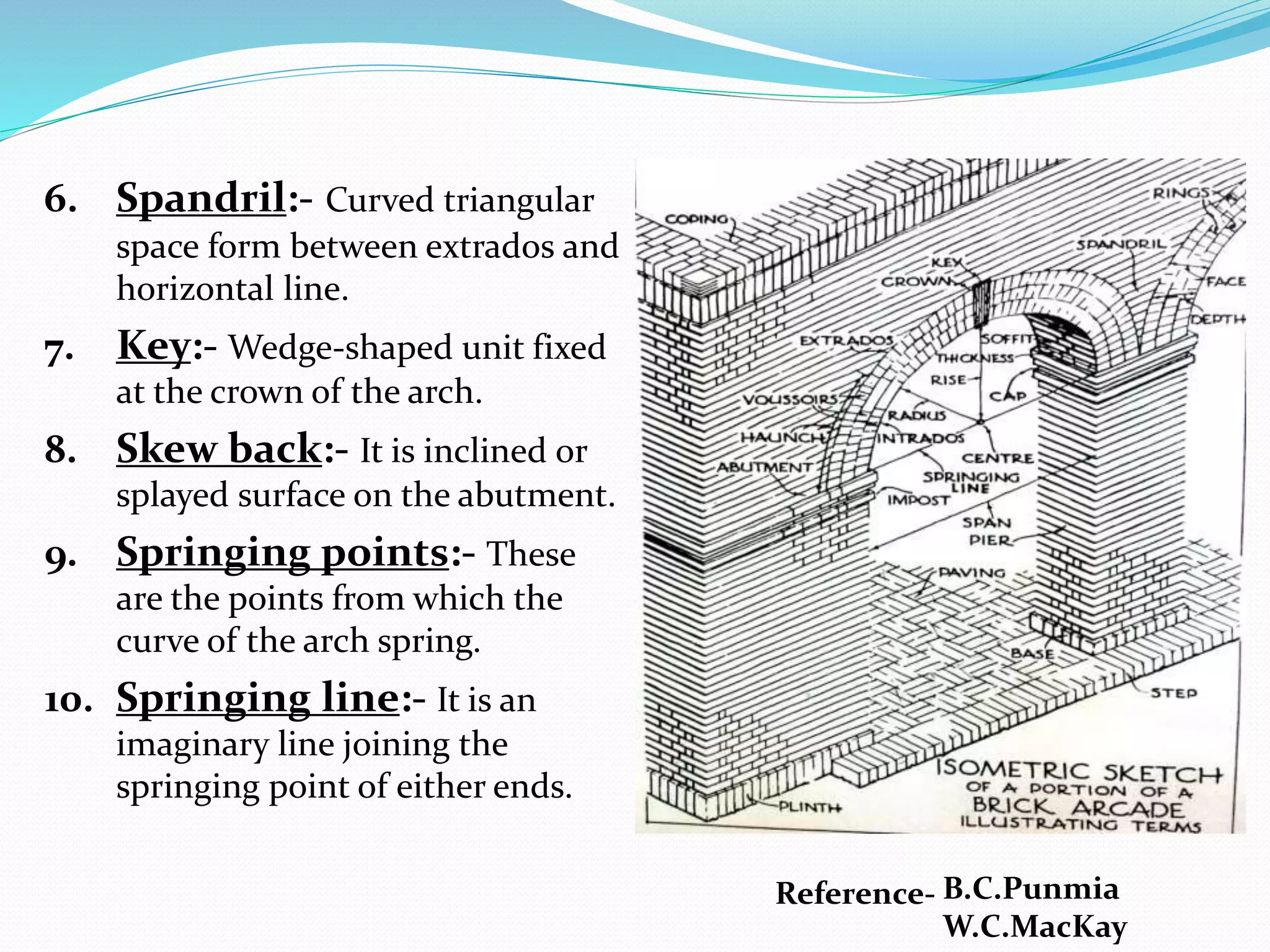
6. Spandril:- Curved triangular
space form between extrados and
horizontal line.
7. Key:- Wedge-shaped unit fixed
at the crown of the arch.
8. Skew back:- It is inclined or
splayed surface on the abutment.
9. Springing points:- These
are the points from which the
curve of the arch spring.
10. Springing line:- It is an
imaginary line joining the
springing point of either ends.
Reference- B.C.Punmia
W.C.MacKay
11. Abutment:-End point of
an Arch.
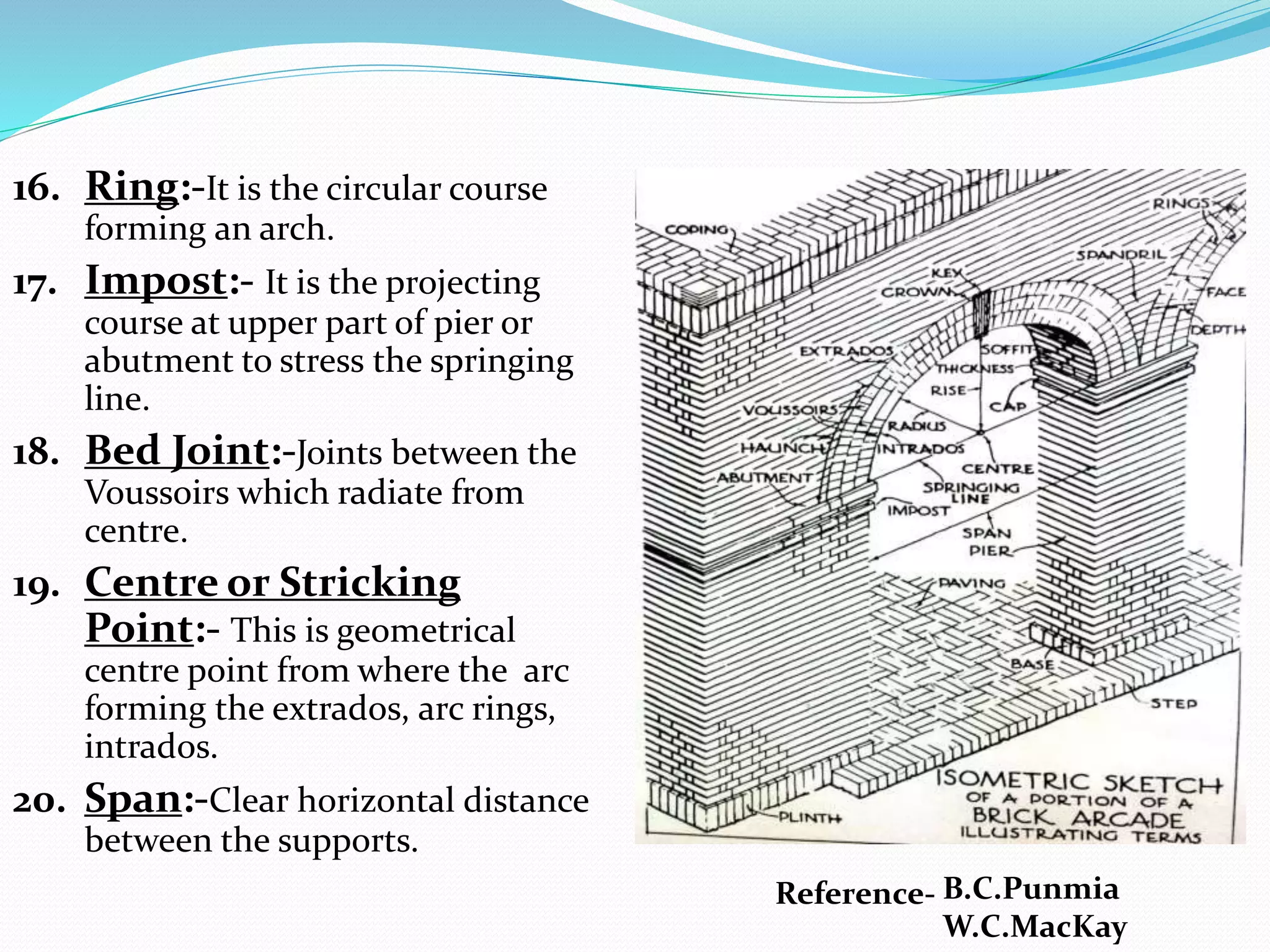
12. Springer:- It is the first
voussoir at springing level.
13. Pier:-Intermediate support
of an archade.
14. Arcade:- It is a row of
arches in continuation.
15. Haunch:-Lower half of the
arch between the crown and
skew back.
Reference- B.C.Punmia
W.C.MacKay
16. Ring:-It is the circular course
forming an arch.
17. Impost:- It is the projecting
course at upper part of pier or
abutment to stress the springing
line.
18. Bed Joint:-Joints between the
Voussoirs which radiate from
centre.
19. Centre or Stricking
Point:- This is geometrical
centre point from where the arc
forming the extrados, arc rings,
intrados.
20. Span:-Clear horizontal distance
between the supports.
Reference- B.C.Punmia
W.C.MacKay
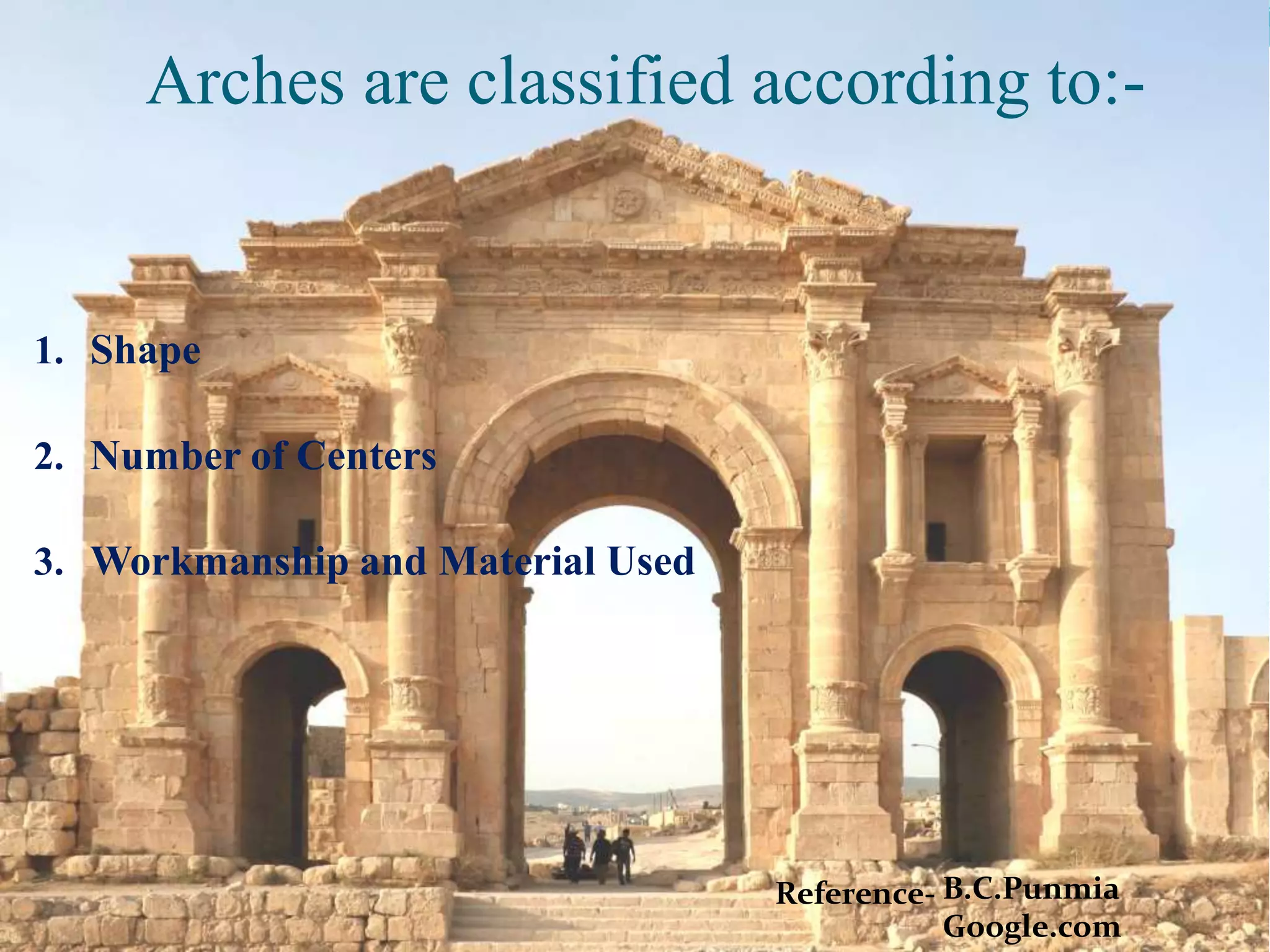
Arches are classified according to:-
1. Shape
2. Number of Centers
3. Workmanship and Material Used
Reference- B.C.Punmia
Google.com
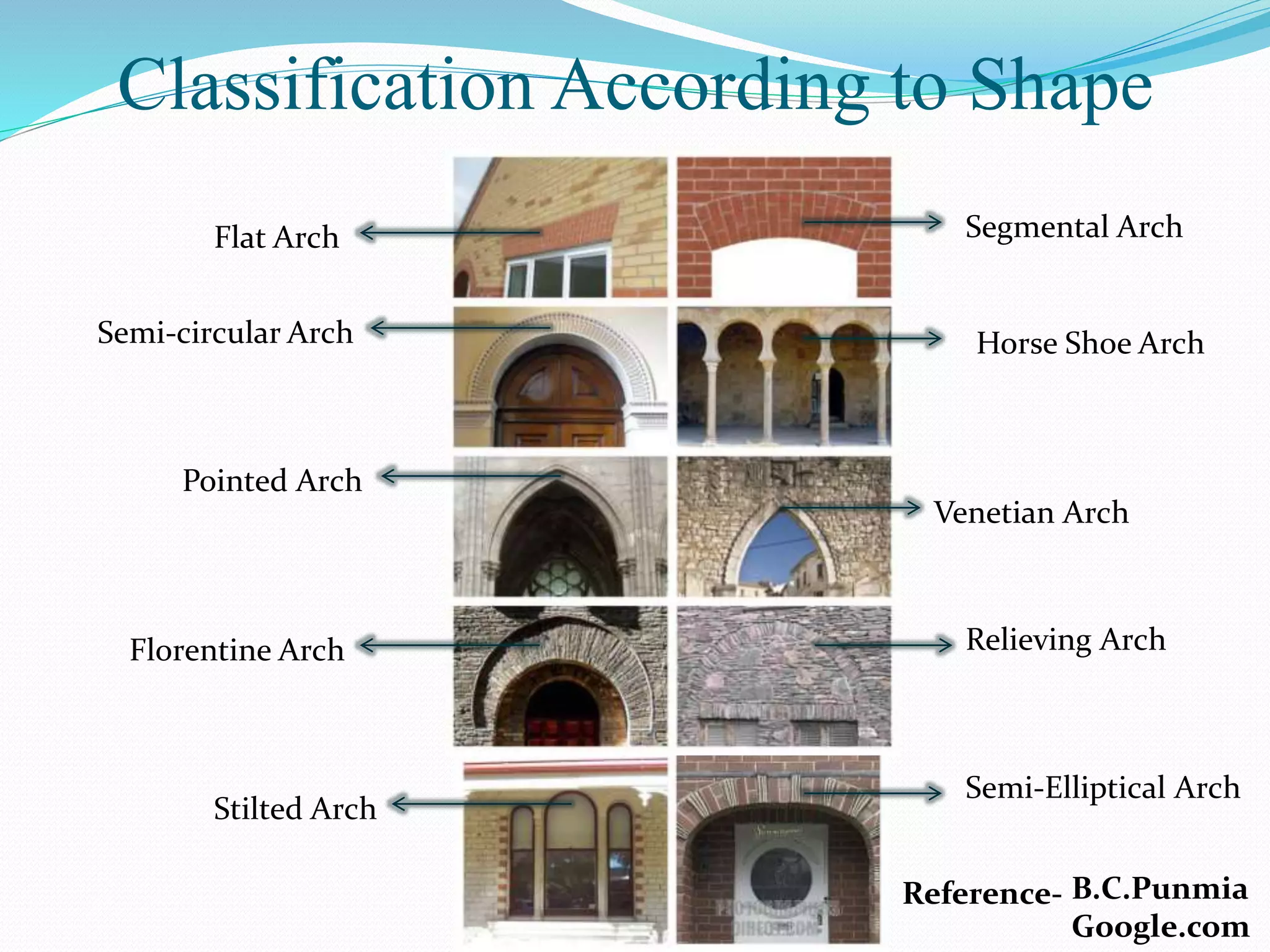
Classification According to Shape
Flat Arch Segmental Arch
Semi-circular Arch
Pointed Arch
Florentine Arch
Stilted Arch
Horse Shoe Arch
Venetian Arch
Relieving Arch
Semi-Elliptical Arch
Reference- B.C.Punmia
Google.com
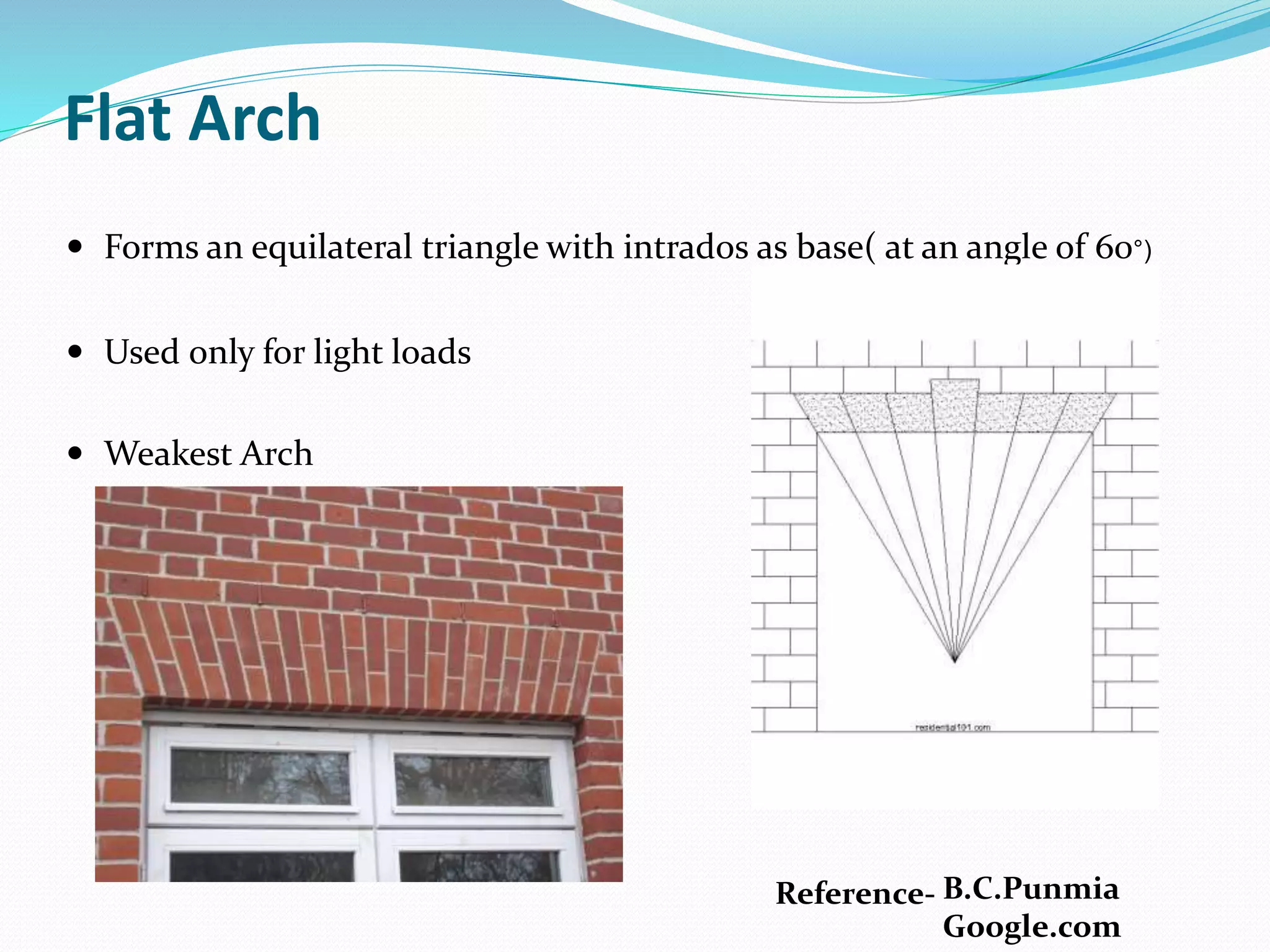
Flat Arch
 Forms an equilateral triangle with intrados as base( at an angle of 60°)
 Used only for light loads
 Weakest Arch
Reference- B.C.Punmia
Google.com
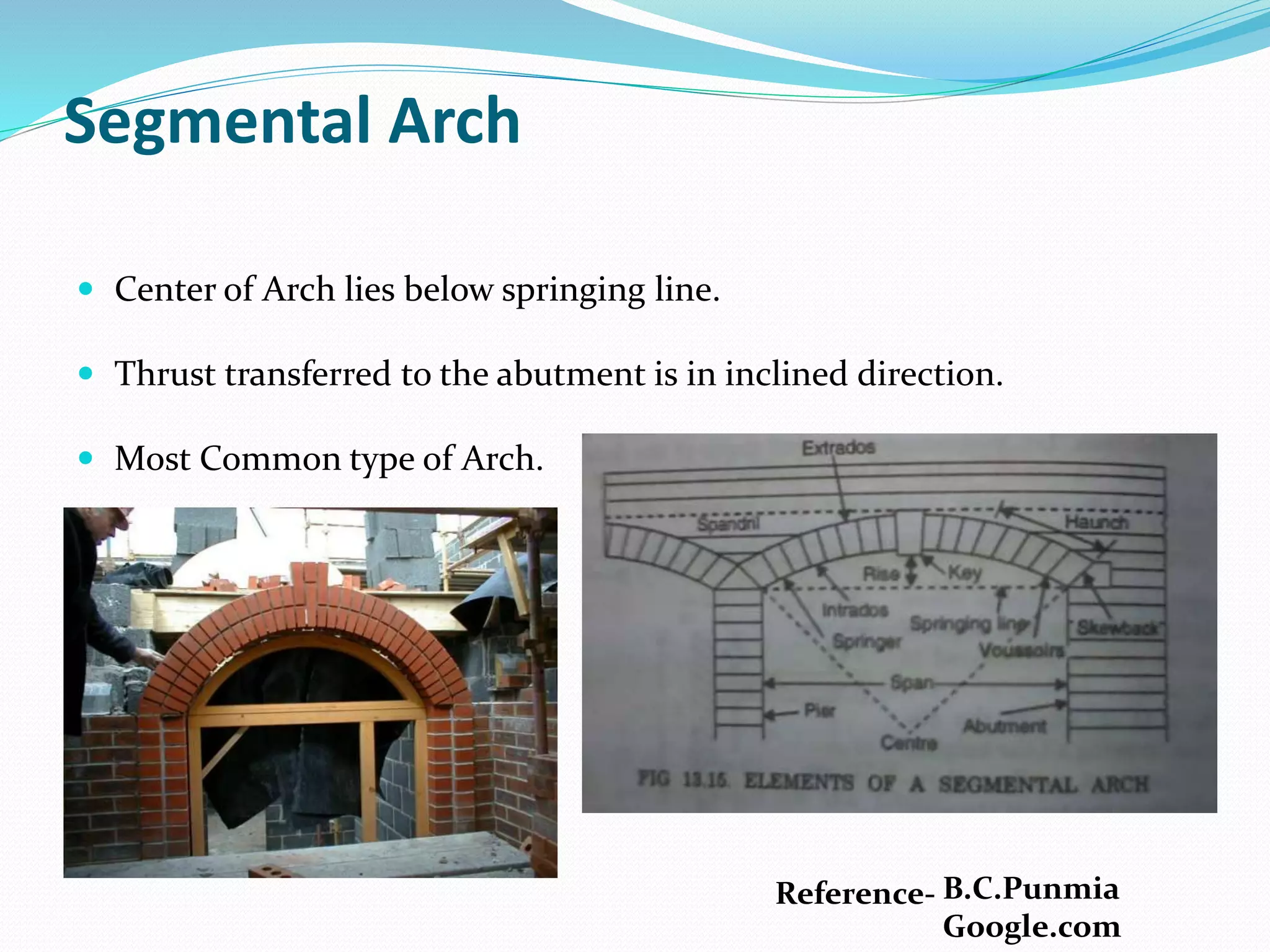
Segmental Arch
 Center of Arch lies below springing line.
 Thrust transferred to the abutment is in inclined direction.
 Most Common type of Arch.
Reference- B.C.Punmia
Google.com
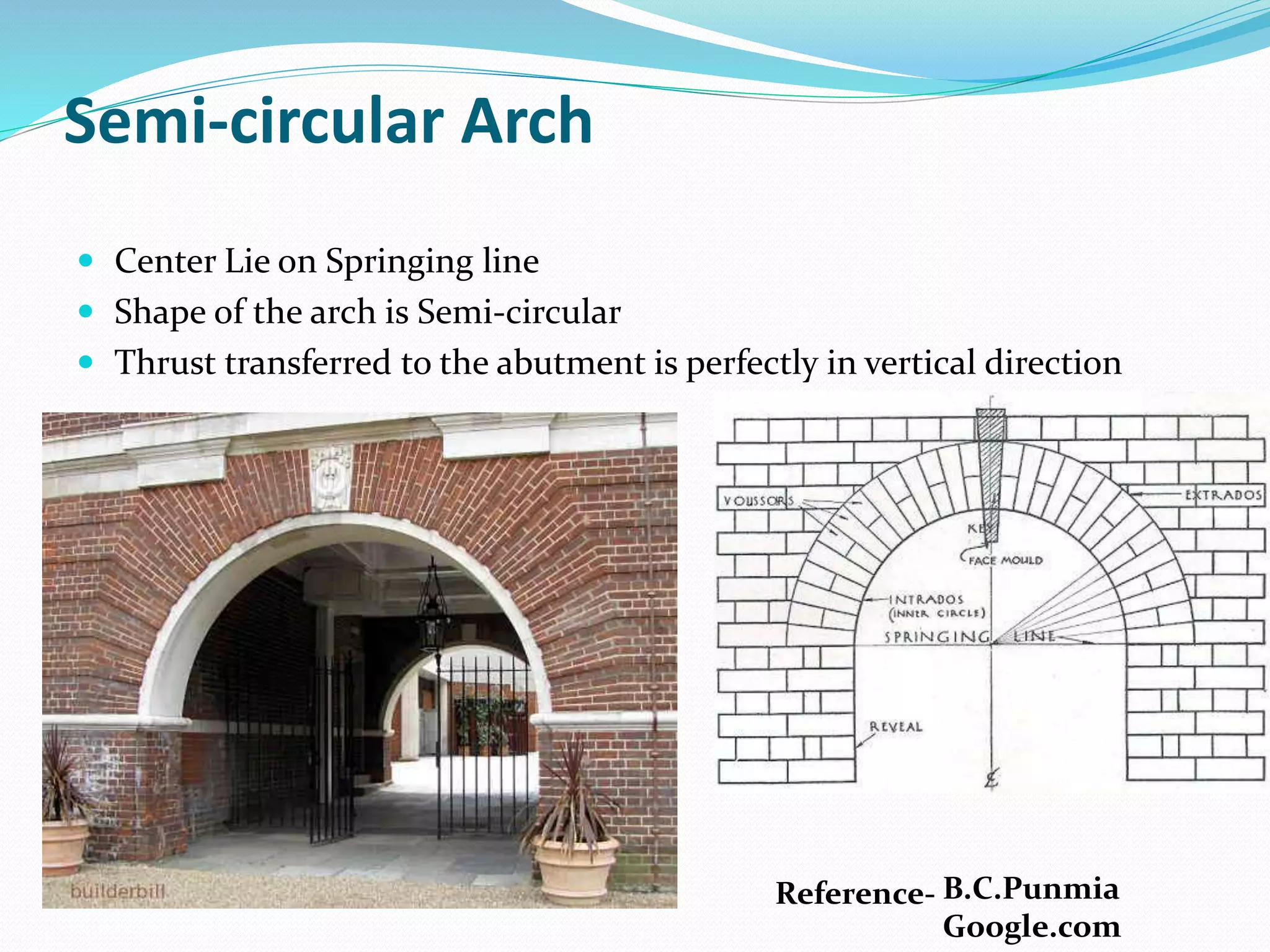
Semi-circular Arch
 Center Lie on Springing line
 Shape of the arch is Semi-circular
 Thrust transferred to the abutment is perfectly in vertical direction
Reference- B.C.Punmia
Google.com
Horse Shoe Arch
 The arch has the shape of a horse shoe.
 Incorporating more than a semi circle.
 Mainly use for Architectural consideration.
Reference- B.C.Punmia
Google.com
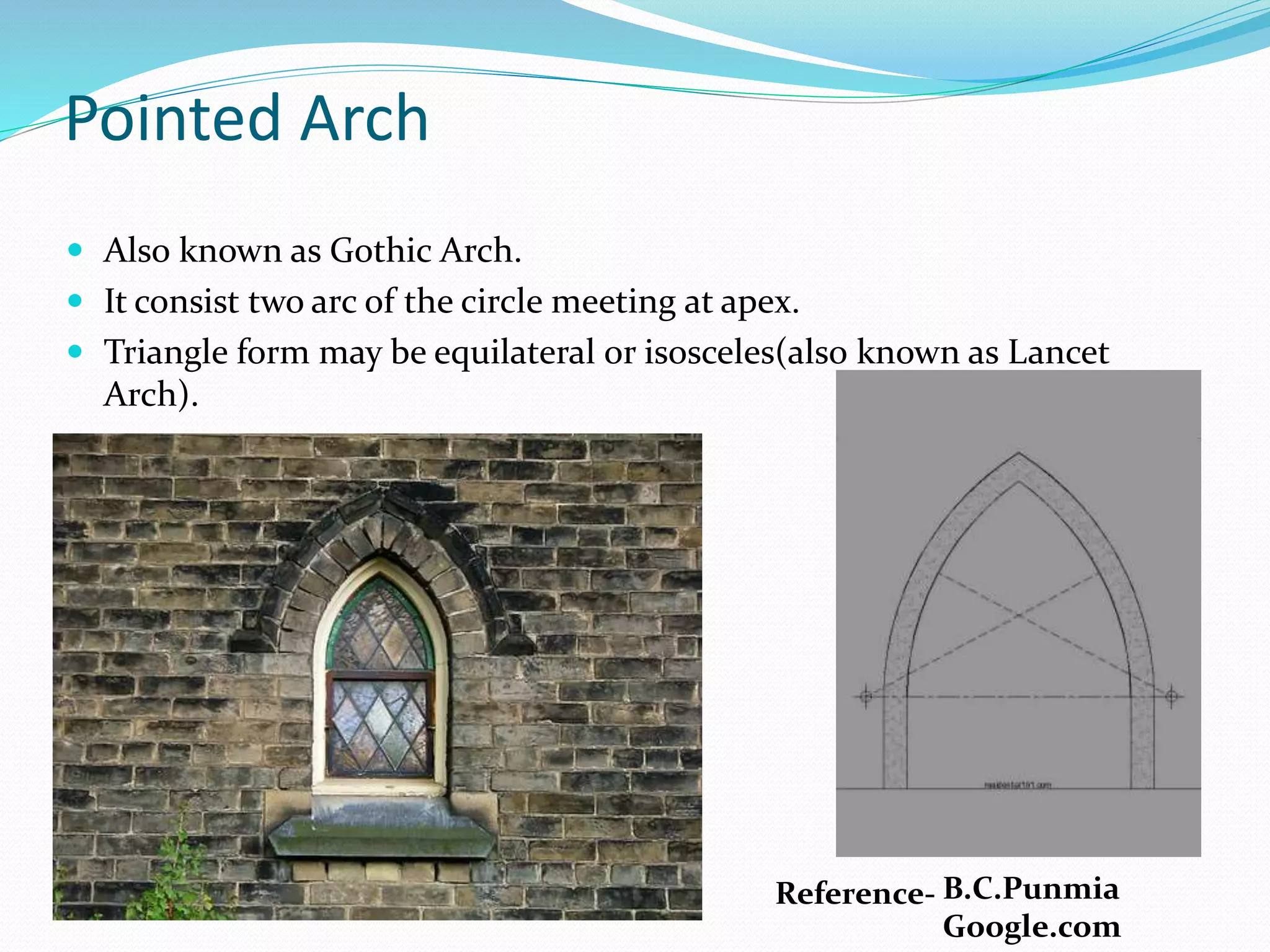
Pointed Arch
 Also known as Gothic Arch.
 It consist two arc of the circle meeting at apex.
 Triangle form may be equilateral or isosceles(also known as Lancet
Arch).
Reference- B.C.Punmia
Google.com
Venetian Arch
 This is another form of Pointed Arch.
 Has deeper depth at crown than springings.
 It Has four centers located on springing line.
Reference- B.C.Punmia
Google.com
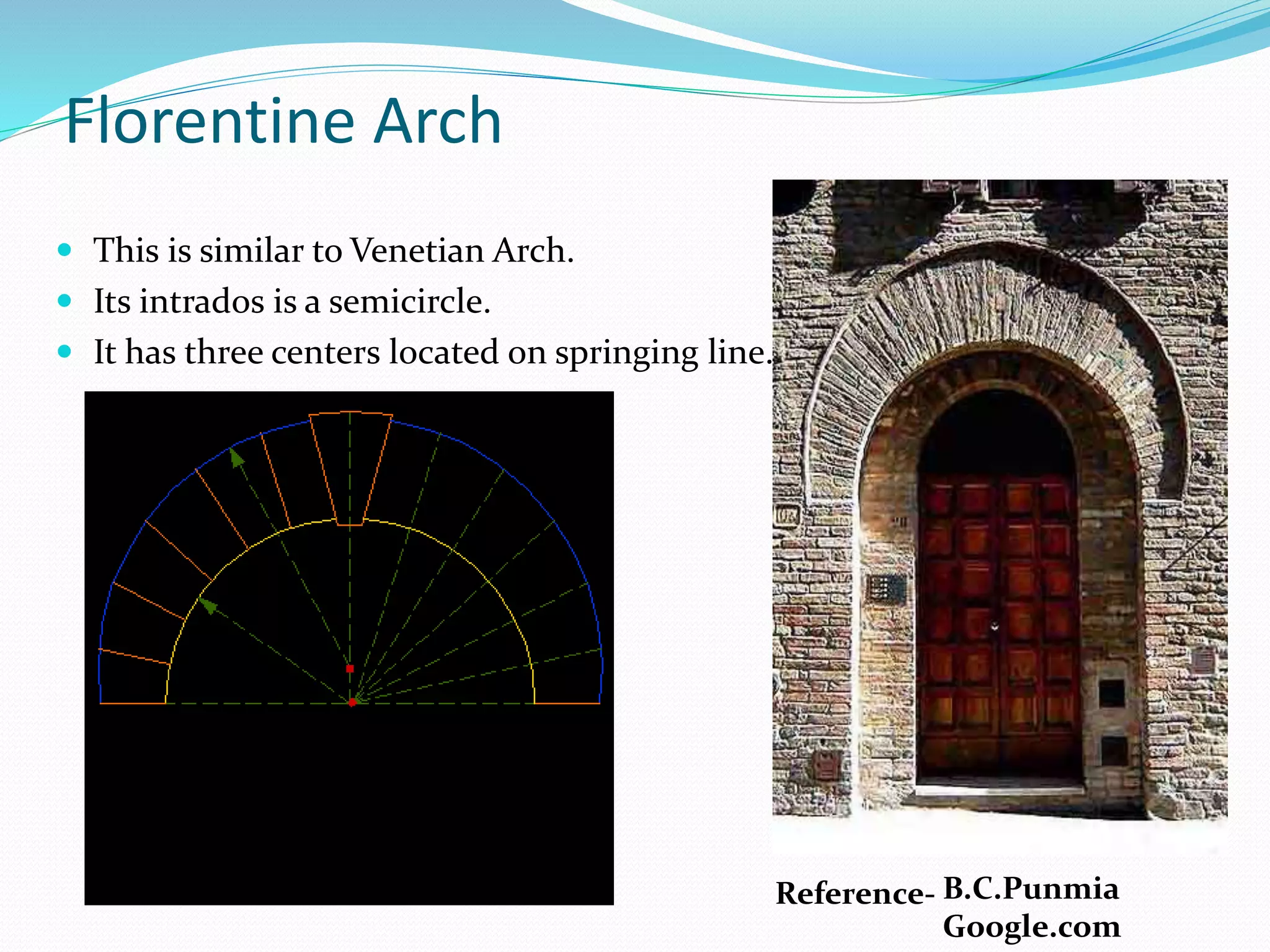
Florentine Arch
 This is similar to Venetian Arch.
 Its intrados is a semicircle.
 It has three centers located on springing line.
Reference- B.C.Punmia
Google.com
Relieving Arch
 The ends of Arch carried sufficiently into abutment.
 Its lintel can be replaced without effecting the Arch.
 The Arch is constructed on either flat arch or wooden lintel.
Reference- B.C.Punmia
Google.com
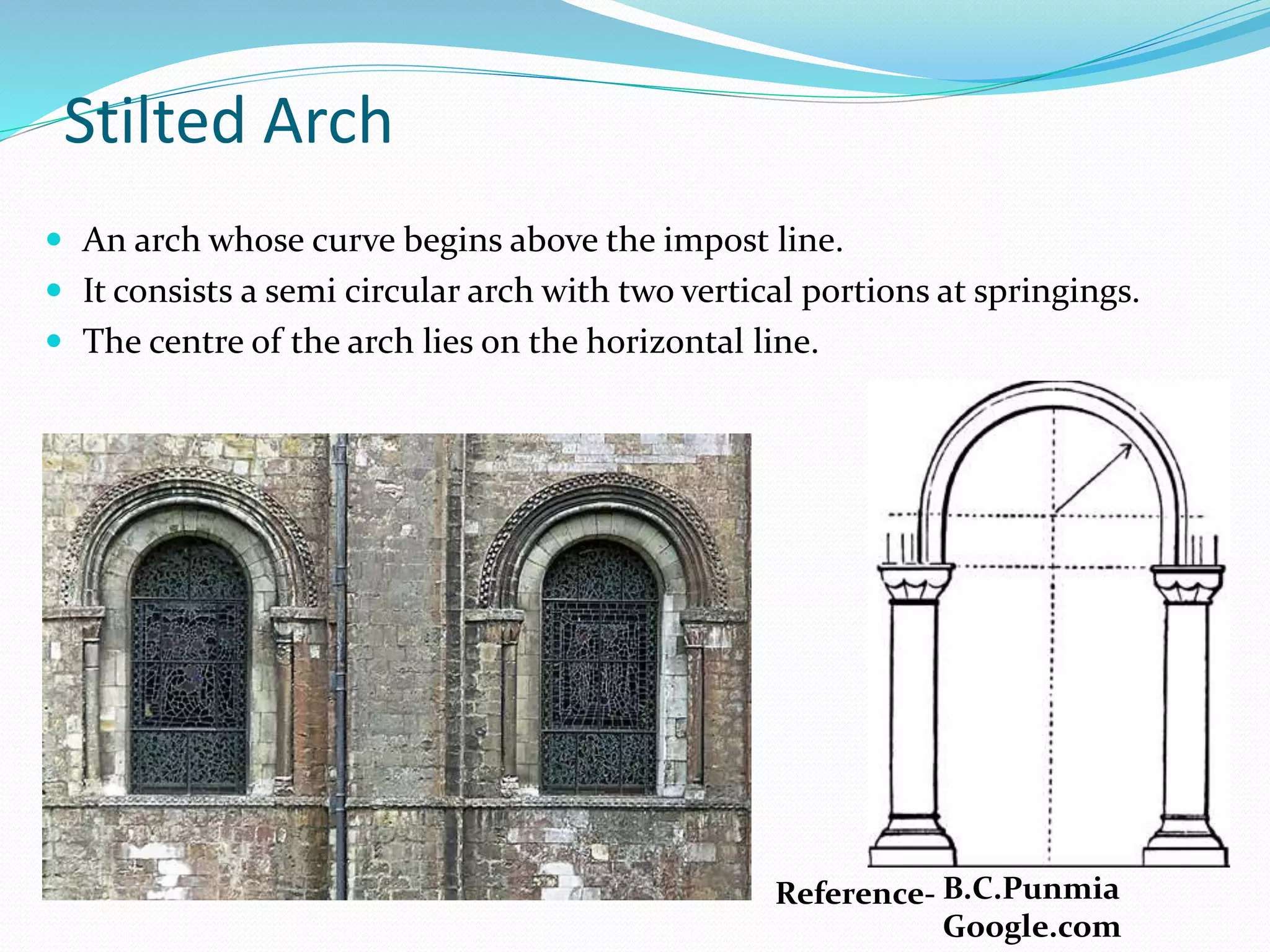
Stilted Arch
 An arch whose curve begins above the impost line.
 It consists a semi circular arch with two vertical portions at springings.
 The centre of the arch lies on the horizontal line.
Reference- B.C.Punmia
Google.com
Semi-Elliptical Arch
 It has shape of semi-ellipse.
 It has either three centre or five centre.
 Also called a basket-handle arch.
Reference- B.C.Punmia
Google.com
Classification According to Number Of
Centers
One-Centered Arch
Two-Centered Arch
Three-Centered Arch
Four-Centered Arch
Five-Centered Arch
Reference- B.C.Punmia
Google.com
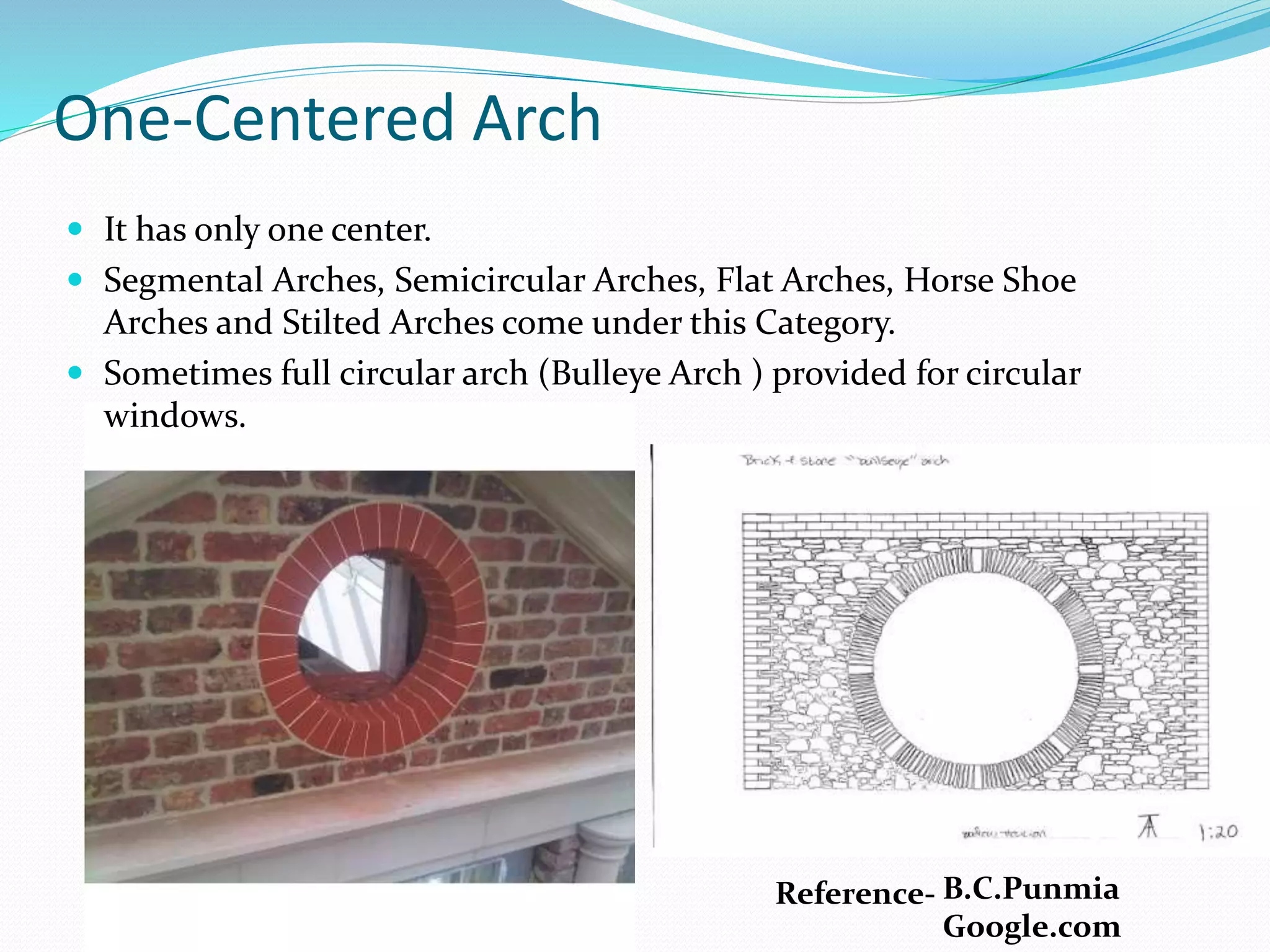
One-Centered Arch
 It has only one center.
 Segmental Arches, Semicircular Arches, Flat Arches, Horse Shoe
Arches and Stilted Arches come under this Category.
 Sometimes full circular arch (Bulleye Arch ) provided for circular
windows.
Reference- B.C.Punmia
Google.com
Two-Centered Arch
 It has two centers.
 Pointed Arches comes under this category.
 Semi-elliptical arch and Florentine arch also comes under this category.
Reference- B.C.Punmia
Google.com
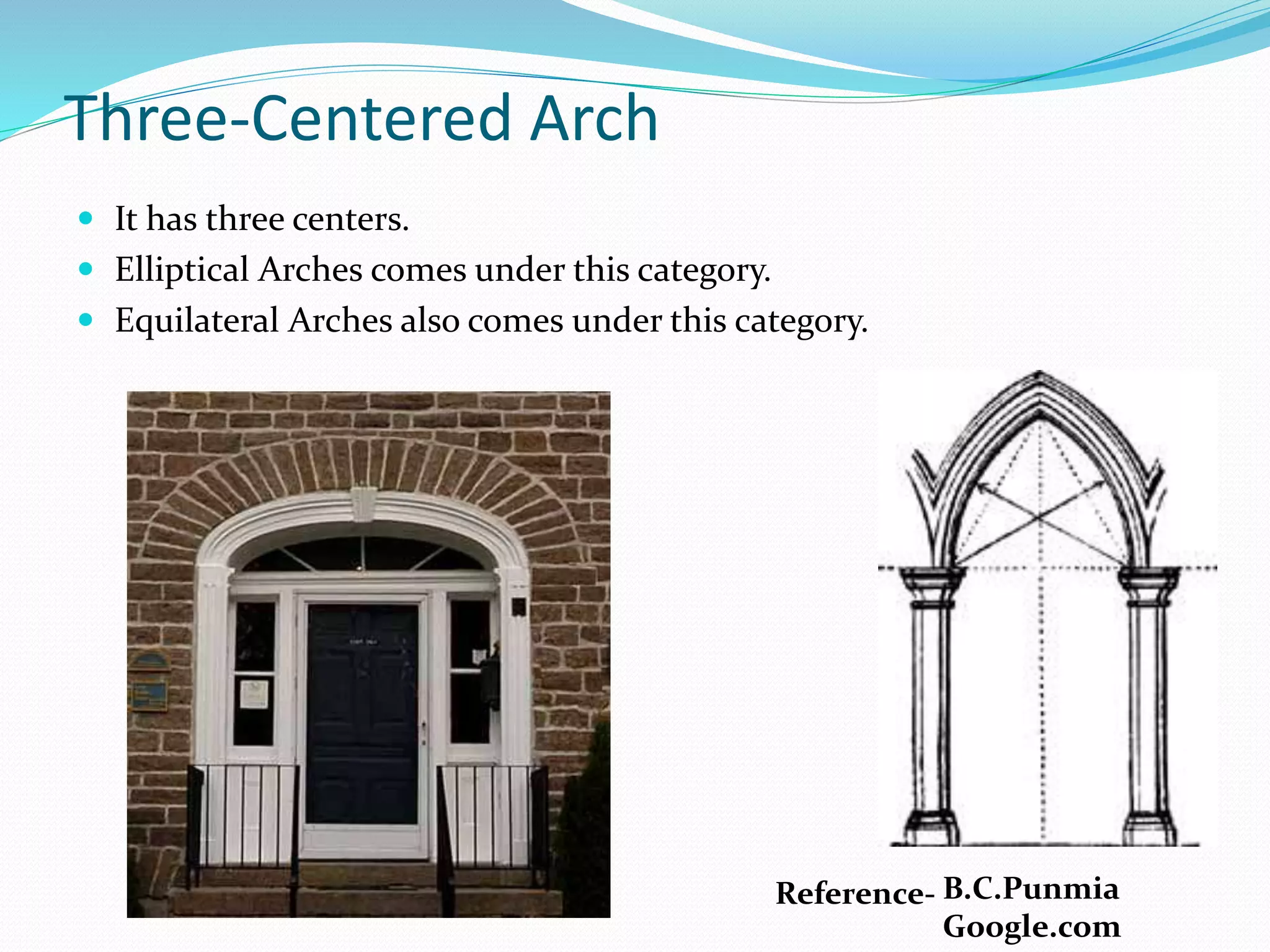
Three-Centered Arch
 It has three centers.
 Elliptical Arches comes under this category.
 Equilateral Arches also comes under this category.
Reference- B.C.Punmia
Google.com
Four-Centered Arch
 It has four centers.
 Venetian arch comes under this category.
 Another example is Tudor arch.
B.C.Punmia
Google.com
Reference-
Five-Centered Arch
 It has five centers
 Fives centers help in getting a good semi- elliptical shape
Reference- B.C.Punmia
Google.com
Classification Based On Material And
Workmanship
Stone Arch Brick Arch
Concrete Arch Reference- B.C.Punmia
Google.com
Stone Arch
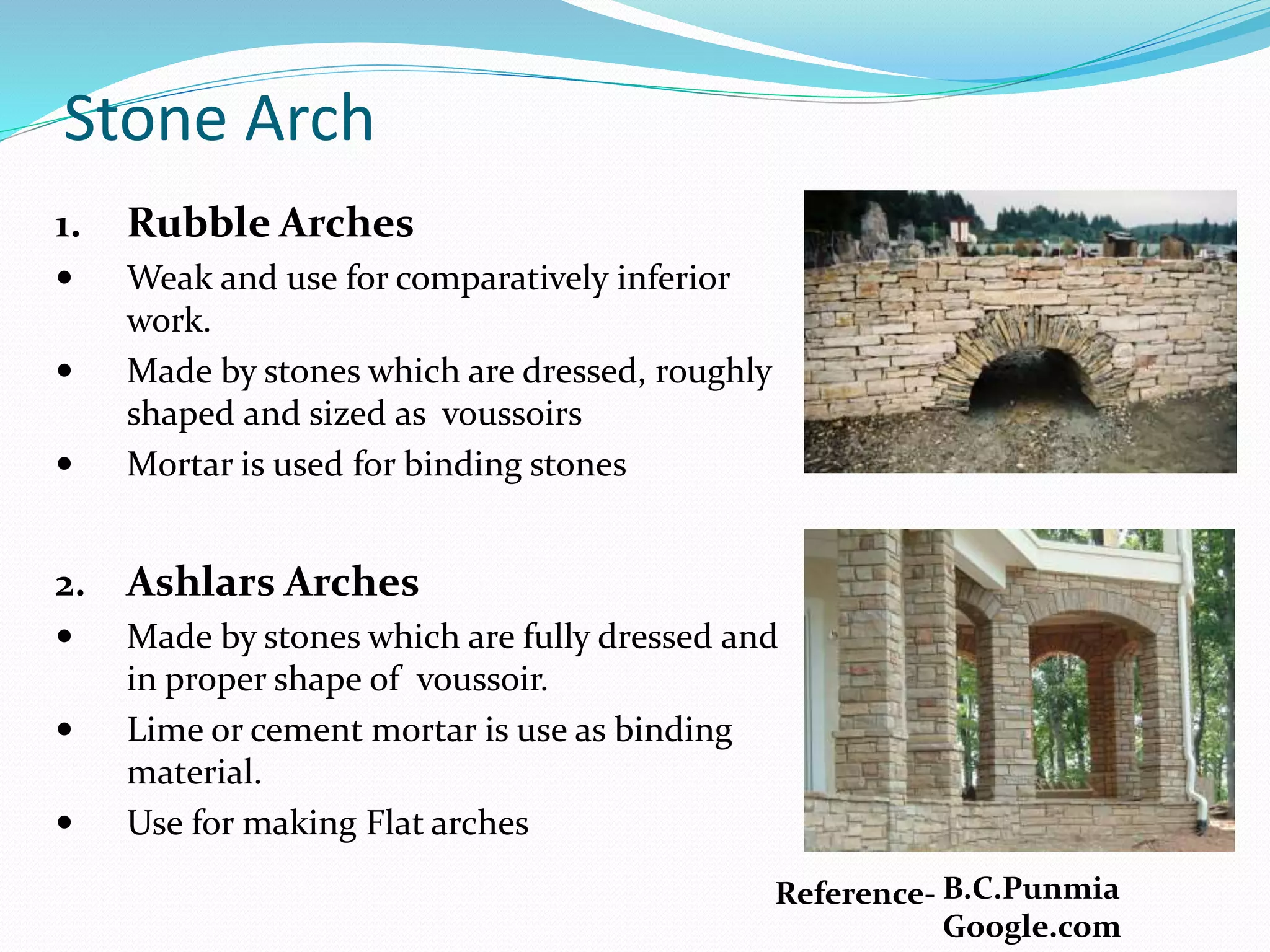
1. Rubble Arches
 Weak and use for comparatively inferior
work.
 Made by stones which are dressed, roughly
shaped and sized as voussoirs
 Mortar is used for binding stones
2. Ashlars Arches
 Made by stones which are fully dressed and
in proper shape of voussoir.
 Lime or cement mortar is use as binding
material.
 Use for making Flat arches
Reference- B.C.Punmia
Google.com
Brick Arches
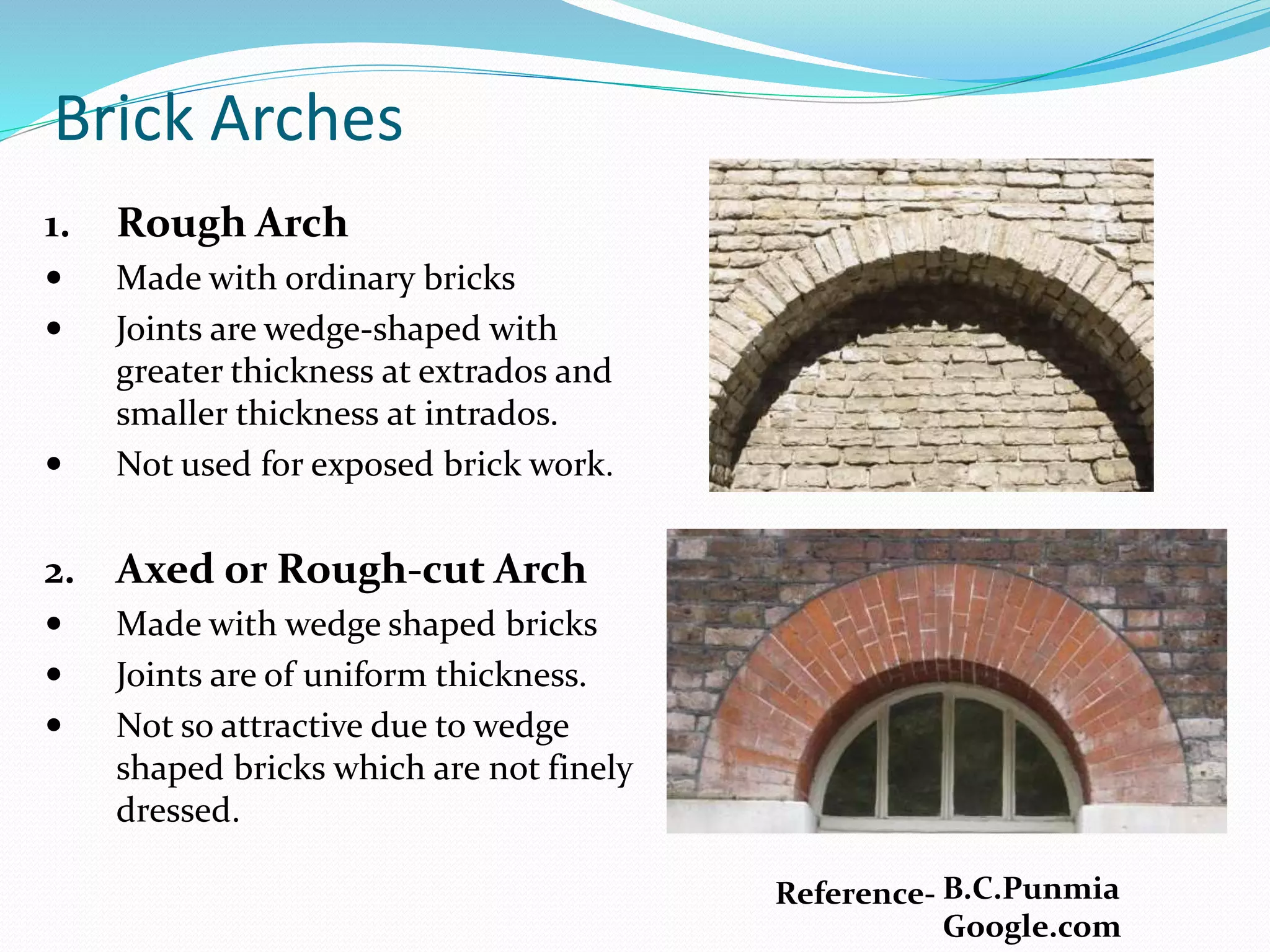
1. Rough Arch
 Made with ordinary bricks
 Joints are wedge-shaped with
greater thickness at extrados and
smaller thickness at intrados.
 Not used for exposed brick work.
2. Axed or Rough-cut Arch
 Made with wedge shaped bricks
 Joints are of uniform thickness.
 Not so attractive due to wedge
shaped bricks which are not finely
dressed.
Reference- B.C.Punmia
Google.com
3. Gauged Arch
 Made with bricks which are prepared to
exact size and shape of voussoir.
 Joints are fine , thin and truly radial.
 Lime putty is use as a binding material.
4. Purpose made brick Arch
 Made with special bricks which are
manufactured in exact shape and size of
voussoirs.
 This is very fine workmanship.
 Lime putty is used as a binding material.
Reference- B.C.Punmia
Google.com
Concrete Arches
1. Concrete block-unit Arch
 Made with pre casted concrete
blocks.(moulds in shape of voussoirs)
 Good appearance and size of arch
achieved due to perfections.
 Cement mortar is used as a binding
material and joints are thin.
2. Monolithic Arch
 Made with cast-in- situ concrete, either
plain or reinforced.
 Suitable for large span.
 The thickness is 15cm for arches upto
3m span.
Reference- B.C.Punmia
Google.com

Types of Arches

  • 1.
    TYPE OF ARCHES AnkitShukla ACA,Agra
  • 2.
    ARCH What is anArch?  An Arch is a structure constructed of wedge-shaped unit.  It spans an opening to support the weight of the wall and other superimpose load. B.C.Punmia Google.com Reference-
  • 3.
    Terminology 1. Intrados:- Thisis an inner curve of an arch. 2. Extrados:- Outer Curve of an arch 3. Soffit:- Inner Surface of an arch. 4. Voussoirs:- These are wedge shaped units. 5. Crown:- Highest part of extrados B.C.Punmia W.C.MacKay Reference-
  • 4.
    6. Spandril:- Curvedtriangular space form between extrados and horizontal line. 7. Key:- Wedge-shaped unit fixed at the crown of the arch. 8. Skew back:- It is inclined or splayed surface on the abutment. 9. Springing points:- These are the points from which the curve of the arch spring. 10. Springing line:- It is an imaginary line joining the springing point of either ends. Reference- B.C.Punmia W.C.MacKay
  • 5.
    11. Abutment:-End pointof an Arch. 12. Springer:- It is the first voussoir at springing level. 13. Pier:-Intermediate support of an archade. 14. Arcade:- It is a row of arches in continuation. 15. Haunch:-Lower half of the arch between the crown and skew back. Reference- B.C.Punmia W.C.MacKay
  • 6.
    16. Ring:-It isthe circular course forming an arch. 17. Impost:- It is the projecting course at upper part of pier or abutment to stress the springing line. 18. Bed Joint:-Joints between the Voussoirs which radiate from centre. 19. Centre or Stricking Point:- This is geometrical centre point from where the arc forming the extrados, arc rings, intrados. 20. Span:-Clear horizontal distance between the supports. Reference- B.C.Punmia W.C.MacKay
  • 7.
    Arches are classifiedaccording to:- 1. Shape 2. Number of Centers 3. Workmanship and Material Used Reference- B.C.Punmia Google.com
  • 8.
    Classification According toShape Flat Arch Segmental Arch Semi-circular Arch Pointed Arch Florentine Arch Stilted Arch Horse Shoe Arch Venetian Arch Relieving Arch Semi-Elliptical Arch Reference- B.C.Punmia Google.com
  • 9.
    Flat Arch  Formsan equilateral triangle with intrados as base( at an angle of 60°)  Used only for light loads  Weakest Arch Reference- B.C.Punmia Google.com
  • 10.
    Segmental Arch  Centerof Arch lies below springing line.  Thrust transferred to the abutment is in inclined direction.  Most Common type of Arch. Reference- B.C.Punmia Google.com
  • 11.
    Semi-circular Arch  CenterLie on Springing line  Shape of the arch is Semi-circular  Thrust transferred to the abutment is perfectly in vertical direction Reference- B.C.Punmia Google.com
  • 12.
    Horse Shoe Arch The arch has the shape of a horse shoe.  Incorporating more than a semi circle.  Mainly use for Architectural consideration. Reference- B.C.Punmia Google.com
  • 13.
    Pointed Arch  Alsoknown as Gothic Arch.  It consist two arc of the circle meeting at apex.  Triangle form may be equilateral or isosceles(also known as Lancet Arch). Reference- B.C.Punmia Google.com
  • 14.
    Venetian Arch  Thisis another form of Pointed Arch.  Has deeper depth at crown than springings.  It Has four centers located on springing line. Reference- B.C.Punmia Google.com
  • 15.
    Florentine Arch  Thisis similar to Venetian Arch.  Its intrados is a semicircle.  It has three centers located on springing line. Reference- B.C.Punmia Google.com
  • 16.
    Relieving Arch  Theends of Arch carried sufficiently into abutment.  Its lintel can be replaced without effecting the Arch.  The Arch is constructed on either flat arch or wooden lintel. Reference- B.C.Punmia Google.com
  • 17.
    Stilted Arch  Anarch whose curve begins above the impost line.  It consists a semi circular arch with two vertical portions at springings.  The centre of the arch lies on the horizontal line. Reference- B.C.Punmia Google.com
  • 18.
    Semi-Elliptical Arch  Ithas shape of semi-ellipse.  It has either three centre or five centre.  Also called a basket-handle arch. Reference- B.C.Punmia Google.com
  • 19.
    Classification According toNumber Of Centers One-Centered Arch Two-Centered Arch Three-Centered Arch Four-Centered Arch Five-Centered Arch Reference- B.C.Punmia Google.com
  • 20.
    One-Centered Arch  Ithas only one center.  Segmental Arches, Semicircular Arches, Flat Arches, Horse Shoe Arches and Stilted Arches come under this Category.  Sometimes full circular arch (Bulleye Arch ) provided for circular windows. Reference- B.C.Punmia Google.com
  • 21.
    Two-Centered Arch  Ithas two centers.  Pointed Arches comes under this category.  Semi-elliptical arch and Florentine arch also comes under this category. Reference- B.C.Punmia Google.com
  • 22.
    Three-Centered Arch  Ithas three centers.  Elliptical Arches comes under this category.  Equilateral Arches also comes under this category. Reference- B.C.Punmia Google.com
  • 23.
    Four-Centered Arch  Ithas four centers.  Venetian arch comes under this category.  Another example is Tudor arch. B.C.Punmia Google.com Reference-
  • 24.
    Five-Centered Arch  Ithas five centers  Fives centers help in getting a good semi- elliptical shape Reference- B.C.Punmia Google.com
  • 25.
    Classification Based OnMaterial And Workmanship Stone Arch Brick Arch Concrete Arch Reference- B.C.Punmia Google.com
  • 26.
    Stone Arch 1. RubbleArches  Weak and use for comparatively inferior work.  Made by stones which are dressed, roughly shaped and sized as voussoirs  Mortar is used for binding stones 2. Ashlars Arches  Made by stones which are fully dressed and in proper shape of voussoir.  Lime or cement mortar is use as binding material.  Use for making Flat arches Reference- B.C.Punmia Google.com
  • 27.
    Brick Arches 1. RoughArch  Made with ordinary bricks  Joints are wedge-shaped with greater thickness at extrados and smaller thickness at intrados.  Not used for exposed brick work. 2. Axed or Rough-cut Arch  Made with wedge shaped bricks  Joints are of uniform thickness.  Not so attractive due to wedge shaped bricks which are not finely dressed. Reference- B.C.Punmia Google.com
  • 28.
    3. Gauged Arch Made with bricks which are prepared to exact size and shape of voussoir.  Joints are fine , thin and truly radial.  Lime putty is use as a binding material. 4. Purpose made brick Arch  Made with special bricks which are manufactured in exact shape and size of voussoirs.  This is very fine workmanship.  Lime putty is used as a binding material. Reference- B.C.Punmia Google.com
  • 29.
    Concrete Arches 1. Concreteblock-unit Arch  Made with pre casted concrete blocks.(moulds in shape of voussoirs)  Good appearance and size of arch achieved due to perfections.  Cement mortar is used as a binding material and joints are thin. 2. Monolithic Arch  Made with cast-in- situ concrete, either plain or reinforced.  Suitable for large span.  The thickness is 15cm for arches upto 3m span. Reference- B.C.Punmia Google.com