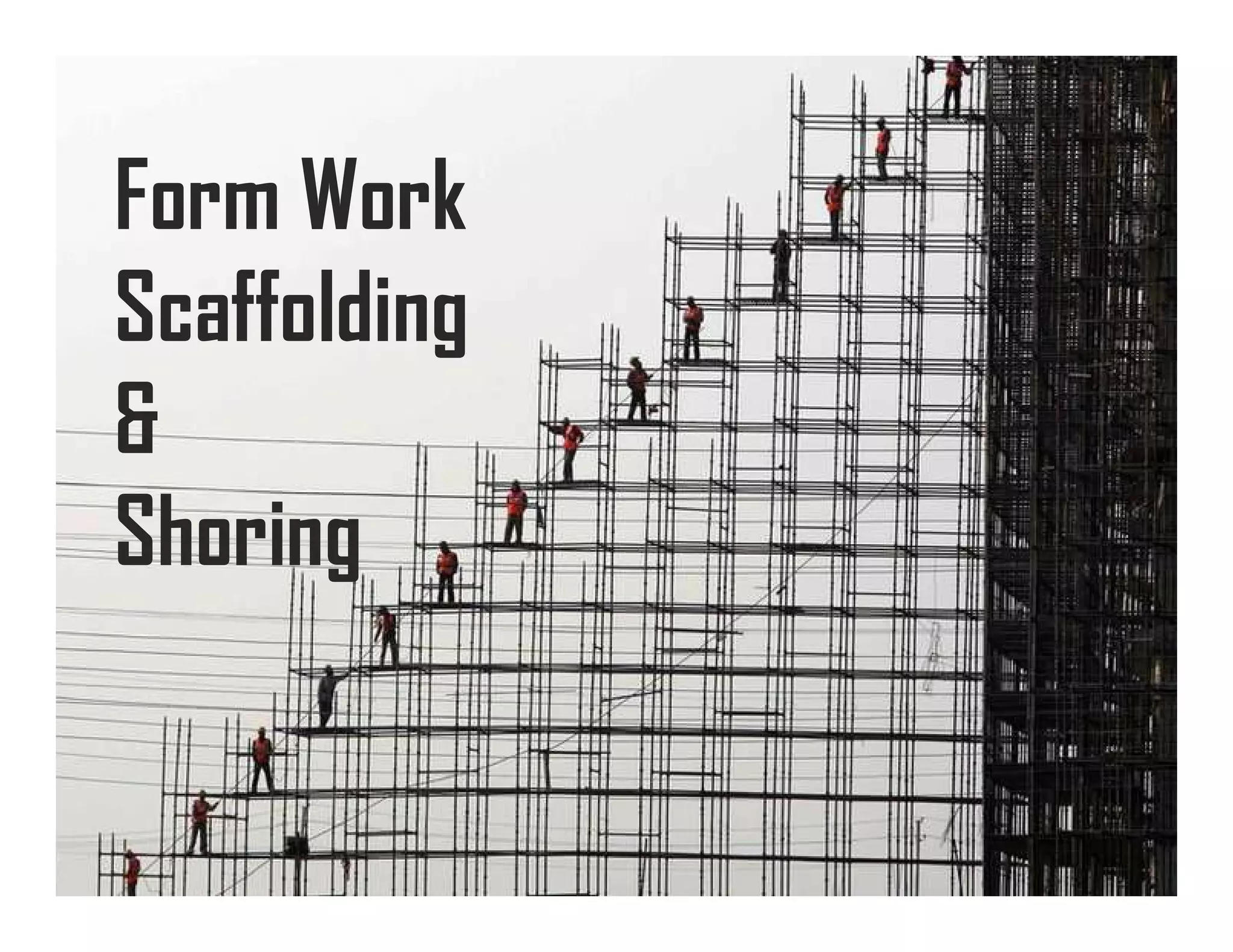
Form Work
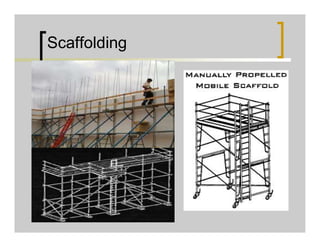
Scaffolding
&
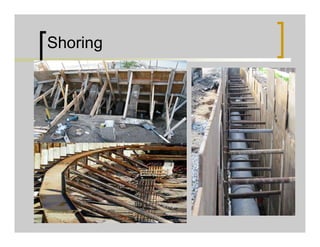
Shoring
General
 For the different construction activities like
 Brick work above 5 ft
 Surface finishing works like plastering, painting, walling
etc.
 Renovation, repair and alteration works.
 Roof and slab pouring
Some temporary supports are required like
 Formwork (forms in which concrete is poured)
 Scaffoldings (arrangement for working plate forms)
 Shoring (supporting method for unsafe structure)
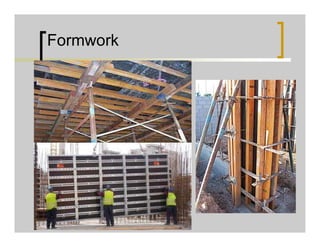
Formwork
Scaffolding
Shoring
Form work
 Definition
 Qualities of formwork
 Types of formwork
 Formwork detail for different structural
members
 Removal of formwork
 Maintenance of formwork
 Cost of formwork
 Advantages of steel form work
Formwork - Definition
 Its is a temporary support provided below and
around the concrete work.
 Formwork is commonly made up of
 Steel
 wood
 Formwork construction is of prime importance in
concrete industry. It shares a significant amount of
concrete cost.
 Formwork is designed according to The ACI
document SP-4.
Qualities of formwork
 Formwork should be according to
ACI document SP-4
 It should be water tight
 It should be strong
 It should be reusable
 Its contact surface should be uniform
 It should be according to the size and
shape of member.
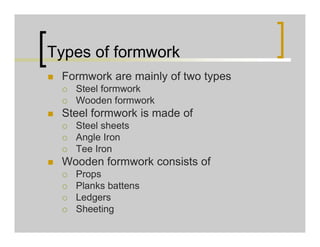
Types of formwork
 Formwork are mainly of two types
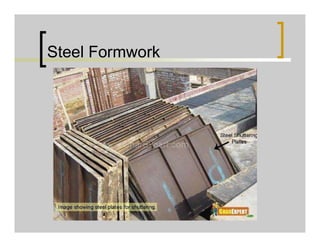
 Steel formwork
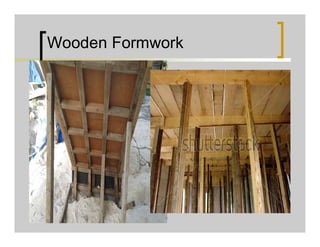
 Wooden formwork
 Steel formwork is made of
 Steel sheets
 Angle Iron
 Tee Iron
 Wooden formwork consists of
 Props
 Planks battens
 Ledgers
 Sheeting
Steel Formwork
Wooden Formwork
Formwork detail for different
structural members
 In concrete construction formwork is
commonly provided for the following
structural members.
 Foundations
 Walls
 Columns
 Slabs & beams
 Stairs
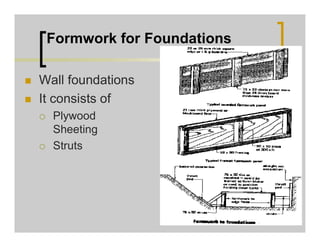
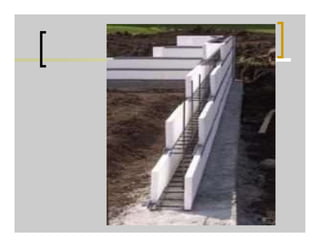
Formwork for Foundations
 Wall foundations
 It consists of
 Plywood
Sheeting
 Struts
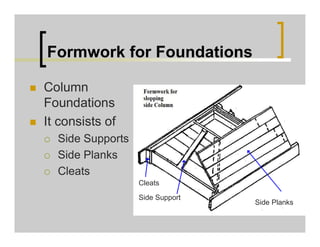
Formwork for Foundations
 Column
Foundations
 It consists of
 Side Supports
 Side Planks
 Cleats
Side Support
Side Planks
Cleats
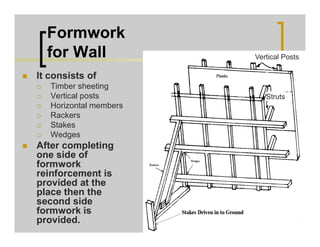
Formwork
for Wall
 It consists of
 Timber sheeting
 Vertical posts
 Horizontal members
 Rackers
 Stakes
 Wedges
 After completing
one side of
formwork
reinforcement is
provided at the
place then the
second side
formwork is
provided.
Vertical Posts
Struts
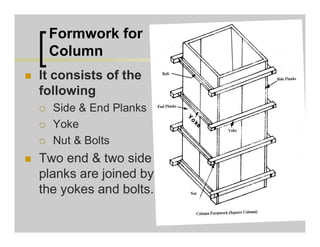
Formwork for
Column
 It consists of the
following
 Side & End Planks
 Yoke
 Nut & Bolts
 Two end & two side
planks are joined by
the yokes and bolts.
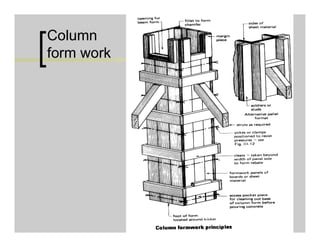
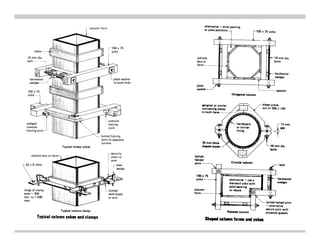
Column
form work
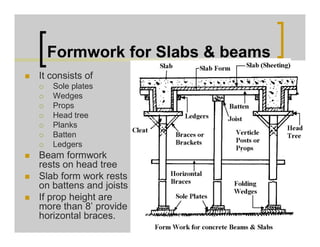
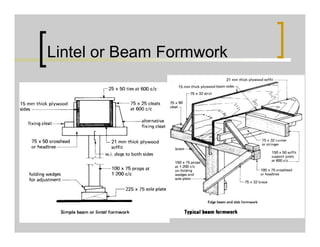
Formwork for Slabs & beams
 It consists of
 Sole plates
 Wedges
 Props
 Head tree
 Planks
 Batten
 Ledgers
 Beam formwork
rests on head tree
 Slab form work rests
on battens and joists
 If prop height are
more than 8’ provide
horizontal braces.
Lintel or Beam Formwork
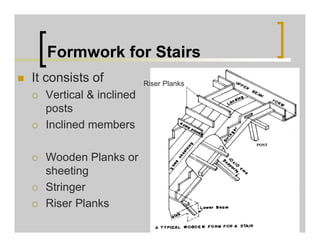
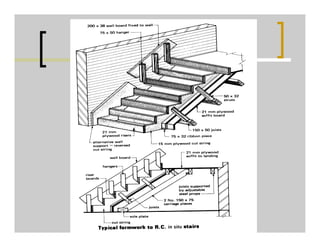
Formwork for Stairs
 It consists of
 Vertical & inclined
posts
 Inclined members
 Wooden Planks or
sheeting
 Stringer
 Riser Planks
Riser Planks
Removal of formwork
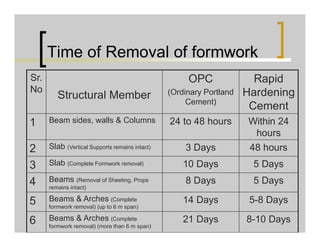
Time of formwork removal depends on the
following factors
1. Type of Cement
1. Rapid hardening cements require lesser time as
compared to OPC (Ordinary Portland Cement)
2. Ratio of concrete mix
1. Rich ratio concrete gain strength earlier as
compared to weak ratio concrete.
3. Weather condition
1. Hydration process accelerates in hot weather
conditions as compared to cold and humid
weather conditions.
Time of Removal of formwork
Sr.
No
Structural Member
OPC
(Ordinary Portland
Cement)
Rapid
Hardening
Cement
1 Beam sides, walls & Columns 24 to 48 hours Within 24
hours
2 Slab (Vertical Supports remains intact) 3 Days 48 hours
3 Slab (Complete Formwork removal) 10 Days 5 Days
4 Beams (Removal of Sheeting, Props
remains intact)
8 Days 5 Days
5 Beams & Arches (Complete
formwork removal) (up to 6 m span)
14 Days 5-8 Days
6 Beams & Arches (Complete
formwork removal) (more than 6 m span)
21 Days 8-10 Days
Maintenance of formwork
 Due to continuous use wooden planks &
steel plates surfaces become uneven and
require maintenance.
 For wooden formwork use cardboard or
plastic fiber board. Bolt hole places must
also be repaired.
 For steel formwork plates must be leveled
by mallet and loose corners must be
welded.
Cost of formwork
 For normal works cost of formwork is about
30%-40% of the concrete cost.
 For special works cost of formwork is about
40%-50% of the concrete cost.
 Formwork cost is controlled by the following
factors
 Formwork Material cost
 Formwork erecting cost
 Formwork removal cost
 Formwork jointing cost (Nails and Cables)
 Labor charges.
Advantages of steel form work
 It has more life so can be used for a number
of times.
 It is non absorbent.
 It is water tight
 Smooth finish surface obtained.
 No shrinkage of formwork occurs.
 Easy to use.
 Its volume is less
 Its strength is more.
Scaffolding
 Definitions
– It’s a temporary structure to provide a platform at
different levels of a building for workers and
Materials.
Types of Scaffolding
 Following are the types of scaffolds
1. Single Scaffolds
2. Double Scaffolds
3. Ladder Scaffolds
4. Cantilever Scaffolds
5. Suspended Scaffolds
6. Steel or Tubular Scaffolds
Definition
 Scaffold
– It is the temporary support system provided for
the construction & maintenance purposes.
– It consists of supports and a working platform for
workers and Materials.
 Scaffolding
– Method of construction of scaffolds is called
scaffolding.
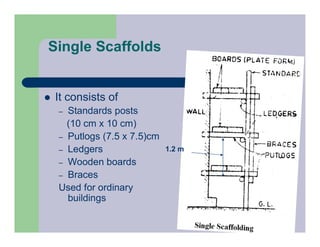
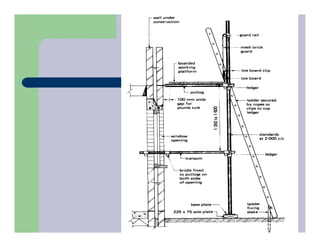
Single Scaffolds
 It consists of
– Standards posts
(10 cm x 10 cm)
– Putlogs (7.5 x 7.5)cm
– Ledgers
– Wooden boards
– Braces
Used for ordinary
buildings
1.2 m
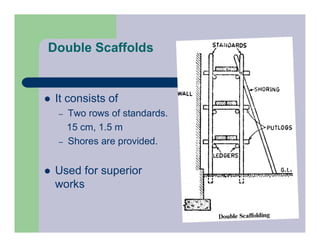
Double Scaffolds
 It consists of
– Two rows of standards.
15 cm, 1.5 m
– Shores are provided.
 Used for superior
works
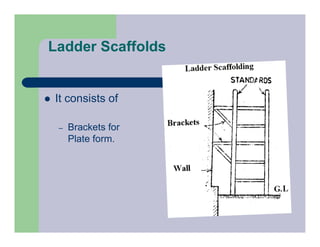
Ladder Scaffolds
 It consists of
– Brackets for
Plate form.
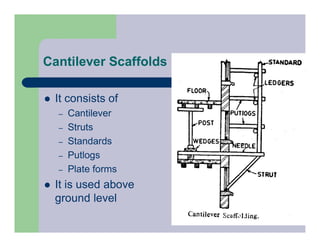
Cantilever Scaffolds
 It consists of
– Cantilever
– Struts
– Standards
– Putlogs
– Plate forms
 It is used above
ground level
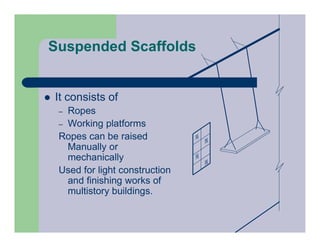
Suspended Scaffolds
 It consists of
– Ropes
– Working platforms
Ropes can be raised
Manually or
mechanically
Used for light construction
and finishing works of
multistory buildings.
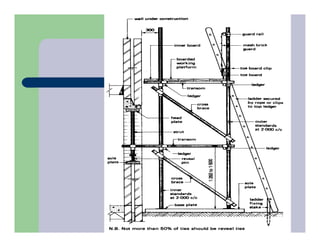
Steel or Tubular Scaffolds
 It consists of
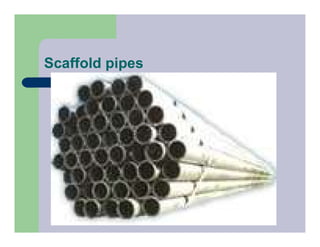
– Steel tubes (1-1/2” – 2-1/2” diameter)
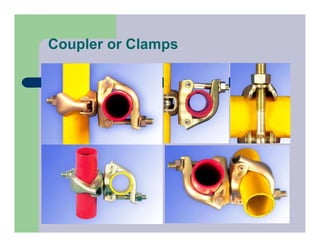
– Coupler or Clamps (to hold pipes in different
positions)
– Prop nuts (to hold single pipes)
– Bolts, Nuts & washers
– Wedge & Clip
Scaffold pipes
Coupler or Clamps
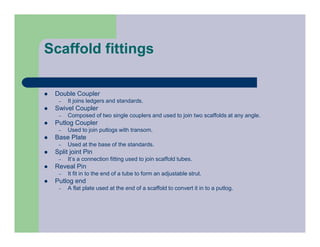
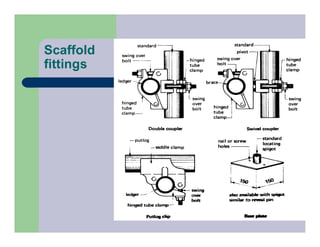
Scaffold fittings
 Double Coupler
– It joins ledgers and standards.
 Swivel Coupler
– Composed of two single couplers and used to join two scaffolds at any angle.
 Putlog Coupler
– Used to join putlogs with transom.
 Base Plate
– Used at the base of the standards.
 Split joint Pin
– It’s a connection fitting used to join scaffold tubes.
 Reveal Pin
– It fit in to the end of a tube to form an adjustable strut.
 Putlog end
– A flat plate used at the end of a scaffold to convert it in to a putlog.
Scaffold
fittings
Standards
 BS 1139:Part 2:Section 2.1 (working scaffolds
and false work made of steel tubes )
 NZ 3620 Scaffold Planks
 AS 1576 Scaffolding
Shoring
 Definition
 It is the method of providing temporary support
(shores) to an unsafe structure.
 Types of Shoring
 Horizontal shoring or flying shoring
 Vertical shoring or dead shoring
 Inclined Shoring or flying shoring
Horizontal shoring
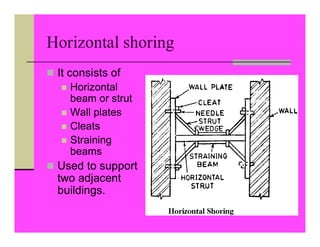
 It consists of
 Horizontal
beam or strut
 Wall plates
 Cleats
 Straining
beams
 Used to support
two adjacent
buildings.
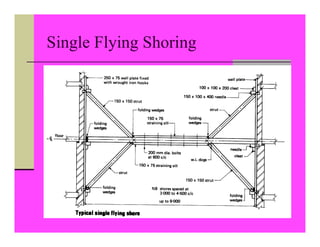
Single Flying Shoring
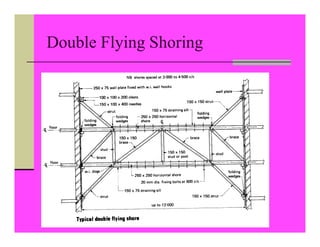
Double Flying Shoring
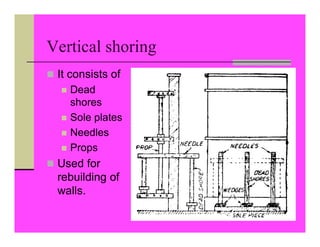
Vertical shoring
 It consists of
 Dead
shores
 Sole plates
 Needles
 Props
 Used for
rebuilding of
walls.
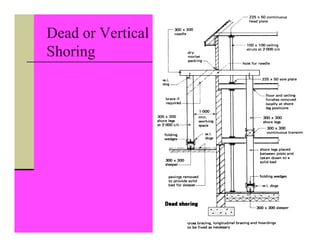
Dead or Vertical
Shoring
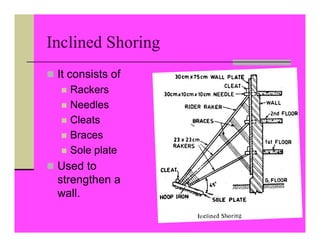
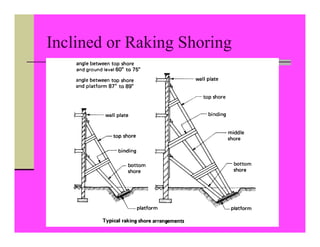
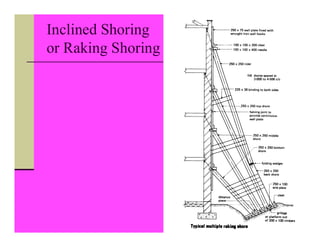
Inclined Shoring
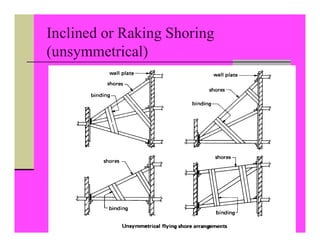
 It consists of
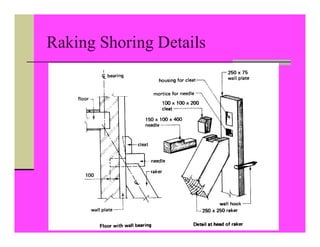
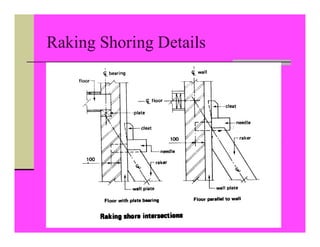
 Rackers
 Needles
 Cleats
 Braces
 Sole plate
 Used to
strengthen a
wall.
Inclined or Raking Shoring
(unsymmetrical)
Raking Shoring Details
Inclined Shoring
or Raking Shoring
Under-Pinning
 Definition
 Methods of Under-Pinning
 Pit method
 Pile method
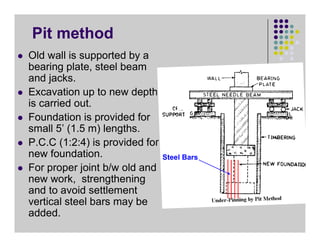
Pit method
 Old wall is supported by a
bearing plate, steel beam
and jacks.
 Excavation up to new depth
is carried out.
 Foundation is provided for
small 5’ (1.5 m) lengths.
 P.C.C (1:2:4) is provided for
new foundation.
 For proper joint b/w old and
new work, strengthening
and to avoid settlement
vertical steel bars may be
added.
Steel Bars
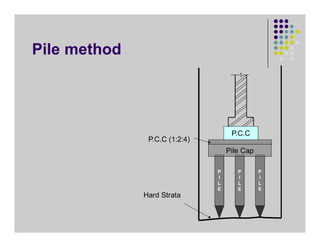
Pile method
P
I
L
E
P
I
L
E
P
I
L
E
Pile Cap
P.C.C
Hard Strata
P.C.C (1:2:4)
ACI Document SP-4
Back
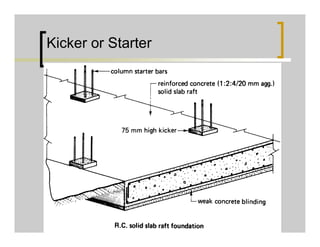
Kicker or Starter
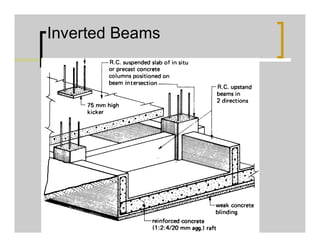
Inverted Beams

formwork.pdf

  • 1.
  • 2.
    General  For thedifferent construction activities like  Brick work above 5 ft  Surface finishing works like plastering, painting, walling etc.  Renovation, repair and alteration works.  Roof and slab pouring Some temporary supports are required like  Formwork (forms in which concrete is poured)  Scaffoldings (arrangement for working plate forms)  Shoring (supporting method for unsafe structure)
  • 3.
  • 4.
  • 5.
  • 6.
    Form work  Definition Qualities of formwork  Types of formwork  Formwork detail for different structural members  Removal of formwork  Maintenance of formwork  Cost of formwork  Advantages of steel form work
  • 7.
    Formwork - Definition Its is a temporary support provided below and around the concrete work.  Formwork is commonly made up of  Steel  wood  Formwork construction is of prime importance in concrete industry. It shares a significant amount of concrete cost.  Formwork is designed according to The ACI document SP-4.
  • 8.
    Qualities of formwork Formwork should be according to ACI document SP-4  It should be water tight  It should be strong  It should be reusable  Its contact surface should be uniform  It should be according to the size and shape of member.
  • 9.
    Types of formwork Formwork are mainly of two types  Steel formwork  Wooden formwork  Steel formwork is made of  Steel sheets  Angle Iron  Tee Iron  Wooden formwork consists of  Props  Planks battens  Ledgers  Sheeting
  • 10.
  • 11.
  • 12.
    Formwork detail fordifferent structural members  In concrete construction formwork is commonly provided for the following structural members.  Foundations  Walls  Columns  Slabs & beams  Stairs
  • 13.
    Formwork for Foundations Wall foundations  It consists of  Plywood Sheeting  Struts
  • 14.
    Formwork for Foundations Column Foundations  It consists of  Side Supports  Side Planks  Cleats Side Support Side Planks Cleats
  • 15.
    Formwork for Wall  Itconsists of  Timber sheeting  Vertical posts  Horizontal members  Rackers  Stakes  Wedges  After completing one side of formwork reinforcement is provided at the place then the second side formwork is provided. Vertical Posts Struts
  • 16.
    Formwork for Column  Itconsists of the following  Side & End Planks  Yoke  Nut & Bolts  Two end & two side planks are joined by the yokes and bolts.
  • 17.
  • 19.
    Formwork for Slabs& beams  It consists of  Sole plates  Wedges  Props  Head tree  Planks  Batten  Ledgers  Beam formwork rests on head tree  Slab form work rests on battens and joists  If prop height are more than 8’ provide horizontal braces.
  • 20.
  • 21.
    Formwork for Stairs It consists of  Vertical & inclined posts  Inclined members  Wooden Planks or sheeting  Stringer  Riser Planks Riser Planks
  • 23.
    Removal of formwork Timeof formwork removal depends on the following factors 1. Type of Cement 1. Rapid hardening cements require lesser time as compared to OPC (Ordinary Portland Cement) 2. Ratio of concrete mix 1. Rich ratio concrete gain strength earlier as compared to weak ratio concrete. 3. Weather condition 1. Hydration process accelerates in hot weather conditions as compared to cold and humid weather conditions.
  • 24.
    Time of Removalof formwork Sr. No Structural Member OPC (Ordinary Portland Cement) Rapid Hardening Cement 1 Beam sides, walls & Columns 24 to 48 hours Within 24 hours 2 Slab (Vertical Supports remains intact) 3 Days 48 hours 3 Slab (Complete Formwork removal) 10 Days 5 Days 4 Beams (Removal of Sheeting, Props remains intact) 8 Days 5 Days 5 Beams & Arches (Complete formwork removal) (up to 6 m span) 14 Days 5-8 Days 6 Beams & Arches (Complete formwork removal) (more than 6 m span) 21 Days 8-10 Days
  • 25.
    Maintenance of formwork Due to continuous use wooden planks & steel plates surfaces become uneven and require maintenance.  For wooden formwork use cardboard or plastic fiber board. Bolt hole places must also be repaired.  For steel formwork plates must be leveled by mallet and loose corners must be welded.
  • 26.
    Cost of formwork For normal works cost of formwork is about 30%-40% of the concrete cost.  For special works cost of formwork is about 40%-50% of the concrete cost.  Formwork cost is controlled by the following factors  Formwork Material cost  Formwork erecting cost  Formwork removal cost  Formwork jointing cost (Nails and Cables)  Labor charges.
  • 27.
    Advantages of steelform work  It has more life so can be used for a number of times.  It is non absorbent.  It is water tight  Smooth finish surface obtained.  No shrinkage of formwork occurs.  Easy to use.  Its volume is less  Its strength is more.
  • 28.
    Scaffolding  Definitions – It’sa temporary structure to provide a platform at different levels of a building for workers and Materials.
  • 29.
    Types of Scaffolding Following are the types of scaffolds 1. Single Scaffolds 2. Double Scaffolds 3. Ladder Scaffolds 4. Cantilever Scaffolds 5. Suspended Scaffolds 6. Steel or Tubular Scaffolds
  • 30.
    Definition  Scaffold – Itis the temporary support system provided for the construction & maintenance purposes. – It consists of supports and a working platform for workers and Materials.  Scaffolding – Method of construction of scaffolds is called scaffolding.
  • 31.
    Single Scaffolds  Itconsists of – Standards posts (10 cm x 10 cm) – Putlogs (7.5 x 7.5)cm – Ledgers – Wooden boards – Braces Used for ordinary buildings 1.2 m
  • 33.
    Double Scaffolds  Itconsists of – Two rows of standards. 15 cm, 1.5 m – Shores are provided.  Used for superior works
  • 35.
    Ladder Scaffolds  Itconsists of – Brackets for Plate form.
  • 36.
    Cantilever Scaffolds  Itconsists of – Cantilever – Struts – Standards – Putlogs – Plate forms  It is used above ground level
  • 37.
    Suspended Scaffolds  Itconsists of – Ropes – Working platforms Ropes can be raised Manually or mechanically Used for light construction and finishing works of multistory buildings.
  • 38.
    Steel or TubularScaffolds  It consists of – Steel tubes (1-1/2” – 2-1/2” diameter) – Coupler or Clamps (to hold pipes in different positions) – Prop nuts (to hold single pipes) – Bolts, Nuts & washers – Wedge & Clip
  • 39.
  • 40.
  • 41.
    Scaffold fittings  DoubleCoupler – It joins ledgers and standards.  Swivel Coupler – Composed of two single couplers and used to join two scaffolds at any angle.  Putlog Coupler – Used to join putlogs with transom.  Base Plate – Used at the base of the standards.  Split joint Pin – It’s a connection fitting used to join scaffold tubes.  Reveal Pin – It fit in to the end of a tube to form an adjustable strut.  Putlog end – A flat plate used at the end of a scaffold to convert it in to a putlog.
  • 42.
  • 43.
    Standards  BS 1139:Part2:Section 2.1 (working scaffolds and false work made of steel tubes )  NZ 3620 Scaffold Planks  AS 1576 Scaffolding
  • 44.
    Shoring  Definition  Itis the method of providing temporary support (shores) to an unsafe structure.  Types of Shoring  Horizontal shoring or flying shoring  Vertical shoring or dead shoring  Inclined Shoring or flying shoring
  • 45.
    Horizontal shoring  Itconsists of  Horizontal beam or strut  Wall plates  Cleats  Straining beams  Used to support two adjacent buildings.
  • 46.
  • 47.
  • 48.
    Vertical shoring  Itconsists of  Dead shores  Sole plates  Needles  Props  Used for rebuilding of walls.
  • 49.
  • 50.
    Inclined Shoring  Itconsists of  Rackers  Needles  Cleats  Braces  Sole plate  Used to strengthen a wall.
  • 51.
  • 52.
    Inclined or RakingShoring (unsymmetrical)
  • 53.
  • 54.
  • 55.
  • 56.
    Under-Pinning  Definition  Methodsof Under-Pinning  Pit method  Pile method
  • 57.
    Pit method  Oldwall is supported by a bearing plate, steel beam and jacks.  Excavation up to new depth is carried out.  Foundation is provided for small 5’ (1.5 m) lengths.  P.C.C (1:2:4) is provided for new foundation.  For proper joint b/w old and new work, strengthening and to avoid settlement vertical steel bars may be added. Steel Bars
  • 58.
  • 60.
  • 61.
  • 62.