ASSIGNMENT QUESTION 
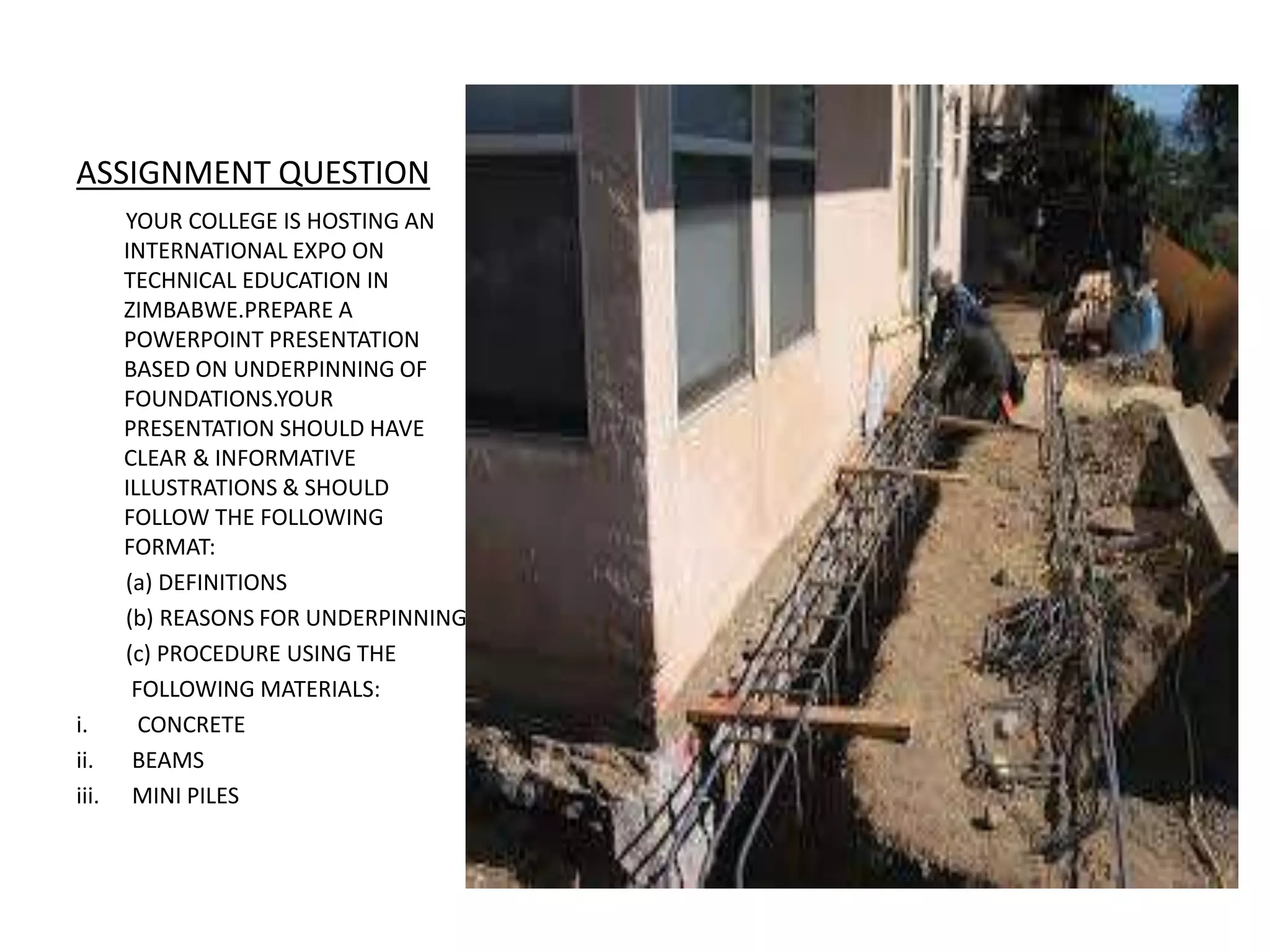
YOUR COLLEGE IS HOSTING AN 
INTERNATIONAL EXPO ON 
TECHNICAL EDUCATION IN 
ZIMBABWE.PREPARE A 
POWERPOINT PRESENTATION 
BASED ON UNDERPINNING OF 
FOUNDATIONS.YOUR 
PRESENTATION SHOULD HAVE 
CLEAR & INFORMATIVE 
ILLUSTRATIONS & SHOULD 
FOLLOW THE FOLLOWING 
FORMAT: 
(a) DEFINITIONS 
(b) REASONS FOR UNDERPINNING 
(c) PROCEDURE USING THE 
FOLLOWING MATERIALS: 
i. CONCRETE 
ii. BEAMS 
iii. MINI PILES
UNDERPINNING 
CHAKAMBA J
UNDERPINNING 
OBJECTIVES 
• Define the term underpinning. 
• Describe underpinning,when it is 
needed and how it is done. 
• State the reasons for underpinning. 
• State the methods of underpinning a 
structure.
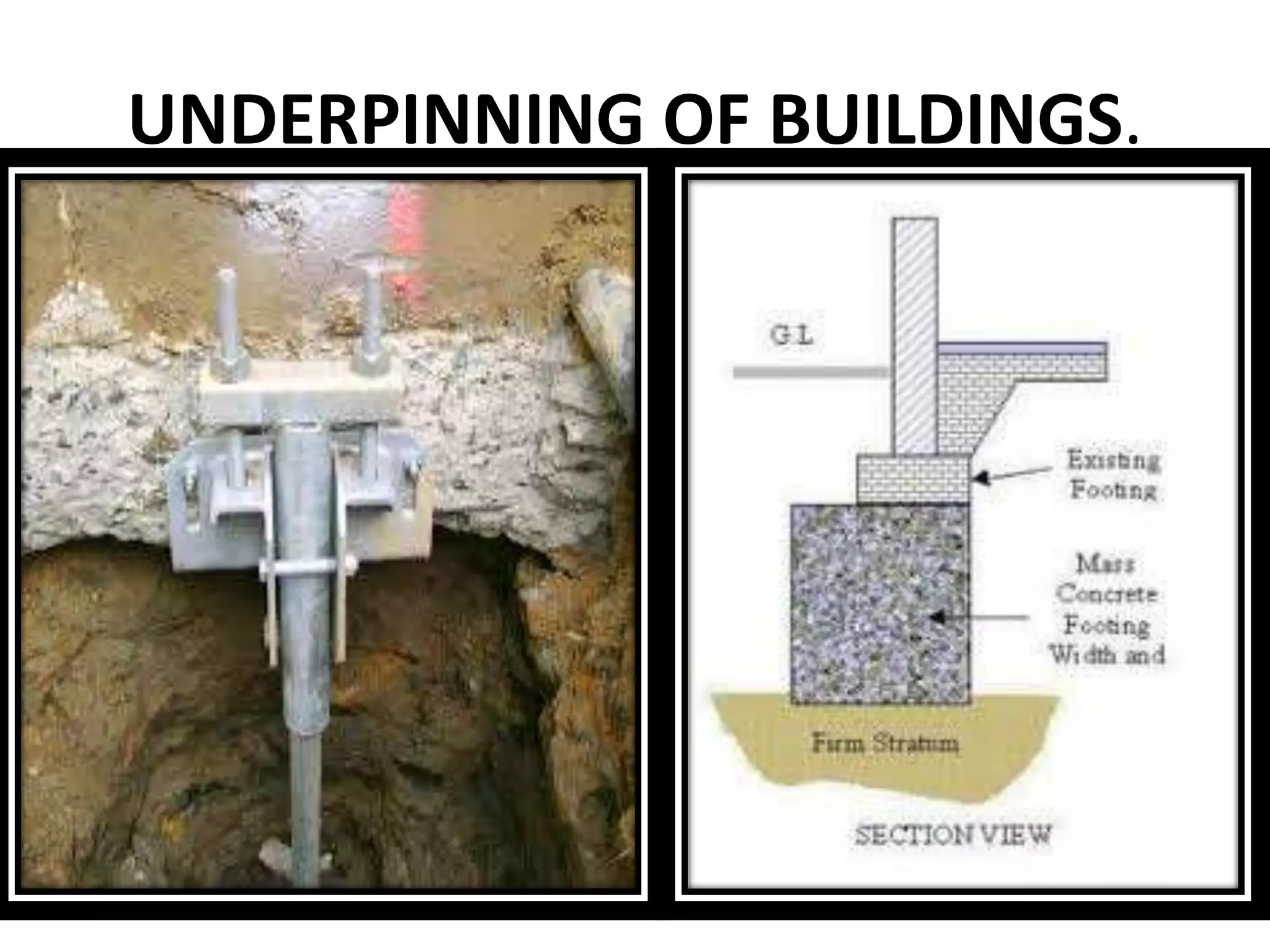
UNDERPINNING OF BUILDINGS.
INTRODUCTION 
Whenever a new building is to be built especially 
in urban areas,it is quite common to have the 
foundations lower than the foundations of 
adjacent buildings. 
It is therefore essential that the stability of the 
existing building(s) is safeguarded by performing 
underpinning as well as shoring.`that care and 
forethought should be undertaken if these 
operations are to be successfully carried out. 
Only highly skillied and experienced personnel or 
companies should perform these operations.
DEFINITIONS 
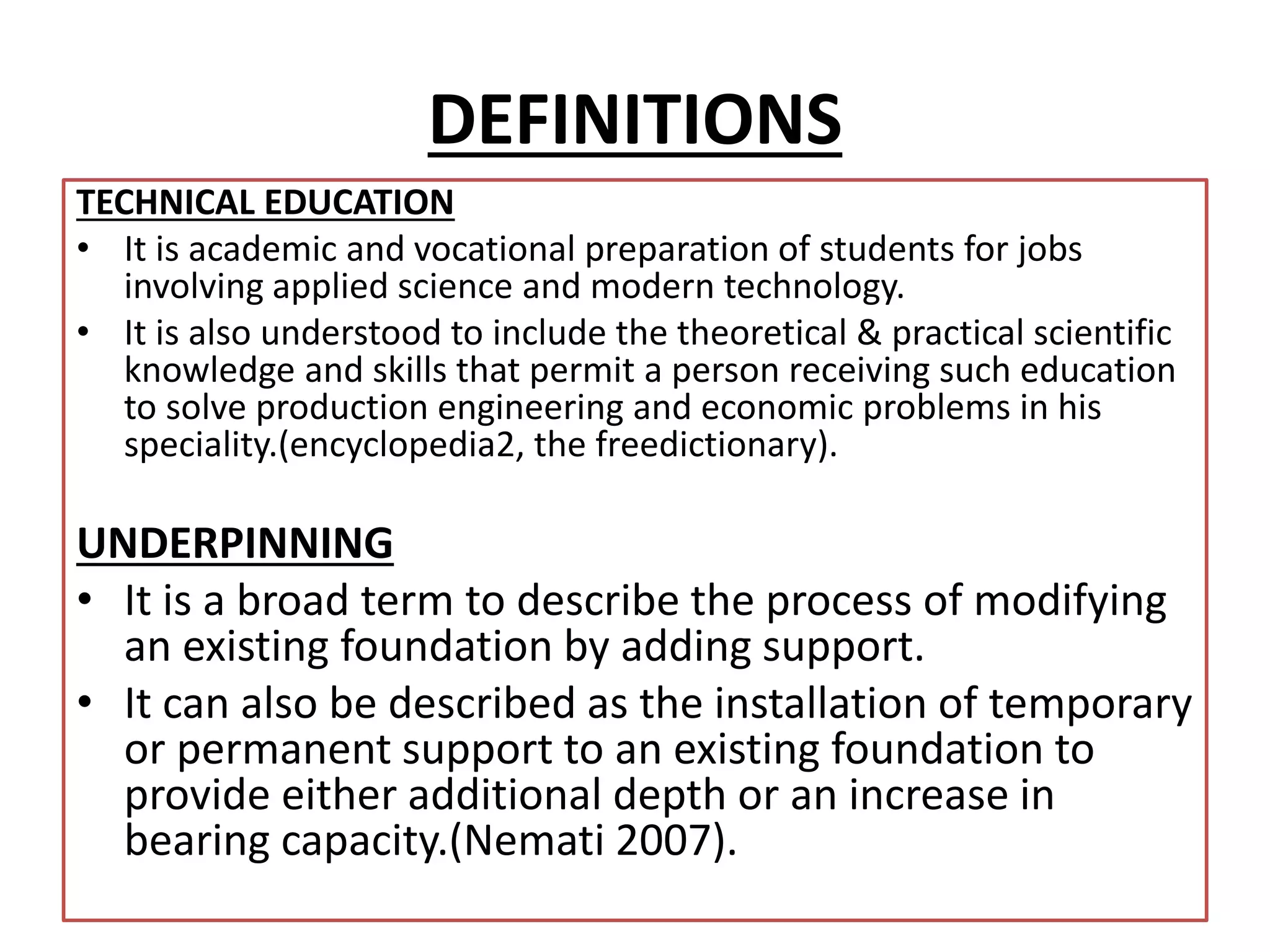
TECHNICAL EDUCATION 
• It is academic and vocational preparation of students for jobs 
involving applied science and modern technology. 
• It is also understood to include the theoretical & practical scientific 
knowledge and skills that permit a person receiving such education 
to solve production engineering and economic problems in his 
speciality.(encyclopedia2, the freedictionary). 
UNDERPINNING 
• It is a broad term to describe the process of modifying 
an existing foundation by adding support. 
• It can also be described as the installation of temporary 
or permanent support to an existing foundation to 
provide either additional depth or an increase in 
bearing capacity.(Nemati 2007).
DEFINITIONS Cont 
• Underpinning can also be reffered to as a process of 
strengthening the foundation of an existing building or 
other structure(wikipedia,the free encyclopedia). 
REASONS FOR UNDERPINNING 
 Construction of a new project with a deeper 
foundation adjacent to an existing building. 
 To enable the foundations to be deepened for 
structural reasons e.g to construct a basement or 
addition of another storey to the building.
REASONS cont 
To support a structure that is sinking or tilting due to 
poor soil or instability of the superstructure. 
Change in use of a structure. 
 As a safeguard against possible settlement of a 
structure when excavating close to or below its 
foundation level. 
To support a structure while making alteration to its 
foundations or main supporting members. 
To increase the width of a foundation to permit 
heavier loads to be carried e.g when increasing the 
height of a building with new levels. 
To enable a building to be moved bodily to a new site.
REASONS Cont 
The original foundation is simply not strong or 
stable enough. 
The properties of the soil supporting the 
foundation may have changed possibly through 
subsidence or were mischaracterized during 
design stages. 
Settlement of an existing structure.
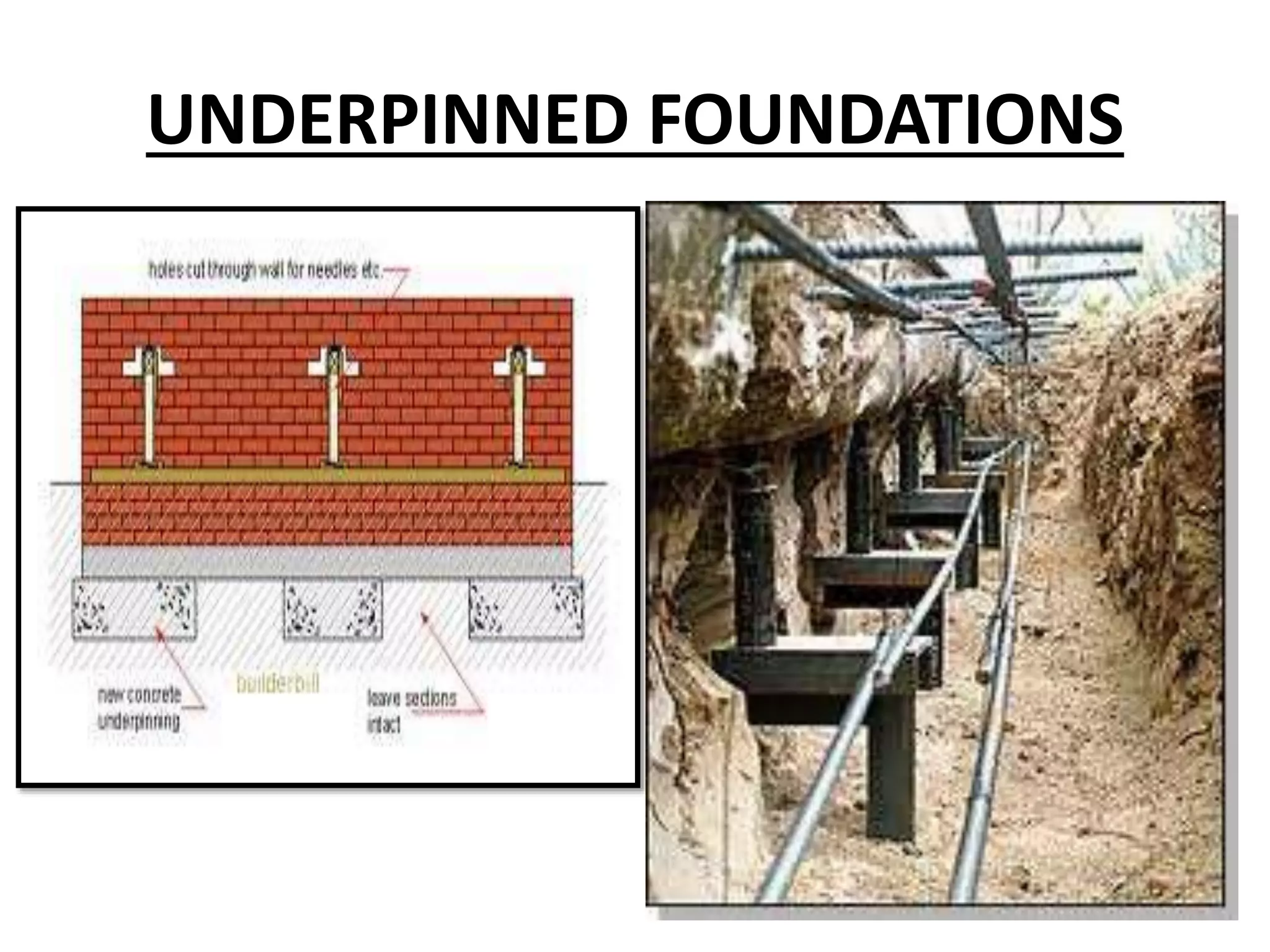
UNDERPINNED FOUNDATIONS
SOME CAUSES OF SETTLEMENT ON A 
BUILDING 
 Lowering of the water table due to tidal fluctuations,wells 
for a water district etc. 
 Lowering of the water table can then cause tops of timber 
piles to decay overtime and will require remedial 
underpinning. 
 Rising of the water table in some soils can effect a 
decrease in bearing capacity of the soil causing settlement 
on the building which will then require underpinning. 
 Construction of buildings on unsuitable bearing material or 
over compressible layer e.g peat,organic silts or poorly 
compacted backfill may also cause settlement. 
 Earthquakes,floods or other natural causes can cause the 
structure to move thereby requiring stabilisation of 
foundation soils or footings.
DETERMINING THE NEED FOR 
UNDERPINNING 
 Underpinning as a direct support of an existing building 
foundation provides the opportunity to preload i.e jacking to 
limit settlement and improve poor foundations. 
 When a structure starts showing signs of settlement or distress, 
it is of utmost importance to precisely monitor the settlement 
or movement by a professional on a daily,weekly or monthly 
basis. 
 Data collected or readings will indicate if the movements are 
decreasing or increasing. 
 Analyzing the results will also tell whether underpinning is 
required or not to safeguard the structure e.g cracks or any 
other weaknesses 
 Before the beginning of any excavation on a new structure a 
professional must examine all the structures in close proximity 
to the construction site so as to determine whether 
underpinning is also necessary.Nash 1988:146.
PROCEDURES INVOLVED WHEN 
USING PILES FOR UNDERPINNING 
 The piles are formed of precast concrete sections. 
 Each section has a steel-linked hole running through it. 
 The steel lining helps the locating of the sections and ensures 
that they are all in line. 
THE PROCESS 
 A hole is dug below the existing foundation of the structure. 
 The first section which has a pointed steel toe-piece to make 
penetration into the ground easier is placed into position below 
the foundation . 
 A bearing plate is then positioned between the jack and the 
foundation.
PROCESS cont 
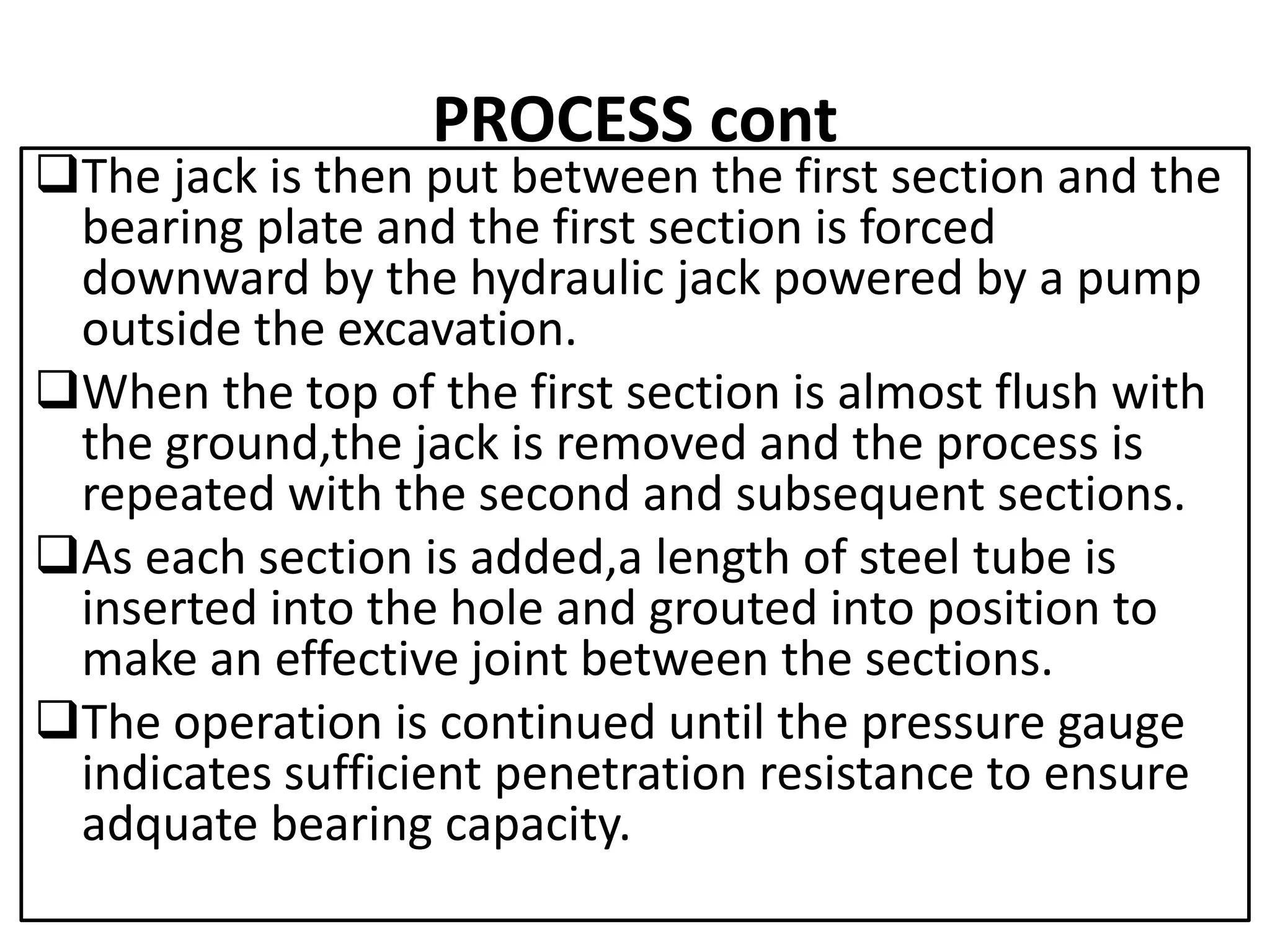
The jack is then put between the first section and the 
bearing plate and the first section is forced 
downward by the hydraulic jack powered by a pump 
outside the excavation. 
When the top of the first section is almost flush with 
the ground,the jack is removed and the process is 
repeated with the second and subsequent sections. 
As each section is added,a length of steel tube is 
inserted into the hole and grouted into position to 
make an effective joint between the sections. 
The operation is continued until the pressure gauge 
indicates sufficient penetration resistance to ensure 
adquate bearing capacity.
THE PROCEDURES INVOLVED WHEN 
UNDERPINNING BUILDINGS cont. 
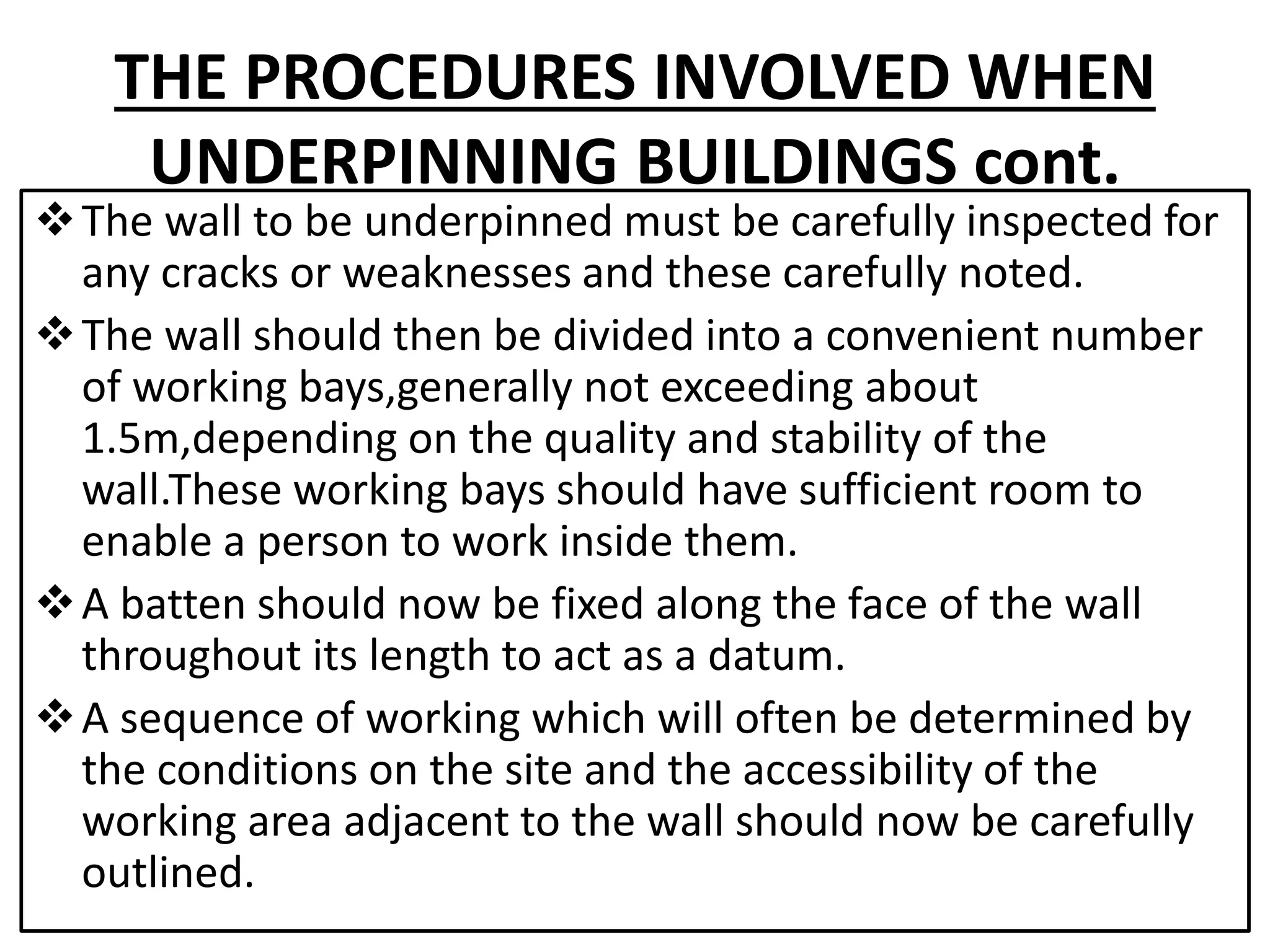
The wall to be underpinned must be carefully inspected for 
any cracks or weaknesses and these carefully noted. 
The wall should then be divided into a convenient number 
of working bays,generally not exceeding about 
1.5m,depending on the quality and stability of the 
wall.These working bays should have sufficient room to 
enable a person to work inside them. 
A batten should now be fixed along the face of the wall 
throughout its length to act as a datum. 
A sequence of working which will often be determined by 
the conditions on the site and the accessibility of the 
working area adjacent to the wall should now be carefully 
outlined.
PROCEDURE cont 
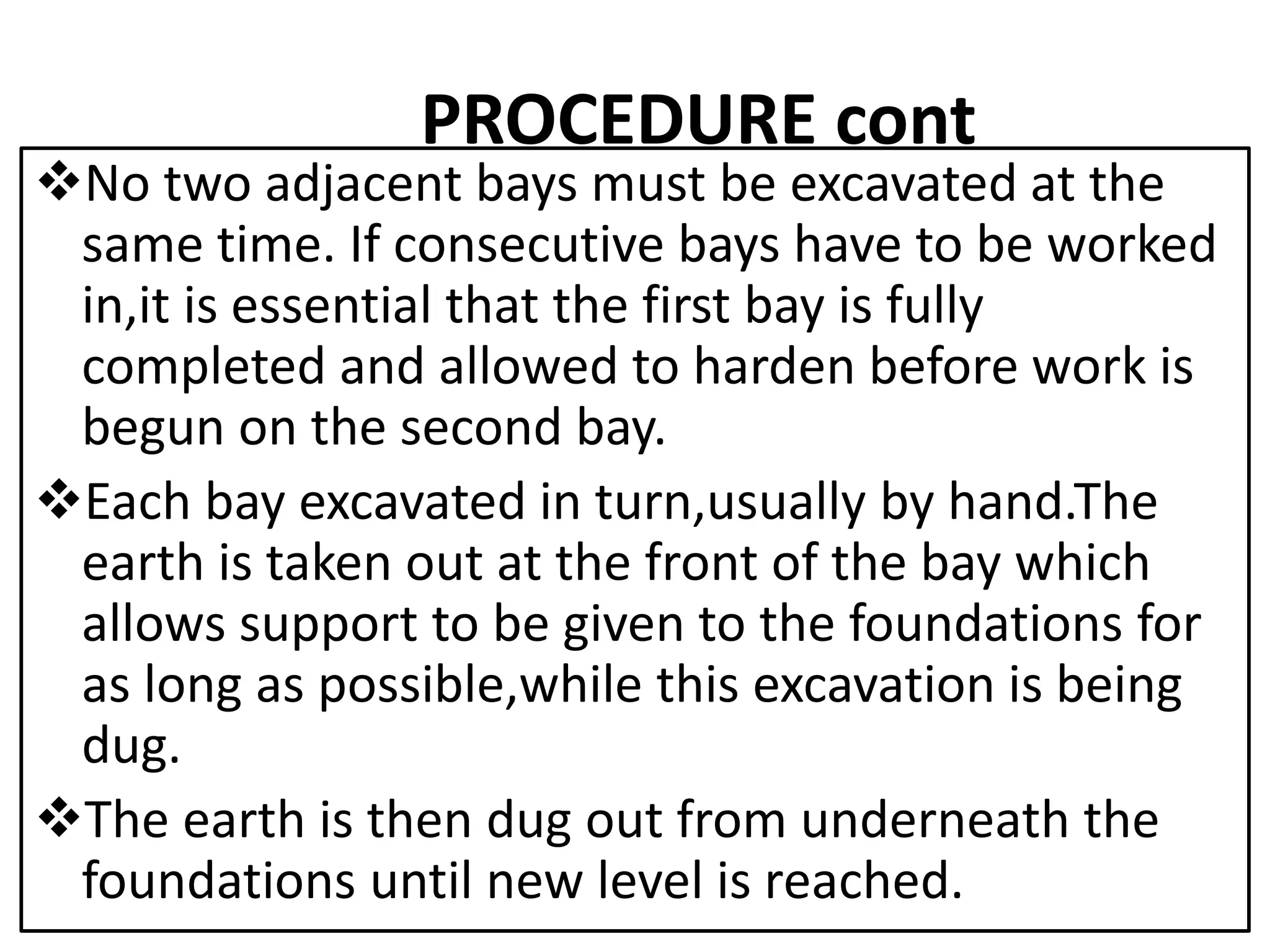
No two adjacent bays must be excavated at the 
same time. If consecutive bays have to be worked 
in,it is essential that the first bay is fully 
completed and allowed to harden before work is 
begun on the second bay. 
Each bay excavated in turn,usually by hand.The 
earth is taken out at the front of the bay which 
allows support to be given to the foundations for 
as long as possible,while this excavation is being 
dug. 
The earth is then dug out from underneath the 
foundations until new level is reached.
PROCEDURE cont. 
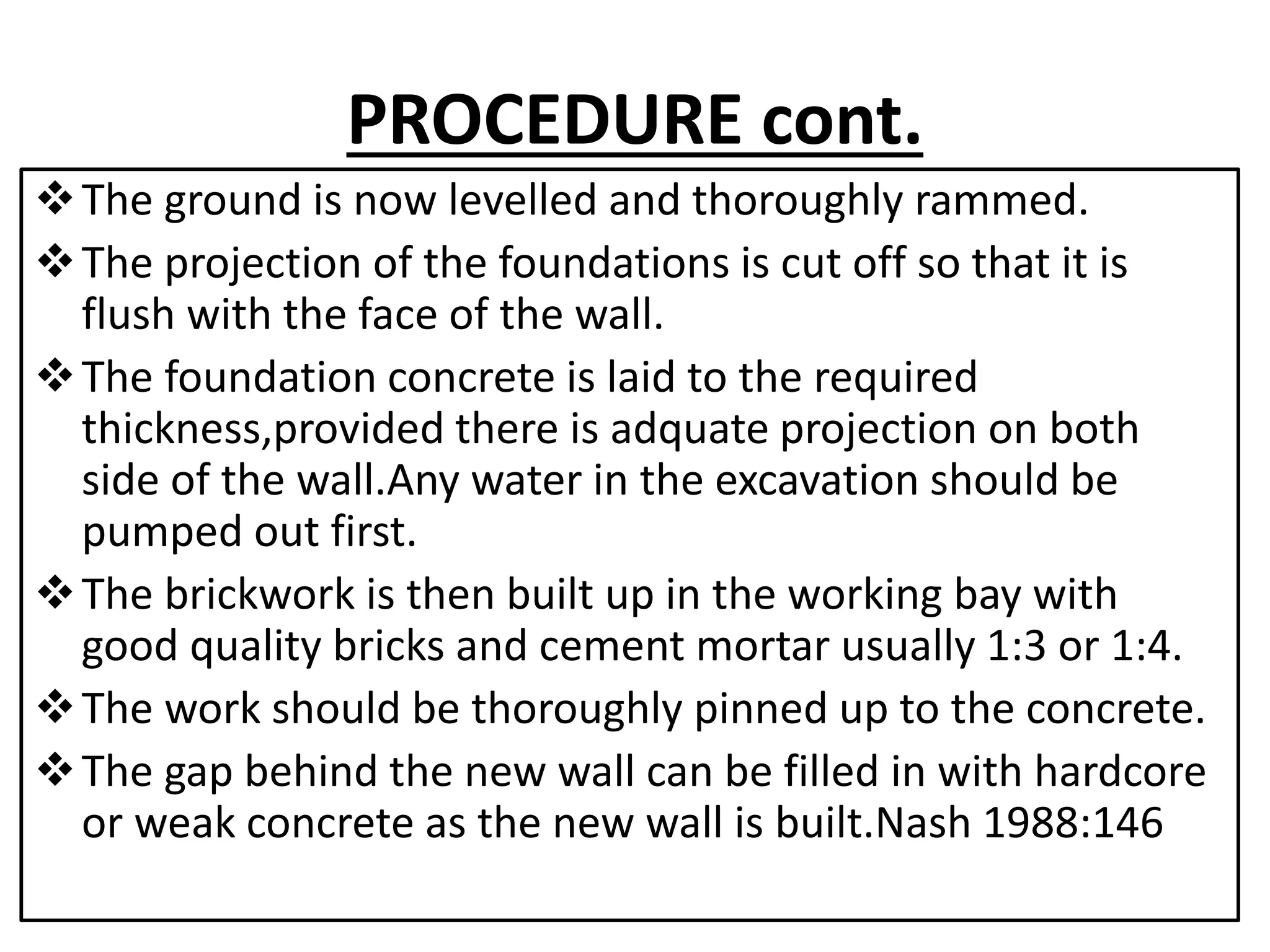
The ground is now levelled and thoroughly rammed. 
The projection of the foundations is cut off so that it is 
flush with the face of the wall. 
The foundation concrete is laid to the required 
thickness,provided there is adquate projection on both 
side of the wall.Any water in the excavation should be 
pumped out first. 
The brickwork is then built up in the working bay with 
good quality bricks and cement mortar usually 1:3 or 1:4. 
The work should be thoroughly pinned up to the concrete. 
The gap behind the new wall can be filled in with hardcore 
or weak concrete as the new wall is built.Nash 1988:146
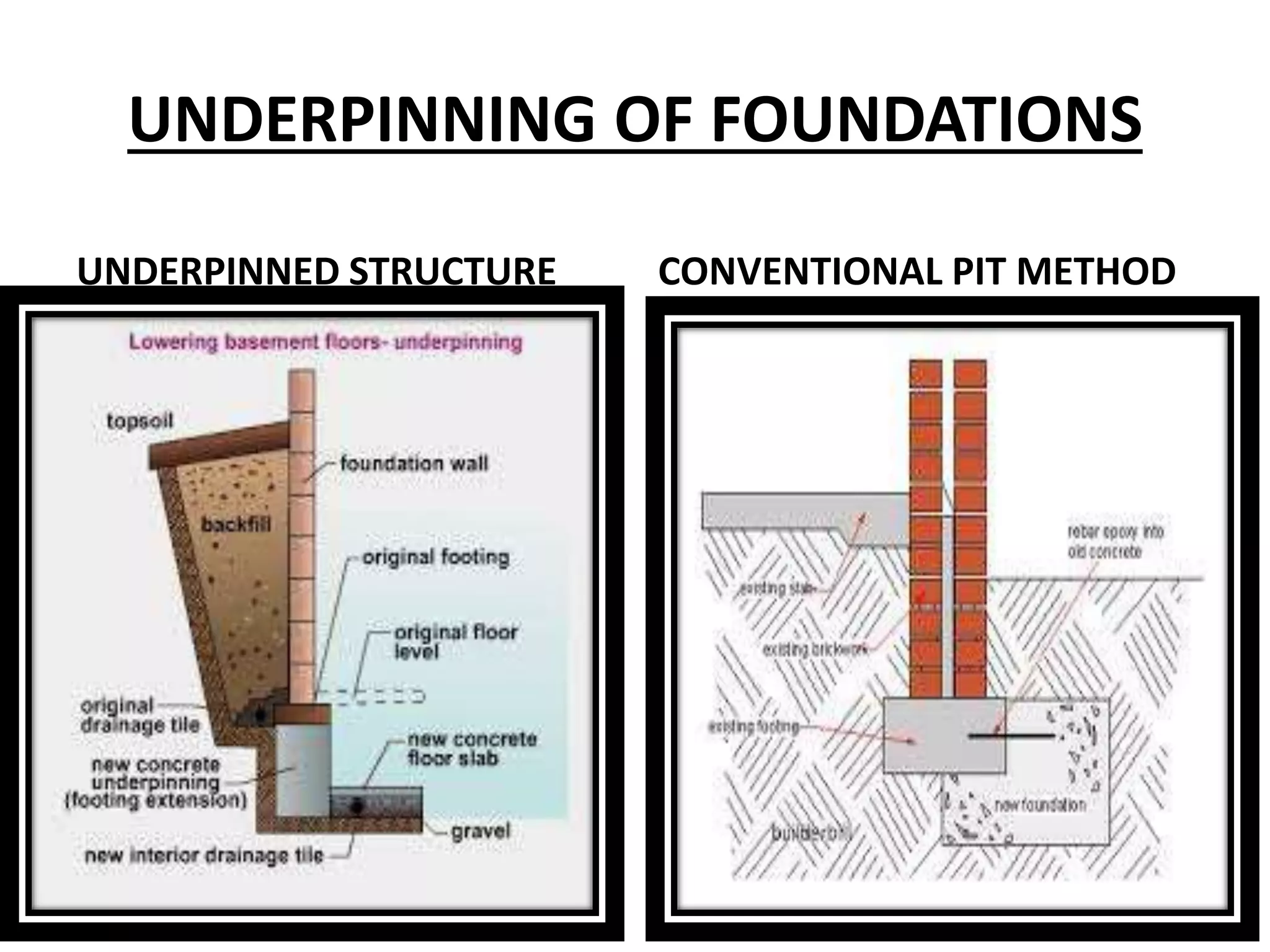
UNDERPINNING OF FOUNDATIONS 
UNDERPINNED STRUCTURE CONVENTIONAL PIT METHOD
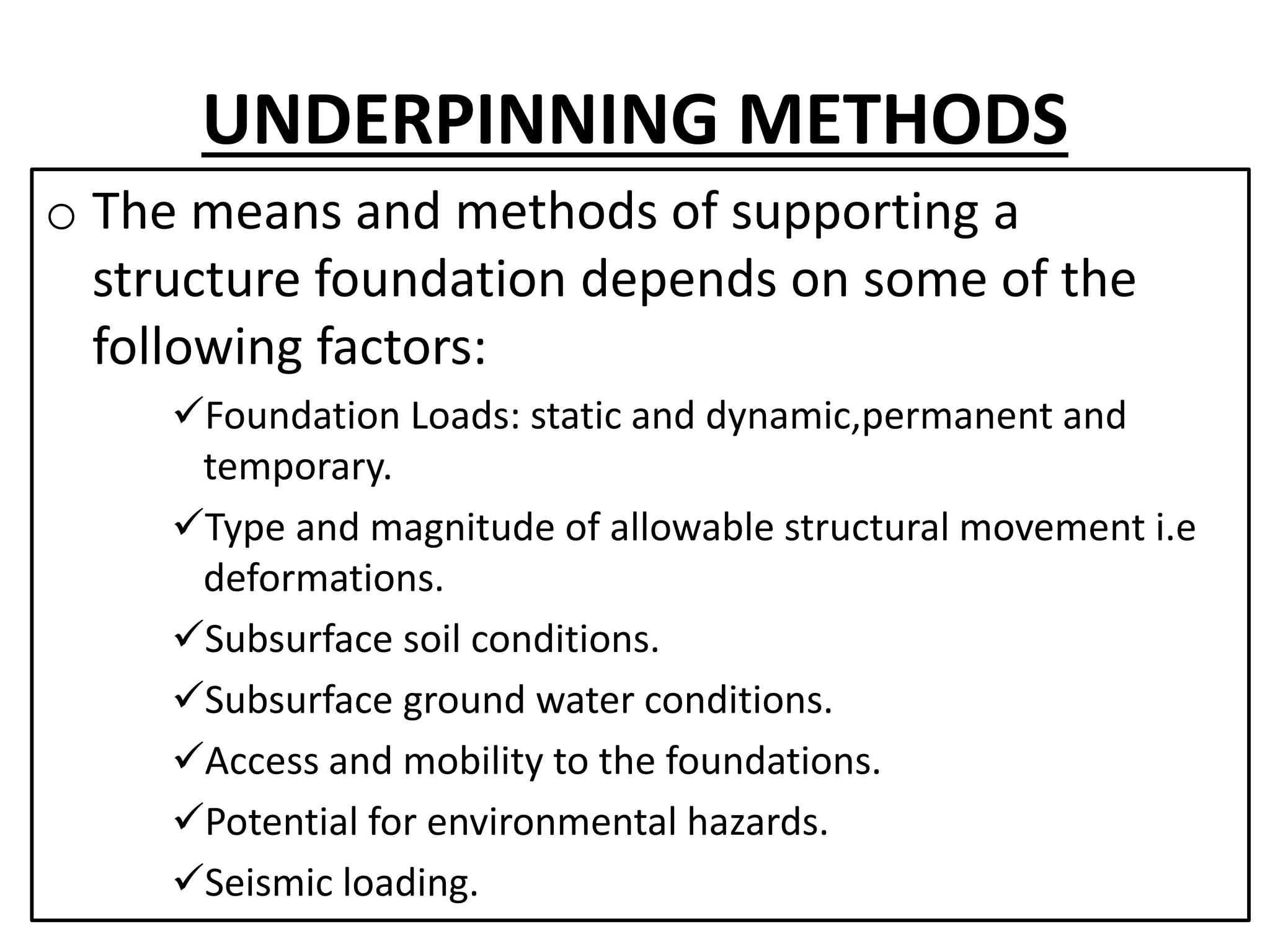
UNDERPINNING METHODS 
o The means and methods of supporting a 
structure foundation depends on some of the 
following factors: 
Foundation Loads: static and dynamic,permanent and 
temporary. 
Type and magnitude of allowable structural movement i.e 
deformations. 
Subsurface soil conditions. 
Subsurface ground water conditions. 
Access and mobility to the foundations. 
Potential for environmental hazards. 
Seismic loading.
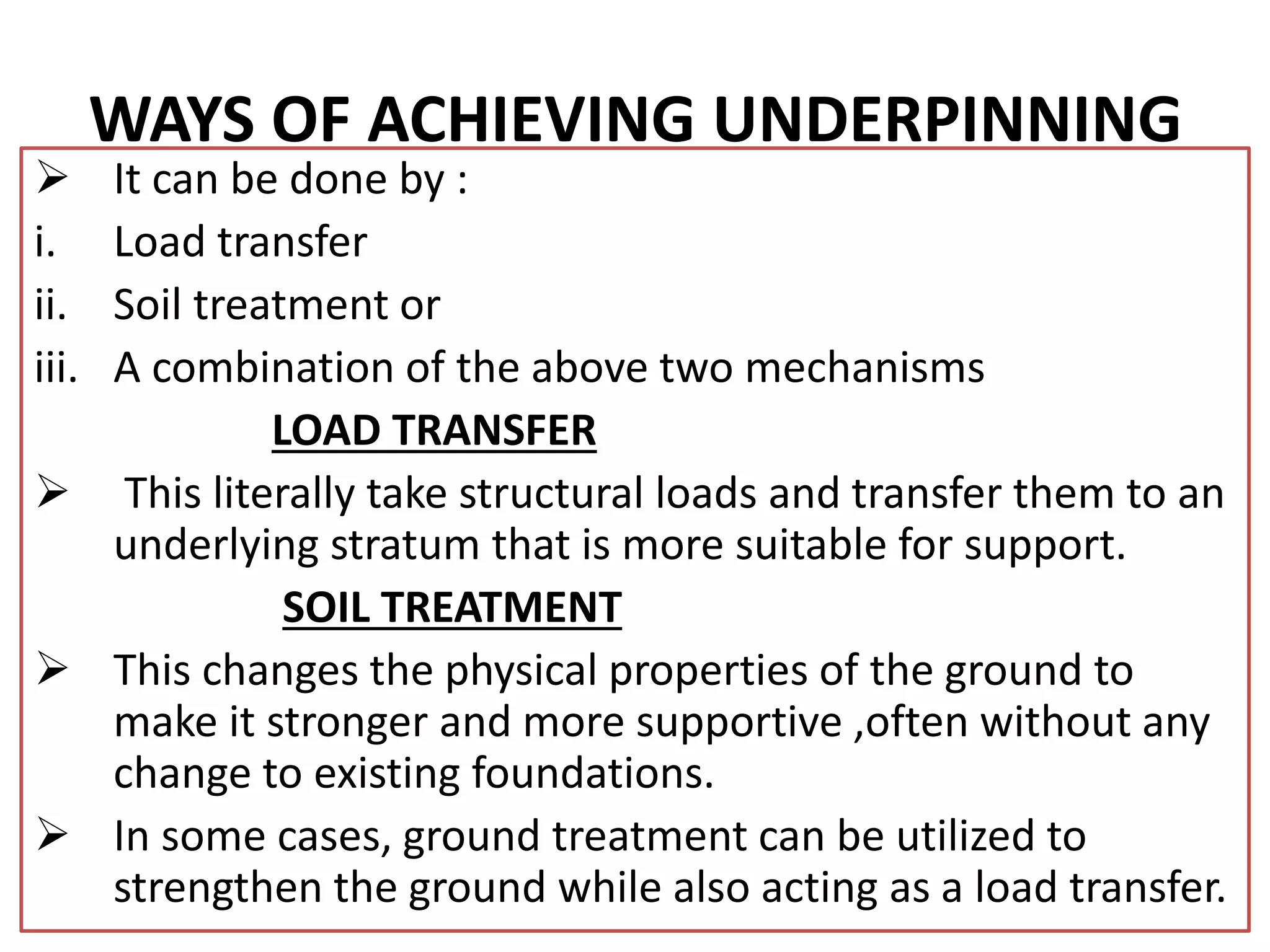
WAYS OF ACHIEVING UNDERPINNING 
 It can be done by : 
i. Load transfer 
ii. Soil treatment or 
iii. A combination of the above two mechanisms 
LOAD TRANSFER 
 This literally take structural loads and transfer them to an 
underlying stratum that is more suitable for support. 
SOIL TREATMENT 
 This changes the physical properties of the ground to 
make it stronger and more supportive ,often without any 
change to existing foundations. 
 In some cases, ground treatment can be utilized to 
strengthen the ground while also acting as a load transfer.
UNDERPINNING METHODS 
 There are numerous methods that can be used 
when underpinning. 
 Each methods having its own specific soil and 
loading conditions where its application is most 
effective. 
 In some cases constructability can also determine 
the system to be used. 
 Each method have also its own advantages and 
disadvantages depending on the specific 
characteristics of the project.
1. CONVENTIONAL PIT METHOD 
o It consists of enlarging and or deepening existing foundations by 
removing soil from beneath the foundations and replacing it with 
concrete,reinforcements and a grout material. 
o The structure can also be temporary shored to prevent settlement. 
DISADVANTAGES OF THE PIT METHOD 
i. It often results in moderate deformation of the structure. 
ii. Unsafe working conditions. 
ADVANTAGES OF THE PIT METHOD 
i. Simplicity of the engineering. 
ii. Low cost of labour to produce the result. 
iii. There is continuity of the structure’s uses during construction.
2. JET GROUTING 
 It is a load transferring system for the underpinning,often 
also serving as an excavation support and ground water 
control system. 
 It is an in-situ method of construction undertaken beneath 
foundations. 
 High velocity injection of fluids,often enclosed in air erodes 
the soils and replaces the soil with and engineered 
grout,forming a cementations product known as SOILCRETE 
that is capable of attaining unconfined compressive 
strengths in excess of 70.3 kg/cm2. 
 Groups of 1 to 1.2m diameter soilcrete columns are 
constructed to transfer foundation loads to underlying 
suitable bearing material.
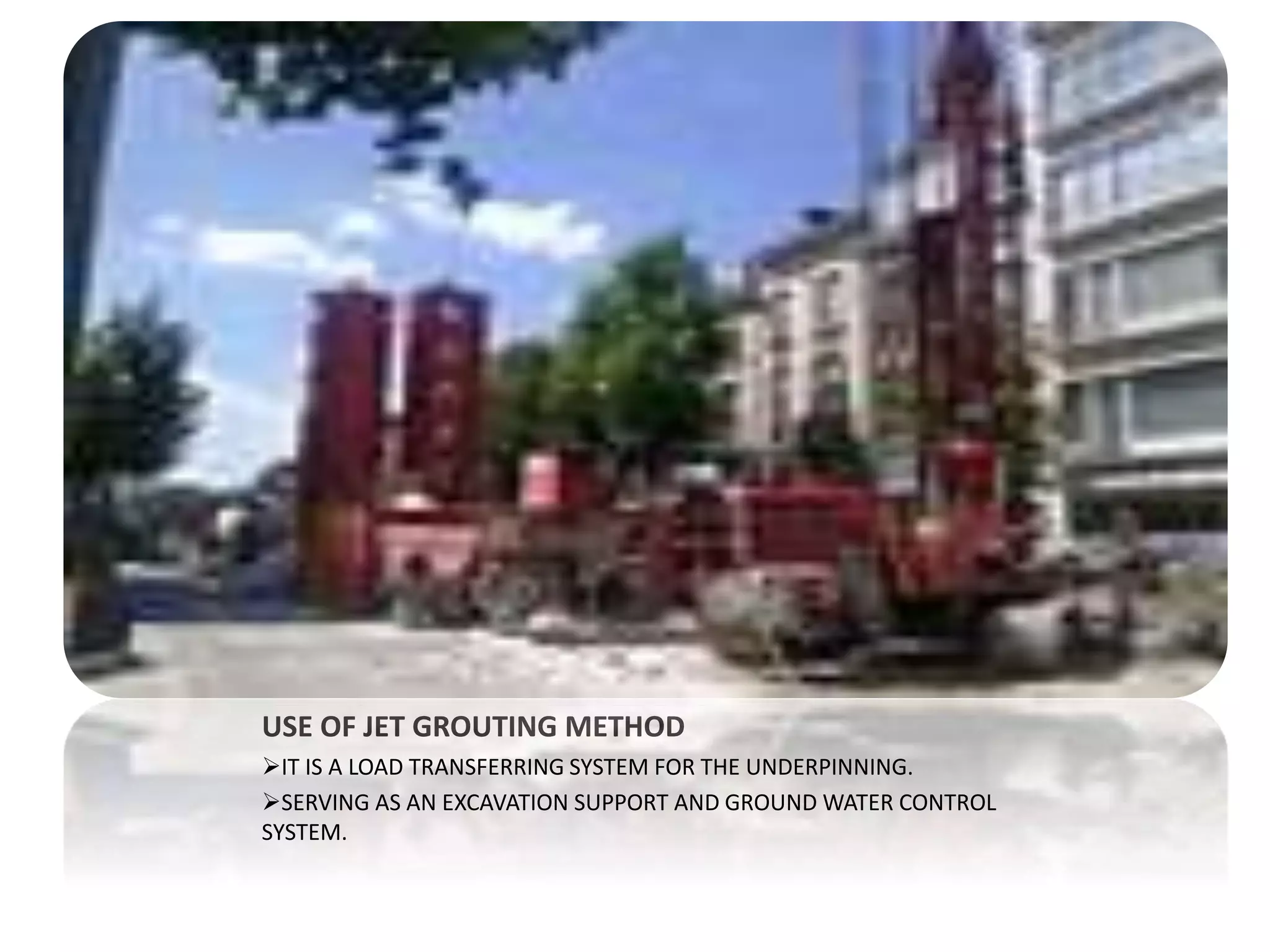
USE OF JET GROUTING METHOD 
IT IS A LOAD TRANSFERRING SYSTEM FOR THE UNDERPINNING. 
SERVING AS AN EXCAVATION SUPPORT AND GROUND WATER CONTROL 
SYSTEM.
ADVANTAGES OF JET GROUTING 
i. Work is accomplished safely above grade and 
sequenced so that little or no structural 
deformation occurs. 
ii. It is most widely used for underpinning historical 
and sensitive structures. 
iii. Can also be used to construct deep foundations,in 
site gravity wall structures and groundwater cut off 
structures.
3.MICROPILES 
 It is used to stabilize or upgrade existing foundation by 
installing micropiles through pre-drilled holes 
determined by load characteristics. 
 Micropiles are described as small diameter piles that 
can be installed in almost any type of soil and that can 
carry loads up to 500 tonnes depending on the type of 
it. 
 These micropiles are steel reinforced placed into a 
small diameter hole and scaled to the ground by grout 
injections under relatively high pressure. 
 Micropiles are widely recognized as a common 
remedial option for underpinning structures having 
foundations problems after completion or during 
service period.
ADVANTAGES OF MICROPILES 
i. They have high carrying capacity. 
ii. Less site constraint problems. 
iii. Low noise and vibration. 
iv. It is a self –sustained operation. 
v. It can be designed to have very low settlement. 
DISADVANTAGES OF MICROPILES 
i. Higher cost as compared to other pilling systems.
TYPES OF MICROPILES 
 Pile and Beam. 
 Pile and Cantilever Beam. 
 Knuckle pile. 
 Piled raft. 
 Angle pile. 
 Cantilever Ring Beam. 
 Twin pile. 
 Jack Down piles.
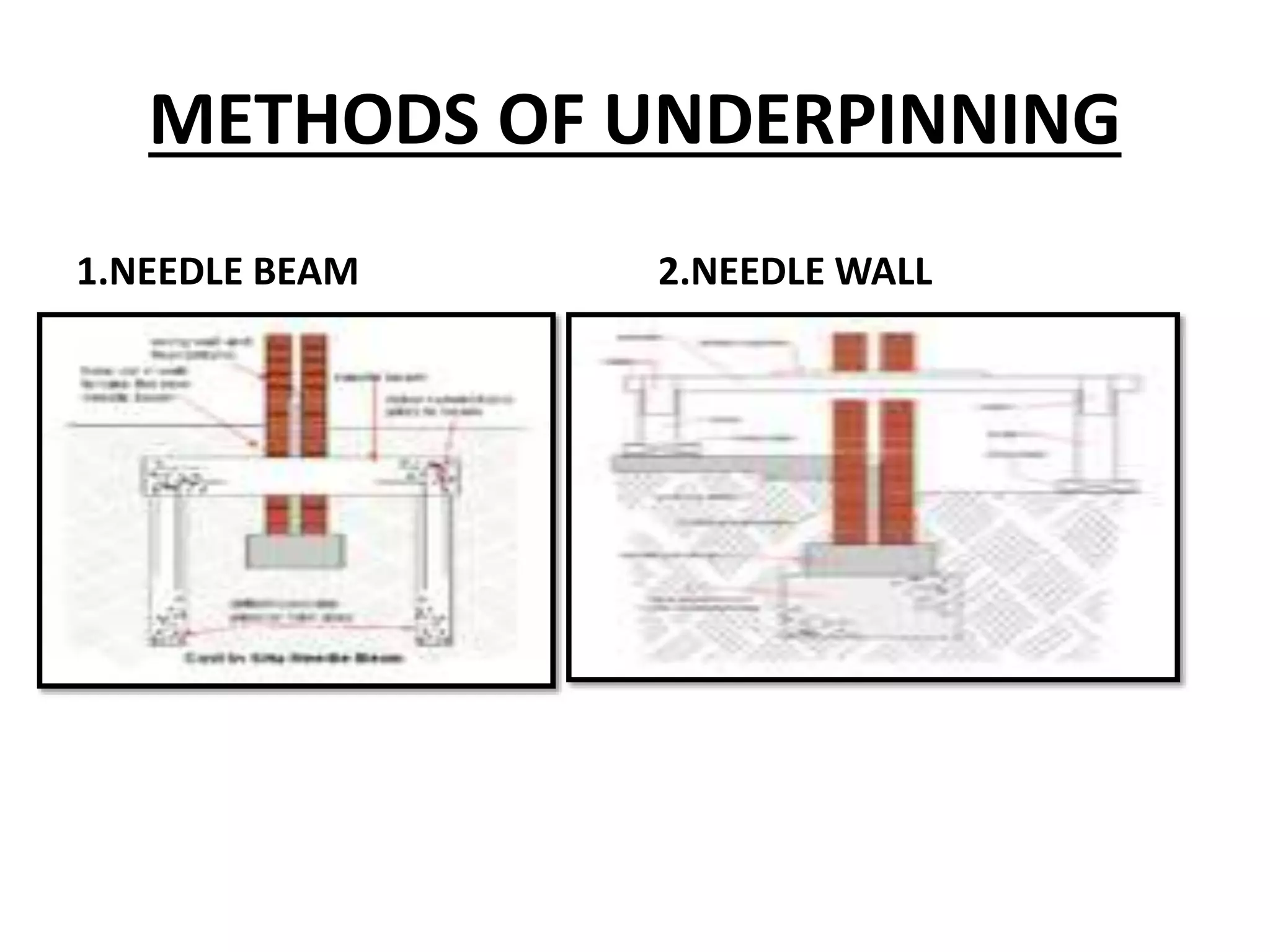
METHODS OF UNDERPINNING 
1.NEEDLE BEAM 2.NEEDLE WALL
UNDERPINNING METHODS 
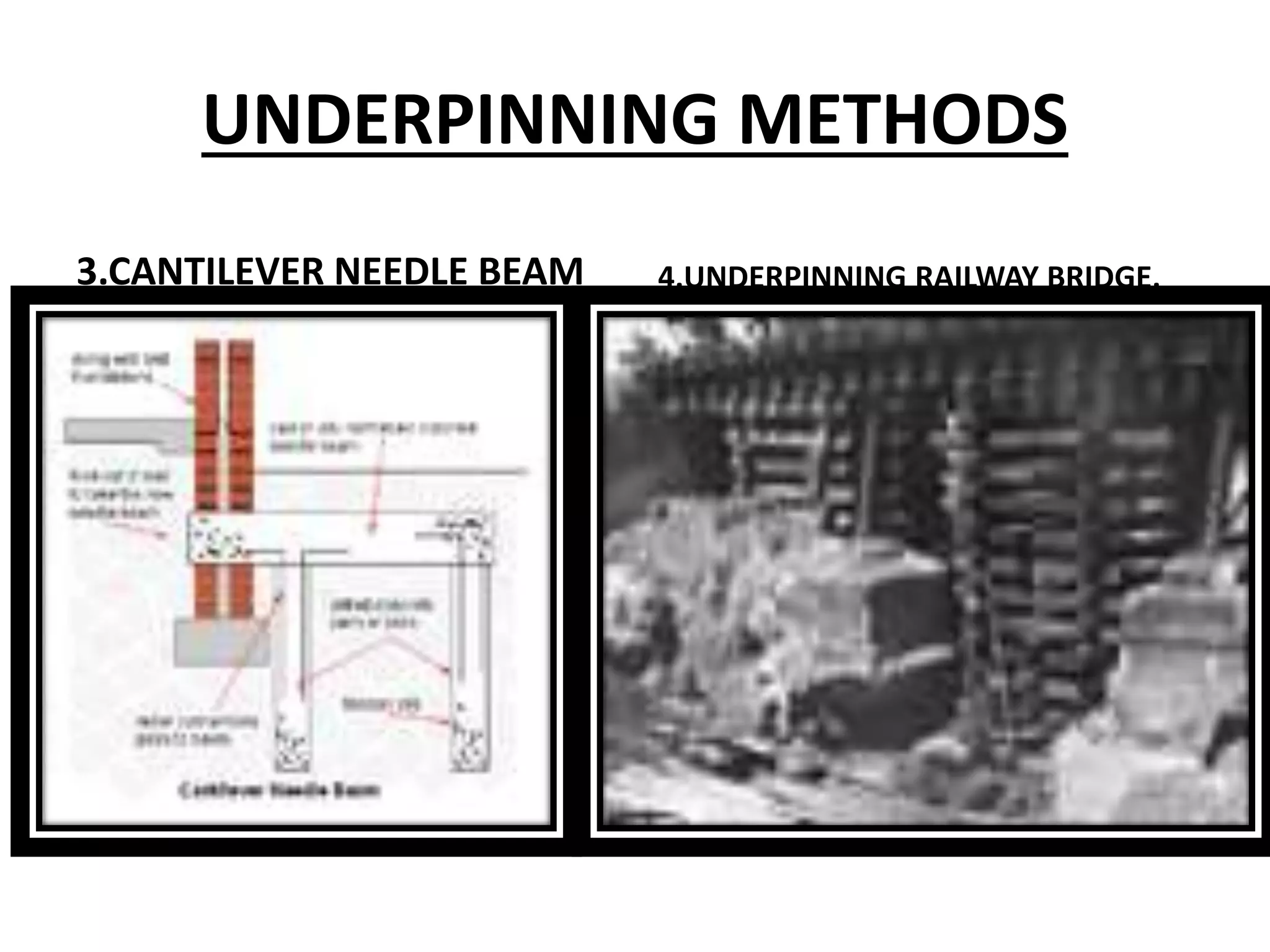
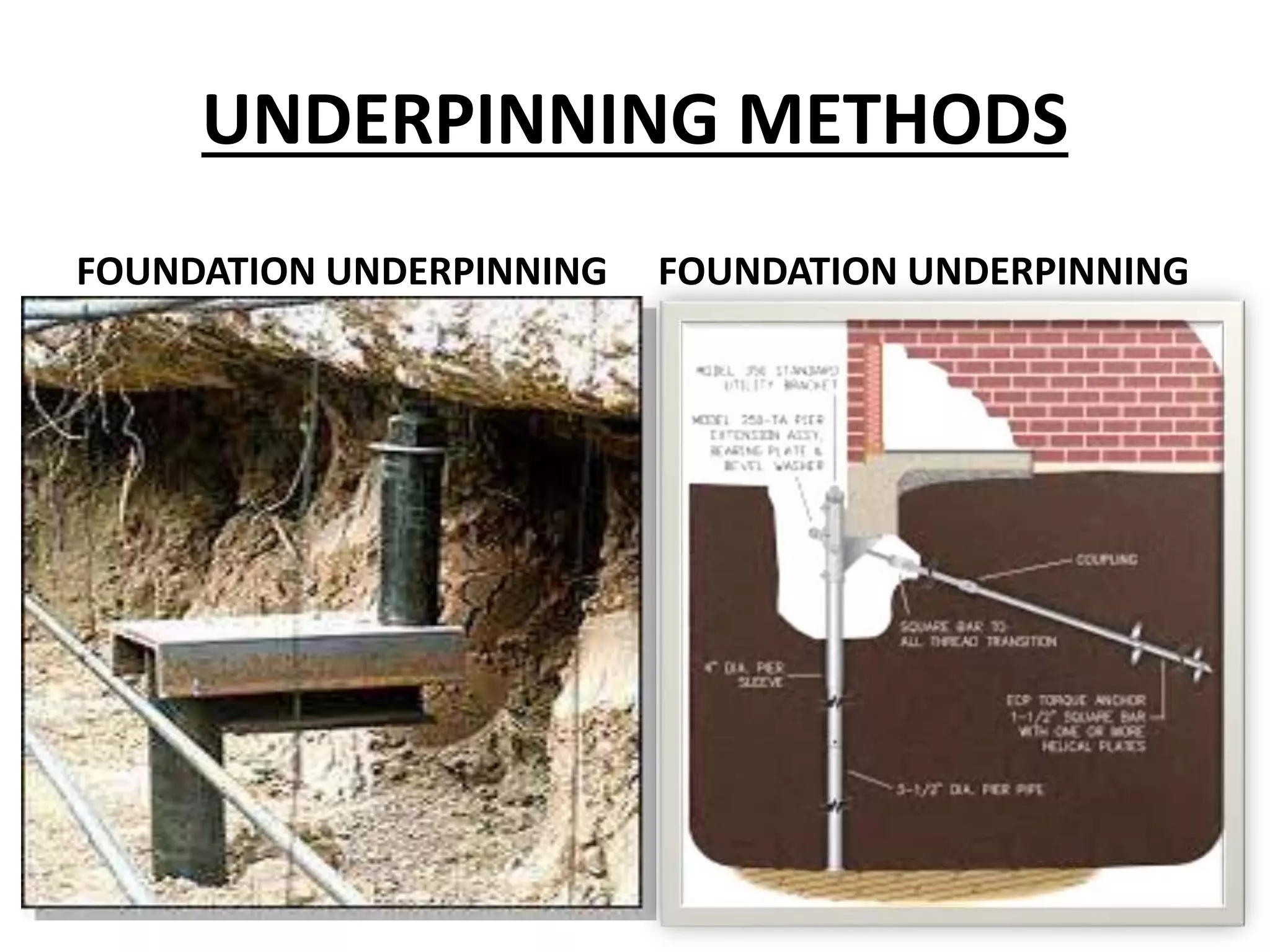
3.CANTILEVER NEEDLE BEAM 4.UNDERPINNING RAILWAY BRIDGE.
UNDERPINNING METHODS 
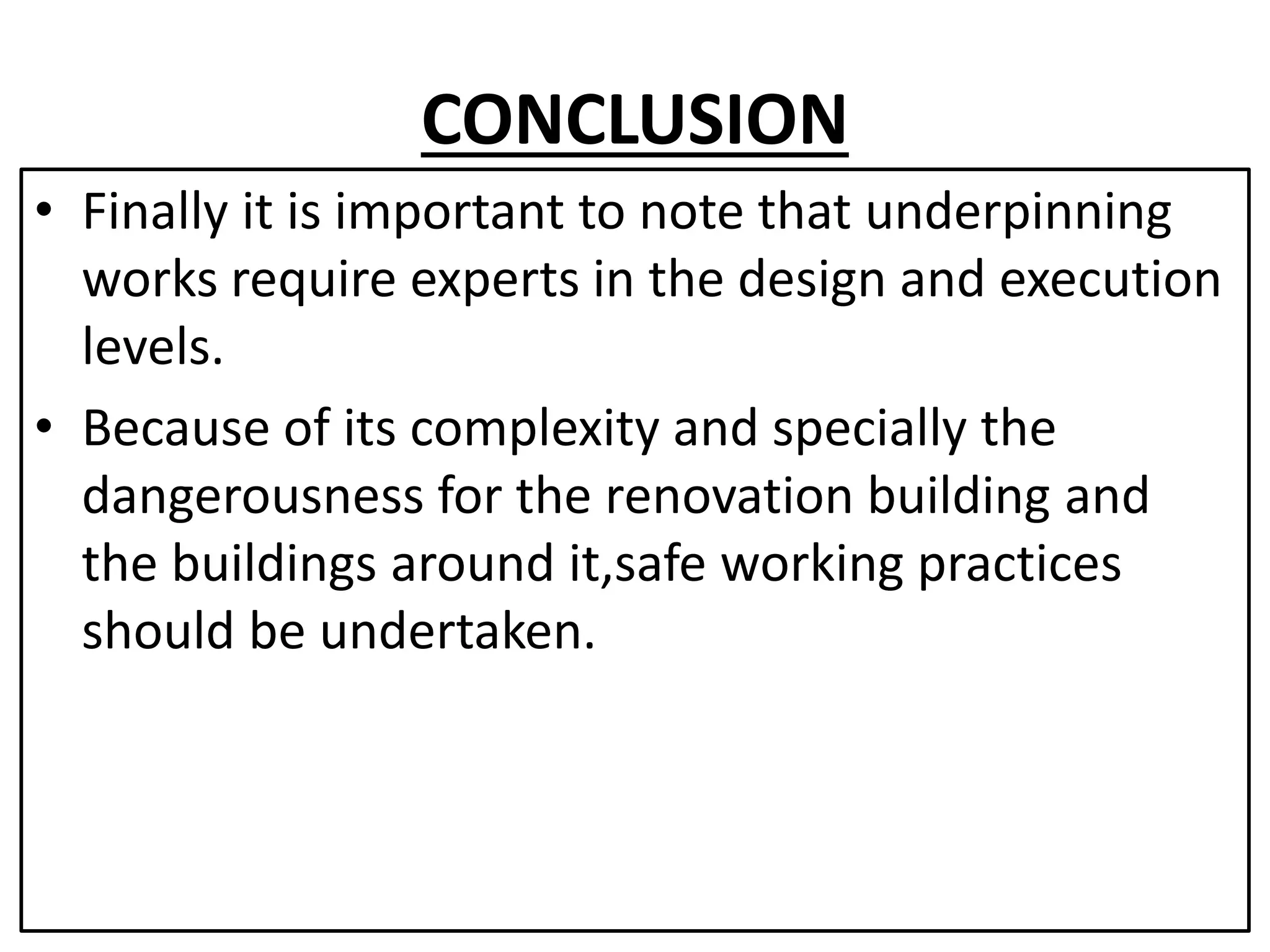
FOUNDATION UNDERPINNING FOUNDATION UNDERPINNING
CONCLUSION 
• Finally it is important to note that underpinning 
works require experts in the design and execution 
levels. 
• Because of its complexity and specially the 
dangerousness for the renovation building and 
the buildings around it,safe working practices 
should be undertaken.
REFERENCES 
http://encyclopedia2.the 
freedictionary.com|Technical Education. 
Accessed on 06/01/2014. 
http://courses.washington.educ|cm420/underpi 
nning.pdf 
Accessed on 06/01/2014. 
Nash,W.G.(1988).Brickwork 3 revised third 
edition.Essex.Anchor Press Ltd.

Underpinning presentation chakamba

  • 1.
    ASSIGNMENT QUESTION YOURCOLLEGE IS HOSTING AN INTERNATIONAL EXPO ON TECHNICAL EDUCATION IN ZIMBABWE.PREPARE A POWERPOINT PRESENTATION BASED ON UNDERPINNING OF FOUNDATIONS.YOUR PRESENTATION SHOULD HAVE CLEAR & INFORMATIVE ILLUSTRATIONS & SHOULD FOLLOW THE FOLLOWING FORMAT: (a) DEFINITIONS (b) REASONS FOR UNDERPINNING (c) PROCEDURE USING THE FOLLOWING MATERIALS: i. CONCRETE ii. BEAMS iii. MINI PILES
  • 2.
  • 3.
    UNDERPINNING OBJECTIVES •Define the term underpinning. • Describe underpinning,when it is needed and how it is done. • State the reasons for underpinning. • State the methods of underpinning a structure.
  • 4.
  • 5.
    INTRODUCTION Whenever anew building is to be built especially in urban areas,it is quite common to have the foundations lower than the foundations of adjacent buildings. It is therefore essential that the stability of the existing building(s) is safeguarded by performing underpinning as well as shoring.`that care and forethought should be undertaken if these operations are to be successfully carried out. Only highly skillied and experienced personnel or companies should perform these operations.
  • 6.
    DEFINITIONS TECHNICAL EDUCATION • It is academic and vocational preparation of students for jobs involving applied science and modern technology. • It is also understood to include the theoretical & practical scientific knowledge and skills that permit a person receiving such education to solve production engineering and economic problems in his speciality.(encyclopedia2, the freedictionary). UNDERPINNING • It is a broad term to describe the process of modifying an existing foundation by adding support. • It can also be described as the installation of temporary or permanent support to an existing foundation to provide either additional depth or an increase in bearing capacity.(Nemati 2007).
  • 7.
    DEFINITIONS Cont •Underpinning can also be reffered to as a process of strengthening the foundation of an existing building or other structure(wikipedia,the free encyclopedia). REASONS FOR UNDERPINNING  Construction of a new project with a deeper foundation adjacent to an existing building.  To enable the foundations to be deepened for structural reasons e.g to construct a basement or addition of another storey to the building.
  • 8.
    REASONS cont Tosupport a structure that is sinking or tilting due to poor soil or instability of the superstructure. Change in use of a structure.  As a safeguard against possible settlement of a structure when excavating close to or below its foundation level. To support a structure while making alteration to its foundations or main supporting members. To increase the width of a foundation to permit heavier loads to be carried e.g when increasing the height of a building with new levels. To enable a building to be moved bodily to a new site.
  • 9.
    REASONS Cont Theoriginal foundation is simply not strong or stable enough. The properties of the soil supporting the foundation may have changed possibly through subsidence or were mischaracterized during design stages. Settlement of an existing structure.
  • 10.
  • 11.
    SOME CAUSES OFSETTLEMENT ON A BUILDING  Lowering of the water table due to tidal fluctuations,wells for a water district etc.  Lowering of the water table can then cause tops of timber piles to decay overtime and will require remedial underpinning.  Rising of the water table in some soils can effect a decrease in bearing capacity of the soil causing settlement on the building which will then require underpinning.  Construction of buildings on unsuitable bearing material or over compressible layer e.g peat,organic silts or poorly compacted backfill may also cause settlement.  Earthquakes,floods or other natural causes can cause the structure to move thereby requiring stabilisation of foundation soils or footings.
  • 12.
    DETERMINING THE NEEDFOR UNDERPINNING  Underpinning as a direct support of an existing building foundation provides the opportunity to preload i.e jacking to limit settlement and improve poor foundations.  When a structure starts showing signs of settlement or distress, it is of utmost importance to precisely monitor the settlement or movement by a professional on a daily,weekly or monthly basis.  Data collected or readings will indicate if the movements are decreasing or increasing.  Analyzing the results will also tell whether underpinning is required or not to safeguard the structure e.g cracks or any other weaknesses  Before the beginning of any excavation on a new structure a professional must examine all the structures in close proximity to the construction site so as to determine whether underpinning is also necessary.Nash 1988:146.
  • 13.
    PROCEDURES INVOLVED WHEN USING PILES FOR UNDERPINNING  The piles are formed of precast concrete sections.  Each section has a steel-linked hole running through it.  The steel lining helps the locating of the sections and ensures that they are all in line. THE PROCESS  A hole is dug below the existing foundation of the structure.  The first section which has a pointed steel toe-piece to make penetration into the ground easier is placed into position below the foundation .  A bearing plate is then positioned between the jack and the foundation.
  • 14.
    PROCESS cont Thejack is then put between the first section and the bearing plate and the first section is forced downward by the hydraulic jack powered by a pump outside the excavation. When the top of the first section is almost flush with the ground,the jack is removed and the process is repeated with the second and subsequent sections. As each section is added,a length of steel tube is inserted into the hole and grouted into position to make an effective joint between the sections. The operation is continued until the pressure gauge indicates sufficient penetration resistance to ensure adquate bearing capacity.
  • 15.
    THE PROCEDURES INVOLVEDWHEN UNDERPINNING BUILDINGS cont. The wall to be underpinned must be carefully inspected for any cracks or weaknesses and these carefully noted. The wall should then be divided into a convenient number of working bays,generally not exceeding about 1.5m,depending on the quality and stability of the wall.These working bays should have sufficient room to enable a person to work inside them. A batten should now be fixed along the face of the wall throughout its length to act as a datum. A sequence of working which will often be determined by the conditions on the site and the accessibility of the working area adjacent to the wall should now be carefully outlined.
  • 16.
    PROCEDURE cont Notwo adjacent bays must be excavated at the same time. If consecutive bays have to be worked in,it is essential that the first bay is fully completed and allowed to harden before work is begun on the second bay. Each bay excavated in turn,usually by hand.The earth is taken out at the front of the bay which allows support to be given to the foundations for as long as possible,while this excavation is being dug. The earth is then dug out from underneath the foundations until new level is reached.
  • 17.
    PROCEDURE cont. Theground is now levelled and thoroughly rammed. The projection of the foundations is cut off so that it is flush with the face of the wall. The foundation concrete is laid to the required thickness,provided there is adquate projection on both side of the wall.Any water in the excavation should be pumped out first. The brickwork is then built up in the working bay with good quality bricks and cement mortar usually 1:3 or 1:4. The work should be thoroughly pinned up to the concrete. The gap behind the new wall can be filled in with hardcore or weak concrete as the new wall is built.Nash 1988:146
  • 18.
    UNDERPINNING OF FOUNDATIONS UNDERPINNED STRUCTURE CONVENTIONAL PIT METHOD
  • 19.
    UNDERPINNING METHODS oThe means and methods of supporting a structure foundation depends on some of the following factors: Foundation Loads: static and dynamic,permanent and temporary. Type and magnitude of allowable structural movement i.e deformations. Subsurface soil conditions. Subsurface ground water conditions. Access and mobility to the foundations. Potential for environmental hazards. Seismic loading.
  • 20.
    WAYS OF ACHIEVINGUNDERPINNING  It can be done by : i. Load transfer ii. Soil treatment or iii. A combination of the above two mechanisms LOAD TRANSFER  This literally take structural loads and transfer them to an underlying stratum that is more suitable for support. SOIL TREATMENT  This changes the physical properties of the ground to make it stronger and more supportive ,often without any change to existing foundations.  In some cases, ground treatment can be utilized to strengthen the ground while also acting as a load transfer.
  • 21.
    UNDERPINNING METHODS There are numerous methods that can be used when underpinning.  Each methods having its own specific soil and loading conditions where its application is most effective.  In some cases constructability can also determine the system to be used.  Each method have also its own advantages and disadvantages depending on the specific characteristics of the project.
  • 22.
    1. CONVENTIONAL PITMETHOD o It consists of enlarging and or deepening existing foundations by removing soil from beneath the foundations and replacing it with concrete,reinforcements and a grout material. o The structure can also be temporary shored to prevent settlement. DISADVANTAGES OF THE PIT METHOD i. It often results in moderate deformation of the structure. ii. Unsafe working conditions. ADVANTAGES OF THE PIT METHOD i. Simplicity of the engineering. ii. Low cost of labour to produce the result. iii. There is continuity of the structure’s uses during construction.
  • 23.
    2. JET GROUTING  It is a load transferring system for the underpinning,often also serving as an excavation support and ground water control system.  It is an in-situ method of construction undertaken beneath foundations.  High velocity injection of fluids,often enclosed in air erodes the soils and replaces the soil with and engineered grout,forming a cementations product known as SOILCRETE that is capable of attaining unconfined compressive strengths in excess of 70.3 kg/cm2.  Groups of 1 to 1.2m diameter soilcrete columns are constructed to transfer foundation loads to underlying suitable bearing material.
  • 24.
    USE OF JETGROUTING METHOD IT IS A LOAD TRANSFERRING SYSTEM FOR THE UNDERPINNING. SERVING AS AN EXCAVATION SUPPORT AND GROUND WATER CONTROL SYSTEM.
  • 25.
    ADVANTAGES OF JETGROUTING i. Work is accomplished safely above grade and sequenced so that little or no structural deformation occurs. ii. It is most widely used for underpinning historical and sensitive structures. iii. Can also be used to construct deep foundations,in site gravity wall structures and groundwater cut off structures.
  • 26.
    3.MICROPILES  Itis used to stabilize or upgrade existing foundation by installing micropiles through pre-drilled holes determined by load characteristics.  Micropiles are described as small diameter piles that can be installed in almost any type of soil and that can carry loads up to 500 tonnes depending on the type of it.  These micropiles are steel reinforced placed into a small diameter hole and scaled to the ground by grout injections under relatively high pressure.  Micropiles are widely recognized as a common remedial option for underpinning structures having foundations problems after completion or during service period.
  • 27.
    ADVANTAGES OF MICROPILES i. They have high carrying capacity. ii. Less site constraint problems. iii. Low noise and vibration. iv. It is a self –sustained operation. v. It can be designed to have very low settlement. DISADVANTAGES OF MICROPILES i. Higher cost as compared to other pilling systems.
  • 28.
    TYPES OF MICROPILES  Pile and Beam.  Pile and Cantilever Beam.  Knuckle pile.  Piled raft.  Angle pile.  Cantilever Ring Beam.  Twin pile.  Jack Down piles.
  • 29.
    METHODS OF UNDERPINNING 1.NEEDLE BEAM 2.NEEDLE WALL
  • 30.
    UNDERPINNING METHODS 3.CANTILEVERNEEDLE BEAM 4.UNDERPINNING RAILWAY BRIDGE.
  • 31.
    UNDERPINNING METHODS FOUNDATIONUNDERPINNING FOUNDATION UNDERPINNING
  • 32.
    CONCLUSION • Finallyit is important to note that underpinning works require experts in the design and execution levels. • Because of its complexity and specially the dangerousness for the renovation building and the buildings around it,safe working practices should be undertaken.
  • 33.
    REFERENCES http://encyclopedia2.the freedictionary.com|TechnicalEducation. Accessed on 06/01/2014. http://courses.washington.educ|cm420/underpi nning.pdf Accessed on 06/01/2014. Nash,W.G.(1988).Brickwork 3 revised third edition.Essex.Anchor Press Ltd.