GRAVITY DAMS
SAFETY & STABILITY ANALYSIS
DIVYA VISHNOI
Assistant Professor
Stability Analysis
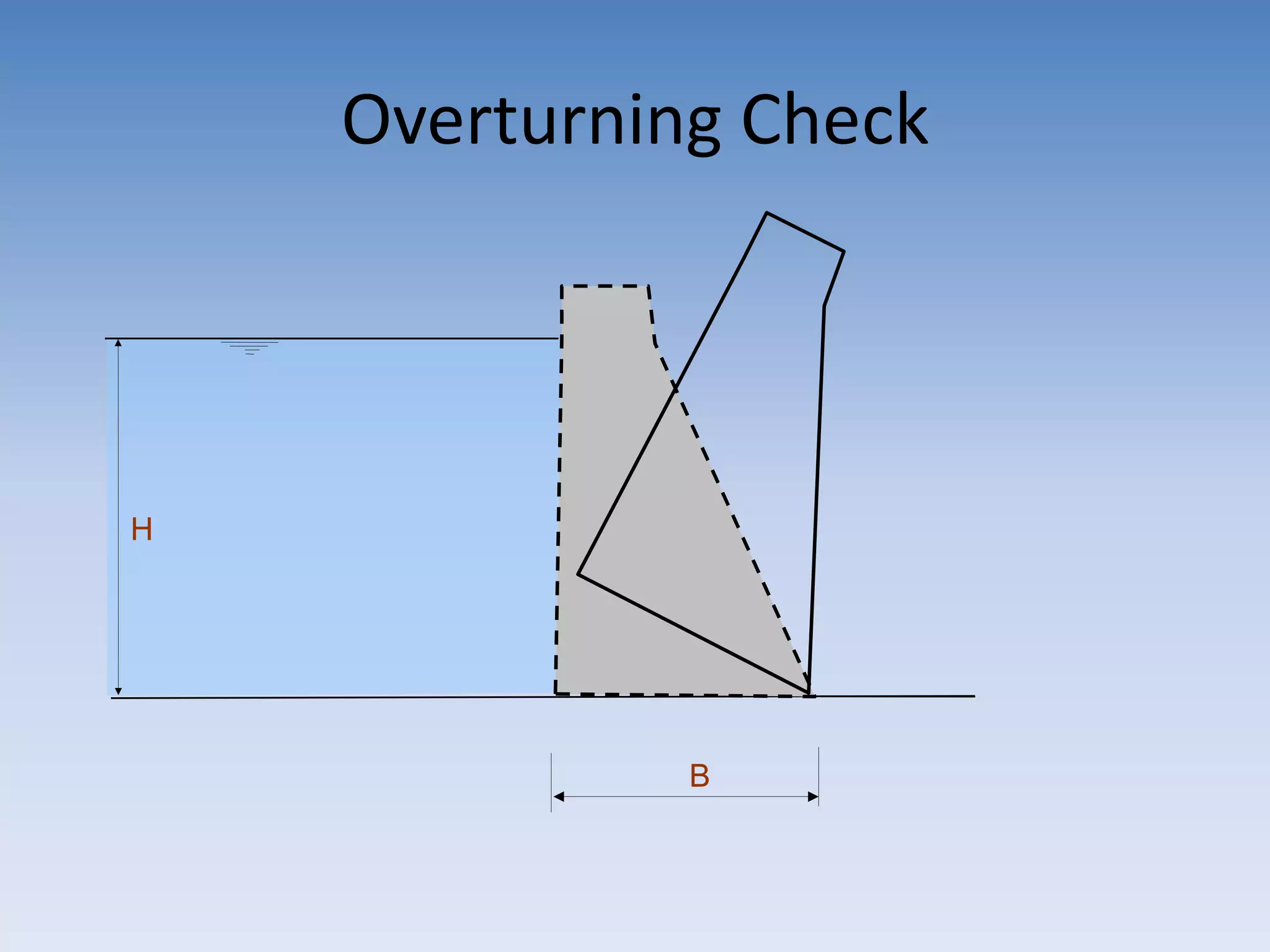
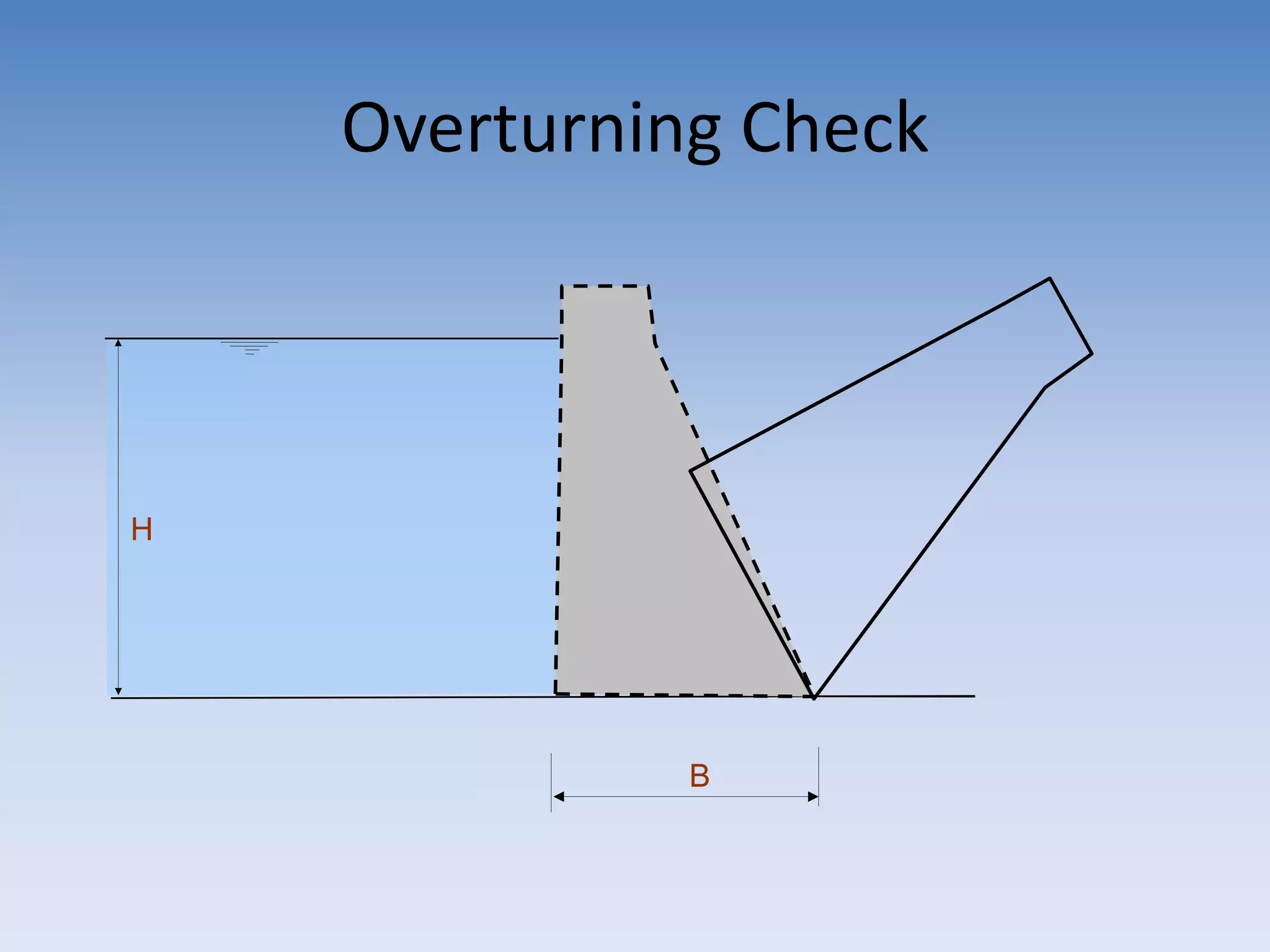
•Stability Against Forward Overturning
•Stability Against Forward Sliding
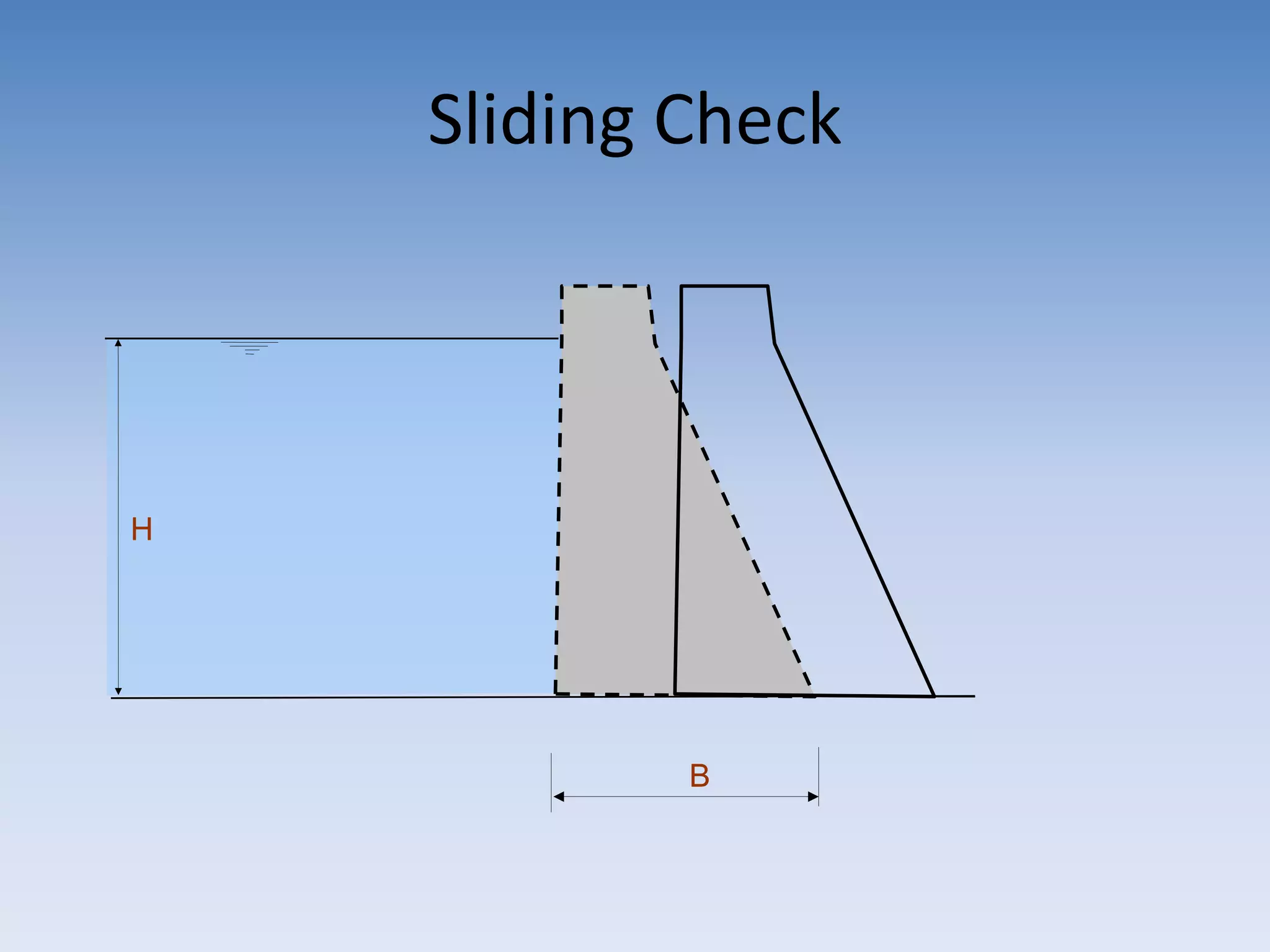
•Stability Against Sliding & Shear
•Stability Against Concrete Overstresses
•Stability Against Foundation Overstresses
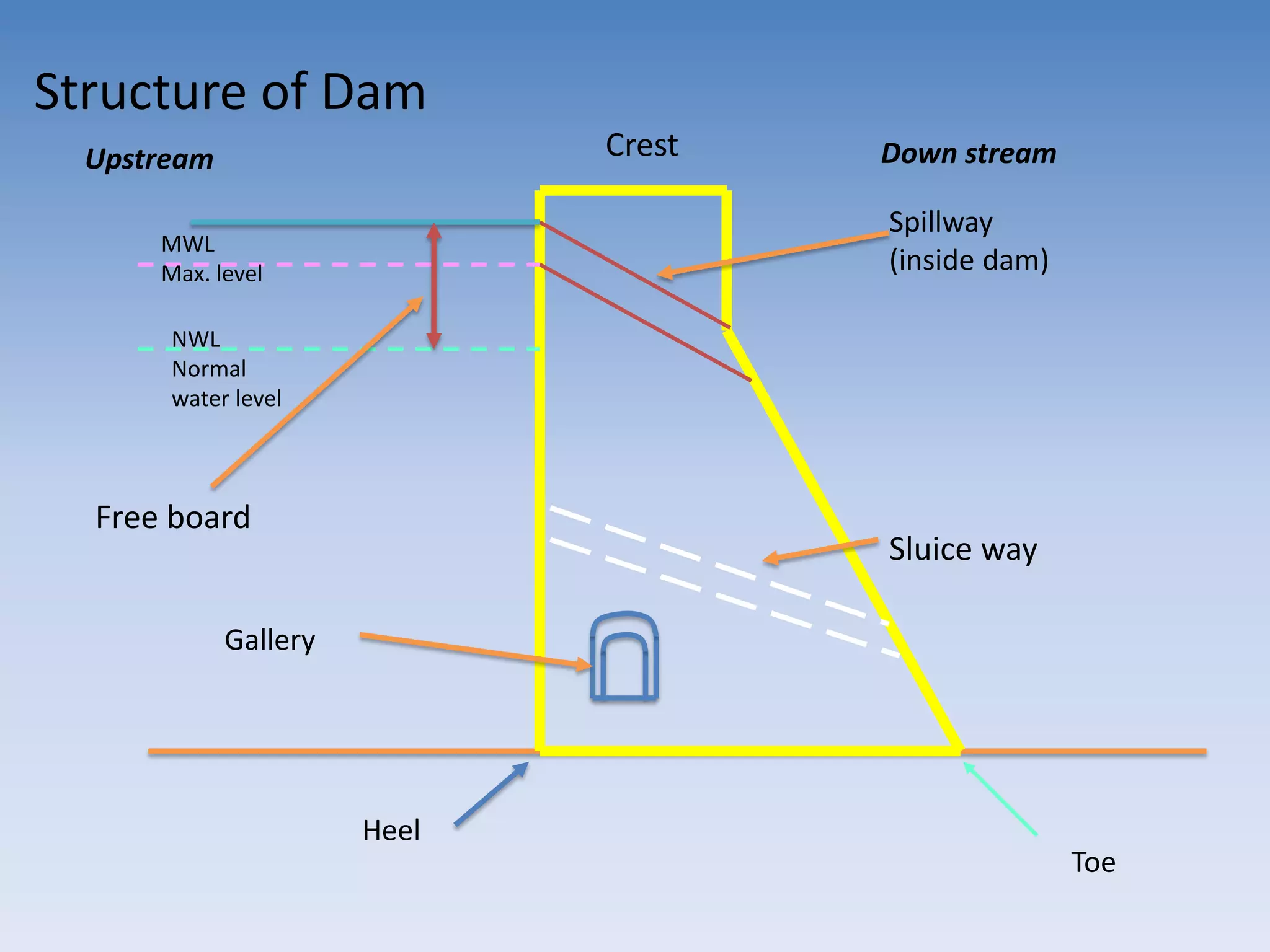
Structure of Dam
Heel
Gallery
Toe
Spillway
(inside dam)
Crest
NWL
Normal
water level
MWL
Max. level
Free board
Sluice way
Upstream Down stream
• Heel: contact with the ground on the upstream side
• Toe: contact on the downstream side
• Abutment: Sides of the valley on which the structure of the dam rest
• Galleries: small rooms like structure left within the dam for checking
operations.
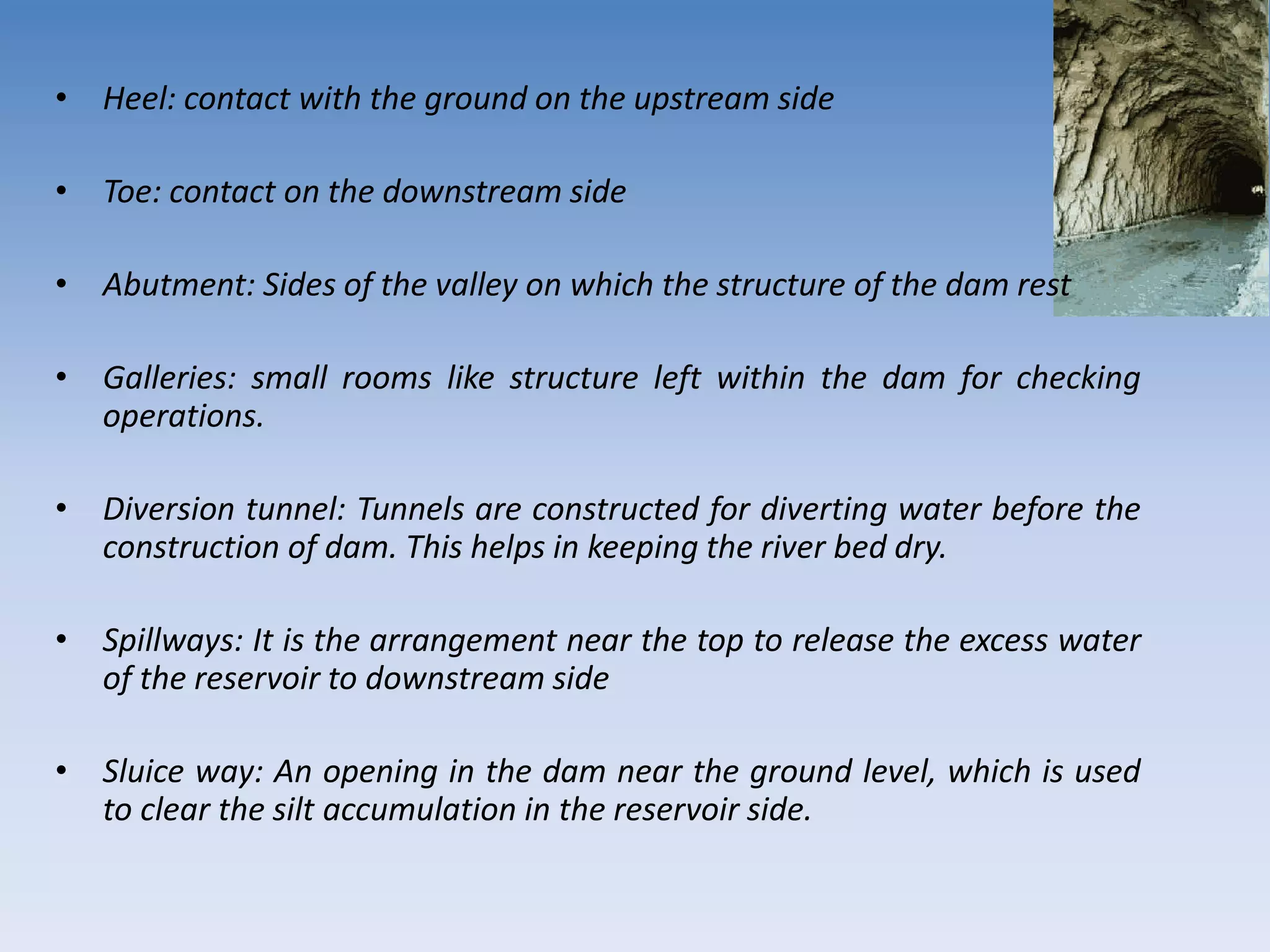
• Diversion tunnel: Tunnels are constructed for diverting water before the
construction of dam. This helps in keeping the river bed dry.
• Spillways: It is the arrangement near the top to release the excess water
of the reservoir to downstream side
• Sluice way: An opening in the dam near the ground level, which is used
to clear the silt accumulation in the reservoir side.
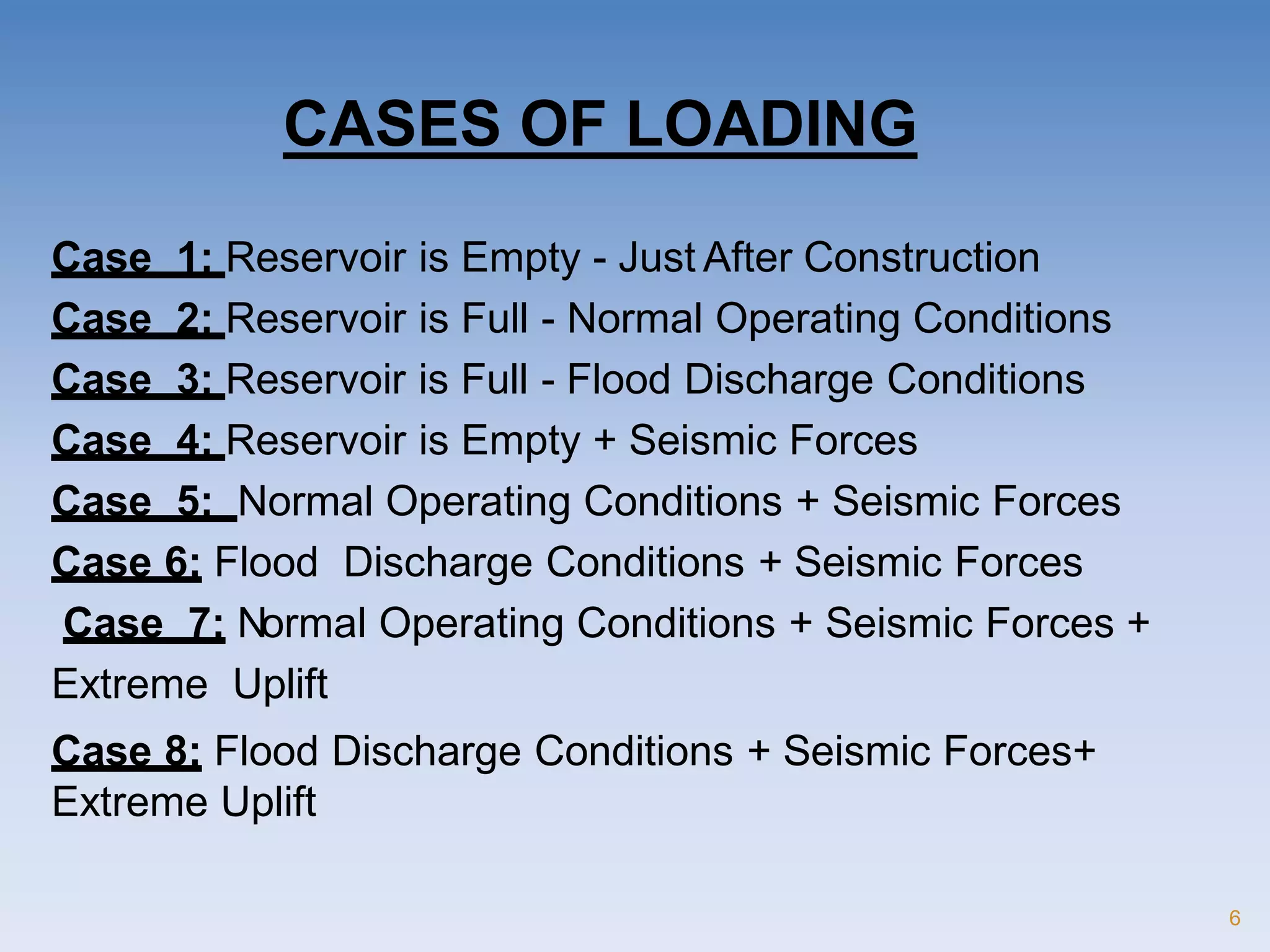
Case 1: Reservoir is Empty - Just After Construction
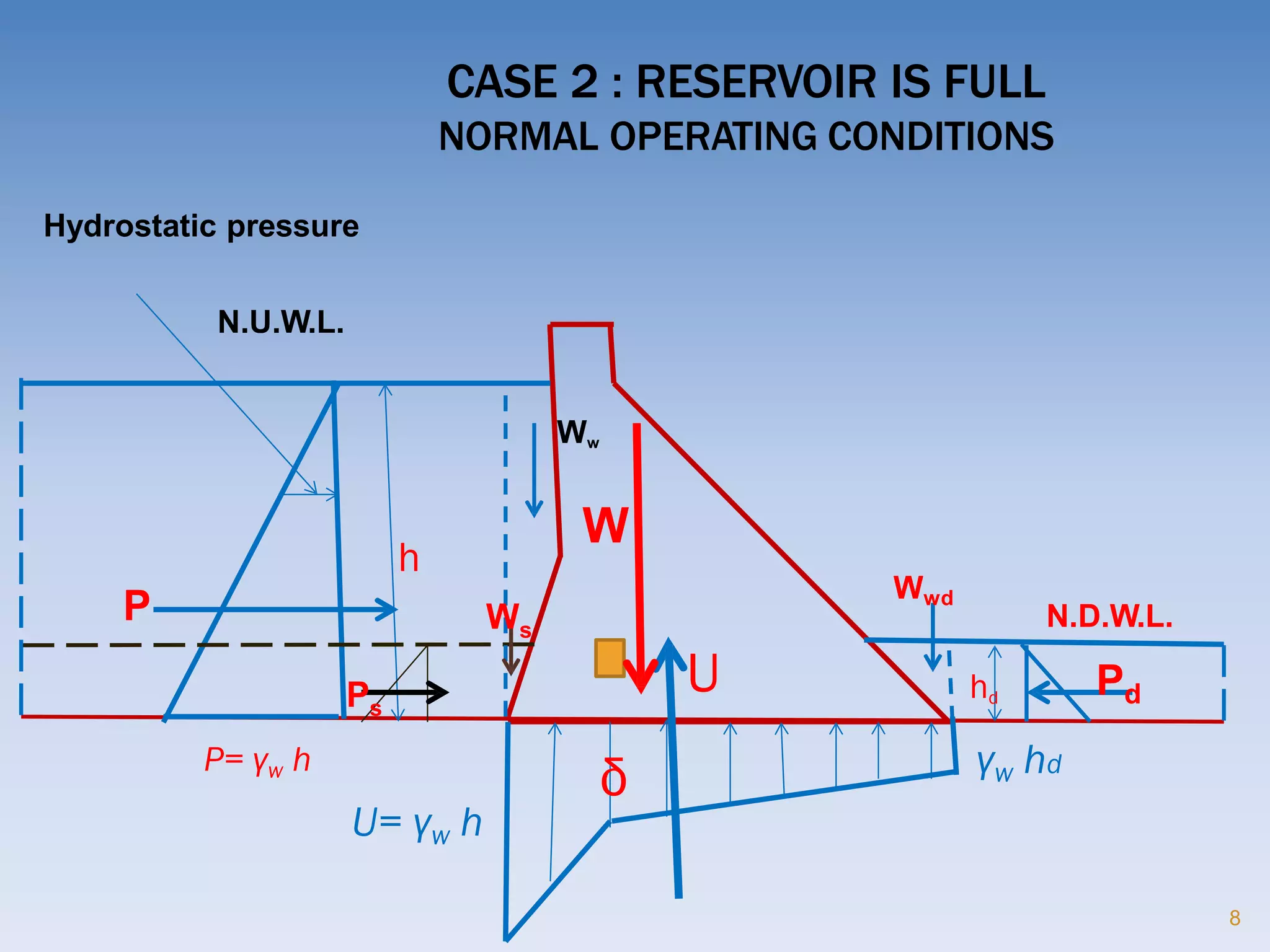
Case 2: Reservoir is Full - Normal Operating Conditions
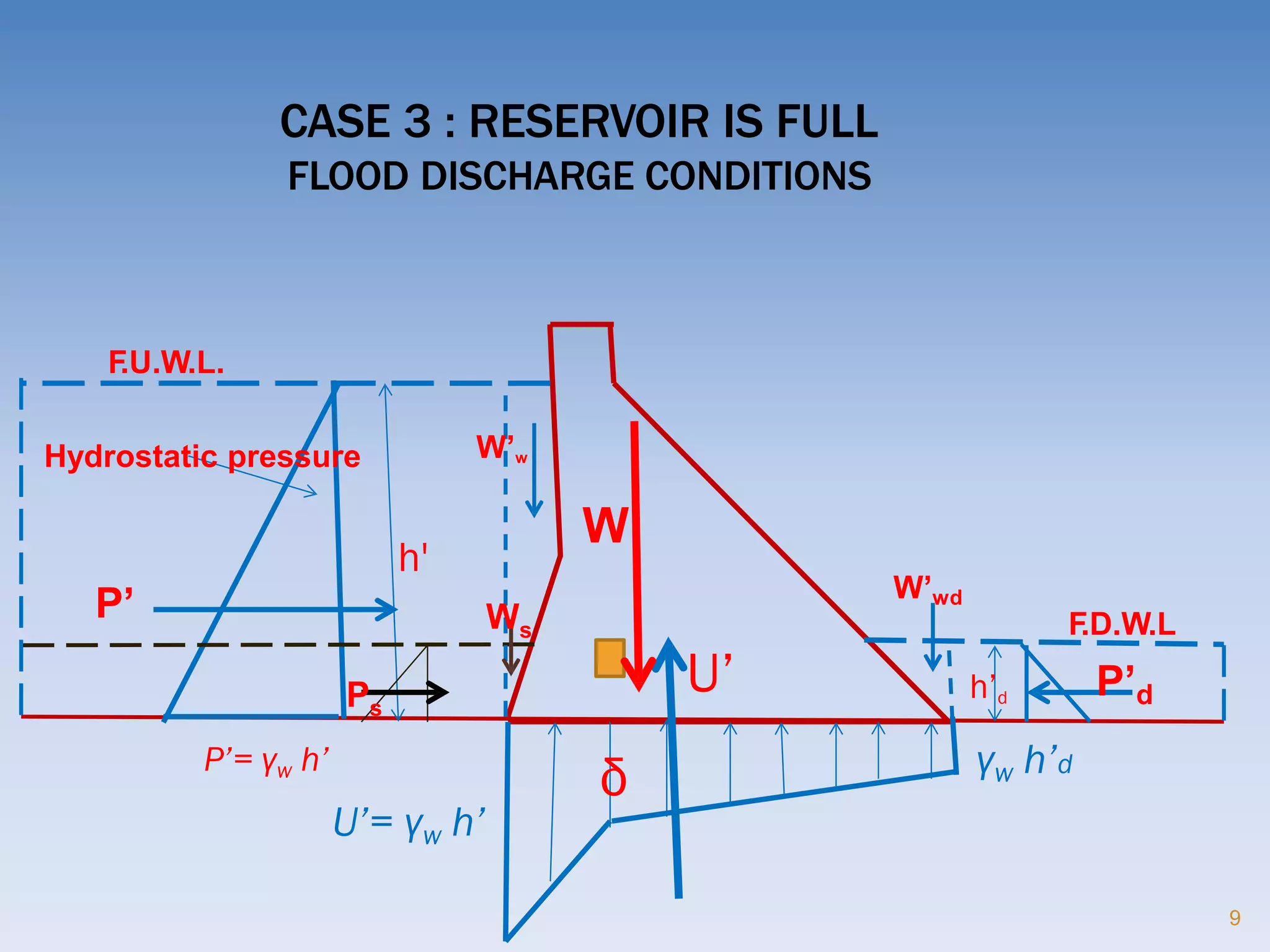
Case 3: Reservoir is Full - Flood Discharge Conditions
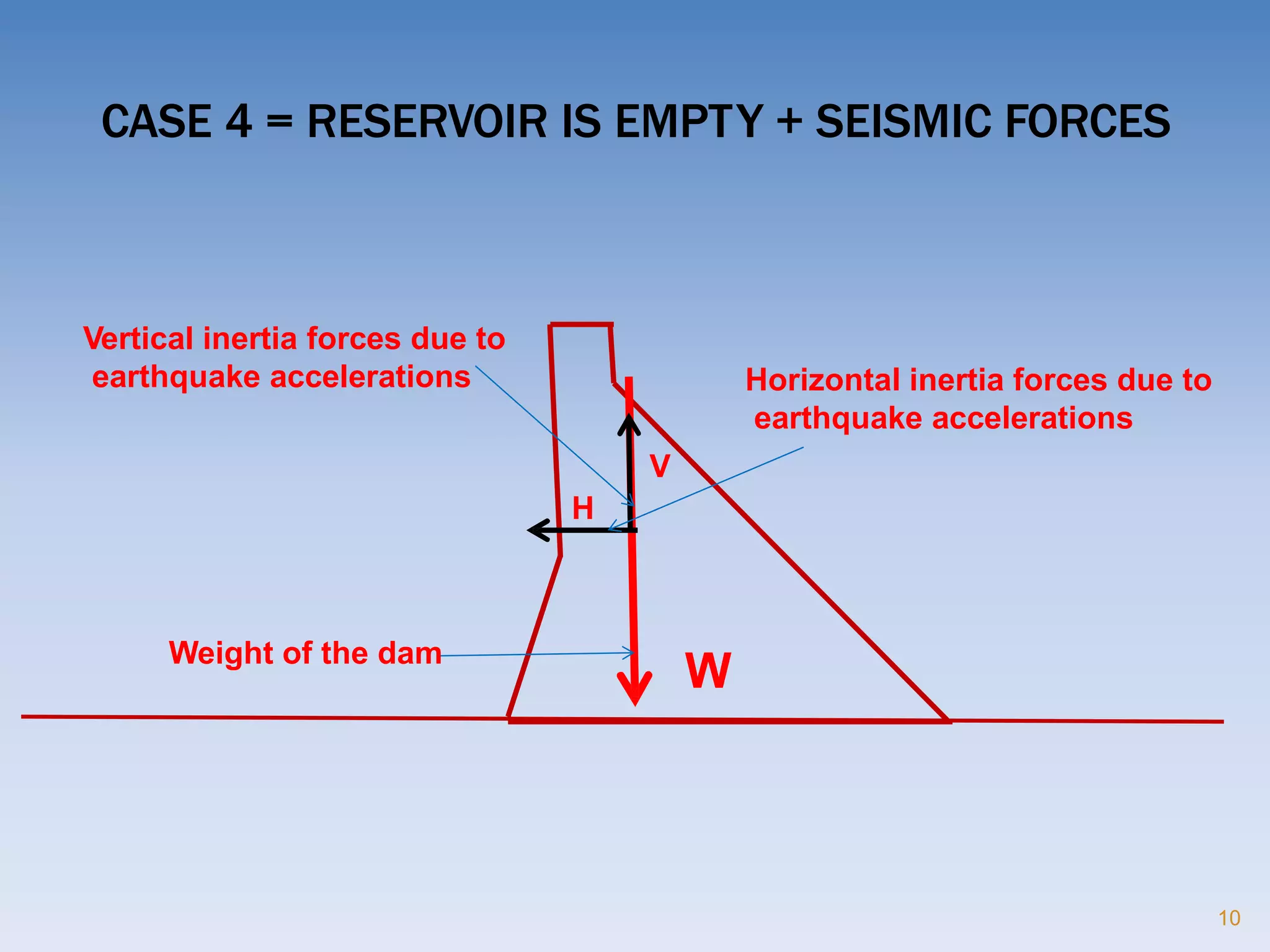
Case 4: Reservoir is Empty + Seismic Forces
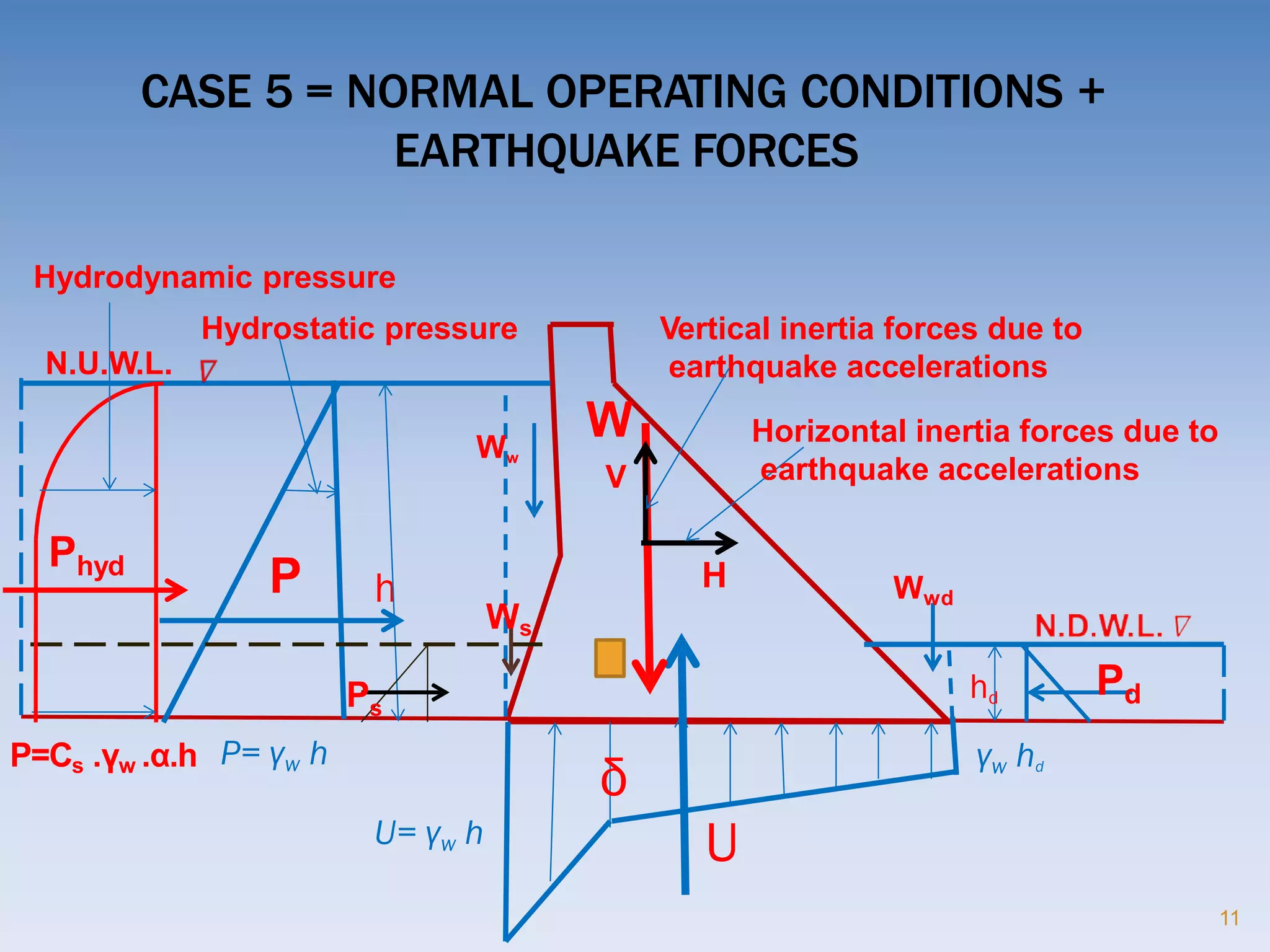
Case 5: Normal Operating Conditions + Seismic Forces
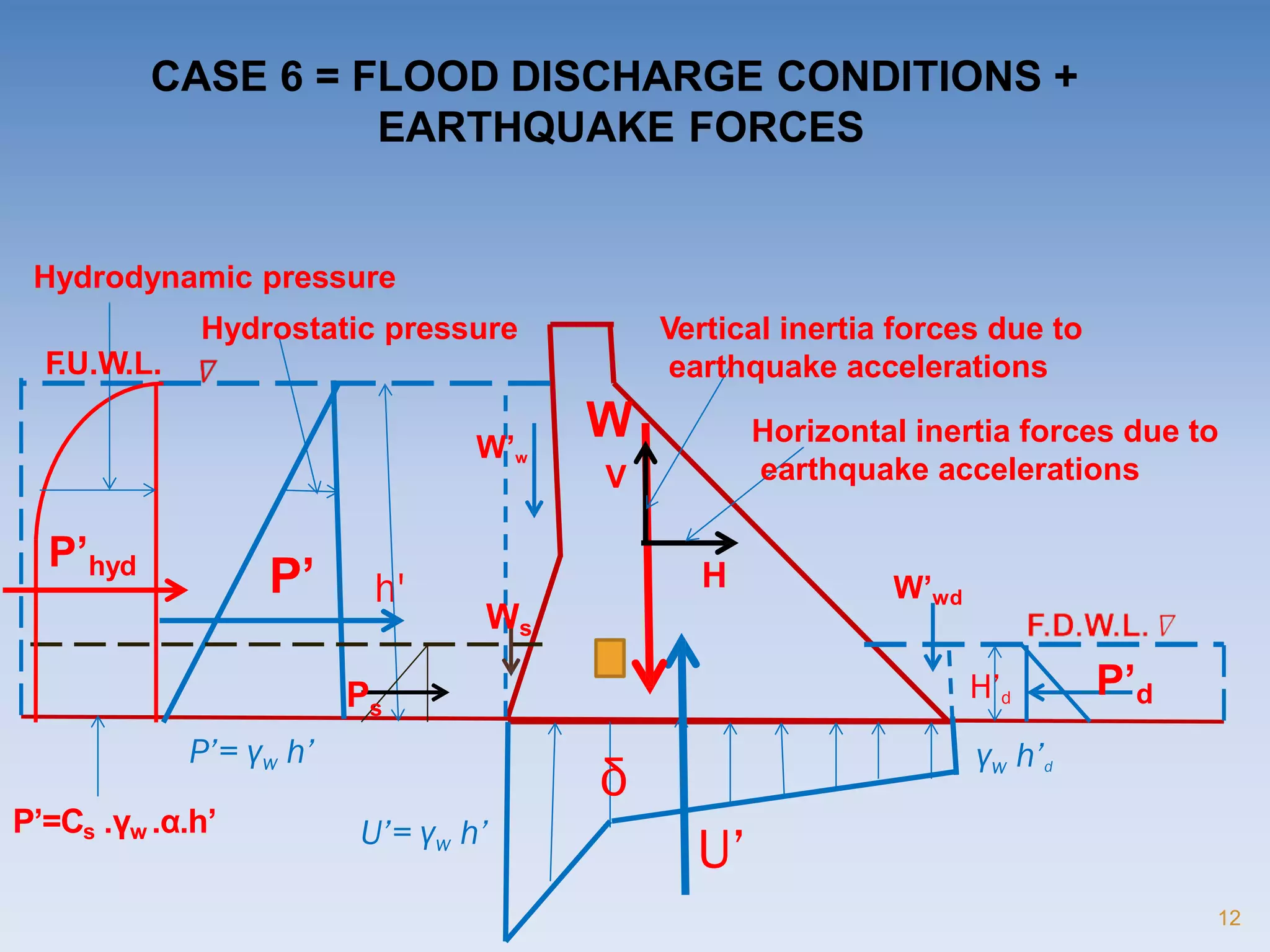
Case 6: Flood Discharge Conditions + Seismic Forces
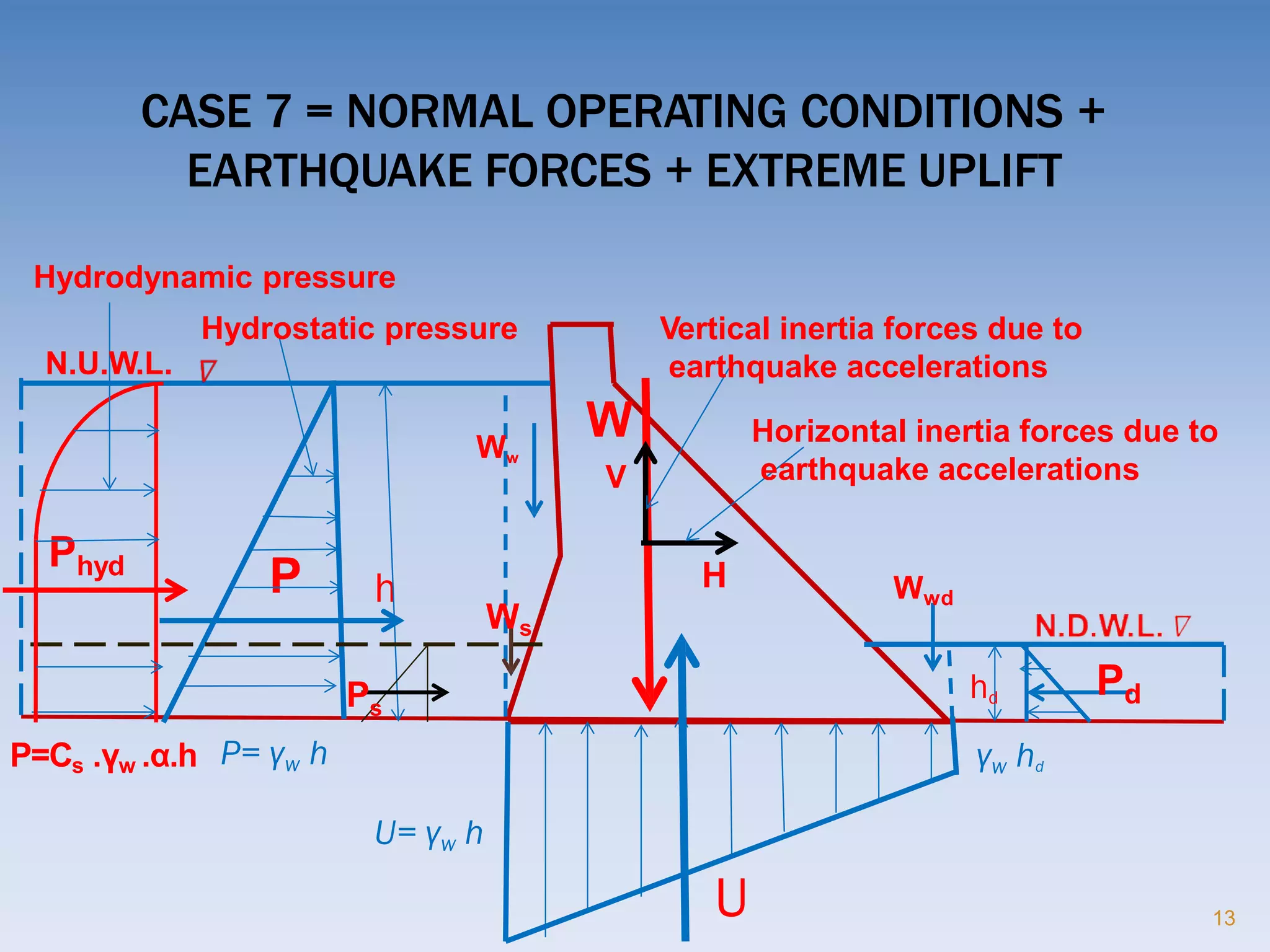
Case 7: Normal Operating Conditions + Seismic Forces +
Extreme Uplift
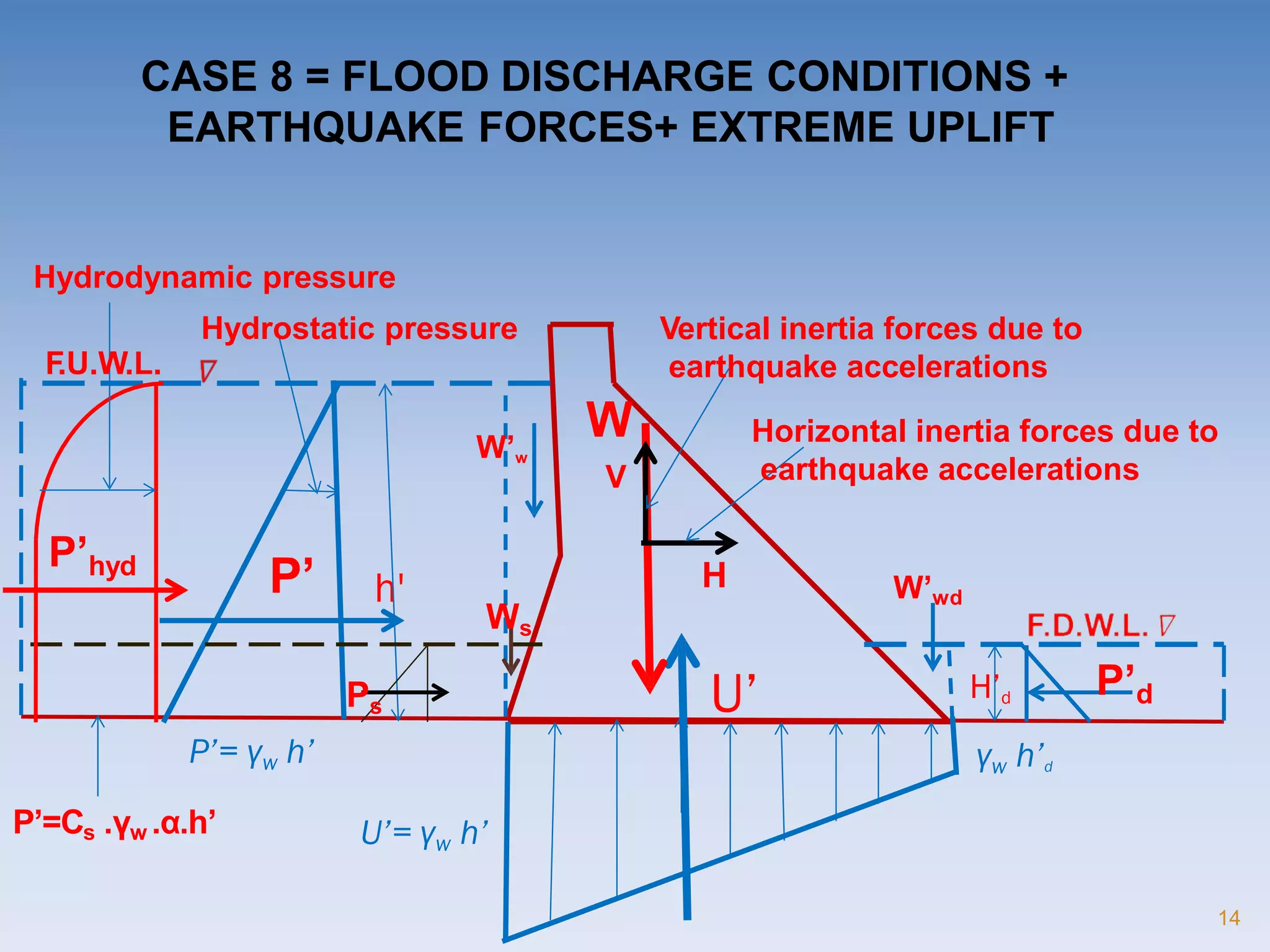
Case 8: Flood Discharge Conditions + Seismic Forces+
Extreme Uplift
6
CASES OF LOADING
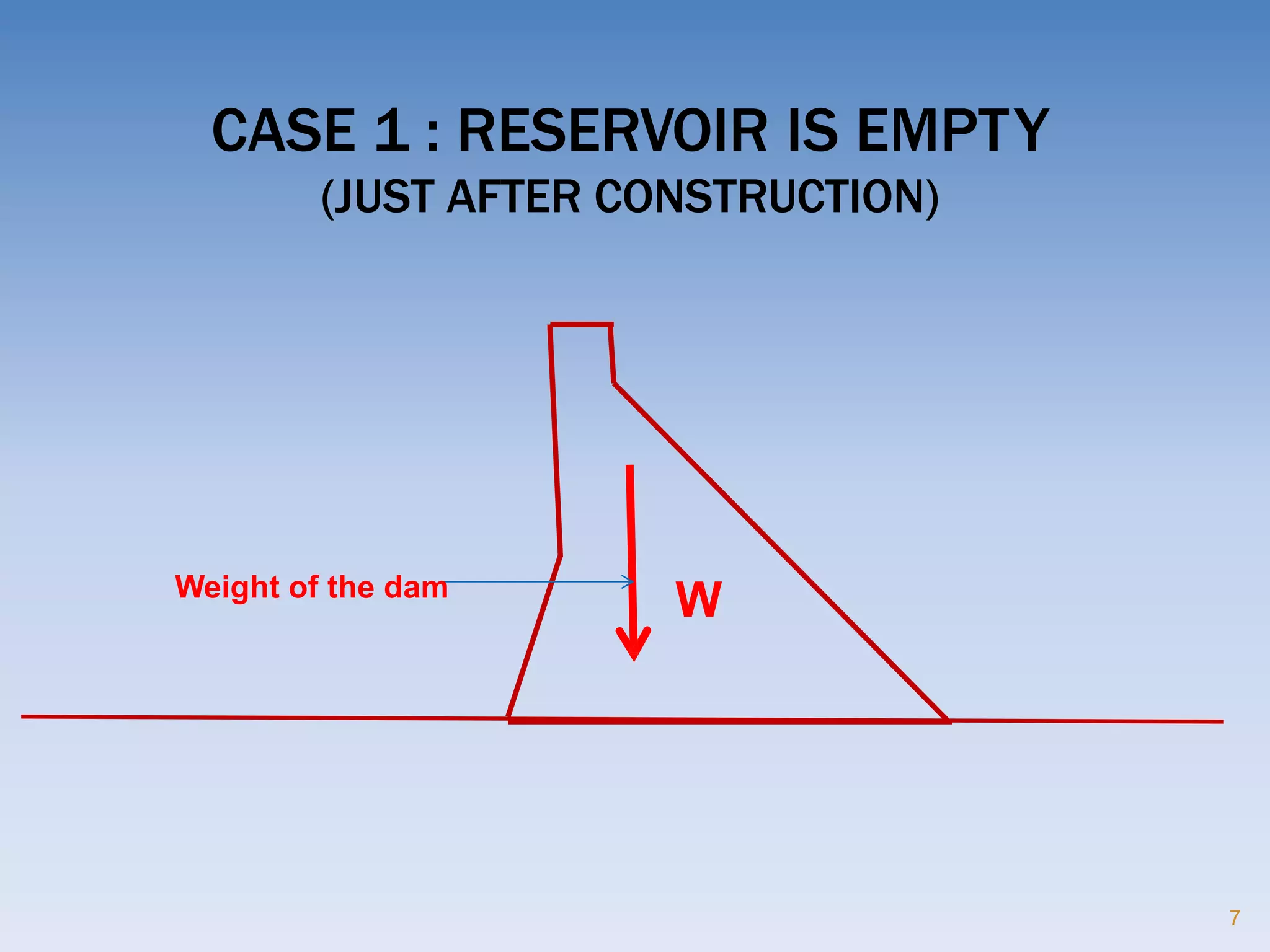
CASE 1 : RESERVOIR IS EMPTY
(JUST AFTER CONSTRUCTION)
WWeight of the dam
7
hd
U
U= γw h
γw hdP= γw h
δ
Pd
Ws
Ps
CASE 2 : RESERVOIR IS FULL
NORMAL OPERATING CONDITIONS
Hydrostatic pressure
N.U.W.L.
Ww
h
P
Wwd
W
N.D.W.L.
8
CASE 3 : RESERVOIR IS FULL
FLOOD DISCHARGE CONDITIONS
h'
h’d
U’
U’= γw h’
γw h’dP’= γw h’
δ
W’w
P’ W’wd
F.D.W.L
P’d
Ws
W
Ps
Hydrostatic pressure
F.U.W.L.
9
CASE 4 = RESERVOIR IS EMPTY + SEISMIC FORCES
W
V
H
Horizontal inertia forces due to
earthquake accelerations
Vertical inertia forces due to
earthquake accelerations
Weight of the dam
10
CASE 5 = NORMAL OPERATING CONDITIONS +
EARTHQUAKE FORCES
h
hd
UU= γw h
γw hdP= γw h
δ
Ww
P Wwd
Pd
Ws
W
V
Ps
Phyd H
P=Cs .γw .α.h
Vertical inertia forces due to
earthquake accelerations
Horizontal inertia forces due to
earthquake accelerations
Hydrodynamic pressure
Hydrostatic pressure
N.U.W.L.
11
CASE 6 = FLOOD DISCHARGE CONDITIONS +
EARTHQUAKE FORCES
h'
H’d
γw h’d
P’= γw h’
δ
W’w
P’ W’wd
P’d
Ws
W
V
Ps
P’hyd H
Hydrodynamic pressure
Hydrostatic pressure
F.U.W.L.
Vertical inertia forces due to
earthquake accelerations
Horizontal inertia forces due to
earthquake accelerations
P’=Cs .γw .α.h’ U’= γw h’
U’
12
CASE 7 = NORMAL OPERATING CONDITIONS +
EARTHQUAKE FORCES + EXTREME UPLIFT
13
h
hd
U
U= γw h
γw hdP= γw h
Ww
P Wwd
Pd
Ws
W
V
Ps
Phyd H
P=Cs .γw .α.h
Hydrodynamic pressure
Hydrostatic pressure
N.U.W.L.
Vertical inertia forces due to
earthquake accelerations
Horizontal inertia forces due to
earthquake accelerations
CASE 8 = FLOOD DISCHARGE CONDITIONS +
EARTHQUAKE FORCES+ EXTREME UPLIFT
h'
H’dU’
U’= γw h’
γw h’d
P’= γw h’
P’=Cs .γw .α.h’
W’w
P’ W’wd
P’d
Ws
W
V
Ps
P’hyd H
Hydrodynamic pressure
Hydrostatic pressure
F.U.W.L.
Vertical inertia forces due to
earthquake accelerations
Horizontal inertia forces due to
earthquake accelerations
14
DESIGN OF GRAVITY DAMS
15
INTRODUCTION:
 Dams are national properties, for the development
of national economy in which large investments
are deployed
 Safety of dams is a very important aspect for
safeguarding national investment and benefits
derived by the project
 Unsafe dams constitute hazards to human life in
the downstream reaches
 Safety of dams and allied structures is an
important aspect to be examined to ensure public
confidence and to protect downstream area from
any potential hazards.
DESIGN OF GRAVITY DAMS
 Technically, a concrete gravity dam derives its
stability from the force of gravity of its materials.
 The gravity dam has sufficient weight so as to
withstand the force and the over turning moments
caused by the water impounded in the reservoir
behind it.
 It transfers the loads to the foundations by
cantilever action and hence good foundations are
pre requisite for the gravity dam.
16
DESIGN OF GRAVITY DAMS
17
Gravity dams are satisfactorily adopted for narrow valleys having
stiff geological formations.
Their own weight resists the forces exerted upon them.
They must have sufficient weight against overturning
tendency about the toe.
The base width of gravity dams must be large enough to
prevent sliding.
These types of dams are susceptible to settlement,
overturning, sliding and severe earthquake shocks.
PROCEDURE OF CONCRETE GRAVITY DESIGN
18
In the gravity dam calculations one should proceed through the following steps:
1. Determination of all expected acting loads
2. State the combination of acting loads for each case of loading
3.Check stability against overturning for all possible cases of loading (cases of full
reservoir)
4.Check stability against forward sliding for all possible cases of loading (cases
of full reservoir)
5.Determine normal stress distribution at dam base and any given sections for all
cases of loading
6.Determine maximum and minimum principal and shear stresses at dam
base and any given sections for all cases of loading
7.Compare results with corresponding factors of safety and allowable stresses 8.
approve the dam profile or redesign for a new profile
STABILITY CRITERIA
19
Stability analyses are performed for various loading
conditions.The structure must prove its safety and
stability under all loading conditions.
Since the probability of occurrence of extreme events is
relatively small, the joint probability of the independent
extreme events is negligible. In other words, the probability
that two extreme events occur at the same time is
relatively very low.
Therefore, combination of extreme events are not considered
in the stability criteria.
e.g. Floods (spring and summer) versus Ice load (winter).
then no need to consider these two forces at the same
time.
STABILITY CRITERIA
Usual Loading
Hydrostatic force (normal operating level)
Uplift force
Temperature stress (normal temperature)
Dead loads
Ice loads
Silt load
Unusual Loading
Hydrostatic force (reservoir full)
Uplift force
Stress produced by minimum temperature at full level Dead loads
Silt load
Extreme (severe) Loading
Forces in Usual Loading and earthquake forces
STABILITY CRITERIA
21
The ability of a dam to resist the applied loads is
easured by some safety factors.
To offset the uncertainties in the loads, safety
criteria are chosen sufficiently beyond the static
equilibrium condition.
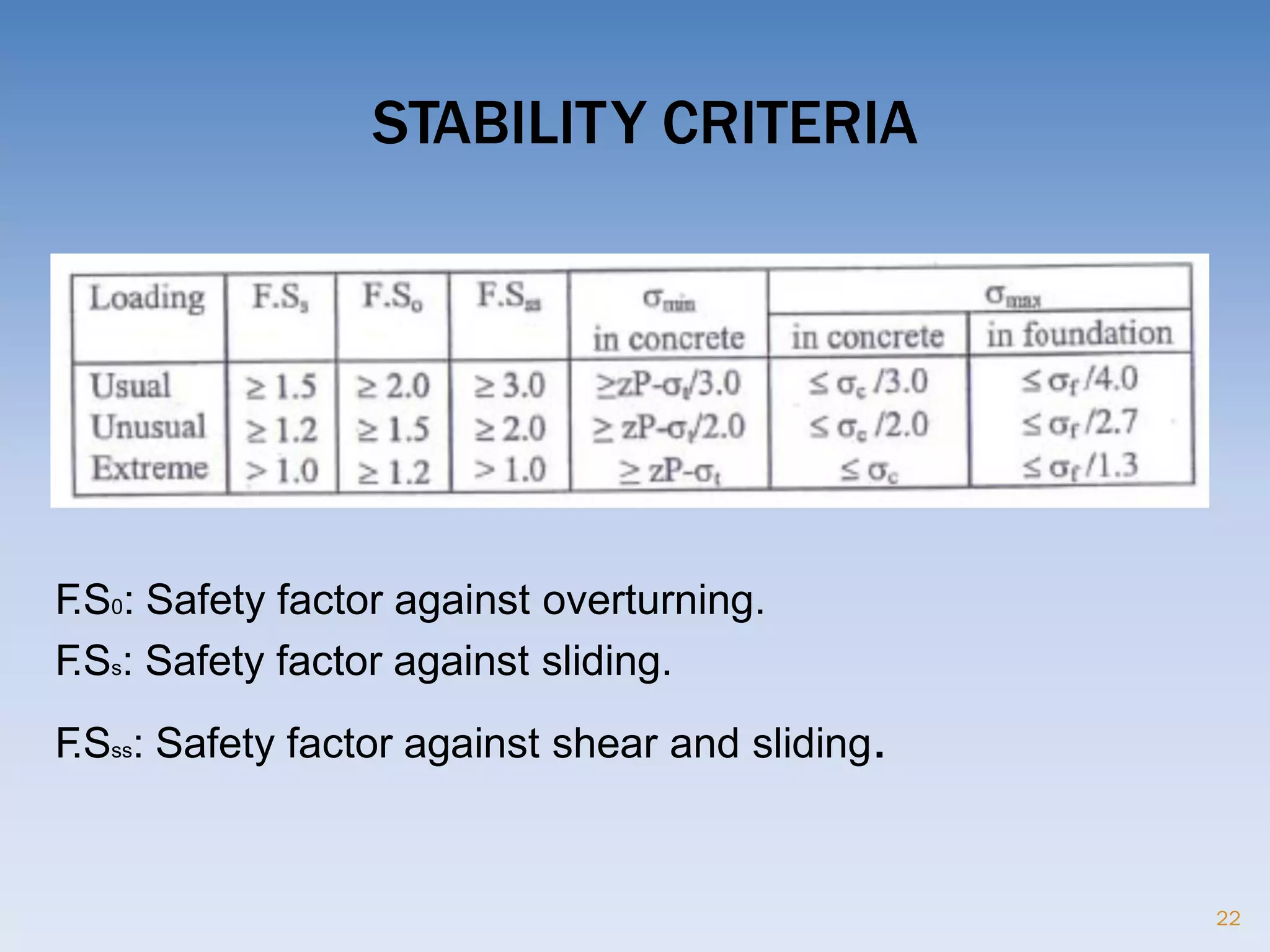
Recommended safety factors: (USBR, 1976 and
1987)
However, since each dam site has unique features,
different safety Factors may be derived considering the
local condition.
STABILITY CRITERIA
F.S0: Safety factor against overturning.
F.Ss: Safety factor against sliding.
F.Sss: Safety factor against shear and sliding.
22
STABILITY ANALYSIS OF GRAVITY DAMS
23
1 Stability against overturning
2 Stability against Forward sliding
3 Failure against overstressing
Normal stresses on horizontal planes
Shear stresses on horizontal planes
Normal stresses on vertical planes
Principal stresses
Permissible stresses in concrete
STABILITY ANALYSIS OF CONCRETE GRAVITY DAMS
 For the considerations of stability of a concrete gravity
dam the following assumptions are made:
the
dam
• Is composed of individual transverse vertical elements
each of which carries its load to the foundation
separately
Stability
analysis
• Is carried out for the whole block
vertica
l
stress
• Varies linearly from upstream face to downstream face
on any horizontal section
24
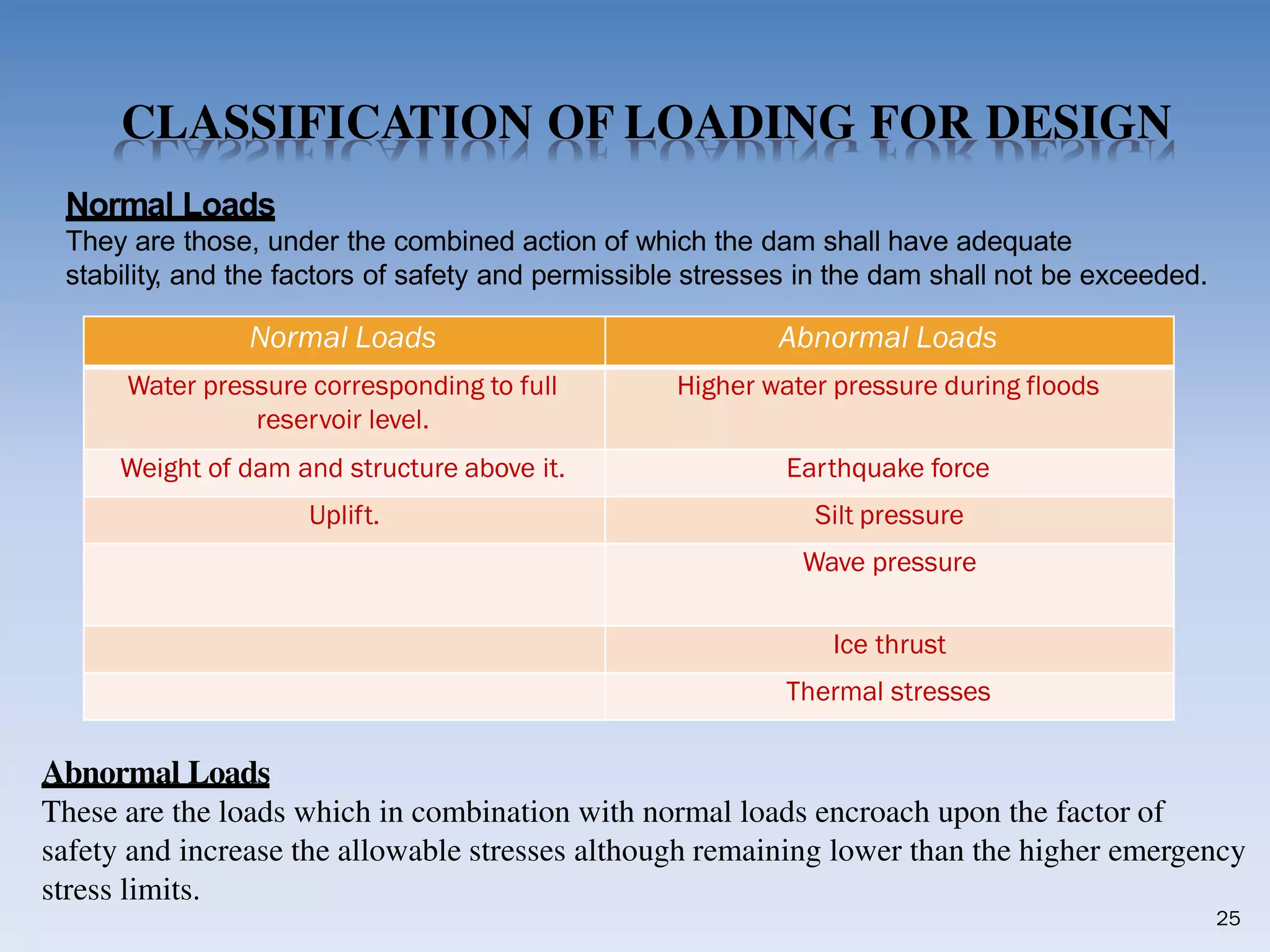
CLASSIFICATION OF LOADING FOR DESIGN
Normal Loads
They are those, under the combined action of which the dam shall have adequate
stability, and the factors of safety and permissible stresses in the dam shall not be exceeded.
25
Abnormal Loads
These are the loads which in combination with normal loads encroach upon the factor of
safety and increase the allowable stresses although remaining lower than the higher emergency
stress limits.
Normal Loads Abnormal Loads
Water pressure corresponding to full
reservoir level.
Higher water pressure during floods
Weight of dam and structure above it. Earthquake force
Uplift. Silt pressure
Wave pressure
Ice thrust
Thermal stresses
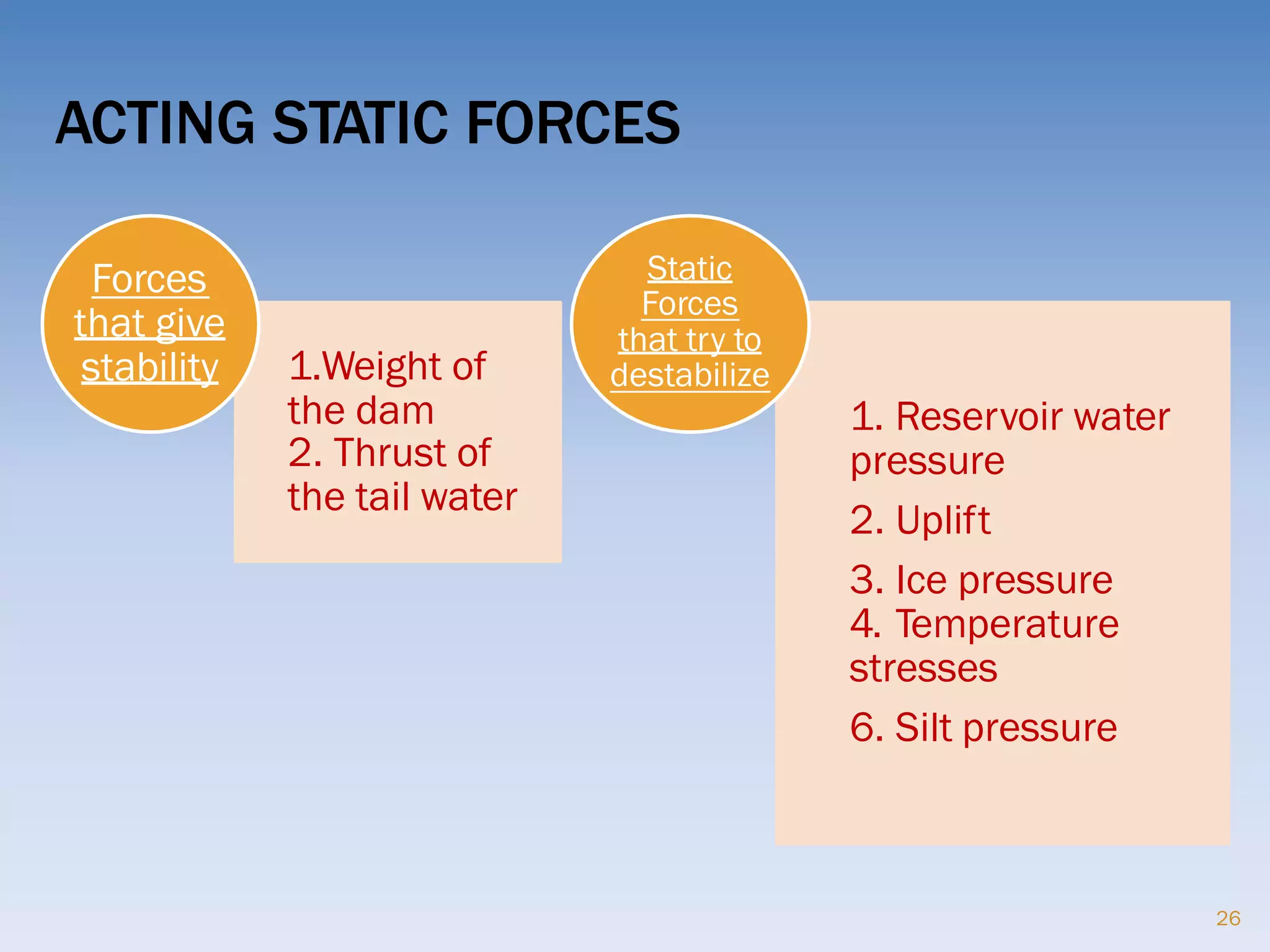
ACTING STATIC FORCES
1.Weight of
the dam
2. Thrust of
the tail water
Forces
that give
stability
1. Reservoir water
pressure
2. Uplift
3. Ice pressure
4. Temperature
stresses
6. Silt pressure
Static
Forces
that try to
destabilize
26
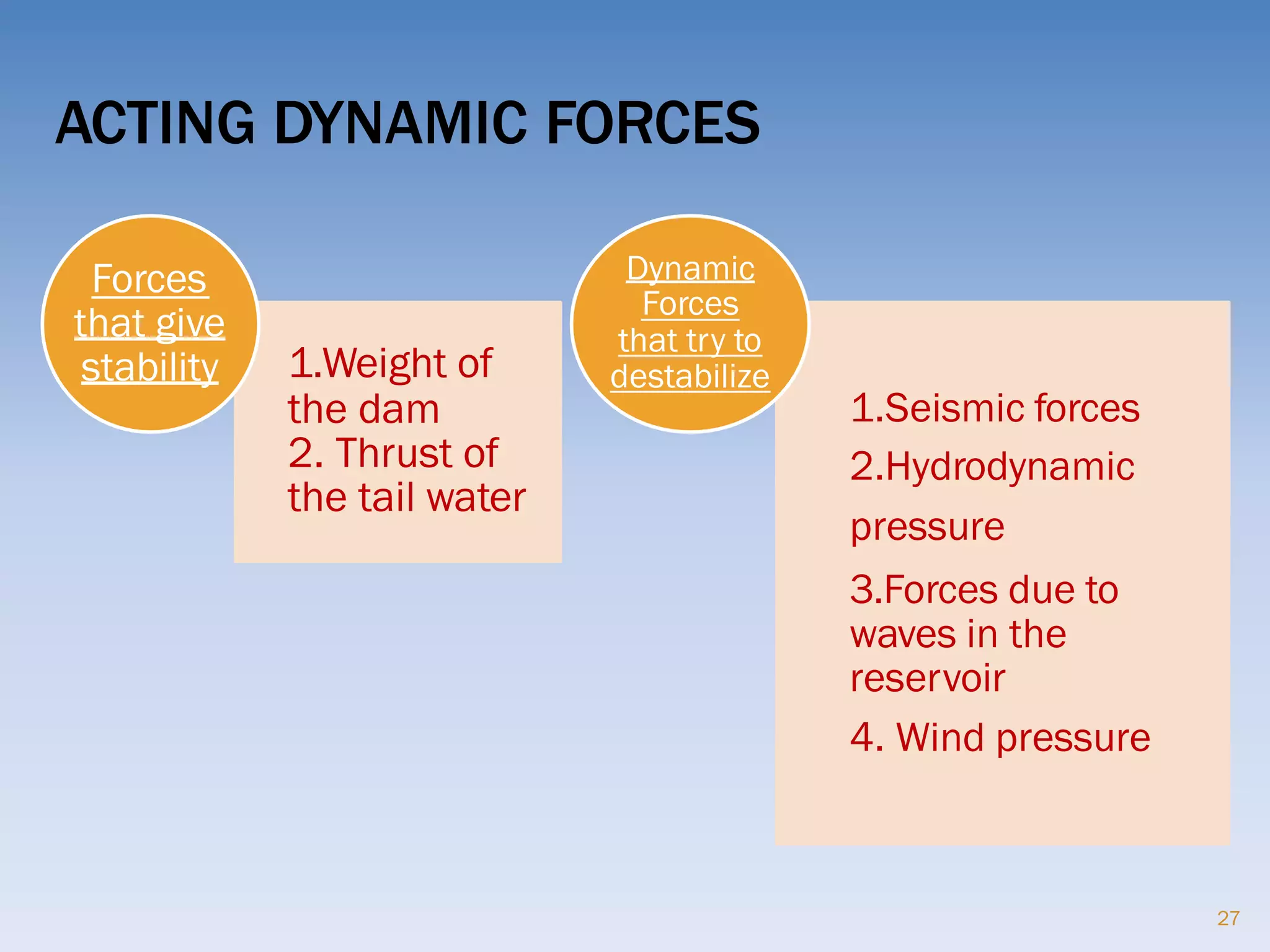
ACTING DYNAMIC FORCES
1.Weight of
the dam
2. Thrust of
the tail water
Forces
that give
stability
1.Seismic forces
2.Hydrodynamic
pressure
3.Forces due to
waves in the
reservoir
4. Wind pressure
Dynamic
Forces
that try to
destabilize
27
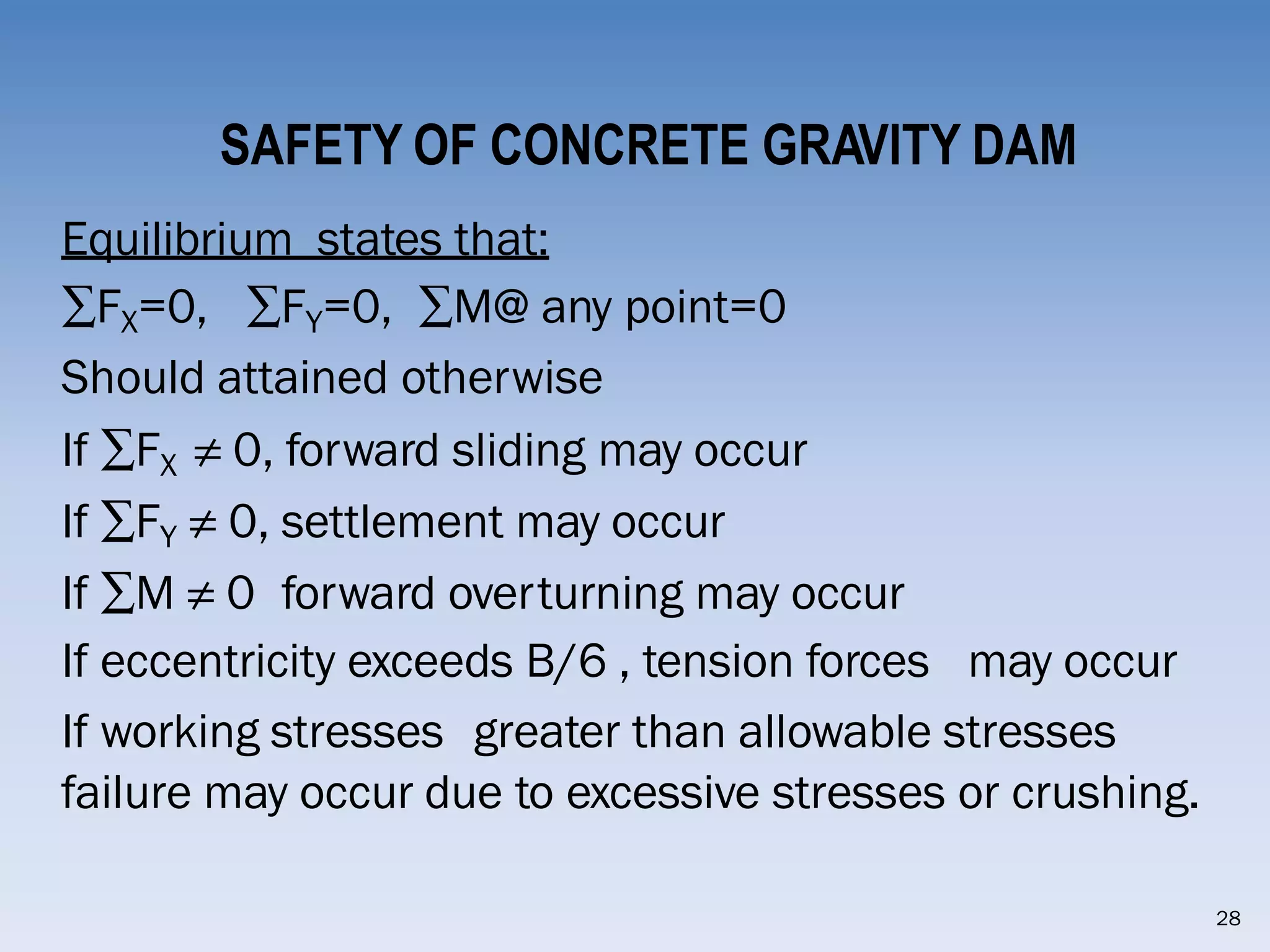
SAFETY OF CONCRETE GRAVITY DAM
Equilibrium states that:
∑FX=0, ∑FY=0, ∑M@ any point=0
Should attained otherwise
If ∑FX ≠ 0, forward sliding may occur
If ∑FY ≠ 0, settlement may occur
If ∑M ≠ 0 forward overturning may occur
If eccentricity exceeds B/6 , tension forces may occur
If working stresses greater than allowable stresses
failure may occur due to excessive stresses or crushing.
28
SAFETY OF CONCRETE GRAVITY DAM
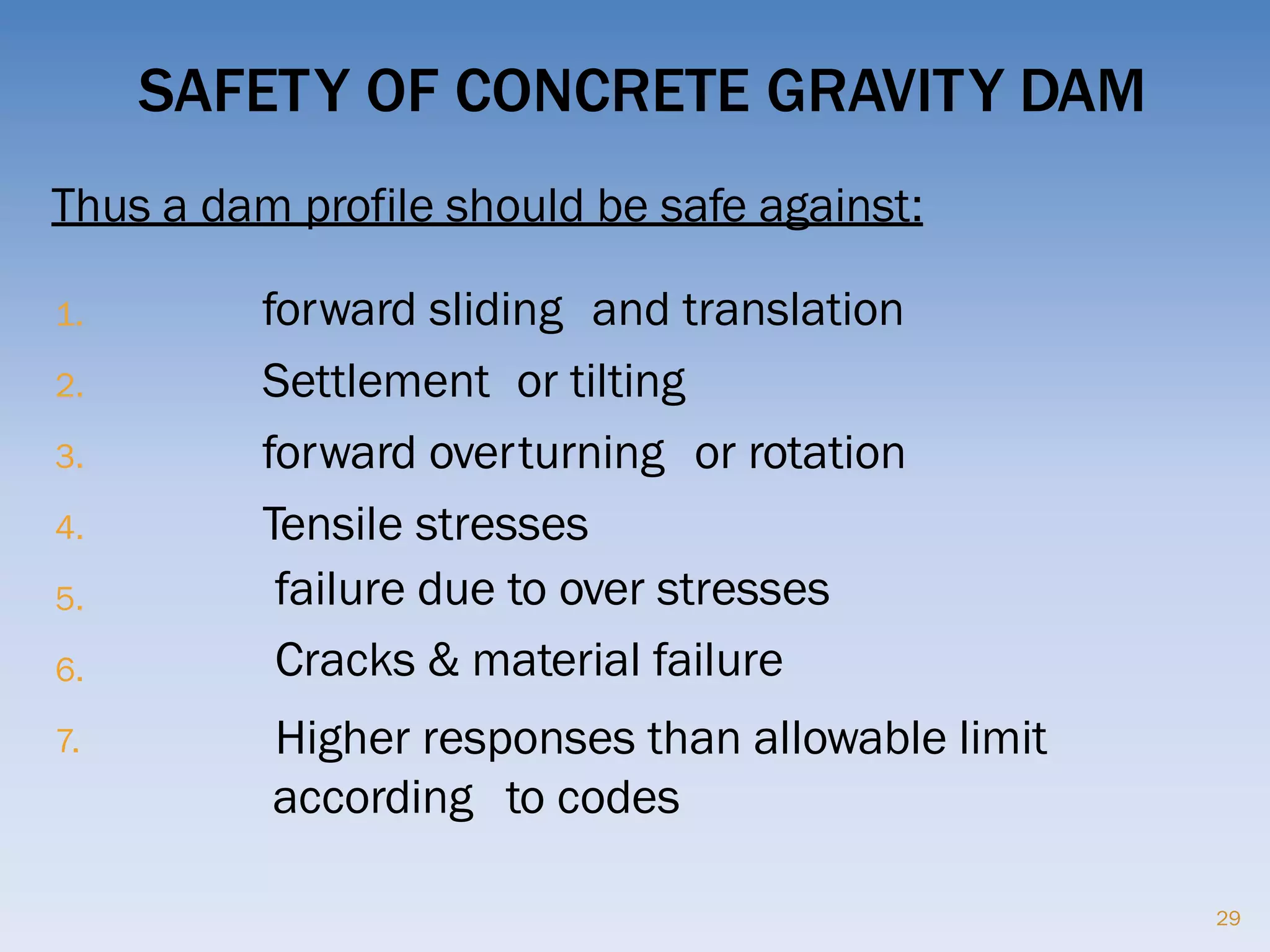
Thus a dam profile should be safe against:
29
1. forward sliding and translation
Settlement or tilting
forward overturning or rotation
Tensile stresses
failure due to over stresses
Cracks & material failure
Higher responses than allowable limit
according to codes
2.
3.
4.
5.
6.
7.
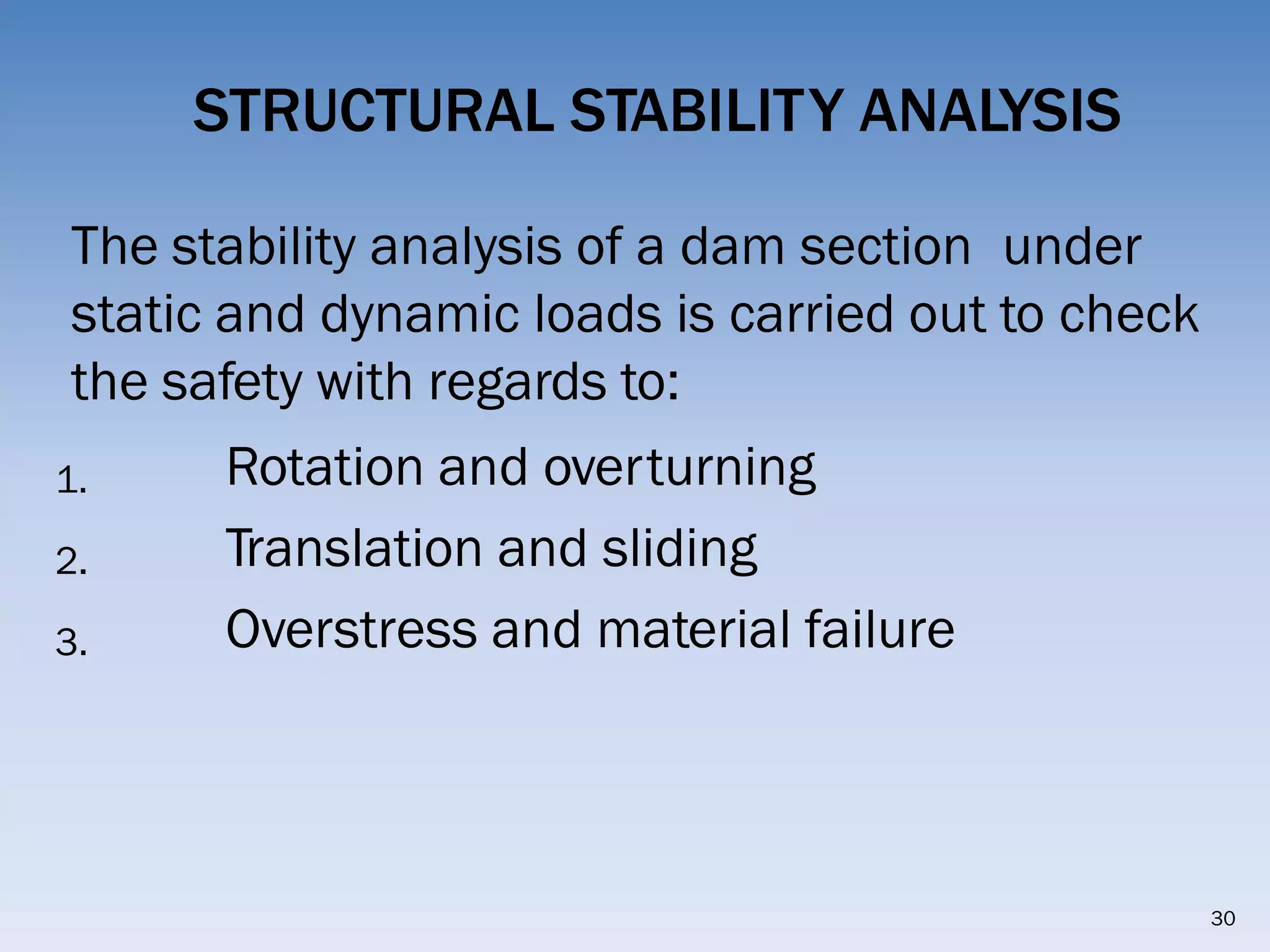
STRUCTURAL STABILITY ANALYSIS
The stability analysis of a dam section under
static and dynamic loads is carried out to check
the safety with regards to:
30
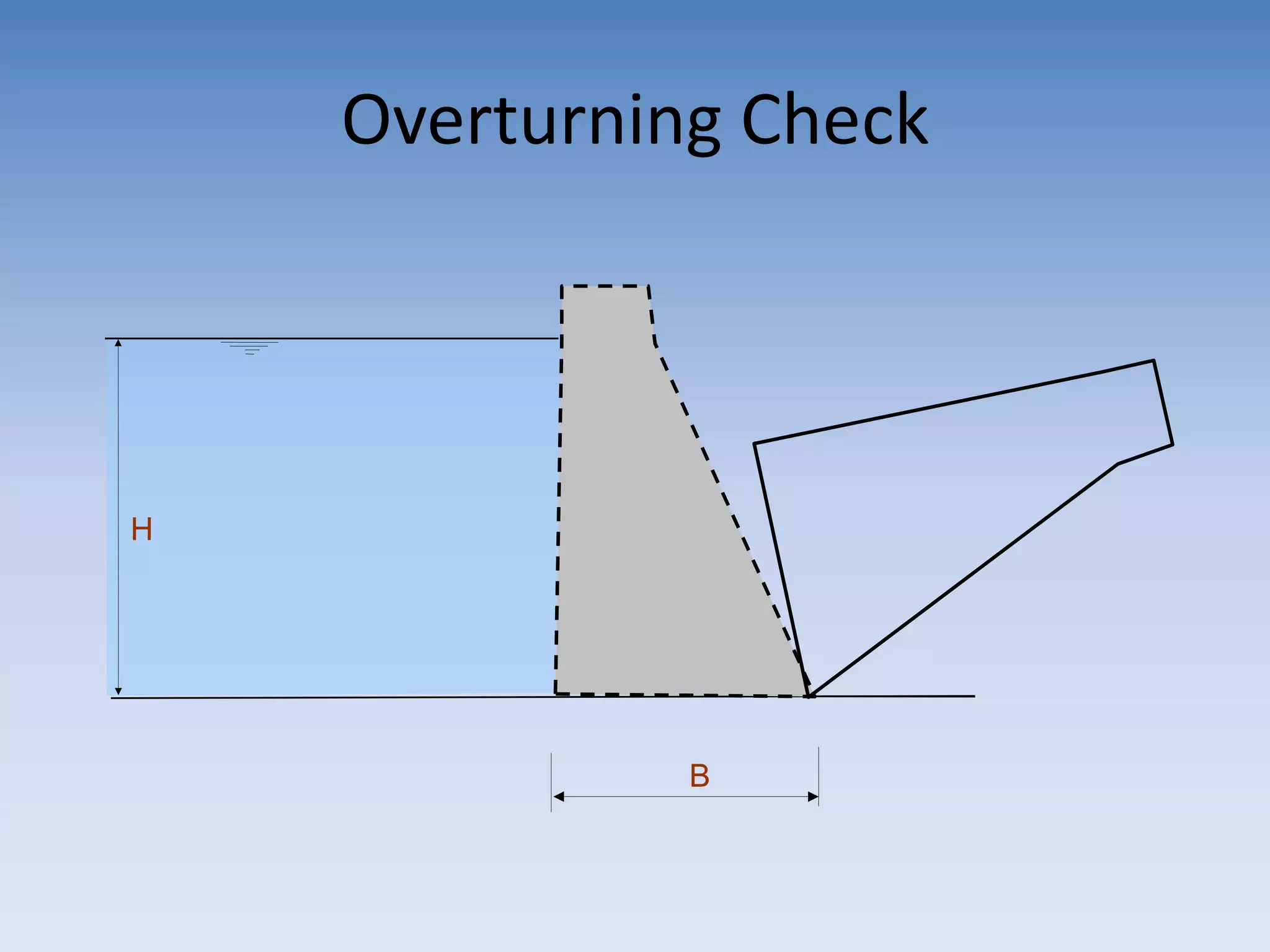
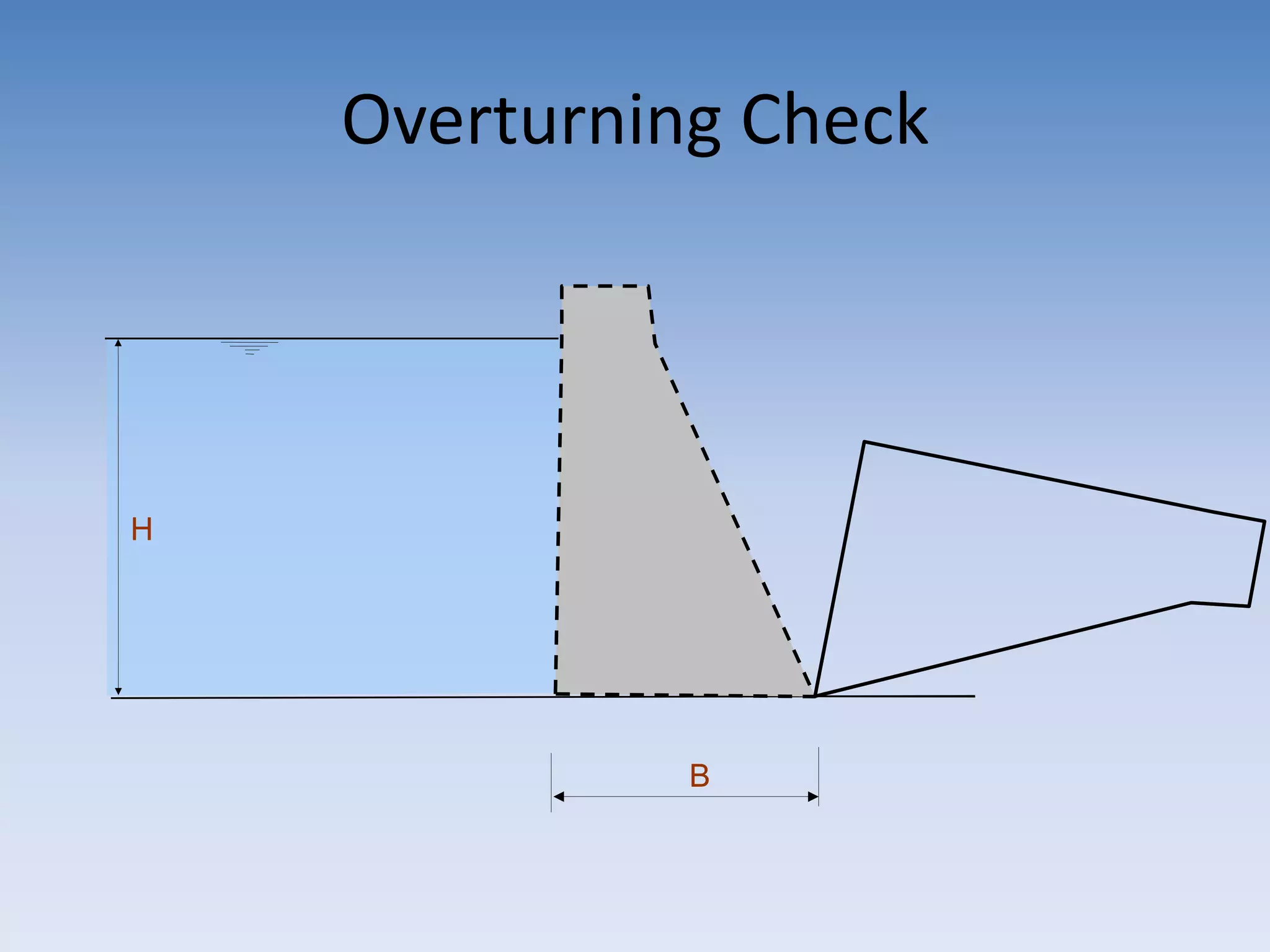
1. Rotation and overturning
Translation and sliding
Overstress and material failure
2.
3.
H
B
Overturning Check
H
B
Overturning Check
H
B
Overturning Check
H
B
Overturning Check
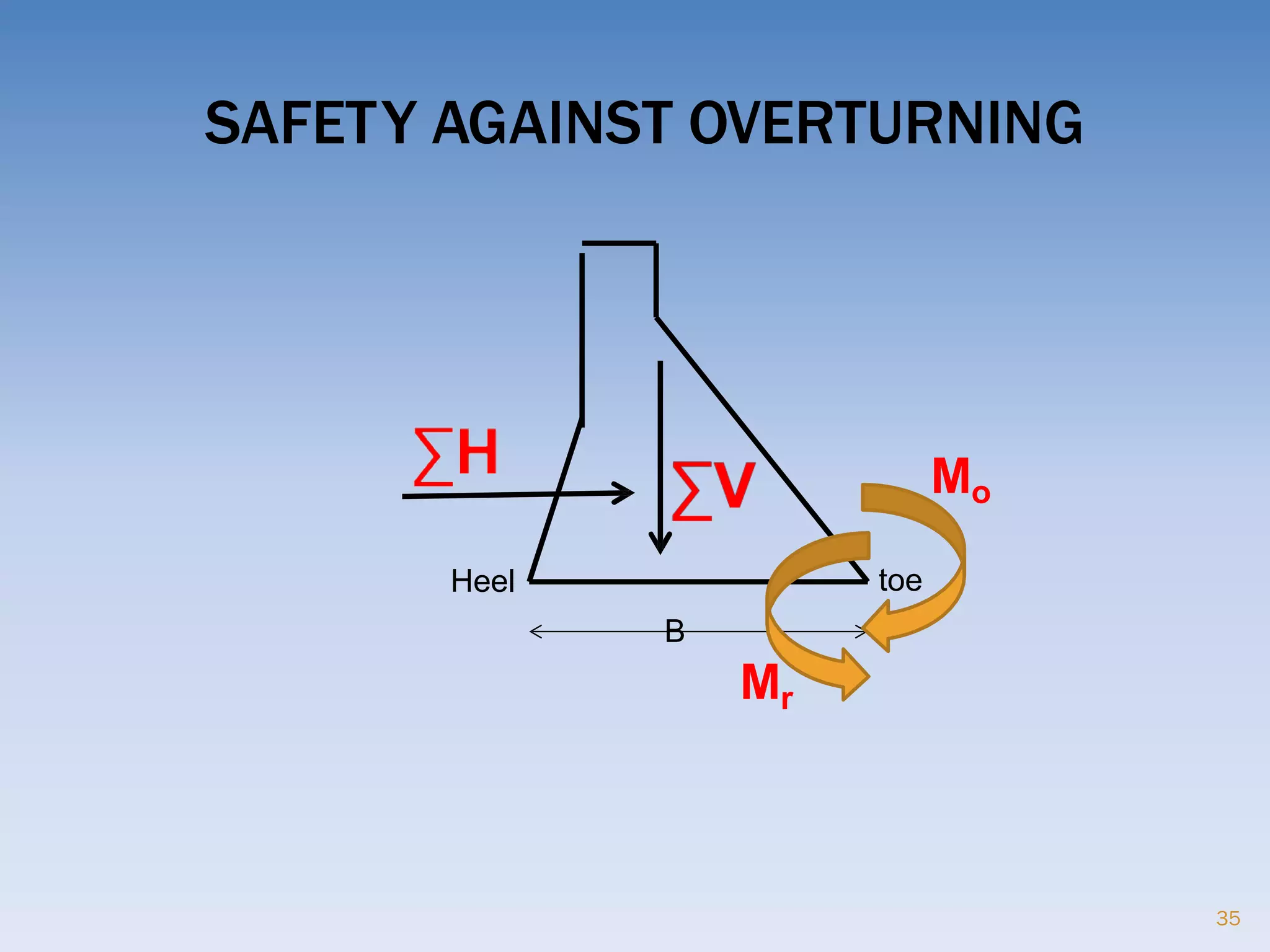
SAFETY AGAINST OVERTURNING
B
Mr
Mo
Heel toe
35
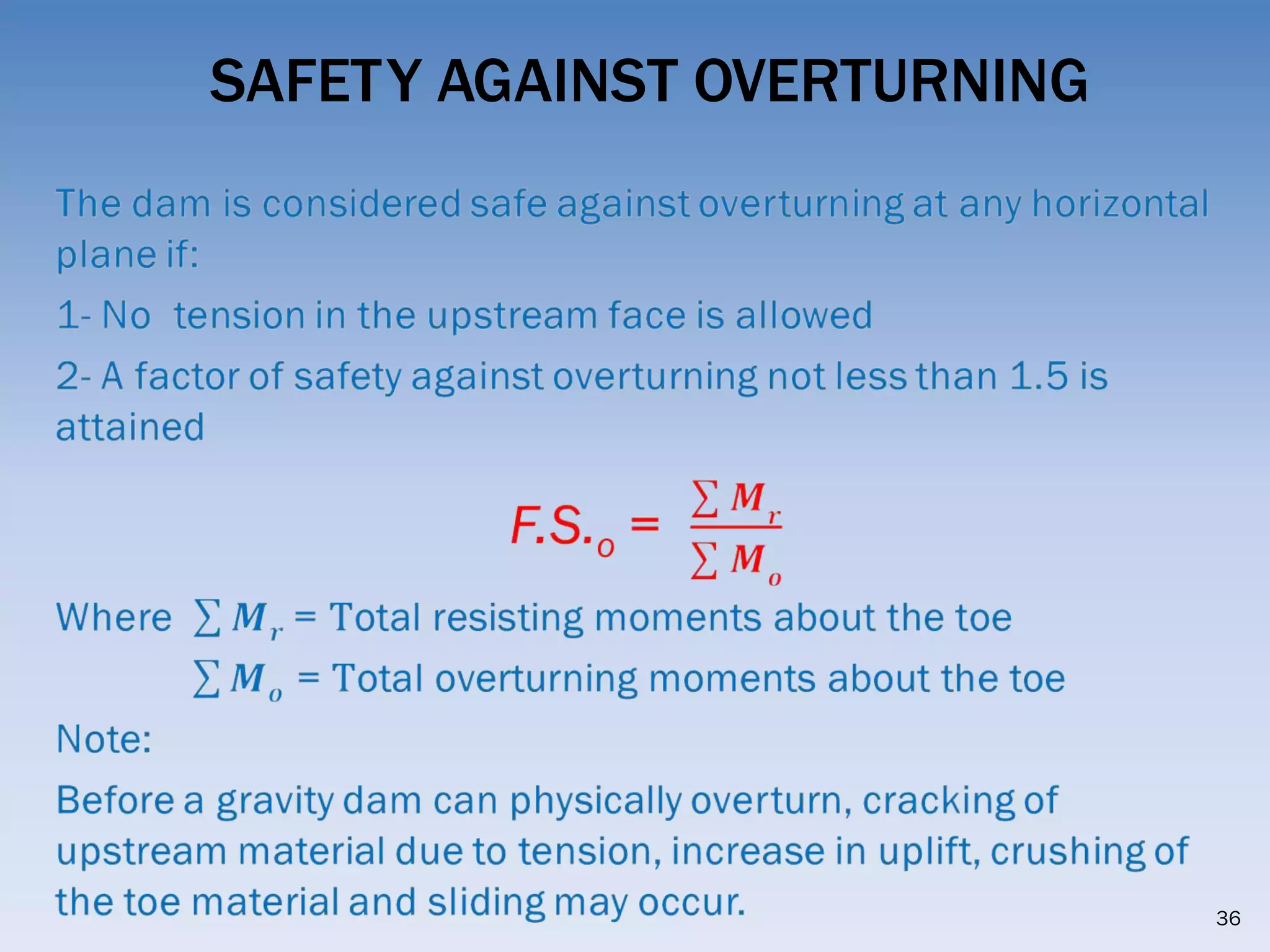
SAFETY AGAINST OVERTURNING
36
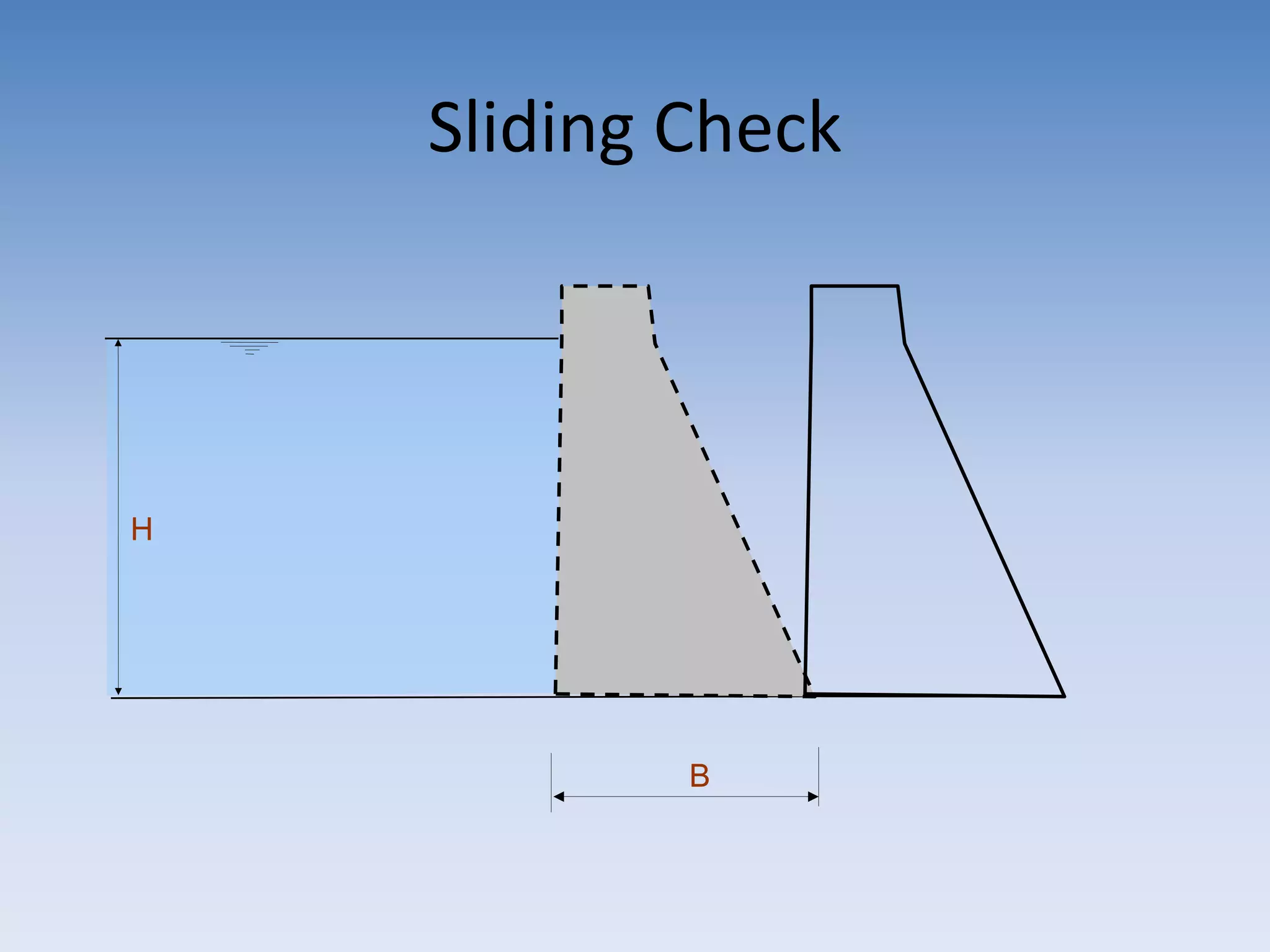
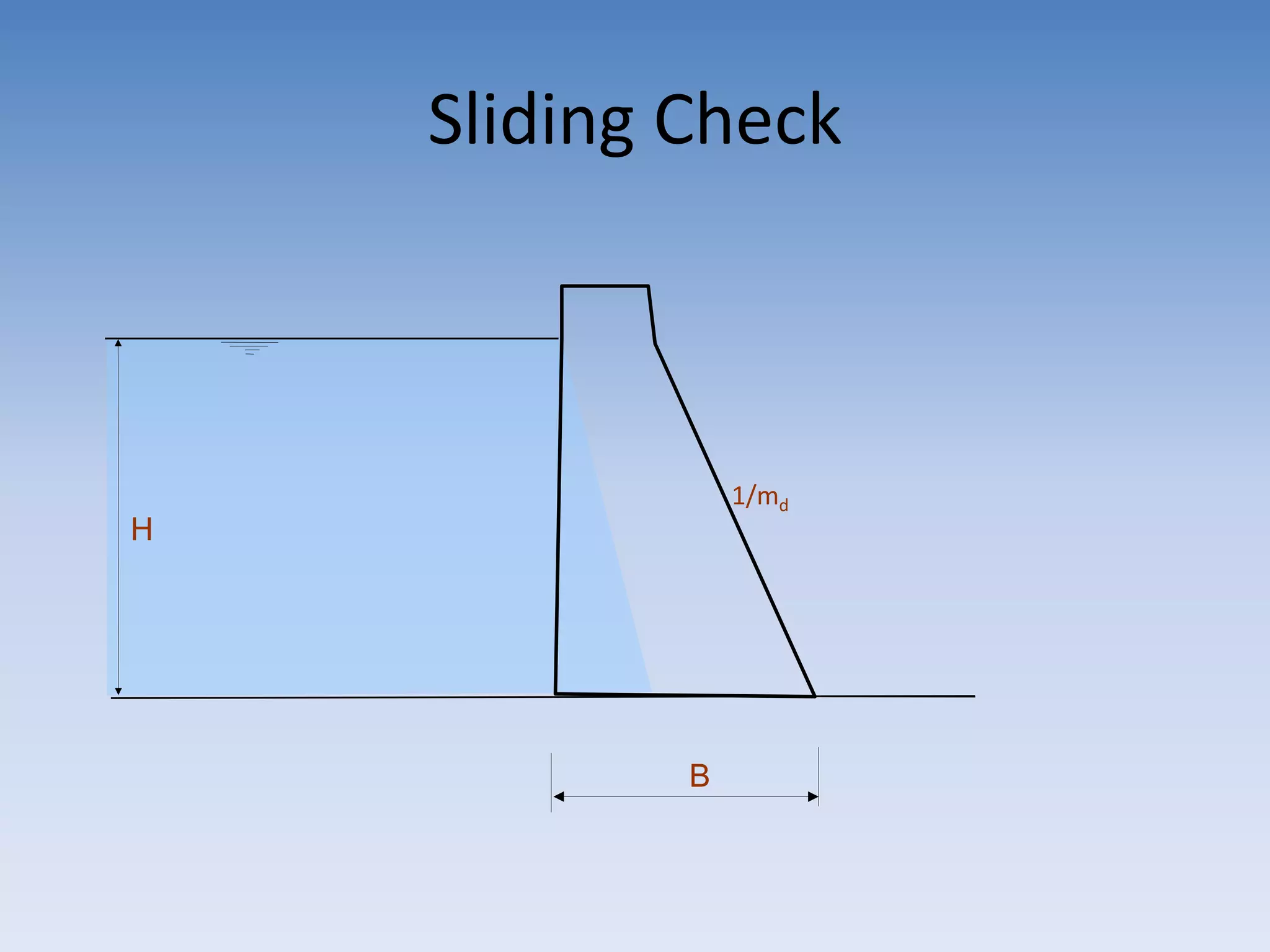
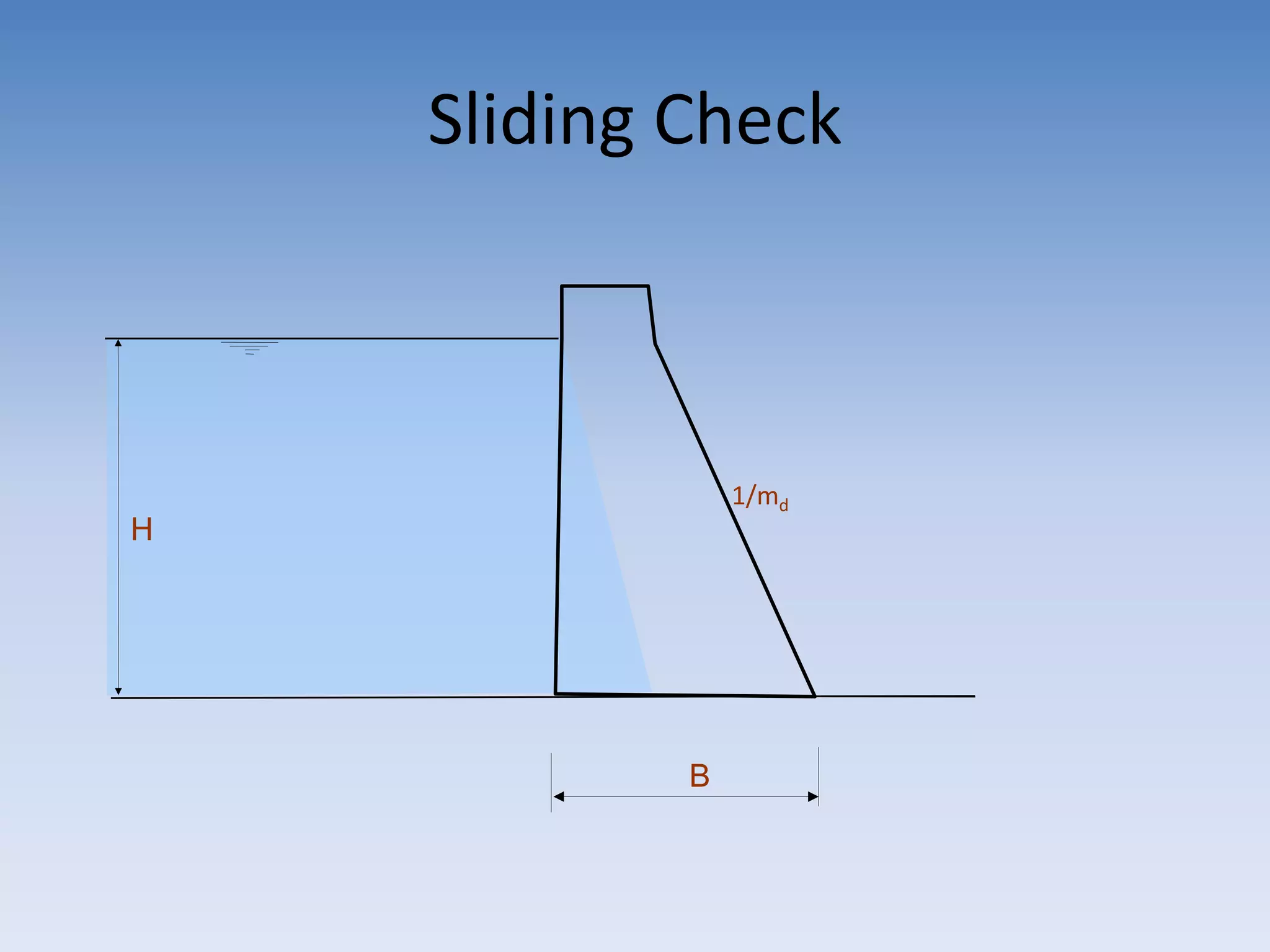
Sliding Check
H
1/md
B
H
B
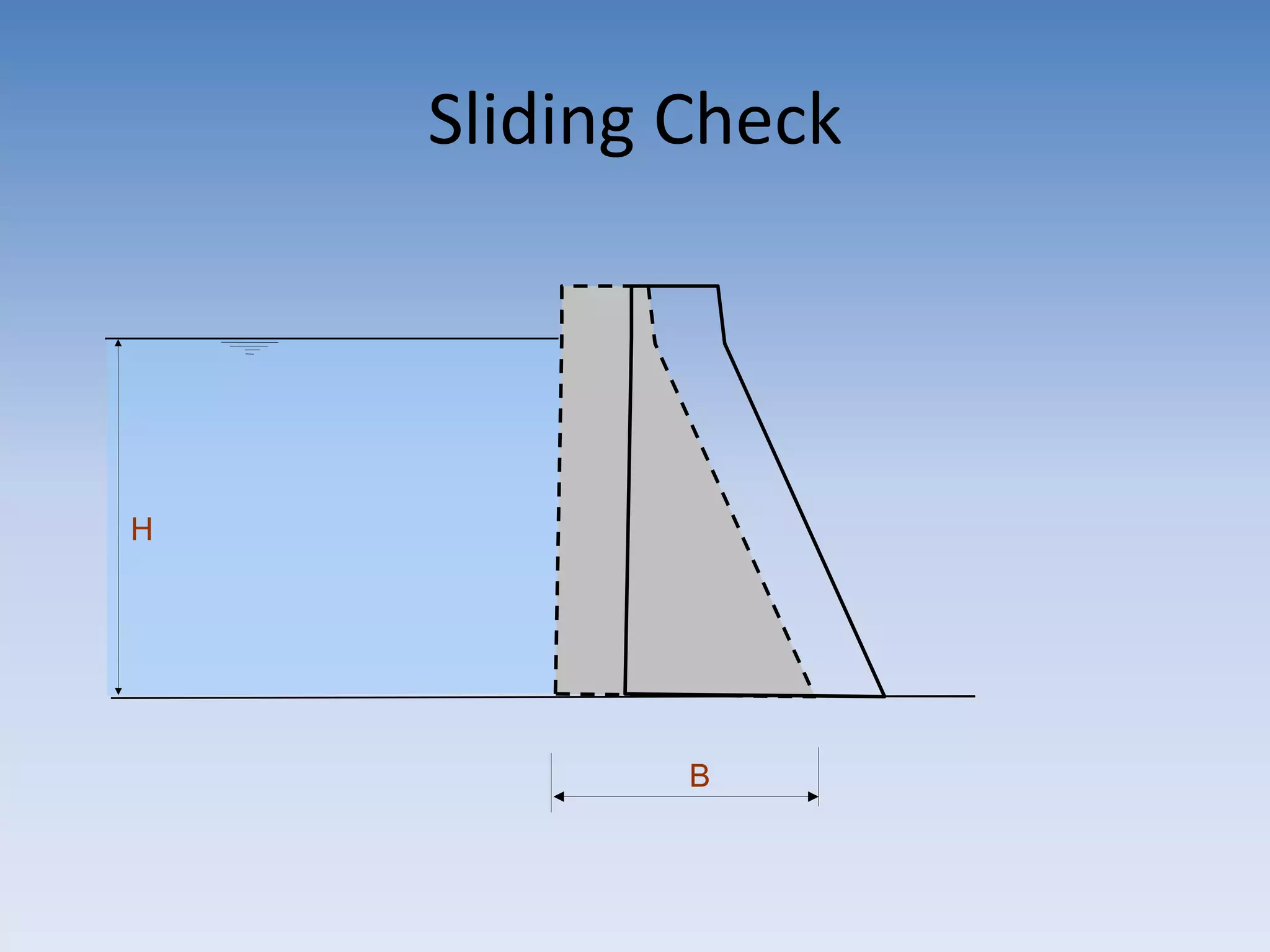
Sliding Check
H
B
Sliding Check
H
B
Sliding Check
H
1/md
B
Sliding Check
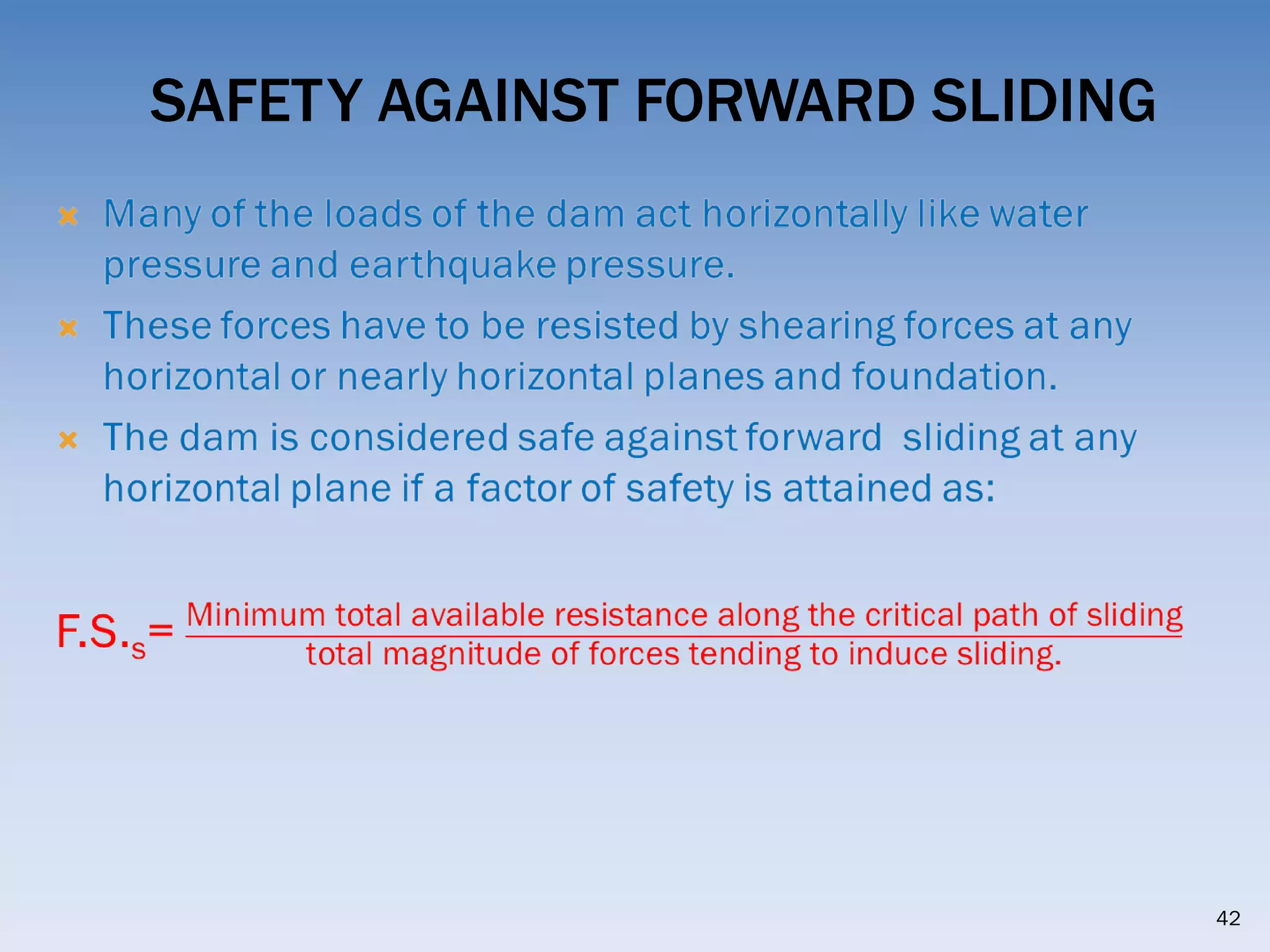
SAFETY AGAINST FORWARD SLIDING
42
SAFETY AGAINST FORWARD SLIDING
43
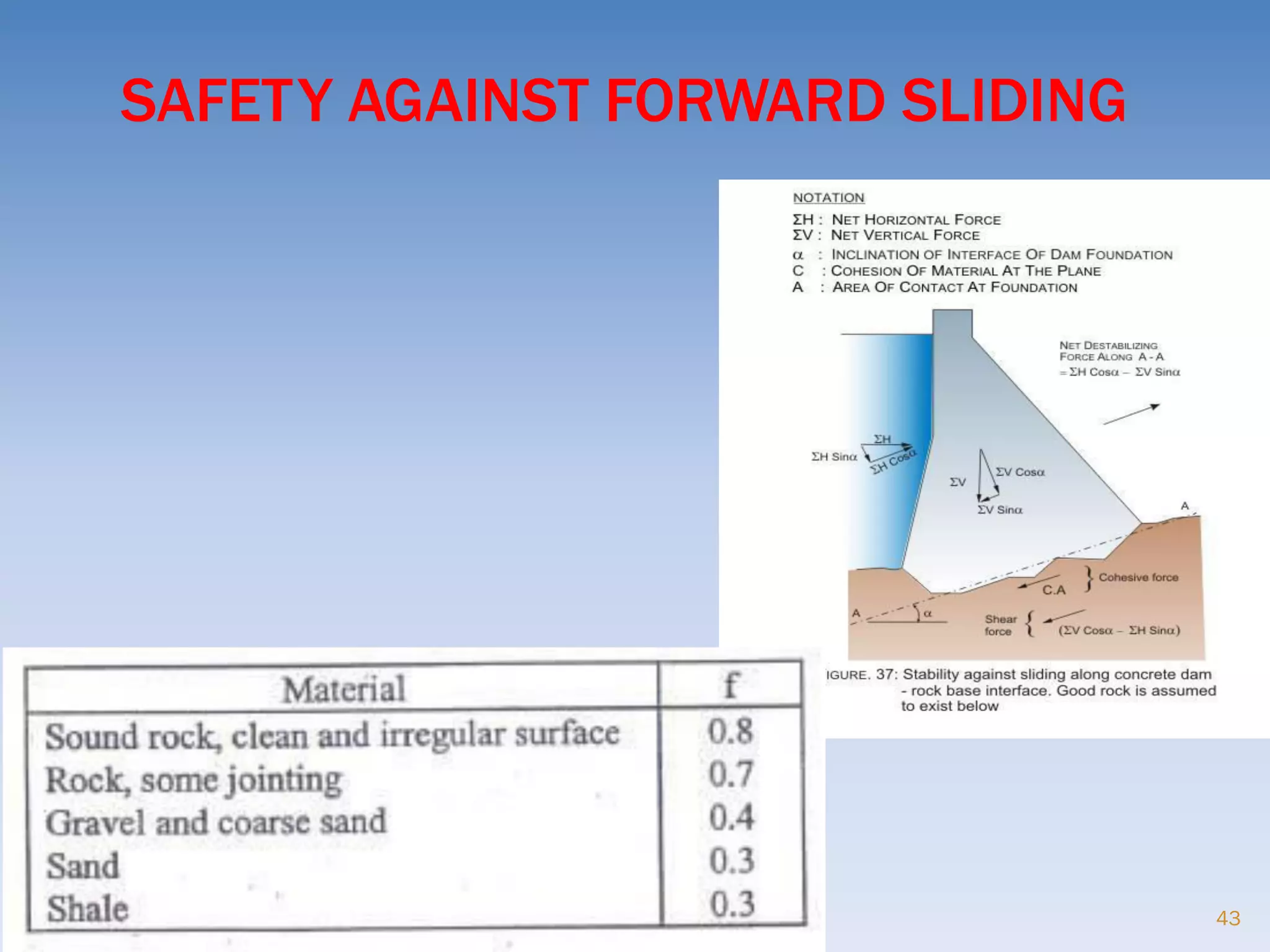
SAFETY AGAINST FORWARD SLIDING
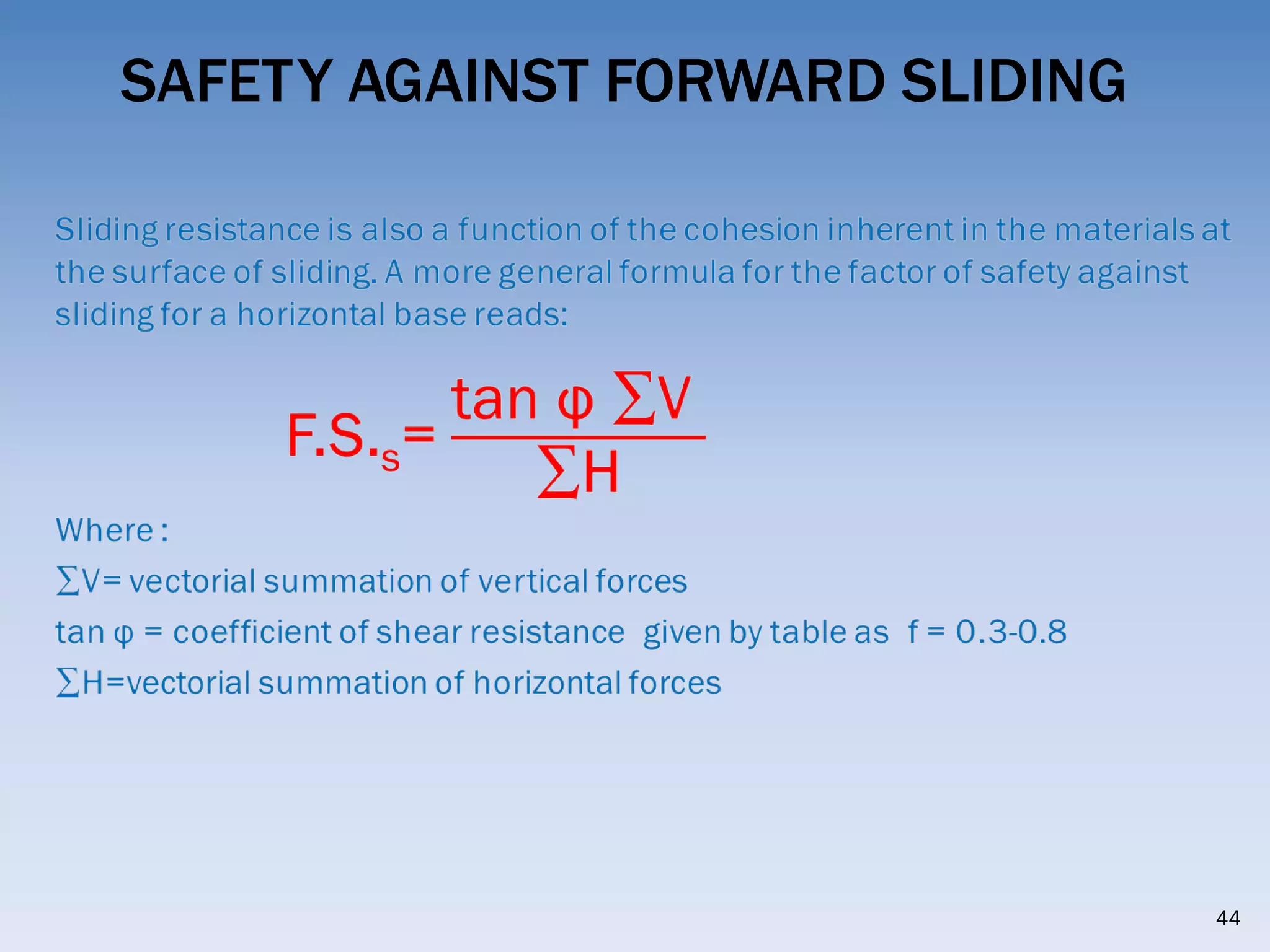
44
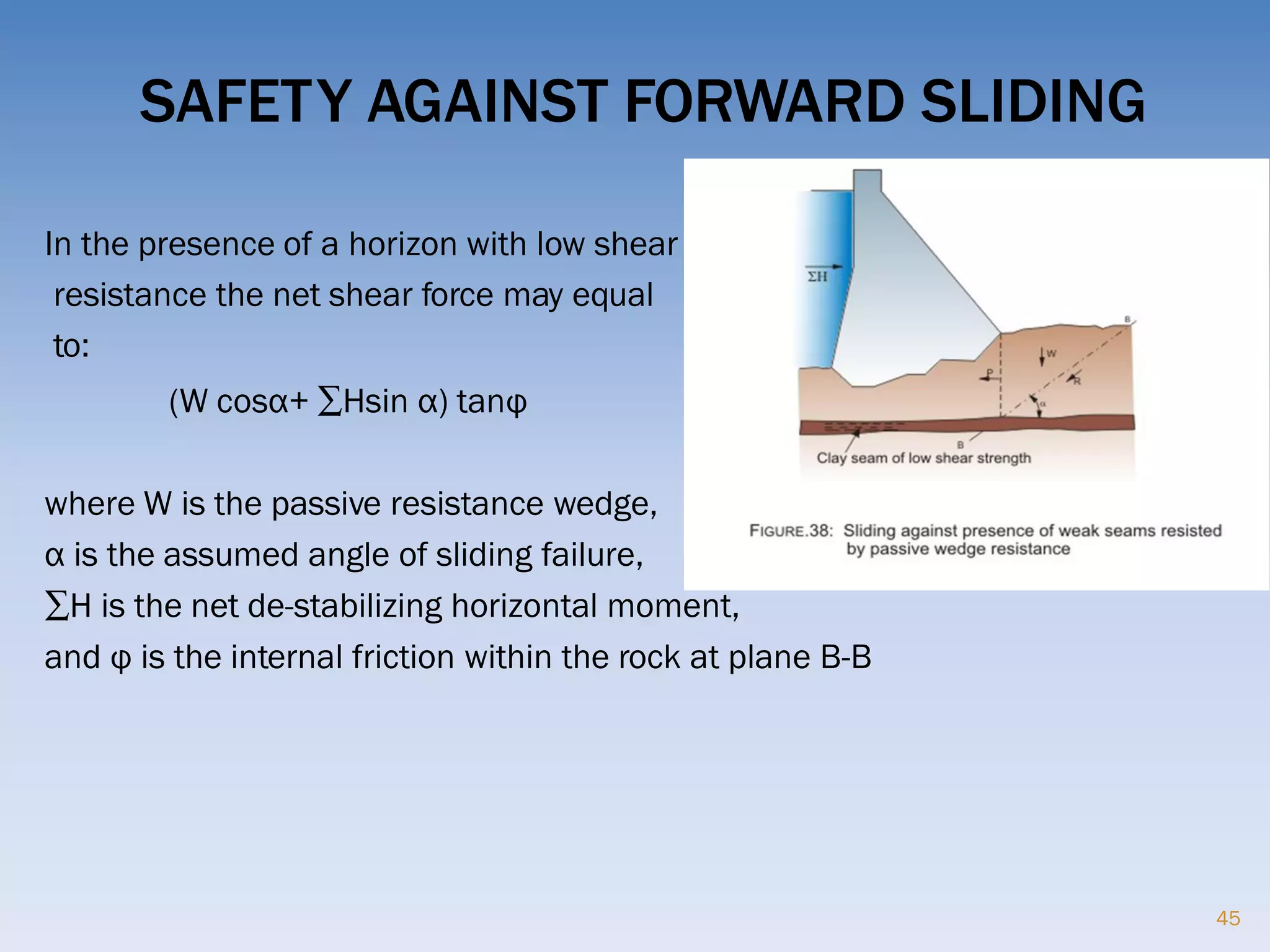
SAFETY AGAINST FORWARD SLIDING
In the presence of a horizon with low shear
resistance the net shear force may equal
to:
(W cosα+ ∑Hsin α) tanφ
where W is the passive resistance wedge,
α is the assumed angle of sliding failure,
∑H is the net de-stabilizing horizontal moment,
and φ is the internal friction within the rock at plane B-B
45
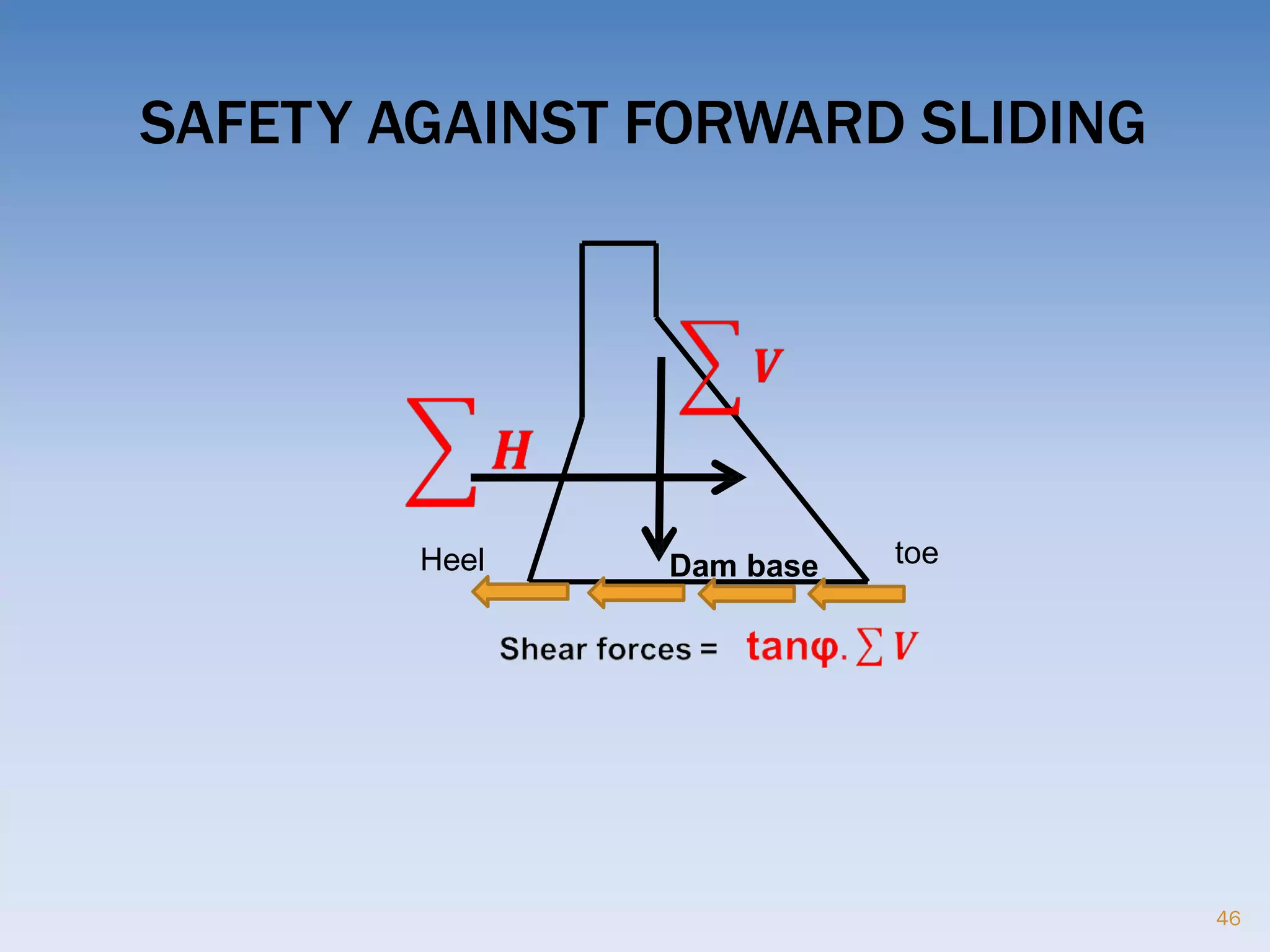
SAFETY AGAINST FORWARD SLIDING
Heel toeDam base
46
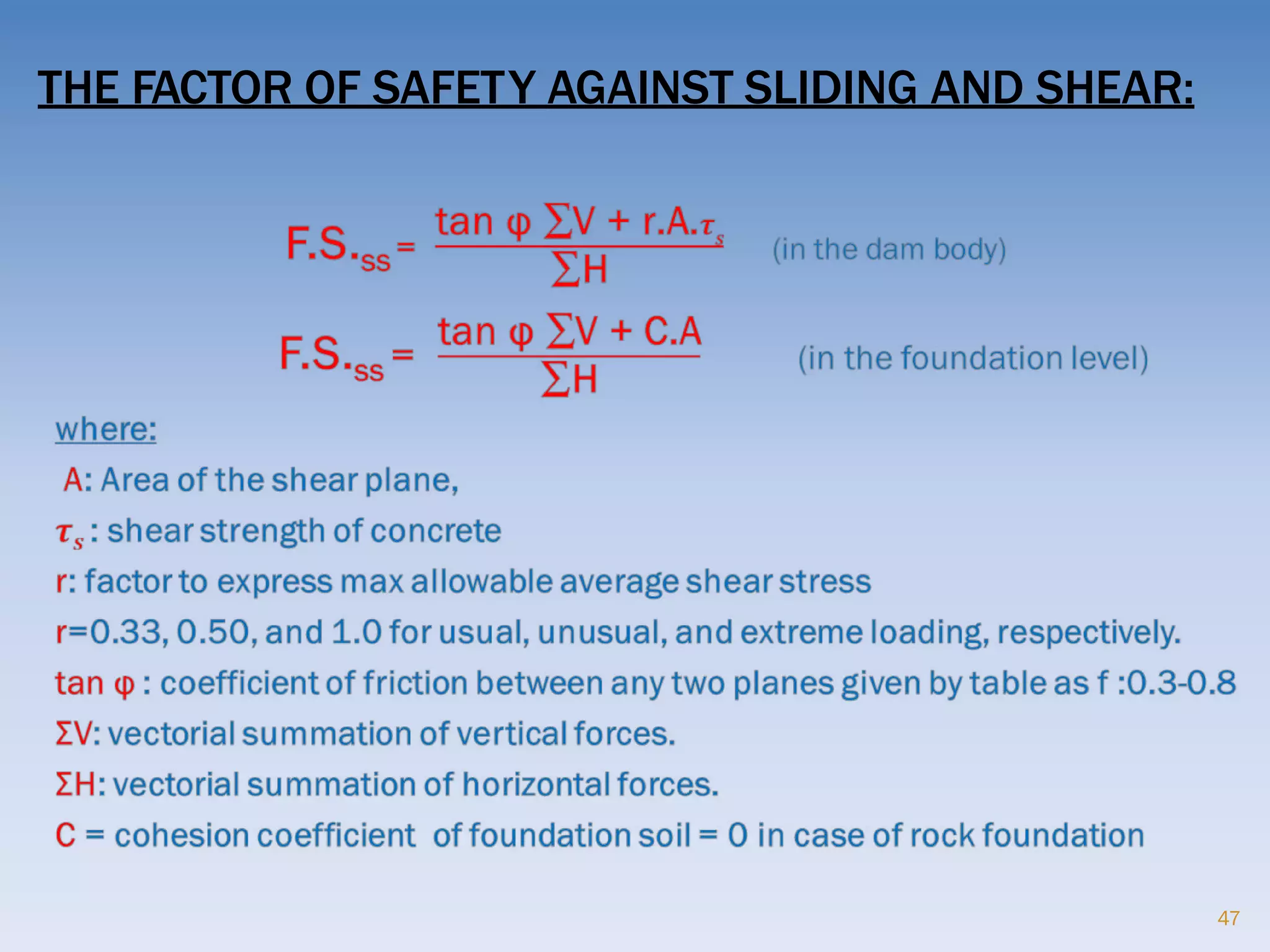
THE FACTOR OF SAFETY AGAINST SLIDING AND SHEAR:
47
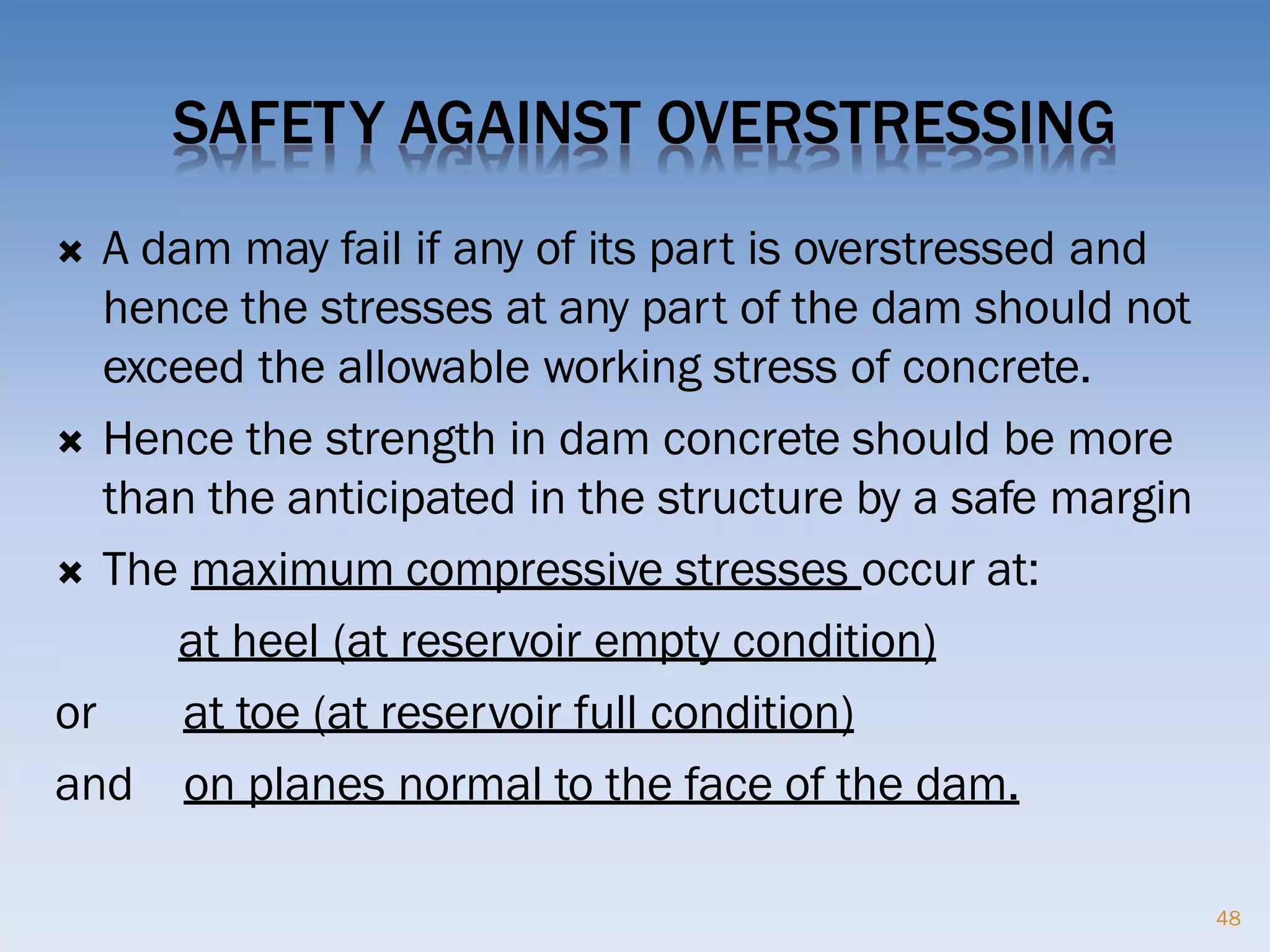
SAFETY AGAINST OVERSTRESSING
 A dam may fail if any of its part is overstressed and
hence the stresses at any part of the dam should not
exceed the allowable working stress of concrete.
 Hence the strength in dam concrete should be more
than the anticipated in the structure by a safe margin
 The maximum compressive stresses occur at:
at heel (at reservoir empty condition)
or at toe (at reservoir full condition)
and on planes normal to the face of the dam.
48
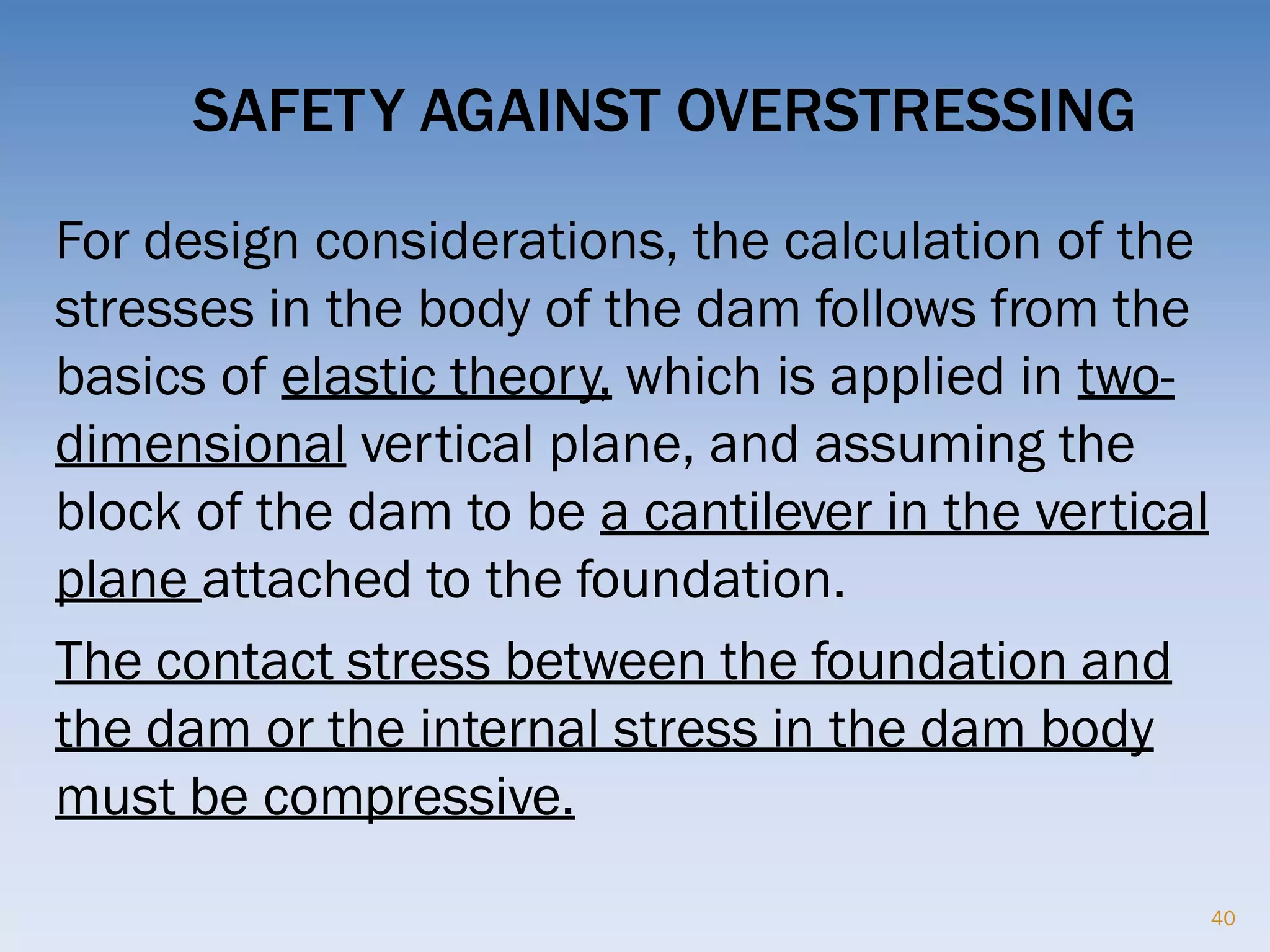
SAFETY AGAINST OVERSTRESSING
For design considerations, the calculation of the
stresses in the body of the dam follows from the
basics of elastic theory, which is applied in two-
dimensional vertical plane, and assuming the
block of the dam to be a cantilever in the vertical
plane attached to the foundation.
The contact stress between the foundation and
the dam or the internal stress in the dam body
must be compressive.
40
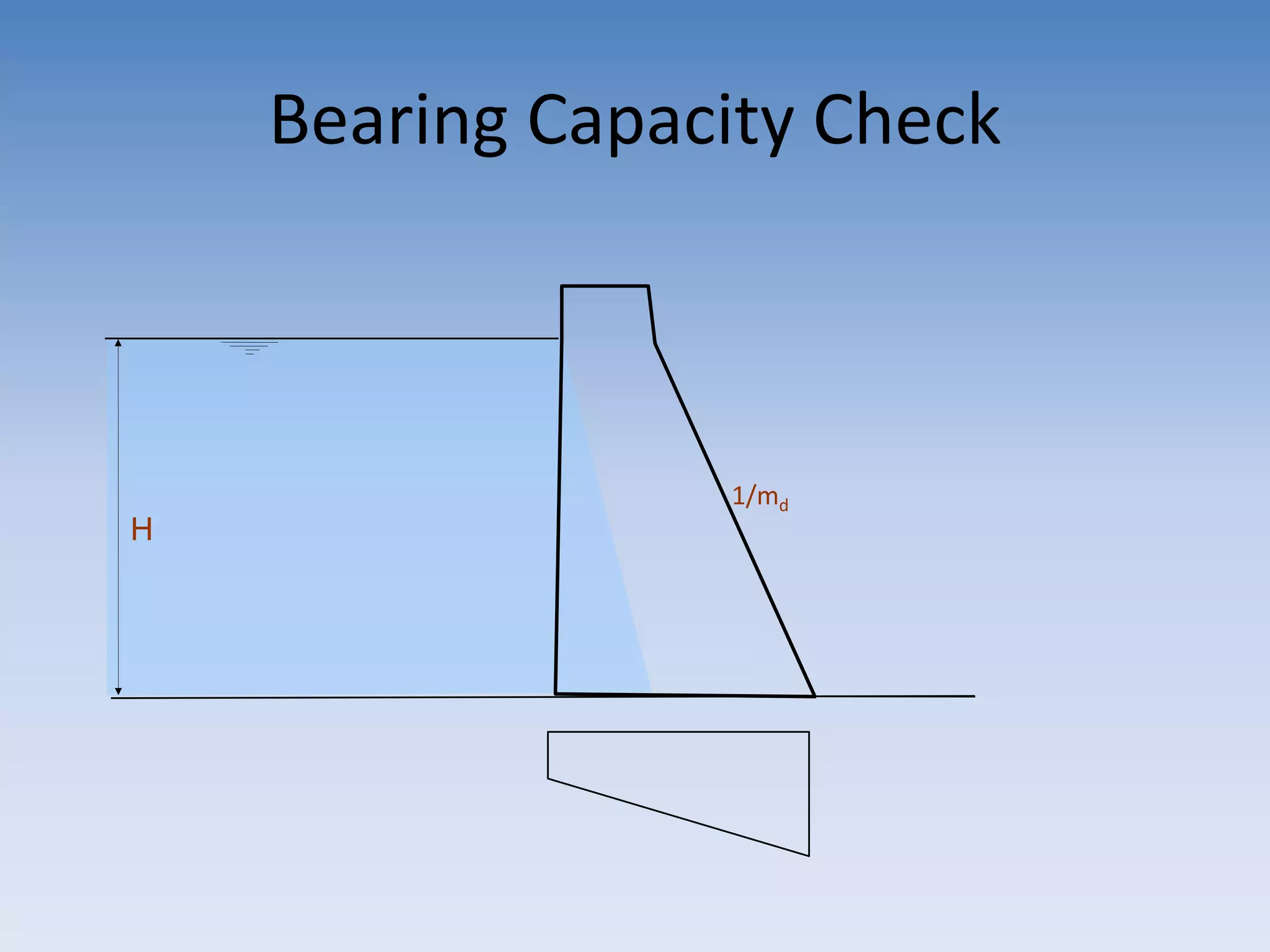
Bearing Capacity Check
H
1/md
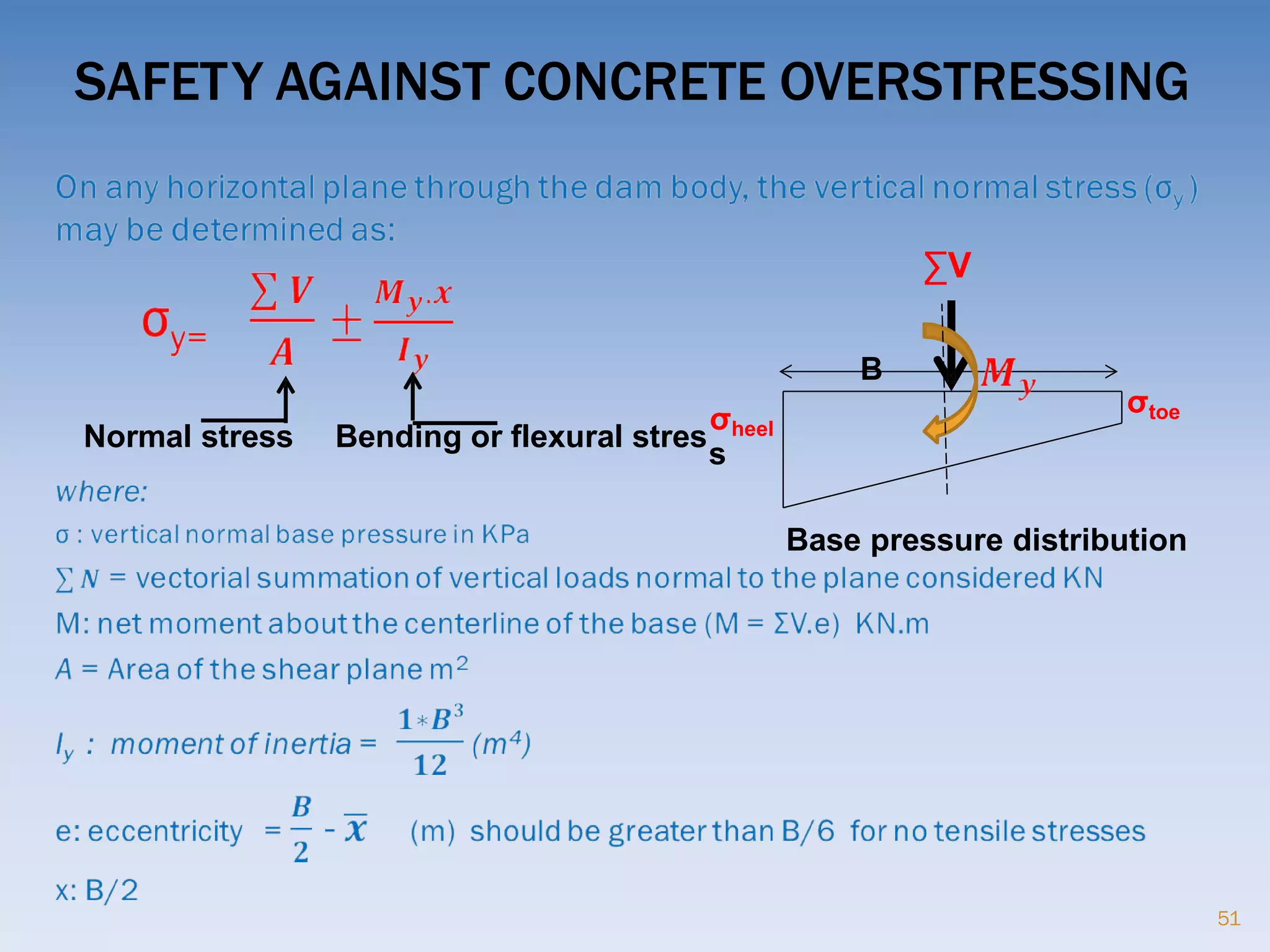
SAFETY AGAINST CONCRETE OVERSTRESSING
Normal stress Bending or flexural stres
σheel
s
σtoe
Base pressure distribution
∑V
B
51
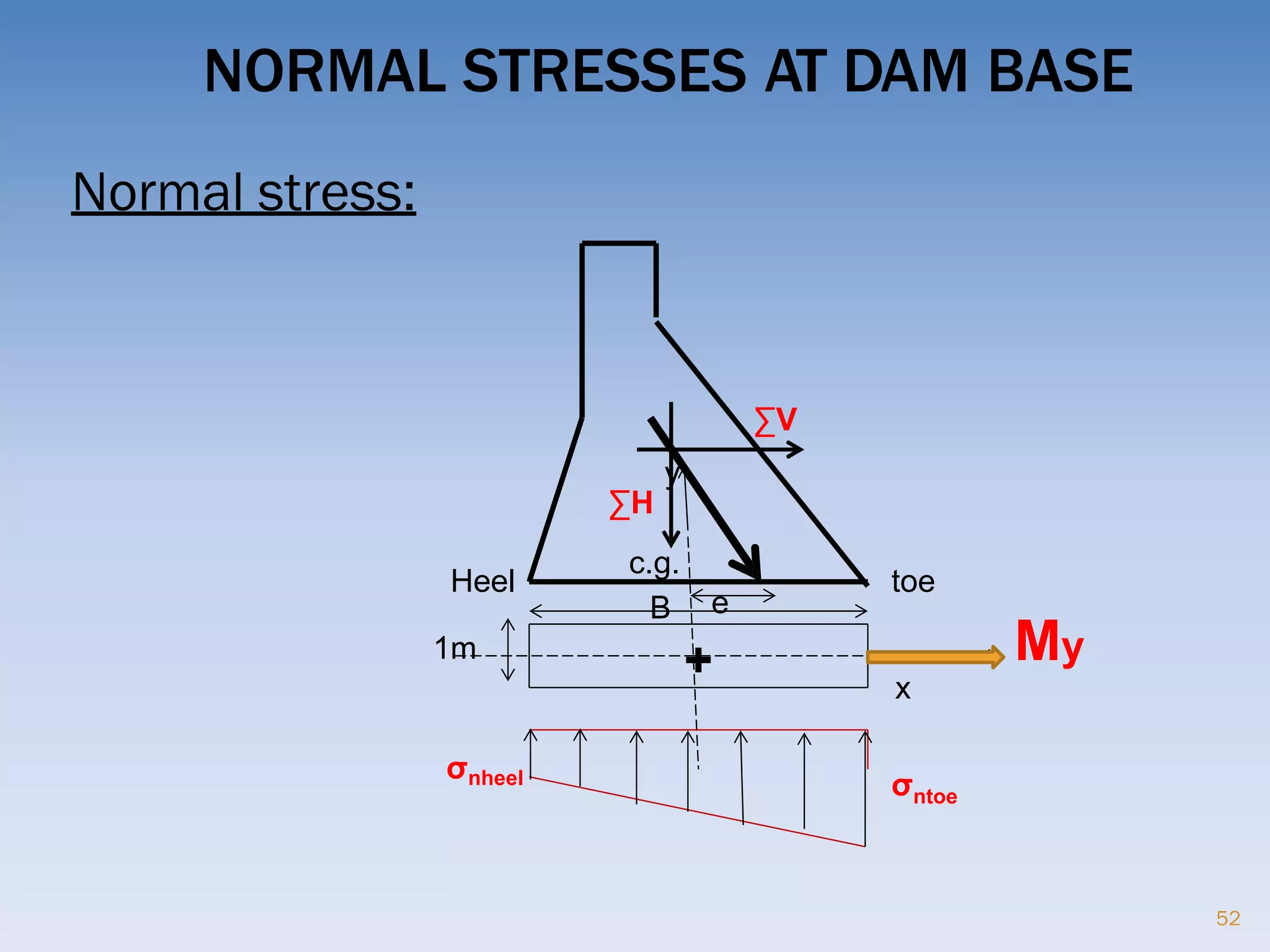
NORMAL STRESSES AT DAM BASE
Normal stress:
c.g.
x
My
σnheel σntoe
1m
+
∑V
y
∑H
B
Heel toe
e
52
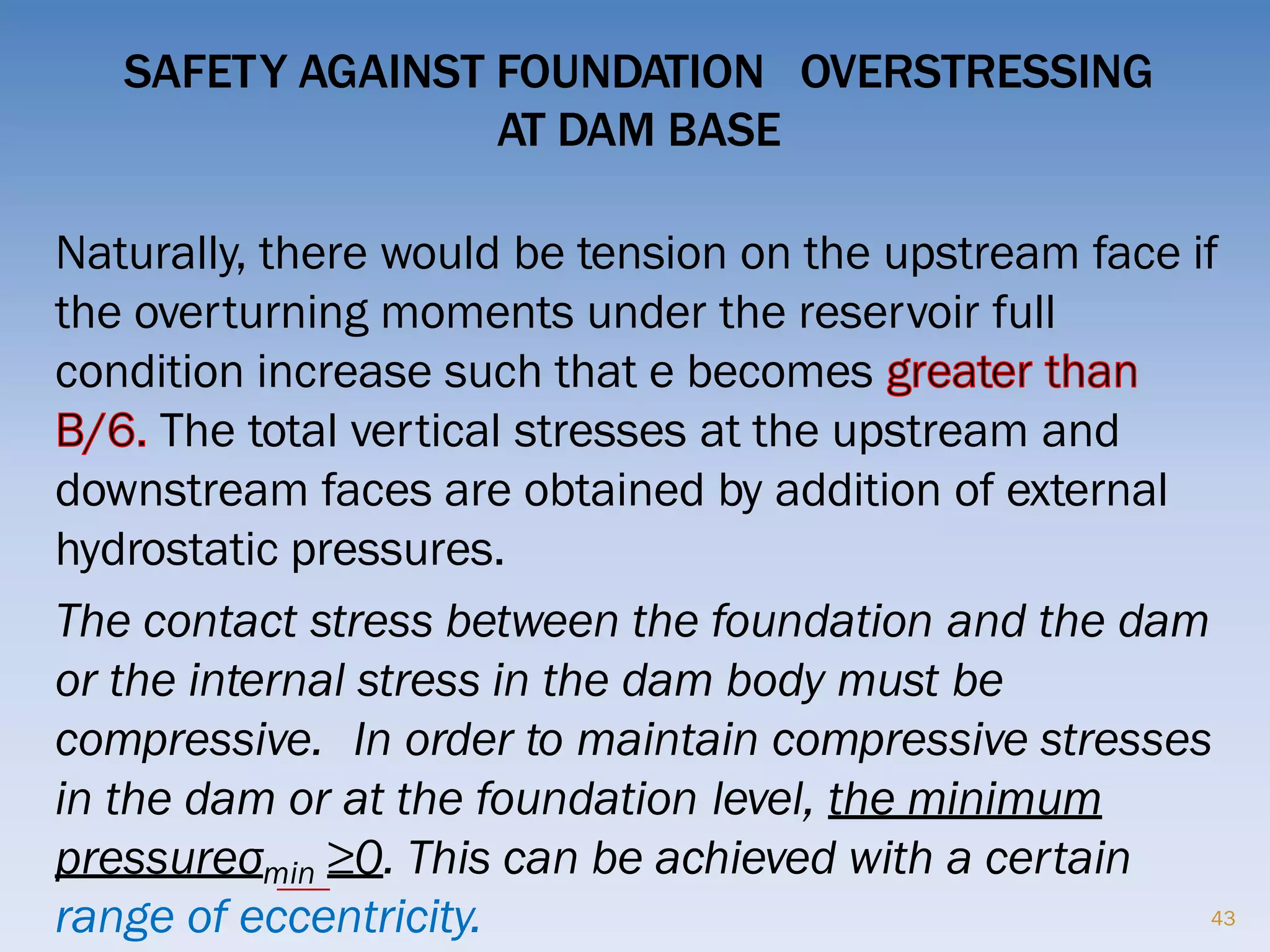
SAFETY AGAINST FOUNDATION OVERSTRESSING
AT DAM BASE
Naturally, there would be tension on the upstream face if
the overturning moments under the reservoir full
condition increase such that e becomes
The total vertical stresses at the upstream and
downstream faces are obtained by addition of external
hydrostatic pressures.
The contact stress between the foundation and the dam
or the internal stress in the dam body must be
compressive. In order to maintain compressive stresses
in the dam or at the foundation level, the minimum
pressureσmin ≥0. This can be achieved with a certain
range of eccentricity. 43
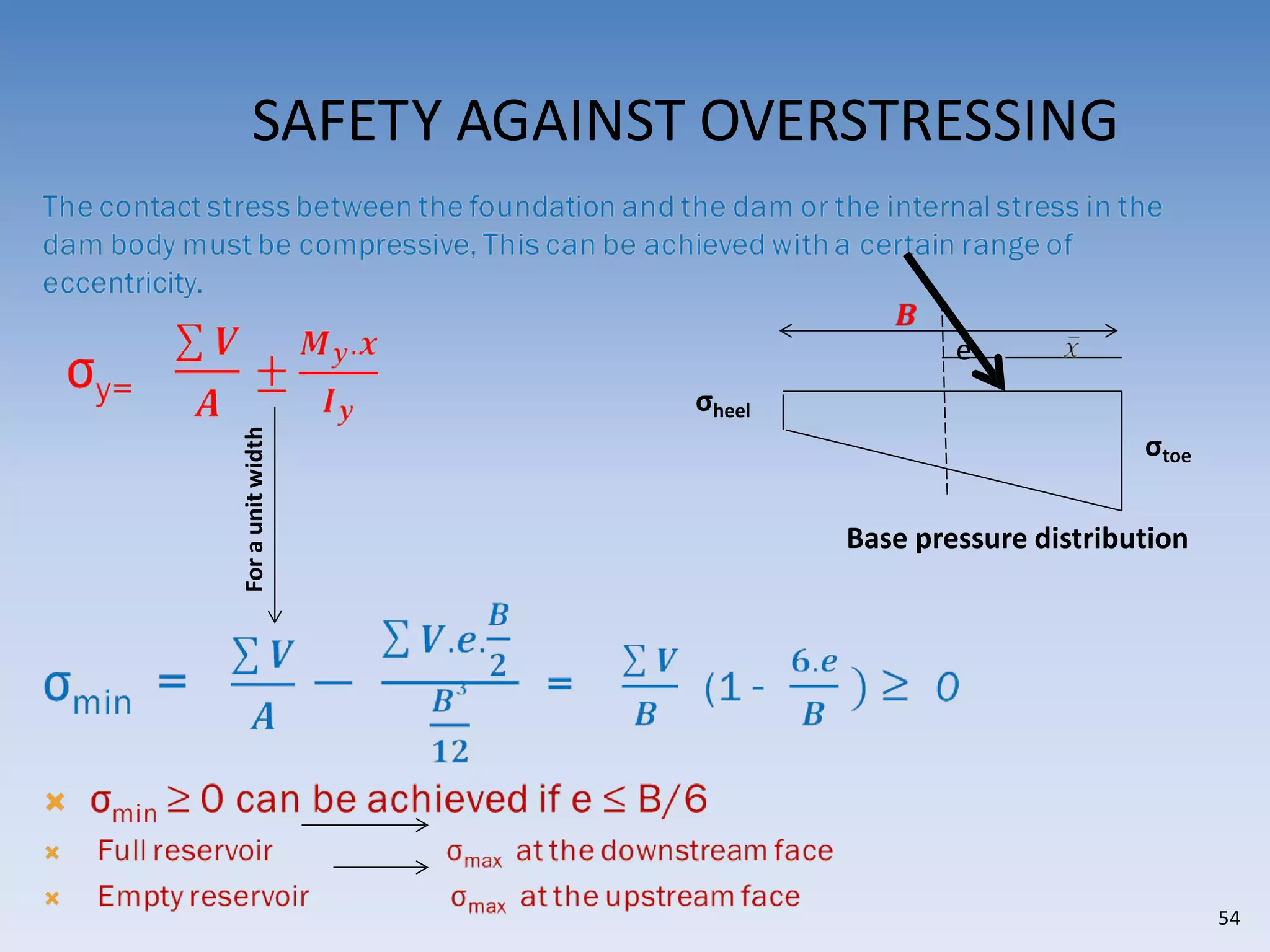
SAFETY AGAINST OVERSTRESSING
e
σheel
σtoe
Base pressure distribution
Foraunitwidth
54
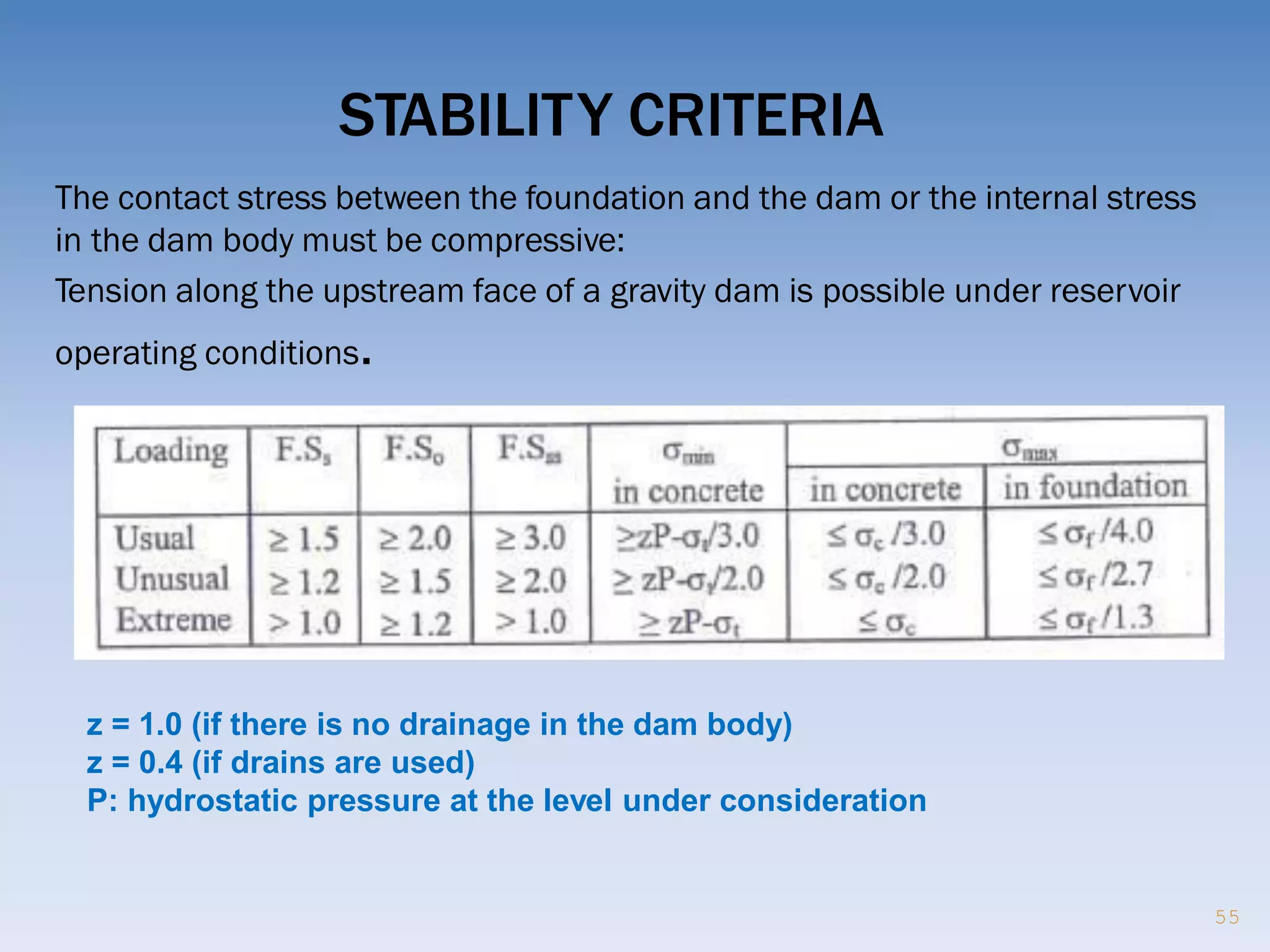
STABILITY CRITERIA
The contact stress between the foundation and the dam or the internal stress
in the dam body must be compressive:
Tension along the upstream face of a gravity dam is possible under reservoir
operating conditions.
z = 1.0 (if there is no drainage in the dam body)
z = 0.4 (if drains are used)
P: hydrostatic pressure at the level under consideration
55
56
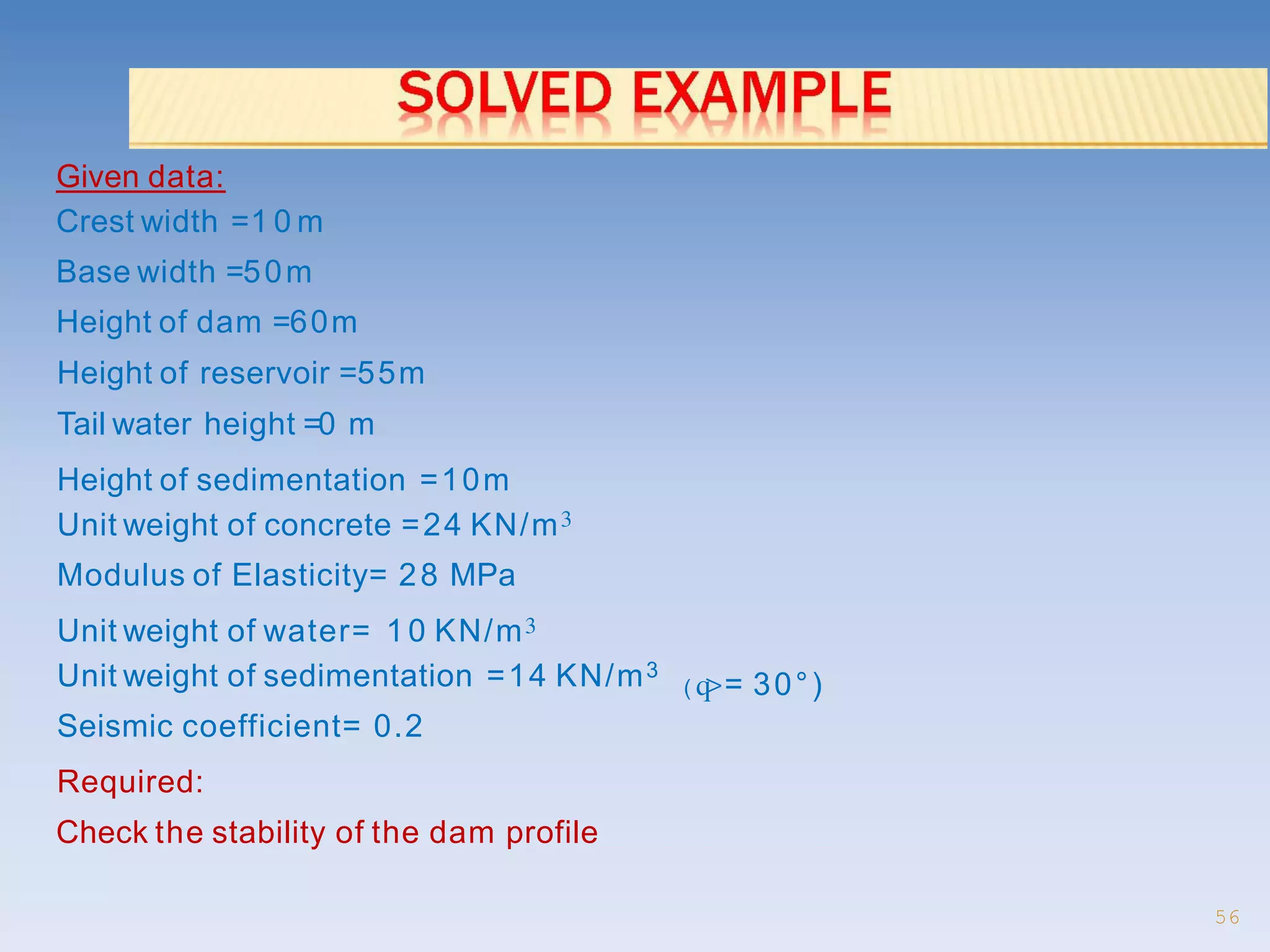
Given data:
Crest width =1 0 m
Base width =50m
Height of dam =60m
Height of reservoir =55m
Tail water height =0 m
Height of sedimentation =10m
Unit weight of concrete =24 KN/m3
Modulus of Elasticity= 28 MPa
Unit weight of water= 10 KN/m3
Unit weight of sedimentation =14 KN/m3
Seismic coefficient= 0.2
Required:
Check the stability of the dam profile
( q>= 30°)
References
• Irrigation Engineering & Water Power Engineering
– By Prof B.C.PUNMIA
– Laxmi Publication
• Irrigation Engineering & Hydraulic Structures
– By Prof. Santosh Kumar Garg
– Khanna Publishers
• Irrigation, Water Power Engineering & Hydraulic Structures
– By Prof K.R. Arora
– Standard Publishers Distributions
• Internet Websites
• http://www.aboutcivil.org/
• http://nptel.ac.in/courses/105105110/
Thanks…..

Gravity dam stability analysis

  • 1.
    GRAVITY DAMS SAFETY &STABILITY ANALYSIS DIVYA VISHNOI Assistant Professor
  • 2.
    Stability Analysis •Stability AgainstForward Overturning •Stability Against Forward Sliding •Stability Against Sliding & Shear •Stability Against Concrete Overstresses •Stability Against Foundation Overstresses
  • 4.
    Structure of Dam Heel Gallery Toe Spillway (insidedam) Crest NWL Normal water level MWL Max. level Free board Sluice way Upstream Down stream
  • 5.
    • Heel: contactwith the ground on the upstream side • Toe: contact on the downstream side • Abutment: Sides of the valley on which the structure of the dam rest • Galleries: small rooms like structure left within the dam for checking operations. • Diversion tunnel: Tunnels are constructed for diverting water before the construction of dam. This helps in keeping the river bed dry. • Spillways: It is the arrangement near the top to release the excess water of the reservoir to downstream side • Sluice way: An opening in the dam near the ground level, which is used to clear the silt accumulation in the reservoir side.
  • 6.
    Case 1: Reservoiris Empty - Just After Construction Case 2: Reservoir is Full - Normal Operating Conditions Case 3: Reservoir is Full - Flood Discharge Conditions Case 4: Reservoir is Empty + Seismic Forces Case 5: Normal Operating Conditions + Seismic Forces Case 6: Flood Discharge Conditions + Seismic Forces Case 7: Normal Operating Conditions + Seismic Forces + Extreme Uplift Case 8: Flood Discharge Conditions + Seismic Forces+ Extreme Uplift 6 CASES OF LOADING
  • 7.
    CASE 1 :RESERVOIR IS EMPTY (JUST AFTER CONSTRUCTION) WWeight of the dam 7
  • 8.
    hd U U= γw h γwhdP= γw h δ Pd Ws Ps CASE 2 : RESERVOIR IS FULL NORMAL OPERATING CONDITIONS Hydrostatic pressure N.U.W.L. Ww h P Wwd W N.D.W.L. 8
  • 9.
    CASE 3 :RESERVOIR IS FULL FLOOD DISCHARGE CONDITIONS h' h’d U’ U’= γw h’ γw h’dP’= γw h’ δ W’w P’ W’wd F.D.W.L P’d Ws W Ps Hydrostatic pressure F.U.W.L. 9
  • 10.
    CASE 4 =RESERVOIR IS EMPTY + SEISMIC FORCES W V H Horizontal inertia forces due to earthquake accelerations Vertical inertia forces due to earthquake accelerations Weight of the dam 10
  • 11.
    CASE 5 =NORMAL OPERATING CONDITIONS + EARTHQUAKE FORCES h hd UU= γw h γw hdP= γw h δ Ww P Wwd Pd Ws W V Ps Phyd H P=Cs .γw .α.h Vertical inertia forces due to earthquake accelerations Horizontal inertia forces due to earthquake accelerations Hydrodynamic pressure Hydrostatic pressure N.U.W.L. 11
  • 12.
    CASE 6 =FLOOD DISCHARGE CONDITIONS + EARTHQUAKE FORCES h' H’d γw h’d P’= γw h’ δ W’w P’ W’wd P’d Ws W V Ps P’hyd H Hydrodynamic pressure Hydrostatic pressure F.U.W.L. Vertical inertia forces due to earthquake accelerations Horizontal inertia forces due to earthquake accelerations P’=Cs .γw .α.h’ U’= γw h’ U’ 12
  • 13.
    CASE 7 =NORMAL OPERATING CONDITIONS + EARTHQUAKE FORCES + EXTREME UPLIFT 13 h hd U U= γw h γw hdP= γw h Ww P Wwd Pd Ws W V Ps Phyd H P=Cs .γw .α.h Hydrodynamic pressure Hydrostatic pressure N.U.W.L. Vertical inertia forces due to earthquake accelerations Horizontal inertia forces due to earthquake accelerations
  • 14.
    CASE 8 =FLOOD DISCHARGE CONDITIONS + EARTHQUAKE FORCES+ EXTREME UPLIFT h' H’dU’ U’= γw h’ γw h’d P’= γw h’ P’=Cs .γw .α.h’ W’w P’ W’wd P’d Ws W V Ps P’hyd H Hydrodynamic pressure Hydrostatic pressure F.U.W.L. Vertical inertia forces due to earthquake accelerations Horizontal inertia forces due to earthquake accelerations 14
  • 15.
    DESIGN OF GRAVITYDAMS 15 INTRODUCTION:  Dams are national properties, for the development of national economy in which large investments are deployed  Safety of dams is a very important aspect for safeguarding national investment and benefits derived by the project  Unsafe dams constitute hazards to human life in the downstream reaches  Safety of dams and allied structures is an important aspect to be examined to ensure public confidence and to protect downstream area from any potential hazards.
  • 16.
    DESIGN OF GRAVITYDAMS  Technically, a concrete gravity dam derives its stability from the force of gravity of its materials.  The gravity dam has sufficient weight so as to withstand the force and the over turning moments caused by the water impounded in the reservoir behind it.  It transfers the loads to the foundations by cantilever action and hence good foundations are pre requisite for the gravity dam. 16
  • 17.
    DESIGN OF GRAVITYDAMS 17 Gravity dams are satisfactorily adopted for narrow valleys having stiff geological formations. Their own weight resists the forces exerted upon them. They must have sufficient weight against overturning tendency about the toe. The base width of gravity dams must be large enough to prevent sliding. These types of dams are susceptible to settlement, overturning, sliding and severe earthquake shocks.
  • 18.
    PROCEDURE OF CONCRETEGRAVITY DESIGN 18 In the gravity dam calculations one should proceed through the following steps: 1. Determination of all expected acting loads 2. State the combination of acting loads for each case of loading 3.Check stability against overturning for all possible cases of loading (cases of full reservoir) 4.Check stability against forward sliding for all possible cases of loading (cases of full reservoir) 5.Determine normal stress distribution at dam base and any given sections for all cases of loading 6.Determine maximum and minimum principal and shear stresses at dam base and any given sections for all cases of loading 7.Compare results with corresponding factors of safety and allowable stresses 8. approve the dam profile or redesign for a new profile
  • 19.
    STABILITY CRITERIA 19 Stability analysesare performed for various loading conditions.The structure must prove its safety and stability under all loading conditions. Since the probability of occurrence of extreme events is relatively small, the joint probability of the independent extreme events is negligible. In other words, the probability that two extreme events occur at the same time is relatively very low. Therefore, combination of extreme events are not considered in the stability criteria. e.g. Floods (spring and summer) versus Ice load (winter). then no need to consider these two forces at the same time.
  • 20.
    STABILITY CRITERIA Usual Loading Hydrostaticforce (normal operating level) Uplift force Temperature stress (normal temperature) Dead loads Ice loads Silt load Unusual Loading Hydrostatic force (reservoir full) Uplift force Stress produced by minimum temperature at full level Dead loads Silt load Extreme (severe) Loading Forces in Usual Loading and earthquake forces
  • 21.
    STABILITY CRITERIA 21 The abilityof a dam to resist the applied loads is easured by some safety factors. To offset the uncertainties in the loads, safety criteria are chosen sufficiently beyond the static equilibrium condition. Recommended safety factors: (USBR, 1976 and 1987) However, since each dam site has unique features, different safety Factors may be derived considering the local condition.
  • 22.
    STABILITY CRITERIA F.S0: Safetyfactor against overturning. F.Ss: Safety factor against sliding. F.Sss: Safety factor against shear and sliding. 22
  • 23.
    STABILITY ANALYSIS OFGRAVITY DAMS 23 1 Stability against overturning 2 Stability against Forward sliding 3 Failure against overstressing Normal stresses on horizontal planes Shear stresses on horizontal planes Normal stresses on vertical planes Principal stresses Permissible stresses in concrete
  • 24.
    STABILITY ANALYSIS OFCONCRETE GRAVITY DAMS  For the considerations of stability of a concrete gravity dam the following assumptions are made: the dam • Is composed of individual transverse vertical elements each of which carries its load to the foundation separately Stability analysis • Is carried out for the whole block vertica l stress • Varies linearly from upstream face to downstream face on any horizontal section 24
  • 25.
    CLASSIFICATION OF LOADINGFOR DESIGN Normal Loads They are those, under the combined action of which the dam shall have adequate stability, and the factors of safety and permissible stresses in the dam shall not be exceeded. 25 Abnormal Loads These are the loads which in combination with normal loads encroach upon the factor of safety and increase the allowable stresses although remaining lower than the higher emergency stress limits. Normal Loads Abnormal Loads Water pressure corresponding to full reservoir level. Higher water pressure during floods Weight of dam and structure above it. Earthquake force Uplift. Silt pressure Wave pressure Ice thrust Thermal stresses
  • 26.
    ACTING STATIC FORCES 1.Weightof the dam 2. Thrust of the tail water Forces that give stability 1. Reservoir water pressure 2. Uplift 3. Ice pressure 4. Temperature stresses 6. Silt pressure Static Forces that try to destabilize 26
  • 27.
    ACTING DYNAMIC FORCES 1.Weightof the dam 2. Thrust of the tail water Forces that give stability 1.Seismic forces 2.Hydrodynamic pressure 3.Forces due to waves in the reservoir 4. Wind pressure Dynamic Forces that try to destabilize 27
  • 28.
    SAFETY OF CONCRETEGRAVITY DAM Equilibrium states that: ∑FX=0, ∑FY=0, ∑M@ any point=0 Should attained otherwise If ∑FX ≠ 0, forward sliding may occur If ∑FY ≠ 0, settlement may occur If ∑M ≠ 0 forward overturning may occur If eccentricity exceeds B/6 , tension forces may occur If working stresses greater than allowable stresses failure may occur due to excessive stresses or crushing. 28
  • 29.
    SAFETY OF CONCRETEGRAVITY DAM Thus a dam profile should be safe against: 29 1. forward sliding and translation Settlement or tilting forward overturning or rotation Tensile stresses failure due to over stresses Cracks & material failure Higher responses than allowable limit according to codes 2. 3. 4. 5. 6. 7.
  • 30.
    STRUCTURAL STABILITY ANALYSIS Thestability analysis of a dam section under static and dynamic loads is carried out to check the safety with regards to: 30 1. Rotation and overturning Translation and sliding Overstress and material failure 2. 3.
  • 31.
  • 32.
  • 33.
  • 34.
  • 35.
  • 36.
  • 37.
  • 38.
  • 39.
  • 40.
  • 41.
  • 42.
  • 43.
  • 44.
  • 45.
    SAFETY AGAINST FORWARDSLIDING In the presence of a horizon with low shear resistance the net shear force may equal to: (W cosα+ ∑Hsin α) tanφ where W is the passive resistance wedge, α is the assumed angle of sliding failure, ∑H is the net de-stabilizing horizontal moment, and φ is the internal friction within the rock at plane B-B 45
  • 46.
    SAFETY AGAINST FORWARDSLIDING Heel toeDam base 46
  • 47.
    THE FACTOR OFSAFETY AGAINST SLIDING AND SHEAR: 47
  • 48.
    SAFETY AGAINST OVERSTRESSING A dam may fail if any of its part is overstressed and hence the stresses at any part of the dam should not exceed the allowable working stress of concrete.  Hence the strength in dam concrete should be more than the anticipated in the structure by a safe margin  The maximum compressive stresses occur at: at heel (at reservoir empty condition) or at toe (at reservoir full condition) and on planes normal to the face of the dam. 48
  • 49.
    SAFETY AGAINST OVERSTRESSING Fordesign considerations, the calculation of the stresses in the body of the dam follows from the basics of elastic theory, which is applied in two- dimensional vertical plane, and assuming the block of the dam to be a cantilever in the vertical plane attached to the foundation. The contact stress between the foundation and the dam or the internal stress in the dam body must be compressive. 40
  • 50.
  • 51.
    SAFETY AGAINST CONCRETEOVERSTRESSING Normal stress Bending or flexural stres σheel s σtoe Base pressure distribution ∑V B 51
  • 52.
    NORMAL STRESSES ATDAM BASE Normal stress: c.g. x My σnheel σntoe 1m + ∑V y ∑H B Heel toe e 52
  • 53.
    SAFETY AGAINST FOUNDATIONOVERSTRESSING AT DAM BASE Naturally, there would be tension on the upstream face if the overturning moments under the reservoir full condition increase such that e becomes The total vertical stresses at the upstream and downstream faces are obtained by addition of external hydrostatic pressures. The contact stress between the foundation and the dam or the internal stress in the dam body must be compressive. In order to maintain compressive stresses in the dam or at the foundation level, the minimum pressureσmin ≥0. This can be achieved with a certain range of eccentricity. 43
  • 54.
    SAFETY AGAINST OVERSTRESSING e σheel σtoe Basepressure distribution Foraunitwidth 54
  • 55.
    STABILITY CRITERIA The contactstress between the foundation and the dam or the internal stress in the dam body must be compressive: Tension along the upstream face of a gravity dam is possible under reservoir operating conditions. z = 1.0 (if there is no drainage in the dam body) z = 0.4 (if drains are used) P: hydrostatic pressure at the level under consideration 55
  • 56.
    56 Given data: Crest width=1 0 m Base width =50m Height of dam =60m Height of reservoir =55m Tail water height =0 m Height of sedimentation =10m Unit weight of concrete =24 KN/m3 Modulus of Elasticity= 28 MPa Unit weight of water= 10 KN/m3 Unit weight of sedimentation =14 KN/m3 Seismic coefficient= 0.2 Required: Check the stability of the dam profile ( q>= 30°)
  • 57.
    References • Irrigation Engineering& Water Power Engineering – By Prof B.C.PUNMIA – Laxmi Publication • Irrigation Engineering & Hydraulic Structures – By Prof. Santosh Kumar Garg – Khanna Publishers • Irrigation, Water Power Engineering & Hydraulic Structures – By Prof K.R. Arora – Standard Publishers Distributions • Internet Websites • http://www.aboutcivil.org/ • http://nptel.ac.in/courses/105105110/
  • 58.