Unit-5
Tension Coefficient Method
Presented by : -DIVYA VISHNOI
Analysis of frame
Tension Coefficient Method
• Prof. R.V. Southwell introduce the Tension
Coefficient Method.
• It is systematic presentation of the method
of joints.
• This is specially useful for space frame.
• This method is valid for perfect frame.
Tension Coefficient
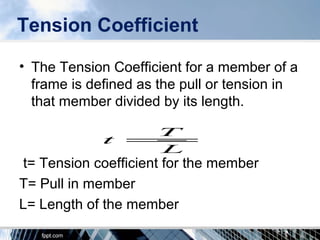
• The Tension Coefficient for a member of a
frame is defined as the pull or tension in
that member divided by its length.
t= Tension coefficient for the member
T= Pull in member
L= Length of the member
L
T
t =
Tension Coefficient
Tension Coefficient
• Consider a member AB of a pin jointed
perfect frame in equilibrium under a given
system of external forces (or reactions)
acting at the joint.
• be the resulting pull in the member.TAB
Tension Coefficient
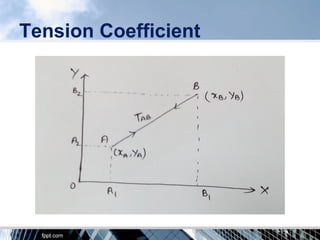
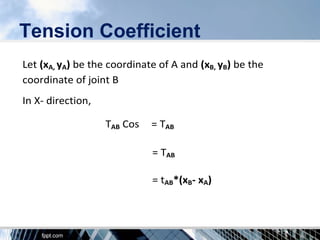
Let (xA, yA) be the coordinate of A and (xB, yB) be the
coordinate of joint B
In X- direction,
TAB Cos = TAB
= TAB
= tAB*(xB- xA)
Tension Coefficient
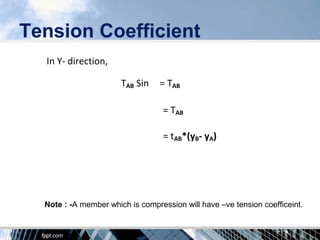
In Y- direction,
TAB Sin = TAB
= TAB
= tAB*(yB- yA)
Note : -A member which is compression will have –ve tension coefficeint.
Analysis of Plane Frame
• Let us consider a joint A, where a no. of
members AB,AC,AD…….. etc are
meeting.
• Let PA is the external force acting at the
joint A and let xA & yA be the component of
this force P in X- direction and Y-direction.
Analysis of Plane Frame
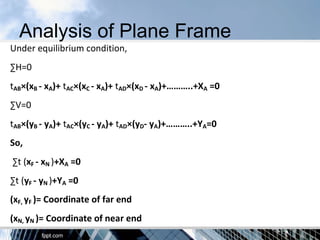
Under equilibrium condition,
∑H=0
tAB×(xB - xA)+ tAC×(xC - xA)+ tAD×(xD - xA)+………..+XA =0
∑V=0
tAB×(yB - yA)+ tAC×(yC - yA)+ tAD×(yD- yA)+………..+YA=0
So,
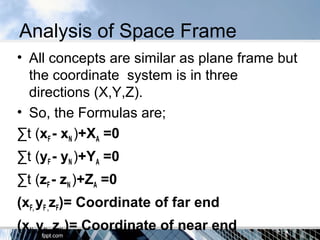
∑t (xF - xN )+XA =0
∑t (yF - yN )+YA =0
(xF, yF )= Coordinate of far end
(xN, yN )= Coordinate of near end
Problem
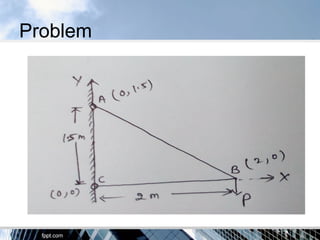
• A plane frame consists of two members
AB and CB, hinged at A and C to the wall,
as shown in fig. Determine the forces in
the two members due to vertical force P
applied at joint B.
Problem
Problem
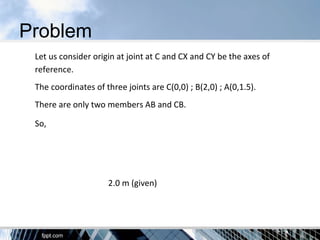
Let us consider origin at joint at C and CX and CY be the axes of
reference.
The coordinates of three joints are C(0,0) ; B(2,0) ; A(0,1.5).
There are only two members AB and CB.
So,
2.0 m (given)
Problem
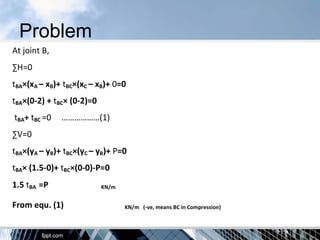
At joint B,
∑H=0
tBA×(xA – xB)+ tBC×(xC – xB)+ 0=0
tBA×(0-2) + tBC× (0-2)=0
tBA+ tBC =0 ………………(1)
∑V=0
tBA×(yA – yB)+ tBC×(yC – yB)+ P=0
tBA× (1.5-0)+ tBC×(0-0)-P=0
1.5 tBA =P KN/m
From equ. (1) KN/m (-ve, means BC in Compression)
Problem
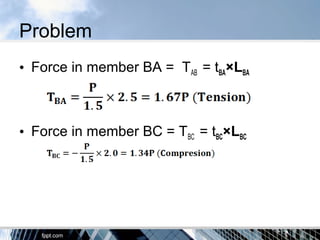
• Force in member BA = TAB = tBA×LBA
• Force in member BC = TBC = tBC×LBC
Analysis of Space Frame
• All concepts are similar as plane frame but
the coordinate system is in three
directions (X,Y,Z).
• So, the Formulas are;
∑t (xF - xN )+XA =0
∑t (yF - yN )+YA =0
∑t (zF - zN )+ZA =0
(xF, yF ,zF)= Coordinate of far end
(xN, yN, zN )= Coordinate of near end
Problem
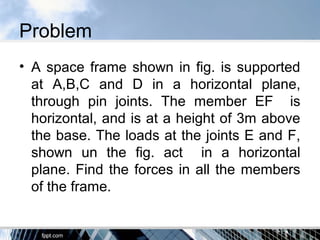
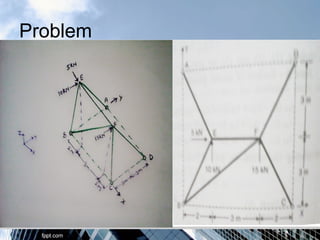
• A space frame shown in fig. is supported
at A,B,C and D in a horizontal plane,
through pin joints. The member EF is
horizontal, and is at a height of 3m above
the base. The loads at the joints E and F,
shown un the fig. act in a horizontal
plane. Find the forces in all the members
of the frame.
Problem
Problem
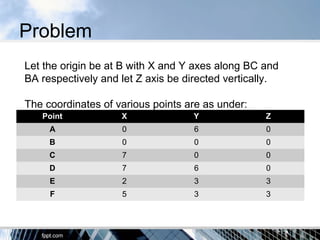
Point X Y Z
A 0 6 0
B 0 0 0
C 7 0 0
D 7 6 0
E 2 3 3
F 5 3 3
Let the origin be at B with X and Y axes along BC and
BA respectively and let Z axis be directed vertically.
The coordinates of various points are as under:
Problem
Length of various members
Problem
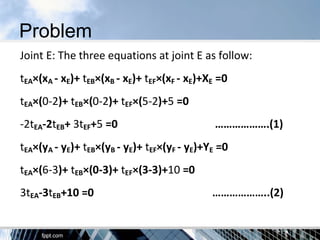
Joint E: The three equations at joint E as follow:
tEA×(xA - xE)+ tEB×(xB - xE)+ tEF×(xF - xE)+XE =0
tEA×(0-2)+ tEB×(0-2)+ tEF×(5-2)+5 =0
-2tEA-2tEB+ 3tEF+5 =0 ……………….(1)
tEA×(yA - yE)+ tEB×(yB - yE)+ tEF×(yF - yE)+YE =0
tEA×(6-3)+ tEB×(0-3)+ tEF×(3-3)+10 =0
3tEA-3tEB+10 =0 ………………..(2)
Problem
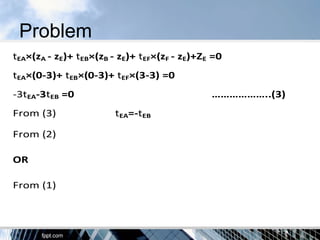
tEA×(zA - zE)+ tEB×(zB - zE)+ tEF×(zF - zE)+ZE =0
tEA×(0-3)+ tEB×(0-3)+ tEF×(3-3) =0
-3tEA-3tEB =0 ………………..(3)
From (3) tEA=-tEB
From (2)
OR
From (1)
Problem
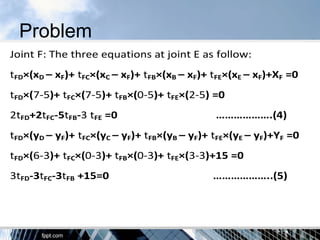
Joint F: The three equations at joint E as follow:
tFD×(xD – xF)+ tFC×(xC – xF)+ tFB×(xB – xF)+ tFE×(xE – xF)+XF =0
tFD×(7-5)+ tFC×(7-5)+ tFB×(0-5)+ tFE×(2-5) =0
2tFD+2tFC-5tFB-3 tFE =0 ……………….(4)
tFD×(yD – yF)+ tFC×(yC – yF)+ tFB×(yB – yF)+ tFE×(yE – yF)+YF =0
tFD×(6-3)+ tFC×(0-3)+ tFB×(0-3)+ tFE×(3-3)+15 =0
3tFD-3tFC-3tFB +15=0 ………………..(5)
Problem
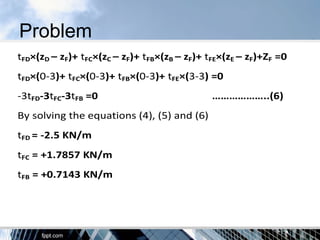
tFD×(zD – zF)+ tFC×(zC – zF)+ tFB×(zB – zF)+ tFE×(zE – zF)+ZF =0
tFD×(0-3)+ tFC×(0-3)+ tFB×(0-3)+ tFE×(3-3) =0
-3tFD-3tFC-3tFB =0 ………………..(6)
By solving the equations (4), (5) and (6)
tFD = -2.5 KN/m
tFC = +1.7857 KN/m
tFB = +0.7143 KN/m
Problem
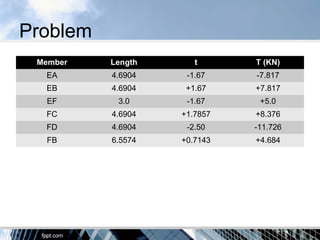
Member Length t T (KN)
EA 4.6904 -1.67 -7.817
EB 4.6904 +1.67 +7.817
EF 3.0 -1.67 +5.0
FC 4.6904 +1.7857 +8.376
FD 4.6904 -2.50 -11.726
FB 6.5574 +0.7143 +4.684
References
• SMTS-II, Theory of Structures, by “B.C.
Punmia” , ISBN:8170086183.
• Structural and Stress analysis, by “T.H.G.
Megson”, ISBN: 97-8008-099-936-4.
• www.iitg.ac.in/kd/Lecture
%20Notes/ME101-Lecture07-KD.pdf
Tension coefficient method

Tension coefficient method

  • 1.
  • 2.
  • 3.
    Tension Coefficient Method •Prof. R.V. Southwell introduce the Tension Coefficient Method. • It is systematic presentation of the method of joints. • This is specially useful for space frame. • This method is valid for perfect frame.
  • 4.
    Tension Coefficient • TheTension Coefficient for a member of a frame is defined as the pull or tension in that member divided by its length. t= Tension coefficient for the member T= Pull in member L= Length of the member L T t =
  • 5.
  • 6.
    Tension Coefficient • Considera member AB of a pin jointed perfect frame in equilibrium under a given system of external forces (or reactions) acting at the joint. • be the resulting pull in the member.TAB
  • 7.
    Tension Coefficient Let (xA,yA) be the coordinate of A and (xB, yB) be the coordinate of joint B In X- direction, TAB Cos = TAB = TAB = tAB*(xB- xA)
  • 8.
    Tension Coefficient In Y-direction, TAB Sin = TAB = TAB = tAB*(yB- yA) Note : -A member which is compression will have –ve tension coefficeint.
  • 9.
    Analysis of PlaneFrame • Let us consider a joint A, where a no. of members AB,AC,AD…….. etc are meeting. • Let PA is the external force acting at the joint A and let xA & yA be the component of this force P in X- direction and Y-direction.
  • 10.
    Analysis of PlaneFrame Under equilibrium condition, ∑H=0 tAB×(xB - xA)+ tAC×(xC - xA)+ tAD×(xD - xA)+………..+XA =0 ∑V=0 tAB×(yB - yA)+ tAC×(yC - yA)+ tAD×(yD- yA)+………..+YA=0 So, ∑t (xF - xN )+XA =0 ∑t (yF - yN )+YA =0 (xF, yF )= Coordinate of far end (xN, yN )= Coordinate of near end
  • 11.
    Problem • A planeframe consists of two members AB and CB, hinged at A and C to the wall, as shown in fig. Determine the forces in the two members due to vertical force P applied at joint B.
  • 12.
  • 13.
    Problem Let us considerorigin at joint at C and CX and CY be the axes of reference. The coordinates of three joints are C(0,0) ; B(2,0) ; A(0,1.5). There are only two members AB and CB. So, 2.0 m (given)
  • 14.
    Problem At joint B, ∑H=0 tBA×(xA– xB)+ tBC×(xC – xB)+ 0=0 tBA×(0-2) + tBC× (0-2)=0 tBA+ tBC =0 ………………(1) ∑V=0 tBA×(yA – yB)+ tBC×(yC – yB)+ P=0 tBA× (1.5-0)+ tBC×(0-0)-P=0 1.5 tBA =P KN/m From equ. (1) KN/m (-ve, means BC in Compression)
  • 15.
    Problem • Force inmember BA = TAB = tBA×LBA • Force in member BC = TBC = tBC×LBC
  • 16.
    Analysis of SpaceFrame • All concepts are similar as plane frame but the coordinate system is in three directions (X,Y,Z). • So, the Formulas are; ∑t (xF - xN )+XA =0 ∑t (yF - yN )+YA =0 ∑t (zF - zN )+ZA =0 (xF, yF ,zF)= Coordinate of far end (xN, yN, zN )= Coordinate of near end
  • 17.
    Problem • A spaceframe shown in fig. is supported at A,B,C and D in a horizontal plane, through pin joints. The member EF is horizontal, and is at a height of 3m above the base. The loads at the joints E and F, shown un the fig. act in a horizontal plane. Find the forces in all the members of the frame.
  • 18.
  • 19.
    Problem Point X YZ A 0 6 0 B 0 0 0 C 7 0 0 D 7 6 0 E 2 3 3 F 5 3 3 Let the origin be at B with X and Y axes along BC and BA respectively and let Z axis be directed vertically. The coordinates of various points are as under:
  • 20.
  • 21.
    Problem Joint E: Thethree equations at joint E as follow: tEA×(xA - xE)+ tEB×(xB - xE)+ tEF×(xF - xE)+XE =0 tEA×(0-2)+ tEB×(0-2)+ tEF×(5-2)+5 =0 -2tEA-2tEB+ 3tEF+5 =0 ……………….(1) tEA×(yA - yE)+ tEB×(yB - yE)+ tEF×(yF - yE)+YE =0 tEA×(6-3)+ tEB×(0-3)+ tEF×(3-3)+10 =0 3tEA-3tEB+10 =0 ………………..(2)
  • 22.
    Problem tEA×(zA - zE)+tEB×(zB - zE)+ tEF×(zF - zE)+ZE =0 tEA×(0-3)+ tEB×(0-3)+ tEF×(3-3) =0 -3tEA-3tEB =0 ………………..(3) From (3) tEA=-tEB From (2) OR From (1)
  • 23.
    Problem Joint F: Thethree equations at joint E as follow: tFD×(xD – xF)+ tFC×(xC – xF)+ tFB×(xB – xF)+ tFE×(xE – xF)+XF =0 tFD×(7-5)+ tFC×(7-5)+ tFB×(0-5)+ tFE×(2-5) =0 2tFD+2tFC-5tFB-3 tFE =0 ……………….(4) tFD×(yD – yF)+ tFC×(yC – yF)+ tFB×(yB – yF)+ tFE×(yE – yF)+YF =0 tFD×(6-3)+ tFC×(0-3)+ tFB×(0-3)+ tFE×(3-3)+15 =0 3tFD-3tFC-3tFB +15=0 ………………..(5)
  • 24.
    Problem tFD×(zD – zF)+tFC×(zC – zF)+ tFB×(zB – zF)+ tFE×(zE – zF)+ZF =0 tFD×(0-3)+ tFC×(0-3)+ tFB×(0-3)+ tFE×(3-3) =0 -3tFD-3tFC-3tFB =0 ………………..(6) By solving the equations (4), (5) and (6) tFD = -2.5 KN/m tFC = +1.7857 KN/m tFB = +0.7143 KN/m
  • 25.
    Problem Member Length tT (KN) EA 4.6904 -1.67 -7.817 EB 4.6904 +1.67 +7.817 EF 3.0 -1.67 +5.0 FC 4.6904 +1.7857 +8.376 FD 4.6904 -2.50 -11.726 FB 6.5574 +0.7143 +4.684
  • 26.
    References • SMTS-II, Theoryof Structures, by “B.C. Punmia” , ISBN:8170086183. • Structural and Stress analysis, by “T.H.G. Megson”, ISBN: 97-8008-099-936-4. • www.iitg.ac.in/kd/Lecture %20Notes/ME101-Lecture07-KD.pdf