Temperature
Regulation
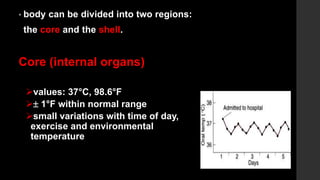
• body can be divided into two regions:
the core and the shell.
Core (internal organs)
values: 37°C, 98.6°F
 1°F within normal range
small variations with time of day,
exercise and environmental
temperature
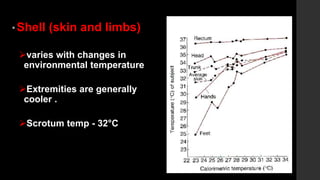
•Shell (skin and limbs)
varies with changes in
environmental temperature
Extremities are generally
cooler .
Scrotum temp - 32°C
Physiological variations in body
temperature
1.Normally, the body temp
lowest - morning
highest - evening
2.In Woman
there is a rise in basal temp of about 0.50 C
at the time of ovulation
during the second half of the menstrual cycle
during the first trimester of pregnancy.
3. In children normally have a temp that is 0.50C above the
normal for adults.
4. During exercise – temp rise to as high as 400C .
5. Emotional excitement - increases the body temp.
6. When the metabolic rate is high - the body temp - elevated
7. Constitutional hyperthermia.
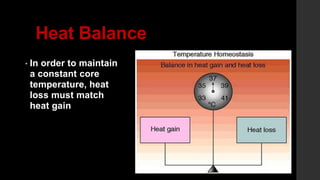
Heat Balance
• In order to maintain
a constant core
temperature, heat
loss must match
heat gain
Mechanisms of Heat production
• Heat is produced in the body by
the basal rate of metabolism,
contraction of skeletal muscles
food ingestion
effect of thyroxin on the cells
effect of epinephrine, nor epinephrine and
 sympathetic effects on the cells.
Mechanisms of Heat loss
Radiation - 65%
Evaporation - 25%
Convection - 8%
Conduction - 2%
Radiation
EM Radiation
The body at the higher temperature emits more energy than the one at the lower
temperature, and the net transfer of energy (heat) is down the temperature
gradient.
AIR
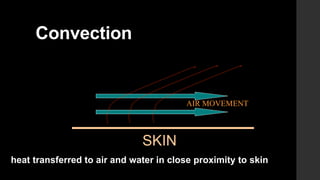
Convection
SKIN
AIR MOVEMENT
heat transferred to air and water in close proximity to skin
Evaporation
For every ml of water evaporated from the surface of
the skin, 0.58 Kcal are removed from the body.
 Insensible - skin, respiratory
approximately 600 ml/day
Sensible - sweat
up to 3 liters/hr
conduction
heat exchange between objects at different
temp. that are in contact with one another.
Small amounts of heat are
removed in the urine and
Feces.
Temperature regulating centres
:
located in the hypothalamus.
1. The anterior hypothalamus-preoptic area :
contain two types of neurons :
Heat – Sensitive neurons(receptors)
They increase their rate of firing as the temp. rises.
Cold – sensitive neurons (receptors)
Their firing rate increase when the body temp. falls.
2. The posterior hypothalamus
contains a special area located bilaterally,
approximately at the level of the mammary bodies.
This area receives signals from the anterior
hypothalamus -preoptic area and from peripheral
receptors
Peripheral receptors for detection
of Temperature
The skin:-
• Where both cold and warmth receptors are present
Deep body tissues :
• In spinal cord, in the abdominal viscera, and
around the great veins.
• These receptors detect body core temp.
Temp.– regulating mechanisms :
• When the body core temp. either increase above or
decreases below almost exactly 37o C.
• several thermoregulatory responses take place to
bring it back to this temp.
• Therefore, this critical temp. level is called the”set-
point” of the temp. control system.
A) Increase heat loss :
1) Cutaneous vaso dilatation :
This occurs in almost all areas of the body.
It is caused by inhibition of the sympathetic
centers in the posterior hypothalamus.
Cutaneous vasodilatation increase the rate of
heat tranfer to the skin.
Temp. decreasing mechanisms
activated by heat :
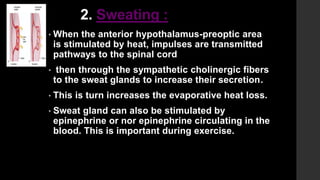
2. Sweating :
• When the anterior hypothalamus-preoptic area
is stimulated by heat, impulses are transmitted
pathways to the spinal cord
• then through the sympathetic cholinergic fibers
to the sweat glands to increase their secretion.
• This is turn increases the evaporative heat loss.
• Sweat gland can also be stimulated by
epinephrine or nor epinephrine circulating in the
blood. This is important during exercise.
Acclimatization of the sweating
mechanism :
• When a normal person is exposed to hot
weather for 1 to 6 weeks two changes take
place which are called acclimatization of the
sweating mechanism.
• These are :
A) Sweat production increases to as much 2
liters/hour.
B) Decreased concentration of sodium chloride
in the sweat caused by increased secretion of
aldosterone.
B) Decrease heat production :
1. Strong inhibition of mechanisms which cause
excess heat production.
2. Anorexia.
3. Apathy and inertia
II. Temp. increasing mechanisms activated by cold
A) Decrease heat loss :
1.) Cutaneous vasoconstriction :
Caused by stimulated of the posterior hypothslsmus
sympathetic centers. This decreases the rate of
heat transfer to the skin.
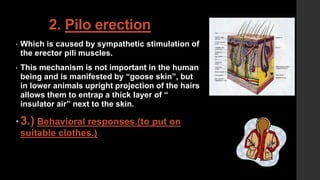
2. Pilo erection
• Which is caused by sympathetic stimulation of
the erector pili muscles.
• This mechanism is not important in the human
being and is manifested by “goose skin”, but
in lower animals upright projection of the hairs
allows them to entrap a thick layer of “
insulator air” next to the skin.
•3.) Behavioral responses.(to put on
suitable clothes.)
B) Increase heat production:
1) Shivering :
• It is an involuntary response of the skeletal muscles
which is controlled by an area in the posterior
hypothalamus called the primary motor center for
shivering .
• Therefore, this center becomes activated when the body
temp. falls even slightly below 370C.
FEVER
PATHOPHYSIOLOGY
OF FEVER
Fever is a temporary “resetting of the
hypothalamic thermostat” to a
higher level in response to
endogenous or exogenous
pyrogens.
•During fever , this level is raised so that the
thermoregulatory center now adjusts heat
production , conservation, and loss to
maintain the core temperature at the new,
higher temperature, which function as a
new set point .
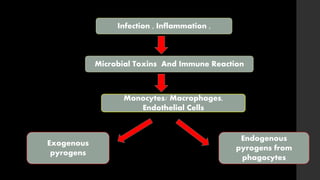
Infection , Inflammation ,
Microbial Toxins And Immune Reaction
Monocytes/ Macrophages,
Endothelial Cells
Exogenous
pyrogens
Endogenous
pyrogens from
phagocytes
Pyrogenic Cytokines :
IL-1,IL-6,TNF, IFN
Hypothalamic
Endothelium
CIRCULATION
Microbial Toxins
PGE2
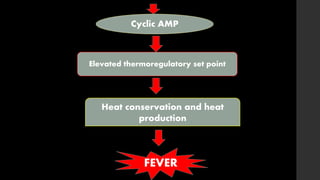
Cyclic AMP
Elevated thermoregulatory set point
Heat conservation and heat
production
FEVER
Thank you

Temperature regulation

  • 1.
  • 2.
    • body canbe divided into two regions: the core and the shell. Core (internal organs) values: 37°C, 98.6°F  1°F within normal range small variations with time of day, exercise and environmental temperature
  • 3.
    •Shell (skin andlimbs) varies with changes in environmental temperature Extremities are generally cooler . Scrotum temp - 32°C
  • 4.
    Physiological variations inbody temperature 1.Normally, the body temp lowest - morning highest - evening 2.In Woman there is a rise in basal temp of about 0.50 C at the time of ovulation during the second half of the menstrual cycle during the first trimester of pregnancy.
  • 5.
    3. In childrennormally have a temp that is 0.50C above the normal for adults. 4. During exercise – temp rise to as high as 400C . 5. Emotional excitement - increases the body temp. 6. When the metabolic rate is high - the body temp - elevated 7. Constitutional hyperthermia.
  • 6.
    Heat Balance • Inorder to maintain a constant core temperature, heat loss must match heat gain
  • 7.
    Mechanisms of Heatproduction • Heat is produced in the body by the basal rate of metabolism, contraction of skeletal muscles food ingestion effect of thyroxin on the cells effect of epinephrine, nor epinephrine and  sympathetic effects on the cells.
  • 8.
    Mechanisms of Heatloss Radiation - 65% Evaporation - 25% Convection - 8% Conduction - 2%
  • 9.
    Radiation EM Radiation The bodyat the higher temperature emits more energy than the one at the lower temperature, and the net transfer of energy (heat) is down the temperature gradient. AIR
  • 10.
    Convection SKIN AIR MOVEMENT heat transferredto air and water in close proximity to skin
  • 11.
    Evaporation For every mlof water evaporated from the surface of the skin, 0.58 Kcal are removed from the body.  Insensible - skin, respiratory approximately 600 ml/day Sensible - sweat up to 3 liters/hr
  • 12.
    conduction heat exchange betweenobjects at different temp. that are in contact with one another.
  • 13.
    Small amounts ofheat are removed in the urine and Feces.
  • 14.
    Temperature regulating centres : locatedin the hypothalamus. 1. The anterior hypothalamus-preoptic area : contain two types of neurons : Heat – Sensitive neurons(receptors) They increase their rate of firing as the temp. rises. Cold – sensitive neurons (receptors) Their firing rate increase when the body temp. falls.
  • 15.
    2. The posteriorhypothalamus contains a special area located bilaterally, approximately at the level of the mammary bodies. This area receives signals from the anterior hypothalamus -preoptic area and from peripheral receptors
  • 16.
    Peripheral receptors fordetection of Temperature The skin:- • Where both cold and warmth receptors are present Deep body tissues : • In spinal cord, in the abdominal viscera, and around the great veins. • These receptors detect body core temp.
  • 17.
    Temp.– regulating mechanisms: • When the body core temp. either increase above or decreases below almost exactly 37o C. • several thermoregulatory responses take place to bring it back to this temp. • Therefore, this critical temp. level is called the”set- point” of the temp. control system.
  • 18.
    A) Increase heatloss : 1) Cutaneous vaso dilatation : This occurs in almost all areas of the body. It is caused by inhibition of the sympathetic centers in the posterior hypothalamus. Cutaneous vasodilatation increase the rate of heat tranfer to the skin. Temp. decreasing mechanisms activated by heat :
  • 19.
    2. Sweating : •When the anterior hypothalamus-preoptic area is stimulated by heat, impulses are transmitted pathways to the spinal cord • then through the sympathetic cholinergic fibers to the sweat glands to increase their secretion. • This is turn increases the evaporative heat loss. • Sweat gland can also be stimulated by epinephrine or nor epinephrine circulating in the blood. This is important during exercise.
  • 20.
    Acclimatization of thesweating mechanism : • When a normal person is exposed to hot weather for 1 to 6 weeks two changes take place which are called acclimatization of the sweating mechanism. • These are : A) Sweat production increases to as much 2 liters/hour. B) Decreased concentration of sodium chloride in the sweat caused by increased secretion of aldosterone.
  • 21.
    B) Decrease heatproduction : 1. Strong inhibition of mechanisms which cause excess heat production. 2. Anorexia. 3. Apathy and inertia II. Temp. increasing mechanisms activated by cold A) Decrease heat loss : 1.) Cutaneous vasoconstriction : Caused by stimulated of the posterior hypothslsmus sympathetic centers. This decreases the rate of heat transfer to the skin.
  • 22.
    2. Pilo erection •Which is caused by sympathetic stimulation of the erector pili muscles. • This mechanism is not important in the human being and is manifested by “goose skin”, but in lower animals upright projection of the hairs allows them to entrap a thick layer of “ insulator air” next to the skin. •3.) Behavioral responses.(to put on suitable clothes.)
  • 23.
    B) Increase heatproduction: 1) Shivering : • It is an involuntary response of the skeletal muscles which is controlled by an area in the posterior hypothalamus called the primary motor center for shivering . • Therefore, this center becomes activated when the body temp. falls even slightly below 370C.
  • 24.
  • 25.
    Fever is atemporary “resetting of the hypothalamic thermostat” to a higher level in response to endogenous or exogenous pyrogens.
  • 26.
    •During fever ,this level is raised so that the thermoregulatory center now adjusts heat production , conservation, and loss to maintain the core temperature at the new, higher temperature, which function as a new set point .
  • 27.
    Infection , Inflammation, Microbial Toxins And Immune Reaction Monocytes/ Macrophages, Endothelial Cells Exogenous pyrogens Endogenous pyrogens from phagocytes
  • 28.
    Pyrogenic Cytokines : IL-1,IL-6,TNF,IFN Hypothalamic Endothelium CIRCULATION Microbial Toxins PGE2
  • 29.
    Cyclic AMP Elevated thermoregulatoryset point Heat conservation and heat production FEVER
  • 30.