
Chapter 16 2005-2006 Photosynthesis Leaf Structure and Function & Factors  necessary
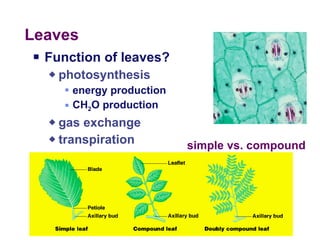
Leaves Function of leaves? photosynthesis energy production CH 2 O production gas exchange transpiration 2005-2006 simple vs. compound
2005-2006
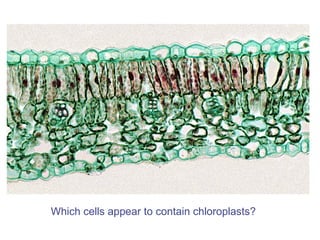
Which cells appear to contain chloroplasts?
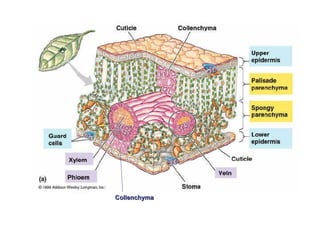
Collenchyma
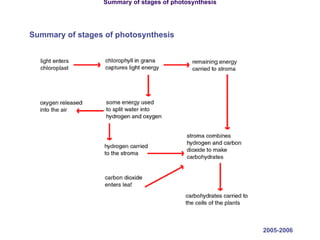
2005-2006 Summary of stages of photosynthesis Summary of stages of photosynthesis
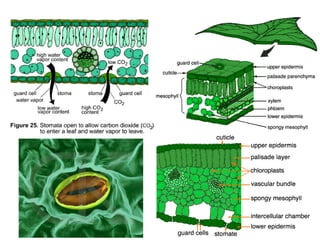
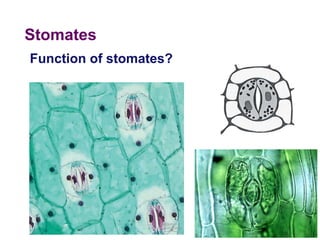
Stomates  2005-2006 Function of stomates?
blue-light wavelengths of daylight, detected by zeaxanthin (a carotenoid) activate proton pumps in the guard cell membranes, which proceed to extrude protons from the cytoplasm of the cell; this creates a "proton motive force" (an electrochemical gradient across the membrane) which; opens voltage operated channels in the membrane, allowing positive K ions to flow passively into the cell, from the surrounding tissues.  Chloride ions also enter the cell.  2005-2006
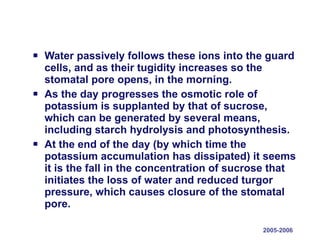
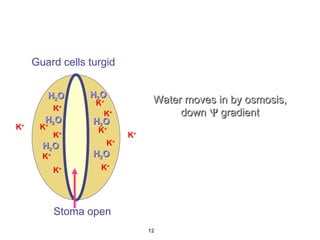
Water passively follows these ions into the guard cells, and as their tugidity increases so the stomatal pore opens, in the morning.  As the day progresses the osmotic role of potassium is supplanted by that of sucrose, which can be generated by several means, including starch hydrolysis and photosynthesis.  At the end of the day (by which time the potassium accumulation has dissipated) it seems it is the fall in the concentration of sucrose that initiates the loss of water and reduced turgor pressure, which causes closure of the stomatal pore. 2005-2006
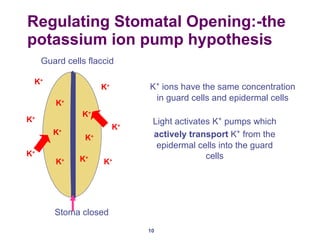
Regulating Stomatal Opening:-the potassium ion pump hypothesis  Guard cells flaccid Stoma closed K + K + K + K + K + K + K + K + K + K + K + K + K +  ions have the same concentration in guard cells and epidermal cells Light activates K +  pumps which  actively transport  K +  from the epidermal cells into the guard cells
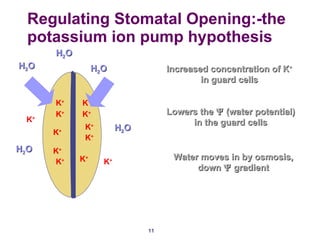
Regulating Stomatal Opening:-the potassium ion pump hypothesis  K + K + K + K + K + K + K + K + K + K + K + K + Increased concentration of K +  in guard cells Lowers the    (water potential) in the guard cells Water moves in by osmosis, down    gradient H 2 O H 2 O H 2 O H 2 O H 2 O
Stoma open Guard cells turgid K + K + K + K + K + K + K + K + K + K + K + K + Water moves in by osmosis, down    gradient H 2 O H 2 O H 2 O H 2 O H 2 O H 2 O
Factors affecting the rate of photosynthesis The main factors are  light intensity,  carbon dioxide concentration and  temperature,  known as limiting factors. 2005-2006
Factors affecting the rate of photosynthesis As light intensity increases, the rate of the light-dependent reaction, and therefore photosynthesis generally, increases proportionately.  As light intensity is increased however, the rate of photosynthesis is eventually limited by some other factor.  Chlorophyll a is used in both Photosystems. The wavelength of light is also important. PSI absorbs energy most efficiently at 700 nm and PSII at 680 nm. Light with a high proportion of energy concentrated in these wavelengths will produce a high rate of photosynthesis. 2005-2006
Factors affecting the rate of photosynthesis An increase in CO 2  increases the rate at which carbon is incorporated into carbohydrate in the light-independent reaction and so the rate of photosynthesis generally increases until limited by another factor. Photosynthesis is dependent on temperature. It is a reaction catalysed by enzymes. As the enzymes approach their optimum temperatures the overall rate increases. Above the optimum temperature the rate begins to decrease until it stops. 2005-2006
C3/C4 Plants? The photosynthetic reactions we have been discussing related to C3 plants CO 2  combines with RuBP to form a 6C molecule that immediately splits into two 3C molecules In some plants the first thing produced is a 4C molecule 2005-2006
Avoiding photorespiration Rubisc o catalyzes the CO 2  combining with  RuBP  But, can also catalyze  O 2   combining with RuBP –  photorespiration RuBP is being wasted Photorespiration occurs more readily in high temperature/high light conditions 2005-2006
Avoiding photorespiration Tropical grasses evolved a method of avoiding photorespiration Bundle sheath cells  – keep RuBP and rubisco arranged in vascular bundles away from high oxygen concentration areas Mesophyll cells containing the enzyme PEP carboxylase absorb CO 2   2005-2006
Avoiding photorespiration CO 2  + PEP (phosphoenolpyruvate) yields oxaloacetate converted to malate Malate passed to bundle sheath cells where the CO 2  is removed  Light independent reactions then proceed normally i.e. rubisco catalyzes RuBP + CO 2 2005-2006
CAM Plants  (crassulacean acid metabolism) CAM plants are adapted to life in arid conditions by conserving water. During the night, the CAM plant's stomata are open, allowing CO 2  to enter and be fixated as organic acids (CAM) that are stored in  vacuoles . During the day the stomata are closed (thus preventing water loss), and the carbon is released to the  Calvin cycle  so that  photosynthesis  may take place. 2005-2006
The carbon dioxide is fixed in the  mesophyll cell's   cytoplasm  by a  PEP  reaction similar to that of  C4 plants . But, unlike C4 plants, the resulting organic acids are stored in vacuoles for later use; that is, they are not immediately passed on to the Calvin cycle.  Of course, the latter cannot operate during night because the  light reactions  that provide it with  ATP  and  NADPH  cannot take place without light. 2005-2006
During the day The carbon in the organic acids is freed from the  mesophyll  cell's vacuoles and enters the  chloroplast's   stroma  and, thus, into the Calvin cycle. 2005-2006
The benefits of CAM The most important benefit to the plant is the ability to leave most leaf stomata closed during the day.  Being able to keep stomata closed during the hottest and driest part of the day reduces the loss of water through  evapotranspiration , allowing CAM plants to grow in environments that would otherwise be far too dry.  2005-2006
C3 plants , for example, lose 97% of the water they uptake through the roots to transpiration - a high cost avoided by CAM plants. 2005-2006
Any Questions?? 2005-2006

Chapter 16 lecture 3

  • 1.
    Chapter 16 2005-2006Photosynthesis Leaf Structure and Function & Factors necessary
  • 2.
    Leaves Function ofleaves? photosynthesis energy production CH 2 O production gas exchange transpiration 2005-2006 simple vs. compound
  • 3.
  • 4.
    Which cells appearto contain chloroplasts?
  • 5.
  • 6.
    2005-2006 Summary ofstages of photosynthesis Summary of stages of photosynthesis
  • 7.
    Stomates 2005-2006Function of stomates?
  • 8.
    blue-light wavelengths ofdaylight, detected by zeaxanthin (a carotenoid) activate proton pumps in the guard cell membranes, which proceed to extrude protons from the cytoplasm of the cell; this creates a "proton motive force" (an electrochemical gradient across the membrane) which; opens voltage operated channels in the membrane, allowing positive K ions to flow passively into the cell, from the surrounding tissues. Chloride ions also enter the cell. 2005-2006
  • 9.
    Water passively followsthese ions into the guard cells, and as their tugidity increases so the stomatal pore opens, in the morning. As the day progresses the osmotic role of potassium is supplanted by that of sucrose, which can be generated by several means, including starch hydrolysis and photosynthesis. At the end of the day (by which time the potassium accumulation has dissipated) it seems it is the fall in the concentration of sucrose that initiates the loss of water and reduced turgor pressure, which causes closure of the stomatal pore. 2005-2006
  • 10.
    Regulating Stomatal Opening:-thepotassium ion pump hypothesis Guard cells flaccid Stoma closed K + K + K + K + K + K + K + K + K + K + K + K + K + ions have the same concentration in guard cells and epidermal cells Light activates K + pumps which actively transport K + from the epidermal cells into the guard cells
  • 11.
    Regulating Stomatal Opening:-thepotassium ion pump hypothesis K + K + K + K + K + K + K + K + K + K + K + K + Increased concentration of K + in guard cells Lowers the  (water potential) in the guard cells Water moves in by osmosis, down  gradient H 2 O H 2 O H 2 O H 2 O H 2 O
  • 12.
    Stoma open Guardcells turgid K + K + K + K + K + K + K + K + K + K + K + K + Water moves in by osmosis, down  gradient H 2 O H 2 O H 2 O H 2 O H 2 O H 2 O
  • 13.
    Factors affecting therate of photosynthesis The main factors are light intensity, carbon dioxide concentration and temperature, known as limiting factors. 2005-2006
  • 14.
    Factors affecting therate of photosynthesis As light intensity increases, the rate of the light-dependent reaction, and therefore photosynthesis generally, increases proportionately. As light intensity is increased however, the rate of photosynthesis is eventually limited by some other factor. Chlorophyll a is used in both Photosystems. The wavelength of light is also important. PSI absorbs energy most efficiently at 700 nm and PSII at 680 nm. Light with a high proportion of energy concentrated in these wavelengths will produce a high rate of photosynthesis. 2005-2006
  • 15.
    Factors affecting therate of photosynthesis An increase in CO 2 increases the rate at which carbon is incorporated into carbohydrate in the light-independent reaction and so the rate of photosynthesis generally increases until limited by another factor. Photosynthesis is dependent on temperature. It is a reaction catalysed by enzymes. As the enzymes approach their optimum temperatures the overall rate increases. Above the optimum temperature the rate begins to decrease until it stops. 2005-2006
  • 16.
    C3/C4 Plants? Thephotosynthetic reactions we have been discussing related to C3 plants CO 2 combines with RuBP to form a 6C molecule that immediately splits into two 3C molecules In some plants the first thing produced is a 4C molecule 2005-2006
  • 17.
    Avoiding photorespiration Rubisco catalyzes the CO 2 combining with RuBP But, can also catalyze O 2 combining with RuBP – photorespiration RuBP is being wasted Photorespiration occurs more readily in high temperature/high light conditions 2005-2006
  • 18.
    Avoiding photorespiration Tropicalgrasses evolved a method of avoiding photorespiration Bundle sheath cells – keep RuBP and rubisco arranged in vascular bundles away from high oxygen concentration areas Mesophyll cells containing the enzyme PEP carboxylase absorb CO 2 2005-2006
  • 19.
    Avoiding photorespiration CO2 + PEP (phosphoenolpyruvate) yields oxaloacetate converted to malate Malate passed to bundle sheath cells where the CO 2 is removed Light independent reactions then proceed normally i.e. rubisco catalyzes RuBP + CO 2 2005-2006
  • 20.
    CAM Plants (crassulacean acid metabolism) CAM plants are adapted to life in arid conditions by conserving water. During the night, the CAM plant's stomata are open, allowing CO 2 to enter and be fixated as organic acids (CAM) that are stored in vacuoles . During the day the stomata are closed (thus preventing water loss), and the carbon is released to the Calvin cycle so that photosynthesis may take place. 2005-2006
  • 21.
    The carbon dioxideis fixed in the mesophyll cell's cytoplasm by a PEP reaction similar to that of C4 plants . But, unlike C4 plants, the resulting organic acids are stored in vacuoles for later use; that is, they are not immediately passed on to the Calvin cycle. Of course, the latter cannot operate during night because the light reactions that provide it with ATP and NADPH cannot take place without light. 2005-2006
  • 22.
    During the dayThe carbon in the organic acids is freed from the mesophyll cell's vacuoles and enters the chloroplast's stroma and, thus, into the Calvin cycle. 2005-2006
  • 23.
    The benefits ofCAM The most important benefit to the plant is the ability to leave most leaf stomata closed during the day. Being able to keep stomata closed during the hottest and driest part of the day reduces the loss of water through evapotranspiration , allowing CAM plants to grow in environments that would otherwise be far too dry. 2005-2006
  • 24.
    C3 plants ,for example, lose 97% of the water they uptake through the roots to transpiration - a high cost avoided by CAM plants. 2005-2006
  • 25.