
2006-2007
Photosynthesis: Life   from   Light,  Air & Water
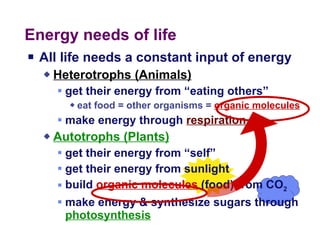
Energy needs of life All life needs a constant input of energy Heterotrophs (Animals) get their energy from “eating others” eat food = other organisms =  organic molecules make energy through  respiration Autotrophs (Plants)   get their energy from “self” get their energy from sunlight build  organic molecules  (food) from CO 2  make energy & synthesize sugars through  photosynthesis
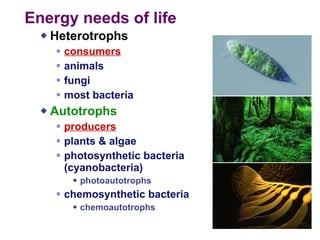
Energy needs of life Heterotrophs consumers animals fungi most bacteria Autotrophs   producers plants & algae photosynthetic bacteria (cyanobacteria) photoautotrophs chemosynthetic bacteria chemoautotrophs
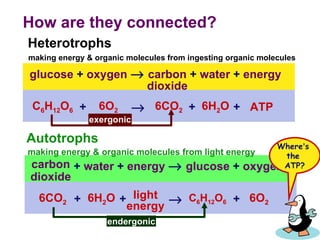
How are they connected? Heterotrophs Autotrophs making energy & organic molecules from light energy making energy & organic molecules from ingesting organic molecules Where ’ s  the  ATP? exergonic endergonic glucose  +  oxygen    carbon  +  water  +  energy dioxide C 6 H 12 O 6 6O 2 6CO 2 6H 2 O ATP  + + + +  water  +  energy    glucose  +  oxygen carbon dioxide 6CO 2 6H 2 O C 6 H 12 O 6 6O 2 light energy  + + +
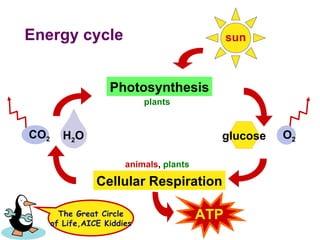
Energy cycle Photosynthesis Cellular Respiration O 2 CO 2 plants animals ,  plants ATP The Great Circle of Life,AICE Kiddies H 2 O sun glucose
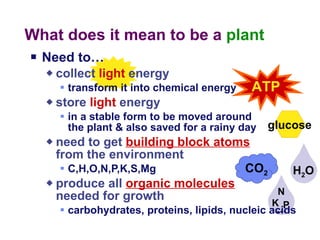
What does it mean to be a  plant Need to… collect  light  energy transform it into chemical energy store  light  energy in a stable form to be moved around  the plant & also saved for a rainy day  need to get  building block atoms   from the environment  C,H,O,N,P,K,S,Mg produce all  organic molecules   needed for growth carbohydrates, proteins, lipids, nucleic acids ATP CO 2 N P K … H 2 O glucose
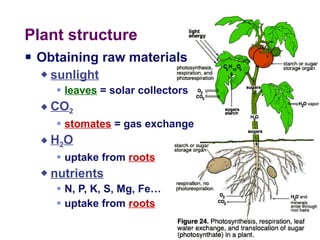
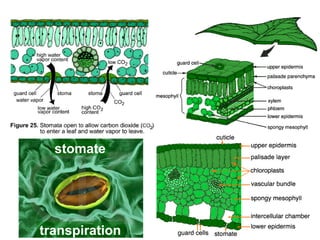
Plant structure  Obtaining raw materials sunlight leaves  = solar collectors CO 2 stomates  = gas exchange H 2 O uptake from  roots nutrients N, P, K, S, Mg, Fe…  uptake from  roots
stomate transpiration
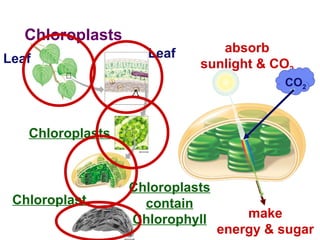
Chloroplasts Chloroplasts Leaf Leaf Chloroplast absorb sunlight & CO 2 make energy & sugar Chloroplasts contain Chlorophyll CO 2
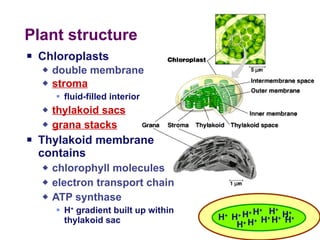
Chloroplasts double membrane stroma fluid-filled interior thylakoid sacs grana stacks Thylakoid membrane contains chlorophyll molecules electron transport chain ATP synthase H +  gradient built up within thylakoid sac Plant structure  H + H + H + H + H + H + H + H + H + H + H +
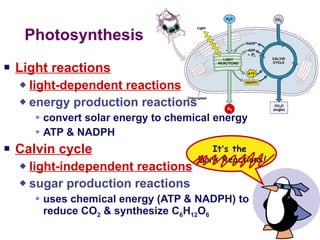
Photosynthesis Light reactions light-dependent reactions energy production reactions convert solar energy to chemical energy ATP & NADPH Calvin cycle light-independent reactions sugar production reactions uses chemical energy (ATP & NADPH) to reduce CO 2  & synthesize C 6 H 12 O 6 It ’ s the  Dark Reactions !
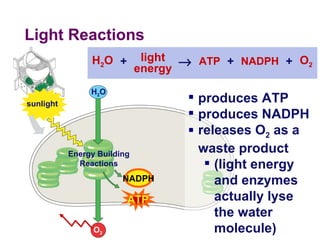
Light Reactions O 2 H 2 O Energy Building Reactions ATP produces ATP produces NADPH releases O 2  as a waste product (light energy and enzymes actually lyse the water molecule) NADPH sunlight H 2 O ATP O 2 light energy  + + + NADPH
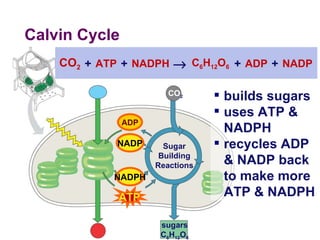
Calvin Cycle sugars C 6 H 12 O 6 CO 2 Sugar Building Reactions ADP builds sugars uses ATP & NADPH recycles ADP & NADP back to make more ATP & NADPH ATP NADPH NADP CO 2 C 6 H 12 O 6  + + + NADP ATP + NADPH ADP
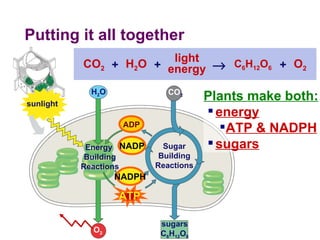
Putting it all together Sugar Building Reactions Energy  Building Reactions Plants make both: energy ATP & NADPH sugars O 2 H 2 O sugars C 6 H 12 O 6 CO 2 ADP ATP NADPH NADP CO 2 H 2 O C 6 H 12 O 6 O 2 light energy  + + + sunlight
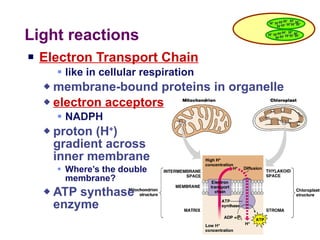
Light reactions Electron Transport Chain   like in cellular respiration membrane-bound proteins in organelle electron acceptors NADPH proton (H + )  gradient across  inner membrane Where’s the double  membrane? ATP synthase  enzyme H + H + H + H + H + H + H + H + H + H + H + H + H + H + H + H + H + H + H + H + H + H +
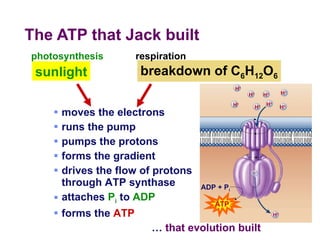
The ATP that Jack built moves the electrons  runs the pump pumps the protons forms the gradient drives the flow of protons  through ATP synthase attaches  P i  to  ADP forms the  ATP …  that evolution built sunlight breakdown of C 6 H 12 O 6 respiration photosynthesis ATP H + ADP + P i H + H + H + H + H + H + H + H +
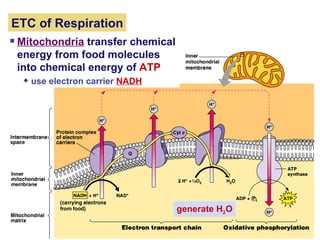
ETC of Respiration Mitochondria  transfer chemical energy from food molecules into chemical energy of  ATP  use electron carrier  NADH generate H 2 O
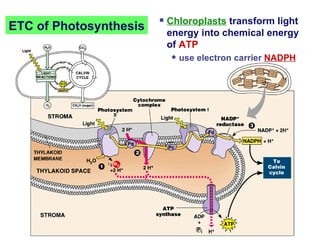
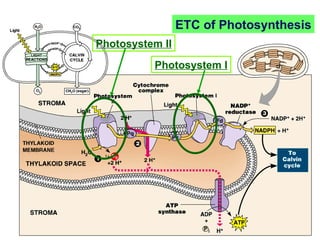
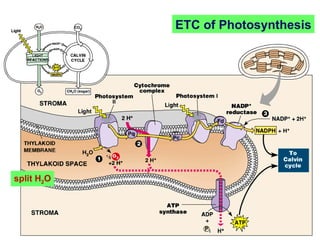
ETC of Photosynthesis Chloroplasts  transform light energy into chemical energy of  ATP use electron carrier  NADPH
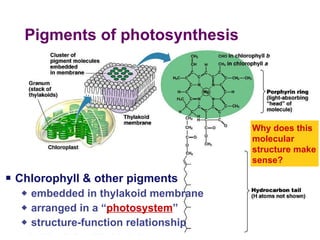
Pigments of photosynthesis  Chlorophyll & other pigments embedded in thylakoid membrane arranged in a “ photosystem ” structure-function relationship Why does this molecular structure make sense?
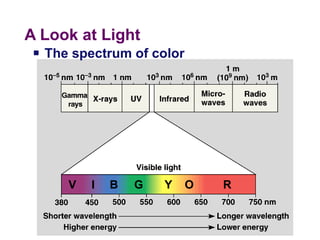
A Look at Light The spectrum of color  R O Y G B I V
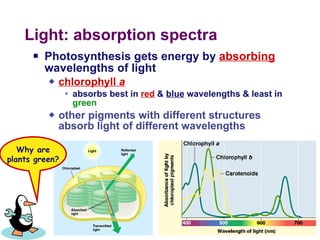
Light: absorption spectra Photosynthesis gets energy by  absorbing  wavelengths of light chlorophyll  a   absorbs best in  red  &  blue  wavelengths & least in  green other pigments with different structures absorb light of different wavelengths Why are plants green?
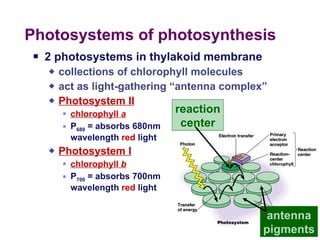
Photosystems of photosynthesis  2 photosystems in thylakoid membrane collections of chlorophyll molecules  act as light-gathering “antenna complex” Photosystem II chlorophyll  a P 680  = absorbs 680nm  wavelength  red  light  Photosystem I chlorophyll  b P 700  = absorbs 700nm  wavelength  red  light  reaction center antenna pigments
ETC of Photosynthesis Photosystem II Photosystem I
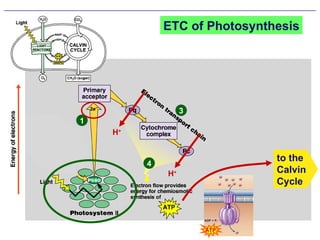
ETC of Photosynthesis 1 3 4 ATP H + H + H + ADP + P i H + H + H + H + H + H + H + H + to the Calvin Cycle
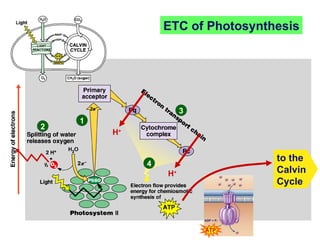
1 2 3 4 ATP ETC of Photosynthesis H + H + H + ADP + P i H + H + H + H + H + H + H + H + to the Calvin Cycle
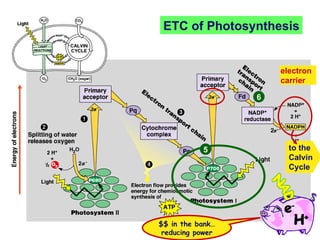
ETC of Photosynthesis 6 5 $$ in the bank… reducing power electron carrier to the Calvin Cycle
ETC of Photosynthesis split H 2 O
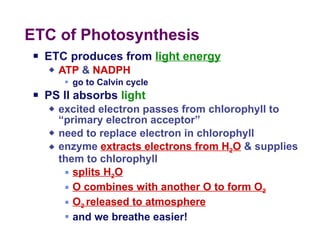
ETC of Photosynthesis ETC produces from  light energy ATP  &  NADPH go to Calvin cycle PS II absorbs  light excited electron passes from chlorophyll to “primary electron acceptor” need to replace electron in chlorophyll enzyme  extracts electrons from H 2 O  & supplies them to chlorophyll splits H 2 O O combines with another O to form O 2 O 2  released to atmosphere and we breathe easier!
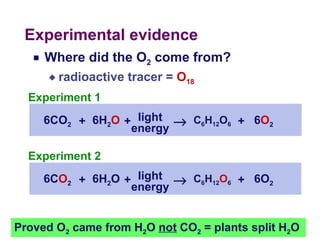
Experimental evidence Where did the O 2  come from? radioactive tracer =  O 18 Proved O 2  came from H 2 O  not  CO 2  = plants split H 2 O 6CO 2 6H 2 O C 6 H 12 O 6 6O 2 light energy  + + + 6CO 2 6H 2 O C 6 H 12 O 6 6 O 2 light energy  + + + Experiment 1 6C O 2 6H 2 O C 6 H 12 O 6 6O 2 light energy  + + + Experiment 2
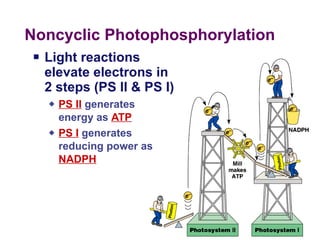
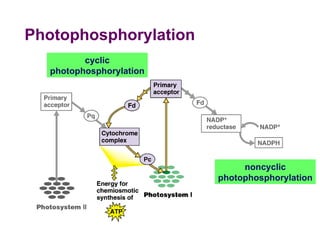
Noncyclic Photophosphorylation Light reactions elevate electrons in  2 steps (PS II & PS I)   PS II  generates  energy as  ATP PS I  generates  reducing power as  NADPH
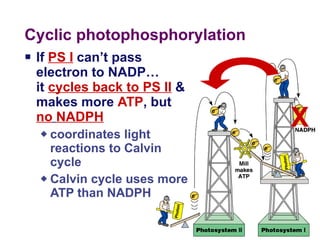
Cyclic photophosphorylation If  PS I  can’t pass electron to NADP… it  cycles back to PS II  & makes more  ATP , but  no   NADPH coordinates light reactions to Calvin cycle Calvin cycle uses more ATP than NADPH X
Photophosphorylation  noncyclic photophosphorylation cyclic photophosphorylation
Photosynthesis summary  Where did the energy come from? Where did the electrons come from?  Where did the H 2 O come from? Where did the O 2  come from? Where did the O 2  go?  Where did the H +  come from? Where did the ATP come from? What will the ATP be used for?  Where did the NADPH come from? What will the NADPH be used for? … stay tuned for the Calvin cycle
Any Questions??
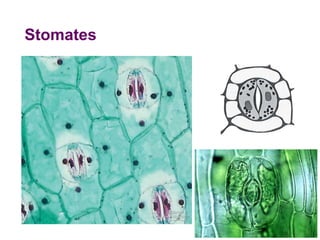
Stomates

Chapter 16 lecture 1

  • 1.
  • 2.
    Photosynthesis: Life from Light, Air & Water
  • 3.
    Energy needs oflife All life needs a constant input of energy Heterotrophs (Animals) get their energy from “eating others” eat food = other organisms = organic molecules make energy through respiration Autotrophs (Plants) get their energy from “self” get their energy from sunlight build organic molecules (food) from CO 2 make energy & synthesize sugars through photosynthesis
  • 4.
    Energy needs oflife Heterotrophs consumers animals fungi most bacteria Autotrophs producers plants & algae photosynthetic bacteria (cyanobacteria) photoautotrophs chemosynthetic bacteria chemoautotrophs
  • 5.
    How are theyconnected? Heterotrophs Autotrophs making energy & organic molecules from light energy making energy & organic molecules from ingesting organic molecules Where ’ s the ATP? exergonic endergonic glucose + oxygen  carbon + water + energy dioxide C 6 H 12 O 6 6O 2 6CO 2 6H 2 O ATP  + + + + water + energy  glucose + oxygen carbon dioxide 6CO 2 6H 2 O C 6 H 12 O 6 6O 2 light energy  + + +
  • 6.
    Energy cycle PhotosynthesisCellular Respiration O 2 CO 2 plants animals , plants ATP The Great Circle of Life,AICE Kiddies H 2 O sun glucose
  • 7.
    What does itmean to be a plant Need to… collect light energy transform it into chemical energy store light energy in a stable form to be moved around the plant & also saved for a rainy day need to get building block atoms from the environment C,H,O,N,P,K,S,Mg produce all organic molecules needed for growth carbohydrates, proteins, lipids, nucleic acids ATP CO 2 N P K … H 2 O glucose
  • 8.
    Plant structure Obtaining raw materials sunlight leaves = solar collectors CO 2 stomates = gas exchange H 2 O uptake from roots nutrients N, P, K, S, Mg, Fe… uptake from roots
  • 9.
  • 10.
    Chloroplasts Chloroplasts LeafLeaf Chloroplast absorb sunlight & CO 2 make energy & sugar Chloroplasts contain Chlorophyll CO 2
  • 11.
    Chloroplasts double membranestroma fluid-filled interior thylakoid sacs grana stacks Thylakoid membrane contains chlorophyll molecules electron transport chain ATP synthase H + gradient built up within thylakoid sac Plant structure H + H + H + H + H + H + H + H + H + H + H +
  • 12.
    Photosynthesis Light reactionslight-dependent reactions energy production reactions convert solar energy to chemical energy ATP & NADPH Calvin cycle light-independent reactions sugar production reactions uses chemical energy (ATP & NADPH) to reduce CO 2 & synthesize C 6 H 12 O 6 It ’ s the Dark Reactions !
  • 13.
    Light Reactions O2 H 2 O Energy Building Reactions ATP produces ATP produces NADPH releases O 2 as a waste product (light energy and enzymes actually lyse the water molecule) NADPH sunlight H 2 O ATP O 2 light energy  + + + NADPH
  • 14.
    Calvin Cycle sugarsC 6 H 12 O 6 CO 2 Sugar Building Reactions ADP builds sugars uses ATP & NADPH recycles ADP & NADP back to make more ATP & NADPH ATP NADPH NADP CO 2 C 6 H 12 O 6  + + + NADP ATP + NADPH ADP
  • 15.
    Putting it alltogether Sugar Building Reactions Energy Building Reactions Plants make both: energy ATP & NADPH sugars O 2 H 2 O sugars C 6 H 12 O 6 CO 2 ADP ATP NADPH NADP CO 2 H 2 O C 6 H 12 O 6 O 2 light energy  + + + sunlight
  • 16.
    Light reactions ElectronTransport Chain like in cellular respiration membrane-bound proteins in organelle electron acceptors NADPH proton (H + ) gradient across inner membrane Where’s the double membrane? ATP synthase enzyme H + H + H + H + H + H + H + H + H + H + H + H + H + H + H + H + H + H + H + H + H + H +
  • 17.
    The ATP thatJack built moves the electrons runs the pump pumps the protons forms the gradient drives the flow of protons through ATP synthase attaches P i to ADP forms the ATP … that evolution built sunlight breakdown of C 6 H 12 O 6 respiration photosynthesis ATP H + ADP + P i H + H + H + H + H + H + H + H +
  • 18.
    ETC of RespirationMitochondria transfer chemical energy from food molecules into chemical energy of ATP use electron carrier NADH generate H 2 O
  • 19.
    ETC of PhotosynthesisChloroplasts transform light energy into chemical energy of ATP use electron carrier NADPH
  • 20.
    Pigments of photosynthesis Chlorophyll & other pigments embedded in thylakoid membrane arranged in a “ photosystem ” structure-function relationship Why does this molecular structure make sense?
  • 21.
    A Look atLight The spectrum of color R O Y G B I V
  • 22.
    Light: absorption spectraPhotosynthesis gets energy by absorbing wavelengths of light chlorophyll a absorbs best in red & blue wavelengths & least in green other pigments with different structures absorb light of different wavelengths Why are plants green?
  • 23.
    Photosystems of photosynthesis 2 photosystems in thylakoid membrane collections of chlorophyll molecules act as light-gathering “antenna complex” Photosystem II chlorophyll a P 680 = absorbs 680nm wavelength red light Photosystem I chlorophyll b P 700 = absorbs 700nm wavelength red light reaction center antenna pigments
  • 24.
    ETC of PhotosynthesisPhotosystem II Photosystem I
  • 25.
    ETC of Photosynthesis1 3 4 ATP H + H + H + ADP + P i H + H + H + H + H + H + H + H + to the Calvin Cycle
  • 26.
    1 2 34 ATP ETC of Photosynthesis H + H + H + ADP + P i H + H + H + H + H + H + H + H + to the Calvin Cycle
  • 27.
    ETC of Photosynthesis6 5 $$ in the bank… reducing power electron carrier to the Calvin Cycle
  • 28.
  • 29.
    ETC of PhotosynthesisETC produces from light energy ATP & NADPH go to Calvin cycle PS II absorbs light excited electron passes from chlorophyll to “primary electron acceptor” need to replace electron in chlorophyll enzyme extracts electrons from H 2 O & supplies them to chlorophyll splits H 2 O O combines with another O to form O 2 O 2 released to atmosphere and we breathe easier!
  • 30.
    Experimental evidence Wheredid the O 2 come from? radioactive tracer = O 18 Proved O 2 came from H 2 O not CO 2 = plants split H 2 O 6CO 2 6H 2 O C 6 H 12 O 6 6O 2 light energy  + + + 6CO 2 6H 2 O C 6 H 12 O 6 6 O 2 light energy  + + + Experiment 1 6C O 2 6H 2 O C 6 H 12 O 6 6O 2 light energy  + + + Experiment 2
  • 31.
    Noncyclic Photophosphorylation Lightreactions elevate electrons in 2 steps (PS II & PS I) PS II generates energy as ATP PS I generates reducing power as NADPH
  • 32.
    Cyclic photophosphorylation If PS I can’t pass electron to NADP… it cycles back to PS II & makes more ATP , but no NADPH coordinates light reactions to Calvin cycle Calvin cycle uses more ATP than NADPH X
  • 33.
    Photophosphorylation noncyclicphotophosphorylation cyclic photophosphorylation
  • 34.
    Photosynthesis summary Where did the energy come from? Where did the electrons come from? Where did the H 2 O come from? Where did the O 2 come from? Where did the O 2 go? Where did the H + come from? Where did the ATP come from? What will the ATP be used for? Where did the NADPH come from? What will the NADPH be used for? … stay tuned for the Calvin cycle
  • 35.
  • 36.

Editor's Notes

  • #6 So, in effect, photosynthesis is respiration run backwards powered by light. Cellular Respiration oxidize C 6 H 12 O 6  CO 2 & produce H 2 O fall of electrons downhill to O 2 exergonic Photosynthesis reduce CO 2  C 6 H 12 O 6 & produce O 2 boost electrons uphill by splitting H 2 O endergonic
  • #12 A typical mesophyll cell has 30-40 chloroplasts, each about 2-4 microns by 4-7 microns long. Each chloroplast has two membranes around a central aqueous space, the stroma. In the stroma are membranous sacs, the thylakoids. These have an internal aqueous space, the thylakoid lumen or thylakoid space. Thylakoids may be stacked into columns called grana.
  • #17 Not accidental that these 2 systems are similar, because both derived from the same primitive ancestor.
  • #19 NADH is an input ATP is an output O 2 combines with H + ’s to form water Electron is being handed off from one electron carrier to another -- proteins, cytochrome proteins & quinone lipids So what if it runs in reverse??
  • #20 Two places where light comes in. Remember photosynthesis is endergonic -- the electron transport chain is driven by light energy. Need to look at that in more detail on next slide
  • #24 Photons are absorbed by clusters of pigment molecules ( antenna molecules) in the thylakoid membrane. When any antenna molecule absorbs a photon, it is transmitted from molecule to molecule until it reaches a particular chlorophyll a molecule = the reaction center . At the reaction center is a primary electron acceptor which removes an excited electron from the reaction center chlorophyll a. This starts the light reactions. Don’t compete with each other, work synergistically using different wavelengths.
  • #25 Two places where light comes in. Remember photosynthesis is endergonic -- the electron transport chain is driven by light energy. Need to look at that in more detail on next slide
  • #26 PS II absorbs light Excited electron passes from chlorophyll to the primary electron acceptor Need to replace electron in chlorophyll An enzyme extracts electrons from H 2 O & supplies them to the chlorophyll This reaction splits H 2 O into 2 H + & O - which combines with another O - to form O 2 O 2 released to atmosphere Chlorophyll absorbs light energy (photon) and this moves an electron to a higher energy state Electron is handed off down chain from electron acceptor to electron acceptor In process has collected H + ions from H 2 O & also pumped by Plastoquinone within thylakoid sac. Flow back through ATP synthase to generate ATP.
  • #28 Need a 2nd photon -- shot of light energy to excite electron back up to high energy state. 2nd ETC drives reduction of NADP to NADPH. Light comes in at 2 points. Produce ATP & NADPH
  • #29 Two places where light comes in. Remember photosynthesis is endergonic -- the electron transport chain is driven by light energy. Need to look at that in more detail on next slide
  • #32 1 photosystem is not enough. Have to lift electron in 2 stages to a higher energy level. Does work as it falls. First, produce ATP -- but producing ATP is not enough. Second, need to produce organic molecules for other uses & also need to produce a stable storage molecule for a rainy day (sugars). This is done in Calvin Cycle!