DR POTNURU SRINIASA SUDHAKAR
M.D.(HOMOEO)
PROF AND HOD SURGERY
• The animal kingdom can be broadly classified into
two groups, depending upon their body
temperature.
• Those who can maintain their body temperature
relatively constant in the face of wide variations
of environmental temperature are known as
warm-blooded animals or homeotherms,
whereas those whose temperature fluctuates
with fluctuations of the environmental
temperature are termed cold-blooded animals or
poikilotherms.
• In the course of evolution, from poikilotherms
to homoiotherms, there exist another group
who are known as hibernates, going into
hibernation in winter, otherwise behaving like
the warm-blooded animals in the remaining
period.
• Hibernating mammals do not require an
external source of heat to raise their body
temperature to normal and can rouse
themselves probably by activating their large
stores of brown fat.
• Normal temperature:
• Oral 97° -99°F or 36.11 ° -37.22°C (average
98.4°F or 36.89 °C).
• Axillary (or groin) temperature is 1 °F or
0.55°C less.
• Rectal and oesophageal temperatures are 1 °F
or 0.55°C more.
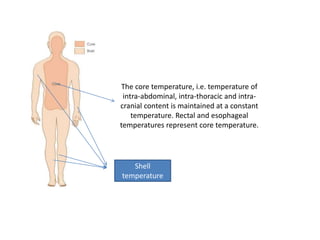
• The body is hypothetically divided into
core and shell.
The core temperature, i.e. temperature of
intra-abdominal, intra-thoracic and intra-
cranial content is maintained at a constant
temperature. Rectal and esophageal
temperatures represent core temperature.
Shell
temperature
FACTORS AFFECTING BODY TEMPERATURE
1. Diurnal variation
• It is highest in the evening ( after the day's labor-
between 5 and 7 pm) and lowest in the early
hours of the morning (after the night's rest).
• In the night-workers, the rhythm is reversed.
• The average range of variation is 1 °F (0.55°C) to
l.5°F (0.83°C).
• This diurnal variation is related to exercise and
specific dynamic action (SDA) of food.
• Fasting and absolute bed rest abolishes this
variation.
2. Age
• In infants regulation is imperfect.
• Hence, range of variation is wider.
• A fit of crying may raise and a cold bath may
lower the body temperature.
• In old age, the body temperature may be
subnormal due to low BMR.
3. Size
• Heat production and heat loss depend upon
the ratio of mass to body surface area.
• In a mouse, heat production is 452 large
calories per kilogram body weight per 24
hours; whereas in a horse it is only 14.5 large
calories.
4. Sex
• In females the body temperature may be a little lower.
• This is due to relatively low BMR and thick layer of
subcutaneous fat (non-conductor).
• During menstruation, temperature slightly falls (0.3°F
or O.l7°C).
• Then it gradually rises and becomes maximum 24 to 48
hours after the ovulation.
• This rise is due to progesterone level of blood which is
secreted by the corpus luteum.
• Regular record of oral temperature in the early
morning is sometimes used to detect the exact date of
ovulation in a woman, in clinical practice.
5. Food
• Protein food, due to high SDA may raise body
temperature.
• The act of ingestion of food may also raise
body temperature.
6. Exercise
• Increases temperature (only 25% of muscular
energy is converted into mechanical work, the
rest comes out as heat).
7. Atmospheric conditions
• Temperature, humidity and movement of air
are directly concerned with the amount of
heat loss from the surface and thus affect
body temperature.
8. Cold and warm baths
• These have a far greater influence than air at
the same temperature, but since the duration
of exposure to these baths are short, they
have a little effect on the normal body
temperature.
• However, body temperature may remain
elevated for a considerable time after a
prolonged hot water bath.
9. Sleep
• Because of muscular inactivity, sleep results in
a slight fall of body temperature
10. Emotion
• Body temperature may rise due to emotional
disturbances.
• The rise of temperature may be as high as 2 °C
• 11. General anaesthetics or chlorpromazine
reduce the body temperature by depressing
the activity of the ascending reticular system.
• 11. Posture, piloerection and clothing are also
important factors which affect the body
temperature.
• All animals and even man may conserve heat
or may prevent heat loss by curling them up
during exposure to cold.
REGULATION OF BODY TEMPERATURE
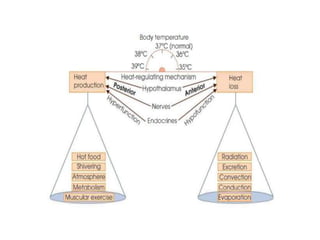
• A large amount of heat is produced and lost from
the body constantly, yet the body temperature
remains fixed within a limited range.
• The physiologic process of heat production in the
body is known as THERMOGENESIS.
• Dissipation of bodily heat by means of radiation,
evaporation, etc. is called THERMOLYSIS.
• The mechanism by which body temperature is
normally adjusted is known as the THERMOTAXIS.
MECHANISMS OF HEAT PRODUCTION
(THERMOGENESIS)
Heat production
• Heat production takes place through
physiological oxidation of food materials in the
body-by combustion of carbohydrates,
proteins and fats.
• Cold climate stimulates appetite.
• Subjects take more food and proportionately
higher amounts of fat.
• Higher fat intake increases heat production.
• Increasing the activity of the muscles whether
voluntarily or involuntarily thus automatically
increases the heat production.
• Shivering increase heat production although not
as high as voluntary muscular exercise.
• Ingestion of hot foods or drinks contributes to
heat production in negligible amounts.
• Heat produced by liver and heart is relatively
constant.
• The action of some internal secretion and
enzymes, e.g. thyroxine and epinephrine
(possibly) also helps to heat production.
• During digestion the peristaltic action of
intestines and the activity of various digestive
glands produce heat.
• Increased heat production which occurs by
increasing the BMR and metabolic activity is
termed chemical thermogenesis, while the
heat production by increased muscular
activity is termed physical thermogenesis.
MECHANISMS OF HEAT LOSS
(THERMOLYSIS)
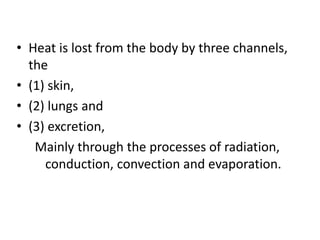
• Heat is lost from the body by three channels,
the
• (1) skin,
• (2) lungs and
• (3) excretion,
Mainly through the processes of radiation,
conduction, convection and evaporation.
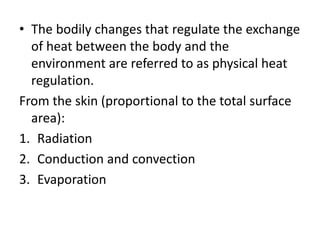
• The bodily changes that regulate the exchange
of heat between the body and the
environment are referred to as physical heat
regulation.
From the skin (proportional to the total surface
area):
1. Radiation
2. Conduction and convection
3. Evaporation
1. Radiation
• Due to the difference of temperature existing
between the body and the cooler
environment heat is lost from the body by
radiation (loss by electromagnetic waves).
• The body however does not radiate to the
surrounding air, but through the air to the
solid objects in the vicinity.
1. Radiation
• When a number of people are present in a room, they
radiate towards one another as well as to the
surrounding objects.
• Amount of heat lost by this process is about 55% of
total heat lost.
• The amount of radiation from an object is determined
by several factors.
• It is proportional to the surface area of the body, to its
emissive power, and to the difference in temperature
between the radiating body and the surrounding
objects (actually to the difference between the fourth
power of the absolute temperatures of each
respectively).
1. Radiation
• However, the colour of human skin has no
effect upon the degree of radiation; both
white and black skin is a 97% perfect black
body.
• [A body absorbing 100% of the radiant energy
falling on its surface is a perfect black body.]
2.Conduction and convection
• The molecules of the air gradually get warmed
and move away from the skin.
• Another layer of cooler air takes its place.
• Heat loss through convection depends upon
the relative density and temperature of air
and wind velocity but not on relative humidity
of the air.
2.Conduction and convection
• About 20% of heat is lost from the body
through conduction and convection.
• The heat loss through these processes
depends upon the temperature of the
surrounding atmosphere.
• When the temperature of the surrounding
atmosphere is low, heat is lost from the skin to
the surrounding air.
2.Conduction and convection
• Besides these factors, adjustment of the blood
vascular system plays an important role.
• Not only variation of blood flow and caliber of
the cutaneous blood vessels alter the skin
temperature but arteriovenous anastomoses
and alignment of veins and arteries-venae
comitantes also help to regulate temperature.
2.Conduction and convection
• Vasoconstriction of the cutaneous vessels
reduces blood flow and thereby less heat is
lost from the body, whereas vasodilatation
produces opposite effect.
• Wearing woolen clothes, which are bad
conductors of heat, also decrease the heat
loss through conduction.
2.Conduction and convection
• Heat loss is prevented due to the entrapment
of air between clothes and body surface.
3. Evaporation
• About 25% of heat is lost by evaporation from
the body including lungs.
3. Evaporation
From skin:
Insensible perspiration occurs due to continuous
diffusion of fluid from the capillaries of the
deeper layer of skin to the dry surface of skin.
The sweat is vapourised from the surface of the
skin, which decreases its temperature,
because it is found that 1 gm of water
vapourised from the surface produces the loss
of about 580 kcal.
3. Evaporation
• Evaporation decreases to a great extent if the
humidity of the atmosphere is high.
• For this reason a person can better tolerate
high but dry atmospheric temperature than
high humid one.
3. Evaporation
• About 25% of heat is lost by evaporation from
the body including lungs.
From skin
• Insensible perspiration occurs due to continuous
diffusion of fluid from the capillaries of the
deeper layer of skin to the dry surface of skin.
• The sweat is vaporized from the surface of the
skin, which decreases its temperature, because it
is found that 1 gm of water vaporized from the
surface produces the loss of about 580 kcal.
• Evaporation decreases to a great extent if the
humidity of the atmosphere is high.
• For this reason a person can better tolerate high
but dry atmospheric temperature than high
humid one.
From lungs
• Evaporation of water in expired air is the main
pathway through which heat is lost in dogs
and sheep.
• Heat lost for warming the inspired air is about
2% in man.
By excreta
• Urine, faeces, etc. about 2%.
• Protrusion of the tongue facilitates heat loss
through salivation in dogs.
NERVOUS SYSTEM AND THERMOTAXIS
• Nervous system controls both heat production
and heat loss in the following ways:
1. Role of cerebrum
2. Role of hypothalamus
3. Role of autonomic nervous system
4. Role of spinal cord in heat regulation
5. Role of motor fibers of the cerebrospinal
system in heat regulation
1. Role of cerebrum
• Removal of cerebrum makes very little
change.
• The regulating capacity only becomes slightly
restricted.
• The animal responds normally to external heat
or cold but the body temperature falls if kept
in the cold room for a long time.
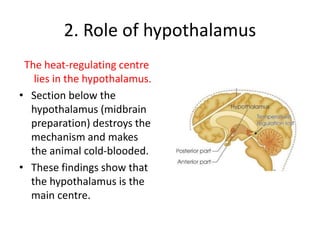
2. Role of hypothalamus
The heat-regulating centre
lies in the hypothalamus.
• Section below the
hypothalamus (midbrain
preparation) destroys the
mechanism and makes
the animal cold-blooded.
• These findings show that
the hypothalamus is the
main centre.
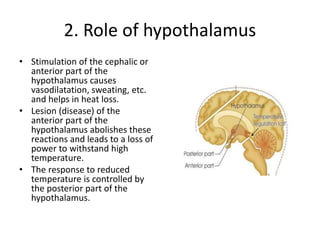
2. Role of hypothalamus
• Stimulation of the cephalic or
anterior part of the
hypothalamus causes
vasodilatation, sweating, etc.
and helps in heat loss.
• Lesion (disease) of the
anterior part of the
hypothalamus abolishes these
reactions and leads to a loss of
power to withstand high
temperature.
• The response to reduced
temperature is controlled by
the posterior part of the
hypothalamus.
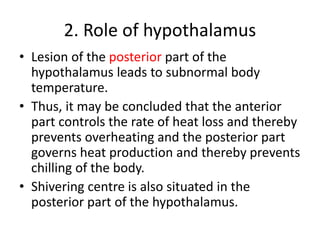
2. Role of hypothalamus
• Lesion of the posterior part of the
hypothalamus leads to subnormal body
temperature.
• Thus, it may be concluded that the anterior
part controls the rate of heat loss and thereby
prevents overheating and the posterior part
governs heat production and thereby prevents
chilling of the body.
• Shivering centre is also situated in the
posterior part of the hypothalamus.
2. Role of hypothalamus
• Hypothalamus exerts its effects by controlling
autonomic nervous system and by controlling
the ductless glands.
3. Role of autonomic nervous system
• Only a few thermal responses are mediated by
the para-sympathetic division, e.g. salivary
secretion, secretion of glands of the pharynx
and respiratory tract, and local vasodilatation
followed by activity.
3. Role of autonomic nervous system
• Greater part of the generalized thermal
responses in visceral effectors is due to
sympathetic control, e.g. constriction of
peripheral vessels, erection of hair and
feathers, liberation of epinephrine and
norepinephrine, sweating and cutaneous
vasodilatation.
3. Role of autonomic nervous system
• It has been definitely established that adrenal
medulla is an integral part of the sympathetic
system.
• Sympathetic nervous system is best known for its
role in responding to dangerous or stressful
situations. In these situations, your sympathetic
nervous system activates to speed up heart rate,
deliver more blood to areas of your body that
need more oxygen or other responses to help
your get out of danger.
• Parasympathetic nervous system is a network of
nerves that relaxes your body after periods of
stress or danger. It also helps run life-sustaining
processes, like digestion, during times when you
feel safe and relaxed.
4. Role of spinal cord in heat
regulation
• Spinal cord is the connecting path between
the heat-regulating centers in the
hypothalamus, peripheral thermoreceptors
and effector organs (muscles).
• The cervical segment of the spinal cord
transmits greater part of the sympathetic
outflow, which regulates peripheral circulation
and hence heat regulation.
4. Role of spinal cord in heat
regulation
• Spinothalamic tracts of the spinal cord carry
the efferent impulse for shivering from higher
centres.
• Effect of section through spinal cord on
thermoregulation depends upon the level.
• When the section of the cord is made above
or through the level of sympathetic outflow (
cervical segments), gross disturbance of
temperature regulation occurs.
4. Role of spinal cord in heat
regulation
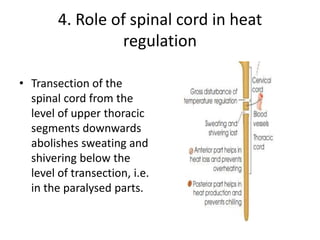
• Transection of the
spinal cord from the
level of upper thoracic
segments downwards
abolishes sweating and
shivering below the
level of transection, i.e.
in the paralysed parts.
5. Role of motor fibers of the cerebrospinal
system in heat regulation
• Muscle tone alone (even without locomotion
and exercise) is a continuous source of heat
production.
• Central nervous system maintains the muscle
tone (thermal muscle tone) by continuous
discharge of impulses to the muscles via the
motor fibers.
5. Role of motor fibers of the cerebrospinal
system in heat regulation
• Exaggerated 'thermal muscle tone' to the
extent of tremor is described as shivering.
• Shivering impulses from the shivering centre
are not transmitted via the sympathetic
system but via the motor fibers of
cerebrospinal system.
INTERACTION OF CENTRAL AND PERIPHERAL
FACTORS
Central and Reflex Control
The normal stimulus which mobilises nervous
influence arises in two ways:
• 1. Variations of external temperature affect
the skin thermal receptors and reflexly
regulate the heat regulating centers of the
hypothalamus.
• Recent evidences indicate that there are
temperature sensitive cells in the
hypothalamus (thermo detectors) that
respond to high temperature.
• 2. Temperature of blood, directly bathing the
heatregulating centres, adjusts its activities.
• For instance, warming the blood in the carotid
artery causes those changes which increase
heat loss, viz. sweating, cutaneous
vasodilatation, increased respiration, etc.
• Cooling the carotid blood causes opposite
changes.
• The relative roles played by peripheral and
central thermoreceptors in the regulation of
body temperature are not easily determined.
Role of Endocrines
• Certain endocrine glands also take part in heat
production and heat loss.
• For instance:
Thyroid:
• Thyroxine stimulates BMR.
• Cold stimulates and heat reduces thyroid secretion.
• In cold, excess thyroid-stimulating hormone (TSH) is
liberated from the anterior pituitary and thereby
excess thyroid hormones are secreted from the thyroid
gland in controlling low body temperature.
• In cretinism and myxoedema body temperature is
subnormal.
• Thyroidectomised animals cannot maintain the normal
body temperature.
• The skin thermal receptors are responsible for
bringing about early thermoregulatory
changes in response to environmental
temperature changes.
• Hypothalamic thermodetector cells are more
important in that, final thermoregulatory
adjustments are brought about by them.
Anterior pituitary:
• Thyrotrophic hormone stimulates secretion of
thyroxine and helps in the maintenance of
body temperature.
• Adrenocorticotrophic hormone (ACTH) is
secreted under increased or decreased body
temperature (cold stress or heat stress
respectively).
Adrenal medulla:
• It helps in both ways.
• Cold reflexly stimulates adrenaline secretion,
which increases heat production by stimulating
metabolism.
• There is increased tissue oxidation and also
accelerated conversion of liver glycogen to blood
glucose.
• The former is of special importance in
temperature regulation.
• It also reduces heat loss by peripheral
vasoconstriction.
Adrenal cortex:
• Adrenal corticoid secretion is stimulated by
the increase or decrease of environmental
temperature.
• Usually a low body temperature has been
noted in Addison's disease (hypofunction of
adrenal cortex).
BODY TEMPERATURE AND ITS REGULATION.pptx

BODY TEMPERATURE AND ITS REGULATION.pptx

  • 1.
    DR POTNURU SRINIASASUDHAKAR M.D.(HOMOEO) PROF AND HOD SURGERY
  • 2.
    • The animalkingdom can be broadly classified into two groups, depending upon their body temperature. • Those who can maintain their body temperature relatively constant in the face of wide variations of environmental temperature are known as warm-blooded animals or homeotherms, whereas those whose temperature fluctuates with fluctuations of the environmental temperature are termed cold-blooded animals or poikilotherms.
  • 3.
    • In thecourse of evolution, from poikilotherms to homoiotherms, there exist another group who are known as hibernates, going into hibernation in winter, otherwise behaving like the warm-blooded animals in the remaining period. • Hibernating mammals do not require an external source of heat to raise their body temperature to normal and can rouse themselves probably by activating their large stores of brown fat.
  • 4.
    • Normal temperature: •Oral 97° -99°F or 36.11 ° -37.22°C (average 98.4°F or 36.89 °C). • Axillary (or groin) temperature is 1 °F or 0.55°C less. • Rectal and oesophageal temperatures are 1 °F or 0.55°C more. • The body is hypothetically divided into core and shell.
  • 5.
    The core temperature,i.e. temperature of intra-abdominal, intra-thoracic and intra- cranial content is maintained at a constant temperature. Rectal and esophageal temperatures represent core temperature. Shell temperature
  • 6.
  • 7.
    1. Diurnal variation •It is highest in the evening ( after the day's labor- between 5 and 7 pm) and lowest in the early hours of the morning (after the night's rest). • In the night-workers, the rhythm is reversed. • The average range of variation is 1 °F (0.55°C) to l.5°F (0.83°C). • This diurnal variation is related to exercise and specific dynamic action (SDA) of food. • Fasting and absolute bed rest abolishes this variation.
  • 8.
    2. Age • Ininfants regulation is imperfect. • Hence, range of variation is wider. • A fit of crying may raise and a cold bath may lower the body temperature. • In old age, the body temperature may be subnormal due to low BMR.
  • 9.
    3. Size • Heatproduction and heat loss depend upon the ratio of mass to body surface area. • In a mouse, heat production is 452 large calories per kilogram body weight per 24 hours; whereas in a horse it is only 14.5 large calories.
  • 10.
    4. Sex • Infemales the body temperature may be a little lower. • This is due to relatively low BMR and thick layer of subcutaneous fat (non-conductor). • During menstruation, temperature slightly falls (0.3°F or O.l7°C). • Then it gradually rises and becomes maximum 24 to 48 hours after the ovulation. • This rise is due to progesterone level of blood which is secreted by the corpus luteum. • Regular record of oral temperature in the early morning is sometimes used to detect the exact date of ovulation in a woman, in clinical practice.
  • 11.
    5. Food • Proteinfood, due to high SDA may raise body temperature. • The act of ingestion of food may also raise body temperature.
  • 12.
    6. Exercise • Increasestemperature (only 25% of muscular energy is converted into mechanical work, the rest comes out as heat).
  • 13.
    7. Atmospheric conditions •Temperature, humidity and movement of air are directly concerned with the amount of heat loss from the surface and thus affect body temperature.
  • 14.
    8. Cold andwarm baths • These have a far greater influence than air at the same temperature, but since the duration of exposure to these baths are short, they have a little effect on the normal body temperature. • However, body temperature may remain elevated for a considerable time after a prolonged hot water bath.
  • 15.
    9. Sleep • Becauseof muscular inactivity, sleep results in a slight fall of body temperature
  • 16.
    10. Emotion • Bodytemperature may rise due to emotional disturbances. • The rise of temperature may be as high as 2 °C
  • 17.
    • 11. Generalanaesthetics or chlorpromazine reduce the body temperature by depressing the activity of the ascending reticular system.
  • 18.
    • 11. Posture,piloerection and clothing are also important factors which affect the body temperature. • All animals and even man may conserve heat or may prevent heat loss by curling them up during exposure to cold.
  • 19.
    REGULATION OF BODYTEMPERATURE
  • 20.
    • A largeamount of heat is produced and lost from the body constantly, yet the body temperature remains fixed within a limited range. • The physiologic process of heat production in the body is known as THERMOGENESIS. • Dissipation of bodily heat by means of radiation, evaporation, etc. is called THERMOLYSIS. • The mechanism by which body temperature is normally adjusted is known as the THERMOTAXIS.
  • 21.
    MECHANISMS OF HEATPRODUCTION (THERMOGENESIS)
  • 22.
    Heat production • Heatproduction takes place through physiological oxidation of food materials in the body-by combustion of carbohydrates, proteins and fats. • Cold climate stimulates appetite. • Subjects take more food and proportionately higher amounts of fat. • Higher fat intake increases heat production.
  • 23.
    • Increasing theactivity of the muscles whether voluntarily or involuntarily thus automatically increases the heat production. • Shivering increase heat production although not as high as voluntary muscular exercise. • Ingestion of hot foods or drinks contributes to heat production in negligible amounts. • Heat produced by liver and heart is relatively constant. • The action of some internal secretion and enzymes, e.g. thyroxine and epinephrine (possibly) also helps to heat production.
  • 24.
    • During digestionthe peristaltic action of intestines and the activity of various digestive glands produce heat. • Increased heat production which occurs by increasing the BMR and metabolic activity is termed chemical thermogenesis, while the heat production by increased muscular activity is termed physical thermogenesis.
  • 25.
    MECHANISMS OF HEATLOSS (THERMOLYSIS)
  • 27.
    • Heat islost from the body by three channels, the • (1) skin, • (2) lungs and • (3) excretion, Mainly through the processes of radiation, conduction, convection and evaporation.
  • 28.
    • The bodilychanges that regulate the exchange of heat between the body and the environment are referred to as physical heat regulation. From the skin (proportional to the total surface area): 1. Radiation 2. Conduction and convection 3. Evaporation
  • 29.
    1. Radiation • Dueto the difference of temperature existing between the body and the cooler environment heat is lost from the body by radiation (loss by electromagnetic waves). • The body however does not radiate to the surrounding air, but through the air to the solid objects in the vicinity.
  • 30.
    1. Radiation • Whena number of people are present in a room, they radiate towards one another as well as to the surrounding objects. • Amount of heat lost by this process is about 55% of total heat lost. • The amount of radiation from an object is determined by several factors. • It is proportional to the surface area of the body, to its emissive power, and to the difference in temperature between the radiating body and the surrounding objects (actually to the difference between the fourth power of the absolute temperatures of each respectively).
  • 31.
    1. Radiation • However,the colour of human skin has no effect upon the degree of radiation; both white and black skin is a 97% perfect black body. • [A body absorbing 100% of the radiant energy falling on its surface is a perfect black body.]
  • 32.
    2.Conduction and convection •The molecules of the air gradually get warmed and move away from the skin. • Another layer of cooler air takes its place. • Heat loss through convection depends upon the relative density and temperature of air and wind velocity but not on relative humidity of the air.
  • 33.
    2.Conduction and convection •About 20% of heat is lost from the body through conduction and convection. • The heat loss through these processes depends upon the temperature of the surrounding atmosphere. • When the temperature of the surrounding atmosphere is low, heat is lost from the skin to the surrounding air.
  • 34.
    2.Conduction and convection •Besides these factors, adjustment of the blood vascular system plays an important role. • Not only variation of blood flow and caliber of the cutaneous blood vessels alter the skin temperature but arteriovenous anastomoses and alignment of veins and arteries-venae comitantes also help to regulate temperature.
  • 35.
    2.Conduction and convection •Vasoconstriction of the cutaneous vessels reduces blood flow and thereby less heat is lost from the body, whereas vasodilatation produces opposite effect. • Wearing woolen clothes, which are bad conductors of heat, also decrease the heat loss through conduction.
  • 36.
    2.Conduction and convection •Heat loss is prevented due to the entrapment of air between clothes and body surface.
  • 37.
    3. Evaporation • About25% of heat is lost by evaporation from the body including lungs.
  • 38.
    3. Evaporation From skin: Insensibleperspiration occurs due to continuous diffusion of fluid from the capillaries of the deeper layer of skin to the dry surface of skin. The sweat is vapourised from the surface of the skin, which decreases its temperature, because it is found that 1 gm of water vapourised from the surface produces the loss of about 580 kcal.
  • 39.
    3. Evaporation • Evaporationdecreases to a great extent if the humidity of the atmosphere is high. • For this reason a person can better tolerate high but dry atmospheric temperature than high humid one.
  • 40.
    3. Evaporation • About25% of heat is lost by evaporation from the body including lungs.
  • 41.
    From skin • Insensibleperspiration occurs due to continuous diffusion of fluid from the capillaries of the deeper layer of skin to the dry surface of skin. • The sweat is vaporized from the surface of the skin, which decreases its temperature, because it is found that 1 gm of water vaporized from the surface produces the loss of about 580 kcal. • Evaporation decreases to a great extent if the humidity of the atmosphere is high. • For this reason a person can better tolerate high but dry atmospheric temperature than high humid one.
  • 42.
    From lungs • Evaporationof water in expired air is the main pathway through which heat is lost in dogs and sheep. • Heat lost for warming the inspired air is about 2% in man.
  • 43.
    By excreta • Urine,faeces, etc. about 2%. • Protrusion of the tongue facilitates heat loss through salivation in dogs.
  • 44.
    NERVOUS SYSTEM ANDTHERMOTAXIS
  • 45.
    • Nervous systemcontrols both heat production and heat loss in the following ways: 1. Role of cerebrum 2. Role of hypothalamus 3. Role of autonomic nervous system 4. Role of spinal cord in heat regulation 5. Role of motor fibers of the cerebrospinal system in heat regulation
  • 46.
    1. Role ofcerebrum • Removal of cerebrum makes very little change. • The regulating capacity only becomes slightly restricted. • The animal responds normally to external heat or cold but the body temperature falls if kept in the cold room for a long time.
  • 47.
    2. Role ofhypothalamus The heat-regulating centre lies in the hypothalamus. • Section below the hypothalamus (midbrain preparation) destroys the mechanism and makes the animal cold-blooded. • These findings show that the hypothalamus is the main centre.
  • 48.
    2. Role ofhypothalamus • Stimulation of the cephalic or anterior part of the hypothalamus causes vasodilatation, sweating, etc. and helps in heat loss. • Lesion (disease) of the anterior part of the hypothalamus abolishes these reactions and leads to a loss of power to withstand high temperature. • The response to reduced temperature is controlled by the posterior part of the hypothalamus.
  • 49.
    2. Role ofhypothalamus • Lesion of the posterior part of the hypothalamus leads to subnormal body temperature. • Thus, it may be concluded that the anterior part controls the rate of heat loss and thereby prevents overheating and the posterior part governs heat production and thereby prevents chilling of the body. • Shivering centre is also situated in the posterior part of the hypothalamus.
  • 50.
    2. Role ofhypothalamus • Hypothalamus exerts its effects by controlling autonomic nervous system and by controlling the ductless glands.
  • 51.
    3. Role ofautonomic nervous system • Only a few thermal responses are mediated by the para-sympathetic division, e.g. salivary secretion, secretion of glands of the pharynx and respiratory tract, and local vasodilatation followed by activity.
  • 52.
    3. Role ofautonomic nervous system • Greater part of the generalized thermal responses in visceral effectors is due to sympathetic control, e.g. constriction of peripheral vessels, erection of hair and feathers, liberation of epinephrine and norepinephrine, sweating and cutaneous vasodilatation.
  • 53.
    3. Role ofautonomic nervous system • It has been definitely established that adrenal medulla is an integral part of the sympathetic system.
  • 54.
    • Sympathetic nervoussystem is best known for its role in responding to dangerous or stressful situations. In these situations, your sympathetic nervous system activates to speed up heart rate, deliver more blood to areas of your body that need more oxygen or other responses to help your get out of danger. • Parasympathetic nervous system is a network of nerves that relaxes your body after periods of stress or danger. It also helps run life-sustaining processes, like digestion, during times when you feel safe and relaxed.
  • 55.
    4. Role ofspinal cord in heat regulation • Spinal cord is the connecting path between the heat-regulating centers in the hypothalamus, peripheral thermoreceptors and effector organs (muscles). • The cervical segment of the spinal cord transmits greater part of the sympathetic outflow, which regulates peripheral circulation and hence heat regulation.
  • 56.
    4. Role ofspinal cord in heat regulation • Spinothalamic tracts of the spinal cord carry the efferent impulse for shivering from higher centres. • Effect of section through spinal cord on thermoregulation depends upon the level. • When the section of the cord is made above or through the level of sympathetic outflow ( cervical segments), gross disturbance of temperature regulation occurs.
  • 57.
    4. Role ofspinal cord in heat regulation • Transection of the spinal cord from the level of upper thoracic segments downwards abolishes sweating and shivering below the level of transection, i.e. in the paralysed parts.
  • 58.
    5. Role ofmotor fibers of the cerebrospinal system in heat regulation • Muscle tone alone (even without locomotion and exercise) is a continuous source of heat production. • Central nervous system maintains the muscle tone (thermal muscle tone) by continuous discharge of impulses to the muscles via the motor fibers.
  • 59.
    5. Role ofmotor fibers of the cerebrospinal system in heat regulation • Exaggerated 'thermal muscle tone' to the extent of tremor is described as shivering. • Shivering impulses from the shivering centre are not transmitted via the sympathetic system but via the motor fibers of cerebrospinal system.
  • 60.
    INTERACTION OF CENTRALAND PERIPHERAL FACTORS
  • 61.
    Central and ReflexControl The normal stimulus which mobilises nervous influence arises in two ways: • 1. Variations of external temperature affect the skin thermal receptors and reflexly regulate the heat regulating centers of the hypothalamus. • Recent evidences indicate that there are temperature sensitive cells in the hypothalamus (thermo detectors) that respond to high temperature.
  • 62.
    • 2. Temperatureof blood, directly bathing the heatregulating centres, adjusts its activities. • For instance, warming the blood in the carotid artery causes those changes which increase heat loss, viz. sweating, cutaneous vasodilatation, increased respiration, etc. • Cooling the carotid blood causes opposite changes. • The relative roles played by peripheral and central thermoreceptors in the regulation of body temperature are not easily determined.
  • 63.
    Role of Endocrines •Certain endocrine glands also take part in heat production and heat loss. • For instance: Thyroid: • Thyroxine stimulates BMR. • Cold stimulates and heat reduces thyroid secretion. • In cold, excess thyroid-stimulating hormone (TSH) is liberated from the anterior pituitary and thereby excess thyroid hormones are secreted from the thyroid gland in controlling low body temperature. • In cretinism and myxoedema body temperature is subnormal. • Thyroidectomised animals cannot maintain the normal body temperature.
  • 64.
    • The skinthermal receptors are responsible for bringing about early thermoregulatory changes in response to environmental temperature changes. • Hypothalamic thermodetector cells are more important in that, final thermoregulatory adjustments are brought about by them.
  • 65.
    Anterior pituitary: • Thyrotrophichormone stimulates secretion of thyroxine and helps in the maintenance of body temperature. • Adrenocorticotrophic hormone (ACTH) is secreted under increased or decreased body temperature (cold stress or heat stress respectively).
  • 66.
    Adrenal medulla: • Ithelps in both ways. • Cold reflexly stimulates adrenaline secretion, which increases heat production by stimulating metabolism. • There is increased tissue oxidation and also accelerated conversion of liver glycogen to blood glucose. • The former is of special importance in temperature regulation. • It also reduces heat loss by peripheral vasoconstriction.
  • 67.
    Adrenal cortex: • Adrenalcorticoid secretion is stimulated by the increase or decrease of environmental temperature. • Usually a low body temperature has been noted in Addison's disease (hypofunction of adrenal cortex).