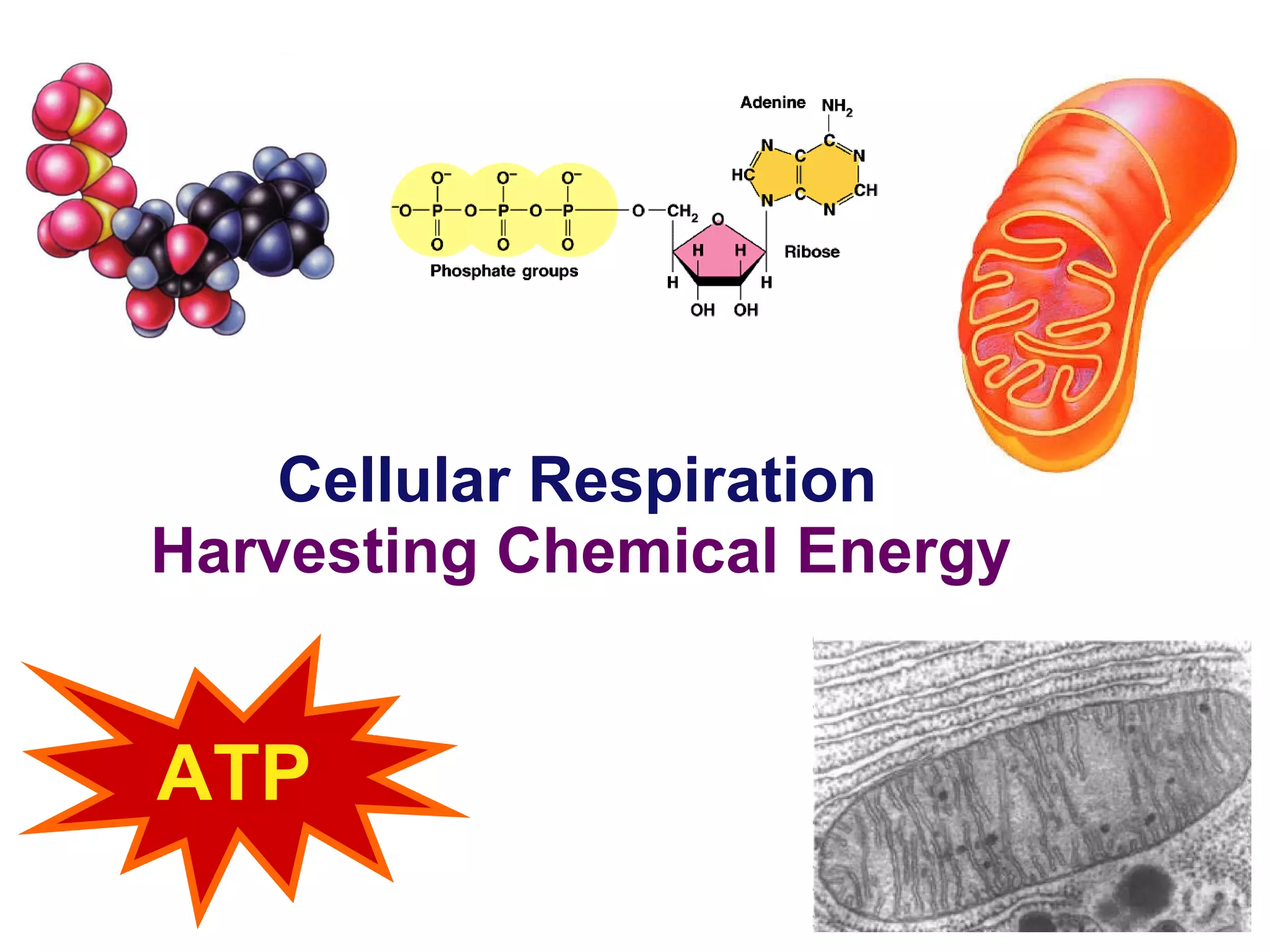
Cellular Respiration Harvesting Chemical Energy 2006-2007 ATP
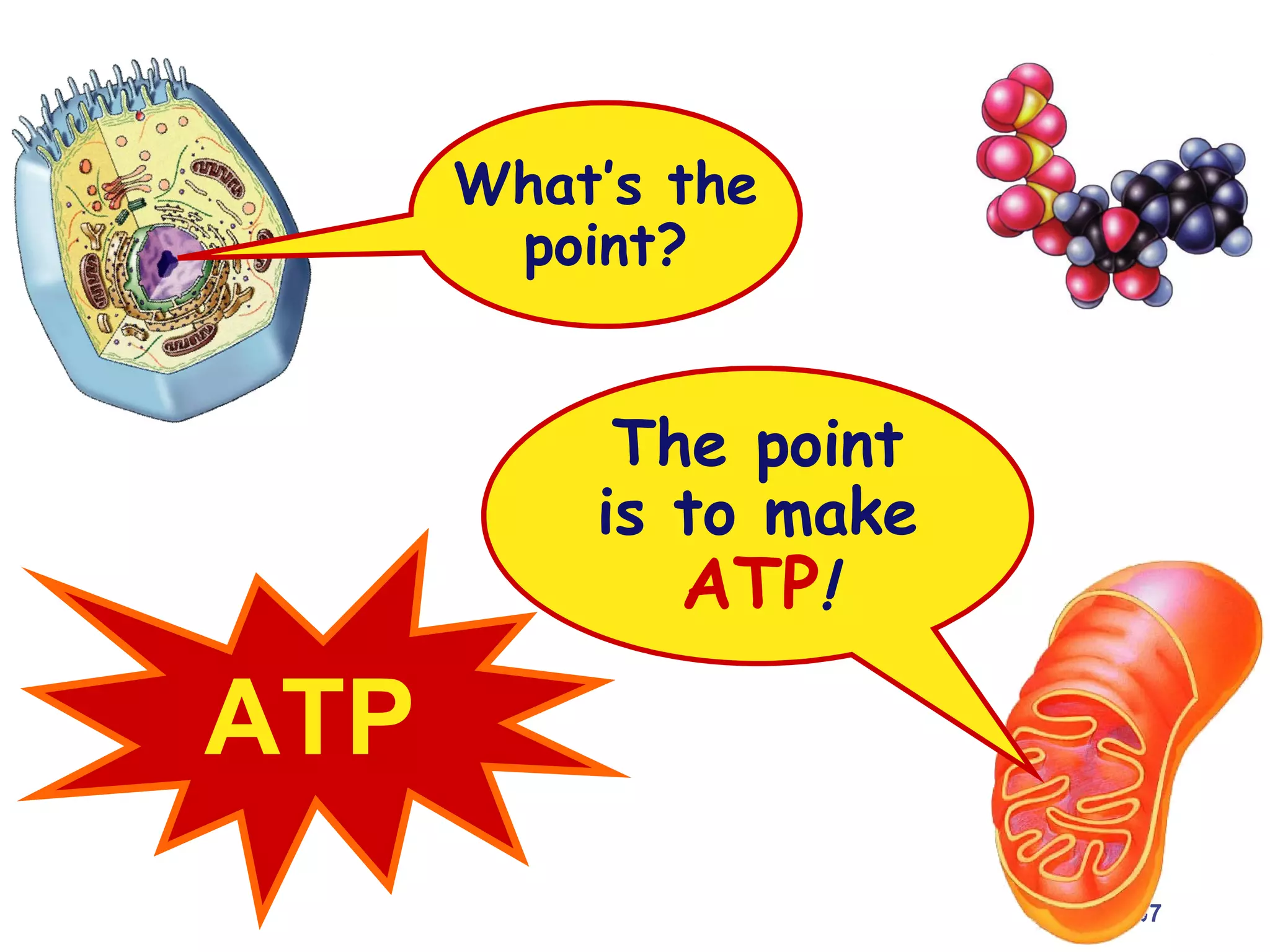
2006-2007 What’s the point? The point is to make ATP ! ATP
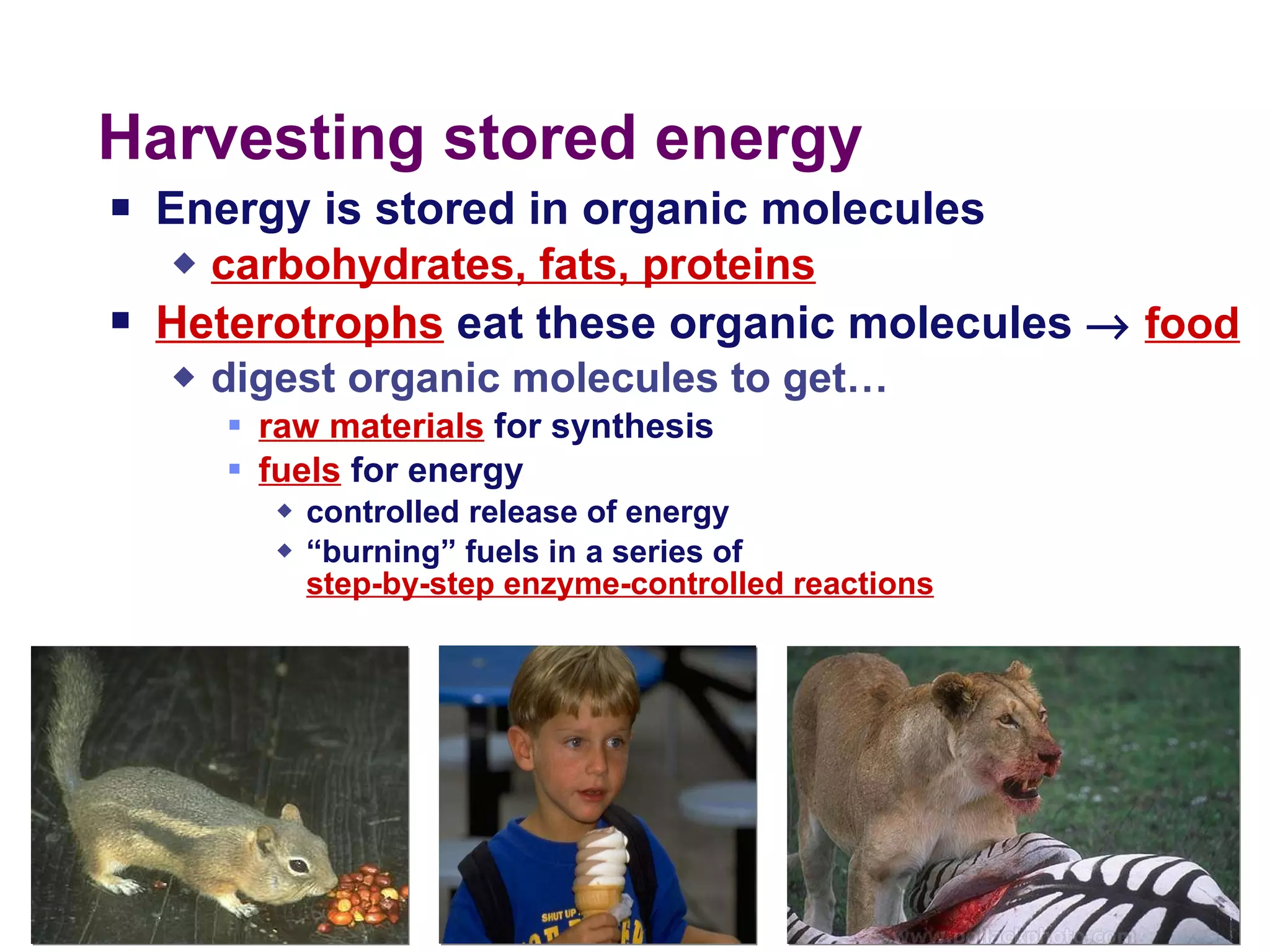
Harvesting stored energy Energy is stored in organic molecules carbohydrates, fats, proteins   Heterotrophs  eat these organic molecules     food digest organic molecules to get… raw materials  for synthesis fuels  for energy controlled release of energy “ burning” fuels in a series of  step-by-step enzyme-controlled reactions
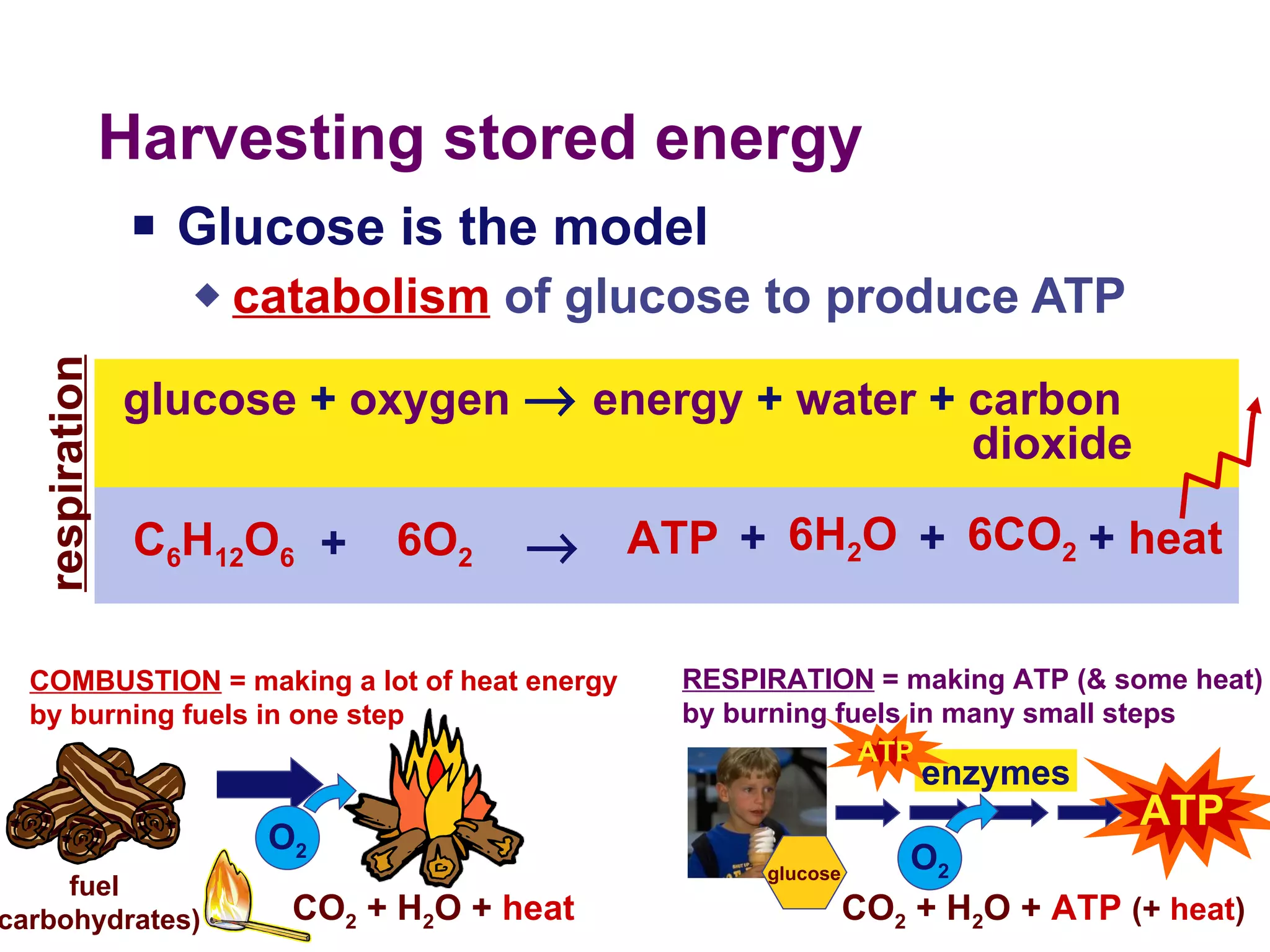
Harvesting stored energy Glucose is the model catabolism  of glucose to produce ATP CO 2  + H 2 O +  heat RESPIRATION  = making ATP (& some heat) by burning fuels in many small steps CO 2  + H 2 O +  ATP  (+  heat ) enzymes ATP C 6 H 12 O 6 6O 2 ATP 6H 2 O 6CO 2  + + + fuel (carbohydrates) COMBUSTION  = making a lot of heat energy  by burning fuels in one step ATP glucose glucose  +  oxygen    energy  +  water  +  carbon dioxide respiration O 2 O 2 +  heat
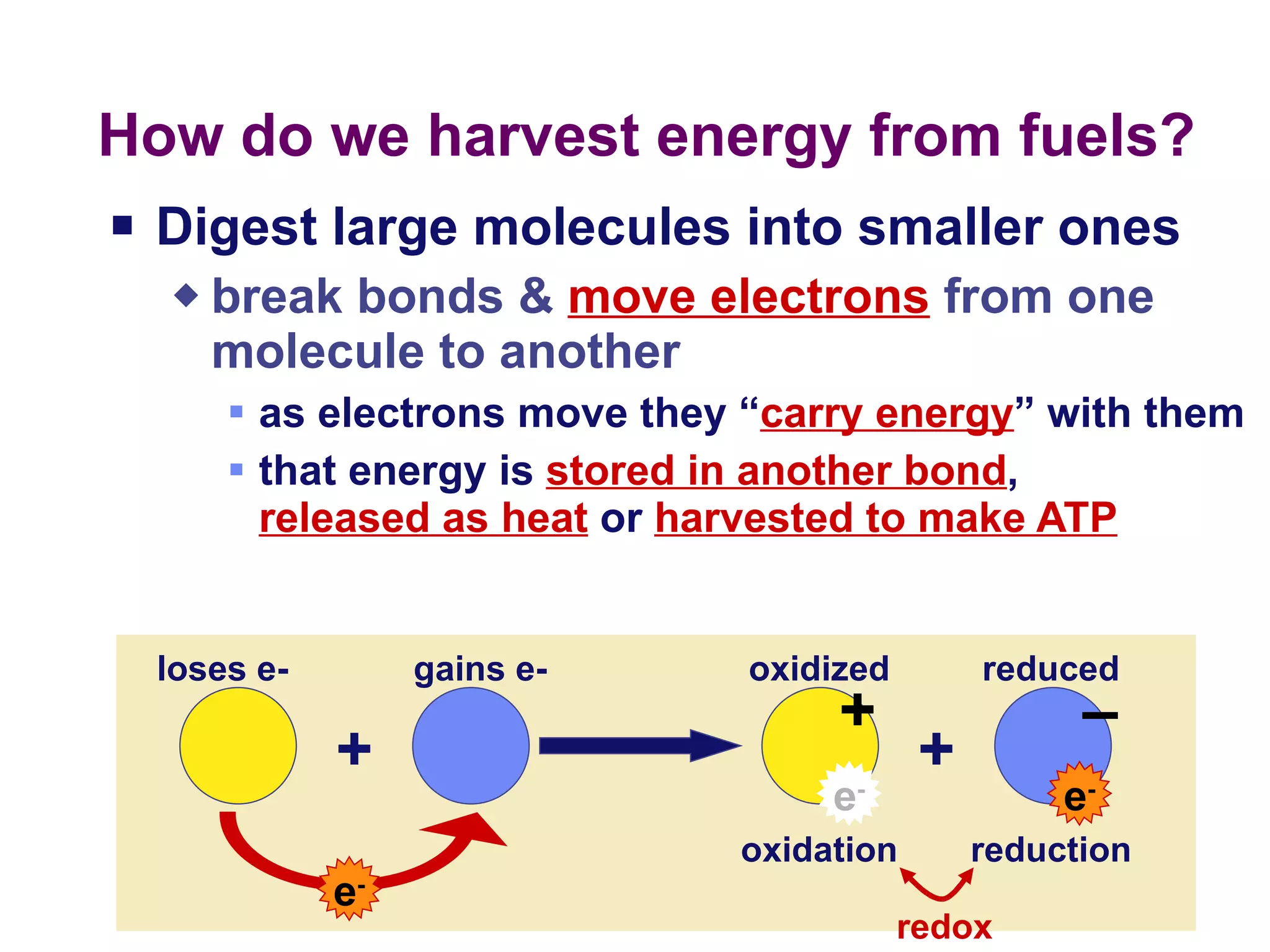
How do we harvest energy from fuels? Digest large molecules into smaller ones break bonds &  move electrons  from one molecule to another as electrons move they “ carry energy ” with them that energy is  stored in another bond ,  released as heat  or  harvested to make ATP e - + – loses e- gains e- oxidized reduced redox e - e - + + oxidation reduction
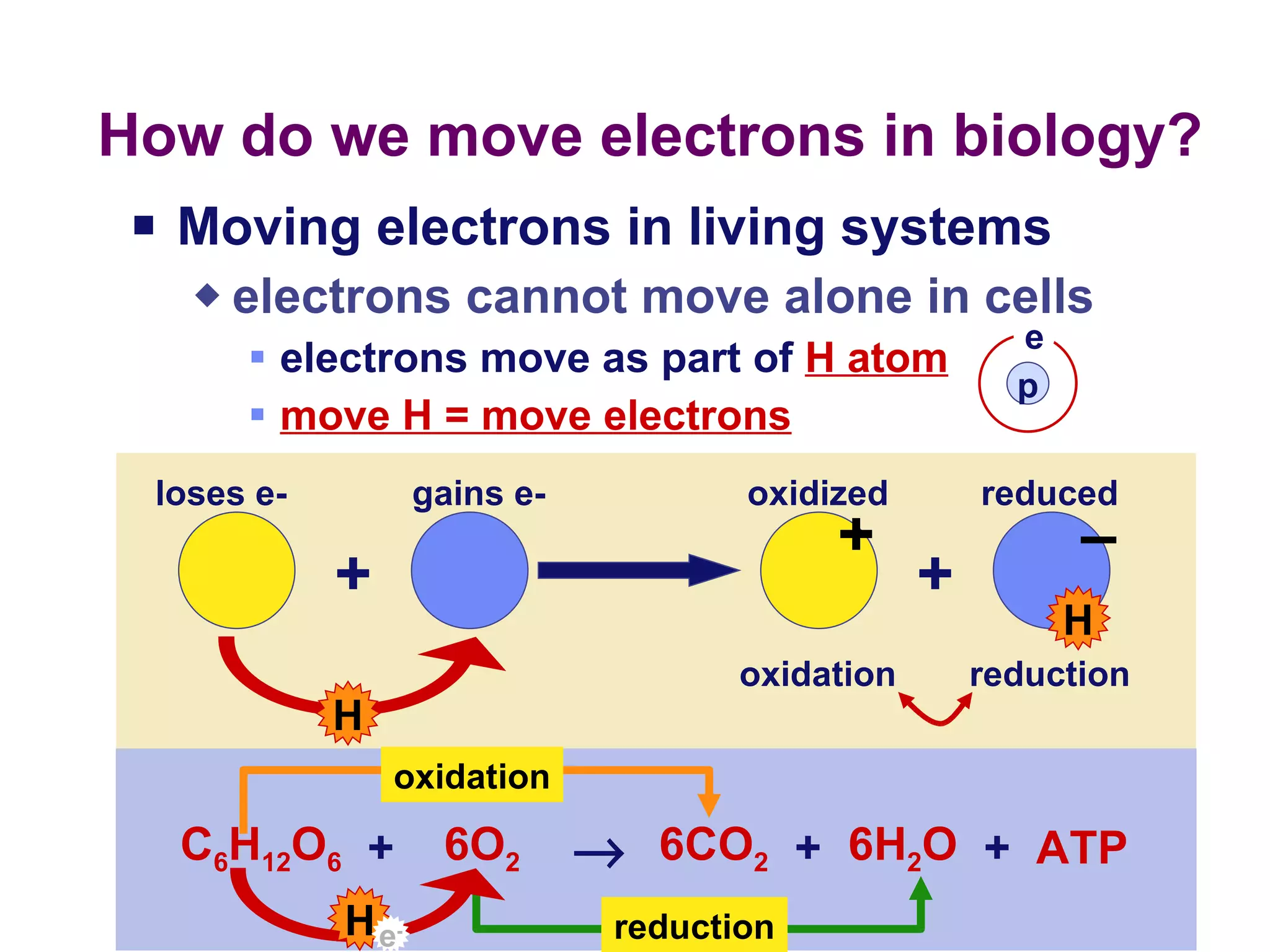
How do we move electrons in biology? Moving electrons in living systems electrons cannot move alone in cells electrons move as part of  H atom move H = move electrons oxidation reduction e - p e + H + H + – loses e- gains e- oxidized reduced oxidation reduction C 6 H 12 O 6 6O 2 6CO 2 6H 2 O ATP  + + + H
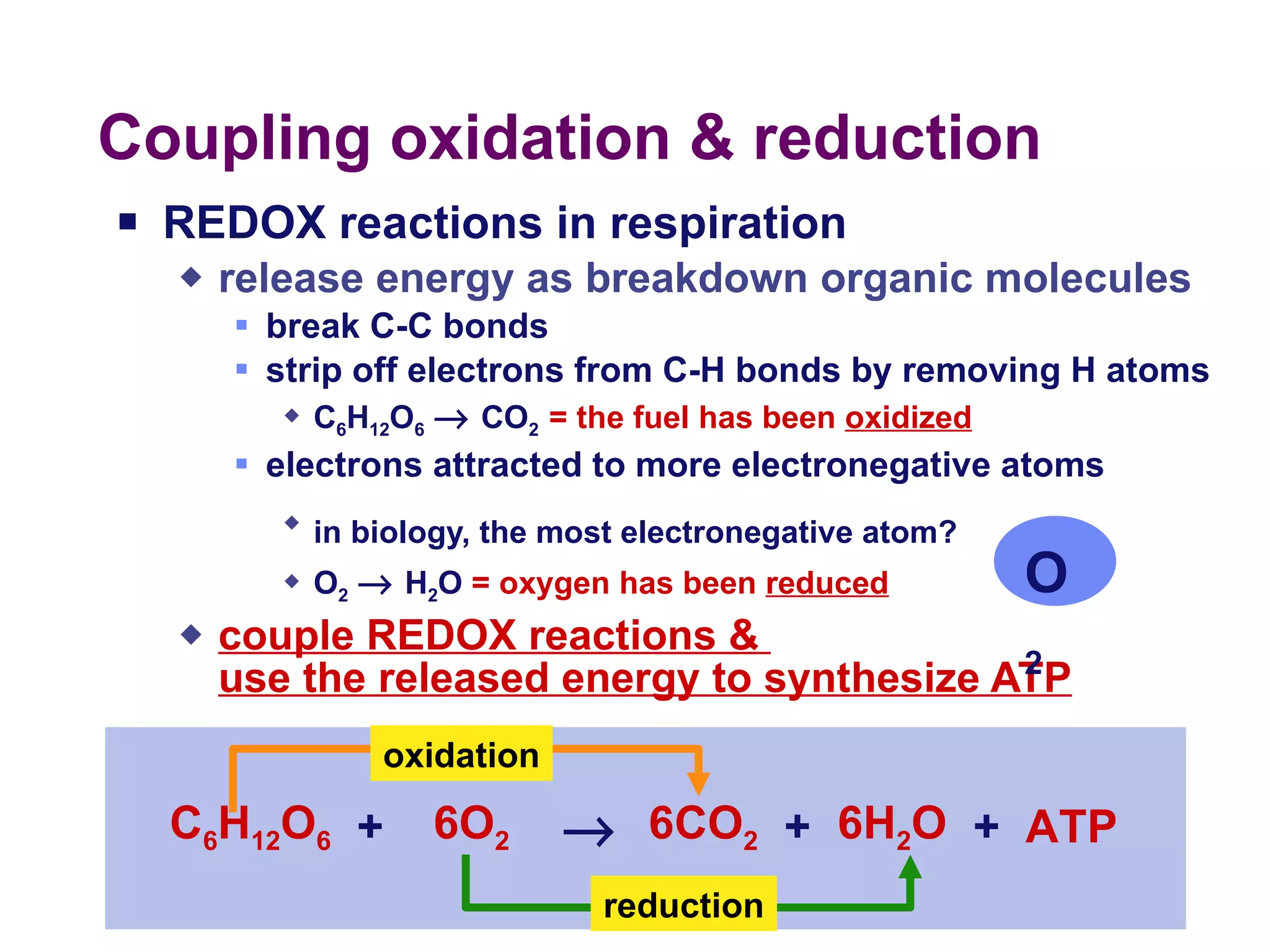
Coupling oxidation & reduction REDOX reactions in respiration  release energy as breakdown organic molecules break C-C bonds strip off electrons from C-H bonds by removing H atoms C 6 H 12 O 6      CO 2  =   the   fuel has been  oxidized electrons attracted to more electronegative atoms in biology, the most electronegative atom?  O 2      H 2 O  =   oxygen has been  reduced couple REDOX reactions &  use the released energy to synthesize ATP O 2   C 6 H 12 O 6 6O 2 6CO 2 6H 2 O ATP  + + + oxidation reduction
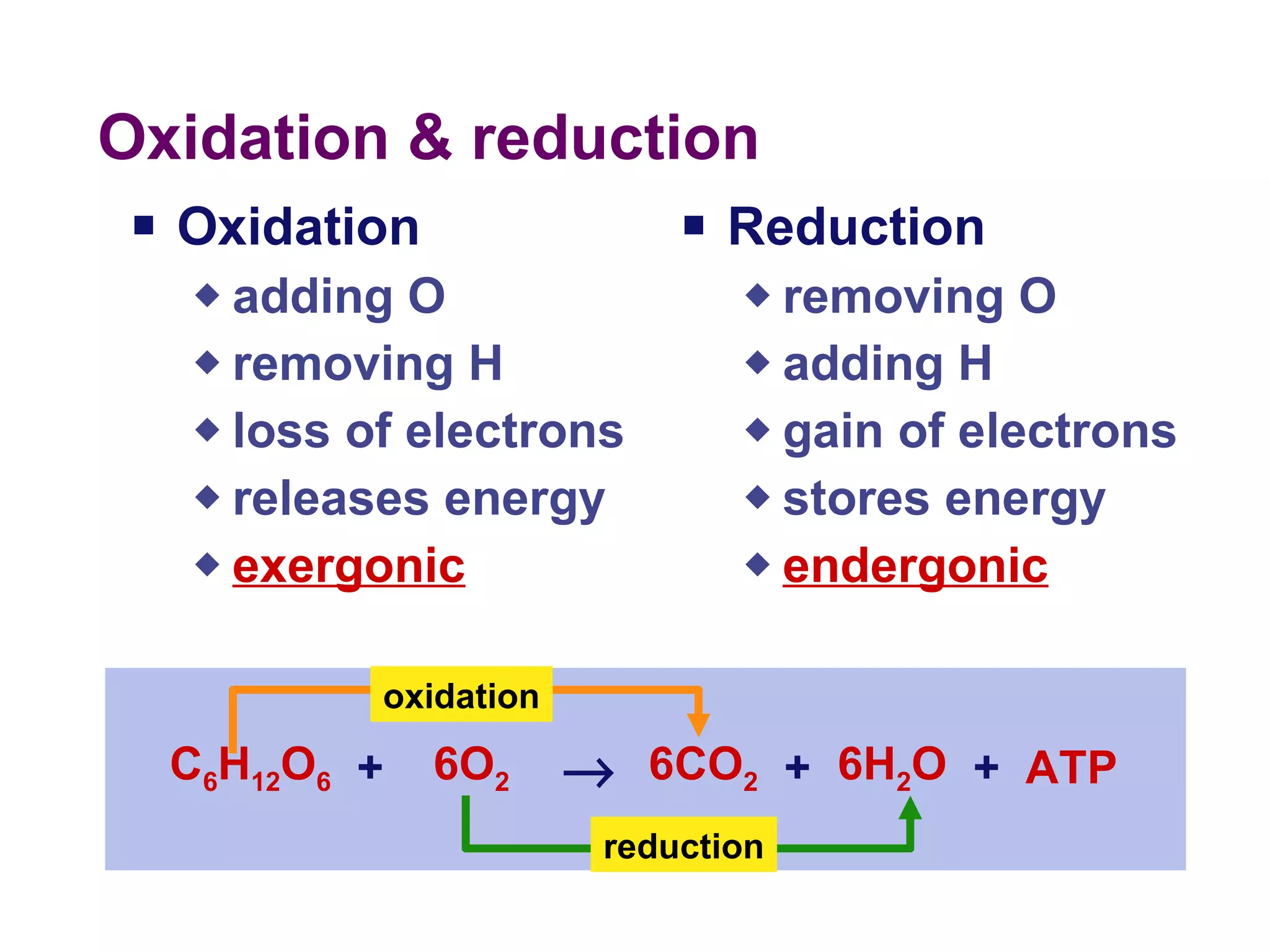
Oxidation & reduction Oxidation adding O removing H  loss of electrons releases energy exergonic Reduction removing O adding H  gain of electrons stores energy endergonic C 6 H 12 O 6 6O 2 6CO 2 6H 2 O ATP  + + + oxidation reduction
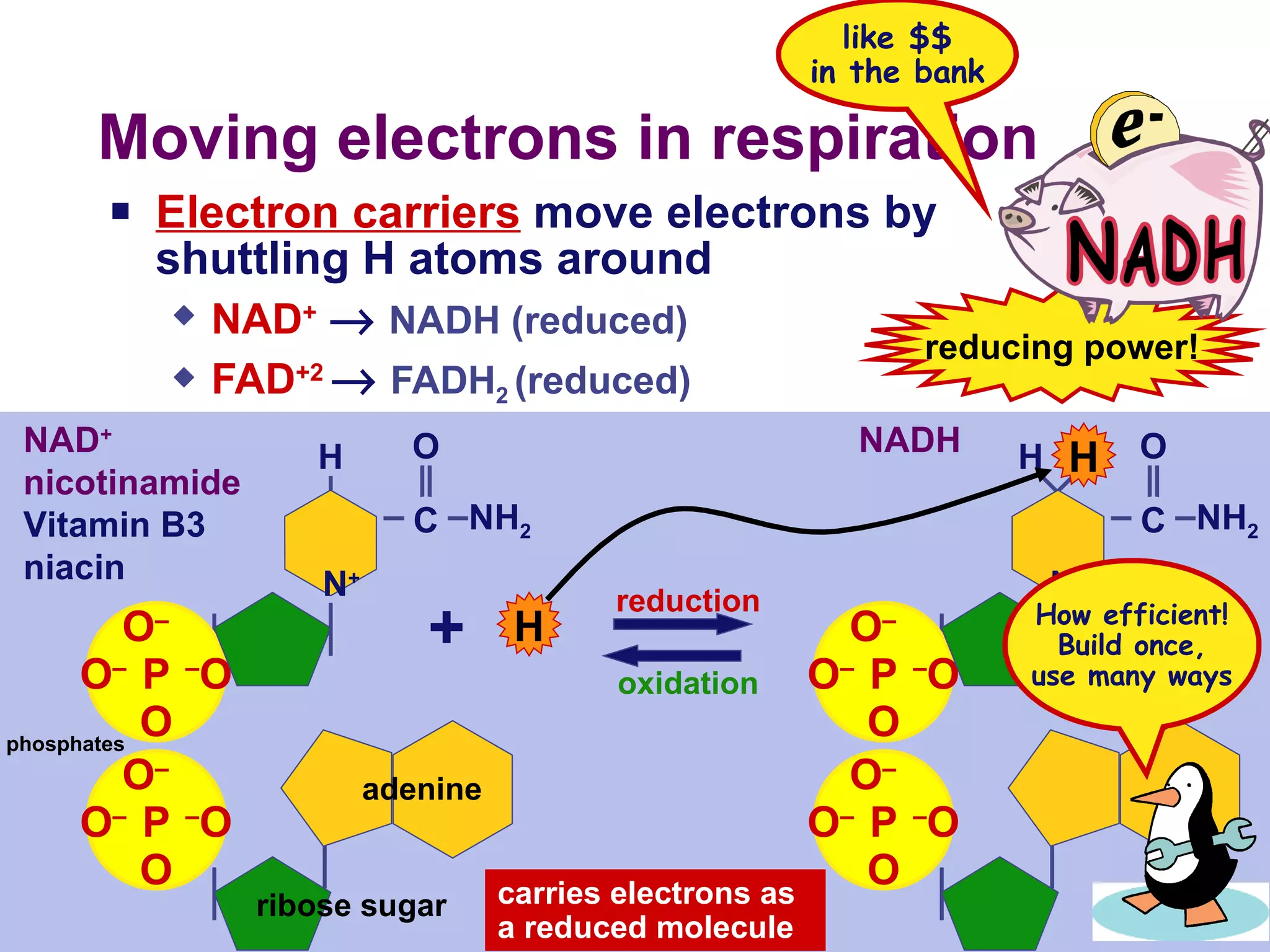
Moving electrons in respiration Electron carriers  move electrons by  shuttling H atoms around NAD +      NADH (reduced) FAD +2      FADH 2  (reduced) NADH carries electrons as a reduced molecule reducing power! H like $$ in the bank + H reduction oxidation P O – O – O – O P O – O – O – O C C O NH 2 N + H adenine ribose sugar phosphates NAD + nicotinamide Vitamin B3 niacin P O – O – O – O P O – O – O – O C C O NH 2 N + H How efficient! Build once, use many ways
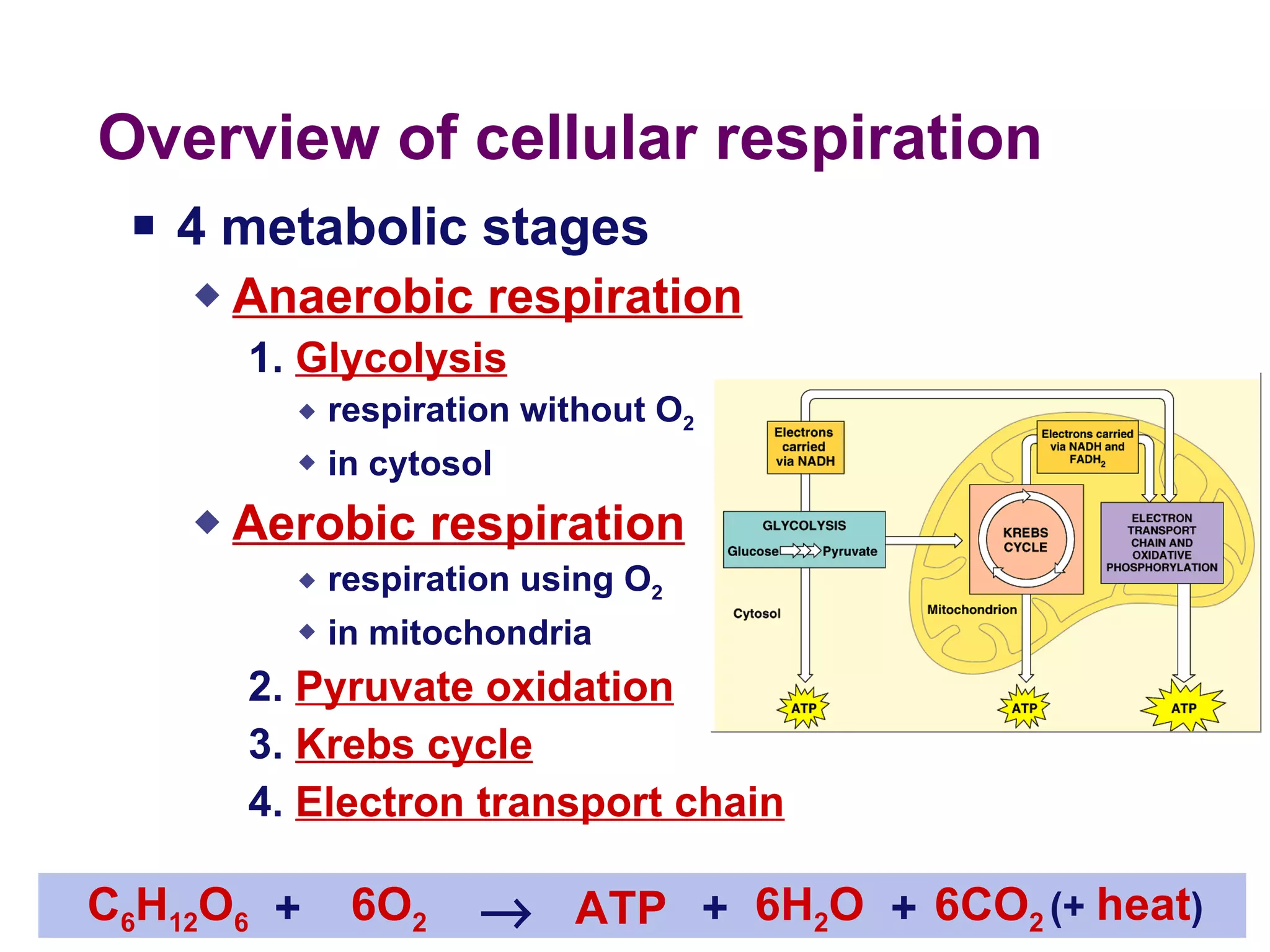
Overview of cellular respiration 4 metabolic stages Anaerobic respiration 1.  Glycolysis respiration without O 2 in cytosol Aerobic respiration respiration using O 2 in mitochondria 2.  Pyruvate oxidation 3.  Krebs cycle 4.  Electron transport chain (+  heat ) C 6 H 12 O 6 6O 2 ATP 6H 2 O 6CO 2  + + +
2006-2007 What’s the point? The point is to make ATP ! ATP
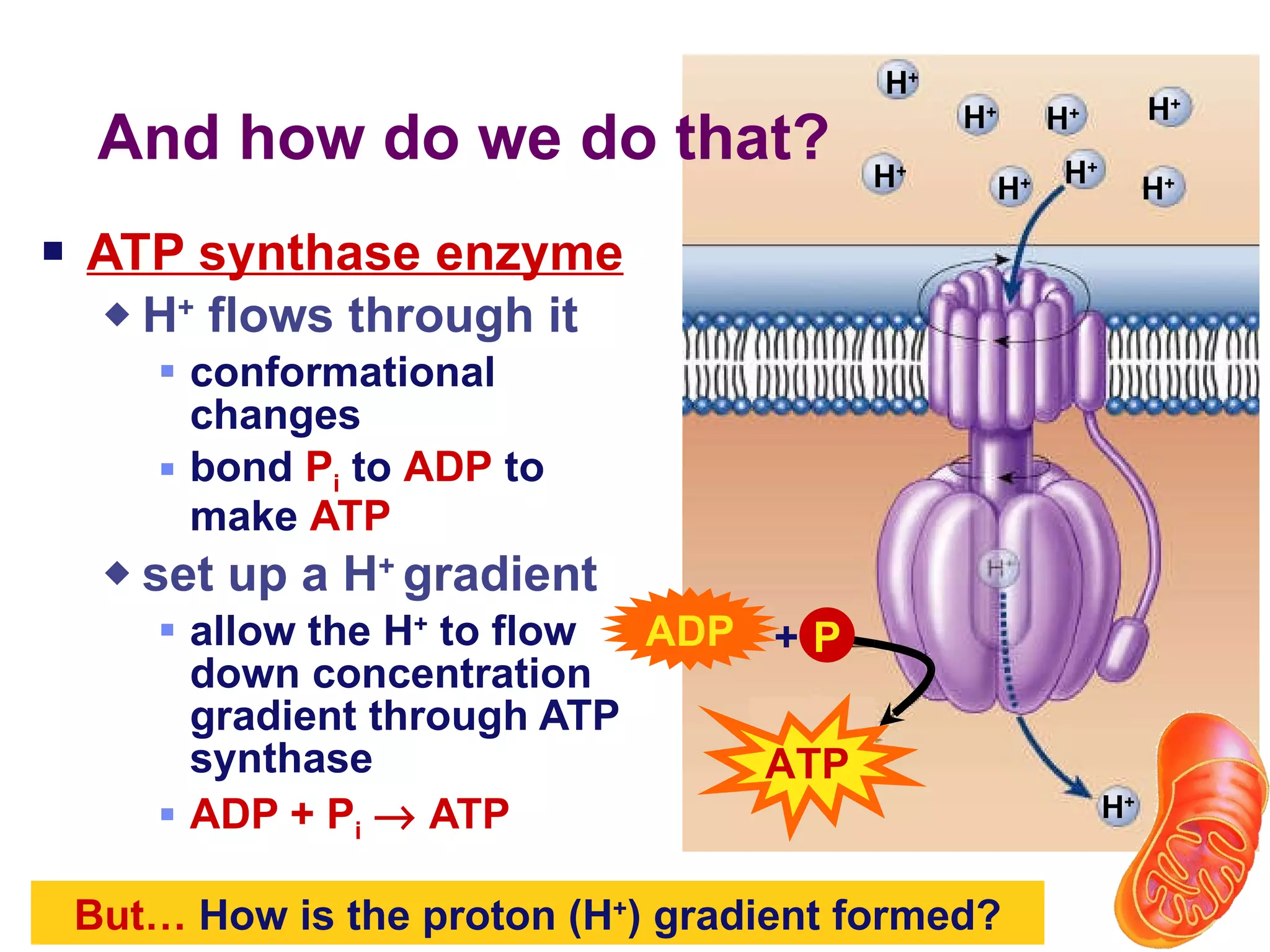
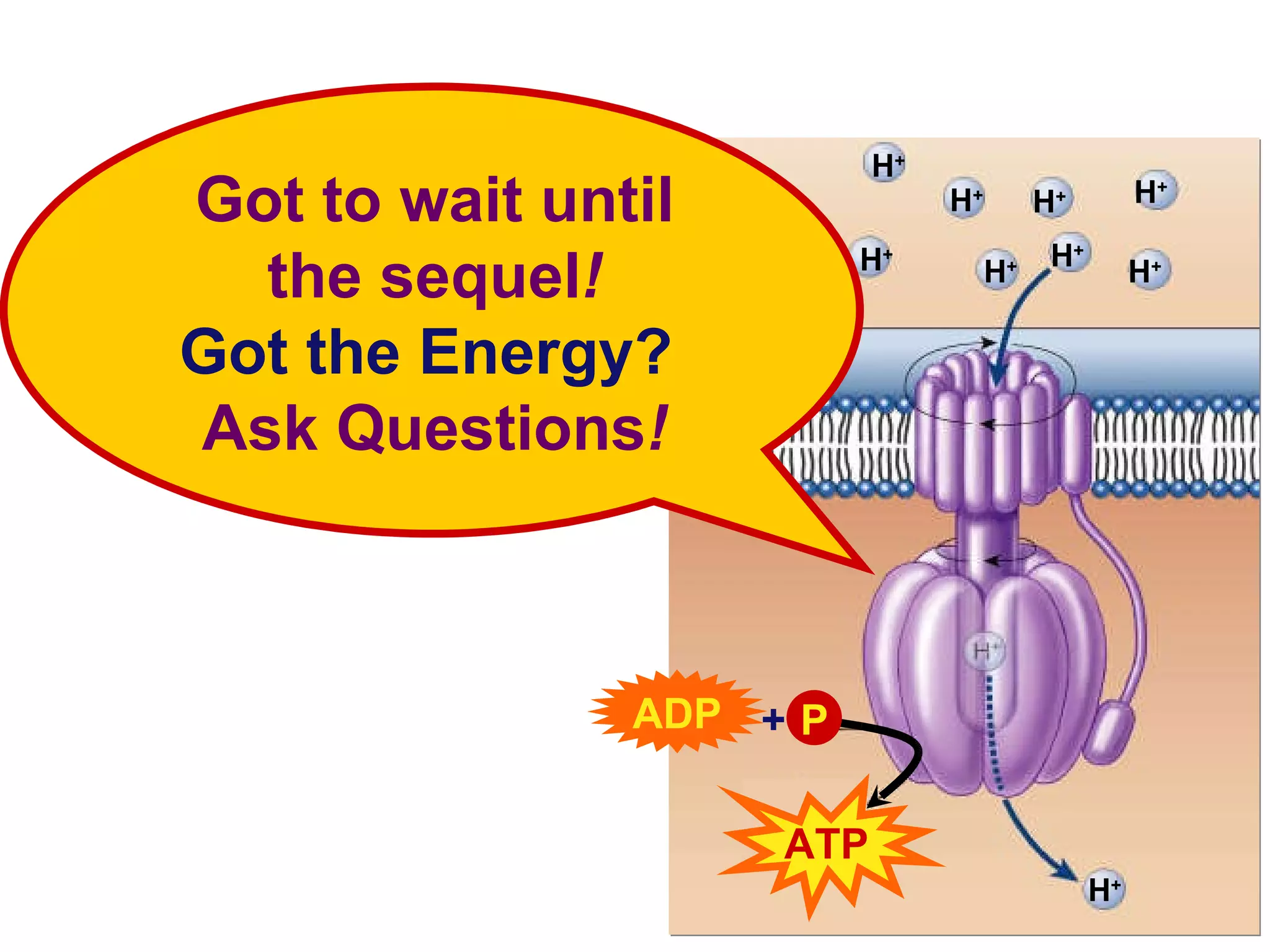
ATP synthase enzyme H +  flows through it conformational changes bond   P i   to   ADP  to make  ATP set up a H +  gradient allow the H +  to flow down concentration gradient through ATP synthase ADP + P i     ATP And how do we do that? ATP ADP But…  How is the proton (H + ) gradient formed? H + H + H + H + H + H + H + H + H + P +
2006-2007 H + ATP Got to wait until the sequel ! Got the Energy?   Ask Questions ! H + H + H + H + H + H + H + H + ADP P +

Chapter 15 lecture 1

  • 1.
    Cellular Respiration HarvestingChemical Energy 2006-2007 ATP
  • 2.
    2006-2007 What’s thepoint? The point is to make ATP ! ATP
  • 3.
    Harvesting stored energyEnergy is stored in organic molecules carbohydrates, fats, proteins Heterotrophs eat these organic molecules  food digest organic molecules to get… raw materials for synthesis fuels for energy controlled release of energy “ burning” fuels in a series of step-by-step enzyme-controlled reactions
  • 4.
    Harvesting stored energyGlucose is the model catabolism of glucose to produce ATP CO 2 + H 2 O + heat RESPIRATION = making ATP (& some heat) by burning fuels in many small steps CO 2 + H 2 O + ATP (+ heat ) enzymes ATP C 6 H 12 O 6 6O 2 ATP 6H 2 O 6CO 2  + + + fuel (carbohydrates) COMBUSTION = making a lot of heat energy by burning fuels in one step ATP glucose glucose + oxygen  energy + water + carbon dioxide respiration O 2 O 2 + heat
  • 5.
    How do weharvest energy from fuels? Digest large molecules into smaller ones break bonds & move electrons from one molecule to another as electrons move they “ carry energy ” with them that energy is stored in another bond , released as heat or harvested to make ATP e - + – loses e- gains e- oxidized reduced redox e - e - + + oxidation reduction
  • 6.
    How do wemove electrons in biology? Moving electrons in living systems electrons cannot move alone in cells electrons move as part of H atom move H = move electrons oxidation reduction e - p e + H + H + – loses e- gains e- oxidized reduced oxidation reduction C 6 H 12 O 6 6O 2 6CO 2 6H 2 O ATP  + + + H
  • 7.
    Coupling oxidation &reduction REDOX reactions in respiration release energy as breakdown organic molecules break C-C bonds strip off electrons from C-H bonds by removing H atoms C 6 H 12 O 6  CO 2 = the fuel has been oxidized electrons attracted to more electronegative atoms in biology, the most electronegative atom? O 2  H 2 O = oxygen has been reduced couple REDOX reactions & use the released energy to synthesize ATP O 2 C 6 H 12 O 6 6O 2 6CO 2 6H 2 O ATP  + + + oxidation reduction
  • 8.
    Oxidation & reductionOxidation adding O removing H loss of electrons releases energy exergonic Reduction removing O adding H gain of electrons stores energy endergonic C 6 H 12 O 6 6O 2 6CO 2 6H 2 O ATP  + + + oxidation reduction
  • 9.
    Moving electrons inrespiration Electron carriers move electrons by shuttling H atoms around NAD +  NADH (reduced) FAD +2  FADH 2 (reduced) NADH carries electrons as a reduced molecule reducing power! H like $$ in the bank + H reduction oxidation P O – O – O – O P O – O – O – O C C O NH 2 N + H adenine ribose sugar phosphates NAD + nicotinamide Vitamin B3 niacin P O – O – O – O P O – O – O – O C C O NH 2 N + H How efficient! Build once, use many ways
  • 10.
    Overview of cellularrespiration 4 metabolic stages Anaerobic respiration 1. Glycolysis respiration without O 2 in cytosol Aerobic respiration respiration using O 2 in mitochondria 2. Pyruvate oxidation 3. Krebs cycle 4. Electron transport chain (+ heat ) C 6 H 12 O 6 6O 2 ATP 6H 2 O 6CO 2  + + +
  • 11.
    2006-2007 What’s thepoint? The point is to make ATP ! ATP
  • 12.
    ATP synthase enzymeH + flows through it conformational changes bond P i to ADP to make ATP set up a H + gradient allow the H + to flow down concentration gradient through ATP synthase ADP + P i  ATP And how do we do that? ATP ADP But… How is the proton (H + ) gradient formed? H + H + H + H + H + H + H + H + H + P +
  • 13.
    2006-2007 H +ATP Got to wait until the sequel ! Got the Energy? Ask Questions ! H + H + H + H + H + H + H + H + ADP P +

Editor's Notes

  • #4 We eat to take in the fuels to make ATP which will then be used to help us build biomolecules and grow and move and… live! heterotrophs = “fed by others” vs. autotrophs = “self-feeders”
  • #5 Movement of hydrogen atoms from glucose to water
  • #6 • They are called oxidation reactions because it reflects the fact that in biological systems oxygen, which attracts electrons strongly, is the most common electron acceptor. • Oxidation & reduction reactions always occur together therefore they are referred to as “redox reactions”. •  As electrons move from one atom to another they move farther away from the nucleus of the atom and therefore are at a higher potential energy state. The reduced form of a molecule has a higher level of energy than the oxidized form of a molecule. • The ability to store energy in molecules by transferring electrons to them is called reducing power , and is a basic property of living systems.
  • #7 Energy is transferred from one molecule to another via redox reactions. C 6 H 12 O 6 has been oxidized fully == each of the carbons (C) has been cleaved off and all of the hydrogens (H) have been stripped off & transferred to oxygen (O) — the most electronegative atom in living systems. This converts O 2 into H 2 O as it is reduced. The reduced form of a molecule has a higher energy state than the oxidized form. The ability of organisms to store energy in molecules by transferring electrons to them is referred to as reducing power . The reduced form of a molecule in a biological system is the molecule which has gained a H atom, hence NAD +  NADH once reduced. soon we will meet the electron carriers NAD & FADH = when they are reduced they now have energy stored in them that can be used to do work.
  • #8 O 2 is 2 oxygen atoms both looking for electrons LIGHT FIRE ==> oxidation RELEASING ENERGY But too fast for a biological system
  • #10 Nicotinamide adenine dinucleotide (NAD) — and its relative nicotinamide adenine dinucleotide phosphate (NADP) which you will meet in photosynthesis — are two of the most important coenzymes in the cell. In cells, most oxidations are accomplished by the removal of hydrogen atoms. Both of these coenzymes play crucial roles in this. Nicotinamide is also known as Vitamin B3 is believed to cause improvements in energy production due to its role as a precursor of NAD (nicotinamide adenosine dinucleotide), an important molecule involved in energy metabolism. Increasing nicotinamide concentrations increase the available NAD molecules that can take part in energy metabolism, thus increasing the amount of energy available in the cell. Vitamin B3 can be found in various meats, peanuts, and sunflower seeds. Nicotinamide is the biologically active form of niacin (also known as nicotinic acid). FAD is built from riboflavin — also known as Vitamin B2. Riboflavin is a water-soluble vitamin that is found naturally in organ meats (liver, kidney, and heart) and certain plants such as almonds, mushrooms, whole grain, soybeans, and green leafy vegetables. FAD is a coenzyme critical for the metabolism of carbohydrates, fats, and proteins into energy.