Transport of Carbon Dioxide
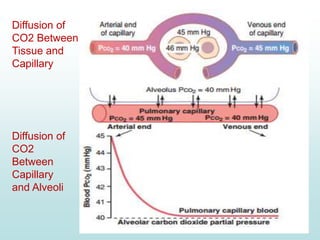
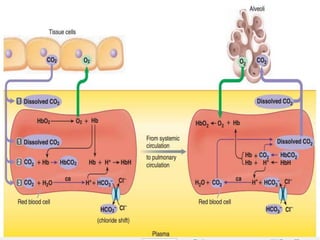
Diffusion of
CO2 Between
Tissue and
Capillary
Diffusion of
CO2
Between
Capillary
and Alveoli
• Carbon dioxide is transported in the blood
in three ways
• Physically dissolved
• Bound to hemoglobin
• As bicarbonate ion
Physically Dissolved
• Part of the carbon dioxide released from
the tissues is dissolved in plasma. But
only a small amount, typically just 7 –
10%, is transported this way.
Bound to Hemoglobin
• 30% of the CO2 combines with Hb to form
carbamino hemoglobin (HbCO2)
• The unloading of O2 from Hb in the tissue
capillaries therefore facilitates the picking
up of CO2 by Hb
• 20-30% is transported by this route
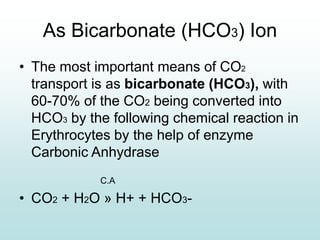
As Bicarbonate (HCO3) Ion
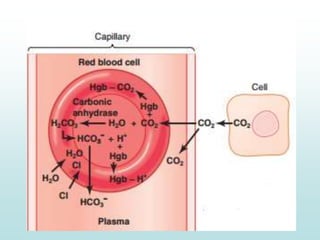
• The most important means of CO2
transport is as bicarbonate (HCO3), with
60-70% of the CO2 being converted into
HCO3 by the following chemical reaction in
Erythrocytes by the help of enzyme
Carbonic Anhydrase
C.A
• CO2 + H2O » H+ + HCO3-
Chloride Shift
• The red blood cell membrane has a HCO3
– Cl carrier that passively facilitates the
diffusion of these ions in opposite
directions across the membrane.
• Consequently, HCO3 efflux and Cl influx
occur, which is known as chloride shift
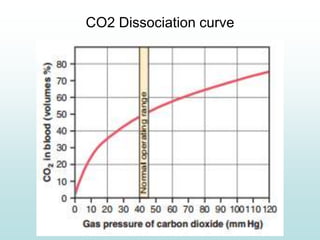
CO2 Dissociation curve
Haldane Effect
• binding of O2 with hemoglobin tends to
displace CO2 from the blood is known as
the Haldane effect
• The Haldane effect results from the fact that
• combination of O2 with hemoglobin in the lungs causes
the hemoglobin to become a stronger acid.
• This displaces CO2 from the blood and into the alveoli in
two ways.
• First, highly acidic hemoglobin has less tendency to
combine with CO2
• Second, the increased acidity of the hemoglobin also
causes it to release an excess of hydrogen ions.
• These bind with bicarbonate ions to form carbonic acid,
which then dissociates to CO2, and the CO2 is released
from the blood into the alveoli
Carbondioxide transport

Carbondioxide transport

  • 1.
  • 2.
    Diffusion of CO2 Between Tissueand Capillary Diffusion of CO2 Between Capillary and Alveoli
  • 3.
    • Carbon dioxideis transported in the blood in three ways • Physically dissolved • Bound to hemoglobin • As bicarbonate ion
  • 4.
    Physically Dissolved • Partof the carbon dioxide released from the tissues is dissolved in plasma. But only a small amount, typically just 7 – 10%, is transported this way.
  • 5.
    Bound to Hemoglobin •30% of the CO2 combines with Hb to form carbamino hemoglobin (HbCO2) • The unloading of O2 from Hb in the tissue capillaries therefore facilitates the picking up of CO2 by Hb • 20-30% is transported by this route
  • 6.
    As Bicarbonate (HCO3)Ion • The most important means of CO2 transport is as bicarbonate (HCO3), with 60-70% of the CO2 being converted into HCO3 by the following chemical reaction in Erythrocytes by the help of enzyme Carbonic Anhydrase C.A • CO2 + H2O » H+ + HCO3-
  • 8.
    Chloride Shift • Thered blood cell membrane has a HCO3 – Cl carrier that passively facilitates the diffusion of these ions in opposite directions across the membrane. • Consequently, HCO3 efflux and Cl influx occur, which is known as chloride shift
  • 10.
  • 11.
    Haldane Effect • bindingof O2 with hemoglobin tends to displace CO2 from the blood is known as the Haldane effect
  • 12.
    • The Haldaneeffect results from the fact that • combination of O2 with hemoglobin in the lungs causes the hemoglobin to become a stronger acid. • This displaces CO2 from the blood and into the alveoli in two ways. • First, highly acidic hemoglobin has less tendency to combine with CO2 • Second, the increased acidity of the hemoglobin also causes it to release an excess of hydrogen ions. • These bind with bicarbonate ions to form carbonic acid, which then dissociates to CO2, and the CO2 is released from the blood into the alveoli