VALENCE BOND THEORY &
HYBRIDIZATION
VALENCE BOND THEORY
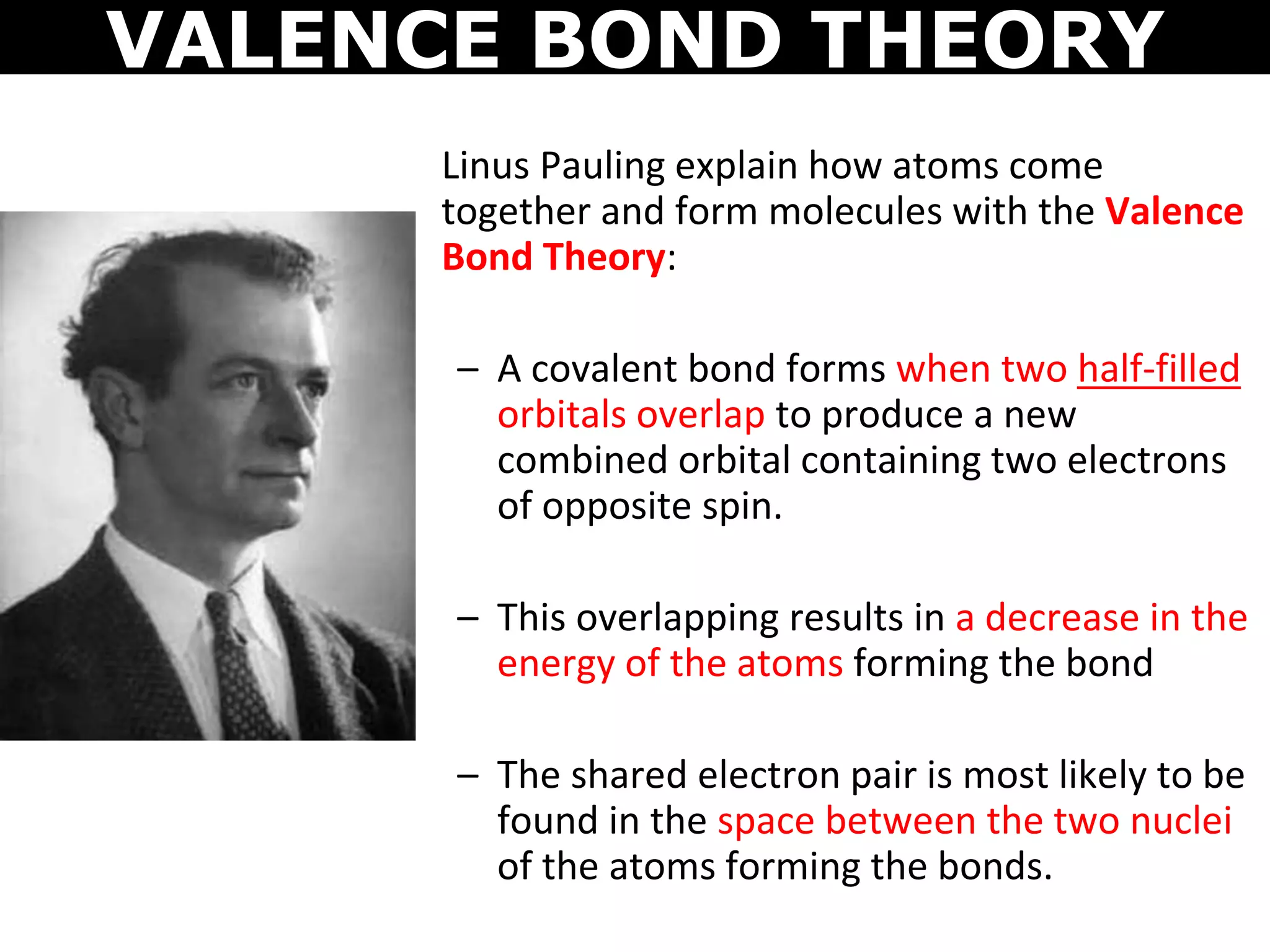
Linus Pauling explain how atoms come
together and form molecules with the Valence
Bond Theory:
– A covalent bond forms when two half-filled
orbitals overlap to produce a new
combined orbital containing two electrons
of opposite spin.
– This overlapping results in a decrease in the
energy of the atoms forming the bond
– The shared electron pair is most likely to be
found in the space between the two nuclei
of the atoms forming the bonds.
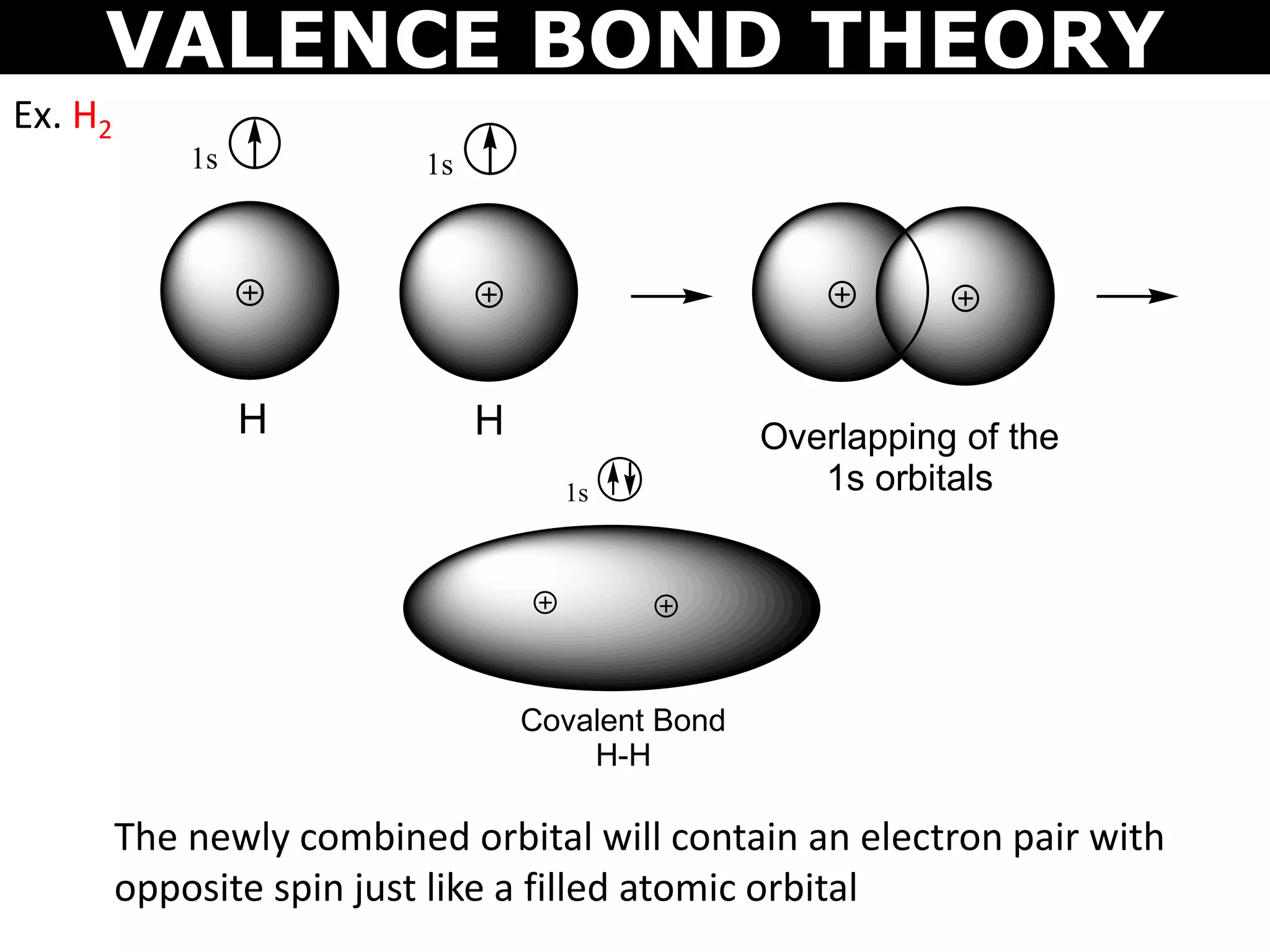
Ex. H2
H H
1s1s
Overlapping of the
1s orbitals
Covalent Bond
H-H
1s
The newly combined orbital will contain an electron pair with
opposite spin just like a filled atomic orbital
VALENCE BOND THEORY
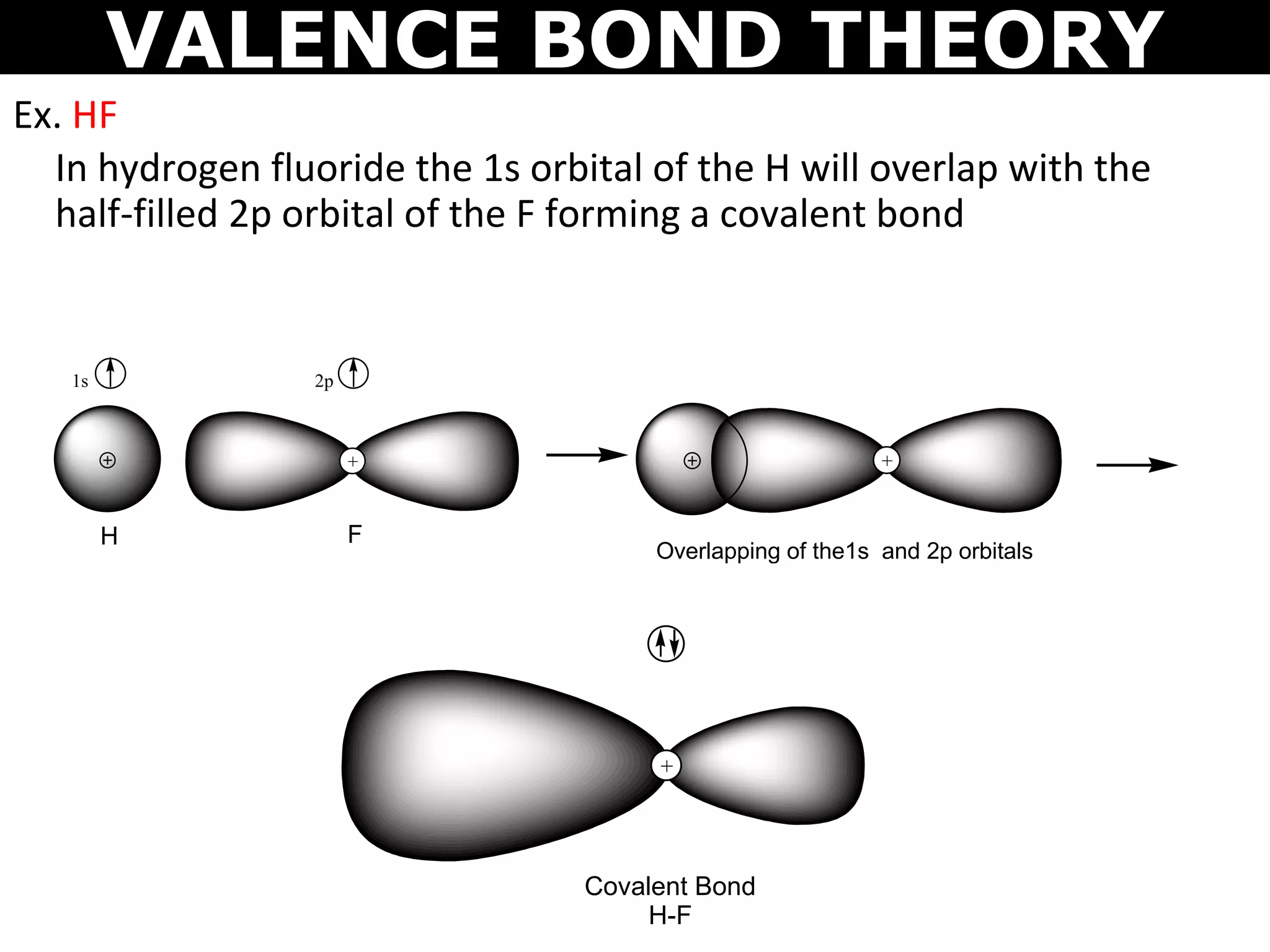
In hydrogen fluoride the 1s orbital of the H will overlap with the
half-filled 2p orbital of the F forming a covalent bond
H F
2p1s
+
Overlapping of the1s and 2p orbitals
+
Covalent Bond
H-F
+
VALENCE BOND THEORY
Ex. HF
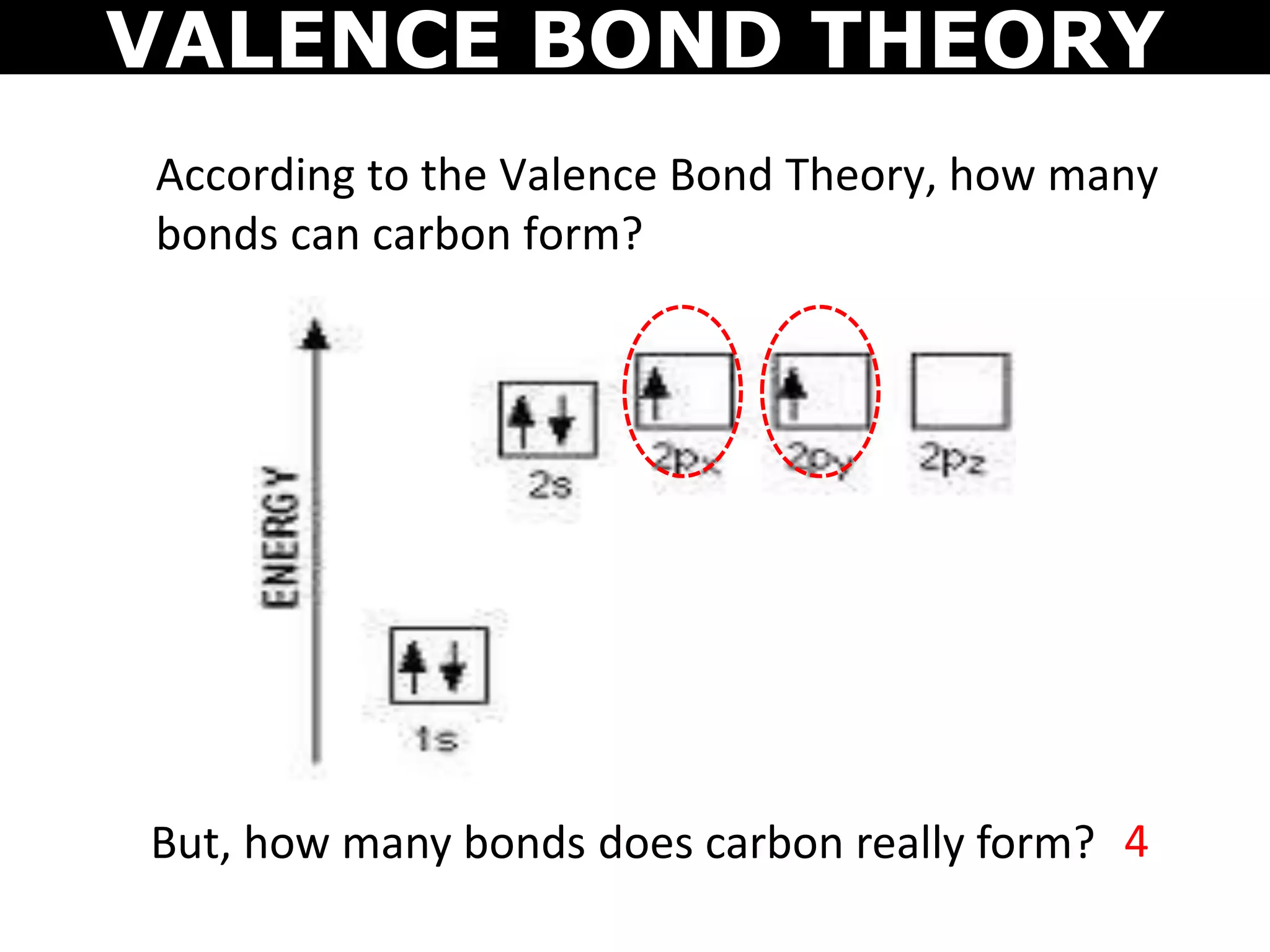
According to the Valence Bond Theory, how many
bonds can carbon form?
But, how many bonds does carbon really form?
VALENCE BOND THEORY
4
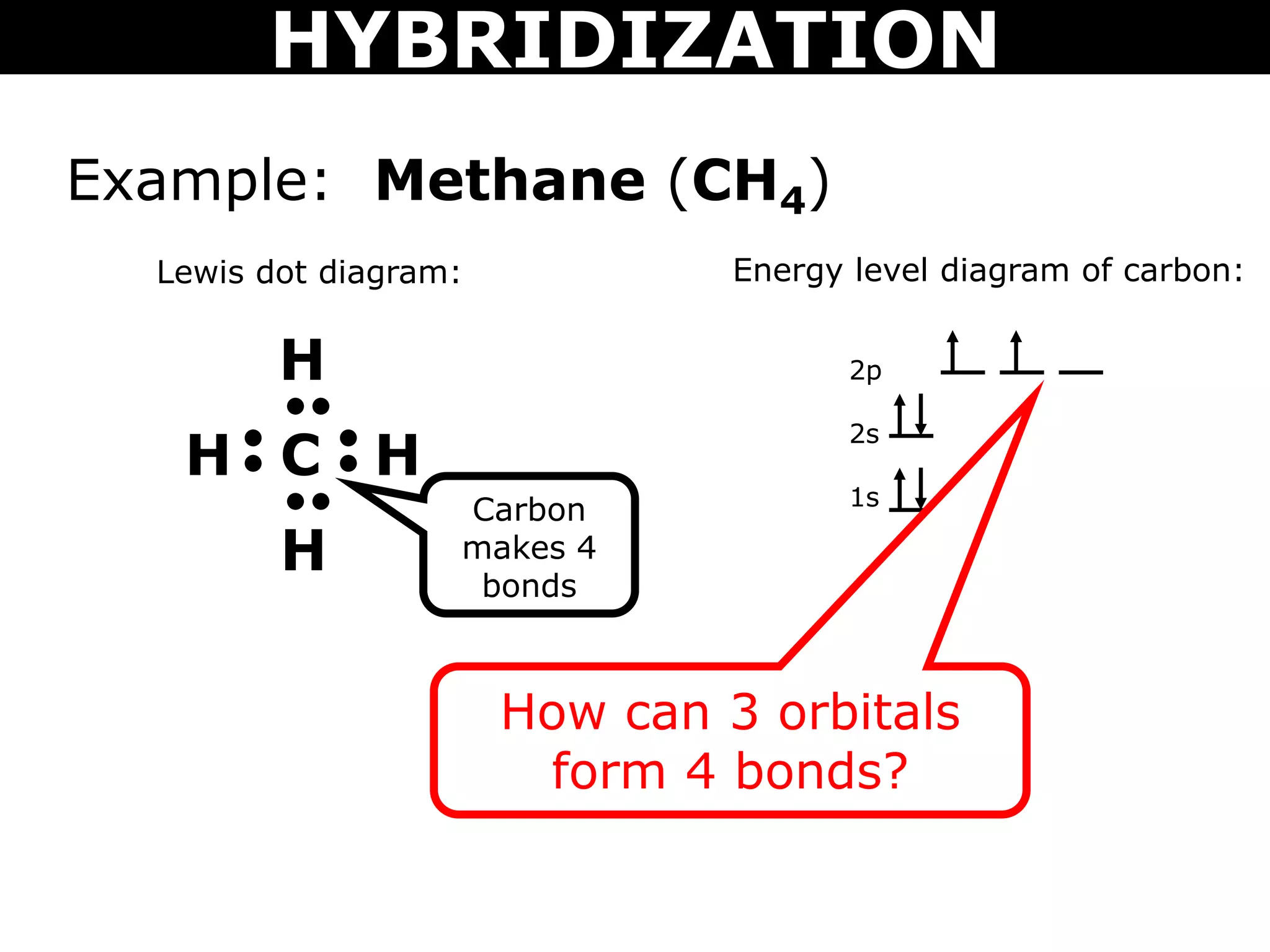
Example: Methane (CH4)
C HH
H
H
C
2p
2s
1s
Lewis dot diagram:
Carbon
makes 4
bonds
Energy level diagram of carbon:
How can 3 orbitals
form 4 bonds?
HYBRIDIZATION
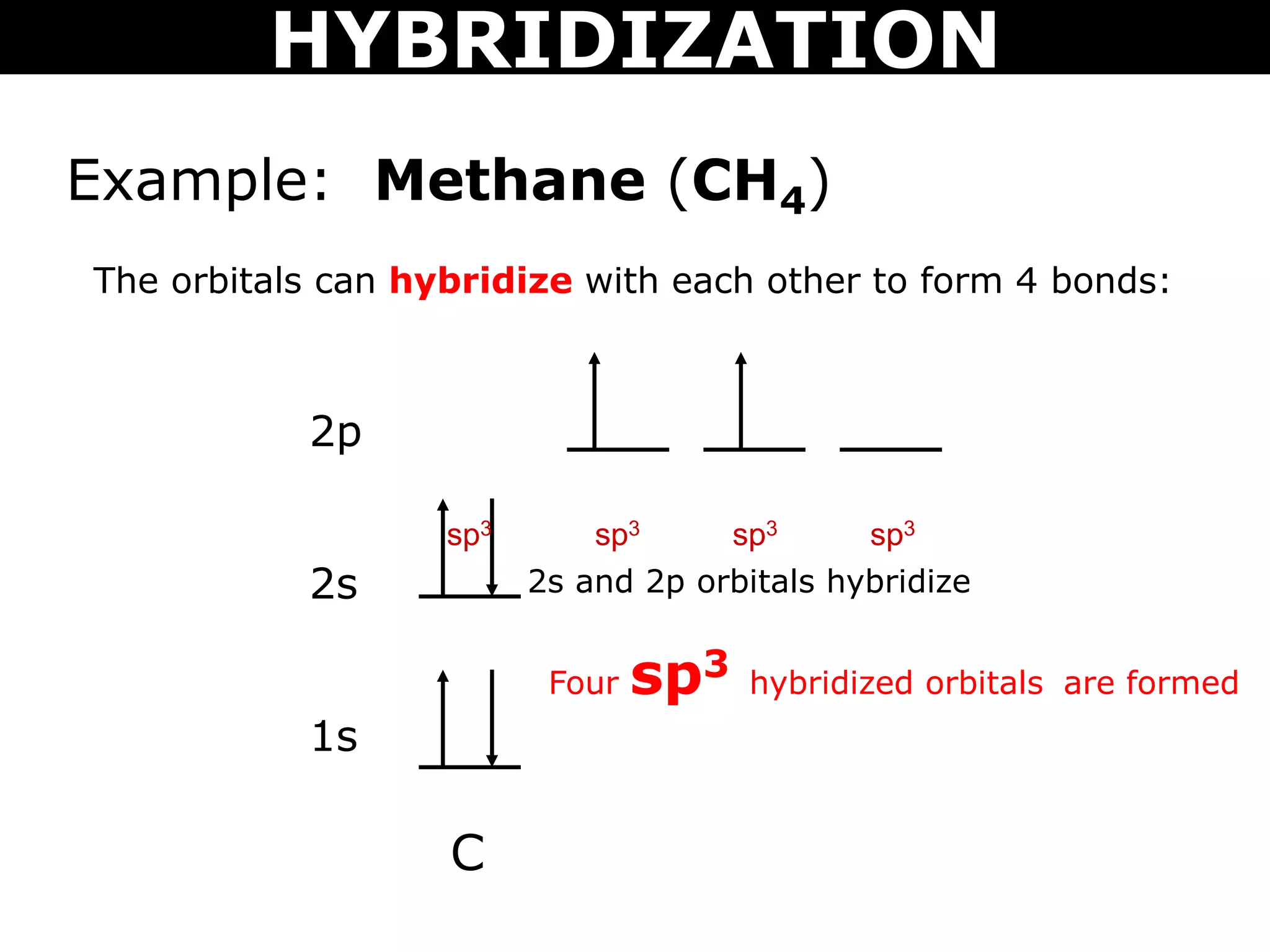
C
2p
2s
1s
The orbitals can hybridize with each other to form 4 bonds:
2s and 2p orbitals hybridize
Four sp3 hybridized orbitals are formed
sp3 sp3 sp3 sp3
Example: Methane (CH4)
HYBRIDIZATION
HYBRIDIZATION THEORY
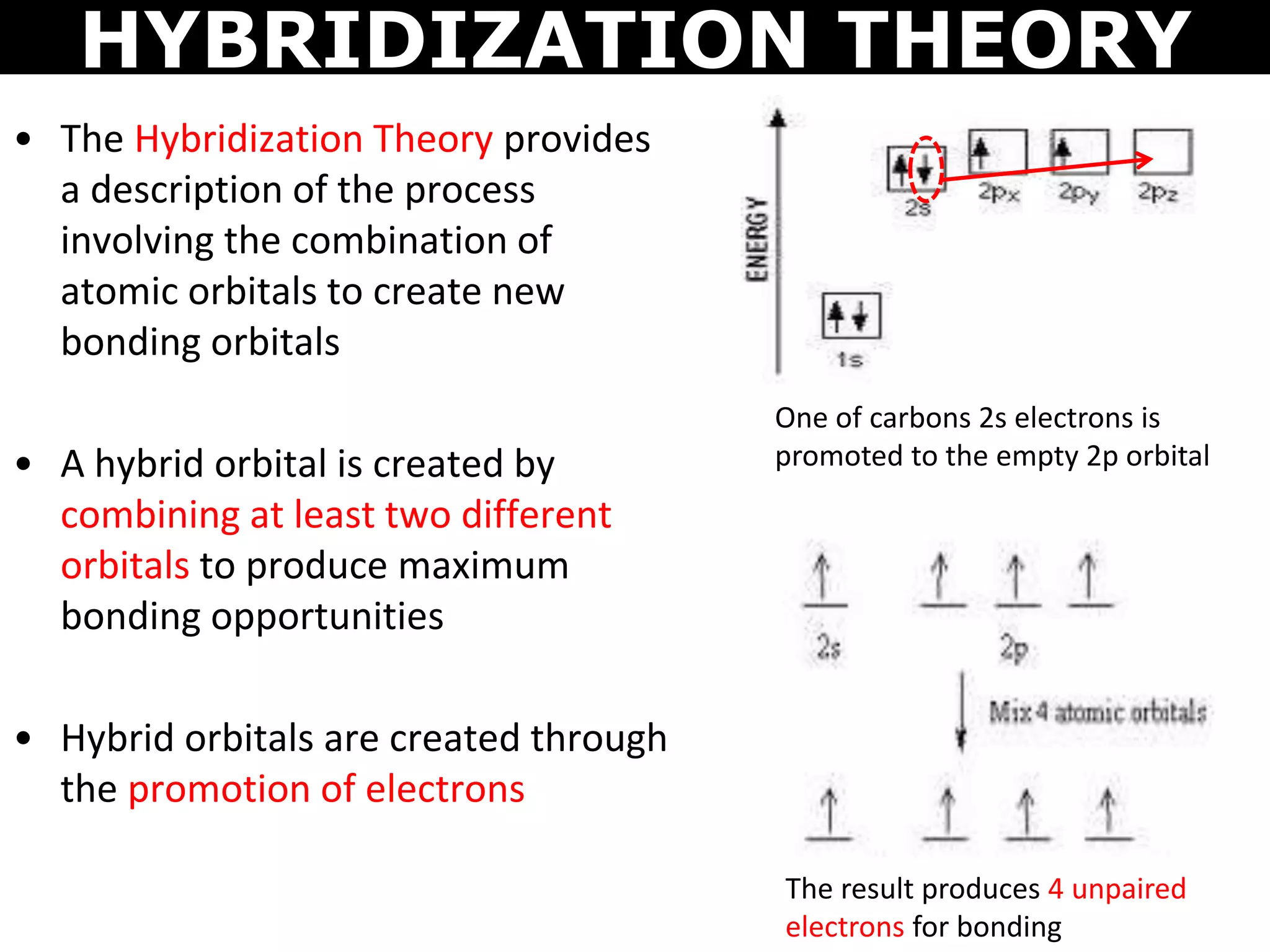
• The Hybridization Theory provides
a description of the process
involving the combination of
atomic orbitals to create new
bonding orbitals
• A hybrid orbital is created by
combining at least two different
orbitals to produce maximum
bonding opportunities
• Hybrid orbitals are created through
the promotion of electrons
One of carbons 2s electrons is
promoted to the empty 2p orbital
The result produces 4 unpaired
electrons for bonding
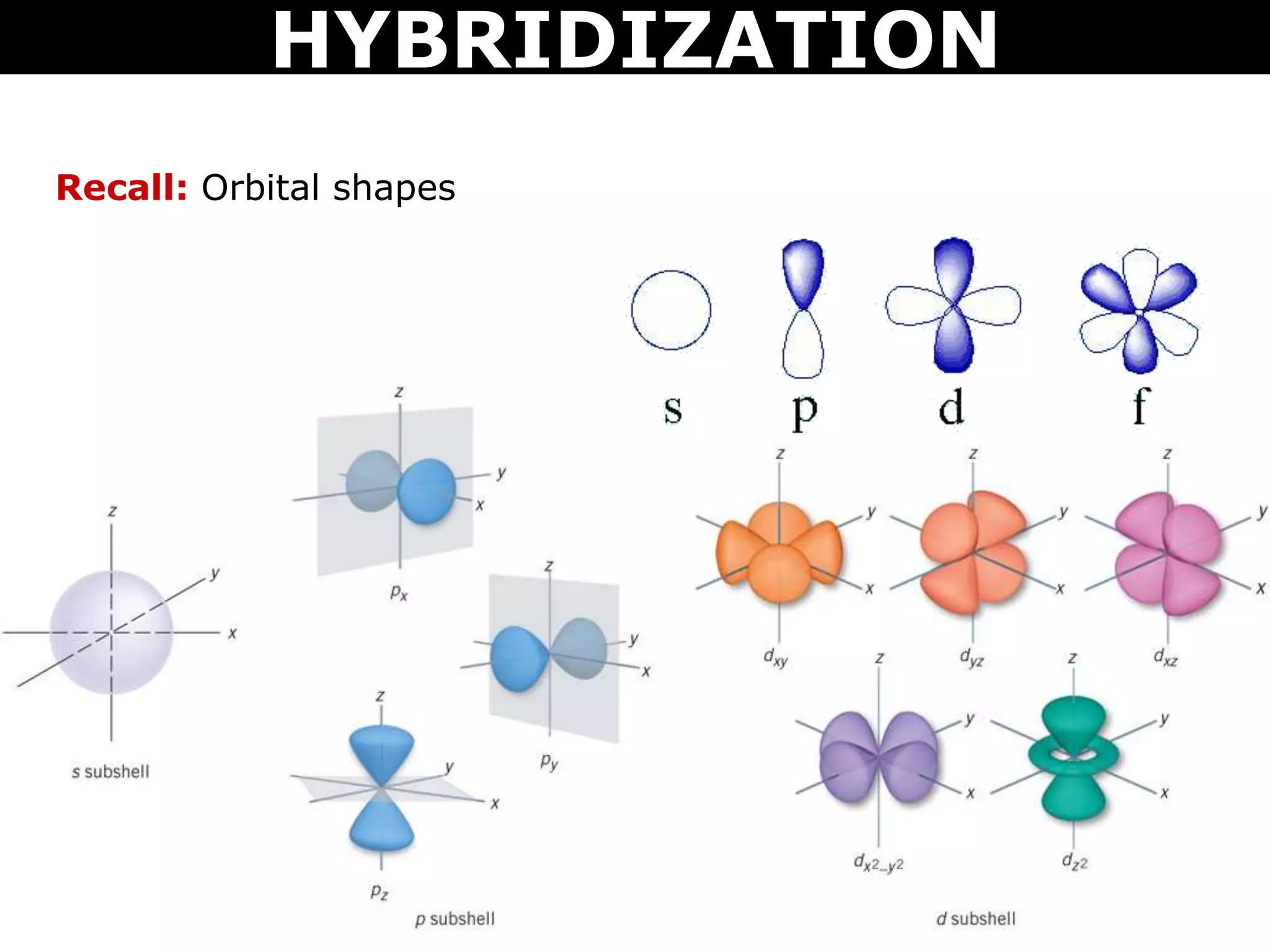
Recall: Orbital shapes
HYBRIDIZATION
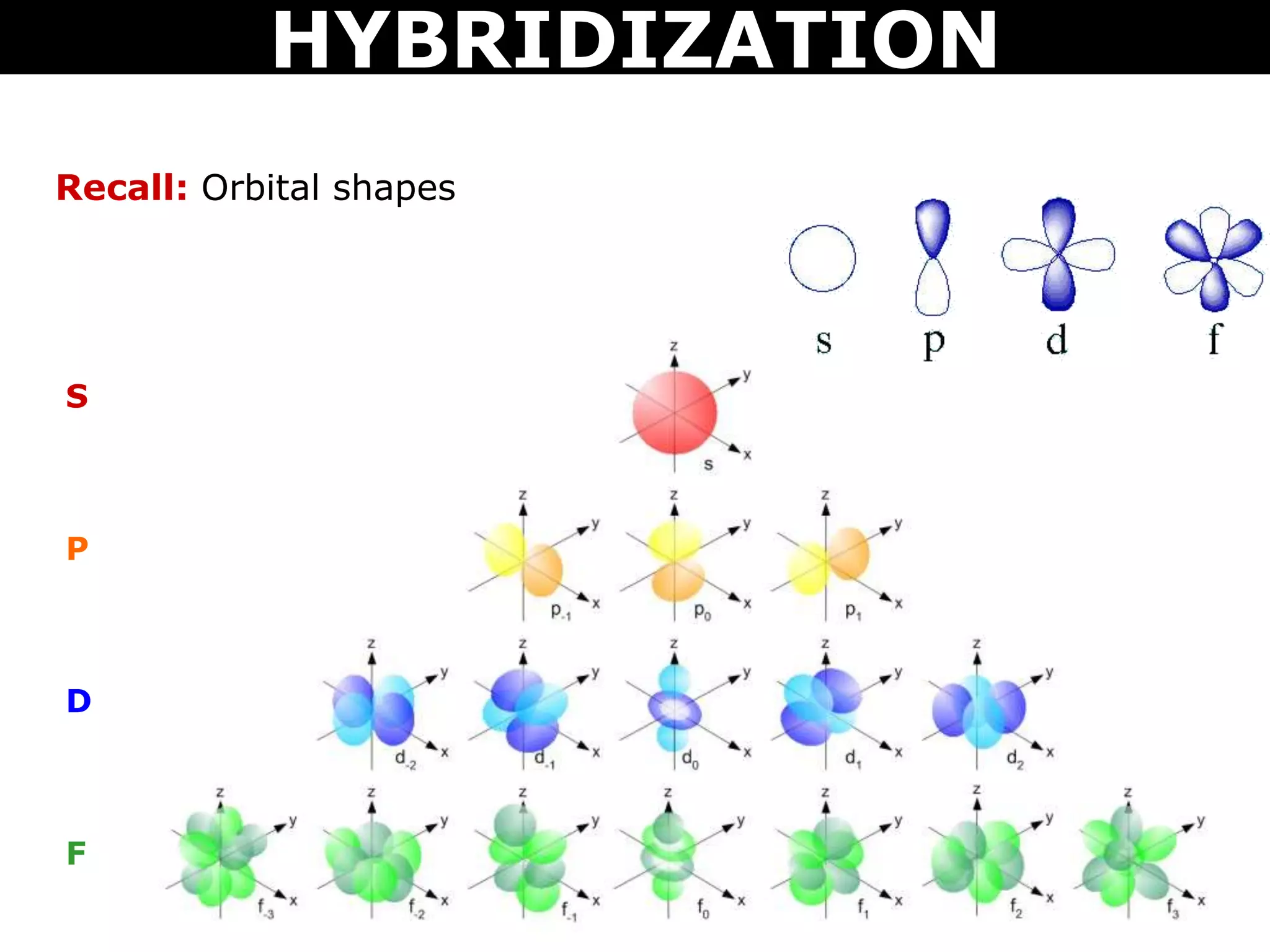
Recall: Orbital shapes
S
P
D
F
HYBRIDIZATION
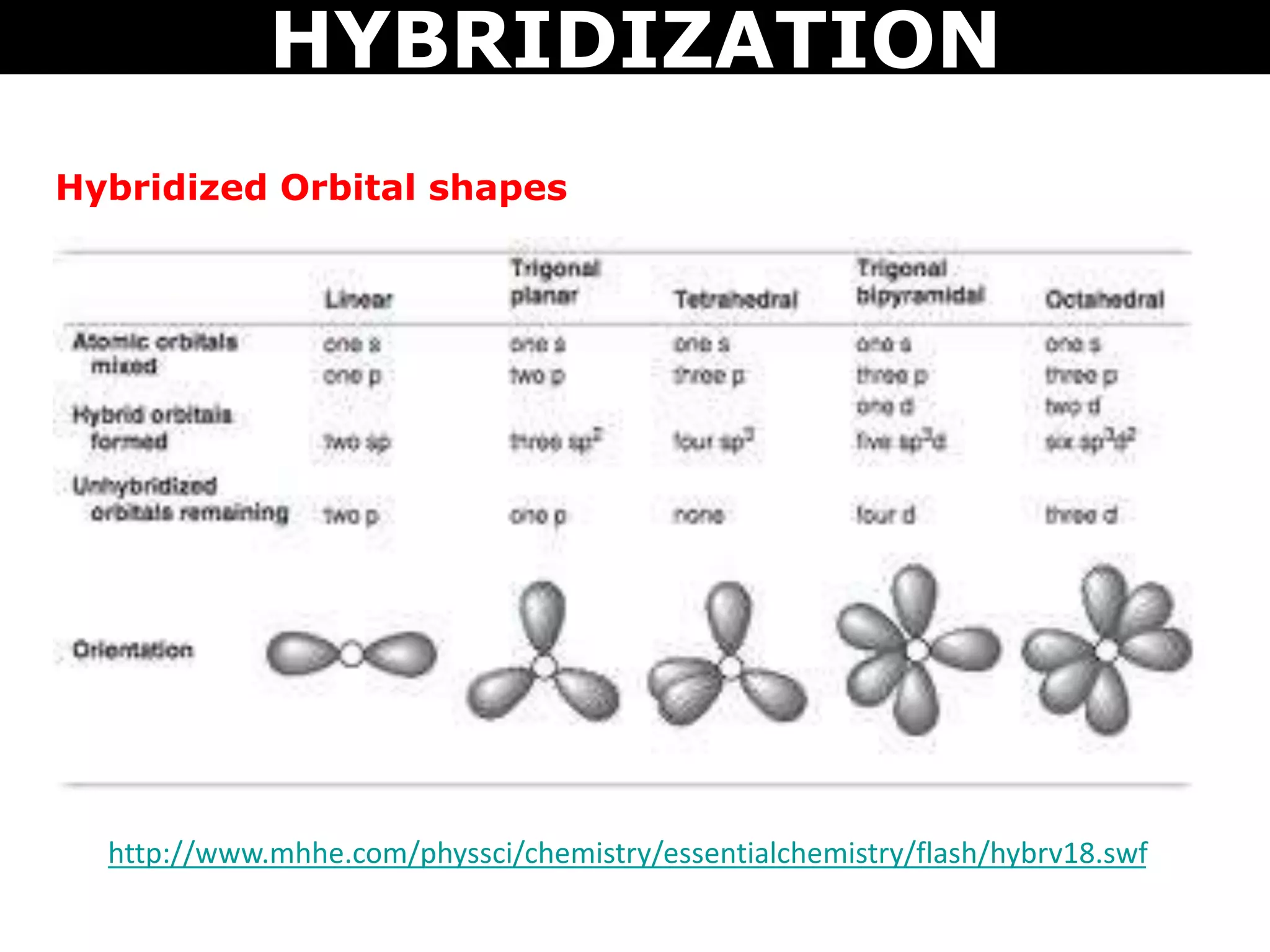
Hybridized Orbital shapes
http://www.mhhe.com/physsci/chemistry/essentialchemistry/flash/hybrv18.swf
HYBRIDIZATION
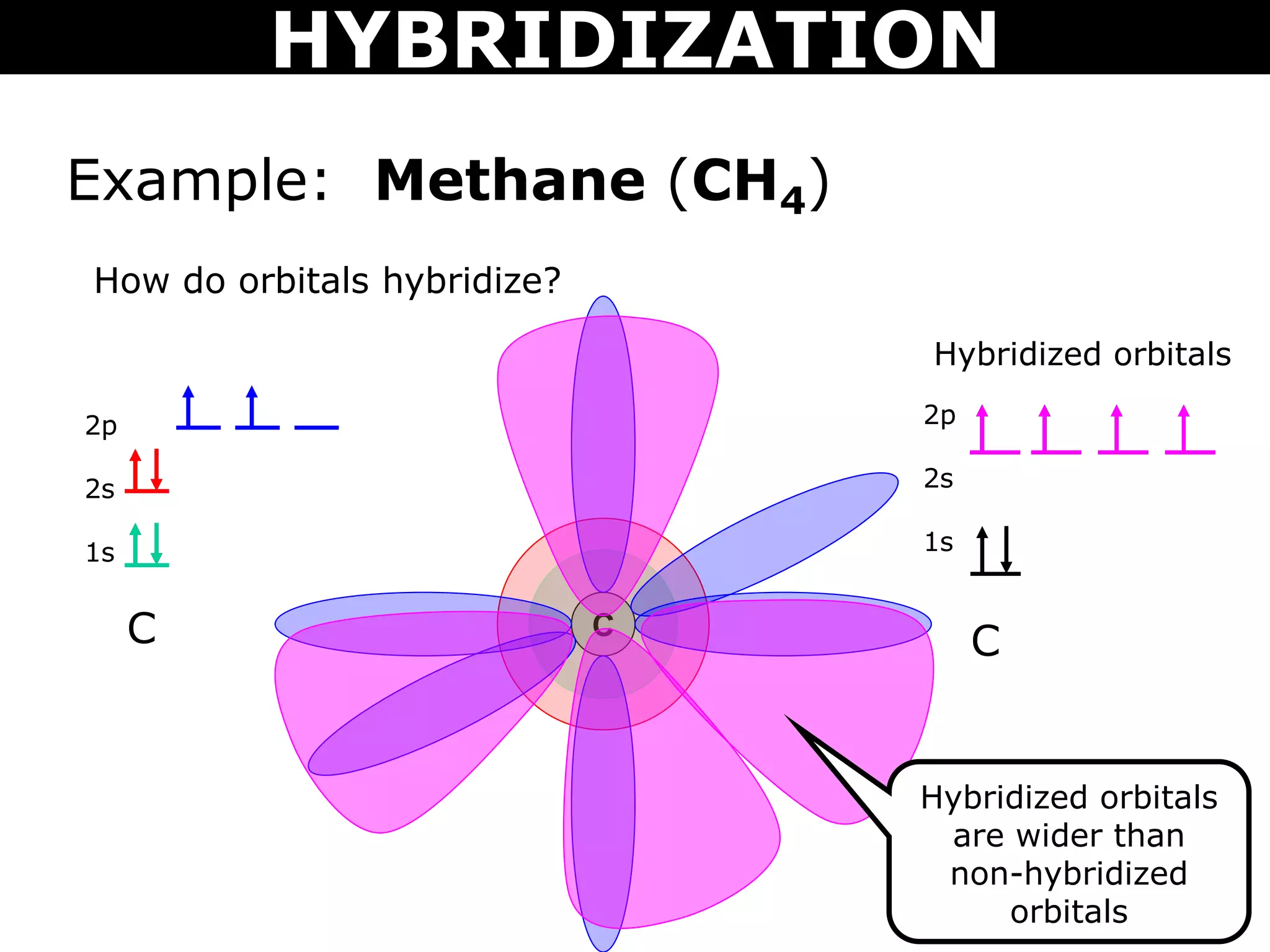
How do orbitals hybridize?
CC
2p
2s
1s
C
2p
2s
1s
Hybridized orbitals
Hybridized orbitals
are wider than
non-hybridized
orbitals
Example: Methane (CH4)
HYBRIDIZATION
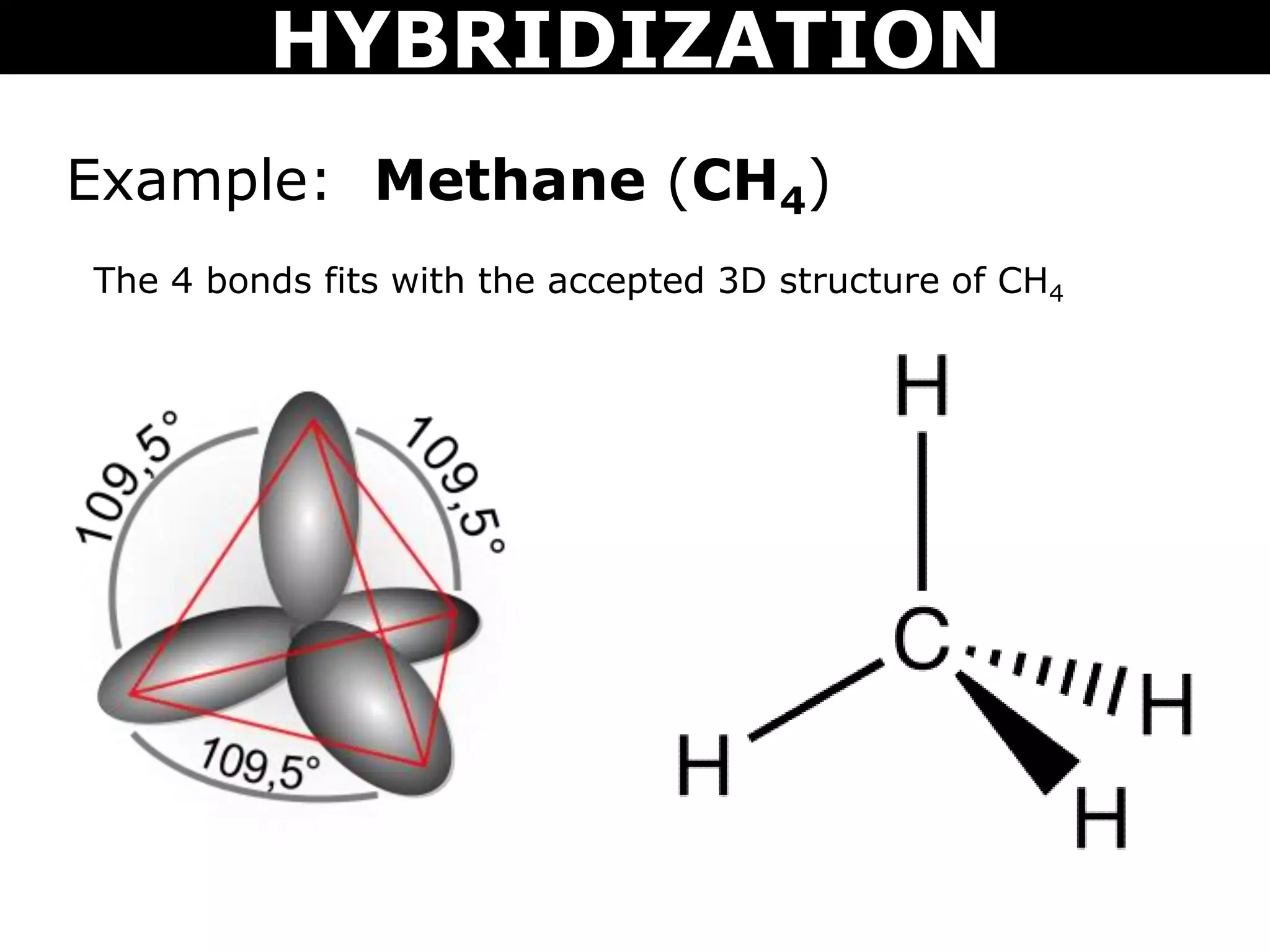
The 4 bonds fits with the accepted 3D structure of CH4
Example: Methane (CH4)
HYBRIDIZATION
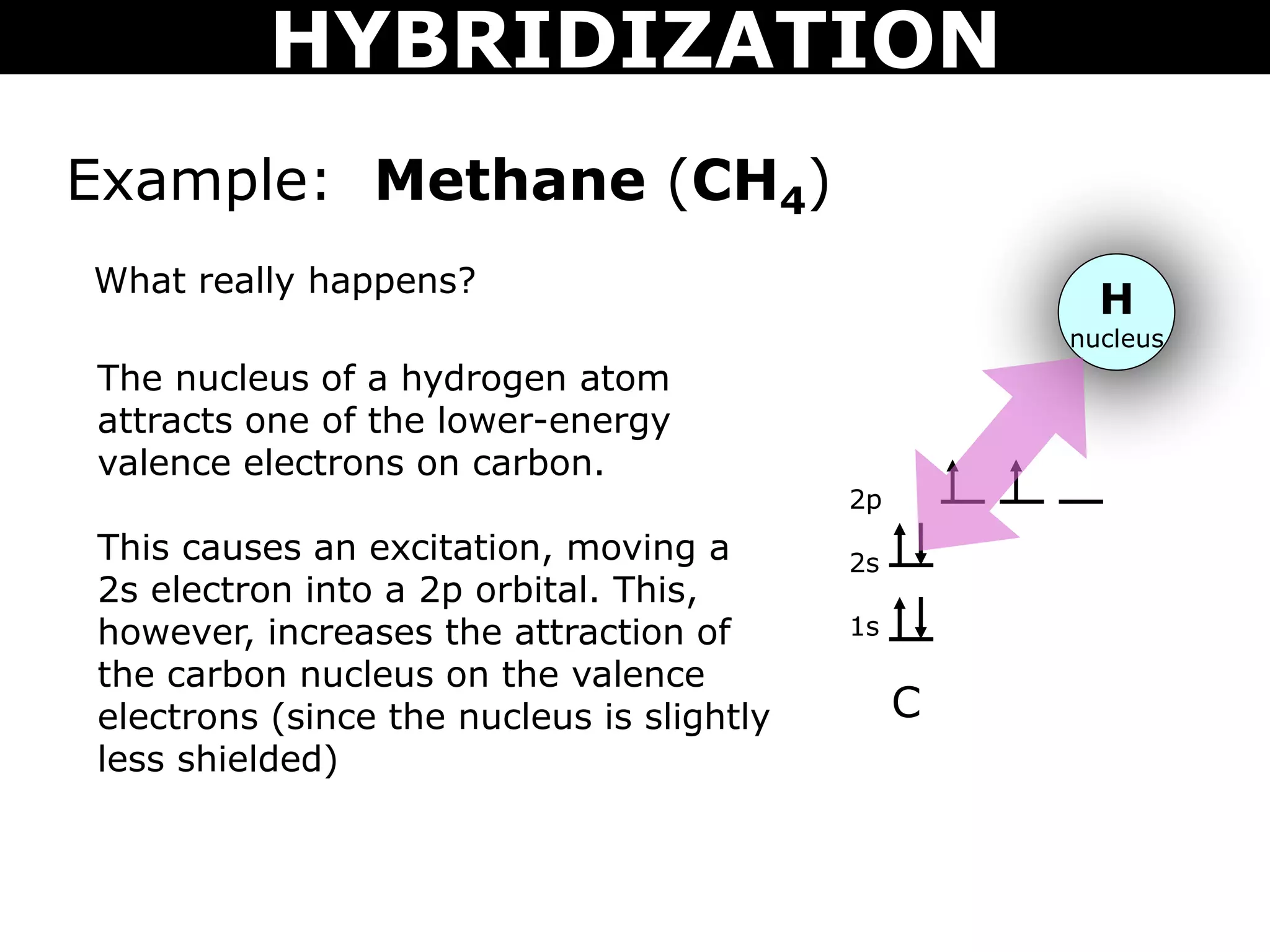
What really happens?
The nucleus of a hydrogen atom
attracts one of the lower-energy
valence electrons on carbon.
This causes an excitation, moving a
2s electron into a 2p orbital. This,
however, increases the attraction of
the carbon nucleus on the valence
electrons (since the nucleus is slightly
less shielded)
C
2p
2s
1s
H
nucleus
Example: Methane (CH4)
HYBRIDIZATION
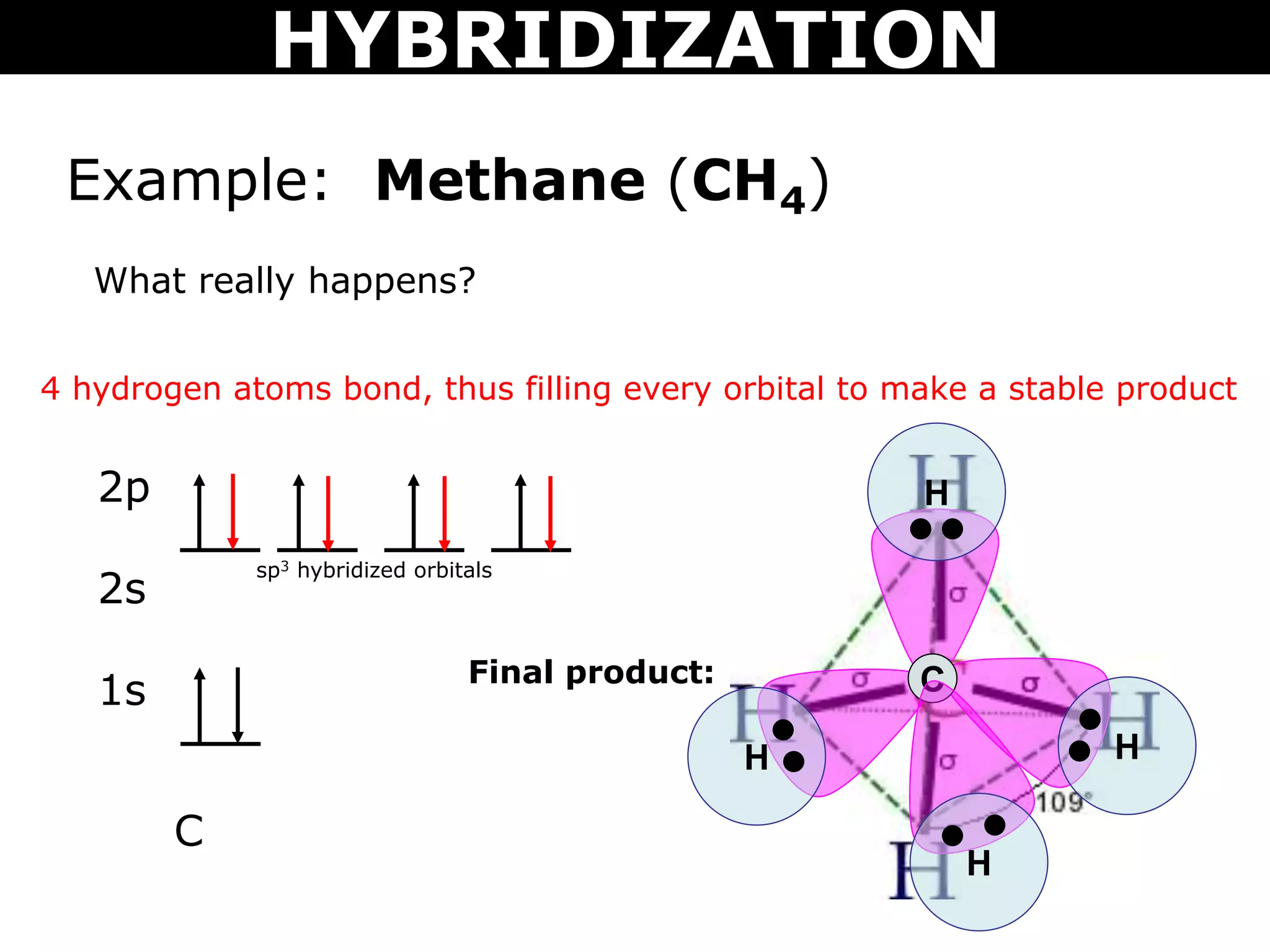
What really happens?
C
2p
2s
1s
sp3 hybridized orbitals
4 hydrogen atoms bond, thus filling every orbital to make a stable product
Final product: C
H
H H
H
Example: Methane (CH4)
HYBRIDIZATION
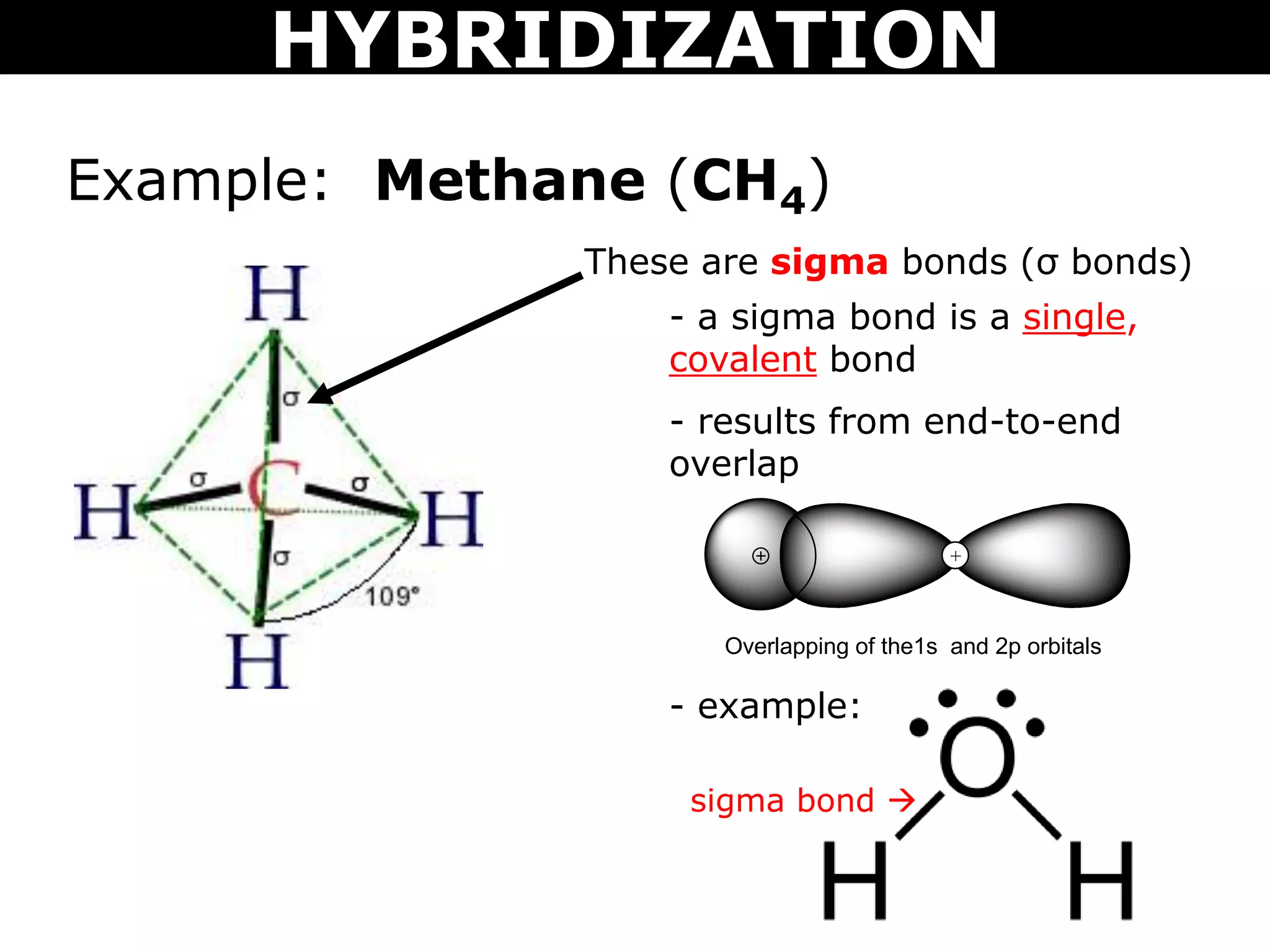
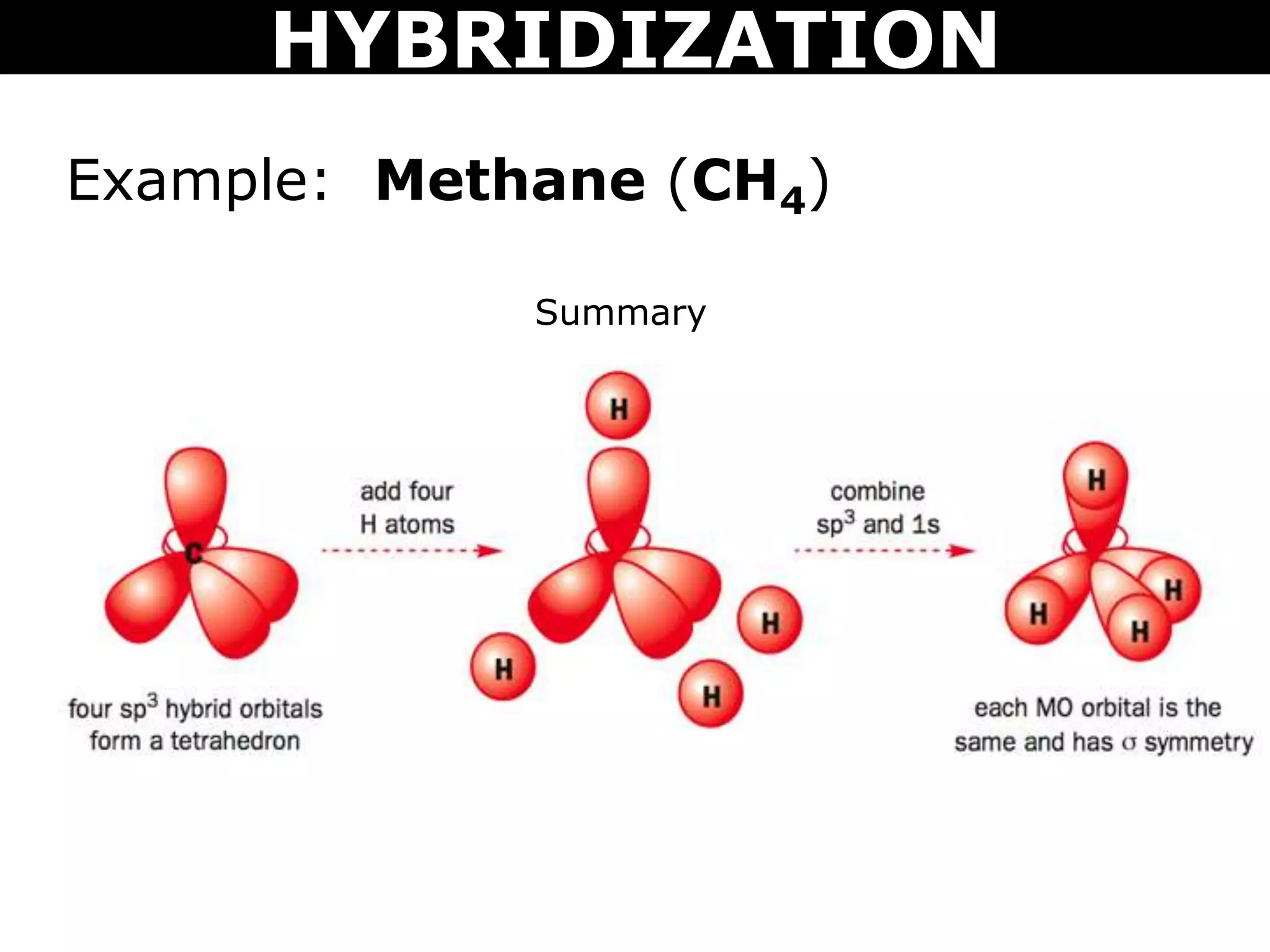
These are sigma bonds (σ bonds)
- a sigma bond is a single,
covalent bond
- example:
sigma bond 
Example: Methane (CH4)
Overlapping of the1s and 2p orbitals
+
- results from end-to-end
overlap
HYBRIDIZATION
Summary
Example: Methane (CH4)
HYBRIDIZATION
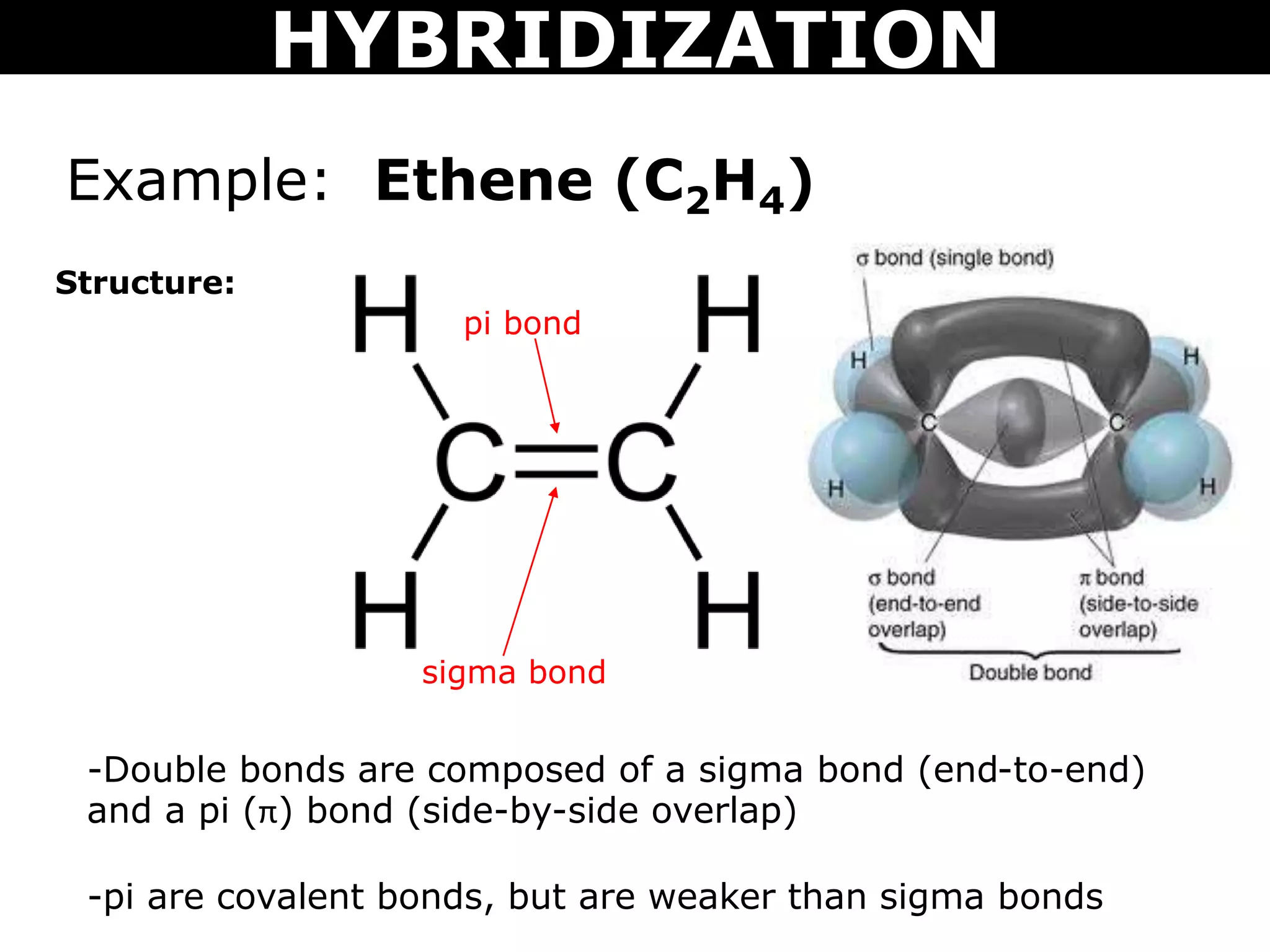
Example: Ethene (C2H4)
Structure:
sigma bond
pi bond
-Double bonds are composed of a sigma bond (end-to-end)
and a pi (π) bond (side-by-side overlap)
-pi are covalent bonds, but are weaker than sigma bonds
HYBRIDIZATION
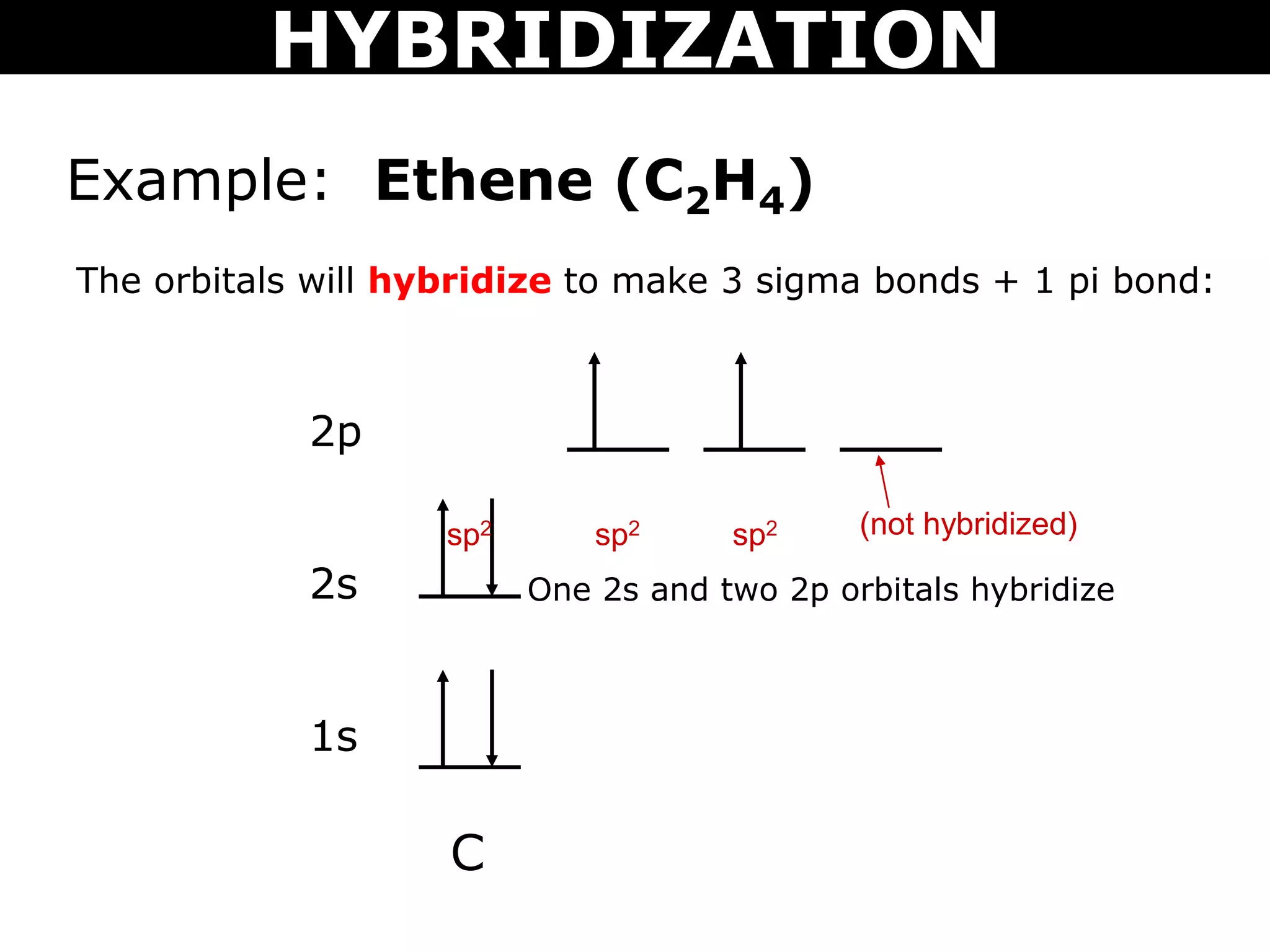
Example: Ethene (C2H4)
C
2p
2s
1s
The orbitals will hybridize to make 3 sigma bonds + 1 pi bond:
One 2s and two 2p orbitals hybridize
sp2 sp2 sp2 (not hybridized)
HYBRIDIZATION
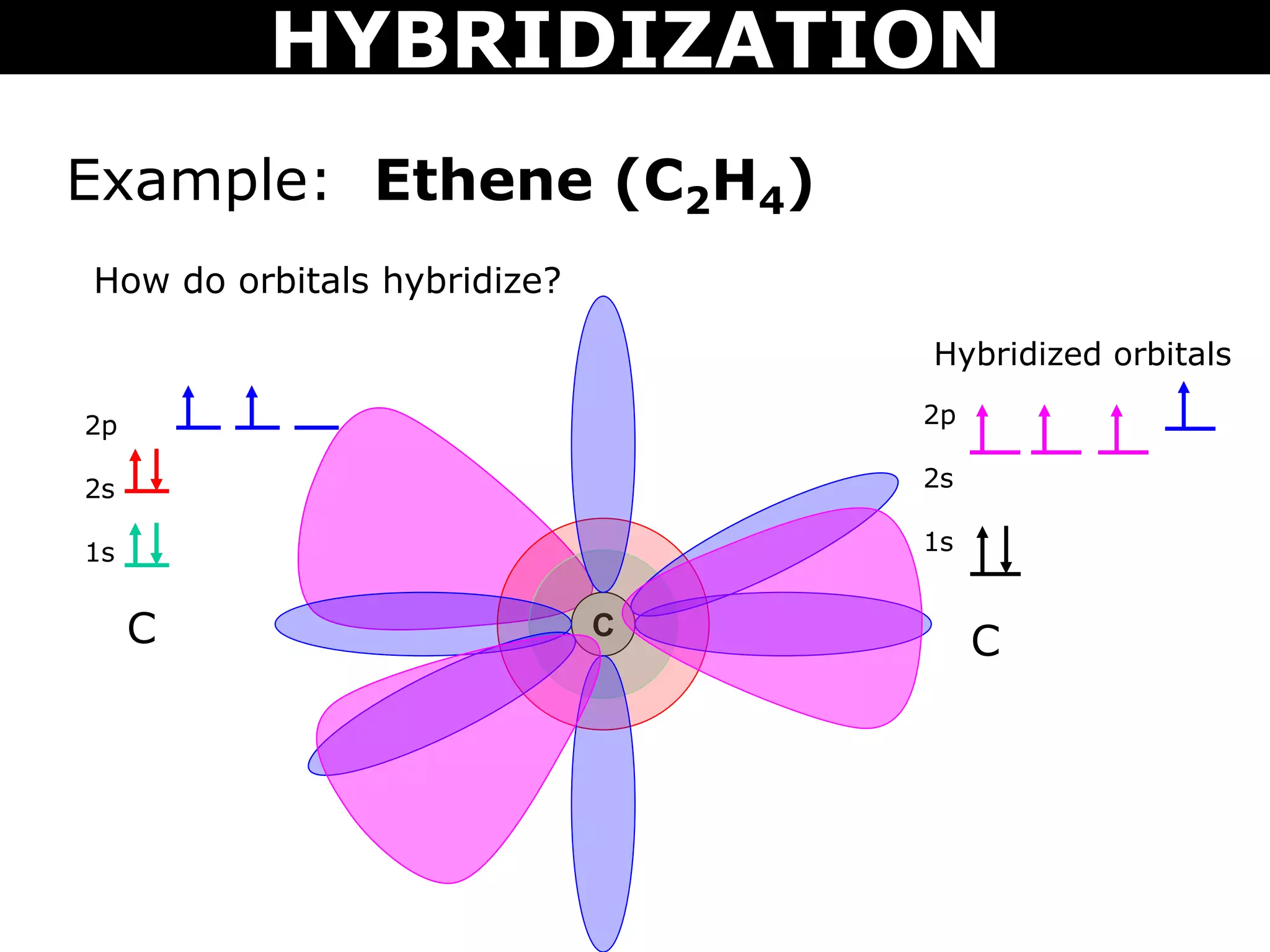
Example: Ethene (C2H4)
How do orbitals hybridize?
CC
2p
2s
1s
C
2p
2s
1s
Hybridized orbitals
HYBRIDIZATION
Example: Ethene (C2H4)
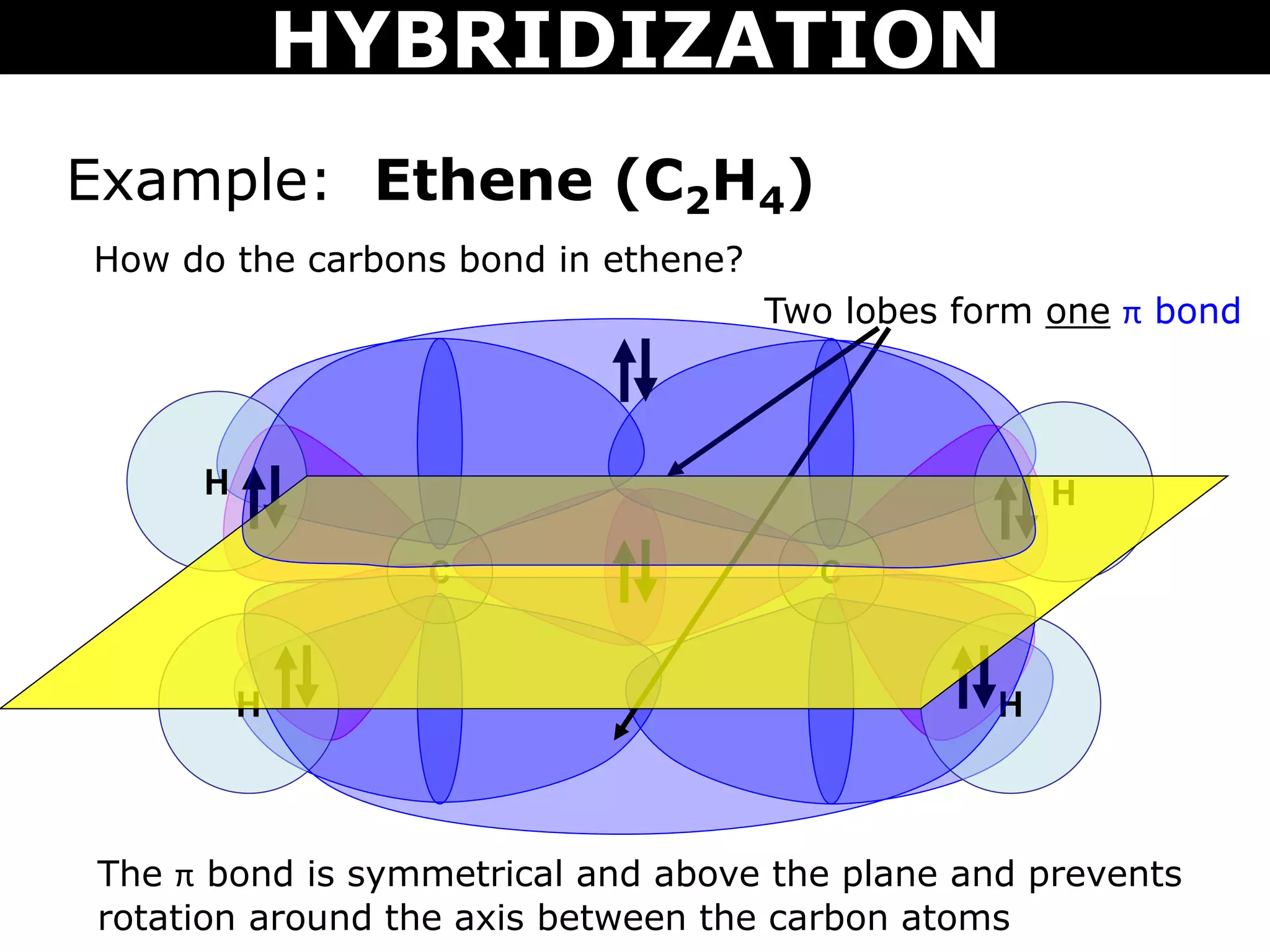
How do the carbons bond in ethene?
C C
H
H
H
H
Two lobes form one π bond
The π bond is symmetrical and above the plane and prevents
rotation around the axis between the carbon atoms
HYBRIDIZATION
Example: Ethene (C2H4)
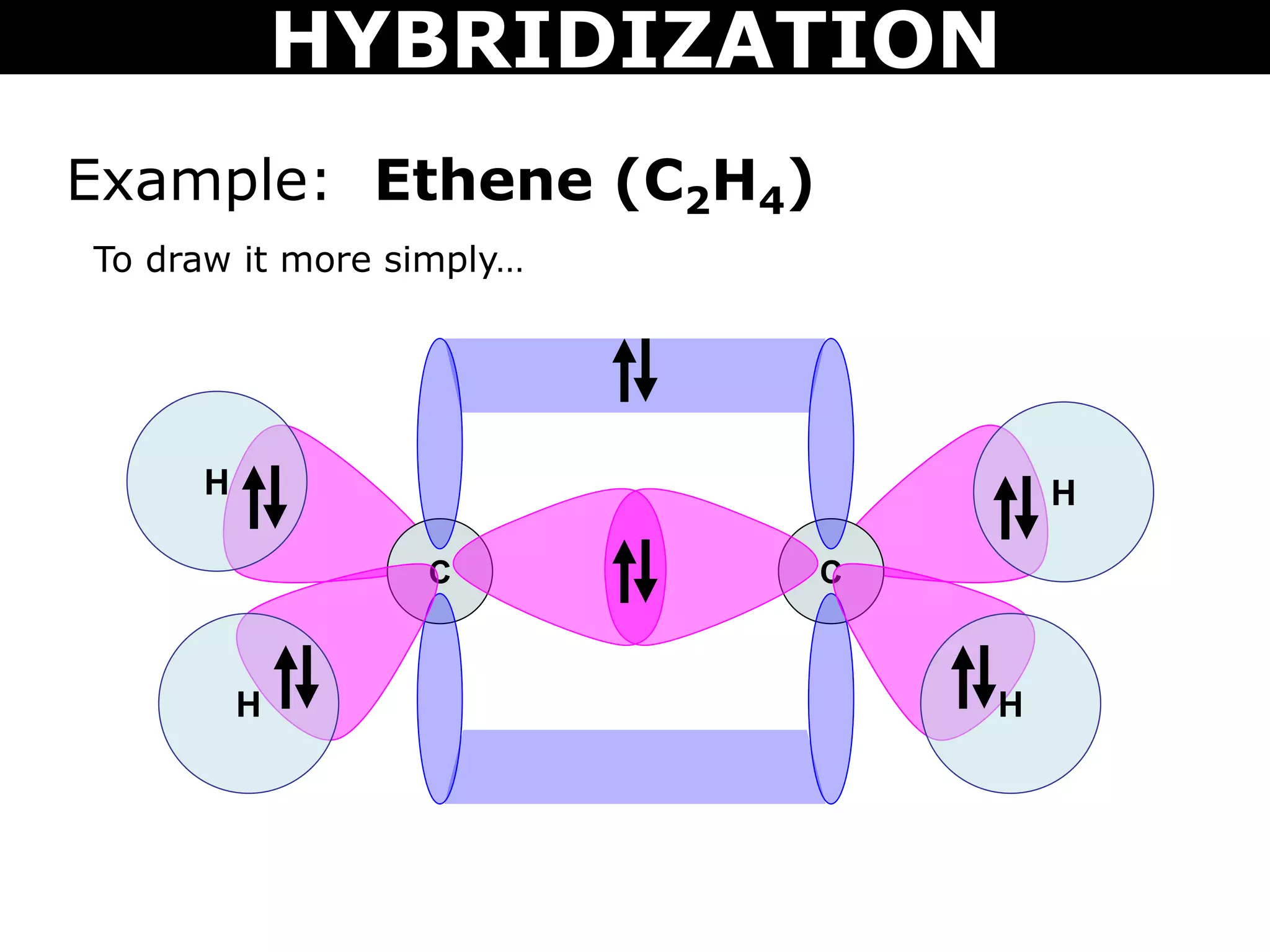
To draw it more simply…
C C
H
H
H
H
HYBRIDIZATION
Example: Ethene (C2H4)
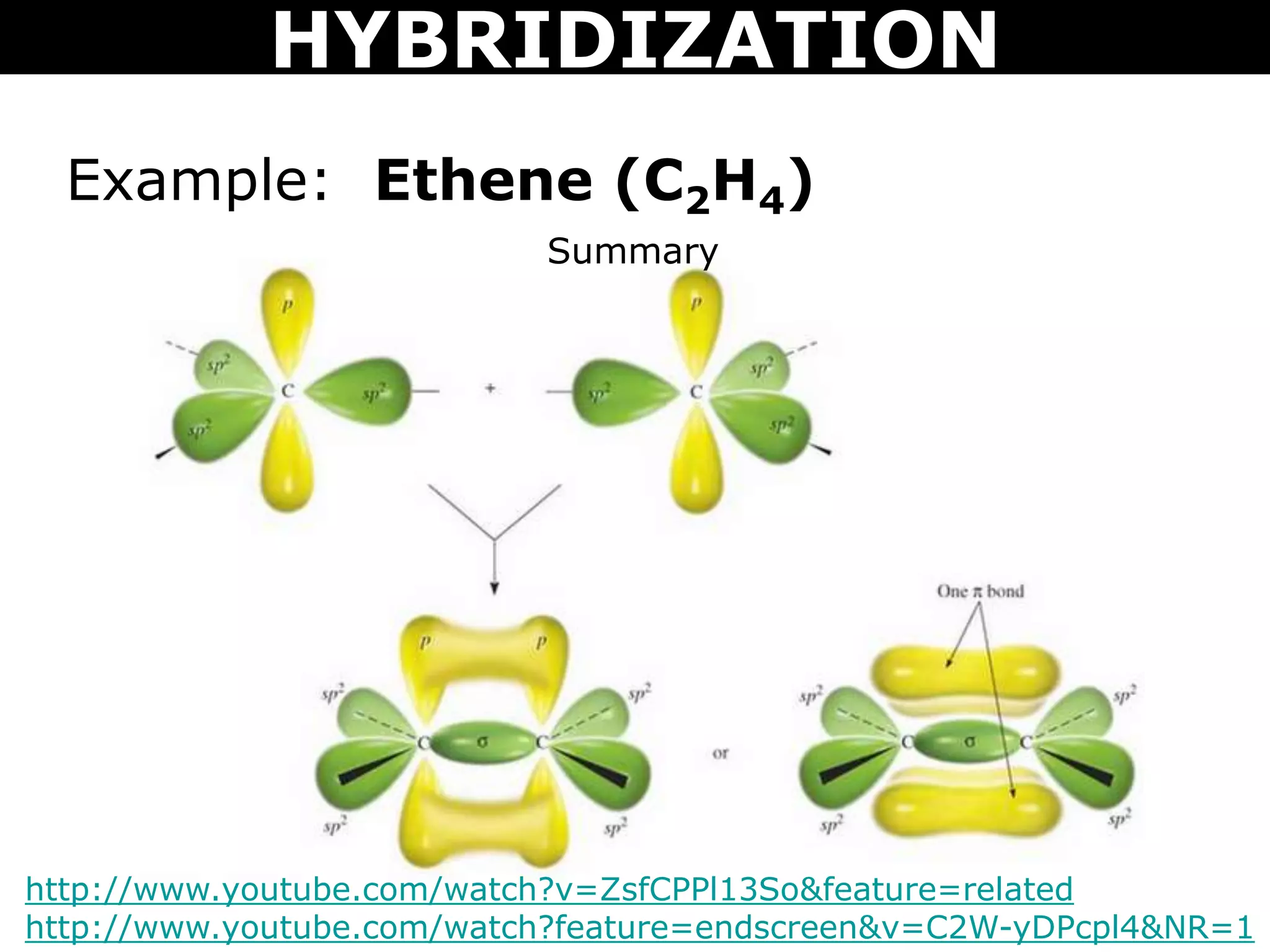
Summary
http://www.youtube.com/watch?v=ZsfCPPl13So&feature=related
http://www.youtube.com/watch?feature=endscreen&v=C2W-yDPcpl4&NR=1
HYBRIDIZATION
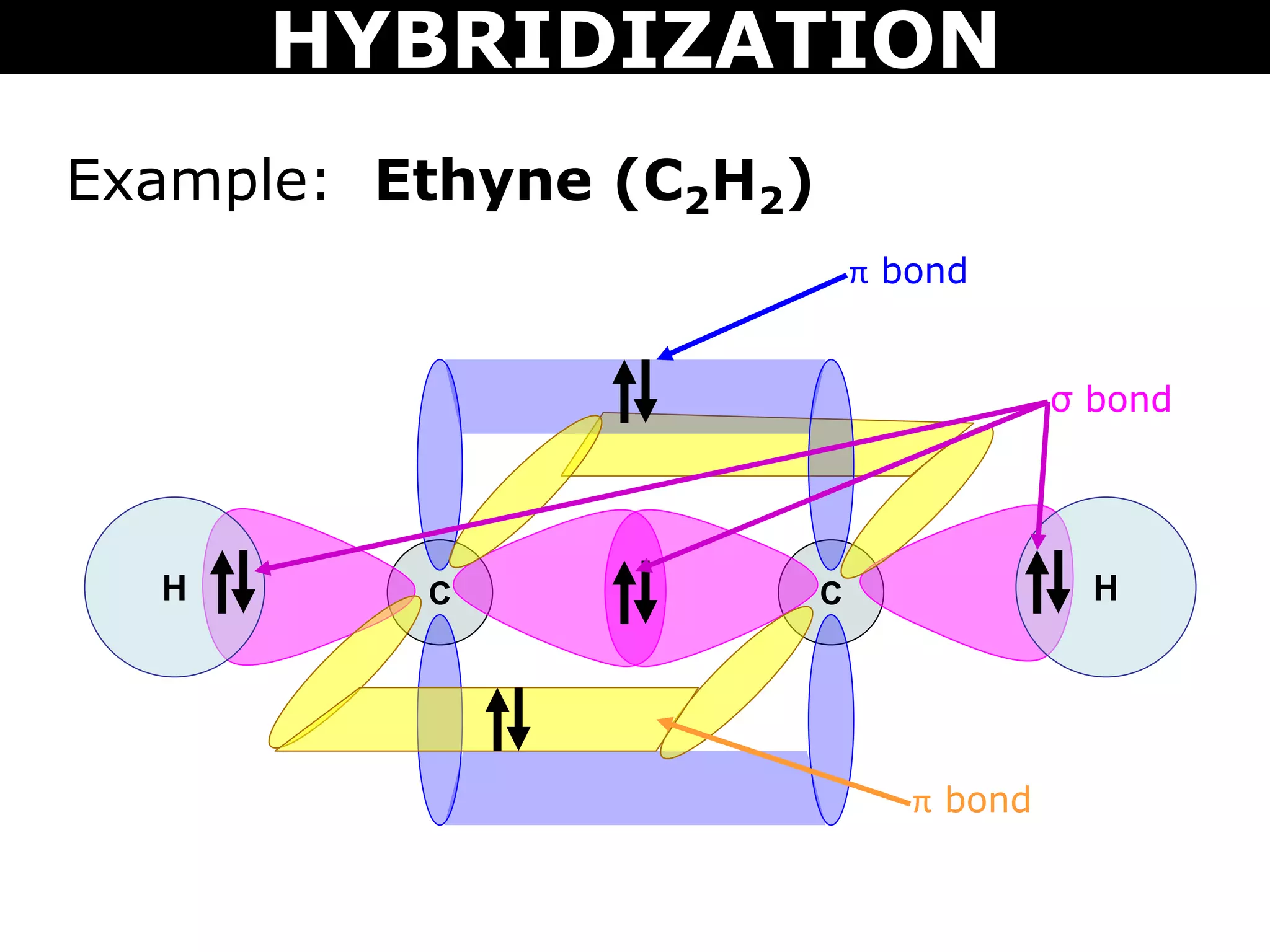
Example: Ethyne (C2H2)
π bond
σ bond
π bond
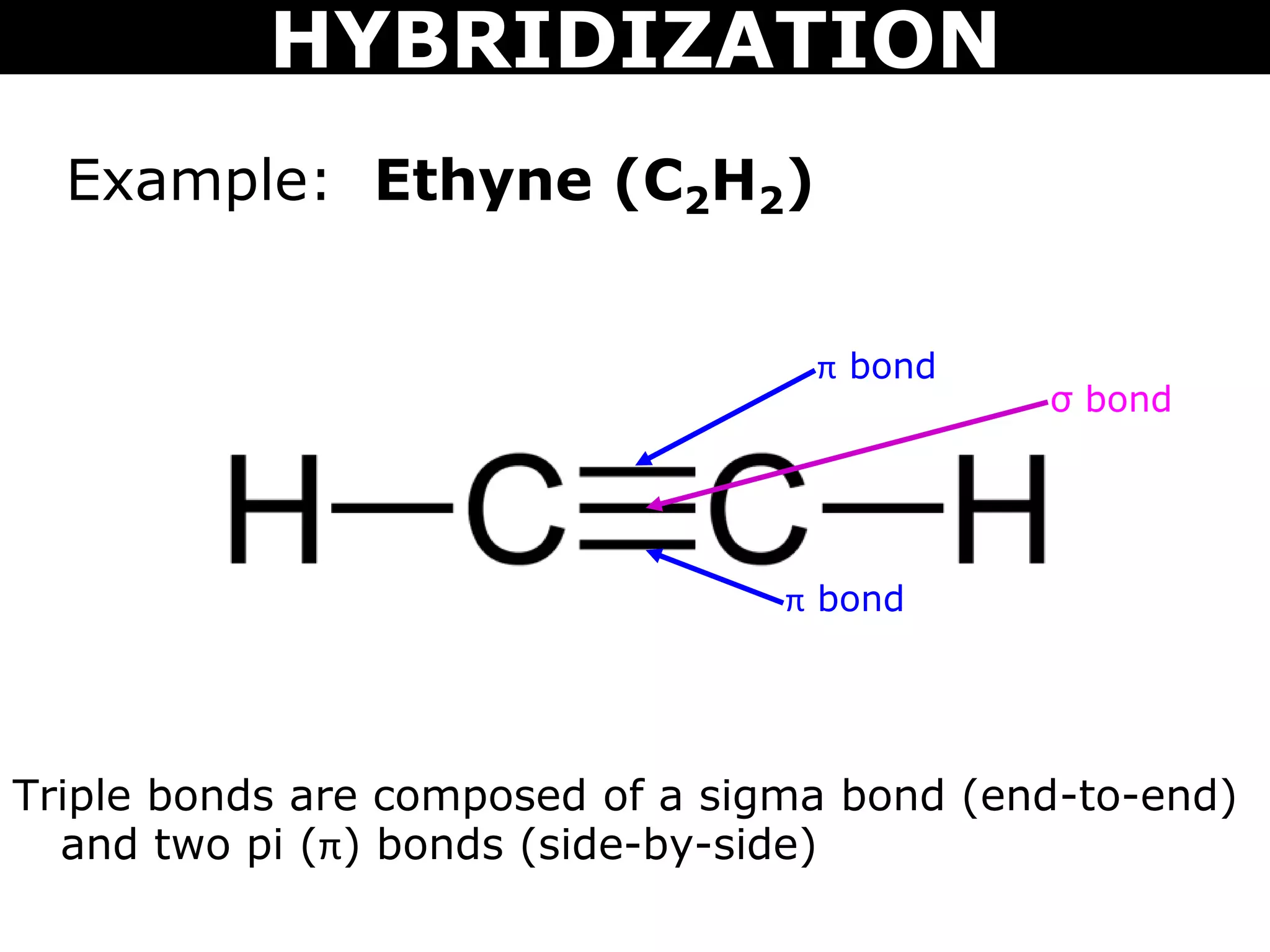
Triple bonds are composed of a sigma bond (end-to-end)
and two pi (π) bonds (side-by-side)
HYBRIDIZATION
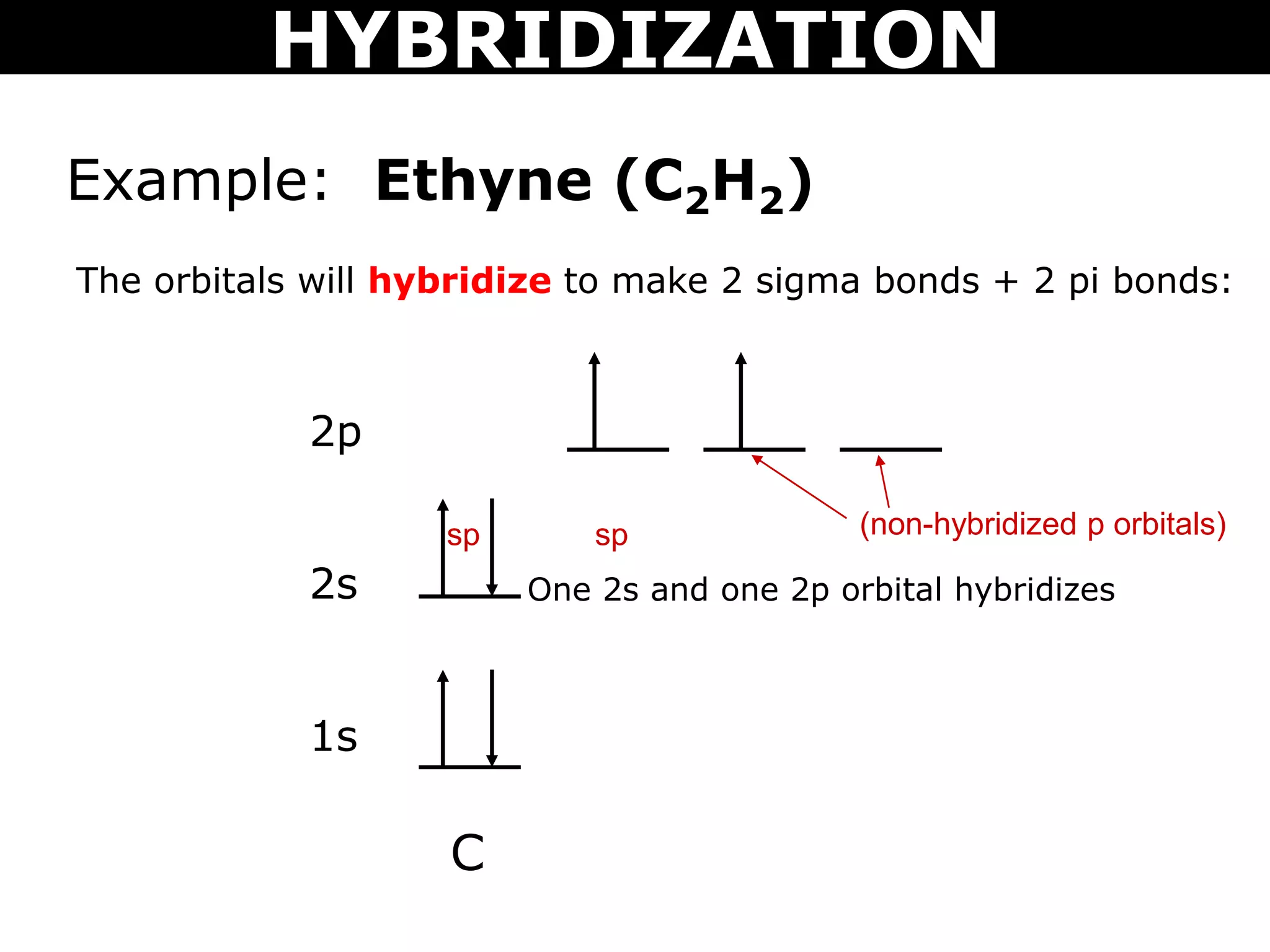
Example: Ethyne (C2H2)
C
2p
2s
1s
The orbitals will hybridize to make 2 sigma bonds + 2 pi bonds:
One 2s and one 2p orbital hybridizes
sp sp (non-hybridized p orbitals)
HYBRIDIZATION
Example: Ethyne (C2H2)
C CH H
π bond
π bond
σ bond
HYBRIDIZATION
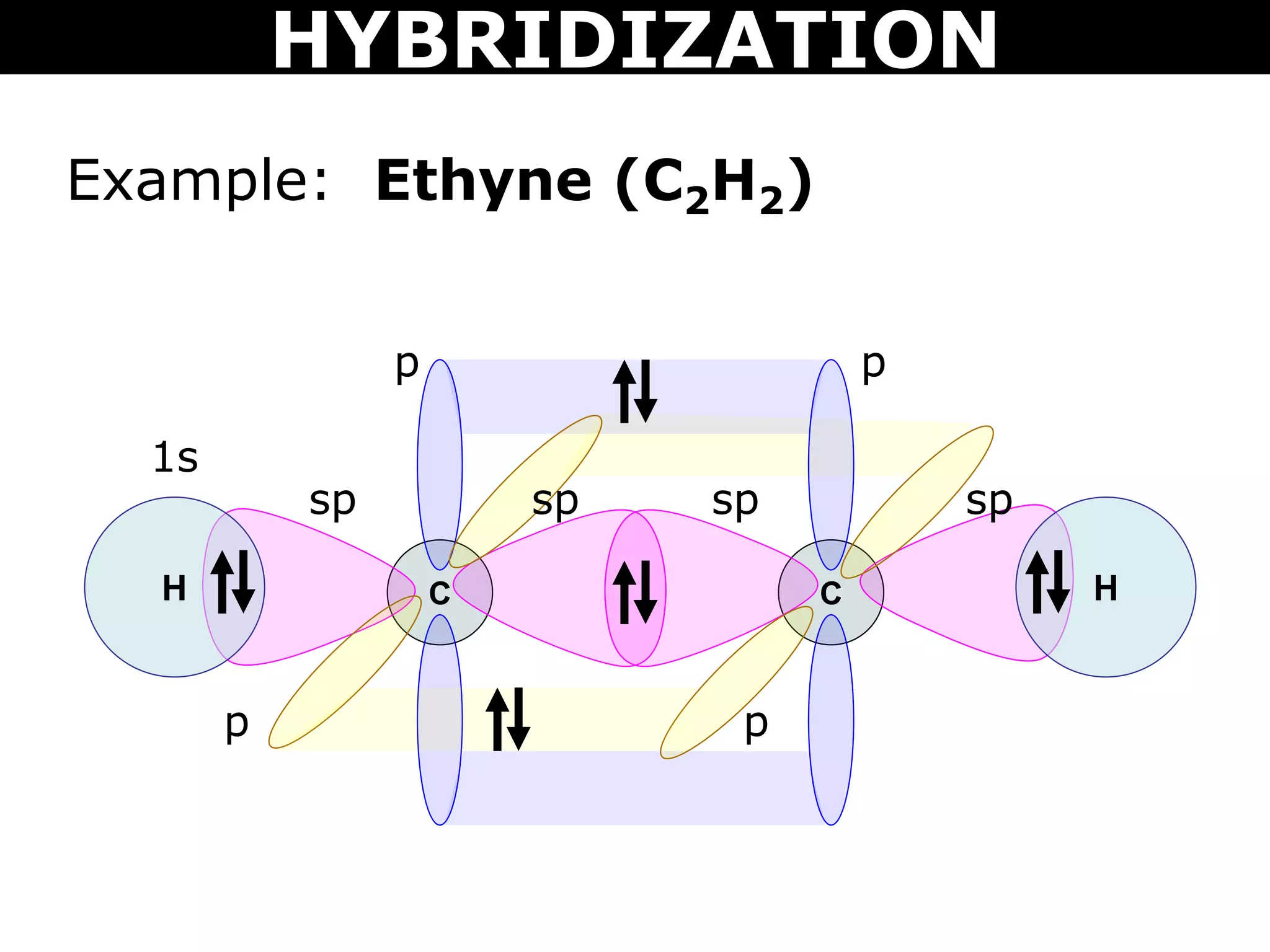
Example: Ethyne (C2H2)
C CH H
1s
sp sp sp sp
p p
p p
HYBRIDIZATION
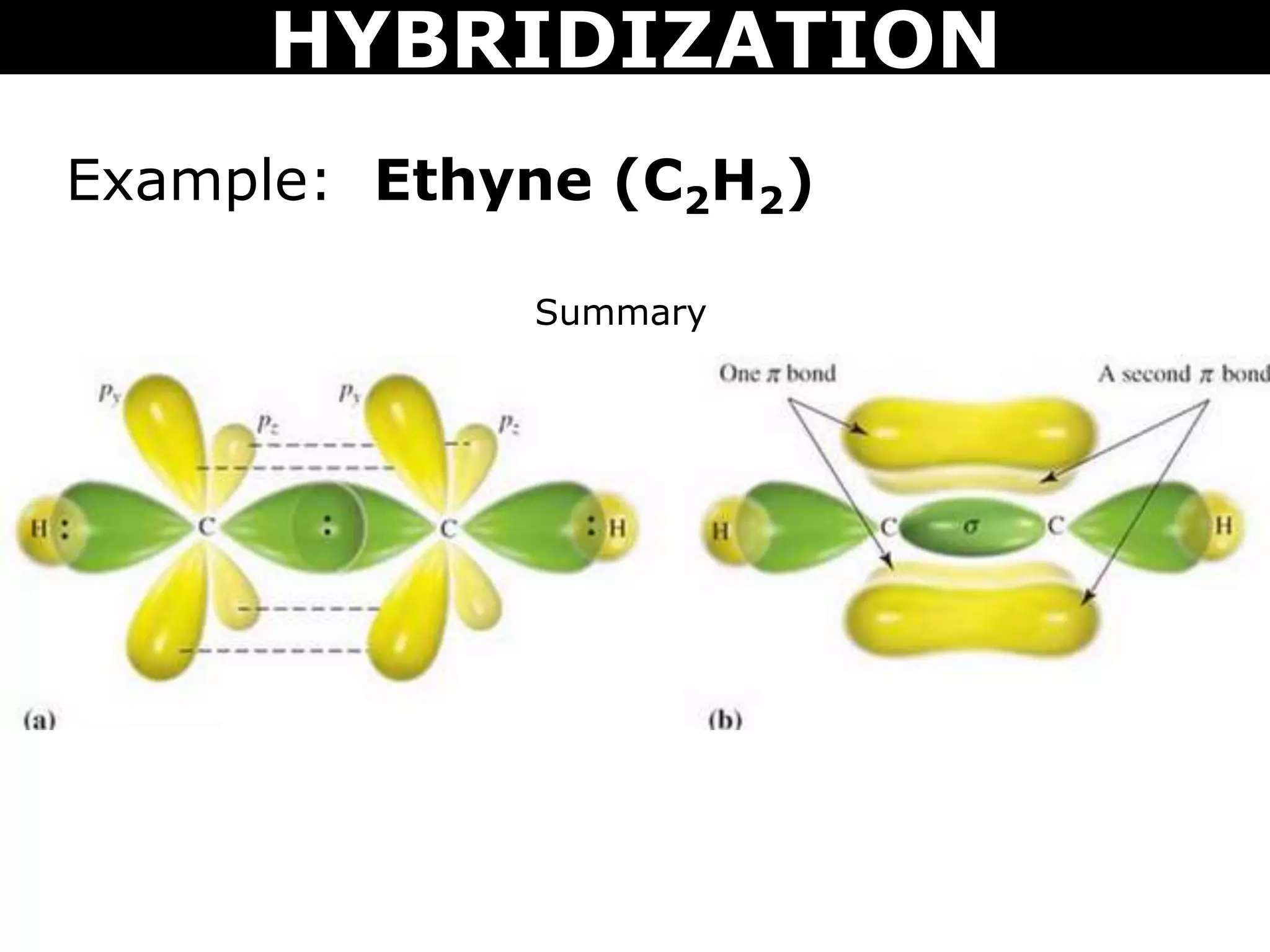
Example: Ethyne (C2H2)
Summary
HYBRIDIZATION
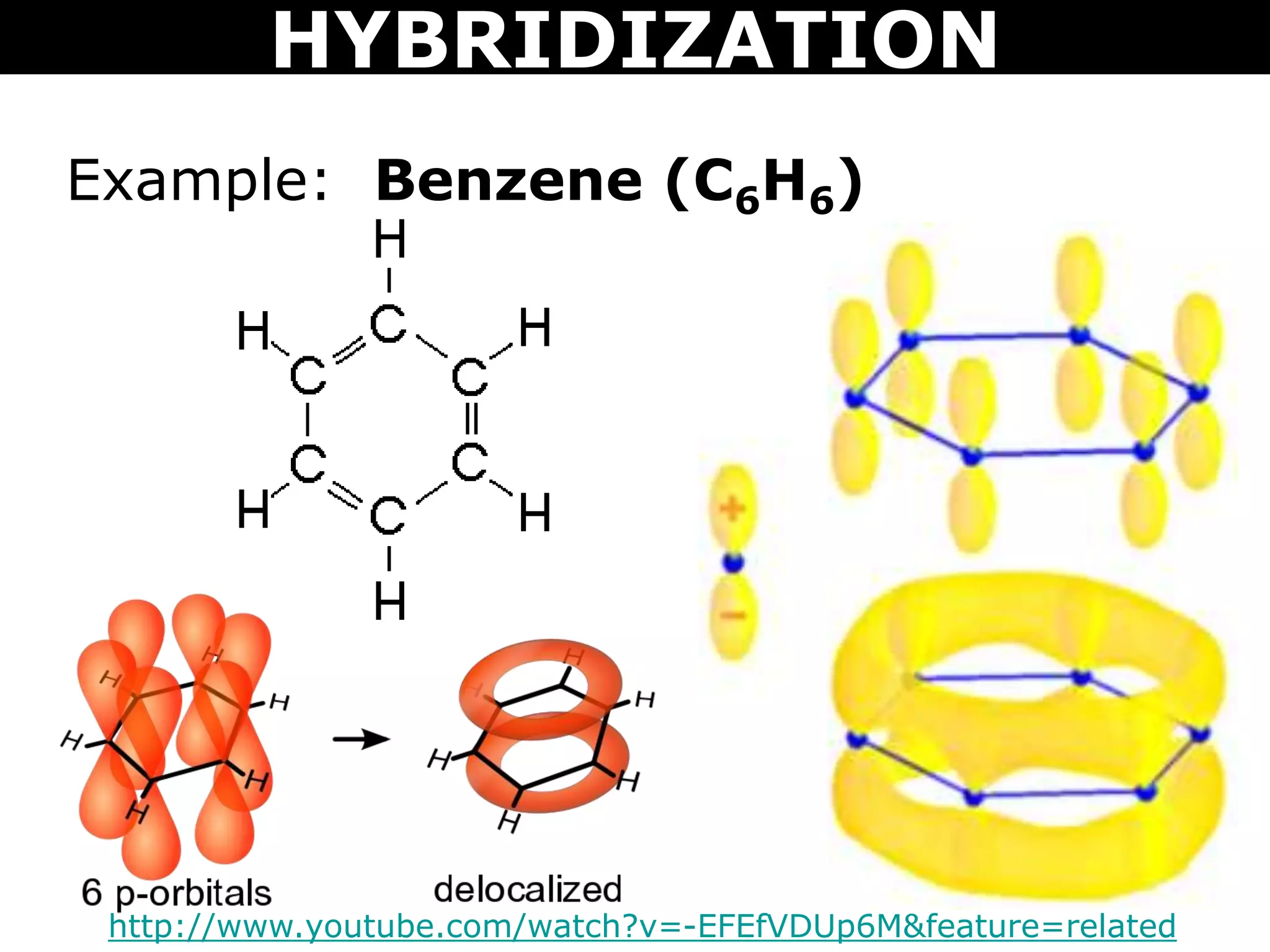
Example: Benzene (C6H6)
http://www.youtube.com/watch?v=-EFEfVDUp6M&feature=related
HYBRIDIZATION
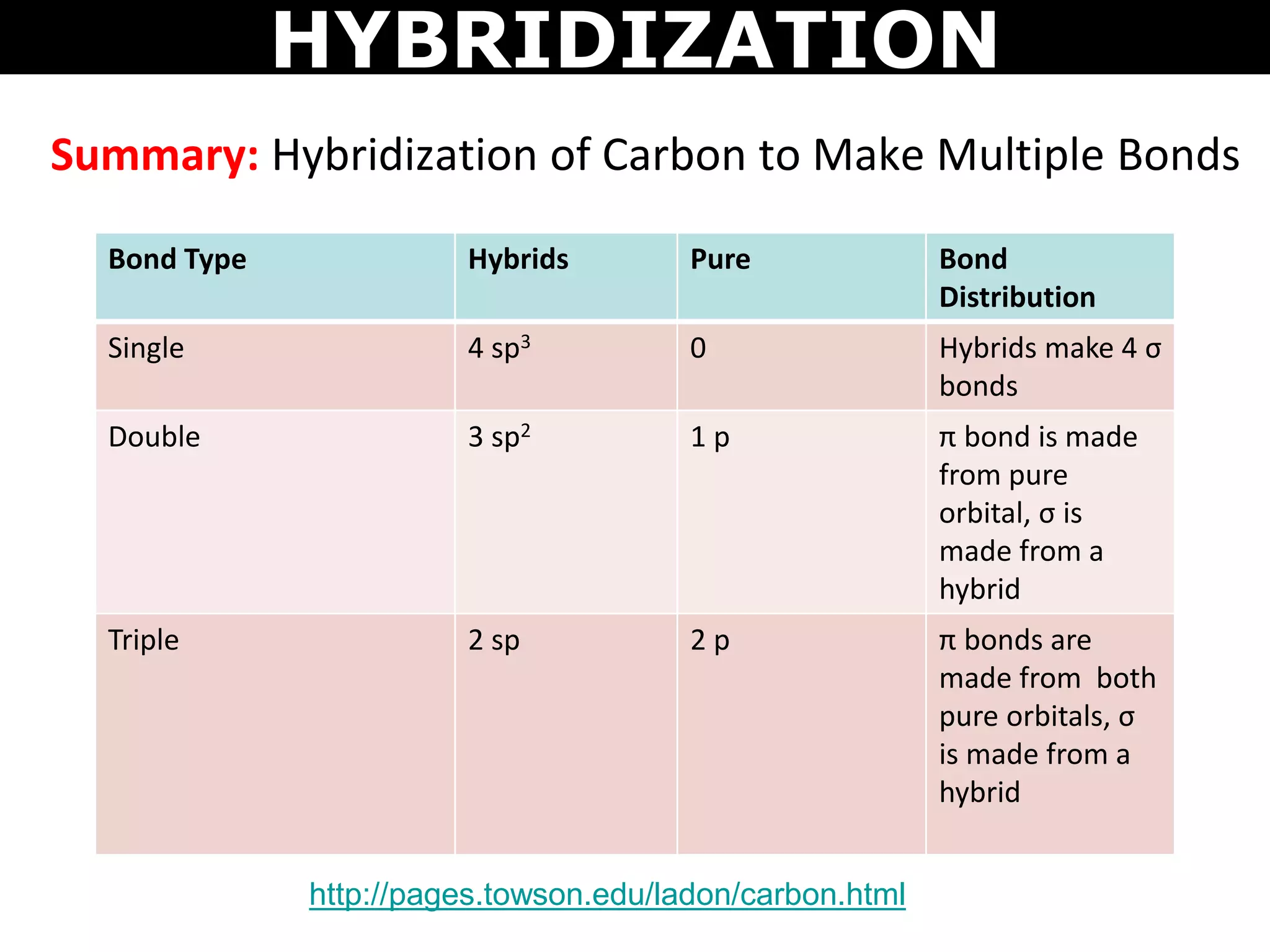
Bond Type Hybrids Pure Bond
Distribution
Single 4 sp3 0 Hybrids make 4 σ
bonds
Double 3 sp2 1 p π bond is made
from pure
orbital, σ is
made from a
hybrid
Triple 2 sp 2 p π bonds are
made from both
pure orbitals, σ
is made from a
hybrid
http://pages.towson.edu/ladon/carbon.html
HYBRIDIZATION
Summary: Hybridization of Carbon to Make Multiple Bonds
HYBRIDIZATION
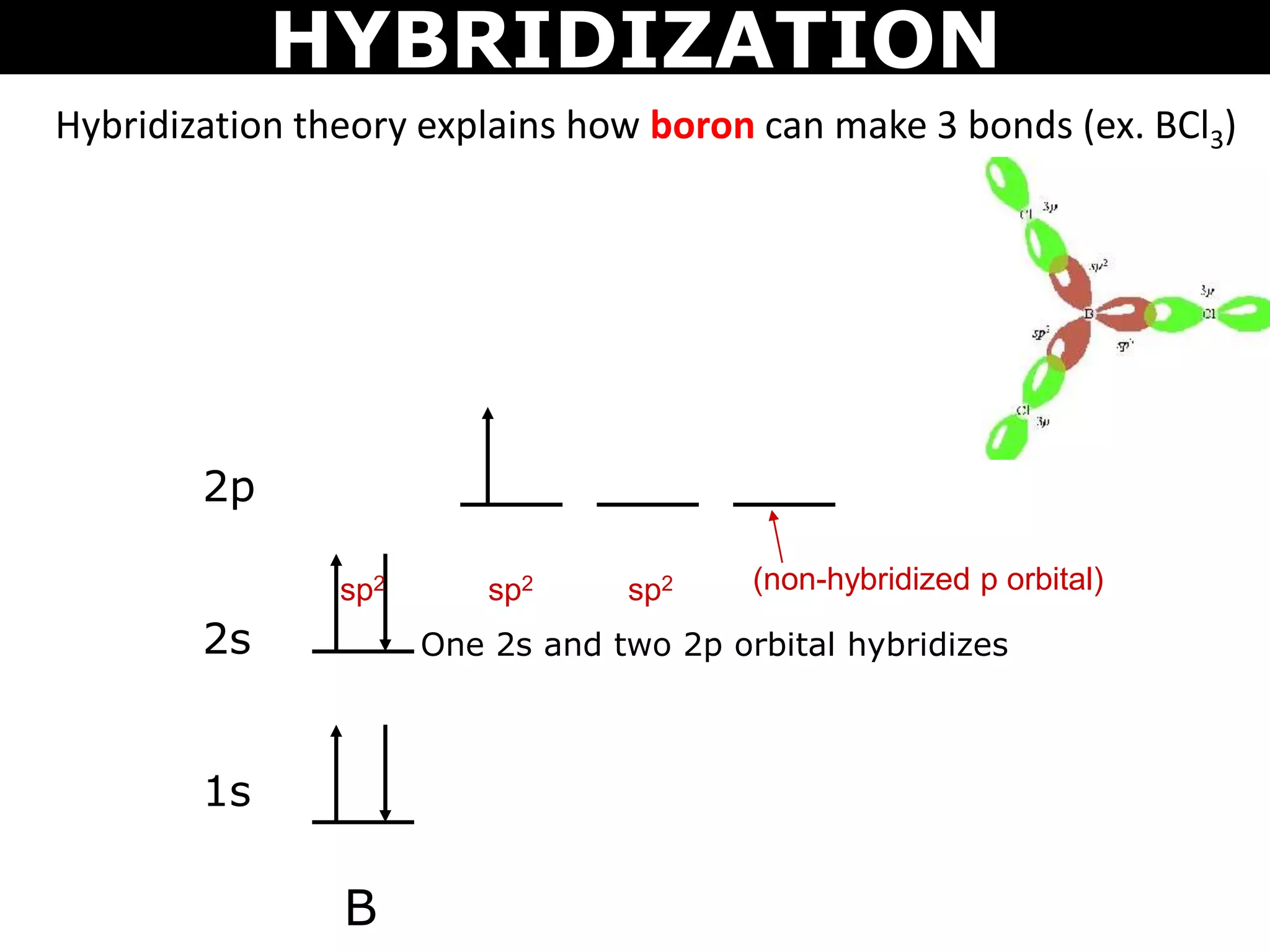
Hybridization theory explains how boron can make 3 bonds (ex. BCl3)
B
2p
2s
1s
One 2s and two 2p orbital hybridizes
sp2 sp2 (non-hybridized p orbital)sp2
HYBRIDIZATION
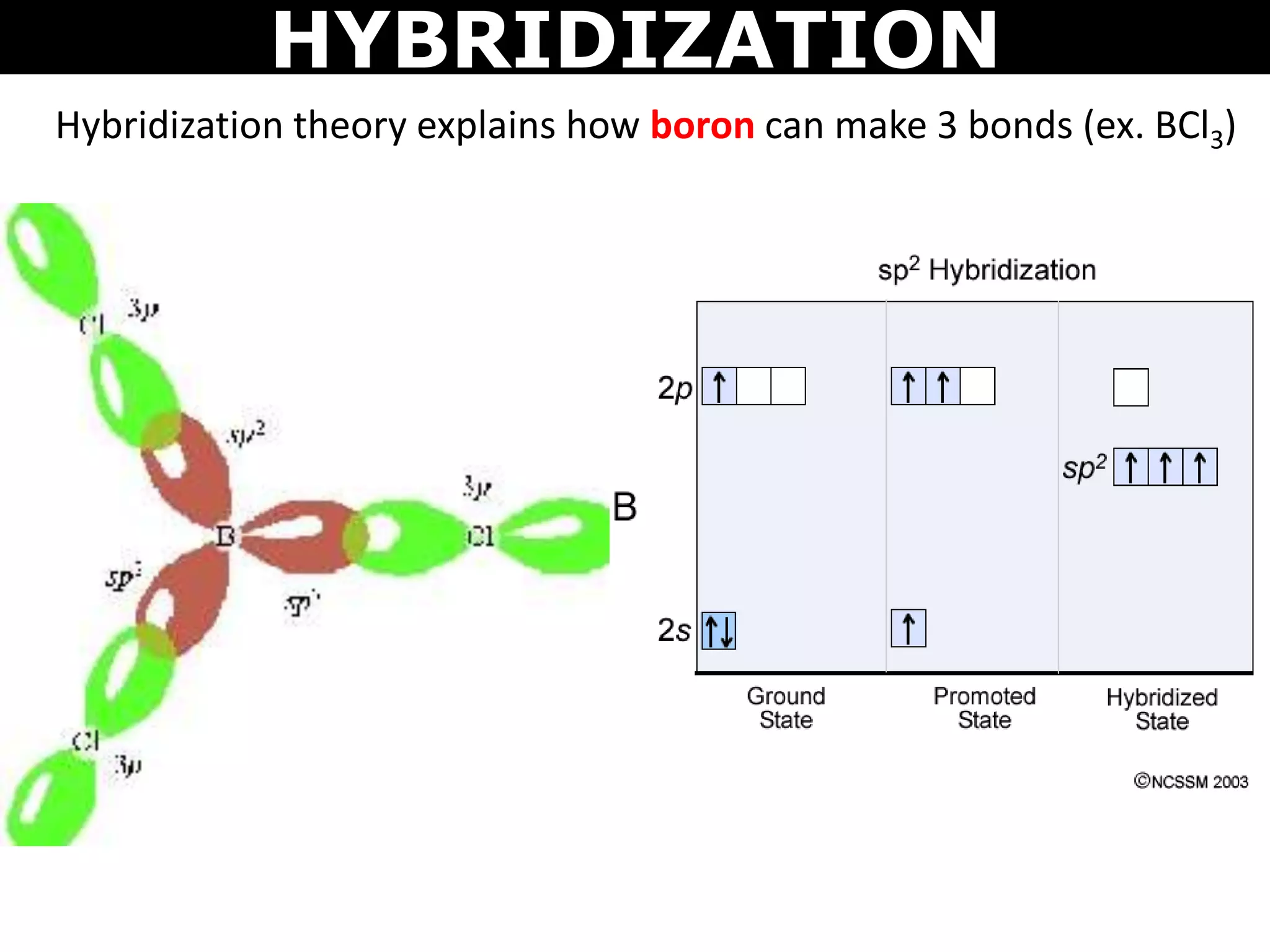
Hybridization theory explains how boron can make 3 bonds (ex. BCl3)
HYBRIDIZATION
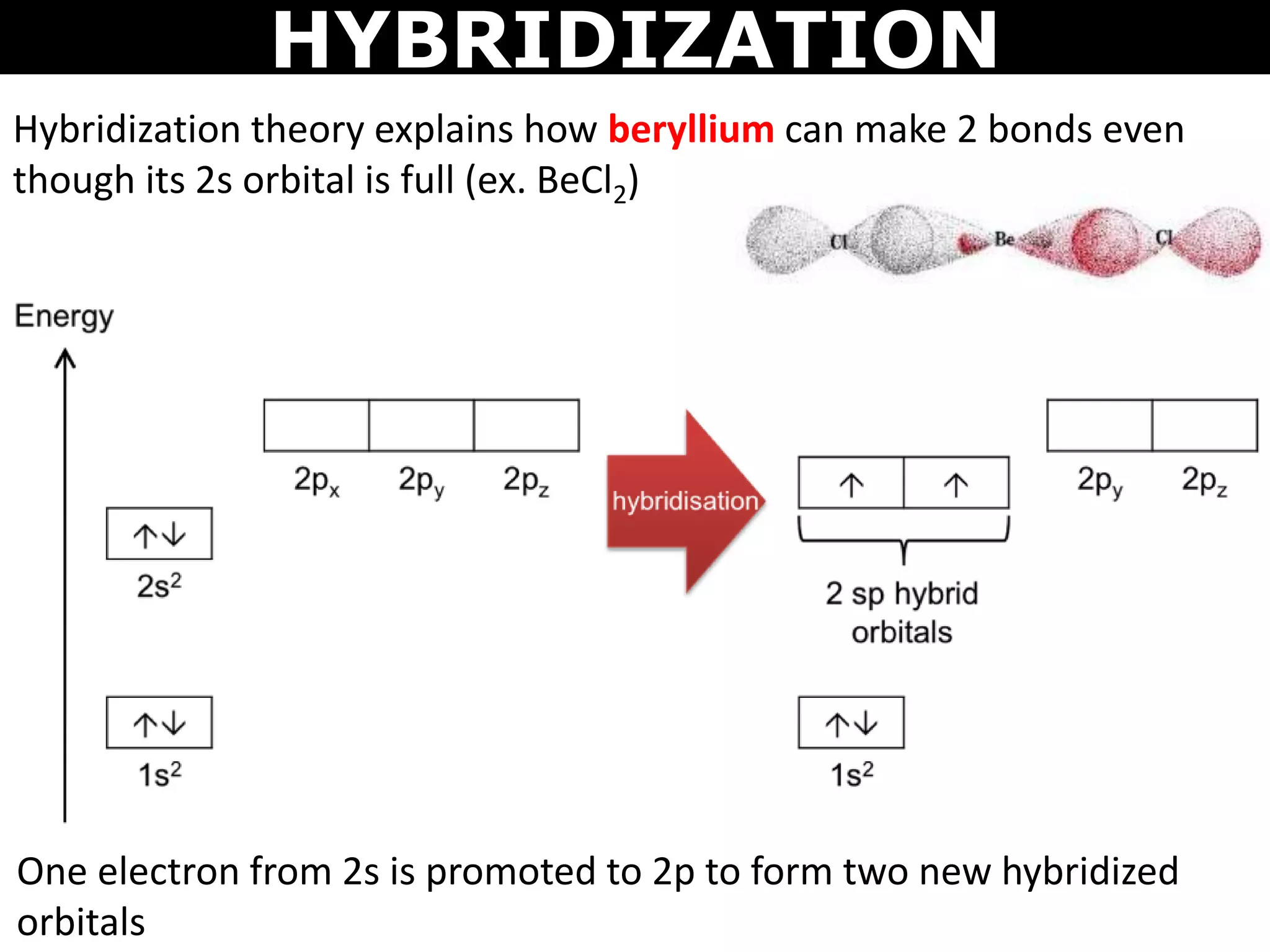
Hybridization theory explains how beryllium can make 2 bonds even
though its 2s orbital is full (ex. BeCl2)
One electron from 2s is promoted to 2p to form two new hybridized
orbitals
HYBRIDIZATION
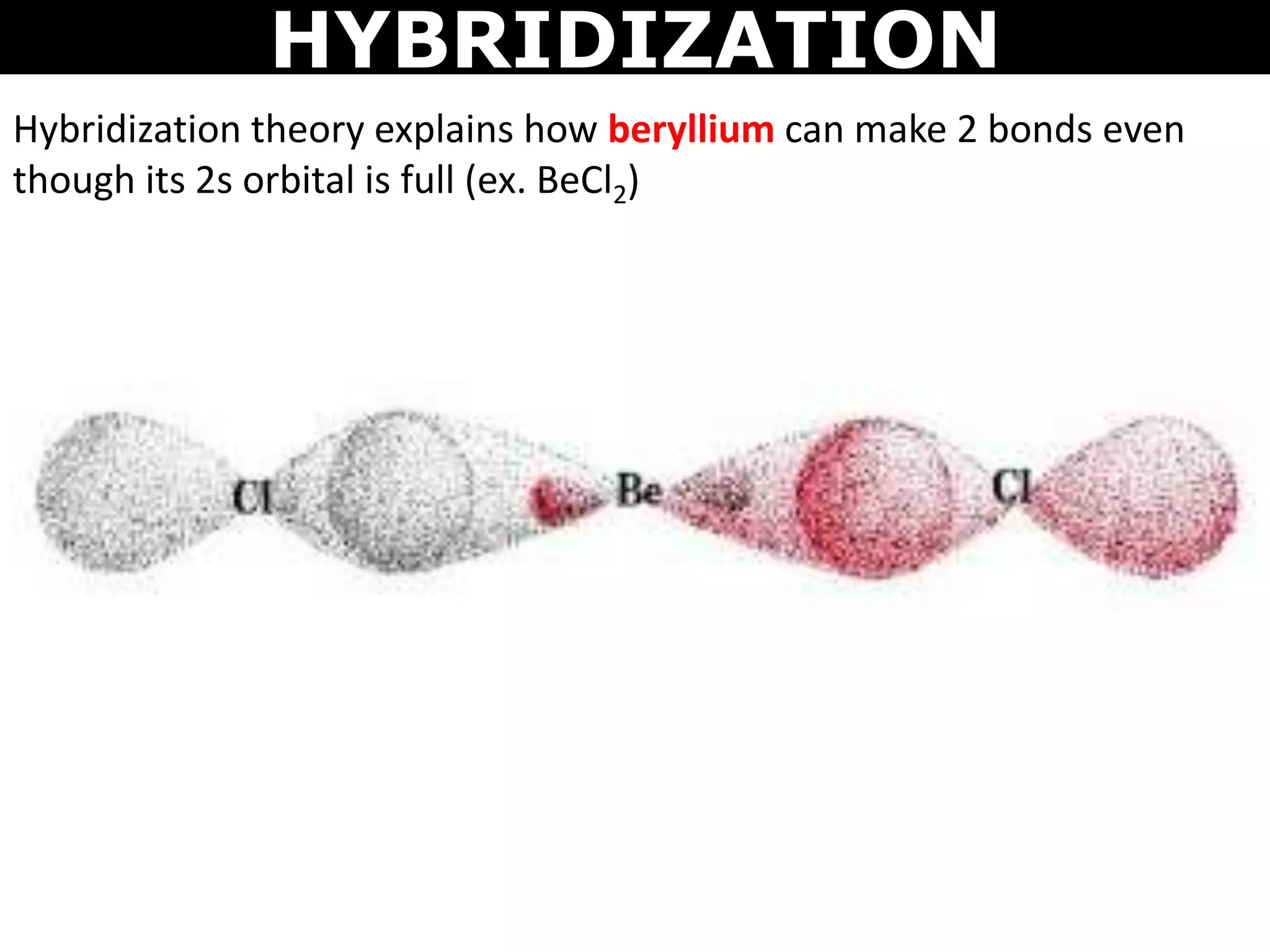
Hybridization theory explains how beryllium can make 2 bonds even
though its 2s orbital is full (ex. BeCl2)
HYBRIDIZATION
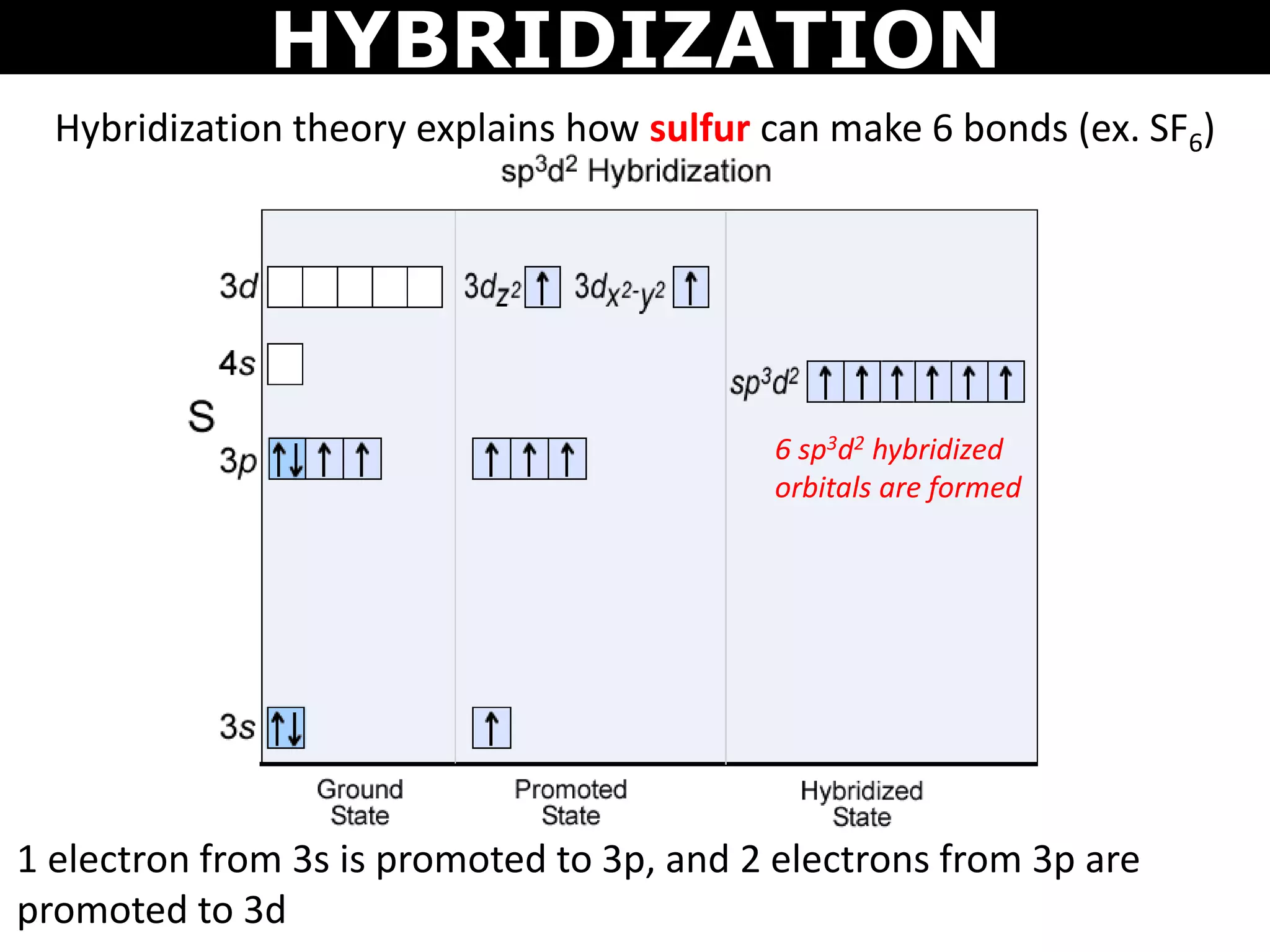
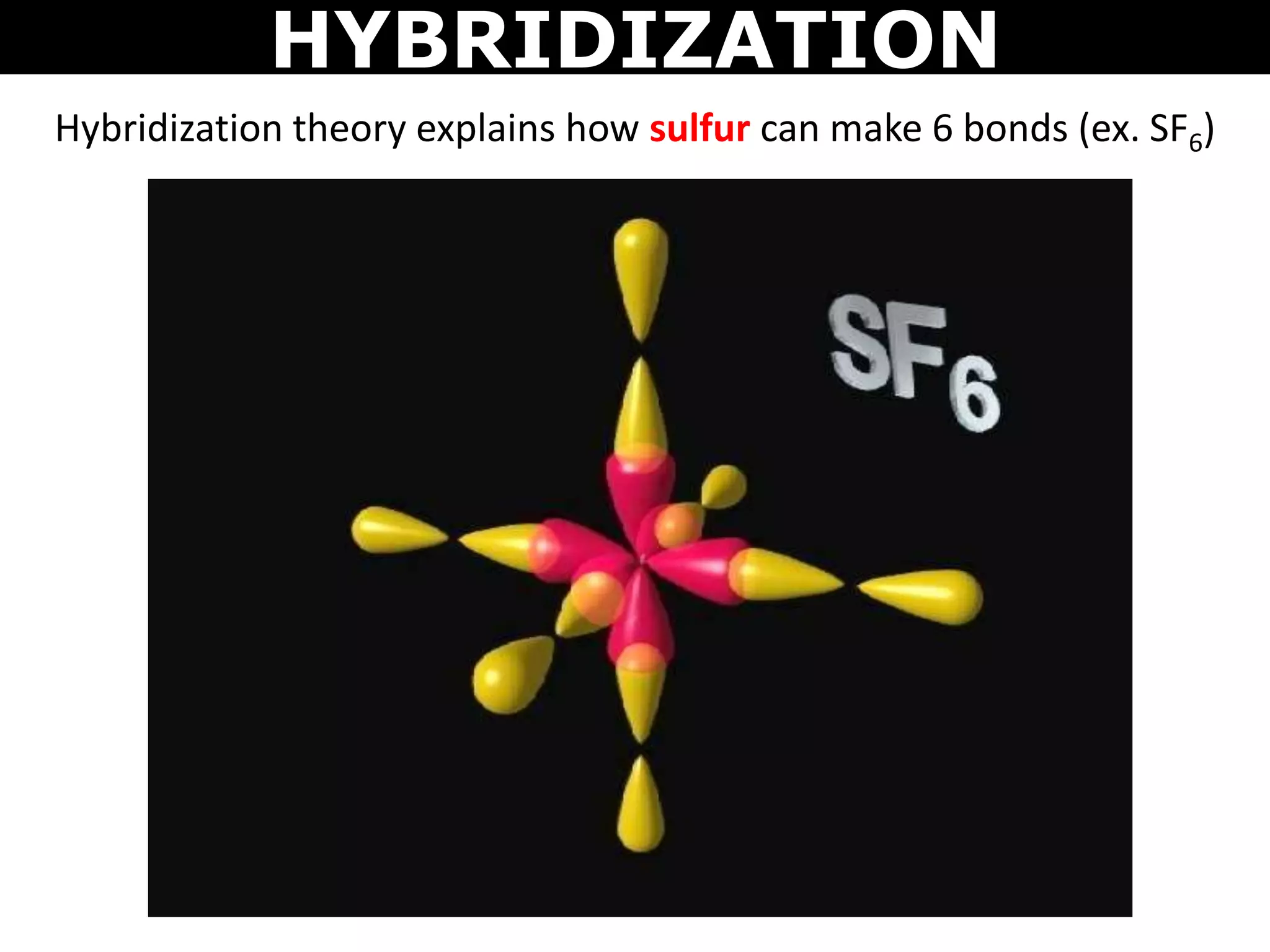
Hybridization theory explains how sulfur can make 6 bonds (ex. SF6)
1 electron from 3s is promoted to 3p, and 2 electrons from 3p are
promoted to 3d
6 sp3d2 hybridized
orbitals are formed
HYBRIDIZATION
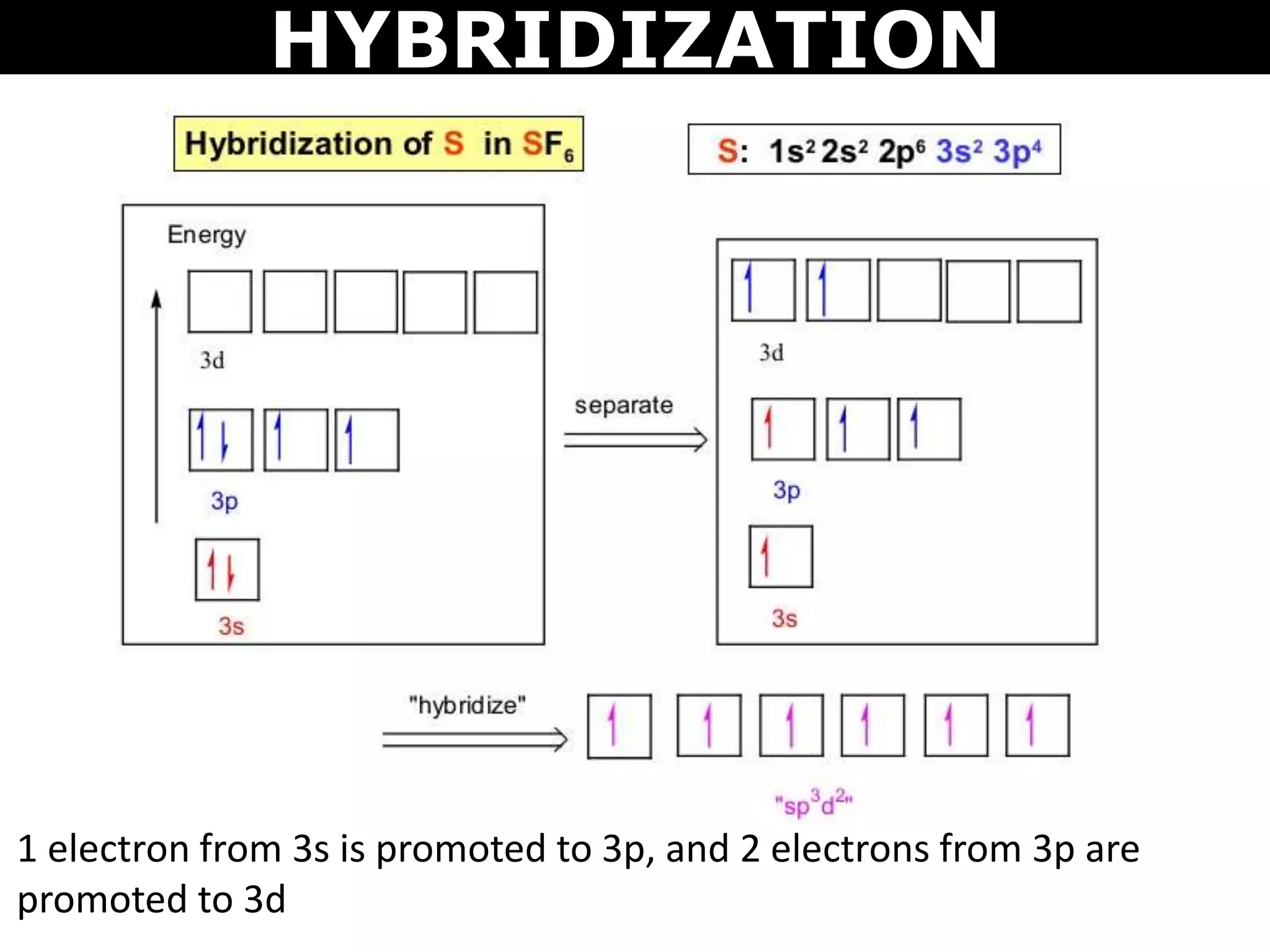
1 electron from 3s is promoted to 3p, and 2 electrons from 3p are
promoted to 3d
HYBRIDIZATION
Hybridization theory explains how sulfur can make 6 bonds (ex. SF6)
HYBRIDIZATION
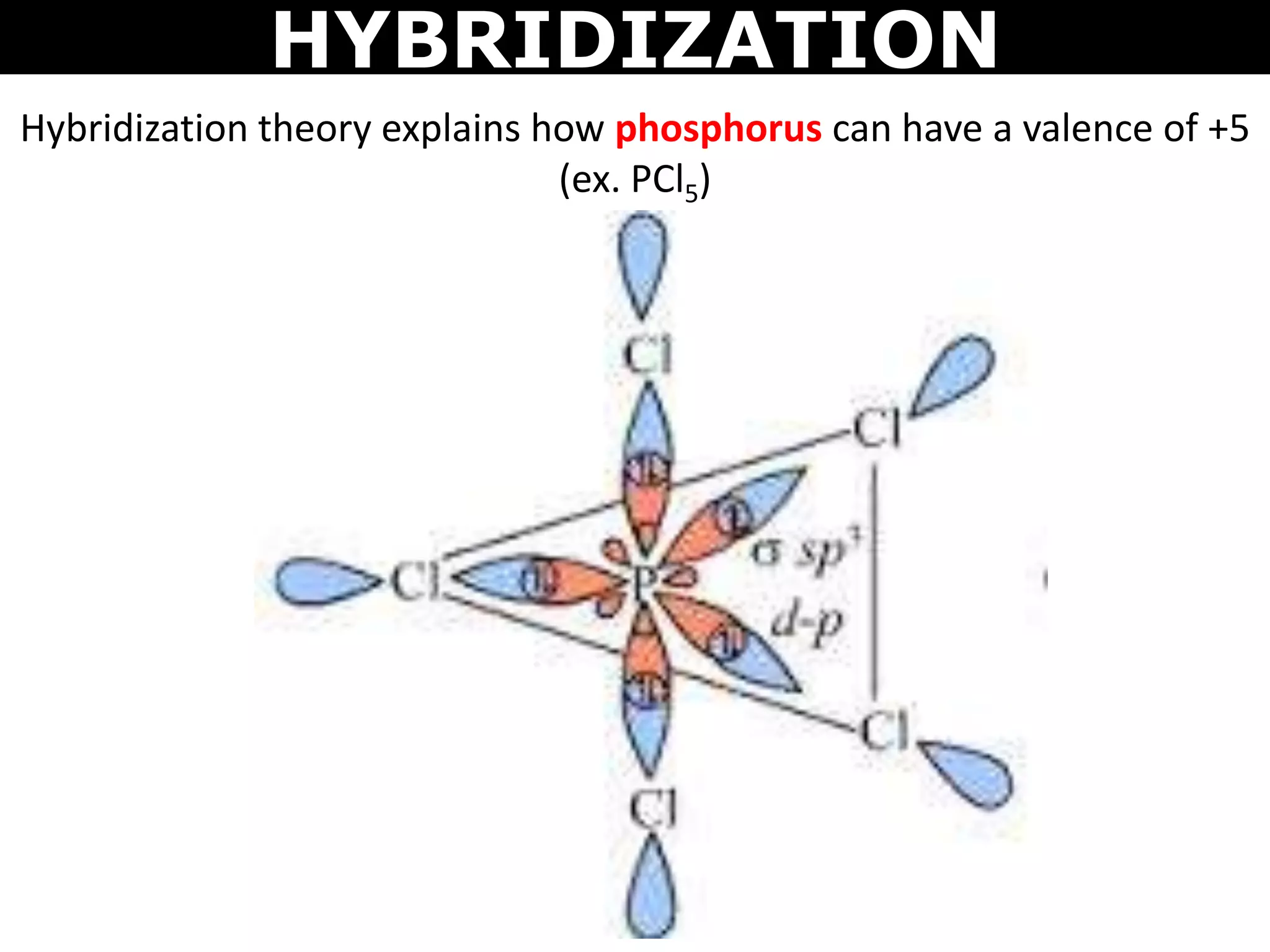
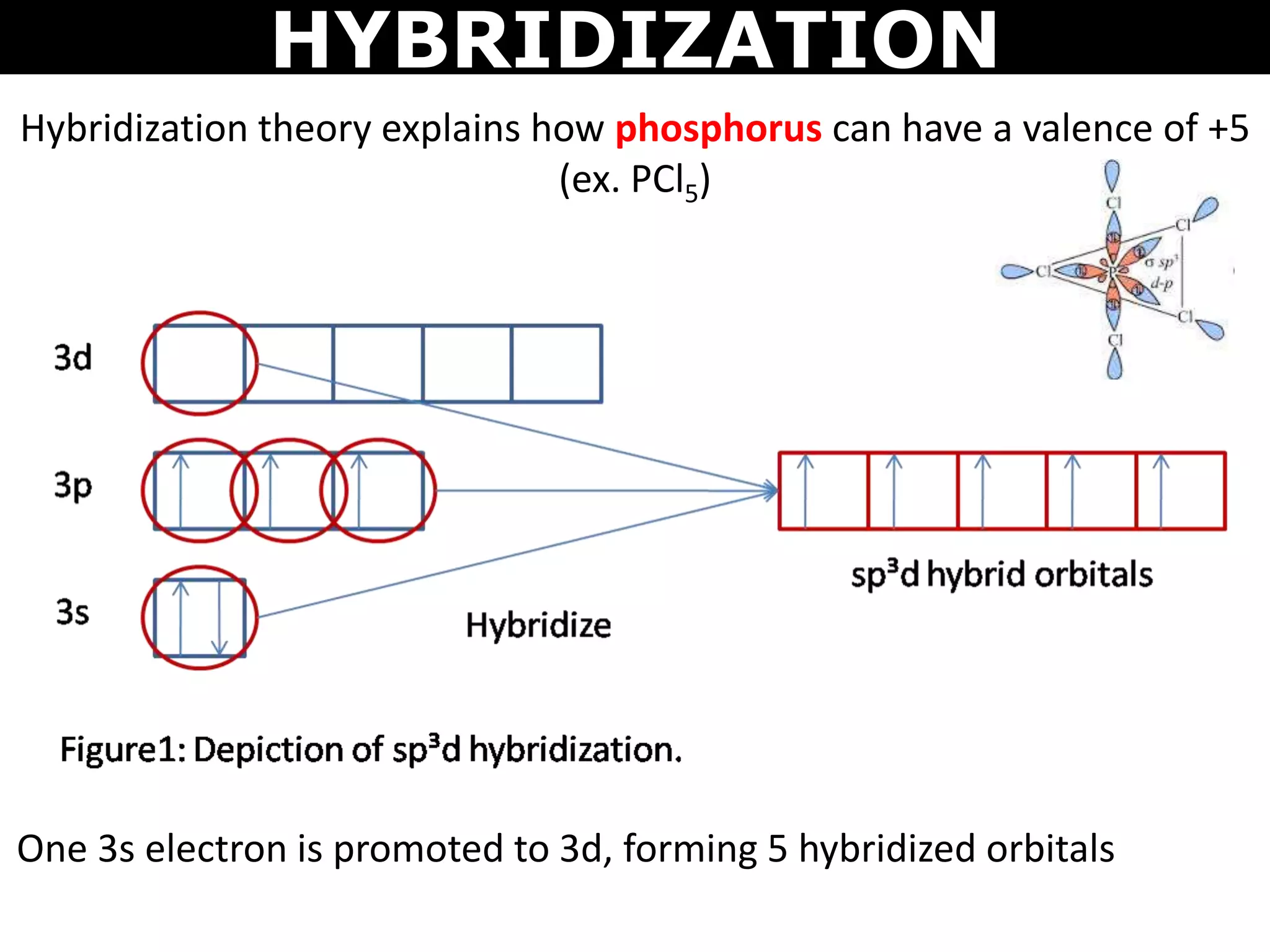
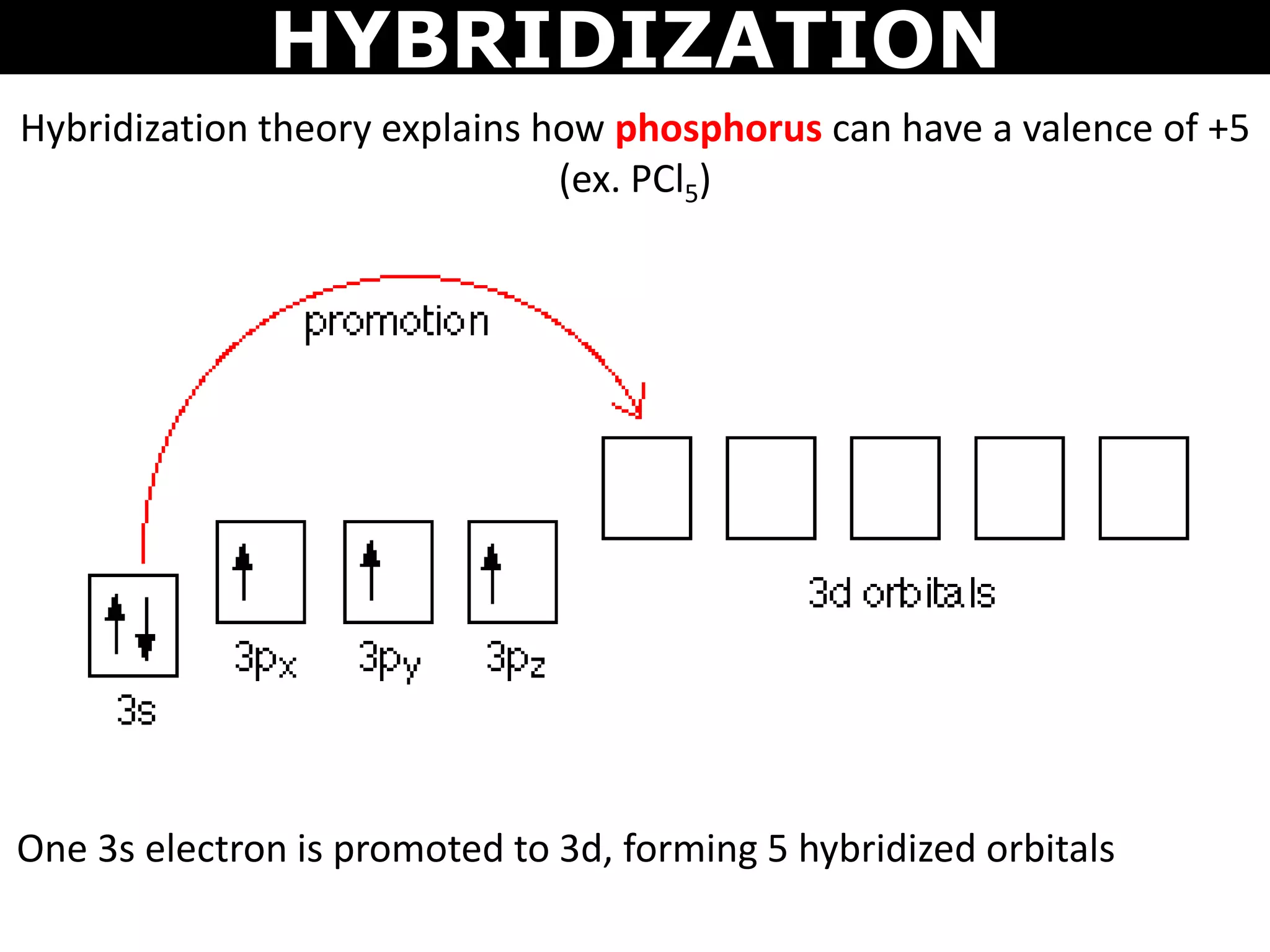
Hybridization theory explains how phosphorus can have a valence of +5
(ex. PCl5)
One 3s electron is promoted to 3d, forming 5 hybridized orbitals
HYBRIDIZATION
Hybridization theory explains how phosphorus can have a valence of +5
(ex. PCl5)
One 3s electron is promoted to 3d, forming 5 hybridized orbitals
HYBRIDIZATION
Hybridization theory explains how phosphorus can have a valence of +5
(ex. PCl5)
HYBRIDIZATION
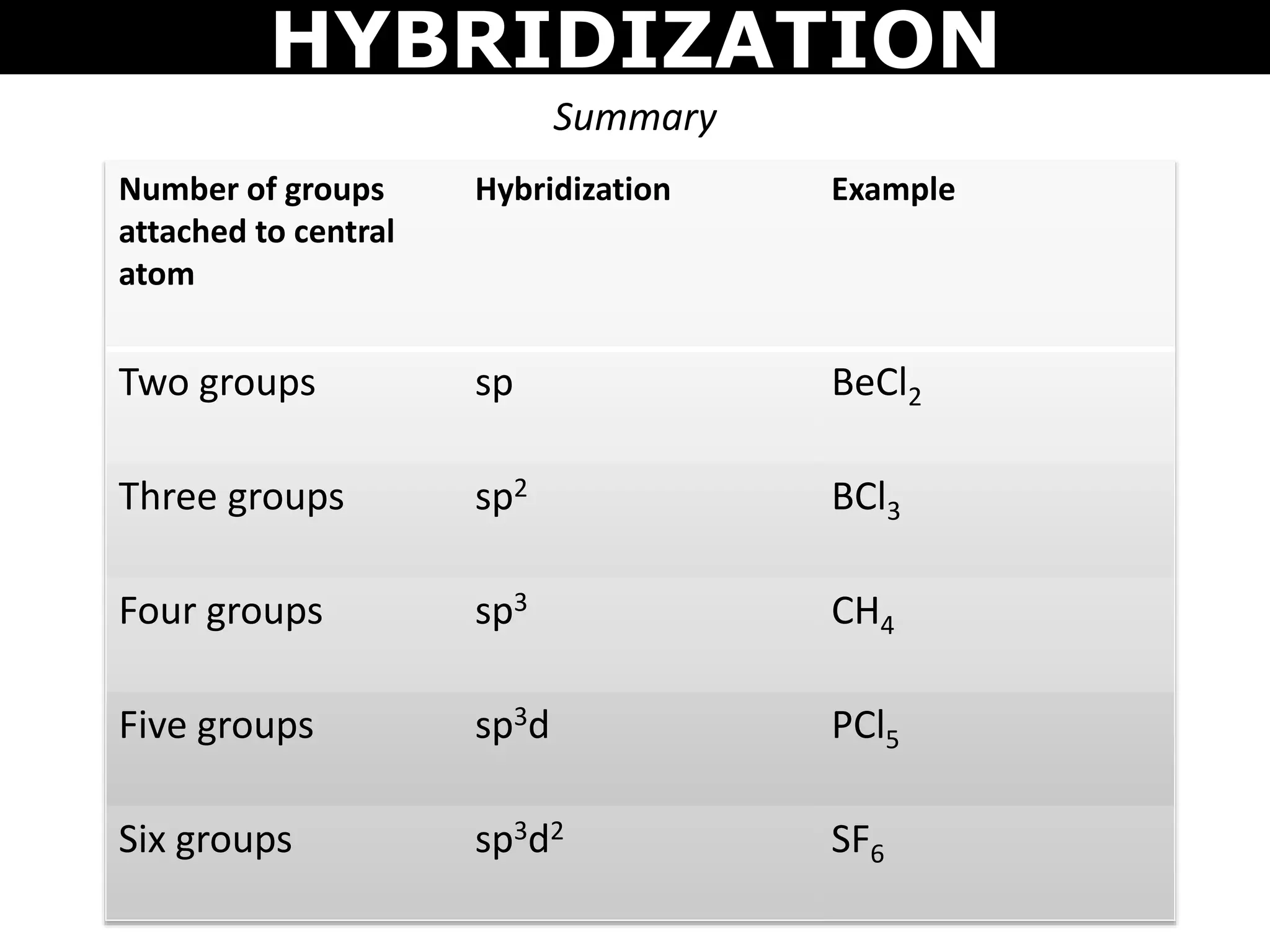
Summary
Number of groups
attached to central
atom
Hybridization Example
Two groups sp BeCl2
Three groups sp2 BCl3
Four groups sp3 CH4
Five groups sp3d PCl5
Six groups sp3d2 SF6
Homework
1. Use the valence bond model or hybridization
theory to show the bonding in the following
molecules: BeH2, BH3, CCl4, PCl5, SF6
2. Page 238 # 1 – 5, 7, 8, 10
HYBRIDIZATION

Tang 06 valence bond theory and hybridization

Editor's Notes

  • #2 Hybridization Animation: http://www.mhhe.com/physsci/chemistry/essentialchemistry/flash/hybrv18.swf     Sigma & Pi Bond Animation: http://www.mhhe.com/physsci/chemistry/animations/chang_7e_esp/bom5s2_6.swf
  • #14  http://www.youtube.com/watch?v=g1fGXDRxS6k