Standard Enthalpy
Changes
XI FDC CHEMISTRY
CHAPTER 11
SIDRA JAVED
Relationship between Internal
Energy of a system and Thermal
Energy at constant Temperature and
Pressure
Enthalpy
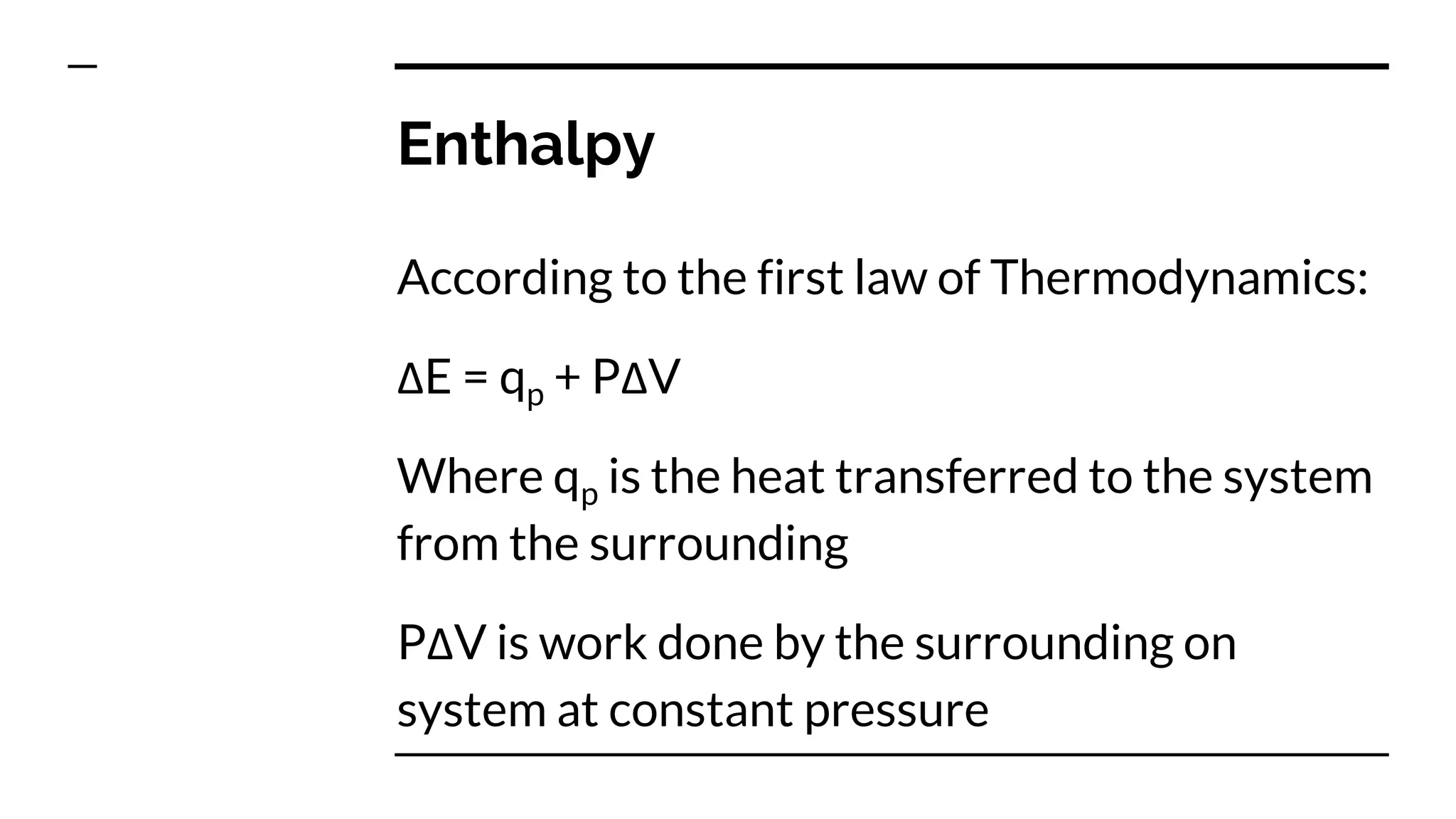
According to the first law of Thermodynamics:
ΔE = qp + PΔV
Where qp is the heat transferred to the system
from the surrounding
PΔV is work done by the surrounding on
system at constant pressure
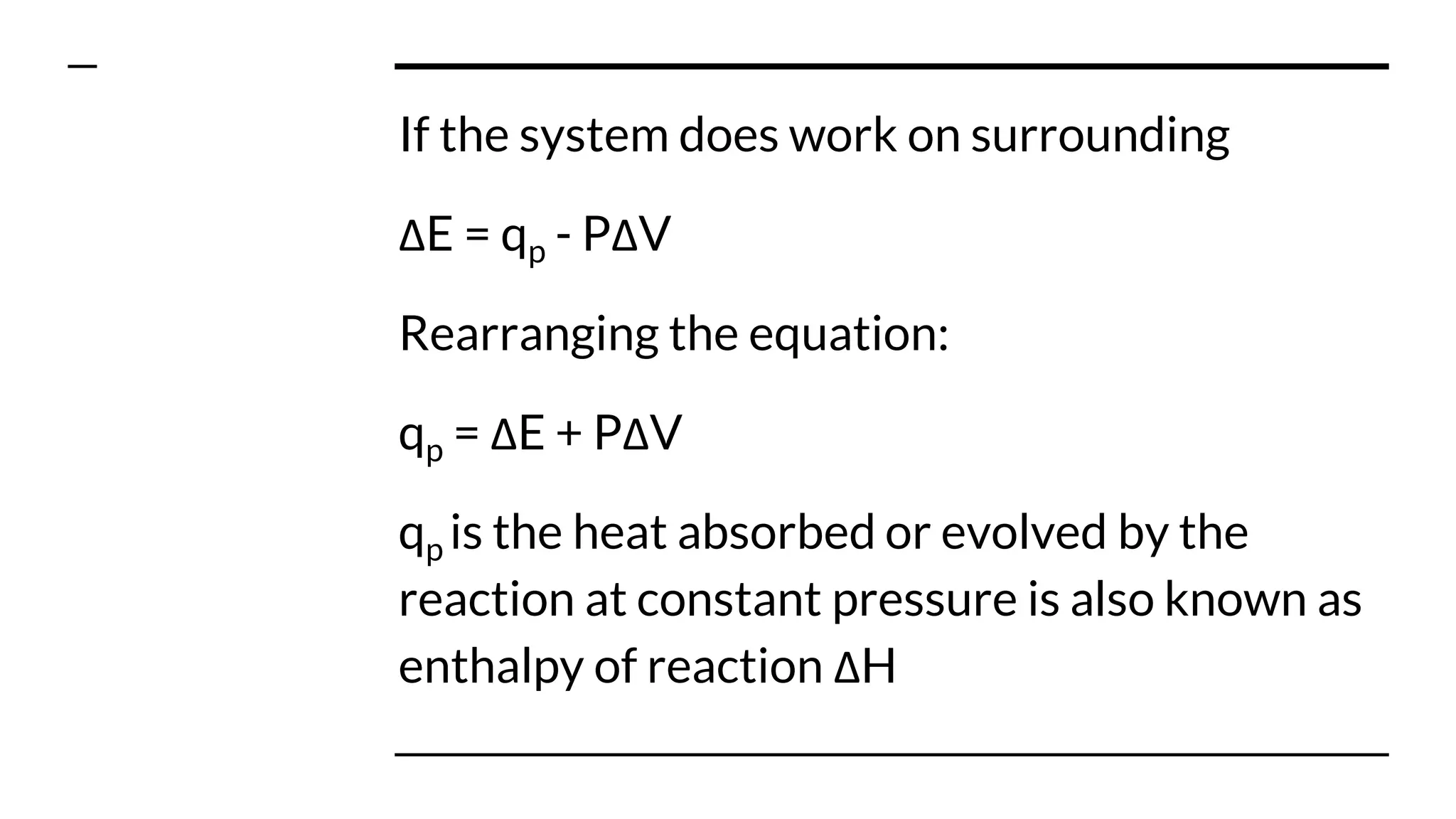
If the system does work on surrounding
ΔE = qp - PΔV
Rearranging the equation:
qp = ΔE + PΔV
qp is the heat absorbed or evolved by the
reaction at constant pressure is also known as
enthalpy of reaction ΔH
Enthalpy
ΔH = qp = ΔE + PΔV
Thermal energy for a reaction is equal to change in internal
energy of the system plus pressure volume work done by the
system at constant pressure
This thermal energy is also called enthalpy change of reaction
Enthalpy of a reaction is defined as
the system's internal energy plus
product of its pressure and volume
H = E + PV
Enthalpy at constant volume:
In case of solids and liquids reactants, there is
no appreciable change in volume. Therefore,
ΔV = 0
ΔH = ΔE + PΔV
ΔH = ΔE + P(0)
ΔH = ΔE
Standard enthalpy change
Standard enthalpy change is the enthalpy
change at constant pressure (1 atm) and
constant temperature (25oC) and is denoted
by ΔHo
Relation between
Enthalpy Change
and heat of reaction
Enthalpy (H) is used to quantify the heat
flow into or out of a system in a process that
occurs at constant pressure
ΔH = Heat given off or absorbed during a
reaction at constant pressure.
Standard states and standard
enthalpy changes
ΔH varies with conditions so standard values
are used.
Standard values are calculated when all
substances are in their standard states.
The standard conditions
The standard conditions are:
1 atm pressure for gases
1 atm pressure and 25oC temperature for any element or
compound in its stable physical state
1M concentration for any aqueous solution
Standard enthalpy of reaction
ΔHr
o
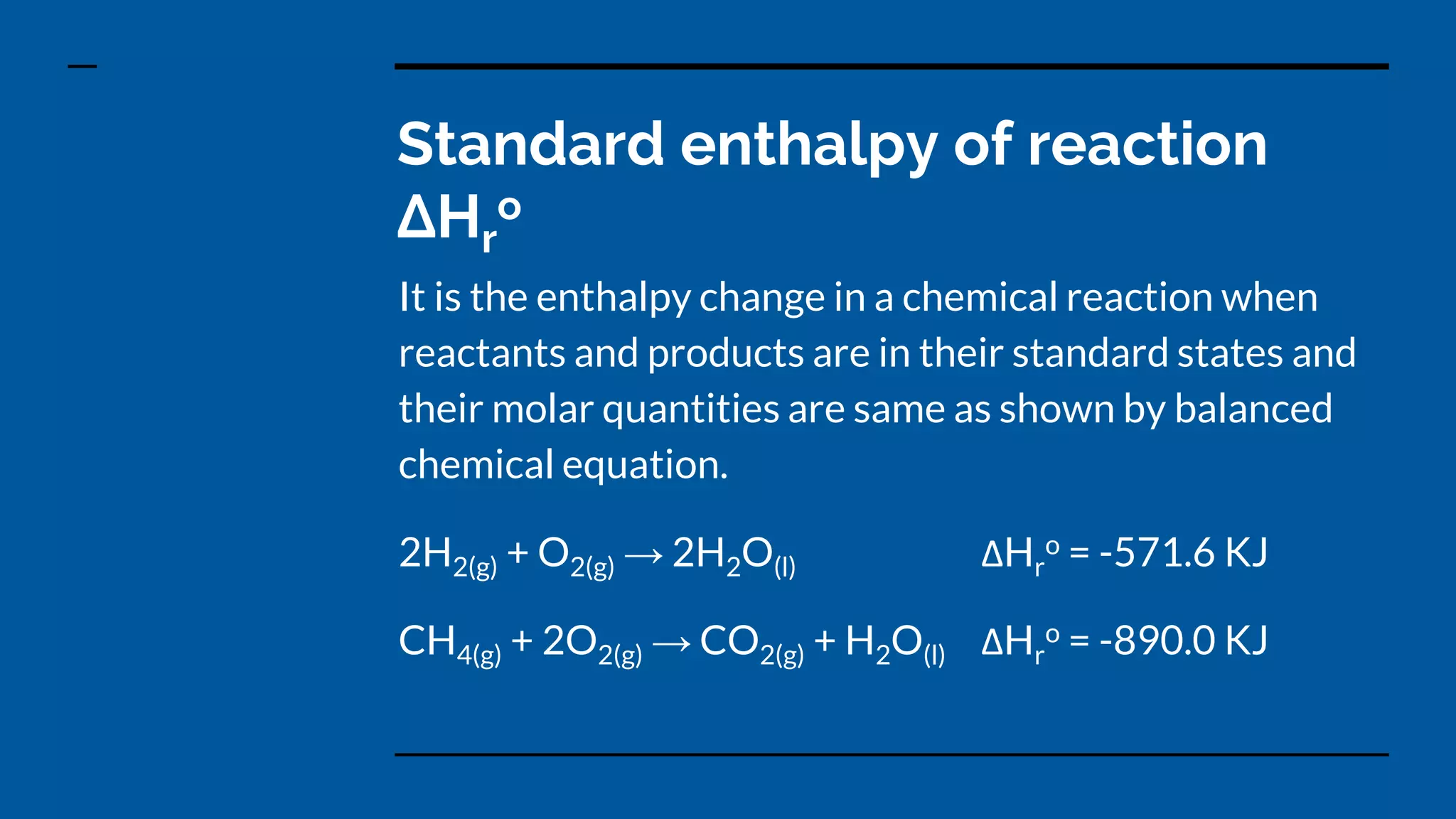
It is the enthalpy change in a chemical reaction when
reactants and products are in their standard states and
their molar quantities are same as shown by balanced
chemical equation.
2H2(g) + O2(g) → 2H2O(l) ΔHr
o = -571.6 KJ
CH4(g) + 2O2(g) → CO2(g) + H2O(l) ΔHr
o = -890.0 KJ
Standard enthalpy of formation
ΔHf
o
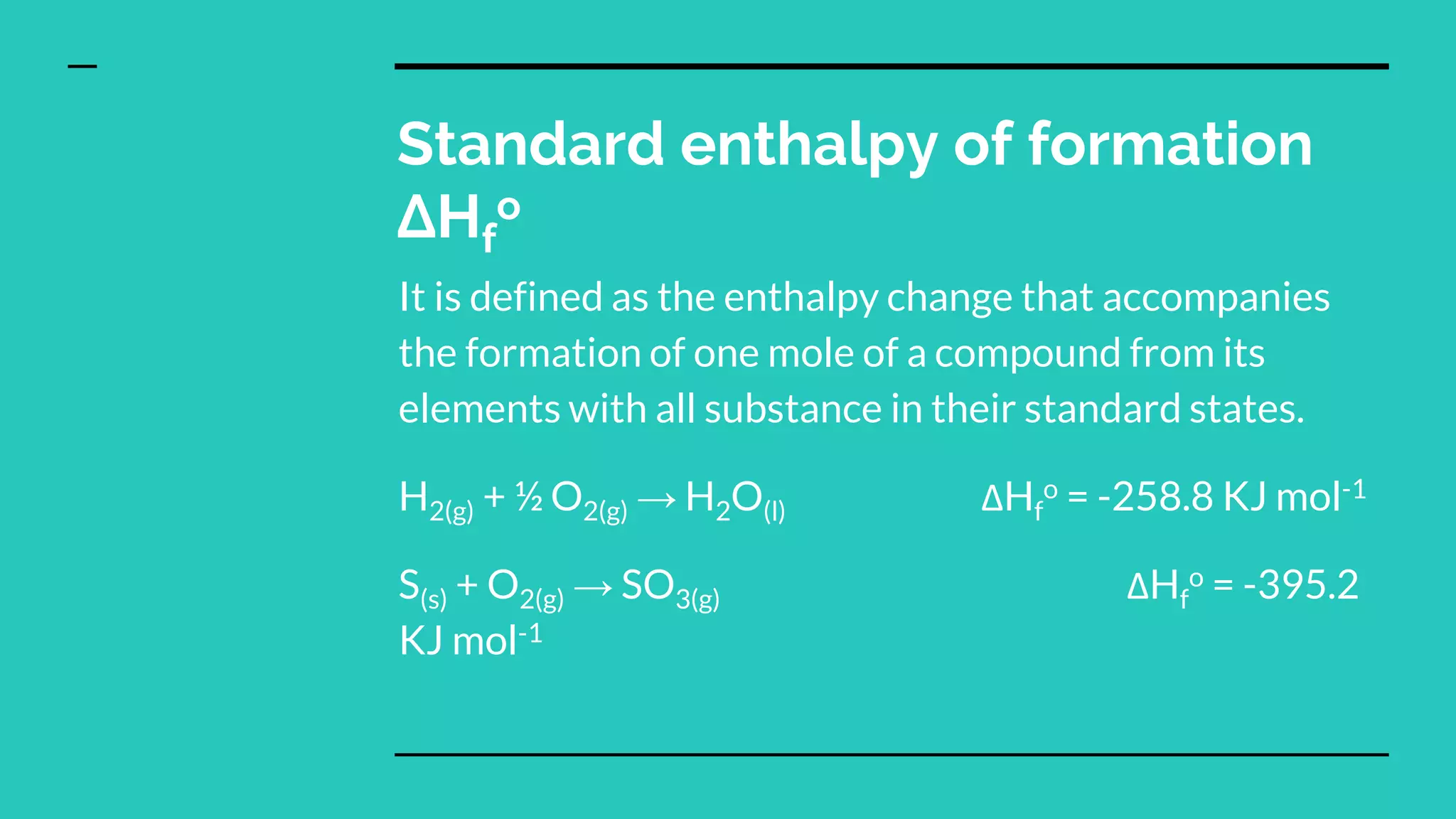
It is defined as the enthalpy change that accompanies
the formation of one mole of a compound from its
elements with all substance in their standard states.
H2(g) + ½ O2(g) → H2O(l) ΔHf
o = -258.8 KJ mol-1
S(s) + O2(g) → SO3(g) ΔHf
o = -395.2
KJ mol-1
Standard enthalpy of combustion
ΔHc
o
It is defined as the enthalpy change when one mole of a
substance is completely burnt in excess of oxygen
under standard conditions.
C(s) + O2(g) → CO2(g) ΔHc
o = -393.5 KJ mol-1
CH4(g) + 2O2(g) → CO2(g) + 2H2O(l) ΔHc
o = -285.8 KJ mol-1
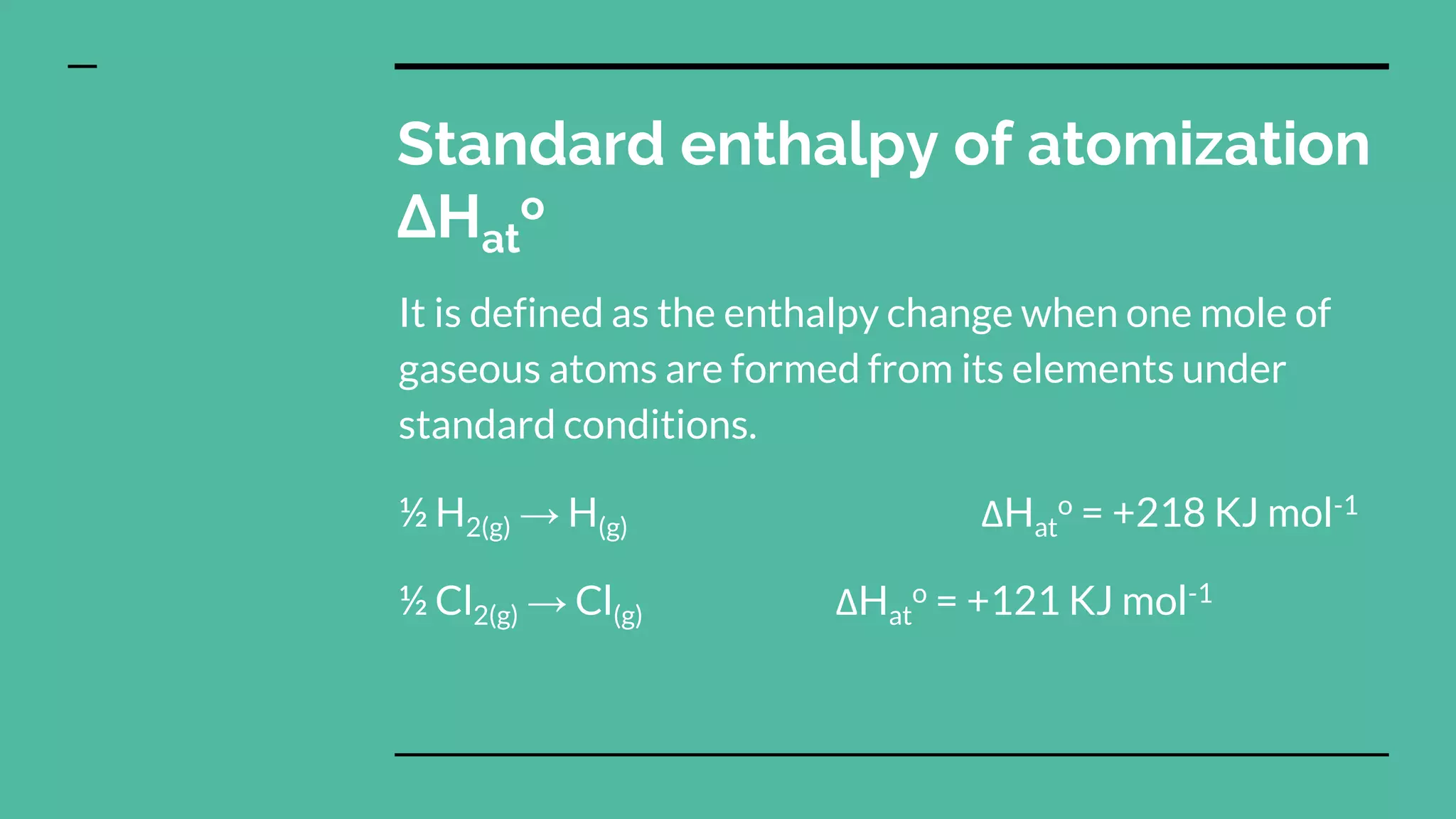
Standard enthalpy of atomization
ΔHat
o
It is defined as the enthalpy change when one mole of
gaseous atoms are formed from its elements under
standard conditions.
½ H2(g) → H(g) ΔHat
o = +218 KJ mol-1
½ Cl2(g) → Cl(g) ΔHat
o = +121 KJ mol-1
Standard enthalpy of
neutralization ΔHn
o
It is defined as the enthalpy change when one mole of H+
ions from an acid combine with one mole of OH- ions from
a base to form one mole of water under standard
conditions.
NaOH(aq) + HCl(aq) → NaCl(aq) + H2O(l) ΔHn
o = -57.4 KJ mol-
1
H+
(aq) + OH-
(aq) → H2O(l) ΔHn
o = -57.4 KJ mol-1
Standard enthalpy of solution
ΔHsol
o
It is defined as the enthalpy change when one mole of a
substance is dissolved in so much solvent that further
dilution results in no detectable heat change under
standard conditions.
NH4Cl(s) NH4
+
(aq) + Cl-
(aq) ΔHsol
o = +15.1
KJ mol-1
HCl(g) H+
(aq) + Cl-
(aq) ΔHsol
o = + 75
KJ mol-1
H2O
H2O
Bond
Dissociation
Energy The difference between B.D.E
and bond energy determines
whether the reaction absorbs or
releases energy overall
ΔHr =Σ B.D.E reactants - Σ B.E products
The amount of energy required
to break one mole of a particular
bond to form neutral atoms is
called Bond Dissociation Energy
(B.D.E)
2H2(g) + O2(g) → 2H2O(l)
ΔHo=?
2 mol H2 = 2 H-H bonds
1 mol O2 = 1 O-O bonds
2 mol H2O = 4 O-H bonds
ΔHr
o =Σ B.D.E reactants - Σ B.E products
Σ B.D.E = 2B.D.E of H2 + 1B.D.E of
O2
Σ B.D.E = 2(436KJ) + 493.6KJ
= 1365.6 KJ
Σ B.E = 4 B.E of O-H bonds
Σ B.E = 4 (460KJ) = 1840 KJ
ΔHr
o =Σ B.D.E reactants - Σ B.E products
ΔHr
o =1365.6 - 1840 = -474.4 KJ
End of Lesson

Standard Enthalpy Changes of Reactions

  • 1.
    Standard Enthalpy Changes XI FDCCHEMISTRY CHAPTER 11 SIDRA JAVED
  • 2.
    Relationship between Internal Energyof a system and Thermal Energy at constant Temperature and Pressure
  • 3.
    Enthalpy According to thefirst law of Thermodynamics: ΔE = qp + PΔV Where qp is the heat transferred to the system from the surrounding PΔV is work done by the surrounding on system at constant pressure
  • 4.
    If the systemdoes work on surrounding ΔE = qp - PΔV Rearranging the equation: qp = ΔE + PΔV qp is the heat absorbed or evolved by the reaction at constant pressure is also known as enthalpy of reaction ΔH
  • 5.
    Enthalpy ΔH = qp= ΔE + PΔV Thermal energy for a reaction is equal to change in internal energy of the system plus pressure volume work done by the system at constant pressure This thermal energy is also called enthalpy change of reaction
  • 6.
    Enthalpy of areaction is defined as the system's internal energy plus product of its pressure and volume H = E + PV
  • 7.
    Enthalpy at constantvolume: In case of solids and liquids reactants, there is no appreciable change in volume. Therefore, ΔV = 0 ΔH = ΔE + PΔV ΔH = ΔE + P(0) ΔH = ΔE
  • 8.
    Standard enthalpy change Standardenthalpy change is the enthalpy change at constant pressure (1 atm) and constant temperature (25oC) and is denoted by ΔHo
  • 9.
  • 10.
    Enthalpy (H) isused to quantify the heat flow into or out of a system in a process that occurs at constant pressure ΔH = Heat given off or absorbed during a reaction at constant pressure.
  • 12.
    Standard states andstandard enthalpy changes ΔH varies with conditions so standard values are used. Standard values are calculated when all substances are in their standard states.
  • 13.
    The standard conditions Thestandard conditions are: 1 atm pressure for gases 1 atm pressure and 25oC temperature for any element or compound in its stable physical state 1M concentration for any aqueous solution
  • 14.
    Standard enthalpy ofreaction ΔHr o It is the enthalpy change in a chemical reaction when reactants and products are in their standard states and their molar quantities are same as shown by balanced chemical equation. 2H2(g) + O2(g) → 2H2O(l) ΔHr o = -571.6 KJ CH4(g) + 2O2(g) → CO2(g) + H2O(l) ΔHr o = -890.0 KJ
  • 15.
    Standard enthalpy offormation ΔHf o It is defined as the enthalpy change that accompanies the formation of one mole of a compound from its elements with all substance in their standard states. H2(g) + ½ O2(g) → H2O(l) ΔHf o = -258.8 KJ mol-1 S(s) + O2(g) → SO3(g) ΔHf o = -395.2 KJ mol-1
  • 16.
    Standard enthalpy ofcombustion ΔHc o It is defined as the enthalpy change when one mole of a substance is completely burnt in excess of oxygen under standard conditions. C(s) + O2(g) → CO2(g) ΔHc o = -393.5 KJ mol-1 CH4(g) + 2O2(g) → CO2(g) + 2H2O(l) ΔHc o = -285.8 KJ mol-1
  • 17.
    Standard enthalpy ofatomization ΔHat o It is defined as the enthalpy change when one mole of gaseous atoms are formed from its elements under standard conditions. ½ H2(g) → H(g) ΔHat o = +218 KJ mol-1 ½ Cl2(g) → Cl(g) ΔHat o = +121 KJ mol-1
  • 18.
    Standard enthalpy of neutralizationΔHn o It is defined as the enthalpy change when one mole of H+ ions from an acid combine with one mole of OH- ions from a base to form one mole of water under standard conditions. NaOH(aq) + HCl(aq) → NaCl(aq) + H2O(l) ΔHn o = -57.4 KJ mol- 1 H+ (aq) + OH- (aq) → H2O(l) ΔHn o = -57.4 KJ mol-1
  • 19.
    Standard enthalpy ofsolution ΔHsol o It is defined as the enthalpy change when one mole of a substance is dissolved in so much solvent that further dilution results in no detectable heat change under standard conditions. NH4Cl(s) NH4 + (aq) + Cl- (aq) ΔHsol o = +15.1 KJ mol-1 HCl(g) H+ (aq) + Cl- (aq) ΔHsol o = + 75 KJ mol-1 H2O H2O
  • 20.
    Bond Dissociation Energy The differencebetween B.D.E and bond energy determines whether the reaction absorbs or releases energy overall ΔHr =Σ B.D.E reactants - Σ B.E products The amount of energy required to break one mole of a particular bond to form neutral atoms is called Bond Dissociation Energy (B.D.E)
  • 21.
    2H2(g) + O2(g)→ 2H2O(l) ΔHo=? 2 mol H2 = 2 H-H bonds 1 mol O2 = 1 O-O bonds 2 mol H2O = 4 O-H bonds ΔHr o =Σ B.D.E reactants - Σ B.E products Σ B.D.E = 2B.D.E of H2 + 1B.D.E of O2 Σ B.D.E = 2(436KJ) + 493.6KJ = 1365.6 KJ Σ B.E = 4 B.E of O-H bonds Σ B.E = 4 (460KJ) = 1840 KJ ΔHr o =Σ B.D.E reactants - Σ B.E products ΔHr o =1365.6 - 1840 = -474.4 KJ
  • 22.