Hybrid Bonding Orbitals
Purpose
• In a previous lesson, you learned about the different atomic orbitals – s, p,
d, and so on. When looking at a molecule such as methane, the atomic
orbitals are not sufficient to describe the bonding and molecular geometry
observed. The orbitals used for bonding are, therefore, different than the
atomic orbitals. In the hybrid orbital bonding model, we take the atomic
orbitals and combine them in a way that satisfies the behavior we see in
molecules.
The problem with atomic orbitals.
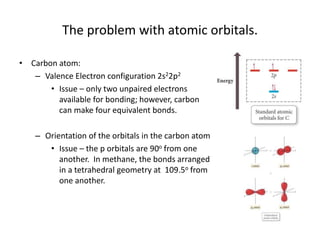
• Carbon atom:
– Valence Electron configuration 2s22p2
• Issue – only two unpaired electrons
available for bonding; however, carbon
can make four equivalent bonds.
– Orientation of the orbitals in the carbon atom
• Issue – the p orbitals are 90o from one
another. In methane, the bonds arranged
in a tetrahedral geometry at 109.5o from
one another.
Solution – hybridize the orbitals
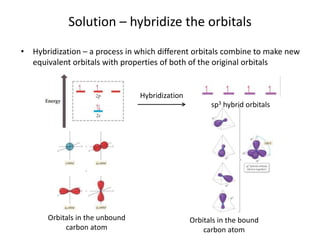
• Hybridization – a process in which different orbitals combine to make new
equivalent orbitals with properties of both of the original orbitals
Hybridization
sp3 hybrid orbitals
Orbitals in the unbound
carbon atom
Orbitals in the bound
carbon atom
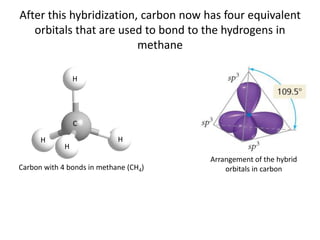
After this hybridization, carbon now has four equivalent
orbitals that are used to bond to the hydrogens in
methane
Carbon with 4 bonds in methane (CH4)
C
H
H
H
H
Arrangement of the hybrid
orbitals in carbon
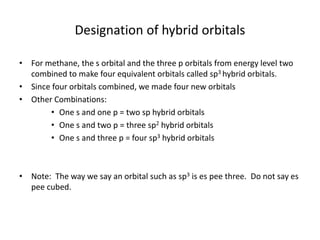
Designation of hybrid orbitals
• For methane, the s orbital and the three p orbitals from energy level two
combined to make four equivalent orbitals called sp3 hybrid orbitals.
• Since four orbitals combined, we made four new orbitals
• Other Combinations:
• One s and one p = two sp hybrid orbitals
• One s and two p = three sp2 hybrid orbitals
• One s and three p = four sp3 hybrid orbitals
• Note: The way we say an orbital such as sp3 is es pee three. Do not say es
pee cubed.
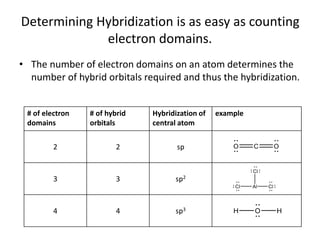
Determining Hybridization is as easy as counting
electron domains.
• The number of electron domains on an atom determines the
number of hybrid orbitals required and thus the hybridization.
# of electron
domains
# of hybrid
orbitals
Hybridization of
central atom
example
2 2 sp
3 3 sp2
4 4 sp3
Misconception alert!
• Hybrid orbitals can be used for both bonding and non-bonding electrons.
This is why we need to count the number of electron domains, not just the
number of bonds.
• Recall that a double and triple bond only count as a single domain. This
does not change for determining hybridization.
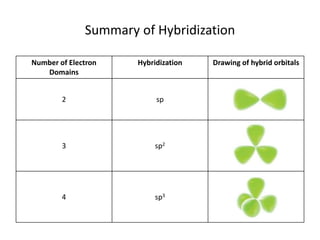
Summary of Hybridization
Number of Electron
Domains
Hybridization Drawing of hybrid orbitals
2 sp
3 sp2
4 sp3
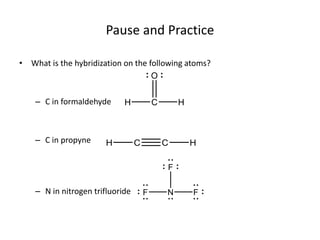
Pause and Practice
• What is the hybridization on the following atoms?
– C in formaldehyde
– C in propyne
– N in nitrogen trifluoride
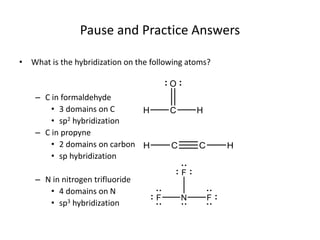
Pause and Practice Answers
• What is the hybridization on the following atoms?
– C in formaldehyde
• 3 domains on C
• sp2 hybridization
– C in propyne
• 2 domains on carbon
• sp hybridization
– N in nitrogen trifluoride
• 4 domains on N
• sp3 hybridization
Try the exercises

Hybridization

  • 1.
  • 2.
    Purpose • In aprevious lesson, you learned about the different atomic orbitals – s, p, d, and so on. When looking at a molecule such as methane, the atomic orbitals are not sufficient to describe the bonding and molecular geometry observed. The orbitals used for bonding are, therefore, different than the atomic orbitals. In the hybrid orbital bonding model, we take the atomic orbitals and combine them in a way that satisfies the behavior we see in molecules.
  • 3.
    The problem withatomic orbitals. • Carbon atom: – Valence Electron configuration 2s22p2 • Issue – only two unpaired electrons available for bonding; however, carbon can make four equivalent bonds. – Orientation of the orbitals in the carbon atom • Issue – the p orbitals are 90o from one another. In methane, the bonds arranged in a tetrahedral geometry at 109.5o from one another.
  • 4.
    Solution – hybridizethe orbitals • Hybridization – a process in which different orbitals combine to make new equivalent orbitals with properties of both of the original orbitals Hybridization sp3 hybrid orbitals Orbitals in the unbound carbon atom Orbitals in the bound carbon atom
  • 5.
    After this hybridization,carbon now has four equivalent orbitals that are used to bond to the hydrogens in methane Carbon with 4 bonds in methane (CH4) C H H H H Arrangement of the hybrid orbitals in carbon
  • 6.
    Designation of hybridorbitals • For methane, the s orbital and the three p orbitals from energy level two combined to make four equivalent orbitals called sp3 hybrid orbitals. • Since four orbitals combined, we made four new orbitals • Other Combinations: • One s and one p = two sp hybrid orbitals • One s and two p = three sp2 hybrid orbitals • One s and three p = four sp3 hybrid orbitals • Note: The way we say an orbital such as sp3 is es pee three. Do not say es pee cubed.
  • 7.
    Determining Hybridization isas easy as counting electron domains. • The number of electron domains on an atom determines the number of hybrid orbitals required and thus the hybridization. # of electron domains # of hybrid orbitals Hybridization of central atom example 2 2 sp 3 3 sp2 4 4 sp3
  • 8.
    Misconception alert! • Hybridorbitals can be used for both bonding and non-bonding electrons. This is why we need to count the number of electron domains, not just the number of bonds. • Recall that a double and triple bond only count as a single domain. This does not change for determining hybridization.
  • 9.
    Summary of Hybridization Numberof Electron Domains Hybridization Drawing of hybrid orbitals 2 sp 3 sp2 4 sp3
  • 10.
    Pause and Practice •What is the hybridization on the following atoms? – C in formaldehyde – C in propyne – N in nitrogen trifluoride
  • 11.
    Pause and PracticeAnswers • What is the hybridization on the following atoms? – C in formaldehyde • 3 domains on C • sp2 hybridization – C in propyne • 2 domains on carbon • sp hybridization – N in nitrogen trifluoride • 4 domains on N • sp3 hybridization
  • 12.