Theories of Covalent Bonding11.1  Valence Shell Electron Pair Repulsion Theory11.2  Valence Bond (VB) Theory and Orbital Hybridization11.3  Molecular Orbital (MO)Theory and Electron Delocalization
Prentice Hall © 2003Chapter 9Covalent Bonding and Orbital OverlapLewis structures and VSEPR do not explain why a bond forms.  How do we account for shape in terms of quantum mechanics?
What are the orbitals that are involved in bonding?
We use Valence Bond Theory:
Bonds form when orbitals on atoms overlap.
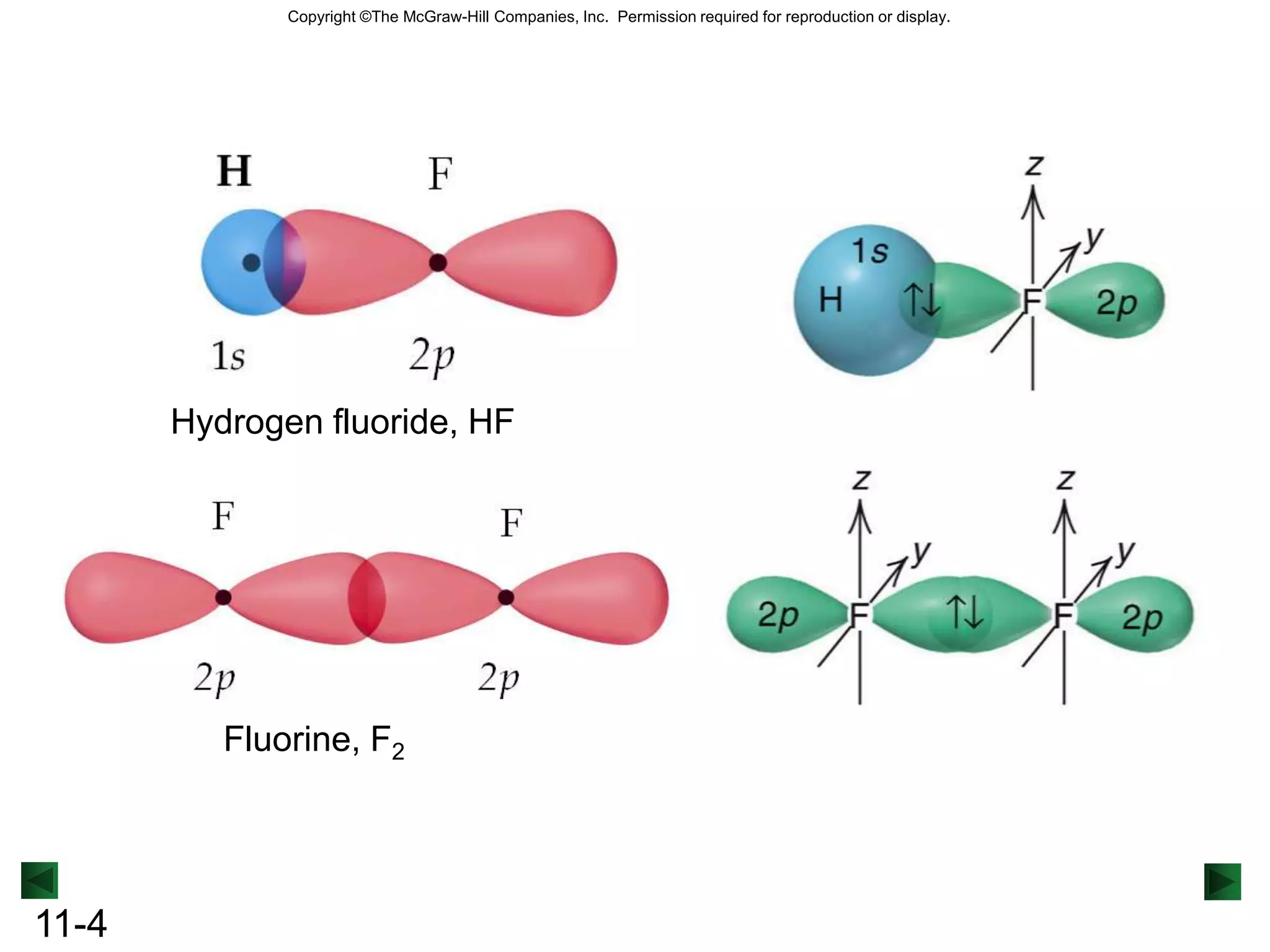
A covalent bond forms when the orbitals of two atoms overlap and the overlap region, which is between the nuclei, is occupied by a pair of electrons.
There are two electrons of opposite spin in the orbital overlap.Prentice Hall © 2003Chapter 9Covalent Bonding and Orbital OverlapHydrogen, H2
Hydrogen fluoride, HFFluorine, F2
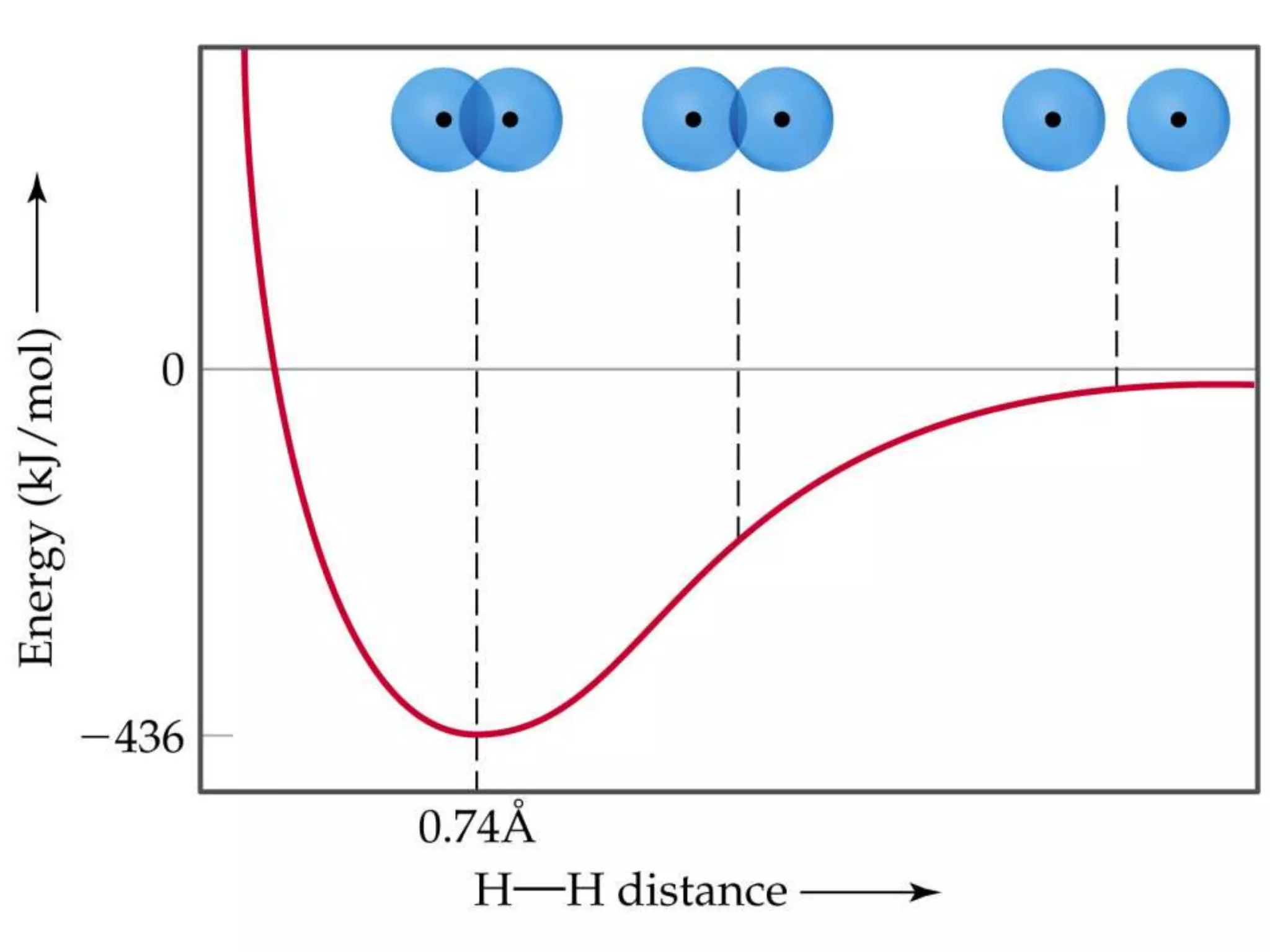
Prentice Hall © 2003Chapter 9Covalent Bonding and Orbital OverlapAs two nuclei approach each other their atomic orbitals overlap.
As the amount of overlap increases, the energy of the interaction decreases.
At some distance the minimum energy is reached.
The minimum energy corresponds to the bonding distance (or bond length).
As the two atoms get closer, their nuclei begin to repel and the energy increases.Prentice Hall © 2003Chapter 9Covalent Bonding and Orbital OverlapAt the bonding distance, the attractive forces between nuclei and electrons just balance the repulsive forces (nucleus-nucleus, electron-electron).
Prentice Hall © 2003Chapter 9Hybrid OrbitalsAtomic orbitals can mix or hybridize in order to adopt an appropriate geometry for bonding.
Hybridization is determined by the electron domain geometry.sp Hybrid OrbitalsConsider the BeF2 molecule (experimentally known to exist):Prentice Hall © 2003Chapter 9Hybrid Orbitalssp Hybrid OrbitalsBe has a 1s22s2 electron configuration.
There is no unpaired electron available for bonding.
We conclude that the atomic orbitals are not adequate to describe orbitals in molecules.
We know that the F-Be-F bond angle is 180 (VSEPR theory).
We also know that one electron from Be is shared with each one of the unpaired electrons from F.Prentice Hall © 2003Chapter 9Hybrid Orbitalssp Hybrid OrbitalsWe assume that the Be orbitals in the Be-F bond are 180 apart.
We could promote and electron from the 2s orbital on Be to the 2p orbital to get two unpaired electrons for bonding.
BUT the geometry is still not explained.
We can solve the problem by allowing the 2s and one 2p orbital on Be to mix or form a hybrid orbital.
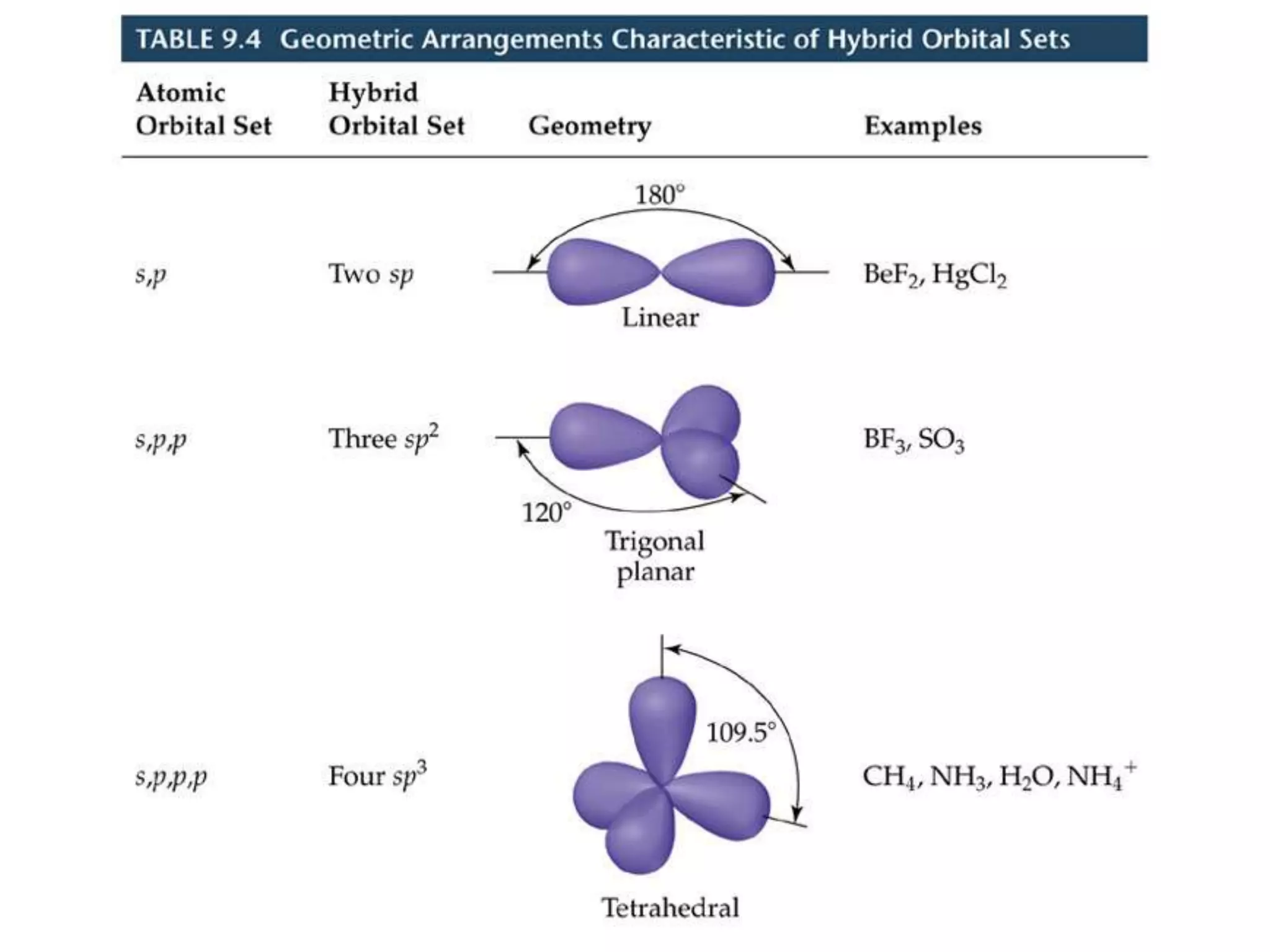
The hybrid orbital comes from an s and a p orbital and is called an sp hybrid orbital.
Prentice Hall © 2003Chapter 9Hybrid Orbitalssp Hybrid OrbitalsThe lobes of  sp hybrid orbitals are 180º apart.
Since only one of the Be 2p orbitals has been used in hybridization, there are two unhybridized p orbitals remaining on Be.The sp hybrid orbitals in gaseous BeCl2.Figure 11.2atomic orbitalshybrid orbitalsorbital box diagrams
The sp hybrid orbitals in gaseous BeCl2(continued).Figure 11.2orbital box diagrams with orbital contours
The sp2 hybrid orbitals in BF3.Figure 11.3
sp2 and sp3Hybrid Orbitals
The sp3 hybrid orbitals in CH4.Figure 11.4
Figure 11.5The sp3 hybrid orbitals in NH3.
Figure 11.5 continuedThe sp3 hybrid orbitals in H2O.
Figure 11.6The sp3d hybrid orbitals in PCl5.
The sp3d2hybrid orbitals in SF6.Figure 11.7
Key PointsTypes of Hybrid Orbitalsspsp2sp3sp3dsp3d2Hybrid OrbitalsThe number of hybrid orbitals obtained equals the number of atomic orbitals mixed.The type of hybrid orbitals obtained varies with the types of atomic orbitals mixed.
Step 1Step 2Step 3Figure 11.8The conceptual steps from molecular formula to the hybrid orbitals used in bonding.Molecular shape and e- group arrangementMolecular formulaLewis structureHybrid orbitals
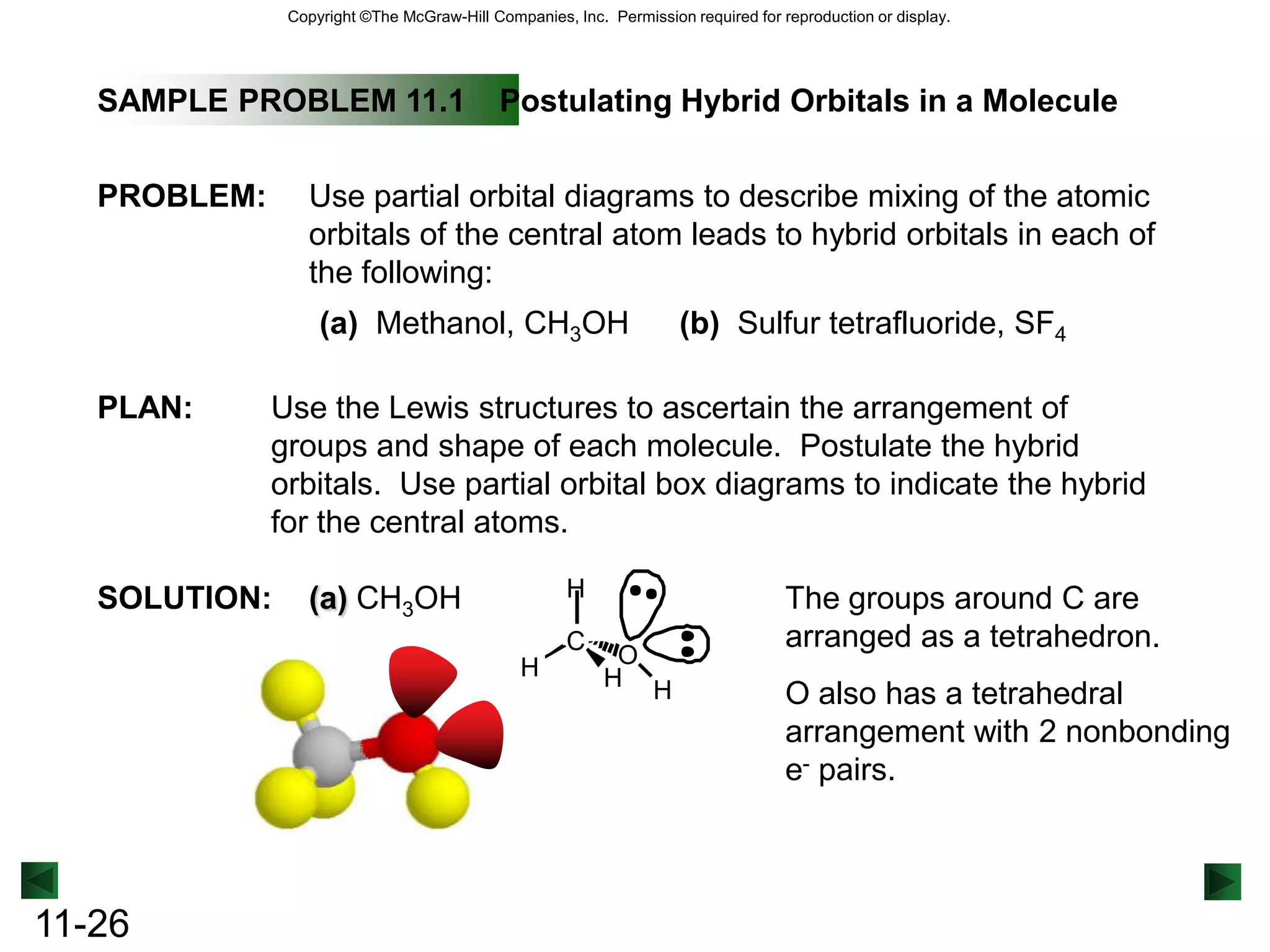
PROBLEM:Use partial orbital diagrams to describe mixing of the atomic orbitals of the central atom leads to hybrid orbitals in each of the following:PLAN:Use the Lewis structures to ascertain the arrangement of groups and shape of each molecule.  Postulate the hybrid orbitals.  Use partial orbital box diagrams to indicate the hybrid for the central atoms.SAMPLE PROBLEM 11.1Postulating Hybrid Orbitals in a Molecule(a)  Methanol, CH3OH(b)  Sulfur tetrafluoride, SF4SOLUTION:(a) CH3OHThe groups around C are arranged as a tetrahedron.O also has a tetrahedral arrangement with 2 nonbonding e- pairs.
hybridized C atomhybridized O atomsingle C atomsingle O atomhybridized S atomS atomSAMPLE PROBLEM 11.1Postulating Hybrid Orbitals in a Moleculecontinued(b) SF4 has a seesaw shape with 4 bonding and 1 nonbonding e- pairs.
Prentice Hall © 2003Chapter 9Hybrid OrbitalsHybridization Involving d OrbitalsSince there are only three p-orbitals, trigonal bipyramidal and octahedral electron domain geometries must involve d-orbitals.
Trigonal bipyramidal electron domain geometries require sp3d hybridization.
Octahedral electron domain geometries require sp3d2 hybridization.
Note the electron domain geometry from VSEPR theory determines the hybridization.Prentice Hall © 2003Chapter 9Hybrid OrbitalsSummaryDraw the Lewis structure.Determine the electron domain geometry with VSEPR.Specify the hybrid orbitals required for the electron pairs based on the electron domain geometry.
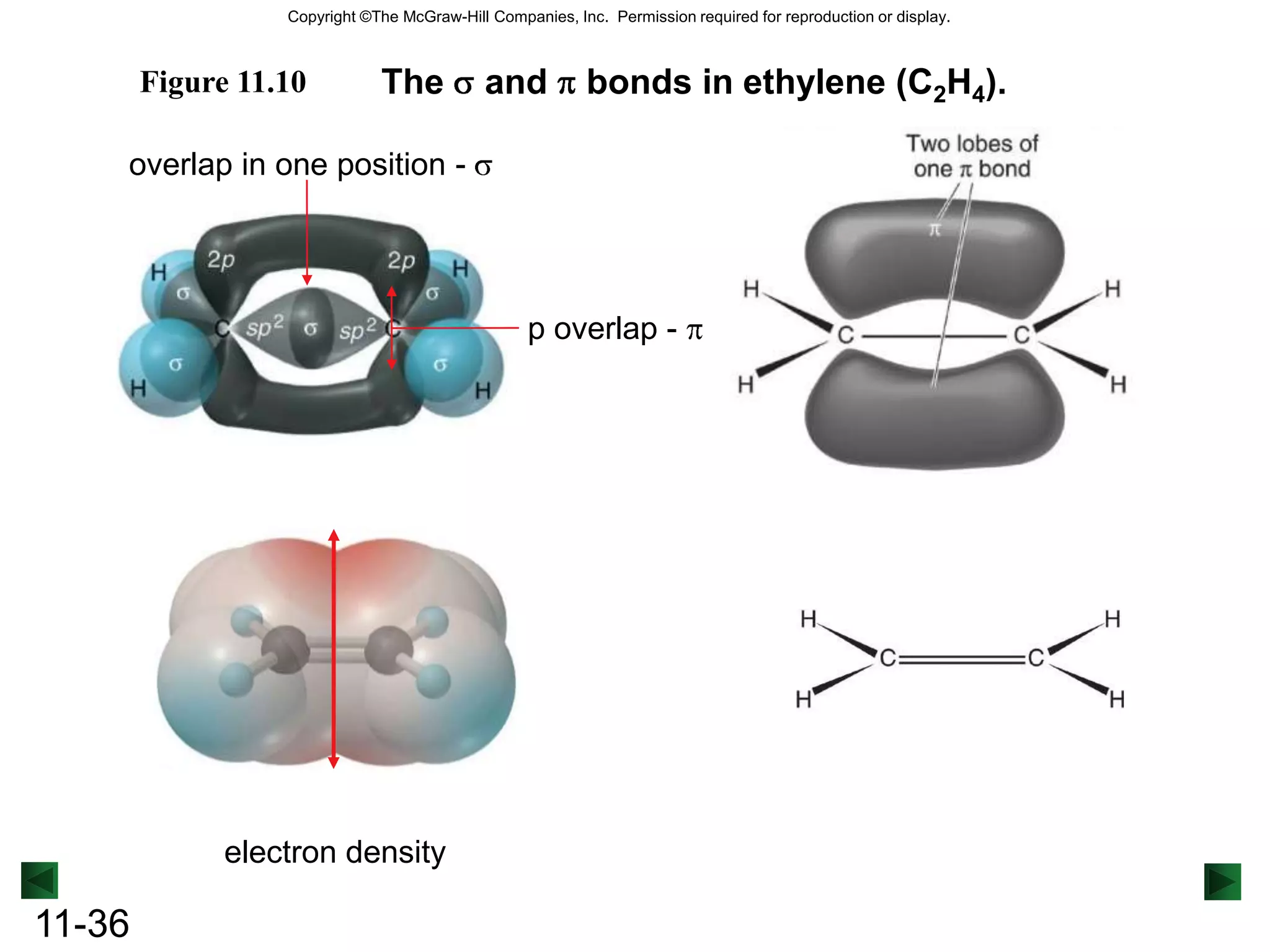
Prentice Hall © 2003Chapter 9Multiple Bonds-Bonds: electron density lies on the axis between the nuclei.
All single bonds are -bonds.
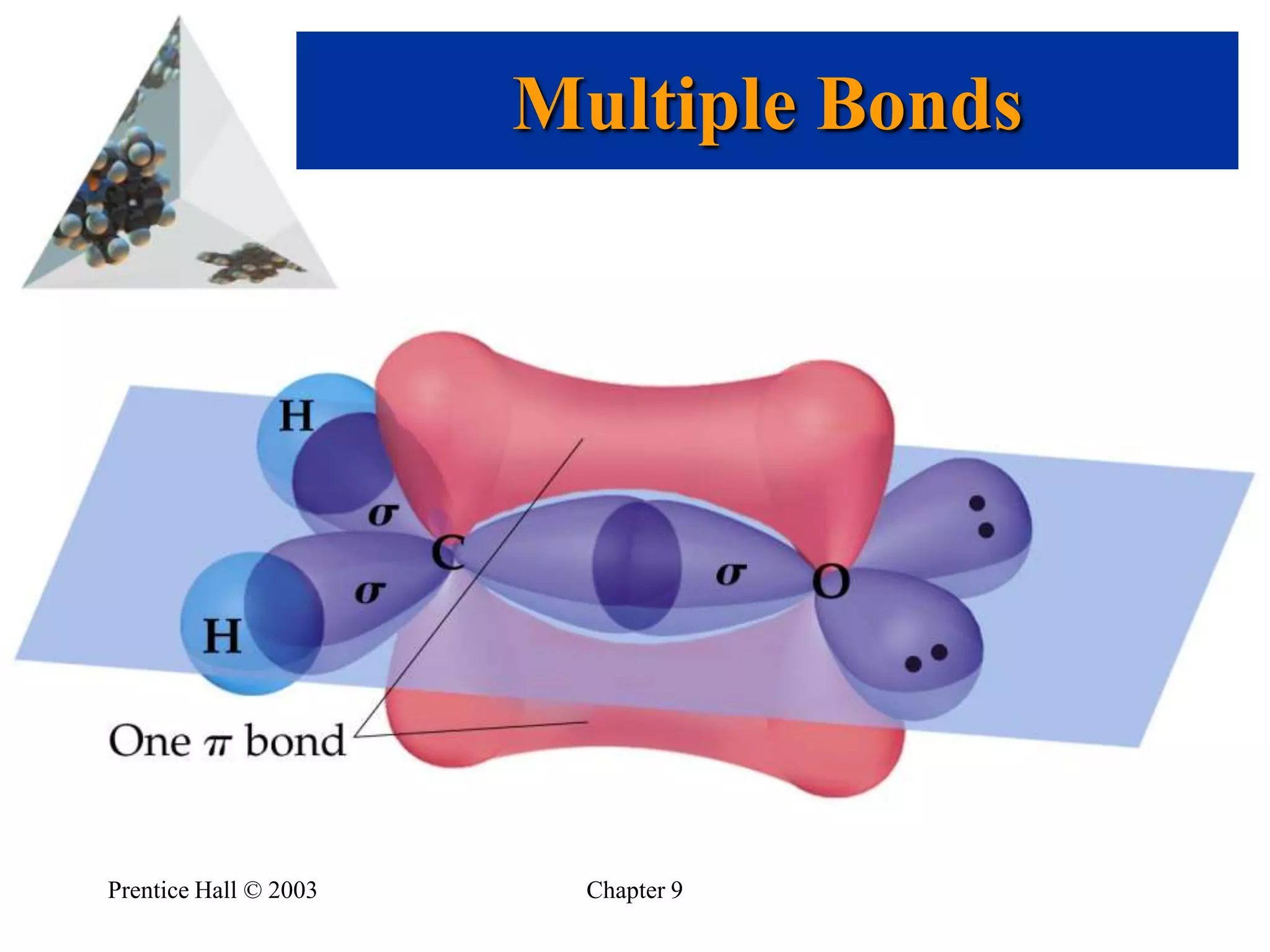
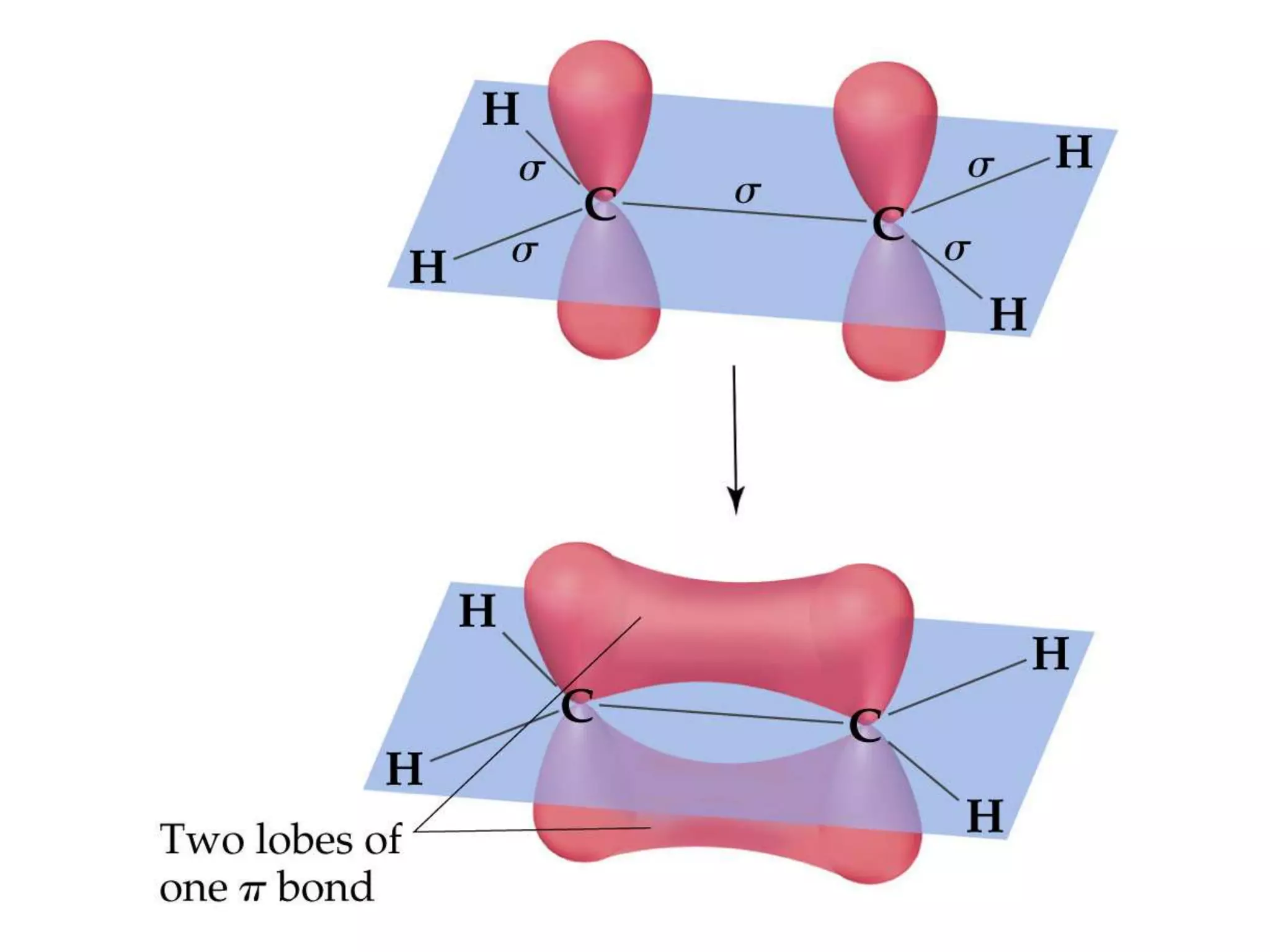
-Bonds: electron density lies above and below the plane of the nuclei.
A double bond consists of one -bond and one -bond.
A triple bond has one -bond and two -bonds.
Often, the p-orbitals involved in -bonding come from unhybridized orbitals.Multiple Bonds
both C are sp3 hybridizeds-sp3 overlaps to  bondssp3-sp3 overlap to form a  bondrelatively even distribution of electron density over all  bondsThe  bonds in ethane(C2H6).Figure 11.9
Prentice Hall © 2003Chapter 9Multiple BondsEthylene, C2H4, has:one - and one -bond;
both C atoms sp2 hybridized;
both C atoms with trigonal planar electron pair and molecular geometries.overlap in one position - p overlap - electron densityThe  and  bonds in ethylene (C2H4).Figure 11.10
Prentice Hall © 2003Chapter 9Multiple Bonds

Valence Bond Theory PPTX

  • 1.
    Theories of CovalentBonding11.1 Valence Shell Electron Pair Repulsion Theory11.2 Valence Bond (VB) Theory and Orbital Hybridization11.3 Molecular Orbital (MO)Theory and Electron Delocalization
  • 2.
    Prentice Hall ©2003Chapter 9Covalent Bonding and Orbital OverlapLewis structures and VSEPR do not explain why a bond forms. How do we account for shape in terms of quantum mechanics?
  • 3.
    What are theorbitals that are involved in bonding?
  • 4.
    We use ValenceBond Theory:
  • 5.
    Bonds form whenorbitals on atoms overlap.
  • 6.
    A covalent bondforms when the orbitals of two atoms overlap and the overlap region, which is between the nuclei, is occupied by a pair of electrons.
  • 7.
    There are twoelectrons of opposite spin in the orbital overlap.Prentice Hall © 2003Chapter 9Covalent Bonding and Orbital OverlapHydrogen, H2
  • 8.
  • 9.
    Prentice Hall ©2003Chapter 9Covalent Bonding and Orbital OverlapAs two nuclei approach each other their atomic orbitals overlap.
  • 10.
    As the amountof overlap increases, the energy of the interaction decreases.
  • 11.
    At some distancethe minimum energy is reached.
  • 12.
    The minimum energycorresponds to the bonding distance (or bond length).
  • 13.
    As the twoatoms get closer, their nuclei begin to repel and the energy increases.Prentice Hall © 2003Chapter 9Covalent Bonding and Orbital OverlapAt the bonding distance, the attractive forces between nuclei and electrons just balance the repulsive forces (nucleus-nucleus, electron-electron).
  • 14.
    Prentice Hall ©2003Chapter 9Hybrid OrbitalsAtomic orbitals can mix or hybridize in order to adopt an appropriate geometry for bonding.
  • 15.
    Hybridization is determinedby the electron domain geometry.sp Hybrid OrbitalsConsider the BeF2 molecule (experimentally known to exist):Prentice Hall © 2003Chapter 9Hybrid Orbitalssp Hybrid OrbitalsBe has a 1s22s2 electron configuration.
  • 16.
    There is nounpaired electron available for bonding.
  • 17.
    We conclude thatthe atomic orbitals are not adequate to describe orbitals in molecules.
  • 18.
    We know thatthe F-Be-F bond angle is 180 (VSEPR theory).
  • 19.
    We also knowthat one electron from Be is shared with each one of the unpaired electrons from F.Prentice Hall © 2003Chapter 9Hybrid Orbitalssp Hybrid OrbitalsWe assume that the Be orbitals in the Be-F bond are 180 apart.
  • 20.
    We could promoteand electron from the 2s orbital on Be to the 2p orbital to get two unpaired electrons for bonding.
  • 21.
    BUT the geometryis still not explained.
  • 22.
    We can solvethe problem by allowing the 2s and one 2p orbital on Be to mix or form a hybrid orbital.
  • 23.
    The hybrid orbitalcomes from an s and a p orbital and is called an sp hybrid orbital.
  • 24.
    Prentice Hall ©2003Chapter 9Hybrid Orbitalssp Hybrid OrbitalsThe lobes of sp hybrid orbitals are 180º apart.
  • 25.
    Since only oneof the Be 2p orbitals has been used in hybridization, there are two unhybridized p orbitals remaining on Be.The sp hybrid orbitals in gaseous BeCl2.Figure 11.2atomic orbitalshybrid orbitalsorbital box diagrams
  • 26.
    The sp hybridorbitals in gaseous BeCl2(continued).Figure 11.2orbital box diagrams with orbital contours
  • 28.
    The sp2 hybridorbitals in BF3.Figure 11.3
  • 29.
  • 30.
    The sp3 hybridorbitals in CH4.Figure 11.4
  • 31.
    Figure 11.5The sp3hybrid orbitals in NH3.
  • 32.
    Figure 11.5 continuedThesp3 hybrid orbitals in H2O.
  • 33.
    Figure 11.6The sp3dhybrid orbitals in PCl5.
  • 34.
    The sp3d2hybrid orbitalsin SF6.Figure 11.7
  • 35.
    Key PointsTypes ofHybrid Orbitalsspsp2sp3sp3dsp3d2Hybrid OrbitalsThe number of hybrid orbitals obtained equals the number of atomic orbitals mixed.The type of hybrid orbitals obtained varies with the types of atomic orbitals mixed.
  • 37.
    Step 1Step 2Step3Figure 11.8The conceptual steps from molecular formula to the hybrid orbitals used in bonding.Molecular shape and e- group arrangementMolecular formulaLewis structureHybrid orbitals
  • 38.
    PROBLEM:Use partial orbitaldiagrams to describe mixing of the atomic orbitals of the central atom leads to hybrid orbitals in each of the following:PLAN:Use the Lewis structures to ascertain the arrangement of groups and shape of each molecule. Postulate the hybrid orbitals. Use partial orbital box diagrams to indicate the hybrid for the central atoms.SAMPLE PROBLEM 11.1Postulating Hybrid Orbitals in a Molecule(a) Methanol, CH3OH(b) Sulfur tetrafluoride, SF4SOLUTION:(a) CH3OHThe groups around C are arranged as a tetrahedron.O also has a tetrahedral arrangement with 2 nonbonding e- pairs.
  • 39.
    hybridized C atomhybridizedO atomsingle C atomsingle O atomhybridized S atomS atomSAMPLE PROBLEM 11.1Postulating Hybrid Orbitals in a Moleculecontinued(b) SF4 has a seesaw shape with 4 bonding and 1 nonbonding e- pairs.
  • 40.
    Prentice Hall ©2003Chapter 9Hybrid OrbitalsHybridization Involving d OrbitalsSince there are only three p-orbitals, trigonal bipyramidal and octahedral electron domain geometries must involve d-orbitals.
  • 41.
    Trigonal bipyramidal electrondomain geometries require sp3d hybridization.
  • 42.
    Octahedral electron domaingeometries require sp3d2 hybridization.
  • 43.
    Note the electrondomain geometry from VSEPR theory determines the hybridization.Prentice Hall © 2003Chapter 9Hybrid OrbitalsSummaryDraw the Lewis structure.Determine the electron domain geometry with VSEPR.Specify the hybrid orbitals required for the electron pairs based on the electron domain geometry.
  • 46.
    Prentice Hall ©2003Chapter 9Multiple Bonds-Bonds: electron density lies on the axis between the nuclei.
  • 47.
    All single bondsare -bonds.
  • 48.
    -Bonds: electron densitylies above and below the plane of the nuclei.
  • 49.
    A double bondconsists of one -bond and one -bond.
  • 50.
    A triple bondhas one -bond and two -bonds.
  • 51.
    Often, the p-orbitalsinvolved in -bonding come from unhybridized orbitals.Multiple Bonds
  • 52.
    both C aresp3 hybridizeds-sp3 overlaps to  bondssp3-sp3 overlap to form a  bondrelatively even distribution of electron density over all  bondsThe  bonds in ethane(C2H6).Figure 11.9
  • 53.
    Prentice Hall ©2003Chapter 9Multiple BondsEthylene, C2H4, has:one - and one -bond;
  • 54.
    both C atomssp2 hybridized;
  • 55.
    both C atomswith trigonal planar electron pair and molecular geometries.overlap in one position - p overlap - electron densityThe  and  bonds in ethylene (C2H4).Figure 11.10
  • 56.
    Prentice Hall ©2003Chapter 9Multiple Bonds
  • 58.
    Prentice Hall ©2003Chapter 9Multiple BondsWhen triple bonds form (e.g. N2) one -bond is always above and below and the other is in front and behind the plane of the nuclei.Prentice Hall © 2003Chapter 9Multiple BondsConsider acetylene, C2H2the electron pair geometry of each C is linear;
  • 59.
    therefore, the Catoms are sp hybridized;
  • 60.
    the sp hybridorbitals form the C-C and C-H -bonds;
  • 61.
    there are twounhybridized p-orbitals;
  • 62.
    both unhybridized p-orbitalsform the two -bonds;
  • 63.
    one -bond isabove and below the plane of the nuclei;
  • 64.
    one -bond isin front and behind the plane of the nuclei.overlap in one position - p overlap - The  and  bonds in acetylene (C2H2).Figure 11.11
  • 65.
    Prentice Hall ©2003Chapter 9Multiple Bonds
  • 66.
    Prentice Hall ©2003Chapter 9Multiple Bonds
  • 67.
    Prentice Hall ©2003Chapter 9Multiple BondsDelocalized  BondingSo far all the bonds we have encountered are localized between two nuclei.
  • 68.
    In the caseof benzene
  • 69.
    there are 6C-C  bonds, 6 C-H  bonds,
  • 70.
    each C atomis sp2 hybridized,
  • 71.
    and there are6 unhybridized p orbitals on each C atom.Prentice Hall © 2003Chapter 9Multiple BondsDelocalized  Bonding
  • 72.
    Prentice Hall ©2003Chapter 9Multiple BondsDelocalized  BondingIn benzene there are two options for the 3  bonds
  • 73.
  • 74.
    delocalized over theentire ring (i.e. the  electrons are shared by all 6 C atoms).
  • 75.
    Experimentally, all C-Cbonds are the same length in benzene.
  • 76.
    Therefore, all C-Cbonds are of the same type (recall single bonds are longer than double bonds).Prentice Hall © 2003Chapter 9Multiple BondsGeneral ConclusionsEvery two atoms share at least 2 electrons.
  • 77.
    Two electrons betweenatoms on the same axis as the nuclei are  bonds.
  • 78.
  • 79.
    If two atomsshare more than one pair of electrons, the second and third pair form -bonds.
  • 80.
    When resonance structuresare possible, delocalization is also possible.Prentice Hall © 2003Chapter 9Molecular OrbitalsSome aspects of bonding are not explained by Lewis structures, VSEPR theory and hybridization. (E.g. why does O2 interact with a magnetic field?; Why are some molecules colored?)‏
  • 81.
    For these molecules,we use Molecular Orbital (MO) Theory.
  • 82.
    Just as electronsin atoms are found in atomic orbitals, electrons in molecules are found in molecular orbitals.PROBLEM:Describe the types of bonds and orbitals in acetone, (CH3)2CO.PLAN:Use the Lewis structures to ascertain the arrangement of groups and shape at each central atom. Postulate the hybrid orbitals taking note of the multiple bonds and their orbital overlaps.sp3 hybridizedsp3 hybridizedsp2 hybridizedSAMPLE PROBLEM 11.2Describing the Bond in MoleculesSOLUTION:bondbonds
  • 83.
    The Central Themesof MO TheoryA molecule is viewed on a quantum mechanical level as a collection of nuclei surrounded by delocalized molecular orbitals.Atomic wave functions are summed to obtain molecular wave functions.If wave functions reinforce each other, a bonding MO is formed (region of high electron density exists between the nuclei).If wave functions cancel each other, an antibonding MO is formed (a node of zero electron density occurs between the nuclei).
  • 84.
    Amplitudes of wavefunctions subtracted.Figure 11.14An analogy between light waves and atomic wave functions.Amplitudes of wave functions added
  • 85.
    Prentice Hall ©2003Chapter 9Molecular OrbitalsMolecular orbitals:
  • 86.
    each contain amaximum of two electrons;
  • 87.
  • 88.
    can be visualizedwith contour diagrams;
  • 89.
    are associated withan entire molecule.The Hydrogen MoleculeWhen two AOs overlap, two MOs form.Prentice Hall © 2003Chapter 9Molecular OrbitalsThe Hydrogen MoleculeTherefore, 1s (H) + 1s (H) must result in two MOs for H2:
  • 90.
    one has electrondensity between nuclei (bonding MO);
  • 91.
    one has littleelectron density between nuclei (antibonding MO).
  • 92.
    MOs resulting froms orbitals are  MOs.
  • 93.
     (bonding) MOis lower energy than * (antibonding) MO.Prentice Hall © 2003Chapter 9Molecular OrbitalsThe Hydrogen Molecule
  • 94.
    Prentice Hall ©2003Chapter 9Molecular OrbitalsThe Hydrogen MoleculeEnergy level diagram or MO diagram shows the energies and electrons in an orbital.
  • 95.
    The total numberof electrons in all atoms are placed in the MOs starting from lowest energy (1s) and ending when you run out of electrons.
  • 96.
    Note that electronsin MOs have opposite spins.
  • 97.
    H2 has twobonding electrons.
  • 98.
    He2 has twobonding electrons and two antibonding electrons.Prentice Hall © 2003Chapter 91s1sAO of HAO of HFigure 11.15The MO diagram for H2.Filling molecular orbitals with electrons follows the same concept as filling atomic orbitals.*1sEnergyH2 bond order = 1/2(2-0) = 11sMO of H2
  • 99.
    Prentice Hall ©2003Chapter 9Second-Row Diatomic Molecules Electron Configurations and Molecular PropertiesTwo types of magnetic behavior:
  • 100.
    paramagnetism (unpaired electronsin molecule): strong attraction between magnetic field and molecule;
  • 101.
    diamagnetism (no unpairedelectrons in molecule): weak repulsion between magnetic field and molecule.
  • 102.
    Magnetic behavior isdetected by determining the mass of a sample in the presence and absence of magnetic field: