AROMATIC
HYDROCARBON
1
INTRODUCTION
• The term 'aromatic' was derived from Greek word 'aroma' meaning
sweet fragrance.
• The term 'aromatic' was first used by August Kekule.
• According to Kekule, benzene and its derivatives are aromatic
compounds.
• But later, it was found that they also contain one or more benzene
rings.
• Hence 'Aromatic compounds' refers to the whole class of compounds
containing one or more benzenoid rings ( benzene rings ).
• Aromatic hydrocarbons are also called ARENES. In this sense, arenes
and their derivatives are all 'Aromatic compounds'.
• But there are aromatic compounds containing no benzene ring.
2
CHARACTERISTICS OF AROMATIC
COMPOUNDS
• Aromatic compounds have cyclic & flat structure.
• They are highly unsaturated but do not give unsaturation test.
• Addition reactions are much less favorable than electrophilic
substitution reactions.
• They are stabilized due to resonance or due to delocalization
of π-electrons, so they have low values of heats of
hydrogenation than expected.
• They obey Huckel's rule: A conjugated ring system containing
(4n+2)πe- will show aromatic character.(where
n=0,1,2,3,4,5,etc)
3
FEW EXAMPLES
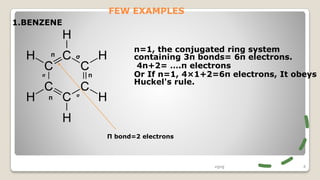
n=1, the conjugated ring system
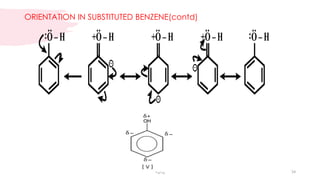
containing 3π bonds= 6π electrons.
4n+2= ….π electrons
Or If n=1, 4×1+2=6π electrons, It obeys
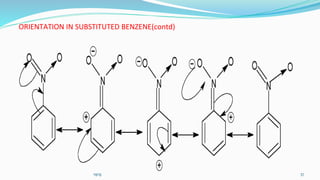
Huckel's rule.
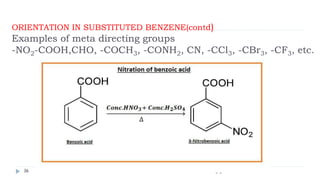
vgvg 4
Π bond=2 electrons
1.BENZENE
σ
σ
σ
Π
Π
Π
vgvg 5
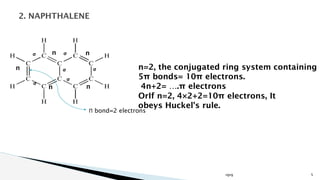
2. NAPHTHALENE
Π bond=2 electrons
n=2, the conjugated ring system containing
5π bonds= 10π electrons.
4n+2= ….π electrons
OrIf n=2, 4×2+2=10π electrons, It
obeys Huckel's rule.
Π
Π
Π
Π
Π
σ
σ
σ σ
σ
σ
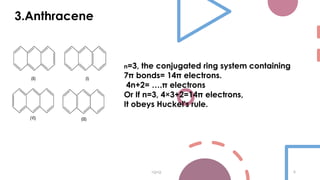
3.Anthracene
vgvg 6
n=3, the conjugated ring system containing
7π bonds= 14π electrons.
4n+2= ….π electrons
Or If n=3, 4×3+2=14π electrons,
It obeys Huckel's rule.
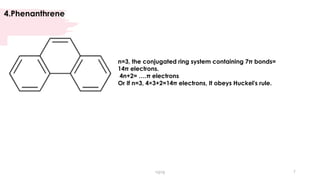
4.Phenanthrene
vgvg 7
n=3, the conjugated ring system containing 7π bonds=
14π electrons.
4n+2= ….π electrons
Or If n=3, 4×3+2=14π electrons, It obeys Huckel's rule.
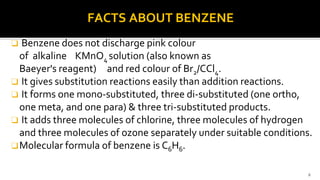
FACTS ABOUT BENZENE
❑ Benzene does not discharge pink colour
of alkaline KMnO4 solution (also known as
Baeyer's reagent) and red colour of Br2/CCl4.
❑ It gives substitution reactions easily than addition reactions.
❑ It forms one mono-substituted, three di-substituted (one ortho,
one meta, and one para) & three tri-substituted products.
❑ It adds three molecules of chlorine, three molecules of hydrogen
and three molecules of ozone separately under suitable conditions.
❑Molecular formula of benzene is C6H6.
8
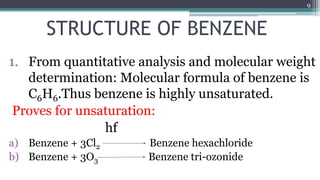
STRUCTURE OF BENZENE
1. From quantitative analysis and molecular weight
determination: Molecular formula of benzene is
C6H6.Thus benzene is highly unsaturated.
Proves for unsaturation:
hf
a) Benzene + 3Cl2 Benzene hexachloride
b) Benzene + 3O3 Benzene tri-ozonide
9
10
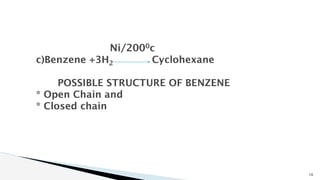
Ni/2000c
c)Benzene +3H2 Cyclohexane
POSSIBLE STRUCTURE OF BENZENE
* Open Chain and
* Closed chain
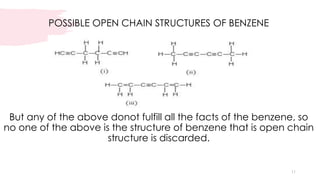
POSSIBLE OPEN CHAIN STRUCTURES OF BENZENE
But any of the above donot fulfill all the facts of the benzene, so
no one of the above is the structure of benzene that is open chain
structure is discarded.
11
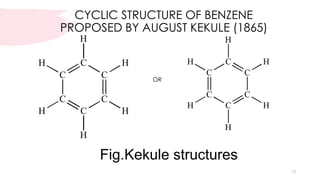
CYCLIC STRUCTURE OF BENZENE
PROPOSED BY AUGUST KEKULE (1865)
12
OR
Fig.Kekule structures
ABOVE KEKULE'S STRUCTURE STILL DOES
NOT EXPLAIN ALL FACTS
Above structure does not explain
• Why it does not discharge pink colour of KMnO4 solution and red
colour of bromine in CCl4.
• Why it gives substitution reactions more easily than addition
reactions.
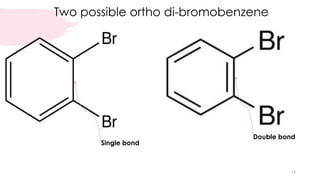
• Why it forms only one ortho di- substituted isomer. On the basis
of above structure two ortho di-substituted isomers are possible.
For example:
13
Two possible ortho di-bromobenzene
14
Single bond
Double bond
ACTUAL STRUCTURE OF BENZENE
• In order to explain all the facts or to overcome
above difficulties, Kekule proposed his oscillation
theory.
• According to oscillation theory, the double bonds
and single bonds in benzene exchange their
positions very rapidly & the dynamic equilibrium
between the following two structures is
maintained.
15
ACTUAL STRUCTURE OF BENZENE ( contd. )
16
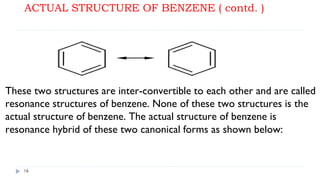
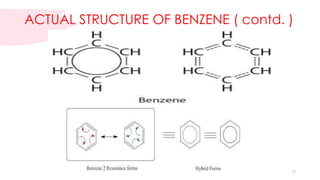
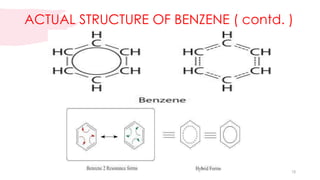
These two structures are inter-convertible to each other and are called
resonance structures of benzene. None of these two structures is the
actual structure of benzene. The actual structure of benzene is
resonance hybrid of these two canonical forms as shown below:
ACTUAL STRUCTURE OF BENZENE ( contd. )
17
ACTUAL STRUCTURE OF BENZENE ( contd. )
18
ACTUAL STRUCTURE OF BENZENE ( contd. )
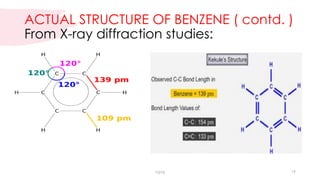
From X-ray diffraction studies:
vgvg 19
STRUCTURE OF BENZENE ( contd. )
• The resonance hybrid structure of benzene can explain the
unusual property of double bonds in it which causes the extra
stability of benzene molecule.
• Resonance hybrid makes a molecule more stable than that
expected theoretically. This extra stabilization energy is called '
Resonance energy' which is 36 Kcal/mole for benzene.
• Resonance hybrid structure explains why benzene shows very
few addition reactions in spite of the presence of apparent
three aliphatic C=C bond in benzene.
vgvg 20
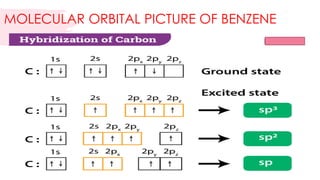
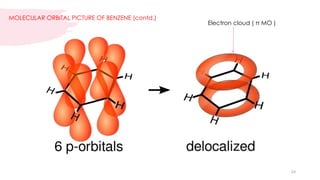
MOLECULAR ORBITAL PICTURE OF BENZENE
21
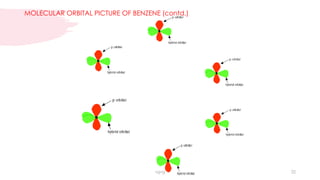
MOLECULAR ORBITAL PICTURE OF BENZENE (contd.)
vgvg 22
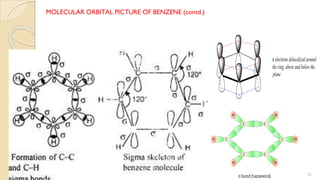
MOLECULAR ORBITAL PICTURE OF BENZENE (contd.)
vgvg 23
MOLECULAR ORBITAL PICTURE OF BENZENE (contd.)
24
Electron cloud ( π MO )
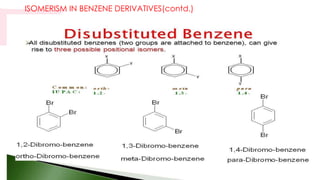
ISOMERISM IN BENZENE DERIVATIVES
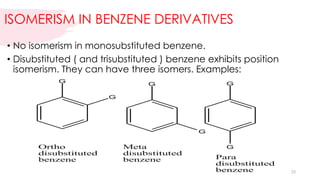
• No isomerism in monosubstituted benzene.
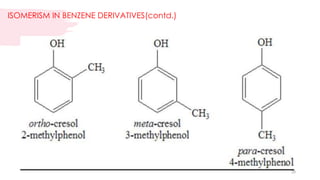
• Disubstituted ( and trisubstituted ) benzene exhibits position
isomerism. They can have three isomers. Examples:
25
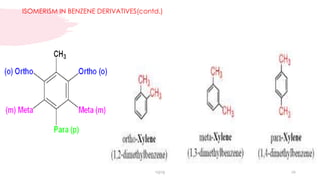
ISOMERISM IN BENZENE DERIVATIVES(contd.)
vgvg 26
ISOMERISM IN BENZENE DERIVATIVES(contd.)
27
ISOMERISM IN BENZENE DERIVATIVES(contd.)
28
ORIENTATION IN SUBSTITUTED BENZENE
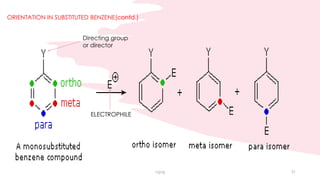
• The term orientation indicates the assignments of the
positions of the substituents with respect to a substituent
already present in the ring during electrophilic substitution
reaction of a mono substituted benzene.
• The first substituent (G) may direct the next incoming group
(E+) to ortho, meta or para position, depending on the
nature of the substituent already present in the ring. This is
called directive or orientation effect. The substituent
already present in the ring is called director or directing
group.
vgvg 29
ORIENTATION IN SUBSTITUTED BENZENE(contd)
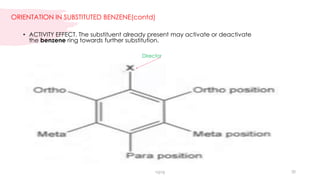
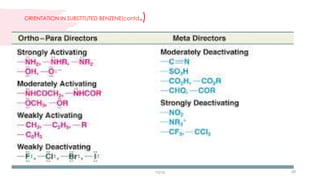
• ACTIVITY EFFECT. The substituent already present may activate or deactivate
the benzene ring towards further substitution.
Director
vgvg 30
vgvg 31
ORIENTATION IN SUBSTITUTED BENZENE(contd.)
Directing group
or director
ELECTROPHILE
ORIENTATION IN SUBSTITUTED BENZENE(contd)
TYPES OF DIRECTOR
Two types of Directors
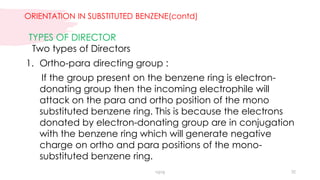
1. Ortho-para directing group :
If the group present on the benzene ring is electron-
donating group then the incoming electrophile will
attack on the para and ortho position of the mono
substituted benzene ring. This is because the electrons
donated by electron-donating group are in conjugation
with the benzene ring which will generate negative
charge on ortho and para positions of the mono-
substituted benzene ring.
vgvg 32
ORIENTATION IN SUBSTITUTED BENZENE(contd)
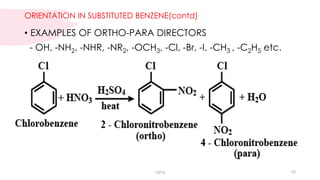
• EXAMPLES OF ORTHO-PARA DIRECTORS
- OH, -NH2, -NHR, -NR2, -OCH3, -Cl, -Br, -I, -CH3 , -C2H5 etc.
vgvg 33
ORIENTATION IN SUBSTITUTED BENZENE(contd)
vgvg 34
ORIENTATION IN SUBSTITUTED BENZENE(contd)
2. Meta directing group:
If the group present on the benzene ring is electron-
withdrawing group then the incoming electro-phile will attack
on the meta position of the mono substituted benzene ring. This
is because the electrons withdrawing group will withdraw the
electron density of the ring by which positive charge will be on
ortho and para positions on the mono-substituted benzene
ring. Since, the ortho and para positions are electron deficient
only meta position will be rich in electron density. Hence,
electrophile will attack on meta position of the mono-
substituted benzene ring. As shown in the image attached.
vgvg 35
ORIENTATION IN SUBSTITUTED BENZENE(contd)
Examples of meta directing groups
-NO2-COOH,CHO, -COCH3, -CONH2, CN, -CCl3, -CBr3, -CF3, etc.
vgvg
36
ORIENTATION IN SUBSTITUTED BENZENE(contd)
vgvg 37
ORIENTATION IN SUBSTITUTED BENZENE(contd.)
vgvg 38
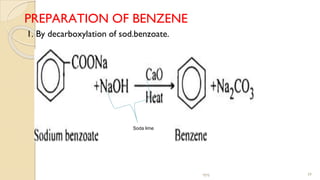
PREPARATION OF BENZENE
1. By decarboxylation of sod.benzoate.
vgvg 39
Soda lime
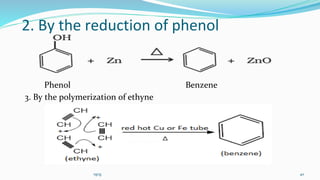
2. By the reduction of phenol
Phenol Benzene
3. By the polymerization of ethyne
vgvg 40
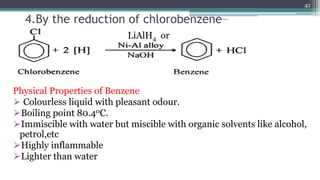
4.By the reduction of chlorobenzene
LiAlH4 or
Physical Properties of Benzene
⮚ Colourless liquid with pleasant odour.
⮚Boiling point 80.40C.
⮚Immiscible with water but miscible with organic solvents like alcohol,
petrol,etc
⮚Highly inflammable
⮚Lighter than water
vgvg
41
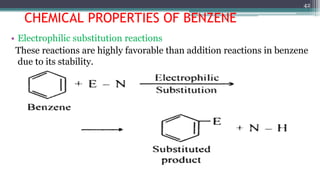
CHEMICAL PROPERTIES OF BENZENE
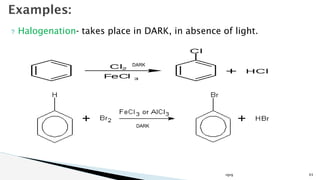
• Electrophilic substitution reactions
These reactions are highly favorable than addition reactions in benzene
due to its stability.
vgvg
42
? Halogenation- takes place in DARK, in absence of light.
vgvg 43
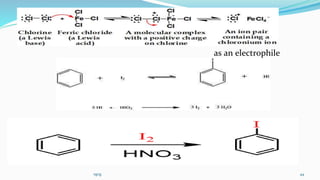
Examples:
DARK
DARK
as an electrophile
vgvg 44
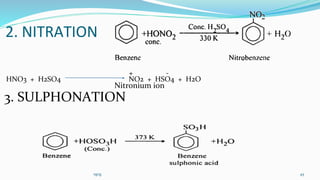
2. NITRATION
+ -
HNO3 + H2SO4 NO2 + HSO4 + H2O
Nitronium ion
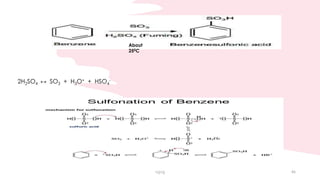
3. SULPHONATION
vgvg 45
vgvg 46
About
250C
2H2SO4 ↔ SO3 + H3O+ + HSO4
-
vgvg 47
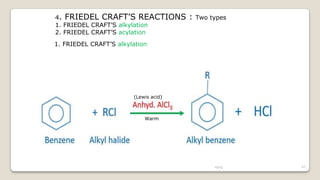
4. FRIEDEL CRAFT’S REACTIONS : Two types
1. FRIEDEL CRAFT’S alkylation
2. FRIEDEL CRAFT’S acylation
1. FRIEDEL CRAFT’S alkylation
Warm
(Lewis acid)
vgvg 48
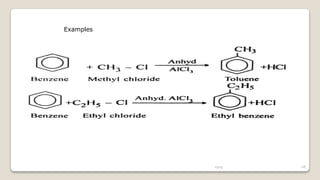
Examples
vgvg 49
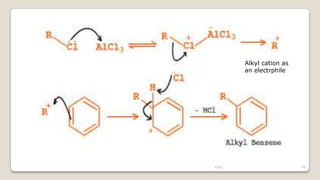
Alkyl cation as
an electrphile
vgvg 50
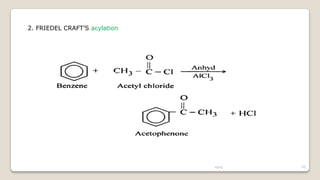
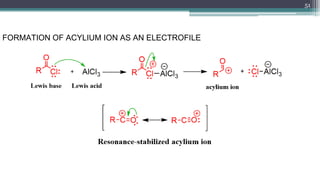
2. FRIEDEL CRAFT’S acylation
51
FORMATION OF ACYLIUM ION AS AN ELECTROFILE
52
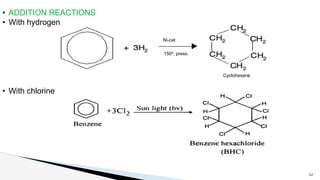
• ADDITION REACTIONS
• With hydrogen
Ni-cat
1500, press.
Cyclohexane
• With chlorine
53
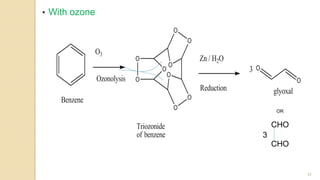
• With ozone
OR
CHO
CHO
3
54
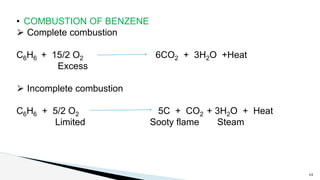
• COMBUSTION OF BENZENE
⮚ Complete combustion
C6H6 + 15/2 O2 6CO2 + 3H2O +Heat
Excess
⮚ Incomplete combustion
C6H6 + 5/2 O2 5C + CO2 + 3H2O + Heat
Limited Sooty flame Steam
55
USES OF BENZENE
⮚ As a solvent for oils and fats.
⮚For dry cleaning or washing of wollen and silk clothes ( garments )
⮚As a fuel for automobiles in the name of Benzol. It is added in gasoline
to increase its OCTANE NUMBER.
⮚ For the manufacture of varieties of commercial derivatives like ethyl
benzene, phenol, chlorobenzene, nitrobenzene, BHC, etc.
⮚ In the manufacture of dyes, drugs, perfumes, explosives, etc.

Aromatic Hydrocarbon

  • 1.
  • 2.
    INTRODUCTION • The term'aromatic' was derived from Greek word 'aroma' meaning sweet fragrance. • The term 'aromatic' was first used by August Kekule. • According to Kekule, benzene and its derivatives are aromatic compounds. • But later, it was found that they also contain one or more benzene rings. • Hence 'Aromatic compounds' refers to the whole class of compounds containing one or more benzenoid rings ( benzene rings ). • Aromatic hydrocarbons are also called ARENES. In this sense, arenes and their derivatives are all 'Aromatic compounds'. • But there are aromatic compounds containing no benzene ring. 2
  • 3.
    CHARACTERISTICS OF AROMATIC COMPOUNDS •Aromatic compounds have cyclic & flat structure. • They are highly unsaturated but do not give unsaturation test. • Addition reactions are much less favorable than electrophilic substitution reactions. • They are stabilized due to resonance or due to delocalization of π-electrons, so they have low values of heats of hydrogenation than expected. • They obey Huckel's rule: A conjugated ring system containing (4n+2)πe- will show aromatic character.(where n=0,1,2,3,4,5,etc) 3
  • 4.
    FEW EXAMPLES n=1, theconjugated ring system containing 3π bonds= 6π electrons. 4n+2= ….π electrons Or If n=1, 4×1+2=6π electrons, It obeys Huckel's rule. vgvg 4 Π bond=2 electrons 1.BENZENE σ σ σ Π Π Π
  • 5.
    vgvg 5 2. NAPHTHALENE Πbond=2 electrons n=2, the conjugated ring system containing 5π bonds= 10π electrons. 4n+2= ….π electrons OrIf n=2, 4×2+2=10π electrons, It obeys Huckel's rule. Π Π Π Π Π σ σ σ σ σ σ
  • 6.
    3.Anthracene vgvg 6 n=3, theconjugated ring system containing 7π bonds= 14π electrons. 4n+2= ….π electrons Or If n=3, 4×3+2=14π electrons, It obeys Huckel's rule.
  • 7.
    4.Phenanthrene vgvg 7 n=3, theconjugated ring system containing 7π bonds= 14π electrons. 4n+2= ….π electrons Or If n=3, 4×3+2=14π electrons, It obeys Huckel's rule.
  • 8.
    FACTS ABOUT BENZENE ❑Benzene does not discharge pink colour of alkaline KMnO4 solution (also known as Baeyer's reagent) and red colour of Br2/CCl4. ❑ It gives substitution reactions easily than addition reactions. ❑ It forms one mono-substituted, three di-substituted (one ortho, one meta, and one para) & three tri-substituted products. ❑ It adds three molecules of chlorine, three molecules of hydrogen and three molecules of ozone separately under suitable conditions. ❑Molecular formula of benzene is C6H6. 8
  • 9.
    STRUCTURE OF BENZENE 1.From quantitative analysis and molecular weight determination: Molecular formula of benzene is C6H6.Thus benzene is highly unsaturated. Proves for unsaturation: hf a) Benzene + 3Cl2 Benzene hexachloride b) Benzene + 3O3 Benzene tri-ozonide 9
  • 10.
    10 Ni/2000c c)Benzene +3H2 Cyclohexane POSSIBLESTRUCTURE OF BENZENE * Open Chain and * Closed chain
  • 11.
    POSSIBLE OPEN CHAINSTRUCTURES OF BENZENE But any of the above donot fulfill all the facts of the benzene, so no one of the above is the structure of benzene that is open chain structure is discarded. 11
  • 12.
    CYCLIC STRUCTURE OFBENZENE PROPOSED BY AUGUST KEKULE (1865) 12 OR Fig.Kekule structures
  • 13.
    ABOVE KEKULE'S STRUCTURESTILL DOES NOT EXPLAIN ALL FACTS Above structure does not explain • Why it does not discharge pink colour of KMnO4 solution and red colour of bromine in CCl4. • Why it gives substitution reactions more easily than addition reactions. • Why it forms only one ortho di- substituted isomer. On the basis of above structure two ortho di-substituted isomers are possible. For example: 13
  • 14.
    Two possible orthodi-bromobenzene 14 Single bond Double bond
  • 15.
    ACTUAL STRUCTURE OFBENZENE • In order to explain all the facts or to overcome above difficulties, Kekule proposed his oscillation theory. • According to oscillation theory, the double bonds and single bonds in benzene exchange their positions very rapidly & the dynamic equilibrium between the following two structures is maintained. 15
  • 16.
    ACTUAL STRUCTURE OFBENZENE ( contd. ) 16 These two structures are inter-convertible to each other and are called resonance structures of benzene. None of these two structures is the actual structure of benzene. The actual structure of benzene is resonance hybrid of these two canonical forms as shown below:
  • 17.
    ACTUAL STRUCTURE OFBENZENE ( contd. ) 17
  • 18.
    ACTUAL STRUCTURE OFBENZENE ( contd. ) 18
  • 19.
    ACTUAL STRUCTURE OFBENZENE ( contd. ) From X-ray diffraction studies: vgvg 19
  • 20.
    STRUCTURE OF BENZENE( contd. ) • The resonance hybrid structure of benzene can explain the unusual property of double bonds in it which causes the extra stability of benzene molecule. • Resonance hybrid makes a molecule more stable than that expected theoretically. This extra stabilization energy is called ' Resonance energy' which is 36 Kcal/mole for benzene. • Resonance hybrid structure explains why benzene shows very few addition reactions in spite of the presence of apparent three aliphatic C=C bond in benzene. vgvg 20
  • 21.
  • 22.
    MOLECULAR ORBITAL PICTUREOF BENZENE (contd.) vgvg 22
  • 23.
    MOLECULAR ORBITAL PICTUREOF BENZENE (contd.) vgvg 23
  • 24.
    MOLECULAR ORBITAL PICTUREOF BENZENE (contd.) 24 Electron cloud ( π MO )
  • 25.
    ISOMERISM IN BENZENEDERIVATIVES • No isomerism in monosubstituted benzene. • Disubstituted ( and trisubstituted ) benzene exhibits position isomerism. They can have three isomers. Examples: 25
  • 26.
    ISOMERISM IN BENZENEDERIVATIVES(contd.) vgvg 26
  • 27.
    ISOMERISM IN BENZENEDERIVATIVES(contd.) 27
  • 28.
    ISOMERISM IN BENZENEDERIVATIVES(contd.) 28
  • 29.
    ORIENTATION IN SUBSTITUTEDBENZENE • The term orientation indicates the assignments of the positions of the substituents with respect to a substituent already present in the ring during electrophilic substitution reaction of a mono substituted benzene. • The first substituent (G) may direct the next incoming group (E+) to ortho, meta or para position, depending on the nature of the substituent already present in the ring. This is called directive or orientation effect. The substituent already present in the ring is called director or directing group. vgvg 29
  • 30.
    ORIENTATION IN SUBSTITUTEDBENZENE(contd) • ACTIVITY EFFECT. The substituent already present may activate or deactivate the benzene ring towards further substitution. Director vgvg 30
  • 31.
    vgvg 31 ORIENTATION INSUBSTITUTED BENZENE(contd.) Directing group or director ELECTROPHILE
  • 32.
    ORIENTATION IN SUBSTITUTEDBENZENE(contd) TYPES OF DIRECTOR Two types of Directors 1. Ortho-para directing group : If the group present on the benzene ring is electron- donating group then the incoming electrophile will attack on the para and ortho position of the mono substituted benzene ring. This is because the electrons donated by electron-donating group are in conjugation with the benzene ring which will generate negative charge on ortho and para positions of the mono- substituted benzene ring. vgvg 32
  • 33.
    ORIENTATION IN SUBSTITUTEDBENZENE(contd) • EXAMPLES OF ORTHO-PARA DIRECTORS - OH, -NH2, -NHR, -NR2, -OCH3, -Cl, -Br, -I, -CH3 , -C2H5 etc. vgvg 33
  • 34.
    ORIENTATION IN SUBSTITUTEDBENZENE(contd) vgvg 34
  • 35.
    ORIENTATION IN SUBSTITUTEDBENZENE(contd) 2. Meta directing group: If the group present on the benzene ring is electron- withdrawing group then the incoming electro-phile will attack on the meta position of the mono substituted benzene ring. This is because the electrons withdrawing group will withdraw the electron density of the ring by which positive charge will be on ortho and para positions on the mono-substituted benzene ring. Since, the ortho and para positions are electron deficient only meta position will be rich in electron density. Hence, electrophile will attack on meta position of the mono- substituted benzene ring. As shown in the image attached. vgvg 35
  • 36.
    ORIENTATION IN SUBSTITUTEDBENZENE(contd) Examples of meta directing groups -NO2-COOH,CHO, -COCH3, -CONH2, CN, -CCl3, -CBr3, -CF3, etc. vgvg 36
  • 37.
    ORIENTATION IN SUBSTITUTEDBENZENE(contd) vgvg 37
  • 38.
    ORIENTATION IN SUBSTITUTEDBENZENE(contd.) vgvg 38
  • 39.
    PREPARATION OF BENZENE 1.By decarboxylation of sod.benzoate. vgvg 39 Soda lime
  • 40.
    2. By thereduction of phenol Phenol Benzene 3. By the polymerization of ethyne vgvg 40
  • 41.
    4.By the reductionof chlorobenzene LiAlH4 or Physical Properties of Benzene ⮚ Colourless liquid with pleasant odour. ⮚Boiling point 80.40C. ⮚Immiscible with water but miscible with organic solvents like alcohol, petrol,etc ⮚Highly inflammable ⮚Lighter than water vgvg 41
  • 42.
    CHEMICAL PROPERTIES OFBENZENE • Electrophilic substitution reactions These reactions are highly favorable than addition reactions in benzene due to its stability. vgvg 42
  • 43.
    ? Halogenation- takesplace in DARK, in absence of light. vgvg 43 Examples: DARK DARK
  • 44.
  • 45.
    2. NITRATION + - HNO3+ H2SO4 NO2 + HSO4 + H2O Nitronium ion 3. SULPHONATION vgvg 45
  • 46.
    vgvg 46 About 250C 2H2SO4 ↔SO3 + H3O+ + HSO4 -
  • 47.
    vgvg 47 4. FRIEDELCRAFT’S REACTIONS : Two types 1. FRIEDEL CRAFT’S alkylation 2. FRIEDEL CRAFT’S acylation 1. FRIEDEL CRAFT’S alkylation Warm (Lewis acid)
  • 48.
  • 49.
    vgvg 49 Alkyl cationas an electrphile
  • 50.
    vgvg 50 2. FRIEDELCRAFT’S acylation
  • 51.
    51 FORMATION OF ACYLIUMION AS AN ELECTROFILE
  • 52.
    52 • ADDITION REACTIONS •With hydrogen Ni-cat 1500, press. Cyclohexane • With chlorine
  • 53.
  • 54.
    54 • COMBUSTION OFBENZENE ⮚ Complete combustion C6H6 + 15/2 O2 6CO2 + 3H2O +Heat Excess ⮚ Incomplete combustion C6H6 + 5/2 O2 5C + CO2 + 3H2O + Heat Limited Sooty flame Steam
  • 55.
    55 USES OF BENZENE ⮚As a solvent for oils and fats. ⮚For dry cleaning or washing of wollen and silk clothes ( garments ) ⮚As a fuel for automobiles in the name of Benzol. It is added in gasoline to increase its OCTANE NUMBER. ⮚ For the manufacture of varieties of commercial derivatives like ethyl benzene, phenol, chlorobenzene, nitrobenzene, BHC, etc. ⮚ In the manufacture of dyes, drugs, perfumes, explosives, etc.