THE H.N.S.B LTD. SCIENCE COLLEGE, HIMATNAGAR
CLASS SEMINAR
M.Sc SEM-I
Subject :- INORGANIC CHEMISTRY
Paper :- CHN- 401
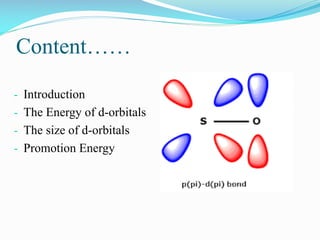
Topic :- d - p BONDS
Presented By Guided By
Bindal patel Dr. N. I. Patel sir
Content……
- Introduction
- The Energy of d-orbitals
- The size of d-orbitals
- Promotion Energy
Introduction The Central atoms belonging to the third period (n=3) has ns, np
and nd orbitals in its valence shell.
 The combination of central and surrounding or peripheral atoms S
and p-orbitals from σ-bond. Which makes principal contribution for
bonding.
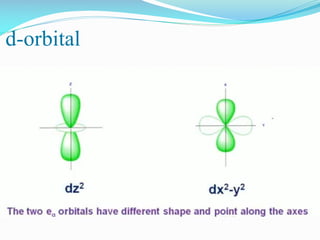
 The central atom d-orbitals namely 𝑑 𝑥2 − 𝑦2 and dz2 denoted by eg
orbitals can participation in σ-bonding by overlapping with
Appropriate set of peripheral of or surrounding s and mainly p-
orbital .
d-orbital
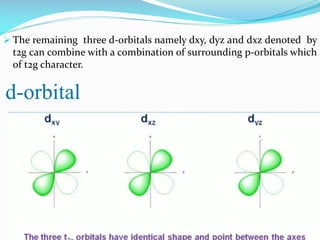
 The remaining three d-orbitals namely dxy, dyz and dxz denoted by
t2g can combine with a combination of surrounding p-orbitals which
of t2g character.
d-orbital
Energy of d-orbitals
 The Spectroscopic data for free atoms of silicon phosphorus, Sulphur
and Chlorine as well as of their large congeners indicate the energy of
valence shell d-orbital are very high.
 The Interaction of sufficient magnitude requires d-orbitals should be
low energy it is concluded that they can not contribute much to
bonding.
Size of d-orbital
 The 3d-orbitals of the free sulphur atom are completely screen by the
inner shell electron and hence d-orbital do not experience the nuclear
charge as much as 3s and 3p electron .
 The d orbital are very diffused then the s and p-orbital with radial
distribution maxima as a distance which is roughly double a typical bond
length
 The overlapping of appreciable magnitude required that orbital should be
compact enough of the shape.
 The diffused shape of d-orbital leads to extremely poor ovelaping and
week bonding.
Promotion Energy
 The promotion energy to state derived from the sp3 Congregation very
high in range of 30-35 ev.
 Second period element form 𝜋-bond using p-orbital .the overlap is
strongly dependent on the magnitude of the wave function in the overlap
region and for the 𝜋-bond.
 𝑝𝜋- p𝜋-bond bonding is important only in second period element and
becomes and less important for Havier element
 The heavier non-transation element from 𝜋-bonds with small element
especially nitrogen and oxygen by using their valence shell d-orbitals.
𝑑2
D pie and p pie bond

D pie and p pie bond

  • 1.
    THE H.N.S.B LTD.SCIENCE COLLEGE, HIMATNAGAR CLASS SEMINAR M.Sc SEM-I Subject :- INORGANIC CHEMISTRY Paper :- CHN- 401 Topic :- d - p BONDS Presented By Guided By Bindal patel Dr. N. I. Patel sir
  • 2.
    Content…… - Introduction - TheEnergy of d-orbitals - The size of d-orbitals - Promotion Energy
  • 3.
    Introduction The Centralatoms belonging to the third period (n=3) has ns, np and nd orbitals in its valence shell.  The combination of central and surrounding or peripheral atoms S and p-orbitals from σ-bond. Which makes principal contribution for bonding.  The central atom d-orbitals namely 𝑑 𝑥2 − 𝑦2 and dz2 denoted by eg orbitals can participation in σ-bonding by overlapping with Appropriate set of peripheral of or surrounding s and mainly p- orbital .
  • 4.
  • 5.
     The remainingthree d-orbitals namely dxy, dyz and dxz denoted by t2g can combine with a combination of surrounding p-orbitals which of t2g character. d-orbital
  • 6.
    Energy of d-orbitals The Spectroscopic data for free atoms of silicon phosphorus, Sulphur and Chlorine as well as of their large congeners indicate the energy of valence shell d-orbital are very high.  The Interaction of sufficient magnitude requires d-orbitals should be low energy it is concluded that they can not contribute much to bonding.
  • 7.
    Size of d-orbital The 3d-orbitals of the free sulphur atom are completely screen by the inner shell electron and hence d-orbital do not experience the nuclear charge as much as 3s and 3p electron .  The d orbital are very diffused then the s and p-orbital with radial distribution maxima as a distance which is roughly double a typical bond length  The overlapping of appreciable magnitude required that orbital should be compact enough of the shape.  The diffused shape of d-orbital leads to extremely poor ovelaping and week bonding.
  • 8.
    Promotion Energy  Thepromotion energy to state derived from the sp3 Congregation very high in range of 30-35 ev.  Second period element form 𝜋-bond using p-orbital .the overlap is strongly dependent on the magnitude of the wave function in the overlap region and for the 𝜋-bond.  𝑝𝜋- p𝜋-bond bonding is important only in second period element and becomes and less important for Havier element  The heavier non-transation element from 𝜋-bonds with small element especially nitrogen and oxygen by using their valence shell d-orbitals. 𝑑2